
Devore J.L., Berk K.N. Modern Mathematical Statistics with Applications
Подождите немного. Документ загружается.


based on examining a random sample of n ¼ 200 boards. Let X denote the number
of defective boards in the sample, a binomial random variable; x represents the
observed value of X.IfH
0
is true, E(X) ¼ np ¼ 200(.10) ¼ 20, whereas we can
expect fewer than 20 defective boards if H
a
is true. A value x just a bit below 20
does not strongly contradict H
0
, so it is reasonable to reject H
0
only if x is
substantially < 20. One such test procedure is to reject H
0
if x 15 and not reject
H
0
otherwise. This procedure has two constituents: (1) a test statistic or function of
the sample data used to make a decision and (2) a rejection region consisting of
those x values for which H
0
will be rejected in favor of H
a
. For the rule just
suggested, the rejection region consists of x ¼ 0, 1, 2, ... , 15. H
0
will not be
rejected if x ¼ 16, 17, ... , 199, or 200.
A test procedure is specified by the following:
1. A test statistic, a function of the sample data on which the decision (reject
H
0
or do not reject H
0
) is to be based
2. A rejection region, the set of all test statistic values for which H
0
will be
rejected
The null hypothesis will then be rejected if and only if the observed or
computed tes t statistic value falls in the rejection region.
As another example, suppose a cigarette manufacturer claims that the aver-
age nicotine content m of brand B cigarettes is (at most) 1.5 mg. It would be unwise
to reject the manufacturer’s claim without strong contradictory evidence, so an
appropriate problem formulation is to test H
0
: m ¼ 1.5 versus H
a
: m > 1.5. Con-
sider a decision rule based on analyzing a random sample of 32 cigarettes. Let X
denote the sample average nicotine content. If H
0
is true, EðXÞ¼m ¼ 1:5, whereas
if H
0
is false, we expect X to exceed 1.5. Strong evidence against H
0
is provided by
a valu e
x that considerably exceeds 1.5. Thus we might use X as a test statistic along
with the rejection region
x 1:60.
In b oth the circuit board and nicotine exampl es, the choice of test sta tistic and
form of the rejection region make sense intuitively. However, the choice of cutoff
value used to specify the rejection region is somewhat arbitrary. Instead of rejecting
H
0
: p ¼ .10 in favor of H
a
: p < .10 when x 15, we could use the rejection region
x 14. For this region, H
0
would not be rejected if 15 defective boards are
observed, whereas this occurrence would lead to rejection of H
0
if the initially
suggested region is employed. Similarly, the rejection region
x 1:55 might be
used in the nicotine problem in place of the region
x 1:60.
Errors in Hypothesis Testing
The basis for choosing a particular rejection region lies in an und er st an di ng of
the errors that one might be faced with in drawing a conclusion. Consider the
rejection region x 15 in the circuit board problem. Even w hen H
0
: p ¼ .1 0 is
true, i t might happen that a n unusual sample results in x ¼ 13, so that H
0
is erroneously rejected. On the other hand, even when H
a
: p < .10 is true,
428 CHAPTER 9 Tests of Hypotheses Based on a Single Sample

an unusual sample might yield x ¼ 20, in which case H
0
would not be rejected,
again a n incorrect conclusion. Thus it is possible that H
0
mayberejectedwhenit
is true or that H
0
may not be rejected when it is false. These possible errors are not
consequences of a foolishly chosen rejection region. Either one of these two
errors might result when the region x 14 is employed, or indeed when any
other sensible region is used.
DEFINITION
A type I error consists of rejecting the null hypothesis H
0
when it is true.
A type II error involves not rejecting H
0
when H
0
is false.
In the nicotine scenario, a type I error consists of rejecting the manufacturer’s claim
that m ¼ 1.5 when it is actually true. If the rejection region
x 1:60 is employed,
it might happen that
x ¼ 1:63 even when m ¼ 1.5, resu lting in a type I error.
Alternatively, it may be that H
0
is false and yet x ¼ 1: 52 is observed, leading to
H
0
not being rejected (a type II error).
In the best of all possible worlds, test procedures for which neither type of
error is possible could be developed. How ever, this ideal can be achieved only by
basing a decision on an examination of the entire population, which is almost
always impractical. The difficulty with using a procedure based on sample data
is that because of sampli ng variability, an unr epres e ntati v e sampl e may resul t.
Even though Eð
XÞ¼m, the observed value x may differ substantially from m
(at least if n is small). Thus when m ¼ 1.5 in the nicotine situation,
x may be
much larger than 1.5, resulting in erroneous rejection of H
0
. Alternatively, it
may be that m ¼ 1.6 yet an
x much smaller than this is observed, leading to a
type II error.
Instead of demanding error-free procedures, we must look for procedures for
which either type of error is unlikely to occur. That is, a good procedure is one for
which the probability of making either type of error is small. The choice of a
particular rejection region cutoff value fixes the probabilities of type I and type II
errors. These error probabilities are traditionally denoted by a and b, respectively.
Because H
0
specifies a unique value of the parameter, there is a single value of a.
However, there is a different value of b for each value of the parameter consistent
with H
a
.
Example 9.1 An automobile model is known to sustain no visible damage 25% of the time in
10-mph crash tests. A modified bumper design has been proposed in an effort to
increase this percentage. Let p denote the proportion of all 10-mph crashes with this
new bumper that result in no visible damage. The hypotheses to be tested are H
0
:
p ¼ .25 (no improvement) versus H
a
: p > .25. The test will be based on an
experiment involving n ¼ 20 independent crashes with prototypes of the new
design. Intuitively, H
0
should be rejected if a substantial number of the crashes
show no damage. Consid er the following test procedure:
Test statistic: X ¼ the number of crashes with no visible damage
Rejection region: R
8
¼ {8, 9, 10, ..., 19, 20}; that is, reject H
0
if x 8,
where x is the observed value of the test statistic
This rejection region is called upper-tailed because it consists only of large values
of the test statistic.
9.1 Hypotheses and Test Procedures 429
When H
0
is true, X has a binomial probability distribution with n ¼ 20 and
p ¼ .25. Then
a ¼ P(type I errorÞ¼PðH
0
is rejected when it is trueÞ
¼ P½X 8 whe n X Binð20;:25Þ ¼ 1 B 7; 20;:25ðÞ
¼ 1 :898 ¼ :102
That is, when H
0
is actually true, roughly 10% of all experiments consisting of
20 crashes would result in H
0
being incorre ctly rejected (a type I error).
In contrast to a, there is not a single b. Instead, there is a different b for each
different p that exceeds .25. Thus there is a value of b for p ¼ .3 [in which case
X ~ Bin(20, .3)], another value of b for p ¼ .5, and so on. For example,
bð:3Þ¼Pðtype II error when p ¼ :3Þ
¼ PðH
0
is not rejected when it is false because p ¼ :3Þ
¼ P½X 7 when X Bin(20, .3)] = B(7; 20, .3) = .772
When p is actually .3 rather than .25 (a “small” departure from H
0
), roughly 77% of
all experiments of this type would result in H
0
being incorrectly not rejected!
The accompanying table displays b for selected values of p (each calculated
for the rejection region R
8
). Clearly, b decreases as the value of p moves farther
to the right of the null value .25. Intuitively, the greater the departure from H
0
,
the more likely it is that such a departure will be detected.
p .3 .4 .5 .6 .7 .8
b(p) .772 .416 .132 .021 .001 .000
The proposed test procedure is still reasonable for testing the more realistic null
hypothesis that p .25. In this case, there is no longer a single a, but instead there
is an a for each p that is at most .25: a(.25), a(.23), a(.20), a(.15), and so on. It is
easily verified, though, that a(p) < a(.25) ¼ .102 if p < .25. That is, the largest
value of a occurs for the boundary value .25 between H
0
and H
a
.Thusifa is small
for the simplified null hypothesis, it will also be as small as or smaller for the more
realistic H
0
. ■
Example 9.2 Th e drying time of a type of paint under specified test conditions is known to
be normally distributed with mean value 75 min and standard deviation 9 min.
Chemists have proposed a new additive designed to decrease average drying time.
It is believed that drying times with this additive will remain normally distrib uted
with s ¼ 9. Because of the expense associated with the additive, evidence shoul d
strongly suggest an improvement in average drying time before such a conclusion
is adopted. Let m denote the true average drying time when the additive is used.
The appropriate hypotheses are H
0
: m ¼ 75 versus H
a
: m < 75. Only if H
0
can be
rejected will the additive be declared successful and used.
Experimental data is to consist of drying times from n ¼ 25 test specimens.
Let X
1
, ... , X
25
denote the 25 drying times—a random sample of size 25 from a
normal distribution with mean value m and standard deviation s ¼ 9. The sample
mean drying time
X then has a normal distribution with expected value m
X
¼ m and
standard deviation s
X
¼ s=
ffiffiffi
n
p
¼ 9=
ffiffiffiffiffi
25
p
¼ 1:80. When H
0
is true, m
X
¼ 75, so
only an
x value substantially < 75 would strongly contradict H
0
. A reasonable
430 CHAPTER 9 Tests of Hypotheses Based on a Single Sample

rejection region has the form x c, where the cutoff v alue c is suitably chosen.
Consider the choice c ¼ 70.8, so that the test procedure consists o f test statistic
X
and rejection region
x 70:8. Because the rejection region consists only of small
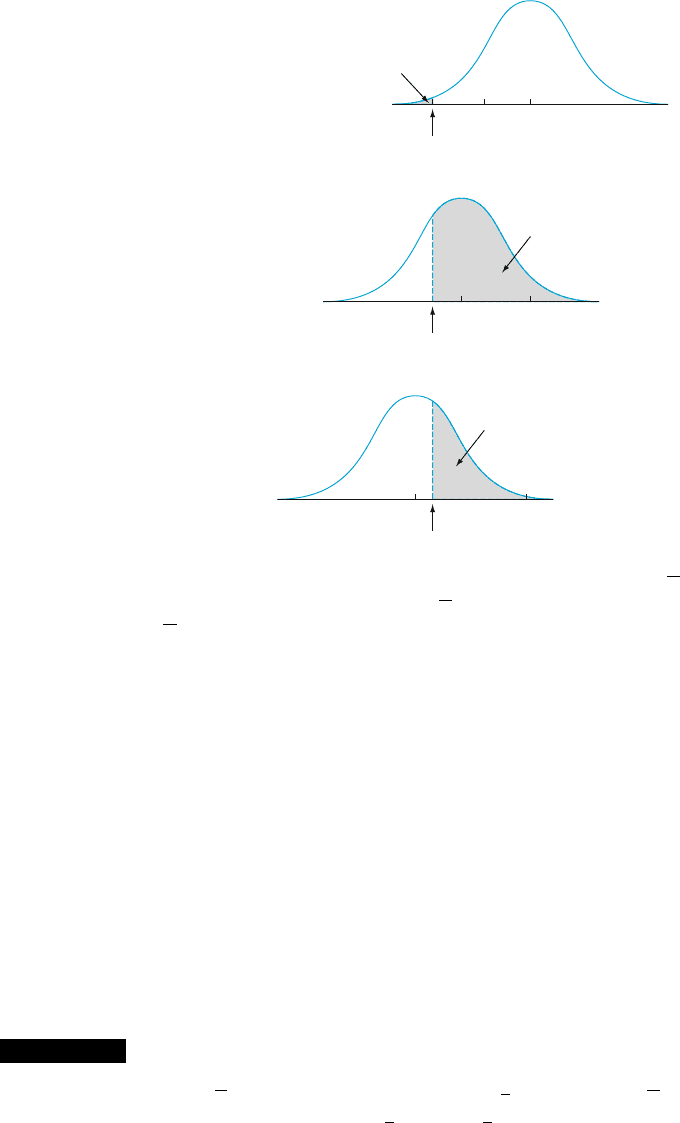
values of the test statistic, the test is said to be lower-tailed. Calculation of a and b
now involves a routine standardization of
X followed by reference to the standard
normal probabilities of Appendix Table A.3:
a ¼ Pðtype I errorÞ¼PðH
0
is rejected when it is trueÞ
¼ Pð
X 70:8 when X normal with m
X
¼ 75; s
X
¼ 1:8Þ
¼ F
70:8 75
1:8
¼ Fð2:33Þ¼:01
b 72ðÞ¼Pðtype II error when m ¼ 72Þ
¼ PðH
0
is not rejected when it is false because m ¼ 72Þ
¼ Pð
X > 70:8 when X normal with m
X
¼ 72; s
X
¼ 1:8Þ
¼ 1 F
70:8 72
1:8
¼ 1 Fð:67Þ¼1 :2514 ¼ :7486
bð70Þ¼1 F
70:8 70
1:8
¼ :3300 bð67Þ¼:0174
For the specified test procedure, only 1% of all experiments carried out as described
will result in H
0
being rejected when it is actually true. However, the chance of a
type II error is very large when m ¼ 72 (only a small departure from H
0
), somewhat
less when m ¼ 70, and quite small when m ¼ 67 (a very substantial departure
from H
0
). These error probabilities are illustrated in Figure 9.1 on the next page.
Notice that a is computed using the probability distribution of the test statistic
when H
0
is true, whereas determination of b requires knowing the test statistic’s
distribution when H
0
is false.
As in Example 9.1, if the more realistic null hypothesis m 75 is considered,
there is an a for each parameter value for which H
0
is true: a(75), a(75.8), a(76.5),
and so on. It is easily verified, though, that a(75) is the largest of all these type I
error probabilities. Focusing on the boundary value amounts to working explicitly
with the “worst case.”
■
The specification of a cutoff value for the rejection region in the examples
just considered was somewhat arbitrary. Use of the rejection region R
8
¼ {8, 9, ..., 20}
in Example 9.1 resulted in a ¼ .102, b(.3) ¼ .772, and b(.5) ¼ .132. Many would
think these error probabilities intolerably large. Perhaps they can be decreased by
changing the cutoff value.
Example 9.3
(Example 9.1
continued)
Let us use the same experiment and test statistic X as previously described in the
automobile bumper problem but now consider the rejecti on regio n R
9
¼ {9, 10,
..., 20}. Since X still has a binomial distribution with parameters n ¼ 20 and p,
a ¼ PðH
0
is rejected when p ¼ :25Þ
¼ P½X 9 when X Bin(20, .25)] = 1 B 8; 20;:25ðÞ¼:041
9.1 Hypotheses and Test Procedures 431
The type I error probability h as been decreased by using the new rejection region.
However, a price has been paid for this decrease:
b :3ðÞ¼PðH
0
is not rejected when p ¼ :3Þ
¼ P½X 8 when X Binð20;:3Þ ¼ B 8; 20;:3ðÞ¼:887
b :5ðÞ¼B 8; 20;:5ðÞ¼:252
Both these b’s are larger than the corresponding error probabilities .772 and .132
for the region R
8
. In retrospect, this is not surprising; a is computed by summing
over probabilities of test statistic values in the rejection region, whereas b is
the probability that X falls in the complement of the rejection region. Making the
rejection region smaller must theref ore decrease a while increasing b for any fixed
alternative value of the parameter.
■
Example 9.4
(Example 9.2
continued)
The use of cutoff value c ¼ 70.8 in the paint-drying example resulted in a very
small value of a (.01) but rather large b’s. Consider the same experiment and test
statistic
X with the new rejection region x 72. Because X is still normally
distributed with mean value m
X
¼ m and s
X
¼ 1:8,
70.8
73 75
a
b
c
72 75
70.8
70 75
70.8
Shaded
area = a = .01
Shaded area = b (72)
Shaded area = b (70)
Figure 9.1 a and b illustrated for Example 9.2: (a) the distribution of
X
when
m ¼ 75 (
H
0
true); (b) the distribution of
X
when m ¼ 72 (
H
0
false); (c) the distribution
of
X
when m ¼ 70 (
H
0
false)
432
CHAPTER 9 Tests of Hypotheses Based on a Single Sample

a ¼ PðH
0
is rejected when it is trueÞ
¼P½
X 72 when X Nð75;1:8
2
Þ
¼F
72 75
1:8
¼Fð1:67Þ¼:0475 :05
b 72ðÞ¼PðH
0
is not rejected when m ¼ 72Þ
¼ Pð
X > 72 when X is a normal rv with mean 72 and standard deviation 1:8Þ
¼ 1 F
72 72
1:8
¼ 1 Fð0Þ¼:5
bð70Þ¼1 F
72 70
1:8
¼ :1335 bð67Þ¼:0027
The change in cutoff value has made the rejection region larger (it includes more
x
values), resulting in a decrease in b for each fixed m less than 75. However, a for
this new region has increased from the previous value .01 to approximately .05. If a
type I error probability this large can be tolerated, though, the second region
(c ¼ 72) is preferable to the first (c ¼ 70.8) because of the smaller b’s.
■
The results of these examples can be generalized in the following manner.
PROPOSITION
Suppose an experiment and a sample size are fix ed and a test statistic is
chosen. Then decreasing the size of the rejection region to obtain a smaller
value of a results in a larger value of b for any particular parameter value
consistent wi th H
a
.
This proposition says that once the test statistic and n are fix ed, there is no rejection
region that will simultaneously make both a and all b’s small. A region must be
chosen to effect a compromise between a and b.
Because of the suggested guidelines for specifying H
0
and H
a
, a type I error is
usually more serious than a type II error (this can always be achieved by proper
choice of the hypotheses). The approach adhered to by most statistical practitioners
is then to specify the largest value of a that can be tolerated and find a rejection
region having that value of a rather than anything sma ller. This makes b as small as
possible subject to the bound on a. The resulting value of a is often referred to as the
significance level of the test. Traditional levels of significance are .10, .05, and .01,
although the level in any particular problem will depend on the seriousness of a
type I error—the more serious this error, the smaller should be the significance
level. The corresponding test procedure is called a level a test (e.g., a level .05 test
or a level .01 test). A test with significance level a is one for which the type I error
probability is controlled at the specified level.
Example 9.5 Con sider the situation mentioned previously in which m was the true average
nicotine content of brand B cigarettes. The objective is to test H
0
: m ¼ 1.5 versus
H
a
: m > 1.5 based on a random sample X
1
, X
2
, ... , X
32
of nicotine contents.
Suppose the distribution of nicotine content is known to be normal with s ¼ .20.
It follows that
X is normally distributed with mean value m
X
¼ m and standard
deviation s
X
¼ :20=
ffiffiffiffiffi
32
p
¼ :0354:
9.1 Hypotheses and Test Procedures 433

Rather than use X itself as the test statistic, let’s standardize X assuming that
H
0
is true.
Test statistic : Z ¼
X 1 :5
s=
ffiffiffi
n
p
¼
X 1:5
:0354
Z expresses the distance between
X and its expected value when H
0
is true as some
number of standard deviations. For example, z ¼ 3 results from an
x that is 3
standard deviations larger than we would have expected it to be were H
0
true.
Rejecting H
0
when x “considerably” exceeds 1.5 is equivalent to rejecting H
0
when z “considerably” exceeds 0. That is, the form of the rejection region is z c.
Let’s now determine c so that a ¼ .05. When H
0
is true, Z has a standard normal
distribution. Thus
a ¼ Pðtype I error) = P(rejecting H
0
when it is trueÞ
¼ P½Z c when Z N 0; 1ðÞ
The value c must capture upper-tail area .05 under the z curve. Either from
Section 4.3 or directly from Appendix Table A.3, c ¼ z
.05
¼ 1.645.
Notice that z 1.645 is equivalent to x 1:5 ð:0354Þð1:645Þ; that is,
x 1:56. Then b is the probability that X < 1:56 and can be calculated for any
m >1.5.
■
Exercises Section 9.1 (1–14)
1. For each of the following assertions, state whether
it is a legitimate statistical hypothesis and why:
a. H: s > 100
b. H:
~
x ¼ 45
c. H: s .20
d. H: s
1
/s
2
< 1
e. H:
X Y ¼ 5
f. H: l .01, where l is the parameter of an
exponential distribution used to model compo-
nent lifetime
2. For the following pairs of assertions, indicate
which do not comply with our rules for setting
up hypotheses and why (the subscripts 1 and 2 dif-
ferentiate between quantities for two different
populations or samples):
a. H
0
: m ¼ 100, H
a
: m > 100
b. H
0
: s ¼ 20, H
a
: s 20
c. H
0
: p 6¼ .25, H
a
: p ¼ .25
d. H
0
: m
1
m
2
¼ 25, H
a
: m
1
m
2
> 100
e.
H
0
: S
2
1
¼ S
2
2
; H
a
: S
2
1
6¼ S
2
2
f. H
0
: m ¼ 120, H
a
: m ¼ 150
g. H
0
: s
1
/s
2
¼ 1, H
a
: s
1
/s
2
6¼ 1
h. H
0
: p
1
p
2
¼.1, H
a
: p
1
p
2
<.1
3. To determine whether the girder welds in a
new performing arts center meet specifications,
a random sample of welds is selected, and tests
are conducted on each weld in the sample. Weld
strength is measured as the force required to break
the weld. Suppose the specifications state that
mean strength of welds should exceed 100 lb/in
2
;
the inspection team decides to test H
0
: m ¼ 100
versus H
a
: m > 100. Explain why it might be
preferable to use this H
a
rather than m < 100.
4. Let m denote the true average radioactivity level
(picocuries per liter). The value 5 pCi/L is consid-
ered the dividing line between safe and unsafe
water. Would you recommend testing H
0
: m ¼ 5
versus H
a
: m > 5orH
0
: m ¼ 5 versus H
a
: m < 5?
Explain your reasoning. [Hint: Think about the
consequences of a type I and type II error for
each possibility.]
5. Before agreeing to purchase a large order of
polyethylene sheaths for a particular type of
high-pressure oil-filled submarine power cable,
a company wants to see conclusive evidence that
the true standard deviation of sheath thickness is
< .05 mm. What hypotheses should be tested, and
why? In this context, what are the type I and
type II errors?
434
CHAPTER 9 Tests of Hypotheses Based on a Single Sample

6. Many older homes have electrical systems that use
fuses rather than circuit breakers. A manufacturer
of 40-amp fuses wants to make sure that the mean
amperage at which its fuses burn out is in fact 40.
If the mean amperage is lower than 40, customers
will complain because the fuses require replace-
ment too often. If the mean amperage is higher
than 40, the manufacturer might be liable for
damage to an electrical system due to fuse mal-
function. To verify the amperage of the fuses, a
sample of fuses is to be selected and inspected. If a
hypothesis test were to be performed on the result-
ing data, what null and alternative hypotheses
would be of interest to the manufacturer? Describe
type I and type II errors in the context of this
problem situation.
7. Water samples are taken from water used for cool-
ing as it is being discharged from a power plant
into a river. It has been determined that as long as
the mean temperature of the discharged water is at
most 150
F, there will be no negative effects on
the river’s ecosystem. To investigate whether the
plant is in compliance with regulations that pro-
hibit a mean discharge-water temperature above
150
, 50 water samples will be taken at randomly
selected times, and the temperature of each sample
recorded. The resulting data will be used to test the
hypotheses H
0
: m ¼ 150
versus H
a
: m > 150
.In
the context of this situation, describe type I and
type II errors. Which type of error would you
consider more serious? Explain.
8. A regular type of laminate is currently being used
by a manufacturer of circuit boards. A special
laminate has been developed to reduce warpage.
The regular laminate will be used on one sample
of specimens and the special laminate on another
sample, and the amount of warpage will then be
determined for each specimen. The manufacturer
will then switch to the special laminate only if it
can be demonstrated that the true average amount
of warpage for that laminate is less than for the
regular laminate. State the relevant hypotheses,
and describe the type I and type II errors in the
context of this situation.
9. Two different companies have applied to provide
cable television service in a region. Let p denote
the proportion of all potential subscribers who
favor the first company over the second. Consider
testing H
0
: p ¼ .5 versus H
a
: p 6¼ .5 based on a
random sample of 25 individuals. Let X denote the
number in the sample who favor the first company
and x represent the observed value of X.
a. Which of the following rejection regions is
most appropriate and why?
R
1
¼ x : x 7orx 18
fg
;
R
2
¼ x : x 8
fg
; R
3
¼ x : x 17
fg
b. In the context of this problem situation,
describe what type I and type II errors are.
c. What is the probability distribution of the test
statistic X when H
0
is true? Use it to compute
the probability of a type I error.
d. Compute the probability of a type II error for
the selected region when p ¼ .3, again when
p ¼ .4, and also for both p ¼ .6 and p ¼ .7.
e. Using the selected region, what would you
conclude if 6 of the 25 queried favored com-
pany 1?
10. For healthy individuals the level of prothrombin in
the blood is approximately normally distributed
with mean 20 mg/100 mL and standard deviation
4 mg/100 mL. Low levels indicate low clotting
ability. In studying the effect of gallstones on pro-
thrombin, the level of each patient in a sample is
measured to see if there is a deficiency. Let m be the
true average level of prothrombin for gallstone
patients.
a. What are the appropriate null and alternative
hypotheses?
b. Let
X denote the sample average level of pro-
thrombin in a sample of n ¼ 20 randomly
selected gallstone patients. Consider the test
procedure with test statistic
X and rejection
region
x 17:92. What is the probability dis-
tribution of the test statistic when H
0
is true?
What is the probability of a type I error for the
test procedure?
c. What is the probability distribution of the test
statistic when m ¼ 16.7? Using the test proce-
dure of part (b), what is the probability that
gallstone patients will be judged not deficient
in prothrombin, when in fact m ¼ 16.7 (a type
II error)?
d. How would you change the test procedure of
part (b) to obtain a test with significance level
.05? What impact would this change have on
the error probability of part (c)?
e. Consider the standardized test statistic Z ¼
ð
X 20Þ=ðs=
ffiffiffiffiffi
nÞ
p
¼ðX 20Þ=:8944. What
are the values of Z corresponding to the rejec-
tion region of part (b)?
11. The calibration of a scale is to be checked by
weighing a 10-kg test specimen 25 times. Suppose
that the results of different weighings are
9.1 Hypotheses and Test Procedures 435

independent of one another and that the weight on
each trial is normally distributed with s ¼ .200 kg.
Let m denote the true average weight reading on
the scale.
a. What hypotheses should be tested?
b. Suppose the scale is to be recalibrated if either
x 10:1032 or x 9: 8968. What is the prob-
ability that recalibration is carried out when it
is actually unnecessary?
c. What is the probability that recalibration is
judged unnecessary when in fact m ¼ 10.1?
When m ¼ 9.8?
d. Let z ¼ð
x 10Þ=ðs=
ffiffiffiffiffi
nÞ
p
. For what value c is
the rejection region of part (b) equivalent to the
“two-tailed” region either z corzc?
e. If the sample size were only 10 rather than 25,
how should the procedure of part (d) be altered
so that a ¼ .05?
f. Using the test of part (e), what would you
conclude from the following sample data?
9.981 10.006 9.857 10.107 9.888
9.728 10.439 10.214 10.190 9.793
g. Re-express the test procedure of part (b) in
terms of the standardized test statistic
Z ¼ð
X 10Þ=ðs=
ffiffiffiffiffi
nÞ
p
:
12. A new design for the braking system on a certain
type of car has been proposed. For the current
system, the true average braking distance at 40
mph under specified conditions is known to be
120 ft. It is proposed that the new design be
implemented only if sample data strongly indi-
cates a reduction in true average braking distance
for the new design.
a. Define the parameter of interest and state the
relevant hypotheses.
b. Suppose braking distance for the new system is
normally distributed with s ¼ 10. Let
X
denote the sample average braking distance
for a random sample of 36 observations.
Which of the following rejection regions
is appropriate: R
1
¼fx : x 124:80g; R
2
¼
f
x : x 115:20g; R
3
¼fx : either x 125:13 or
x 114:87g?
c. What is the significance level for the appropri-
ate region of part (b)? How would you change
the region to obtain a test with a ¼ .001?
d. What is the probability that the new design is
not implemented when its true average braking
distance is actually 115 ft and the appropriate
region from part (b) is used?
e. Let Z ¼ð
X 120Þ=ðs=
ffiffiffiffiffi
nÞ
p
. What is the sig-
nificance level for the rejection region {z:
z 2.33}? For the region {z: z 2.88}?
13. Let X
1
, ... , X
n
denote a random sample from a
normal population distribution with a known
value of s.
a. For testing the hypotheses H
0
: m ¼ m
0
versus
H
a
: m > m
0
(where m
0
is a fixed number), show
that the test with test statistic
X and rejection
region
x m
0
þ 2:33s=
ffiffiffi
n
p
has significance
level .01.
b. Suppose the procedure of part (a) is used to test
H
0
: m m
0
versus H
a
: m > m
0
.Ifm
0
¼ 100,
n ¼ 25, and s ¼ 5, what is the probability of
committing a type I error when m ¼ 99? When
m ¼ 98? In general, what can be said about
the probability of a type I error when the
actual value of m is less than m
0
? Verify your
assertion.
14. Reconsider the situation of Exercise 11 and sup-
pose the rejection region is
x : x 10:1004 or
x 9:8940g¼fz : z 2:51 or z 2:65g:
a. What is a for this procedure?
b. What is b when m ¼ 10.1? When m ¼ 9.9? Is
this desirable?
9.2
Tests About a Population Mean
The general discussion in Chapter 8 of confidence intervals for a population mean m
focused on three different cases. We now develop test procedures for these same
three cases.
Case I: A Normal Population with Known s
Although the assumption that the value of s is known is rarely met in practice, this
case provides a good starting point because of the ease with which general
procedures and their properties can be developed. The null hypothesis in all three
cases will state that m has a particular numerical value, the null value, which we will
436 CHAPTER 9 Tests of Hypotheses Based on a Single Sample

denote by m
0
. Let X
1
, ..., X
n
represent a random sample of size n from the normal
population. Then the sample mean
X has a normal distribution with expected value
m
X
¼ m and standard deviation s
X
¼ s=
ffiffiffi
n
p
. When H
0
is true, m
X
¼ m
0
. Consider
now the statistic Z obtained by standardizing
X under the assumption that H
0
is true:
Z ¼
X m
0
s=
ffiffiffi
n
p
Substitution of the computed sample mean
x gives z, the distance between x and
m
0
expressed in “standard deviation units.” For example, if the null hypothesis is
H
0
: m ¼ 100, s
X
¼ s=
ffiffiffi
n
p
¼ 10=
ffiffiffiffiffi
25
p
¼ 2:0 and x ¼ 103, then the test statistic
value is given by z ¼ (103 100)/2.0 ¼ 1.5. That is, the observed value of
x
is 1.5 standard deviations (of
X) above what we expect it to be when H
0
is true.
The statistic Z is a natural measure of the distance between
X, the estimator of m,
and its expected value when H
0
is true. If this distance is too great in a direction
consistent with H
a
, the null hypothesis should be rejected.
Suppose first that the alternative hypothesis has the form H
a
: m > m
0
. Then an x
value less than m
0
certainly does not provide support for H
a
.Suchanx corresponds to
a negative value of z (since
x m
0
is negative and the divisor s=
ffiffiffi
n
p
is positive).
Similarly, an
x value that exceeds m
0
by only a small amount (corresponding to z
which is positive but small) does not suggest that H
0
should be rejected in favor
of H
a
. The rejection of H
0
is appropriate only when x considerably exceeds m
0
—that
is, when the z value is positive and large. In summary, the appropriate rejection
region, based on the test statistic Z rather than
X, has the form z c.
As discussed in Section 9.1, the cutoff value c should be chosen to control the
probability of a type I error at the desired level a. This is easily accomplished because
the distribution of the test statistic Z when H
0
is true is the standard normal distribu-
tion (that’s why m
0
was subtracted in standardizing). The required cutoff c is the z
critical value that captures upper-tail area a under the standard normal curve. As an
example, let c ¼ 1.645, the value that captures tail area .05 (z
.05
¼ 1.645). Then,
a ¼ Pðtype I errorÞ¼PðH
0
is rejected when H
0
is trueÞ
¼ P½Z 1:645 when Z Nð0; 1Þ ¼ 1 Fð1:645Þ¼:05
More general ly, the rejection region z z
a
has type I error probability a. The test
procedure is upper-tailed because the rejection region consists only of large values
of the test statistic.
Analogous reasoning for the alternative hypothesis H
a
: m < m
0
suggests a
rejection region of the form z c, where c is a suitably chosen negative number
(
x is far below m
0
if and only if z is quite negative). Because Z has a standard norm al
distribution when H
0
is true, taking c ¼z
a
yields P(type I error) ¼ a. This is a
lower-tailed test. For example, z
.10
¼ 1.28 implies that the rejection region
z 1.28 specifies a test with significance level .10.
Finally, when the alternative hypothesis is H
a
: m 6¼ m
0
, H
0
should be rejected
if
x is too far to either side of m
0
. This is equivalent to rejecting H
0
either if z c or
if z c. Suppose we desire a ¼ .05. Then,
:05 ¼ PðZ c or Z c whe n Z has a standard normal distributionÞ
¼ F cðÞþ1 FðcÞ¼2½1 FðcÞ
9.2 Tests About a Population Mean 437