
Devore J.L., Berk K.N. Modern Mathematical Statistics with Applications
Подождите немного. Документ загружается.

rejection region z z
a
is appropriate. Suppose z ¼ 2.10. Then using exactly the
same reasoning as in Example 8.14 gives P-value ¼ 1 F(2.10) ¼ .0179. Con-
sider now testing with several different significance levels:
a ¼ :10 ) z
a
¼ z
:10
¼ 1:28 ) 2:10 1:28 ) reject H
0
a ¼ :05 ) z
a
¼ z
:05
¼ 1:645 ) 2:10 1:645 ) reject H
0
a ¼ :01 ) z
a
¼ z
:01
¼ 2:33 ) 2:10 < 2:33 ) do not reject H
0
Because P-value ¼ .0179 .10 and also .0179 .05, using the P-value approach
results in rejection of H
0
for the first two significance level. However, for a ¼ :01,
2.10 is not in the rejection region and .0179 is larger than .01. More generally,
whenever a is smaller than the P-value .0179, the critical valu e z
a
will be beyond
the P-value and H
0
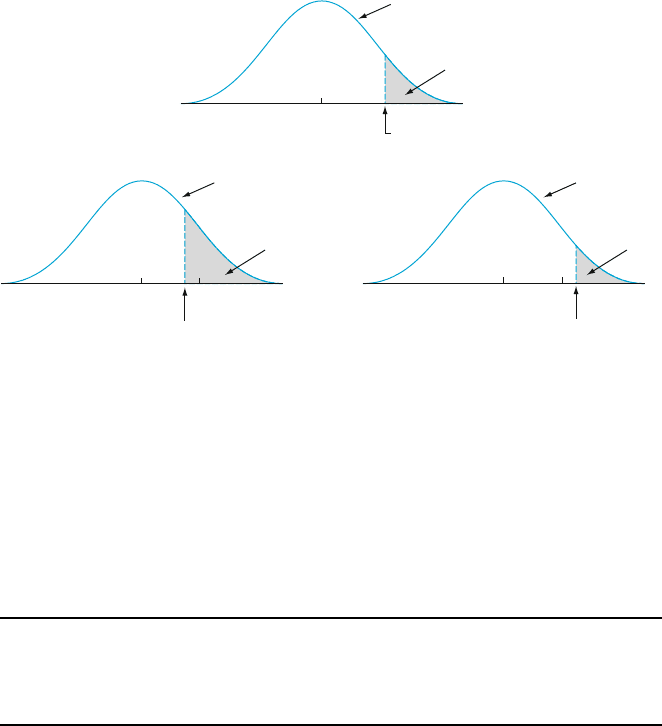
cannot be rejected by either method. This is illustrated in
Figure 9.5.
Let’s reconsider the P-value .0012 in Example 9.14 once again. H
0
can be
rejected only if :0012 a. Thus the null hypothesis can be rejected if a ¼ .05 or
.01 or .005 or .0015 or .00125. What is the smallest significance level a here for
which H
0
can be rejected? It is the P-value .0012.
PROPOSITION
The P-value is the smallest significance level a at which the null hypothesis
can be rejected. Because of this, the P-value is alternatively referred to as the
observed significance level (OSL) for the data.
It is customary to call the data significant when H
0
is rejected and not
significant otherw ise. The P-value is then the smallest level at which the data is
0
a
bc
Shaded
area = .0179
Standard normal (z) curve
0 2.10
z
a
z
a
0
Shaded
area =
a
Shaded
area = a
z curve
z curve
2.10
2.10 = computed z
Figure 9.5 Relationship between a and tail area captured by computed z: (a) tail
area captured by computed z; (b) when a > .0179, z
a
< 2.10 and
H
0
is rejected;
(c) when a < .0179, z
a
> 2.10 and
H
0
is not rejected ■
458
CHAPTER 9 Tests of Hypotheses Based on a Single Sample
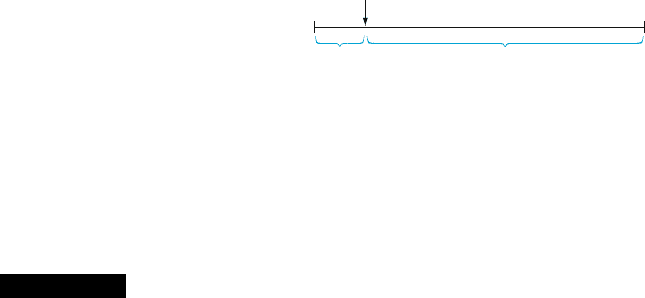
significant. An easy way to visualize the comparison of the P-value with the chosen
a is to draw a picture like that of Figure 9.6 . The calculation of the P-value depends
on whether the test is upper-, lower-, or two-tailed. However, once it has been
calculated, the comparison with a does not depend on which type of test was used.
Example 9.16 The true average time to initial relief of pain for a best-selling pain reliever is
known to be 10 mi n. Let m denote the true average time to relief for a company’s
newly developed reliever. Suppose that when data from an exper iment involving
the new pain reliever was analyzed, the P-value for testing H
0
: m ¼ 10 versus H
a
:
m < 10 was calculated as .0384. Since a ¼ .05 is larger than the P-value [.05 lies in
the interval (a) of Figure 9.6], H
0
would be rejected by anyone carrying out the test
at level .05. However, at level .01, H
0
would not be rejected because .01 is smaller
than the smallest leve l (.0384) at which H
0
can be rejected. ■
The most widely used statistical computer packages automatically include
a P-value when a hypothesis-testing analysis is performed. A conclusion can then
be drawn directly from the output, without reference to a table of critical values.
With the P-value in hand, an investigator can see at a quick glance for which
significance levels H
0
would or would not be rejected. Also, each individual can
then select his or her own significance level. In addition, knowing the P-value allows
a decision maker to distinguish between a close call (e.g., a ¼ .05, P-value ¼ .0498)
and a very clear-cut conclusion (e.g., a ¼ .05, P-value ¼ .0003), something that
would not be possible just from the statement “H
0
can be rejected at significance
level .05.”
P-Values for z Tests
The P-value for a z test (one based on a test statistic whose distribution when H
0
is true is at least approximately standard normal) is easily determined from
the information in Appendix Table A.3. Consider an upper-tailed test and let z
denote the computed value of the test statistic Z. The null hypothesis is rejected if
z z
a
, and the P-value is the smallest a for which this is the case. Since z
a
increases
as a decreases, the P-value is the value of a for which z ¼ z
a
. That is, the P-value
is just the area captured by the computed value z in the upper tail of the standard
normal curve. The corresponding cumulative area is F(z), so in this case
P-value ¼ 1 F(z).
An analogous argument for a lower-tailed test shows that the P-value is the area
captured by the computed value z in the lower tail of the standard normal curve. More
care must be exercised in the case of a two-tailed test. Suppose first that z is positive.
Then the P-value is the value of a satisfying z ¼ z
a/2
(i.e., computed z ¼ upper-tail
(b) (a) 10
P−value = smallest level at which
H
0
can be rejected
Figure 9.6 Comparing a and the P-value: (a) reject
H
0
when a lies here; (b) do not
reject
H
0
when a lies here
9.4 P-Values 459
critical value). This says that the area captured in the upper tail is half the P-value, so
that P-value ¼ 2[1 F(z)]. If z is negative, the P-value is the a for which z ¼z
a/2
,
or, equivalently, z ¼ z
a/2
,soP-value ¼ 2[1 F(z)]. Since z ¼ |z|whenz is
negative, the P-value ¼ 2[1 F(|z|)] for either positive or negative z.
P-value: P ¼
1 FðzÞ for an upper -tailed test
FðzÞ for a lower -tailed test
21 F z
jj
ðÞ½for a two -tailed test
8
>
<
>
:
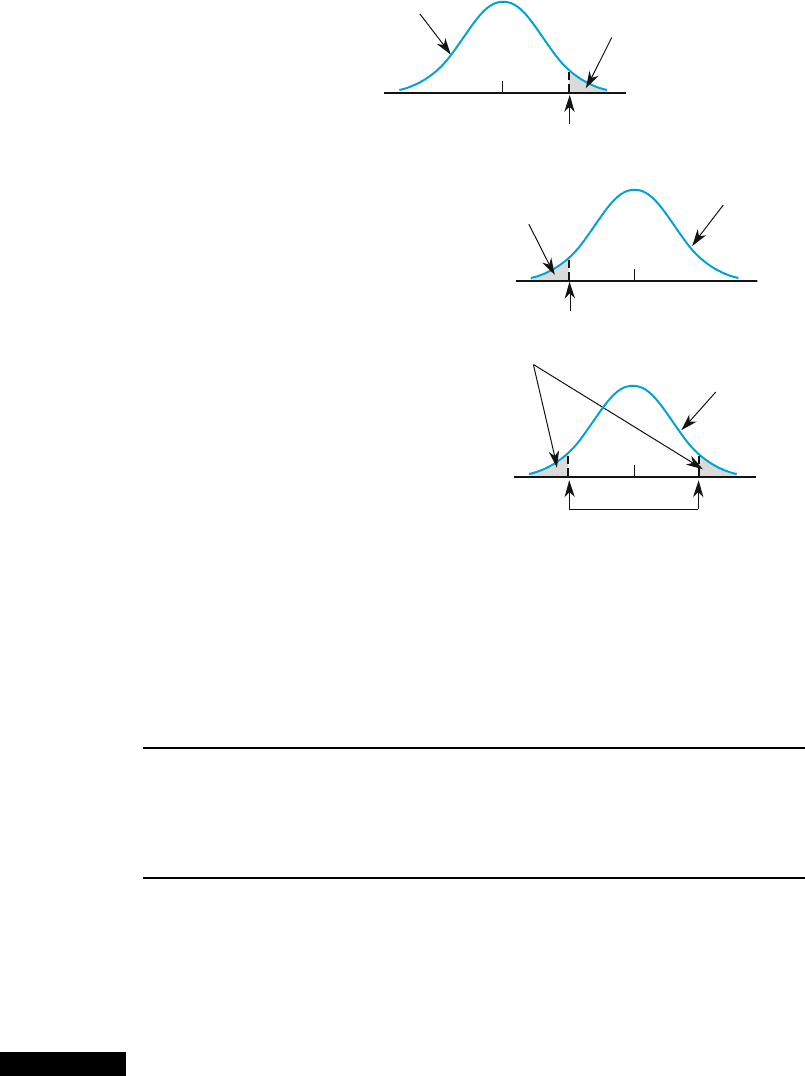
Each of these is the probability of getting a value at least as extreme as what was
obtained (ass uming H
0
true). The three cases are illustrated in Figure 9.7.
The next example illustrates the use of the P-value approach to hypothesis
testing by means of a sequence of steps modified from our previously recom-
mended sequence.
Example 9.17 The target thickness for silicon wafers used in a type of integrated circuit is
245 mm. A sample of 50 wafers is obtained and the thickness of each one is
determined, resulting in a sample mean thickness of 246.18 mm and a sample
standard deviation of 3.60 mm. Does this data suggest that true average wafer
thickness is something other than the target value?
z curve
z curve
z curve
Calculated z
Calculated z
Calculated z, −z
0
0
0
1. Upper-tailed test
H
a
contains the inequality >
H
a
contains the inequality <
H
a
contains the inequality ≠
2. Lower-tailed test
3. Two-tailed test
P-value = area in upper tail
P-value = area in lower tail
= 1 – Φ(z)
= Φ(z)
P-value = sum of area in two tails = 2[1 – Φ(|z|)]
Figure 9.7 Determination of the
P
-value for a z test
460
CHAPTER 9 Tests of Hypotheses Based on a Single Sample
1. Parameter of interest: m ¼ true average wafer thickness
2. Null hypothesis: H
0
: m ¼ 245
3. Alternative hypothesis: H
a
: m 6¼ 245
4. Formula for test statistic value: z ¼
x 245
s
ffiffiffi
n
p
=
5. Calculation of test statistic value: z ¼
246:18 245
3:60
ffiffiffiffiffi
50
p
¼ 2:32
6. Determination of P-value: Because the test is two-tailed,
P-value ¼2½1Fð2:32Þ¼:0204
7. Con clusion: Using a significance level of .01, H
0
would not be rejected since
.0204 > .01. At this significance level, there is insufficient evidence to conclude
that true average thickness differs from the target value.
■
P-Values for t Tests
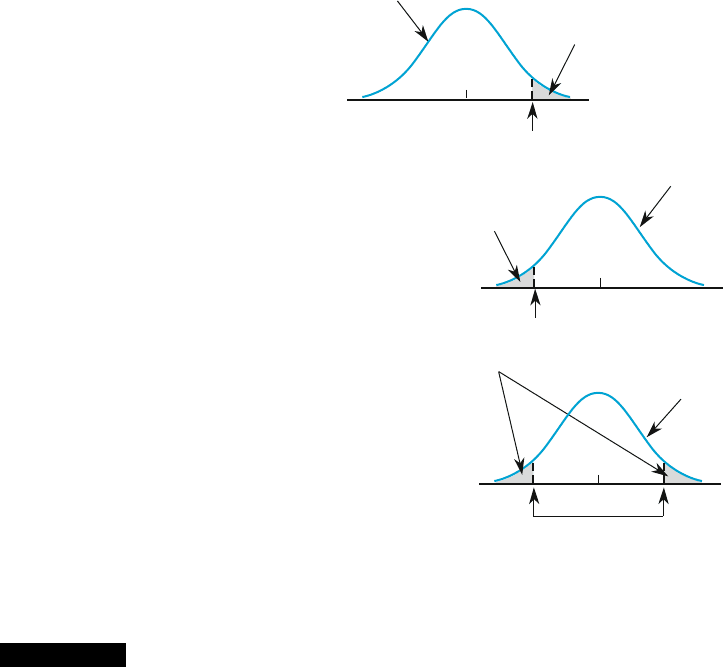
Just as the P-value for a z test is a z curve area, the P-value for a t test will be a
t curve area. Figure 9.8 illustrates the three different cases. The number of df for the
one-sample t test is n 1.
The table of t critical values used previously for confidence and prediction
intervals doesn’t contain enough inform ation about any particular t distribution to
allow for accurate determination of desired areas. So we have included another
t table in Appendix Table A.7, one that contains a tabulation of upper-tail t curve
areas. Each different column of the table is for a different number of df, and the
rows are for calculated values of the test statistic t ranging from 0.0 to 4.0 in
increments of .1. For example, the number .074 appears at the intersection of the 1.6
row and the 8 df column, so the area under the 8 df curve to the right of 1.6 (an
upper-tail area) is .074. Because t curves are symmetric, .074 is also the area under
the 8 df curve to the left of 1.6 (a lower-tail area).
Suppose, for example, that a test of H
0
: m ¼ 100 versus H
a
: m > 100 is based
on the 8 df t distribution. If the calculated value of the test statistic is t ¼ 1.6, then
the P-value for this upper-tailed test is .074. Because .074 exceeds .05, we would
not be able to reject H
0
at a significance level of .05. If the alternative hypothesis is
H
a
: m < 100 and a test based on 20 df yields t ¼3.2, then Appe ndix Table A.7
shows that the P-value is the captured lower-tail area .002. The null hypothesis can
be rejected at either level .05 or .01. Consider testing H
0
: m
1
m
2
¼ 0 versus
H
a
: m
1
m
2
6¼ 0; the null hypothesis states that the means of the two populations
are identical, whereas the alternative hypothesis states that they are different
without specifying a direction of departure from H
0
.Ifat test is based on 20 df
and t ¼ 3.2, then the P-value for this two-tailed test is 2(.002) ¼ .004. This would
also be the P-value for t ¼3.2. The tail area is doubled because values both
larger than 3.2 and smaller than 3.2 are more contradictory to H
0
than what was
calculated (values farther out in either tail of the t curve).
9.4 P-Values 461
Example 9.18 In Example 9.9, we carried out a test of H
0
: m ¼ 25 versus H
a
: m > 25 based on
4 df. The calculated value of t was 1.04. Looking to the 4 df column of Appendix
Table A.7 and down to the 1.0 row, we see that the entry is .187, so the
P-value .187. This P-value is clearly larger than any reasonable significance
level a (.01, .05, and even .10), so there is no reason to reject the null hypothesis.
The MINITAB output included in Example 9.9 h as P-value ¼ .18. P-values from
software packages will be more accurat e than what results from Appendix Table A.7
since values of t in our table are accurate only to the tenths digit.
■
More on Interpreting P-Values
The P-value resulting from carryi ng out a test on a selected sample is not the
probability that H
0
is true, nor is it the probability of rejecting the null hypothesis.
Once again, it is the probability, calculated assuming that H
0
is true, of obtaining a
test statistic value at least as contradictory to the null hypothesis as the value that
actually resulted. For example, consider testing H
0
: m ¼ 50 against H
0
: m < 50
using a lower-tailed z test. If the calculated value of the test statistic is z ¼2.00,
then
1. Upper-tailed test
H
a
contains the inequality >
H
a
contains the inequality <
H
a
contains the inequality ≠
2. Lower-tailed test
3. Two-tailed test
t curve for relevant df
t curve for relevant df
t curve for relevant d
f
Calculated t
Calculated t
0
0
0
P-value = area in upper tail
P-value = area in lower tail
P-value = sum of area in two tails
Calculated t, −t
Figure 9.8
P
-values for
t
tests
462
CHAPTER 9 Tests of Hypotheses Based on a Single Sample

P-value ¼ PZ< 2:00 when m ¼ 50ðÞ
¼ area under the z curve to the left of 2:00 ¼ :0228
But if a second sample is selected, the resulting value of z will almost surely be
different from 2.00, so the corresponding P-value will also likely differ from
.0228. Because the test statistic value itself varies from one sample to another, the
P-value will also vary from one sample to another. That is, the test statistic is a
random variable, and so the P-value will also be a random variable. A first sample
may give a P-value of .0228, a second sample result in a P-value of .1175, a third
yield .0606 as the P- value, and so on.
If H
0
is false, we hope the P-value will be close to 0 so that the null
hypothesis can be rejected. On the other hand, when H
0
is true, we’d like the
P-value to exceed the selected significance level so that the correct decision to not
reject H
0
is made. The next example presents simulations to show how the P-value
behaves both when the null hypothesis is true and when it is false.
Example 9.19 The fuel efficiency (mpg) of any particular new vehicle under specified driving
conditions may not be identical to the EPA figure that appears on the vehicle’s
sticker. Suppose that four different vehicles of a particular type are to be selected
and driven over a certain course, after which the fuel efficiency of each one is to be
determined. Let m denote the true average fuel efficiency under these conditions.
Consider testing H
0
: m ¼ 20 versus H
0
: m > 20 using the one-sample t test
based on the resulting sample. Since the test is based on n 1 ¼ 3 degrees of
freedom, the P-value for an upper-tailed test is the area under the t curve with 3 df
to the right of the calculated t.
Let’s first suppose that the null hypothesis is true. We asked MINITAB to
generate 10,000 different samples, each containing 4 observations , from a normal
population distribution with mean value m ¼ 20 and standard deviation s ¼ 2. The
first sample and resulting summary quantities were
x
1
¼ 20:830; x
2
¼ 22:232; x
3
¼ 20:276; x
4
¼ 17:718
x ¼ 20:264 s ¼ 1:8864 t ¼
20:264 20
:1:8864=
ffiffiffi
4
p
¼ :2799
The P-value is the area under the 3-df t curve to the right of .2799, which accordi ng
to MINITAB is .3989. Using a significance level of .05, the null hypothesis would of
course not be rejected. The values of t for the next four samples were 1.7591,
.6082, .7020, and 3.1053, with corresponding P-values .912, .293, .733, and .0265.
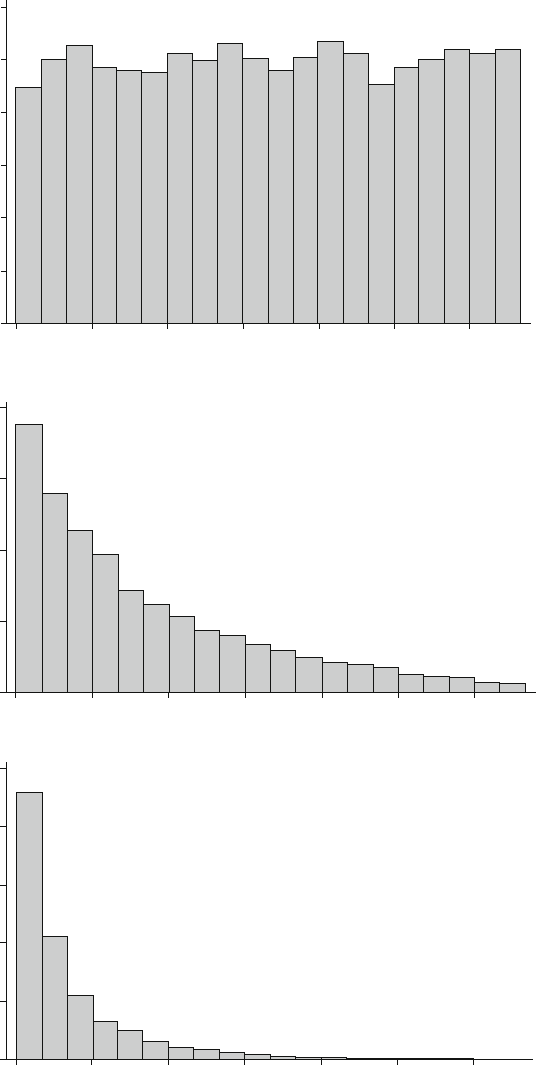
Figure 9.9(a) shows a histogram of the 10,000 P-values from this simulation
experiment. About 4.5% of these P-values are in the first class interval from 0 to
.05. Thus when using a significance level of .05, the null hypothesis is rejected in
roughly 4.5% of these 10,000 tests. If we continue to generate samples and carry
out the test for each one at significance level .05, in the long run 5% of the P-values
would be in the first class interval—because when H
0
is true and a test with
significance level .05 is used, by definition the probability of rejecting H
0
is .05.
Looking at the histogram, it appears that the distribution of P-values is
relatively flat. In fact, it can be shown that when H
0
is true, the probability
distribution of the P-value is a uniform distribution on the interval from 0 to 1.
That is, the density curve is com pletely flat on this interval, and thus must have a
9.4 P-Values 463
0.00 0.15 0.30 0.45 0.60 0.75 0.90
0.00 0.15 0.30 0.45 0.60 0.75 0.90
6
5
4
3
2
1
0
20
15
10
5
0
Percent
Percent
P
-value
a
b
c
P
-value
50
40
30
20
10
0
0.00 0.15 0.30 0.45 0.60 0.75 0.90
Percent
P-value
Figure 9.9
P
-value simulation results for Example 9.19
464
CHAPTER 9 Tests of Hypotheses Based on a Single Sample

height of 1 if the total area under the curve is to be 1. Since the area under such a
curve to the left of .05 is (.05)(1) ¼ .05, we again have that the probability of
rejecting H
0
when it is true is .05, the chosen significance level.
Now consider what happens whe n H
0
is false because m ¼ 21. We again had
MINITAB generate 10,000 different samples of size 4, each from a normal
distribution with m ¼ 21 and s ¼ 2, calculate t ¼ð
x 20Þ=ðs=
ffiffiffi
4
p
Þ for each one,
and then determine the P-value. The first such sample resulted in
x ¼ 20:6411;
s ¼ :49637; t ¼ 2:5832; P-value ¼:0408. Figure 9.9(b) gives a histogram of the
10,000 resulting P-values. The shape of this histogr am is quite different from that
of Figure 9.9(a): there is a much greater tendency for the P-value to be small (closer
to 0) when m ¼ 21 than when m ¼ 20. Again H
0
is rejected at significance level .05
whenever the P-value is at most .05 (in the first class interval). Unfortunately this is
the case for only about 19% of the 10,000 P-values. So only about 19% of the
10,000 tests correctly reject the null hypothesis; for the other 81%, a type II error is
committed. The difficulty is that the sample size is quite small and 21 is not very
different from the valu e asserted by the null hypothesis.
Figure 9.9(c) illustrates what happens to the P-value when H
0
is false because
m ¼ 22 (still with n ¼ 4 and s ¼ 2). The histogram is even more concentrated
toward values close to 0 than was the case when m ¼ 21. In general, as m moves
further to the right of the null value 20, the distribution of the P-value will become
more and more concentrated on values close to 0. Even here a bit fewer than 50% of
the 10,000 P-values are smaller than .05. So it is still slightly more likely than
not that the null hypothesis is incorrect ly not rejected. Only for values of m much
larger than 20 (e.g., at least 24 or 25) is it highly likely that the P-value will be
smaller than .05 and thus give the correct conclusion.
The big idea of this example is that because the value of any test statistic is
random, the P-value will also be a random variable and thus have a distribution.
The farther the actual value of the parameter is from the value specified by the null
hypothesis, the more the distribution of the P-value will be concentrated on values
close to 0 and the greater the chance that the test will correctly reject H
0
(corresponding to smaller b).
▄
Exercises Section 9.4 (45–59)
45. For which of the given P-values would the null
hypothesis be rejected when performing a level
.05 test?
a. .001
b. .021
c. .078
d. .047
e. .148
46. Pairs of P-values and significance levels, a, are
given. For each pair, state whether the observed P-
value would lead to rejection of H
0
at the given
significance level.
a. P-value ¼ .084, a ¼ .05
b. P-value ¼ .003, a ¼ .001
c. P-value ¼ .498, a ¼ .05
d. P-value ¼ .084, a ¼ .10
e. P-value ¼ .039, a ¼ .01
f. P-value ¼ .218, a ¼ .10
47. Let m denote the mean reaction time to a certain
stimulus. For a large-sample z test of H
0
: m ¼ 5
versus H
a
: m > 5, find the P-value associated with
each of the given values of the z test statistic.
a. 1.42
b. .90
c. 1.96
d. 2.48
e. .11
9.4 P-Values 465
48. Newly purchased tires of a certain type are sup-
posed to be filled to a pressure of 30 lb/in
2
. Let
m denote the true average pressure. Find the P-value
associated with each given z statistic value for test-
ing H
0
: m ¼ 30 versus H
a
: m 6¼ 30.
a. 2.10
b. 1.75
c. .55
d. 1.41
e. 5.3
49. Give as much information as you can about the
P-value of a t test in each of the following situa-
tions:
a. Upper-tailed test, df ¼ 8, t ¼ 2.0
b. Lower-tailed test, df ¼ 11, t ¼2.4
c. Two-tailed test, df ¼ 15, t ¼1.6
d. Upper-tailed test, df ¼ 19, t ¼.4
e. Upper-tailed test, df ¼ 5, t ¼ 5.0
f. Two-tailed test, df ¼ 40, t ¼4.8
50. The paint used to make lines on roads must
reflect enough light to be clearly visible at night.
Let m denote the true average reflectometer
reading for a new type of paint under consider-
ation. A test of H
0
: m ¼ 20 versus H
a
: m > 20 will
be based on a random sample of size n from a
normal population distribution. What conclusion
is appropriate in each of the following situations?
a. n ¼ 15, t ¼ 3.2, a ¼ .05
b. n ¼ 9, t ¼ 1.8, a ¼ .01
c. n ¼ 24, t ¼.2
51. Let m denote true average serum receptor concen-
tration for all pregnant women. The average for all
women is known to be 5.63. The article “Serum
Transferrin Receptor for the Detection of Iron Defi-
ciency in Pregnancy” (Amer. J. Clin. Nutrit., 1991:
1077–1081) reports that P-value > .10 for a test of
H
0
: m ¼ 5.63 versus H
a
: m 6¼ 5.63 based on
n ¼ 176 pregnant women. Using a significance
level of .01, what would you conclude?
52. An aspirin manufacturer fills bottles by weight
rather than by count. Since each bottle should
contain 100 tablets, the average weight per tablet
should be 5 grains. Each of 100 tablets taken from
a very large lot is weighed, resulting in a sample
average weight per tablet of 4.87 grains and a
sample standard deviation of .35 grain. Does this
information provide strong evidence for conclud-
ing that the company is not filling its bottles as
advertised? Test the appropriate hypotheses using
a ¼ .01 by first computing the P-value and then
comparing it to the specified significance level.
53. Because of variability in the manufacturing pro-
cess, the actual yielding point of a sample of mild
steel subjected to increasing stress will usually
differ from the theoretical yielding point. Let
p denote the true proportion of samples that
yield before their theoretical yielding point. If on
the basis of a sample it can be concluded that more
than 20% of all specimens yield before the theo-
retical point, the production process will have to
be modified.
a. If 15 of 60 specimens yield before the theoreti-
cal point, what is the P-value when the appro-
priate test is used, and what would you advise
the company to do?
b. If the true percentage of “early yields” is actu-
ally 50% (so that the theoretical point is the
median of the yield distribution) and a level .01
test is used, what is the probability that the
company concludes a modification of the pro-
cess is necessary?
54. Many consumers are turning to generics as a way
of reducing the cost of prescription medications.
The article “Commercial Information on Drugs:
Confusing to the Physician?” (J. Drug Issues,
1988: 245–257) gives the results of a survey of
102 doctors. Only 47 of those surveyed knew the
generic name for the drug methadone. Does this
provide strong evidence for concluding that fewer
than half of all physicians know the generic name
for methadone? Carry out a test of hypotheses
with a significance level of .01 using the P-value
method.
55. A random sample of soil specimens was obtained,
and the amount of organic matter (%) in the soil
was determined for each specimen, resulting in the
accompanying data (from “Engineering Properties
of Soil,” Soil Sci., 1998: 93–102).
1.10 5.09 0.97 1.59 4.60 0.32 0.55 1.45
0.14 4.47 1.20 3.50 5.02 4.67 5.22 2.69
3.98 3.17 3.03 2.21 0.69 4.47 3.31 1.17
0.76 1.17 1.57 2.62 1.66 2.05
The values of the sample mean, sample standard
deviation, and (estimated) standard error of the
mean are 2.481, 1.616, and .295, respectively.
Does this data suggest that the true average per-
centage of organic matter in such soil is something
other than 3%? Carry out a test of the appropriate
hypotheses at significance level .10 by first deter-
mining the P-value. Would your conclusion be
different if a ¼ .05 had been used? [Note: A nor-
mal probability plot of the data shows an
466
CHAPTER 9 Tests of Hypotheses Based on a Single Sample

acceptable pattern in light of the reasonably large
sample size.]
56. The times of first sprinkler activation for a series
of tests with fire prevention sprinkler systems
using an aqueous film-forming foam were (in sec)
27 41 22 27 23 35 30 33 24 27 28 22 24
(see “Use of AFFF in Sprinkler Systems,” Fire
Tech., 1976: 5). The system has been designed so
that true average activation time is at most 25 s
under such conditions. Does the data strongly
contradict the validity of this design specification?
Test the relevant hypotheses at significance level
.05 using the P-value approach.
57. A pen has been designed so that true average
writing lifetime under controlled conditions
(involving the use of a writing machine) is at
least 10 h. A random sample of 18 pens is selected,
the writing lifetime of each is determined, and a
normal probability plot of the resulting data sup-
ports the use of a one-sample t test.
a. What hypotheses should be tested if the inves-
tigators believe a priori that the design specifi-
cation has been satisfied?
b. What conclusion is appropriate if the hypoth-
eses of part (a) are tested, t ¼2.3, and
a ¼ .05?
c. What conclusion is appropriate if the hypoth-
eses of part (a) are tested, t ¼1.8, and
a ¼ .01?
d. What should be concluded if the hypotheses of
part (a) are tested and t ¼3.6?
58. A spectrophotometer used for measuring CO con-
centration [ppm (parts per million) by volume] is
checked for accuracy by taking readings on a
manufactured gas (called span gas) in which the
CO concentration is very precisely controlled at
70 ppm. If the readings suggest that the spectro-
photometer is not working properly, it will have to
be recalibrated. Assume that if it is properly cali-
brated, measured concentration for span gas sam-
ples is normally distributed. On the basis of the six
readings—85, 77, 82, 68, 72, and 69—is recali-
bration necessary? Carry out a test of the relevant
hypotheses using the P-value approach with
a ¼ .05.
59. The relative conductivity of a semiconductor
device is determined by the amount of impurity
“doped” into the device during its manufacture.
A silicon diode to be used for a specific purpose
requires an average cut-on voltage of .60 V, and if
this is not achieved, the amount of impurity must
be adjusted. A sample of diodes was selected and
the cut-on voltage was determined. The accompa-
nying SAS output resulted from a request to test
the appropriate hypotheses.
N Mean Std Dev T Prob > |T|
15 0.0453333 0.0899100 1.9527887 0.0711
[Note: SAS explicitly tests H
0
: m ¼ 0, so to test
H
0
: m ¼ .60, the null value .60 must be subtracted
from each x
i
; the reported mean is then the average
of the (x
i
.60) values. Also, SAS’s P-value is
always for a two-tailed test.] What would be con-
cluded for a significance level of .01? .05? .10?
9.5
Some Comments on Selecting
a Test Procedure
Once the experimenter has decided on the questio n of interest and the method for
gathering data (the design of the experiment), construction of an appropriate test
procedure consists of three distinct steps:
1. Specify a test statistic (the decision is based on this function of the data).
2. Decide on the general form of the rejection region (typically, reject H
0
for
suitably large values of the test statistic, reject for suitably small values, or reject
for either small or large values).
3. Select the specific numerical critical value or values that will separate the
rejection region from the acceptance region (by obtaining the distribution of the
test statistic when H
0
is true, and then selecting a level of significance).
9.5 Some Comments on Selecting a Test Procedure 467