
Devore J.L., Berk K.N. Modern Mathematical Statistics with Applications
Подождите немного. Документ загружается.


In the examples thus far, both steps 1 and 2 were carried out in an ad hoc manner
through intuition. For example, when the underlying population was assumed normal
with mean m and known s, we were led from
X to the standardized test statistic
Z ¼
X m
0
s=
ffiffiffi
n
p
For testing H
0
: m ¼ m
0
versus H
a
: m > m
0
, intuition then suggested rejecting H
0
when z was large. Finally, the critical value was determined by specifying the level
of significance a and using the fact that Z has a standard normal distribution when
H
0
is true. The reliability of the test in reaching a correct decision can be assessed
by studying type II error probabiliti es.
Issues to be considered in carrying out steps 1–3 encompass the following
questions:
1. What are the practical implications and consequence s of choosing a particular
level of significance once the other aspects of a test procedure have been
determined?
2. Does there exist a general principle, not dependent just on intuition, that can be
used to obtain best or good test procedures?
3. When two or more tests are appropriate in a given situation, how can the tests be
compared to decide which should be used?
4. If a test is derived under specific assumptions about the distribution or
population being sampled, how well will the test procedure work when the
assumptions are violated?
Statistical Versus Practical Significance
Although the process of reaching a decision by using the methodology of classical
hypothesis testing involves selecting a level of significance and then rejecting or
not rejecting H
0
at that level, simply reporting the a used and the decisio n reached
conveys little of the information contained in the sample data. Especially when the
results of an experiment are to be communicated to a large audience, rejection of H
0
at level .05 will be much more convi ncing if the observed value of the test statistic
greatly exceeds the 5% critical value than if it barely exceeds that value. This is
Table 9.1 An illustration of the effect of sample size on P-values and b
nP-value when
x
= 101 b(101) for Level .01 Test
25 .3085 .9664
100 .1587 .9082
400 .0228 .6293
900 .0013 .2514
1600 .0000335 .0475
2500 .000000297 .0038
10,000 7.69 10
24
.0000
468
CHAPTER 9 Tests of Hypotheses Based on a Single Sample

precisely what led to the notion of P-value as a way of reporting significance
without imposing a particular a on others who might wish to draw their own
conclusions.
Even if a P-value is included in a summary of results, however, there may be
difficulty in interpreting this value and in making a decision. This is because a
small P-value, which would ordinarily indicate statistical significance in that it
would strongly suggest rejection of H
0
in favor of H
a
, may be the result of a large
sample size in combination with a departure from H
0
that has little pract ical
significance. In many experimental situations, only departures from H
0
of large
magnitude would be worthy of detection, whereas a small departure from H
0
would
have little practical significance.
Consider as an example testing H
0
: m ¼ 100 versus H
a
: m > 100 where m is
the mean of a normal population with s ¼ 10. Suppose a true value of m ¼ 101
would not represent a serious departure from H
0
in the sense that not rejecting H
0
when m ¼ 101 would be a relatively inexpensive error. For a reasonably large
sample size n, this m would lead to an
x value near 101, so we would not want this
sample evidence to argue strongly for rejecti on of H
0
when x ¼ 101 is observed.
For various sample sizes, Table 9.1 records both the P-value when
x ¼ 101 and also
the probability of not rejecting H
0
at level .01 when m ¼ 101.
The second column in Table 9.1 shows that even for moderately large sample
sizes, the P-value of
x ¼ 101 argues very strongly for rejection of H
0
, whe reas
the observed
x itself suggests that in practical terms the true value of m differs little
from the null value m
0
¼ 100. The third column points out that even when there is
little practical difference between the true m and the null value, for a fixed level of
significance a large sample size will almost always lead to rejection of the null
hypothesis at that level. To summarize, one must be especially careful in interpret-
ing evidence when the sam ple size is large, since any small departure from H
0
will
almost surely be detected by a test, yet such a departure may have little practical
significance.
Best Tests for Simple Hypotheses
The test procedures present ed thus far are (hopefully) intuitively reasonable, but
have not been shown to be best in any sense. How can an optimal test be obtained,
one for which the type II error probability is as small as possible, subject to
controlling the type I error probability at the desired level? Our starting point
here will be a rather unrealistic situation from a practical viewpoint: testing a
simple null hypothesis against a simple alternative hypothesis. A simple hypothesis
is one which, when true, completely specifies the distribution of the sample X
i
’s.
Suppose, for example, that the X
i
’s form a random sample from an exponential
distribution with parameter l. Then the hypothesis H: l ¼ 1 is simple, since when
H is true each X
i
has an exponential distribution with parameter l ¼ 1. We might
then consider H
0
: l ¼ 1 versus H
a
: l ¼ 2, both of which are simple hypotheses.
The hypothesis H: l 1 is not simple, because whe n H is true, the distribution of
each X
i
might be exponential with l ¼ 1 or with l ¼ .8 or .... Similarly, if the X
i
’s
constitute a random sample from a normal distribution with known s, then
H: m ¼ 100 is a simple hypothesis. But if the value of s is unknown, this hypothesis
is not simple because the distribution of each X
i
is then not completely specified; it
could be normal with m ¼ 100 and s ¼ 15 or normal with m ¼ 100 and s ¼ 12 or
9.5 Some Comments on Selecting a Test Procedure 469

normal with m ¼ 100 and any other positive value of s. For a hypothesis to be
simple, the value of every parameter in the pmf or pdf of the X
i
’s must be specified.
The next result was a milestone in the theory of hypothesis testing—a method
for constructing a best test for a simple null hypothesis versus a simple alternative
hypothesis. Let f(x
1
, ... , x
n
; y) be the joint pmf or pdf of the X
i
’s. Then our null
hypothesis will assert that y ¼ y
0
and the relevant alternative hypothesis will claim
that y ¼ y
a
. The result will carry over to the case of more than one parameter as
long as the value of each parameter is completely specified in both H
0
and H
a
.
THE
NEYMAN-
PEARSON
THEOREM
For testing a simple null hypothesis H
0
: y ¼ y
0
versus a simple alternative
hypothesis H
a
: y ¼ y
a
, let k be a positive fixed number and form the rejection
region
R
¼ðx
1
; ...; x
n
Þ:
f ð x
1
; ...; x
n
; y
a
Þ
f ð x
1
; ...; x
n
; y
0
Þ
k
Thus R* is the set of all observations for which the likelihood ratio—ratio of
the alternative likelihood to the null likelihood—is at least k. The probability
of a type I error for the test with this rejection region is a* ¼ P[(X
1
, ..., X
n
)
∈ R* when y ¼ y
0
], whereas the type II error probability b* is the probability
that the X
i
’s lie in the complement of R* (in the “acc eptance” region) when
y ¼ y
a
.
Then for any other test procedure with type I error probability a
satisfying a a*, the probability of a type II error must satisfy b b*.
Thus the test with rejection region R* has the smallest type II error probabil-
ity among all tests for which the type I error probability is at most a *.
The choice of the constant k in the rejection region will determine the type I
error probability a*. In the continuous case, k can be selected to give one of the
traditional significance levels .05, .01, and so on, whereas in the discrete case
a* ¼ .057 or .039 may be as close as one can get to .05.
Example 9.20 Consider randomly selecting n ¼ 5 new vehicles of a certain type and determining
the number of major defects on each one. Letting X
i
denote the number of such
defects for the ith selected vehicle (i ¼ 1, ... ,5), suppos e that the X
i
’s form
a random sample from a Poisson distribution with parame ter l. Let’s find the
best test for testing H
0
: l ¼ 1 versus H
a
: l ¼ 2. The Poisson likelihood is
f ð x
1
;:::;x
5
; lÞ¼e
5l
l
Sx
i
=Px
i
!. Substituting first l ¼ 2, then l ¼ 1, and then
taking the ratio of these two likelihoods gives the rejection region
R
¼ðx
1
; ...; x
5
Þ : e
5
2
Sx
i
k
Multiplying both sides of the inequality by e
5
and letting k
0
¼ ke
5
gives the
rejection region 2
Sx
i
k
0
. Now take the natural logarithm of both sides and let
c ¼ ln(k
0
)/ln(2) to obtain the rejection region Sx
i
c.
This latter rejection region is completely equi valent to R*: For any particular
value k there will be a corresponding value c, and vice versa. But it is much easier to
470 CHAPTER 9 Tests of Hypotheses Based on a Single Sample
express the rejection region in this latter form and then select c to obtain a desired
significance level than it is to determine an appropri ate value of k for the likelihood
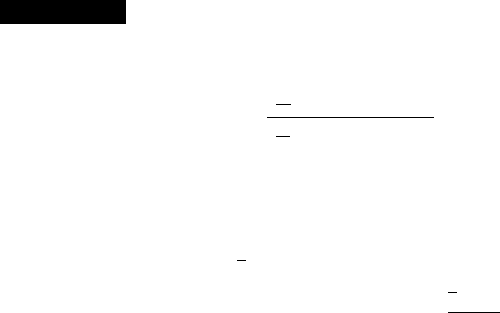
ratio. In particular, T ¼ SX
i
has a Poisson distribution with parameter 5l (via a
moment generating function argument), so when H
0
is true T has a Poisson dis-
tribution with parameter 5. From the 5.0 column of our Poisson table (Table A.2),
the cumulative probabilities for the values 8 and 9 are .932 and .968, respectively.
Thus if we use c ¼ 9 in the rejection region,
a
¼ PðPoisson rv with parameter 5 is 9Þ¼1 :932 ¼ :068
Choosing instead c ¼ 10 gives a* ¼ .032. If we insist that the significance level be
at most .05, then the optimal rejection region is Sx
i
10.
When H
a
is true, the test statistic has a Poisson distribution with parameter 10.
Thus
b
¼ PH
0
is not reject ed when H
a
is trueðÞ
¼ PðPoisson rv with parameter 10 is 9Þ¼:458
Obviously this type II error probability is quite large. This is because the sample
size n ¼ 5 is too small to allow for effective discrimination between l ¼ 1 and
l ¼ 2. For a sample size of 10, the Poisson table reveals that the best test havi ng
significance level at most .05 uses c ¼ 16, for which a* ¼ .049 (Poisson para-
meter ¼ 10) and b* ¼ .157 (Poisson parameter ¼ 20).
Finally, returning to a sample size of 5, c ¼ 10 implies that 10 ¼ ln(ke
5
)/ln(2),
from which k ¼ 2
10
/e
5
6.9. For the best test to have a significance level of at most
.05, the null hypothesis should be rejected only when the likelihood for the alternative
value of l is more than about 7 times what it is for the null value.
■
Example 9.21 Let X
1
, ... , X
n
be a random sample from a normal distribution with mean m and
variance 1 (the argument to be given will work for any other known value of s
2
).
Consider testing H
0
: m ¼ m
0
versus H
a
: m ¼ m
a
where m
a
> m
0.
The likelihood ratio is
1
2p
n=2
e
ð1=2ÞSðx
i
m
a
Þ
2
1
2p
n=2
e
ð1=2ÞSðx
i
m
0
Þ
2
¼ e
m
a
Sx
i
m
0
Sx
i
ðn=2Þ m
2
a
m
2
0
ðÞ
¼ e
nðm
2
a
m
2
0
Þ=2
hi
e
ðm
a
m
0
ÞSx
i
hi
The term in the first set of brackets is a numerical constant. Then m
a
m
0
> 0
implies that the likelihood ratio will be at least k if and only if Sx
i
k
0
, that is, if
and only if
x k
00
, which means if and only if
z ¼
x m
0
1=
ffiffiffi
n
p
c
If we now let c ¼ z
.01
¼ 2.33, this z test (one for which the test statistic has a
standard normal distribution when H
0
is true), will have minimum b among all tests
for which a .01.
■
The key idea in these last two examples cannot be overemphasized: Write an
expression for the likelihood ratio, and then manipulate the inequality likelihood
ratio k so it is equivalent to an inequality involving a test statistic whose distribution
when H
0
is true is known or can be derived. Then this known or derived distribution
9.5 Some Comments on Selecting a Test Procedure 471
can be used to obtain a test with the desired a. In the first example the distribution was
Poisson with parameter 5, and in the second it was the standard normal distribution.
Proof of the Neyman-Pearson Theorem: We shall consider the case in which the
X
i
’s have a discrete distribution, so that type I and type II error probabilities are
obtained by summation. In the continuou s case, integration replaces summation.
Then
R
¼fx
1
; ...; x
n
ðÞ: fx
1
; ...; x
n
; y
a
ðÞk fx
1
; ...; x
n
; y
0
ðÞg
a
¼ P½ðX
1
; ...; X
n
Þ2R
when y ¼ y
0
¼
X
R
f ð x
1
; ...; x
n
; y
0
Þ
b
¼ P½ðX
1
; ...; X
n
Þ2R
0
when y ¼ y
a
¼
X
R
0
f ð x
1
; ...; x
n
; y
a
Þ
(b* is the sum over values in the complement of the rejection region). Suppose that
R is a rejection region different from R* whose type I error probability is at most a*;
that is,
a ¼ P½ðX
1
; ...; X
n
Þ2R when y ¼ y
0
¼
X
R
f ð x
1
; ...; x
n
; y
0
Þa
We then wish to show that b for this rejection region must be at least as large
as b*. Consider the difference
D ¼
X
R
½f ðx
1
; ...; x
n
; y
a
Þk f ðx
1
; ...; x
n
; y
0
Þ
X
R
½f ðx
1
; ...; x
n
; y
a
Þk f ðx
1
; ...; x
n
; y
0
Þ
¼
X
R
\R
½...þ
X
R
\R
0
½...
X
R\R
½...þ
X
R\R
0
½...
()
¼
X
R
\R
0
½...
X
R\R
0
½...
This last dif ference is nonnegati ve (i.e. 0) because the term in the square brackets
is 0 for any set of x
i
’s in R* and is negative for any set of x
i
’s not in R*. It then
follows that
0
X
R
f ð x
1
; ...; x
n
; y
a
Þk
X
R
f ð x
1
; ...; x
n
; y
0
Þ
X
R
f ð x
1
; ...; x
n
; y
a
Þþk
X
R
f ðx
1
; ...; x
n
; y
0
Þ
¼ð1 b
Þka
ð1 bÞþka
¼ b b
kða
aÞb b
ðsince a a
implies that the term being subtracted is nonnegative Þ
Thus we have shown that b* b as desired. ■
472 CHAPTER 9 Tests of Hypotheses Based on a Single Sample
Power and Uniformly Most Powerful Tests
The Neyman–Pearson theo rem can be restat ed in a slightly different way by
considering the power of a test, first introduced in Section 9.2.
DEFINITION
Let O
0
and O
a
be two disjoint sets of possible values of y, and consider testing
H
0
: y ∈ O
0
versus H
a
: y ∈ O
a
using a test with rejection region R. Then the
power function of the test, denoted by p( ) is the probability of rejecting H
0
considered as a function of y:
pðy
0
Þ¼P½ X
1
; :::; X
n
ðÞ2R when y ¼ y
0
Since we don’t want to reject the null hypothesis when y ∈ O
0
and do want to reject
it when y ∈ O
a
, we wish a test for which the power function is close to 0 whenever
y
0
is in O
0
and close to 1 whenever y
0
is in O
a
. The power is easily related to the
type I and type II error proba bilities:
pðy
0
Þ¼
Pðtype I error when y ¼ y
0
Þ¼aðy
0
Þ when y
0
2 O
0
1 Pðtype II error when y ¼ y
0
Þ¼1 bðy
0
Þ when y
0
2 O
a
(
Thus large power when y
0
∈ O
a
is equivalent to small b for such parameter values.
Example 9.22 The drying time (min) of a particular brand and type of paint on a test board under
controlled conditions is known to be normally distributed with m ¼ 75 and s ¼ 9.4. A
new additive has been developed for the purpose of improving drying time. Assume
that drying time with the additive is still normally distributed with the same standard
deviation, and consider testing H
0
: m 75 versus H
a
: m < 75 based on a sample of
size n ¼ 100. A test with significance level .01 rejects H
0
if z 2.33, where
z ¼ð
x 75Þ=ð9:4=
ffiffiffiffiffiffiffiffi
100
p
Þ¼ðx 75Þ=:94. Manipulating the inequality in the rejec-
tion region to isolate
x gives the equivalent rejection region x 72:81. Thus the
power of the test when m ¼ 70 (a substantial departure from the null hypothesis) is
pð70Þ¼Pð
X 72:81 when m ¼ 70Þ¼F
72:81 70
9:4=
ffiffiffiffiffiffiffiffi
100
p
¼ Fð2:99Þ¼:9986
so b ¼ .0014. It is easily verified that p(75) ¼ .01, the significance level. The
power when m ¼ 76 (a parameter value for which H
0
is true) is
pð76Þ¼Pð
X 72:81 when m ¼ 76Þ¼F
72:81 76
9:4=
ffiffiffiffiffiffiffiffi
100
p
¼ Fð3:39Þ¼:0003
which is quite small as it should be. By repeating this calculation for various
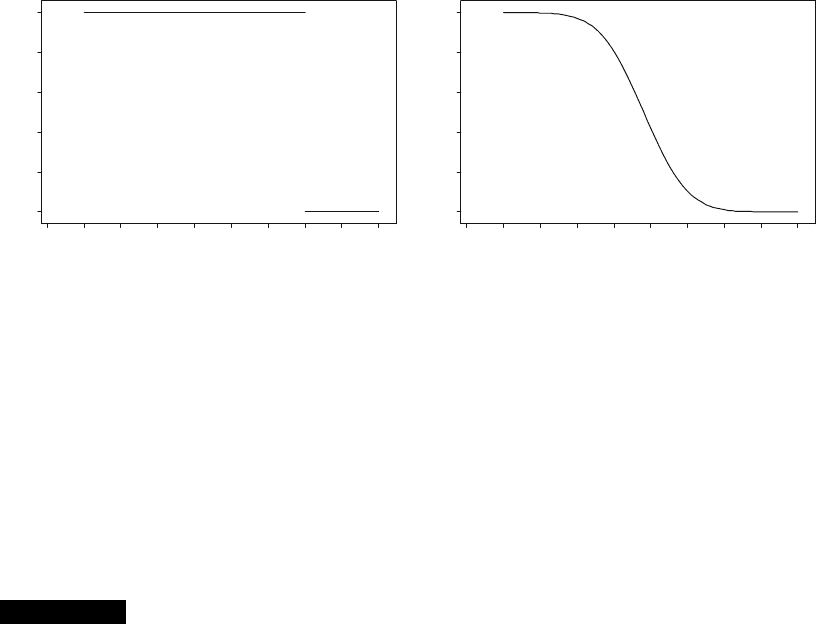
other values of m we obtain the entire power function. A graph of the ideal
power function appears in Figure 9.10(a) and the actual power function is graphed
in Figure 9.10(b). The maximum power for m 75 (i.e. in O
0
)occursatm ¼ 75, on
the boundary between O
0
and O
a
. Because the power function is continuous, there are
values of m smaller than 75 for which the power is quite small. Even with a large
sample size, it is difficult to detect a very small departure from the null hypothesis.
9.5 Some Comments on Selecting a Test Procedure 473
The Neyman–Pearson theorem says that when O
0
consists of a single value
y
0
and O
a
also consists of a single value y
a
, the rejection region R* specifies a test
for which the power p(y
a
) at the alternative value y
a
(which is just 1 b )is
maximized subject to p(y
0
) a for some specified value of a . That is, R* specifies
a most powerful test subject to the restriction on the power when the null hypothesis
is true.
What about best tests when at least one of the two hypothese s is composite,
that is, O
0
or O
a
(or both) consist of more than a single value?
Example 9.23
(Example 9.20
continued)
Consider again a random sample of size n ¼ 5 from a Poisson distribution, and
suppose we now wish to test H
0
: l 1 versus H
a
: l > 1. Both of these hypotheses
are composite. Arguing as in Example 9.20, for any value l
a
exceeding 1, a most
powerful test of H
0
: l ¼ 1 versus H
a
: l ¼ l
a
with significance level (power when
l ¼ 1) .032 rejects the null hypothesis when Sx
i
10. Furthermore, it is easily
verified that the power of this test at l
0
is smaller than .032 if l
0
< 1. Thus the test
that rejects H
0
: l 1 in favor of H
0
: l > 1 when Sx
i
10 has maximum power
for any l
0
> 1 subject to the condition that p(l
0
) .032. This test is uniformly most
powerful.
■
More generally, a uniformly most powerful (UMP) level a test is one for
which p(y
0
) is maximized for any y ∈ O
a
subject to p(y
0
) a for any y
0
∈ O
0
.
Unfortunately UMP tests are fairly rare, especially in commonly encountered
situations when H
0
and H
a
are assertions about a single parameter y
1
whereas the
distribution of the X
i
’s involves not only y
1
but also at least one other “nuisance
parameter”. For example, when the population distribution is normal with values of
both m and s unknown, s is a nuisance parameter when testing H
0
: m ¼ m
0
versus
H
a
: m 6¼ m
0
. Be careful here—the null hypothesis is not simple because O
0
consists
of all pairs (m, s) for which m ¼ m
0
and s > 0, and there is certainly more than one
such pair. In this situation, the one-sample t test is not UMP.
ideal actual
0.0
68 69 70 71 72 73 74 75 76 77
0.2
0.4
0.6
IDEAL POWER
MEAN
68 69 70 71 72 73 74 75 76 77
MEAN
0.8
1.0
ab
0.0
0.2
0.4
0.6
POWER
0.8
1.0
Figure 9.10 Graphs of power functions for Example 9.22 ■
474
CHAPTER 9 Tests of Hypotheses Based on a Single Sample

However, suppose we restrict attention to unbiased tests, those for which the
smallest value of p(y
0
)fory
0
∈ O
a
is at least as large as the largest value of p(y
0
)for
y
0
∈ O
0
. Unbiasedness simply says that we are at least as likely to reject the null
hypothesis when H
0
is false as we are to reject it when H
0
is true. The test proposed in
Example 9.22 involving paint drying times is unbiased because, as Figure 9.10(b)
shows, the power function at or to the right of 75 is smaller than it is to the left of 75.
It can be shown that the one-sample t test is UMP unbiased; that is, it is uniformly
most powerful among all tests that are unbiased. Several other commonly used tests
also have this property. Please consult one of the chapter references for more details.
Likelihood Ratio Tests
The likelihood ratio (LR) principle is the most frequently used method for finding an
appropriate test statistic in a new situation. As before, denote the joint pmf or pdf of
X
1
, ... , X
n
by f(x
1
, ... , x
n
; y). In the case of a random sample, it will be a product
f(x
1
;y)
f(x
n
;y). When the x
i
’s are the actual observations and f(x
1
, ... , x
n
;y)is
regarded as a function of y,itiscalledthelikelihood function. Again consider
testing H
0
: y ∈ O
0
versus H
a
: y ∈ O
a
,whereO
0
and O
a
are disjoint sets, and
let O ¼ O
0
[ O
a
. In the Neyman–Pearson theorem, we focused on the ratio of the
likelihood when y ∈ O
a
to the likelihood when y ∈ O
0
, rejecting H
0
when the value of
the ratio was “sufficiently large”. Now we consider the ratio of the likelihood when
y ∈ O
0
to the likelihood when y ∈ O. A very small value of this ratio argues against
the null hypothesis, since a small value arises when the data is much more consistent
with the alternative hypothesis than with the null hypothesis. More formally,
1. Find the largest value of the likelihood for any y ∈ O
0
by finding the maximum
likelihood estimate of y within O
0
and substituting this mle into the
likelihood function to obta in Lð
^
O
0
Þ.
2. Find the largest value of the likelihoo d for any y ∈ O by finding the maximum
likelihood estimate of y within O and substituting this mle into the likelihood
function to obtain Lð
^
OÞ. Because O
0
is a subset of O, this likelihood Lð
^
OÞ can’t
be any smaller than the likelihood Lð
^
O
0
Þ obtained in the first step, and will be
much larger when the data is much more consistent with H
a
than with H
0
.
3. Form the likelihood ratio Lð
^
O
0
Þ=Lð
^
OÞand reject the null hypothesis in favor
of the alternative when this ratio is k. The critical value k is chosen to give a
test with the desired significance level. In practice, the inequality Lð
^
O
0
Þ=Lð
^
OÞk
is often re-expressed in terms of a more convenient statistic (such as the sum
of the observations) whose distribution is known or can be derived.
The above prescription remains valid if the single parameter y is replaced by
several parameters y
1
, ... , y
k
. The mle’s of all parameters must be obtained in
both steps 1 and 2 and substituted back into the likelihood function.
Example 9.24 Consider a random sample from a normal distribution with the values of both
parameters unknown. We wish to test H
0
: m ¼ m
0
versus H
a
: m 6¼ m
0
. Here O
consists of all values of m and s
2
for which 1 < m < 1 and s
2
> 0, and the
likelihood function is
1
2ps
2
n=2
e
1=ð2s
2
Þ
P
ðx
i
mÞ
2
9.5 Some Comments on Selecting a Test Procedure 475

In Section 7.2 we obtained the mle’s as
^
m ¼ x;
^
s
2
¼
P
ðx
i
xÞ
2
=n: Substituting
these estimates back into the likelihood function gives
Lð
^
OÞ¼
1
2p
P
ðx
i
xÞ
2
=n
n=2
e
n=2
Within O
0
, m in the foregoing likelihood is replaced by m
0
, so that only s
2
must be
estimated. It is easily verified that the mle is
^
s
2
¼
P
ðx
i
m
0
Þ
2
=n: Substitution of
this estimate in the likelihood function yields
Lð
^
O
0
Þ¼
1
2p
P
ðx
i
m
0
Þ
2
=n
n=2
e
n=2
Thus we reject H
0
in favor of H
a
when
Lð
^
O
0
Þ
Lð
^
OÞ
¼
P
ðx
i
xÞ
2
P
ðx
i
m
0
Þ
2
!
n=2
k
Raising both sides of this inequality to the power 2/n, we reject H
0
whenever
P
ðx
i
xÞ
2
P
ðx
i
m
0
Þ
2
k
2=n
¼ k
0
This is intuitively quite reasonable: the value m
0
is implausible for m if the sum of
squared deviations about the sample mean is much smaller than the sum of squared
deviations about m
0
. The denominator of this latter ratio can be expressed as
X
½ðx
i
xÞþðx m
0
Þ
2
¼
X
ðx
i
xÞ
2
þ 2
X
ðx m
0
Þðx
i
xÞþnðx m
0
Þ
2
The middle (i.e., cross-product) term in this expression is 0, because the constant
x m
0
can be moved outside the summation, and then the sum of deviations from
the sample mean is 0. Thus we should reject H
0
when
P
ðx
i
xÞ
2
P
ðx
i
xÞ
2
þ nðx m
0
Þ
2
¼
1
1 þ nð
x m
0
Þ
2
=
P
ðx
i
xÞ
2
k
0
This latter ratio will be small when the second term in the denominator is large, so
the condition for reject ion becomes
nðx m
0
Þ
2
P
ðx
i
xÞ
2
k
00
Dividing both sides by n 1 and taking square roots gives the rejection region
either
x m
0
s=
ffiffiffi
n
p
c or
x m
0
s=
ffiffiffi
n
p
c
If we now let c ¼ t
a=2;n1
, we have exactly the two-tailed one-sample t test. The
bottom line is that when testing H
0
: m ¼ m
0
against the two-sided (6¼) alternative,
the one-sample t test is the likelihood ratio test. This is also true of the upper-tailed
version of the t test when the alternative is H
a
: m > m
0
and of the lower-tailed test
when the alternative is H
a
: m < m
0
. We could trace back through the argument to
recover the critical constant k from c, but there is no point in doing this; the
rejection region in terms of t is much more convenient than the rejection region
in terms of the likelihood ratio.
■
476 CHAPTER 9 Tests of Hypotheses Based on a Single Sample

A number of tests discussed subsequently, including the “pooled” t test from
the next chapter and various tests from ANOVA (the analysis of variance) and
regression analysis, can be derived by the likelihood ratio principle. Rather fre-
quently the inequality for the rejection region of a likelihood ratio test cannot be
manipulated to express the test procedure in terms of a simple statistic whose
distribution can be ascertained. The following large-sample result, valid under
fairly general conditions, can then be used: If the sample size n is suffic iently
large, then the statistic 2[ln(likelihood ratio)] has approximately a chi-squared
distribution with n degrees of freedom, where n is the difference between the
number of “freely varying” parameters in O and the number of such parameters
in O
0.
For example, if the distribution sampled is bivariate normal with the 5 para-
meters m
1
, m
2,
s
1,
s
2
, and r and the null hypothesis asserts that m
1
¼ m
2
and
s
1
¼ s
2
, then n ¼ 5 3 ¼ 2. By definition Lð
^
O
0
Þ=Lð
^
OÞ1, and the likelihood
ratio test rejects H
0
when this likelihood ratio is much less than 1. This is equivalent
to rejecting when the logarithm of the likelihood ratio is quite negative, that is,
when ln(LR) is quite posi tive. The large- sample version of the test is thus upper-
tailed: H
0
should be rejected if 2ln(likelihood ratio) w
a;n
2
(an upper-tail critical
value extracted from Table A.6).
Example 9.25 Suppose a scientist makes n measurements of some physical characteristic, such as
the specific gravity of a liquid. Let X
1
, ... , X
n
denote the resulting measurement
errors. Assume that these X
i
’s are independent and identically distributed according
to the double exponential (Laplace) distribution: f ðxÞ¼:5e
xyjj
for 1<x <1:
This pdf is symmetric about y with somewhat heavier tails than the normal pdf.
If y ¼ 0 then the measurements are unbiased, so it is natural to test H
0
: y ¼ 0 versus
H
a
: y 6¼ 0. Here n ¼ 1 0 ¼ 1. The likelihood is
LðyÞ¼ð:5Þ
n
e
S x
i
y
jj
Because of the minus sign preceding the summation, the likelihood is maximized
when
P
jx
i
yj is minimized. The absolute value function is not differentiable,
and therefore dif ferential calculus cannot be used. Instead, consider for a moment
the case n ¼ 5 and let y
1
, ..., y
5
denote the values of the x
i
’s ordered from smallest
to largest—so the y
i
’s are the observed values of the order statistics. For example, a
random sample of size five from the Laplace distribution with y ¼ 0is.24998,
.75446, .19053, 1.16237, .83229, so (y
1
, ..., y
5
) ¼ (.24998, .19053, .75446,
.83229, 1.16237) . Then
X
x
i
y
jj
¼
X
jy
i
yj¼
y
1
þ y
2
þ y
3
þ y
4
þ y
5
5yy< y
1
y
1
þ y
2
þ y
3
þ y
4
þ y
5
3y y
1
y < y
2
y
1
y
2
þ y
3
þ y
4
þ y
5
y y
2
y < y
3
y
1
y
2
y
3
þ y
4
þ y
5
þ y y
3
y < y
4
y
1
y
2
y
3
y
4
þ y
5
þ 3y y
4
y < y
5
y
1
y
2
y
3
y
4
y
5
þ 5yy y
5
8
>
>
>
>
>
>
>
>
>
<
>
>
>
>
>
>
>
>
>
:
The graph of this expression as a function of y appears in Figure 9.11, from which it
is apparent that the minimum occurs at y
3
¼
~
x ¼ :75446, the sample median. The
situation is similar whenever n is odd. When n is even, the function achieves its
minimum for any y between y
n/2
and y
(n/2)+1
; one such y is ðy
n=2
þ y
ðn=2Þþ1
Þ=2 ¼
~
x.
In summary, the mle of y is the sample median.
9.5 Some Comments on Selecting a Test Procedure 477