
Devore J.L., Berk K.N. Modern Mathematical Statistics with Applications
Подождите немного. Документ загружается.

The likelihood ratio statistic for testing the relevant hypotheses is
ð:5Þ
n
e
S x
i
jj
=½ð:5Þ
n
e
S x
i
~
x
jj
. Taking the natural log of the likelihood ratio and multi-
plying by 2 gives the rejection region 2
P
x
i
jj
2
P
x
i
~
x
jj
w
2
a;1
for the large-
sample vers ion of the LR test.
Suppose that a sample of n ¼ 30 errors results in
P
x
i
jj
¼ 38:6 and
P
x
i
~
x
jj
¼ 37:3. Th en
2lnðLRÞ¼2
X
x
i
jj
X
x
i
~
x
jj
¼ 2:6
Comparing this to w
2
:05;1
¼ 3:84, we would not reject the null hypothesis at the
5% significance level. It is plausible that the measurement process is indeed
unbiased.
■
Exercises Section 9.5 (60–71)
60. Reconsider the paint-drying problem discussed in
Example 9.2. The hypotheses were H
0
: m ¼ 75
versus H
a
: m < 75, with s assumed to have value
9.0. Consider the alternative value m ¼ 74, which
in the context of the problem would presumably
not be a practically significant departure from H
0
.
a. For a level .01 test, compute b at this alterna-
tive for sample sizes n ¼ 100, 900, and 2500.
b. If the observed value of
X is x ¼ 74, what can
you say about the resulting P-value when
n ¼ 2500? Is the data statistically significant
at any of the standard values of a?
c. Would you really want to use a sample size
of 2500 along with a level .01 test (disregard-
ing the cost of such an experiment)? Explain.
61. Consider the large-sample level .01 test in Sec-
tion 9.3 for testing H
0
: p ¼ .2 against H
a
: p > .2.
a. For the alternative value p ¼ .21, compute
b(.21) for sample sizes n ¼ 100, 2500,
10,000, 40,000, and 90,000.
b. For
^
p ¼ x=n ¼ :21, compute the P-value when
n ¼ 100, 2500, 10,000, and 40,000.
4.0
3.0
2.5
3.5
5.0
4.5
5.5
−.5
1.51.0
q
.50
Σ|x
i
−
q
|
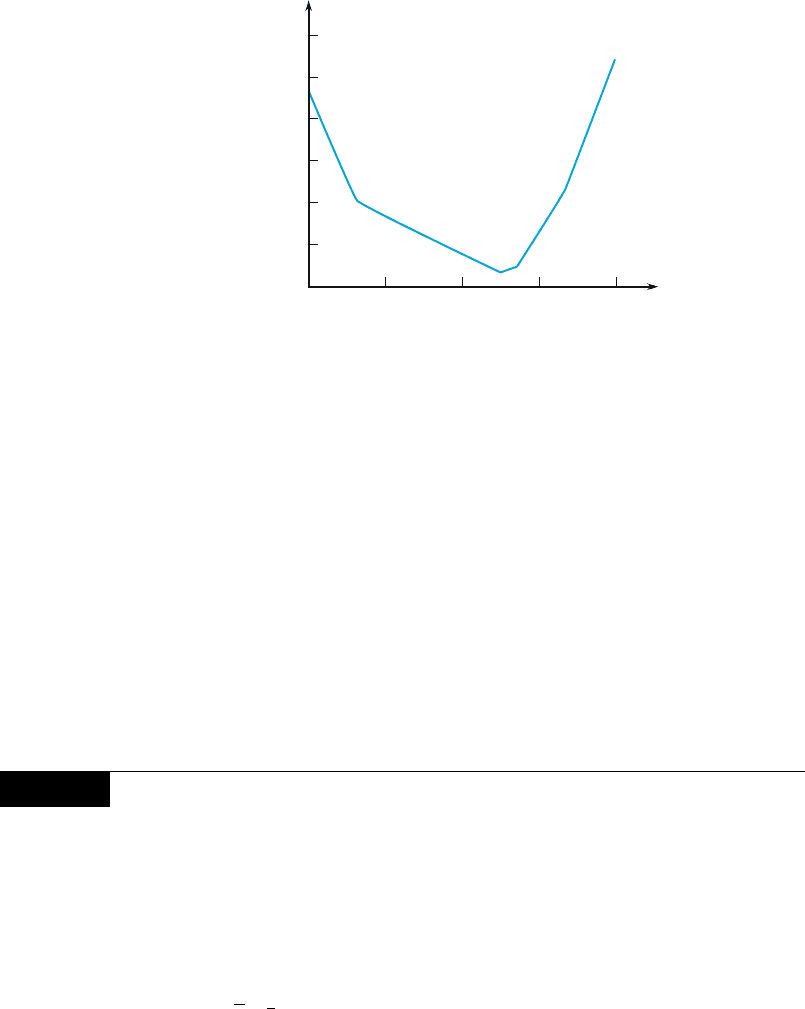
Figure 9.11 Determining the mle of the double exponential parameter by minimizing
P
jx
i
yj
478
CHAPTER 9 Tests of Hypotheses Based on a Single Sample

c. In most situations, would it be reasonable to
use a level .01 test in conjunction with a sample
size of 40,000? Why or why not?
62. For a random sample of n individuals taking a
licensing exam, let X
i
¼ 1 if the ith individual in
the sample passes the exam and X
i
¼ 0 otherwise
(i ¼ 1, ... , n).
a. With p denoting the proportion of all exam-
takers who pass, show that the most powerful
test of H
0
: p ¼ .5 versus H
a
: p ¼ .75 rejects H
0
when Sx
i
c.
b. If n ¼ 20 and you want a .05 for the test of
(a), would you reject H
0
if 15 of the 20 indivi-
duals in the sample pass the exam?
c. What is the power of the test you used in (b)
when p ¼ .75 [i.e., what is p(.75)]?
d. Is the test derived in (a) UMP for testing
the hypotheses H
0
: p ¼ .5 versus H
a
: p >.5?
Explain your reasoning.
e. Graph the power function p(p) of the test for the
hypotheses of (d) when n ¼ 20 and a .05.
f. Return to the scenario of (a), and suppose the
test is based on a sample size of 50. If the
probability of a type II error is approximately
.025, what is the approximate significance level
of the test (use a normal approximation)?
63. The error X in a measurement has a normal distri-
bution with mean value 0 and variance s
2
. Con-
sider testing H
0
: s
2
¼ 2 versus H
a
: s
2
¼ 3 based
on a random sample X
1
, ... , X
n
of errors.
a. Show that a most powerful test rejects H
0
when
P
x
i
2
c:
b. For n ¼ 10, find the value of c for the test in
(a) that results in a ¼ .05.
c. Is the test of (a) UMP for H
0
: s
2
¼ 2 versus
H
a
: s
2
> 2? Justify your assertion.
64. Suppose that X, the fraction of a container that is
filled, has pdf f(x;y) ¼ yx
y1
for 0 < x < 1
(where y > 0), and let X
1
, ... , X
n
be a random
sample from this distribution.
a. Show that the most powerful test for H
0
: y ¼ 1
versus H
a
: y ¼ 2 rejects the null hypothesis if
Sln(x
i
) c.
b. Is the test of (a) UMP for testing H
0
: y ¼ 1
versus H
a
: y > 1? Explain your reasoning.
c. If n ¼ 50, what is the (approximate) value of c
for which the test has significance level .05?
65. Consider a random sample of n component life-
times, where the distribution of lifetime is expo-
nential with parameter l.
a. Obtain a most powerful test for H
0
: l ¼ 1
versus H
a
: l ¼ .5, and express the rejection
region in terms of a “simple” statistic.
b. Is the test of (a) uniformly most powerful for
H
0
: l ¼ 1 versus H
a
: l < 1? Justify your
answer.
66. Consider a random sample of size n from the
“shifted exponential” distribution with pdf
fx; yðÞ¼e
ðxyÞ
for x > y and 0 otherwise (the
graph is that of the ordinary exponential pdf with
l ¼ 1 shifted so that it begins its descent at y rather
than at 0). Let Y
1
denote the smallest order statistic,
and show that the likelihood ratio test of H
0
: y 1
versus H
a
: y > 1 rejects the null hypothesis if y
1
,
the observed value of Y
1
,is c.
67. Suppose that each of n randomly selected indivi-
duals is classified according to his/her genotype
with respect to a particular genetic characteristic
and that the three possible genotypes are AA, Aa,
and aa with long-run proportions (probabilities) y
2
,
2y(1y), and (1y)
2
, respectively (0 < y < 1).
It is then straightforward to show that the
likelihood is
y
2x
1
½2yð1 yÞ
x
2
ð1 yÞ
2x
3
where x
1
, x
2
, and x
3
are the number of individuals
in the sample who have the AA, Aa, and aa geno-
types, respectively. Show that the most powerful
test for testing H
0
: y ¼ .5 versus H
a
: y ¼ .8
rejects the null hypothesis when 2x
1
+ x
2
c.Is
this test UMP for the alternative H
a
: y > .5?
Explain. [Note: The fact that the joint distribution
of X
1
, X
2
, and X
3
is multinomial can be used to
obtain the value of c that yields a test with any
desired significance level when n is large.]
68. The error in a measurement is normally dis-
tributed with mean m and standard deviation 1.
Consider a random sample of n errors, and show
that the likelihood ratio test for H
0
: m ¼ 0 versus
H
a
: m 6¼ 0 rejects the null hypothesis when either
x c or x c. What is c for a test with
a ¼ .05? How does the test change if the standard
deviation of an error is s
0
(known) and the rele-
vant hypotheses are H
0
: m ¼ 0 versus H
a
: m 6¼m
0
?
69. Measurement error in a particular situation is
normally distributed with mean value m and
standard deviation 4. Consider testing H
0
: m ¼ 0
versus H
a
: m 6¼ 0 based on a sample of n ¼ 16
measurements.
a. Verify that the usual test with significance
level .05 rejects H
0
if either x 1:96 or
9.5 Some Comments on Selecting a Test Procedure 479

x 1:96. [Note: That this test is unbiased
follows from the fact that the way to capture
the largest area under the z curve above an
interval having width 3.92 is to center that inter-
val at 0 (so it extends from 1.96 to 1.96).]
b. Consider the test that rejects H
0
if either
x 2:17 or x 1:81. What is a, that is, p(0)?
c. What is the power of the test proposed in (b)
when m ¼ .1 and when m ¼.1? (Note that .1
and .1 are very close to the null value, so one
would not expect large power for such values).
Is the test unbiased?
d. Calculate the power of the usual test when
m ¼ .1 and when m ¼.1. Is the usual test a
most powerful test? [Hint: Refer to your calcu-
lations in (c).] [Note: It can be shown that
the usual test is most powerful among all
unbiased tests.]
70. A test of whether a coin is fair will be based on
n ¼ 50 tosses. Let X be the resulting number of
heads. Consider two rejection regions: R
1
¼ {x:
either x 17 or x 33} and R
2
¼ {x: either
x 18 or x 37}.
a. Determine the significance level (type I error
probability) for each rejection region.
b. Determine the power of each test when
p ¼ .49. Is the test with rejection region R
1
a
uniformly most powerful level .033 test?
Explain.
c. Is the test with rejection region R
2
unbiased?
Explain.
d. Sketch the power function for the test with
rejection region R
1
, and then do so for the test
with the rejection region R
2
. What does your
intuition suggest about the desirability of using
the rejection region R
2
?
71. Consider Example 9.24.
a. With t ¼ð
x m
0
Þ=ðs=
ffiffiffi
n
p
Þ, show that the likeli-
hood ratio is equal to l ¼ [1 + t
2
/(n 1)]
n/2
,
and therefore the approximate chi-square statis-
tic is 2[ln(l)] ¼ n ln[1 + t
2
/(n 1)].
b. Apply part (a) to test the hypotheses of
Exercise 55, using the data given there. Com-
pare your results with the answers found in
Exercise 55.
Supplementary Exercises (72–94)
72. A sample of 50 lenses used in eyeglasses yields a
sample mean thickness of 3.05 mm and a sample
standard deviation of .34 mm. The desired true
average thickness of such lenses is 3.20 mm. Does
the data strongly suggest that the true average
thickness of such lenses is something other than
what is desired? Test using a ¼ .05.
73. In Exercise 72, suppose the experimenter had
believed before collecting the data that the value
of s was approximately .30. If the experimenter
wished the probability of a type II error to be .05
when m ¼ 3.00, was a sample size of 50 unneces-
sarily large?
74. It is specified that a certain type of iron should
contain .85 g of silicon per 100 g of iron (.85%).
The silicon content of each of 25 randomly
selected iron specimens was determined, and the
accompanying MINITAB output resulted from a
test of the appropriate hypotheses.
Variable N Mean StDev SE
Mean
TP
sil cont 25 0.8880 0.1807 0.0361 1.05 0.30
a. What hypotheses were tested?
b. What conclusion would be reached for a sig-
nificance level of .05, and why? Answer the
same question for a significance level of .10.
75. One method for straightening wire before coiling
it to make a spring is called “roller straightening.”
The article “The Effect of Roller and Spinner
Wire Straightening on Coiling Performance and
Wire Properties” (Springs, 1987: 27–28) reports
on the tensile properties of wire. Suppose a sample
of 16 wires is selected and each is tested to deter-
mine tensile strength (N/mm
2
). The resulting sam-
ple mean and standard deviation are 2160 and 30,
respectively.
a. The mean tensile strength for springs made
using spinner straightening is 2150 N/mm
2
.
What hypotheses should be tested to determine
whether the mean tensile strength for the roller
method exceeds 2150?
b. Assuming that the tensile strength distribution
is approximately normal, what test statistic
would you use to test the hypotheses in part (a)?
c. What is the value of the test statistic for this
data?
d. What is the P-value for the value of the test
statistic computed in part (c)?
480
CHAPTER 9 Tests of Hypotheses Based on a Single Sample

e. For a level .05 test, what conclusion would you
reach?
76. A new method for measuring phosphorus levels in
soil is described in the article “A Rapid Method to
Determine Total Phosphorus in Soils” (Soil Sci.
Amer. J., 1988: 1301–1304). Suppose a sample of
11 soil specimens, each with a true phosphorus
content of 548 mg/kg, is analyzed using the new
method. The resulting sample mean and standard
deviation for phosphorus level are 587 and 10,
respectively.
a. Is there evidence that the mean phosphorus
level reported by the new method differs sig-
nificantly from the true value of 548 mg/kg?
Use a ¼ .05.
b. What assumptions must you make for the test
in part (a) to be appropriate?
77. The article “Orchard Floor Management Utilizing
Soil-Applied Coal Dust for Frost Protection”
(Agric. Forest Meteorol., 1988: 71–82) reports
the following values for soil heat flux of eight
plots covered with coal dust.
34.7 35.4 34.7 37.7 32.5 28.0 18.4 24.9
The mean soil heat flux for plots covered only
with grass is 29.0. Assuming that the heat-flux
distribution is approximately normal, does the
data suggest that the coal dust is effective in
increasing the mean heat flux over that for
grass? Test the appropriate hypotheses using
a ¼ .05.
78. The article “Caffeine Knowledge, Attitudes, and
Consumption in Adult Women” (J. Nutrit. Ed.,
1992: 179–184) reports the following summary
data on daily caffeine consumption for a sample
of adult women: n ¼ 47,
x ¼ 215 mg, s ¼ 235
mg, and range ¼ 51176.
a. Does it appear plausible that the population
distribution of daily caffeine consumption is
normal? Is it necessary to assume a normal
population distribution to test hypotheses
about the value of the population mean con-
sumption? Explain your reasoning.
b. Suppose it had previously been believed that
mean consumption was at most 200 mg. Does
the given data contradict this prior belief? Test
the appropriate hypotheses at significance level
.10 and include a P-value in your analysis.
79. The accompanying output resulted when MINI-
TAB was used to test the appropriate hypotheses
about true average activation time based on the
data in Exercise 56. Use this information to reach
a conclusion at significance level .05 and also at
level .01.
TEST OF MU ¼ 25.000 VS MU G.T. 25.000
N MEAN STDEV SE MEAN T P VALUE
time 13 27.923 5.619 1.559 1.88 0.043
80. The true average breaking strength of ceramic
insulators of a certain type is supposed to be at
least 10 psi. They will be used for a particular
application unless sample data indicates conclu-
sively that this specification has not been met.
A test of hypotheses using a ¼ .01 is to be based
on a random sample of ten insulators. Assume
that the breaking-strength distribution is normal
with unknown standard deviation.
a. If the true standard deviation is .80, how
likely is it that insulators will be judged satis-
factory when true average breaking strength is
actually only 9.5? Only 9.0?
b. What sample size would be necessary to have
a 75% chance of detecting that true average
breaking strength is 9.5 when the true stan-
dard deviation is .80?
81. The accompanying observations on residual flame
time (sec) for strips of treated children’s nightwear
were given in the article “An Introduction to Some
Precision and Accuracy of Measurement Pro-
blems” (J. Test. Eval., 1982: 132–140). Suppose a
true average flame time of at most 9.75 had been
mandated. Does the data suggest that this condition
has not been met? Carry out an appropriate test
after first investigating the plausibility of assump-
tions that underlie your method of inference.
9.85 9.93 9.75 9.77 9.67 9.87 9.67
9.94 9.85 9.75 9.83 9.92 9.74 9.99
9.88 9.95 9.95 9.93 9.92 9.89
82. The incidence of a certain type of chromosome
defect in the U.S. adult male population is
believed to be 1 in 75. A random sample of 800
individuals in U.S. penal institutions reveals 16
who have such defects. Can it be concluded that
the incidence rate of this defect among prisoners
differs from the presumed rate for the entire adult
male population?
a. State and test the relevant hypotheses using
a ¼ .05. What type of error might you have
made in reaching a conclusion?
b. What P-value is associated with this test?
Based on this P-value, could H
0
be rejected at
significance level .20?
83. In an investigation of the toxin produced by a
certain poisonous snake, a researcher prepared 26
Supplementary Exercises 481

different vials, each containing 1 g of the toxin, and
then determined the amount of antitoxin needed to
neutralize the toxin. The sample average amount of
antitoxin necessary was found to be 1.89 mg, and
the sample standard deviation was .42. Previous
research had indicated that the true average neutra-
lizing amount was 1.75 mg/g of toxin. Does the
new data contradict the value suggested by prior
research? Test the relevant hypotheses using the
P-value approach. Does the validity of your analy-
sis depend on any assumptions about the population
distribution of neutralizing amount? Explain.
84. The sample average unrestrained compressive
strength for 45 specimens of a particular type of
brick was computed to be 3107 psi, and the sample
standard deviation was 188. The distribution of
unrestrained compressive strength may be some-
what skewed. Does the data strongly indicate that
the true average unrestrained compressive
strength is less than the design value of 3200?
Test using a ¼ .001.
85. To test the ability of auto mechanics to identify
simple engine problems, an automobile with a
single such problem was taken in turn to 72 differ-
ent car repair facilities. Only 42 of the 72 mechan-
ics who worked on the car correctly identified the
problem. Does this strongly indicate that the true
proportion of mechanics who could identify this
problem is less than .75? Compute the P-value and
reach a conclusion accordingly.
86. When X
1
, X
2
, ... , X
n
are independent Poisson
variables, each with parameter l, and n is large,
the sample mean
X has approximately a normal
distribution with m ¼ Eð
XÞ¼l and s
2
¼ VðXÞ¼
l=n. This implies that
Z ¼
X l
ffiffiffiffiffiffiffiffi
l=n
p
has approximately a standard normal distribution.
For testing H
0
: l ¼ l
0
, we can replace l by l
0
in
the equation for Z to obtain a test statistic. This
statistic is actually preferred to the large-sample
statistic with denominator S=
ffiffiffi
n
p
(when the X
i
’s
are Poisson) because it is tailored explicitly to the
Poisson assumption. If the number of requests for
consulting received by a certain statistician during
a 5-day work week has a Poisson distribution and
the total number of consulting requests during a
36-week period is 160, does this suggest that the
true average number of weekly requests exceeds
4.0? Test using a ¼ .02.
87. A hot-tub manufacturer advertises that with its
heating equipment, a temperature of 100
Fcanbe
achieved in at most 15 min. A random sample of 32
tubs is selected, and the time necessary to achieve a
100
F temperature is determined for each tub. The
sample average time and sample standard deviation
are 17.5 min and 2.2 min, respectively. Does this
data cast doubt on the company’s claim? Compute
the P-value and use it to reach a conclusion at level
.05 (assume that the heating-time distribution is
approximately normal).
88. Chapter 8 presented a CI for the variance s
2
of a
normal population distribution. The key result
there was that the rv w
2
¼ðn 1ÞS
2
=s
2
has a
chi-squared distribution with n 1 df. Consider
the null hypothesis H
0
: s
2
¼ s
2
0
(equivalently,
s ¼ s
0
). Then when H
0
is true, the test statistic
w
2
¼ðn 1ÞS
2
=s
2
0
has a chi-squared distribution
with n 1 df. If the relevant alternative is
H
a
: s
2
> s
2
0
, rejecting H
0
if ðn 1ÞS
2
=s
2
0
w
2
a;n1
gives a test with significance level a.To
ensure reasonably uniform characteristics for a
particular application, it is desired that the true
standard deviation of the softening point of a
certain type of petroleum pitch be at most .50
C.
The softening points of ten different specimens
were determined, yielding a sample standard devi-
ation of .58
C. Does this strongly contradict the
uniformity specification? Test the appropriate
hypotheses using a ¼ .01.
89. Referring to Exercise 88, suppose an investigator
wishes to test H
0
: s
2
¼ .04 versus H
a
: s
2
< .04
based on a sample of 21 observations. The com-
puted value of 20s
2
/.04 is 8.58. Place bounds
on the P-value and then reach a conclusion at
level .01.
90. When the population distribution is normal and n is
large, the sample standard deviation S has approxi-
mately a normal distribution with E(S) s and
V(S) s
2
/(2n). We already know that in this
case, for any n,
X is normal with EðXÞ¼m and
Vð
XÞ¼s
2
=n.
a. Assuming that the underlying distribution is
normal, what is an approximately unbiased
estimator of the 99th percentile y ¼ m + 2.33s?
b. As discussed in Section 6.4 , when the X
i
’s are
normal
X and S are independent rv’s (one mea-
sures location whereas the other measures
482
CHAPTER 9 Tests of Hypotheses Based on a Single Sample

spread). Use this to compute Vð
^
yÞ and s
^
y
for
the estimator
^
y of part (a). What is the esti-
mated standard error
^
s
^
y
?
c. Write a test statistic for testing H
0
: y ¼ y
0
that
has approximately a standard normal distribu-
tion when H
0
is true. If soil pH is normally
distributed in a certain region and 64 soil sam-
ples yield
x ¼ 6:33, s ¼ .16, does this provide
strong evidence for concluding that at most
99% of all possible samples would have a pH
of less than 6.75? Test using a ¼ .01.
91. Let X
1
, X
2
, ... , X
n
be a random sample from an
exponential distribution with parameter l. Then it
can be shown that 2lSX
i
has a chi-squared distri-
bution with n ¼ 2n(by first showing that 2lX
i
has
a chi-squared distribution with n ¼ 2).
a. Use this fact to obtain a test statistic and rejec-
tion region that together specify a level a test
for H
0
: m ¼ m
0
versus each of the three com-
monly encountered alternatives. [Hint: E(X
i
) ¼
m ¼ 1/l,som ¼ m
0
is equivalent to l ¼ 1/m
0
.]
b. Suppose that ten identical components, each
having exponentially distributed time until
failure, are tested. The resulting failure times
are
95 16 11 3 42 71 225 64 87 123
Use the test procedure of part (a) to decide
whether the data strongly suggests that the
true average lifetime is less than the previously
claimed value of 75.
92. Suppose the population distribution is normal with
known s. Let g be such that 0 < g < a. For testing
H
0
: m ¼ m
0
versus H
a
: m 6¼ m
0
, consider the test
that rejects H
0
if either z z
g
or z z
ag
, where
the test statistic is Z ¼ð
X m
0
Þ=ðs=
ffiffiffi
n
p
Þ:
a. Show that P(type I error) ¼ a.
b. Derive an expression for b(m
0
). [Hint: Express
the test in the form “reject H
0
if either
x c
1
or c
2
.”]
c. Let D > 0. For what values of g (relative to a)
will b(m
0
+ D) < b(m
0
D)?
93. After a period of apprenticeship, an organization
gives an exam that must be passed to be eligible
for membership. Let p ¼ P(randomly chosen
apprentice passes). The organization wishes an
exam that most but not all should be able to pass,
so it decides that p ¼ .90 is desirable. For a par-
ticular exam, the relevant hypotheses are H
0
:
p ¼ .90 versus the alternative H
a
: p 6¼ .90. Sup-
pose ten people take the exam, and let X ¼ the
number who pass.
a. Does the lower-tailed region {0, 1, ... ,5}
specify a level .01 test?
b. Show that even though H
a
is two-sided, no
two-tailed test is a level .01 test.
c. Sketch a graph of b(p
0
) as a function of p
0
for
this test. Is this desirable?
94. A service station has six gas pumps. When no
vehicles are at the station, let p
i
denote the proba-
bility that the next vehicle will select pump i
(i ¼ 1, 2, ... , 6). Based on a sample of size n,
we wish to test H
0
: p
1
¼ ... ¼ p
6
versus the alter-
native H
a
: p
1
¼ p
3
¼ p
5
, p
2
¼ p
4
¼ p
6
(note
that H
a
is not a simple hypothesis). Let X be the
number of customers in the sample that select an
even-numbered pump.
a. Show that the likelihood ratio test rejects H
0
if
either X c or X n c.[Hint: When H
a
is
true, let y denote the common value of p
2
, p
4
,
and p
6
.]
b. Let n ¼ 10 and c ¼ 9. Determine the power of
the test both when H
0
is true and also when
p
2
¼ p
4
¼ p
6
¼
1
10
; p
1
¼ p
3
¼ p
5
¼
7
30
:
Bibliography
See the bibliographies for Chapters 7 and 8.
Bibliography 483

CHAPTER TEN
Inferences Based
on Two Samples
Introduction
Chapters 8 and 9 presented confidence intervals (CIs) and hypothesis testing
procedures for a single mean m, single proportion
p
, and a single variance s
2
.
Here we extend these methods to situations involving the means, propor tions,
and variances of two different population distributions. For example, let m
1
and
m
2
denote true average decrease in cholesterol for two drugs. Then an investi-
gator might wish to use results from patients assigned at random to two different
groups as a basis for testing the hypothesis
H
0
: m
1
¼ m
2
versus the alternative
hypothesis
H
a
: m
1
6¼ m
2
. As another example, let
p
1
denote the true proportion of
all Catholics who plan to vote for the Republican candidate in the next presidential
election, and let
p
2
represent the true proportion of all Protestants who plan to
vote Republican. Based on a survey of 500 Catholics and 500 Protestants we might
like an interval estimate for the difference
p
1
p
2
.
J.L. Devore and K.N. Berk, Modern Mathematical Statistics with Applications, Springer Texts in Statistics,
DOI 10.1007/978-1-4614-0391-3_10,
#
Springer Science+Business Media, LLC 2012
484

10.1
z Tests and Confidence Intervals for a
Difference Between Two Population Means
The inferences discussed in this section concern a difference m
1
m
2
between the
means of two different population distributions. An investigator might, for example,
wish to test hypotheses about the difference between the true average weight losses
of two diets. One such hypothesis would state that m
1
m
2
¼ 0, that is, that m
1
¼ m
2
.
Alternatively, it may be appropriate to estimate m
1
m
2
by computing a 95% CI.
Such inferences are based on a sample of weight losses for each diet.
BASIC
ASSUMPTIONS
1. X
1
, X
2
, ... , X
m
is a random sample from a population with mean m
1
and
variance s
2
1
.
2. Y
1
, Y
2
, ... , Y
n
is a random sample from a population with mean m
2
and
variance s
2
2
.
3. Th e X and Y samples are independent of each other.
The natural estimator of m
1
m
2
is X Y, the difference between the corresponding
sample means. The test statistic results from standardizing this estimator, so we
need expressions for the expected value and standard deviation of
X Y.
PROPOSITION
The expected value of
X Y is m
1
m
2
,soX Y is an unbiased estimator of
m
1
m
2
. The standard deviation of X Y is
s
XY
¼
ffiffiffiffiffiffiffiffiffiffiffiffiffiffiffi
s
2
1
m
þ
s
2
2
n
r
Proof Both these results depend on the rules of expected value and variance
presented in Chapter 6. Since the expected value of a difference is the difference of
expected values,
Eð
X YÞ¼EðXÞEðYÞ¼m
1
m
2
Because the X and Y samples are independent, X and Y are independent quantities,
so the variance of the difference is the sum of Vð
XÞ and VðYÞ:
Vð
X YÞ¼VðXÞþVðYÞ¼
s
2
1
m
þ
s
2
2
n
The standar d deviation of
X Y is the squar e root of this expression. ■
If we think of m
1
m
2
as a parameter y, then its estimator is
^
y ¼ X Y with
standard deviation s
^
y
given by the proposition. When s
2
1
and s
2
2
both have known
values, the test statistic will have the form ð
^
y null valueÞ=s
^
y
; this form of a test
10.1 z Tests and Confidence Intervals for a Difference Between Two Population Means 485

statistic was used in several one-sample problems in the previo us chapter. When s
2
1
and s
2
2
are unknown, the sample variances must be used to estimate s
^
y
.
Test Procedures for Normal Populations
with Known Variances
In Chapters 8 and 9, the first CI and test procedure for a population mean m were
based on the assumption that the population distribution was normal with the
value of the population variance s
2
known to the investigator. Similarly, we first
assume here that both population distributions are normal and that the values of
both s
2
1
and s
2
2
are known. Situations in which one or both of these assumptions can
be dispensed with will be present ed shortly.
Because the population distributions are normal, both
X and Y have normal
distributions. This implies that
X Y is normally distributed, with expected value
m
1
m
2
and standard deviation s
XY
given in the foregoing proposition. Standar-
dizing
X Y gives the standard normal variable
Z ¼
X Y ðm
1
m
2
Þ
ffiffiffiffiffiffiffiffiffiffiffiffiffiffiffi
s
2
1
m
þ
s
2
2
n
r
ð10:1Þ
In a hypothesis-testing problem, the null hypothesis will state that m
1
m
2
has
a specified value. Denoting this null value by D
0
, the null hypothesis becomes
H
0
:
m
1
m
2
¼ D
0
. Often D
0
¼ 0, in which case
H
0
says that m
1
¼ m
2
. A test statistic
results from replacing m
1
m
2
in Expression (10.1) by the null value D
0
. Because
the test statistic Z is obtained by standardizing
X Y under the assumption that
H
0
is true, it has a standard normal distribution in this case. Consider the alternat ive
hypothesis
H
a
: m
1
m
2
> D
0
. A value x y that considerably exceeds D
0
(the
expected value of
X Y when
H
0
is true) provides evidence against
H
0
and for
H
a
.
Such a value of
x y corresponds to a positive and large valu e of z. Thus
H
0
should
be rejected in favor of
H
a
if z is greater than or equal to an appropriately chosen
critical value. Because the test statistic Z has a standard normal distribution when
H
0
is true, the upper-tailed rejection region z z
a
gives a test with significance
level (type I error probability) a. Rejection regions for the other alternatives
H
a
: m
1
m
2
< D
0
and
H
a
: m
1
m
2
6¼ D
0
that yield tests with desired significance
level a are lower-tailed and two-tailed, respectively.
Null hypothesis:
H
0
: m
1
m
2
¼ D
0
Test statistic value: z ¼
x y D
0
ffiffiffiffiffiffiffiffiffiffiffiffiffiffiffi
s
2
1
m
þ
s
2
2
n
r
Alternative Hypothesis Rejection Region for Level a Test
H
a
: m
1
m
2
> D
0
z z
a
(upper-tailed test)
H
a
: m
1
m
2
< D
0
z z
a
(lower-tailed test)
H
a
: m
1
m
2
6¼ D
0
either z z
a/2
or z z
a/2
(two-tailed test)
486 CHAPTER 10 Inferences Based on Two Samples

Because these are z tests, a P-value is computed as it was for the z tests in
Chapter 9 [e.g., P-value ¼ 1 F(z) for an upper-tailed test].
Example 10.1 Each student in a class of 21 responded to a questionnaire that requested their grade
point average (GPA) and the number of hours each week that they studied.
For those who studied less than 10 h/week the GPAs were
2.80 3.40 4.00 3.60 2.00 3.00 3.47 2.80 2.60 2.00
and for those who studied at least 10 h/week the GPAs were
3.00 3.00 2.20 2.40 4.00 2.96 3.41 3.27 3.80 3.10 2.50
Normal plots for both sets are reasonably linear, so the normality assumption is
tenable. Because the standard deviation of GPAs for the whole campus is .6, it is
reasonable to apply that value here. The sample means are 2.97 for the <10 study
hours group and 3.06 for the 10 study hours group. Treating the two samples as
random, is there evidence that true aver age GPA differs for the two study times?
Let’s carry out a test of significance at level .05.
1. Th e parameter of interest is m
1
m
2
, the difference between true mean GPA for
the < 10 (conceptual) population and true mean GPA for the 10 population.
2. Th e null hypothesis is
H
0
: m
1
m
2
¼ 0.
3. Th e alternative hypothesis is
H
a
: m
1
m
2
6¼ 0; if
H
a
is true then m
1
and m
2
are
different. Although it would seem unlikely that m
1
m
2
> 0 (those with low
study hours have higher mean GPA) we will allow it as a possibility and do a
two-tailed test.
4. With D
0
¼ 0, the test statistic value is
z ¼
x y
ffiffiffiffiffiffiffiffiffiffiffiffiffiffiffi
s
2
1
m
þ
s
2
2
n
r
5. Th e inequal ity in
H
a
implies that the test is two-tailed. For a ¼ .05, a/2 ¼ .025
and z
a/2
¼ z
.025
¼ 1.96.
H
0
will be rejected if z 1.96 or z 1.96.
6. Substituting m ¼ 10,
x ¼ 2:97, s
2
1
¼ :36, n ¼ 11, y ¼ 3:06, and s
2
2
¼ :36 into
the formula for z yields
z ¼
2:97 3:06
ffiffiffiffiffiffiffiffiffiffiffiffiffiffiffiffiffiffiffi
:36
10
þ
:36
11
r
¼
:09
:262
¼:34
That is, the value of
x y is only one-third of a standard deviation below what
would be expected when
H
0
is true.
7. Because the value of z is not even close to the rejection region, there is no reason
to reject the null hypothesis. This test shows no evidence of any relationship
between stud y hours and GPA.
■
10.1 z Tests and Confidence Intervals for a Difference Between Two Population Means 487