
Dixon R.M.W., Aikhenvald Alexandra Y. The Amazonian Languages (Cambridge Language Surveys)
Подождите немного. Документ загружается.

155
154
Cheryl Jensen
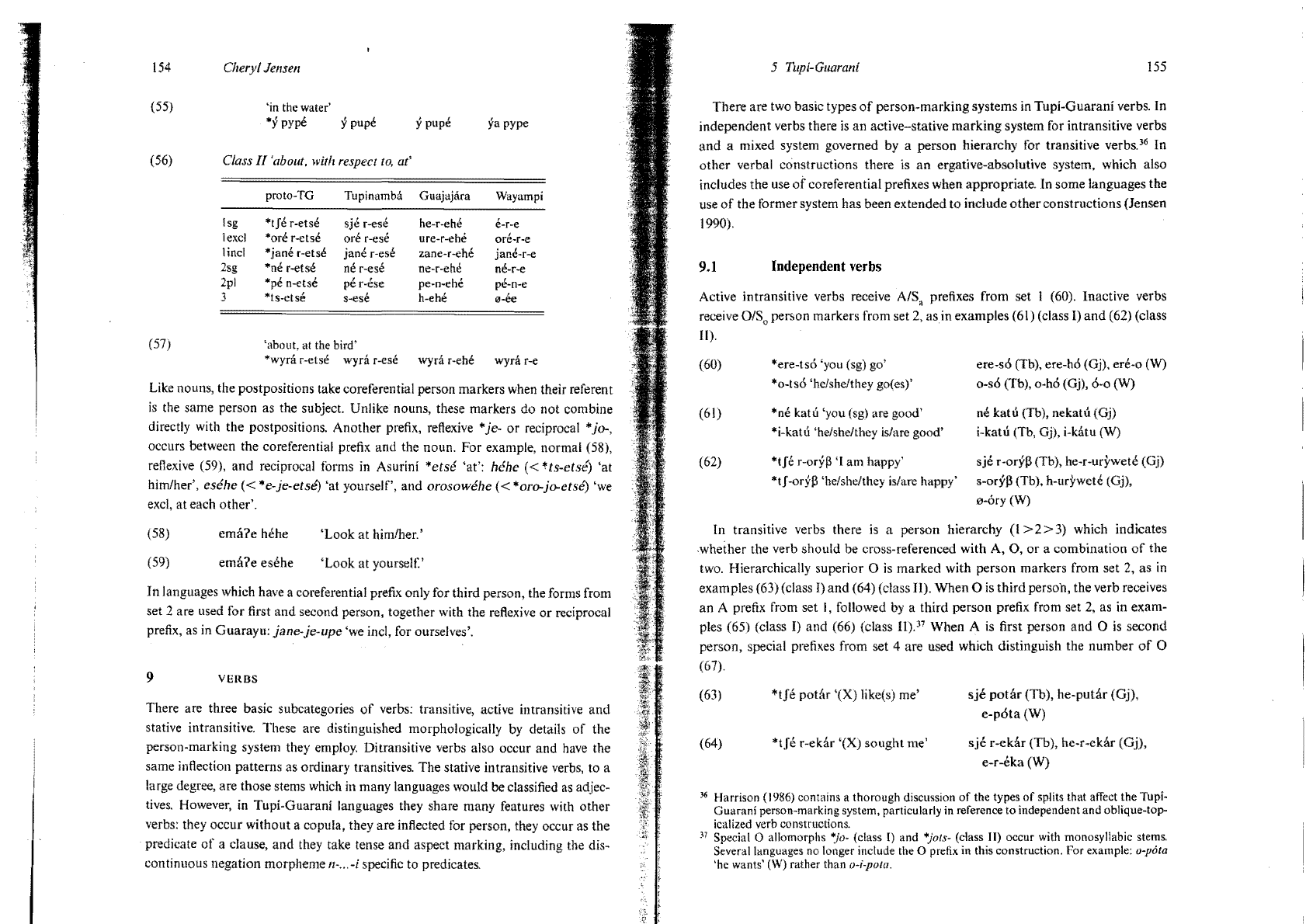
(55)
'in the water'
*y
pypé
Ypupé
y pupé
ya pype
(56)
Class
/I
'about. witll respect
too
at'
proto-TG
Tupinambá Guajajára Wayampi
Isg
*IJé r-etsé
sjé
r-esé he-r-ehé
é-r-e
lexcl
*oré r-etsé
oré
r-esé ure-r-ehé
I
ore-r-e
linc1
*jané r-etsé
jané
r-esé zane-r-ehé jané-r-e
2sg *né r-etsé
né r-esé ne-r-ehé
né-r-e
2pl
*pé n-etsé
pé r-ése pe-n-ehé
pé-n-e
3 *ts-etsé
s-esé
h-ehé
,,-ée
(57)
'abo lit, at the bird'
*wyrá r-elsé
wyrá r-esé wyrá r-ehé
wyrá
r-e
Like nouns,
the
postpositions
take coreferential person
markers
when their referent
is
the
same
person
as the subject.
Unlike
nouns, these
markers
do
not
combine
directly with
the
postpositions.
Another
prefix, reflexive *je-
or
reciprocal *jo-,
occurs
between the coreferential prefix
and
the
noun.
For
example,
normal
(58),
reflexive (59),
and
reciprocal forms in Asuriní
*etsé
'at':
héhe
«~ts-etse)
'al
him/her',
eséhe
« *e-je-etsé)
'at
yourself',
and
orosowéhe « "oro-jo-etsé) 'we
excl,
at
each
other'.
emáí'e
héhe
'Look
at
him/her.'
emá?e
eséhe
'Look
at
In
languages which have a cOl'eferential
for
third
person,
the forms
from
set
2
are
lIsed
for
first
and
second
person,
together
with
the
reflexive
or
reciprocal
prefix,
as
in
Guarayu:
jane-je-upe
'we
inel, for ourselves'.
9 VERBS
There
are
three
basic subcategories
of
verbs: transitive, active intransitive
and
stative intransitive.
These
are distinguished morphologically by details
of
the
person-marking
system they employ. Ditransitive verbs
also
occur
and
have the
same
inflection
patterns
as
ordinary
transitives.
The
stative intransitive verbs,
to
a
degree,
are
those
stems which in
many
languages would be c1assified as adjec-
tives. However, in
Tupí-Guaraní
languages they
share
many
features with
other
verbs: thev
occur
without
a cooula.
they
are
inflected for
person,
they
occur
as
the
01'
s clause,
snd
take tense
and
sspect
continuous
negation
morpheme
11-
••.
-i
specific
to
predicates.
nClUomg the dis-
5 Tupí-Guaraní
There
are
two
basic
types
of
person-marking
systems
in
Tupí-Guaraní
verbs. In
independent
verbs there
is
an
active-stative
marking
system
for
intransitive
verbs
snd
a
mixed
system
governed
by
a
person
hierarchy
for transitive verbs.
36
In
other
verbal
constructions
there
is
an
ergative-absolutive system,
which
also
includes
the
use
of
coreferential
prefixes
when
appropriate.
In
sorne
languages
the
use
of
the
former
system
has
been
extended
to
include
other
constructions
(Jensen
1990).
9.1
Independent verbs
Active
intransitive
verbs receive
A/S
prefixes
fmm
set
1 (60).
Inactive
verbs
a
receive O/So per80n
markers
from
set 2,
asin
examples
(61) (c1ass
1)
and
(62) (c1ass
I1).
*ere-tsó 'you (sg) go'
ere-s6
(Tb), ere-h6 (Gj),
eré-o
(W)
*0-ts6 'he/she/thev
goCes)'
0-s6
(Tb), o-hó (Gj), 6-0 (W)
né
katú
(Tb),
nekatú
(Gj)
i-katú
i-kátu
(W)
*i-katú 'h,,/.h.,lthl'<V
(62)
*tfé
r-oqí~
'1
am
sjé
*tf-orya
'he/she/they ¡s/are happy'
0-óry
(W)
s-ory13
(Tb),
h~
..
r'mmt
In
transitive
verbs
there
is a
person
hierarchy
(1)
2> 3) which
indicates
,whether
the
verb
should
be
cross-referenced
with
A,
0,
or
a
combination
of
the
two.
Hierarchically
superior
°
is
marked
with
person
markers
from
set
2,
as
in
examples
(63) (c1ass
1)
and
(64) (c1ass JI).
When
O is
third
person,
the
verb
receives
an
A prefix from
set
l,
followed by a
third
person
prefix from set
2,
as
in
exam-
pIes (65) (c1ass
1)
and
(66) (c1ass
lI)Y
When
A is first
person
and
O
is
second
person,
special
from
set
4
are
used
which
distinguish
the
number
of
O
(63)
*tfé
potár
'(X)
me'
sjé
potár
e-póta
(64) '"tfé
r-ekár
'(X)
sought
me'
sjé
r-ekár
(Th),
he-r-ekár
e-r-éka
(W)
36
Harrison (1986) contains a thorough diseussion
of
the types
of
splíts tha! affee! the Tupí-
Guaraní person-marking system, particularly
in
reference to independent and oblique-top-
icalized vcrb conslructions.
31
Special O allomorphs
'"jo-
(class
1)
and
*jols-
(class
11)
occur with monosyllabic stems.
Severallanguages no longer inelude the O prefix in this construction. For example:
o-pÓIa
'he wants'
(W)
rather than o-i-pola.
157
156
Cheryl
Jellsell
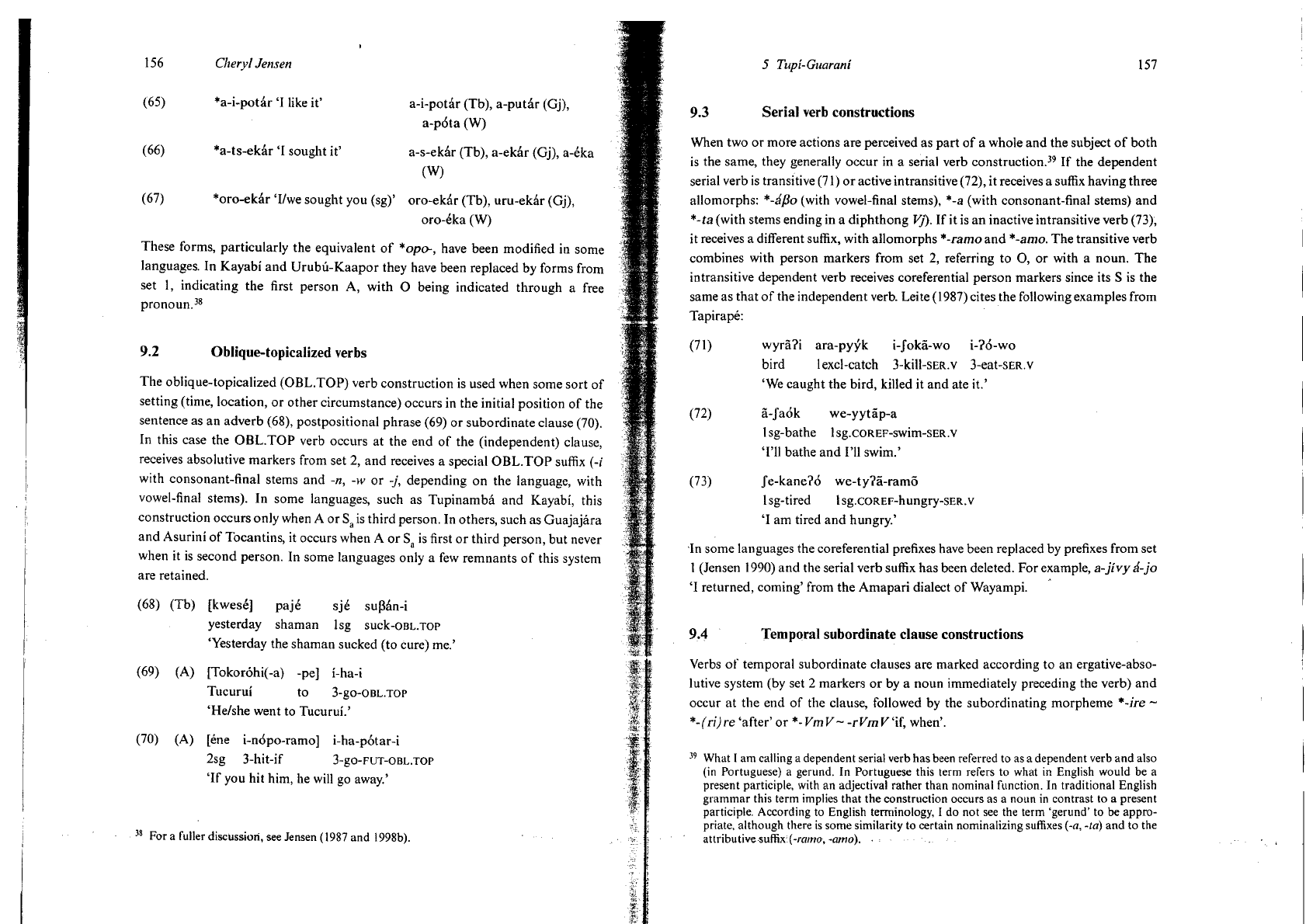
(65)
*a-i-potár
'1
Iike
it'
a-i-potár (Tb),
a-putár
(Gj),
a-póta
(W)
(66)
*a-ts-ekár
'1
sought it'
a-s-ekár (Tb), a-ekár (Gj), a-éka
(W)
(67)
*oro-ekár 'I/we sought you (sg)' oro-ekár (Tb), uru-ekár (Gj),
oro-éka (W)
These forms, particularly the equivalent
of
*opo-, have been modified in sorne
languages. In Kayabí
and
Urubú-Kaapor
they have been replaced by forms from
set
1,
indicating the first person A, with O being indicated through a free
pranoun.
38
9.2
Oblique-topicalized verbs
The oblique-topicalized (OBL.TOP) verb construction
is
used when sorne sort
of
setting (time, location,
or
other circumstance) occurs in the initial position
of
the
sentence as an adverb (68), postpositional phrase (69)
or
subordinate c1ause (70).
In this case the
OBL.TOP
verb occllrs at the end
of
the (independent) clause,
receives absollltive markers fram set
2,
and
receives a special
OBL.TOP
suffix
(-i
with consonant-final stems
and
-11, -w
or
-j, depending on the language, with
vowel-final stems). In sorne languages, such as Tupinambá
and
Kayabí, this
construction occllrs only when A
or
S.
is
third persono In others, such as Guajajára
and
Asuriní
of
Tocantins, it occllrs when A
or
Sa
is
first
or
third person, but never
when it
is
second persono In sorne languages only a
few
remnants
of
this system
are retained.
(68) (Tb) [kwesé]
pajé
sjé
sllJ3án-i
yesterday shaman Isg
sllck-OBL.TOP
'Yesterday the shaman sucked (to cure) me.'
(69)
(A) [Tokoróhi(-a) -pe] í-ha-i
TlIcuruí
to
3-go-0BL.TOP
'He/she went to Tucllruí.'
(70)
(A) [éne i-nópo-ramo]
i-ha-p6tar-i
2sg 3-hit-if
3-go-FUT-OBL.TOP
'If
you hit him,
he
will
go
away.'
38
For a fuller discussiori, see Jensen (1987 and 1998b).
5 Tupí-Guaraní
9.3
Serial verb constructions
When two or more actions are perceived as part
of
a whole and the subject
of
both
is
the same, they generally occur
in
a seríal verb construction.
39
If
the dependent
serial verb
is
transitive (71)
or
active intransitive (72), it receives a suffix having three
a11omorphs:
*-áf3o (with vowel-final stems), *-a (with consonant-final stems)
and
*-ta (with stems ending in a diphthong V'j).1f it
is
an in active intransitive verb (73),
it receives a different suffix, with a11omorphs
*-ramo
and
*-amo. The transitive verb
combines with person markers fram set
2,
referring to
O,
or
with a noun. The
intransitive dependent verb receives coreferential person markers sin
ce
its S
is
the
same as that
of
the independent
verbo
Leite (1987) cites the following examples from
Tapirapé:
(71) wyra?i ara-pyyk
i-foka-wo i-í'ó-wo
bird lexcl-catch
3-kill-SER.
v 3-eat
-SER.
v
'We callght the bird,
ki11ed
it and ate it.'
(72)
íl-faók
we-yytap-a
l sg-bathe l
sg.COREF-swim-SER.v
'['11
bathe
and
1'11
swim.'
(73)
fe-kaneí'ó we-tyí'a-ramó
Isg-tired
1 sg.COREF-hungry-sER.
V
'1
am tired
and
hungry.'
'In sorne langllages the coreferential prefixes have been replaced by prefixes fram set
1 (Jensen 1990)
and
the serial verb suffix has been deleted. For example,
a-jívy
á-jo
'1
returned, coming' fram the Amapari dialect
of
Wayampi.
9.4 Temporal subordinate clause constructions
Verbs
01'
temporal subordinate c1auses are marked according to an ergative-abso-
lutive system (by set
2 markers
or
by a noun immediately preceding the verb)
and
occllr at the end
of
the c1allse, foIlowed by the subordinating morpheme *-Íre -
*-(ri)
re
'after'
or
*-
VmV
-
-rVmV'if,
when'.
39
What [ arn calling a dependent serial verb has been referred to as a dependent verb
and
also
(in Portllguese) a gerllnd. [n Portllgllese this term refers to what in English would be a
present participle, with an adjectival rather than nominal fllnction. In traditional English
grarnmar this term implies that the construction occurs as a
nOlln
in
contrast to a present
participle. According to English terminology, I do not see the terrn 'gerund' to be appro-
priate. although there
is
sorne sirnilarity to certain norninalizing suffixes (-a, -tal
and
to the
attributive.suffix'(
-ramo, -amo). .
159
Cheryl Jensen
158
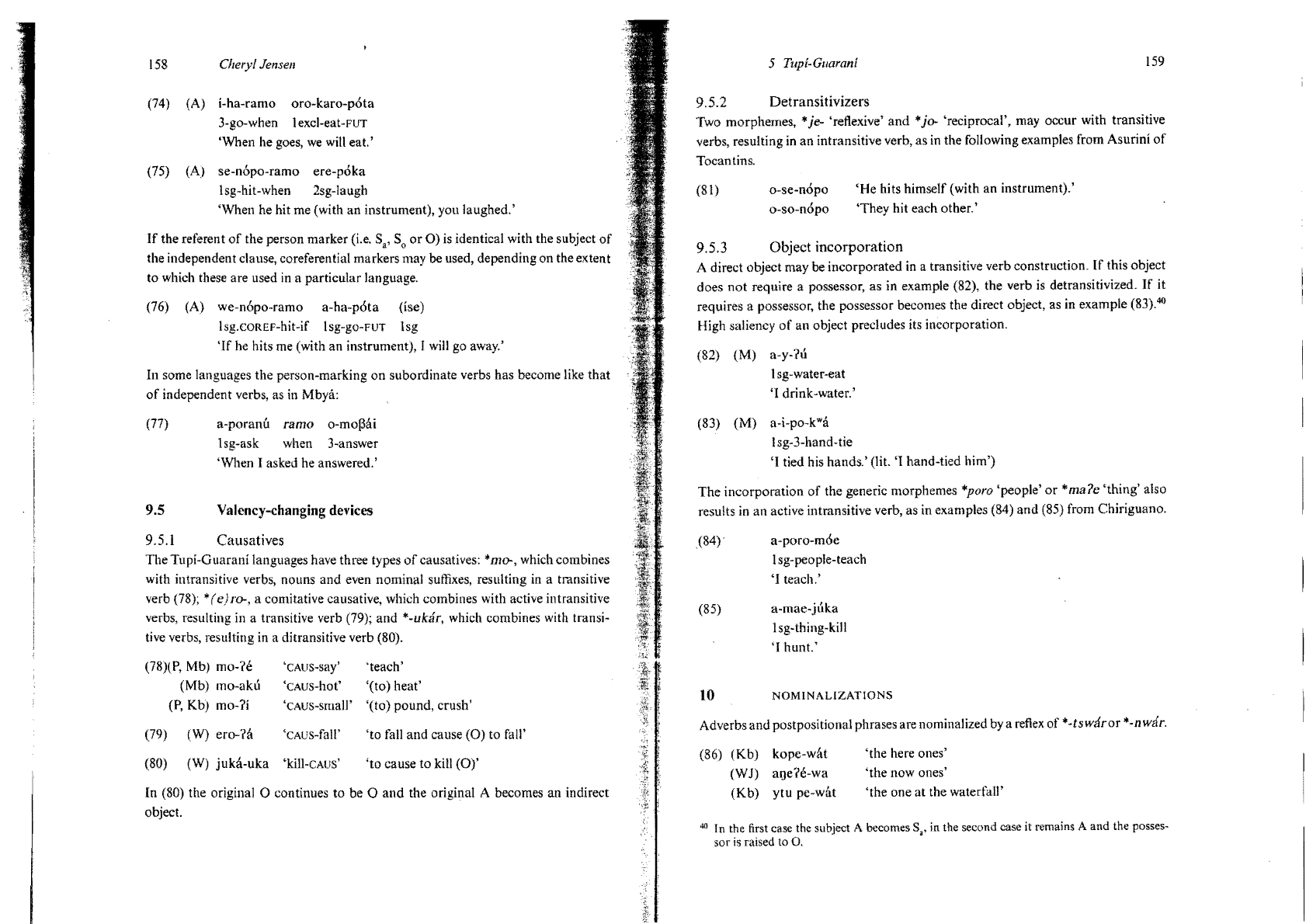
(74) (A) í-ha-ramo
oro-karo-póta
3-go-when 1excl-eat-FuT
'When he goes,
we
will eat.'
(75)
(Al
se-n6po-ramo
ere-póka
Isg-hit-when 2sg-laugh
'When he hit me (with an yon laugneu.
Ir
the referent
of
the person marker
(Le.
S.'
So
or
O)
is
identical wilh the subject
of
the independent clanse, coreferential markers may be lIsed, depending on the extent
to
which these are lIsed
in
a particular langllage.
(76) (A) we-n6po-ramo
a-ha-póta
(íse)
Isg.COREF-hit-if lsg-go-FUT Isg
'If
he hits me (with an instrument), 1
wilI
go away.'
In sorne languages the
"E"rOl'\n_tTl!>
on
sllbordinate verbs has become Iike
that
of
(77)
a-poranú
ramo o-mol3ái
1 sg-ask when 3-answer
'When 1 asked he answered.'
9.5
Valency-changing
devices
9.5.1
Causatives
The
Tupí-Guaraní languages have three types
of
causatíves: *mo-, which combines
with intransitive verbs, nouns
and
even nominal suffixes, resulting
in
a trnnsitive
verb (78);
*(e)ro-, a comitative causative, which combines with active intransitive
verbs, resultillg in a transitive verb (79);
and
*-ukár, which combines with transí-
tive verbs, resulting in a ditransitive verb (80).
(78)(P, Mb)
mo-le
'cAus-say'
'teach'
(Mb) mo-akó
'cAus-hot'
'(lO) heat'
(P,
Kb) mo-Ji
'CAUS-small'
'(to) pound, crush'
(W) ero-'rá
'cAus-fall'
'to
fall
and
cause (O) to fall'
'kill-cAus'
'to
cause
to
kili (O)'
In (80) the original O continues
to
be O
and
the original A beco mes an indirect
object.
5 Tupí-Guaraní
9.5.2 Detransitivizers
Two morphemes, *
je-
'reflexive'
and
*jo- 'reciprocar, may occur with transitive
verbs, resulting
in
an
intransitive verb, as
in
the rollowing examples fram Asuriní
of
Tocantins.
o-se-nópo
'He
hits himself (with an instrument).'
o-so-nópo
'They hit each other.'
9.5.3 Object incorporation
A direct object may be íncorporated
in
a transitive verb construction.
If
this object
does
not
require a possessor,
as
in example (82), the verb is detransitivized.
If
it
requires a possessor, the possessor becomes the direct object, as in example
(83).40
01'
an object precludes its incorporation.
(M)
a-y-ló
1sg-water-eat
'1
drink-water.'
(83)
(M)
a-i-po-kwá
1 sg-3-hand-tie
'1
tied his hands.'
'1
hand-tied
The
incorporation
of
the generic morphemes *poro 'people'
or
*ma?e
'thing'
also
results
in
an active intrallsitive verb, as
in
examples (84)
and
(85) from Chiriguano.
a-poro-móe
1 sg-people-teach
'1
teach.'
(85)
a-mae-jóka
1 sg-thing-kill
'1
hunt.'
10
NOMINALlZATlONS
Adverbs
and
postpositional phrases are nominalized
by
a
reftex
01'
*-tswáror *-nwár.
(86) (Kb) kope-wát
'the
here ones'
(W
J) al)e're-wa
'the
now ones'
(Kb)
Y
tu
pe-wát
'the
one
at
the waterfall'
40 In the first case the subject A becomes Sa'
in
the second case
it
remains A and the posses-
sor
is
raised to
O.
160
Cheryl
Jensen
Verbs are nominalized to indicate the agent (refiex
of
"'-tsár-
-ár-
-tár), circum-
stanee
("'-tsáP - -áp - -tápj, and,
in
the ease
of
transitive verbs, object ("'emj-) or
patient
("'-pYr).
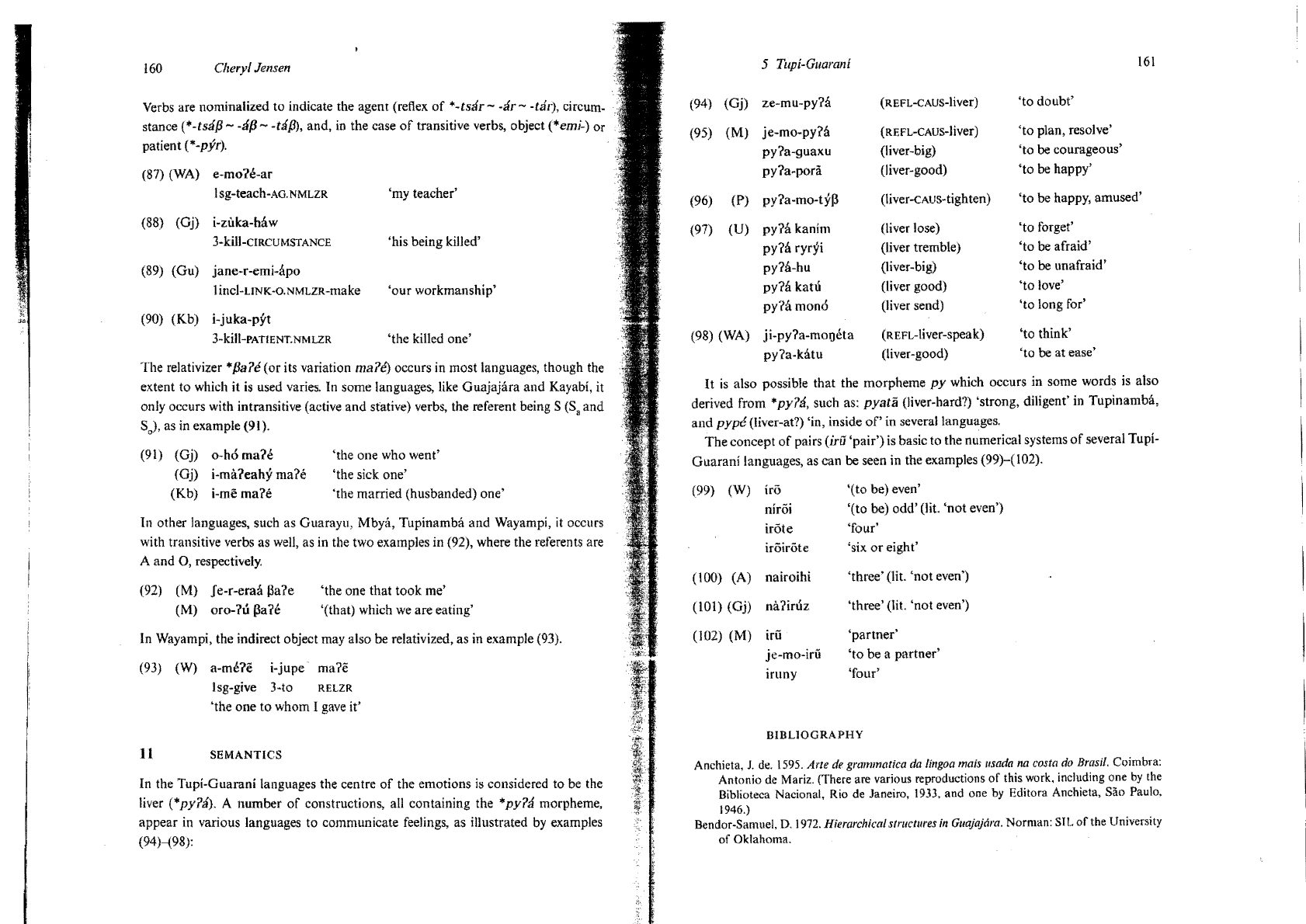
(87) (WA) e-mo?é-ar
1sg-teach-AG.
NMLZR
'my teaeher'
(88) (Gj)
i-zuka-báw
3-kill-CIRCUMSTANCE
'his being killed'
(89) (Gu)
jane-r-emi-ápo
linc1-uNK-O.NMLzR-make
'our
workmanship'
(90) (Kb) i-juka-pyt
3-kill-PATlENT.NMLzR
'the
killed one'
The
reJativizer
"'pa?é
(or its variatíon ma?é) oceurs in most languages, though the
extent
to
whieh it
is
used varies. In sorne languages, like Guajajára and Kayabí, it
only occurs with intransitive (active and stative) verbs, the rererent being
S (S. and
So), as in example (91).
(91) (Oj)
o-hó
ma?é 'the one who went'
(Oj) i-ma?eahy
maré
'the sick one'
(Kb) i-me
ma?é
'the married (husbanded) one'
In
other Janguages, such as Ouarayu, Mbyá, Tupinambá and Wayampi, it oceurs
with transitive verbs as well, as in the two examples in
(92), where the referents are
A and
O, respectively.
(92) (M)
fe-r-eraá
13a?e
'the one that took me'
(M)
oro-?ú j3a?é '(that) which
we
are eating'
In Wayampi, the indirect object may
al
50
be relativized, as in example (93).
(93) (W) a-mé1e i-jupe ma?e
lsg-give 3-to
RELZR
'the
one
to
whom 1
gave
it'
SEMANTlCS
In the Tupí-Guaraní languages the centre
of
the emotions
is
eonsidered to be Ihe
liver
(*py?á). A nurnber
of
constructions,
a1l
containing Ihe *py?á morpheme,
appear
in
various languages lo communicate feelings, as illustrated
by
examples
(94)-(98):
5 Tupí-Guaraní
161
(94) (OD
ze-mu-py?á
(REFL-CAus-liver)
'to
doubt'
(95)
(M)
je-mo-py?á
py?a-guaxu
py1a-pora
(REFL-CAus-liver)
(liver-big)
(liver-good)
'to
plan, resolve'
'to
be courageous'
'to
be happy'
(96)
(P)
py?a-mo-typ
(liver-cAus-tighten)
'lo
be happy, amused'
(97)
(U)
py1á kaním
py?á
ryryi
py?á-hu
py?á
katú
py?á
monó
(liver lose)
(liver tremble)
(Iiver-big)
(liver good)
(liver send)
'to
forget'
'lo
be afraid'
'to
be unafraid'
'to
love'
'to
long for'
(98) (WA)
ji-py1a-molJéta
py?a-kátu
(REFL-liver-speak)
(Iiver-good)
'to
think'
'to
be
at
ease'
It
is
also possible that Ihe morpheme
py
which occurs in some words
is
also
derived from
*py?á, such as: pyata (liver-hard?) 'strong, diligent' in Tupinambá,
and
pypé
(liver-at?) 'in, inside
of'
in severallanguages.
The
concept
of
pairs (ira
'pair')
is
basic to the numerical systems
of
several Tupí-
Guaraní
languages, as can be seen in the examples
(99)-(
102).
(99)
(W) íro
'(to
be) even'
níroi
'(to
be) odd' (lit.
'not
even')
¡rote
'follr'
¡rCirote
'six
or
eight'
(100) (A)
nairoihi
'three' (lit.
'not
even')
(l0l)
(Gj)
na.?irúz
'three' (lit.
'not
even')
(102) (M) iru
'partner'
je-mo-iru
Oto
be a partner'
¡runy
'four'
BIBLlOGRAPHY
Anchieta,
J.
de.
1595. Arte
de
gl'ammatica
da
lingoa
mais
IISIUÚl
na
costa
do
Brasil.
Coimbra:
Antonio de Mariz. (There are various reproductions
of
this work, inc1uding one
by
the
Biblioteca Nacional, Rio de Janeiro, 1933, and one
by
Editora Anchieta, Sao Paulo,
1946.)
Bendor-Samuel.
D.
1972.
Hierarchical
structlll'es
in
Guajajám.
Norman: SIL
of
the University
of
Oklahoma.
11
163
Cheryl
Jensen
162
Betts,
L.
V.
1981. Dicionário Porintintln-Portugués Porlllgués-Parintintfn. Brasília: SI
L.
Cabral, A.
S.
A.
C. 1995. 'Contact-induced language change in the Western Amazon: the non-
genetic origin
of
the Kokáma language', Ph.D. thesis, University
of
Pittsburgh.
Dietrich,
W.
1986. El idioma
Chil'iguano.
Madrid: Instituto de
Cooperación
Iberoamericana.
1990a.
'Chiriguano
and
Guarayo word formation', pp. 293-320
of
Amazonian linguístics:
sllldies
in
Lowland
SOl/th
American
¡anguages,
ed. Doris
L.
Payne. Austin: University
01'
Texas Press,
1990b.
More evidence for
all
internal classljicatioll
of
Tupi-Guarani languages. Berlin: Gebr.
Mann
Verlag.
1993. 'Mbyá, guaraní criollo y castellano: el
contacto
de las tres lenguas estudíado
en
un
grupo mbyá en Missiones',
Signo and Seña: revista dellnstitulO
de
Linguistica,
3.55-71.
1995a.
'El
español del Paraguay en
contacto
con
el
guaraní',
pp. 203-16
of
Lenguas
en
con-
lacto
en
Hispanoamérica:
nl/el'OS
enfoques, ed. by
K,
Zimmerman. Vervuert: Bibliotheca
Ibero-Americana.
1995b.
'La
importancia
de
los diccionarios guaraníes de
Montoya
para
el
estudio
compar-
ativo de las lenguas tupí-guaraníes de hoy', Amerindia: Revue d'elhnolinguistíqlle amérin-
dienne,19f20.287-99.
Dobson, R. 1973.
'Notas
sobre substantivos
do
Kayabí', Série Linguistica, 1.30-56. Brasilia:
SIL.
1988.
Aspectos
da
líllgua Kayabl, Série Linguística,
12.
Brasília: SIL.
Dooley, R. A. 1982.
Vocabulário
do
Guaraní.
Brasília: SIL.
Grimes,
B.
F.
1996. Etllllofoglle:
languages
of
the
world.
13th edition. Dalias: SIL.
Harrison, C. 1986. 'Verb prominence. verb initialness, ergativíty
and
typological disharmony
in
Guajajára',
pp. 407··39
of
lfandbook
of
Amazonian languages, vol. I, ed. D. C.
Derbyshíre
and
G. K. Pullum. Berlin:
Moulon
de Gruyter.
Hoeller. A.
1932.
Guarayo-Delltsciles Würterbuch. Guarayos e IIall in Tirol: Verlag del'
Missionsprokura
der
P.
P.
Franziskaner.
Jensen,
C.
1987. 'Object-prefix incorporation in Proto-Tupí-Guaraní verbs', Langllage
Sciences,
9.45-55.
1989.
O desem'olvimelllo histórico
da
fíngua
Wayampi. Campinas:
Editora
da
Universidade
Estadu¡tl de Campinas.
1990. 'Cross-referencing changes in sorne Tupí-Guaraní languages', pp. 117-58
of
Amazonianlinguistics: swdies in/ow/and
SOllth
American languages, ed. Dorís L Payne.
Austin: Univcrsity
01'
Texas Press.
19981.1.
'The
use
of
corefercntial
and
reflexive markers
in
Tupí-Guaraní
languages', Joumal
of
Amazoniall Lallgllages. 1(2).1-49.
1998b. 'Comparativc Tupí-Guaraní
morphosyntax',
pp. 487-618
of
lfandbook
of
Amazonian
fangllages,
vol. lV, ed.
D.
C. Derbyshire
1;lnd
G. K. Pu!lum. Bcrlin:
Mouton
de Gruytcr.
Juliao.
M.
R.
S.
1993. 'A lingua dos Índios do
Rio
Cairari',
MA
thesis, Universidade Federal
do
Pará.
Kakumasu.1. Y 1986.
'Urubu-Kaapor',
pp. 326-403
of
Handbook
of
Amazonian Languages,
vol. L ed. D. C. Derbyshire
and
G. K. Pul1um. Berlin:
Mouton
de Gruyter.
Kakumasu.
J.
Y
and
Kakumasu,
K. 1988.
DiciOllário
por tópicos: Urubtí-Kaapor-Portugués.
Brasília: Coedition Funda<;:ao Nacional
do
Índio/SIL.
Leite, Y.1977.
Aspectos
dafon%gia
e mOlfofon%gia
Tapirapé.
Lingüística, 8. Rio de Janciro:
Museu Nacional.
1987. 'Referential hierarchy
and
Tapirape split marking systems', papel' presented at the
Workíng Conference on Amazonian Languages, Eugene, Oregon.
Lemle.
M.
1971.
'Internal
c1assification
01'
the
Tupi-Guarani
Iinguistic family', pp.
107-290f
Tupi
swdies
1,
ed.
D.
Bcndor-Samuel.
Norman:
SIL.
5 Tupí-Guaraní
Mello. A. A.
S.
1992.
'Estudo
comparativo do léxico
da
família lingüística
Tupi-Guarani',
MA
thesis, Universidade Federal de
Santa
Catarina.
Newton,
D.
1978.
'Guarayu
discourse', pp. 252-68
of
Work papers
of
the
SIL,
ed.
U.
Wiesemann
el
al.
Riberalta (Bolívia): SIL.
Nicholson,
V.
1978. Aspectos
da
linglla Asurin/. Brasília: SIL.
Rodrigues, A. D. 1952. 'Análise morfológica de
um
texto
Tupi',
Logos, 7.15.
1958. 'Classífication
of
Tupí-Guaraní',
!JAL, 24.231-4.
1984/5.
'Rela90es internas
na
família lingüística
tupí-guaraní',
Revista
de
Antropología,
27/28.33-53.
1986a.
Línguas brasileiras:
pira
o conhecimento
das
IInguas
indígenas.
Sao
Paulo: Edír;oes
Loyola.
1986b. 'Silencio, pausa e nasaliza<;:iio', pp. 153-9
of
Anais
do
8" Encontro Naciooo/
de
Linguistica. Río de Janeiro.
1 996a.
'Panorama
das
Hnguas indígenas
da
Amazonia',
papel' presented al the conference,
As
Línguas Indigenas
da
Amazonia
na
Ciencia e nas Sociedades, organized by the M useu
Paraense
Emílio Goeldi.
1996b.
'As
Iínguas gerais sul-americanas',
Papia.
Revista
de
Crioulos
de
Base Ibérica,
4(2).6-18.
Rodrigues, A. D.
and
Dietrich,
W.
1997.
'On
the linguistic relationship between Mawé
and
Tupí-Guaraní',
Diachronica, 14.265-304.
Ruiz de
Montoya,
A. 1639.
Tesoro
de
la
lengua
Guaraní.
Madrid:
Juan
Sanchez. (There are
various cditions
01'
this, ínc1uding
one
edited by
P.
Restivo
and
published in 1892 as
Linguae Guaraní Grammatica Hispanice, published in
Stuttgart
by Guílielmi
Kohlhammar.)
Schuchard,
B.
1979.
!Vande
Ni': Gramática guaraní
para
castellano hablantes.
Santa
Cruz
de la
Sierra: Ayuda
para
el Campesino del Oriente Boliviano I Centro Bolivíano de
Investigación y Acción Educativas.
Seki, L. 1990.
'Kamaiurá
(Tupí-Guaraní) as
an
active-stative language', pp, 367-91
of
Amazonian lingllistics: stl/dies
in
low{and
South American languages, ed.
Daris
L. Payne.
Austin: University
of
Texas Press.
Soares,
M.
F.
and
Leite.
Y.
1991. 'Vowel shift in the
Tupí-Guaraní
language family: a typo-
logical
approach'.
pp. 36-53
of
Lallguage
change
in
South American
IlIdian
languages, ed.
M.
R.
Key.
Philadclphía: University
of
Pennsylvania Press.
"
,--
~~
,
\
\
III~-')
/'
'~
---
,(
IX
'II~,.T
',-
__
,
'1
IV-1"
q~
\
~
)
~,;.
>'
Id-}
1
/ES
" SP \ /
,,\
/
" / '
",
"
...
_--~--R;
'-
I_~
\
o 500 1 000
km
I I I
RS
40°
20°
6
Macro-Je
ARYON
D.
RODRIGUES
1
HlSTORICAL
SURVEY
Macro-Je
is
the name that was proposed about fifty years ago by Mason (1950: 287)
for a large array
of
South American languages
(aH
spoken in Brazil) thought to be
related to the
Je
linguistic family.
W.
Schmidt (1926: 234-8) had earlier employed the
name Ges-Tapuya, and Loukotka (1944
[1942]:
2-6) the name Tapuya-zé in the same
sen
se.
The possible genetic relationship among the many languages ascribed to the
Macro-Je stock
is
a working hypothesis whose details have varied according to
different scholars. Loukotka included
in
it
the foHowing eight 'Ianguage families':
té
(Je), Opaie (Ofayé), Kaingán (Kaingáng), Coroado (Purí), Masakali (Maxakalí),
Patasó (Pataxó), Botokudo (Krenák) and Kamakan (Kamak1i) (names
or
spellings
added
in
parentheses are those now currently used
by
Brazilian linguists and anthro-
pologists and adopted in the present chapter). Nimuendajú (Métraux and
Nimuendajú
1946:
542;
Nimuendajú
1945
[1980])
considered Malalí an independent
'linguistic family, whereas Mason (1950) added Malalí and Coropó (Koropó) to
Macro-Je, but took out Ofayé as
weH
as laté (Yate). The latter had already been sep-
arated from the stock
by
Loukotka (1942). Later, on the basis
oi
good comparative
work, Davis (1966) demonstrated that Kaingáng
is
truly a member
of
the Je genetic
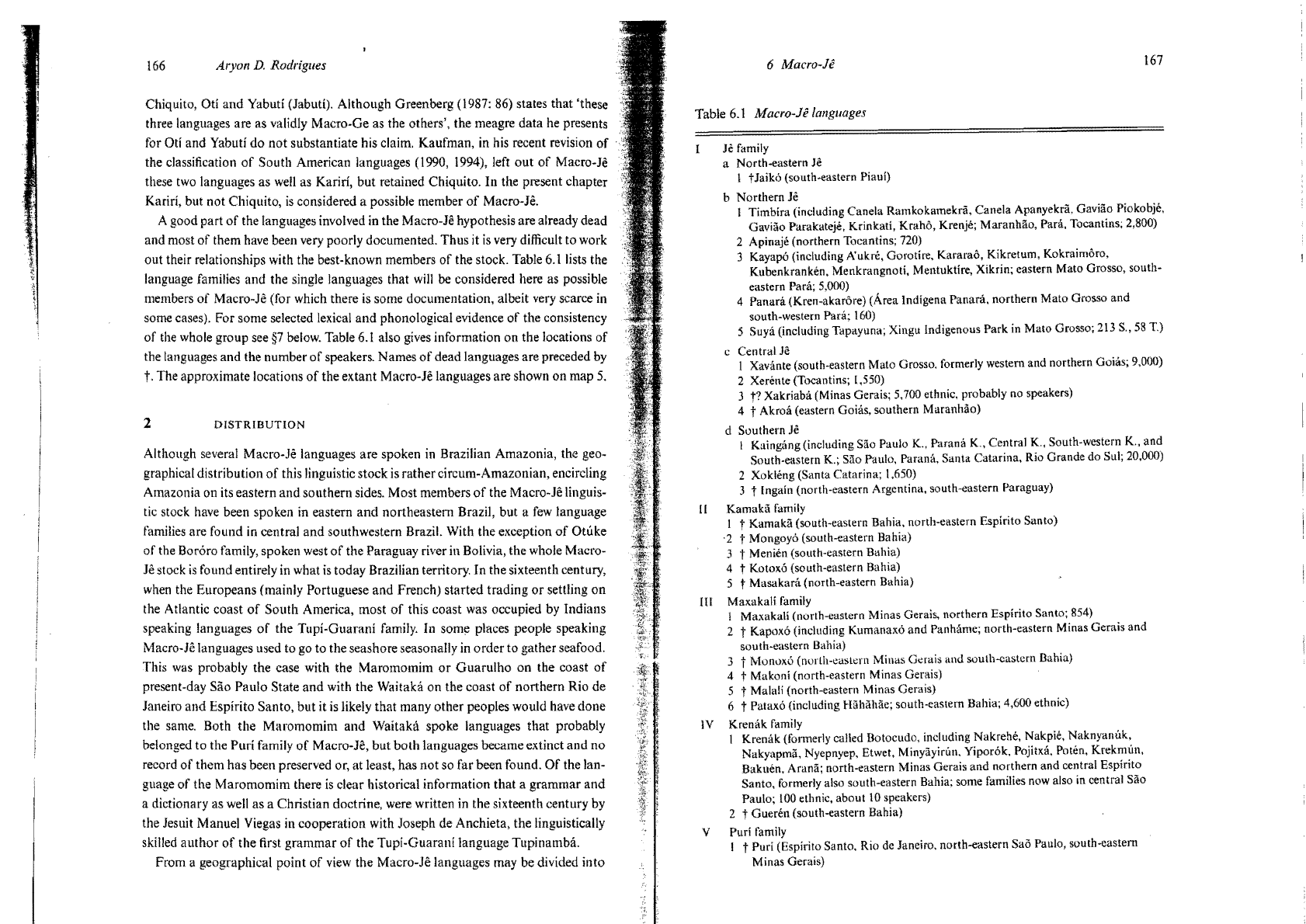
Map 5 Macro-Je languages with approximate locations
family and not another family in itself. In another paper, Davis (1968)
gave
evidence
of
regular phonological correspondences between Je and Maxakalí as
weH
as
between Je and Karajá and mentioned possible wider relationships
of
Macro-Je with
Boróro, Tupí, and Fulni6 (Yate). As for Boróro, Guérios (1939) presented as indica-
tive
of
genetic relationship the similarities he had found between Eastem Boróro and
two
Northem
Je
languages, Timbíra (,Merrime' = Canela) and Kayapó. Gudschinsky
(1971), comparing Ofayé with Davis' reconstruction
of
proto-Je, showed that it
is
more likely to be a member
of
Macro-Je. Boswood (1973)
gave
sorne lexical evidence
in
favour
of
the inclusion
of
Rikbaktsá
in
this stock. Rodrigues (1986) included in it
Karirí and Guató, but dealt with Pataxó
as
a member
of
the Maxakalí family, the
same being true
of
Malalí, which
had
already been
put
in
this family (and not as a
main branch
of
Macro-Je) by Loukotka. For Greenberg (1987),
aH
the aforemen-
tioned languages
or
language families (except for Karirí) belong to Macro-Je, as do
';~
.
.
~~
.~
166
167
6 Macro-Jé
Aryon
D.
Rodrigues
Chiquito, Otí and Yabutí (Jabutí). Although Greenberg (1987: 86) states that 'these
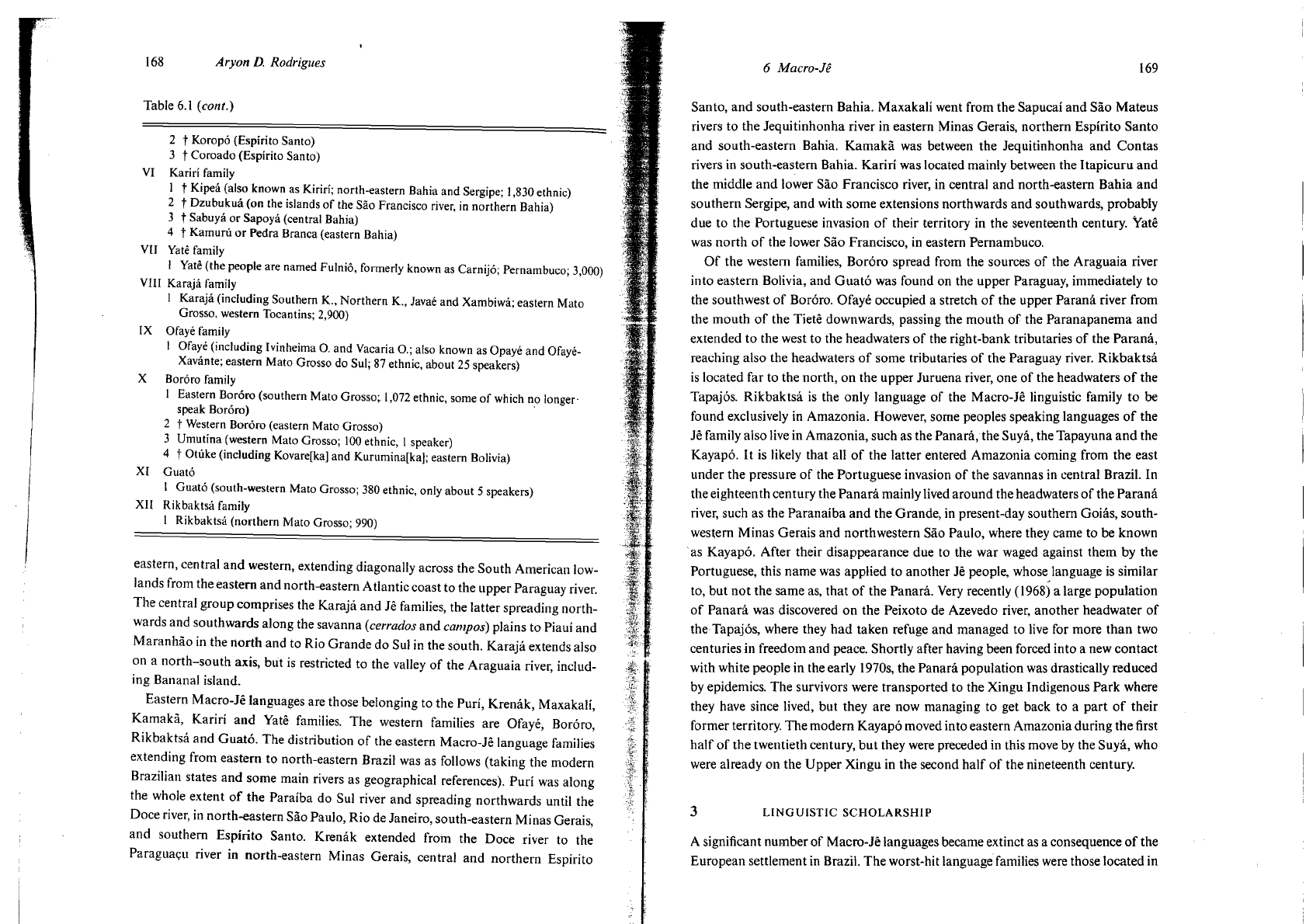
Table
6.1
MacrQ-Jé
languages
three languages are as validly Macro-Ge
as
the others', Ihe meagre data he presents
for Otí and Yabutí do not substantiate his
c1aim.
Kaufman, in his recent revision
of
Je
farníly
the c1assification
of
South American languages (1990, 1994), left
out
of
Macro-le
a North-eastern
Je
I tJaikó (south-eastern Piaul)
these two languages as
well
as Karió,
but
retained Chiquito. In the present chapter
b
NorthemJe
Karirí, but not Chiquito,
is
considered a possible member
of
Macro-Je.
I Tirnbíra (including Canela Rarnkokamekra, Canela Apanyekra, Gaviao Piokobjé,
A good part
of
the langllages involved in the Macro-Je hypothesis are already dead
Gaviao Parakatejé, Krinkatí, Krahó, Krenjé; Maranhiío, Pará, Tocantins; 2,800)
and most
of
them have been very poorly documented. Thus it
is
very difficult to work
2 Apinajé (northern Tocantins; 720)
3 Kayapó (including A'ukré, Gorotire, Kararao, Kíkretum, Kokraimóro,
out their relationships with the best-known members
of
the stock. Table
6.1
lists the
Kubenkrankén, Menkrangnotí, Mentuktíre, Xikrin; eastern Mato
Gros5O,
south-
~
language families and the single languages that
will
be considered here as possible
eastern Pará; 5,000)
members oí' Macro-Je (for which there is sorne documentation, albeit very scarce
in
4 Panará (Kren-akaróre) (Área Indígena Panará. northern Mato Grosso and
sorne cases). For sorne selected lexieal
and
phonological evidenee
of
the consistency
south-western Pará;
160)
5 Suyá (including Tapayuna; Xíngu lndigenous Park in
Mala
Grosso; 213
S.,
58
T)
of
the whole group see
§7
below. Table
6.1
also gives information on the locations
of
e Central
Je
the languages and the number
of
speakers. Names
of
dead languages are preceded
by
Xavánte (south-eastern Mato Grosso. formerly western and northern Goiás; 9,000)
t. The approximate locations
of
the extant Macro-Je languages are shown
on
map
5.
2 Xerénte (Tocantins; 1,550)
3
t?
Xakriabá (Minas Geraís; 5,700 ethnic. probably no speakers)
4
t Akroá (eastern Goíás, southern Maranhao)
2
DISTRIBUTION
d Southern
Je
1 Kaingáng (including Sao Paulo K., Paraná K., Central K., South-western K., and
Although several Macro-Je languages are spoken
in
Brazilian Amazonia, the geo-
South-eastern K.; Sao Paulo. Paraná. Santa Catarina. Río Grande do Sul; 20.000)
graphical distribution
of
this linguistic stock is rather circum-Amazonian, encircling
2 Xokléng (Santa
Catadna;
1,650)
3
t Ingaín (north-easlern Argentina. south-eastern Paraguay)
Amazonia on its eastern and southern sides. Most members
of
the Macro-Je linguis-
II
Kamaka famíly
tic
stock have been spoken in eastern
and
northeastern Brazil, but a
few
language
I t Kamaka (5Outh-eastern Bahía. north-eastern Espirito Santo)
fami!ies are found in central
and
southwestern Brazil. With the exception
of
Otúke
'2 t Mongoyó (5Outh-eastern Bahía)
of
lhe Boróro family, spoken west
of
lhe Paraguay r¡ver in Bolivia, the whole Macro-
3
t Meníén
(south-ea~tern
Bahía)
Je stock
is
found entirely in what is today Brazilian territory. In the sixteenth century,
4
t Kotoxó (south-easlern Bahía)
5
t Masakará (north-eastern Bahía)
when
the Europeans (mainly Portuguese and French) started trading
or
settling
on
lU Maxakalí famíly
lhe Atlantic coas!
of
South Ameriea, most
of
this coast was occupied by Indians
I Maxakalí (north-eastern Minas Gerais. northern Espírito Santo; 854)
speaking languages
of
the Tupí-Guaraní family. In sorne places people speaking
2
t Kapoxó (including Kumanaxó and Panháme; north-eastern Minas Geraís and
Macro-Je languages used to go to the seashore seasonally in order to gather seafood.
south-eastern Bahía)
3
t Monoxó (norlh-eastern Minas Gemís
¡llld
soulh-eastern Bahía)
This was probably the case with the Maromomim
or
Guarulho
on the coast
of
4
t M¡¡koní (north-eastern Mín¡¡s Geraisl
present-day Sao Paulo State
and
with the Waitaká on lhe coast
of
northern Río de
5
t Mala!í (north-eastern Minas Geraís)
Janeiro and Espirito Santo, but it is likely that many other peoples would have done
6
t Pataxó (inc\uding Hahahae; south-eastern Bahía; 4,600 ethnic)
IV
Krenák farnily
Krenák (formerly called Botocudo, including Nakrehé. Nakpié. Naknyanúk.
lhe same. Both the Maromomim and Waítaká spoke languages that probably
belonged to the
Puó
family
of
Macro-Je, but both langllages became extinct
and
no
Nakyapma, Nyepnyep, Etwet. Mínyayírún. Yiporók. Pojitxá. Potén. Krekmún,
record
of
them has been preserved or, al least, has not so far been found.
Of
the lan-
Bakuén. Arana; north-eastern Minas Gerais and northern and central Espirito
guage
of
lhe
Maromomim there
is
c1ear historical information that a grammar
and
Santo. formerly also south-eastern Bahía; sorne farnilies
now
al
so
ín
central Sao
Paulo;
100
ethnic, about
10
speakers)
a dictionary as well as a Christian doctrine, were written in the sixteenth century by
2
t Guerén (5Outh-eastern Bahía)
the Jesuit Manuel Viegas in eooperation with loseph de Anchieta, the Iinguistically
V Purí
fami1y
skilled
author
of
the first grammar
of
the Tupí-Guaraní language Tupinambá.
I t Puri (Espirito Santo. Río
de
Janeiro. norlh-eastern Sao Paulo, south-eastern
From a geographical point
of
view the Macro-Je languages may be divided into
Minas Gerais)
168
Aryon
D.
Rodrigues
Table
6.1
(cont.)
2 t Koropó (Espírito Santo)
3
t Coroado (Espirito Santo)
VI
Karirí
family
I t Kipeá
(also
known
as
Kirirí; north-eastern
Bahia
and
Sergipe;
1,830
ethnic)
2 t Dzubukuá
(on
the
islands
of
the
Sao
Francisco
river,
in
northern Bahia)
3
t Sabuyá or Sapoyá (central
Bahia)
4 t Kamurú or Pedra Branca (eastern Bahia)
VII
Yate
family
I
Yate
(the people
are
named
Fulnió,
formerly
known
as
Carnijó; Pernambuco;
3,000)
VIII
Karajá
family
I Karajá (including Southern
K.,
Northern
K.,
Javaé
and
Xambiwá;
eastern
Mato
Grosso,
western
Tocantins;
2,900)
IX
Ofayé
family
I
Ofayé
(including Ivinheima
O.
and
Vacaria
O.;
also
known
as
Opayé
and
Ofayé-
Xavánte;
eastern Mato
Grosso
do
Sul;
87
ethnic, about
25
speakers)
X
Boróro
family
I Eastern Boróro (southern Mato Grosso;.I,072 ethnic,
sorne
of
which
no
longer'
speak Boróro) .
2
t
Western
Boróro (eastern
Mato
Grosso)
3 Umutína
(western
Mato
Grosso;
100
ethnic, I
speaker)
4 t Otúke (including
Kovare[ka]
and Kurumina[ka]; eastern
Bolivia)
XI
Guató
1 Guató (south-western Mato Grosso;
380
ethnic,
only
about 5 speakers)
XII Rikbaktsá
family
I Rikbaktsá (northern Mato
Grosso;
990)
eastern, central
and
western, extending diagonally across the South American low-
lands from the eastern
and
north-eastern A t1antic coast to the upper Paraguay river.
The
central group comprises the Karajá
and
le families, the latter spreading north-
wards and southwards along the savanna (cerrados
and
campos) plains to Piauí
and
Maranhao
in the
north
and to Rio
Grande
do
Sul in the south. Karajá extends also
on a
north-south
axis, but
is
restricted to the valley
of
the Araguaia river, includ-
ing Bananal island.
Eastern
Macro-le
languages are those belonging to the Purí, Krenák, Maxakalí,
Kamaka,
Karirí
and
Yate families.
The
western families are Ofayé, Boróro,
'.~~
f,'r,
Rikbaktsá
and
Guató.
The
distribution
of
the eastern Macro-Je language families
~.
extending from eastern to north-eastern Brazil was as follows (taking the modern
~,
Brazilian states
and
sorne main rivers as geographical references). Purí was along
.'~;
the whole extent
of
the
Paraíba
do
Sul river
and
spreadíng northwards until the
Doce
river, in north-eastern Sao Paulo,
Rio
de Janeiro, south-eastern Minas Gerais,
and
southern Espirito Santo. Krenák extended from the Doce river to the
Parag
ua
9u
river in north-eastern Minas Gerais, central
and
northern
Espirito
6 Macro-Jé
169
Santo,
and
south-eastern Bahia. Maxakalí went from the Sapucai
and
Sao
Mateus
rivers to
the
lequitinhonha
river in eastern Minas Gerais, northern Espirito
Santo
and
south-eastern Bahia.
Kamaka
was between the Jequitinhonha
and
Contas
rivers in south-eastern Bahia. Karirí was located mainly between the
Itapicuru
and
the middle
and
lower Sao Francisco river, in central
and
north-eastem
Bahia
and
southern Sergipe,
and
with sorne extensions northwards
and
southwards, probably
due to the Portuguese invasion
of
their territory in the seventeenth century. Yate
was
north
of
the lower Sao Francisco, in eastern Pernambuco.
Of
the westem families, Boróro spread from the sources
of
the
Araguaia
river
into eastern Bolivia,
and
Guató
was found on the
upper
Paraguay, immediately to
the southwest
of
Boróro. Ofayé occupied a stretch
of
the upper
Paraná
river from
the
mouth
of
the Tiete downwards, passing the
mouth
of
the
Paranapanema
and
extended
to
the west to the headwaters
of
the right-bank tributaries
of
the
Paraná,
reaching also the headwaters
of
some tributaries
of
the Paraguay river.
Rikbaktsá
is
located far to the
north,
on
the upper
luruena
river, one
of
the headwaters
of
the
Tapajós.
Rikbaktsá
is
the only language
of
the
Macro-le
linguistic family
to
be
found exclusively
in Amazonia. However, some peoples speaking languages
of
the
Je family also live in Amazonia, such as the
Panará,the
Suyá, the Tapayuna
and
the
Kayapó.
lt
is
Iikely that all
of
the latter entered
Amazonia
coming from
the
east
under the pressure
of
the Portuguese invasion
of
the savannas in central Brazil. In
the eighteenth century the
Panará
mainly lived
around
the headwaters
of
the
Paraná
river, such as the
Paranaiba
and
the Grande, in present-day southern Goiás,
south-
western Minas Gerais
and
northwestern Sao Paulo, where they carne
to
be
known
'as
Kayapó. After their disappearance due to the
war
waged against
them
by
the
Portuguese, this
name
was applied to
another
Je people, whose.language is similar
to,
but
not
the same as,
that
of
the
Panará. Very recently (1968) a large
population
of
Panará
was discovered
on
the Peixoto de Azevedo river,
another
headwater
of
the Tapajós, where they
had
taken refuge
and
managed to live for
more
than
two
centuries
in
freedom and peace. Shortly after having been forced into a new
contact
with white people in the early l 970s, the
Panará
population was drastically reduced
by epidemics.
The
survivors were
transported
to the Xingu Indigenous
Park
where
they have since lived,
but
they are now managing to get back to a
part
of
their
former territory.
The
modern
Kayapó moved into eastern Amazonia during
the
first
half
of
the
twentieth century,
but
they were preceded in this move by the Suyá, who
were already on the
Upper
Xingu in the second
half
of
the nineteenth century.
3
L1NGUISTIC
SCHOLARSHIP
A significant number
of
Macro-le
languages became extinct as a consequence
of
the
European settlement
in Brazil.
The
worst-hit language families were those located in
Aryon
D.
Rodrigues
170
eastern Brazil, since they were most affected by the Portuguese gold-seeking and
slave-hunting expeditions. Although the very first victims
of
the European expan-
sion were the Tupí-Guaraní-speaking Tupinambá, who during the sixteenth century
were
wiped out on large stretches
of
the Atlantic coast, sorne Macro-Je-speaking
peoples became lhe objects
of
Portuguese attacks around this time for example,
the Aimoré
in
southeastem Bahia (whose language probably belonged to the Krenák
fami1y).
At the beginning
of
the nineteenth century there were still small groups
of
Indians
in
eastern Brazil who spoke languages
of
all
the families here ascribed to
Macro-Je, but many other languages were already extinct
and
we
do not know
whether they were indeed Macro-Je
or
noto
The first years
of
the nineteenth century
were characterized by the beginning
of
the study
of
Brazilian natural history
European scientists, mainly Germans and French. Many botanists, zoologists and
geologists crossed the country gathering samples
of
the flora, the fauna and the soils
and also gathered samples
of
the languages spoken
by
the Indians they met on their
way.
At that time there were no specialists in the study
of
languages and the model
of
language documentation
was
the coIlection
of
short comparative lists
of
words,
such as those published
in
the eighteenth century by Adelung and by Hervás. The
scientific curiosity
of
the naturalists has saved from complete oblivion scores
of
words
of
many languages that, duríng the following years, became extinct.
AII
the languages oí' the Purí, Kamakll and Karirí families are now dead.
Two
lan-
guages
of
the Karirí family are quite
well
known thanks to the work
of
sevellteenth-
century missionaríes. An Italian Jesuit published a fine grammar and a catechism
in
Kipeá (Mamiani
1698,
1699)
and a Freneh Capuehin published a catechism
in
Dzubukuá (Bemardo de Nantes
1709).
Knowledge
of
the Purí langllages
is
limited
to the
scal1ty
data in lists gathered
by
European naturalists and by a Brazilian engi-
neer (for the linguistic data
see
Loukotka
1937).
The Kamakalanguage
was
the last
01'
the family with the same llame to disappear; it was still possible
to
elicit words
and phrases from the last
speakersin
the
1930s
and
1940s
(Guérios
1945,
Nimllendajú and Guérios
1948;
for earlier data
see
Laúkotka
1932).
For the Krenák
family there are today
no
more than ten speakers represellting two
Of
three dialects
of
the olle language (informatioll on published and unpublished !lourees
in
Seki
1990;
see
al so Silva
1986
and Sebestyén
1981).
Some
of
these, speaking the Nakrehé
live
far from their original home, in the interior
of
the State
of
Sao Pauto, to
where they
were
deported
by
the Brazilian administration about forty years ago. The
Maxakalí language
is
the only slIrviving member
of
the Maxakalí family, the other
five
languages 110W being dead (recent studies are Pereira
1992;
Popovich 1967,1971,
1985,
1986;
Gudschinsky, Popovich
and
Popovich
1970;
Rodrigues
1981;
Wet<:els
1996;
Wetzels and Sluyters
1996;
for earlier data
see
Loukotka
1931
and
1939).
Yate
.ís
the only indigenous langllage to survive in northeastern Brazil, in a region where
there are remnants
of
several other indigenous peoples who now speak only
6 Macro-le
171
Portuguese.
lt
is not known whether the extínct languages
of
sorne
of
these peoples
belonged to the same family as Yate
or
even whether they were members
of
the
Macro-Je stock (studies
on
Yate are Lapenda
1968;
Pinto
1956:
265-76
and
passim;
Meland 1968;
Melandand
Meland 1967,1968; Barbosa 19(1).
The
languages
of
the Je family were better preserved due to the inland loeatíon
of
their speakers. Apparently only one main branch
of
the family disappeared com-
pletely, namely Jaikó, whose living area
in
the backlands
of
Piauí
was
one
of
the
first to be used by the Portuguese for intensive cattle-raising. The other three sub-
groups still have some healthy languages, despite suffering heavy populatíon losses.
For Jaikó the only source
is
asma\!
word list gathered and published by
Von
Martius (1867:
143);
for northern Je the main contributions are Popjes
and
Popjes
(1986), So tiza (1989)(Timbíra); CaJlow
(962),
Ham
(1961,
1967),
Ham, WaIler
and
Koopman (1979) (Apinajé); Stout and Thomson (l974a,b), Thomson
and
Stout
(1974), Jefferson (1989), M. de
N.
de
O.
F.
Borges (1995)(Kayapó);
Dourado
(1990,
1993a,b) (Panará); Guedes (1993), Santos (1997) (Suyá); for central Je: Mattos
(Xerénte); Hall (1979), Hall, McLeod and Mitchell (1987), McLeod (1974),
McLeod
and
Mitehell (1977), Lachnitt (1987,
1988)
(Xavánte); ror southern Je:
Guéríos (1942), Mullen (1965, 1966), Wiesemann (1971, 1972, 1978), Rodrigues
and Cavalcante (1982), Cavalcante (1987), Teixeira (1988) (Kaingáng); Henry
(1935, 1948),
Urban
(1985), Bublitz (1994)(Xokléng).
The
main Iiterature on Karajá comprises Ehrenreieh (1894), Kunike (1916, 1(19),
Fortune (1973), Fortune
and
Fartune (1975), Maia (1986), Cavalcante (1992),
Ribeiro (1996), Borges (1997).
The
only analytieal essay on Ofayé
is
Gudschinsky
(1974), which makes reference to previous sources.
For
the Boróro family there
is
a
nmatical essay and a monumental encyclopaedic dictionary plus the text collee-
tions by the members
of
the Salesían Mission (Colbacchini
1925;
Colbacchini
and
Albisetti 1942, Albisetti and Venturelli
1962,
1969, 1976), as
well
as Crowell's
grammar (1979), all for Eastern Boróro. For Umutína
see
M. Schmidt (1941),
Schultz (1952) and Lima (1995); Rodrigues (1962) provides a comparíson
of
Umutína with Eastern Boróro.
Guató
was
analysed by Palácio (1984,1986), who
gives information on previous data. For Rikbaktsá see Boswood (1974a,b, 1978)
and
Tremaine
4
PHONOLOGY
4.1
Vocalic
systems
As
in
other language families
of
Lowland South Ameriea, a very common feature
in
many languages oí' the Macro-Je stock
is
the presence
of
phonologically con-
trastive nasal
vowels.
Often
it
is
the nasal vowels that condition the variation
of
the
172
Aryon
D.
Rodrigues
Table 6.2
VOlVel
system
01
lhe
Paraná
dialect
01
Kaingáng (afier Wiesemann
oral
nasal
front
unrounded
central
unrounded
rounded
fron!
unrounded
central
unrounded
back
e
e
()
a
u
o
:)
e
;¡
ji
ii
Table 6.3
VOlI'el.system
01
Apinajé (afier Ham 1967)
oral
nasal
fron!
unrounded
central
unrounded
rounded
rront
unrounded
central
unrounded
back
e
e
t
;)
A
a
u
o
::>
i
¡;
A
¡¡
ii
Ó
consonants
and
not
the reverse (as
happens
in
other
languages).
In
general the
number
of
nasal vowels ls less
than
the
number
of
oral ones.
The
Paraná
dialect
of
Kaingáng
(Je),
for
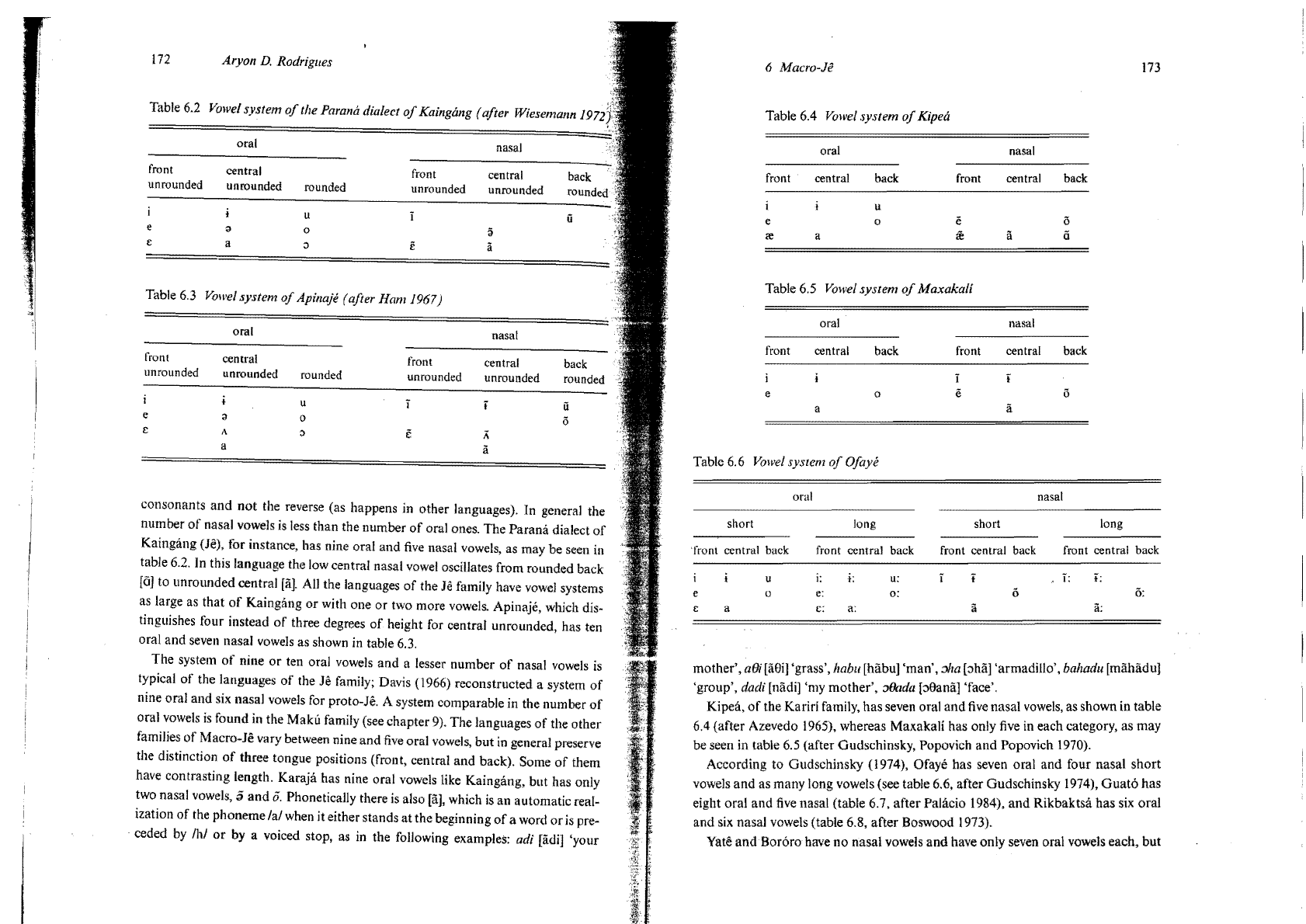
instance,
has
nine
oral
and
five nasal vowels,
as
may
be
seen in
table 6.2. In this
language
the low central
nasal
vowel oscillates
from
rounded
back
[o) to
unrollnded
central
[a).
AlI the langllages
of
the
Je family have vowel systems
as large as
that
of
Kaingáng
or
with
oue
or
two
more
vowels. Apinajé, which dis-
tinguishes
four
instead
of
three degrees
of
height ror
central
unrounded,
has
ten
oral
and
seven
nasal
vowels
as
shown in table 6.3.
The
system
of
nine
or
ten
oral
vowels
and
a lesser
number
of
nasal vowels is
typical
of
the lallguages
of
the
Je
family; Davís (1966)
reconstructed
a system
of
nine
oral
and
six
nasal
vowels for proto-Jé. A system
comparable
in the
number
of
oral
vowels is foulld in
the
Makú
family (see
chapter
9).
The
languages
of
the
other
families
of
Macro-Je
vary between nine
and
five
oral
vowels,
but
in general preserve
the distinction
of
three
tongue position8 (front, central
and
back).
Sorne
of
them
have
contrasting
length.
Karajá
has
nine
oral
vowels Iike
Kaingáng,
but
has
only
two nasal vowels,
j
and
o.
Phonetically thefe is al80 [a], which
is
an
automatic
real-
izatíon
of
Ihe
phoneme
lal when it either
stands
at
the
beginning
of
a word
or
i5
pre-
ceded
by Ihl
or
by
a voiced stop, as in the following examples: adi [adi]
'your
6 Macro-le
173
Table 6.4
Vowel
system
01
Kipeá
fron!
oral
central
back fron!
nasal
central
back
u
e
o
é
o
re
a
re
ji
a
Table 6.5
VOlVe[
system
01
Maxakalí
oral nasal
front central
back front
central back
e
a
o é
¡¡
o
Table 6.6
Vowel
system
olOlayé
oral nasal
short long
shor!
long
'rront central back
front central back fron! central back
front central back
u
i:
i:
u:
i
i: i:
e
o
e:
o:
Ó
5:
e
a
e:
a:
a
a:
mother',
aOi(aOi]
'grass',
habu [habu]
'man',
:Jha
[::lha]
'armadillo',
bahadu
[mahadu]
'grollP', dad; [nadi]
'my
mother',
:JiJada
[::lean a] '[ace'.
Kipeá,
of
the
Karirí
family,
has
seven oral
and
five
nasal
vowels, as
shown
in table
6.4
(arter
Azevedo 1965),
whereas
Maxakalí
has
only five in
each
category,
as
may
be
seen in table 6.5
(after
Olldschinsky, Popovich
and
Popovich 1970).
According
to
Oudschinsky
(1974), Ofayé
has
seven
oral
and
four
nasal
short
vowels
and
as
many
long
vowels (see table 6.6,
after
Gudschinsky
1974),
Guató
has
eight
oral
and
five
nasal
(table
6.7,
after
Palácio 1984).
and
Rikbaktsá
has
six
oral
and
six
nasal
vowels (table 6.8,
after
Boswood
Yaté
and
Boróro
have
no
nasal
vowels
and
have only seven
oral
vowels
each,
but