
Dixon R.M.W., Aikhenvald Alexandra Y. The Amazonian Languages (Cambridge Language Surveys)
Подождите немного. Документ загружается.

\
414
Alexandra
Y.
Aikhelll'ald
ms.
'Verb
compoundíng
and serialization in
Tariana'.
in prep.
A grammar
o/
Tariana.
Ardila,
0.1989.
'Diversidad lingüística y mullilingüismo en los grupos Tucano del
Forma
y
Función,
4.23-34.
Barnes,
J.
1985. 'Evidentials in the Tuyuca
verb',IJAL,
50,225-71.
) 990. 'Classífiers in Tuyuca', pp. 273-92
01'
Amazonian lillgl/istics: sllldies in Lowland
SOllth
American [ndian Imrguages,
ed. Dorís
L.
Payne. Austín: Uníversity
01'
Texas Press,
1996. 'Autoscgments wíth three-way lexical
contrasts
in
Tuyucu',lJAL,
62.31-58.
Bessa Freire,
1.
1983,
'Da
"fala
boa"
ao
portugues
na
Amazonia
brasilcira',
Amerindia,
8.39-83.
Brlizzi, A. A.
da
S,
]967.
Obsen'ar{Jes gramaticais da língua Daxseyé
011
Tucano.
Iauarete:
Centro de Pesquisas
de
lauarete.
1977.
A
cÍl'iliza~ilo
indfgena do
Vaupés.
Rome: Las.
Campbell,
L.,
Kaufman,
T.
and
Smith-Stark,
'[
1986. 'Meso-America as a linguistic area',
Langllage,
62.530-70.
Dixon, R.
M.
W.
1994.
r./'gativity.
Cambridge: Cambridge University Press.
DixOL1.
R.
M,
W.
and
Aikhenvald,
A,
Y.
1997.
'A
typology
01'
argumcnt-dctermined construc-
tions', pp, 71-113
01'
Essays
0/1
l(lIrguage
fimctioll and lang!lage /ype,
ed,
J.
Bybee,
1.
Haiman
and
S.
Thompson,
Amstcrdam: John Benjamins.
Galviio,
E.
1919. 'Acultura<;:ao indígena
no
rio Negro', pp. 135-92
of
his
EIICOlllro
de
soci-
edades.
Rio
de
Jflneim: Paz e terra.
Goldman,
!. 1979.
The Cubeo: Indians
o/
the
Nortlnvest Amazon.
2nd edilion. Urbana:
University
of
lIlinois Press.
Gomez-Imbert,
E.
1988. 'Construcción verbal en
barasana
y tatuyo',
Amerindia,
13.97-108.
1996. 'When animals become "roundcd"
and
"femininc": conceptual categories
and
tic c\assification in a multilingual setting', pp. 438-69
of
Rft/¡¡nking lingl/islic
ed,
1. 1.
Gumperz
and
S.
C.
Levinson. Cambridge: Cambridge University Press.
Gralow,
F.
L. 1980.
'Formas
de tematización en corcguaje',
Artículos
en
lingüística y campos
afines,
8.1-36.
Grimes.
B.
F.
1985. 'Language altitudes: identity, distinctivcness. survival in the Vaupés',
Joumal
of
Multilillglla{ and Mlllticultllml Development, 6.389-401.
(ed.) 1988,
Etlmofague: lallguages
of
lhe
world.
II
th
edition. Dalias:
Wyc1iffe
Bible
Translators, Inc.
Gumperz,
1.
1.
and
Wilson,
R.
1971. 'Convergence
and
creolization. A case
fmm
the
Inde-
Aryan/Dnwidían
border
in
India', pp. 151-68
of
Pidgil1izatial1 {wd creolizatian
af
lan-
guages,
ed.
D.
Ilymes. Cambridge:
Cambridge
University Press,
lleath,
1.
1978.
Linguistic ditfllsion
in
Amlrem Land.
C¡mberra: Australian Institute
01'
Aboriginal Stlldies.
1981.
'A
case
01'
intensive lexical diffllsion',
Language,
57.335··67.
Huber, R.
Q.
and
Reed. R.
B.
¡992.
Compal'arive vocabulmy: selected wards
in
indigenol/S lan-
guages
of
Colombia.
Santale
de Bogotá: Asociación Instituto Lingüístico de Verano.
Hugh-Jones, C. 1979,
From
tire
Milk
Rivel:'
spatial and temporal processes
in
nOl'lhwest
Amazonia.
Cambridge: Cambridge University
Pres&
H ugh-Jones,
S.
O. 1979.
Tire
palm and
tire
pleiades: initiatian and cosmology
in
nort/¡west
Ama?onia.
Cambridge: Cambridge University Press.
Jackson,
1.
1974.
'Language
identity
of
the
Colombian
Vaupés Indians', pp. 50-64
of
Explorations
in
the ellmograp/¡y 01 speaking,
ed. R. Bmunan
and
J.
Sherzer. Cambridge:
Cambridge UniversÍly Press,
Jones,
W.
amI Jones,
P.
1991.
BamSlll10
syllta,\;,
Studies in the languages ol' Colombia, 2.
Dalias:
SIL
and
the University
of
Texas
at
Arlington.
14 ¡fana-Vaupés
area
415
Kinch, R. A. 1977, 'El
enfoque
temático
vs
el
enfoque
no
temátíco
en
yuriti',
Estudios
TI/canos,
2.129-75.
Koch-Grünberg,
T.
1911. 'Aruak-Sprachen Nordwestbrasiliens und der angrenzenden
Gebiete',
Mittei/ulIgen
del'
anthropologischen Gesellschaft,
41.33-153,203-82.
Malone,
T.
1987.
'Proto-Tucanoan
and
Tucanoan
genetic relationships'. Colombia: Instituto
Lingüístico dé Verano. Ms.
Martins, S. A. 1994. 'Análise
da
morfosintaxe
da
língua
Daw
(Makú-Kama)
e fiua classill-
ca.;:ao tipológica',
MA
thesis, Universidade Federal
de
Santa
Catanna,
Flonanópolis,
Brazil.
Masica, C.
P.
1976.
Defining
a
linguistic area:
SOl/tI!
Asia,
Chicago: University
of
Chicago
Press.
Metzger, R.
G.
1981.
Gramótica popula!' del Carapana,
Bogotá: Instituto Lingüístico
de
Verano.
Moore,
D.
L., Faeundes,
S.
and
Pires, N.
N.
1994,
'Nheengatu
(Língua Geral Amazónica), its
history alld the effects
of
language contact', pp. 93-118
of
Proceedings
of
Ihe
Meeting
of
SSILA
Ju/y
2-4,1993
and
lile Hokan-Pelllltian Workslwp. July
3,1993,
ed.
M.
Langdon.
Berkeley: University
01'
California.
Nimucndajú,
C.
1950/5.
'Reeonhecimento
dos Rios
I<;una,
Ayari e Vaupés',
Joumal
de
la
Société des Amérícanistes,
n.
s"
39,125-82,44.149-78.
1982,
Textos indigenistas.
Sao
Paulo: Edi.;:6es Loyola.
Oliveira, A.
E,
de. 1975.
'A
terminologia
de
parentesco Baniwa',
Boletim
do
Museu Pamense
Emflio Goeldí,
NOl'a
Séri/', Antropologia,
56,
Belém.
Payne,
Doris
L.
1991.
'A
c\assifieation
of
Maípuran (Arawakan) languages
based
on
shared
lexical retentiolls', pp. 355-49901"
HClIldbook
of
Amazonian languages,
vol. I1I, ed, D,
e
Derbyshire
and
G.
K,
Pullum. Berlin:
Moulon
de
Gruyter.
Ramirez, H. 1997.
A filia Tukano dos Yepa-masa. Tomo
1:
Gramótica.
Manuus:
Inspetoria
Salesiana,
Reichel-Dolmatoff, G. 1986.
Desana: simbolismo
de
los indios Tukano del Vallpés.
Bogotá:
Nueva
biblioteca
colombiana
de cultura.
Rodrigues, A. D. 1986.
Línguas brasileiras: pllra o conhecimento
das
língllas indígenas.
Sao
Paulo: Edi<;oes Loyola.
Sherzer,1. 1973. 'Arcallinguistics in
North
America', pp. 749-95
01'
Current trends
[n
Unguis-
tics,
vol. X, ed.
T.
Sebeok.
The
Haguc: Mouton.
1976.
An
areal-typalogical
swdy
al
Americall
IlldiclII
lallguáges
Ilortll
o/
Mexico.
North
Holland
Linguistic Series, 20. Amsterdam:
North-Holland.
Sílverwood-Cope,
P.
L.
1990,
Os Makli: povo
ca~ador
do
Noroeste da Amaz¡)lIia.
Brasilia:
Editora
da
lJniversidade Nacional
de
Brasília.
Sorensen. A.
P.,
.Ir.
1967 (1972). ·Mi.lttilingualism
in
the Northwest
Amazon',
American
Antlrropologist,
69.670-84 (reprinted in 1972, pp, 78-93
of
Sociolingllislics,
ed.
J.
B.
Pride
and
1.
Holmcs.
Harmondsworth:
Penguin),
Taylor, G. 1990.
Intl'odu~i'lo
illíngua Balliwa
do
l~ana.
Campinas: Editora
da
Unicamp.
Tholllason,
S.
G.
and
Kaufman,
T.
1988.
Lallguage cOlltact, creo!ization alld genetic lillguis-
tic.~.
Berkeley
and
Los Angeles: LJniversity
of
California Prcss.
Valadares,
S.
M.
B.
1994. 'Aspectos
da
Jíngua Kurrípako (Kumandene)',
MA
thesis,
Universidade Federal de
Santa
Catalina,
Florianópolis, Brazil.
Waltz, N.
and
Wa
Itz
, C. 1967.
'Guanano
phonemics', pp. 25-36
of
Pilonemic systems
of
Colombian languages.
Norman:
SIL
and
University
of
OkJ¡thoma,
Weinreích,
U.
1964.
l.anguages
in
contact: findings and problems.
The
Hague:
Mouton.
Weir,
E.
M.
H.
1984,
'A
ncgaQuo e olllrOS tópicos
da
gramática
Nadeb',
MA
thesís,
Universidade Estadual
de
Campinas, Brazil.
416 Alexandra
Y.
Aikhenvald
1990.
'Incorporation in Nadeb',
pp.
321-66
of
Amazonian linguistics: stl/dies
in
Lowland
SOtll1r
American Indian languages,
ed. Doris
L.
Payne. Austin: University
of
Texas
Press.
West,
B.
1980.
Gramática popular
del
Tucano.
Bogotá: Instituto Língüístico de Verano.
Wheeler,
A.
1987.
Ganteya Baln: el pueblo Siona del
/,[0
Putl/mayo, Colombia. Tomo
J.
Etnología. gmmática, textos.
Bogotá: Instituto Lingüístico de Verano.
Whisler,
D.
and Whisler,
J.
1976.
'Fonología del tatuyo',
Sistemas fonológicos
de
Idiomas
Colombianos,
3.113-22.
15
The
Upper
Xingu as
an
incipient
linguistic area
LUCY
SEKI
THE
UPPER
XINGU
AND
ITS
LANGUAGES'
When the Portuguese carne to Brazil they lost
no
time in colooizing the coasts and
rivers. The Xingu, a major southern tributary
of
the Amazon,
is
navigable
for only 200 kilometres. After this there are innumerable rapids, which proved a
barrier to the invader.
As
a consequence, the Upper Xingu area remained unmo-
lested.
The
Jodian tríbes living therewere able, by
and
large, to maintain their tra-
ditional way
of
Ji
fe.
Other tribes converged on this region, as a haven
of
escape from
the white man's takeover
of
BraziL (lo addítion, some tribes were sent to the Xingu
area by the Europeans.) Contact wíth the outside world was only really established
in the
19508.
As a result, the Upper Xingu region - which was, in
1961,
declared a 'national
, park'
by
the Brazilian government
is
remarkable for
its
Iinguistic diversity.
Cultural traits diffuse more quickly than linguistic ones. The Upper Xingu has
become culturally rather homogenous, due
to
cIose intertribal contacts, a network
of
intermarriage and the sharing
of
material culture. But linguistic diffusion
is
as
yet
in
its early stages; what
we
have here
is
an incipient linguistic area.
1.1
Languages spoken
There are currentlv
17
indigenous
g'i'OUPS
in
lhe Upper Xingu and lhe
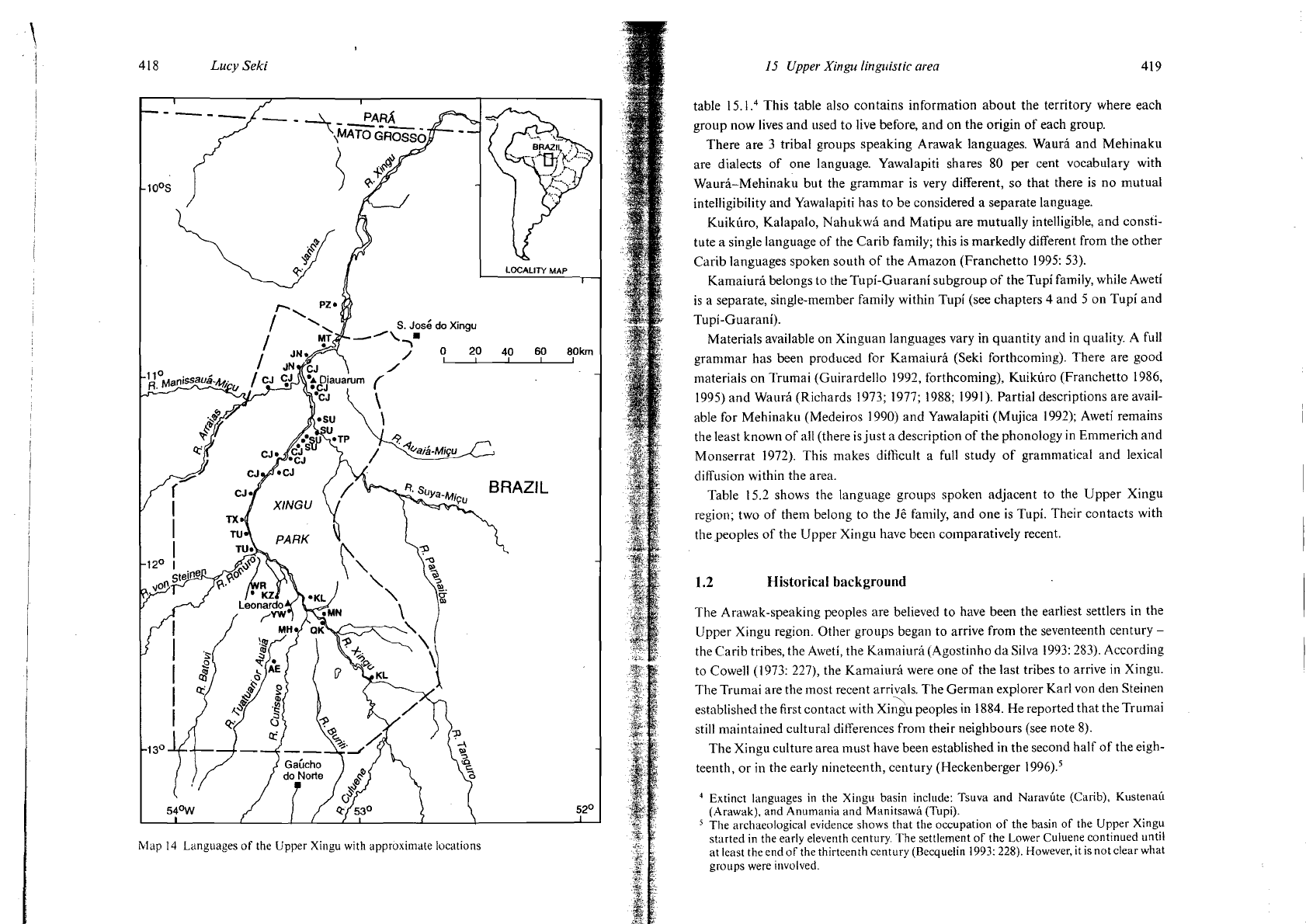
arcas. See map
14.
\O
01'
them
2
have becn there
fol'
more than
100
years. The
languages spoken and lhe number
01'
speakcrs
J
in lhe Upper are Usted
in
I
1 am grateful lo Frantomé
B.
Pacheco,
fol'
infol'mation on Carib languages.
2
Sínce Nahukwa and Matipu
live
together
in
one village, they are sometimes considel'ed as
(Sekí forthcoming).
of
speakers
in
tables 15.1-15.3 are
according to Baruzzi, Rodrigues,
Mendon<;:aet
al.
(1995); data
on
Yawalapiti are
Mujica(1992).
1
419
\
418
100S
(
I
I
I
Lucy
Seki
~
PARÁ
- -
\MATO
GROSSo.
.~'Ir
.¡
~:
.~
,/l!
~
.,y
I
~
S.
José do Xingu
--\..
.
') 9
2p
4?
sp
apkm
(
\
,
~""
./
"-
\
"?
-<)
~
'"'"
~"
O'
.,
~~\
\i
BRAZIL
52°
Map
14
Langllages
of
the Upper Xillgll with approximate locatiolls
15 Upper Xingu Unguis/ir area
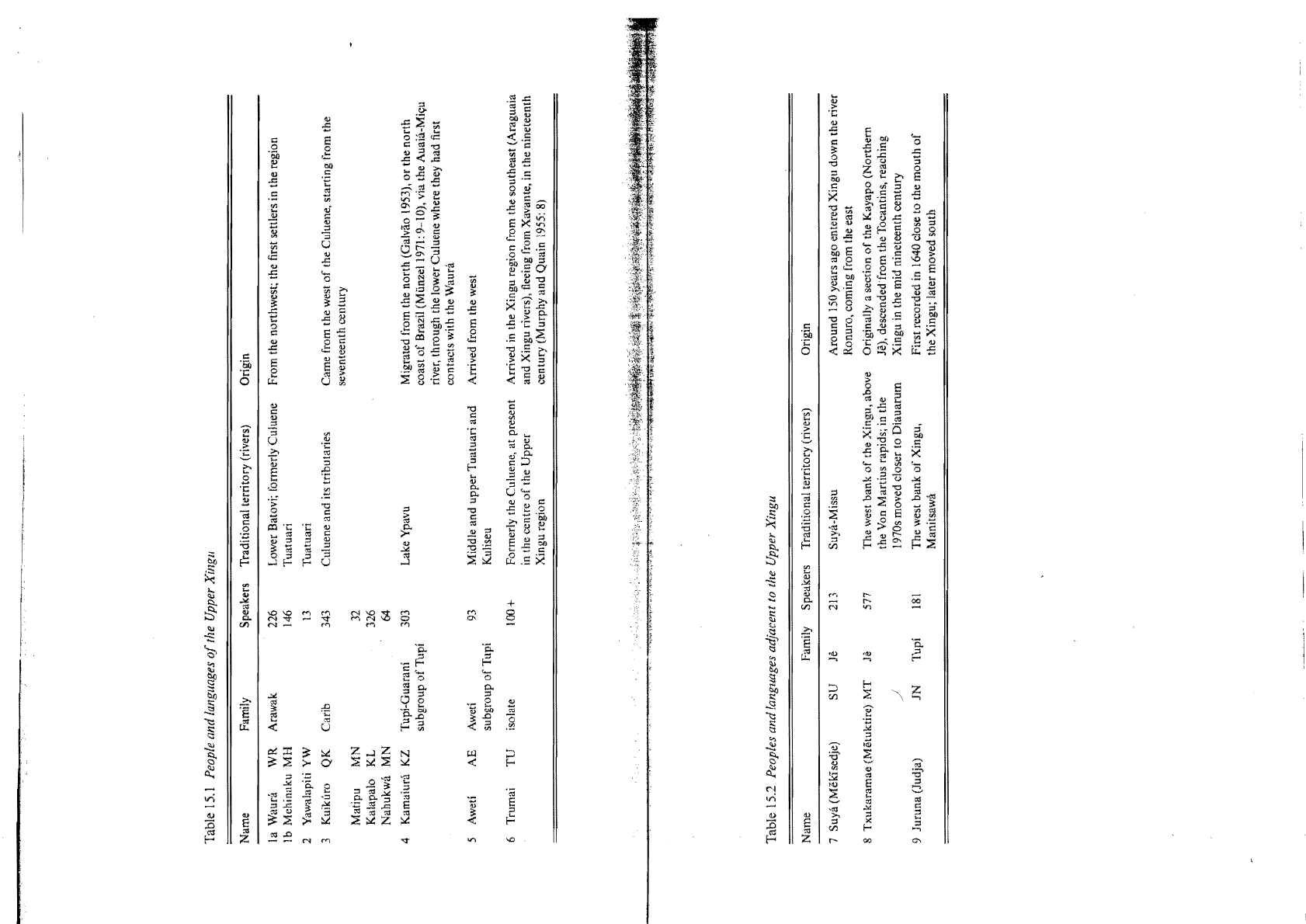
table
15.1.
4
This table also contains information
about
the territory where each
group now lives and used to live before, and on the origin
of
each group.
There are 3 tribal groups speaking Arawak languages. Waurá and Mehinaku
are dialects
of
one language. Yawalapiti shares
80
per cent vocabulary with
Waurá-Mehinaku
but the
grammar
is
very different, so that there
is
no
mutual
intelligibility and Yawalapiti has to be considered a separate language.
Kuikúro, Kalapalo,
Nahukwá
and
Matipu are mutually intelligible, and consti-
tute a single language
of
the Carib family; this
is
markedly different from the other
Carib languages spoken south
of
the Amazon (Franchetto
1995:
53).
Kamaiurá belongs to the Tupí-Guaraní subgroup
of
the Tupí family, while Awetí
is
a separate, single-member family within Tupí (see chapters 4 and 5 on Tupí and
Tupí-Guaraní).
Materials available on Xinguan languages vary in quantity and
in
quality. A full
grammar has been produced for Kamaiurá (Seki forthcoming). There are good
materials on Trumai (Guirardello
1992,
forthcoming), Kuikúro (Franchetto
1986,
1995)
and
Waurá (Richards
1973; 1977;
1988;
1991).
Partial descriptions are avail-
able for Mehinaku (Medeiros
1990)
and Yawalapiti (Mujica
1992);
Awetí remains
the least known
of
all (there
isjust
a description
of
the phonology
in
Emmerich and
Monserrat
1972).
This makes ditllcult a
full
study
of
grammatical and lexical
diffusion within the area.
Table
15.2
shows the language groups spoken adjacent to the
Upper
Xingu
region; two
of
them belong to the
le
family, and one
is
Tupí. Their contacts with
the ,peoples ol' the U pper Xingu have been comparatively recen!.
1.2
Historical background
The Arawak-speaking peoples are believed
to
have been the earliest settlers in the
Upper Xingu region. Other groups began to arrive from the seventeenth century -
the Carib tribes, the Awetí, the Kamaiurá (Agostinho
da
Silva
1993:
283).
According
to Cowell
(1973: 227),
the Kamaiurá were one
of
the last tribes to arrive
in
Xingu.
The Trumai are the most recent arrivals. The German explorer Karl von den Steinen
established the first contact with
Xj¡~u
peoples
in
1884.
He reported that the Trumai
still maintained cultural differences from their neighbours (see note
8).
The
Xingu culture area must have been established in the second half ol' the eigh-
teenth,
or
in
the early nineteenth, century (Heckenberger
1996).5
4
Extinct languages
in
the Xingu basin inclllde: Tsuva
and
Naravúte (Carib), Kustellaú
(Arawak),
and
Anumania
and
Manitsawá
(Tu pi).
5
The
archaeological evidence shows
that
the occupation
of
the basin
of
the
Upper
Xingu
started
in the early eleventh centllry.
The
settlement
of
the Lower Culllene continued until
at
least the
end
of
the thirtcenth century (Becquelin 1993: 228). However, it
is
not
clear what
groups were involved.
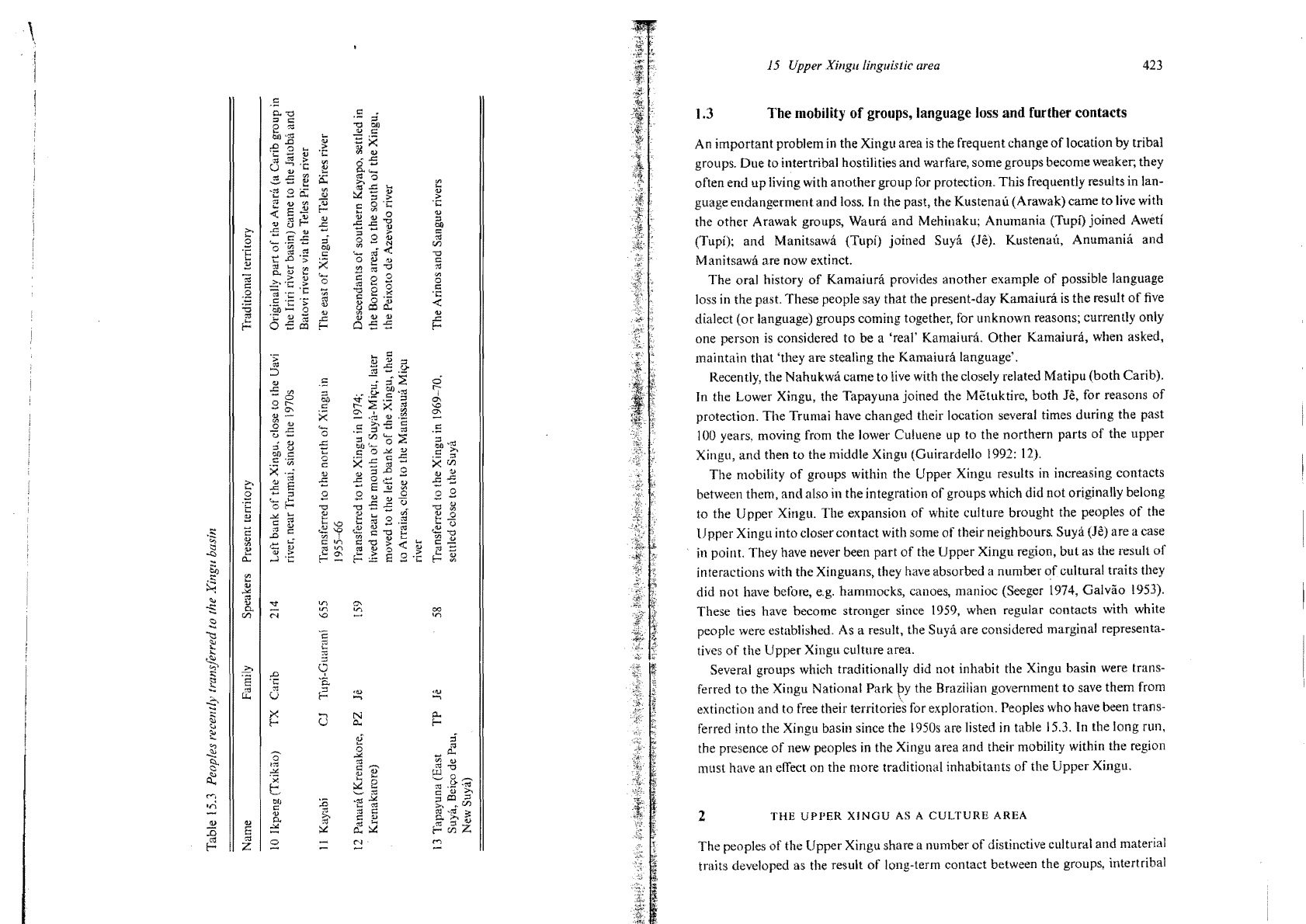
Table
15.1
People
and
languages
o/
rhe Upper Xingll
Name
Pamily Speakers Traditional territory (rivers) Orígin
la
Waurá
WR
Arawak
226
Lower Batovi; t'ormerly Culuene
From tne nortnwest; the first settlers in the regíon
1 b Mehinaku
MH
146
Tuatuarí
2
Yawalapítí
YW
13
Tuatuarí
3
Kuíkúro
QK
Carib 343 Culuene
and
its tríbutaries Carne from Ine wesl
of
Ihe Culuene, startíng from the
sevenleenth century
Matipu
MN
32
Kalapalo
KL
326
Nahukwá
MN
64
4
Kamaiurá
KZ
Tupí-Guaraní
303
Lake Ypavu
Mígrated from the north (Galvao 1953),
or
the
north
subgroup
01'
Tupí
coast
01'
Brazil (Münzel 1971: 9-10), vía the Auaíá-Mi;;u
river, through tne lower Culuene where they
had
first
conlacts wíth Ihe Waurá
S
Awelí
AE
Awetí
93
Middle and upper Tualuarí
and
Arrived from Ihe wesl
subgroup
ofTupí
Kuliseu
6
Trumai
TU
ísolate
100+ Formerly rhe Culuene, at present
Arrived in Ihe Xingu regio n [rom Ihe southe-ast (Araguaia
in Ihe centre
of
Ihe
Upper
and
Xingu rivers), fieeing from Xavante, in Ihe níneteenlh
Xíngu regíon century (Murphy and Quain
1955:
8)
Table 15.2
Peoples
and
languages adjacent
lo
lhe
Upper Xingu
Name
Famíly Speakers Traditíonal territory (rivers)
7 Suyá (Mekísedje)
SU
le
213 Suyá-Missu
8
Txukaramae
(Métuktire)
MT
Je
577
The west
bank
of
the Xingu, aboye
the
Von
Martius rapids; in the
1970s moved closer to
Díauarum
9
Juruna
(Judja)
JN
lupi
181
The
wesl
bank
01'
Xingu,
Manitsawá
Origin
Around 150 years ago entered Xingu down the river
Ronuro, coming [rom Ihe east
Originally a sectíon
of
lhe Kayapo (Northern
Je), descendedfrorn the Tocantins, reaching
Xingu in the mid nineteenth century
First recorded in 1640 close
to
che
mouth
of
the Xingu; later moved south
\
15 Upper
Unguis/ic
area
423
.5
0.-0
.5 ;:Í
1.3 Tbe rnobility
of
groups, language loss and further contacts
'"
¡::
-O
0Il
o
'"
'-'
e
to'~
ti
1jx
A n important problem
in
the Xingu area
is
the frequent change
of
location by tribal
:e
'3
t
.~
.,
.,
-.c
;
.r;;.~
:G
0-
groups. Due to intertribal hostilitíes and warfare, sorne groups become weaker; they
0.<....
u
Ven.:::
¿
-5
~
.::...
¡:;
often end up living with another group for protection. This frequently results in lan-
'é
.9
ce
]
u - "
~
~~
~
"'"
::>
>-
'C
guage endangerment and
los$,
In the past, the Kustenaú (Arawak) carne to live with
e
E
~ ~
E
~
"C
_ _
1J
" ., o
the other Arawak groups, Waurá and Mehinaku; Anumania (Tupí) joined Awetí
i::'
¡;
o
~ ~
.c.<::-O
0Il
'"
"
~
'2
~
::l
;'j
(Tupí); and Manitsawá (Tupí) joined Suyá
(le).
Kustenaú, Anumaniá and
~
2
~
<:Il
2
o
';;;;
~o
'-
,f
<
"O
'E
1.:
2
*;;
x
e
Manitsawá are now extinct.
o " "
~
11;\;1
'"
<;¡
~
~ ~
ti
¡::
o
o
o
'"
O
The oral history
of
Kamaiurá another example
of
possible language
~
l...
¡::
¿:~'~'c
+.:n
"'Q
e
x:
'C
'"
.g
loss in the past. These people say that the present-day Karnaiurá
is
the result
of
five
.~:5'~
~
8~;f
<
:.c
'"
'"
dialect
(or
langllage) groups coming together, for unknown reasons; currently only
'" '"
1)
,::
'"
0-5-5
one person
is
considcred to be a 'real' Kamaiurá. Other Kamaiurá, when asked,
5-s
~ ~
F
'S;:
....
c::
maintain that 'they are stealing the Kamaiurá langllage'.
~]
::1
:3
~
......
S?
Recently, the Nahukwá carne to
Uve
with the closely related
(both Carib),
.S
;:Í
;:Í:::2
ó
.c
"
'"
::>
.;,.¡.S:r
~~~
'1
-o
In the Lower
the Tapayuna
the Metuktire, both
Je,
for reasons
of
oc-
gf
$
~~><~
-'"
~~
1)
__
'"
protection. The Trumai have changed their location several times during the past
.,
-
X
'"
=
~..c
'2
-§-s
.6
::>
'"
"
'o
';;
a
~
~
100
years, moving from the lower Culuene
IIp
to the northern parts
01'
the upper
Q:l)
~(!j
-
.,
00
'_
0:::2
::>
u
-5
;::
O..llt
u
'"
>,
Xingu,
and
then to the middle Xingu (Guirardello
1992:
12).
e
'C;;
o
v.cC::.c
'-
::>
00
"
c::
"....
....
ro
.....
X<:Il
'd)
::1
.J:J
o
X';j
" "
The mobility
of
grollps within the Upper Xingll results in increasing contacts
¡:,
-E
~~~~
-5-=
~
§
o
¡;:; !lJ
V'i
between them, and also in the integration
of
groups which did not originally belong
2
.....
o
~
e
.;:;
2
.~
'o'::
"O
"O~..t=Q
-O
ill
'U
L.o:
.......
<If
to the Upper Xingu. The expansion
of
white culture brought the peoples
of
the
B
~
~
::l
'"''-O
E
~
3
.~
t~
]
~
e
Upper Xingu into c1osercontact with sorne
of
their neighbours. SlIyá
(Je)
are a case
:::
'"
~c"C)~
","O
..o
..:
~'i'
c::
.,.,
e
"'O
o
¡,.."
1il
J!::
~
~uE;<;.)
'"
:'3-:::
"
in point. They have never been part
of
the Upper Xingu reglon,
bul
as the reslIlt
ar
j
'C:
~~
¡-.
1:
6 2
.¡:
é
v
J:
.
'"
interactions with the Xingllans, they have absorbed a number
of
cultural traits
¡:;
:>.i
.~
II
did not have before,
e.g.
harnmocks, canoes, rnanioc (Seeger 1974, Galvao
1953).
:::
,..
...
.,;-
V)
<1,
00
o..
"S
These lies have become stronger since
1959,
when regular contacts with white
N
""
.,..,
VI
'"
""
s
were established. As a result, the are considered marginal representa-
~~
tives
of
the Upper culture area.
q
~
b
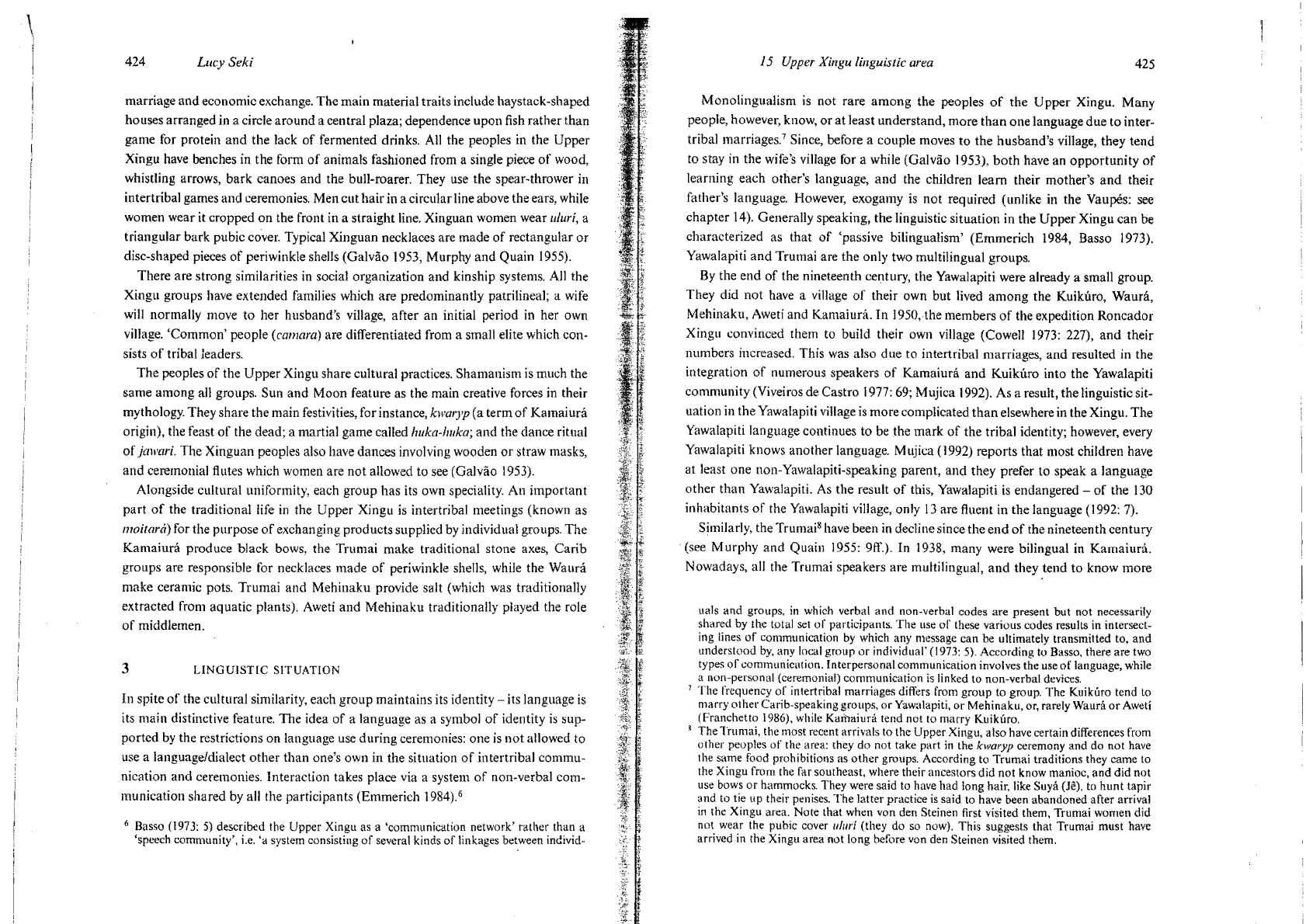
Several groups which traditionally did not ínhabit the Xingu basin were trans-
..o
'8
'C
'6.
.
.,
ferred lo the Xingu National Park
~y
the Brazilian government
to
save thern from
<",
¡¡:
V
'"
,::
-.
....,
-t~
extinction and to free their territoríes ror exploration. Peoples who have been trans-
~
¡::
~
~
u
'-'
ferred into the Xingu basin since the
19505
are li5ted in table
15.3.
In the long run,
~
;:Í
~
:::
the presence
of
new peoples in the Xingu afea aml theír mobility withín the region
_.::...
""
...::::
~
O'
,:::
'"
.,
e
'"
~
"'"O
~
must have an cffect on the more traditional inhabitants
of
the
Xingu.
...
.,
~o
""
'"'
....
<>~
d:;
~
e
~
.....
~~
e '"
>.
f"".
~
'"
;:l
¡:c
::>
~~
..!:.!
O~
.,..;
c:
:o
....
ro
"
'"
c::
c.>.;;>
ª
¡;;
••
,f
c;:
2
THE
UPPER
XINGU
AS A
CULTURE
AREA
.,
&
~
¡:: "
:o
<!)
;:!!
~
&:~
FaZ
6
,..,
O
N
Z
'"
The peoples
01'
the Upper Xingu share a number
of
distinctive cultural and material
traits
as the result
of
long-term contact between the graups. intertribal
~
425
\
!
424
Lucy
Seki
marriage and economic exehange. The main material traits ¡nelude haystack-shaped
houses arranged in a eircIe around a central plaza; dependenee upon
fish
rather than
game for protein and the lack
of
fermented drinks.
AIl
the peoples in the Upper
Xingu have benches in the form
of
animals fashioned from a single piece
of
wood,
whistling arrows, bark canoes and the bull-roarer. They use the spear-thrower
in
intertribal games and ceremonies. Men cut hair
in
a circular tine aboye the ears, while
women wear it cropped on the front in a straight
lineo
Xinguan women wear
ulurí,
a
triangular bark pubic cover. Typical Xinguan necklaces are made
of
rectangular
or
disc-shaped pieces
of
periwinkle shells (Galvao 1953, Murphy and Quain
1955).
There are strong similarities
in
social organization and systems.
AH
the
Xingu groups have extended families which are predominantly patrilineal; a wife
will
normally move
to
her hllsband's village, after an initial period
in
her own
village. 'Common' people
(camara}
are differentiated from a small elite which con-
sists
of
tribal Jeaders.
The peoples
of
the Upper
share cultural practices. Shamanism
i8
much the
same among all groups. Sun and Moon feature as the main creative forces in their
mythology. They share the main festivities, for instance,
kwaryp
(a term
of
Kamaiurá
origin), the feast
01'
the dead; a martial game called
huka-hllka;
and the dance ritual
of
jawari.
The Xinguan peoples also have dances involving wooden
or
straw masks,
and ceremonial fiutes which women are not allowed to
see
(Galvao 1953).
Alongside cultural uniformity, each group has its own speciality. An important
part
of
the traditional life
in
the Upper Xingu
i5
intertribal meetings (knowll as
moitará)
for the pllrp05e
of
exchanging products supplied by individual groups. The
Kamaiurá produce black bows, the Trumai make traditional stone axes, Carib
groups are responsible for necklaces made
of
periwinkle shells, while the Waurá
make ceramic pots. Trumai and Mehinaku provide salt (which was traditionally
extracted from aquatic plants). Aweti and Mehinaku traditionally played the role
of
middlemen.
3
LlNGUISTlC
SITUATION
In spite
of
the cultural similarity, each grollp maintains its - its language
is
its maill distinctive feature. The idea
of
a language as a
of
identity
is
sup-
ported
by
the restríctions on language use during ceremonies: one
is
not allowed to
use a language/dialect
other
than one's own in the sitllatioll
of
intertribal commll-
nication and ceremonies. Interaction takes place via a system
of
non-verbal com-
munication shared by all the participants (Emmerich
1984).6
6
Basso (1973:
5)
described the Upper Xingu as a 'communication network' rather than a
'speech cornmunity',
Le.
'a
syslem consisling
of
several kinds
of
linkages between indívid-
J
5
Xingu linguistic area
Monolingualism
i8
not rare among the peoples
of
the Upper Xingu. Many
people, however, know,
or
at
least understand, more Ihan one language due
to
ínter-
tribal marriages.
7
Since, before a couple moves
to
the husband's village, they tend
to stay
in
the wife's village [or a while (Galvao 1953),
both
have an opportunity
of
learning each olher's language,
and
!he children learn their mother's
and
their
father's language. However, exogamy
is
not required (unlike in Ihe Vaupés:
see
chapter 14). Generally speaking, the linguistic situation in the Upper Xingu can be
characterized as that
of
'passive bilingllalism' (Emmerich 1984, Basso 1973).
Yawalapiti and Trurnai are the only two multilingual groups.
By
the end
of
the nineteenth century, the Yawalapiti were already a smalJ group.
did not have a village
of
their own but lived among Ihe Kuikúro, Waurá,
Mehinaku, Aweti and Kamaiurá.
In
1950,the members
of
the expeditíon Roncador
Xingu convinced Ihem to build their own village (Cowell
1973:
227),
and
their
numbers increased. This
was
also due to intertribal and reslllted in the
integration
of
numerOllS
speakers
of
Kamaiurá and Kuikúro into the Yawalapiti
community (Viveiros de Castro 1977: 69; Mujica 1992). As a result, the Iinguistic sit-
uation
in
the Yawalapiti village
i3
more complicated
than
elsewherein the Xingu. The
Yawalapiti language continues to be lhe mark
of
the tribal identity; however, every
'awalapiti knows another langllage. Mujica (l992} reports that mos! children have
at least one non-Yawalapiti-speaking parent, and they prefer to speak a language
other than Yawalapiti.
As
the result
of
Ihis, Yawalapiti
is
endangered - of the
130
inhabitants
of
the Yawalapiti village, only
13
are fillent in the language (1992:
SimiJarly, the Trumai
8
have been
in
decline since the end
of
the nineteenth century
(see Murphy
and
Quain
1955:
9tT.).
In 1938, many were bilin2ual in Kamaiurá.
Nowadays,
alJ
the Trumai speakers are
and
they tend to know more
uals
and
groups,
in
whích verbal
and
non-verbal codes are present bul not necessaríly
shared by .lhe total sel
of
participants. The
use
01'
these varíous eodes results
in
intersecl-
ing lines
of
communícalion by which any messagc can
be
ultimately transmitted to, and
understood
by,
any local group
or
individual' (1973:
5).
According lo Basso, Ihere are
two
types
of
communicntion. Interpersonal communication involves ¡he use
of
)anguage, while
a non-personal (ceremonial) communicatíol1
is
linked to non-verbal deviccs.
1
The frequency
or
intertribal marriages differs rrom group lo group. The Kuikúro lend lo
marry other Carib-speakinggroups,
or
Yawalapilí,
or
Mehinaku, or, rarely Waurá
or
Awetí
(Franchetto 1986), while Kama.iurá tend no!
10
rnurry Kuikúro,
!
The Trumai. Ihe mosl recent arrivals to Ihe Uppcr Xingu, also
huye
cerlain differences from
other peoples
01'
the area: they
do
not take part
in
the
kwol'yp
ceremony and
do
not have
lhe same food prohibitions as
other
groups. According to Trurnaí Iraditions they carne lo
Ihe Xingu from the far southeast, where their ancestOfS did nol know manioc,
and
did not
use bows
or
nammocks. They were said lo have had long hair,
Iike
Suyá
(Je),
lo
nunt
and
lO
tie up Iheir penises. The lalter praclice
is
said lo have been abandoned after
in
the Xingu area. Note that when von den Steinen firsl visiled Ihem, Trumai women did
not wear the pubic cover
U/I//'í
(Ihey do so now). This sllggests that Trumai musí have
arrivedin the Xingu area not long before von den Steinen visited them.
I
\
426
Seki
than
do
other
Xinguan peoples. Children tend first to learn languages
other
than Trumai (claiming that Trumai
is
too
hard). Trumai is likely to become
endangered in the
near
future (Guirardello
1992:
20).
4
INCIPIENT
AREAL
DIFFUSION
IN
THE
UPPER
XINGU
Given the
short
time depth
and
Iimited multilingllalism,
one
would
not
expect to
find many traces
of
lingllistic diffusion in the
Upper
Xingu.
Since the Arawak peoples were probab!y the first to have setttled
in
the area
followed by
Carib
and
Tupí,
and
then by Trumai one would expect the great-
est area! diffusion to be between Carib, Arawak and Tupí,
and
from these languages
into
Trumai.
9
The
Je
groups Usted in table
15.2,
and JUnlna (Tupí), are marginal to
the Upper Xingll,
and
one would not expect
to
find much area! diffllsion into these
languages.
There
is
evidence
of
lexical
frol11
Kamaiurá
into
Trumai
and
into
to
8-9),
'the
songs
of
two
Trumai ceremonies, both
of
which are practiced also by Kamaiurá, show a
of
Kamaiurá words ami phrases', while words
of
Carib
and
Arawak
'are
frequent
in
other
songs'.
Among
lexical loans from Kamaiurá into
Trumai are
lllwall'i
'mat',
y'a
'calabash',
jany
'pequi oil',
and
wyrapy
'vulture'.
According to
Franchetto
(1986:
126)
Kuikúro myths
and
ceremonial discourse are
reported to
bear
an Arawak influence.
There
is
a certain
amount
01'
Jexical diffusion from
Kamaiurá
¡nto
:>uya, a mar-
member
of
the
Upper
culture area, e.g. Suyá
kall1í'mixture
of
water
and manioc bread',
parana
'river',
woasi
'corn'
from KafIlaiurá
kawJ,
parana,
(/lI'(/si
(c[
1978:
Some languages
of
the
Upper
Xingu share celiain traits which are not found
in
genetically related languages outside the area and may have developed as the result
of
area! diffusion. FOllr
of
these tralts are:
(A) The development
of
the vowel phoneme
j
in
Yawa!apiti
Vowel
systems
in
all
the
Xingllan
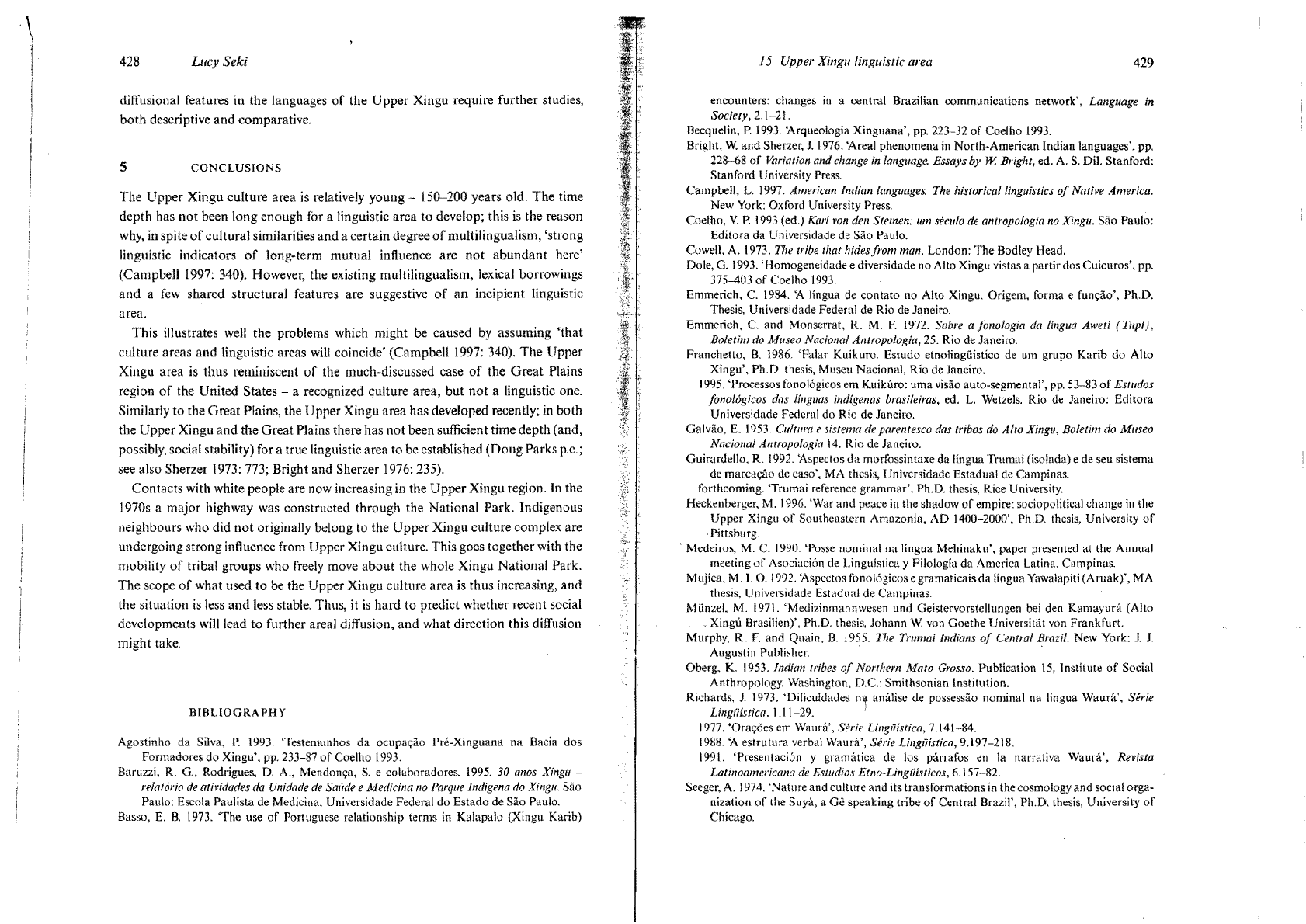
The
chart
shows vowel correspOntl
Waurá
ane!
YawalaDiti (Seki
and
Aikhenvald
forthc0111111g
The
ohonolOg¡cal
9
The Trumai, being !he latest arrivals (and
among
lhe weakest tribes in the Upper Xingu),
would
nol
be
expecled
lo
be
lhe
so urce
of
diffusion
aud
borrowing. Intereslingly, a Trumai
word
misil
'water'
is
used
iu
a
nllll1ber
of
names
of
rivers
in
Ihc uorthcrn
par!
of
Ihe Upper
Xingu, stlch as AlIaiá
Mi911,
Suyú Mh;u, Manissauú-Mi'lI.
10
The
vowel
e
is
found in
Waurá-Mehinaku.
and
Kuikúro, Aweti and
Kamaiurú
have
both
e
and
o.
/5
Upper
Xingu
Table 15.4
Vowe
linguistic
area
l
correspondences
in
Arawak
427
proto-Arawak
Waurá
Yawalapiti
*i
*e
e
*i
pre-Yawalapiti have to be ordered as follows:
(i)
*i~i;
(ji)
*e~¡.
In Yawalapiti the
two high vowels merged: then
e
shifted
to
l.
(See table 15.4.)
The
recreation
of
the
vowel
¡(after
the original ideveloped into
i)
was possibly
due
to areal pressure, since
í
is
present in every
other
Xinguan language.
(8)
Shiftp>f¡:
from Arawak
to
Carib
and
Tupí-Guaraní
A feature shared
by
genetically unrelated languages in the Upper Xingu regíon
is
the
shift In Kuikúro,
p
has become
h
in intervocalic position
(Franchetto
1995: 55). Kamaillrá (chapter 5)
and
proto-Tupí-GlIaraní
*pw
has become
Inv
or
h.
In Yawalapiti,
pi-
'2sg prefix' becomes
hi-
if
the following root begins with
IV
or
y.
This change
is
not
found in
other
Tupí-Guaraní
or
Carib
languages.
lt
is
not
unfre-
quent in Arawak langllages outside the regíon. Por example,
p
has become
h
in
Pared,
the
Arawak lal1guage which
is
genetically
and
geographically closest to
Xinguan Arawak,
and
also in a nllmber
of
North
Arawak
languages (e.g. Bahwana,
Achagua, Yavitero). One may hypothesize that the source
of
this diffllsional featme
cOllld have been the Arawak languages.
.
(C)
CV
syllable structure: from Arawak into
Carib
Al!
Arawak langllages, including those spoken in
the
Upper
Xingu, have CV sy!-
lable structure.
Carib
langllages spoken olltside
the
Upper
Xingll have
CV
and
CVC
syllables, while
the
Xinguan
Carib
language (with its four dialectal has
only
CV
sylIables.
It
may
well
be
that
this feature is
the
result
of
Arawak inflllence.
(O) Loss
of
in
Xingllan Arawak: a featllre difTusing from
Carib
and
Tupí
¡nto
Arawak
The
Arawak languages
of
the
Upper
Xingu have
lost
the
gender clistinction between
masculine
alle!
feminine illSJoss-referencing markers.
Waurá-Mehinaku
has
al so
lost genders in indepenclent pronollns.
We
may hypothesize that this
10ss
could have
occurred as the result
of
contact
with Tupí
and
Carib
languages in the Xingu, none
of
which have genders.
These
traits
are imlicative
of
an
early stage
of
area! dilfusion in the
Upper
Xingu
The
exact amollnt
ane!
the
character
of
lexical borrowings
and
other
429
\
428
Lucy Seki
1
I
diffusional features in the languages
of
the Upper Xingu require further studies,
i
both descriptive and comparative.
CONCLUSIONS
5
The Upper Xingu culture area
is
relatively young - 150-200 years old. The time
depth has not been long enough for a
area to develop; this
is
the reason
of
cultural similarities and a certain degree
of
multílingualism, 'strong
indicators
of
long-term mutual influence are not abundant here'
(Campbell
1997:
340). However, the existing multilingualism, lexical borrowings
and
a
few
shared structural features are suggestive
of
an incipient linguistic
area.
This iIlustrates
well
the problems which might be caused
by
assuming
'that
culture areas and linguistic areas
will
coincide' (Campbell
1997:
340).
The
Xingu area
is
thus reminiscent
of
the much-discussed case
of
the Great Plains
regían
of
the United States - a
recogllíz~~d
area, but
not
a linguistic one.
to the Great Plains. the
Xingu area has developed recently;
in
both
the Upper Xingu and the Great Plains there has not been sufficient time depth (and,
possibly, social stability) ror a tme linguistic area to be established (Doug Parks p.c.;
see also Sherzer
1973:
773;
Bright and Sherzer
1976:
235).
Contacts with white people are
now
increasíng
in
the Upper Xingu region.
In
the
19705
a major highway was constructed through the National Park. Indigenous
neighbours who did
not
originally belong
to
the Upper Xingu culture complex
are
undergoing strong influence
from
Upper culture. This goes together with the
of
tribal groups who freely move abont the whole Xingu National Park.
The scope
of
what used to be the Upper culture arca
is
thus increasing, and
the situatiol1
is
less and less stable. Thus, ít
is
hard to predict whether recent social
developments
will
lead to further areal diffusion, ami what direction this diffusion
mi
gh
t
take.
BIBLIOGRAPHY
Agostinho
da
Silva,
P.
1993.
'Testemunhos
da
ocupu<;:ao
Pré-Xinguana
na
Bacía dos
Formadores
do
Xingu',
pp.
233-87
of
Coelho
1993.
Baruzzi, R.
0.,
Rodrigues, D. A.,
Mendon,a,
S.
e colaboradores. 1995.
30
a/1OS
Xingll
rela!ório
de
(l/ividadl.'s
da
Unidade
de
Satíde e Medicina
no
Parque
Indígena
do
Xingu.
Silo
Paulo: Escola Paulista de Medicina. Univcrsidade Federal
do
Estado
de
Sao
Punlo.
Basso,
E.
B.
1973.
'The
use
of
Portuguese relationship terms
in
Kalapalo (Xingll Karib)
15 Upper
Xingulinguistic
area
encollnters: changes
in
a
central
Brazilian communications network',
Language
in
Socie/y, 2.1-21.
Becquelin,
P.
1993.
'Arqueologia
Xinguana',
pp.
223-32
of
Cnelho 1993.
Bright.
W.
and
Sherzer.
1.
1976. 'Areal
phenomena
in
North-American
Indianlanguages',
pp.
228-68
of
Vllriation
and
change
in
langullge.
Essays by
Iv.
Bright,
ed.
A.
S.
Dil. Stanford:
Stanford
University Press.
Campbell,
L.
1997.
American lndialllanguages.
The
historicallinguistics
of
Native Arnerica.
New York: Oxford University Press.
Coelho,
V.
P.
1993
(ed.)
Kar/
I'on
den
Sleinen:
um
século
de
antropologia
no
Xingu.
Sao
Paulo:
Editora
da
Universidade de
Sao
Paulo.
Cowell, A. 1973.
The
tribe
that hidesfrom
mano
London:
The
Bodlcy Head.
Dole, G.
1993.
'Homogeneidade e diversidade
no
Alto Xingu vistas a partir dos Cuicllros', pp.
375-403
of
Coelho 1993.
Emmerich,
C.
1984.
'A
Iínglla
de
contato
no
Alto Xingu. Origem, forma e
fun,ao',
Ph.D.
Thesis, Universidade Federal
de
Rio de Janeiro.
Emmerich, C.
and
Monserrat,
R.
M.
F.
1972.
Sobre afonologia
da
língua
Awetí
(Tupi),
Boletím
do
Museo Nacional Antropología,
25. Río de Janeíro.
Franchetto,
B.
1986.
'Falar
Kuikllro.
Estudo
etnolingüístico de
UIll
grupo
Karib
do
Alto
Xingu',
Ph.D. thesis, Museu Nacional, Rio de Jancíro.
1995. 'Processos fonológicos em Kuikúro: urna visao auto-segmenta!', pp.
53-83
of
Estudos
fonológicos
das
línguas
indígenas brasileiras,
ed.
L.
Wetzels. Rio de Janeiro:
Editora
Universidade Federal do Rio de Janeiro.
Galvao, E. 1953.
Cultllra
e
sistema
de
parentesco
das
tribos
do
Alto
Xíngu,
Bolelim
do
MI/seo
Nacional Antropologia
14.
Rio
de Janeiro.
Guimrdello, R. 1992. 'Aspectos
da
morlossintaxe
da
Iíngua Trumai (isolada) e de
seu
sistema
de marca<;:ao de caso',
MA
thesis, Universidade Estadual de Campinas.
forthcoming. 'Trumai reference
grammar',
Ph.D. thesis, Rice University.
Heckenberger. M. 1996. 'War
and
peace in Ihe shadow
of
empire: sociopolitical
change
in the
Upper
Xingu
of
SOlltheastern
Amazonia,
AD
1400-2000', Ph.D. thesis, University
of
. PiUsbllrg.
Medeiros, M. C.
1990.
'Posse nominal
na
língua
Mehinaku',
paper presented at the Annllal
meeting
of
Asociación
de
Linguistica y Filología
da
Amcrica Latina, Campinas.
Mlljica, M.
LO.
1992. 'Aspectos fonológicos e
gramaticaisda
língua Yawalapiti
(Aruak)',
MA
thesis, Universidade Estadual
de
Campinas.
Münzel. M.
1971.
'Medizinl11annwesen
und
Geistervorstellungen bei den
Kamayurá
(Alto
Xingú Brasilicn)', Ph.D. thesis,
Johann
W.
von
Goethe
Universitat von
Frankfurt.
Murphy,
R.
F.
and
Quain,
B.
1955.
The Tmtnaí Indians
of
Central Brazil.
New York:
J.
1.
AlIgllstin Puhlisher.
Oberg,
K.
1953.
¡ndial!
tribes
of
Norlhern Malo
Grosso.
Publication 15, Institute
of
Social
Anthropology. Washington,
D.e.:
Smithsonian lnstitution.
Richards,1.
1973. 'Dificllldades
nl1-
análise de possessilo nominal
na
Iíngua
Waurá',
Série
Lingüística,
1.11-29.
1977. 'Ora<;:oes em Waurá',
Série Lingíiístíca,
7.141-84.
1988.
'A estrutllnl verbal
Waurá',
Série Lingüística,
9.197-218.
1991. 'Presentaci6n
y
gramática de los párrafos en la narrativa
Waurá',
Revista
Latinoamericana
de
Estudios EtJlo-Lingt1ísticos,
6.157-82.
Seeger,
A.
1974.
'Nature
and culture
and
lts transformations in lhe cosmology
and
social orga-
nizalÍon
of
the SlIyá, a
Gc
speaking
lríbe
of
Central Brazil', Ph.D. thesis, University
of
Chlcago.
1
1
430
Lucy Seki
1978.
'A
identidade étnica
como
processo:
os
indios Suyá e as sociedades
do
Alto Xingu',
Anuário Antropológic%r
1978, pp. 156-75,
Seki,
1..
lortllcoming,
Gramática
da
Llngua
Kamlliurá.
Campinas:
Editora
da
Unicamp,
Seki,
L.
and
Aikhenvald, A. forthcoming. 'Arawak languages
of
Xingu: a reconstruction'.
Sherzer,1. 1973. 'Areal Jinguistics
in
North
America', pp. 749-95
of
Current
trends
in
UI/guis-
ties, vol. X, ed.
T,
Sebeok.
The
Hague:
Moulon.
Yiveiros de Castro,
E,
B.
1977, 'Individuo
e
sociedade
no
Alto Xingu:
os
Yawalapiti',
MA
thesis. Universidade Federal
de
Río de Janciro,
INDEX
OF
AUTHORS
Abbott, M, 24-5, 31,
39,42,44
Adam,
L.
73
Adams
Lichlan,
P.
297
Adelaar, W
F.
H,
19
Agnew, A, 317
Agostinho
da
Silva,
P.
419
Aikhenvald, A.
Y
xxviii,
9, 65, 74. 77. 79,
83,86-90,92-3,95,97-8,100-1.
385-8,393-5.397,399,401-7,410,412
Albisetti,
C.
171
Alicea,
N.
307
Allin,
T.
R.
77.
79.
83-4,93,370
Alvarez,1.
77,79.84,90,
100
Alves,
P.
M.
110
Anchieta.1. de,
see
de
Anchieta,
1.
Anderson, Lambert 318
Andcrson.
S,
R.
179
Ardila,
o.
391
Armellada. C. de,
se/?
de Armellada,
C.
Aschmann,
R,
p,
77.
312,
316,370
Azevedo.
G.
M.
C.
\71
Baarle.
P.
van,
see
van Baarle,
P.
Baldi,
p,
111
p,
77-8
E.
A,
17\
llames.
J.
211. 214. 219. 222. 252.
3889.
4012
Barrientos,
1.
131
Haruzzi,
R,
G.
417
Basso,
E.
B.
424-5
Becker-Donner.
E.
362
Becquelin,
r~
419
Bendor-Samuel,
D.
152
Bcndor-Samuel,1.
T.
79,313
Bernardo de Nantes, R,
p,
Fr.,
170
Bessa Freire.
1.
387
Bontkes,C
110.121
Bontkes.
W,
110,
119
Borges. M, de
N.
de
o.
F.
171
Borges,
M.
V.
171,
177
Borgman,
D.
M.
345,6, 350-1
Boswood,J. 165, 171,
173
Braga,
A.
de
0,
110
Brandao
Lopes.
A.
255
Brandon,
F.
R.
110,
121
Braun,
I.
110
Bright, W 428
Brinton, D.
G.
73,293,365
Brüzzi,
A. A,
S.
255,
390,
392
Bublitz,
T.
171
Burgess,
E.
82,95,
98
Surquest,
D.
A,
82,
lOO,
102
Burteh,
B.
326.
331
Burtch, S.
A.
321
Burum, M.
110
Buller, N. E. 79, 82,
86.
99
Cabral, A.
S,
A. C, 129,
131
Callow,1. C.
171
Camp, E.
366,
368-9
Campbell.
L
412,428.
Captain,
D,
74-5
Carlson.
H.
363
Carlson.
R.
42
Carson,
N.
24-5
Caspar,
F.
5,
I
!O,
liS
Catheart. M, 255.
258.260.263
Cavalcante, M.
P.
171,179,184
ChalIanjon,1.
72
Chagnon,
N,
345
Chamberlain, A.
F.
359,365
Chandless,
W.
5,293-4
Chapman,
S,
294,301
Colbacchini, A.
171
Col
e,
P.
10
Cook,D.
M.2I3,215,218.220
Coudreau,
H.
108
Cowell, A. 419, 425
Créqui-Montfort,
G.
de.
see
de Créqui-
Montfort,
G.
Criswell,
L.
L. 213, 215, 218
\
lndex
01
authors
433
432
lndex 01
cltlthors
1
Hoff,
B.
1.
23-6, 28, 30, 37-8,
41,50,53,55,
Leavítt, C. W 24,
27
Crowell,
T.
171,
174, 176
Franklin, G. 255, 257, 265
I
Crofts, M. 110, 114, 116-20
Frank,
P.
370,
372,
374
75
Leite,
Y
144, 157
Huher,
R.
Q.
255,370-1,386
Lemle,
M.
134, 140
Curnow,
T.
1.
370
G¡lbas,
N.Jr
110-11, 113, 115-16
Hugh-Jones, C. 390
Lévi-Strauss, C. 269
Hugh-Jones.
S.
O. 390
Levinsohn, S.
H.
212, 219-20, 255, 258, 263
d'Orbigny,
A.
D. 359 Galúcio, A.
V.
110
Davis,
!.
165, 172, 178
Galvao,
E.
252, 390, 420,
423-5
Liccardi,
M.
367-9
Day, D. 237
Gíacone,
A.
255
¡barra
Grasso,
D.
E.
364
Lima.
S.
T.
P.
171
Lizot,
1.
341, 345
de Anchieta,
1.
125,
166
Gibson, M. 307
de Armellada, C. 25
Gildea,
S.
L.
O. 23-5, 28,
30~4,
36-8,45,
Jackson,J.
252. 388
Longacre.
R. E.
223
Jackson.
W.
S.
24, 27
Lonot,1.
237
de Créqui-Montfort, G. 359, 365
48-9,55,57-8,60-1
Jefferson,
K.
171
Loukotka,
C.
14-15,65,74,
107, 165, 170,
de Goeje, C.
H.
24, 61, 74, 89
Girard,
V.
25.
227, 343, 364-5
Jensen, C.
61,134-5,
142,144. 147-8, 156-7
343-4,357,363-4
de
la Grasserie,
R.
227 Gnerre, M. 312
de
Kinch,
P.
217,220--1
C. H. de,
see
de Goeje, C. H.
Johnson, O.
E.
212, 219
Lowe,
r.
278
Jones,
P.
207, 212, 215-16, 218-19. 222, 224,
Lyon,
P.1.
312
de Mattos,
R.
171, 180
l.
389
de
Oliveira, A.
E.
390
Gomez. G. G. 345, 348
396
de SOllza,
S.
M,
17l,
180
Gomez-Imbert,
E.
212, 224, 389, 391-·2,
lones.
W.
207. 212, 215-16, 218-19, 222,
Maía, M. A.
R.
171
4~
.
224,396
Malone,
T.
207,209,211,214,386,388-9,
de SOllza,
T.
C. 24,
29,33,60
391-2,394-5,408
de -¡ovar, C. L. 14-15,74--5,341
Gon<;alves, C.
H.
R.
C.
116
Judy,
1.
E.
367-9
Judy,
R.
367-9
Mamiani, L.
V.
170, 185, 194, 197
Del Vigna,
D.
255
González Ñáñez, O. 89
Derbyshire, D. C.
3,15,24-5,28,32,38,
Graham,
A. 110,
119
Julíiio, M.
R.
S.
139
Marlett,
S.
297
Jusayú,
M.
A.
92--3
Martins,
S.
J\.
255,389,394,400,410
43,50,53,
55·-{í,
61, 75,
81,100,294,
Graham,
S.
1
!O,
119
301
Gralow,
F.
L. 397
Martins,
V.
255-6
Kakumasu,1.
Y.
9,
139
Martius,
K.
F.
P.
von,
see
von Martius, K.
F.
Dietrich, W
107,110,126-7,131,133-4,
Grasserie,
R.
de la,
see
de la Grasserie,
R.
137,147
Green,
D.
9, 74, 83,
88-9,
93, 95, 97
Kaufman,
T.
12,23,25,60,73,166,392,
P.
Dil\on, R.
M.
W
Xl\viii,
15-16,90,295,298,
Green,
H. 89
412
Masica, C. P.412
302,306
Greenberg,1. H.
12,
15-16,
165-6,327
Kensinger, K.
M.
227
Mason,.J. A. 12.
14-15,74,165,364-5
Kern.
B.
359--60
Mattéi-Muller, M.
24-5,
377
do
Valle-Rentes,
E.
H.
354, 359
Grimcs,
B.
F.
25-6, 133, 387-8
Kerr,
1.
3706
Malteson,
E.
13-15,73,75,82,86,88,
92,
Dobson,
R.
141
Grimes,
1.
E.
81,101,368
Dooley,
R.
1\. 110, 119
Grinevald, C. 369
Key.
H.
367
95,98,100-1
Dourado.
L.
G. 171, 18!
Gudschínsky,
S.
C. 165,
17()'·I,
173, \76,
Key,
M.
R.
227, 364-6,368--9
Mattos.
R.
de,
see
de
MallOS,
R.
Kinch,
P.
de
217, 220-1
McLeod,
R.
A. 171. 178,
199
Durbin, M. 25,
27
\79, \81
Guedes, M. 17\
Kínch,
R.
1\. 217,
220-1,397
Medeiros,
M.
C. 81,419
Kindberg,
W.
91
Meer,
T.
H.
van
der,
see
van
der Meer,
T.
H.
Eastman.
E.
318,326,333
Guérios,
R.
F.
M. 165, 170-1
Klumpp,
D.
88, 98
Meland. D.
171,174-5,180,185
Eastman,
R.
318.326,333
Guirardello, R.
351,419,423,426
Meléndez, M.
A.
84, 98
Eberhand,
D.270
Gumperz,
J.
1.
389,
392,
413
Klumpp,1. 82.
lOO,
102
Edwanls,
W
F.
24-5
Koch-Grünberg,
T.
72,251-3,362,387,
Mello,
A_
A.
S.
133
390--1
Mendon9a,
S.
417
Ehrenreich,
P.
[2,
15,
171, 177
Hall,J.
17!,
199
Ekdahl.
E.
M.
79,
81, 82,
99,101
Hall,
K.
L.
24-7,
29,
34
Koehn,
E.
24-·5, 29
Métraux, A. 15,
165
Koehn,
S.
24-5,
29, 42
Metzger,
R.
G.
212,216,218-19,392
Emmerich, C. 24, 27, 110, 112,419,
Ham,
P.
171-2
'Kondo,
R.
371-- _. Miglia7.za,
E.
C. 251, 341-3, 345-7, 350, 362
424-5
Hanke,
W
110,362
Kondo,
V.
371
Miller, M. 211, 215
Estrada,
H.
R.
370-1, 374
Harrison, C. 110, 119, 151, 155
Evcrett,
D.
L.
354--{í.
35960
Hart,
G.
313
Koopman,
L.
171
Miner,
K.
L.
45
Mitcnel!,
V.
171,199
Eynde,
E.
van den,
see
van den Eynde, E.
Hart,
H.
313,
320-5,327,330,332,334
Krausc,
F.
177
Míthun,
M.
95
Hawkins,
R.
E.
24-5,27,38,50
Kunike,
H.
171,
177
Mitrani,
P.
377
FaclIndes,
S.
82,96.387
Heath,1. 412
Lachnill,G.
171, 199
Monod-Becquelin,
A.
351
Fargetti, C. M.
110
Heckenberger,
M.
419
Ladefoged,
P.
359
Monscrral, R.
M.
F.
110,
112,294,419
Faron,
L.
C.
7
Heinen, H.
D.
377
Fast,
D.
321, 323, 326-8
Heinrichs,
A.
L.
354
Landaburu,
J.
369-
..
72.
374-6
Montes
Rodríguez,
M.
E. 318
Landín,
D.
1.
110,
118
Moore.
B.
1.
255, 257, 265
Fas!, G. 321, 323,
326·8
Hemming,
J.
6,
107
Lapenda,
G.
171,
185
Moore,
D.
L.
110,112-14,117,119-21.
Fast, R. 321, 323,
326-8
Henley,
P.
24-5, 377
Fergllson,
1.
212
Henry,1.
171
I.arsen,
T.
W.
195
387
Fortune,
D.
L. [71, 176-7
Hill,
1.
H.
24-5,28-9
Larson, M.
L.
308,
332,
334
Morse,
N.
212,370
Fortune, G. 171,
177
Hil!.
T.
E. 24-5,
28-9
Lathmp,
D.
W.
75
Mosonyí,
1.
C. 25
Lauriault,
E.
237
Mujica, M.
1.
O.
72,417,419,425
Franchetto,
B.
24,
27,29,31,
36,40,419,
Hinton,
L. 362
425-7
Hoeller,
A.
139
Leach,
1.
317
Mullen,
P.
171