
Dixon R.M.W., Aikhenvald Alexandra Y. The Amazonian Languages (Cambridge Language Surveys)
Подождите немного. Документ загружается.

134
135
Cheryl Jensen
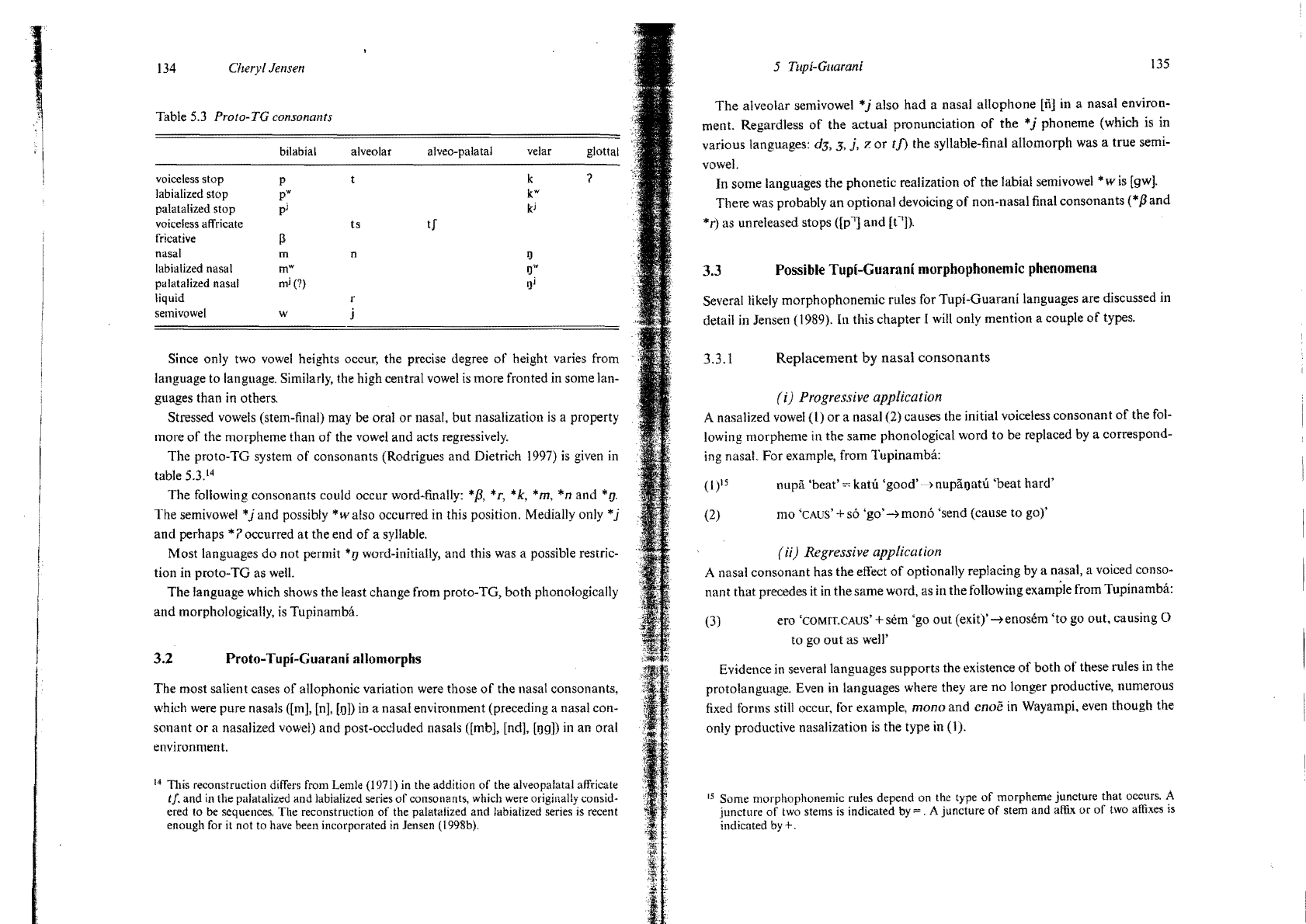
Table
5.3
Pr%-TG
consonan/s
bilabial
alveolar alveo-palatal velar
glottal
voiceless
stop
p k
?
labialized
stop
pw
k
w
palalalized
stop
pi
k
i
voiceless affricate
ts
tI
fricative
13
nasal m n
U
labialízed nasal
m
W
o"
palatalízed nasal
mi
(7)
u
i
liquid
semivowel w
Since only two
vowel
heights occur, the precise degree
of
height varies from
language to langllage. Similarly, the high central vowel
is
more fronted in sorne lan-
gllages lhan in others.
Stressed vowels (stem-final) may be oral
or
nasal, but nasalizatíon
is
a property
more
of
the morpheme than
of
the vowel and acts regressively.
The proto-
TG
system
01'
consonants (Rodrigues
and
Dietrich
1997)
is
given
in
table
5.3.
14
The following consonants could occur word-finally:
*/3,
*r,
*k, *m, *n and
*IJ.
The semivowel
*j
and possibly
*w
also occufred in lhis position. Medially only *j
and perhaps
*?
occurred at the end
of
a syllable.
Most languages do not permit
*1) word-initially, and this was a possible restric-
tion in proto-
TG
as
well.
The language which shows the least change from proto-TG, both phonologically
and morphological1y,
is
Tupinambá.
3.2 Proto-Tupí-Guaraní allomorphs
The most salient cases
of
allophonic variation were those
of
the nasal consonants,
which were pure nasals
([m),
[n],
[O])
in
a nasal environment (preceding a nasal con-
sonant
or
a nasalized vowel) and post-occluded nasals ([mbJ, [nd],
[Ug))
in
an oral
environment.
14
This reconstruction differs from Lemle
(1971)
in the addition 01'
lhe
alveopalatal affricale
tI.
and
in
the
palatalized
and
labialized series
of
consonants, which were originally consid-
ered
10 be sequences.
The
reconstruction
of
the palatalized
and
lubialized series
is
recen!
enough for it no!
10 huye been incorporated in Jensen (1998b).
5 Tupí-Guaraní
The
alveolar semivowel
,.
j also
had
a nasal allophone
[ñ]
in a nasal enviro
n-
ment. Regardless
of
the actual pronuncíation
of
the
*j
phoneme (which is in
various languages:
d3,
3,
j,
Z
or
tf)
the syllable-final al1omorph was a true semi-
vowel.
In sorne languages the phonetic realization
of
the labial semivowel
,.
w
is
[gw).
There was probably
an
optional devoicing
of
non-nasal final consonants
(*/3
and
*
r)
as unreleased stops ([p
,]
and
3.3 Possible Tupí-Guaraní morpbophonemic phenomena
Severallikely morphophonemic rules [or Tupí-Guaraní languages are discussed in
detail in Jensen (1989). In this chapter 1
wil\
only mention a couple
of
types.
3.3.1
Replacement
by nasal consonants
Progressive application
A nasalized vowel
(l)
or
a nasal (2) causes the initial voiceless consonant
of
the
fol-
morpheme in the same phonological word to be replaced by a correspond-
ing nasal. For example,
frOID
Tupinambá:
(1)15
nupa'beat'=katú'good'
>nupauatú'beathard'
(2)
mo 'CAUS' + só
'go'
-4monó
'send (cause to
(ii)
Regressive application
A nasal consonant has the effect
or
optionally replacing
by
a nasal, a voiced conso-
nant that it in the same word, as in the following example from Tupinambá:
ero
'COMIT.CAUS' +sém 'go
out
(exít)' -4enosém
'to
go out, causing O
to go out as well'
Evidence
in
severallanguages supports the existence
of
both
01'
these rules in the
protolanguage. Even
in
languages where they are
no
longer productive, numerous
fixed forms still occur, for example,
mono and enoe
ín
Wayampi, even though the
productive nasalization
i5
the type
in
15
Sorne rnorphophonemíc rules
depend
on the type
of
morpheme
that
oecurs. A
of
two stems ís indicated
by
= . A
juncture
of
stem
and
or
of
two affixes is
by+.
137
136
Cheryl
Jellsell
3.3.2
Strategies for the
1055
of
consonant
c1usters forrned
at
morpheme
juncture
,ff!
(i)
Epenthesis
When a consonant-finaI morpheme combines with another morpheme, various
morphophonemic strategies may apply, depending on Ihe nature
of
the second mor-
pheme.
If
the second morpheme is a consonant-initial suffix, an epenthetic vowel,
y
or
i,
is
inserted,
For
example, in the Amapari dialect
of
Wayampi:
*wfr
'under-
side'+pe
'PUNCT.LOC'>wyrype
'under'. In Kayabí: *mytér
'middle'+pe>
myteripe 'in the middle', The environment
in
which epenthesis takes place
is
limited
since several suffixes have vowel-initial allomorphs for consonant-final stems, alter-
nating with consonant-inítial allomorphs for vowel-final stems. For example:
*-watJú - *-utJú 'Iarge'.
(ií)
Loss
When both morphemes are stems
and
second moroheme
is
consonant-initial,
the final consonant
of
the lirst morpherne
is
lost: *
tare
7yr 'traíra fish' = *
tí.o
'white' > *
tare?ytí.o
'white traira (species)'.
If
the final consonant
of
the first stem
is
a nasal, the feature
of
nasalizatíon remains on the precedíng vowel, as in
Tupinambá:
(4)
akáIJ
'head' =pé(3 'flat'
~akáIJ
=
mé(3
(through rule in
§3.3.1)~
akámé(3 'flatheamd'
When the initial consonant
of
the second morpheme, whether stem
or
suffix,
begins with a glottal stop, in most languages the glottal stop
is
lost and the final
consonant
of
the preceding stem
is
retained, as in Wayampi:
(5) *akáIJ 'head' = *?ók 'remove'
~akáIJo
'decapítate'
*takWár
'bamboo species' + *?i
'DIM'
~takWári'bamboo
species'
This inversion
of
loss strategy can
be
explained
by
a rule
of
metathesis prior to
loss.
In
Parintintín and Kayabí this metathesis occurs without loss
of
the other consonant.
(6) (P)
'white'+?i
'very white'
'skin':;
?ok 'remove'
......¡.ipi?rok
'(to)
skin'16
The occurrence
of
syllable-final glottal stop as the result
of
morpheme combina-
tion
in
these two languages suggests that the same may have occurred
in
the proto-
language.
16
See
§4.5.1
(on devoicing) regarding alternation
of
t
and
r.
5 Tupí-Guaraní
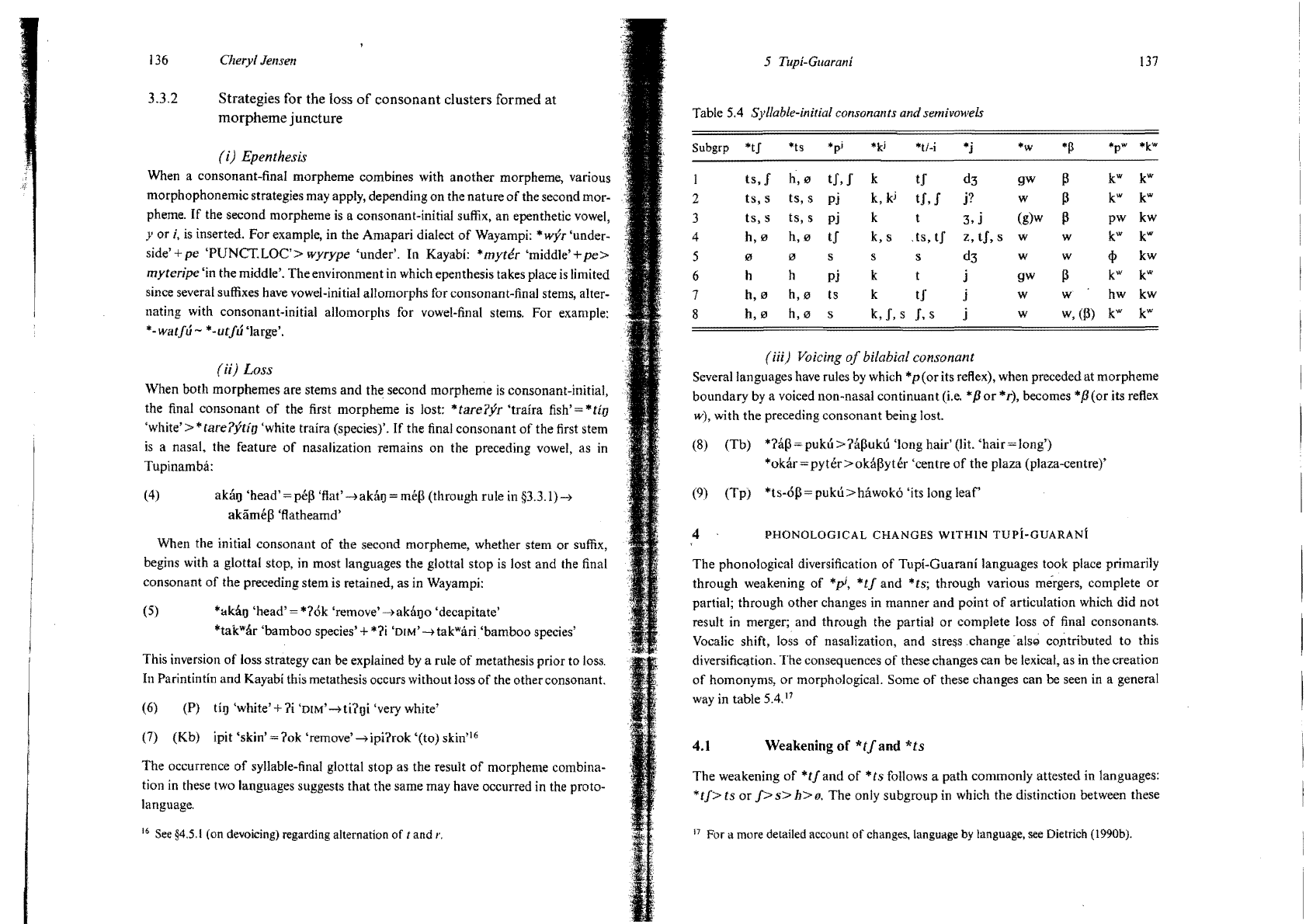
Table
5.4
Syllable-ínitíal consonallts and semivowels
Subgrp
"tJ
*ts
"pi
"'leí
"tI-i
*j
"w
*(.\
"pw
"le"
k
W
k
W
ts,1
h,0
tI.
1
k
tI
d3
gw
f3
k
W
2
ts, S
Is,
S
pj
k, k
i
tI,
I
J.
'?
w
f3
k
W
3
ts,
S ts, S
pj
k
t 3,
j
(g)w
(3
pw
kw
k
W
k
W
4
h,0
h,0
tI
k,s
.t5,
tI
z,
tI.
s
w w
5
0
0 s
s
s
d3
w w
<P
kw
k
W
k
W
6
h
h
pj
k
t
j
gw
f3
7
h,0
h,0
ts
k
tI
j w w hw kw
k
W
k
W
8
h,0
h,0
s k, J, s J, s
w
w,
(j3)
Voicing
01
bilabial consonant
Severallanguages
have
rules
by
which * p (or its reflex), when preceded at morpheme
boundary
by
a voíced non-nasal continuant
(Le.
*{3
or
*r), becomes
*{3(or
its reflex
w), with the preceding consonant being
10s1.
(8) (Tb) *?á(3=pukú>?áf3ukú 'long hajr'
'hair
= long')
*okár
=
pytér>okáj3ytér
'centre
of
the plaza
*ts-óP=
pukú>háwokó
'its long leaf'
4
PHONOLOGICAL
CHANGES
WITHIN
TUPÍ-GUARANÍ
The phonological diversification
of
Tupí-Guaraní languages took place prírnarily
through weakening
of
*pi,
*tJ
and
*lS;
through various mergers, complete
or
partial; through other changes in manner and point
of
articulatíon which did not
result in merger; and through the partial
or
complete 1055
of
final consonants.
Vocalic shift, loss
of
nasalization, and stress .change·
alsQ
co.tÍtríbuted
to
this
diversificatíon. The consequences ol' these changes can be lexícal, as
in
the creatíon
of
homonyms,
or
morphological. Sorne
of
these changes can be seen in a general
way
in table 5.4.
17
4.1
Weakening
of
*tJand *ts
The weakening
of
*tJ and
of
*ts follows a path commonly attested in languages:
*tJ> ts
or
J>s>
h>lJ.
The only subgroup in which the dístinction between these
17
For a
more
detailed account
of
changes, language by language, see Dietrich (l990b).
139
.,
'.1
138
Chery! Jensen
I
two phonemes
is
systematically retained
is
subgroup
1,
as
in
the Mbyá reflexes
of
*tfY
'mother'
and
*ts6
'(to) go':
tJy'and
6.
In other subgroups the two phonemes
have merged. For example, the Tupinambá forms for these two morphemes are
sy
and s6,
in
Guajajára they are
hy
and
h6,
and
in
Wayampi
yand
ó.
Nevertheless,
even in languages where merger has taken place, there are indications that
*tf
in
certain environments (or certain morphemes)
was
more resistant to weakening than
was
*ts.
Forexample,
in
Wayampi, where normally
*tfand
*ts
became@,
the
reflex
of
*tfulú
'(to) bite, chew'
is
súlu,
and
in
Asuriní
of
Tocantins, where normally
*tf
and *ls became h
or
@,
the
reflex
of
the first person singular prono
un
*tfé
is
sé.
Comparative
data
show that h
is
particularly resistant
in
lhe final, (originally-)
stressed syllable. For example, the h
is
lost in initíal (prestressed) positíon
(lO)but
retained
in
stressed position (11) both
in
Parintintín
and
in
Asuriní
of
Tocantins.
(10)
*tseJ3o?í 'worm'>ef3o?í
ewó?ia
(A)
(11)
*t5ó '(to)
go'>hó
há(A)
Medially in (originally-)prestressed syllables, the h
is
retained in Parintintín
and
lost
in
Asuriní, as
in
example (
(12)
*tsykyjé
'(to)
fear'>
kytsyjé>
kyhyjí (P), kyyse (A)
The
h
is
also resistant to IOS5
in
the monophonemic person marker ror third
person:
*ts-
'3
(allomorph for Class II stems)'. Presumably thefe
is
resistance to the
formation
of
a e morpheme. Hence, h
is
retained
in
the words
h-orywéte
(A) and
h-llrywcté (Gj) '(to be) happy' « *oryfJ-eté 'happy-genuine'), even though the
same phoneme
was
lost
in
Asuriní in the word-initial position in the
reflex
of
*tsefJo?í 'worm': ew61ia.
[n
Wayampi, the reflexes
of
both
*tfand
*ts
were
leaving a (J morpheme as the
reflex
of
.,
ts-, as in e-éa 'hislher eye' « *ts-elfá),
except for when it combines wíth a
few
monosyllabic stems in the Jari dialect. such
as
'"
ts-ér
'3-name' > h-ee.
4.2 Palatalization
Various phonological changes, either widespread or localized,
in
some
way
involved
palatalization.
I9
In many languages the protophoneme *pi, which occurs
in
the
reconstruction
*epiák
'(to) see', underwent an unconditioned change of point
of
articulation to the alveo-palatal position, followed by weakening, as
in
example (13).
18
Metathesis occurred
in
this word
in
languages from subgroups I
and
4-8.
19
r
<1m
using the term broadly to reter lo changes which ínvolved palatalizatíon
in
sorne
way,
even ir the final result was
nOI
-a
palatalized phoneme, such as
s.
5 Tupí-Guarallí
(13)
*pj>tj>tJ>
J 01' tS>S20
In Tupinambá this consonant underwent a structural reanalysis as a consonant plus
a semivowel, as
in
epják
'(to) see'.
The phoneme
'1k
i
occurs in the reconstructed morphemes *ikjé '(to) enter',
'1k
i
ér
sleep'
and
*kié'here, near the speaker', which were previously reconstructed as
..
iké, *
kér
and
..
ké, respectively. This change
in
analysis accounts ror the palatal-
ized form
We
in Hoeller's data (1932)
of
Guarayu.
ll
In Kayabí this phoneme
resulted
in
the alveolar fricative
s:
set '(to) sleep'
and
se
'(to) enter'. In Guajajára it
resulted in the alveo-palatal affricate
in
¡sé
[itfé] '(to) enter'; that this was caused by
the palatalized consonant rather than the preceding high vowel can be seen
in
ik6
*ik6
'to
be in motion').22 In Parintintín
*/d
provoked the raising
of
the sub-
sequent vowel, then merged with
*k, resulting
in
kir'sleep'
and
kí'here'.
In most
other languages, generally *klmerged with
,.
k (and *viwith
*{/).l3
Other
palatalized forms developed
in
various languages as allophonic variation.
The
palatalization
of
t before
i,
as in example (14), occurred
in
most languages, but
not in Tupinambá
or
Parintintin.
*t (preceding
i»t
i
>
tJ>
f
or
t5>S
The palatalization
of
k the labialized and palatalized
phonemes) in Urubú-Kaapor contiguous to i resulted in
f In Tupinambá the frica-
tive s « *ts,
*tf)
was palatalized as f contiguoliS to
i.
In Guajajára the same sort
of
palatalization takes place, though the sources
of
s
in
this language are different
from
those
in
Tupinambá.
Sorne
of
these changes are limited to allophonic variation, such as the case
of
Tupinambá. However, what begins as allophonic variation has the possibility
of
leading to a phonemic split, as the palatalized allophone merges with another
phoneme
or
with the palatalized aIlophone
of
another phoneme. Various combina-
tions
of
mergers took place in the Tupí-Guaraní subgroup as the reflexes
of
several
palatalized consollants
or
of
allopholles
of
consollants converged in the alveolar
and
alveo-palatal positions.
In Guajajára the phoneme
s,
with allophone
tI
contiguous to
i,
has several
sources:
*pi
(*epiák>esáV), *t (*afJati>awasi [awatjil) and *kj(*ikié >
¡se').
In
Urubú-Kaapor
(Kakumasu
thefe are cases
of
f which are
:w
Anambé
has h as the end result
of
this change, one step beyond s
in
the weakening process
*epiák '(lO) see'
>ahi1
(Julíao 1993).
21
More recent
data
from Guanlyu (Newton 1978) lisIs ke rather than
kJe.
22
The
morpheme
*/dér
'(to) sleep'
is
kér
in
Guajajára, even though presumably al
one
time
Ihe
reflcx
of
*j-kJér
would have been phonetically [i-tJerJ.
2)
In Kayabi the nasalized equivalent
01'
s « ·Id)
is
v:
move 'cause to enter,.
140
Clteryl Jensen
recognizable as having originated from k beca
use
of
an altemation
in
the initial con-
sonant
of
the stem when it
is
preceded
by
the third person prefix j-. For example:
kwál'(<
*kwár)
'hale', í-Jwár'its hole';
ki(
< '"kip'louse, lice'),
í-Jf'his
louse, lice'.
Such altemation
is
not observable medialIy, although the conditioning environment
is
still intact: iJé '(to) en ter' «
*ih!),
iN 'eontinuative aspect, in motion' «
*ikÓ).
Other sourees
of
J come from the palatalization
of
t before
i:
awafi 'coro'
«
"'apat¡).
At times the conditioning environment has been absorbed into the frica-
tive,
permitting altemations such as Jaowérand
iJaowér«*i-kárrér)
'his bone'.
Other morphemes have the appropriate conditioning environment but are
c1early
not
of
Tupí-Guaraní origin, such as paJiá (from Portuguese passear
'to
take a walk
or a trip'). Thus what began in large part as palatalized allophones
of
two separate
phonemes developed into a
new
phoneme in Urubú-Kaapor. Similarly, the
phoneme
s in this language comes from several sources:
*tJ
("'tJu7ú '(to) bite,
chew'>su7ú)
and "'ts (*tsef307í
'worm'>
perhaps through Nheengatú;
'"
kie
(se 'here, near the speaker'); as
well
as borrowings from Portuguese:
sapé
(from
clrapéu
'har)
and sapát (from sapato
In Wayampi the phoneme s developed through the merging
of
the reflex
of
*pJ
(*epiák
'(to)
see'>
ésa), the palatalized alIophone
of
*t (tT'nose,
beak'>
sf), and
some vestiges
of
*tJwhich
escaped further weakening (*tJu?ú '(to) bite,
chew'>
súru), with additional sourees coming into Ihe language through borrowing
(kamísa 'cIoth'<Portuguese camisa 'shirt';
semárí
'manioc grater'<Apalaí
Jiman).
[n Mbyá, the palatalized allophone
of
"'t
("'kytí'(to)
cut'>kytsi)
merged with
the reftexes
of
*pi
(*e¡lák>
et.sá '(to) see') and
*tJ
(*etJá>
etsá
'eye').
In Asuriní
of
Tocantins, the
reftex
of
the palatalized allophone
of
*t (*tiO 'white'
>silJ) and the reflex
of
"'pj (*epiák '(to) see'>ésa!J) merged with the reflex
of
*j
(*juká '(to) kill'>s6ka).24
To
these were added the two forms
of
the first person
singular pronoun
se
« "'tJé) and íse « *itJé) which resisted further weakening.
The variety
of
mergers demonstrate the care that must
be
laken in determining
correspondences in these languages.
4.3
Labialization
In a number
of
languages there occurred a merger
of
the reflex
of
*p" with
*k'V(and
of
*mWwith
*01.
This happened in subgroups
1,2,4,6
and 8, as in examp!e (15).
languages the merger
was
complete, but in Wayampi it
was
limited
to what were
stressed
24
The data
in
Lemle
(911)
does not reflect Ihe merger
of
*j
in
Asuriní
of
Tocantins with these
other sources.
5 Tupí-Guaraní
141
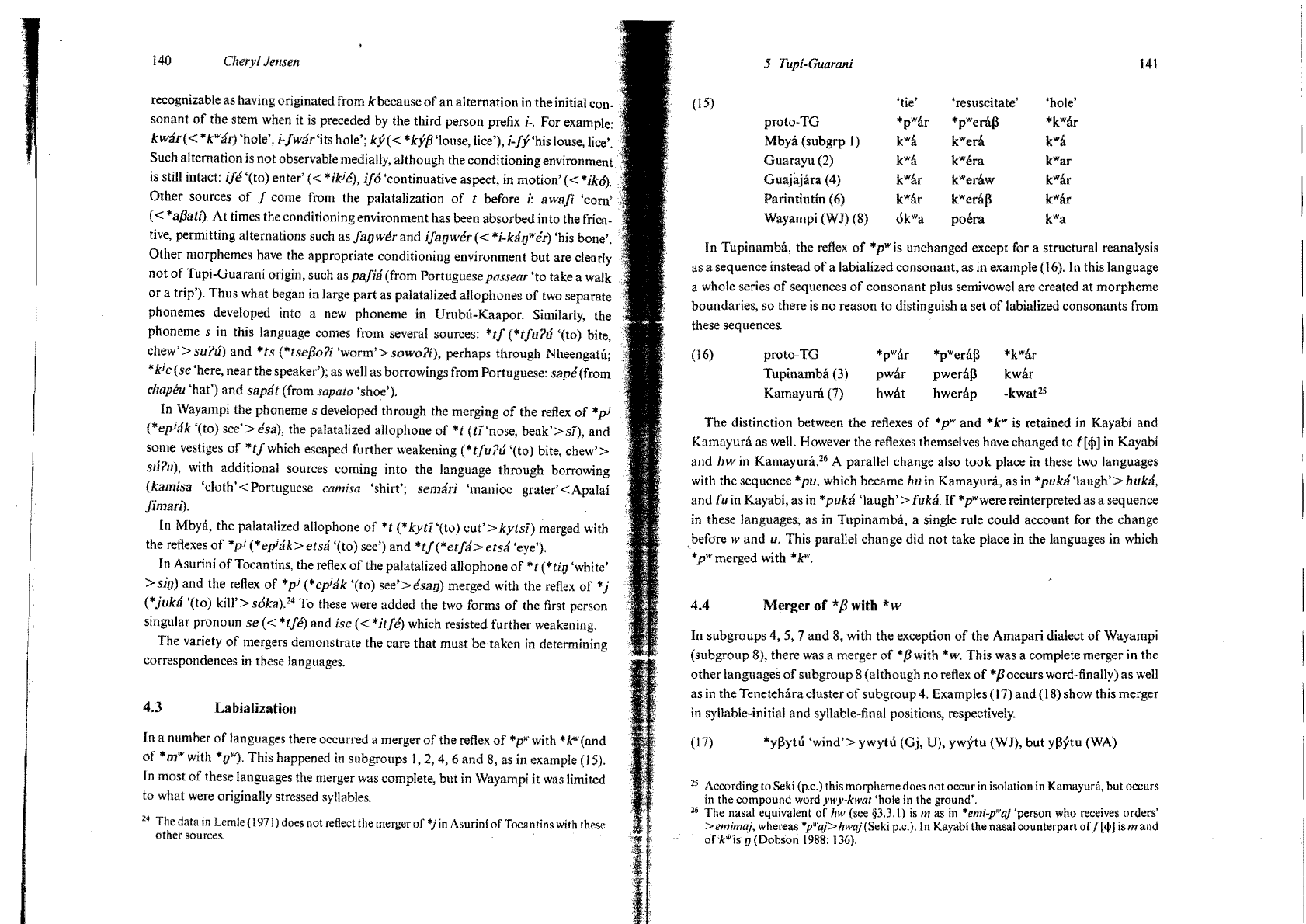
(15)
proto-TG
Mbyá (subgrp
1)
Guarayu (2)
Guajajára (4)
Parintintín (6)
VVayampi(WJ)(8)
'tie'
*pwár
kwá
kwá
kwár
kwár
ókwa
'resuscitate'
*pw
er
áJ3
kWerá
kwéra
kWeráw
k
W
eráJ3
poéra
'hole'
*kwár
kwá
kWar
kwár
kwár
kWa
In
Tupinambá, the reflex
of
*pwis unchanged exeept for a structural reanalysis
as a sequence instead
of
a labialized consonant, as in example (16). In this language
a whole series
of
sequences
of
consonant plus semivowel are created
al
morpheme
boundaries, so thefe
is
no reason to distinguish a set
of
labialized consonants from
these sequenees.
(16) proto-TG
*pwár
*pw
er
áf3
*kwár
Tupinambá (3) pwár
pweráJ3 kwár
Kamayurá (7)
hwát
hweráp -kwat
25
The distinction between the reflexes
of
*pwand
*k
w
is
retained
in
Kayabí and
Kamayurá as well. However the reflexes themselves have changed to
[(<ji] in Kayabí
and
hw
in
Kamayurá}6 A parallel change also took place in these two languages
with the sequence
*pu, which became hu in Kamayurá, as in *puká
'Iaugh'>
huká,
and fu
in
Kayabí, as
in
*puká
'Iaugh'>
fuká.
If
*¡i"were reinterpreted as a sequenee
in
these languages, as in Tupinambá, a single rule could account for the change
,befO're
wand
u.
This parallel change did not take place in the languages in which
*pwmerged with
*k"'.
4.4 Merger
of
*P
with *w
In subgroups
4,5,
7
and
8, with the exception
of
the Amapari dialect
of
VVayampi
thefe was a merger
of
*pwith *w. This was a complete merger in the
otherlanguages
of
sllbgroup 8 (althollgh no reflex
of
*poccurs word-finaIly) as
well
as
in
the Tenetehára cluster
of
subgroup
4.
Examples (17) and (18) show this merger
in syllable-initial and syllable-final positions, respectively.
(17) *yj3ytú
'wind'>ywytú
(Gj, U),
ywytu
(WJ), but
yf3Ytu
(WA)
25
According lo Seki (p.c.) Ihis morpheme does nol occur in isolation in Kamayurá, bu! occurs
in the
compound
word ywy-kwat 'hole in the ground'.
26
The
nasal equivalen!
of
hw (see §3.3.1)
is
m as
in
*emi-p"aj 'person who receives orders'
> emimaj. whereas ·p"'aj> hwaj (Seki p.c.).
In
Kayabi the nasal counterpart
of
f[<J¡J
is m and
of
k"is
V (Dobson 1988: 136).
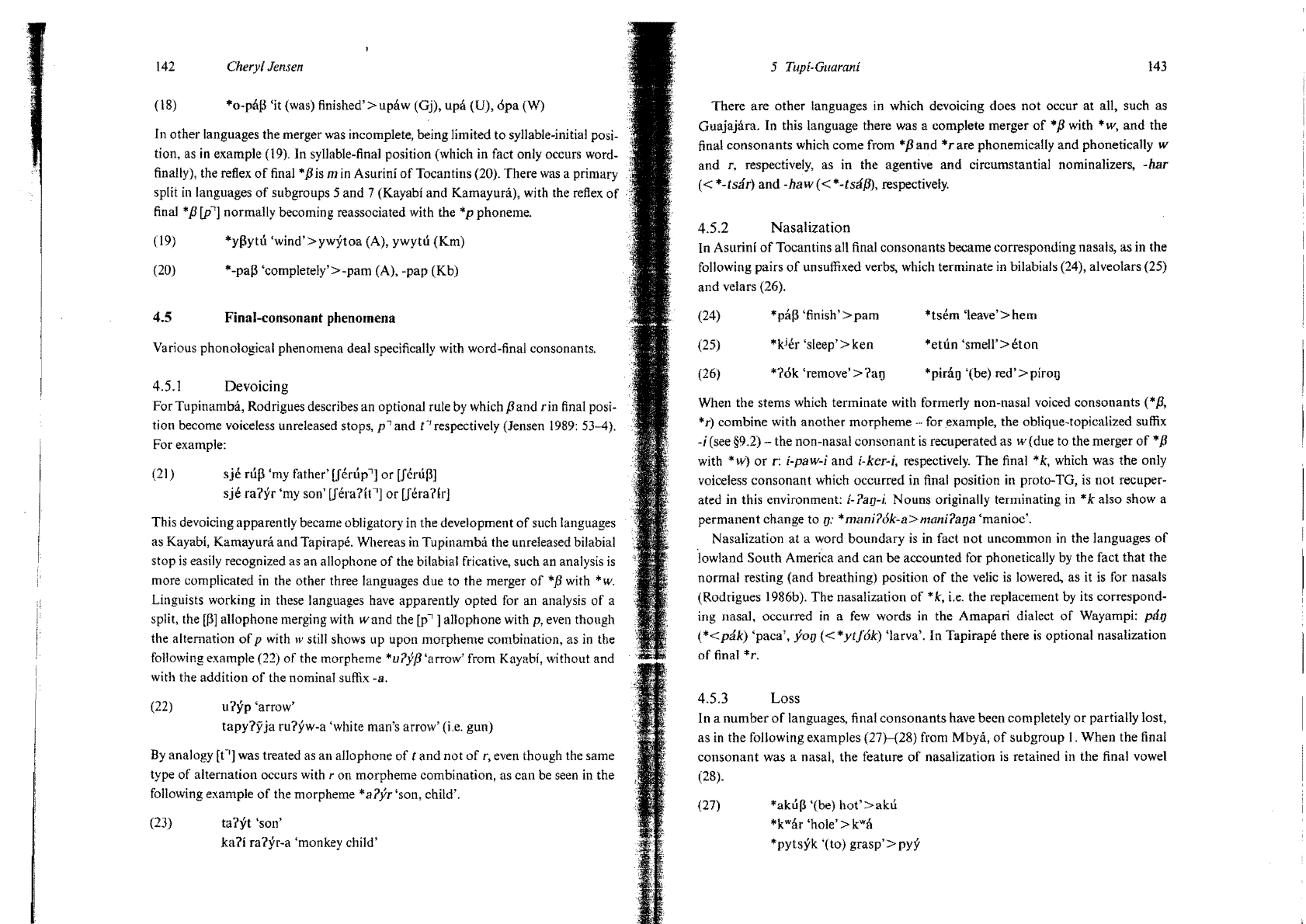
143
142
Cheryl Jensen
(18)
*o..páf3
'it (was)
finished'>upáw
(Gj),
(U),
ópa
(W)
In
other
languages the merger was incomplete, being limited to syllable-initial posi-
tion, as in example (19). In syllable-final position (which in faet only occurs word-
finally), the reflex
of
final
"'13is
m
in
Asuriní
ofTocantins
(20). There 'ÑllS a primary
split in languages
of
subgroups 5
and
7 (Kayabí
and
Kamayurá), with the reflex
of
final
*/3
[p'] normalIy becoming reassociated with the
"'p
phoneme.
(19)
*y13ytú
'wind'>ywytoa
(A),
ywytú
(Km)
(20)
*-pa13
'completely'>-pam (A), -pap (Kb)
4.5
Final-consonant phenomena
Various phonological phenomena deal specifically with word-final consonants.
4.5.1
Devoicing
For Tupinambá, Rodrigues describes an optional rule
by
which
13
and
rin
final posi-
tíon become voiceless unreleased stops,
p
-¡
and
t'
respectively (Jensen
1989:
53--4).
For example:
(21)
sjé
rú13
'my father'
¡férúp
'l
or
Lférú13J
sjé
ra1yr 'my son'
Uéra1it'j
or
Uéra?lrJ
This devoicing apparently became obligatory in the development
of
such languages
as Kayabí, Kamayurá and Tapirapé. Whereas
in
Tupinambá the unreleased bilabial
stop
is
easily recognized as an allophone
of
the bilabial frieative, such an analysis
is
more eomplicated in the other three languages due to the merger
of
"'13
with *w.
Linguists working ín these languages have apparently opted for an analysis
of
a
splít, the
[f31
allophone merging with
wand
the
[p'
1allophone wíth p, even
the alternation
of
p with IV sliI! shows up upon morpheme combinatíon, as in the
following example
(22)
01'
the morpheme
*u?j13
'arrow' from Kayabí, without and
with the addition
of
the nominal suffix
-8.
u1yp
'arrow'
tapy1yja
ru?yw-a 'white man's arrow'
(Le.
gun)
By
analogy
[t'l
was treated
as
an allophone
of
t
and
not
of
r, even though the same
type
of
alternation occurs with r on morpheme combinatíon, as can be seen in the
following example
of
the morpheme *a7fr 'son, child'.
(23)
ta?yt
'son'
ka1í ra?yr-a 'monkey ehild'
5 Tupí-Guaraní
There are
other
languages in which devoicíng does
not
occur
at
all, such as
Guajajára. In this language there was a complete merger
of
*13
with *w,
and
the
final consonants which come from
*13
and
*r
are phonemically
and
phonetically w
and
r, respectively, as in the agentive
and
circumstantial nominalizers,
-har
«
*-tsár)
and
-haw
« *-tsáf3), respectively.
4.5.2
Nasalization
In Asuriní
of
Tocantins
an
final consonants became corresponding nasal
s,
as in the
following pairs
of
unsuffixed verbs, which terminate in bilabial s (24), alveolars (25)
and
velars (26).
(24)
*pál3
'finish'>pam
"t5ém
'leave'>hem
*kiér
'sleep'>ken
*etún
'smell'>éton
*1ók
'remove'>
1aIJ
*pírálJ '(be) red' >pírolJ
When the stems which terminate with formerly non-nasal voiced consonants
("'/3,
"'r) combine with another
morpheme
forexample, the oblique-topicalized suffix
-Í
(see §9.2) - the non-nasal
consonant
is
recuperated as w (due to the merger
of
*13
with "w)
or
r.
í-paw-í
and
¡-ker-i, respectively.
The
final *k, which was the only
voiceless
consonant
which occurred in final position in proto-TG, is
not
recuper-
ated in this environment:
í-?a1]-i.
Nouns
originally terminating in
*k
also show a
permanent
change to
{]:
*maní7ók-a>maní?aya 'manioc'.
Nasalization
al
a word
boundary
is
in fact
not
uncommon in the languages
of
lowland
South
America
and
can
be
accounted for phonetically
by
the faet
that
the
normal resting (and breathing) position
of
the velic
is
lowered., as it
is
for nasals
(Rodrigues 1986b).
The
nasalizatíon
of
*
k,
Le.
the replacement
by
íts correspond-
nasal, occurred ín a few words in the Amapari dialect
of
Wayampi: páV
(*<pák)
'paca',
jO!]
«*ytJók)
'larva'. In Tapirapé there
is
optional nasalization
of
final
*r.
4.5.3
Loss
In a
number
of
languages, final
consonants
have been completely
or
partially lost,
as in the following examples (27)-(28) from
Mbyá,
of
subgroup
l.
When
the final
consonant
was a nasal,
the
feature
of
nasalizatíon
is
retained in the final vowel
(28).
(27) *akú[l '(be)
hot'>akú
*kwár 'hole' > k"'á
*pytsyk
'(to)
grasp'>pyy
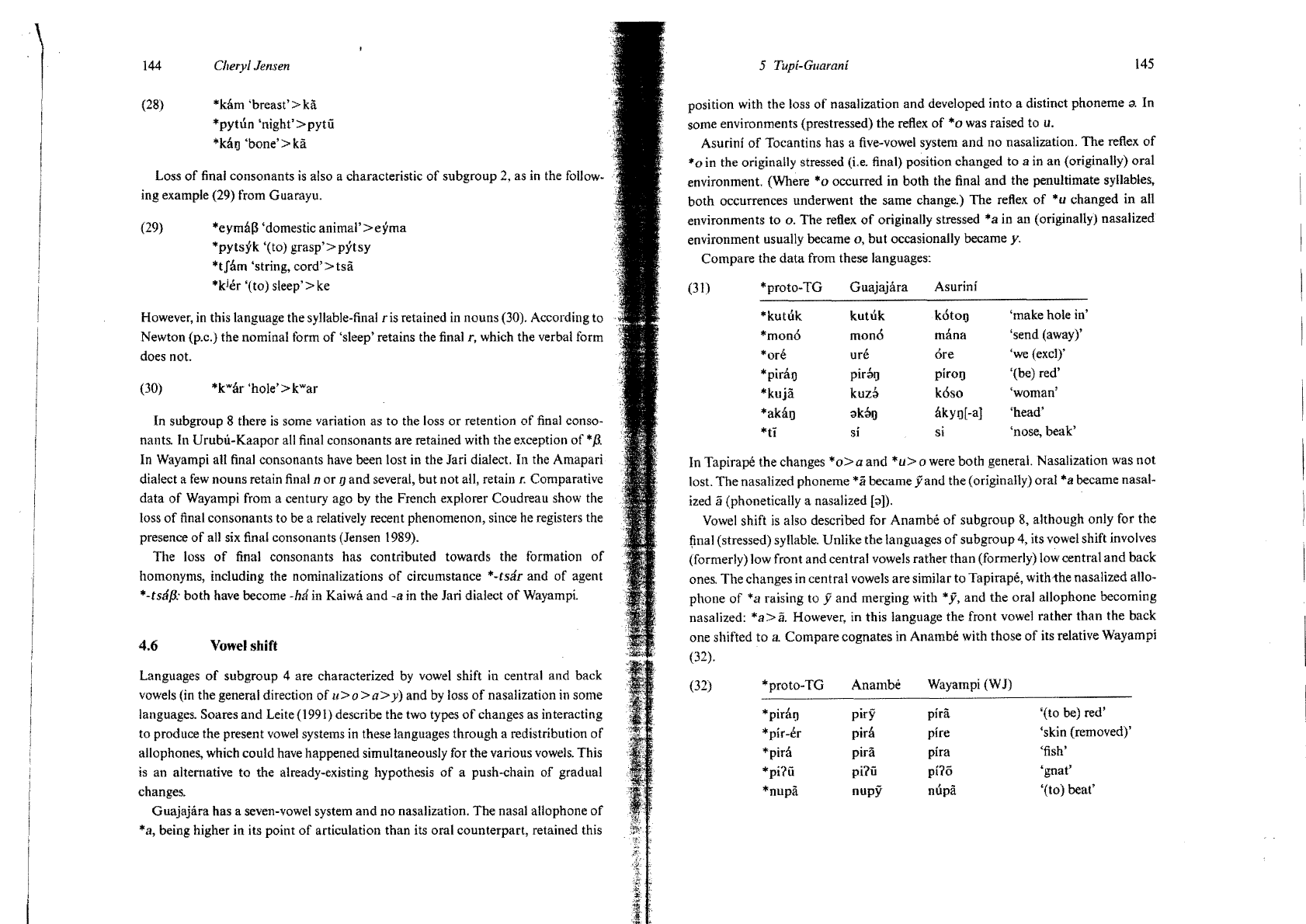
145
I
144 Cfleryl Jensen
(28) *kám 'breast' > ka
*pytún
'night'>pytú
*kál)
'bone'>
kii
Loss
of
final consonants
is
also a characteristic
of
subgroup
2,
as in the follow-
íng example
(29) from Guarayu.
(29) *eymá(! 'domestíc
animal'>eyma
*pytsyk
'(to)
grasp'>pytsy
*tfám
'strillg,
cord'>tsa
*kjér '(to)
sleep'>
ke
However,
in
this language the syllable-final r
is
retailled
in
nouns (30). Accordíng to
Newton (p.c.) the nominal form
of
'sleep' retains the final r, which the verbal form
does not.
(30) *kwár 'hole'>kwar
In subgroup 8 there
is
sorne variation as to the loss
or
retention
of
final conso-
nants. In Urubú-Kaapor
all
final consonants are retained with the exceptioll
of
*/3.
In Wayampi al! final consonants have been lost
in
the Jari dialect. In the Amapari
dialect a
few
nouns retain final n
or
f)
and
several, but not all, retain
r.
Comparative
data
of
Wayampi from a century ago
by
the French explorer Coudreau show the
1088
of
final consonants to
be
a relatively recent phenomenon, since he registers the
presence
of
all six final consonants (Jensen 1989).
The
108s
of
final consonants has contributed towards the formation
of
homonyms, including the nominalizations
of
circumstance *-tsár and of agent
*-tsáfj: both have become
-há
in
Kaiwá
and
-a in the Jari dialect
of
Wayampi.
4.6
Vowel
shift
Languages
of
subgroup 4 are characterized
by
vowel shift in central and back
vowels (in the general direction
of
u>o
>a>y)
and by 1055
of
nasalization in sorne
languages. Soares
and
Leite (1991) describe the two types
of
changes as interacting
to produce the present
vowel
systems
in
these languages through a redistríbution
of
allophones, which could have happened simultaneously for the various
vowels.
This
is
an altemative lo the already-existing hypothesis
of
a push-chain
of
gradual
changes.
Guajajára has a seven-vowel system
and
no
nasalization.
The
nasal allophone
of
*a,
being higher in its point
of
articulation than its oral counterpart, retained this
5
Tupí-Guaraní
position with the loss
of
nasalization and developed into a distinct phoneme
;;).
In
sorne environments (prestressed) the
reflex
of
*0
was raised to
u.
Asuriní
of
Tocantins has a five-vowel system
and
no nasalization. The reflex
of
*0 in the originally stressed
(Le.
final) position changed to a in an (originally) oral
environment. (Where *0 occurred in both the final
and
the penultimate syllables,
both
occurrences underwent lhe same change.) The refiex
of
*u
changed in all
environments to
o.
The retlex
of
originally stressed
*a
in an (originally) nasalized
environment usually became o,
but
occasionally became y.
Compare the data from these languages:
(31)
*proto-TG
Guajajára
Asuriní
*kutúk
*monó
*oré
*pirág
*kujii
*akág
*tí
kutúk
monó
uré
pir;!¡g
kuz;!¡
;}k;!¡g
si
kótog
mána
óre
pirol)
kóso
ákyol-aJ
si
'make hole in'
'send (away)'
'we (excl)'
'(be) red'
'woman'
'head'
'nose, beak'
In Tapirapé the changes
*o>a
and
*u>o
were both general. Nasalizatíon was not
lost.
The
nasalized phoneme *á became
jiand
the (originally) oral *a became nasal-
ized
á (phonetically a nasalízed
[;:¡I).
Vowel
shift
is
also described for Anambé
of
subgroup 8, although only for the
~nal
(stressed) syllable. Unlike the languages
of
subgroup 4, ils vowel shift ínvolves
(formerly) low front and central vowels rather than (formerly) low central
and
back
ones.
The
changes
in
central vowels are similar to Tapirapé,
withthe
nasalized allo-
phone
of
*a
raising to
ji
and
merging with *9, and the oral allophone becoming
nasalized: *a>a. However, in this language the front vowel rather than the back
one shifted to
a Compare cognates in Anambé with those
of
its relatíve Wayampi
(32).
(32)
*proto-TG
Anambé
Wayampi (W J)
*piráu
piry pira
'(to be) red'
*pír-ér pirá
pire
'skin (removed)'
*pirá
pira
pira
'fish'
*pi?íi
pi?ú
pí?ó
'gnat'
*nupa
nupy nópii
'(to) beat'
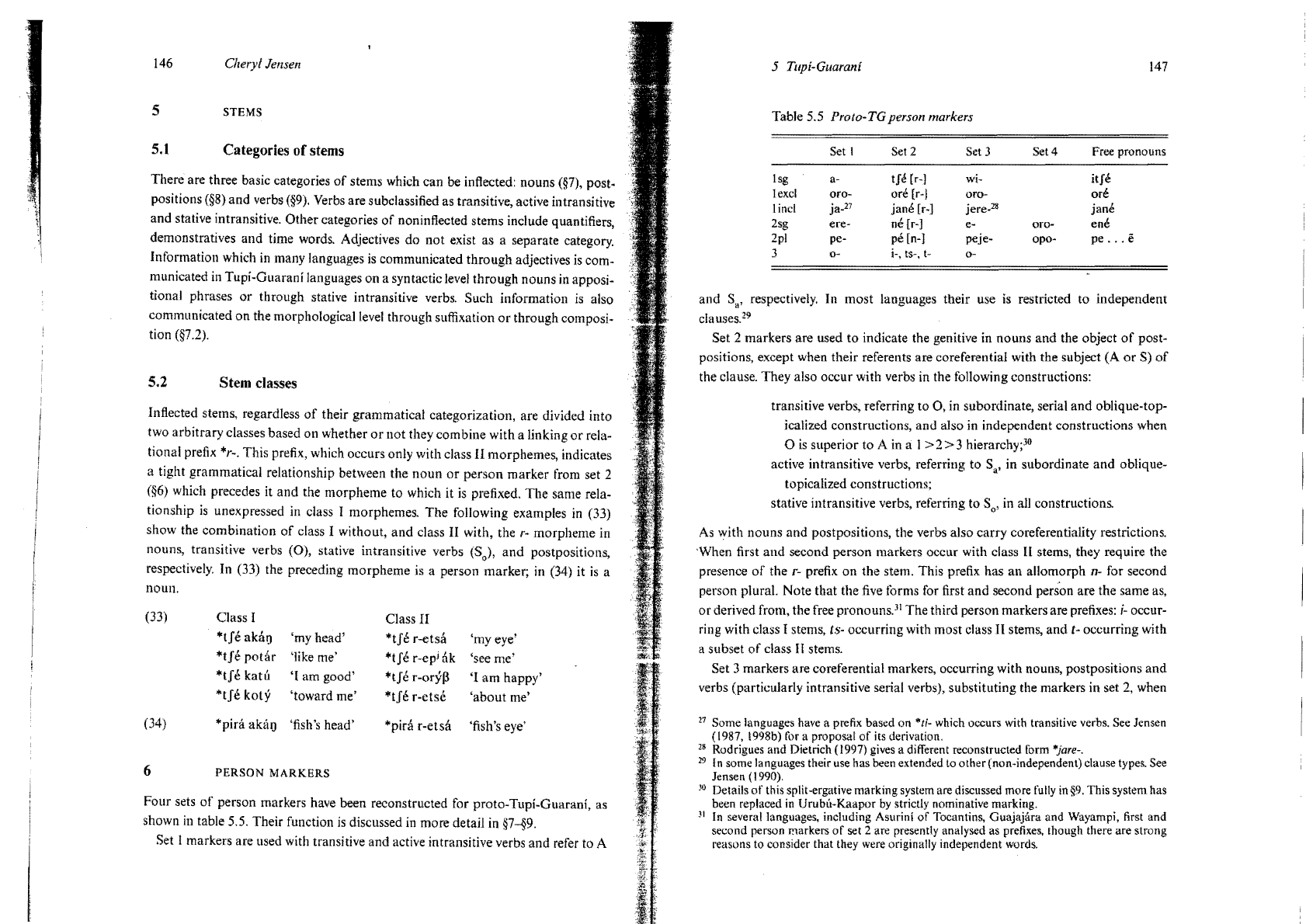
147
146
Cheryl Jensen
5 STEMS
5.1
Categories of stems
There are three basic categories
of
stems which
can
be inflected: nouns
(§7),
post-
positions
(§8)
and
verbs
(§9).
Verbs are subclassified as transitive, active intransitive
and stative intransitive.
Other
categories
of
noninflected stems inelude quantifiers,
demonstratives
and
time words. Adjectives
do
not
exist as a separate category.
Information which in many Ianguages is communicated
through
adjectives is com-
municated in Tupí-Guaraní Ianguages on a syntactic level through nouns
in
apposi-
Honal phrases
or
through stative intransitive verbs. Such informatíon
is
also
commllnicated
on
the morphologicallevel
suffixation
or
composi-
tion
(§7.2).
5.2
Stem
classes
Inflected stems, regardIess
of
their grammatical categorization, are divided jnto
two
arbitrary
e1asses based on whether
or
not
they com bine with a Iinking
or
reIa-
tional prefix
"'r-.
This prefix, which occurs only with cIass
II
morphemes, indicates
a tight grammatical relationship between
the
noun
or
person
marker
from set 2
(~6)
which precedes it
and
the
morpheme
to which
it
is
prefixed.
The
same rela-
is
unexpressed in
c1ass
1 morphemes.
The
following examples in (33)
show the
combination
of
e1ass
1 without,
and
e1ass
II
with, the
r-
morpheme
in
nOUI1S,
transitive verbs (O), stative intransitive verbs (So),
and
postpositions,
respectively. In
(33) the preceding
morpheme
is a person marker; in (34) it
is
a
noull.
(33)
Class I
Class
II
"'tfé akal)
"'tJé
potar
"'tfé
katú
*tfé
koty
'myhead'
'like me'
'1
am good'
'toward
me'
"'tfé
r-etsa
"'Ifé r-epi
ák
"'tJé
r-oryf3
"'tIé
r-etse
'myeye'
'see
me'
'lam
happy'
'about
me'
"'pirá akálJ 'fish
'5
head'
*pirá
r-etsá
'fish 's eye'
PERSON
MARKERS
Four sets
of
person markers have been reconstructed for proto-Tupí-Guaraní, as
shown
in
table 5.5. Their funetion
is
discussed in more detail in §7-§9.
Set I markers are used with transitive and active intransitive verbs
and
refer to A
5 Tupí-Guaraní
TabJe 5.5 Proto-TG person markers
Set
I
Se!
2
Se!
3 Set4
Free
pronouns
Isg
a-
lIé
[ro]
wi-
ilIé
lexcl oro- oré
troj
oro- oré
1
inel
ja_
27
jané
[ro]
jere.
23
jané
2sg
ere-
né
[rol
e-
oro- ené
2pl
pe-
pé
[n-J
peje-
opo-
pe
...
e
3
o-
j-,
IS-,
1-
o-
and
s.'
respectively. In
most
Janguages their use is restrícted to independent
c1auses.
29
Set 2 markers
are
used
to
indicate the genitive in
nouns
and
the object
of
post-
positions, except when their referents are eoreferential with Ihe subjeet
(A
or
S)
of
the clause. They also occur with verbs in the tollowing constructions:
transitive verbs, referring to O, in subordinate, serial
and
oblique-top-
icalized constructions, and also in independent constructions when
O
is
superior to A
in
al>
2 > 3 hierarchy;30
active intransitive verbs, referring to
S.'
in subordinate
and
oblique-
topicalized constructions;
stative intransitive verbs, referring to
So'
in all constructions.
As with
nouns
and
postpositions, the verbs also
carry
coreferentialíty restrictions.
'When first
and
second person markers oceur with elass n stems, they require the
presence
of
the
r-
prefix
on
the stem. This prefix has
an
allomorph
n-
for second
person plural.
Note
that the five lorms for first
and
second person
are
the same as,
or
derived from, the free pronouns. JI
The
third person markers are prefixes:
i-
occur-
ring with cluss 1 stems,
(s- occurring with most class
II
stems,
and
t-
occurring with
a subset
of
class n stems.
Set 3 markers are coreferential markers, occurring with nouns, postpositíons
and
verbs (particularly intransitive serial verbs), substituting the markers in set
2,
when
27
Sorne
languages
have
a
prefix
based
on
*/;-
which
occurs
with
transitive
verbs.
See
Jensen
(1987,
1998b)
for
a proposal of
its
derivation.
28
Rodrigues and Dietrich
(1997)
gives
a
dífferent
reconstructed
form
*jare-.
29
In
sorne
languages their
use
has
been
extended
to
other (non-independent)
c1ause
type~
See
Jensen
(1990).
JO
Details
01'
this split-ergative marking
system
are
discussed
more
fully
in
§9.
This syslem has
been
replaced
in
Urubú-Kaapor
by
strictly
nominative
marking.
31
In
severallanguages, including Asurini of Tocantins, Guajajára and
Wayampi,
first
and
second person markers
of
set
2
are
presently
analysed
as
prefixes.
though there are strong
reasons
to
consider that they
were
originally independent
words.
6
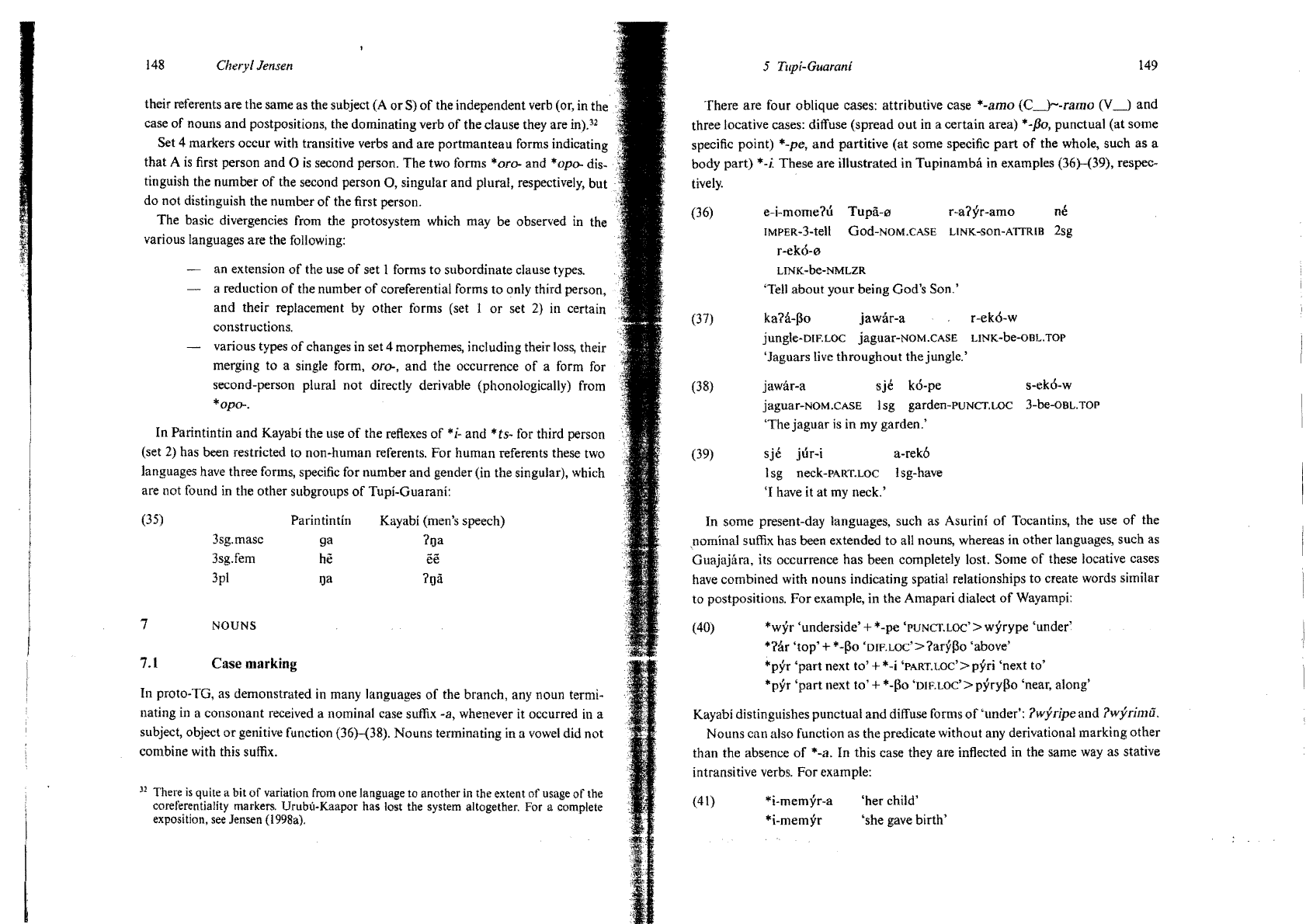
149
148
Cheryl
Jensen
their referents are the same as the subject
(A
or
S)
of
the índependent verb
(or,
in the
case
of
nouns and postpositions, the dominating verb
of
the clause they are
in).32
Set 4 markers occur with transitive verbs and are portmanteau forms indicatíng
that A
is
first person and O
is
second persono The two forms *oro- and *apo- dis-
tinguish the number
of
the second person O, singular and plural, respectively, but
do
not distínguish the number
of
the first persono
The basic divergencies from the protosystem which may be observed in the
various Ianguages are the foIlowing:
an extension
of
the use
of
set 1forms to subordinate clause types.
a reduction
of
the number
of
coreferential forms
to
only third person,
and their replacement by other forms (set
1
or
set
2)
in certain
constructions.
vanous types
of
changes in set 4 morphemes, íncluding their
loss,
their
merging to a single form,
oro-,
and
the occurrence
of
a form for
second-person plural
not
directly derivable (phonologicaIly) from
*opo-.
In Panntintín and Kayabí the use
of
the reflexes
of
*i-
and *ts- for third person
(set
2)
has been restricted to non-human referents. For human referents these two
languages have three forms, specific for number and gender (in the singular), which
are not found
in
the other subgroups
of
Tupí-Guaraní:
(35)
Parintintín
Kayabí (men's speech)
3sg.masc
ga
?oa
3sg.fem
he
ee
3pl
oa
?oa
7
NOUNS
7.1
Case
marking
In proto-TG, as dernonstrated
in
many languages
of
the branch, any noun termi-
nating
in
a consonant received a nominal case suffix -a, whenever it occurred in a
subject, object
or
genitive function (36)-(38). Nouns terminating in a
vowel
did not
combine with this suffix.
32
There
is
quite a bit
of
variation from one language to another
in
the extent
of
usage
of
the
coreferentiality markers. Urubú-Kaapor has lost
the system altogether. For a complete
exposition,
see
Jensen (1998a),
5 Tupí-Guaraní
There
are
four oblique cases: attributive case *-amo
(C-l--ramo
(V
_)
and
three locative cases: diffuse (spread
out
in a certain area)
*-/30,
punctual (at sorne
specific point)
*-pe,
and
partitive (at sorne specific
part
of
the whole, such as a
body part) *-i These are iIIustrated in Tupinambá
in
examples (36}-(39), respec-
tively.
(36)
e-i-mome?ú
Tupii-0 r-a?yr-amo né
IMPER-3-tell
GOd-NOM.CASE
LINK-SOn-AITRIB
2sg
r-ekó-0
LINK-be-NMLZR
'Tell about your being God's Son.'
ka?á-f3o
jawár-a
r-ekó-w
jungle-DIELOC
jaguar-NoM.cASE
LINK-be-oBL.TOP
'Jaguars live throughout the jungle.'
(38)
jawár-a
sjé
kó-pe
s-ekó-w
jaguar-NOM.CASE
Isg
garden-puNCT,LOC
3-be-OBL.TOP
'The jaguar
is
in
my
garden.'
(39)
sjé
júr-i a-rek6
Isg
neck-PART.LOC
Isg-have
'{
have it at my neck.'
In sorne present-day languages, such as AsurinÍ
of
Tocantins, the use
of
the
,nominal suffix has been extended to all nouns, whereas in other Ianguages, such as
Guajajára, its occurrence has been completely lost. Sorne
of
these locative cases
have combined with nouns indicating spatíal relatíonships to create words similar
to postpositions.
For
example, in the Amapari diaIect
of
Wayampi:
(40)
*wyr 'underside' +* -pe
'PUNCT.LOC'
> wyrype 'under:
*?ár
'top'
+
*-130
'D/P.LOC'> ?aryf3o 'aboye'
*pyr
'part
next
to'
+*-i 'PART.Loc'>pYri 'next to'
"pyr
'part
next
to'
+
*-(30
'DIP.LOC'>pYryf3o 'near, aIong'
Kayabí distinguishes punctuaI
and
diffuse forms
of
'under': 7wyripe and 7wYrimü.
Nouns can al so function as the predicate without any derivational marking other
than the absence
of
*-a. In this case they are inflected
in
the same
way
as stative
intransitive verbs. For example:
(41) *i-memyr-a
'her child'
*i-memyr
'she gave birth'
151
ISO
Cheryl Jensen
7.2 Possession
Pronominal possession
is
normally expressed
by
the person markers of set
2.
The
forms for first and second person
were
derived from
free
forms and are reconstructed
for proto-TG as free forms.
However,
in
many languages they are now analysed
as
pre-
fixes.
These forms co-occur with the prefix
r-
when combining with a stem from class
II
(43). The third person marker, undisputably a prefix, occurs without the
r-
prefix.
(42)
Class 1 'hand'
proto-TG Tupinambá Guajajára Wayampi
lsg
lexcl
lincl
2sg
2pl
3
*IJé pó
*oré pó
*jané pó
*né pó
*pé pó
*i-pó
sjé pó
oré pó
jané pó
né
pó
pé pó
i-pó
he-pó
ure-pó
zane-pó
ne-pó
pe-pó
i-pó
é-po
oré-po
jané-po
né-po
pé-po
í-po
(43)
Class
JI
'eye'
proto-TG TlIpinambá GlIajajára Wayampi
lsg
·IJé
r-elJá
sjé
r-esá he-r-ehá e-r-éa
lexcl *oré r-elJá oré r-esá
ure-r-ehá ore-r-éa
linc\ *jané r-elJá jané r-esá zane-r-ehá
jane-r-éa
2sg
*né r-elJá né r-esá ne-r-ehá ne-r-éa
2pl
*pé n-elJá pé r-esá pe-n-ehá
pe-n-éa
3
·ls-eIJá
s-esá h-ehá 0-éa
When the possessor
of
the noun
is
identical with the subject, a coreferential prefix
(set
3)
is
used, as can be
seen
by
comparing Tapirapé (44), where the arguments are
not coreferential, and (45), where the arguments are coreferential.
(44) ere-ma-pén fe-pá
2sg-cAus-break Isg-hand
'YOll
broke
my
hand.'
(45)
a-ma-pén we-pá
l sg-cAus-break I sg-hand
'1
broke
my
(own) hand.'
In sorne languages, like Asuriní
of
Tocantins and Tapirapé, these prefixes occur for
all persons. In olhers, like Guajajára, the Guaraní languages and Wayampi, they
5 Tupí-Guaraní
occur withjust third person, the only person for which there
is
any possible ambigu-
ity.
In Wayampi, there
is
only one form for 'my hand': é-po, whereas there are two
forms, non-coreferential and coreferential for the third person reference 'his/her
hand': í-po and ó-po, respectively. Urubú-Kaapor has lost the coreferential prefixes
altogether.
7.3 Noun composition
There are a number
of
Tupí-Guaraní suffixes which occur with nouns to give mod-
ifying information which in other languages tends to be communicated through a
separate
c1ass
of
adjectives. These suffixes indicate:
size *-watJú (and its allomorph *-utJu) 'Iarge', *-7í 'small'
quality
*-eté
'genuine', *-rán 'imitation'
status *-pWér(and its allomorphs *-wér and *-ér) 'former', *-ram
(alternating with *-wám and *-ám) 'future'
For example, from Tupinambá:
f-wasú
'great water', pajé-rám-a 'future shaman'.
Nouns may
al
so occur
in
composition with verbs, particularly stative intransitive
verbs, giving information such as colour and shape. For example, from Tupinambá:
itá-piráo-a 'red rock
(rock-red-NOMINAL.SUFFlX)'.
Nouns may also occur with
other nouns, the second indicating sorne distinguishing feature
of
the former. For
example, Guajajára: ka
71-a
7fr
'young monkey (monkey-child)'; Tupinambá arár-
akáO 'macaw distinguished
by
its head (macaw-head)'; Wayampi: péko-áká-míra
"red-headed woodpecker (woodpecker-head-red)'; ParintinlÍn: -ata-tío 'smoke
(fire-white)'.
7.4 Indication
of
number
Tupí-Guaraní languages do
not
have a common plural morpheme. There are sorne
suffixes which are used to indicate a group. For example:
*_p
w
ér
33
(occurring with
humans),
*-tfr
and perhaps *-tf/J. The word
*y/Jytfr
'hill'
is
a derivation
of
*y/Jf
'dirt' +
*tfr.
Sorne languages have their own plural morphemes: Wayampi
ko
and
Emerillon
kom
were borrowed from a Carib language. In Guajajára a clause-final
c1itic
wa
is
used when third person subject, object or both are plural
and
animate
(Harrison
1986: 431); this morpheme has a cognate wá in Kayabí.
Another strategy for indicating number
is
the use
of
a quantifier, as in (46),
although the numerical system
in
proto-TG was rudimentary. Another strategy is
))
This
is
homonymous wilh Ihe 'former' morpheme and seems lo
have
Ihe
same allomorphs.
7.5
IS2
CheryJ
Jensen
the use
of
the dilfuse suffix, as
in
Tupinambá kalá-f3o 'throllghout the jungle'
in
(37), when the subject
is
countable.
Nonn phrases
Noun phrases tend to be short and consist
of
three basic types: specifier-nolln, gen-
itive-noun
and
nOlln-appositive,34 as in examples (46) and (47), (48), and (49),
respectívely, from Guajajára (Bendor-Samuel
1972:
1\
0-11). The specifier may be
a quantifier
or
a demonstrative (note that example (47) has two specifiers). In the
genitive construction, the
r-
prefix occurs when the possessed stem ls class
11.
These
phrase types may al80 combine, as in example
(49).
(46)
mokóz ka1\-a?yr
two monkey-child
'two
yOllng
monkeys'
(47)
kwéz omó
arár
that certain macaw
'that particular macaw (parrot)'
(48) mamáz
mother
'rnother's pe!'
r-eimáw
LlNK-pet
(49) [mamáz
mother
r-eirnáw]
LlNK-pet
zapukáz
chicken
'mother's pet chicken'
7.6 Possession classes
Sorne stems are grammatically llnpossessible, reflecting the indigenolls worldview,
slIch
as
the sun, Ihe moon, the jllngle. Others are grammatically lInpossessible,
thollgh they may
in
fact
be
possessed
in
reallife, such as 'chicken' in example (49).
In this case possession
i8
handled through apposition.
Still other stems are obligatorily possessed, regardless
of
whether the possessor
is
in rceus. These inelude body parts and personal possessions. When the possessor
is
not
in
focus, an unspecified possessor morpheme
is
slill required. Stems are
.14
A relalive clau5e (see
§IO)
may
occur
in
apposition to a noun (or as a headJess construc-
tion), as in Wayampi:
moi [poro-su1u ma?éJ
snake [people-bite
RELZR]
'a
poisonous snake' (lit.
'a
snake that bites people')
1
I
5 Tupí-Guaraní
153
Table 5.6 Unspecijied possessor
mOl'pheme
Stem
c1ass
Third person Unspecified possessor
oO'
la
*.
¡-
*,,-
lb
(p-initial)
¡-
*nasalization
of
initial e
Ha
*15-
*1-
m
*1-
*1-
Ile
*Is- *0-
lid
(V-initial) *Is-
"subtraction
of
initial V
further subclassified on the basis
of
the dilferent forms that this morpheme takes,
as in table 5.6.
Examples
(SO)-(53) are from Tupinambá:
(50) (la)
i-akáo
'his/her head'
akáo
'(possessed) head'
(SI)
(lb) i-po?yr
'his/her beads'
mo?yr
'(possessed) beads'
(52)
(lla)
s-esá 'hisfher eye'
t-esá
'(possessed) eye'
(53)
(lId)
s-apé 'his/her
path'
pé '(possessed) path'
In
sorne languages, like Mbyá,
the
strategy in example (53) has been replaced
by
the
one used in (52), resulting in forms
Iike
t-apé
'path'.
-8
Postpositions
Postpositions are similar in form to genitive constructions. Their objects are indi-
cated by the same person markers
that
are used to indicate the genitive. This
is
nor-
by a persan marker from set 2
(54 and
S6)
or
a noun
(55
and
57).
(S4)
Class 1 'ín'
proto-TG Tupinarnbá
Guajajára Asuriní (T)
lsg
'"tIé pypé
35
sjé
pupé he-pupé se-pype
lexcl *oré pypé
orépllpé
ure-pupé ore-pype
1 inel
*jané pypé
jané
pupé
zane-pupé
sene-pype
2sg
*né pypé
né pupé ne-pupé
ne-pype
2pl *pé pypé
pépupé
pe-pupé
pe-pype
3
*i-pypé
i-pupé i-pupé
i-pype
35
Sorne languages have pilpé and others pypé. The latter allowsfor the possible interpretation
of
Ihis rnorpherne as a derivation
of
py?ó-pe (liver-at).