
Dixon R.M.W., Aikhenvald Alexandra Y. The Amazonian Languages (Cambridge Language Surveys)
Подождите немного. Документ загружается.

214
Janet
Barnes
information: person, number, gender, tense,
and
evidentiality.
The
five
suffix sets
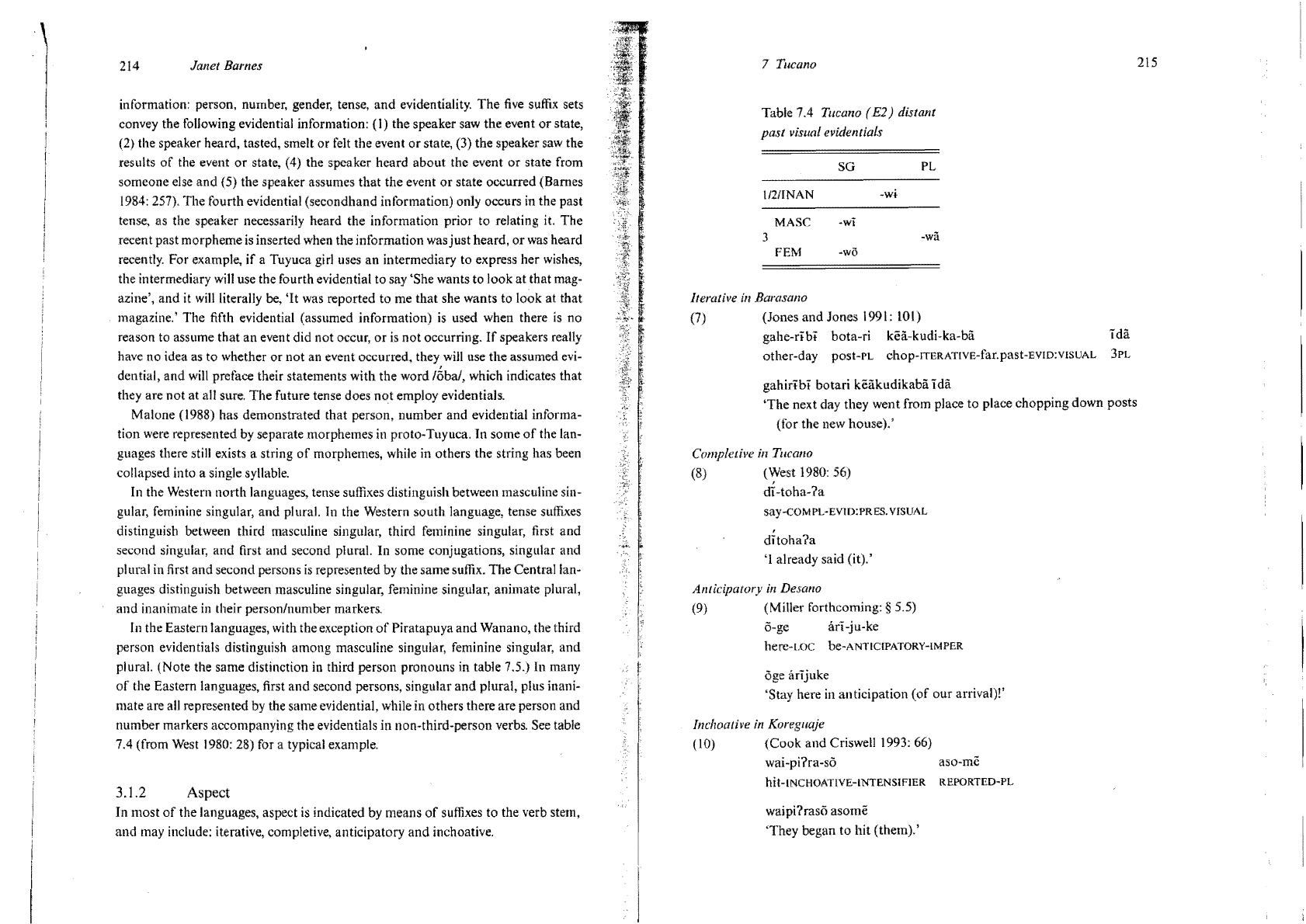
convey the following evidential information:
(I)
the speaker saw the event
or
stnte,
(2) tlle speaker heard, tasted, smelt
or
felt the event
or
state, (3) the speaker saw the
results
of the event
or
state, (4) the speaker heard about the event
or
state from
someone else and (5) the speaker assumes that the event
or
state occurred (Barnes
1984:
257).
The fourth evidential (secondhand inlbrmatíon) only occurs in the past
tense, as the necessarily heard the information prior to relating it. The
recent past morpheme
ís
ínserted when the informatíon wasjust heard, or
was
heard
recently. For example,
if
a Tuyuca girl uses
an
intermediary to express her wishes,
the intermediary
will
use the fourth evidential to say 'She wants to look at that mag-
azine',
and
ir
wí1l1iterally
be,
'It
was reported to me that she wants to look at that
magazine.' The fifth evidential (assumed ínformatíon)
ís
used when there
is
no
reason to assume that an event did not occur,
or
is
not occurring.
If
speakers
have no idea as
to
whether or not an event occurred, they
will
use the assumed
evÍ-
dential, and
will
preface their statements with the word /¿ba!, which indicates that
they are
not
at all sure.
The
future tense does
not
employ evidentials.
Malone (1988) has demonstrated that person, llumber and evidential informa-
tíon were represented by separate morphemes in proto-Tuyuca. In some
of
the lan-
guages there still exists a stríng
of
morphemes, while
in
others the string has been
collapsed into a single syllable.
In lhe Weslern north languages, tense suffixes dístinguish betweel1 masculine sin-
gular, feminine singular, and plural. In the Western south language, tense suffixes
distinguish betweell third masculil1e singular, third feminine singular, first and
second singular, and first and second plural. In sorne conjugations, singular and
in
first and second persons
is
represented by the same suffix. The Centrallan-
guages between masculine singular, feminine singular, animate plural,
and
inanimate
in
their person/number markers.
In the Eastern languages, with the exceplion
of
Piratapuya
and
Wanano, the third
person evidentials distinguish
amOl1g
masculine singular, feminine singular, and
plural. (Note the same distinction
in
third person pronouns in table 7.S.) In many
of
lhe Eastern languages, first and second persons, singular
and
plural, plus inani-
mate are all represented by the same evidential, while in others there are person and
number markers
"f'i'nmn"
on-third-versoll verbs. See table
7.4 example.
3.1.2 Aspect
In most
of
lhe languages, aspect
is
indicated by means
of
suffixes to the verb stem,
and may include: iterative, completive, anticipatory
and
inchoative.
7
Tucano
215
Table 7.4
Tucano
(E2)
distant
past visual evidentials
SG
PL
112/1NAN
-wi
MAse
3
FEM
-wi
-W0
-wa
Iterative in Barasano
(Jones
and
Jones 1991:
101)
gahe-ribt
bota-ri kéa-kudi-ka-ba
ida
other-day post-PL
ChOp-ITERATlvE-far.past-EvID:VISUAL
3PL
gahiribi
botari keakudikaba
ida
'The
next day they went from place
to
place chopping down posts
(for the new house).'
Completil1e in
TI/cano
(West 1980:
say-coMPL-EVlD:PRES.
VISUAL
,
ditoha?a
'1
already said (it).'
Anticipatory
in Desano
(9) (Miller forthcoming: § 5.5)
ári-ju-ke
here-I.oc
be-ANTICIPATORY-IMPER
árijuke
'Stay here in anticipation
(of
our arrival)!'
Inchoative
in
Koregl/aje
(10) (Cook and Criswell1993: 66)
wai-pi?ra-so aso-me
hit
-INCHOATIVE-INTENSIFIER R EPORTED-PL
waipi?raso asome
began
to
hit
217
1
216
Janet
Bames
I
The progressive and perfect aspects are generally achieved through verb com-
pounding. The main verb is
in
a participial forro, and is folIowed
by
an auxiliary
verb with a tense/person/evidential
suffix.
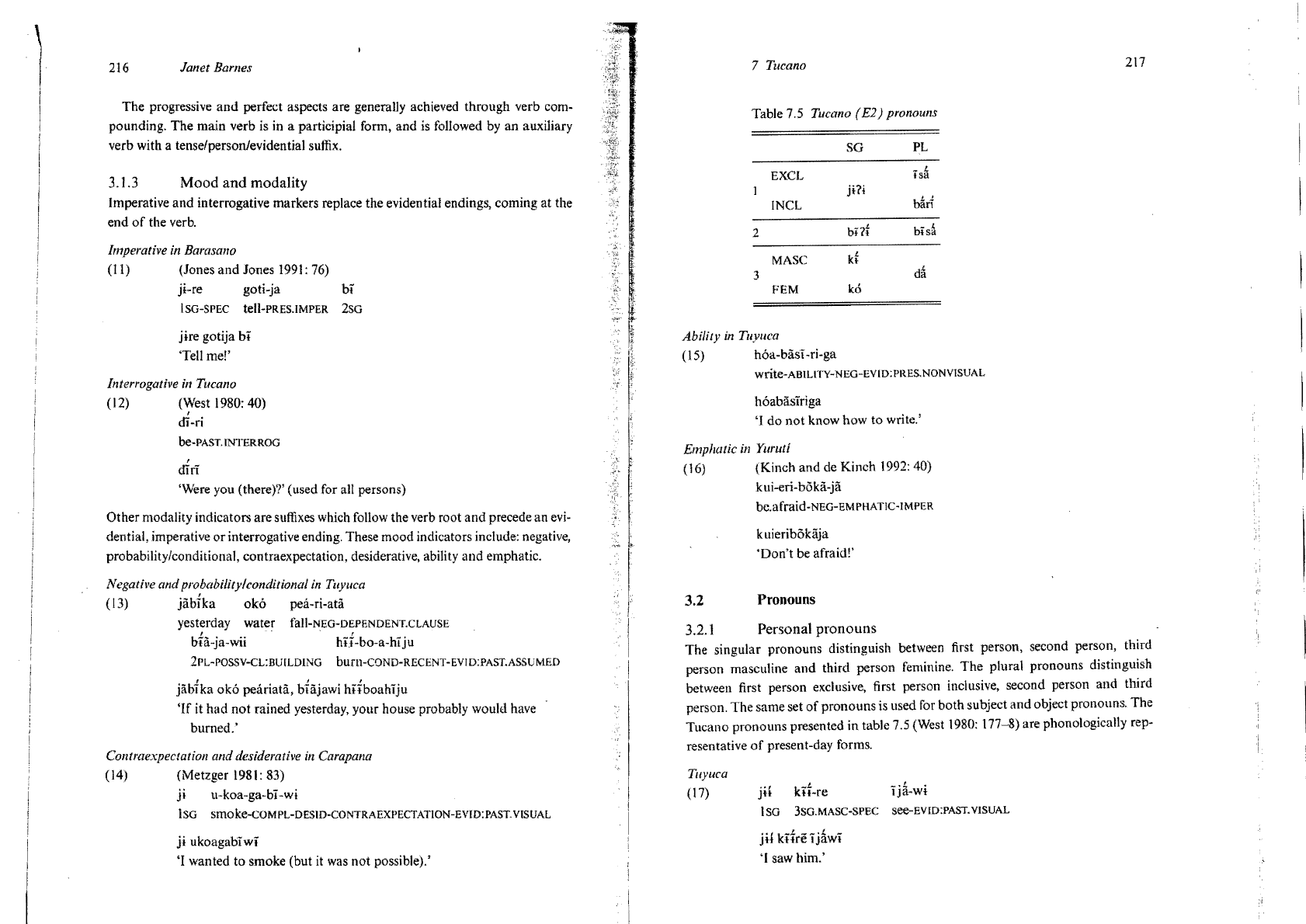
3.1.3 Mood and modaJity
Imperative and interrogative markers replace the evidential endings, coming at the
end
of
the
verb.
Imperati
(\1)
ve
in
Barasano
(Jones and
ji-re
ISG-sPEC
Jones
1991:
76)
goti-ja
tell-PREs.IMPER
bi
2SG
jire gotija
'Tell me!'
bi
Interrog
(12)
ative
in
Tucano
(West
1980:
40)
di-ri
be-PAST.INTERROG
diri
'Were you (thefe)?' (used for
all
persons)
Other modalíty indicators are
suffixes
which
follow
the verb root and precede an
evi-
dential, imperative
or
interrogative ending. These mood indicators inelude: negative,
probability/conditional, contraexpectation, desiderative, ability and emphatic.
Negative afld probabilitylconditional
in
Tuyuca
(13)
jabika
okó peá-ri-ata
yesterday water
fall-NEG-DEPENDENT.CLAUSE
bia-ja-wií hti-bo-a-hiju
2PL-POSSV-CL:BUILDlNG
burn-coNo-RECENT-EVID:PAST.ASSUMEO
j¡U>Íka
okó peáriata, biajawi hiiboahiju
'If
it had not rained yesterday, your house probably would have
burned.'
Contraexpectation alld desiderative
in
Campana
(Metzger
1981:
83)
ji
u-koa-ga-bI-wi
ISG
smoke-COMPL-DESlD-CONTRAEXPECTATION-EVID:PAST.
VISUAL
ji
ukoagabiwi
'1
wanted to smoke (but it
was
not possible).'
7 Tucano
Table
7.5
Tucano (E2) pronoulIs
SG
PL
EXCL
is&
INCL
jm
b&rf
2
bi1i
bi's~
MASC
kf
3
d&
FEM
kó
Ability
in
Tuyuca
(15)
hóa-basi -doga
wrÍte-ABILITY-NEG-EVID:PRES.NONV1SUAL
hóabasíriga
'1
do not know how to write.'
Emp/¡atic in Yurutí
(16) (Kinch and de Kinch
1992:
k ui-eri-bokii-jii
bc.afraid-NEG-EMPHATIC-IMPER
k uieribOkiija
'Don't
be
afraid!'
3.2
Pronouns
3.2.1
Personal pronouns
The singular pronouns distinguísh between first person, second person, third
person masculine and third person femínine.
The
plural pronouns distinguish
between first person
ex:clusive,
first person inclusive, second person and thírd
persono
The same set
of
pronouns is used ror both subject and object pronouns. The
Tucano pronouns presented in
tab1e
7.5
(West
1980:
177-8) are phonologically rep-
resentative
of
present-day forms.
TI/yuca
(17)
jH
kii-re
iji-wi
lSG
3SG.MASC-SPEC
see-EVID:PAST.
ViSUAL
jiJ kiifi!
'ij~wi
'1
saw
him.'
218
Jallel Bames
3.2.2 Possessive pronouns
In six
of
the languages: e2,
El
and
WI-4,
subject
pronouns
are used as possessive
pronollns.
The
rest
of
the langllages suffix a genitive, generally -ja 'singular'
or
-le
'plural',
to the possessive
pronoun
4
and then the item possessed follows.
The
item
possessed
is
expressed by a classifier
or
a
noun.
However,
if
the
noun
is
a kinship
term,
the genitive is
not
used (see lones
and
Jones 1991: 61-3 for a description
of
a
Tucano possessive system).
Koregl/aje
(l8)
(Cook
and
Criswell 1993: 45)
d3t?i
wa?thi
ISG knife
d3i?i
wa?thi
'my knife'
(Metzger
1981: 184)
k6-ja-wi
3sG.
FEM
-GEN-CL:CYUNDR1CAL
k6jawi
'her cylindrical object'
Barasano
(20)
(Jones
and
Jones 1991: 61)
i
jíkI
3SG.MASC
grandfather
i jiki'
'his
grandfather'
3.3
Classifiers
The
Tucano
languages
are
primarily numeral classifier languages. Classifiers in Ihe
Tucano
languages
are
suffixes that are subdivided
into
a small set
of
animate clas-
sifiers (which also function as nominalizers)
and
a larger set
of
inanimate classifi-
ers. Each e1assifier
denotes
salient characteristics
of
the noun(s) associated with it.
Nouns
which are
not
assoeiated with any c\assifier function as self-classifier suffixes
'repeaters', see Aikhenvald 1994: 420-2), for example,
names
for some body
parts. In al!
of
the
Eastern
languages plus
the
Centrallanguage
Cubeo, c1assifiers
are
found slIffixed
to
numeraIs, nouns, demonstrative adjectives, possessives
and
4 Wanano uses shortened forms
of
the subject pronouns as possessives (see Waltz 1997).
7
Tucallo
219
verbs
(to
form nominalized verbs).
The
other
Centrallanguage
Tanimuca
does
not
suffix c1assifiers
to
possessives.
In
Koreguaje, classifiers are found suffixed
to
the
same categories as the Eastern languages. FulI informatíon is
not
available
on
the
rest
of
the
Western languages.
One
of
the
differenees between the Western
and
the
Eastern languages regarding classifiers
ís
that
ín the Western languages
nouns
with
a specific referent are obligatorily suffixed by c1assífiers, although
nouns
that
denote
a general category are
not
suffixed.
Of
the
4 Western
Tucano
languages, has
17
c\assifiers, Siona
has
20
and
Koreguaje
has
28.
No
informatioll is available
on
Orejón.
Of
the
2 Central
Tucano
languages, Tanimuca
has
at
least
21
c1assifiers.
Cubeo
has
around
100.
The
classifiers
denote
form
or
fUlletíon (Strom
1992:
11,
and
Salser
et
al.:
16).
Eastern
Tucano
languages have anywhere from 50 to
140
classifiers.
The
salient
charactenstics denoted by these c1assifiers inelude
not
only the three dimensions,
but
also collection
and
arrangement.
There are rarely
heard
classifiers, such as one
denoting
bark
that
does
not
cling closely
to
the tree.
By
extension, this c1assifier
is
llsed ror sllch
as baggy
pants
and
plywood
that
has
become wet so
that
the
sheets have
separated
one from another.
(For
listings
of
classifier categories, see
Barnes 1990
and
Jones
and
Jones
1991: 50-6.)
Clllssifiers in Secoya
(21)
and
Levinsohn
1990:
41)
mia
sakHi.-pi
cedar
tree-CL:WITH
ROOTS-INST
canoe-CL:CONTAINER
mia
sakijtpi
jowi
'a
eedar
canoe'
Classifiers
in
Campana
(Metzger 1981: 154)
idé-jQ-ri ka-ibia-ri-jQ-ri
chonta-CL:PALM-PL
SPECIF1C.NOMINAL.REFERENT-high-NMLZR-
CL:PALM-PL
¡déjar!
kaibiar'ij5ri
'chonta
palms, specifieally the tall ones'
3.4 Specificity marker
The
specificity
marker
may ocellr
on
any nonverb word
or
construction,
and
in
most
of
the languages it is obligatory
on
specific dírect objects, experiencers
and
benefac-
tees. In
some
of
the
other
langllages, it marks specific items in the discourse, even
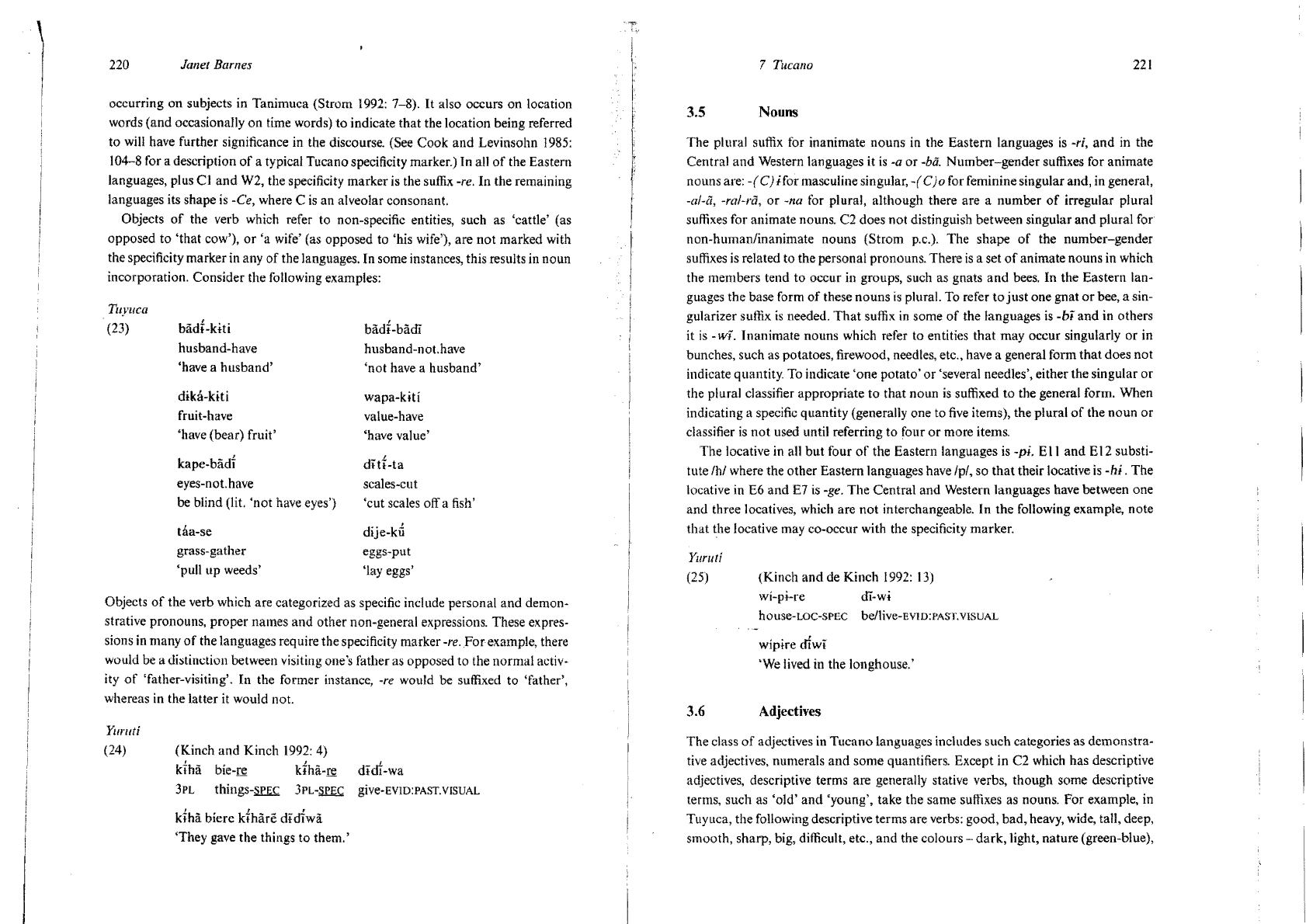
220 Janet Barnes
1
occurring on subjects in Tanimuca (Strom
1992:
7-8).
It
al80 occurs
on
loearíon
I
I
words (and occasionally
on
time words)
to
indicate that the location being referred
I
i
to will have further significance in the discourse. (See Cook
and
Levinsohn
1985:
I
104-8 for a description
of
a typieal Tucano specificity marker.) In all
of
the Eastern
languages, plus
CI
and
W2, the specificity rnarker is the suffix
-re.
In the rernaining
languages its shape
15
-Ce, where C
is
an alveolar consonant.
Objects
of
the verb which refer to non-specific entities, such as 'cattle' (as
opposed
to
'that cow'),
or
'a
wife' (as opposed to 'his
are
not
rnarked with
the specificity rnarker in any
of
the languages. In sorne instances, this resuIts in noun
incorporation. Consider the following exarnples:
TI/yuca
(23)
badf-kiti
badi-barn
husband-have
husband-noLhave
'have a
husband'
'not
have a husband'
diká-kiti
wapa-kití
fruit-have
value-have
'have (bear) fmi!'
'have value'
,
kape-badf
diti-ta
eyes-not.have
scales-cut
be blind (lit.
'not
have eyes')
'cut
scales off a fish'
táa-se
díje-kfl
grass-gather
eggs-put
'pulI up weeds'
'Iayeggs'
Objects
of
the verb which are categorized as specifie incIude personal and dernon-
strative pronouns,
proper
names
and
other non-general expressions. These expres-
sions in many
of
the languages require the specificity rnarker
-re.
Forexample, there
would be a distinction between visiting one's father as opposed to the normal activ-
ity
of
'father-visiting'. In the former instanee,
-re
would be suffixed to 'father',
whereas in the tatter it would not.
YUl'ItlÍ
(24)
(Kinch
and
Kinch 1992: 4)
kthii
bíe-~
k¡ha-~
didf-wa
3PL
things-~
3PL-~
give-Evm:PAsT.VISUAL
ktha
biere
ktharé
didfwa
'They gave the things to thern.'
7
Tucano
221
3.5 Nouns
The plural suffix for inanimate nouna in the Bastem languages
is
-ri,
and
in the
Central
and
Westem languages it is -a
or
-bao
Nurnber-gender suffixes for anímate
nouns are:
-(
C)ifor
masculíne singular,
-(CJo
for ferninine singular and, in general,
-al-lí,
-ra/-ra,
or
-na
for plural, although there
are
a number
of
irregular plural
suffixes for animate nouns. C2 does not distinguish between singular
and
plural for
non-human/inanimate nouns (Strorn p.c.). The
shape
of
the number-gender
suffixes
is
related to the personal pronouns. There
is
a set
of
animate nouns in which
the rnembers tend to occur in groups, such as gnats
and
bees. In the Bastem lan-
guages the base forrn
of
these nouns
ís
plural. To refer
to
just
one gnat
or
bee, a sin-
gularizer suffix
is
needed.
That
suffix in sorne
of
the languages is -b'i
and
in others
it
i5
-w'i. Inanirnate nOllns which refer to entities
that
may
occur singularly
or
in
bunches, such as potatoes, firewood, needles, etc., have a general forro
that
does not
indicate quantÍty. To indieate
'one
potato'
or
'several needles', either the singular
or
the plural c1assifier appropriate to that noun
is
slIffixed
to
the general
formo
When
indicating a specific quantity (generalIy one to
five
items), the plural
of
the
noun
or
c1assifier
is
not
used until referring to four
or
more items.
The locative in all
but
four
of
the Eastem languages is -pi, E
II
and
E
12
substi-
tute Ih/ where the other
Eastem
languages have Ipl,
so
that
their locative is
-h;.
The
locative in E6
and
E7 is
-ge.
The Central and Westem languages have between one
and
three locatives, which are
not
interchangeable. In the following example, note
that
the locative rnay co-occur with the specificity marker.
Yurutí
(25) (Kinch
and
de Kinch 1992: 13)
wí-pi-re rn-wi
house-Loc-sPEC
bellive-EVID:PASr.
VISUAL
wípire
dfwi
'We lived in the longhouse.'
3.6 Adjectives
The
e1ass
of
adjectives in Tucano langllages ineludes such categories as dcrnonstra-
tive adjectives, numeral s
and
sorne quantifiers. Exeept
in
C2 which has descriptive
adjectives, descriptive terrns are generally stative verbs, tho\¡gh sorne descriptive
terrns, such as
'old'
and
'yollng', take the sarne su!flxes as nouns. For example, in
Tllyllca, the following descriptive terrns are verbs: good,
bad,
heavy, wide, tall, deep,
srnooth, sharp, difficult, etc., and the colours -
dark,
nature (green-blue),
222
Janet
Bames
contrast
(red-orange). These verbs
do
not
take the full range
of
verb suffixes,
but
do
function as verbs, as
the
following examples iIIustrate.
Tuyuca
(26a)
dikÍ-ri-ku
be.heavy-NEO-EY1D:PRES.ASSUMED
dikÍriku
'It
is
not
heavy.'
(26b)
basoki
deb6-ro
ibid-ki
person be.bigger.
than-ADVZ
be.tall-EvlD:PRbS.ASSUMED
basok¡
debor6
ibilikí
'He
(a gorilla)
is
taller
than
a person.'
3.7
Negation
means
of
a negative suffix which precedes the evidential
(or
Nouns
can be negated by suffixing a different negative mor-
to them.
There
are
generally two negative verbs: 'to
not
have'
and
'to
not be'.
Concepts such as 'never',
'no
one'
and
'nothing'
are encoded without the use
of
spe-
cífic words for these concepts
(Bames
1994: 337-9). Neither is there a negative
response word.
5
Rather,
the
negative response
to
'Will you go'!'
is
a full clause '[
will
notgo.'
3.8 Nominalized
verbs
Nominalized verbs in the
Tucano
languages are used where other languages use rel-
ative clallses.
6
Note
the following examples which are inflected for tense
and
mood:
Barasallo
(27)
(Jones
and
Jones 1991: 43)
blle-go
bllego
study-SG.FEM 'she who studies'
Koreguaje and the Centrallangllages
do
have
a
negative
response
is
paami.
The
negative
response
words
in
lhe Central languages
are
)Qnse
words
in
one
Of
more
Arawak
langllages.
In
ClIbeo
it
is
bi,
and
in
Tanimllca/Retuara
ít
is
he/"(}
liJ.
Ó Tanimuca/Retuara
has
both
relative
clauses
and
nominalized
verbs.
7 Tucano
223
bue-ka-ko
buekako
study-PAST-SO.FEM
'she who
studied'
bue-ro-ko bueroko
studY·FUT-SO.FEM
'she
who will
study'
3.9
Switch-reference
In
the
Eastern
languages,
if
the subject
of
a
dependent
dause
is
the
same
as the
it, there
is
a set
of
suffixes, often indicating person
and
number,
that
is
used
on
the verb
of
the
dependent
c1ause. However. there is only
one
suffix
to
indicate tilat tile subject
of
tile
dependent
clause
is
different from the
sllbject
of
the
following
da
use.
The
set
of
same-subject markers, in many
of
the Jan-
guages,
is
identical to the set
of
nominalizers. In
other
langllages the sets differ in
accent placement only. If, in a
dependent
clause,
no
suffix
is
added to the verb stem,
it is
understood
that
lhe subject
of
that
c1allse is the
same
as the subject
of
the
fol-
lowing clause.
This
type
of
construction
is
typically used when describing a series
of
events
that
took place one right after another.
(For
a discussion
of
a typica1
Eastem
Tucano
switch-reference system, see
Longacre
1983.)
D(fferent sl/bject
in
Wanano
(28)
(Longacre 1983:
202)
to
wa?a-tJi
tidii thuatasi
this when.going-Ds they
won't(return)
to
wa?atfi
tida
thuatasi
'When
he goes, won't
return.'
Same
in Wanano
1983:
202)
tiro
wa?a-ro
thuatasi
3MASC
won't(return)
tiro wa?aro
thuatasi
'When he goes, he won't
return.'
DifIeren! subject
in
Tuyuca
(30)
bit
wáa-ri
wáa-ida
2so gO-DS
gO-SG.MASC.FUT
bit
wáari,
wáaida
'Ir
you go, 1 will go.'
I
-rr
.'--j
224
Janet Barnes
!
Same subject in Tuyuca
(31)
kit
ajií-ro kadi-gi uti-ri-ki
3SG.MASC
goOd-ADVZ
sleep-ss
cry-NEG-Evm:PRES.ASSUMED
kii
ajÓro kadigi, utíriki
'If
he sleeps well, he does not cry.'
The Western north langllages utilize same-subject
and
dilferent-subject marker5
between sentences. Typically, the verb
of
the preceding sentence
i5
repeated, and
suffix(es) are added to indicate same subject
or
dilferenl subject.
(For
examples, see
Wheeler
1987:
179-80.)
4
Syntax
The Tucano languages are Iypically
AOY,
SY
langllages, with variations
in
word
arder
dlle
lO
discourse conslderations. In sorne
of
Ihe languages,
if
the actor
i5
an
animate noun, whether expressed
or
understood, Ihe corresponding pronoun
is
mandatory just prior
lo
the
verbo
Thus; these languages have a large percentage
of
sentences that are
OAY,
with the A argument being a pronoun.
The
two Eastern
sOlllh langllages, Barasano and Macllna, are
OY7
and
OYA
respectively, and the
Westem langllage Koreguaje
15
YAO.
Typica
lIy
the object
is
unexpressed
if
understood, so thal it
is
common to hear a
command such as 'Close!', rather than 'Close it!' Also, statements such as:
'1
already
told', rather than
'1
already told
it
to her' are common. Sentences with three partic-
ipants explicitly stated, sllch as actor, direct object
and
indirect object, are no! com-
heard. When they
do
occur, the direct object precedes the indirect object (see
example 24).
In some
of
Ihe Eastern languages, such
as
TUYllca,
lltterances generally involve
many short sentences, with a marked lack
of
hypotaxís. Others, such as Taiwano,
tend to have sentences with long series
of
dependent c\allSes.
Typically among speakers
of
the Tllcano langllages, listeners
will
respond to a
speaker
by
llttering an affirming
'Hmm',
repeating Ihe final verb,
or
a ques-
tion
of
the final verb, as
if
to
say,
'Is that so?'
Time
and location
There
is
flexibility wlthin the sentence regarding the order
of
words
or
phrases
denoting time and locatlon. In general, expressions
of
time precede the verb and
7 Barasano
is
described in lones and lones (1991:
2)
as
'OV,
with Ihe subject gencrally follow-
ing the verb'. One
of
lhe aulhors, through personal communication, has indic'ated lha!
further sludies may indicate that the language
i8
AOV.GÓmez-Imbert (1988: 99) considers
Harasana lo
be
OVA.
7 Tucano
225
may follow a subject pronoun. Expressions
of
location generally follow expressions
of
time,
and
oflen follow the
verbo
Expressions
of
location may also signa) para-
graph boundaries (Waltz
1975:
50).
4.2
Noun
phrase
Noun phrases are
not
commonly used
in
most Tucano languages. If, in a given sen-
tence, the contexl makes it clear that a canoe
is
being discussed, then to state
that
it
is
big requires
that the c\assifier referring to canoes be suffixed to the word
Phrascs such as
'My
old, beat-up canoe' are
not
often heard in most
of
the lan-
guages. Generally
just
one descriptive word will occur in a given sentence. But
if
al!
of
the descriptive concepts are new
to
the context,
and
necessary for full under-
standing, then each descriptive term
wi11
occur with the appropriate c1assifier
attached
to
it. The following example
is
taken from a text about a DC-3 aeroplane
that landed upriver. The 'hollow' c1assifier, which refers to the aeroplane,
is
also that
used for canoes
and
reed-Iike plants which grow with hollow centres.
TI/yuca
tii-wi pai-ri-,ffi-béda
that-cL:HOLLQW
big-sG.NMLZR-CL:HOLLOW-INST
weki-a pta-r1i tikoko-wa
cattle-PL
two-PL.ANIM
send-EvID:PAST.VISUAL
tiiwi pairíwibéda
wekiápiar[
tikókowa
'Two bu lis were sent in (by means
01)
that big plane.'
BIBLIOGRAPHY
Aikhenvald.
A.
Y.
1994. 'Classifiers
in
Tariana', Antllropological Linguistics. 36.407--65.
Bames,1. 1984. 'Evidentials
in
lhe TlIyuca verb',
IJAL,
50.255-71.
1990. 'C1assifiers
in
TlIyuca'. pp. 273-92
of
Amazonian linguistics: studies
in
Lowland South
American langllages,
ed.
D.
L. Payne. AlIstin: University
of
Texas Press.
1994.
'TlIyuca',
pp.
325·-42
of
Typological sludies in nega/ion. Typological Studies
in
Language,
29,
ed.
P.
Kahrel and R.
Van
Den Berg. Amsterdam: John Benjamins.
1996.
i'\utosegments with three-way lexical contrasts in Tuyuca'. IJAL, 62.31-58.
Cook.
D.
M. and Levinsohn.
S.
H.
1985.
'Coreguaje:
Domainsof
Foclls Markers" pp. 91-116
ol'
From phonology 10 discolIl'se: slIIdies in six Colombian languages, ed.
R.
M. Brend.
Dalias: SIL.
Cook,
D. M.
and
Criswell,
L. L.
1993.
El
idioma koregllaje (Tucano Occidental). Colombia:
Asociación Instituto Lingüístico de Verano.
Gómez-Imberl,
E.
1988. 'Construcción verbal en barasana y tatuyo'; Amerindia, 13.97-108.
1995.
(ms.) 'Extrametricality
and
postlcxical rules in Barasana (E astero Tucanoan)'. (Paper
presented at ¡he summer
meetingof
Society for the Study
of
the Indigenous Languages
of
Ihe Americas.)
4.1
- - -
- I
226
Janet
Barnes
Huber, R. Q.
and
Reed, R.
B.
1992.
Vocabulario comparativo: palabras selectas
de
lenguas ind!·
genas de Colombia.
1st edition. Colombia: Asociación Instituto Lingüístico de Verano.
Johnson,
o.
E.
and
Levinsohn,
S.
H. ¡990. Gramática secoya,
Cuadernos
Etnolingüísticos,
11.
Ecuador: Instituto Lingüístico de Verano.
Jones,
W.
and
Jones.
P.
1991. Barasallo sylllax, Studies in the Languages
of
Colombia, 2.
Dalias:
SIL
and
University
of
Texas
at
Arlington.
Kinch, R. A.
and
de Kinch,
P.
1992.
(ms.) 'El
yurutí',
Estudio preliminar para
el
atlas etllo-
lillgüístico colombiano.
Colombia: Instituto
Caro
y Cuervo.
Longacre, R. E.
1983. 'Switch-reference systems in two distinct linguistic areas: Wojokeso
(Papua
New
Guinea)
and
Guanano
(Northern
South
America)', pp. 185-207
of
Switch-
reference ami universal grammar,
ed.
J.
Haiman
and
P.
Munro. Amsterdam: John
Benjamins.
Malone,
T.
1987.
'Proto-
Tucanoan
and
Tucanoan genetic relationshiJJs'. Colombia: Instituto
Lingüístico de Verano. Ms.
1988. 'The origin
and
development
of
Tllyuca evidentials', IJAL, 54.119-40.
Metzger,
R.
G. 1981. Gramática popular del cara pana. Bogotá: Instituto Lingüístico de
Verano.
1998.
'The
morphcme
KA-
of
Carapan3
(Tucanoan)' (online) available al http://www.sil.
orglsilewp.
Miller, M. 1999.
Desano grammar, Studies
in
lhe Languages
of
Colombia, 6. DaBas:
SIL
and
University
01'
Texas
at
Arlington.
Salser,
J.
K., Morse,
N.
and
Ferguson,
1.
1986.
'Cubeo
workpaper'. Colombia: Instituto
Lingüístico
de
Verano. Ms.
Salser,1. K., Jr. 1971.
'Cubeo
phonemics'. Linguis/ies,
75.74--9.
Smothermon,1.
R.,
Smothermon,
1.
H. with
Frank,
P.
S.
1995. Bosquejo del mael/na: aspectos
de la cl/llura ma/erial
de
los macunas; fonología; gramática. Colombia: Asociación
Instituto Lingüístico
de
Verano.
Sorensen. A.
P.,
Jr. 1967. 'Multilingualism in the Northwest
Amazon',
American
AIII/¡ropolagist,69.670-84.
Strom,
C.
1992. Reluaril syntax, Studies in the Languages
01'
Colombia, 3. Dalias:
SIL
and
University
of
Texas
al
Arlington.
Velie, D.
and
Velie,
V.
1981. Vocabulario orejón. Serie Lingüística Peruana.
16.
Peru: Instituto
Lingüístico de Verano.
Velie Gable,
D.
1975.
'Bosquejo de la lonología y gramática del ídioma
orejón
(coto)',
Datos
Etno-Lingüísticos,
10.
Peru: Instituto Lingüístico de Verano.
Waltz,
N.
E.
and
Waltz, C. 1972. 'Fonologia del
guanano',
Sistemas fonológicos de idiomas
colombiano,I,
1.29-40. (Columbia: Instituto Lingüístico de Verano.)
Waltz.
N.
E.
1975. 'Discoursc functions
01'
Guanano
sentence
and
paragraph',
pp. 21-145
01'
Sll/dies
ill
illdigenolls languages
of
Colombia. Panama. ami Ecuador, vol.
1:
Discourse
grammar, ed. R, E. Longacre
and
F Woods. Dalias:
SIL
1997.
'A
comparisol1
of
Wanano
and
Piratapuyo'. Ms.
Waltz,
N.
E.
and
Wheeler, A. 1972.
'Proto
Tucanoan', pp. 119-49
of
Comparative studies
in
Amerinditl/¡ langl/agr.\', ed.
E,
Malteson et al.,
Janua
Linguarum, Series Practica, no.
127.
The
Hague.
Mouton.
Wcst,
B.
1977.
'Re~u!ts
of
a Tucanoan syntax questionnaire pilol stlldy', pp. 339-74
of
SIl/dies
in
indigellol/s /angl/ages
of
Colombia, Panama,
ami
Ecuador, vol.
I1I:
Discourse grammar,
ed. R. E. Longacre
and
F.
Woods. Dalias: SIL.
1980. Gramática popular deltuCilno. Colombia: Instituto Lingüístico de Verano.
Wheeler,
A.
1987.
Gallféya Bain: el pueblo símil! del río Putumayo, Colombia, Tomo
¡.
Etnologia, gramática, textos. Bogotá: Instituto Lingüístico de Verano.
8
Pano
EUGENE
E.
LOaS
1
INTRODUCTION
1
Languages
of
the Pano
are spoken on the eastern side
of
the Andes
in
Peru
and nearby regions
of
Brazil and Bolivia. They were first recognized to constitute
a family, on the basis
of
the comparison
of
seven languages,
by
De la Grasserie
(1890). He named
it
'la
famille linguistique Pano' after one
of
the languages, called
Pano
or
Wariapano. The languages show cIose similarities, indicating a
f:;!!,ly
shall9,iV
time-depth and recent expansion and selit.
1t has been suggested that the Pano family may be related to the
Tacana family, which
is
discussed
in
chapter
13
(there
is
phonological comparison
and reconstruction
in
Key
1968 aud Girard 1971). There are sorne lexícal and sorne
grammatical similarities, e.g. 2sg pronoun mi- and the forms
of
switch-reference
markers. However, more work
is
required to determine whether these similarities are
. sure indicators
of
gene tic connection, rather than being due to areal ditTusion.
Shell (1965/1975) undertook a systematic comparison and reconstruction
of
proto-Pano phonology
and
aspects
of
the morphology. She listed more than eighty
names tound in the Iiterature but sorne
of
these are names
of
dialects
or
clans withiu a language group,
or
alternative names
01'
languages. The number
(i
distinct languages
is
probably no more than thirty, as shown in table 8.1; sorne
of
these may
tum
out, on further study, to be dialects
of
a single language. Many
ditTerent subgroupings have been
in
the literature. In table 8.1,1 recognize
three subgroups and a number
of
ungrouped languages; the subgroupings are
made, tentativelv. on the basis
of
shared Dhonoloe:ícal
names end in
-nawa
'people' and sorne others in the plural rnarker
-ha
.
.l'..enslIlgeI
(1985) provides a useful overview
of
Pano groups with bibliography.
I 1 owe special thanks
to
Ivagene Shive
101'
Yaminawa, Eugene
and
Marie
Scotl for
Shafllllawa, Kim Fowler for Yoranawa, Harriet Fields for Matses,
and
Wayne Gil!
of
NTM-
Rolivia ror Chimane.
i
228
100
200km
I 1
74
0
W
,,.
,""
se'
se'
¡
El/gene
E.
Loos
8 Pano
229
i
...
so
I ,
..
..
,2"
14'
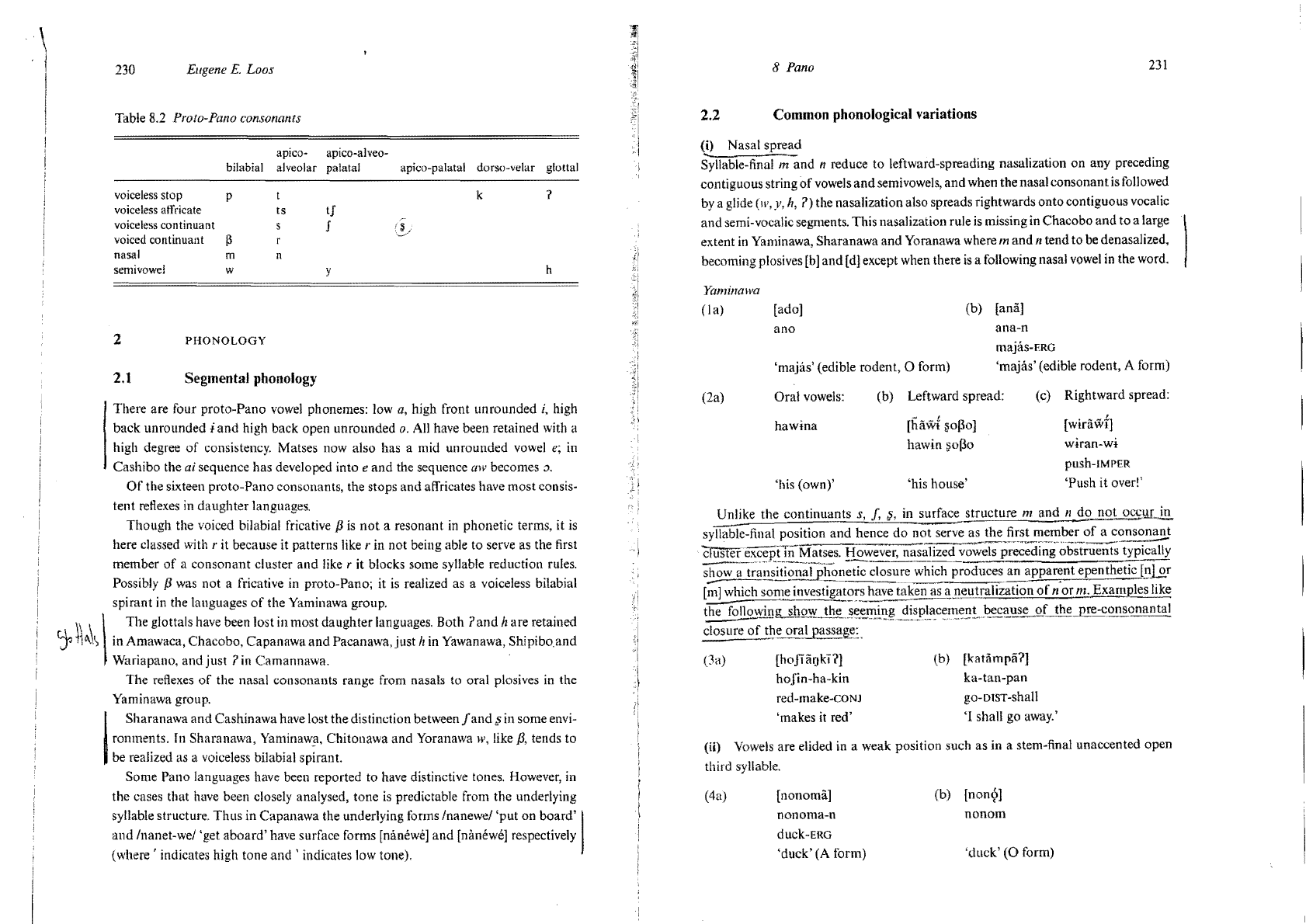
Map
7 Pano languages with approximate locations
One often finds many lexical roots shared between two languages, although the
fói'i'ñS'"óM1i{!"suffixes
vary, leading to initiallack
of
intelligibility. However, this can
be overcome through a degree
O~C!)9uFe-t&-afl€Jl;\;¡~e.-Afte!"1:1.o'fe~f
adjustments to dilferences, a Yaminawa
or
a Sharanawa can understand most
of
a
give-and-take exchange with a Yoranawa but gets lost in flowing discourse. The
Sharanawa are reported
to
be able to understand much
of
the Yawanawa. When
Cashinawas converse with Sharanawas they are known to resort to a kind
of
i1i~
Pañ{;"
by
suppressing the use
of
most suffixes, especially those
not
shared between
t..,.h-e-m-.------.....,...""'~
..
>-
............
.,..---'-
.....
__
.....
_-
~---,..--
••
-
Note that, unless otherwise indicated, all examples in this chapter are from
Capanawa, the language with which
1am most familiar. Also, allomorphic forms
are used
in
examples without identifying the basic form
of
the morpheme each
time.
Table
8.1
Languages 01 the Pano
lamily
The
Yaminawa
subgroup
1 Yaminawa 500
P,
Br
2 Amawaca 200 P
3 CashínawalHonikoin 500
p,
Br
4 Sharanawa/Shanindawa/ChandinawallnonawalMarinawa 300 P
5 Yawanawa 200
Br
6 Chitonawa 35 P
7 YoranawalNawa/Parquenawa 200 P
8 Moronawa 300
Br
9 Mastanawa 100 P
The
Chacobo
subgroup
10
Chacobo
400 Bo
t Arazaíre P
12
t Atsawaca P
13
t Yamiaka P
14
Katllkina/Camannawa/Waninnawa 300
Br
15 Pacawara
12
Bo
The
Capanawa
sllbgroup
16
Capanawa/Pahenbakebo 400 P
17 Shipibo/Conibo/Xetebo 8,000 P
18
tRemo
Br
19
Marubo
400 Br
20
t
Wariapano/Panobo/Pano
P
21
Isconawa 30 P
22
t CanamarilTaverí/Matoinahii Br
Ungrouped languages
23
Cashibo/Cacataibo/Comabo
lOO
P \ \
24
t Culino
Br
25 t Karipllná Br
26 Kaxariri 100 Br
27 Matses/Mayoruna 2,000
P.
Br
28 t
Nokamán
Br
29
t Poyanáwa Br
30
t Tutxinawa Br
Nole:
The
approximate
number
of
speakers is given ror each langllage; t índicates a
language tha! is probably
no
longer spoken. l..ocations
are
indicated
by
P,
ror
Peru; Br, ror Brazil; Bo, for Bolivia. (For approxirnate geographicallocations
of
each language see
map
7.)
Note
that in Spanish
'hu'
would be substituted
ror 'w' in these names.
I
231
,)
230
Ettgene
E.
Loas
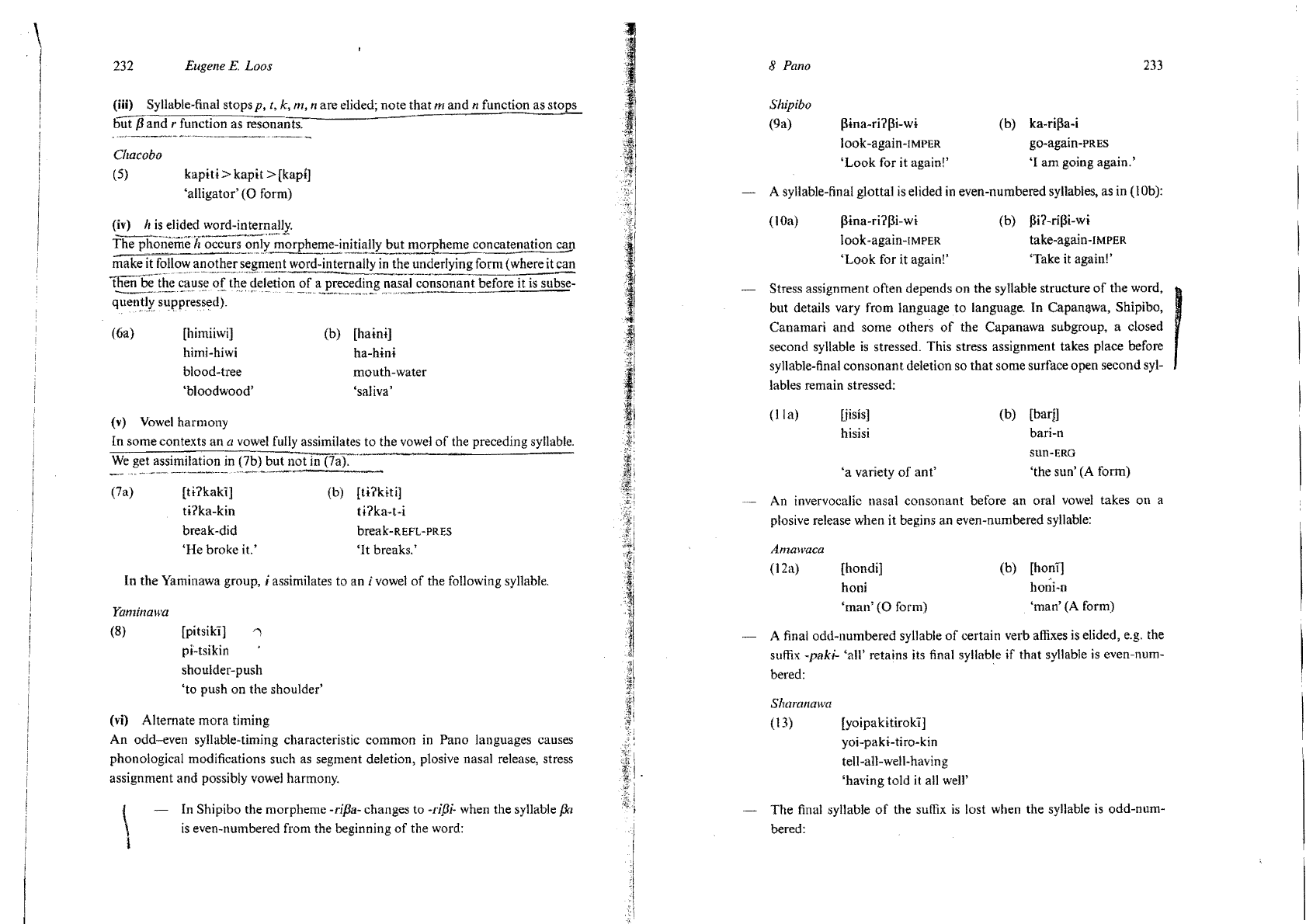
Table 8.2 Proto-Pano consonants
apico- apico-alveo-
bilabial alveolar palatal apico-palatal dorso-velar glottal
voiceless stop p
k
"/
voiceless affricate
ts
tJ
voiceless continuant
J
voiccd continuant
¡3
nasal
m n
semivowel
w
y
h
2
PHONOLOGY
2.1
Segmental phonology
There are rour proto-Pano
vowel
phonemes: low
a,
front unrollnded
í,
back unrounded ¡ and high back open lInrollnded
0,
Al! have been retained with a
degree
of
consistency. Matses now also has a mid llnrollnded
vowel
e;
in
Cashibo the
ai
sequenee has developed into e
and
the sequence aw beeomes
;:J.
or
the sixteen proto-Pano eonsonants, the stops
and
affrieates have most consis-
tent reflexes
in
danghter languages.
Thollgh the voiced bilabial fricative
13
is
nOI
a resonant
in
phonetic terms, it
is
here classed with r it beca use it patterns like r in not being able to serve as the first
member
of
a consonant cluster
and
Iike
r it blocks sorne syllable reduction rules,
Possibly
13
was not a fricative
in
proto-Pano;
it
is
realized as a voieeless bilabial
spirant
in
Ihe lallguages
of
the Yaminawa group.
\\
\ \ The glottals have been lost in most daughter languages.
80th?
and
h are retained
~?
titl.\~
in Amawaea, Chaeobo, Capanawa
and
Pacanawa,just h
in
Yawanawa, Shipibo.and
Wariapano, and just
7
in
Camannawa,
The reflexes
of
the nasal consonants range from nasals to oral plosives
in
the
Yaminawa group.
I
Sharanawa
and
Cashinawa have lost the distinction between Jand
ij
in some envi-
ronments.
In
Sharanawa, Yaminawa, Chitonawa and Yoranawa
11',
Iike
13,
tends to
be realized as a voiceless bilabialspirant.
Sorne Pano languages have been reported to have distinctive tones, However,
in
the cases that have been closely analysed, tone
is
predietable from the underlying
structure, Thlls in Capanawa the lInderlying íorms /nanewel
'put
on board' I
and Inanet-we/'get aboard' have surface forms [nánéwé] and [niméwé] respectively
(where'
indicates high tone and ' indicates low
+~,,~\
'«1
iít¡
~I
,~I
~I
8
Pano
."
~
I
2.2 Common phonological variations
(i)
Nasal spread
,,-~--~'---
Syllable-final m and n reduce to leftward-spreading nasalization
011
any preceding
contiguous string
of
vowels
and
semivowels, and when the nasal consonant is followed
by
a glide
(11',
y,
h,
7)
the nasalization also spreads rightwards onto eontiguous vocalic
and semi-vocalic segments. This nasalization rule
is
missing
in
Chaeobo and
to
a
extent
in
Yaminawa, Sharanawa and Yoranawa where
In
and n tend
to
be denasalized,
becoming plosÍves [b] and
[d}
exeept when there
is
a following nasal
vowel
in
the word.
Yaminawa
(la)
(b)
ano
ana-11
majás-ERa
'majás' (edible rodent, O form)
'majás' (edible rodent, A form)
(2a)
Oral vowels:
(b) Leftward spread:
(e)
Rightward spread:
hawina
~0130]
[wirawt]
hawin
~0130
wiran-wt
PUSh-IMPER
'his (own)'
'his house'
'Pllsh it over!'
Unlike the continuants
s,
J,
ij,
in surface structllre
ni
and n_do
.112,t
OCCl!Ll!!..
sy1iábÍe-final position and hence
do
not
serve as the first member
of
a eonsonant
-1
cr
usteréXCePHñM atses. However,
nas¡ii1ZedVo'~p~~~;d¡;;io¡;strüeñtS
t
ypic~
~;-ú-¡~~!iYIiól1~tic
c.losure which produces an
appar:nt
epenthetic
tI1J..9.r
[m]
which some investigators have taken as a neutralization
of
n or m. Exargples like
~-----_...
..--
~~K2hº.!Y.J!!!::
...
~~.fl"!~~~._~~s.p.~c:n:.e~!_.bec1!.~~f
the
yre-
c
2E.!onantal
dosure
of
t.b!:.2
ral
Ea~~.:.
:1
(3a)
[hoJialJki?]
(b)
[kaHimpa?]
hofin-ha-kin
ka-tan-pan
"\
red-make-CONJ
go-msT-shall
'makes
it
red'
'1
shall go away.'
(ii)
Vowels are elided in a weak position such as in a stem-final unaeeented open
third
(4a)
[non{>1
nonoma-n
nonom
duck-ERG
'duck'
(A
form)
'dllCk' (O form)
\
Eugene
E.
Loas
232
(iii)
Syllable-final stops p, t,
k,
m,
n are elided; note that m and n function as
sto~
6iit73
and r function as resonants.
Chacobo
(5) kapitt> kapit > [kapi]
'alligator'
(O form)
(iv) h
is
elided word-internally.
fi1éPh~~eni'eíí-OCcur~_?~~~'~~rpheme-ir0iall~
but.!!~rpheme
concatenation
cl!!.1
make it follow another segment word-internally
in
the underlying form (where it can
"fIlen
be-th~~~~;~--;;i-th;'d~let¡:;n
of
~g-;:.""it'SaT-;;-ó~so;¡~t
before it
is
subse-
___
•.
--
•.
-'"'~
".-
_._,
-,~.,~
..
'~'.'"
......
~,,
___
"">_.~
..
~"~_"",,.
,'c',"''''_'''
__
quen!lx
su~pressed).
(6a)
[himiiwi] (b)
[hatni]
himi-hiwi
ha-hinf
blood-tree mouth-water
'bloodwood' 'saliva'
(v)
Vowel
harmony
ln
sorne contexts an a
vowel
fully assimilales lo Ihe
vowel
of
the preceding syllable.
We
get assimilation in (7b) but
notiñ(fa):--"-
-"---~_
..
_-"_._-""
...............
'~
•..
_---'"
(7a)
[ti?kaki]
(b) [tií'kiti]
ti?ka-kin
tií'ka-t-i
break-did
break-REFL-PRES
'He
broke
it.'
'lt
breaks.'
ln
the Yaminawa group, i assimilates to an i
vowel
of
the following syllable.
Yaminawa
(8)
[pitsiki]
Fj
pi-tsikin
shoulder-push
'to push on the shoulder'
(vi) Altemate mora timing
An
odd-even syllable-timing characteristic common
in
Pano languages causes
phonological modifications such as segment deletion, plosive nasal release, stress
assígnment and possibly vowel harmony.
\
In Shipibo the morpheme -ripa- changes to
-riJ3i-
when the
syUable
f3a
ís
even-Ilumbered from the begillning
of
the word:
8 Pano
233
Shipibo
(9a)
l3ina-ri?l3i-wi:
(b) ka-ril3a-i
look
-again-IMPER
go-again-PREs
'Look
for it agaín!'
'1
am
going again.'
A syIlable-final glottal
is
elided
in
even-numbered syllables. as in
(1
Ob):
(lOa) l3ina-ri?l3i-wi
(b)
[3i?-ríl3i-wi
look-again-IMPER
take-again-IMPER
'Look
for it again!'
'Take
it again!'
Stress assignment often depends.on the syllable structure
of
the word, ,
but details vary from language to language. In Capanawa, Shipibo,
Canamari
and
some others
of
the Capanawa subgroup, a closed
second syllable
is
stressed. This stress assignment takes place before
syllable-final consonant deletion so tbat some surface open second syl-
lables remain stressed:
(1
la)
[¡isis]
(b) [barí]
hisisi
bari-n
sun-ERG
'a
variety
of
ant'
'the sun'
(A
forro)
An invervocalic nasal consonant before an oral
vowel
takes on a
plosive release when it begins an even-numbered syllable:
Amawaca
(I2a)
[bondi]
(b) [honí]
honí
hOlli-n
'man'
(O
form)
'man'
(A form)
A final odd-numbered syllable
of
certain verb affixes is elided, e.g. the
suffix
-paki- 'all' retains its final syllable ir that syllable
is
even-num-
bered:
Sharanawa
(13) [yoipakHirokl]
yoi-paki-tiro-kin
teU-all-well-having
'having told it all well'
The
final syllable
of
the suffix
is
lost when the syllable
is
odd-num-
bered: