
Dixon R.M.W., Aikhenvald Alexandra Y. The Amazonian Languages (Cambridge Language Surveys)
Подождите немного. Документ загружается.

174
Aryon
D.
Rodrigues
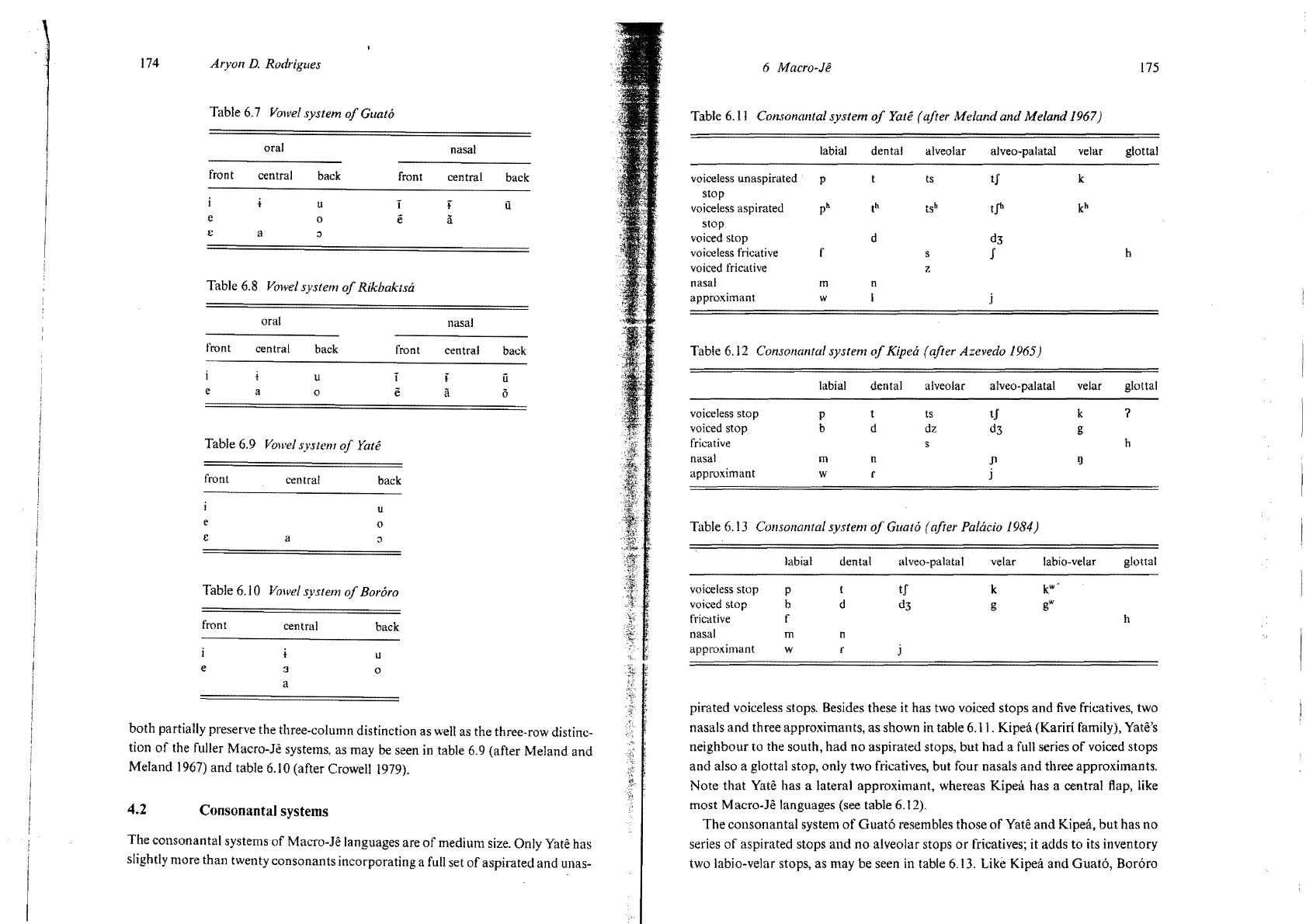
Table 6.7
Vowel
systern
of
Guató
oral
nasal
fron!
central
back
front
central
back
u
t
i1
e
o
é
a
e
a
:J
Table 6.8
Vowel
systern
of
Rikbaktsá
oral
nasal
front
central
back
fronl
central
back
e
a
u
o
é
a
i1
ii
Table 6.9
Vowel
system
of
Yate
fronl
central
back
u
e
o
e
a
:J
Table 6.10
Vowel
system
of
Boróro
fronl
central
bacle
u
e
3
o
a
both
partially preserve the three-column distinction as well as the three-row distinc-
tion
of
the fuJler
Macro-Je
systems, as may
be
seen
in
table 6.9
(after
Meland
and
Meland
1967)
and
table 6.10 (after CroweIl1979).
Consonantal systems
The
consonantal
systemsof
Mal-'ro-Je languages
are
of
medium
size.
Only
Yate has
more
than
twenty
consonants
incorporating
a
fuI!
sel
of
aspirated
and
unas-
6 Macro-Je
175
Table 6.11 Consonan/al system
of
Yate (after Me/and
and
Meland 1967)
labial dental alveolar
alveo-palatal velar glottal
voiceless
unaspirated .
p
ts
tJ
le
stop
voiceless
aspirated
ph
t
h
ts
h
tJh
le
h
stop
voiced
stop
d
d3
voiceless
fIicative
f
J
h
voiced
fricative
z
nasal m n
approximant
w l
Table 6.12
Consonan tal system
of
Kipeá (afier Azevedo 1965)
labial dental alveolar alveo-palatal velar glottal
voiceJess
stop
p
t
ts
tJ
le
?
voiced
stop b
d
dz
d3
g
fricative
s h
nasal
m
n
Jl
IJ
approximant
w j
Table 6.13 Consonan/al system
of
Gualó Palácio 1984)
labial dental alveo-palatal
velar labio-velar
glottal
voiceless
stop p I
tI
k
k
W
'
voiced
stop
b
d
d3
g
gW
fricative f h
nasal
m
n
approximant
w
pirated voiceless stops. Besides tbese it
has
two voiced
stops
and
five fricatives, two
nasals
and
three approximants,
as
shown in table
6.1
l.
Kipeá (Karirí family), Yate's
lO
the
south,
had
no
aspirated
stops,
but
had
a full series
of
voiced
stops
and
al
so
a glottal stop, only two fricatives,
bUI
four nasal s
and
three approximants.
Note
that
Yate has a lateral
approximant,
whereas
Kipeá
has
a central
fiaD.
Iike
most
Macro-Je
languages table 6.12).
The
consonantal
system
of
Guató
resembles
those
of
Yate
and
Kipeá,
but
has
no
series
of
aspirated stops
and
no
alveolar
stops
or
fricatives; it
adds
to
¡ts inventory
two labio-velar stops,
as
may
be
seen in table 6.13. Like Kipeá
and
Guató,
Boróro
4.2
176
k
g
glottal
Alyon
D.
Rodrigues
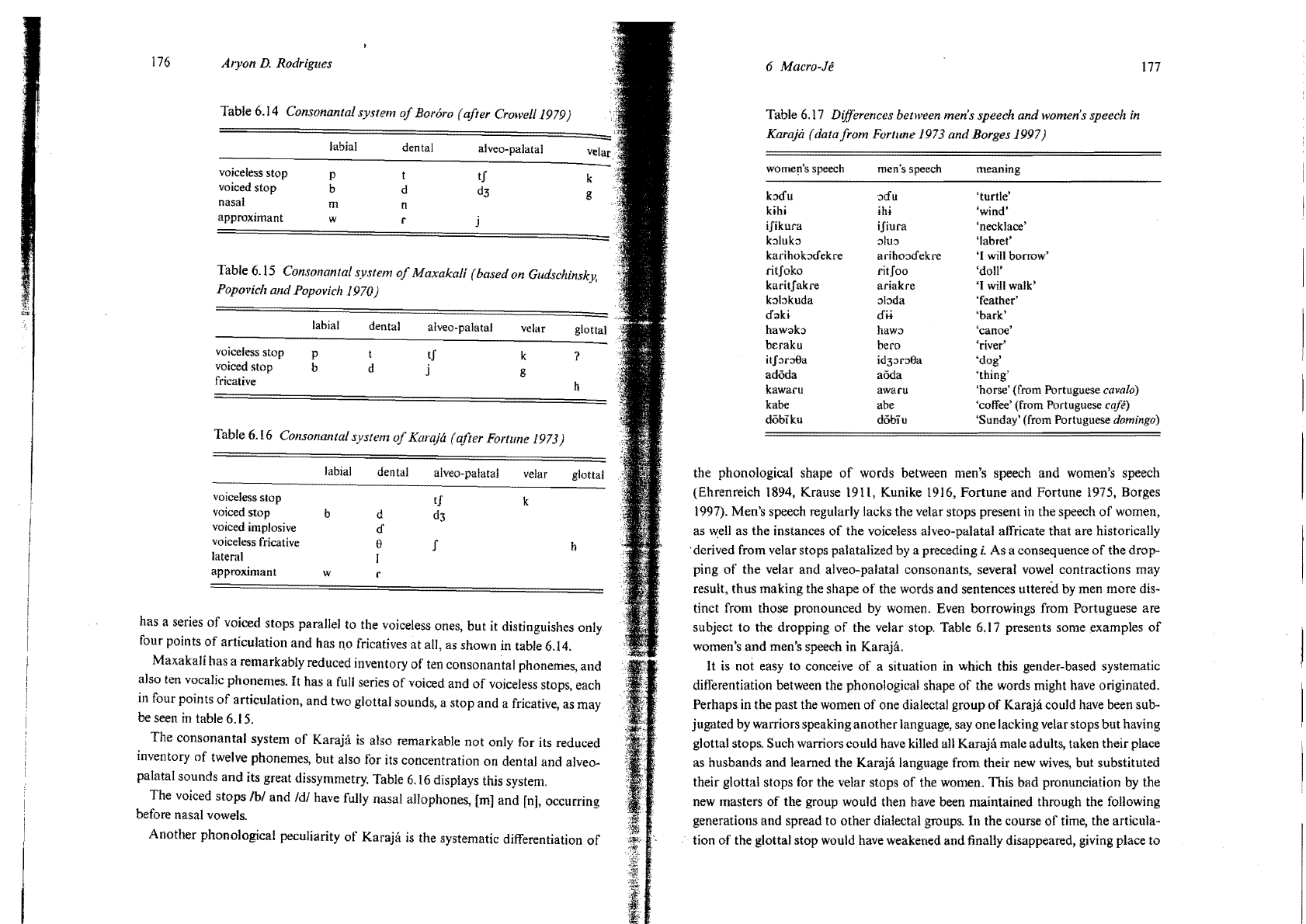
Table 6.14 Consonan tal system
of
Boróro (after Crowell1979)
labial
dental
alveo-palatal
voiceless stop
p
I
tI
voiced stop
b
d
d3
nasal
m
n
approximant
w
Table 6.15 Consonanta/ system
of
Maxakalí
(based on Gudschinsky,
Popol'ich and Popovich 1970)
labial
dental
alveo-palatal
velar
voiceless stop
p
t
tJ
k
?
voiced stop
fricative
b
d
g
h
Table 6.16 Consonan/al system
of
Km'ajá (afier Fortune 1973)
labial
dental
alveo-palatal
velar
voiceless stop
tf
k
voiced
stop
b
d
d3
voiced implosive
a
voiceless fricative
e
f
h
lateral
I
approximant
w
f
has a series
of
voiced stops parallel to the voiceless ones,
but
it distinguishes
four points
of
artículatíon
and
has 1\0 fricatives at all, as shown in table 6.14.
Maxakalí has a remarkably reduced inventory
of
ten consonan tal phonemes, and
also ten vocalic phonemes.
It
has a full series
of
voiced and
of
voiceless stops, each
in four points
of
articulation,
and
two glottal sounds, a
stop
and
a fricative, as may
be seen in table 6.15.
The consonantal system
of
Karajá is
al
so remarkable
not
only for its reduced
inventory
of
twelve phonemes, but also for its concentration
on
dental and alveo-
palatal sounds
and
its great dissymmetry. Table 6.16 displays this system.
The voiced stops
Ibl
and
Idl have
fuHy
nasal alJophones,
[m]
and
[nJ,
oeeurring
before nasal vowels.
Another
phonological peculiarity
of
Karajá
is
the systematic differentiation
of
6 Macro-Ji
177
Table 6.17 Dífferences between men's speech and women's speech
in
Karajá
(datafrom
Fortune 1973 and Borges 1997)
womell's speech men's speech meaning
bou
:láu
'turtle'
kihi
ihi
'wind'
ifikura
iIiura
'necklace'
blub
:llu:l 'labre!'
karihoboekre
ariho:loekre
'1
will borrow'
ritIoko
filIoo
'doll'
karitIakre
ariakrc
'1
will walk'
bbkuda
:lbda
'feather'
o;¡ki
áii
'bark'
haw:lb
haw:l
'can~e'
beraku
befO
'river'
itf::Jr:J8a
id3::Jf:l&d
'dog'
adooa
aooa
'thing'
kawaru awaru 'horse' (from Portuguese
cavalo)
kabe
abe
'coffee' (from Portuguese café)
dobiku
dóbiu
'Sunday' (from Portuguese
domingo)
the phonologieal shape
of
words between men's speeeh
and
women's speech
(Ehrenreich 1894, Krause 1911, Kunike 1916,
Fortune
and
Fortune 1975, Borges
1997). Men
's
speech regularly lacks the velar stops present in the speech
of
women,
as
v.:ell
as the instances
of
the voiceless alveo-palatal alfricate
that
are historically
. derived from velar stops palatalized by a preceding
i.
As a eonsequence
of
the
ping
of
the velar
and
alveo-palatal consonants, several vowel contraetions may
result,
thus
making
the shape
of
the words
and
sentences utteréd by men
more
dis-
tinet from those pronouneed by women. Even borrowings from Portuguese are
subject
to
the dropping
of
the velar stop. Table 6.17 presents sorne examples
of
women's
and
men's speech in Karajá.
lt
is noi easy to conceive
01'
a situation
in
which this gender-based systematic
differentiation between the phonological shape
of
the words might have originated.
Perhaps
in
the past the women
01'
one dialectal group
of
Karajá could have been sub-
jugated by warriors speaking
another
language, say
one
lacking velar stops
but
having
glottal stops. Such warriors eouJd have killed all Karajá maJe adults, taken their place
as husbands and learned the Karajá language from their new
wives,
but substituted
their glottal stops for the velar stops
of
the women. This bad pronunciation by the
new rnasters
of
the group would then have been maintained through the foUowing
generatiol1s and spread to other dialectal groups.
In
the course
of
time, the articula-
tíon
of
the glottal stop would have weakened
and
finally disappeared,
.giving
place
to
178
Aryofl
D.
Rodrigues
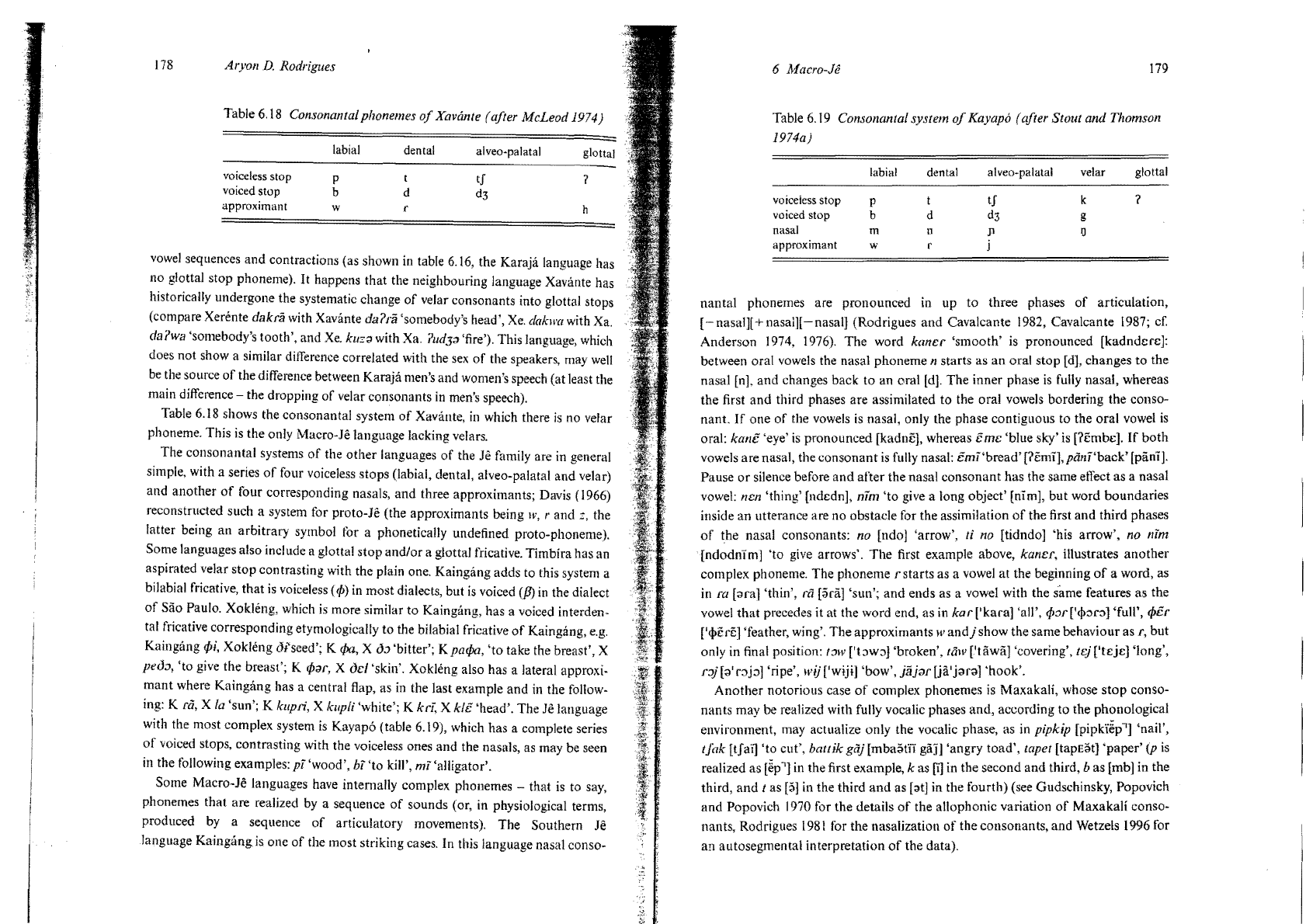
Table 6.18 COflsonantal phonemes
of
Xavánte (after
McLeod
1974)
labial
dental
voiceless stop
p
t
tI
?
voiced stop
approximant
b
w
d
f
d3
h
vowel
seqllences and contractions (as shown
in
table
6.16,
the Karajá language has
no glottal stop phoneme). It happens that the neighbouring language Xavánte has
historically undergone the systematic change
of
velar consonants into glottal stops
(compare Xerénte
dakrll with Xavánte da?rií 'somebody's head',
Xe.
dakll'a
with Xa.
da
?wa
'somebody's tooth', and
Xe.
kllz;:) with Xa.
?udJ;'/
'fire'). This language, which
does not show a similar
ditTerence
correlated with the
sex
of
the speakers,
may
well
be
the source
of
the dilference between Karajá men's and women's speech (at least the
main dilference - the dropping
of
velar consonants
in
men's speech).
Table
6.18
shows the consonan tal system
of
Xavánte,
in
which there
is
no
velar
phoneme. This
is
the only Macro-Jé language lacking velars.
The cOllsonantal systems
of
the other languages
of
the Jé family are
in
general
simple, with a series
of
fotlr voiceless stops (labial, dental, alveo-palatal and
and another
of
four corresponding nasals,
and
three approximants; Davis
(1966)
reconstructed such a system for proto-Je (the approximants being IV, r and
:,
the
lalter being an arbitrary symbol tor a phonetically undefined proto-phoneme).
Sorne languages also inc1ude a glottal stop
and/or a glottal fricative. Timbíra has an
aspirated velar stop contrasting with the plain one. Kaingáng adds
lO
this system a
bilabial fricalive, that
is
voÍc.eless
(r{1)
in
most dialects, but
is
voiced
(/3)
in
the dialect
of
Sao Paulo. Xokléng, which
is
more similar to Kaingáng, has a voiced interden-
tal fricative corresponding etymologically to the bilabial fricative
of
Kaingáng,
e.g.
Kaingáng
r{1i,
Xokléng ólseed'; K
r{1a,
X
o.J
'bitter';
Kpar{1a,
'to
take the breast', X
peo.J,
'to
give the breast'; K
r{1;]r,
X del 'skin'. Xokléng al50 has a lateral approxi-
mant where Kaingáng has a central flap, as
in
the last example and
in
the follow-
ing:
K dí, X la 'sun'; K kl/pri, X kupli 'white'; K
kri,
X
klé
'head'. The Je language
with the most complex system
is
Kayapó (table 6.19), which has a complete series
of
voiced stops, contrasting with the voiceless ones and the nasal
s,
as may be seen
in
the lollowing examples:
pi
'wood',
b'i
'to
kili',
mi
'alligator'.
Sorne Macro-Jé langllages have intemally complex phonemes that
is
lo
say,
phonemes that are realized
by
a sequen
ce
of
sounds (or,
in
physiological terms,
by
a seqllence
of
articulatory movements). The Southern Jé
language Kaingángis one
of
the most
strikin¡¡;
cases. In this language nasal con so-
6 Macro-Jé
179
Table
6.19
Consonantal system
of
Kayapó (afler
Stout
and Thomson
1974a)
labial
dental
alveo-palatal
velar
glottal
voiceless
stop p
t
tJ
k
?
voiced
stop
b d
d3
g
nasal
m
n
J1
IJ
approximant
w
j
nantal phonemes are pronounced in up to three phases
of
articulation,
nasal][-nasaIJ (Rodrigues
and
Cavalcante
1982,
Cavalcante
1987;
cf
Anderson 1974, 1976).
The
word kancr 'smooth'
is
pronollnced [kadnderc]:
between oral vowels the nasal phoneme
n starts as an oral stop
Id],
changes to the
nasal [n], and changes back to an oral
[d].
The inner phase
is
fully nasal, whereas
the first and third phases are assimilated to the oral vowels bordering the conso-
nanto
If
one
of
lhe vowels
is
nasal, only the phase contiguous to the oral
vowe!
is
oral:
kaflé
'eye'
is
pronollnced [kadne), whereas Eme 'blue sky'
is
rUmbe).
If
both
vowels are nasal, the consonant
is
flllly nasal: Emi'bread' [í'emlj,
paní'back'
[pani].
Pause
or
silence before
and
aner
the nasal consonant has the same
etTect
as a nasal
vowel:
nen 'thing' [ndedn],
ním
'to
give a long object' [nim], but word boundaries
inside an utterance are no obstacle ror the assimilation
of
the firsl and third phases
of
the nasal consonants: no [ndo] 'arrow', ti
no
[tidndo] 'his arrow', no nlm
[ndodnTm]
'to
give
arrows'.
The
first example aboye, kaner, iIIustrates another
complex phoneme. The phoneme
rstarts
as a vowel al the beginning
01'
a word, as
in
ra
[;}fa]
'thin', fii
[;;r<lj
'SUll';
and ends as a vowel with the same features as the
vowel thal precedes it at the word end, as
in
kar['kara]
'all',
r{1:V['«>:>f:::l]
'full',
r{1ér
['«>ere]
'feather, wing'. The approximants w
andjshow
the same behaviour as
r,
but
only in final position:
t:JW
['tJWJ] 'broken',
taw
['tawaj 'covering', tej ['teje]
r:Jj
[;}I
r:>jJ]
'ripe',
wij
['wiji] 'bow',
jllj¡:¡r
[ja'j;}f;}]
'hook'.
Another notorious case
of
complex phonemes
lS
Maxakalí, whose
stop
conso-
nants may be realized with fully vocalic phases and, according to the phonological
environment, may actualize only the vocalic phase, as
in
pipkip
[pipki~p
,]
'nail',
tfak
[tfai]
Oto
cut',
battik
giij [mbai}tH gaj] 'angry toad', tapet
[tapE1ít]
'paper' (p
is
realized as
[~p
']
in
the first example, k as
[íJ
in
the second and third, b as [mb] in the
third,
and
t as
Pi)
in
the third
and
as
[~tl
in the fourth) (see Gudschinsky, Popovich
and Popovich
1970
for the details
of
the allophonic variation
of
Maxakalí conso-
nants, Rodrigues
1981
ror the nasalization
of
the consonants, and Wetzels 1996 for
an autosegmental interpretatíon
of
the data).
;':G
181
180
Aryon
D.
Rodrigues
Consonan
tal c\usters
in
most
Macro-le
languages are Iimited to the combination
of
grave (labial
and
velar) stops followed by a central
or
a lateral approximant, as
in Kipeá
pri
'blood',
kru 'tail',
Of
in the following Kaingáng examples: pra
'to
bite',
mrúr
'vine'.
krc
'burrow', yrcn
'to
dance'.
An
exception is Yate, which presents a
large variety
of
sequen ces
of
two, three
and
four consonants - for example: kwlélja
'rotten', ehklendonklja
'car',
kéfkja 'hearing', ét"ohtfkja 'admiring', étJtkílkja
'bad
odour',
éskwa 'pulling
out',
éJtJoka 'c1eaning', étfk"ése 'blanket',
¡¿'frel'a
'nose',
kfrelnésa 'toy',
t"nija
'star',
Irle
'now',
JI'ánhan 'alone',
dmalrného
'beautiful',
tf'/reka 'tree', tsfówa 'Iouse', knáfnika 'advising', kmáskja 'asking',
1'lóIVa
'knife',
jil1aja
'wind', ktsaléne 'message', fd3iika 'snake', fl/áhtJo
'pepper'
(Meland and
Meland 1967).
Another
exception is
the
Central
le
language Xerénte, which has
developed very complex consonantal c\usters:
psedi
'it
is
good',
bd;;}di
'path',
kde
[kné] 'stone', tbe 'fish', kbure 'alI', sbíka [smika] 'ashes',
sil;;}
'to
cut', sra 'hill', zraku
'to
the other river
bank',
rbeta 'iron', krsasari
Oto
hunt',
krdbr5hd5 [krnmr5mn5] 'to
live',
ha
10 tktikre
'he
got thin' (Mattos 1973).
4.3 Tone
Two Macro-le languages have been described as being tonal, Yate in the Brazilian
northeast
and
Guató
in the Brazilian southwest. Yate has two distinctive levels
of
tone, but word-finally the tone tends to
be
middle; according to Meland
and
Meland (1967) there
is
morphophonological
'tone
perturbation'. Examples
of
words contrasting only in tone are (tones marked as follows: á high, a middle, a
íjkja 'wide', ifkja 'fast';
l/síja
'a
kind
of
pigeon',
l/sija
'centipede'; ídnika
'denouncing', Idnika 'tasting';
éJ
i
'to
suck'.
eJ
í
'to
scratch'.
Guató
(Palácio
1986)
also has only two distinctive levels
of
tone: mótl
'piranha',
mótJ'word';
mikí'mat',
míki'pot';
1llabó
'foot',
mclbó
'tobacco', mábó 'dove'.
Although
none
of
the best-
analysed
le
languages have been reported to be tonal,
it
is said
that
KrahO (Timbíra)
speakers may communicate at distance by means
of
'sentence whistling' (Sueli M.
de SOllza,
p.
c.).
5
MORPHOLOGY
Macro-Je languages are agglutinating
and
mildly synthetic; they combine elements
of
head-
and
of
dependent marking.
5.1
Inflection
for
contiguity
of
a determiner
The
11l0rphology
of
most Macro-Je languages
is
not
very complex. Word classes are
distinguished more by syntactíc strategies
t11an
by affixation. A pervasive infiec-
6 Macro-le
tional device in
Macro-le
languages is the marking
of
the head
of
a nominal, verbal
or
postpositional phrase for textual contiguity
(CNT)
or
non-contiguity
(NCNT)
of
the
determiner
(or
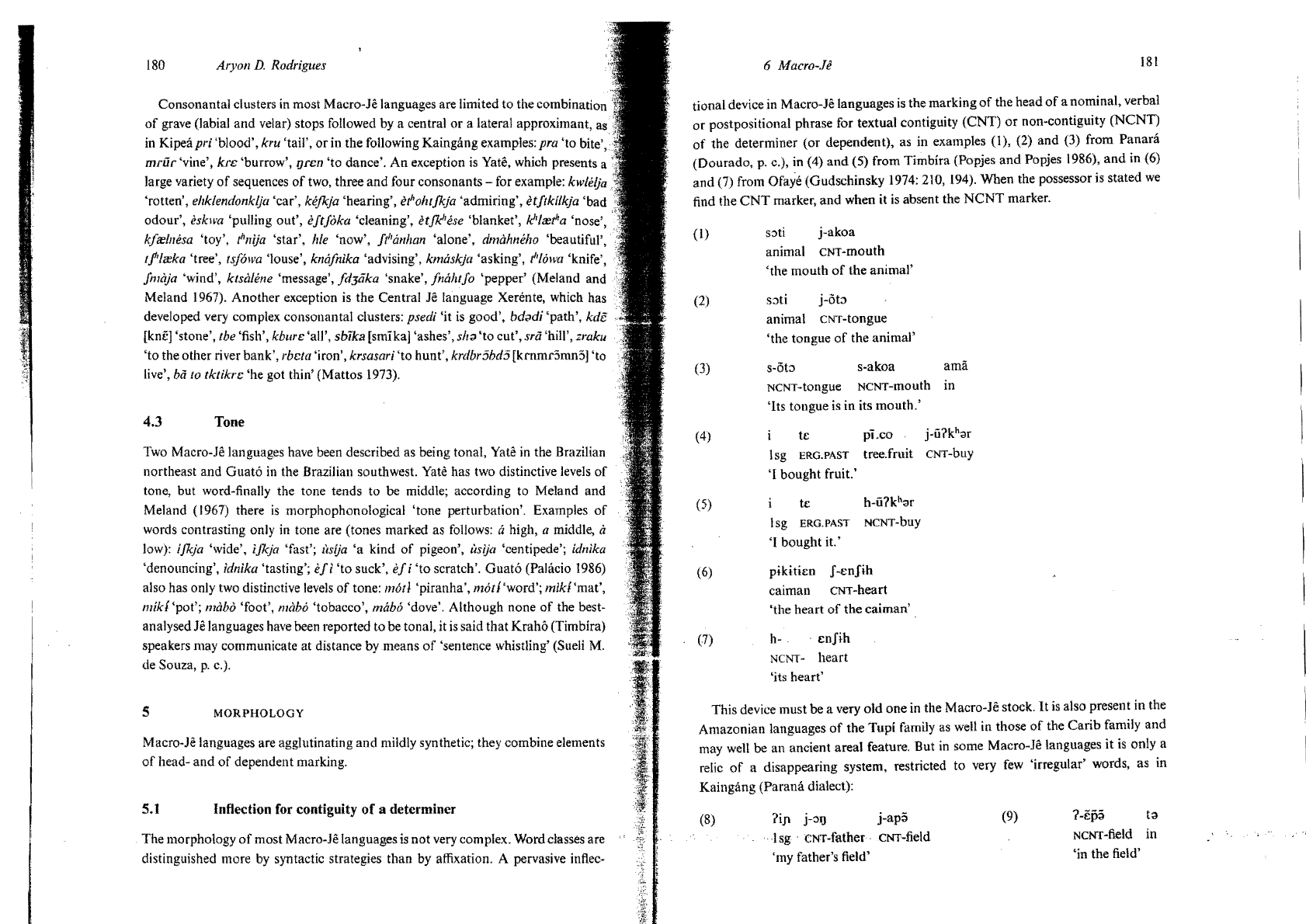
dependent), as in examples (1), (2)
and
(3) from
Panará
(Dourado,
p. c.), in (4)
and
(5) from Timbíra (Popjes
and
Popjes 1986),
and
in (6)
and
(7) from Ofayé (Gudschinsky 1974: 210,194). When the possessor is stated we
find the
CNT
marker,
and
when it
Is
absent the
NCNT
marker.
s:>ti
j-akoa
animal cNT-mouth
'the
mouth
of
the
animal'
s:>ti
j-ot:>
animal cNT-tongue
'the
tongue
of
the
animal'
s-ot:>
s-akoa
ama
NCNT-tongue NCNT-mouth in
'lts
tongue
i5
in
it5
mouth.'
te
pi
.co
j-íi?kh~r
1sg
ERG.PAST
tree.fruit
CNT-buy
'1
bought
fruit.'
te
h-ú?kh~r
lsg
ERG.PAST
NCNT-buy
'1
bought
it.'
(6)
pikitü:n
J-enfih
caiman CNT-heart
'the
heart
of
the
caiman'
(7)
h- . .
enJih
NCNT-
heart
'it5
heart'
This device must
be
a very
old
one
in
the
Macro-le
stock.
It
i8
also present in the
Amazonian
languages
of
the
Tupí family as well in those
of
the
Carib
family
and
may well be
an
ancient areal feature. But in sorne
Macro-le
languages
it
is
only a
reHe
of
a disappearing system, restricted to very few 'irregular' words,
as
in
Kaingáng
(Paraná
dialect):
(8)
?iJl
j-:>IJ
j-ap¡j
(9)
?-ep¡j
t3
Isg
cNT-father· cNT-field
NCNT
-field in
'my
father's field'
'in tlle field'
182
5.2
Aryoll
D.
Rodrigues
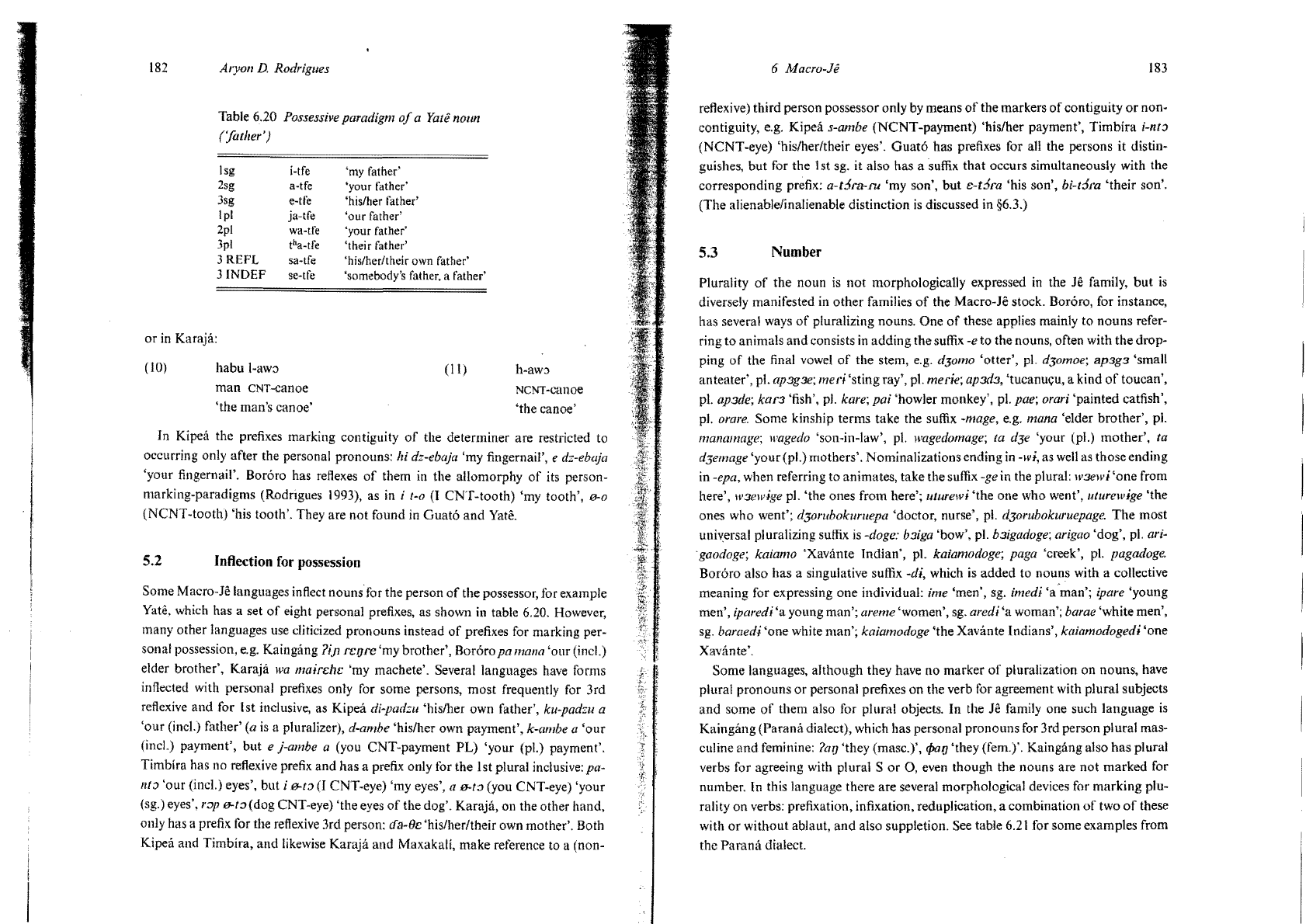
Table 6.20 Possessive paradigm 01 a Yate n01l1l
(father')
tsg
i-Ife
'my falber'
2sg
a-Ife
'your falher'
3sg
e-Ife
'hislber father'
Ipl
ja-Ife
'our
[alber'
2pl
wa-Ife
'your falher'
3pt
tha-Ife
'their father'
3
REPL
sa-Ife
'hislherltbeir own father'
3INDEP
se-Ife
'somebody's falher, a father'
or
in
Karajá:
(10)
habu l-awo
(11
)
h-awJ
man
CNT-canoe
NCNT-canoe
'the man's canoe'
'the canoe'
In Kipeá the prefixes marking contiguity
of
the determiner are restricted to
occurring only after the personal pronouns:
hi
dz-ebaja 'my fingernail', e dz-ebuja
'your fingemai\'. Boróro has
reflexes
of
them
in
the allomorphy
of
its person-
marking-paradigms (Rodrigues 1993),
as
in
i
1-0
(I
CNT-tooth) 'my tooth',
0-0
(NCNT-tooth) 'his tooth'. They are not found in Guató and
Yate.
Inftection for possession
Sorne Macro-le languages
inRect
nouns tor the person
of
the possessor, for example
Yate. which has a set
of
eight personal prefixes, as shown
in
table 6.20. However,
many other languages use diticized pronouns instead
of
prefixes for marking per-
sonal possession, e.g. Kaingáng
?¡JI
rClJre 'my brother', Boróro
pa
malla 'our
elder brother', Karajá
\Va
mairehe
'my machete' Several langllages
have
forms
inflected with personal prefixes only ror some persons, most frequently ror 3rd
reflexive and tor
1st
inclusive,
as
Kipeá di-pmizu 'hislher own father', ku-padzu a
'our
(incl.) father' (a
is
a pluraJizer), d-amhe 'hisfher own payment', k-ambe a
'our
(lnc!.) payment', but e j-ambe a (you CNT-payment PL) 'your (pI.) payment'.
Timbíra has no reftexive prefix and has a prefix only tor the
1st
plural inclusive:pa-
fltO
'our (lnel.) eyes', but i 0-(0
(I
CNT-eye) 'my , a
fJ-t:J
(you CNT-eye)
(sg.) eyes',
r;;p
0-to(dog CNT-eye) 'the eyes
of
the dog'. Karajá, on the other hand,
has a prefix lor tlle
reflexive
3rd person:
áa-ee
'his/her/their own mother'. 90th
Kipeá and Timbíra, and
Iikewise
Karajá and Maxakalí, make reference to a
6 Macro-Ji!
183
reflexive) third person possessor only by means
of
the markers
of
contiguity
or
non-
contiguity, e.g. Kipeá
s-ambe (NCNT-payrnent) 'his/her payment', Timbíra ¡-mo
(NCNT-eye) 'hislher/their eyes'. Guató has prefixes ror
al!
the persons it distin-
guíshes, but
for
the 1st sg. it also has a suffix that occurs simultaneously with the
corresponding prefix:
a-lira-m
'my son', but e-dra 'his son',
bi-t:5J'a
'their son'.
(The alienable/inalienable distinction
is
discussed in §6.3.)
5.3 Number
of
the noun
is
not morphologically expressed
in
the Je
but
is
diverscly manifested in other families ol' the Macro-le stock. Boróro, ror instanee,
has several ways
of
pluralizing nouns. One
of
these applies mainly to nouns refer-
ring
to
animals and consists
in
adding the suffix
-e
to the nouns, often with the drop-
of
the final
vowel
of
the stem,
e.g.
d30mo 'oUer',
pI.
d3omoe; ap3g3 'small
anteater',
pI.
ap3g3e; me ri 'sting ray',
pI.
merie; ap:xl3, 'tucanm;:u, a kind
of
touean',
pI.
ap3de;
kar3
'fish',
pl.
kare;
pai
'howler monkey',
pI.
pae; orari 'painted catfish',
orare.
Sorne kinship teems take the suffix -mage,
e.g.
mana 'elder brother', pl.
mallamage; wagedo 'son-in-law',
pI.
wagedomage;
la
d3e 'your (pl.) mother', ta
d3emage
'your (pI.) mothers'. Nominalizations ending
in
-wi,
as
well
as those ending
in
-epa, when referring to animates, take the suffix -ge in the plural: w3ewi 'one from
here',
w3ewige pl. 'the ones from here'; uturewi 'the one who went', ulurewige 'the
ones who went';
d30rubokuruepa 'doctor, nurse',
pI.
d30rubokuruepage.
The
most
univ:ersal pluralizing suffix
is
-doge: b3iga 'bow',
pI.
b3igadoge; arigao 'dog',
pI.
ari-
'gaodoge; kalamo
'Xavánte Indian"
pI.
kaiamodoge; paga 'creek',
pI.
pagadoge.
Boróro also has a singulative sllffix -di, which
is
added to nouns with a eolleetive
meaning for expressing one individual:
íme 'men',
sg.
imedi 'a'man'; ipare 'young
men',
iparedi'a young man'; areme 'women',
sg.
aredi
'a
woman'; barae 'white men',
sg.
baraedi
'one
white man'; kaiamodoge 'the Xavánte Indians', kaiamodogedi 'one
Xavánte'.
Sorne languages, although they have no marker
01'
pluralizatíon on nouns, have
plural pronouns
oc
personal prefixes on the verb for agreement with plural subjects
and sorne
of
them also for plural objects. In the
le
family one such language
is
Kaingáng (Paraná dialect), which has personal pronouns ror 3rd person plural mas-
cutine and ferniníne:
?alJ
'they (mase.)',
POI)
'they (fem.)'. Kaingáng also has plural
verbs
roc
agreeing with plural S
or
O,
even
number. In this language thefe are several morphologieal devíces for marking plu-
rality on verbs: prefixation, infixation, reduplicatíon, a combinatíon
of
two
of
these
with
or
wíthout abJaut, and
al80
suppletion.
See
table
6.21
ior sorne exarnples from
the Paraná dialect.
\
i
184
Alyon
D.
Rodrigues
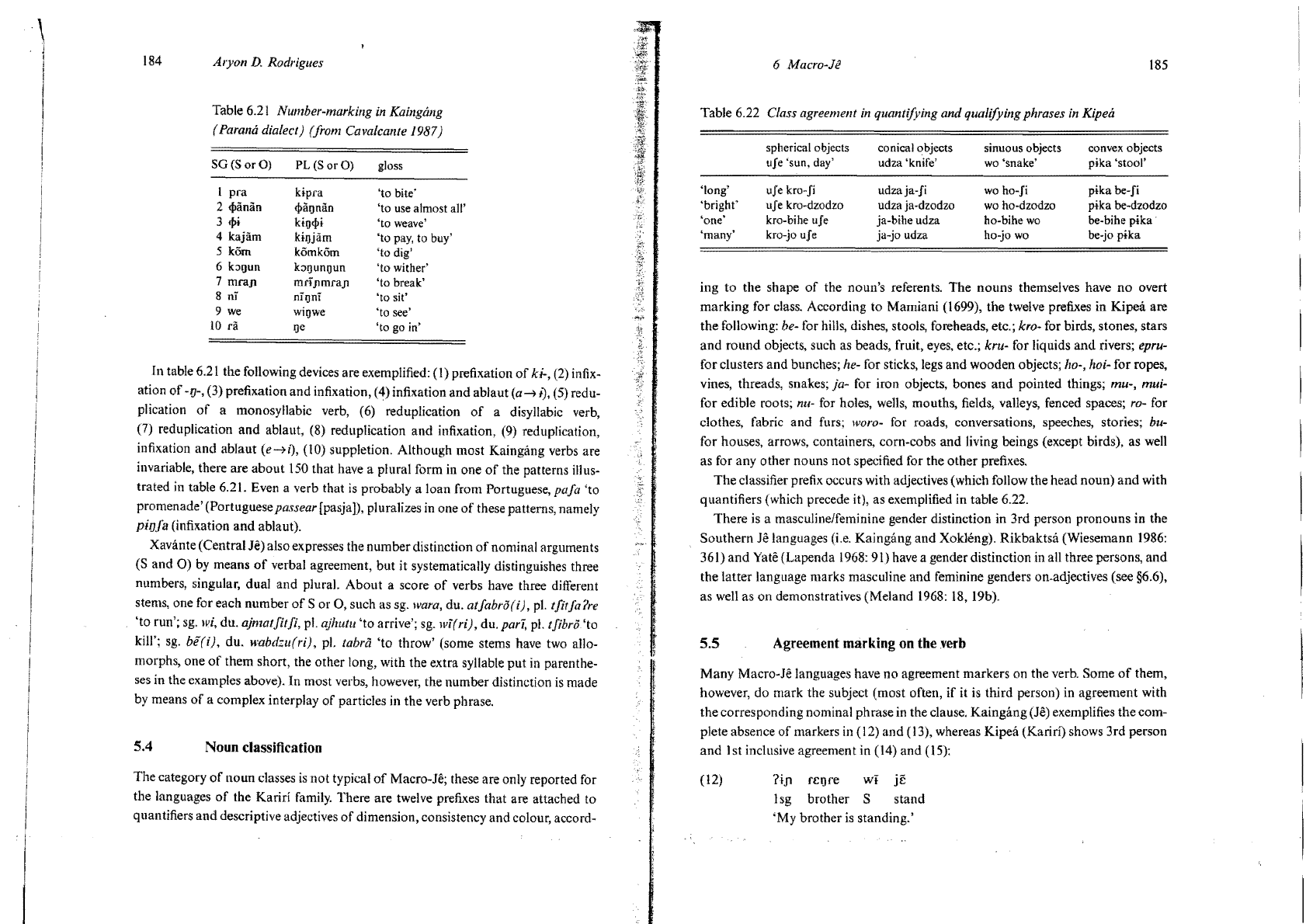
Table
6.21
Number-marking in Kaingáng
I
(Paraná dialect) (from Cavalcallte
1987)
I
i
SG
(S
orO)
PL
(S
or
O)
gloss
I
pfa
ktpra
'to bite'
2
<jliíniin
<jliílJnan
'to
use almost
aH'
3
<jli
kilJ<jli
'to weave'
4 kajiim
kilJjiim
'to
pay,
to buy'
5 k6rn
komk6rn
'to
dig'
6
boun
blJunlJun
'to
wither'
7 mraJl
mriJlmraJl
'to
break'
8
ni
nilJni 'lo sit'
9
we
wilJwe
'to
see'
10
fa
IJC
'lo go in'
[n table
6.21
the following devices are exemplified:
(l)
prefixation
of
ki-,
(2)
infix-
ation
of
-Ve,
(3) prefixation
and
infixation, (4) infixation and ablaut
(a-H),
(5) red
u-
plication
of
a monosyllabic verb,
(6)
reduplication
of
a disyllabic verb,
(7) reduplieation
and
ablaut,
(8)
reduplication and infixation,
(9)
reduplication,
infixation
and
ablaut
(e~I),
(10) suppletion. Although most Kaingáng verbs are
invariable, there are abont
150
that have a plural form
in
one
of
the patterns
iIlus-
trated
in
table 6.21. Even a verb that
is
probably a loan from Portugnese,
paja
'to
promenade' (Portuguese passear [pasja]), pluralizes
in
one
of
these patterns, namely
piI)Ja (infixation
and
ablaut).
Xavánte (Central Je) also expresses the number distinction
of
nominal arguments
(S and O)
by
means
of
verbal agreement,
but
it systematically distinguishes three
numbers, singular, dual and plural. About a seore
of
verbs have three different
stems, one for each number
of
S or O, such as sg.
¡vara,
duo
atJabra(
i),
pI.
tJilIa
?re
'to
run';
sg.
IVi,
duo
ajmatJitJi,
pI.
ajhutu
'to
arrive';
sg.
wi(ri),
duo
parÍ,
pI.
tJibra
'lo
kilI';
sg.
bé'(i),
duo
wabdzu(ri},
pI.
tabra
'to
throw' (sorne stems have two allo-
morphs, one
of
them short, the other long, with the extra syllable
put
in
parenthe-
ses
in the examples aboye). In most verbs, however, the number distinction
is
made
by means
of
a complex interplay
of
particles in the verb pbrase.
5.4 Noun classitlcation
The category
of
noun
c1asses
is
not typical
of
Macro-Je; these are only reported for
the languages
of
the Karirí
family.
There are twelve prefixes Ihat are attached to
quantifiers
and
descriptive adjectives
of
dimension, consistency and colour, accord-
6 Macro-le
185
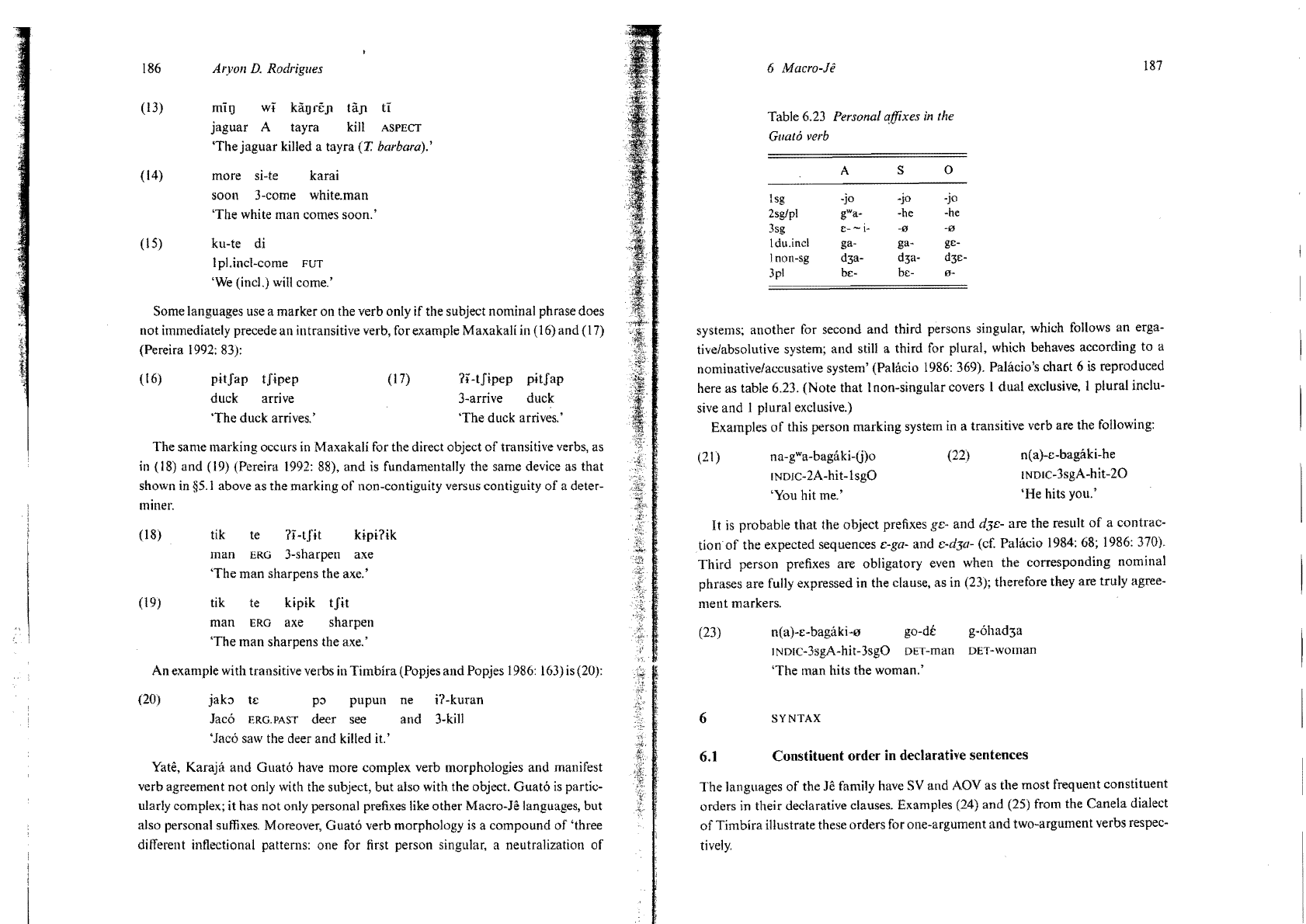
Table 6.22 Class agreement
in
quantifying and qualifying phrases in Kipeá
spherical objects
conical objects sinuous objects
convex objects
uJe 'sun, day' udza 'knife'
wo'snake'
pika
'stool'
'long'
ufe kro-fi udzaja-Ji
wo
ho-Ji
pika
be-fi
'brighl' uJe kro-dzodzo udza ja-dzodzo
wo ho-dzodzo
pika be-dzodzo
'one'
kro-bihe uJe
ja
-bihe udza
ho-bihewo
be-bihe
pika
.
'many'
kro-jo uJe
ja-jo udza
ho-jo
wo
be-jo
pika
iug to the shape
of
the noun's referents. The nouus themselves have
no
overt
marking for class. According to Mamiani (1699), the twelve prefixes in Kipeá are
the following:
be- for hills, dishes, stools, foreheads, etc.; kro- for birds, stones, stars
and
round objects, such as beads, fruit, eyes, etc.; kru- for liquids
and
livers; epru-
for clusters and bunches; he- for sticks, legs and wooden objects; ho-, hoi- for ropes,
vines, threads, snakes;
ja-
for iron objects, bones
and
pointed things; muo, mui-
for edible roots; nu- for holes,
wells,
mouths, fields, val!eys, fenced spaces; ro- for
clothes, fabríc and fllrs;
¡voro-
ror roads, conversations, speeches, stories; bu-
for houses, arrows, containers, corn-cobs and living beings (except birds), as well
as for any other nouns not specified for the other prefixes.
The
c1assifier prefix occurs with adjectives (which follow the head noun)
and
with
quantifiers (which precede it), as exemplified in table 6.22.
There
is
a mascnline/feminine gender distinction in 3rd person pronouns in the
Southern
le
languages
(Le.
Kaíngáng and Xokléng). Rikbaktsá (Wiesemann
1986:
and
Yate (Lapenda
1968:
91) have a gender distinction in
al!
three persons,
and
the latter language marks masculine and feminine genders on.adjectives (see §6.6),
as well as on demonstratives (Meland
1968:
18, 19b).
5.5
Agreemeot marking
00
the
:verb
Many Macro-le languages have
no
agreement markers on the verb. Sorne
of
them,
however, do mark the subject (most ofien, ir it
is
third person) in agreement with
the corresponding nominal phrase in the clause. Kaingáng (Je) exemplifies the com-
plete absence
of
markers
in
(12) and (13), whereas Kipeá (Karirí) shows 3rd person
and
1st inclusive agreement in (14) and
(1
S):
(12)
'lij1
rt:l;)fe
wi
jc
1
sg
brother S stand
brother
is
standing.'
186
Aryoll
D.
Rodrigues
(13) mil) wi kal)rép
tap
ti
jaguar A tayra kili
ASPECT
'Thejaguar
killed a tayra barbara).'
(14) more si-te karai
soon 3-come white.man
'The white man comes soon.'
(15) ku-te di
1pl.il1cl-come
FUT
'We (inc!.)
will
come.'
Sorne languages use a marker on the verb only
if
the subject nominal phrase does
not immediately precede an intransitive verb, for example Maxakalí in (16) and
(Pereira
1992;
83);
pitJap tJipep
(17) 1í-lJipep ptt}ap
duck arrive 3-arrive duck
'The duck arrives.'
'The
duck arrives.'
The same marking occurs in Maxakalí for the direct object
of
transitive verbs, as
in
(18) and (19) (Pereira 1992: 88),
and
is
fundamentaIly the same device as that
shown in
§5.1
aboye as the marking
of
non-contiguity versus contiguity
of
a deter-
minero
(18)
tik
te
1¡
-tJit
ktpt1ik
man ERO 3-sharpen axe
'The man sharpens the axe.'
tik
te
tJit
man
ERO
axe sharpen
'The
man sharpens the axe.'
An example with transitive verbs
in
Timbíra (Popjes and
1986:
163)
is
jab
tE
p~
pupun ne i?-kuran
Jacó
ERG.PAST
deer
see
and 3-kill
'lacó
saw the deer and killed it.'
Yate, Karajá
and
Guató have more complex verb morphologies and manifest
verb agreement not only with the subject,
but
also with the object.
Guató
is
partic-
complex; it has
not
personal prefixes like other Macro-Je languages, but
also personal suffixes. Moreover, Guató verb morphology
is
a compound
of
'three
dilferellt inflectional patterns: one for first person singular, a neutralization
of
6
Macro-Ji?
187
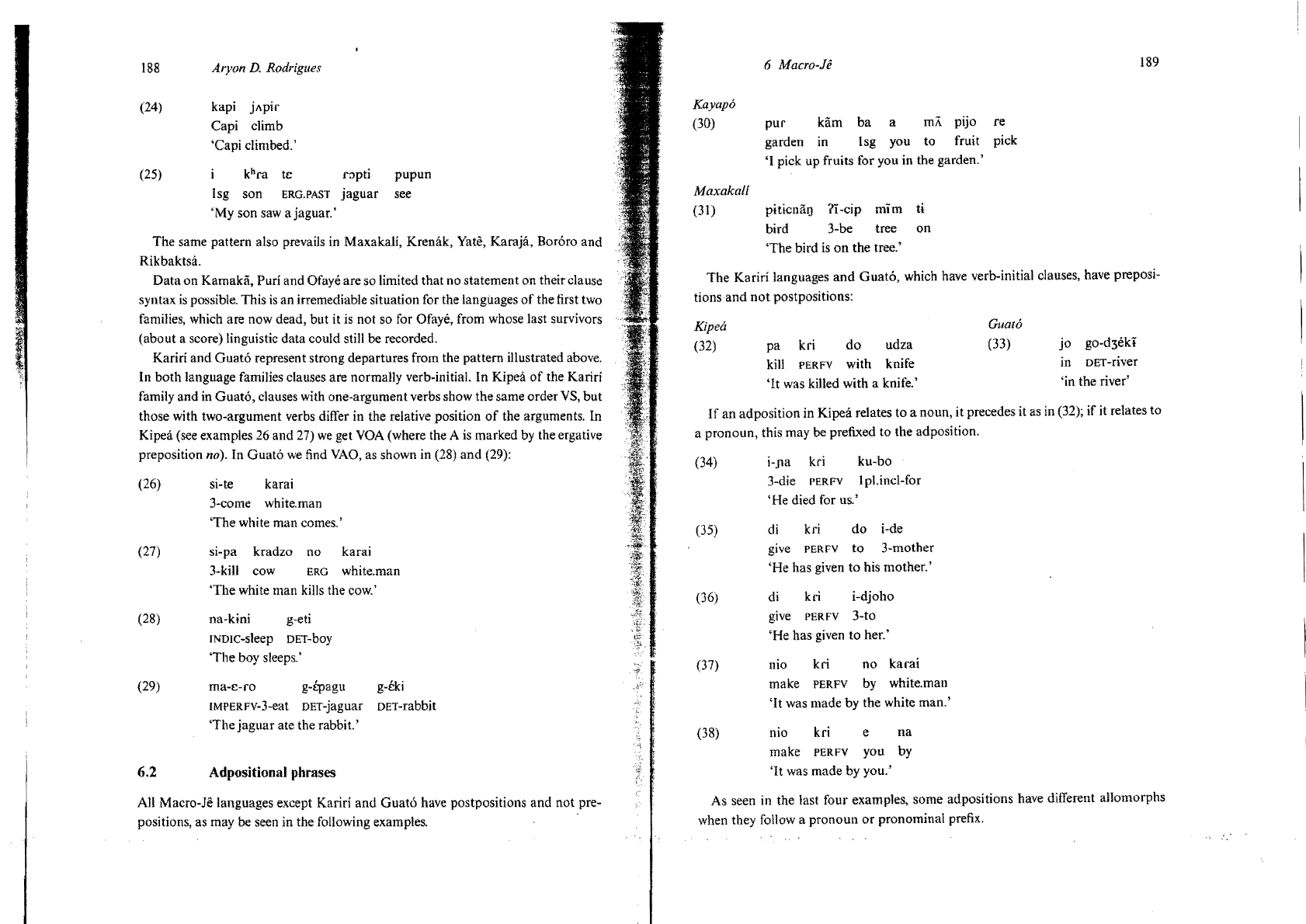
Table
6.23
Personal
aljixes
in
fhe
Guató
verb
A
S O
Isg
-jo
-jo -jo
2sglpl
gWa_
-he
-he
3sg
c--j-
-0
-0
ldu.incl
ga-
ga-
ge-
l
non-sg
d3a- d3
a
- d3
e
-
3pl
be- be-
fj-
systems; another for second
and
third persons singular, which follows an erga-
tive/absolutive system;
and
stiII
a third ror plural, which behaves according to a
nominative/accusative system' (Palácio
1986:
369). Palácio's chart 6
is
reproduced
here
as table 6.23. (Note that lnon-singular covers l dual exclusive, 1 plural inclu-
sive and
I plural exclusive.)
Examples
of
this person marking system in a transitive verb are the foIlowing:
na-gWa-bagáki-(j)o
(22)
n(a)-e-bagáki-he
INDlC-2A-hit-lsgO
INDIC-3sgA-hit-20
'You hit me.'
'He hits you.'
It
is
probable that the object prefixes ge-
and
d3e- are the result
of
a contrac-
the expected sequences
e-ga- and
(cf.
Palácio
1984:
68;
1986:
370).
Third
person prefixes are obligatory even when the corresponding nominal
phrases
are
fulIy expressed in the c\ause, as in (23); therefore they are truly agree-
ment rnarkers.
(23)
n(a)-e-bagáki-e
go-dt
g-óhad3a
INDIC-3sgA-hit-3sg0
DET-man
DET-woman
'The man hits the woman.'
6
SYNTAX
6.1
Constituent order
in
declarative sentences
The
languages
of
the Je farnily have
SV
and
AOVas
the most frequent constituent
orders in their declarative c1auses. Examples (24)
and
(25) from the Canela dialect
of
Timbíra i1Iustrate these orders
fol'
one-argument
and
two-argument verbs respec-
tively.
189
~
~i
Aryon
D.
Rodrigues
188
(24)
kapi jApir
Capi climb
'Capi
c1imbed.'
(25)
khra
te
f:)pti
pupun
lsg
son
ERG.PAST
jaguar
see
'My
son
saw
ajaguar.'
The
same
pattem
also prevails in Maxakalí, Krenák, Yate,
Karajá,
Boróro
and
Rikbaktsá.
Data
on
Kamaka,
Purí
and
Ofayé
are
so
Iimited
that
no
statement
on
their clause
syntax
i8
possible. This
is
an
irremediable situatíon for the languages
of
the first two
families, which are now dead,
but
it is
not
so
for Ofayé, from whose last survivors
(about
a score) Iinguistic
data
could
stiU
be recorded.
Kariri
and
Guató
represent strong departures from the
pattem
illustrated aboye.
In
both
language families c\auses
are
normally verb-initial.
In
Kipeá
of
the Karirí
family
and
in
Guató,
c\auses with one-argument verbs show
the
same
order
VS,
but
those with two-argument verbs differ in the relative position
of
the arguments. In
Kipeá (see examples 26
and
27)
we
get VOA (where the A is
marked
by the ergatíve
preposition
no).
In
Guató
we
find VAO, as shown
in
(28)
and
(29):
(26) si-te karai
3-come white.man
'The
white man comes.'
(27)
si-pa
kradzo
no
karai
3-kill cow
ERO
white.man
'The
white man kills the cow.'
(28)
na-k¡ni g-eti
INDlc-sleep
DET-boy
'The
boy sleeps.'
(29)
ma-e-ro
g-tpagu
g-tki
IMPERFv-3-eat DET-jaguar DET-rabbit
'The
jaguar
ate the rabbit.'
6.2
Adpositional
phrases
AH
Macro-Je languages except Karirí
and
Guató
have postpositions
and
not
pre-
positions, as may be seen in
the
following examples.
6 Macro-lé
Kayapó
(30)
pur
kim
ba
a
mX
pijo
re
garden in
lsg
you
to
fruit pick
'1
pick up fruits for you in the garden.'
Maxakalí
(31)
piticnau
Tt-cip
mim
ti
bird 3-be tree
on
'The
bird
i8
on
the
tree.'
The
Karirí languages
and
Guató,
which have verb-initial c1auses, have preposi-
tionsand
not
postpositions:
Kipeá
Guató
(32)
pa
kri
do
udza
(33)
jo
go-d3éki
kili
PERFV
with knife
in
DET
-river
'H
was killed with a knife.'
'in
the
river'
Ir
an
adposition
in
Kipeá
relates
to
a noun,
it
precedes
it
as in (32);
if
it relates
to
a
prono
un, this may be prel1xed
to
the
adposition.
(34) ¡-Jla kri
ku-bo
3-die
PERFV
I
pl.ind-for
'He
died for us.'
(35)
di
kri
do
i-de
give
PERFV
to
3-mother
'He
has given
to
his
mother.'
(36)
di kri
i-djoho
give
PERFV
3-to
'He
has
given
to
her.'
nio
kri
no
karai
make
PERFV
by
white.man
'It
was
made
by
the
white
man.'
(38)
nio
kri
e
na
make
PERFV
you by
'It
was
made
by
you.'
As seen in
the
las! four examples,
some
adpositions have different
allomorphs
when they follow a
prono
un
or
pronominal pretix.
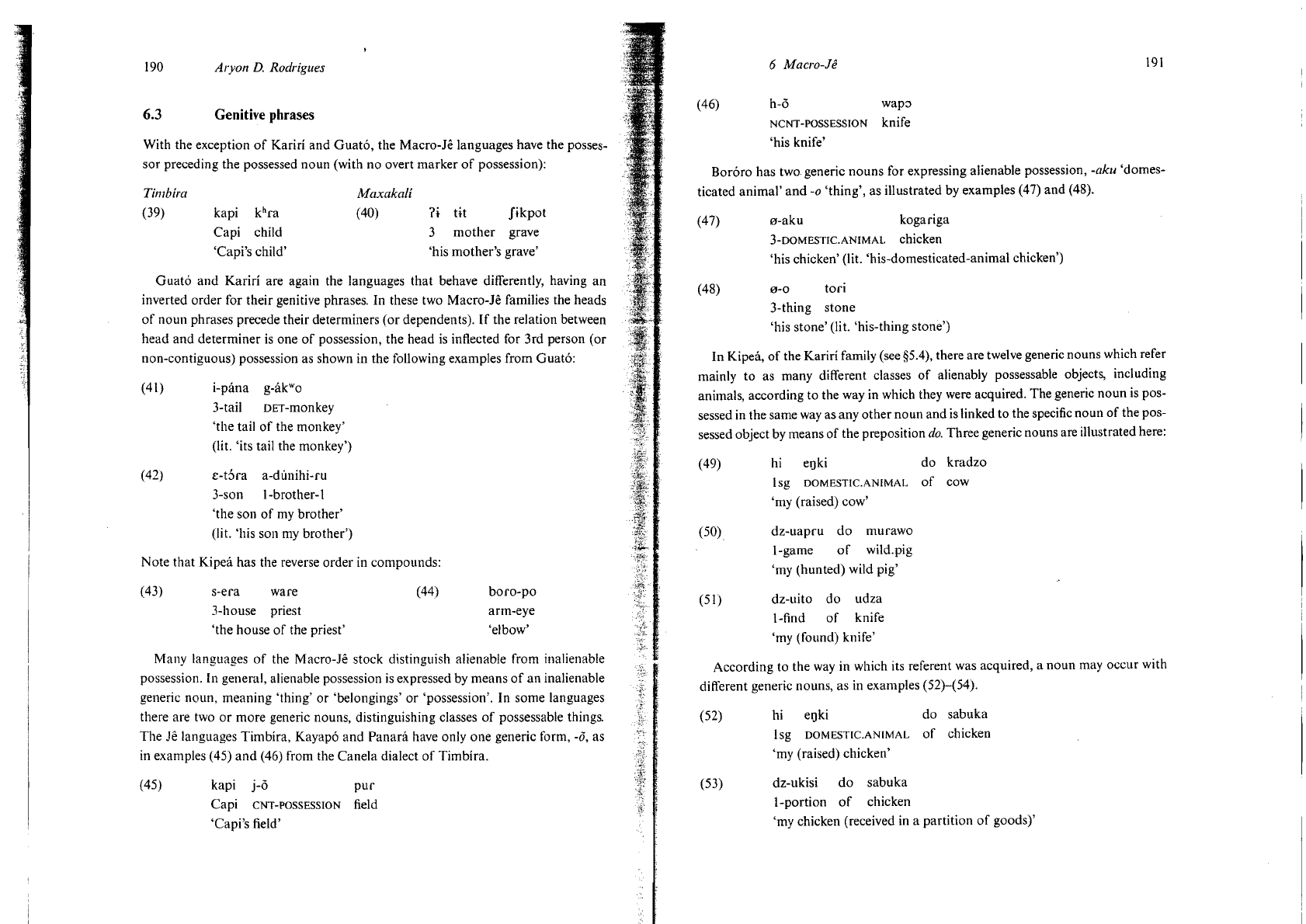
190
Aryon
D.
Rodrigues
6.3
Genitive
phrases
With the exception
of
Karirí and
Guató,
the Macro-le languages have the pos ses-
sor preceding the possessed noun (with no overt marker
of
possession):
Timbíra
Maxakalí
(39)
kapi
khra
(40)
?i ttt
Jikpot
Capi
child 3
mother
grave
'Capi's child' 'his mother's grave'
Guató
and
Karirí are again the languages
that
behave differently, having an
inverted order for their genitive phrases. In these two Macro-le families the heads
of
noun phrases precede their determiners (or dependents).
If
the relation between
head and determiner
is
one
of
possession, the head
is
inflected for 3rd person (or
non-contiguous) possession as shown in the following examples from Guató:
(41)
i-pána
g-ákWo
3-tail DET-monkey
'the
tail
of
the monkey'
(lit. 'its tail the monkey')
(42)
e-t6ra
a-dúnihi-ru
3-son I-brother-I
'the
son
of
my
brother'
(Ji
t.
'his son
my
brother')
Note that Kipeá has the reverse order in compounds:
(43)
s-era ware (44)
boro-po
3-house priest arm-eye
'the
house
of
the priest' 'elbow'
Many languages
of
the Macro-le stock distinguish alienable from inalienable
possession. In general, alienable possession
is
expressed by means
of
an inalienable
generic noun, meaning 'thing'
or
'belongings'
or
'possession'. In sorne languages
there are two
or
more generic nouns, distinguishing
c1asses
of
possessable things.
The
le
languages Timbíra, Kayapó
and
Panará have only one generic form,
-o,
as
in examples (45)
and
(46) from the Canela dialect
of
Timbíra.
(45)
kapi
j-o
pur
Ca
pi
CNT-POSSESSION
field
'Capi's field'
6 Macro-le
191
(46)
h-o
wap:>
NCNT-POSSESSION
knife
'his knife'
Boróro has two generic nouns for expressing alienable possession, -aku 'domes-
ticated animal'
and
-o 'thing', as iIlustrated by examples (47) and (48).
(47)
o-aku
kogariga
3-DOMESTIC.ANIMAL
chicken
'his chicken' (lit. 'his-domesticated-animal chicken')
(48)
o-o
tori
3-thing stone
'his stone' (lit. 'his-thing stone')
In Kipeá,
of
the Karirí family (see §5.4), there are twelve generic nouns which refer
mainly
to
as many different
c1asses
of
alienably possessable objects, including
animal
s,
according to the way
in
which they were acquired. The generic noun
is
pos-
ses sed
in
the same
way
as any other noun and
is
Iinked to the specific noun
of
the pos-
sessed object by mean s
of
the preposition
do.
Three generic nouns are illustrated here:
(49)
hi
elJki
do kradzo
Isg
DOMESTIC.ANIMAL
of
cow
'my (raised) cow'
(50)
dz-uapru
do
murawo
I-game
of
wild.pig
'my (hunted) wild pig'
(51)
dz-uito do udza
l-find
of
knife
'my (follnd) knife'
According to the way in which its referent was acquired, a noun may occur with
different generic nouns, as
in
examples (52)-(54).
(52) hi elJki do sabuka
Isg
DOMESTIC.ANIMAL
of
chicken
'my (raised) chicken'
(53)
dz-ukisi
do
sabuka
I-portion
of
chicken
'my chicken (received
in
a partition
of
goods)'
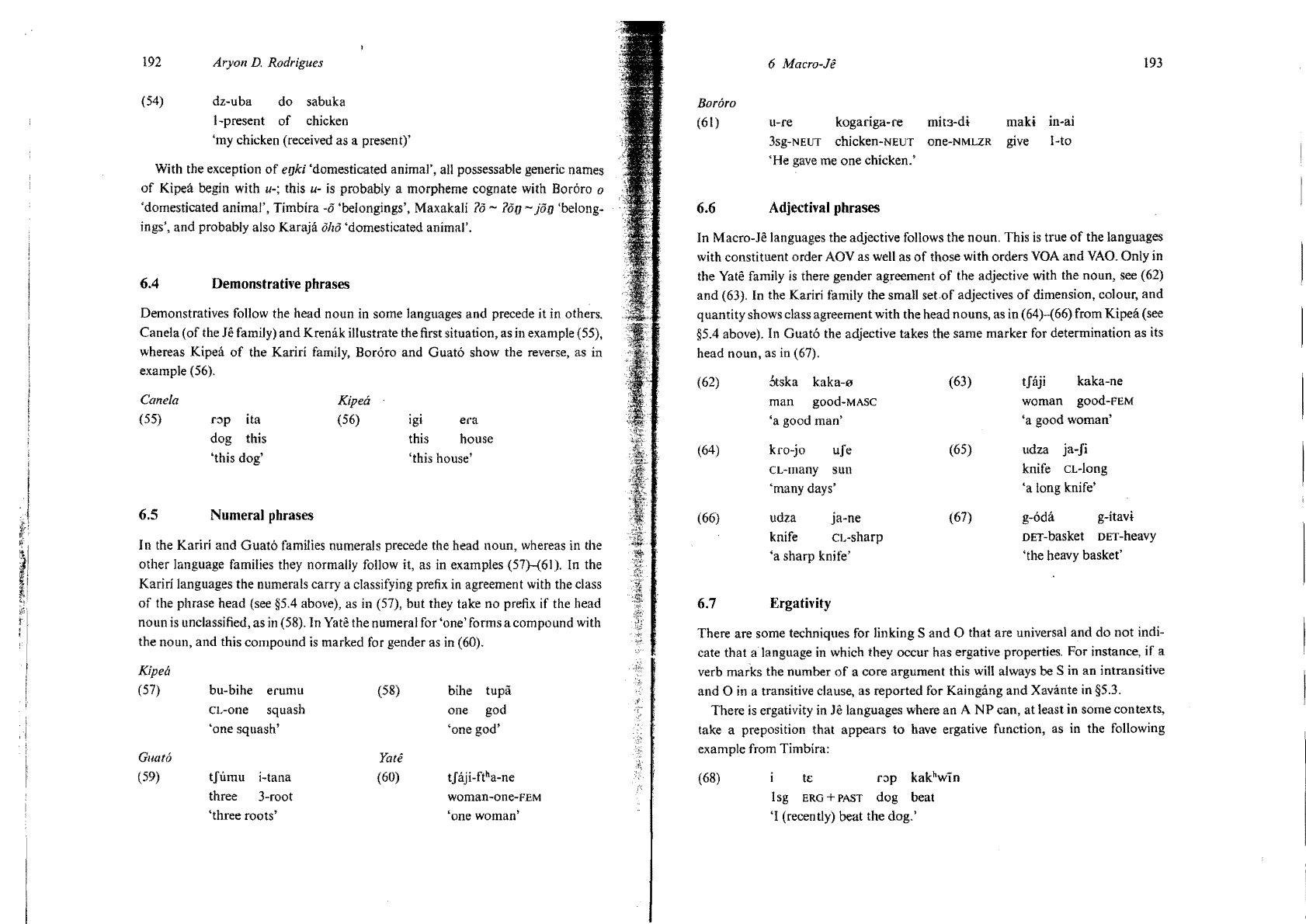
192
Aryoll
D.
Rodrigues
(54)
dz-uba
do
sabuka
1-present
of
chicken
'my chicken (received
as
a present)'
With the exception
of
ei)ki 'domesticated animal', all possessable generic names
of
Kipeá with
u-;
this
u-
is
probably a morpheme cognate with Boróro o
'domesticated animal', Timbíra
-o
'belongings', Maxakali
70
- 70{} -
j5{}
'belong-
,and
pmbably also
Karajá
oh5
'domesticated animal'.
6.4
Demonstrative
phrases
Demonstratives follow the head noun in sorne languages
and
precede
it
in others.
Canela
(of
the
Je
family)
and
Krenák iIIustrate the first situation, as in
whereas Kipeá
of
the
Karirí family, Boróro
and
Guató
show
the
reverse, as in
example (56).
Canela
Kipeá
(55)
C::lp
ita
(56) igi
ua
dog this
this house
'this
dog'
'this house'
6.5
Numeral
phrases
,.'
I
w
".
In
the Karirí and
Guató
families numeral s precede the head
noun,
whereas in the
other
language families they normally follow it, as in examples (57}-(61). In the
lj
(li
~I
Karirí languages
the
numerals carry a c1assifying prefix
in
agreement with the
c1ass
~I
of
the ohrase
head
(see §5.4 above), as in (57), but they take no pretix
if
the head
noun
is unclassified,
as
in
(58).
In
Yate the numeral ror
'one'
forms a compound with
the
110Ull,
and
this
compound
is
marked for gender as in (60).
Kipeá
(57)
bu-bihe
erumu
CL-one sq uash
'one
squash'
(58) bihe
one
'one
tupa
god
Guutó
Yaté
tfúmu
three
i-tana
3-mot
(60) tfáji-ftb
a
-
ne
woman-one-FEM
'three roots'
'one
woman'
6 Macro-Jé
193
Boróro
u-re
kogariga-re mit3-di
maki
in-ai
3sg-NEUT
chicken-NEuT
one-NMLZR
give loto
'He
gave me
one
chicken.'
6.6
Adjectival
phrases
In Macro-Je languages the adjective follows the noun. This
is
true
of
the languages
with constituent oeder
AOVas
well as
of
those with orders VOA
and
VAO.
Only in
the Yate family is there gender agreement
of
the adjective with the
noun,
see
and
(63). In the Karirí l'amily the small set.ol' adjectives
of
dimension, colour,
and
the head nouns, as in (64}-(66) from
Kipeá
(see
§5.4 aboye). In
Guató
the adjective takes the same
marker
ror determination as its
head
noun,
as in (67).
(62)
&tska
kaka-0
man
good-MASC
'a
good
man'
(63)
tfáji kaka-ne
woman good-FEM
'a
good woman'
(64)
kro-jo
ufe
cL-many sun
days'
(65) udza
knife
'a
long knife'
udza
ja-ne
knife cL-sharp
'a
sharp
knife'
(67)
g-ódá
g-ítavi
DET-basket DET-heavy
'the heavy basket'
6.7
Ergativity
There are sorne techniques for Iinking
S
and
O
that
are universal
and
do
not
indi-
cate
that
a language in which they
occur
has ergative properties. For instanre,
ir
a
verb
marks
the number
of
a
core
argument this will always be S in
an
intransitive
and
O in a transitive c1ause,
as
reported ror Kaingáng
and
Xavánte in §5.3.
There
is
ergativity in
Je
languages where
an
A NP
can,
at
least in sorne contexts,
take a preposition
that
appears
to
have ergative function, as in the following
example from Timbíra:
(68)
tE
C:lp
kakhwin
1
sg
ERO
+
PAST
dog
beat
'1
(recently) beat the dog.'