
Dixon R.M.W., Aikhenvald Alexandra Y. The Amazonian Languages (Cambridge Language Surveys)
Подождите немного. Документ загружается.

11
10
R.
M.
W.
Dixon and Alexandra
Y.
Aikhenvald
_:J....
gender systems; there
is
an extellsive set
of
case markers; possession
is
marked both
on possessor
and
on possessed. (f-h)
Two
COfe
arguments are marked on the verb,
S
'.
in
an entirely accusative system; bound pronominal markers
of
possession show
,J.
...
sorne similarity to, but are
not
identical with, the forms marking core arguments on
...s
';;
.....
the
verbo
(i-k) There are no prefixes; and there
i5
an obligatory suffixal system for
.
....Q
tense and aspect.
(l) SubordinatiOI1 does not involve nominalization. (m-n) There
i5
no
incorporatíon
of
nouns, adverbs
or
prepositions (Cole
1982:
161
mentions
incorporatíon withín nominalization, but this is just a type
of
compoundíng,
as
in
English). (o) There
is
a
full
set
of
lexical numbers. As regards characteristic (a),
Andean languages are synthetic, and combine head and dependen! marking; they
are b.asically agglutinating with some fusion (subject, object and tense suffixes to the
verb may be fused).
There
is
no sharp boundary between the Andean and Amazonian
IIngUlstlC
areas
they tend to
flow
into each other. For Andean features such
as
lack
of
prefixes and an accusative technique for marking syntactic functíon are found in
languages
of
the Tucano
family,
which are in Amazonia but fairly close to the
Andes.
There are a number
of
grammatical properties which are not shared
by
all
Amazonian languages but are found
in
the langllages in certain regions and help to
\
define these as linguistic subareas within a wider linguistic area. These inelude:
(1) contrastive lexical tones are
fOllnd
in two regions - one
in
southern
Amazonia (overlapping the sta!es
of
Rondónia and Mato Grosso) and
one in the north-west (along the Vaupés
river,
from Brazil into Peru).
switch-reference marking is
fOllnd
in a group
of
languages
in
western
Amazonia.
(3) gender assignment
is
no! semantically transparent in a region
of
south-
ern Amazonia centred on the Purús river basin (where Bolivia, Brazil
and
Peru meet)
which
¡neludes languages from the Arawá and
Chapacura families and the Peruvian
and
Pre-andine subgroups
of
Arawak.
(4) e1assifiers are llsed
in
different morphosyntactic contexts
in
different
regions - tor instance, they are used
in
possessive constructions
in
the
Upper Rio Negro regíon but not in Peruvian Arawak languages.
The limited regional distribution
of
these features can
be
important for hypoth-
esizing whether certain features
were
more widespread at some time in the past, and
are being progressively lost,
or
whether they are recent innovations that are cur-
rently diffusing more and more
1 lntroduction
GENETIC
RELATIONSHIP
3
There can be a number
of
explanations for some perceived similarity between two
more) languages.
It
can be
an
indication
of
genetic relationship.
Or
it can be the
result
of
areal diffusion, borrowing from one language ¡nto another (in one
or
in
both directions)
or
borrowing
by
both languages from a third language.
Or
it
can
be
sorne universal feature, e.g. the word for 'blow' typically imitates the activity,
having a form something like
¡l'u (the actual form
will
relate to the phonetic and
phonological resources
of
each language). Or it can be chance,
as
where the
Australian language Mbabaram
and
the Indo-European language English both
have
dog
as
the name for an animal
of
the species Canis.
To
say
that a group
of
languages
i5
genetically related (as a language family)
is
to
say only one thing.
It
is
to assert that they go back to a common ancestor, each
I
developed from this 'proto-Ianguage' by its own set
of
historical changes.
Concordant with this, there is only one
way
to prove that a group
of
languages
is
genetically related. This
is
to
pro pose what the proto-language was Iike (in sorne
detaíl) and
to
describe how each
of
the modern languages developed, by systematic
changes, from this common ancestor.
If two (or more) languages show a certain set
of
similarities, these need
not
nec-
essarily
be
evidellce for genetic relationship. They may, alternatively, be due to bor-
rowing, to universa'l'tendencies
or
jllst to
chanceo
It
is
true that certain kinds
of
similarity (a pronoun paradigm, or a suppletive set) are strongly sllggestive
of
gen.etic
relationship. But suggestion
is
not proof. And the only proof
is
to demon-
. strate
the genetic relatiollship by showing the regular changes which each individ-
ual
language has undergone from a postulated
proto-lan&l,uage
(dealing with
phonology, verbal and nominal morphology, pronouns, markers
of
negatíon, etc.,
as
well
as all killds
of
lexemes).
In only a
few
instances
do
we
have written records
of
sufficient time depth to iden-
the proto-langllage
and
details
of
the changes modern languages have under-
gone - Sallskrit and the modern lndic languages; Latin and Romance languages;
Old lrish and Irish Gaelic, Scots Gaelic and Manx. In other instances, large por-
tions
of
a putative proto-Ianguage have been reconstructed, together with the
changes modern languages have undergone.
A number
of
proto-Ianguages have been proved in this
way,
so that all scholars
are agreed on their genetic unity; they ¡nelude Indo-European, Uralic, Dravidian,
Austronesian, Algonquian and Mayan. Although most
of
these language families
have been recognized ror a
faiT
period
of
time, it has
not
proved possible to estab-
lish
any higher-levei genetic linkage between them.
13
12
R.
M.
W.
Dixon
and
Alexandra
Y.
Aikhenvald
However, sorne people are not prepared
to
rest upon what can be scientifically
proved and want to go on - to attempt to relate families together as higher-Ievel
families, and so
on
back (sometimes, even back to a putative proto-WorId lan-
guage). Such suggestions
of
higher-Ievel genetic groupings are generally based on a
few
odd corresponden
ces
(often, between one
or
two languages in family X and a
few
langllages in family
Y,
rather
than
between proto-X
and
proto-
Y)
and thus
cannot be accepted as serious scholarship.
The suggestions that have bren made are mutually incompatible, which
is
itseJf
not a good portento For instance, Schul!er
(1919120)
proposed a genetic link
of
Carib with Arawak (also throwing in Chibcha and Mayan); Greenberg (1960)
linked Carib with Je, Pano
and
Nambiquara; Greenberg (1987) kept Carib, Je and
Pano together but now placed Nambiquara in
a group with Tucano and Makú,
among others; and Rodrigues (1985) suggested a genetic link between Carib and
Tupí. Thus Carib has been linked with Arawak, Maya, Chibcha, Je, Pano,
Nambiquara
and
Tupi at one time
or
another (although not
al!
at once). Kaufman
(1990) surveys a number
of
higher-leveJ genetic suggestions, showing how these dis-
agree; he has lists
of
languages that are 'Macro-le for sorne [investigators], Macro-
Kariban for others', and
of
languages that are 'Macro-Tupian for sorne, Macro-Je
for others', etc.
A perceptive cornment on suggestions
of
this type conceming higher-JeveJ genetic
links comes from Mason
(1950:
162):
'It
is
a truism
of
linguistic research that, given
large enollgh vocabularies to compare, and making allowances for
all
possible
changes
in
the form
of
a word
or
stem, as
well
as
in
¡ts
meaning, a nllmber
of
appar-
ent
similarities, convincing to the uncritical, can be found between any
two
lan-
guages.' The lack
of
scientific basis for posited long-distance genetic links can be
iIIustrated with a couple
of
examples (these could be multiplied a hllndred times
over).
Ebrenreich
(1897) first suggested a genetic link between the Amwá
and
Amwak
families.
He
gave
17
'correspondence sets' with examples for each dmwn from 1
or
\."
~
.,
~
more
of
3 Arawá lallguages, and 1 or more
of
29
Arawak languages. A typical set
·s
~
~
~.
J
is:
'bow' (as
in
'bow
and
arrow')
Arawá languages Arawak languages
Paumarí:
kudaii Bare: davidaja
lamamadi: didisa
Kustenaú:
tuti
Amwá: bigauaha Tariana: shidoa ('arrow')
No
proto-form was suggested (nor
is
it easy to see one that could be suggested), for
proto-Arawá,
or
for proto-Arawak,
or
for proto-Arawá-Arawak. In fact Arawá Jan-
1 Introduction
guag
es
all have dilferent (and unrelated) words for 'bow'. For proto-Arawak, Payne
: 396) reconstructs *tapo 'bow' (a form that
is
in fact reflected in Tariana yawi-
thepu
'bow').
Yet
on the basis
of
17
sets
of
'correspondences' Iike this,
it
was sug-
gested that the Arawá
and
Arawak families are genetically related. Rivet and
Tastevin
(1940) followed a similar 'method', drawing
odd
correspondences between
sorne forms in a
few
Arawá languages and sorne forms in a
few
Arawak languages
(and they drew on a pool
of
86
Arawak languages). A typical (short) entry from
their Iist
of
'cognate' sets
is
(Rivet
and
Tastevin
1940:
8):
appeler ['to
wawana-he, il appelle ['he calls'], Kulina [Arawá]
pi-uána, bi-uána, Tariana [Arawak]
The idea that Arawá (now called Madi)
and
Arawak are related
in
a family called
'Arawakan' was repeated by Matteson
(1972). She believed that she was demon-
strating gerietic relationships by 'rigorous application
of
standard techniques
of
the
comparative method' (Matteson
el
al.
1972:
21).
The
first
of
her
353
putative
cognate sets
of
proto-Arawakan is (Matteson 1972:
172):
1.
'abdomen' *tia-ri
[in
proto-Arawakan]
*tika-telko, proto-Piro-Apuriná
*tso-mon-tí-a, proto-Ashaninka
t;
*ato-fi, proto-Madi
[Le.
proto-Arawá]
*tee-IV, proto-Newiki
, Note that the only segment that the proposed proto-Arawakan reconstruction and
the four intermediate reconstructions have
in
common
is
't'.
Further
on
in
the paper, Matteson (1972: 203) gíves the Piro and Apuriná forms:
l.
'abdomen' "'tiká-telko
[sic,
accent included here
but
not aboye]
[proto-Piro-Apllriná]
ckc:te, Piro
-tikáko, Apuriná
and then the forms in her Ashaninka subgroup (Matteson
1972:
211):
l.
'abdomen' *tso-mon-tí-a [proto-Ashaninka]
-motía, Machiguenga
-tsomonte, Campa
tsomollé, Nomatsigllenga
In the proto-Madi section there
is
no word for 'abdomen'. However, the first
cognate set given is (Matteson
1972:
219):
15
14
R.
M.
W.
Dixon and Alexandra
y.
Aiklzenvald
J.
'bark'
*ato-Ii [proto-Madi]
ele-ru, Culina
*atu-li, pre-Jamamadi
There are a number
of
possible explanations here. One
is
that Matteson just copied
out the first item from her proto-Madi Iist, assuming that (as in the other lists)
it
was
'abdomen', overlooking the fact that the proto-Madi list has no term 'abdomen'
but lts first item
is
'bark'. Oc she muy have imagined that 'abdomen' could be
cognate with 'bark', but neglected to mention this.
There
is
no
'abdomen' given
in
the proto-Newiki Iist, but
we
do find this further
on, under proto-Westem-Newiki (Matteson
1972: 231):
l.
'abdomen' *tée-lV[sic, aeeent included here but not aboye] [proto-
Western-Newiki]
dé-, Piapoeo
tere, Cabiyari
This example
is
typical
of
Matteson's methods.
It
shows a lack
of
understanding
of
the established methodology
of
language comparison
and
reconstruction
an extreme sloppiness).lndeed, the volume begins with 'reconstructions'
of
lexemes
in
'proto-Amerindian', comparing
odd
forms from odd
modem
Janguages across
two continents.
The Arawak family ls
well
established (going back to 1783). Recently, the term
'Arawakan' has been used
foc
an unproven higher-Ievel unit which includes Arawak
(nowcalled Maipuran), Arawá, Chapacura, Guamo, Harakmbet and
(the details vary a
IiUle
from author to author). This
is
par!
of
the reason
wnv
we
avoid the term 'Arawakan' (along with other terms ending
in
'an')
in
this
preferring 'Arawak', a label cOl1sistently llsed by scholars from South American
countries
fOf
the well-established genetic grouping (corresponding to the Maipuran
of
the Arawakanists).
The first satisfactory reconstruction
of
a part
of
proto-Arawak vocablllary
is
by
Payne (1991); this includes 203 forms. Dixon has reconstructed over 400 lexemes for
proto-Arawá. Three possible cognates can be recognized between these lists, non e
of
them fully convincing. The grammatical forms
of
proto-Arawá and proto-
Arawak are also quite different.
It
must be concluded that there
is
no evidence what-
soever that (despite their similar names
and
geographical proximity) the Arawá
and
Arawak language families are genetically related.
In fact, the most perceptive commentators on South American languages do not
suggest any genetic connection hefe,
e.g.
Mason (1950), Loukotka (1968), Tovar
and De Tovar
(I984) and Rodrigues (1986). However, the eccentrie suggestion from
1
lntroduction
Ehrenreich, Rivet and Tastevin, and Matteson has been repeated by others, e.g.
Métraux
(1948), Noble (1965)
and
Greenberg (1960, 1987). Even so eminent
and
(generally) reliable a scholar as Derbyshire uncritically accepts this, mingling data
from Arawá with that from Arawak languages in his 'Comparative study
of
mor-
phology
and
syntax
in
Brazilian Arawakan' (Derbyshire 1986).
There can be a tendency to accept what
is
put
forward as an orthodoxy, without
pausing to question
ir.
When a missionary Iinguist from Peru, who
had
spent over
thirty years studying Kulina (an Arawá language), received a copy
of
Dixon (1995),
she wrote
to
Dixon:
'1
became so intrigued by your declaration
of
no kinship with
the Arawak family that 1 read and re-read that
part
[of
the paper]
...
No
wonder
we
never did seem to "fit the pattero" among Arawaks here.' That
is,
this linguist
had been told that Kulina was
an
Arawak language. But there are
no
significant
cognates
aod
entirely different grammars, which puzzled her.
We
have dwelt at sorne length upon the Arawak/Arawá suggestion to iIlustrate its
vaCUOllS
oature. A similar refutation could be provided for almost all other (perhaps
for all other) suggestions
of
higher-Ievel genetic relationships between the estab-
lished language families.
There have been a number
of
commentators who are sound scholars
and
confine
themselves
to
slImmarizing the established families and the isolates - as already
mentioned, these ¡nelude Mason
(1950), Loukotka (1968), Tovar and
De
Tovar
(1984)
and
Rodrigúes (1986). Rivet has considerable reputation
but
his work
on
South American comparative linguistics
is
deeply flawed (he al50 suggested a
gel\etic connection between South American Indian
and
Australian Aboriginallan-
, guages). Greenberg's
(1960, 1987) 'Amerind' has attracted considerable publicity
but
i5
without scholarly foundation (see the critical comments in Dixon 1997:
54--5
and references quoted
It
should be borne
in
mind that just beca use something has been published in a
book does not necessarily mean that it has any value. People writing a grammar
of
language X from family Y sometimes
feel
impelled to say something Iike 'fami1y Y
belongs
to
the Macro-Tucanoan stock within the Equatorial-Tucanoan stock
within Greenberg's Amerind'. Such a statement should
be
avoided.
It
simply adds
~
a veneer
of
fantasy
to
what may
well
be a sound
and
useful grammar
of
language
X.
(Contributors to this volume have confined themselves to just mentioning those
genetic groupings that are
well
accepted
and
have been proved.)
As a rough rule
of
thumb, readers should be
on
their guard against any name
beginning with 'macro-'
or
any unit labelled as a 'stock'. With the possible excep-
tion
of
Macro-Je (which,
if
proved to be a genetic group, ought to be relabelled) all
macro-X's are intensely speculative. A similar comment applies for almost all
stocks. (Note tilat
in
thi8
book
we
refer to tile Tupí family and the Tupí-Guaraní
17
16
R M
W.
Dü;on
and
Alexandra
Y.
Aikhenva/d
branch
or
sllbgroup within it - just as one talks
of
the Indo-Ellropean family and
the Germanic branch
or
subgroup within it - in preference to Tupí stock and Tupí-
Guaraní family.)
4
THE
PUNCTUATED
EQUILIBRIUM
MODEL
It
is
generally recognized among historicallinguists that one can only recognize his-
torical relationships between languages (and reconstruct shared proto-Ianguages)
to a time-depth
of
5,000-8,000
yeaes.
Given any longer time, individual languages
are Iikely to have changed too much for their onginal genetic connection to be
apparent. Thus, Greenberg's (1987) views about a relationship between
all
the lan-
guages
of
South America and most
of
those
of
North America are not
unproven but unprovable.
But
ir
one
views
the 'family tree' as the basic model
of
language relationship, one
must presume that there probably was a family tree joining togethei family trees.
That
is,
that many
of
the language famílies (and isolates)
of
the Americas presum-
are geneticalIy related, only one would need a time machine to discover exactly
how.
In tbis
view,
Greenberg's scheme
is
a perfectly possible one. But there are many
altemative scenarios that are equally plausible, and there is no
way
of
deciding
between them.
We
believe that this
is
a mistaken
view.
The family-tree model is appropriate for
certain kinds
of
language development but not for all
of
them. Humankind
is
believed to have had language ror
at
least
100,000
years (many people would
opt
for
a longer time-span). Consider the Indo-European family, which has ayer
lOO
modem languages
and
for which a time-depth
of
about 6,000 years
is
posited. There
are about
17
periods
of
6,000
years in
100,000
years.
If
one language spawns
102
descendants
in
6,000 years, then over
100,000
years it should
give
rise to
2
10
34
10
><11
or
10
million billion billion billion languages. But how many languages
do
we
have in
lhe
world today? About 5,000-6,000. This suggests that
we
should re-
think the idea that a family-tree type
of
language split
is
the universal model
of
Ian-
guage development.
Dixon's essay
T/¡e
rise
and
la/l ollanguages (1997) puts forward an altemative
idea, the Punctuated Equilibrium model
of
language development. He sllggests that
during most
of
the history
of
humankind there have been long periods
of
equilib-
interrupted by short periods ol' punctuation. During
an
equilíbrium period a
given geographical area would have been inhabited
by
a number ol' small polítical
groups
of
similar size, each with its own traditions, religion,
laws
and language. No
one group
or
language would have substantially greater prestige than any other.
Cultural teaits, including linguistic [eatures, would steadily diffuse across the geo-
1 Introduction
graphical area. There would always
be
gradual changes; sorne languages would split
and some would cease to be spoken,
but
this would
be
on
a relatively minor scale.
In
due course, as a result
of
linguistic diffusion,
al!
the languages
in
the geograph-
ical area wouJd become more similar
in
structural profiJe - they would converge
towards a common prototype.
An equilibrium situation may be punctuated by sorne cataclysmíc happening.
This could be a natural event (Rood
or
drought, rising
or
faIling sea levels);
or
sorne
material innovation
(say,
a new method
of
food production);
or
the rise
of
some
military
or
religious leader, intent on building an empire;
or
entry into new terrí-
tory. In a period
of
punctuation there
will
be expansion
and
split
of
peoples
and
of
languages.
It
is
during punctuation that a family-tree model
is
appropriate;
we
get
the divergence
of
a steadily increasingset
of
languages,
aU
emanating from a
common proto-language. Eventually, the punctuation mode
will
gradually lose
pawer, and merge into a new equilibrium período
When the first people carne into South America - 12,000
or
so years ago - they
would quickly have expanded
to
fill
the continent. Population
is
Iikely
to
roughly
double each generation ir there is unlimÍted food
and
land available. This was a
period
of
punctuation, describable
by
a family-tree diagram. Once the land was
populated (which may only have taken
2,000--3,000
yeaes), a
penod
of
equi-
librium would have commenced within each geographical zone - in the tropical
forests, on the
gras¡:¡lands,
on
the mountains,
and
so on. There would have been
many small groups
of
hunters
and
gatherers living in a state
of
relatíve equilibrium
each other. Linguistic traits would have diffused across the languages within
, each regíon.
A major punctuation would have been triggered by the adoption
of
agriculture,
believed to have taken place about 5,000 years ago.
The
peoples with agriculture had
a distinct advantage
in
food production.
As
a result they expanded
and
split, and
so
did their languages. This serves
to
explain the readily provable genetic unity
of
the Arawak, Carib
and
Tupí ramilies. The agriculturalists took over the best land,
along major rivers. Scattered between them are hunters
and
gatherers. Genetic rela-
are here less clear. As mentioned in
§1,
it
is
possible that modern-day
Makú tri bes are relícs
of
an earlier equilibrium situatíon, with their similarities
being the result
of
having belonged to
an
olden-days diffusion area (rather than
beíng indicators
or
close genetic relationship).
The
point being made
is
that there
is
no sure way to dístinguish between similarities that are due to areal diffusion and
those that reRect common inheritance. Suppose Europe came to be invaded and
settled by the Chinese, leaving
just
small pockets
of
people speaking ltalian
and
Basque
and
Hungarian. Alater-day Iinguist míght well take the similarities between
these three relictanguages (their 'Standard Average European' features)
as
evidence
19
18
R M
W.
Dixoll and Alexandra
Y.
Aikhenvald
of
genetic relationship.
It
is
possible
that
the history
of
the
Makú
follows a similar
pattern.
Chapter 6, on
Macro-le, discusses the Je family and
1I
other language families,
basically all spoken in the grasslands regíon. Rodrigues presents
39
possible cognates
and a number
of
points
of
grammatical similarity. AlI
of
these are
of
a typological
nature, relating to similarities
in
construction type, constituent order and grammat-
ical categories between the languages, rather than shared grammatical forms.
(Prollominal forms, for instance,
appear
to be rather different between Macro-Je
families.) Rather than all the Macro-Je families being related in a higher-Ievel
tree, it seems
to
us that they could constitute a long-term linguistic area; this would
account for their considerable typological similarities. (There may,
of
course, be
genetic links between
some
of
the established families, within the linguistic area.)
lt
will
be
seen
that
- in terms
of
the Punctuated Equilibrium model
of
language
development - the quest for a family
of
language families (a lree
of
trees) is mis-
conceived. Each modern language family probably had its origin in 'the end
of
a
perlod
of
equilibrium. Similarities
that
are noted between proto-Janguages may
well
be areaJ features which had - during the equilibrium period - spread to
al!
or
most
of
the languages in a given geographical region.
In summary, at the end
of
the initial human expansion across the whole
of
South
America a family tree would have appropriately mapped the period
of
punctuation
that was drawing
to
an end. A long period
of
equilibrillm then ensued, with
stable population
and
a great deal
of
cultural
and
linguistic diffusion withín each
ecological zone.
The
genetic relationships between languages, which had been clear
at the
end
of
the period
of
punctuation, would have gradually become blurred
and
finally lost as more
and
more features diffused. Then the equilibrium would have
been punctuated
and
just a
few
of
the languages (those whose peoples had sorne
distinct advantage
in
living
and
winning, e.g. agriculture) would expand and split,
each starting lts own family tree (and obliteratlng
other
languages, whose speakers
did
not
have this point
of
advantage).
Establishing that a group
of
languages is genetically related, as a language
ís
generally an easier matter than decíding on the internal constitution
of
the
tree, i.e. subgroupings.
To
a set
of
languages to a subgrollp there must be evi-
dence that they have shared sorne historical development (and it should be sorne
rather distinctive change,
not
anything
that
commonly recurs all over the world).
The difficulty here
is
to distinguish between similarities
that
are dne to shared
genetic development
and
those which are due to diffllsion. Consider the Arawak
family, for instance. A number
of
subgroups have been tentatively established, each
of
them being located in a certain region.
The
languages in a given subgrollp do
1 Introductíon
share certain developments. But these may well be characteristic features
uf
that
geographical region,
and
found in
both
the Arawak
and
the non-Arawak languages
that are spoken there.
It
is
first necessary to examine the areal linguistics
of
the
region,
factor
out
the areal features,
and
then see whether the remaining similarities
between the Arawak languages spoken there constitute sufficient evidence for sub-
grouping.
None
of
this has yet been done. A full investigatíon
of
subgroupíng -
within
an
areal perspective - is an
important
topic for future research.
The
European invasion, commencing
in
1500, acted as an abrupt
punctuation
of
linguístic areas across all
of
South America.
The
prestige languages - Spanish,
Portuguese
and
a
few
creoles are continually expanding their domains.
It
is likely
that more
than
half
(perhaps much more than half)
of
the languages spoken in 1500
have already passed into oblivion,
and
the remainder
are
following at a steady rate.
Quechua
is
currently estimated
to
have
about
8,5 million speakers; however, in
central Perll (and probably in
other
regions as well), most children
of
Quechua-
speaking parents are preferring to speak
just
Spanish (Adelaar 1991: 50). Only
Guaraní
appears to be safe,
in
the medium term, beca use
it
is
one
of
the two
nationallanguages
of
Paraguay
(and
is
in fact spoken in Paraguay by more people
than is Spanish). In lowland Amazonia there is Httle hope for even medium-term
survival
of
any language.
The
tentacles
of
European-style civilization have been
slow
to
penetrate
th~ain
forest,
and
it
is
this
that
has helped sorne cultures
and
Jan-
guages to maintain their alltonomy. But the outside world
is
now creeping in. Every
decade, each indigenolls language is spoken a little less (sometimes, a lot less)
and
, Spanish
or
Portuguese a Hule more
(or
a
lot
more).
Describing these languages, before they disappear, is an urgent task.
Ir
everyone
who calls themseJf a linguist - from South American countries and from overseas
were to devote
ayear
or
so to fieldwork,
and
then wrlle
and
publish a grammar,
dictionary
and
volume
of
texts ror sorne previously undescribed
(or
scarcely
described) langllage, then
most
of
the rich linguistic
and
cultural heritage would be
preserved, for posterity.
nhis
would also lead
to
substantial enrichment
of
Basic
Linguistic Theory.)
5
ORGANIZATlON
OF
THIS
BOOK
Basically, we have devoted a chapter to each
of
the
major
language families - a long
chapter
for a large family (with several dozen languages)
and
a short
chapter
for a
small family
(withjust
a
few
members). Tupí-Guaraní (a subgroup within the Tupí
family) is the best-known group
of
languages
and
we
have accorded it a
chapter
ol'
its own.
21
20
R
M.
W.
Dl:wn and Alexandra
y.
Aikhenvald
Then, in chapter
12,
Mary Ruth Wise surveys the smalllanguage families
of
Peru.
In chapter
13,
we
provide
Sorne
information on the small families
and
language iso-
lates
of
Srazil, Bolivia, Colombia and Venezuela. The final two chapters look
at
lin-
guistic areas - the established area
in
the I¡;ana-Vaupés River Sasin, and the
incipient area on the Upper Xingu River.
There are a few langllages that
we
say nothing about, for the simple reason that
almost nothing is known about them. These include: Awaké, Hoti, Irantxe, Kanoé,
Puinave, Sape
and
the small Katukina family.
the present book has not been
an
easy task. The contributors come from
differing backgrounds and have different kinds ol' lingllistic training. In a couple ol'
instances one
of
the editors had personal contact with contributors and she was
able to work
c10sely
with them on their chapters. Chapters 9
and
15
were written in
Portuguese
and
translated into English by the editors.
We
have
not
in
all cases been
able to achieve the degree
of
coverage that we
had
hoped
foro
The
reader
will
be able
to
see for themself, from this volume, what the state
of
the
art
is
at tlle end
of
the
twentieth century - with respect to knowledge
of
the various language families
in
Amazonia.
BIBLIOGRAPHY
Ade1aar,
W.
F.
H. 1991. 'The endangered languages problem:
South
AmeriC'd', pp. 45-91
of
Endangered langllages, ed. R. H. Robins
and
E. H. Uhlenbeck. Oxford: Berg.
Aikhenvald, A. y.
and
Green, D. 1998. 'Palikur and the typology
of
c1assifiers',
Anthl'Opological Linguístícs. 40.429-80.
Anchieta,1. de. 1595. Arte de grammatlca
da
lingoa mais usada na costa do Brasil. Coimbra:
Antonio de Mariz.
Caspar,
F.
1956. TIlparl. London: Bell.
Cole,
P.
J982. Imbabllra Quechua, Lingua Descriptive Series. Amsterdam: North-Holland.
Derbyshire,
D.
C. 1986. 'Comparative survey
of
morphology
and
syntax in Brazilian
Arawakan" pp. 469-566
of
Handbook
of
Amazonfan languages,
vol.!,
ed.
D.
e.
Derhyshire
and
G. K. Pullum. BerHn:
Mouton
de Gruyter.
Dixun, R. M.
w:
1995. 'Fusional development
of
gender marking in Jarawara possessed
nouns"
lJAL,
61.263-94.
1997.
The rise
andfall
of
languages. Cambridge: Cambridge Universily Press.
Ehrenreich,
P.
1897. 'Materialen
zur
Sprachenkunde Brasilíens: Vokabulare von
Purus-Stlimmen',
Zeitschriftfiir E/hnologie, 24.59-71.
nberg,
1.
1960.
'The
general c1assification
of
Central
and
South American languages', pp.
791--4
of
Men and cultures: Selec/ed papers
of
tire
5/h Interna/iollal Congress
of
Anthl'opological
and
Etlmograplric Sciences, ed.
A.
Wallace. Philadelphia: University
of
Pennsylvania Press.
1987.
Language
in
the Ameritas. Stanford: Stanford University Press.
Hemming,
1.
1978.
Red
gold: The conques/
of
Ihe
Brazilian IndiallS. Cambridge, Mass.:
Harvard
Ulliversity Press.
1 Introduction
Kakumasu,1. 1986,
'Urubu-Kaapor',
pp. 326-403
of
Handbook
of
Amazonian languages, vol.
1,
ed. O.
e.
Oerbyshire
and
G. K. Pullum. Berlín:
Mouton
de Gruyter.
Kaufman,
T.
1990. 'Langl.lage history in Soulh America: what
we
know
and
how to know
more', pp. 13-73
of
Amazonían linguistics: sludies
in
Lowland South American languages,
ed. D. L. Payne. Auslin: Universily
of
Texas Press.
Loukotka,
e.
1968: Classification
of
South American Indian languages. Los Angeles: Latin
American Center,
ueLA.
Mason,1. A. 1950.
'The
languages
of
Soulh
American Indians',
pp.
157-317
of
Handbook
of
Soulh American Indians, vol. VI, ed.
1.
H. Sleward. Bureau
of
American Ethnology,
Bulletin
143.
Washington,
O.e.:
Smilhsonian Institution.
Malteson,
E.
1972. 'Proto-Arawakan', pp. 160-242
of
Matteson et al.,
1972.
Matteson,
E.
et al. (eds.) 1972. Comparative studies
in
Amerindian languages.
The
Hague:
Moulon.
Métraux,
A.
1948. 'Tri bes
of
the
Juruá-Purús
Basins', pp. 657-86
of
Handbook
of
South
American lndians,
vol.
In,
ed.
1.
H. Steward. Bureau
of
American Ethnology, BulIetín
143. Washington,
D.e.:
Smithsonian Institution.
Noble, G. K. 1965.
Proto-Arawakan and its descendants. Publication
38
of
Indiana University
Research Center in Anthropo1ogy, Folklore
and
Linguistics.
(lJAL
vol. 31, no. 3, par!
n.)
Payne, Ooris L. 1991.
'A
c1assification
of
Maipuran
(Arawakan) languages based
on
shared
lexical relentíons',
pp.
355--499
of
Handbook
of
Amazonian languages, vol. I1I, ed. D.
e.
Derbyshire
and
G.
K.
Pullum. Berlín:
Mautan
de Gruyter.
Rivet,
P.
and
Tastevin,
e.
1938. 'Les langues Arawak
du
Purús
et
du
Juruá
(Groupe Arauá)',
lournal de
la
Socié/é
des
Américanis/es de París, 30.71-114.
1940. 'Les langlles Arawak dll
P\lrÚS
el
du
Jurllá (Groupe Arauá) (suite)',
Jour1U!1
de
la
Sociélé
des
Américanistes de Paris, 32.1-55.
Rodrigues, A.
D.
1985. 'Evidence for
Tupi-Carib
relationships', pp. 371--404
of
SOl/th
Americanlndian
I'dnguages:
Retrospect and prospec/, ed. H.
E.
M. Klein
and
L. R. Stark.
Austin: University
of
Texas Press.
1986.
Línguas brasíleiras: para o conhecimento das /ínguas indígenas. Sao Paulo: Edi90es
. Loyola.
, Schuller, R. 1919/20. 'Zllr sprachlichen Verwandtschaft
der
Maya-Qu'itsé mil der
Catib-
Aruác'. Anthropos, 14-15.465-91.
Seki, L. forthcoming. Gramática
da
língua Kamaiurá. Campinas: Editdra
da
Unicamp.
Spearman, A. M. 1989.
YÍlquí: forest nomads
in
a changing
world.
New York: Holt,
Rinehart
and Winston.
Steward,
J.
H.
and
Faron, L.
e.
1959. Native peoples
of
Sol/th America. New York: McGraw-
HiII.
Tovar, A.
and
De
Tovar, C. L.
1984.
Catálogo
de
las lenguas de América del
SIII'.
Madrid:
Editorial Gredos.
10"
)
S"N
?
1S"W
COlOMBIA
"\
.........
...l'./':\
L..
~I.;
• .
~
,,-v
1 , .
./
l
'~
\
''"\..-"
B?Okm
70"
65"
''--,
sO"
Map 1 Carib languages with approximate locations
2
Carib
DES
MONO
C.
DERBYSHIRE
1
INTRODUCT
ION
1
The Caríb famíly contains the second largest number
of
languages (following
Arawak)
in
South America. Hundreds
of
Carib language names can be found
in
the
literature, but arter eliminating different names that apply to only one language
or
to
dialects
of
a language, the number
of
languages spoken today
is
probably about
30.
Kaufman (1990: 51) gives the number as 43,
but
this seems to inelude sorne that are
probably extinct
or
are dialects (see Gildea 1998, for the Kaufman
1989
c1assification).
Hoff
(1992) gives approximate numbers
of
speakers
of
individual languages, and
these
add
up to a total
of
between 48,000 and 57,000 Carib speakers. Many
of
them
al
so
speak the nationallanguage (Dutch, Englísh, French, Portuguese
or
Spanish).
Caríb
languages "are spoken in six countries
of
South America: Colombia,
Venezuela, Guyana, Suriname, French
Guiana
and
Brazíl.
Map
1 shows approxi-
mate locations for each language. There are differing víews about the original
Carib
homeland. Sorne scholars claim
that
it was south
of
the
Amazon, probably between
the Xingu
and
Tapajós rivers. Others locate it
north
of
the Amazon, where most
of
Ihe
Carib
groups are currently found, with movements
of
sorne groups (íneluding
Arara, Bakairí, Kalapalo, Kuikúro
and
Txíkao)
to
locatiol1s south
of
the Amazon
as far as the Xingu river basin. See the introduction in Edwards
(1980) for a
summary
of
these views.
The
earliest known linguistic matefÍals on any
Carib
language are two works with
the title
Introduction ala lallgue des Galibis by the missionary priest Pierre Pelleprat
(1606-67). They were based
on
the research
and
notes
of
Fr. Dionisio Mesland, a
Jesuit intellectual. The first
attempt
at a classification carne in the next century,
It
is obvíous that this chapter could not have been written without the source materials
vided by the scholars whose works are listed
in
the bibliography.
My
thanks to all
of
for enriching my knowledge
of
Carib languages and my apologies for any misrepresenta-
tions
or
errors 1 may have introdul,'ed. 1 am grateful to the following for helpful cornments
on
an
initial draft
of
the paper: Bob Dixon, Spike Gildea, Bereud Hoff and Tom Payne. 1
have especially valued the opportunities to interact in recent years with Gildea
and
Hoff,
both
of
whom have m,¡de such extensive
aud
important contributions to Carib studies.
25
'"1:!
""
'3
~
JI
,.
~
~
"'>
.~
"S
..;:
.:::
..;:
~
~
i;3
~
~
t:
oS!
:Q
a
"-
('i
Z
¡:::
N
,..,
'"
R
~
El
'"
~
-
'"
.,
u
'"
-
¿g
'15
~
N
N
'"
-~~
;
'"
.......,
0\
•
."
..
""
~
__
Ir¡
'"
ó
e
0
~
::ª~
~
f:OOOO
....,
lO;-
~~
.~~-..
~
~.!COQ
a-
"Ct~::::~
~~
o(!
'§
-.ti
<J;.t::!
-:g~
'"
u
..
"'",,,,
~
~J!~~~
~.:.:f.':~
-
'"
~-~
te
_0\0\0'\
g"~~~e
=,=0\--
- o
:;0=
""'~
~:::ij
~
¡;;o(!gg
::lE~'"
:z::-"''''
Q.)
C.>
.-
~
8
~.5
~
~'E~
-
11)
'"
-=..c
¡;
.-'"
oU-
'"
c_
~;:;
...
!t::
.~~
-e~
~
;;;.B~~
g¡
g e
::
c::
N
o
.-
.D
'"
"O
'g8~
.<::
~
S
~
¡;.~
:z::
8oo~o
l:~
......
"~l:
at
......
Q.,-
&
,...,
o
.....
\Q
o
8
g~~S;;~
~~~8
~~~
..........
~
o
o
--:.--VOO"V""¡
f'<')~..q-"'1
"''<I'N
N.
-
.,.;
""
N-
Ó
'"
r:::
~
-'"
;§
~
:;¡
.¡
§ ;
",'
"
'o
.c:
g'j'
.50
.~
'¡:
>(
~
~~~
'"
.,
"O
""
~
..r
-
¡¡jO
N::::
'"
i,
¡..;:;j,
lO;
e
0_
_
.c:
'"
..
'"
r:::
IU
~
~
~~
5l~
0-
-'"
..
~E
0\0
e
00
"'''''
'"
~~
'<1'
e
'C
__
bO bO
IU)(CC
·c
'"
o
0.::100
:.;;¡
""
"'0"'''''
-'"
3:
:'<j
~
."!
:a
~::lE,,",;:,:
::lE
'"
u
E;;:
.(~~~
;;;
Q.,'
...
~
~~;:¡~-
U
f-U
l:
at:::E~~
....
~e
~Q~
~
ti
'"
¡¡¡
~
§
....
~
l~",s
t:l
:¡¡
.i5
i·
~
~
~
I § I
\;1
:~,~
~
s::
-~
<::-Sl.,¡;¡
~-
~
¡~~'"
~*l~
<:>
'~J'~-,'<
J:::;";
§' a "
~u
=t:i:¡
~~~~
;:¡¡:"I:C¡
o:iS~t!
.i:::
..ti
u
u
r:::
C
r.:
í:!
;l:l
;l:l
r:::
e
.i:::
'c:
'"
..ti
'c:
'"
u
o
u
e
2
~
1:
e
;l:l
El
;l:l
'"
~
r:::
.c:
]
.c
'"
~
:Q
'5
'"
1:
o
:;
a
:z
~
Jl
J
"
I
2
Carib
made
by
Fr. Salvatore Filippo Gilij (1721-89),
and
was
restricted to Venezuelan
Carib languages. Durbin (1977) supplies information
on
these early sources. Later
c1assifications appeared,
but
all were based on insufficient
and
unreliable data.
The best intemal cIassifications in recent times (Girard 1971, Durbin
1977,
Kaufman
1989)
áre reviewed
by
Gildea (1992,
1998).
As he points out, they are all
f1awed
to a greater
or
lesser degree by lack
of
adequate data and the consequent
impossibility
of
reconstructing grammatical morphemes and lexical items.
Thas
Carib comparative and historical studies lag far behind those
of
the other two
1arge
Amazonian language groups, Arawak and Tupí-Guaraní. In the last twenty years,
however, good descriptions
of
the morphology
and
syntax
of
several Carib lan-
guages have become available,
and
ongoing research by several scholars in other lan-
guages
ShOllld
soon lead to more reliable reconstruction and internal c1assification.
Gildea (1998)
is
an excelIent comparative study
of
certain features
of
Carib morpho-
syntax (constituent order, person-marking prefixes, tense-aspect-mode marking,
marking
of
possession, nominalizing morphology,
and
the development
of
ergativ-
itv
in
majn clauses), based
on
nineteen languages (sorne not
weIl
documented as yet).
The most conservative classification to date
i5
that
of
Kaufman (1989, reproduced
in
Gildea 1998), based on cognate retention, consonant cluster reduction, and stress
patteros. It
is
this elassification that
is
reflected in table
2.1,
wbich shows: (1)
Kaufman's putative four main branches
of
the Carib family (the Carib language and
Panare constitute sejlarate groupings);
(2)
the individual languages on which this
survey
is
based (Kaufman ineludes others); (3) the two-Ietter abbreviation used
in
this
paper for each langllage name;
(4)
sorne frequently lIsed altemate names,
or
the larger
groups
of
which the language
15
a dialect; (5) approximate populations (Wai
Wai
from
Hawkins, p.c.; the others from Grimes
1996);
and (6) the main sources 1 have used.
The sources in table
2.1
inelude substantive grammars for Carib (Hoff 1968),
Wai
Wai
(Hawkins 1998), Hixkaryana (Derbyshire 1979, 1985), Makushi (WilIiams
1932,
Carson 1982, Abbott 1991), Apalaí (Koehn
and
Koehn 1986),
and
Dekwana
(Hall 1988).
There are also useful word lists for Carijona (Otterloo and Peckham ms.),
Kashuyana (Derbyshire 1958), Wai
Wai
(Hawkins, forthcoming), Waimirí-Atroarí
(HilI and
HiII
1994), Makushi (Williams
1932:
138-342), Arekuna
and
Akawaio
(Edwards 1980), Dekwana (Hall 1988), Panare (Mattéi-Muller and Henley 1990).
Other word Iists and dictionaries
to
which 1 have
not
had
access inc\ude: Mosonyi
(1978) for KaliJla, a dialect
of
Carib; Armellada (1943) and Armellada
and
Salazar
(1981) for the Pemoug group .
Other
Carib
languages still spoken,
and
inc1uded in Kaufman's c1assification, are:
in
a separate Yukpa
Group
Yukpa:
YukpaGroup
Japreria:
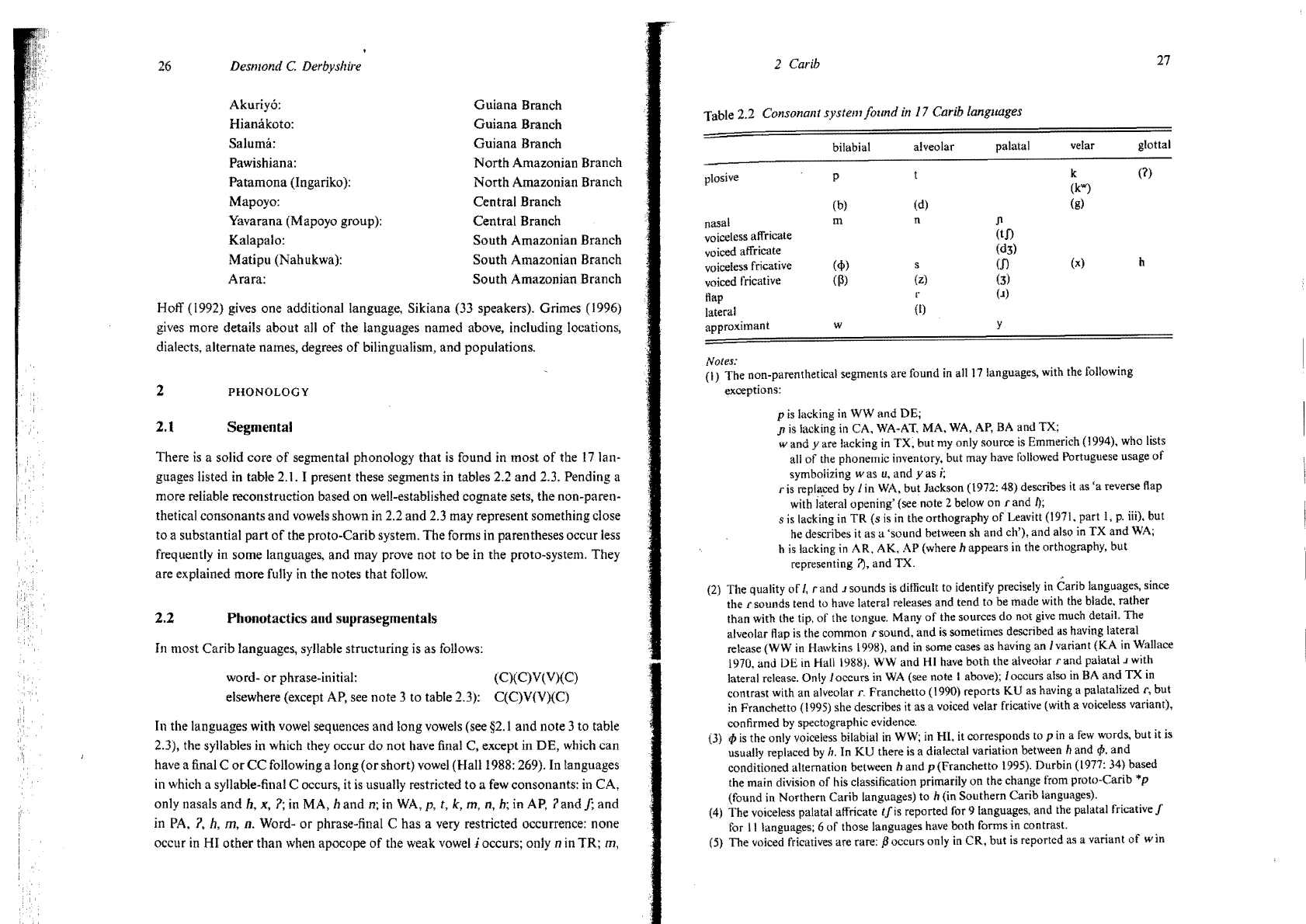
27
Des/1lond
e
Derbysh¡re
26
Akuriyó:
Guiana
Branch
Hianákoto:
Guiana
Branch
Salumá:
Guiana
Branch
Pawishiana:
North
Amazonian
Branch
Patamona
(Ingariko):
North
Amazonian
Branch
Mapoyo:
Central
Branch
Yavarana
(Mapoyo
group):
Central
Branch
Kalapalo:
South
Amazonian
Branch
Matipu
(Nahukwa):
South
Amazonian
Branch
Arara:
South
Amazonian
Branch
HotT (1992) gives
one
additionallanguage,
Sikiana
(33 speakers).
Grimes
(1996)
gives
more
details
about
al!
of
the
languages
named
aboye, incJuding locations,
alternate
names, degrees
of
bilingualism,
and
populations.
2
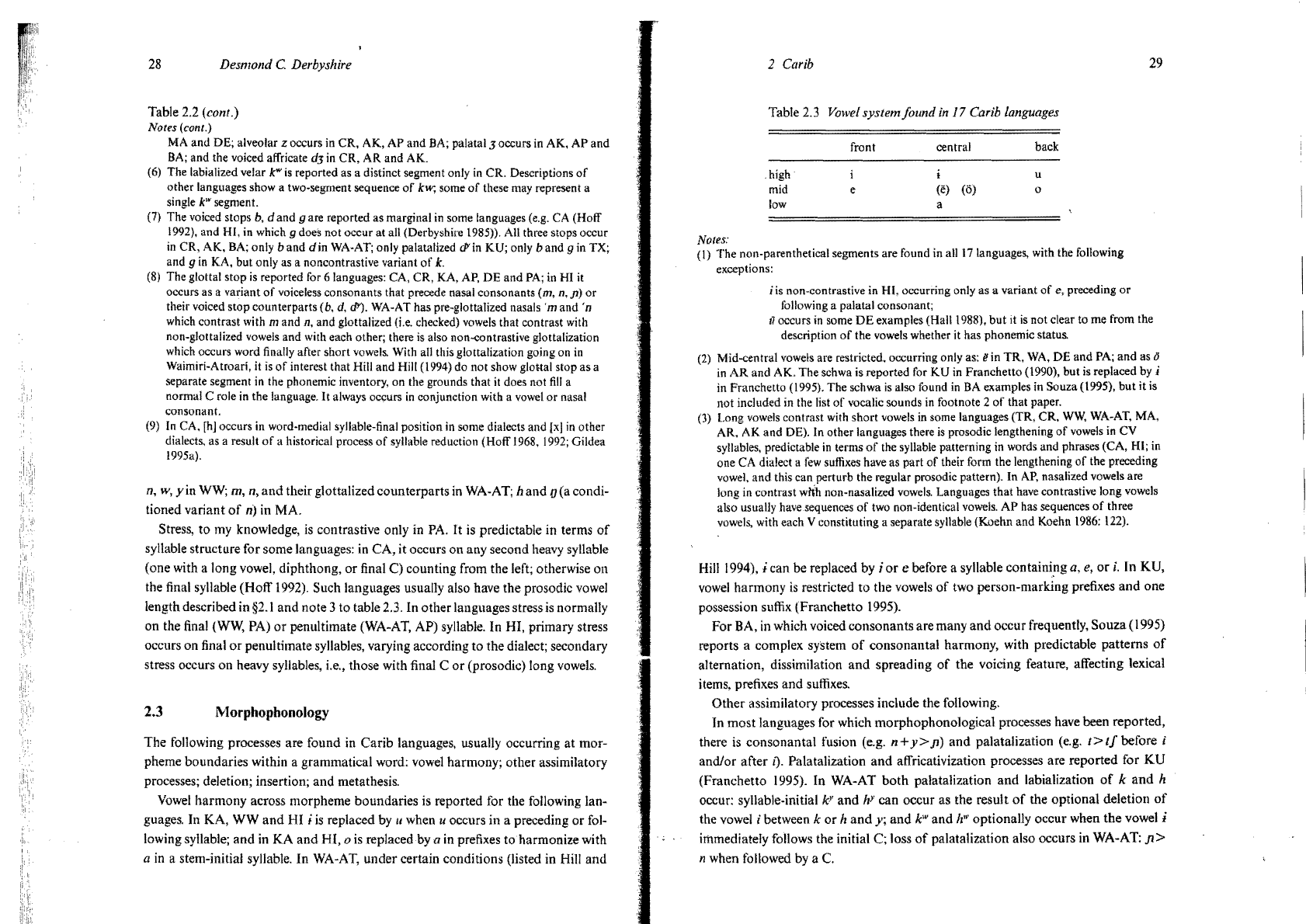
PHONOLOGY
2.
t
Segmental
There
is
a solid
core
of
segmental
phonology
that
is
found
in
most
of
the
17
Jan-
guages listed in
table
2.1. 1
present
these
segments
in tables 2.2
and
2.3.
Pending
a
more
reliable
reconstruction
based
on
well-established
cognate
sets,
the
non-paren-
thetical
consonants
and
vowels
shown
in 2.2
and
2.3
may
represent
something
close
to
a
substantial
part
of
the
proto-earib
system.
The
forms in
parentheses
occur
less
frequently in
sorne
languages,
and
may
prove
not
to
be
in
the
proto-system.
They
are
explained
more
fully in the
notes
that
fol!ow.
2.2
Phonotactics
and
suprasegmentals
In
most
Carib
languages, syl!able
structuring
is as follows:
word-
or
phrase-initial:
(e)(C)V(V)(C)
elsewhere (except AP, see
note
3
to
table 2.3): C(C)V(V)(C)
In
the
languages
with
vowel sequences
and
long
vowels (see
§2.l
and
note
3
to
table
2.3), the syl1ables in which they
occur
do
not
have final
e,
except
in
DE,
whk:h
can
have a final e
or
ce
following a
long
(or
short)
vowel
(Hall
1988:
269).
In
languages
in which a syllable-final e occurs, it is usually restricted
to
a few
consonants:
in
CA,
only
nasals
and
h, x,
7;
in
MA,
h
and
n; in WA, p, t, k,
m,
n,
h;
in AP, ?
and
J;
and
in PA,
7,
h,
m,
n.
Word-
or
phrase-final C
has
a very restricted occurrence:
none
occur
in
HI
other
than
when
apocope
of
the
weak
vowel i occurs; only n in
TR;
m,
2
Carib
Table
2.2
Consonanl
system
fOllnd
in
17
Carib
languages
bilabial
alveolar
palatal
velar
glottal
p
k
(1)
(kW)
(b)
(d)
(g)
nasal
m
n
JI
voiceless affricate
(tD
voiced affricate
(d3)
voiceless fricative
(<ji)
W
(x)
h
voiced fricative
(~)
(z)
(3)
flap
r
(J)
lateral
(1)
approximant
w
Y
Notes:
(1) The non-parenthetical segments are found
in
all17languages, with the following
exceptions:
pis
lacking
in
WW and DE;
JI
is
lacking
in
CA,
WA-AT.
MA,
WA,
AP,
BA
and TX;
w and y are lacking
in
TX, but
my
only source
is
Emmerich (1994), who lists
all
of
the
phonemic inventory, but may have
followed
Porluguese usage
af
symbolizing
was
u,
and
yas
i;
ris
repll\ced
by
/
in
WA,
but Jackson
(1972:
48) describes
it
as
'a
reverse
flap
with
lateral opening' (see note 2 below on r and
1);
s
is
lacking in TR
{s
is
in
the orthography
of
Leavitt (1971. part
1,
p.
Hi), but
he
describes it as a 'sound between sh and eh'), and also
in
TX and
WA;
h
is
lacking
in
AR, AK, AP (where h appears
in
the orthography. bu!
representing
7),
and TX.
(2)
The qua
lit
y
of
1,
r and J sounds
is
dilficult lo identify precisely
in
Carib languages, since
the
rsounds
tend
to
have lateral releases and !end to be made
with
the
blade. rather
than with lhe tip, of the tongue. Many
of
the sources do not
givc
much detail. The
alveolar
flap
is
the cornmon
rsound,
and
is
sometimes descríbed as having lateral
release (WW
in
Hawkins
1998),
and
in
some cases
as
having
an
/varíant (KA
in
Wallace
1970,
and
DE
in
Hall
1988).
WW
and HI
have
both the alveolar
rand
palatal J with
lateral release. Only
Joccurs
in
WA
(see
note 1 aboye); 10ccurs also
in
HA
and TX
in
contrast with an alveolar
r.
Franchetto
(1990)
reports KU
as
having a palatalized
r,
but
in
Franchetto
(1995)
she describes it as a voiced velar fricative (with a voiceless variant),
conllrmed
by
spectographic evidence.
(3)
¡P
is
the only voiceless bilabial
in
WW;
in
HI. it corresponds
to
p
in
a
few
words, but
it
is
usually replaccd
by
h.
In
KU
there
is
a dialectal variation between h and
¡P.
and
conditioned altemation between
h and p (Franchetto
1995).
Durbin
(1977:
34) based
the main division
of
his classification primarily on the change from proto-Carib *p
(found
in
Northern Carib languages) to h (in Southern Carib languages).
(4)
The voiceless palatal affricate
tfis
reported
for
9languages, and
the
palatal fricative f
for
11
languages; 6 of those languages
have
both fonns in contras!.
(5)
The voiced fricatives are rare: poccurs only
in
CR, bul
is
reported
as
a variant
of
w
in
28
Desmond
C.
Derbyshire
Table 2.2 (cont.)
Notes (com.)
MA and DE; alveolar Z occurs in CR, AK, AP
and
BA;
palatal3
occurs
in
AK,
AP
and
BA;
and the voiced affricate
d3
in
CR,
AR
and AK.
(6) The labialized velar
k
W
is
reported as a distinct segment only
in
CR. Descriptions
of
other languages show a two-segrnent sequence
of
kW;
sorne
of
these
may
represenl a
single
k
W
segment.
(7) The voiced
slOps
b, d and 9 are reported as marginal
in
sorne languages (e.g. CA (Hoff
1992), and HI, in which 9
doe!!
not occur at all (Derbyshire 1985».
AH
three stops occur
in
CR, AK,
BA;
only
band
din WA-AT; only palatalized
dYin
KU; only
band
gín
TX;
and
9
in
KA, but only as a noncontrastive variant
of
k.
(8) The glottal
stop
is
reported
for
6languages: CA, CR, KA, AP,
DE
and
PA;
in HI ít
occurs as a variant
of
voíceless consonants that precede nasal consonants (m,
n,
Jl)
or
their voiced stop counterparts
(b.
d.
dY).
WA-AT has pre-glottalized nasals
'm
and 'n
which contrast with m and
n,
and glottalized
(Le.
checked) vowels that contrast wíth
non-glottalized vowels and with eaeh olher; there is also non-contrastive glottalization
which occurs word finally afier short vowels. With
all
this glottalization going on
in
Waimiri-Atroarl,
it
is
of
interes! that
HiJI
and HiIl (1994) do
nOI
show glo¡tal stop as a
separate segment
in
the phonemic inventory, on the grounds that
it
does not
fill
a
normal C role in the language.
It
always
oe¡;:urs
in
conjunction with a
vowel
or
nasal
consonant.
(9) In CA.
[h]
oceurs
in
word-medial syllable-final position
in
sorne dialects and
[xj
in
other
dialects, as a result
of
a historical process
of
syllable reduction (Hoff 1968,1992; Gildea
1995a).
n,
W,
yin
WW;
m,
n,
and
their glottalizedeounterpartsin WA-AT;
hand
o(aeondi-
tioned varíant
of
n)
in
MA.
Stress,
to
my knowledge,
is
contrastive only
in
PA.
It
is
predietable in terms
of
syllable structure for some languages:
in
CA, it occurs on any second heavy syllable
(one with a long vowel, diphthong, or final
C) counting from the left; otherwise on
the final syllable (Hoff 1992). Such languages usualIy also have the prosodie vowel
length described in
§2.1
and note 3 to table 2.3. In other langllages stress
is
normally
on the final (WW, PA)
or
penllltímate (WA-AT, AP)
syIJable.
In HI, primary stress
oeeurs on final
or
penultimate syllables, varying aecording
to
the dialect; secondary
stress occurs on heavy syllables,
Le.,
those with final C
or
(prosodie) long
vowels.
2.3
Morphophonology
The followíng processes are found
in
Carib languages, usually occurring at mor-
pheme boundaries withín a grammatieal word:
vowel
harmony; other assímilatory
processes; deletion; insertion; and metathesis.
Vowel
harmony aeross morpheme bOllndaries
is
reported for the following lan-
guages. In KA, WW
and
HI i
is
replaced by
11
when u oceurs in a preeeding
or
fol-
lowing syllable;
and
in
KA
and
HI, o
is
replaeedby a
in
prefixes
toharmonize
with
a
in
a stem-initial syllable. In WA-AT, under eertain eondítions (listed
in
HiIl
and
2 Carib
29
Table 2.3
Vowel system
found
in 17 Carib languages
front
central
back
high
i
u
mid
e
(e) (o)
o
low
a
Notes:
(1) The non-parenthetical segrnents are found in all
17
languages, with the following
exceptions:
i
is
non-contrastive in HI, occurring only as a varian!
of
e,
preceding
or
following a palatal consonanl;
íJ
occurs
in
sorne
DE
examples (Hall 1988),
but
it is
not
clear to me from the
description
of
the vowels whether
it
has phonemie status.
(2) Mid-central vowels are restricted, occurring only as:
I!
in
TR,
WA,
DE
and
PA;
and
as
(J
in
AR
and A K.
The
schwa is reported ror
KU
in Franchetto (1990), but
is
replaeed by i
in Franchetto (1995). The schwa is also found
in
BA examples in Souza(I99S), but it is
no! included
in
the list
of
vocalic sounds
in
footnote 2
of
that
papero
(3) Long vowels contrast with short vowels
in
sorne languages (TR,
CR,
WW,
WA-AT,
MA,
AR. AK and DE). In olher languages there
is
prosodic lengthening
of
vowels in CV
syllables, predictable
in
terrns
of
the syllable patterning in words and phrases (CA, HI; in
one CA dialect a
few
suffixes have as part
of
their form the lengthening
of
the preceding
vowel, and this can perturb the regular prosodic pattern). In
AP,
nasalized vowels are
long in contras! whh non-nasalized
vowels.
Languages Iha! have contrastive long vowels
also usually havesequences
of
two non-identical vowels.
AP
has sequences
of
three
vowels, with eaeh V constituting a separate syllable (Koehn and Koehn
1986:
122).
Hill 1994), i can be replaeed by i
or
e before a syllable containi,ng
a,
e,
or
i.
In KU,
vowel
harmony
is
restricted
to
the vowels
of
two person-marking prefixes and one
possession suffix (Franehetto 1995).
For
BA,
in
whieh voieed consonants are many
and
occur frequently, Souza (1995)
reports a complex system
of
consonantal harmony, with predietable patterns
of
alternation, dissimilation
and
spreadiog
of
the voicing feature, affecting lexieal
items, prefixes and suffixes.
Other assimilatory processes ¡nelude the following.
lo
most languages ror whieh morphophonological processes have been reported,
there
is
consonan tal fusion (e.g.
n+Y>fl)
and
palatalization (e.g.
t>tjbefore
i
andlor after
1).
Palatalizadon
and
affrieativization processes are reported ror
KU
(Franehetto 1995). In WA-AT
both
palatalization
and
labialization
of
k
and
h
occur: syllable-initial
k·
v
and
h
Y
can oceur as the result
of
the optional deletioll
of
the vowel i between k
or
h
and
y;
and
k
IV
and h" optionally occur when the vowel i
irnmediateIy follows the initial C; 1055
of
palatalization also occurs
in
WA-AT:
fl>
n when followed by a
C.