
Dixon R.M.W., Aikhenvald Alexandra Y. The Amazonian Languages (Cambridge Language Surveys)
Подождите немного. Документ загружается.

31
30
Desmond e
Derbyshire
In CA, a morpheme-final n before p, t
or
k results in the sequences
mb,
nd
or
the
velar nasal
!1
respectively. In sorne CA dialects there has been
los5
of
word-medial
which has resulted in breathiness
of
the
vowel
in the preceding syllable,
which sometimes takes the form
of
a velar
or
glottal fricative in syllable-final posi-
tion (Hoff 1992).
In
TR,
n>g
before k and word-finally;
n>m
before
p;p>p
following/¡;
and
k>
x following
h.
In Ww,
k>h
before
t,
k, s,
tfat
morpheme boundaries
(cf.
HI
below);
p>h
in
consonant c\usters and
/¡
then deletes
if
it
is
preceded by two syllables, a long
V,
a
CC cluster
oc
m.
In HI, morpheme-initialn > Ji following
e;
1'>J before
e;
and
s and
t>
f and
tf
respectively when they follow a syilable containing the vowels e
or
a;
morpheme-
final
k>h
when it precedes a voiceless non-syllabic other than
h;
and morpheme-
initial h>
p following rnorpherne-final m
or
h.
(The last two rules avoid
non-permitted
CC
c\usters
in
a word.)
In
WA,p>h
before p, m and
w;p>m
before
n;
t>h
before t, I and
n;
t>n
before
111;
k>h
before
k;
and
k>
Q before m
and
n.
In
AP,
a sequence
of
V plus nasal e
in
rnorpheme-initial position, and preceding
another C, becornes a nasalízed
V;
any rnorpherne-final
stop>
? before
e.
Deletion processes include the following.
High vowels, especially
i
and
u,
are deleted in several
earib
langllages when they
occur morpheme-finally following a non-c1ustered e
and
preceding a morpherne-
initial V
or
unclustered provided
that
the resulting
ec
is
a perrnitted one. This
process
is
reported for
WW,
HI,
WA-AT,
MA
and
AP.
Whole syllables containing
these weak vowels can delete
in
sorne languages (CA, MA). For fuller discussion,
see Gildea
(1
995a).
In
WW,
morpheme-initial y deletes following s
and
tI.
In HI, a similar process
occurs: morpheme-initial
y deletes when it follows a voiceless alveolar
or
palatal
e,
but
in
this case h
is
inserted before the
C;
this results in ty> ht, sy>hs,
fy>
hf
(tf
alld y
do
not come together at morpheme bOllndaries).
In MA, certain
Ci syllables (pi,
ti,
ki,
SI)
are weak, and when certain affixes are
added the whole syllable may be deleted
or
be reduced to
h.
A
few
insertion processes have been reported.
In
WW,
when
tfis
preceded
by
a long
V,
the V
is
shortened and h
is
inserted fol-
lowing the
V.
In HI
and
MA, there
is
insertion
of
y between a prefix tha! consists
of
a single V
(o or a
in
HI;
It
or
a in MA) and a stem-inítial V (only a V
of
the same quality as that
of
the prefix in HI). A similar y-insertion process occurs in
PA
(Gildea p.c.). (See
2
Carib
Gildea 1998, for a diachronic hypothesis which traces
back to a rnorphological
inverse marker
in
proto-Carib.) In MA, there
is
abo
insertion
of
t between the third-
person prefix
i- and a stem-initial vowel.
In
HI, there are also epenthesis rules for the
insertion
of
a brief
vowel
sound between syllabJes when certain CC sequences oceur.
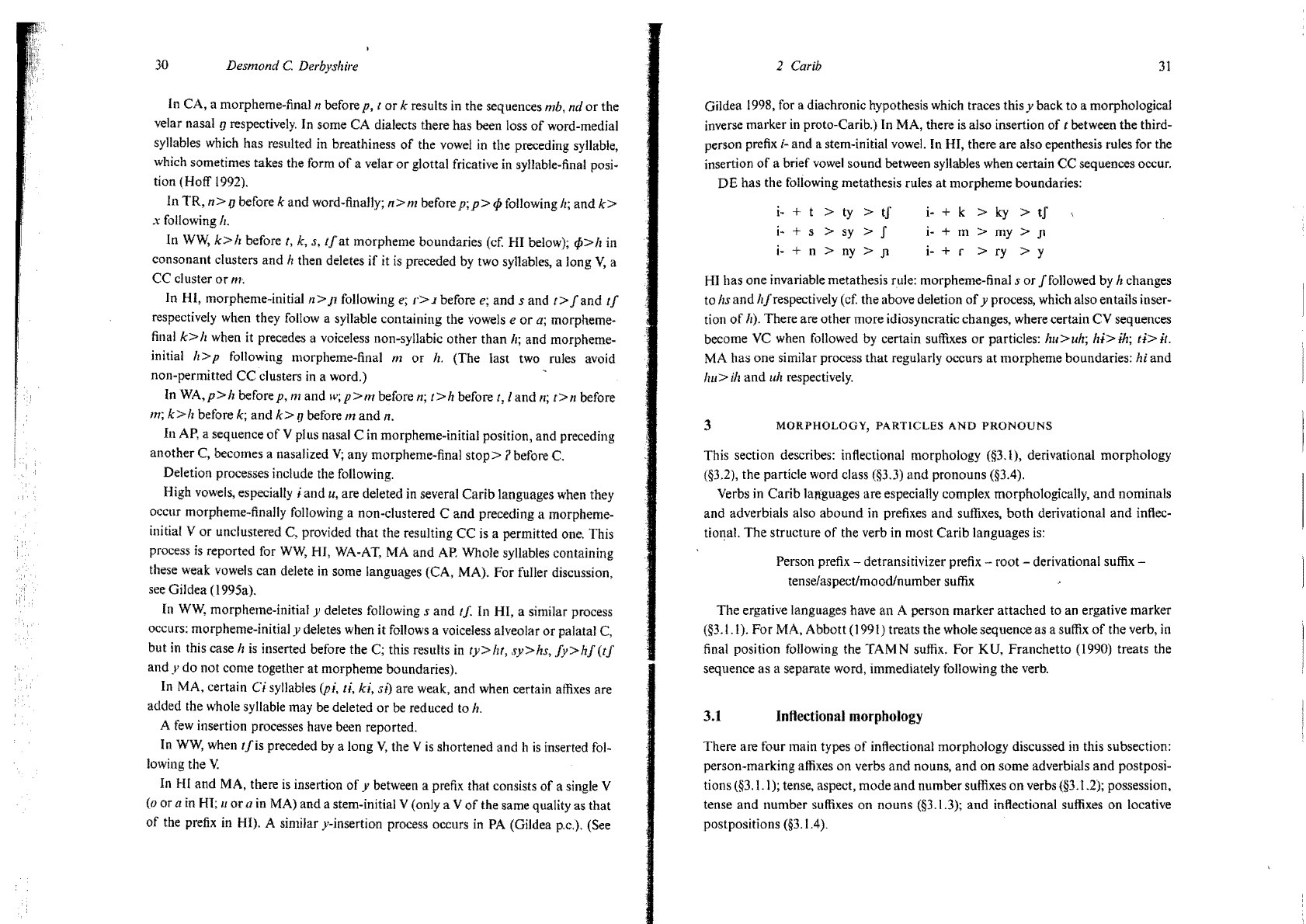
DE
has the following rnetathesis rules
at
rnorpheme boundaries:
i-
+ t > ty >
t1'
j-
+ k >
ky
>
tI
i·
+ s >
sy
> l'
i-
+ rn > my >
Jl
j-
+ n >
ny
>
Jl
j-
+ f > ry > y
HI has one invariable metathesis rule: morpherne-finaJ s
or
ffollowed by h changes
to
hs
and
hf
respectively
(cf.
the aboye deletion
of
y process, which also entails ¡n ser-
tion
of
h).
There are
other
more idiosyncratic changes, where
<-'Crtain
CV sequences
becorne VC when followed by certain suffixes
01' particJes: hu>uh; IIt>i/¡;
ti>it.
MA
has one similar process
that
occurs
at
rnorpherne boundaries:
hi
and
hit>
ih
and
ti/¡ resoectivelv.
3
MORPHOLOGY, PARTICLES AND
PRONOUNS
This section describes: inflectional morphology (§3.l), derivational morphology
(§3.2), the particle word class (§3.3)
and
pronouns (§3.4).
Verbs in Carib languages are especial1y complex morphoJogical1y,
and
nominals
and adverbials also abound
in
prefixes and suffixes,
both
derivational
and
inflec-
tiona!.
The
structure
of
the verb in most Carib languages
is:
Person prefix
~
detransitivizer prefix
~
root - derivational suffix -
tense/aspectlrnood/nurnber suffix
The
ergative languages have
al1
A person marker attached to an ergative marker
1.1).
For
MA, Abbott (1991) treats the whole sequence as a suffix
of
the verb,
in
final Dosition following the
TAMN
suffix. For KV, Franchetto (1990) treats the
sequence as a separate word, ímmediately following the
verbo
3.1
Inflectional morphoJogy
There are four main types
of
infiectional
discussed in this subsection:
person-marking affixes on verbs
and
nouns,
and
on
sorne adverbials
and
postposi-
tions (§3.1.1); tense, aspect, mode
and
nurnber suffixes on verbs (§3.1.2); possession,
tense
and
llumber suffixes on nouns (§3.1.3);
and
inflectional suffixes on locative
postpositions
(§3.
J.4).
33
32
Desmond
e Derbyshire
3.1.1
Person-marking affixes on verbs, nouns, adverbial s and
postpositions
In
order
[O
get a clear pieture
of
the person-marking systems
of
Carib
languages, it
is
neeessary to distinguish the three gramrnatieal funetions to whieh the verb person
rnarkers relate: intransitive subject (S), transitive subjeet
(A)
and
objeet (O). There
is only one prefix
per
verb.
A eharaeteristie
of
the rnorphosyntax
of
these languages is that they show
varying degrees
of
ergatively organized rnorphology
and
syntax; in sorne, ergativ-
ity
is
strong, in others, it
is
weaker. (See
§4.3
for further diseussion.) The majority
of
the languages have split systems, partly ergative
and
partly aeeusative.
The
person-marking systems form four distinct. sets that can be dassified as follows:
Transitive A-onented prefixes
Transitive O-onented prefixes
Intransitive
S.
-oriented prefixes
Intransitive So-oriented prefixes
(See Derbyshire
1991
and 1994 for the
HI
system based on this elassification; and
Gildea 1998, for an alternative analysis which ineludes an inverse system
and
a
summary
of
other
possible analyses.)
Sa
prefixes oecur with one set
of
intransitive verbs (in general, 'active' verbs),
while the S" prefixes occur with another set (in general, 'stative' verbs). However, the
semantie distinetion between 'active'
and
'stative' does
not
always determine to
which set a particular verb belongs. Sorne languages listed in table 2.5 have only a
partial set
of
So-oriented forrns (restricted to one
or
two persons). In
PA
the distinc-
tion is
not
prirnarily between
Sa
and
So'
but
between two tense/aspect paradigms:
'past
perfective', which takes the A
or
S. prefues,
and
'non-past-perfective', whieh
takes the prefixes:
0-
'IS',
a- '2S',Y- '3S' (only the first
and
second person forms are
the sarne as those in the O set shown in table 2.5; see Gildea 1998).
Gildea (1998)
has reconstructed the proto-Carib forms
of
the person-marking
prefixes based
011 cogllate sets from nineteen languages. In tables 2.4
and
2.5, 1 use
his reeonstructed forms,
but
have modified the cognate sets to conform to the data
in
my
own sourees
and
to inelude only the languages
on
which this study
is
based.
r exclude
AK,
AR,
MA
and KU, the strongly ergative languages, whose person-
marking systems
are
somewhat different (see table 2.6 for the
MA
and
KU
sets),
and
also two languages for which my sourees
do
110t
provide the necessary data -
KA
and
TX. There
is
one eategory
of
person
not
shown in the tables: first person
exclusive
(1
+ 3); except in
MA
and
KV
(see table 2.6), the
1+3
prefix is identical in
form
and
function with third person,
and
a free pronoun ana
(or
cognate)
'1
+ 3'
is
present. (n PA, the
1+2
prefix
(n(
¡Jo)
is
also identical with third person
2 Carib
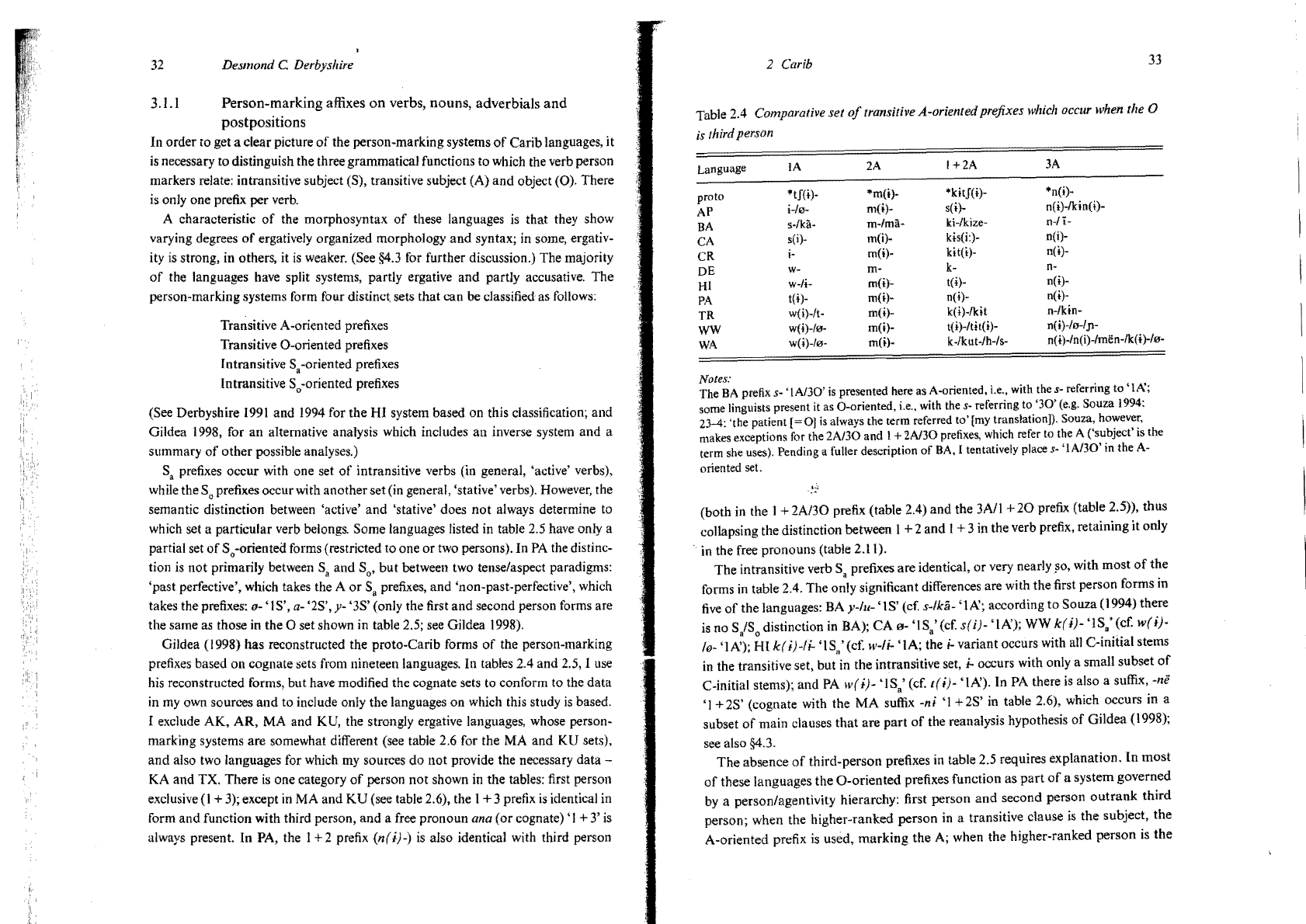
Table 2.4 Comparative set
of
transitive A-oriented prefixes which occur when the O
is third person
lA
2A
1+2A
proto
*tf(i)-
"m(t)-
*kitJ(i)-
*n(i)-
i-11i'J-
m(i)-
s(i)-
n(i)-Ikio(i)-
AP
BA
s-/ka-
m-/ma-
ki-/kize-
n-lí-
s(i)-
m(i)-
kis(i:)-
n(i)-
CA
i-
m(i)-
kit(i)-
n(t)-
CR
DE
w-
m-
k-
n-
w-/i-
m(i)~
t(i)-
nCi)-
HI
PA
t(il-
m(l)-
o(t)-
o(i)-
TR
w(i)-/t-
m(i)-
k(i)-fkit
n-/kin-
W(i)-/0-
m(i)-
t(i)-/tit(i)-
n(
i)-/Ii'J-/]l-
WW
WA
w(i)-/0-
m(i)-
k-/kut-/h-/s-
n(
i)-In(i)-/men-Ik(i)-/e-
Notes:
The
HA
prefix
s-
'IA/30'
is
presented
here
as
A-oriented,
Le.,
with
the
s-
refernng
to
'lA';
sorne
Iinguists
present
it
as
O-oriente<!,
Le.,
with
the
s-
referring lo
'30'
(e.g.
Souza 1994:
23-4: 'the palieol
[=0]
is
always
the
term
referred
to'
[my
translatioo]). Souza,
however,
makes
exceptions
for
the
2A/30 and l + 2A/30
prefixes,
which
refer
lo
the
A ('subject'
is
the
term
she
uses).
Pending
a fuller descriptioo of
BA,
1 teotatively
place
s-
'IA/30'
in
¡he
A-
orieoted
seL
,.I~
(both in the 1+
2A/30
prefix (table 2.4)
and
the 3A/I +
20
prefix (table
2.5»,
thus
collapsing the distínction between
I + 2
and
I + 3 in the verb prefix, retaining it only
. in the free pronouns (table 2.11).
The
intransitive verb S. prefixes
are
identical,
or
very
nearly~o,
with rnost
of
the
forrns in table 2.4. The only significant differences are with the first person forrns in
five
of
the languages: BA y-/u-
'IS'
(cf.
s-/ka-
'lA';
aceording
to
Souza (1994) there
is
no
S/So
distinction in BA);
CA
0-
'IS:
(cf.
s(i)-
'IA');
WW
k(i)-
'IS;
(cf.
w(i)-
lo-
'IA');
Hl
k(i)-/í-
'ISo' (cf. w-/í-
'lA;
the
í-
variant occurs with
all
C-initial sterns
in the transitive set,
but
in the intransitive set,
í-
occurs with only a small subset
of
C-initial stems);
and
PA
w(i)-
'ISo' (cf.
t(
¡)- '1A').
In
PA there is
al
so a suffix,
-ni?
'1
+2S'
(cognate with the
MA
suffix -ni
'1
+2S'
in table 2.6), which oceurs in a
subset
of
main c1auses
that
are
part
of
the reanalysis hypothesis
of
Gildea (1998);
see
al so §4.3.
The
absenee
of
third-person prefixes in table 2.5 requires explanatíon.
In
most
of
these languages the
O-oriented
prefixes function as
part
of
a system governed
by a person/agentivity hierarchy: first person
and
second person
outrank
third
person; when the higher-ranked person in a transitive c\ause is
the
subject,
the
A-oriented prefix is uséd,
marking
the
A; when the higher-ranked
person
is
the
34
Desmond e Derbyshire
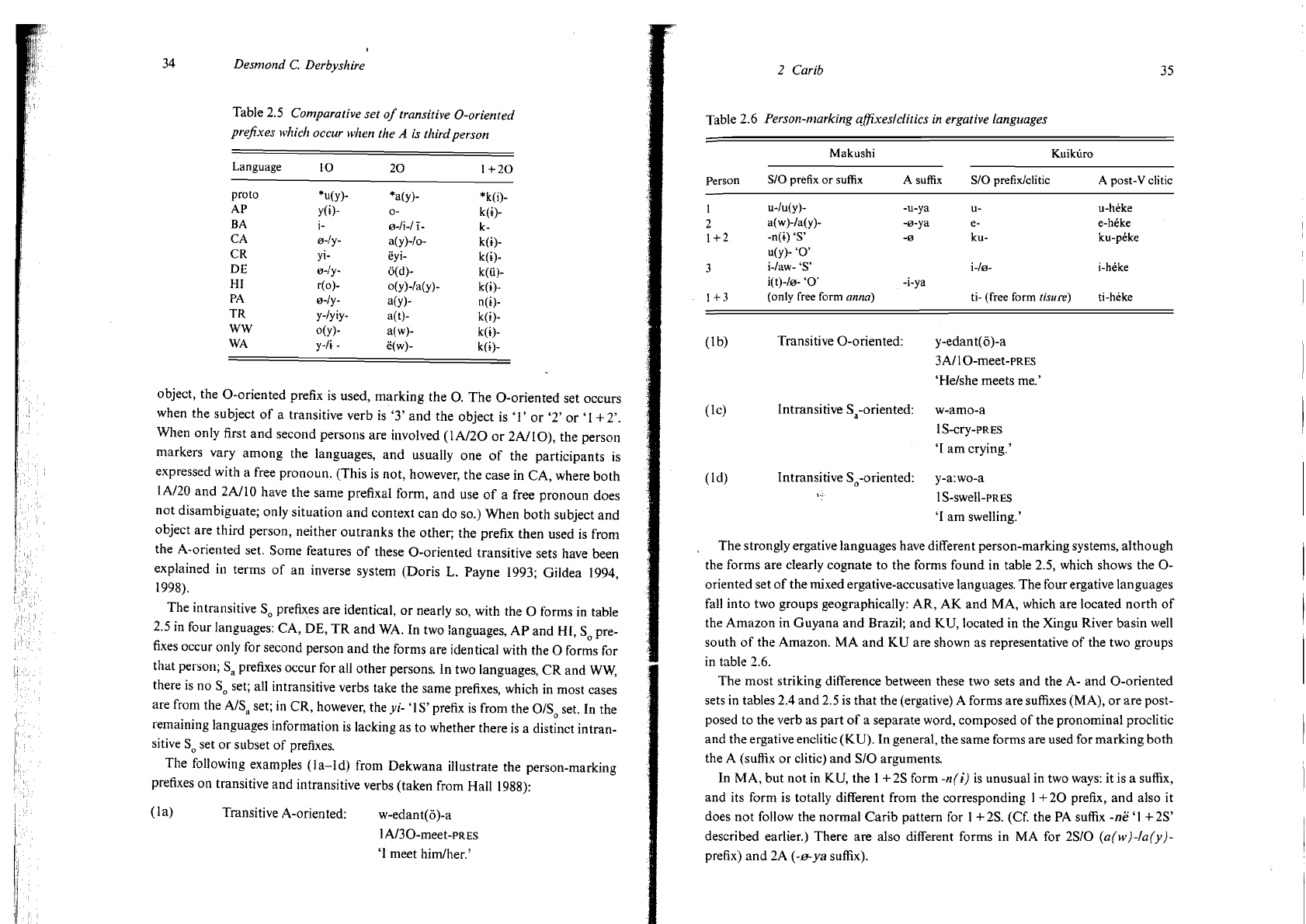
Table 2.5 Comparative set
01
transitive O-oriented
prefixes which occur whell the
A is third person
Language
10
20
1+20
proto
*u(y)-
*a(y)-
*k(i)-
AP
y(i)-
0-
k(i)-
BA
i-
o-/i-li-
k-
CA
a-/y-
a(y)-/o-
k(i)-
CR
yi-
eyi-
k(i)-
DE
a-/y-
6(d)-
k(ü)-
HI
r(o)-
o(y)-/a(y)-
k(i)-
PA
1iJ-/y-
a(y)-
n(i)-
TR
y-/yiy-
a(t)-
k(i)-
WW
o(y)-
a(w)-
k(i)-
WA
y-/i
-
e(w)-
k(i)-
object, the O-oriented prefix
is
used,
marking
the
O.
The
O-oriented set occurs
when the subject
of
a transitive verb
is
'3'
and
the object
is
'1'
or
'2'
or
'1
+2'.
When only first
and
second persons
are
involved
(IA/20
or
2NIO),
the person
markers vary
among
the languages,
and
usually
one
of
the participants
is
expressed with a free pronoun. (This
is
not, however, the case in
CA,
where
both
IA/20
and
2A/1O have the same prefixal form,
and
use
of
a free
pronoun
does
not
disambiguate; only situation
and
context can
do
so.)
When
both
subject
and
object are third person, neither
outranks
the other; the prefix then used
is
from
I
jl
,
the A-oriented
seto
Sorne features
of
these O-oriented transitive sets have been
explained in terms
of
an inverse system (Doris L. Payne 1993; Gildea 1994,
1998).
The intransitive
So
prefixes are identical,
or
nearly so, with the O forms
in
table
, ,
2.5
in
four langllages: CA, DE,
TR
and
WA.
In two langllages,
AP
and
HI,
So
pre-
¡j'
fixes
occur only for second person
and
the forms are identical with the O forms for
j,:
that person;
Sa
prefixes occur for
aH
other persons. In two langllages,
CR
and
WW,
there
is
no
So
set; all intransitive verbs take the same prefixes, which in most cases
are from the A/S
a
set;
in
CR, however, the yi-
'1
S' prefix
is
from the
O/So
set. In the
remaining languages information
is
lacking as to whether there
is
a distinct intran-
sitive
So
set
or
sllbset
of
prefixes.
The foHowing examples
(la-Id)
from Dekwana iIIustrate the person-marking
prefixes on transitive and intransitive verbs (taken from Hall 1988):
(la)
Transitive A-oriented:
w-edant(6)-a
IA/30-meet-PRES
'1
meet hirnlher.'
'i
il
:11'
2 Carib
35
Table 2.6 Person-marking affixes/c/itics
in
ergative languages
Makushi
Kuikúro
Person
S/O
prefix
or
suffix
A
suffix
S/O
prefix/c1itic
A post-V
clitic
1
u-/u(y)-
-u-ya
u-
u-héke
2
a(w)-/a(y)-
-1iJ-ya
e-
e-héke
1+2
-n(i) 'S'
-1iJ
ku-
ku-péke
u(y)-
'O'
3
i-/aw-
'S'
i-/a-
i-héke
i(t)-/a- 'O'
-i-ya
1+3
(only
free
form
anna)
ti-
(free
form
tisl/re)
ti-héke
(1
b)
Transitive O-oriented:
y-edant(6)-a
3AtI0-meet-PRES
'He/she meets me.'
(le)
Intransitive S.-oriented: w-amo-a
1
S-cry-PRES
'1
am
crying.'
(1
d) Intransitive
So
-oriented:
,.
y-a:wo-a
I S-swell-PREs
'1
am swelling.'
The
strongly ergative languages have different person-marking systems, although
the forms are c1early cognate to the forms found in table 2.5, which shows the
0-
oriented set
of
the mixed ergative-accusative languages.
The
four ergative languages
fall into two groups geographically:
AR,
AK
and
MA,
which are located
north
of
the
Amazon
in
Guyana
and
Brazi1;
and
KU, located in the Xingu River basin well
south
of
the Amazon.
MA
and
KU
are shown as representative
of
the two groups
in
table 2.6.
The
most striking difference between these two sets
and
the A-
and
O-oriented
sets in tables 2.4
and
2.5
is
that
the (ergative) A forms are suffixes (MA),
or
are
post-
posed
to
the verb as
part
of
a separate word, composed
of
the pronominal proclitic
and the ergative enclitic (KU). In general, the same forms are used for marking
both
the A (suffix
or
c1itic)
and
StO arguments.
In
MA,
but
not
in
KU, the I +2S form
-11
(
i}
is
unusual in two ways: it is a suffix,
and
its form
is
totally different from the corresponding 1+
20
prefix,
and
also it
does
not
follow the normal
Carib
pattern for
1+
2S.
(Cf. the
PA
suffix
-ne
'1
+ 2S'
described earlier.) There are also different forms in MA for
2StO
(a(w}-/a(y)-
prefix)
and
2A
(-fJ-
ya
suffix).
36
Desmond e Derbyshire
The
A forms in table 2.6 ¡nelude the ergative elitic:
-ya
in
MA,
and
-héke in
KV.
(In
other
Carib
languages -ya is cognate with forms like the
HI
postposi-
tion
-wya
'to'
(indirect object marker)
or
'ergative/agentive'; -héke
is
probably
cognate with forms Iike the
HI
postposition hoko 'concerning,
about,
with'.)
These ergative clitics
occur
on
the
free form
noun
when there
is
one,
or
are
attached to the
pronominal
suffix
(M
A)
or
proclitic (KV),
as
described aboye. In
MA,
the free
form
and
person-marker never eo-oceur.
The
forms are cJearly
not
cognates with
each
other;
the
MA
-ya, however,
is
eognate with c1itics
that
some-
times
occur
with
an
ergative meaning in the languages listed in tables 2.4
and
2.5.
In
MA
the -ya clitie does
not
occur
for
'1
+ 2' person,
but
-héke does
occur
in
KV, in the form ku-péke.
KV
is
unusual
among
Carib
languages in having a '1
+ 3' free form
prono
un, tisúre,
that
is
not
a cognate
of
anna
(see
table 2.11),
and
whose
corresponding
prefix (tí-) is
not
the third persono
The
person/agentivity
hierarchy
is
not
applicable
to
the person-marking
in
the ergatively organized
systems
of
these languages, but in
KV
it
is
relevant
to
what
Franchetto
calls the 'interactive
moods',
in whieh ergative constructions occur with third
person A,
and
accusative constructions occur with first person
and
first person
inclusive A (with first person exclusive
and
second person A there
is
free alterna-
tion between
the
ergative
and
accusative patterns).
See
§4.3 for further discussion
on
ergativity.
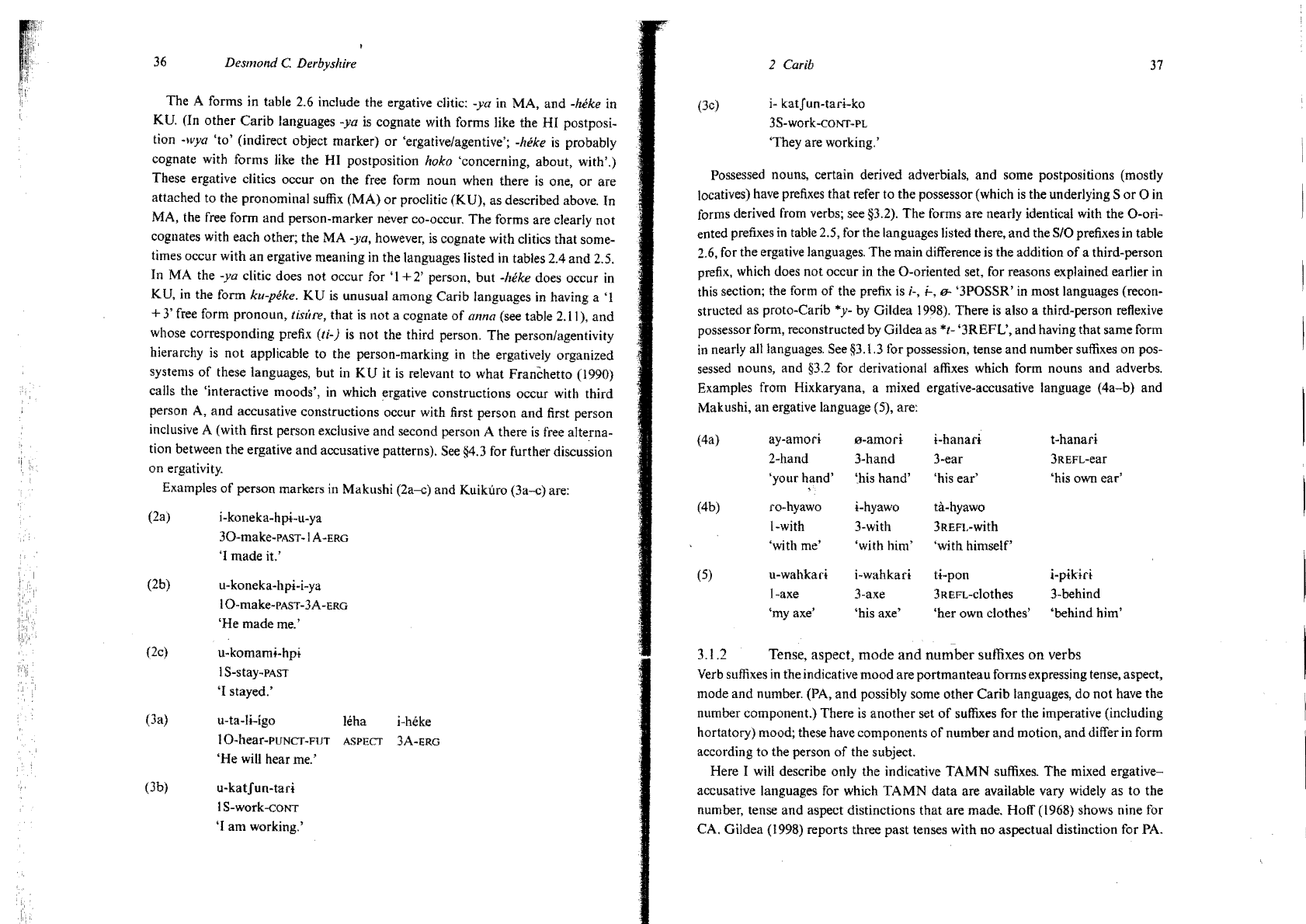
Examples
of
person markers in Makushi (2a-e) and Kuikúro
(3a-e)
are:
(2a)
í-koneka-hpt-u-ya
30-make-PAsT
-1
A
-ERG
'1
made
it.'
(2b)
u-koneka-hpi-i-ya
10-make-PAsT-3A-ERG
'He
made
me.'
(2c)
u-komamt-hpt
1 S-stay-PAsT
'1
stayed.'
u-ta-li-ígo
10-hear-puNCf-FUT
'He
will
hear
me.'
léha
ASPECT
i-héke
3A-ERG
(3b)
u-katfun-tart
I S-work-coNT
'[
am
working.'
2 Carib
37
i-
katfun-tart-ko
3S-work-coNT-PL
'They are working.'
Possessed nouns, certaln derived adverbials,
and
sorne postposítions (mostIy
locatives) have prefixes
that
refer to the possessor(which
is
the underlying S
or
O in
forms derived from verbs; see §3.2).
The
forms
are
nearly identical with the O-ori-
ented prefixes in table 2.5, for the languages listed there,
and
the
5/0
prefixes in table
2.6, for the ergative languages.
The
main
difference ls the addítion
of
a third-person
prefix, which does
not
occur
in the O-oriented set, for reasons explained earlier in
this section; the form
of
the
prefix is í-,
i-,
8-
'3POSSR'
in most languages (recon-
structed
as
proto-Carib '"y- by Gildea 1998).
There
i5
also a third-person reflexive
possessor form, reconstructed by Gildea as
'"t-
'3REFL',
and
having that same form
in
nearly alllanguages. See §3.1.3 for possession, tense
and
number suffixes
on
pos-
sessed nouns,
and
§3.2 for derivational affixes which form nouns
and
adverbs.
Ex.amples from Hixkaryana, a mixed ergative-accusative language
(4a-b)
and
Makushi,
an
ergative language
(5),
are:
ay-amori
2-hand
'yourhand'
e-amod
3-hand
~hig
hand'
¡-hanad
3-ear
'his
ear'
t-hanari
3REFL-ear
'his
own
ear'
(4b) ro-hyawo
l-with
'with me'
i-hyawo
3-with
'with him'
ta-hyawo
3REFL-with
'with
himself'
(5)
u-wahkari
i-wahkari
ti-pon
i-pikiri
I-axe
3-axe 3REFL-c1othes
3-behind
'myaxe'
'his axe'
'her
own c1othes'
'behind
him'
3.1.2 Tense, aspect, mode and number sutlixes on verbs
Verb suffixes
in
the indicative
mood
are
portmanteau
forms expressing tense, aspect,
mode
and
number. (PA,
and
possibly sorne
other
Carib
languages,
do
not
have the
number component.)
There
is
another
set
of
suffixes for the imperative (including
hortatory) mood; the5e have
componen
t5
of
number
and
motion,
and
differ
in
form
according
to
the person
of
the
Here 1 will describe only the indicative
TAMN
suffixes.
The
mixed
ergative-
accusative languages ror which
TAMN
data
are
available vary widely as
to
the
number, tense
and
aspect distinctions
that
are
made.
Hoff
(1968) shows nine for
CA.
Gildea
(1998) reports three
past
tenses with
no
aspectual distinction for PA.
Desmond e Derbyshire
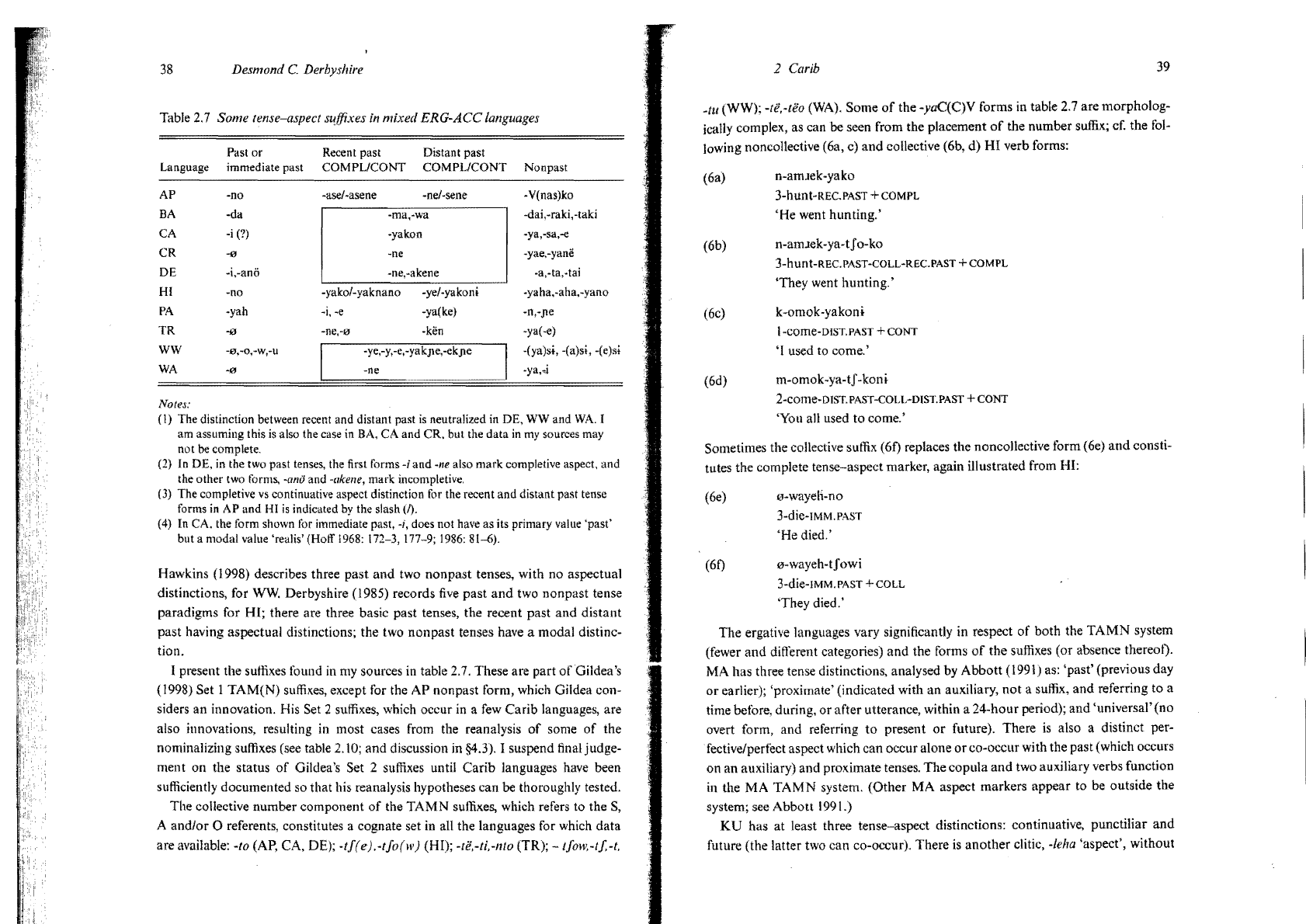
Table 2.7 Same tense-aspect sulfixes in
mixed
ERG-ACC
languages
38
Past
or
Language
irnmediate past
AP
-no
BA
-da
CA
-i
(1)
CR
-6
DE
-i,-ano
HI
-no
PA
-yah
TR
-i3
WW
-0,-O,"'W,-U
WA
-i3
Notes:
Recent pasl Distant past
COMPLlCONT
COMPLlCONT
-ase! -asene -ne/-sene
-ma,-wa
-yakon
-ne
-ne,-akene
-yakol-yaknano -ye/-yakon.
-j, -e -ya(ke)
-ne,-e
-ken
-ye,-y,
-e,
-ya
kJ1e,-ekJ1e
-ne
Nonpast
-Y(nas)ko
-daí,-raki,-takí
-ya,-sa,-e
-yae,-yane
-a,-ta,-tai
-yaha,-aha,-yano
-n,-j1e
-yaC
-e)
-(ya)st, -(a)s., -(e)st
-ya,"¡
2 Carib
39
-tu (WW); -te,-teo (WA). Sorne
of
the
-yaC(C)V forms in table 2.7
are
morpholog-
ically complex, as can be seen from the plaeement
of
the
number
suffix; ef.
the
101-
lowing noncollective (6a, e)
and
colleetive (6b,
d)
HI
verb
forms:
(6a) n-amJek-yako
3-hunt-REc.PAST
+
COMPL
'He
went
hunting.'
(6b) n-amlek-ya-tJo-ko
3-hunt-REc'
PAST-COLL-REc'PAST
+
COMPL
'They went
hunting.'
(6c)
k-omok-yakoni
l-come-D1ST.PAST
+
CONT
'1
used to come.'
(6d) m-omok-ya-tJ-konj.
2-come-DlsT.
PAST
-COLL-DIST.PAST
+
CONT
'You al! used
to
come.'
Sometimes the collective suffix
(60
replaces
the
noneollectíve form (6e)
and
consti-
tutes
the
complete tense-aspect marker, again iIIustrated from HI:
(6e) e-wayelí-no
3-die-IMM.PAST
'He
died.'
(60
e-wayeh-tJowi
3-die-1
MM.
PAST
+
COLL
died.'
The
ergative languages
vary
sígníficantly in respect
of
both
the
TAMN
system
(fewer
and
different categones)
and
the
forms
of
the
suffixes (or absence
thereot)
MA
has
three tense distinctions, analysed by
Abbott
(1991) as:
'past'
(previous day
or
earlíer); 'proxímate' (indícated with
an
auxiliary,
not
a suffix,
and
referring
to
a
time betore, during,
or
after
utterance, within a
24-hour
penod);
alld 'universal'
(no
overt form, and referríng
to
present
or
future).
There
is
also a distinct per-
fective/perfect aspect which can
occur
alone
or
co-occur with the
past
(which OCCUfS
on
an auxiliary)
and
proximate tenses.
The
copula
and
two auxiliary verbs function
in the
MA
TAMN
system.
(Other
MA
aspect rnarkers
appear
to
be
outside
the
system; see
Abbott
1991.)
K U
has
at
least three tense-aspect distillctíons: continuative,
punctiliar
and
future
(the
latter two can co-occur).
There
is
another
clitic, -leila 'aspect',
without
(1)
The
distinctíon between recent
and
distant past
is
neutralízed in
DE,
WW
and
WA.
1
am
assumíng Ihis
ís
al50 the case in BA,
CA
and
CR,
but the
data
in my 50urces may
nol
be
complete.
(2) In
DE,
in the two past tenses, ¡he first lorms
-í
and
-/le also
mark
completive aspect,
and
Ihe other two forms, -ano and -ake/le, mark incompletive.
(3)
The
completive vs continuative aspect distinction for Ihe recent
and
distant pas! tense
ronns in
AP
and HI
is
indicated
by
the slash (l).
(4) In CA. ¡he form shown
/{)r
immediate pasl, -í, does
not
have
as
its prímary value
'pasl'
bul a
modal
value 'realis' (Hoff 1968: 172-3, 177-9; 1986: 81-6).
Hawkins (1998) describes three
past
and
two
nonpast
tenses, with
no
aspectual
distinctions, for
WW.
Derbyshire (1985) records five
past
and
two
nonpast
tense
paradigms
for
HI;
there are three basic past tenses,
the
recent past
and
distant
past
having aspectual distinctions;
the
two
nonpast
tenses have a
modal
distinc-
tion.
1 present
the
suffixes found in my sources in table 2.7. These
are
part
ofGildea's
(1998) Set 1
TAM(N)
suffixes, except for the
AP
nonpast
form, which Gildea
con-
siders
an
innovation. His Set 2 suffixes, which occur in a few
Carib
languages,
are
also innovations, resulting in
most
cases from the reanalysis
of
sorne
of
the
nominalizillg suffixes (see table 2.10;
and
discussion in §4.3). 1 suspend final
judge-
ment
on
the
status
of
Gildea's Set 2 suffixes until
Carib
languages have been
sllfficiently docllmented so
that
his reanalysis hypotheses
can
be
thoroughly tested.
The
collective
number
component
of
the
TAMN
suffixes, which refers
to
the
S,
A
and/or
O referents, constitutes a cognate set in
aH
the languages for which
data
are available:
-lO
(AP, CA, DE); -IJ( e}.-IJo(W} (HI); -te,-li,-n/o (TR); - tJow,-/f,-t,
40
Desmond e Derbyslzire
further specification. There
is
also a suffix which functions as both nominalizer
and
perfective aspect (Franchetto 1990).
The
forms in these two languages are:
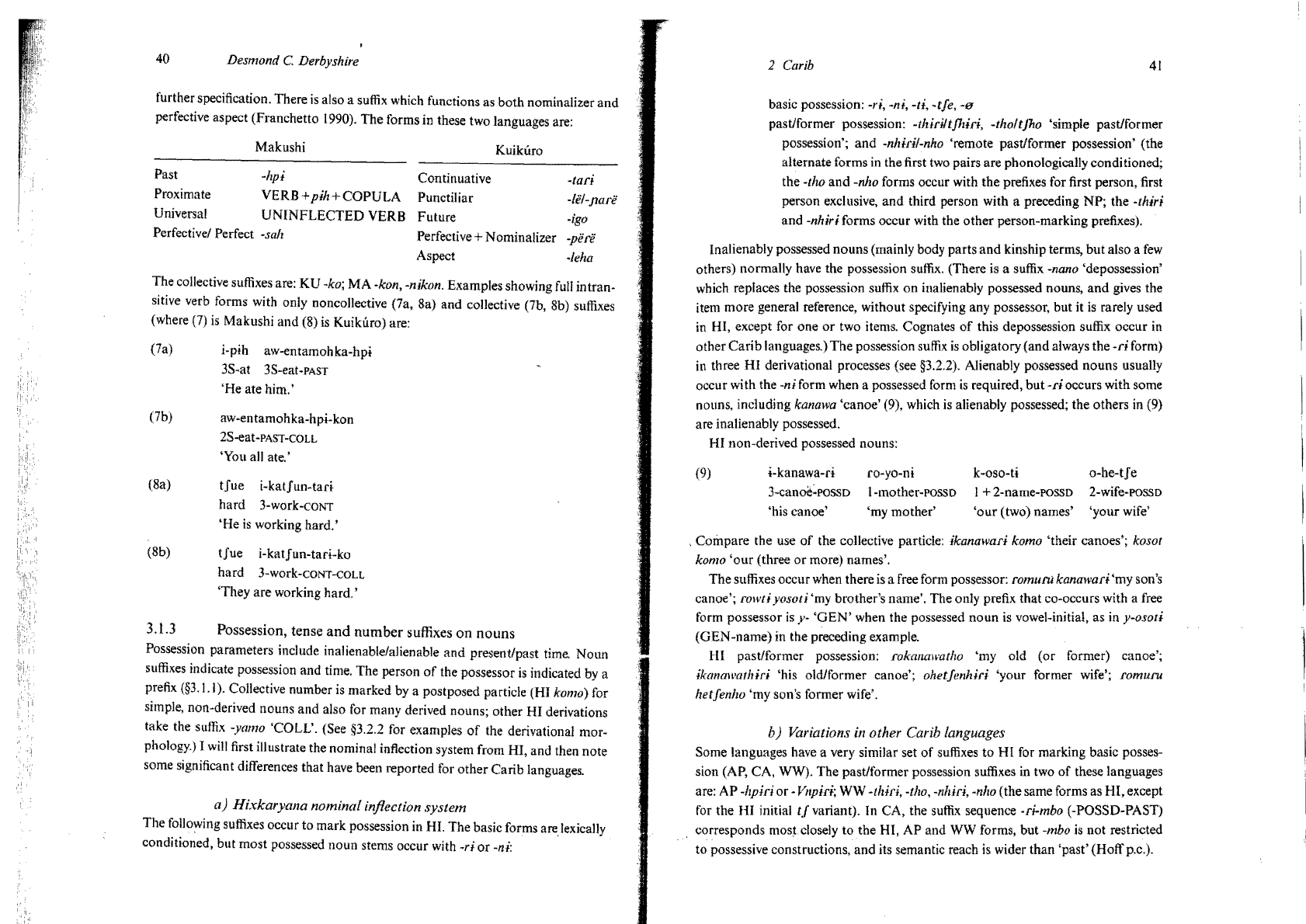
Makushi
Kuikúro
Past
-/¡pi Continuative
-tari
Proximate
VERB
+pi!t +
COPULA
Punctiliar
-lel-flare
Universal
UNINFLECTED
VERB Future
oigo
Perfectivel Perfect -sah
Perfective+ Nominalizer opere
Aspect .leha
The collective suffixes are:
KU
-ko;
MA
-kon, -nikon. Examples showing
full
intran-
sitive verb forros with only noncollective (7a, 8a) and collective (7b, 8b) suffixes
(where
(7)
is
Makushi
and
(8)
is
Kuikúro) are:
i-pih aw-entamohka-hpi
3S-at
3S-eat-PAST
'He
ate him.'
(7b)
aw-entamohka-hpi-kon
2S-eat-PAST-COLL
'You all ate.'
(8a)
tfue
i-kalfun-tari
hard
3-wock-cONT
'He
is
working hard.'
(8b)
tfue
i-kalfun-tari-ko
hard
3-work-cONT-COLL
'They are working hard.'
3.1.3 Possession,
tense
and
number
suffixes
on
nouns
Possession parameters include inalienable/alienable
and
present/past time.
NOllll
suffixes indicate possession and time. The person
of
Ihe possessor
is
indicated by a
prefix
(§3.1.
l).
Collective number is marked by a postposed particle (HI komo) for
simple, non-derÍved nouns and also
foc
many derived nouns; other
HI
derivations
lake Ihe suffix
-yamo 'COLL'. (See §3.2.2 for examples
of
the derivational
mOf-
phology.) 1
will
first illustrate the nominal inflection system from HI, and then note
sorne significant differences thal have been reported for other Carib languages.
a) Hixkaryana nominal inflection system
The
follo~ing
suffixes occur to mark possession
in
HI. The basic forms
are.
lexical1y
conditioned, but most possessed noun stems occur with
-ri
oc -ni:
2 Carib
41
basic possession: -ri, -ni, -ti,
-t/e,
-fJ
pastlformer possession: -thiriltflziri, -tholtlho 'simple pastlformer
possession';
and
-nhiril-nho 'remote pastlforroer possession' (the
alternate forms
in
the first two pairs are phonologícally conditioned;
the -tho
and
-nho forms occur with the prefixes for first person, first
person exclusive,
and
third person with a preceding NP; the -thiri
and -n!tiri forms occur with the other person-markíng prefixes).
Inalienably possessed nouns (mainly body parts
and
kinship terms, but also a
few
others) normally have the possession suffix. (There is a suffix -nano 'depossession'
which replaces the possessíon suffix
on
inalíenably possessed nouns,
and
gives the
item more general reference, wíthout specifying any possessor, bul it
is
rarely used
in HI, except for one
or
two
items.
Cognates
of
this depossessíon suffix occur in
other Carib languages.)
The
possessíon suffix
is
obligatory (and always the
-ri
form)
in
three
HI
derivational processes (see §3.2.2). Alienably possessed nouns usualIy
occur with the
-ni
form when a possessed form
is
required,
but
-ri
occurs with sorne
nouns, including
kanawa 'canoe' (9), which
is
alienably possessed; the others in (9)
are inalienably possessed.
HI
non-derived possessed nouns:
i-kanawa-ri
ro-yo-ni k-oso-ti o-he-tfe
3-canoe~POssD
l-mother-POssD I +
2-name-POSSD
2-wife-POssD
'his cance'
'mymother'
'our
(two) names' 'your wife'
, Compare the use
of
the collective particle: ikanawari komo 'their canoes'; kosot
komo
'our
(three
or
more) names'.
The
suffixes occur when there
is
a free form possessor: romuru kanawari 'my son's
canoe';
/'Owti
yosoti
'my brother's name'. The only prefix that co-occurs with a free
form possessor
is
y-
'GEN'
when the possessed noun
is
vowel-initial, as in y-osoti
(GEN-name) in the preceding exarnple.
HI
pasl/former possession: rokaliawatho 'my old (or former) canoe';
ikana1l'CI1hiri
'his old/former canoe'; ohet/enhiri 'your forrner wife'; romuru
het/enho
'my
80n'8
former wife'.
b)
Val'iations
in
other Carib languages
Sorne languages have a very similar set
of
suffixes to
HI
for markillg basic posses-
sion (AP, CA. WW). The past/former possession suffixes
in
two
af
Ihese languages
are: AP
-hpiri or -Vnpiri; WW -t!tiri, -tho, -nhiri, -nho (the same forms as HI, except
for the
HI
initial
tI
variant). In CA, the
suffix
sequence -ri-mbo (-POSSD-PAST)
corresponds rnost.closely to the HI,
AP
and WW forms, but -mbo is not restricted
to possessive constructions, and its sernantic reach
is
wider than 'pas!' (Hoff p.c.).
43
42
Desmond e Derbyshire
DE
suffixes are -dü, -i
and
a
few
less
common
variants; the -dü
is
probably a
cognate
of
-rf
which occurs in
other
languages. There are three collective suffixes
and
these replace the noncollective suffix: -tomo
marks
pluraJity
of
the entity
referred to by the noun;
-komo
marks
plurality
of
the person
of
the possessor;
and
the sequence
of
the two takes the form
of
-Ionkomo. There
is
also a past suffix, -Mi,
which co-occurs with,
and
precedes, the possession suffix
-dü.
TR
possessed nouns usually have
no
overt suffix, although
-ri
optionally occurs
under certain conditions; the person prefixes are lhe primary indicators
of
posses-
the pastlformer possession suffix
is
-hpe;
collective suffixes are -konl-komo
and
-ton/-tomo.
WA
possession suffixes are -/1, off, the collective suffix
is
-kom; pastlformer posses-
sion suffixes are:
-(
V)tpe,
-(
V)npe,
-(
V)tpi,
-(
V)npi.
The ergative language MA has the possession suffixes -Pi
and
-1'i,
with less
common variants
-si, -ni, -ka, -no.
The
eollective suffix
is
-kon. The pastlformer
possession
sl1ffix
is
-rihpi
on non-denved nouns
and
-hpi (the verb past-tense
sl1ffix)
on denved nouns.
There are many obligatorily non-possessed nouns in
Carib
languages, including
all names
of
plants, animals, persons
and
natural phenomena. For some
of
these a
genenc
noun
that
has possession marking
is
often used as a classifier, with
or
without the addition
of
the specific noun, e.g., HI
rokni
(kaykusu)
'my pet (a dog)'
(r-ok-ni I-dornestic animal-POSSD,
kaykusu
'dog'). See Koehn (1994) on
AP
gen-
itive constructions; and Carlson
and
Payne (1989), who first deseribed this system
as 'genitive c1assifier', established a typology
of
such systems,
and
provided exam-
pIes from AP, MA
and
PA.
Carib languages tend to have between ten
and
twenty
of
these c1assifiers, and it is the only type
of
noun c1assifier system found in the
family.
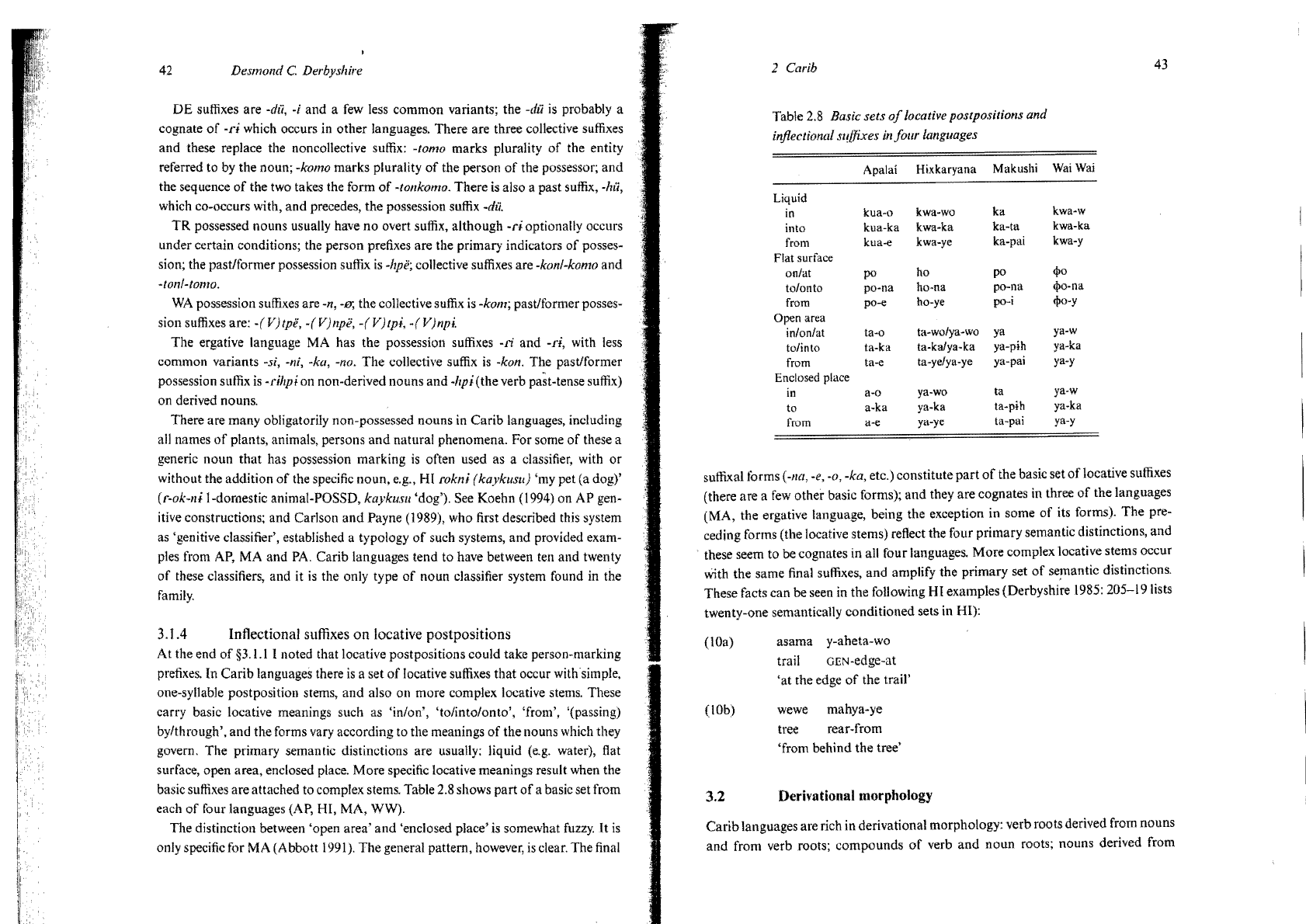
3.1.4 lnflectional
suffixes
on locative postpositions
A t the end
of
§3.1.1 1 noted that locative postpositions could take person-marking
prefixes. In
Carib
languages there
is
a set
of
locative suffixes that occur with'simple,
one-syllable postposition stems,
and
al so on more complex locative stems. These
carry basic locative meanings such as 'in/on',
'to/int%nto',
'from', '(passing)
bylthrough', and the forms vary according to tlle meanings
of
the
nouns which
govern. The
pnmary
semantic distinetions are usualIy: liquid (e.g. water), fiat
surface, open area, enclosed place. More specific locative meanings result when the
basic suffixes are attaehed to complex stems. Table 2.8 shows part
of
a basic set from
each
of
four languages (AP, HI,
MA,
WW).
The distinction between 'open area'
and
'enclosed place' is somewhat
fuzzy.
It
is
only specific for MA (Abbott 1991).
The
general pattern, however, is elear. The final
2 Carib
Table 2.8 Basie seis
of
loeative postpOSitiOflS
and
inflectional sulfixes ill fOllr languages
Apalaí
Hixkaryana
Makushi
WaiWai
Liquid
in
kua-o
kwa-wo
ka
kwa-w
into
kua-ka
kwa-ka
ka-ta
kwa-ka
from
kua-e
kwa-ye
ka-pai
kwa-y
Flat
surface
on/al
po
ho
po
$0
t%nto
po-na
ho-na
po-na
.¡,o-na
from
po-e
ho-ye
po-i
.¡,o-y
Open
area
in/on/al
to/into
fmm
ta-o
ta-ka
ta-e
ta-wo/ya-wo
ta-kalya-ka
ta-ye/ya-ye
ya
ya-pih
ya-pai
ya-w
ya-ka
ya-y
Enc10sed
place
in
a-o
ya-wo
la
ya-w
to
a-ka
ya-ka
ta-pih
ya-ka
from
a-e
ya-ye
ta-pai
ya-y
suffixal forms (-Ila,
-e,
-o, -ka, etc.) constitute
part
of
the basic set
of
locative suffixes
(there are a
few
other basic forms);
and
they are cognates in three
of
the languages
(MA, the ergative language, being the exception in sorne
of
its forms).
The
pre-
ceding forms (the locative stems) reRect the four primary semantic distinctions,
and
these seem to be cognates in all four languages. More complex 10cative stems occur
With
the same final suffixes,
and
amplify
the
primary set
of
se~nantic
distinctions.
These faets
can
be seen in the following
HI
examples (Derbyshire 1985: 205-1 91ists
twenty-one semantically conditioned sets in HI):
(lOa) asama y-aheta-wo
trail GEN-edge-at
'at
the edge
of
the trail'
(lOb) wewe mahya-ye
tree rear-from
'from behind
the
tree'
3.2 Derivational morphology
Carib
languages are rich in derivational morphology: verb roots derived from nouns
and
from verb roots;
compounds
of
verb
and
noun
roots; nouns
denved
from
44
Desmond e Derbyshire
nouns, verb stems, adverbials and postpositions;
and
adverbials derived from
nouns, verb stems
and
adverbs.
In
this section 1
will
first describe sorne verb deriva-
tional affixes (§3.2.1), followed by nominalizing
affixes
added
to
verb stems to form
nouns (§3.2.2),
and
then sorne adverbial derivations from noun and verb stems
(§3.2.3).
3.2.1
Verb derivational affixes
In most Carib languages, only one verb derivatíon category occurs as a prefix: the
detransitivizer, which is added to a transitive stem and carries the meanings
of
'reflexive'
or
'reciproca!', or simply 'intransitive' whích
is
often best translated as a
passive
in
languages
Iike
English. There are many categories which occur as suffixes.
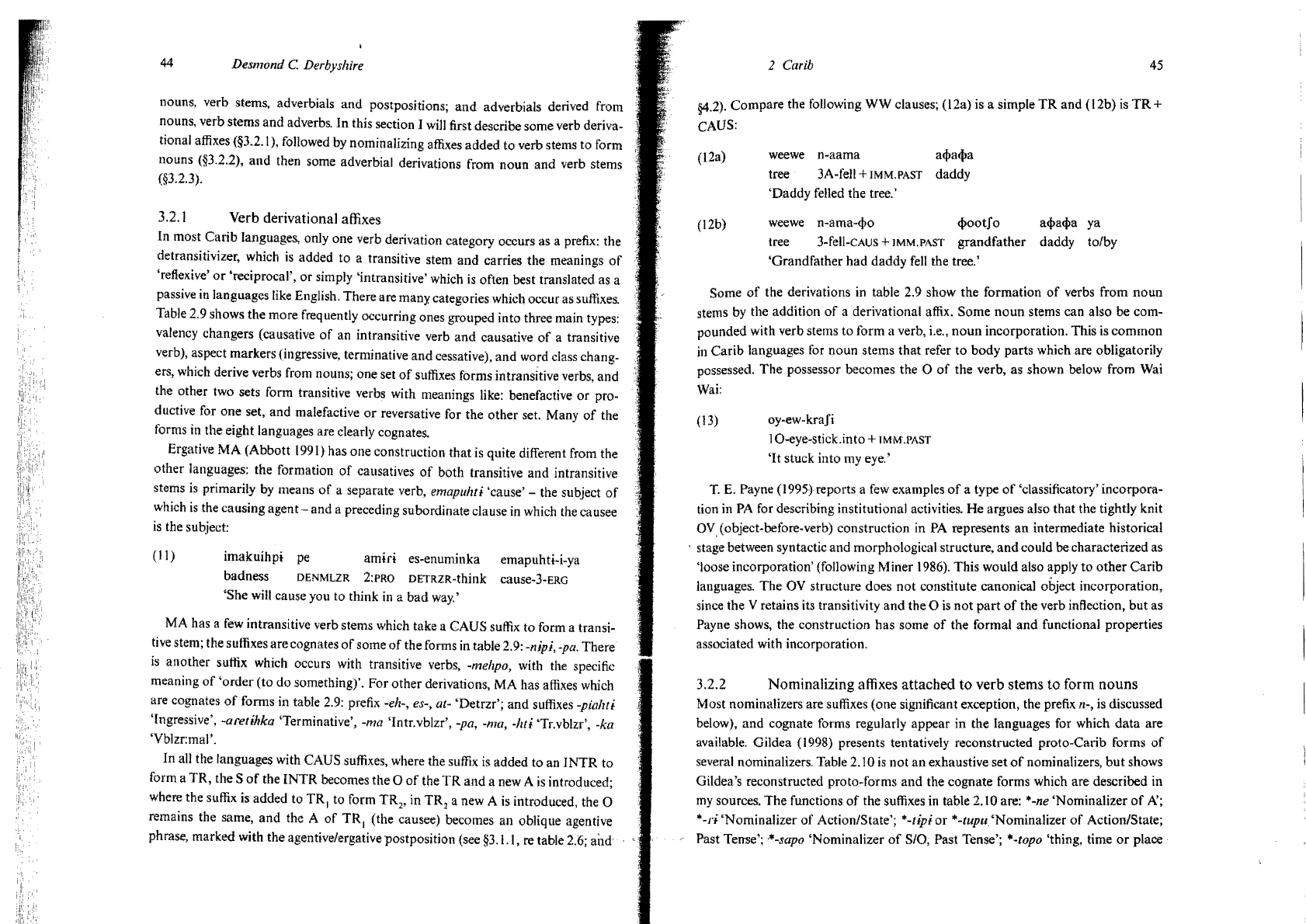
Table 2.9 shows the more freq uently occurring ones grouped into three main types:
valency changers (causative
of
an intransitive verb
and
causative
of
a transitive
verb), aspect markers (ingressive, terminative
and
cessative), and word
c1ass
chang-
ers, which derive verbs from nouns; one set
of
suffixes forms intransitive verbs, alld
the other two sets form transitive verbs with meanings
Iike:
bellefactive
or
pro-
ductive for one set, and malefactive
or
reversative for the other
seto
Many
of
the
forms in the eight languages are clearly cognates.
Ergative MA (Abbott
1991)
has one construction that
is
quite different from the
other languages: the formation
of
causatives
of
both transitive and intransitive
stems
is
primarily by means
of
a separa te verb, emaplIhti 'cause' - the subject
of
which
is
the causing agent - and a preceding subordinate
c1ause
in which the causee
is
the subject:
(11) imakuíhpi: pe
amiri
es-enuminka emapuhti-í-ya
badness
DENMLZR
2:PRO
DETRzR-think
cause-3-ERG
'Sbe
will
cause you to think
in
abad
way.'
MA has a
few
intransitive verb stems which take a CAUS suffix to form a Iransí-
tive stem; Ihe suffixes are cognates
of
sorne
of
the forms
in
table 2.9: -nipi,
-pa.
There
is
another slIffix which occurs wilh transitive verbs, -mehpo, with the specific
meaning
of
'order
(to do something)'. For other derivations, MA has
affixes
which
are cognates
of
forms in table
2.9:
prefix -eh-,
eso,
at- 'Detrzr'; and
slIffixes
-piahti
'Ingressíve', -aretihka 'Terminative', -ma 'Intr.vblzr',
opa,
-ma, -Iui 'Tr.vblzr', -ka
'Vblzr:mal'.
In
al!
Ihe languages with CAUS suffixes, where the suffix
is
added lo an
INTR
to
form a
TR,
the S
of
the INTR becomes the O
of
the
TR
and
a new A
is
inlroduced;
where Ihe suffix is added to TRI to form
TR
2
,
in
TR
2
a new A is introduced, the O
remains the same, and the A
of
TRI (the causee) becomes an oblique agentive
phrase, marked with the agentive/ergative postposition (see §3.1.1,
re
table 2.6; and
2 Carib
45
§4.2).
Compare the following WW c1auses;
(l2a)
is a simple
TR
and (12b)
is
TR
+
CAUS:
(l2a)
weewe
n-aama
a<f¡a<f¡a
teee 3A-fell +
IMM.PAST
daddy
'Daddy felled the tree.'
(12b)
weewe
n-ama-<f¡o
"'oolfo
a<f¡a<f¡a
ya
tree 3-fell-cAUs
+
IMM.PAST
grandfather daddy
'Grandfather
had
daddy
fell
the tree.'
Sorne
of
the derivations in table 2.9 show the formation
of
verbs from noun
stems by the addition
of
a derivational
affix.
Sorne noun stems can also be com-
pounded with verb stems to form a verb, i.e.,
noun
incorporation. This
is
common
in Carib languages for noun stems that refer to body parts which are obligatorily
possessed.
The
possessor becomes the O
of
the verb, as shown below from Wai
Wai:
(13) oy-ew-krafi
1O-eye-stick.into +
IMM.PAST
'[t
stuck into
my
eye.'
T.
E.
Payne
(1
995} reports a
few
examples
of
a type
of
'classificatory' incorpora-
tion
in
PA
ror describing institutional activities.
He
argues also that the tightly knit
OV
(object-before-verb) construction in
PA
represents
an
intermediate historical
. stage between syntactic and morphological structure,
and
could be characterized as
'loose incorporation' (following Miner
)986). This would also apply to
other
Carib
languages.
The
OV
structure does
not
constitute canonical ohject incorporatíon,
since the V retains its transitivity
and
the O
is
not
part
of
the verb intlection,
but
as
Payne shows, the construction has sorne
of
the formal
and
funcHona) properties
associated with incorporation.
3.2.2 Nominalizing affixes attached to verb stems
to
form nouns
Most nominalizers are suffixes (one significant
eX<""eption,
the prefix
no,
is díscussed
below), and cognate forms regularly appear in tbe languages for which
data
are
available. Gildea (1998) presents tentatively reconstructed proto-Carib forms
of
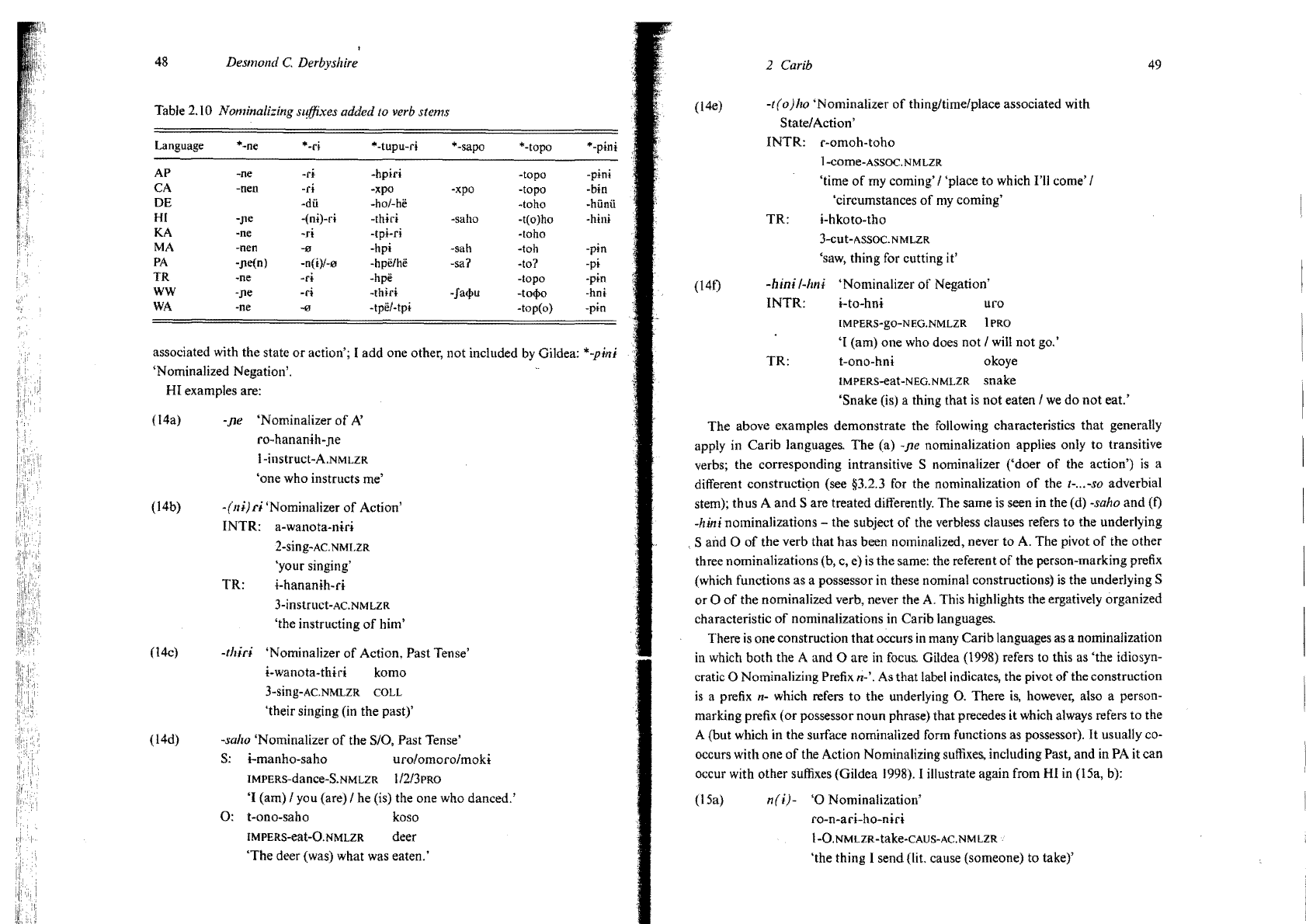
several nominalizers. Table 2.10
is
not
an
exhaustive set
of
nominalizers,
but
sbows
Gildea's reconstructed proto-forms and the cognate forms which are described in
my
sourees. The functions
of
the suffixes in table 2.10 are: *-ne 'Nominalizer
of
N;
"'-á 'Nominalizer
of
Action/State'; *-tipi or *-tllptl 'Nominalizer
of
Action/State;
Past Tense';
'*.sapo 'Nominalizer
of
S/O, Past Tense'; *-topo 'thing, time
or
place
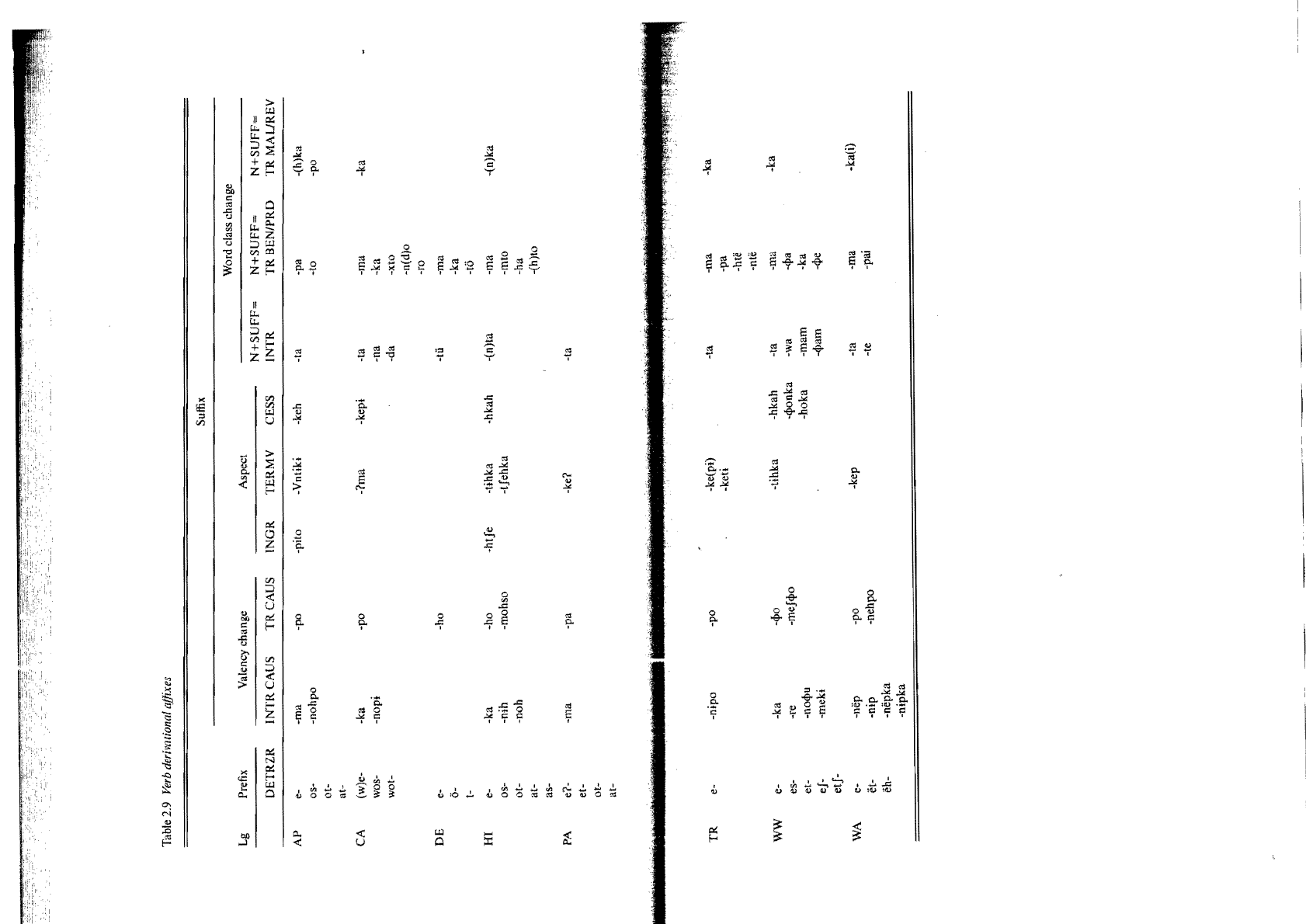
Table 2.9 Verb derívational qtJixes
Suffix
Word class change
Lg Pretix Valenc)' cbange Aspect
N+SVFF=
N+SVFF=
N+SVFF=
OETRZR
INTRCAUS
TRCAVS
INGR
TERMV
CESS
INTR
TR
BEN/PRO
TRMAUREV
AP
e-
-ma
-po -pito -Vnttki -keb -ta
opa
-(h)ka
os-
-nohpo
-lo
-po
ot-
at-
CA
(w)e-
-ka
-po -?ma -kept -ta
-ma
-ka
wos-
-nopt
-na
-ka
wot- -da
-xto
-n(d)o
-ro
DE
e-
-he
-Iü
-ma
0- -ka
t-
oto
HI
e-
-ka
-he
-htIe
-tthka -bkah -(n)ta
-ma
-(n)ka
os- -nib -mobso
-tIehka
-mto
ot-
-nob
-ha
at- -(h)to
as-
PA
e7-
-ma
opa
-ke?
-ta
et-
ot-
at-
T
TR
e-
-nipo
-po
-ke(pi)
-la
-ma
-ka
-kcti
opa
-hte
-nte
WW
c-
-ka
-«>0
-tihka
-hkah
-ta
-ma
-ka
es-
-re
-meI«>o
-«>onka
-wa
..pa
-hoka
-mam
-ka
et-
-no«>u
..pam
..pe
eJ-
-meki
elf-
-ka(i)
WA
e-
-ntip
-po
-kep
-ta
-ma
et-
-nip
-nehpo
-te
-paí
eh-
-nepka
-nipka
48
Desmond
C.
Derbyshire
Table 2.10 Nominalizing
Sl!tfixes
added lO
verb
stems
language
"'-ne
"'-rl
*-tupu-ri
"-sapo
"-topo "'-pini
AP
-ne
-rf -hpiri
-topo
-píni
CA
-nen
-ti
-xpo -xpo
-topo -bin
DE
-dü -ho/-he
-toho
-hünü
HI
-J1e
-(ni)-ri
-thid
-saho
-t(o)ho
-hini
KA
-ne
-rí
-Ipi-fi
-toho
MA
-nen
-0
-hpi
-sah
-toh
-pin
PA
-J1e(n)
-n(i)l-0
-hpeJhe -sa?
oto?
-pi
TR
WW
WA
-ne
-pe
-ne
-fi
-ri
-0
-hpe
-thid
-tpe/-tpi
-faq,u
-topo
-t04>o
-top(o)
-pin
-hní
-pin
associated with the state
or
action'; I add one other, not inc\uded
by
Gildea:
*-pini
'Nominalized Negation'.
HI examples are:
(l4a)
-]le
'Nominalizer
of
p.:
ro-hananth-
pe
l-instruct-A.NMLzR
'one who instructs me'
(14b)
-(!li)ó
'Nominalizer
of
Action'
INTR:
a-wanota-ntrt
2-sing-Ac.
NMI.ZR
'your singing'
TR: t-hananih-rt
3-instrllct-Ac.NMLZR
'the instrllcting
of
him'
(l4c)
-(flirt
'Nominalizer
of
Action, Past Tense'
i-wanota-thiri komo
3-sing-Ac.NMLZR
COLL
'their singing (in the past)'
-salio
'Nominalizer
of
the StO, Past Tense'
S;
i-manho-saho ufo/omoro/moki
IMPERs-dance-S.NMLZR
1/213PRo
'(
(am) I you (are) I he (is) the one who danced.'
O:
t-ono-saho koso
IMPERs-eat-O.NMLZR
deer
'The
deer (was) what was eaten.'
2 Carib
49
-1(0)110
'Nominalizer
of
thing/time/place associated with
Statel Action'
INTR:
r-omoh-toho
l-come-ASSoc.
NMLZR
'time
of
my coming' , 'place to which
1'11
come' ,
'circumstances
of
my
coming'
TR:
i-hkoto-tho
3-cut-ASSOC.
NMLZR
'saw, thing for cuuing
jt'
-hini
I-hni
'Nominalizer
of
Negation'
INTR:
i-to-hni
uro
IMPERS-gO-NEG.NMLZR
1
PRO
'I
(am) one who doe8 not I
wiII
not
go.'
TR: t-ono-hni
okoye
IMPERs-eat-NEG.NMLZR
snake
'Snake (is) a thing that
i8
not
eaten I
we
do
not
eat.'
The aboye examples demonstrate the following characterístics that gene rally
apply
in
Carib languages.
The
(a)
-]le
nominalization applies only to transitive
verbs; the corresponding intransitive S nominalizer ('doer
of
the action')
is
a
different construction (see §3.2.3 for the nominalization
of
the
1-.
.•-so adverbial
stem); thus A
and
S are treated differently. The same
is
seen in the (d) -saho
and
-hini nominalizations the subject
of
the verbless c1auses refers
to
the underlying
. S aild O
of
the verb that
has
been nominalized, never
to
A. The pivot
of
the other
three nominalizations (b, c, e)
is
the same: the referent
of
the person-marking prefix
(which functions
as
a possessor in these nominal constructiollS)
is
the undedying S
or O
of
the nominalized verb, never the A. This highlights the ergatively organized
characteristic
of
nominalizatiOllS
in
Carib languages.
There
i8
one construction
that
occurs
in
many Carib languages as a nominalizatÍon
in
which
both
the A and O are in focus. Oildea (1998) refers to this as 'the idiosyn-
cratic O Nominalizing Prefix
n-'. As that label indicates, the pivot
of
the construction
is
a prefix n- which refers
to
the underlying
O.
There
i8,
however, also a person-
marking pretix (or possessor noun phrase) that precedes it which always refers to the
A (but which
in
the surface nominalized form functions as possessor).
It
usually co-
occurs with one
of
the Action Nominalizing suffixes, ineluding Past, and
in
PA
it can
occur with other suffixes (Gildea 1998).1 iIlustrate again from
HI
in
(15a, b);
(15a)
n(i)-
'O
Nominalization'
ro-n-ari-ho-niri
l-O.NMlzR-take-cAuS-AC.NMLZR
'the
thing 1 send (lit. cause (someone) to take)'