
Dixon R.M.W., Aikhenvald Alexandra Y. The Amazonian Languages (Cambridge Language Surveys)
Подождите немного. Документ загружается.

51
50 Desmo/ld e Derbyshire
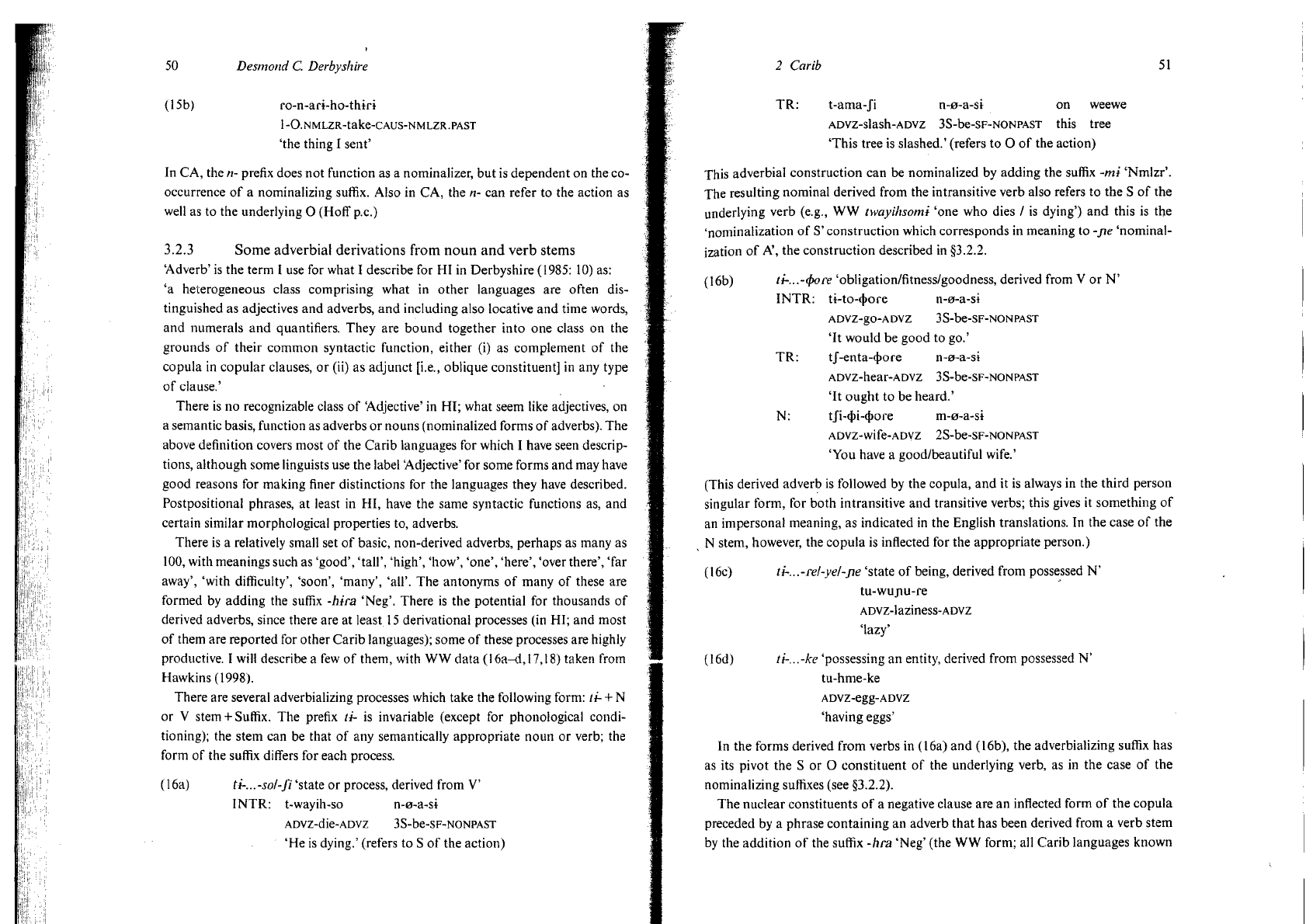
(I5b)
ro-n-ari-ho-thiri
I-O.NMLzR-take-CAUS-NMLZR.PAST
'the
thing
I
sent'
In
CA,
the
/1-
prefix
do
es
not
function as a nominalizer,
but
is
dependent
on
the
co-
occurrence
of
a nominalizing suffix.
Also
in
CA,
the
n-
can
refer
to
the
action
as
well as
to
the
underlying O
(Hoff
p.c.)
3.2.3
Sorne
adverbial
derivations
frorn
no
un
and
verb
sterns
'Adverb'
is
the
term
1use for
what
1
describe
for
HI
in
Derbyshire
(1985:
10)
as:
'a
heterogeneous
class
comprising
what
in
other
languages
are
often
dis-
tinguished
as
adjectives
and
adverbs,
and
incIuding
also
locative
and
time
words,
and
numerals
and
quantifiers.
They
are
bound
together
into
one
cIass
on
the
grounds
of
their
common
syntactic
function,
either
(i)
as
complement
of
the
copula
in
copular
clauses,
or
(ii)
as
adjunct
[i.e.,
oblique
constituent]
in
any
type
of
cIause.'
There
is
no
recognizable c1ass
of
'Adjective' in
HI;
what
seem like adjectives,
on
a
semantic
basis,
function
as
adverbs
or
nouns
(nominalized
forms
of
adverbs).
The
aboye definition covers
most
of
the
Carib
languages
for which 1have seen descrip-
tions,
although
sorne Iinguists use
the
label 'Adjective' for sorne forms
and
may have
good
reasons for
making
finer
distinctions
for
the
languages
they have described.
Postpositional
phrases,
at
least in
HI,
have
the
same
syntactic
functions as,
and
certain
similar
morphological
properties
to, adverbs.
There
is a relatively small set
of
basic,
non-derived
adverbs,
perhaps
as
many
as
100, with
meanings
such as
'good',
'tall',
'high',
'how',
'one',
'here',
'overthere',
'far
away',
'with
difficulty',
'soon',
'many',
'all'.
The
antonyms
of
many
of
these are
formed by
adding
the suffix -hira
'Neg'.
There
is
the
potential
for
thousands
of
derived adverbs, since there
are
at
least
15
derivational
processes (in
HI;
and
most
of
them are
reported
for
other
Carib
languages); sorne
of
these processes
are
highly
productive.
1
wil1
describe a few
of
them,
with
WW
data
(16a-d,
17, 18)
taken
from
Hawkins
(1998).
There
are several adverbializing processes which
take
the
following form: ti- +N
or
y
stem
+Suffix.
The
prefix ti- is invariable (except for
phonological
condi-
tioning); the
stem
can
be
that
of
any
semantically
appropriate
noun
or
verb; the
form
of
the
suffix differs for each process.
(I6a)
ti-... -sol-fi
'state
or
process, derived
from
y'
INTR:
t-wayih-so
n-a-a-si
ADvz-die-ADvz 3S-be-sF-NoNPAST
'He
is
dying.' (refers
to
S
of
the
action)
2 Carib
TR:
t-ama-Ji
n-a-a-si
on
weewe
ADvz-slash-ADvZ 3S-be-sF-NoNPAST this
tree
'This
tree is
slashed.'
(refers
to
O
of
the
action)
This
adverbial
construction
can
be
nominalized
by
adding
the suffix
-mi
'Nmlzr'.
The
resulting
nominal
derived
fram
the
intransitive
verb
also refers
to
the
S
of
the
underlying
verb
(e.g.,
WW
twayihsomi
'one
who
dies I
is
dying')
and
this is
the
'nominalization
of
S'
construction
which
corresponds
in
meaning
to
-]le
'nominal-
ization
of
X,
the
construction
described in §3.2.2.
(16b)
ti-...
-l/JOre
'obligation/fitness/goodness, derived from Y
or
N'
INTR:
Ü-to-¡f>ore
n-a-a-si
ADVZ-go-ADVZ
3S-be-sF-NoNPAST
'It
would
be
good
to
go.'
TR:
tJ-enta-¡f>ore
n-a-a-si
ADvz-hear-ADVZ 3S-be-sF-NoNPAST
'It
ought
to
be
heard.'
N:
tJi-¡f>i-¡f>ore
m-a-a-si
ADvz-wife-ADvz 2S-be-sF-NoNPAST
'You
have a
good/beautiful
wife.'
(This derived
adverb
is
followed by
the
copula,
and
it
is always in
the
third
person
singular
form,
for
both
intransitive
and
transitive verbs; this gives it
something
of
an
impersonal
meaning,
as
indicated
in the English translations. In
the
case
of
the
, N
stem,
however,
the
copula
is inflected for
the
apprapriate
person.)
(16c)
ti-... -rel-yel-]Ie
'state
of
being,
derived
fram
possessed
N'
tu-wuJ1u-fe
ADvz-laziness-ADvZ
'lazy'
(l6d)
ti-... -ke
'possessing
an
entity, derived
from
possessed
N'
tu-hme-ke
ADvz-egg-ADvz
'having
eggs'
In
the
forms derived
fram
verbs
in (16a)
and
(I6b),
the
adverbializing suffix
has
as its
pivot
the
S
or
O
constituent
of
the
underlying
verb, as in
the
case
of
the
nominalizing
suffixes (see §3.2.2).
The
nuclear
constituents
of
a negative clause
are
an
inflected form
of
the
copula
preceded by a
phrase
containing
an
adverb
that
has
been
derived
fram
a
verb
stem
by the
addition
of
the suffix -hra
'Neg'
(the
WW
form; all
Carib
languages
known
52
Desmond
C.
Derbyshire
to me have cognates
of
this form). Compare the Nominalized Negation suffix in
table 2.10 (WW
ohm). Possessed noun stems and sorne postpositions and adverbs
are negated with the same suffix. With forms derived from intransitive verbs
and
possessed no un stems, the impersonal pretix yi-Ig- co-occurs with the suffix; with
forms derived from transitive stems a personal prefix co-occurs, and it refers to the
O
of
the verb; in both cases the inflected copula (or other main verb which oeca-
sionaJly oecurs) has the prefix which refers to the subject
of
the action
or
state.
Examples from WW illclude:
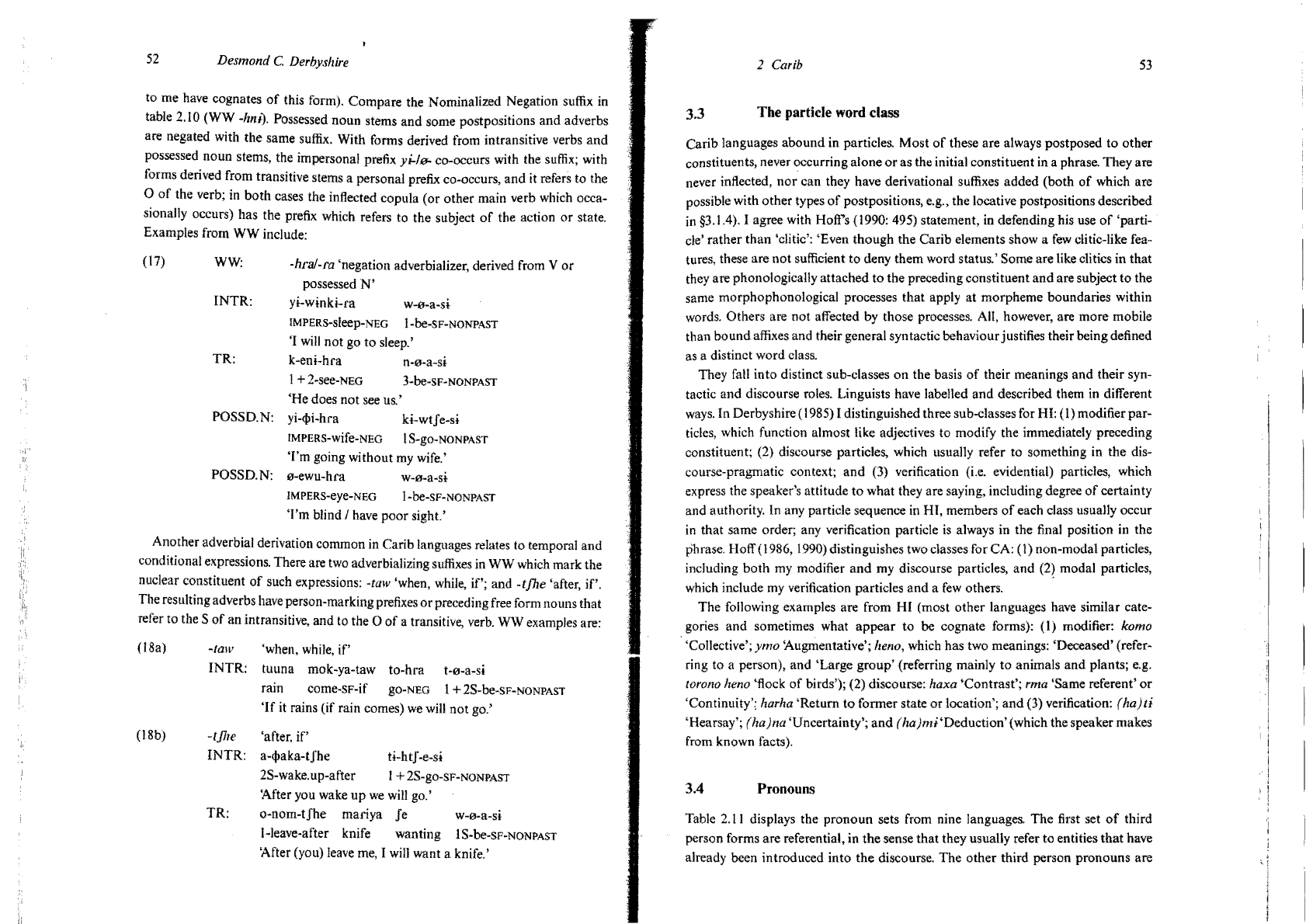
(17)
WW:
-hra/-ra 'negation adverbializer, derived from Y
or
possessed
N'
INTR:
yi-wtnki-ra
w-0-a-sÍ:
lMPERs-sleep-NEG
l-be-sF-NoNPAST
'1
will
not go
to
sleep.'
TR: k-eni-hra
n-El-a-s!
1+
2-See-NEG
3-be-SF-NONPAST
'He
does not see us.'
POSSD.N:
yi-</Ji-hra
ki-wtJe-si
IMPERs-wife-NEG
1
S-go-NONPAST
'I'm going without
my
wife.'
POSSD.N: e-ewu-hra
w-e-a-st
IMPERs-eye-NEG
I-be-SF-NONPAST
'I'm blilld I have poor sight.'
Another adverbial derivatioll cornmon in Carib languages relates to temporal and
conditional expressions. There are two adverbializing
suffixes
in WW which mark the
nuclear constituent
of
such expressions: -taw 'when,
while,
ir'; and
-tfhe
'after, if'.
The resulting adverbs
have
person-marking prefixes
or
preceding free form nouns that
refer
to
the S
of
an intransitive, and to the O
of
a transitive,
verbo
WW
examples are:
(ISa)
-talV
'when, while, if'
INTR: tuuna mok-ya-taw to-hra t-a-a-s!
rain come-sF-if
gO-NEG
1+
2S-be-sF-NoNPAST
'If
it rains (if rain comes)
we
will
not go.'
(18b)
-tJhe 'after, if'
INTR: a-<jlaka-tJhe
ti-htJ-e-si
2S-wake. up-after
1
'After you wake
up
we
will
go.'
TR:
mariya
fe
W-0-a-st
l-leave-after knife wanting 1
S-be-SF-NONPAST
'After (you) leave
me,
1
wíll
want a knife.'
2 Carib
53
3.3 The
particle
word
class
Carib languages abound in particles. Most
of
these are always postposed to other
constituents, never occurring alone
or
as the initial constituent in a phrase. They are
never inflected,
nor
can they have derivational suffixes added (both
of
which are
possible with other types ol' postpositions, e.g., the locative postpositions described
in
§3.1.4). 1 agree with Hofrs (1990: 495) statement,
in
defending his use
of
'partí-
ele' rather
than
'c1itic': 'Even though the Carib elements show a
few
clitic-Iike fea-
tu
res,
these are
not
sufficient to deny them word status.' Sorne are Iike cIitics in that
they are phonologically attached
to
the preceding constituent
and
are subject
to
the
same morphophonological processes that apply at morpheme boundaries within
words. Others are not affected by those processes. AIl, however, are more mobile
than bound affixes and their general syntactic behaviour justifies their being defined
as a distinct word
c1ass.
They
fall
into distinct sub-c\asses
on
the basis
of
their meanings and their syn-
tactic and discourse roles. Linguists have labelled and described them
in
different
ways.
In Derbyshire (1985) 1 distinguished three sub-classes
l'or
HI: (1) modifier par-
ti
eles,
which function almost like adjectives to modify the irnmediately preceding
constituent;
(2) discourse particles, which usually refer to something in the dis-
course-pragmatic context; and (3) verification (i.e. evidential) particles, which
i
express the speaker's attitude
to
what they are saying, ineluding degree
of
eertainty
and authority. In any particle sequence
in
HI, members
of
each
c1ass
usually occur
I
in
that same order; any verification particJe
is
always in the final position in the
phrase. Hoff
(1986, 1990) distinguishes two elasses ror CA: (1) non-modal particles,
including both my rnodifier
and
my discourse particles, and
(2~
modal particles,
which inelude
my
verification particles and a
few
others.
The following examples are from
HI
(most other languages have similar cate-
gories and sometimes what appear to be cognate forms):
(1) modifier:
komo
'Collective';
ymo
'Augmentative'; heno, which has two meanings: 'Deceased' (refer-
ríng to a person), and 'Large group' (referring mainly to animals and plants; e.g.
torono heno 'flock
of
birds'); (2) discourse: haxa 'Contrast'; rma 'Same referent'
or
'Continuity'; haTlla 'Returo
to
former state
or
location';
and
(3) verification:
(ha)ti
'Hearsay';
(ha)na'Uncertainty';
and
(ha)mi
'Deduction' (which thespeakermakes
from known faets).
3.4
Pronouns
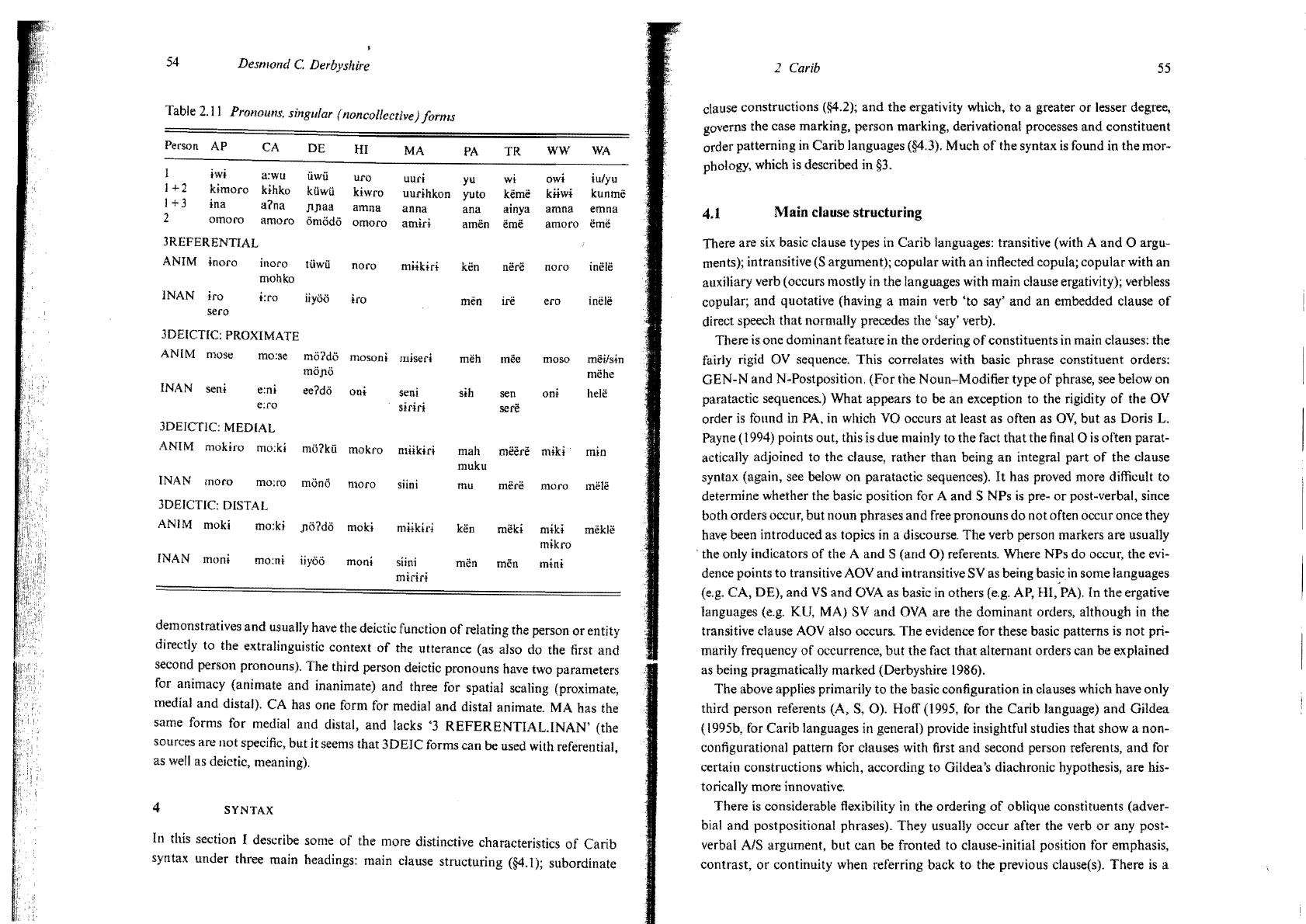
Table
2.11
displays the pronoun sets from nine languages. The first set
of
third
person forms are referential, in the sense that they usually refer to entities that have
already been introduced into the discourse. The other third person pronouns are
54
Desmond e Derbyshire
Table
2.11
Pronouns.
singular (noncollective) forms
Person
AP
CA
DE
HI
MA
PA
TR
WW
WA
iwí
a:wu
üwü
uro
uuri
yu
wi
owi
iu/yu
1+2
kimoro
kthko
küwü
kiwro
uurihkon yuto
keme
kiiwi
kunme
1+3
ina
aí'na
JlJlaa amna
anna
ana
ainya
amna emna
2
omoro
amoro
omodo
omoro
amiri
amen eme
amo ro eme
3REFERENTlAL
ANIM
tnoro
¡noro
tüwü
noro
miikiri
ken nere noro
¡nele
mohko
INAN
¡ro
i:ro
iiy60
iro
men ü'e
ero
¡neJe
sero
3DEICTIC: PROXIMATE
ANIM
mose
mo:se
mOldo
mosoni
miseri
meh
mee moso mei/sin
mOJlo
mche
INAN
seni
e:ni
ee?do
oni
seni
sih
sen
oni
heJe
e:ro
siriri
sere
3DEICTlC:
MEDIAL
ANIM
mokiro
mo:kí
m6?kií
mokro
miikiri
mah meere miki
min
muku
INAN
moro
mo:ro
mono
moro
siini
mu
mere
mo¡'o
meJe
3DEICTIC: DISTAL
ANIM
moki
mo:ki
Jlo?do
moki
miikki
ken
meki
miki
mekle
mikro
INAN
muní
mo:ni
iiyoo
moní
siini
men
men mini
miriri
demonstratives
and
usually have the deictie funetion
of
relating the person or entity
directly to the extralinguistic context
of
the utterance (as also do the first and
second person pronouns). The third person deictic pronouns have two parameters
for animacy (anímate and ínanimate) and three for spatíal scaling (proximate,
medial
and
distal). CA has one form for medial and distal animate. MA has the
same forms for medial
and
distal, and lacks '3
REFERENTIAL.INAN'
(the
sources are
not
specific, but it seems that 3DEIC forms
can
be used with referential,
as
well
as deictic, meaning).
4
SYNTAX
In this section 1 describe sorne
of
the more distinctive characteristics
of
Carib
syntax under three main headings: main
c1ause
structuring (§4.l); subordinate
2
Car¡b
55
c1ause
constructions (§4.2);
and
the ergativity which,
to
a greater or lesser degree,
governs the case marking, person marking, derivational processes and constituent
order patterning in Carib languages (§4.3). M uch
of
the syntax
is
found in the mor-
phology, which
is
described in §3.
4.1
Main
c1ause structuring
There are six basic clause types in Carib languages: transitive (with A
and
O argu-
ments); intransitive
(S
argument); copular with
an
inflected copula; copular with
an
auxíliary verb (occurs mostly in the languages with main
c1ause
ergativity); verbless
copular; and quotative (having a main verb
'to
say'
and
an embedded clause
01'
direct speech
that
normally precedes the 'say' verb).
There
is
one dominant feature in the ordering
of
constituents in main clauses: the
fairly rigid
OV
sequence. This correJates with basic phrase constituent orders:
GEN-N
and N-Postposition.
(For
the Noun-Modifier type
of
phrase, see below on
paratactic sequences.) What appears
to
be
an
exception to the rigidity
of
the
OV
order
is
found in PA, in which VO occurs
at
least as often as
OV,
but
as
Doris L.
Payne (1994) points out, this is due mainly to the fact
that
the final O
is
often parat-
actically adjoined to the c1ause, rather than being
an
integral part
of
the c1ause
syntax (again, see below on paratactíc sequences).
It
has proved more difficult to
determine whether the basic position for A and S
NPs
is
pre-
or
post-verbal, since
both orders occur, but noun phrases
and
free pronouns
do
not often occur once they
have been introduced as topics in a discourse.
The
verb person markers are usually
, the only indicators
of
the A and S (and O) referents. Where NPs do occur, the evi-
dence points to transitive AOV
and
intransitive SV as being
basi;
in
sorne languages
(e.g. CA, DE),
and
VS
and
OVA
as basic in others (e.g. AP,
HI,
PAlo
In
the
ergative
Janguages (e.g. KU, MA) SV
and
OVA
are the dominant orders, although
in
the
transitive c\ause
AOV
also occurs.
The
evidence for these basic patterns
is
not
pri-
mari1y freq uency
01'
occurrence, but the fact that alternant orders can be explained
as being pragmatically marked (Derbyshire 1986).
The aboye applies primarily
to
the basic configuration in c1auses which have only
third person referents (A,
S,
O). Hoff (1995, for the Carib language)
and
Gildea
(1995b, for Carib languages in general) provide insightful studies that show a non-
configurational pattern for clauses with fírst
and
second person referents,
and
for
certain constructions which, according to Gildea's diachronic hypothesis, are his-
torically more innovative.
There
is
considerable flexibility
in
the ordering
of
oblique constituents (adver-
bial
and
postpositional phrases). They usually occur after the verb
or
any post-
verbal
A/S
argumenl, but
can
be fronled to c1ause-initial positíon for emphasis,
contrast,
or
continuity when referring back
to
the previous c1ause(s). There
is
a
56
Desmolld e
Derbyshire
strong tendency
not
to have more
than
one
constituent preceding the maln predica-
tion
(V
or
OY).
Paratactic constructions are a feature
of
Carib
sentences
and
cJauses. A sentence
may consist
of
two
or
more juxtaposed clauses
usua11y
in a coordinating funcHon,
but without any conjunctions
or
partic1es (such as
'and',
'but',
'or',
etc.). Only the
final clause in such a sequence has the terminal intonation pattem. Within a c1ause,
constituents
other
than the verb (i.e. A, S
and
O
noun
phrases,
and
adverbial
and
postpositional phrases) can consist
of
two
or
more
juxtaposed phrases. The first can
usually be considered the head phrase,
and
the
phI""ases
that
follow may have
one
of
several functíons: coordinating, modífying, adding a greater degree
of
specification,
or
as
an
afterthought
clarification. Each phrase in the sequence is usually separated
by a brief pause. These sequences can
be
left-dislocated for emphasis
or
as a top-
icalizatíon device. More often they are right-dislocated, following the majn predica-
tion. A single
noun
or
phrase can also be left-
or
right-dislocated, as
is
often the case
with the
PA
post-verbal O constituent mentioned aboye. There
can
al so be dis-
continuous sequences in which the
head
phrase precedes,
and
the
other phrases
follow, the verb.
For
fuller discussion
and
exemplification, see Derbyshire (1985:
129-35)
on
HI,
and
Doris L. Payne (1994) on PA.
4,2
Subordinate
cJause
constructions
In sorne Carib languages
CA,
HI, WW) there are, strictly speaking, no sub-
ordinate clauses.
The
subordinate constructions take
the
form
of
phrases: nominal
phrases (§4.2.l), adverbial phrases (§4.2.2)
and
postpositional phrases (§4.2.3).
These phrases have as their nuclear eJements nominalized
or
adverbialized forms
derived from verbs.
The
more strongly ergative languages have a
few
constructions
of
that kind,
but
there are also regular subordinate c1auses, including sorne with
finiteverb forms.
As
1 pointed
out
in §3.2.2
and
§3.2.3,
most
of
the norninalízed
forms
and
sorne
of
the
adverbialized forms take person-marking prefixes which refer
to the S
and
O
of
the underlying verb, thus indicating the ergative character
of
the
constructions,
and
in the derived structures these prefixes express a possessor rela-
tionship rather
than
S
or
O (although this is sometimes difficult to translate into
English). Free form (pro )noun possessors
can
substitute for third person prefixes.
The
A
of
the underlying verb, when it occurs as either a
noun
phrase
or
person-
marking prefix, is folJowed
by
a postposition which has cognates in most Carib lan-
gllages with the meanings 'to,
by,
ERG'
(HI
o-wya
in (23c)
and
romuru
wya
in (24b».
4.2.1 Nominalizations
The
various types
of
nominalization
and
the derivational suffixes (and, in one case,
prefix) are described in Here 1 give a
few
examples from
WW
and
MA,
of
2
Carib
57
the way these function as
A,
S
and
O,
and
also as modifiers
of
other
noun
phrases
(corresponding
to
relative c1auses in languages Iike English) in main c1auses. The
other
functions
of
nominalized constructions
occur
in postpositional phrases
(§4.2.3). Examples (19a-c)
are
WW
and
(20a-b)
are
MA.
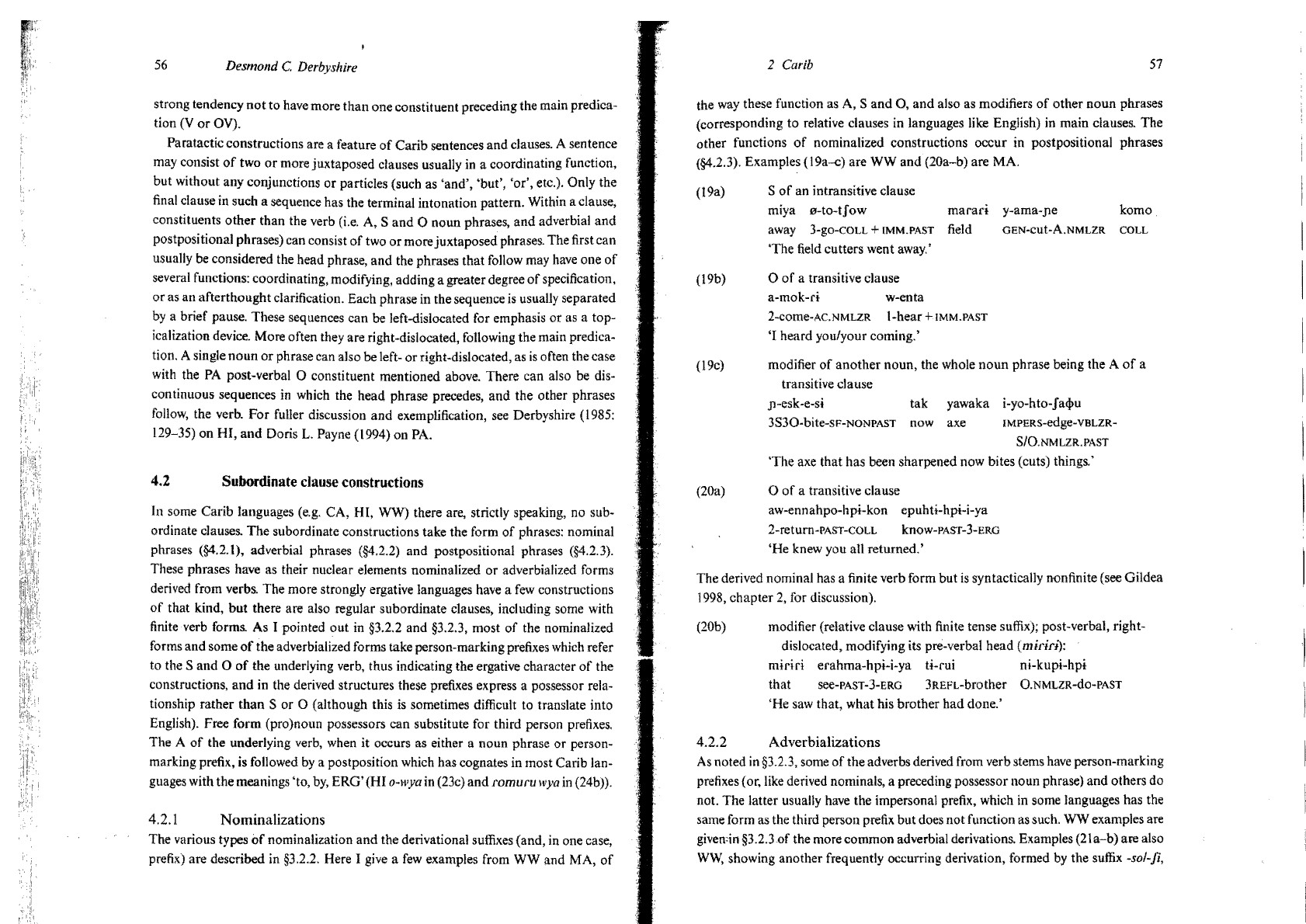
(19a)
S
of
an intransitive c1ause
miya
,,-to-tfow
marari: y-ama-Jle
komo
away
3-go-COLL
+
IMM.PAST
field
GEN-cut-A.NMLZR
COLL
'The
field cutters went away.'
O
of
a transitive clause
a-mok-fi
w-enta
2..come-Ac.NMLZR
l-hear
+IMM.PAST
'1
heard you/your coming.'
modifier
of
another
noun,
the whole
noun
phrase being
the
A
of
a
transitive cJause
Jl-esk-e-si
tak
yawaka i-yo-hto-fa<j>u
3S30-bite-sF-NoNPAsT
now axe
IMPERs-edge-YBLZR-
S/O.NMLZR.PAST
'The
axe that has been sharpened now bites (cuts) things.'
(20a) O
of
a transitive cJause
aw-ennahpo-hpi-kon epuhti-hpi-i-ya
2-retum-PAST-COLL
know-PAST-3-ERG
'He
knew you all
retumed.'
The
derived nominal has a finite verb form but
is
syntactically nonfinite (see Gildea
1998,
chapter
2, for discussion).
modifier (relative cJause with finite tense suffix); post-verbal, right-
dislocated, modifying its pre-verbal
head
(miriri):
miriri
erahma-hpi-i-ya ti-rui
ni-kupi-hpi
that
see-PAST-3-ERG
3REPL-brother
O.NMLZR-do-PAST
'He
saw that. what his brother
had
done.'
4.2.2 Adverbializations
As noted in §3.2.3, sorne
of
the adverbs derived from verb stems have person-marking
prefixes (or, Iike derived nominals, a preceding possessor noun phrase)
and
others
do
not.
The
latter usually have the impersonal prefix, which in sorne languages has the
same form as the third person prefix but does
not
function as such. WW examples are
given'in §3.2.30f the more common adverbial derivations. Examples
(2Ia-b)
are also
WW,
showing
another
frequently occurring derivation, forrned by the suffix
-sol-Ji,
58
Desmond
C.
Derbyshire
wíth the meaning
'purpose
or
goal
of
a verb
of
motion'. This derivatíon
is
not
to be
confused with
the
-sol-Ji
derivation
that
co-occurs with the adverbializing ti- prefix
(§3.2.3); Ihe two sets
of
suffixes have the same allomorphy in all the
Carib
languages
for whieh they have
been
descríbed (Gíldea p.c.),
and
both
result in adverbial fune-
tions,
but
the
'purpose
of
motion'
derivation has person-marking prefixes
on
transi-
tive verbs
and
the impersonal prefix
on
intransítive verbs, while the other derivation
has the invariable prefix
ti- 'Advz'. Examples from
WW
are:
WW:
-sol-Ji 'purpose/goaI
of
motion'
(2Ia)
JNTR:
yi-win-so
ki-wtf-e-st
IMPERs-sleep-ADvZ:PURPOSE.OF.MOTION
I-go-SF-NONPAST
'1
am
going (away)
to
sleep:
TR:
aw-akronoma-fi
k-mok-ya-si amJ1e
2-help-ADvZ:PURPOSE.OF.MOTION
l-come-sF-NoNPAST later
'Later
1
wiU
come
to
help
you.'
MA
has the
same
construction,
with the suffixes -í/-se,
and
it
is
nonfinite.
LAalJlfJl"~
incIude:
(22a)
INTR:
suhminan-se
toh
plaY-ADvz;PURPOSE.OEMOTION
3;COLL
epahka-piti-hpi
poro
pona
go
out-lTERATIVE-PAST
outside lo
went
outside
to
(22b)
TR:
tiaron-kon
witi-hpi
moroh
other-coLL
gO-PAsT
fish
yapih-se
catch-ADVZ:PURPOSE.OF.MOTION
'Oth,ers went
to
catch fish.'
4.2.3
Postpositíons
In postpositional
of
the postposition
can
be
any
type
of
no un
or
noun
phrase, includíng nomínalized constructions. These
embedded
subordinate
constructions are
common
in
Carib
languages. Two
of
the
more
frequently occur-
ring
constructions
of
this
kind
in
Hl
will
now
be described.
In HI, the
primary
means
of
conveyíng the concepts
of
'desire',
'want',
'like'
and
'1
ove' is with
the
postposition
Je,
which has the basic meaning 'desideratíve'. It co-
occurs with
the
copula,
which carries the inflections for tense
and
person
of
the
The
following examples
show
that
Je:
(l)
can
be inflected with the O person
marker
can
be
preceded by a simple
noun
and
suffixed with the negation
2
Carib
59
adverbializer -hira (23b);
and
(3)
can
be preceded by a
more
complex
construction
such as a derived
nominal
(23c).
Hl
occurrences
of
Je
'Desid'
are;
(23a)
0-
fe
w-ehf-aha
2-0ESlD IS-be-NoNPAST
'1
love you.'
a-kanawa-thiri
fe-hra
w-ehf-aha
2-canoe-POSSD.PAST
DESID-NEG
1S-be-NoNPAST
'1
don't
want
your
old
canoe.'
(23c)
ro-min
l-house
yaka
to
ro-katfho
l-thing
y-ok-niri
GEN-bring-NMLzR
fe
DESlD
w-ehf-aha
o-wya
IS-be-NONPAST
2-by
'1
want
you
to
bring
my things
to
my
house.'
(lit.
'[
am
wanting
the
bringing
of
my
things
to
my
house
by
you.')
In
the
noun
which is
embedded
as
the
object
of
the
postposition
Je
has as i ts nuclear
constituent
a possessed
noun
that
is derived from a transitive verb,
-oki-
'bring'.
The
A
of
that
verb
is
indicated in
the
sentence-final
postpositional
phrase
oll'ya
by
the
prefix
0-
'2'.
The
root
-wya
has
several usages, including
'to'
when referring
to
recipients
or
addressees.
Here
it
refers
to
the
A
of
the
nominal-
ized verb,
and
thus
functions as
an
agentive
or
ergative marker. In
HI,
as in
many
other
Carib
languages, ergativity operates only in
subordinate
constructions.
The
second
embedded
construction
of
this
kind
is
one
which occurs with
the
post-
ke, which has
the
meaaings 'because
of',
and
'by
means
0['.
HI
'ke' is
not
inflected for person,
nor
does it
occur
with
the
suffix -hira
'Neg',
but
it
has
the same
embedding
poteatial
as
Je,
and
an
embedded derived
nominal
functions erllativel
(24a)
i-to-hra
w-ahko,
thepehra
tuna
IMPERS-go-NEG
1-be
+
IMM.PAST
much
water
y-omok-niri
ke
GEN-COme-Ac.NMLZR
beca use
'1
didn't
go
because
it
was raíning heavily.' (lit.
'1
didn't
go
because
of
the
coming
of
mueh
rain.')
(24b)
k-eryehotehe
c-WO-ntft
ke
I-be.happy
+
NONPAST
peccary GEN-shoot-AC.NMLZR
because
ro-muru
wya
I-son
by
'1
am
happy
beca use my son killed a peccary.' (lit.
'I
am
happy
because
of
the
shooting
of
a peccary by
my
son.')
60
Desl110nd
C.
Derbyshire
In (24a) the nominalized verb yomokniri
is
intransitive and the preceding pos-
sessor noun
tuna refers to the S
of
the verb. In (24b) the nominalized verb
woniri
is
transitive, the preceding possessor noun
hO)1ko
refers to the O
of
the verb, and
the A
of
the same verb
is
expressed
by
romu11I
with the ergative marker
!Vya.
4.3 Ergativity
The ergativity that
is
rife in Carib langllages has already been discussed
in
several
sections. Here 1 first
review
the categories and constructions which are affected
by
it
and the varying degrees
of
ergativity that are
fOllnd
in
different languages, and
then present two opposing
views
which have been proposed on the direction
of
diachronic change, one from earlier ergative to accusative systems, and the other
from earlier accllsative to ergative systems.
The langllages in which ergativity
is
dominant are:
AK,
AR,
MA
(aH
in
Kallfman's North Amazonian Branch) and
KV
(South Amazonian Branch - also
Kalapalo
in
this Branch). In these langllages there
is
case marking in main and sub-
ordinate clauses, and the person-marking systems and constituent order patterns
are also ergatively organized.
BA,
another language
in
the South Amazonian
Branch, has been described as not having nominal ergative case marking
or
constituent order, but as having a split ergati'le-accusative person-marking system,
which
is
intrinsically tied to a syntactic S/O pivot
in
complex sentences, both coor-
dinate and subordinate constructions (Souza
1994).
AH
the other languages
described
in
this survey have mixed ergative-accusative systems,
but
differ in the
degree
of
ergativity
and
accusativity. In most
of
them the ergativity does not occur
in
main clauses but
is
restricted to subordinate constructions with verbs that have
been nominalized
or
adverbialized (§3.2.2 and §3.2.3).
Gildea (1998) agrees with the aboye set
of
five
dominantly ergative languages. He
divides the rest into different groupings depending on the degrees
of
ergativity and
accusativity they display in what he considers to be main (finite)
c1auses.
These
groupings are based primarily on hypotheses concerning developments
in
the main
clause person-marking and tense-aspect systems, constituent order changes,
reanalysis
of
derivational
affixes
as tense-aspect markers, and reanalysis
of
demon-
strative pronouns as auxiliary verbs. His grollpings can be summarized:
(1)
CA, CR,
DE, HI and WW are exclusively accusative in main
c1auses;
(2)
AP,
KA, TR and
WA
(also Yukpa
and
KaliJ1a, a Venezuelan dialect
of
CA) have at least one main
clause construction that
is
ergative, but otherwise are dominantly accusative; and
(3)
PA
is
a complex system
of
construction types, sorne
of
which are ergative and
others accusative. He concludes that the dominantly accusative languages represent
the earlier
proto~Carib
system. Gildea's research has been extensive and his
diachronic approach
is
sound and persuasive.
'1,'
,11
(,
2 Carib
61
1 have taken the
view
that the languages with dominant ergativity represent the
earlier stage
of
Carib morphosyntax and that the other languages, with varying
degrees
of
mixed ergative-absolutive patterning, have developed from that earlier
more 'pure' ergative stage (Derbyshire 1991, 1994). This was consistent with a view
of
constituent order change in the Carib family that 1 had proposed earlier
(Derbyshire 1981), based on a study
of
constituent order
in
three languages (CA,
HI and MA). In the
1991
paper 1 compared the ergativity-related characteristics
of
MA,
PA
and
HI, arguing that the facts
of
PA,
as described in
T.
E.
Payne (1990)
and
by
Gildea (in earlier work culrninating
in
his
1992
dissertation), did
not
support
their reanalysis hypotheses for that language and that the relevant
PA
constructions
could be more plausibly construed as nonfinite subordinate constructions (i.e.,
not
reanalysed as finite c1auses). A reference grammar
of
PA
is
in preparation (T.
E.
Payne and D. L. Payne, ms.),
and
this may help to determine which
of
the compet-
ing
views
is
more convincing for that language.
My
view
of
the direction
of
change in the Carib family has been reinforced
by
a
more general factor: the rampant ergativity that
is
found in
so
many Amazonian lan-
guage families (Arawá, Carib, Je, Pano, Tacana, Tupí-Guaraní, Yanomami). This
suggests a long history of ergativity in the area (Derbyshire
1987).
Preliminary
comparisons
of
sorne
of
the linguistic features
of
Carib and Tupí-Guaraní suggest
the possibility
of
a distant genetic relationship (see Goeje
1909
- cited in Rodrigues
1985:
373,
398-9 - for an early conjecture about such a relationship; Rodrigues
1985
for phonological correspondences and a list
of
likely lexical cognates; Rodrigues
1996,
.and Derbyshire
1994
for morphosyntactic similarities). Historical and compar-
ative studies are
well
advanced for Tupí-Guaraní, and Jensen (1998) has made a
strong case that the present mixed ergative-accusative systems
in
the languages
of
that
family can be traced back to more dominant ergativity
in
proto-T~pí-Guaraní.
A more definitive assessment
of
the Carib--Tupí relationship (whether genetic
or
areal), and
of
diachronic change in all areas
of
Carib morphosyntax,
is
dependent
on extensive comparative studies aimed at producing reliable phono10gical
and
lexical reconstructions and a more reliable internal c1assification
of
the Carib
family.
Such stlldies can only be undertaken when fuller descriptions become avail-
able
of
more Carib languages.
BIBLlOGRAPHY
Abbott, M. 1991. 'Macushi', pp. 23-160
of
Derbyshire and Pullum 1991.
Armellada,
C.
de.
1943. Diccionario
de
la
lengua
pemón. Caracas: Artes Gráficas.
Armellada,
C.
de and Salazar,
?vi.
G. 1981. Diccionario pemón. Caracas: Ediciones Corpoven.
Carison:
R.
an'd Payne, Doris L. 1989.
'6~nitive
c1assifiers',
Proceedings
o/
the
Fourth
Annual
Pacific
Linguistics
Conference.
Eugene: University
of
Oregon.
62
Desmond e Derbyshire
Carson,
N.
1982.
'Phonology
and
morphosyntax
of
MacuxÍ (Carib)', Ph.D. thesis, University
01'
Kansas.
Derbyshíre,
D.
C. 1958.
'Ka'chuyana
(Questionário
Padrao
para
a Pesquisa nas Línguas
Indígenas Brasileiras)', Brazil: SIL.
1961.
'Notas
comparativas sóbre tres dialetos karibe', Boletim
do
MI/seu Paraense Emílio
Goeldi,
NOI'a
Sé!'ie,
Antropologia, 14.1-10.
1979.
Hixkaryal!<I, Língua Descriptive Studies l. Amsterdam: Norlh-Holland.
1981.
'A
diachronic explanalion for the origin
of
OVS in sorne
Carib
languages"
Journalo/
Lingllistics, 17.209-20.
1985.
Hixkm)'ana
and
lingl/istic typology. Dalias:
SIL
and
the University
of
Texas
al
Arlinglon.
1986. 'Topic continuity
and
OVS
order
in Hixkaryana', pp. 237-306
of
Native South
American discolIl'se,
ed.
1.
Sherzer
and
G. Urbano Berlin:
Moulon
de Gruyter.
1987.
'Morphosynlactic
areal characteristics
of
Amazonian
languages',
/JAL,
53.311-26.
1991. 'Are
Cariban
languages moving away from
or
towards ergative systemsT, Work Papers
of
lIle
SUII1111el'
InSlilll/e
o/
Linglliuics, Universily
o/
North Dakota Session, 35.1-39.
1994. 'Clause subordination
aod
nominalízation in
Tupí-Guaranian
and
Cariban lan-
guages', pp. 179-9801' Wise 1994.
Derbyshire,
D.
C.
and
Pullum,
G.
K. (eds.) 1986. Handbook
o/
Amazonianlanguages, vol. I.
Berlin:
Moulon
de
Gruyter.
1991.
llandbook
01
Amazonian langllages, vol. III. Berlín:
Mouton
de
Gruyter.
1998.
Handbook
of
Amazoníanlanguages, vol.
IV,
Berlín:
Mouton
de Gruyter.
Durbin,
M. 1977.
'The
Carib
language family', pp. 23-3801' Caríb-speaking ¡ndi(ms: culture.
socie/)' and lallguage,
ed. E.
B.
Basso. Tucson:
The
University
01'
Arizona Press.
Edwards,
w:
F.
1977.
An
ifllroduc/ion lo fIn! Akawaio and Areklma peoples
o/
Guyafla.
Georgetown, Guyana: University
of
Guyana.
1980.
A sllor/ gramma/' and die/ionary
o/
/he Akawaio and A/'ekllna /anguages
of
Guyana.
Georgetown,
Guyana:
University
of
Guyana.
Emmerich, C. 1994.
'rhe
Txikao language: fricatives
or
no fricatives?', pp. 65-72
of
Wíse
1994.
Franchetto,
B.
1990. 'Ergativity
and
nominativity in Kuikúro
and
other
Carib
languages', pp.
407-27
of
Doris L. Payne 1990.
1994.
'A
ergatividade Kuikúro:
quadro
geral, hipóteses explicativas e
uma
visao
compara-
tiva', pp.
7-16
of
Wise 1994.
1995. 'Processos fonológicosem Kuikúro: urna visao auto-segmenta!', pp.
53--83
of
Estudos
(onológicos das línguas
ifUlEgenas
brasileiros, ed. L. Wetzels. Rio de Janeiro: Editora
Universidade Federal
do
Río de Janeiro.
Gildea.
S.
1...0.
1992. 'Comparatíve
Cariban
morphosyntax:
on
lhe genesis
of
ergativity
in
independent c1auses', Ph.D. thesis, University
of
Oregon.
1994. 'Semantic
and
pragmatic inverse: "inverse
alignmenf'
and
"inverse voice" in
Carib
of
Surinam',
pp. 187-230
of
Volee al/d inversioll, ed.
T.
Givón. Amsterdam: John Benjamins.
1995a.
'A
comparative description
of
syllable reduction in the
Cariban
language family',
IJAL. 61.62-102.
1995b. 'Word
order
changc in the Cariban family'. Ms.
1998. On I'ecol/srfllcling
gram11la/7
comparative Cm'iban mOl'phosyntax, Anthropological
LÍnguistics Series. Oxford: Oxford lJniversíty Press.
Girard,
V.
1971.
'Proto
Carib
phonology', Ph.D. thesis, University
of
California, Berkeley.
Goeje,
C.
H.
de.
1909. Ellldes linguislÍqlles Caraibes, Verhandelingen
der
Koninklijke Akademie
van Wetenschappen, afdeeling letterkunde,
n.
r.
10(3).
Amsterdam: Johannes Müller.
1946. Eludes lillguistiques Caribes, Verhandelingen der Koninklijke Akademie van
Wetenschappcn, afdeeling letterkunde,
n.
r.
49(2). Amsterdam: North-Holland.
2
Carib
63
Grimes.
B.
F.
(ed.) 1996. E/llllologue: languages
o/
the wor/d. 13th edition. DalIas: SIL.
Hall, K.
L. 1988.
'rhe
morphosyntax
01'
discourse in
De'kwana
Carib',
Ph.D.
thesis,
Washington University,
St
Louis.
Hawkins, R. E. 1998. 'Wai Wai', in Derbyshire
and
Pullum 1998.
forthcoming. 'Wai Wai',
In/erna/ianal dictional'Y series, vol.
1,
ed.
M.
R.
Key.
HiII,
J.
H.
and
HilI,
T.
E.
1994. 'Phonological sketch
of
Waimirí-Atroarí (Cariban)'. Ms.
Hoff,
B.
1.
1968. The Carib /anguage.
The
Hague:
Martinus
Nijhoff.
1986. 'Evidentiality in
Carib:
particles, affixes,
and
a
variant
of
Waekernagel's law',
Vngua,
69.49-103.
1990.
'The
non-modal particles
of
the
Carib
language
of
Surinam
and
their influence
on
constituent
order',
pp. 495-541
of
Dons
L. Payne 1990.
1992.
'Cariban
languages', pp. 213-17
of
Inte/'national encyclopedia
o/
linguistícs, vol.
1,
ed.
W.
Bright.
New
York:
Oxfbrd
University Press.
1995. 'Configurationality
and
nonconfigurationality in ¡he
Carib
language
of
Surinam',
/JAL,61.347-77.
Jackson,
W.
S.
1972.
'A
Wayana
grammar',
pp. 47-77
of
LanguIlges
o/Ihe
Guyanas, ed.
1.
E.
Grimes.
Norman:
SIL
and
University
of
Oklahoma
Press.
Jensen, C. 1998.
'Comparative
Tupl-Guaraní
morphosyntax',
pp. 487-618
of
Derbyshire
and
Pullum 1998.
Kaufman,
T.
1989. 'Classification
of
Kariban
languages'. Ms.
1990.
'Language
history in
South
America: what
we
know
aod
how lo know
more',
pp.
13-73
of
Doris
L. Payne 1990.
Koehn, E.
and
Koehn,
S.
1986. 'Apalaí', pp. 33-127
of
Derbyshire
and
Pullum 1986.
Koehn, S. 1994.
'The
use
of
generie tCl'ms in Apalaí genitive conslructions', pp.
39-48
of
Wise
1994.
Leavítt, C.
W.
1971. 'Trio
grammar',
parts 1
and
2. Ms.
Mattéi-Mul1er, M.
and
Henley, P 1990.
Los
Tamal/okl/: su lengua, Sil vida. San Cristobal:
Universidad Catolica del Tachira.
Miner,
K.
L. 1986.
'Empty
categories, case
and
configurationality', Natu/'al Language alld
Linglli.¡tic Theory, 2.39-76.
Mosonyi,
1.
C. 1978.
'Diccionario
básico del idioma
cariña',
thesis fol' the title
of
Profesor
Agregado, Universidad
Central
de
Venezuela, Caracas.
Otterloo, R.
V.
and
Peckham,
1.
1975. 'Carijona: Swadesh-Rowe word Iffit'. Ms.
Payne,
Doris
L. (ed.) 1990. Amazonian linguisllcs: studies
in
Lowland South American lan-
gllages.
Austin: Univcrsity
of
Texas Presa
Payne,
Doris
L. 1993. 'Nonconfiguralionality
and
díscontinuous expressions in
Panare',
P/'oceedings
of
Ihe Nine/eenth Annual Meeting
o/
/he Be/'keley Lillguislic Society. Special
Session
on Syn/aclic
hmes
in Native American Langllages, 19.121-38.
1994.
'OVSu
versus VSuO
in
Panare
(Cariban):
do
syntax
and
discourse match?' Text,
14.581-610.
Payne,1'. E. 1990. 'Transitivity
and
ergativity in Panare', pp. 429-53
of
Doris L. Payne 1990.
1995.
'Object
incorporation
in
Panare',
IJAL, 61.295-311.
Payne,
Thomas
E.
and
Payne,
Doris
L. ms.
'Panare
relerence
grammar'.
Rodrigues, A. D. 1985.
'Evidence
for
Tupí-Carib
relationships', pp. 371-404
of
Soutl¡
Amel'icallllldian lmtglloges: Retrospect and prospect,
ed.
H.
E.
M. Klein
and
L. R. Slark.
Austin: University
of
Texas Press.
1996.
'A
case
of
grammatícal affinity
among
Tupí, Karíb,
and
Macro-Je'. Ms.
Souza,
T.
C. de. 1994.
'A
syntaxe
de
urna Iíngua ergativa: o Dakairí', pp. 17-38
of
Wise 1994.
1995.
'O
tra¡;o sonoro
em
Bakairí (Carib)', pp. 29-51
of
ES/lldos/onológicos das língllas indí-
genas brasileil'Os,
ed.
L.
Wetzels.
Río
de
Janeiro:
Editora
Universidade Federal
do
Rio
de
Janeiro.
64
Desmond e Derbyshire
Wallace,
R.
1970.
'Notas
fonológicas
da
Língua kaxuyana', Boletim do Museu Paraense
Emilio Goeldi. Nova Série. Antropologia
(Belém),
no.
43.
Wheatley,1.
1969.
'Bakairí verb struclure', Linguistics, 47.80--100.
1973.
'Pronouns
and
nominal elemenls
in
Bacairi discourse', Linguistics, 104.105-15.
Williams,
1.
1932. Grammar notes and vocabulary 01
che
language 01
che
Makuchi Indians 01
Guiana.
SI
Gabriel-M6dling near Vienna, Austria: Verlag der Internalionalen Zeilschrift
'Anlhropos'.
Wise,
M. R. (ed.)
1994.
Lingtiistica TlIpí-GlIaranfICaribe, vol. 8
of
Revista Latinoamericana de
Estudios Etnolingliisticos,
ed.
1.
P.
Pastor. Lima, Peru.
:,!
3
The Arawak language family
ALEXANDRA
y.
AIKHENVALD
1
INTRODUCTION:
THE
ARAWAK
LANGUAGES
AND
THEIR
SPEAKERS
The Arawak language familyl contains the largest number
of
languages in South
America. GeographicalIy, it spans 4 countries
of
Central America - Belize,
Honduras, Guatemala, Nicaragua - and 8
of
South America - Bolivia, Guyana,
French Guiana, Suriname, Venezuela, Colombia, Pem, Brazil (and formerly
Argentina
and
Paraguay).
There are about
40
living Arawak languages. Numbers given
in
the literature vary
1
I
from
154
(Loukotka
1968)
to
89
(Noble
1965).
As
is
often the case in South
.1.
America, a single name may be used for what are in fact two or more distinct la
n-
guages (a single language can also be referred to with several different names). A
striking example
is
the name 'Baniwa' which etymologically comes from a Tupí-
I
, ,
quaraní
term for bitter manioc.
2
It
is
applied to two languages, Baniwa
of
I¡;ana
(also known
as
Kurripako) and Baniwa
of
Guainia, which are about
as
different
as
English
and
Russian. (These peoples do not call themselves Baniwa.) For extinct
languages there
is
often not enough data to make an informed decision. Table
3.1
presents a cautious assessment
of
what
we
believe to be distinct languages. Their
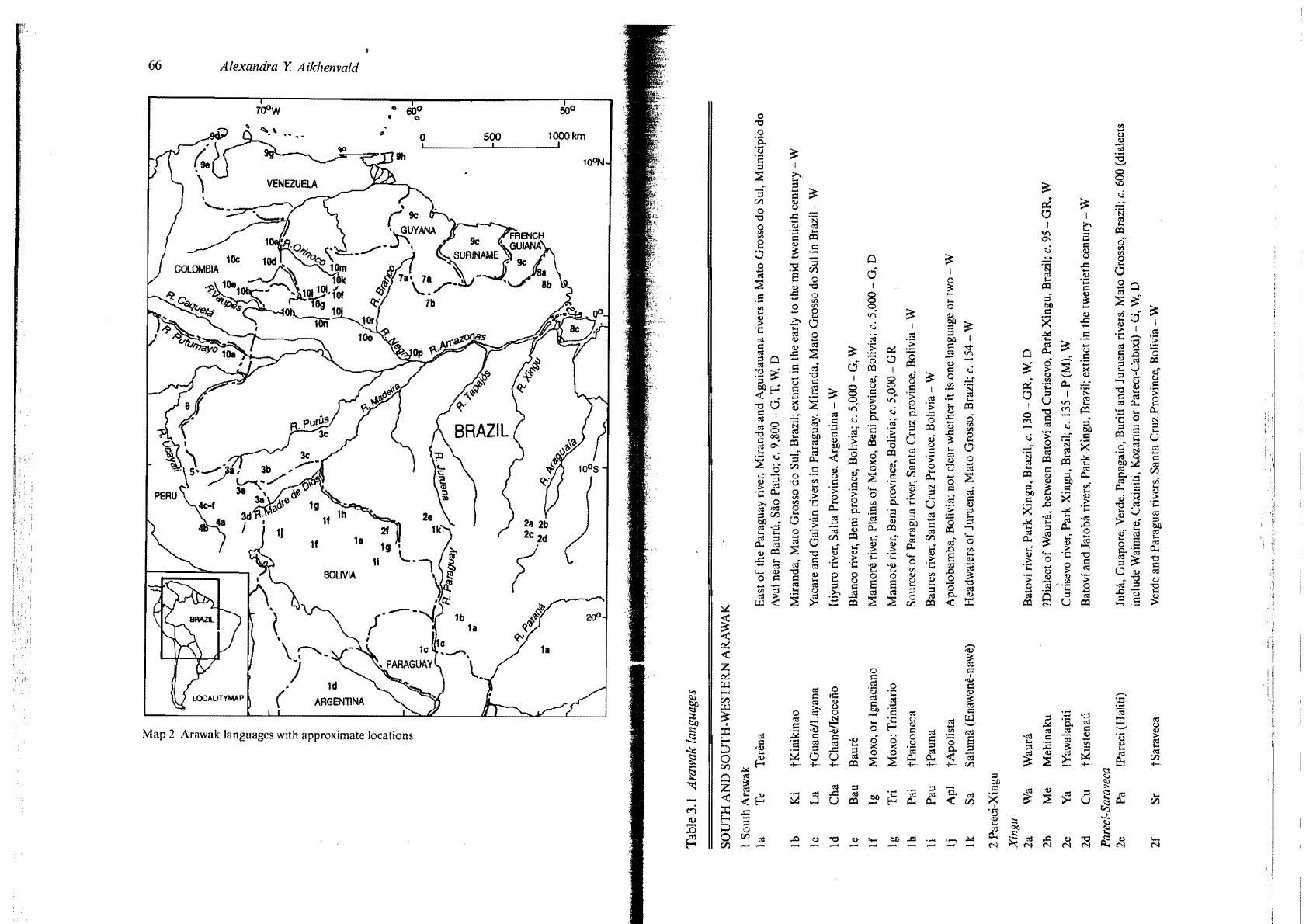
approximate geographicallocations are shown on map
2.
Arawak languages played an interesting role
in
conquest. The first native
American peoples encountered
by
Columbus
in
the Bah amas, Hispaniola and
Puerto Rico were Arawak-speaking Taino - their language became extinct within
the first hundred years
of
the white invasion (Rouse 1992). Spanish - and thus many
other languages - contains a number
of
loans from Arawak languages, including
I 1 am gralefullo all
my
teachers
of
Arawak languages - Candido, Graciliano, Olívia, Jovino
and José Brilo (Tariana), Humberto Baltazar and Pedro Ángelo Tomas (Warekena), the
lale Candelário da Silva (Bare), Afonso, Albino
and
Joao Fonles, Celes lino da Silva
and
Cecília and Laureano da Silva, Januário Paiva and Ihe late Marcília Rodrigues (Baniwa).
Also lo David Payne, José Alvarez and Peter van Baarle.
2 The name 'Warekena'
is
al
so misleadingly used wilh reference to several distinct Arawak
peoples; see discussion in Aikhenvald (1998).
:::
:»
'O
'"
~
~
.,
'"
¡;;
::>
i)Q
:;;
~
>
..
:=
"
o
o2i
Q
'"
'"
;:...
~
).(
§
!}
~
~
:...
;;¡.:
;::;-
!:ll
~
iS::
.,
e
r¡:¡
'"
:s,
;.
'O
"'
'O
el
x
Sr
a
(l)
O'
"
g.
'"
::>
'"
Table
3.1
Arawak
languages
SOUTH AND SOUTH-WESTERN ARAWAK
I Somh Arawak
la
Te
Terena
East
of
the Paraguay
river,
Miranda and Aguidauana rivers in Mato Grosso do Sul, Municipio do
Avaí
near Baurú, Sao Paulo;
c.
9,800 - G,
T,
W,
D
lb
Ki
tKinikinao
Miranda, Mato Grosso do Sul, Brazil; extinct
in
the early to the mid twentieth century - W
le
La tGuané/Layana
Yacare and Galván rivers
in
Paraguay, Miranda, Mato Grosso do
Sul
in
Brazil - W
Id
Cha
tChané/Izoceño
Itiyuro
river,
Salta Province, Argentina - W
le
Bau
Bauré
Blanco
river,
Beni
province, Bolivia;
c.
5,000 -
G,
W
Ir
Ig
Moxo, or Ignaciano
Mamoré
river,
Plains
of
Moxo,
Beni
province, Bolivia;
c.
5,000
G,
D
Ig
Tri
Moxo: Trinitario
Mamoré
river,
Beni
province, Bolivia;
c.
5,000
- GR
Ih Pai
tPaiconeca
Sources
of
Paragua
river,
Santa Cruz province, Bolivia - W
li
Pau
tPauna
Baures
river,
Santa Cruz Province, Bolivia W
Ij
Apl tApolista
Apolobamba, Bolivia; not clear whether it
is
one language or
two
- W
lk
Sa
Salumlí (Enawene-nawe)
Headwaters
of
Juruena, Mato Grosso, Brazil; c.
154
W
2 Pareei-Xingu
Xingu
2a
Wa
Waurá
Batoví
river,
Park Xingu, Brazil;
c.
130
GR,
W,
D
2b
Me
Mehinaku
?Dialect of Waurá, between Batoví and Curisevo, Park Xingu, Brazil;
c.
95
GR, W
2e
Ya
!Yawalapiti
Curisevo
river,
Park Xingu, Brazil;
c.
135
- P (M), W
2d Cu tKustenaú
Batov! and Jatobá rivers, Park Xingu, Brazil; extinct
in
the twentieth century - W
Pareci-Saraveca
2e
Pa !Pareci (Haliti)
JubA,
Guapore,
Verde,
Papagaío, Buriti and Juruena
rivers.,
Mato Grosso, Brazil;
c.
600
(dialects
inelude Waimare, Caxiniti, Kozarini or Pareci-Cabixí) -
G,
W,
D
2f
Sr tSaraveca
Verde
and Paragua rivers, Santa Cruz Province, Bolivia - W
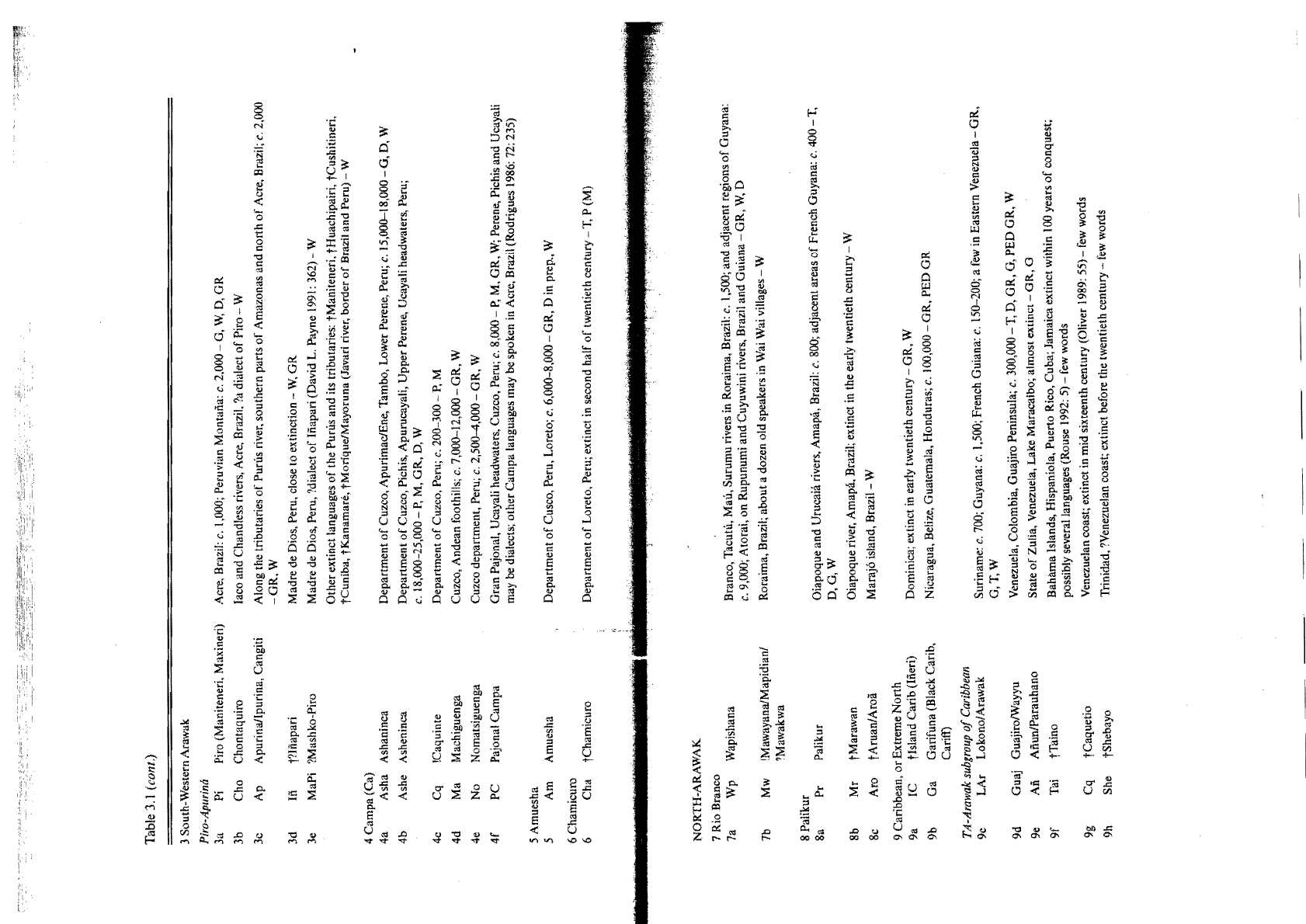
Table
3.1
(cont.)
3 South-Western Arawak
Piro-ApuI'iná
3a
Pi
Piro (Maniteneri, Maxineri)
3b
Cho
Chontaquiro
3c Ap
Apurínallpurína, Cangíti
3d
Iñ
t?lñapari
3e
MaPi
?Mashko-Píro
4
Campa
(Ca)
4a
Asha
Ashaninca
4b
Ashe
Asheninca
4c
Cq
!Caquinte
4d
Ma
Machiguenga
4e
No
Nomatsiguenga
4f
PC
Pajonal
Campa
5 Amuesha
S
Am
Amuesha
6 Chamicuro
6
Cha
tChamicuro
Acre, Brazíl:
c.
1,000; Peruvian
Montaña:
c.
2,000 G,
W.
D,
GR
laco
and
Chandless rívers, Acre, Brazil, 1a dialect
of
Piro
~
W
Along
the
tributaries
01'
Purús
river,
soulhern
parts
of
Amazonas
and
north
of
Acre, Erazil;
c.
2,000
GR,W
Madre
de
Dios. Peru, close
lO
extinction -
W,
GR
Madre
de Dios. Peru, ?dialect
of
Iñapari
(David L. Payne 1991: 362) - W
Other
extinct languages
01'
the
Purús
and
its tributaries:
tManiteneri,
tHuachípairi,
tCushitineri,
tCuniba,
tKanamaré,
tMonque/Mayoruna
(lavarí river,
border
of
Brazíl
and
Peru) W
Department
of
Cuzco, ApurimaclEne, Tambo, Lower Perene, Peru;
c.
15,000-18,000
~
G,
D, W
Department
of
Cuzco, Píchis, Apurucayali,
Upper
Perene, Ueayali headwaters, Peru;
c. 18,000-25,000
~
P,
M,
GR,
D,
W
Department
of
Cuzco, Peru;
c.
200-300 -
P,
M
Cuzco, Andean Ibothills;
c.
7,000-12,000~GR,
W
Cuzco department, Peru;
c.
2,500-4,000 -
GR,
W
Gran
Pajonal, Ucayali headwaters, Cuzco, Peru;
c.
8,000
~
p,
M,
GR,
W;
Perene, Pichis
and
Ueayali
may
be
dialects;
other
Campa
languages may be spoken in Acre, Brazil (Rodrigues 1986:
72:
235)
Department
of
Cusco, Peru, Loreto;
c.
6,000-8,000
GR,
D in prep., W
Department
of
Loreto, Peru; extinct in second
half
of
twentieth century
~
T,
P
(M)
I
NORTH-ARAWAK
7
Rio
Branco
7a
Wp
Wapishana
7b
Mw lMawayanalMapidianl
?Mawakwa
8Palikur
8a
Pr
Palikur
8b
Mr
tMarawan
Sc
Aro
tAruan/Aroa
9 Caribbean,
or
Extreme
North
9a
IC
tIsland
Carib
(lñeri)
9b
Ga
Garifuna
(Black Carib,
Carift)
TA-Arawak
subgroup
o/
Caríbbean
9c
LAr
Lokono/Arawak
9d
Guaj
GuajirolWayyu
ge
Añ
AñunlParauhano
9f
Tai
Faino
9g
Cq
tCaquetio
9h
She
tShebayo
Branco, Tacutú,
Maú,
Surumu
rivers in Roraima, Brazil:
c.
1,500; ¡¡nd adjacent regions
of
Guyana:
c.
9,000; Atorai,
on
Rupunumi
and
Cuyuwini
rivers, Brazíl
and
Guiana
-
GR,
W,
D
Roraima, Brazil;
about
a dozen old speakers in Wai Wai villages - W
Oiapoque
and
Urucaiá rivers,
Amapá,
Brazil:
c.
800; adjacent areas
of
French
Guyana:
c.
400 -
T,
D,G,W
Oiapoque
river,
Amapá,
Brazil; extinct in the early twentieth century W
Marajó
island, Brazil - W
Dominica; extinct in early twentieth century
~
GR,
W
Nicaragua, Belize,
Guatemala,
Honduras;
c.
100,000
GR,
PED
GR
Suriname:
c.
700; Guyana:
c.
1,500; French Guiana:
c.
150-200; a few in Eastern Venezuela
~
GR,
G,T,W
Venezuela, Colombia, Guajiro Peninsula;
c.
300,000 -
T,
D,
GR,
G,
PED
GR.
W
State
of
Zulia, Venezuela, Lake Maracaibo; almost extinct
~
GR,
G
Bahama
lslands, Hispaníola, Puerto Rico, Cuba;
Jamaica
extinct within 100 years
of
eonquest;
possibly severallanguages (Ro use 1992:
5)
few words
Venezuelan coast; extinct in mid sixteentb century (Oliver 1989: 55) - few words
Trinidad. ?Venezuelan coast; extinct before the twentieth century few words