
Dixon R.M.W., Aikhenvald Alexandra Y. The Amazonian Languages (Cambridge Language Surveys)
Подождите немного. Документ загружается.

Table
3.1
kont.)
10
North-Amazonian
Colombian
lOa
Re
tResigaro
Nartheast border
of
Peru, Bora
and
Ocaina villages; lormerly spoken on the Caquetá river;
few
speakers in
19705
- O, D
IOb
Yu
!Yucuna
(tGuarú)
Miritiparaná, Amazonas, Colombia;
c.
600-700 -
GR,
W
lOe
Acha
!Achagua
Mela, Colombia;
c.
200 G, W (old GR)
IOd
Pia
Piapoco
Vaupés, Colombia;
c.
3,000 O,
GR,
W
lOe
Cab
!Cabiyari
Miritiparaná river, Colombia;
c.
50
- W
IOr
Mp
tMaipure
Vichada territory, Colombia -
W,
GR
tCabre
is
anolher language tbrmerly spoken in the Vichada lerritory, Colombia, ror which a
shon
word
list
is
available.
Upper Río Negro
IOg
BI" Baniwa
of
l~ana/Kurripako
lncluding dialects: Carru, Carúlana, Dzawi-nai, Pauliene (Pacú), Catapolitaní, Hohódene, Siuci;
Kumandene (lpeka), Ayanene, etc.; Icana river and its tributaries, border
of
Brazil, Colombia,
Venezuela;
c.
3,000-4,000 -
OR,
D in prep., G
in
prep.,
T,
W
JOh
Ta
!Tariana
Vaupés river, Brazil;
c.
100
adult,
OR,
D in prep., G
in
prep.,
T,
W
10i
Guar
!Ouarequena
Xié river, tributary
of
It;ana, Brazil:
e,
2;
Ouzmán Blanco, Venezuela:
c.
300-
OR,
W
Orinoca
IOj
Ba
!Bare
Casiquiare, Amazonas, Venezuela, upper course
of
Río Negro, Brazil; just a
few
old speakers left
(tOuinau:
state
of
Bolivar, Venezuela: W) - O, D in prep.,
GR,
W
IOk
BOua
!Baniwa ol' Guainia
Including a dialect Warekena
of
Xié (WX); Xié river, tributary
01'
I"ana, Bnlzil:
c.
10; Ouainia,
Venezuela:
e,
200 O, D in prep" W
101
Yav
tYavitero (Baniwa al' Yavita)
VílIage
01'
Yavita, Atabapa river - O, W
JOm
Mnd
tMandawaka
Baria. Pasimoni rivers in Venezuela; possibly extinct
W
IOn
Yb
tYabaana
Marauia, Cauaboris, Brazil; extinct
in
the second half
of
Ihe twen¡ieth century - W
I
Middle Rio Negro
100
Ka
!KaiJana
Brazil; a
fe~
speakers reported in the
19505
-
OR,
W
IOp
Mn
tManao
Brazil; eXlinct in ¡he eighteenlh century -
T,
W
lOr
Bhw
!BahwanalChiriana Demeni river, Amazonas, Brazil, I speaker reported O, small D
Other extinct languages
01'
the Rio Negro
and
its tributaries are: t Amarizana (Vera
and
Aguas
Blancas
TÍ'lers,
Meta, Colombia),
tAnauya
(Amazonas, Venezuela), tCariyai (Rio Negro and
Padauiri),
tMariaté
(I~a
TÍver,
Brazil),
tPasé
(Negro, Japurá,
l¡ya
rivers, Brazil), tWainuma
(I~a
river,
Amazonas, Brazil), tWaraicú IAraikú (Juraí river, Amazonas, Brazil) -
W,
tWirina (Marari, Río
Branco, Brazil),
tYumana
(puré and Joami rivers, Amazonas, Brazil) - W
Notes:
Only living languages and extinct languages on which material s are available are included here and
in
map 2. The map covers only the languages
spoken
in
South America (tha!
is,
9a, 9b
and
9f
are not included), Endangered languages are marked with
!;
extinct languages are marked with t,
Names which probably refer
to
dialects are given in parentheses. The second column gives the abbreviations by which languages are referred
to
in the
tex!, e.g.
Te
for Terena, The following abbreviations are used to indicate the materials available: T - texts,
0-
grammar,
PED
OR
- pedagogical
grammar, M morphology, P - phonology,
OR
- brief grammatical description, W word lists, D - dictionary,
.1
72
73
Alexandra
y.
Aikhenvald
hammock, tobacco, patato, guaya
and
other
names for flora
and
fauna (Oliver 1989,
Valenti 1986).
Languages
in
areas settled by the European invaders soon became extinct. Those
on the north coast
of
South America perished early, before 1700. When the search
for gold and rubber spread up the Amazon
and
its tributary, the Rio Negro, further
languages succumbed. Sometimes the Indians retaliated, attacking settlements
and
missions; but the invaders always returned. lndian rebellions often provoked forced
migrations which sometimes ended up creating a new dialect
or
even a new lan-
guage. For instance,
in
1797
the British authorities removed the rebellious inhabi-
tants
of
St Vincent (an island in the Lesser Antilles) to Belize on the mainland.
Racially, these were a mixture
of
Indians and black slaves who spoke an Arawak
language called Island Carib. This resulted in the creation
of
a new dialect
of
Island
Carib - known as Central American Island Carib, Cariff, Black Carib or Garifuna
- which by the twentieth century had developed into a separate language, now one
of
the Arawak languages with the largest number
of
speakers (Taylor 1 977b).
The overwhelming majority
of
Arawak languages are now endangered. Even
in
the
few
communities with over 1,000 speakers, a nationallanguage (Portuguese
or
Spanish)
or
a locallingua franca (Língua Geral Amaz6nica, Quechua
or
Tucano)
is
gradually gaining ground among younger people. A massive switch to Língua
Geral Amaz6nica took place around
1900
in the region
of
the Rio Negro, and
resulted
in
the rapid loss
of
a number
of
languages. Numerous dialects
of
Baniwa
of
I(fana spoken on the Lower l(fana in Brazil are almost extinct. Tucano
is
rapidly
replacing Tariana in the Vaupés river basin; Yawalapiti is yielding to Kamaiurá as
a Iingua franca
of
the Xingu Park (Mujica 1992).
The
few
healthy Arawak languages are Guajiro in Venezuela
and
Colombia (esti-
mates vary from 60,000 to 300,000 speakers)
and
Garifuna in Central America
(from 30,000 to 100,000). The Campa languages (total estima te 40,000-50,000) are
one
of
the largest indigenous groups
in
Peru.
The majority
of
material s cóllected between
1600
and 1900 consisted
of
word Iists,
phrases and a
few
paradigms. For languages which became extinct early
(e.g.
Taino,
Caquetio, Shebayo) just a
few
words survived in the early Spanish chronicles. There
are material s on a
few
Arawak languages spoken in the northern regions
of
South
America (Achagua, Maipure, Island Carib mixed pidgin, Lokono Arawak) which
go
back to the mid seventeenth century. Valuable materials - including word lists, and
sometimes grammatical notes, short texts and dialogues (though
not
all equally reli-
able) - were collected
by
travellers (for instance, Wallace 1853, Martius
1867,
Von
den Steinen 1886, Chaffanjon 1889, Koch-Grünberg 1911,1928, Nimuendajú
1932).
Most
of
the materials on Arawak languages collected during the second half
of
the twentieth century are
by
SIL Iinguists. Their quality and quantity varies.
At
present,
no
Arawak language - with the possible exceptions
of
Lokono and
3 AralVak
Resigaro - has been provided with a comprehensive grammar (phonology, mor-
phology, syntax), dictionary
and
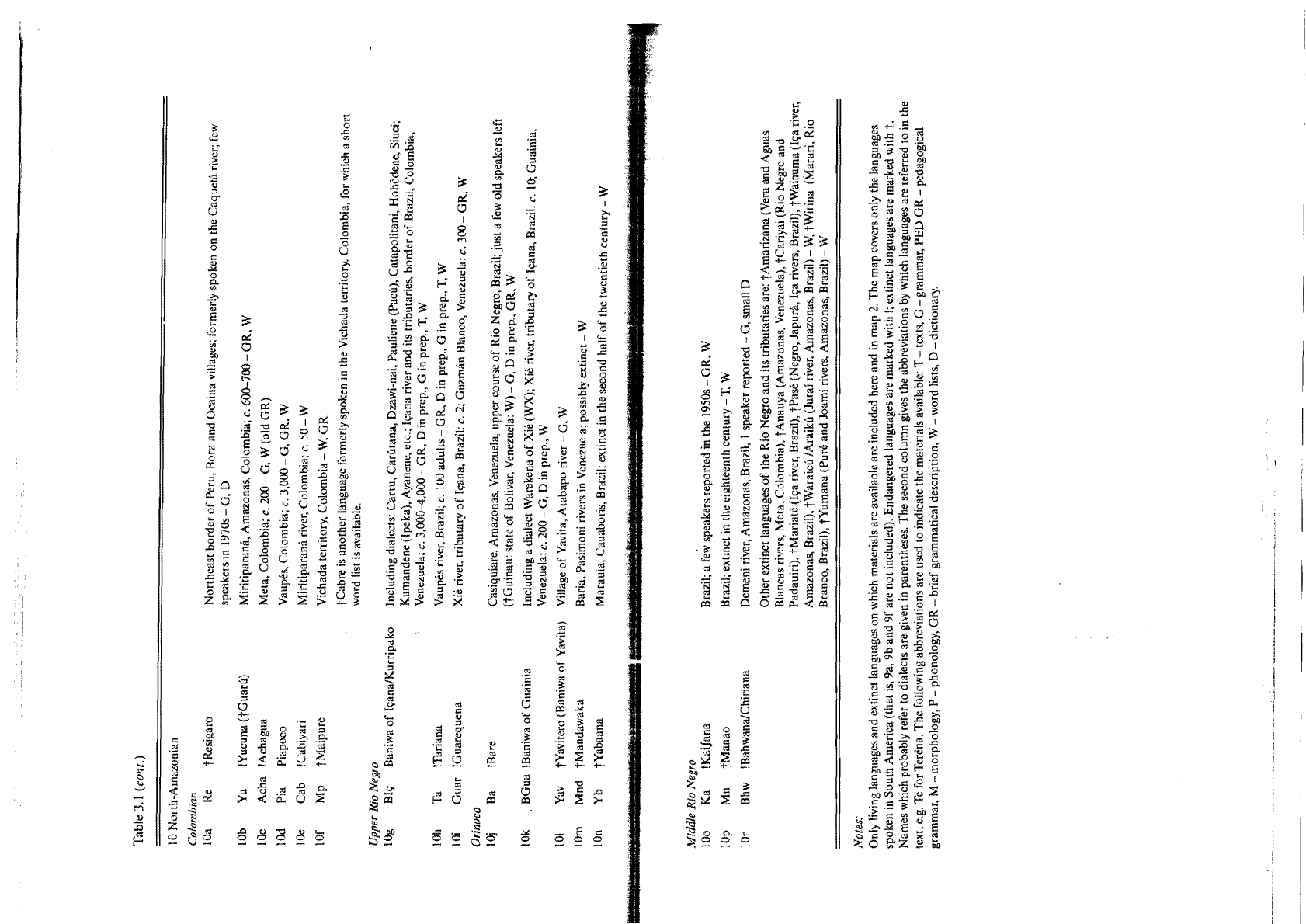
text collection. (See table 3.1.)
1.1
Comparative studies, genetic c1assification
and
subgrouping
Comparative
and
historical studies
of
the Arawak family have a long history. The
genetic unity
of
Arawak languages was first recognized by Father Gilij in 1783;
three years before Sir William Jones's famous statement about Indo-European. The
recognition
of
the family was based on a comparison
of
Maipure, from the Orinoco
Valley,
and
Moxo from Bolivia. He named the family Maipure. Later, it was
'renamed' Arawak by Brinton(1891)
and
Von
den Steinen (1886), after one
of
the
most
important
languages
of
the family, Arawak (or Lokono), spoken in the
Guianas. This name gained wide acceptance during the following decades.
Comparative studies
of
Arawak languages initiated by Gilij were continued by
Von
den Steinen (1886) who proposed the first subdivision
of
the Arawak lan-
guages.
He
distinguished Nu-Arawak and Ta-Arawak divisions (based on
the
form
of
the Isg pronominal prefix - see table 3.5).
Further
studies were done by
Adam
(1890), Brinton (1891, 1892)
and
others.
The limits
of
the family were established
by
the early twentieth century. The
Arawak affiliation
of
a
few
languages earlier considered 'problematic' has been
proved within recent years. These are Amuesha (Taylor 1 954b ), Resigaro (David
L.
Payne 1985), lñapari (Valenzuela 1991), and Bahwana (Ramirez 1992).
Though
there are no doubts concerning the genetic affiliation
of
the Arawak lan-
'guages Iisted
in
table 3.1, problems still exist concerning internal genetic relation-
ships within the family
and
possible genetic relationships with other groups. Even
the name
of
the family has been a subject
of
controversy. The'majority
of
native
South American scholars use the name 'Arawak' ('Aruák') to refer to the group
of
unquestionably related languages easily recognizable by pronominal prefixes such
as
nu-
or
ta-
'1
sg', pi- '2 sg', relative prefix ka- and negative ma-. A number
ofschol-
ars, mainly
North
Americans, prefer to use the term 'Arawak(-an)' to refer
to
much
more doubtful genetic unities
of
a higher taxonomic order,
and
reserve the term
'Maipuran',
or
'Maipurean' for the group
of
undoubtedly related languages (see
David L. Payne 1991, Kaufman 1990;
and
the introduction
to
this volume). Here I
follow the South American practice
and
use the name 'Arawak' for the family
of
def-
initely related languages, following Rodrigues (1986).
Reconstruction, internal c1assification and subgrouping
of
Arawak languages
is
still a matter
of
debate; further detailed work
is
needed on both the descriptive
and
the comparative fronts.
As mentioned
in
the introduction to ·this volume, the putative studies
of
'Arawakan' by Matteson (1972), Noble (1965)
and
others are deeply flawed.
75
3 Arawak
Antilles
is
one
of
the most surprising pieces
of
evidence on language history in pre-
eonquest times. Speakers
of
Iñeri, a dialect
of
the Arawak language now (mislead-
ingly!) known as Island Carib, were eonquered by Carib speakers. Their 'mixed'
Arawak-Carib pidgin survived until the seventeenth century (Taylor 1977b, Hoff
1994). In this pidgin, the 'speech
of
men' and the 'speech
of
women' were
di
s-
tinguished
in
the foIlowing
way.
Women used morphemes and lexemes
of
Arawak
origin, while men used lexical items
of
Carib origin and grarnmatical morphemes
mostly
of
Arawak
origino
This pidgin coexisted with the Carib used by men and the
Iñeri used
by
women and children. This diglossia gradually died out with the spread
of eompetence
in
Iñeri/Island Carib among both men and women. However,
as
a
result, Island Carib underwent a strong lexical and grarnmatical influence from Carib.
A nllmber
of
grammatical phenomena distinguish
North
Arawak from non-
North
Arawak languages (see also Tovar and
De
Tovar
1984:
120-45). Though
there are a
few
comparative stlldies
of
various subgroups (Wise 1986, 1990a, 1991a
and b; Derbyshire
1986;
Captain 1991), further investigation
is
needed to decide
whether this division
is
genetic,
or
is
due to different patterns
of
areal diffusion,
and
exactly what the subgrouping
is.
For the time being, we can only be certain
of
sub-
groupings
of
Arawak languages
on
a very low taxonomic level (e.g. Xinguan lan-
guages, South Arawak
of
Brazil, Pi-Ap). The preliminary subgrouping in table
3.1
is
based on this areal-geographical principle.
4
The linguistic argument in favour
of
an Arawak proto-home located between the
Rio Negro and the Orinoco
river,
or on the Upper Amazon (advocated by Lathrap
1970,
Oliver
1989
5
)
is
the higher concentration
of
structuraIly divergent languages
in
'this region than
in
other Arawak-speaking areas. This
is
highly suggestive and cor-
roborated by a
few
mythical traditions concerning a northern origin among Arawak-
speaking peoples
in
southern regions
(e.g.
in
Xingu). The origin rrÍyths
of
the Tariana
and Baniwa
in
the north
al
so
suggest that they carne from the Caribbean coast. The
expansion
of
Lokono-Iñeri from the Northern Amazon to the islands
in
the Caribbean
is
estimated to be quite reeent
(just
a
few
hundred years before the eonquest).
2
PHONOLOGY
2.1
Segmental phonology
A core
of
segmental phonology found
in
most
of
the languages
is
presented
in
tables
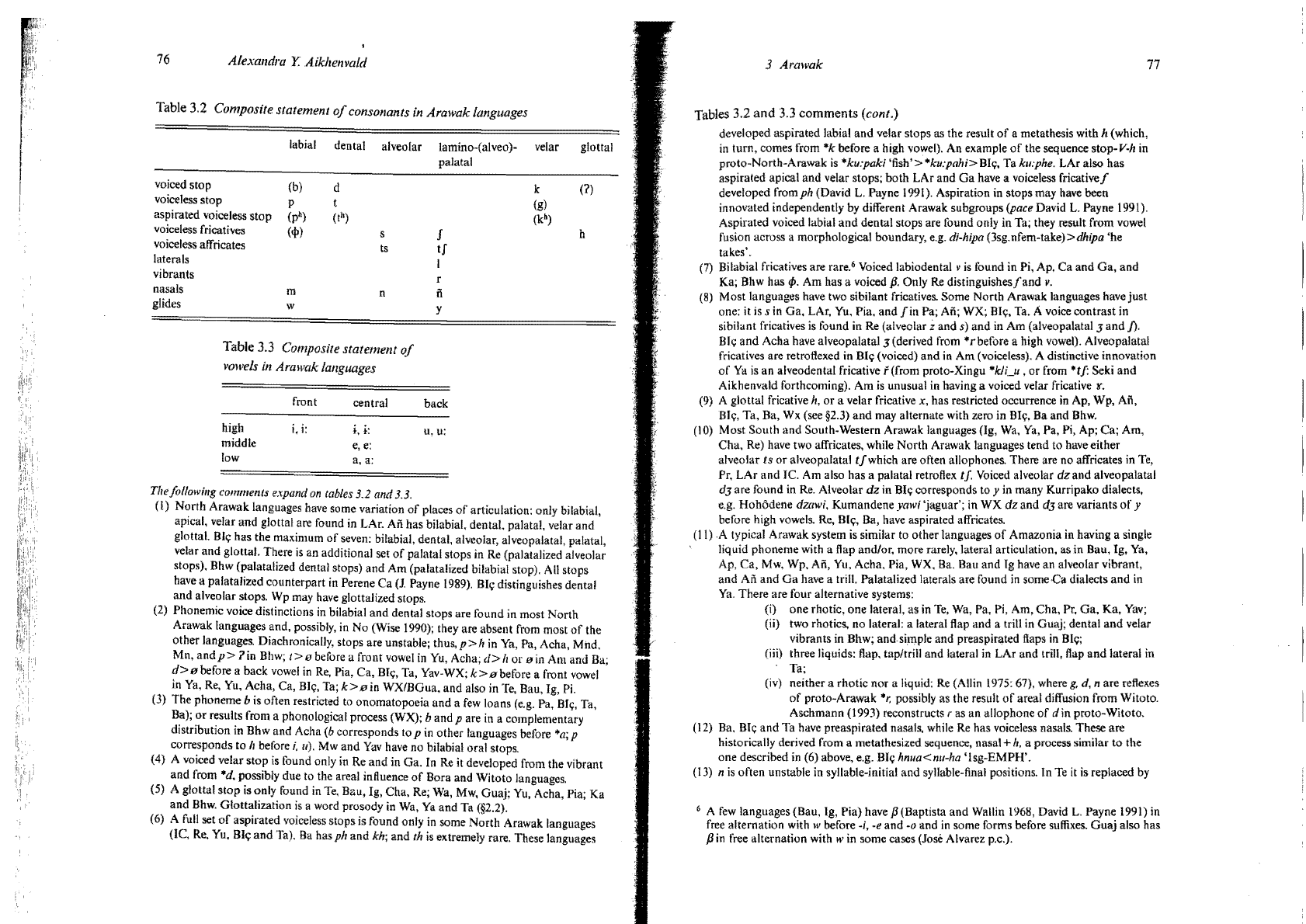
3.2 and 3.3. The likely phoneme system
of
proto-Arawak comprises these eonsonants
4 In all sllbsequent Iists
of
Arawak langllages 1 follow the
order
given in table 3.1.
; Note, however. that Oliver's scheme
is
based
on
Noble's (1965)
and
Matteson's (1972)
c\assifications and his own lexico-statistic comparisons
of
highly lInreliable
data
from
30
languages.
,
;,
r
1:
74
Alexandra
Y.
Aikhenvald
Unfortunately, these have been adopted as the standard reference for the c\assifica-
tion
of
Arawak languages, especially among anthropologists, archaeologists and
geneticists, influencing ideas on a putative proto-home
and
migration routes for
proto-Arawakan - see the criticism in Tovar
and
De Tovar (1984).
The earliest c\assifications -
De
Goeje (1928), Mason (1950)
and
even Loukotka
(1968) - were predominantly based on the geographical distribution
of
languages.
A comparative vocabulary
of
67
Arawak languages with
151
cognate sets (all
of
mixed quality) was compiled
by
De
Goeje (1928) as a chapter
of
bis grammar
of
Lokono Arawak. Later comparative studies were made
by
Shafer (1959) (see the
criticism
in
Taylor 1961, David L. Payne
1991)3
and Valenti (1986). The first truly
scientific reconstruction
of
proto-Arawak phonology - over 200 lexical items
and
a
few
grammatical morphemes - was published by David L. Payne (1991). However,
his subgrouping
of
Arawak languages, which
is
based on lexical retentions, rather
than on innovations, remains open
to
discussion.
Tay10r
(1977a, b)
was
the first to put forward scientific arguments
in
favour
of
North Arawak as a separate subgroup. His contribution
to
Arawak comparative
phono10gy
and
to comparative studies
of
Caribbean Arawak (lsland Carib,
Garifuna, Guajiro, Lokono) cannot be overestimated. A
few
low-Ievel reconstruc-
l'
tions
have
been suggested recently (proto-Lokono-Guajiro, see
Capta
in
1991;
and
proto-Xingu, see Seki and Aikhenvald forthcoming).
The main problem
of
Arawak comparative linguistics
and
subgrouping
is
the
lack
of
adequate data for many languages. Geographical expansion and consider-
able linguistic diversity within the family pose the problem
of
distinguishing areal
from genetic phenomena. This
is
crucial for morphological reconstruction. In sorne
cases the source
of
areal diffusion can be established. Quechuan influences are dis-
cernible in Amuesha (Wise 1976). Resigaro was strongly influenced by Bora and
Ocaina (Witoto family). The grammar
of
Tariana was drasticaIly restructured
under the influence
of
East Tucano languages during the past 300
or
400 years
(Aikhenvald 1996a). In other cases the origin
of
a substratum
is
not
known. The
Arawak languages
of
Peru show structural similarity to neighbouring non-Arawak
languages (Harakmbet, Witoto). Palikur
is
said to have arisen frorn the merger
of
8 dialect
or
language groups (Diana Green p.c., 1996); these unknown substratum
languages may account for the fact that it
is
one
of
the most divergent North
Arawak languages, and has lost a number
of
common Arawak features.
The history
of
the Arawak language family offers interesting examples
of
language
contacts. The creation
of
a 'mixed' language
of
Arawak-Carib origin
in
the Lesser
) He established
18
phonetic correspondence sets between 36 Arawak languages. This was a
start: lInfortunately most
of
these data were
of
mixed quality
and
strongly biased towards
North Arawak.
Of
the 361angllages,
13
are, in fact, dialects
of
Baniwa
of
I<;:ana/KlIrripako,
and only 3 languages are not North Arawak.
77
76
Alexandra
Y.
Aikhellvald
l'
Table
3.2
Composíte statemellt
01
COllsonants
in
Arawak
languages
labial
dental
alveolar
lamino-(alveo)-
velar
glottal
palatal
voiced stop (b)
d
k
(1)
voiceless stop p
t
(g)
aspirated voiceless stop
(ph)
(t
h
)
(k
h
)
voiceless fricatives
(4))
s
h
J
voiceless affricates
ts
tJ
latenl\s
I
vibrants
r
nasals
m
n
ñ
glides
w
y
Table
3.3
Composite statement
01
vowels
in
Arawak
languages
front
central
back
high
middle
low
i,i:
U:
e,e:
a,
a:
u, u:
The
follolVing
comments expand
on
lab/es
3.2 and
3.3.
(1) North Arawak languages have sorne variadon
of
places
of
articulation: only bilabial,
apical, velar and glottal are found in LAr. Añ has bilabial, dental. palatal, velar
and
glottal.
BI<;
has the maximum
of
seven: bilabial, dental, alveolar, alveopalatal, palatal,
velar and glottal. There
is
an additional sel
of
palatals!ops in Re (palatalized alveolar
stops), Bhw (palatalized dentalstops) and Am (palatalized bilabial stop).
AII
stops
have a palatalized counterpart
in
Perene Ca
(1.
Payne
1989).
BI<;
distinguishes dental
and
alveolar stops. Wp may have glottalized stops.
(2) Phonemic voice distinctions
in
bilabial
and
dental stops are found
in
mos! North
Arawak languages and, possibly,
in
No (Wise 1990); they are absent from most
of
the
olher languages. Diachronically, stops are unstable; thus,
p>h
in
Ya, Pa, Acha, Mhd,
Mn,
andp>
7in
Bhw;
t>obefore
a front vowel
in
Yu,
Acha;
eI>l!
Ol'
eín
Am and Ba;
d>
e befo
re
a back
vowel
in
Re,
Pía, Ca,
BI<;,
Ta, Yav-WX;
k>abefore
a front
vowel
in
Ya,
Re,
Yu,
Acha, Ca,
BIr;,
Ta;
k>
a in WX/BGua,
and
also in
Te,
Bau, Ig, Pi.
(3) The phoneme
b is often reslricted lo onomatopoeia and a
few
loans
(e.g.
Pa,
BI~,
Ta,
Ba);
or
results from a phonological process (WX); b and p are in a complementary
distribulion in Bhw and Acha
(b corresponds to p
in
other languages before
"a;
p
corresponds lo /¡ before
i.
11).
Mw and
Yav
have no bilabial oral stops.
(4) A voiced velar stop is found only in Re and in Ga, In
Re
il developed from the vibrant
and
from "d, possibly due to the areal influence
of
Bora and Witoto languages.
(5) A glottal
stop
is only found in
Te,
Bau, Ig, Cha, Re; Wa, Mw, Guaj;
Yu,
Acha, Pía; Ka
and
Bhw.
Gtottalizatíon
is
a word prosody
in
Wa,
Ya
and Ta (§2,2).
(6) A
full
sel
of
aspirated voiceless stops is found only in sorne
Norlh
Arawak languages
(le,
Re,
Yu,
BI<;
and
Ta).
Ba
has ph
and
kh; and
tI!
is
extremely rare. These languages
3 Arawak
Tables
3.2
and
3.3
cornrnents (cont.)
developed aspírated labial
and
velar stops as the result
of
a metathesis with I! (which,
in turn, comes from
*k
before a high vowel). An example
of
the sequence stop-
V-h
in
proto-North-Arawak
is
*ku:paki '6sh' > "ku:pahi>
BI<;,
Ta kll:phe. LAr also has
aspirated apical and velar stops; both LAr and
Ga
have a voiceless Cricativef
developed fromph (David
L. Payne 1991). Aspiration in stops may
have
been
innovated independently
by
different Arawak subgroups (pace David L. Payne 1991).
Aspirated voiced labial
and
dental stops are found only in Ta; they result from vowel
fusíon across a morphologica! boundary, e.g.
di-hipa (3sg.nfem-take»dhipa
'he
takes'
(7) Bilabial fricatives are rare.
6
Voiced labiodental vis found in Pi, Ap,
Ca
and
Ga,
and
Ka; Bhw has
iP.
Am has a voiced
p.
Only
Re
distinguishesfand
V.
(8) Most languages have two sibilant fricatives. Some North Arawak languages have just
one: it is
s
in
Ga,
LAr,
Yu,
Pia, and
fin
Pa; Añ; WX;
BI<;,
Ta. A voice contrast in
sibilant fricatives is found in
Re
(alveolar zand $)
and
in Am (alveopalatal J and.IJ.
BI
..
and
Acha have alveopalatal3(derived from *rbefore a high vowel). Alveopalatal
fricatives are retroflexed in BIe (voiced)
and
in
Am
(voiceless). A distinctive innovation
of
Ya
is
an alveodental fricative
f(from
proto-Xingu
*klLu,
or
frorn
"tf:
Seki
and
Aikhenvald forthcoming). Am
is
unusual
in
having a voiced velar fricative
Y.
(9) A glottal fricative
h,
or a velar
Cricative
x, has restricted occurrence in Ap, Wp, Añ,
BI<;,
Ta, Ba, Wx (see §2.3)
and
may alternate with zero in BI", Ba and
Bhw.
(10)
Most South
and
South-Western Arawak languages (lg,
Wa,
Ya,
Pa, Pi, Ap; Ca; Am,
Cha, Re) have two alfricates, while North Arawak languages tend to have either
alveolar
ts
or
alveopalatal
tfwhich
are often allophones. There are no affricates in
Te,
Pro
LAr
aud
le. Am also has a palatal retroflex
tI
Voiced alveolar dz
and
alveopalatal
dJ are found in
Re.
Alveolar
dz
in
BI<;
corresponds to y in many Kurripako dialects.
e.g. Hohódene
d7.,{llVi,
Kumandene yawi 'jaguar'; in
WX
dz
and dJ are variants
01'
y
before high
vowels.
Re,
Bh;:,
Ba, have aspirated affricates.
(11) .A typical Arawak system
is
similar to other languages
of
Amazonia in having a single
¡¡quid phoneme with a flap and/or, more rarely, lateral articulation,
as
in Bau, Ig, Ya,
Ap,
Ca,
Mw,
Wp, Añ,
Yu,
Acha, Pia, WX, Ba. Bau and
Ig
have an alveolar vibrant,
and
Añ
and
Ga
have a trill. Palatalized laterals are found
in
some·Ca dialects
and
in
Ya.
There are four alternative systems:
(i) one rhotic, one lateral, as
in
Te.
Wa, Pa, Pi, Am, Cha,
Pr,
Ga,
Ka,
Yav;
(ii) two rhotics, no lateral: a lateral flap and a trill in Guaj; dental
and
velar
vibrants in Bhw;
andsi
l1l
ple and preaspirated ftaps
in
BI<;;
(iii) three Iiquids: flap, tapltrill and lateral
in
LAr
and
trill, flap
and
lateral in
Ta;
(iv) neither a rhotíe nor a liquid:
Re
(Allin
1975:
67), where
g.
d,
n are reftexes
of
proto-Arawak
"r,
possibly as the result
of
areal diffusion from Witoto.
Aschmann (1993) reconslructs
r as
an
allophone
of
din
proto-Witoto.
(\2) Ba,
BI~
and Ta have preaspirated nasals, while Re has voiceless nasals. These are
historically derived from a metathesized sequence, nasal
+
h.
a process similar
to
the
one described in (6) above, e.g.
BI<;
hnua<nll-ha
'lsg-EMPH'.
(13)
n
is
oflen unstable
in
syllable-initial and syllable-6nal positions. In
Te
it
IS
replaced
by
Ó A
few
languages (Bau, Ig, Pia) have P(Baptista and Wallin 1968, David
L.
Payne 1991) in
free alternation with
IV before -i,
-e
and
-o
and
in
sorne forms before suffixes.
Guaj
also has
P
in
free alternation with w in sorne cases (José Alvarez p.c.).
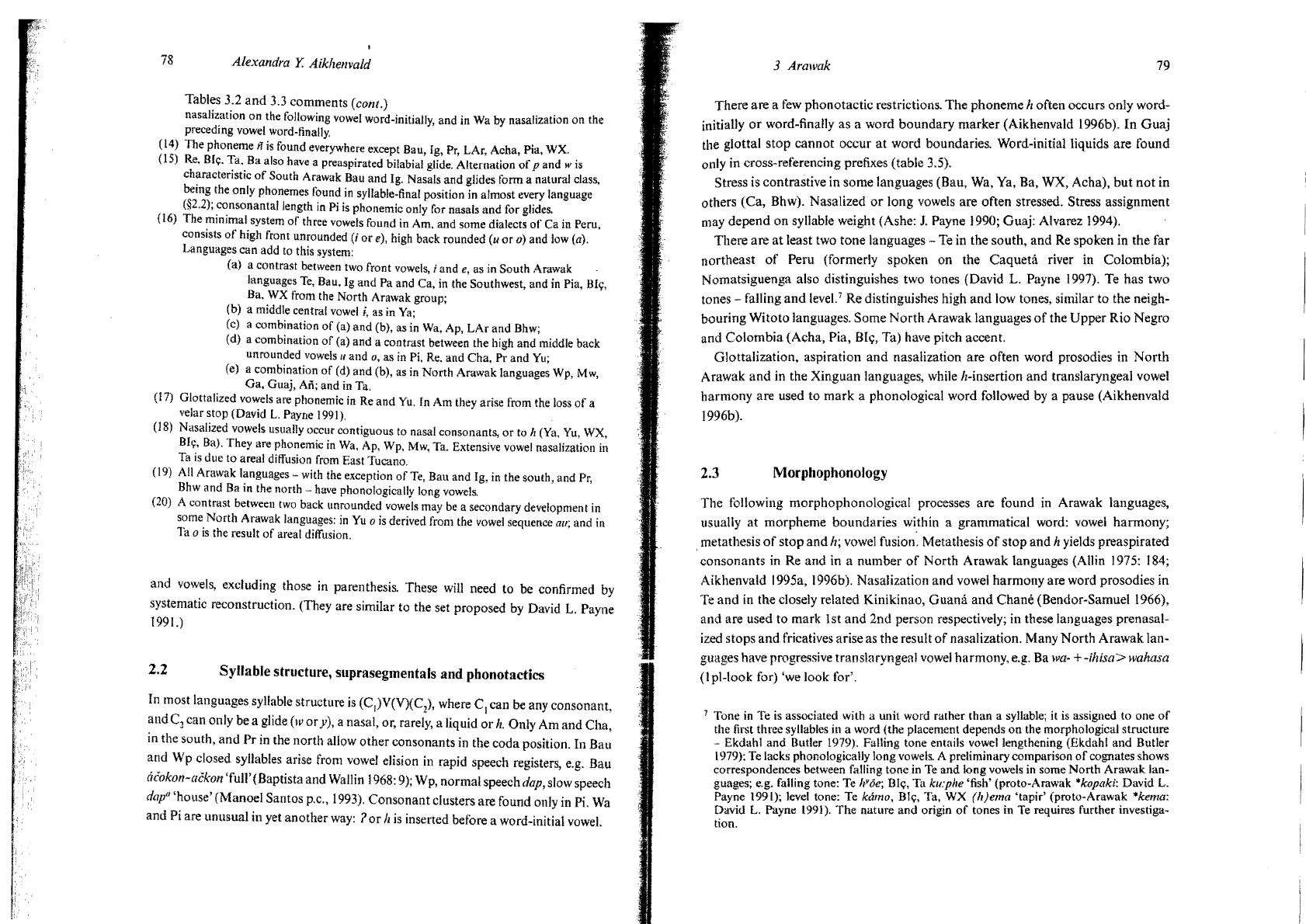
79
78
Alexandra
y.
Aikhenvald
Tables 3.2
and
3.3
comments
(cont.)
nasalization on the following
vowel
word-initially, and
in
Wa
by
nasalization on the
preeeding
vowel
word-finally.
(14) The phoneme
11
is
found everywhere except Bau, Ig,
Pr,
LAr, Aeha, Pia,
WX.
(15)
Re,
BIC;.
Ta. Ba also
nave
a preaspirated bilabial
glide.
Alternation
of
p and w
is
characteristic
of
Soulh Arawak Bau and
Ig.
Nasals and glides form a natural
c1ass,
being ¡he only phonemes found
in
syllable-final position
in
almost every language
(§2.2);
consonantallength
in
Pi
is
phonemic only ror nasals and [or
glides.
(6)
The minimal system
of
three
vowels
found
in
Am.
and sorne dialects
01'
Ca
in
Peru.
consists
of
high fronl unrounded (i
or
e),
high back rounded
(u
or
o) and
low
(a).
Languages can add
lO
this system:
(a) a contrast
between
two
front
vowels,
i and
e,
as in South Arawak
languages
Te,
Bau,
Ig
and Pa and Ca,
in
the Southwest, and
in
Pia,
Blc;,
Ba.
WX
from the North Arawak group;
(b) a middle central
vowel
i, as
in
Ya;
(e)
a combination
of
(a) and (b),
as
in
Wa,
Ap,
LAr and
Bhw;
(d) a eombination
of
(a) and a contrast between the high and middle back
unrollnded
vowels
u and
o,
as
in
Pi,
Re,
and Cha, Pr and
Yu;
(e)
a combination
of
(d) and (b),
as
in
North Arawak languages
Wp,
Mw,
Ga, Guaj,
Añ;
and
in
Ta.
(17) Glottalized
vowels
are phonemic
in
Re
and
Yu.
In
Arn
they arise from the
105s
of
a
velar stop (David
1. Payne 1991).
(18)
Nasalized vowels usually occur contiguous 10 nasal consonants,
or
lO
h
(Ya,
Yu,
WX,
BI<;,
Ba).
They are phonemic
in
Wa,
Ap,
Wp,
Mw,
Ta. Extensive
vowel
nasalization
in
Ta
is dlle lO areal diffusion
from
East Tueano.
(19)
AII
Arawak languages with
the
exception
of
Te,
Bau and Ig,
in
the south, and
Pr,
Bhw
and Ba in the Ilorlh
have
phonologicaJly long
vowe!s.
(20) A contrast between
two
back llnrollnded
vowels
may
be
a secondary development
in
so
me
North Arawak languages:
in
Yu
o
is
derived [rom the
vowel
sequence
au;
and
in
Ta
o
is
¡he result
of
areal diffusion.
and
vowels, excluding those in parenthesis. These will need
to
be
confirrned
by
systernatic reconstruction. (They
are
similar to the set
proposed
by
David
L.
Payne
1991.)
2,2
Syllable structure, sllprasegrnentals
and
phonotactics
In
most
languages
syllable
structure
is (C¡)V(V)(C¡), where C
can
be any
consonant,
I
andC]
can
only
be
a glide
(wor
y), a nasal, or, rarely, a Iiquid
or
h.
Only
Arn
and
Cha,
in the
south,
and
Pr
in the
north
allow
other
consonants
in the
coda
position.
In
Ball
and
Wp
closed syllables arise from vowel elision in rapid speech registers, e.g.
Bau
áéokon-ackon
'full'
(Baptista
and
Wallin 1968: 9); Wp,
normal
speech dap, slow speech
dapu
'house'
(Manoel
Santos
p.C.,
1993).
Consonant
c1usters
are
found
only in Pi. Wa
and
Pi
are
unusual
in yet
another
way: ?
or
h is inserted before a word-initial voweL
3 Arawak
There
are
a few
phonotactic
restrictions.
The
phoneme}¡
often
occurs
only
word-
initially
or
word-finally
as
a
word
boundary
rnarker
(Aikhenvald
1996b).
In
Guaj
the
glottal
stop
cannot
occur
at
word
boundaries.
Word-initial
liquids
are
found
only in cross-referencing prefixes
(table
3.5).
Stress is
contrastive
in
sorne
languages
(Bau,
Wa,
Ya, Ba,
WX,
Acha),
but
not
in
others
(Ca,
Bhw).
Nasalized
or
long
vowels
are
often
stressed. Stress
assignrnent
may
depend
on
syllable weight (Ashe:
1.
Payne 1990;
Guaj:
Alvarez 1994).
There
are
at
least
two
tone
languages
Te in
the
south,
and
Re
spoken
in
the
far
northeast
of
Peru
(formerly
spoken
on
the
Caquetá
river in
Colombia);
Nornatsiguenga
also
distinguishes
two
tones
(David
L.
Payne 1997).
Te
has
two
tones - falJing
and
leve!.7
Re
distínguishes
high
and
low tones, similar
to
the
neigh-
bouring
Witoto
languages.
Sorne
North
Arawak
languages
of
the
Upper
Rio
Negro
and
Colombia
(Acha,
Pia,
Bl¡;,
Ta)
have
pitch
accent.
Glottalization,
aspiration
and
nasalization
are
often
word
prosodies
in
North
Arawak
and
in
the
Xinguan
languages,
while
h-insertion
and
translaryngeal
vowel
harmony
are
used
to
rnark
a
phonological
word
followed by a
pause
(Aikhenvald
1996b).
2.3
Morphophonology
The
foIlowillg
morphophonological
processes
are
found
in
Arawak
languages,
usuaIly
at
morpherne
boundaries
within
a
grarnmatical
word: vowel
hannony;
rnetathesis
of
stop
and
h;
vowel fusiono
Metathesis
of
stop
and
h yields
preaspirated
consonants
in
Re
and
in a
number
of
North
Arawak
languages
(AIlin 1975: 184;
Aikhenvald
1995a,
!996b).
Nasalizatíon
and
vowel
harmony
ar~
word
prosodies
in
Te
and
in
the
c10sely related
Kinikinao,
Guaná
and
Chané
(Bendor-Samuel
1966),
and
are
used
to
mark
1
st
and
2nd
person
respective!y; in these
languages
prenasal-
¡zoo
stops
and
fricatives
arise
as
the
result
of
nasalization.
Many
North
Arawak
lan-
guages
have progressive
translaryngeal
vowel
harmony,
e.g. Ba
wa-
+
-ihisa>
wahasa
(1
pI-loo k for)
'we
look
ror'.
J Tone
in
Te
is
associated with a unit word rather Ihan a syllable; it is assigned to one
of
the first three syllables in a word (Ihe placement depends on the morphological structure
- Ekdnhl and Butler
1979). Falling tone entails
vowcl
lengthening (Ekdahl nnd Butler
1979);
Te
lacks phonologically long
vowels.
A prelirninary comparison
of
cognates shows
correspondenees between
fal1ing
tone
in
Te
and long vowels
in
sorne North Arawak lan-
guages; e.g. falling tone:
Te
Ifvóe;
BI<;:,
Ta ku:phe 'fish' (proto-Arawak *kopaki: David
L.
Payne 1991):
level
tone: Te kámo,
Blc;,
Ta,
WX
{"}ema 'tapir' (proto-Arawak *kema:
David L. Payne 1991).
The
nature and origin
of
tones in Te requires further investiga-
tíon.
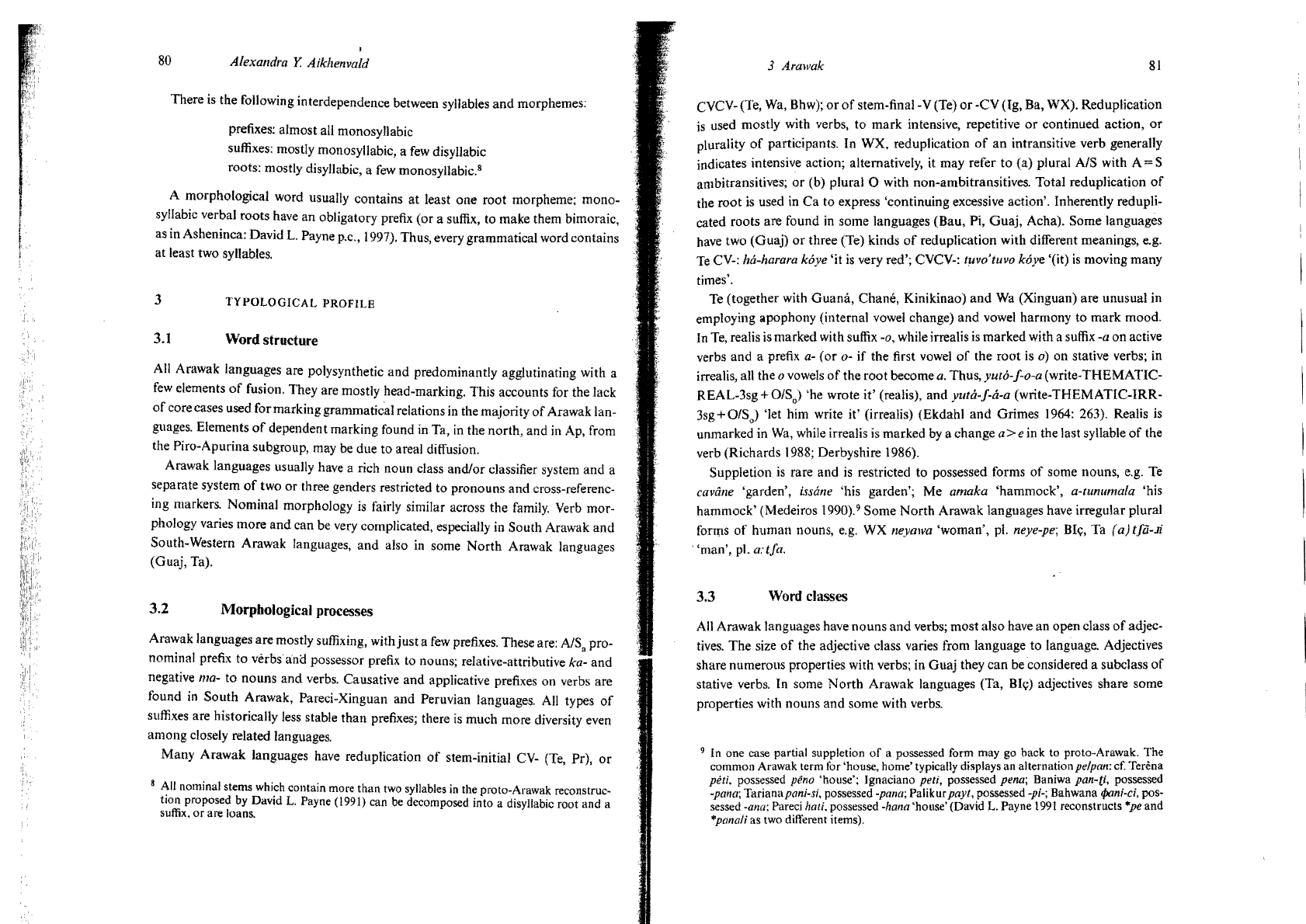
81
80
Alexandra
Y.
Aikhenvald
There
is
the following interdependence between syllables
and
morphemes:
prefixes: almost
al!
monosyllabic
suffixes: mostly monosyllabic, a
few
disyllabic
roots: mostly disyllabie, a
few
monosyllabic.
8
A morphological word usually contains at least one root morpheme; mono-
syllabie verbal roots have an obligatory pretix (or a suffix, to make them bimoraic,
as in Asheninca: David
L.
Payne p.c.,
1997).
Thus, every grammatical word contains
at least two syllables.
3
TYPOLOGICAL
PROFILE
3.1
Word structure
AlI
Arawak languages are polysynthetic and predominantly agglutinating with a
few
elements
of
fusiono
They are mostly head-marking. This accounts for the lack
of
core cases used for marking grammatical relations
in
the majority
of
Arawak lan-
guages. Elements
of
dependent marking found
in
Ta,
in
the north, and
in
Ap, from
the Piro-Apurina subgroup, may
be
due to areal diffusion.
Arawak languages usually have a rich noun class andlor classífier system and a
separate system
of
two or three genders restricted to pronouns and cross-referenc-
íng markers. Nominal morphology
is
fairly similar across the
famíly.
Verb
mOf-
phology varíes more and can be very complicated, especially in South Arawak and
SOllth-Western Arawak languages,
and
al so
in
sorne North Arawak langllages
(Guaj, Ta).
3.2 MorpboJogical processes
Arawak languages are mostly suffixing, withjust a
few
pretixes. These are: A/S. pro-
nominal prefix lo vérbs
ana
possessor pretix to noullS; relative-attributive ka- and
negatíve ma- to nouns
and
verbs. Causative
and
applicative prefixes on verbs are
found
in
South Arawak, Pareci-Xinguan and Peruvian languages.
AlI
types
of
suffixes are historically less stable than prefixes; there
is
much more diversity even
among
c10sely
related languages.
Many Arawak languages have reduplication
of
stem-initíal
CV-
(Te,
Pr),
or
3
AII
nominal stems which
cOl1tain
more Ihan two syllables
in
the prOlo-Arawak reconslruc-
tion proposed by David
L.
Payne (1991) can be decomposed into a disyllabic root and a
suffix.
or
are loans.
3 Arawak
CVCV-
(Te,
Wa, Bhw);
or
of
stem-tinal-V (Te)
or
-CV (Ig, Ba, WX). Reduplicatíon
is
used mostly with verbs, to mark intensive, repetitive
or
continued action,
or
plurality
of
participants. In WX, reduplication
of
an
intransitive verb gene rally
índicates intensive action; alternatively, it may refer to (a) plural
A/S
with
A=S
ambitransitives;
or
(b) plural O with non-ambitransitives. Total reduplieation
of
the rool
is
used
in
Ca
to express 'conlinuing excessíve aelion'. Inherently redupli-
cated roots are found
in
so me languages (Bau, Pi, Guaj, Acha). Sorne languages
have two (Guaj)
or
three (Te) kinds
of
reduplication with different meanings, e.g.
Te
CV-:
há-harara kóye
'it
is
very red'; CVCV-: tuvo'tuvo
kóye
'(it)
ís
moving many
times'.
Te
(together with
Guaná,
Chané, Kiníkinao)
and
Wa
(Xinguan) are untlsual in
employing apophony (internal
vowel
change) and vowel harmony to mark mood.
In
Te,
realis
is
marked with suffix -o, while irrealis
is
marked wíth a suffix -a on active
verbs and a prefix a- (or
0-
if
the tirst
vowel
of
the root
is
o) on stative verbs;
in
irrealis,
al!
the ovowels
of
the root becomea. Thus,yutó-J-o-a (write-THEMATIC-
REAL-3sg+
O/So)
'he wrote it' (realis), and yutá-J-á-a (write-THEMATIC-IRR-
3sg+0/S.,) 'Iet him write ít' (irrealis) (Ekdahl
and
Grimes
1964:
263). Realis
is
unmarked in
Wa,
while irrealis
is
marked
by
a change
a>e
in the last syllable
of
the
verb (Ríchards
1988;
Derbyshire
1986).
Suppletion
is
rare and
is
restrícted to possessed forms
of
sorne nouns,
e.g.
Te
ca
valle
'garden', issálle 'his garden'; Me
amaka
'hammock', a-tunumala 'his
hammock' (Medeiros
1990).9
Some North Arawak languages have irregular plural
fOrI{ls
of
human nouns,
e.g.
WX lIeymva 'woman',
pI.
neye-pe;
BII,':,
Ta (a)
tJií-.Ji
'man',
pI.
a:tfa.
3,3 Word
c1asses
AlI
Arawak languages have nouns
and
verbs; mos! also have an open class
of
adjec-
tíves.
The size
of
the adjective
c1ass
varíes from language to language. Adjectives
share numerous properties with verbs; in Guaj they can be considered a subclass
of
stative verbs. In sorne North Arawak languages (Ta,
BIC;)
adjectives share some
properties with nouns and sorne with verbs.
9 In one case partíal suppletíon
of
a possessed form may go back to proto-Arawak. The
common Arawak term
tor
'house, home' typically displays an alternation
pelpan:
cf.
Terena
péti, possessed
peno
'house'; Ignaciano peti, possessed
pena;
Baníwa pan-ti, possessed
-palla;
Tarianapani-si, possessed
-pana;
Palikurpayl, possessed
opio;
Bahwana
tf>ani-ci,
pos-
sessed
-ana;
Pareci hati, possessed
-halla
'house' (David
L.
Payne
1991
reconstructs
*pe
and
·pallali as two dilferent ¡tems).
- 2008 — 2026 «СтудМед»