
Encyclopedia of Russian History
Подождите немного. Документ загружается.


Hughes, Lindsey, ed. (2000). Peter the Great and the West:
New Perspectives. Basingstoke, UK: Palgrave.
Hughes, Lindsey. (2002). Peter the Great: A Biography.
New Haven, CT: Yale University Press.
Kliuchevsky, Vasily. (1958). Peter the Great, tr. L.
Archibald. New York: St. Martin’s Press.
Pososhkov, Ivan. (1987). The Book of Poverty and Wealth,
ed., tr. A. P. Vlasto, L. R. Lewitter. London: The
Athlone Press.
Raeff, Marc. ed. (1972). Peter the Great Changes Russia.
Lexington, MA: Heath.
Riasanovsky, Nicholas. (1984). The Image of Peter the
Great in Russian History and Thought. Oxford: Ox-
ford University Press.
L
INDSEY
H
UGHES
PETER II
(1715–1730), emperor of Russia, May 1727 to Jan-
uary 1730.
Son of Tsarevich Alexis Petrovich and Princess
Charlotte of Wolfenbüttel, and grandson of Peter I,
the future Peter II had an unfortunate start in life.
His German mother died soon after his birth, and
in 1718 his father died in prison after being tor-
tured and condemned to death for treason. Peter I
did not mistreat his grandson, but feared him as a
possible rallying point for conservatives. He did not
groom him as his heir, and a new Law on Succes-
sion (1722) rejected primogeniture and made it pos-
sible for the ruler to nominate his successor. During
the reign of his step-grandmother, Catherine I
(1725–1727), young Peter found himself under the
protection of Prince Alexander Menshikov, who be-
trothed him to his daughter Maria and persuaded
Catherine to name him as her successor, in the hope
of stealing ground from the old nobility and gain-
ing popularity by restoring the male line. On the
day of Catherine’s death, Peter was proclaimed em-
peror.
For the rest of Peter’s short life it was a ques-
tion of who could manipulate him before he de-
veloped a mind of his own. At first Menshikov kept
the emperor under his wing, but, following a bout
of illness in the summer of 1727, Menshikov was
marginalized then banished by members of the
powerful Dolgoruky clan, backed by the emperor’s
grandmother, Peter I’s ex-wife Yevdokia. Peter II
was crowned in Moscow on March 8 (February 25
O.S.), 1728. His chief adviser was now Prince Alexis
Grigorevich Dolgoruky, but the power behind the
government was Heinrich Osterman. Both men
were members of the Supreme Privy Council. Af-
ter his coronation Peter stayed in Moscow, where
he devoted much of his time to hunting. Portraits
show a handsome boy dressed in the latest West-
ern fashion. His short reign has sometimes been as-
sociated with a move to reject many of Peter’s
reforms, but there is no evidence that Peter II or his
circle planned to return to the old ways, even if
magnates welcomed the opportunity to spend more
time on their Moscow estates. According to one
source, young Peter wished to “follow in the steps
of his grandfather.” He did not get the chance. In
fall 1729 he was betrothed to Prince Dolgoruky’s
daughter Catherine, but the wedding never took
place. On January 29 (January 18 O.S.), 1730, he
died from smallpox, without nominating a succes-
sor. The last of the Romanov male line, he was
buried in the Archangel Cathedral in Moscow.
See also: CATHERINE I; MENSHIKOV, ALEXANDER
DANILOVICH; ROMANOV DYNASTY
BIBLIOGRAPHY
Raleigh, D. J. (1996). The Emperors and Empresses of Rus-
sia: Rediscovering the Romanovs. Armonk, NY: M. E.
Sharpe.
L
INDSEY
H
UGHES
PETER III
(1728–1762), emperor of Russia, January 5, 1762,
to July 9, 1762.
The future Peter III was born Karl Peter Ulrich
in Kiel, Germany, in February 1728, the son of the
duke of Holstein and Peter I’s daughter Anna Petro-
vna, who died shortly after his birth. His paternal
grandmother was a sister of Charles XII of Swe-
den; this relation gave him a claim to the Swedish
throne. In 1742 his aunt, the Empress Elizabeth
(reigned 1741–1762 [1761 O.S.]), brought him to
Russia to be groomed as her heir. Raised a Lutheran
with German as his first language, he received in-
struction in Russian and the Orthodox religion, to
which he converted. In 1745 he was married to the
fifteen-year-old German Princess Sophia of Anhalt
Zerbst, the future Catherine II (“the Great”). On
Christmas Day 1761 (O.S.), Elizabeth died, and Pe-
ter succeeded her.
PETER III
1173
ENCYCLOPEDIA OF RUSSIAN HISTORY
Catherine II’s Memoirs drew a bleak picture of
her marriage, recording bizarre details of Peter
court-martialing rats, bringing hunting dogs to
bed, and spying on Empress Elizabeth through a
hole in the wall. Moreover, she hinted strongly that
the marriage was never consummated and that her
first child, the future Emperor Paul (born 1754),
was in fact the son of her lover. Peter was an “ab-
surd husband,” in fact, not a husband at all. Con-
temporary accounts corroborate the essence, if not
all the details, of Catherine’s portrait of her hus-
band. Peter seems to have been immature, impul-
sive, and unpredictable. He had a keen interest in
military affairs, particularly drill and fortification,
and played the violin quite well, but he also loved
dolls and puppets and enjoyed crude practical jokes
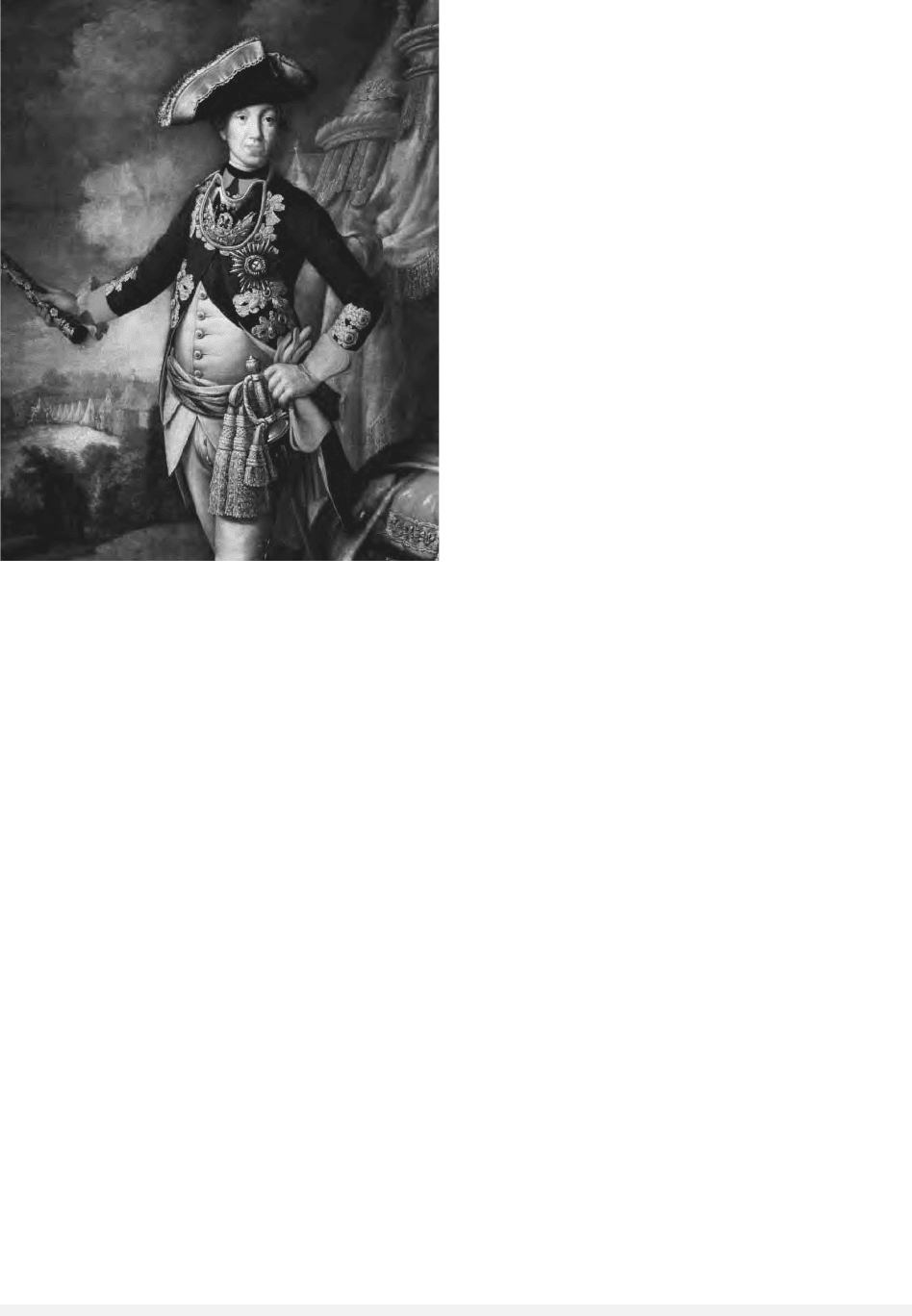
and drinking. Surviving portraits indicate an un-
prepossessing appearance.
But a ruler has never been denied his rightful
throne merely on account of being “absurd,” child-
like, and plain. On the contrary, powerful courtiers
could easily accommodate and even welcomed such
monarchs. Although Peter brought a number of Ger-
mans from Holstein into his council, influential fig-
ures from Elizabeth’s regime such as D. V. Volkov,
A. I. Glebov, and members of the Vorontsov clan
remained powerful. There was even some support
for Peter’s controversial personal decision to make
peace with Prussia, “out of compassion for suffer-
ing humanity and personal friendship toward the
King of Prussia.” The treaty of May 5 (April 24
O.S.) 1762 restored all the territories taken by Rus-
sia during the Seven Years War. Peace triggered
Peter’s most famous edict, the manifesto releasing
the Russian nobility from compulsory state service,
issued on February 29 (February 8 O.S.), 1762,
which Peter himself probably played little part in
drafting. With the prospect of many officers re-
turning from active service, it suited the govern-
ment to save salaries and re-deploy personnel. The
manifesto declared that compulsory service was
no longed needed, because “useful knowledge and
assiduity in service have increased the number of
skillful and brave generals in military affairs, and
have put informed and suitable people in civil and
political affairs.” But this was not an invitation to
wholesale desertion. There were restrictions on im-
mediate release: Nobles must educate their sons
and, on receipt of the monarch’s personal decree,
rally to service. Those who had never served were
to be “despised and scorned” at court.
Other measures issued during Peter’s short
reign included a reduction in the salt tax, a tem-
porary ban on the purchase of serfs for factories,
and some easing of restrictions on peasants enter-
ing and trading in towns. Sanctions were lifted on
Old Believers who had fled into Poland. The Secret
Chancery was abolished and some of its functions
transferred to the Senate. In fulfillment of a deci-
sion already made under Elizabeth, the two million
peasants on church estates were transferred to the
jurisdiction of the state College of Economy, a mea-
sure that did not constitute liberation but was re-
garded as an improvement in the peasants’ status.
In conjunction with the emancipation of the no-
bility, this measure increased speculation that Pe-
ter might have been planning to liberate the serfs.
None of these measures saved Peter III. He de-
moted the Senate, thereby alienating some top of-
ficials. Confiscating its peasants alienated the church.
The decision to end the war with Prussia suited
some influential men, but most opposed Peter’s
further plans to win back Schleswig, formerly the
possession of his Holstein ancestors, with Prussian
support. He disbanded the imperial bodyguard, and
there were rumors that he intended to replace the
PETER III
1174
ENCYCLOPEDIA OF RUSSIAN HISTORY
Emperor Peter III, husband of Catherine the Great. © A
RCHIVO
I
CONOGRAFICO
, S.A./CORBIS

existing guards, now required to wear Prussian uni-
forms, with men from Holstein. His fate was fur-
ther sealed by his alleged contempt for Orthodoxy.
It was rumored that he did not observe fasts and
that he intended to convert Russia to Lutheranism.
Such accusations were exaggerated by Peter’s op-
ponents, who now focused on replacing him with
his more popular wife, who was beginning to fear
for her own safety. On July 5 (June 28 O.S.), 1762,
Catherine seized power with the support of guards
regiments led by her lover Grigory Orlov. “All
unanimously agree that Grand Duke Peter Fyo-
dorovich is incompetent and Russia has nothing to
expect but calamity,” she declared. After vain ef-
forts to rally support, Peter abdicated and was
taken to a residence not far from Peterhof palace.
On July 16 (July 5 O.S.) he died, officially of colic
brought on by hemorrhoids, although rumors
hinted at murder by poison, strangulation, suffo-
cation, beating, or shooting. His escort later ad-
mitted that an “unfortunate scuffle” had occurred,
but nothing was proven and no one charged. Even
if Peter was not killed on Catherine’s explicit or-
ders, his death, while not arousing her regret, of-
ten came back to haunt her.
The somewhat mysterious circumstances of
Peter III’s death and the promising nature of some
of his edicts later made his a popular identity for
a series of pretenders to the throne, culminating in
the Pugachev revolt in 1773 and 1774. Following
Catherine II’s death in 1796, Emperor Paul I, who
never doubted that Peter was his father, had his
parents buried side by side in the Peter and Paul
Cathedral.
See also: CATHERINE II; ELIZABETH
BIBLIOGRAPHY
Hughes, Lindsey. (1982). “Peter III.” Modern Encyclopedia
of Russian and Soviet History 27:238–244. Gulf
Breeze, FL: Academic International Press.
Jones, Robert, E. (1973). The Emancipation of the Russian
Nobility, 1782–1785. Princeton: Princeton University
Press.
Leonard, Carol. (1993). Reform and Regicide: The Reign of
Peter III of Russia. Bloomington: University of Indi-
ana Press.
Madariaga, Isabel de. (1981). Russia in the Age of Cather-
ine the Great. London: Weidenfeld and Nicolson.
Raeff, Marc. (1970). “The Domestic Policies of Peter III
and His Overthrow.” American Historical Review
75:1289–1310.
L
INDSEY
H
UGHES
PETER AND PAUL FORTRESS
The Peter and Paul Fortress was established in May
1703, the third year of the Great Northern War
with Sweden, which would last until 1721. Hav-
ing reduced Swedish positions along the Neva River
from Lake Ladoga, Peter I needed a fortified point
in the Neva estuary to protect Russia’s position on
the Gulf of Finland. Some twenty thousand men
were conscripted to surround the island with
earthen walls and bastions, and by November the
fortress of Sankt Piter Burkh—“Saint Peter’s Burg”—
was essentially completed. It was named in honor
of the Russian Orthodox feast day of Saints Peter
and Paul (June 29).
Peter intended the fortress at the center of his
city to serve not only a military function, but also
as a symbol of his union of state and religious in-
stitutions within a new political order in Russia. To
implement this reformation in the architecture
of Saint Petersburg and its fortress, Dominico
Trezzini, the most productive of the Petrine archi-
tects, capably served Peter. After the completion of
the earthen fortress, Peter ordered a phased re-
building with masonry walls. In May 1706, the
tsar assisted with laying the foundation stone of
the Menshikov Bastion, and for the rest of
Trezzini’s life (until 1734) the design and building
of the Peter-Paul fortress, with its six bastions,
would remain one of his primary duties. The major
sections of the fortress, including the six bastions—
were named either for a leading participant in Pe-
ter’s reign, such as Alexander Menshikov, or for a
member of the imperial house, not excluding Peter
himself.
Within the fortress the dominant feature is the
Cathedral of Saints Peter and Paul, designed by
Trezzini in a radical departure from traditional
Russian church architecture. Trezzini created an
elongated structure, whose baroque dome on the
eastern end is subordinate to the tower and spire
over the west entrance. The tower was the focus
of Peter’s interest and had priority over the rest of
the structure, which was not completed until 1732.
By 1723, the spire, gilded and surmounted with an
angel holding a cross, reached a height of 367 feet
(112 meters), which exceeded the bell tower of Ivan
the Great by 105 feet (32 meters).
On the interior, the large windows that mark
the length of the building provide ample illumi-
nation for the banners and other imperial regalia.
It is not clear whether this great hall was origi-
PETER AND PAUL FORTRESS
1175
ENCYCLOPEDIA OF RUSSIAN HISTORY

nally intended to serve as a burial place for the
Romanov tsars; but with the death of Peter the Great,
this function was assumed from the Archangel
Cathedral in the Kremlin. The centerpiece of the
interior is the gilded icon screen, designed by Ivan
Zarudnyi and resembling the triumphal arches
erected to celebrate Peter’s victories. The frame
was carved between 1722 and 1726 by craftsmen
in Moscow and assembled in the cathedral in
1727. Some of the cathedral’s ornamentation
was lost after a lightning strike and fire in 1756,
although prompt response by the garrison pre-
served the icon screen and much of the interior
work.
The eighteenth century witnessed the con-
struction of many other administrative and garri-
son buildings within the fortress, including an
enclosed pavilion for Peter’s small boat and the state
Mint. At the turn of the nineteenth century the
fortress became the main political prison of Russia.
Famous cultural and political figures detained there
include Alexander Radishchev, Fyodor Dostoevsky,
and Nikolai Chernyshevsky. In 1917, the garrison
sided with the Bolsheviks and played a role in the
shelling of the Winter Palace. During the early
twenty-first century the fortress serves primarily
as a museum.
See also: MENSHIKOV, ALEXANDER DANILOVICH; PETER I
BIBLIOGRAPHY
Brumfield, William Craft. (1993). A History of Russian
Architecture. New York: Cambridge University Press.
Hamilton, George Heard. (1975). The Art and Architecture
of Russia. Harmondsworth, UK: Penguin Books.
W
ILLIAM
C
RAFT
B
RUMFIELD
PETER THE GREAT See PETER I.
PETRASHEVSKY, MIKHAIL See BUTASHEVICH-
PETRASHEVSKY, MIKHAIL VASILIEVICH.
PETRASHEVTSY
Given the oppressive power of the state under
Nicholas I and the weakness of civil society in Rus-
sia, the political ferment that rocked Europe dur-
ing the 1840s took the relatively subdued form
of discussion groups meeting secretly in private
homes. The most important of such groups met on
Friday evenings in the St. Petersburg home of a
young official of the Ministry of Foreign Affairs,
Mikhail Butashevich-Petrashevsky, from late 1845
until the group was disbanded by the police in a
wave of repression following the revolutions that
erupted in Western Europe in 1848. More than one
hundred members of the group were arrested and
interrogated, and twenty-one of the leading figures
were condemned to death. In an infamous instance
of psychological torture, on December 22, 1849,
the condemned men were led to the scaffold and
hooded, and the firing squad ordered to shoulder
arms, before an imperial adjutant rode up with a
last-minute reprieve commuting the sentences to
imprisonment or banishment. Among those sent to
Siberia was the novelist Fyodor Dostoyevsky, who
later depicted the members of the group in his novel
The Possessed.
The meetings of the Petrashevtsy, as the police
labeled the men who met in Petrashevsky’s home,
were open to invited guests as well as regular mem-
bers. Thus, over the course of the group’s existence,
several hundred men took part in the discussions.
Some attendees were wealthy landowners or emi-
nent writers or professors, such as the poets Alexei
Pleshcheyev and Apollon Maikov and the econo-
mist V. A. Milyutin. The majority, however, were
of modest means and held middle- or low-ranking
positions in state service or were students or small-
scale merchants. Serious about political ideas, they
amassed a large collection of works in several lan-
guages on political philosophy and economics.
While Petrashevsky himself was committed to the
utopian socialism of Charles Fourier, and socialist
thought was the dominant theme of the discus-
sions, members of the group held a range of ideo-
logical and tactical approaches to the problem of
transforming Russian society. Their most impor-
tant project was the publication in 1845 and 1846
of A Pocket Dictionary of Foreign Terms, an effort to
propagate their ideas through political articles dis-
guised as dictionary entries. The censors eventually
realized the subversive nature of the dictionary and
ordered it confiscated, but not in time to prevent
the sale of part of the second, more radical, edition.
The Petrashevtsy were not opposed in princi-
ple to a violent overthrow of the tsar’s government,
but in practice most saw little hope of a successful
revolution in Russia and therefore advocated par-
tial reforms such as freedom of speech, freedom of
PETER THE GREAT
1176
ENCYCLOPEDIA OF RUSSIAN HISTORY

press, and reform of the judicial system. The more
radical members, led by Nikolai Speshnev, hoped to
transform the group into a revolutionary organi-
zation that would prepare the ground for an armed
revolt. Through subsidiary discussion circles that
branched off from the original group, such as the
one to which the novelist Nikolai Chernyshevsky
belonged while a university student, the Petra-
shevtsy played an important role in propagating
socialist ideas in Russia.
See also: CHERNYSHEVSKY, NIKOLAI GAVRILOVICH; DOS-
TOYEVSKY, FYODOR MIKHAILOVICH; NICHOLAS I
BIBLIOGRAPHY
Seddon, J. H. (1985). The Petrashevtsy: A Study of the Russ-
ian Revolutionaries of 1848. Manchester, UK: Man-
chester University Press.
Walicki, Andrzej. (1979). A History of Russian Thought:
From the Enlightenment to Marxism. Stanford, CA:
Stanford University Press.
K
ATHRYN
W
EATHERSBY
PETROV, GRIGORY SPIRIDONOVICH
(1868–1925), Orthodox priest and a leading pro-
ponent of Christian social activism.
Grigory Petrov was born in Iamburg, St. Pe-
tersburg province. He was educated at the diocesan
seminary and the St. Petersburg Ecclesiastical Acad-
emy (1887–1891), and on graduating became a
priest in a St. Petersburg church.
Petrov was also active as a writer. In his most
successful work, The Gospel as the Foundation of Life
(1898), he argued that Christian believers were re-
quired to apply the literal teachings of Jesus to
every aspect of their lives in order to begin build-
ing the Kingdom of God here on earth. Petrov knew
of the American Social Gospel movement, but his
ideas were shaped by his encounters with new con-
ceptions of pastorship and Christian activism then
developing among the clergy of St. Petersburg.
Petrov’s writings found a ready audience and
made him famous. In 1903, however, conserva-
tives began to attack his ideas in the ecclesiastical
press, and as a result in 1904 the church dismissed
Petrov from his pulpit and banned him from pub-
lic speaking. Nevertheless, Petrov continued to write.
He became interested in Christian politics and was
an activist during the Revolution of 1905. He es-
tablished the newspaper God’s Truth in Moscow in
1906 and was elected to the first Duma as a Con-
stitutional Democrat.
Petrov never served in the Duma, however, be-
cause he was charged before an ecclesiastical court
with false teaching. Although exonerated, he was
confined to a monastery under church discipline.
Despite popular sympathy for Petrov, the church
defrocked him in 1908 and banned him from the
capital and from public employment. He then be-
came a journalist for a liberal newspaper, The Word.
After the revolutions of 1917 he emigrated to Ser-
bia, and then in 1922 to France. He died in Paris in
1925.
Petrov’s main importance was in his contribu-
tion to the development of a modern, liberal un-
derstanding of Christianity in the Russian Orthodox
context.
See also: ORTHODOXY
BIBLIOGRAPHY
Valliere, Paul. (1977). “Modes of Social Action in Russ-
ian Orthodoxy: The Case of Father Petrov’s Zateinik.”
Russian History 4(2):142–158.
J
ENNIFER
H
EDDA
PETRUSHKA
Petrushka was a Russian puppet theater spectacle
and also the name of its main character (cf. the
English Punch).
The play Petrushka seems to derive from a na-
tive older Russian buffoon and minstrel tradition
and the Western European puppet theater tradition
with its roots in the Italian commedia dell’arte. Pos-
sible evidence of the Petrushka play in Russia is
found as early as 1637 in an engraving and de-
scription by a Dutch traveler, Adam Olearius. From
around the 1840s to the 1930s, the Petrushka show
was one of the most popular kinds of improvisa-
tional theater in Russia, often performed at fairs
and carnivals and on the streets on a temporary
wooden stage (balagan). The show was presented
by two performers, one of whom manipulated the
puppets, while the other played a barrel-organ.
Recorded textual variants from the nineteenth
PETRUSHKA
1177
ENCYCLOPEDIA OF RUSSIAN HISTORY

and twentieth centuries depict the adventures of
Petrushka, a dauntless prankster and joker, who
uses his wit as well as a vigorously wielded club
to get the better of his adversaries, who often rep-
resent established authority. The themes tend to be
sexist and violent. Petrushka is usually dressed in
a red caftan and pointed red cap, and has a hunch-
back, a large hooked nose, and a prominent chin.
The most popular scenes involve Petrushka and a
handful of characters, among them his fiancée or
wife, a gypsy horse trader, a doctor or apothecary,
an army corporal, a policeman, the devil, and a
large fluffy dog. Igor Stravinsky’s ballet Petrushka
(1911) is probably the most famous adaptation of
this puppet theater show.
See also: FOLKLORE; FOLK MUSIC; STRAVINSKY, IGOR FYO-
DOROVICH.
BIBLIOGRAPHY
Kelly, Catriona. (1990). Petrushka: The Russian Carnival
Puppet Theatre. Cambridge, UK: Cambridge Univer-
sity Press.
Zguta, Russell. (1978). Russian Minstrels: A History of the
Skomorokhi. Philadelphia: University of Pennsylvania
Press.
P
ATRICIA
A
RANT
PETTY TUTELAGE
Petty tutelage in the Soviet economy meant that
the day-to-day operations of enterprises could be
(and frequently were) directly influenced or con-
trolled by decisions or actions of the industrial min-
istry to which the enterprise was subordinate.
While Soviet enterprise managers ultimately were
responsible for producing the goods identified by
planners, industrial ministry officials exercised
control over the firm in a number of ways. First,
the industrial ministry annually allocated the plan
targets among the enterprises subordinate to it,
thereby defining changes in output requirements
by firm over time. That is, ministry officials were
responsible for disaggregating the targets they re-
ceived from Gosplan, the State Planning Commit-
tee, and preparing the annual enterprise plan, the
techpromfinplan. Second, industrial ministry offi-
cials distributed the financial resources provided to
them by state committees to individual firms. Fi-
nancial resources included funds for wages and in-
vestment purposes. Third, each industrial ministry
redistributed profits earned by firms subordinate to
them among these same firms. Finally, ministry
officials responded to requests from enterprise
managers to change or “correct” output plan tar-
gets or input allocations over the course of the plan-
ning period if circumstances precluded successful
plan fulfillment.
During perestroika, numerous policies were
adopted to reduce petty tutelage by industrial min-
istry officials over Soviet enterprise operations.
Some view the reduction of ministerial tutelage and
the corresponding increase in decision-making au-
thority by enterprises as a cornerstone of pere-
stroika. Ministry officials were to cease exercising
routine daily control over enterprises and focus
instead on long-term issues such as promoting
investment and technological advance. However,
performance measures applied to the industrial
ministry remained linked to the performance of
their firms, and the ministry retained control over
funds and resources to be allocated to Soviet en-
terprises. Consequently, in practice, it is unlikely
that petty tutelage declined.
See also: GOSPLAN; TECHPROMFINPLAN
BIBLIOGRAPHY
Berliner, Joseph S. (1957). Factory and Manager in the
USSR. Cambridge, MA: Harvard University Press.
Gregory, Paul R. (1990). Restructuring the Soviet Economic
Bureaucracy. New York: Cambridge University Press.
S
USAN
J. L
INZ
PHOTOGRAPHY
The development of photography in Russia during
the nineteenth century followed a history similar
to that of other European countries. After Louis-
Jacques-Mandé Daguerre and William Henry Fox
Talbot made public their methods for capturing im-
ages on light-sensitized surfaces in 1839, I. Kh.
Gammel, corresponding member to the Russian
Academy of Sciences, visited both inventors to learn
more about their work and collected samples of
daguerreotypes and calotypes for study by Russ-
ian scientists. The Academy subsequently commis-
sioned Russian scientists to further investigate both
PETTY TUTELAGE
1178
ENCYCLOPEDIA OF RUSSIAN HISTORY

processes. As elsewhere, Russian experimenters
quickly introduced a variety of refinements to the
initial processes.
Photography found immediate popular success
in Russia with the establishment of daguerreotype
portrait studios in the 1840s. The similarity of the
photograph to the Orthodox icon (an image that
is believed to be a direct and truthful record of a
physical being) heightened the early reception of
photography and resulted in the persistence of por-
traiture as a major genre in Russia. While the first
generation of photographers was largely foreign,
native practitioners soon appeared. Some, such as
Sergei Levitsky, achieved international recognition
for their role in the development of photography.
A personal acquaintance of Daguerre, Levitsky es-
tablished studios in both France and Russia, serv-
ing as court photographer for the Romanovs and
Napoleon III. During the later nineteenth century,
Russian photography became institutionalized with
the establishment of journals, professional societies,
and exhibitions.
While photography was initially largely re-
jected as an art, it became widely accepted with the
emergence of Realism. Russian photographers used
the camera to capture the changing social land-
scape that accompanied the liberation of the serfs
and growing urbanization. Simultaneously, ethno-
graphic photography became an important genre
with the expansion of the Russian Empire and the
opening of Central Asia. Numerous photographic
albums and research projects documented the peo-
ples, customs, landscape, and buildings of diverse
parts of the Russian Empire. With the rise of Sym-
bolism, a younger generation of pictorialist pho-
tographers rejected the photograph as document
in pursuit of more aestheticizing manipulated im-
ages.
At the turn of the century, technological de-
velopments led to the appearance of popular illus-
trated publications and the emergence of modern
press photography. The Bulla family established
the first Russian photo agency; they documented
such events as the Russo-Japanese War, World War
I, and the 1917 Revolutions. The growing com-
mercial availability of inexpensive cameras and
products rendered photography more pervasive in
Russia. However, with the commercialization of
photography, Russian practitioners became in-
creasingly dependent upon foreign equipment and
materials. With the outbreak of World War I, pho-
tographers were largely cut off from their supplies,
and the ensuing crisis severely limited photographic
activity until the mid-1920s.
After the October Revolution, Russian photog-
raphy followed a unique path due to the ideologi-
cal imperatives of the Soviet regime. The Bolsheviks
quickly recognized the propaganda potential of
photography and nationalized the photographic in-
dustry. During the civil war, special committees
collected historical photographs, documented con-
temporary events, and produced photopropaganda.
In the early 1920s, Russian modernist artists, such
as Alexander Rodchenko, experimented with the
technique of photomontage, the assembly of pho-
tographic fragments into larger compositions.
With the growing politicization of art, photomon-
tage and photography soon became important me-
dia for the creation of ideological images. The 1920s
also witnessed the foundation of the Soviet illus-
trated mass press. Despite a shortage of experienced
photojournalists, the development of the illustrated
press cultivated a new generation of Soviet pho-
tographers. Mikhail Koltsov, editor of the popular
magazine Ogonek, laid the groundwork for modern
photojournalism in the Soviet Union by establish-
ing national and international mechanisms for the
production, distribution, and preservation of pho-
tographic material. Koltsov actively promoted pho-
tographic education and the further development
of both amateur and professional Soviet photogra-
phy through the magazine Sovetskoye foto.
During the First Five-Year Plan, creative de-
bates emerged between modernist photographers
and professional Soviet photojournalists. While
both groups shunned aestheticizing pictorialist ap-
proaches and were ideologically committed to the
development of uniquely Soviet photography, dif-
ferences arose concerning creative methods, espe-
cially the relative priority to be given to the form
versus content of the Soviet photograph. These
debates stimulated the further development of So-
viet documentary photography. The illustrated
magazine USSR in Construction (SSSR na stroike;
1930–1941, 1949) was an important venue for So-
viet documentary photography. Published in Russ-
ian, English, French, and German editions, it
featured the work of top photographers and pho-
tomontage artists. Like the nineteenth-century
ethnographic albums, USSR in Construction pre-
sented the impact of Soviet industrialization and
modernization in diverse parts of the USSR in film-
like photographic essays. As the 1930s progressed,
official Soviet photography became increasingly
lackluster and formulaic. Published photographs
PHOTOGRAPHY
1179
ENCYCLOPEDIA OF RUSSIAN HISTORY

were subjected to extensive retouching and
manipulation—not for creative ends, but for the
falsification of reality and history. An abrupt
change took place during World War II, when So-
viet photojournalists equipped with 35-millimeter
cameras produced spontaneous images that cap-
tured the terrors and triumphs of war.
Soviet amateur photography flourished in the
late 1920s with numerous worker photography
circles. Amateur activity was stimulated by the de-
velopment of the Soviet photography industry and
the introduction of the first domestic camera in
1930. Later that decade, however, government reg-
ulations increasingly restricted the activity of am-
ateur photographers, and the number of circles
quickly diminished. The material hardships of the
war years further compounded this situation, prac-
tically bringing amateur photographic activity to
a standstill. With independent activity severely cir-
cumscribed, Soviet photography was essentially
limited to the carefully controlled area of profes-
sional photojournalism.
During the Thaw of the late 1950s, the appear-
ance of new amateur groups led to the cultivation
of a new generation of photographers engaged in
social photography that captured everyday life.
Their activity, however, was largely underground.
By the 1970s, photography played an important
role in Soviet nonconformist and conceptual art.
Artists such as Boris Mikhailov appropriated and
manipulated photographic imagery in a radical cri-
tique of photography’s claims to truth. After the
collapse of the Soviet Union, many photographic
publications and industrial enterprises gradually dis-
appeared. While professional practitioners quickly
adapted to the new market system and creative pho-
tographers achieved international renown, the main
area of activity was consumer snapshot photogra-
phy, which flourished in Russia with the return of
foreign photographic firms.
See also: CENSORSHIP; NATIONALISM IN THE ARTS
BIBLIOGRAPHY
Elliott, David, ed. (1992). Photography in Russia,
1840–1940. London: Thames and Hudson.
King, David. (1997). The Commissar Vanishes: The Falsi-
fication of Photographs and Art in Stalin’s Russia. New
York: Metropolitan Books.
Sartori, Rosalind. (1987). “The Soviet Union.” In A His-
tory of Photography: Social and Cultural Perspectives,
ed. Jean-Claude Lemagny and André Rouillé. Cam-
bridge, UK: Cambridge University Press.
Shudakov, Grigory (1983). Pioneers of Soviet Photography.
New York: Thames and Hudson.
USSR in Construction. (1930–1941, 1949). Moscow: Go-
sizdat.
Walker, Joseph, et al. (1991). Photo Manifesto: Contem-
porary Photography in the USSR. New York: Stewart,
Tabori & Chang.
E
RIKA
W
OLF
PIMEN, PATRIARCH
(1910–1990), patriarch of the Russian Orthodox
Church from June 2, 1971, to May 3, 1990.
Sergei Mikhailovich Izvekov took monastic
vows in 1927 and worked with church choirs in
Moscow. Later, as Patriarch Pimen, his excellent
musical sense led him to forbid singers to embell-
ish the liturgy with operatic flourishes.
During World War II Pimen allegedly concealed
his monastic vows and served as an army officer
in communications or intelligence. When discov-
ered, he was incarcerated, and his political vulner-
ability was said to have figured in the Soviet
authorities’ decision that he could be controlled as
patriarch. More friendly sources recount his hero-
ism in protecting his men with his own body un-
der bombardment. His official biography omits his
military service.
Judgments of Pimen as patriarch are mixed. He
was accused of being withdrawn, passive, and in-
creasingly infirm. On the other hand, he was a
gifted poet, radiated spirituality, and was said to
have defended the integrity of the Church against
corrupting modernism and reckless innovation. Pi-
men’s moment came when Communist General
Secretary Mikhail Gorbachev decided to greet the
millennium of Russia’s conversion to Christianity
by improving relations with the Church. Gorbachev
received Pimen on April 29, 1988, and more than
eight hundred new parishes were permitted to open
that year. Sunday schools, charitable works, new
seminaries and convents, and other concessions to
church needs followed. Whether these tangible ben-
efits justified Pimen’s political collaboration with the
Soviet regime is a controversial question.
See also: RUSSIAN ORTHODOX CHURCH; RUSSIFICATION
PIMEN, PATRIARCH
1180
ENCYCLOPEDIA OF RUSSIAN HISTORY

BIBLIOGRAPHY
Pospielovsky, Dimitry. (1984). The Russian Church Under
the Soviet Regime 1917–1982. 2 vols. Crestwood, NY:
St. Vladimir’s Seminary Press.
N
ATHANIEL
D
AVIS
PIROGOV, NIKOLAI IVANOVICH
(1810–1881), scientist, physician, proponent of ed-
ucational reform.
Nikolai Pirogov was born in Moscow where his
father managed a military commissary. After grad-
uating from the medical school of Moscow Uni-
versity, he enrolled at the Professors’ Institute at
Dorpat University to prepare for teaching in insti-
tutions of higher education. In Dorpat he special-
ized in surgical techniques and in pathological
anatomy and physiology. After five years at Dor-
pat, he went to Berlin University in search of the
latest knowledge in anatomy and surgical tech-
niques. While in Berlin he was appointed a pro-
fessor at Dorpat, where he quickly acquired a
reputation as a successful contributor to anatomy
and an innovator in surgery. In 1837–1839 he pub-
lished Surgical Anatomy of Arterial Trunks and Fas-
ciae in Latin and German.
In 1841 Pirogov accepted a teaching position at
the Medical and Surgical Academy in St. Peters-
burg, the most advanced school of its kind in Rus-
sia. He lectured on clinical service in hospitals and
pathological and surgical anatomy. His major work
published under the auspices of the Medical and
Surgical Academy was the four-volume Anatomia
Topographica (1851–1854) describing the spatial re-
lations of organs and tissues in various planes. He
was also the author of General Military Field Surgery
(1864), relying heavily on his experience in the
Crimean War (1853–1855). In recognition of his
scholarly achievement, the St. Petersburg Academy
of Sciences elected him a corresponding member.
Tired of petty academic quarrels and intrigues,
Pirogov resigned from his professorial position in
1856. In the same year he published “The Questions
of Life,” an essay emphasizing the need for a reori-
entation of the country’s educational system. The
article touched on many pedagogical problems of
broader social significance, but the emphasis was
on an educational philosophy that placed equal em-
phasis on the transmission of specialized knowledge
and the acquisition of general education fortified by
increased command of foreign languages. He also
pointed out that, because of the low salaries, Russ-
ian teachers were compelled to look for additional
employment, which limited their active involve-
ment in the educational process. In his opinion, one
of the most pressing tasks of the Russian govern-
ment was to make the entire school system acces-
sible to all social strata and ethnic groups.
The government not only listened to Pirogov’s
plea for a broader humanistic base of the educa-
tional system, but in the same year appointed him
superintendent of the Odessa school district. Two
years later, he became the superintendent of the
Kiev school district. In his numerous circulars and
published reports he advocated a greater participa-
tion of teachers’ councils in decisions on all aspects
of the educational process.
Apprehensive of the long list of his liberal re-
forms, the Ministry of Public Education decided in
1861 to ask Pirogov to resign from his high post
in education administration. His dismissal pro-
voked a series of rebellious demonstrations by Kiev
University students.
Pirogov’s government service, however, did not
come to an end. In 1862 he was assigned the chal-
lenging task of organizing and supervising the ed-
ucation of Russian students enrolled in Western
universities. In 1866 the government again retired
him; the current minister of public education thought
that the supervision of foreign education could be
done more effectively by a “philologist” than by a
“surgeon.”
In 1881 a large group of scholars gathered in
Moscow to celebrate the fiftieth anniversary of
Pirogov’s engagement in science. Four years later,
an even larger group founded the Pirogov Society
of Russian Physicians with a strong interest in so-
cial medicine. It was not unusual for the periodic
conventions of the Society to be attended by close
to two thousand persons.
See also: EDUCATION
BIBLIOGRAPHY
Frieden, Nancy M. (1981). Russian Physicians in an Era
of Reform and Revolution, 1856–1905. Princeton, NJ:
Princeton University Press.
Vucinich, Alexander. (1963–1970). Science in Russian Cul-
ture, vols. 1–2. Stanford, CA: Stanford University
Press.
A
LEXANDER
V
UCINICH
PIROGOV, NIKOLAI IVANOVICH
1181
ENCYCLOPEDIA OF RUSSIAN HISTORY

PISAREV, DMITRY IVANOVICH
(1840–1868), noted literary critic, radical social
thinker, and proponent of “rational egoism” and
nihilism.
Born into the landed aristocracy, Dmitry
Ivanovich Pisarev studied at both Moscow Univer-
sity and St. Petersburg University, concentrating
on philology and history. From 1862 to 1866, Pis-
arev served as the chief voice of the journal The
Russian Word (Russkoye slovo), a journal somewhat
akin to The Contemporary (Sovremennik), which was
published and edited by the poet Nikolai Nekrasov
(1821–1878). In 1862 Pisarev was imprisoned in
the Petropavlovsk Fortress for writing an article
criticizing the tsarist government and defending the
social critic Alexander Herzen, editor of the London-
based émigré journal The Bell (Kolokol). Ironically,
Pisarev’s arrest marked his own rise to prominence,
coinciding with the death of Nikolai Dobrolyubov
in 1861 and arrest of Nikolai Chernyshevsky in
1862. During his incarceration for the next four
and one-half years, Pisarev continued to write for
the The Russian Word, including several influential
articles exhibiting his literary panache: “Notes on
the History of Labor” (1863), “Realists” (1864),
“The Historical Ideas of Auguste Comte” (1865),
and “Pushkin and Belinsky” (1865). His articles on
Plato and Prince Metternich, and especially the ar-
ticle “Scholasticism of the Nineteenth Century”
brought him fame as a literary critic.
Pisarev differed from other, more liberal, social
reformers of the first half of the decade, since he
stressed individual-ethical aspects of socioeconomic
reforms, such as family problems and the difficult
position of women in society. When Cherny-
shevsky’s novel What is to Be Done (Chto delat?)
came out in 1863, Pisarev praised it as a utilitar-
ian tract focusing on the positive aspects of nihilism
(generally, the view that no absolute values exist).
At the same time, Pisarev criticized Chernyshevsky
for his intellectual timidity and failure to develop
his ideas far enough. According to Pisarev, a func-
tional society did not need literature (“art for art’s
sake”), and literature, therefore, should simply
merge with journalism and scholarly investigation
as descriptions of reality. He even assaulted the rep-
utation of Alexander Pushkin, claiming that the
poet’s work hindered social progress and should be
consigned to the dustbin of history.
Rather than scorn Ivan Turgenev’s novel Fa-
thers and Sons (Otsy i deti), written in 1862, as
Chernyshevsky did, claiming it castigated the rad-
ical youth, Pisarev strongly identified with the
novel’s hero Bazarov—a nihilist who believes in
reason and has a scientific understanding of soci-
ety’s needs, but rejects traditional religious beliefs
and moral values. “Bazarov,” Pisarev wrote, “is a
representative of our younger generation; in his
person are gathered together all those traits scat-
tered among the mass to a lesser degree.” To Pis-
arev, Bazarov’s “realism” and “empiricism” reduced
all matters of principle to individual preference.
Turgenev’s hero is governed only by personal
caprice or calculation. Neither over him, nor out-
side him, nor inside him does he recognize any reg-
ulator, any moral law. Far above feeling any moral
compunction against committing crimes, the new
hero of the younger generation would hardly sub-
ordinate his will to any such antiquated prejudice.
Pisarev’s readers gleaned in the author him-
self some of these same extremist, nihilist ten-
dencies. However, while Pisarev was an extremist
intellectual, he was an honest one. He eloquently
advocated such practical social types as Bazarov—
activists for the intelligentsia, that is, people who
could play the role of a “thinking proletariat.” Yet
Pisarev himself did not advocate a political revo-
lution. He believed society, and above all the mass
of the people, could be transformed through so-
cioeconomic change. He simply denounced what-
ever stood in the way of such peaceful change
more trenchantly than any of his predecessors
had. Thus this urging to attack anything that
seemed socially useless sounded more revolution-
ary than it really was.
Upon his release from prison, Pisarev con-
tributed articles to the journals The Task (Delo) and
Notes of the Fatherland (Otechestvennye zapiski). Al-
though he drowned in the Gulf of Riga in 1868,
at the age of twenty-eight, his ideas continued to
influence other writers, notably Fyodor Dos-
toyevsky. In Crime and Punishment (Prestuplenie i
nakazanie) Dostoyevsky’s hero Raskolnikov (from
the word raskol or “split”) shows what occurs
when one flaunts moral principles and takes a hu-
man life. In The Possessed (Besy) Dostoyevsky
shows his reader the worst ways in which human
beings can abuse their freedom. Several characters
in this novel act on horrifying beliefs, leaving nu-
merous dead bodies in their wake. Raskolnikov’s
views pale next to the shocking behavior of the
“demons” whom Dostoyevsky feared most: hu-
man beings who lose their perspective and let the
worst side of their natures predominate.
PISAREV, DMITRY IVANOVICH
1182
ENCYCLOPEDIA OF RUSSIAN HISTORY