
Encyclopedia of Russian History
Подождите немного. Документ загружается.


Pearl, Deborah. (1996). “From Worker to Revolutionary:
The Making of Worker Narodovol’tsy.” Russian His-
tory 23(1–4):11–26.
Venturi, Franco. (1966). Roots of Revolution: A History of
the Populist and Socialist Movements in Nineteenth Cen-
tury Russia, tr. Francis Haskell. New York: Univer-
sal Library.
D
EBORAH
P
EARL
PERESTROIKA
Perestroika was the term given to the reform process
launched in the Soviet Union under the leadership
of Mikhail Gorbachev in 1985. Meaning “recon-
struction” or “restructuring,” perestroika was a con-
cept that was both ambiguous and malleable. Its
ambiguity lay in the fact that it might convey no
more than a reorganization of existing Soviet in-
stitutions and thus be a synonym for reform of a
modest kind or, alternatively, it could signify re-
construction of the system from the foundations
up, thus amounting to transformative change. The
vagueness and ambiguity were initially an advan-
tage, for even the term reform had become taboo
during the conservative Leonid Brezhnev years af-
ter the Soviet leadership had been frightened by the
Prague Spring reforms of 1968.
Perestroika had the advantage of coming with-
out political and ideological baggage. Everyone
could—in the first two years, at least, of the Mikhail
Gorbachev era—be in favor of it. Its malleability
meant that under this rubric some urged modest
change that in their view was enough to get the
economy moving again while others who wished
to transform the way the entire system worked
were able to advance more daring arguments, tak-
ing cover under the umbrella of perestroika. Within
Gorbachev’s own top leadership team, both Yegor
Ligachev and Alexander Yakovlev expressed their
commitment to perestroika, but for the latter this
meant much more far-reaching political reform
than for the former. Once political pluralism had
by 1989 become an accepted norm, perestroika as
a concept had largely outlived its political utility.
For Gorbachev himself the term “perestroika”
meant different things at different times. Initially,
it was a euphemism for “reform,” but later it came
to signify systemic change. Gorbachev’s views un-
derwent a major evolution during the period he
held the post of General Secretary of the Central
Committee of the CPSU and that included the
meaning he imparted to perestroika. In an impor-
tant December 1984 speech before he became So-
viet leader, Gorbachev had said that one of the
important things on the agenda was a “perestroika
of the forms and methods of running the econ-
omy.” By 1987 the concept for Gorbachev was
much broader and clearly embraced radical politi-
cal reform and the transformation of Soviet for-
eign policy. Gorbachev’s thinking at that time was
set out in a book, Perestroika: New Thinking for our
Country and the World. While the ideas contained
were far removed from traditional Soviet dogma,
they by no means yet reflected the full evolution
of Gorbachev’s own position (and, with it, his un-
derstanding of perestroika). In 1987 Gorbachev was
talking about radical reform of the existing system.
During the run-up to the Nineteenth Conference of
the Communist Party, held in the summer of 1988,
he came to the conclusion that the system had to
be transformed so comprehensively as to become
something different in kind. In 1987 he still spoke
about “communism,” although he had redefined it
to make freedom and the rule of law among its un-
familiar values; by the end of the 1980s, Gorbachev
had given up speaking about “communism.” The
“socialism,” of which he continued to speak, had
become socialism of a social democratic type.
Perestroika became an overarching conception,
under which a great many new concepts were in-
troduced into Soviet political discourse after 1985.
These included such departures from the Marxist-
Leninist lexicon as glasnost (openness, trans-
parency), pravovoe gosudarstvo (a state based on the
rule of law), checks and balances, and pluralism.
One of the most remarkable innovations was Gor-
bachev’s breaking of the taboo on speaking posi-
tively about pluralism. Initially (in 1987) this was
a “socialist pluralism” or a “pluralism of opinion.”
That, however, opened the way for others in the
Soviet Union to talk positively about “pluralism”
without the socialist qualifier. By early 1990 Gor-
bachev himself had embraced the notion of “polit-
ical pluralism,” doing so at the point at which he
proposed to the Central Committee removing from
the Soviet Constitution the guaranteed “leading
role” of the Communist Party.
Even perestroika as understood in the earliest
years of Gorbachev’s leadership—not least because
of its embrace of glasnost—opened the way for real
political debate and political movement in a system
which had undergone little fundamental political
change for decades. In his 1987 book, Perestroika,
PERESTROIKA
1163
ENCYCLOPEDIA OF RUSSIAN HISTORY
Gorbachev wrote: “Glasnost, criticism and self-
criticism are not just a new campaign. They have
been proclaimed and must become a norm in the
Soviet way of life . . . . There is no democracy, nor
can there be, without glasnost. And there is no
present-day socialism, nor can there be, without
democracy.” Such exhortation was alarming to
those who wished to preserve the Soviet status quo
or to revert to the status quo ante. It was, though,
music to the ears of people who wished to promote
the more rapid democratization of the Soviet sys-
tem, even to advocate moving further and faster
than Gorbachev at the time was prepared to en-
dorse.
If perestroika is considered as an epoch in So-
viet and Russian history, rather than a concept
(though conceptual change in a hitherto ideocratic
system was crucially important), it can be seen as
one in which a Pandora’s box was opened. The sys-
tem, whatever its failings, had been highly effec-
tive in controlling and suppressing dissent, and it
was far from being on the point of collapse in 1985.
Perestroika produced both intended and unintended
consequences. From the outset Gorbachev’s aims
included a liberalization of the Soviet system and
the ending of the Cold War. Liberalization, in fact,
developed into democratization (the latter term be-
ing one that Gorbachev used from the beginning,
although its meaning, too, developed within the
course of the next several years) and the Cold War
was over by the end of the 1980s. A major aspect
of perestroika in its initial conception was, how-
ever, to inject a new dynamism into the Soviet
economy. In that respect it failed. Indeed, Gor-
bachev came to believe that the Soviet economic
system, just like the political system, needed not
reform but dismantling and to be rebuilt on dif-
ferent foundations.
The ultimate unintended consequence of pere-
stroika was the disintegration of the Soviet Union.
Liberalization and democratization turned what
Gorbachev had called “pre-crisis phenomena” (most
PERESTROIKA
1164
ENCYCLOPEDIA OF RUSSIAN HISTORY
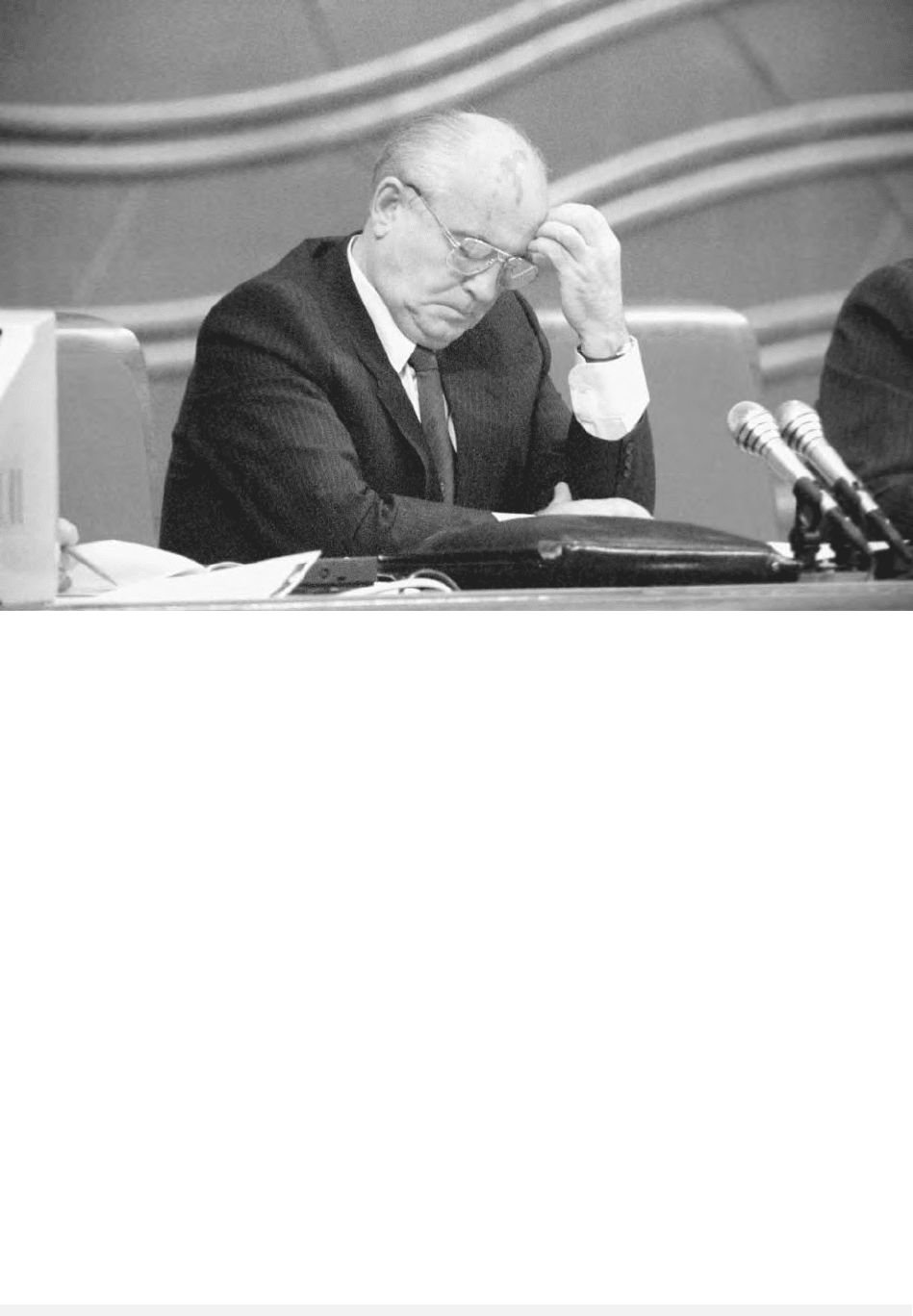
Mikhail Gorbachev reacts to the announcement of foreign minister Eduard Shevardnadze’ planned resignation at a Congress of the
People’s Deputies meeting held December 20, 1990. B
ORIS
Y
URCHENKO
/A
SSOCIATED
P
RESS
. R
EPRODUCED BY PERMISSION
.

notably, economic stagnation) during the early
1980s into a full-blown crisis of survival of the
state by 1990–1991. Measuring such an outcome
against the initial aims of perestroika suggests its
failure. But the goals of the foremost proponents
of perestroika, and of Mikhail Gorbachev person-
ally, rapidly evolved, and democratization came to
be given a higher priority than economic reform.
At the end of this experiment in the peaceful trans-
formation of a highly authoritarian system, there
were fifteen newly independent states and Russia
itself had become a freer country than at any point
in its previous history. Taken in conjunction with
the benign transformation of East-West relations,
these results constitute major achievements that
more than counterbalance the failures. They point
also to the fact that there could be no blueprint for
the democratization of a state that had been at
worst totalitarian and at best highly authoritarian
for some seven decades. Perestroika became a process
of trial and error, but one that was underpinned
by ideas and values radically different from those
which constituted the ideological foundations of the
unreformed Soviet system.
See also: DEMOCRATIZATION; GLASNOST; GORBACHEV,
MIKHAIL SERGEYEVICH; NEW POLITICAL THINKING
BIBLIOGRAPHY
Brown, Archie. (1996). The Gorbachev Factor. New York:
Oxford University Press.
English, Robert D. (2000). Russia and the Idea of the West:
Gorbachev, Intellectuals, and the End of the Cold War.
New York: Columbia University Press.
Gorbachev, Mikhail. (1987). Perestroika: New Thinking for
Our Country and the World. London: Collins.
Gorbachev, Mikhail, and Mlynar, Zdenek. (2002). Con-
versations with Gorbachev: On Perestroika, the Prague
Spring, and the Crossroads of Socialism. New York:
Columbia University Press.
Hough, Jerry F. (1997). Democratization and Revolution
in the USSR. Washington, DC: Brookings Institution.
Matlock, Jack F., Jr. (1995). Autopsy of an Empire: The
American Ambassador’s Account of the Collapse of the
Soviet Union. New York: Random House.
A
RCHIE
B
ROWN
PERMANENT REVOLUTION
“Permanent Revolution” was Leon Trotsky’s ex-
planation of how a communist revolution could
occur in an industrially backward Russia. Accord-
ing to classical Marxism, only a society of advanced
capitalism with a large working class was ripe for
communist revolution. Russia met neither prereq-
uisite. Further, Karl Marx conceived of a two-stage
revolution: first the bourgeois revolution, then in
sequence the proletarian revolution establishing a
dictatorship for transition to communism. Trotsky
argued that the two-stage theory did not apply.
Rather, he said, Russia was in a stage of uneven
development where both bourgeois and proletarian
revolutions were developing together under the im-
pact of the advanced West.
Trotsky predicted that once revolution broke
out in Russia it would be in permanence as the
result of an East–West dynamic. The bourgeois ma-
jority revolution would be overthrown by a con-
scious proletarian minority that would carry
forward the torch of revolution. However, a sec-
ond phase was necessary: namely, the proletarian
revolution in Western Europe ignited by the Rus-
sian proletariat’s initiative; the West European pro-
letariat now in power rescues the beleaguered
proletarian minority in Russia; and the path is
opened to the international communist revolution.
Trotsky’s theory seemed corroborated in the
1917 Russian revolution. Tsarism was overthrown
by a bourgeois Provisional Government in Febru-
ary which the Bolsheviks then overthrew in Octo-
ber. However, the second phase posited by Trotsky’s
theory, the West European revolution, did not ma-
terialize. The Bolsheviks faced the dilemma of how
to sustain power where an advanced industrial
economy did not exist. Was not Bolshevik rule
doomed to failure without Western aid?
Usurping power, Josef Stalin answered Trot-
sky’s theory with his “socialism in one country.”
Curiously, his recipe was similar to a strategy Trot-
sky earlier proposed, namely, command economy,
forced industrialization, and collectivization. With
the communist collapse in Russia in 1991 both
Trotsky’s and Stalin’s theories became moot.
See also: BOLSHEVISM; MARXISM; SOCIALISM IN ONE
COUNTRY; TROTSKY, LEON DAVIDOVICH
BIBLIOGRAPHY
Trotsky, Leon. (1969). The Permanent Revolution. New
York: Pathfinder Press.
C
ARL
A. L
INDEN
PERMANENT REVOLUTION
1165
ENCYCLOPEDIA OF RUSSIAN HISTORY

PEROVSKAYA, SOFIA LVOVNA
(1853–1881), Russian revolutionary populist, a
member of the Executive committee of “Narodnaya
Volya” (“People’s Will”), and a direct supervisor of
the murder of emperor Alexander II.
Sofia Perovskaya was born in St. Petersburg to
a noble family; her father was the governor of
St. Petersburg. In 1869 she attended the Alarchin
Women’s Courses in St. Petersburg, where she
founded the self-education study group. At age sev-
enteen, she left home. From 1871 to 1872 she was
one of the organizers of the Tchaikovsky circle. Her
remarkable organizational skills and willpower
never failed to gain her leading positions in vari-
ous revolutionary societies. To prepare for “going
to the people,” she passed a public teacher’s exam
and completed her studies as a doctor’s assistant.
In January 1874 she was arrested and detained for
several months in the Peter and Paul Fortress and
faced the Trial of 193 (1877–1878), but was proven
innocent. She joined the populist organization Zemlya
i Volya (Land and Freedom) and took part in an un-
successful armed attempt to free Ippolit Myshkin,
who was proven guilty at the Trial of 193. Dur-
ing the summer of 1878 she was once again ar-
rested, and exiled to Olonetskaya province, but on
the way there she fled and assumed an illegal sta-
tus. In June 1879 Perovskaya took part in the
Voronezh assembly of Zemlya i Volya, soon after
which the organization split into Narodnaya Volya
(People’s Will) and Cherny Peredel (The Black Repar-
tition). From the autumn of 1879, she was a mem-
ber of the executive committee of Narodnaya
Volya. In November 1879 she took part in the or-
ganization of the attempt to blow up the tsar’s
train near Moscow. She played the role of the wife
of railroad inspector Sukhorukov (Narodnaya
Volya member Lev Gartman): The underground
tunnel that led to the railroad tracks where the
bomb was planted came from his house. By mis-
take, however, it was the train of the tsar’s en-
tourage that got blown up. During the spring of
1880, Perovskaya took part in another attempt
to kill the tsar in Odessa. In the preparation of
the successful attempt on March 13, 1881, on
the Yekaterininsky channel in St. Petersburg, she
headed a watching squad, and after the party leader
Andrei Zhelyabov (Perovskaya’s lover) was ar-
rested, she headed the operation until it was com-
pleted, having personally drawn the plan of the
positions of the grenade throwers and given the
signal to attack. Hoping to free her arrested com-
rades, after the murder Perovskaya did not leave
St. Petersburg and was herself arrested. At the trial
of pervomartovtsy (participants of the murder of the
tsar), Perovskaya was sentenced to death and
hanged on April 15, 1881, on the Semenovsky pa-
rade ground in St. Petersburg, becoming the first
woman in Russia to be executed for a political
crime.
See also: ALEXANDER II; LAND AND FREEDOM PARTY; PEO-
PLE’S WILL, THE
BIBLIOGRAPHY
Figner, Vera. (1927). Memoirs of a Revolutionist. New
York: International Publishers.
Footman, David. (1968). Red Prelude: A Life of A.I.
Zhelyabov. London: Barrie & Rockliff .
Venturi, Franco. (1983). Roots of revolution: A History of
the Populist and Socialist Movements in Nineteenth-
Century Russia. Chicago: University of Chicago Press.
O
LEG
B
UDNITSKII
PERSIAN GULF WAR
The Persian Gulf War of 1990 and 1991 began as
the high point of Soviet-American cooperation in
the postwar period. However, by late December
1990, a chilling of Soviet-American relations had
set in as Soviet leader Mikhail Gorbachev sought to
play both sides of the conflict, only to have the
USSR suffer a major political defeat once the war
came to an end.
Following the Iraqi invasion of Kuwait in Au-
gust 1990, Soviet foreign minister Eduard She-
vardnadze joined U.S. secretary of state James
Baker in severely condemning the Iraqi action, and
the United States and USSR jointly supported nu-
merous U.N. Security Council Resolutions demand-
ing an Iraqi withdrawal and imposing sanctions on
Iraq for its behavior.
Nonetheless, while supporting the United States
(although not committing Soviet forces to battle),
Gorbachev also sought to play a mediating role be-
tween Iraq and the United States, in part to salvage
Moscow’s important economic interests in that
country (oil drilling, oil exploration, hydroelectric
projects, and grain elevator construction, as well as
lucrative arms sales), and in part to bolster his po-
litical flank against those on the right of the Soviet
PEROVSKAYA, SOFIA LVOVNA
1166
ENCYCLOPEDIA OF RUSSIAN HISTORY

political spectrum (many of whom were later to
stage an abortive coup against him in August
1991), who were complaining that Moscow had
“sold out” Iraq, a traditional ally of the USSR and
one with which Moscow had been linked by a
Treaty of Friendship and Cooperation since 1972.
Responding to these pressures, Gorbachev twice
sent a senior Soviet Middle East Expert, Yevgeny
Primakov, to Iraq to try to mediate on Iraqi with-
drawal from Kuwait, albeit to no avail. Instead, the
Soviet specialists working in Iraq were swiftly
taken hostage in advance of the January 15, 1991,
United Nations deadline for an Iraqi withdrawal.
In late December 1990, as it became more and
more apparent that the U.S.-led coalition would be-
gin its attack against Iraq on January 15, She-
vardnadze suddenly resigned as Soviet foreign
minister in the face of mounting pressure from So-
viet right-wing forces. His replacement, Alexander
Bessmertnykh, was far less pro-U.S., and his re-
marks utilized the old Soviet jargon of “balance of
power” rather than Gorbachev’s “balance of inter-
ests” terminology. Nonetheless, this did not inhibit
the coalition attack on Iraq that took place on Jan-
uary 15 and that thoroughly defeated Saddam
Hussein’s forces and drove them out of Kuwait by
the end of February 1991. Gorbachev’s behavior
during the fighting, as he sought the best possible
deal for Hussein from the United States, resembled
that of a trial lawyer seeking to plea bargain for
his client under increasingly negative conditions.
This was particularly evident in his peace plan of
February 21, which provided for a lifting of sanc-
tions against Iraq before it had fully withdrawn its
troops from Kuwait. The United States, however,
neither accepted Gorbachev’s entreaties nor paid
much attention to the increasingly hostile warn-
ings of Soviet generals as U.S. troops advanced.
By the time the war ended, Washington had
emerged as the dominant power in the Middle East,
while the USSR lost much of its influence both in
the Middle East and in the world. After the war,
the United States consolidated its military position
in the Persian Gulf and reinforced its relations with
Saudi Arabia, Kuwait, and the other members of
the Gulf Cooperation Council, while Moscow sat
on the diplomatic sidelines.
Given Moscow’s diminished position in the re-
gion and in the world as a whole after the Gulf
War, Gorbachev tried to salvage the USSR’s pres-
tige to the greatest degree possible. Thus, besides
trying to reinforce relations with Iran, he sought
to retain a modicum of influence in Iraq by op-
posing U.N. intervention following the postwar
massacres of Iraqi Shiites and Kurds by Hussein’s
forces. Primakov, whose influence in the Russian
government was rising, stated that he believed Hus-
sein “has sufficient potential to give us hope for a
positive development of relations with him.”
Nonetheless, Gorbachev’s attempts to protect
Hussein availed him little. Less than a year after
the end of the Gulf War, the USSR collapsed, and
Gorbachev fell from power.
See also: IRAQ, RELATIONS WITH; UNITED STATES, RELA-
TIONS WITH
BIBLIOGRAPHY
Beschloss, Michael R., and Talbott, Strobe. (1993). At the
Highest Levels: The Inside Story of the End of the Cold
War. Boston: Little, Brown.
Freedman, Robert O. (2001). Russian Policy Toward the
Middle East Since the Collapse of the Soviet Union: The
Yeltsin Legacy and the Challenge for Putin (Donald W.
Treadgold Papers in Russian, East European, and Cen-
tral Asian Studies, no. 33). Seattle: University of
Washington: Henry M. Jackson School of Interna-
tional Studies.
Nizamedden, Talal. (1999). Russia and the Middle East.
New York: St. Martins.
Rumer, Eugene. (2000). Dangerous Drift: Russia’s Middle
East Policy. Washington, DC: Washington Institute
for Near East Policy.
Shaffer, Brenda. (2001). Partners in Need: The Strategic Re-
lationship of Russia and Iran. Washington, DC:
Washington Institute for Near East Policy.
Vassiliev, Alexei. (1993). Russian Policy in the Middle East:
From Messianism to Pragmatism. Reading, UK: Ithaca
Press.
R
OBERT
O. F
REEDMAN
PESTEL, PAVEL IVANOVICH
(1793–1826), a leader of the Decembrist movement.
Pavel Ivanovich Pestel, the son of Ivan Boriso-
vich Pestel and Elisaveta Ivanovna von Krok, was
born in Moscow into a family of German and
Lutheran background. He was sent to Dresden at
the age of twelve to be educated, and on his return
four years later he joined the Corps of Pages in St.
Petersburg, where he began to study political sci-
ence. On graduating Pestel entered the army and in
PESTEL, PAVEL IVANOVICH
1167
ENCYCLOPEDIA OF RUSSIAN HISTORY

time joined several secret societies. The most im-
portant of these was the Society of Salvation,
founded in 1817 and later renamed the Society of
Welfare. Several of Pestel’s fellow officers had been
in Paris and Western Europe during the war against
Napoleon, and from them he became familiar with
the ideas of the French Revolution. Transferred to
the southern Russia in 1818, Pestel organized a lo-
cal branch of the Society of Welfare, where he and
his friends discussed such ideas as constitutional
monarchy and republican government, as well as
the means by which the imperial family might be
coerced into accepting the former or made to abdi-
cate in favor of the latter.
Pestel left two unfinished works, Russkaia
Pravda (Russian Truth) and Prakticheskie nachala
politicheskoy ekonomy (Practical Principles of Political
Economy). The first outlines a program for political
reform in Russia; the second, a rambling essay on
economics, expresses admiration for the prosperity
made possible by political freedom in the United
States. Pestel’s ideas, especially in their tendency to
favor radical solutions to the problem of Russia’s
political backwardness, relied heavily on the ideas
of the French writer Antoine Louis Claude Destutt
de Tracy, but they had other French and German
sources as well.
When Alexander I died in December 1825 there
was some confusion about the succession. There
was also confusion among those who were plot-
ting a revolt. The more radical revolutionaries were
in the south under Pestel’s leadership. Betrayed by
informants in the Southern Society, Pestel was ar-
rested on December 13, the same day that three
thousand soldiers demonstrated in Senate Square in
St. Petersburg on behalf of Alexander I’s brother,
Constantine, who had already given up his claim
to the throne in favor of his brother, Nicholas. Pes-
tel’s colleague Sergei Muraviev-Apostol attempted
to lead a revolt, but it was crushed by imperial
troops. Pestel was found guilty of treason and ex-
ecuted in 1826 with four of his fellow revolution-
aries, Muraviev-Apostol, Peter Kakhovsky, Mikhail
Bestuzhev-Ryumin, and Kondraty Ryleyev.
See also: DECEMBRIST MOVEMENT AND REBELLION;
RYLEYEV, KONDRATY FYODOROVICH
BIBLIOGRAPHY
Mazour, Anatole G. (1937). The First Russian Revolution,
1825: The Decembrist Movement: Its Origins, Develop-
ment, and Significance. Stanford, CA: Stanford Uni-
versity Press.
Walsh, Warren B. (1968). Russia and the Soviet Union: A
Modern History. Ann Arbor: University of Michigan
Press.
P
AUL
C
REGO
PETER I
(1672–1725), known as Peter the Great, tsar and
emperor of Russia, 1682–1725.
The reign of Peter I is generally regarded as a
watershed in Russian history, during which Rus-
sia expanded westward, became a leading player in
European affairs, and underwent major reforms of
its government, economy, religious affairs, and
culture. Peter is regarded as a “modernizer” or
“westernizer,” who forced changes upon his often
reluctant subjects. In 1846 the Russian historian
Nikolai Pogodin wrote: “The Russia of today, that
is to say, European Russia, diplomatic, political,
military, commercial, industrial, scholastic, literary—
is the creation of Peter the Great. Everywhere we
look, we encounter this colossal figure, who casts
a long shadow over our entire past.” Writers be-
fore and after agreed that Peter made a mark on
the course of Russian history, although there has
always been disagreement about whether his in-
fluence was positive or negative.
CHILDHOOD AND YOUTH
The only son of the second marriage of Tsar Alexei
Mikhailovich of Russia (r. 1645–1676) to Nathalie
Kirillovna Naryshkina, Peter succeeded his half-
brother Tsar Fyodor Alexeyevich (1676–1682) in
May 1682. In June, following the bloody rebellion
of the Moscow musketeers, in which members of
his mother’s family and government officials were
massacred, he was crowned second tsar jointly
with his elder, but severely handicapped, half-
brother Ivan V. Kept out of government during the
regency of his half-sister Sophia Alexeyevna (r.
1682–1689), Peter pursued personal interests that
later fed into his public activities; these included
meeting foreigners, learning to sail, and forming
“play” troops under the command of foreign offi-
cers, which became the Preobrazhensky and Se-
menovsky guards. On Tsar Ivan’s death in 1696,
Peter found himself sole ruler and enjoyed his first
military victory, the capture of the Turkish fortress
at Azov, a success which was facilitated by a newly
created fleet on the Don river. From 1697 to 1698
he made an unprecedented tour of Western Europe
PETER I
1168
ENCYCLOPEDIA OF RUSSIAN HISTORY
with the Grand Embassy, the official aim of which
was to revive the Holy League against the Ot-
tomans, which Russia had entered in 1686. Peter
traveled incognito, devoting much of his time to
visiting major sites and institutions in his search
for knowledge. He was particularly impressed with
the Dutch Republic and England, where he studied
shipbuilding. On his return, he forced his boyars
to shave off their beards and adopt Western dress.
In 1700 he discarded the old Byzantine creation cal-
endar in favor of dating years in the Western man-
ner from the birth of Christ. These symbolic acts
set the agenda for cultural change.
THE GREAT NORTHERN
WAR, 1700–1721
After making peace with the Ottoman Empire in
1700, Peter declared war on Sweden with the aim
of regaining a foothold on the Baltic, in alliance
with Denmark and King Augustus II of Poland. Af-
ter some early defeats, notably at Narva in 1700,
and the loss of its allies, Russia eventually gained
the upper hand over the Swedes. After Narva, King
Charles XII abandoned his Russian campaign to
pursue Augustus into Poland and Saxony, allowing
Russia to advance in Ingria and Livonia. When he
eventually invaded Russia via Ukraine in 1707–1708,
Charles found his troops overextended, under-
provisioned, and confronted by a much improved
Russian army. Victory at Poltava in Ukraine in
1709 allowed Peter to stage a successful assault on
Sweden’s eastern Baltic ports, including Viborg,
Riga, and Reval (Tallinn) in 1710. Defeat by the
Turks on the river Pruth in 1711 forced him to re-
turn Azov (ratified in the 1713 Treaty of Adri-
anople), but did not prevent him pursuing the
Swedish war both at the negotiating table and on
campaign, for instance, in Finland in 1713–1714
and against Sweden’s remaining possessions in
northern Germany and the Swedish mainland. The
Treaty of Nystadt (1721) ratified Russian posses-
sion of Livonia, Estonia, and Ingria. During the cel-
ebrations the Senate awarded Peter the titles
Emperor, the Great, and Father of the Fatherland.
In 1722–1723 Peter conducted a campaign against
Persia on the Caspian, capturing the ports of Baku
and Derbent. Russia’s military successes were
achieved chiefly by intensive recruitment, which al-
lowed Peter to keep armies in the field over several
decades; training by foreign officers; home pro-
duction of weapons, especially artillery; and well-
organized provisioning. The task was made easier
by the availability of a servile peasant population
and the obstacles which the Russian terrain and cli-
mate posed for the invading Swedes. The navy,
staffed mainly by foreign officers on both home-
built and purchased ships, provided an auxiliary
force in the latter stages of the Northern War, al-
though Peter’s personal involvement in naval af-
fairs has led some historians to exaggerate the
fleet’s importance. The galley fleet was particularly
effective, as exemplified at Hango in 1714.
DOMESTIC REFORMS
Many historians have argued that the demands of
war were the driving force behind all Peter’s re-
forms. He created the Senate in 1711, for example,
to rule in his absence during the Turkish campaign.
Among the ten new Swedish-inspired government
departments, created between 1717 and 1720 and
known as Colleges or collegiate boards, the Colleges
of War, Admiralty, and Foreign Affairs consumed
the bulk of state revenues, while the Colleges of
PETER I
1169
ENCYCLOPEDIA OF RUSSIAN HISTORY
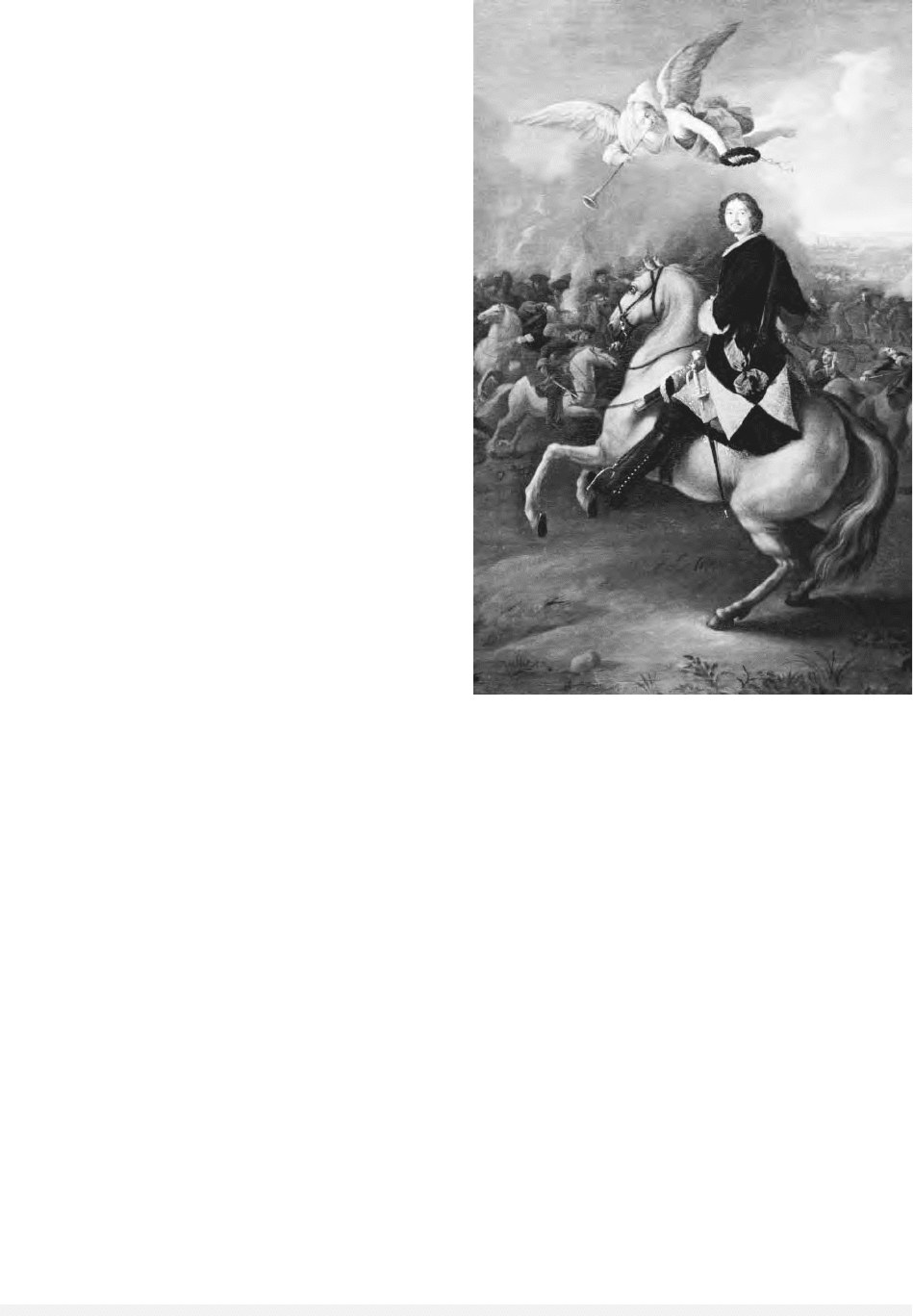
Peter I in battle at Poltava. © T
HE
S
TATE
R
USSIAN
M
USEUM
/CORBIS

Mines and Manufacturing concentrated on pro-
duction for the war effort, operating iron works
and manufacture of weapons, rope, canvas, uni-
forms, powder, and other products. The state re-
mained the chief producer and customer, but Peter
attempted to encourage individual enterprise by of-
fering subsidies and exemptions. Free manpower
was short, however, and in 1721 industrialists
were allowed to purchase serfs for their factories.
New provincial institutions, based on Swedish
models and created in several restructuring pro-
grams, notably in 1708–1709 and 1718–1719, were
intended to rationalize recruitment and tax collec-
tion, but were among the least successful of Peter’s
projects. As he said, money was the “artery of
war.” A number of piecemeal fiscal measures cul-
minated in 1724 with the introduction of the poll
tax (initially 74 kopecks per annum), which re-
placed direct taxation based on households with as-
sessment of individual males. Peter also encouraged
foreign trade and diversified indirect taxes, which
were attached to such items and services as official
paper for contracts, private bathhouses, oak coffins,
and beards (the 1705 beard tax). Duties from liquor,
customs, and salt were profitable.
The Table of Ranks (1722) consolidated earlier
legislation by dividing the service elite—army and
navy officers, government and court officials—into
three columns of fourteen ranks, each containing
a variable number of posts. No post was supposed
to be allocated to any candidate who was unqual-
ified for the duties involved, but birth and marriage
continued to confer privilege at court. The Table
was intended to encourage the existing nobility to
perform more efficiently, while endorsing the con-
cept of nobles as natural leaders of society: Any
commoner who attained the lowest military rank—
grade 14—or civil grade 8 was granted noble sta-
tus, including the right to pass it to his children.
Peter’s educational reforms, too, were utilitar-
ian in focus, as was his publishing program, which
focused on such topics as shipbuilding, navigation,
architecture, warfare, geography, and history. He
introduced a new simplified alphabet, the so-called
civil script, for printing secular works. The best-
known and most successful of Peter’s technical
schools was the Moscow School of Mathematics
and Navigation (1701; from 1715, the St. Peters-
burg Naval Academy), which was run by British
teachers. Its graduates were sent to teach in the so-
called cipher or arithmetic schools (1714), but these
failed to attract pupils. Priests and church schools
continued to be the main suppliers of primary ed-
ucation, and religious books continued to sell bet-
ter than secular ones. The Academy of Sciences is
generally regarded as the major achievement, al-
though it did not open until 1726 and was initially
staffed entirely by foreigners. In Russia, as else-
where, children in rural communities, where child
labor was vital to the economy, remained unedu-
cated.
THE CHURCH
The desire to deploy scarce resources as rationally
as possible guided Peter’s treatment of the Ortho-
dox Church. He abolished the patriarchate, which
was left vacant when the last Patriarch died in
1700, and in 1721 replaced it with the Holy Synod,
which was based on the collegiate principle and
later overseen by a secular official, the Over-
Procurator. The Synod’s rationale and program
were set out in the Spiritual Regulation (1721). Pe-
ter siphoned off church funds as required, but he
stopped short of secularizing church lands. He
slimmed down the priesthood by redeploying su-
perfluous clergymen into state service and restrict-
ing entry into monasteries, which he regarded as
refuges for shirkers. Remaining churchmen accu-
mulated various civic duties, such as keeping reg-
isters of births and deaths, running schools and
hospitals, and publicizing government decrees.
These measures continued seventeenth-century
trends in reducing the church’s independent power,
but Peter went farther by reducing its role in cul-
tural life. Himself a dutiful Orthodox Christian
who attended church regularly, he was happy for
the Church to take responsibility for the saving of
men’s souls, but not for it to rule their lives. His
reforms were supported by educated churchmen
imported from Ukraine.
ST. PETERSBURG AND
THE NEW CULTURE
The city of St. Petersburg began as an island fort
at the mouth of the Neva river on land captured
from the Swedes in 1703. From about 1712 it came
to be regarded as the capital. In Russia’s battle for
international recognition, St. Petersburg was much
more than a useful naval base and port. It was a
clean sheet on which Peter could construct a mi-
crocosm of his New Russia. The Western designs
and decoration of palaces, government buildings,
and churches, built in stone by hired foreign ar-
chitects according to a rational plan, and the Eu-
ropean fashions that all Russian townspeople were
forced to wear, were calculated to make foreigners
PETER I
1170
ENCYCLOPEDIA OF RUSSIAN HISTORY

feel that they were in Europe rather than in Asia.
The city became a “great window recently opened
in the north through which Russia looks on Eu-
rope” (Francesco Algarotti, 1739). Peter often re-
ferred to it as his “paradise,” playing on the
associations with St. Peter as well as expressing his
personal delight in a city built on water. The cen-
tral public spaces enjoyed amenities such as street
lighting and paving and public welfare was super-
vised by the Chief of Police, although conditions
were less salubrious in the backstreets. Nobles re-
sented being uprooted from Moscow to this glori-
fied building site. Noblewomen were not exempt.
They were wrenched from their previously shel-
tered lives in the semi-secluded women’s quarters
or terem and ordered to abandon their modest,
loose robes and veils in favor of Western low cut
gowns and corsets and to socialize and drink with
men. Some historians have referred to the “eman-
cipation” of women under Peter, but it is doubtful
whether this was the view of those involved.
PETER’S VISION AND METHODS
Peter was an absolute ruler, whose great height (six
foot seven inches) and explosive temper must have
intimidated those close to him. His portraits, the first
thoroughly Westernized Russian images painted or
sculpted from life, were embellished with Imperial
Roman, allegorical, military, and naval motifs to
underline his power. Yet he sought to deflect his
subjects’ loyalty from himself to the state, exhort-
ing them to work for the common good. A doer
rather than a thinker, he lacked formal education
and the patience for theorizing. Soviet historians
favored the image of the Tsar-Carpenter, empha-
sizing the fourteen trades that Peter mastered, of
which his favorites were shipbuilding and wood
turning. He also occasionally practiced dentistry
and surgery. Ironically, Peter often behaved in a
manner that confirmed foreign prejudices that Rus-
sia was a barbaric country. Abroad he frequently
offended his hosts with his appalling manners,
while Western visitors to Russia were perplexed by
his court, which featured dwarfs, giants, and
human “monsters” (from his Cabinet of Curiosi-
ties), compulsory drinking sessions, which armed
guards prevented guests prevented from leaving,
and weird ceremonies staged by the “All-Mad,
All-Jesting, All-Drunken Assembly,” which, headed
by the Prince-Pope, parodied religious rituals.
Throughout his life Peter maintained a mock court
headed by a mock tsar known as Prince Caesar,
who conferred promotions on “Peter Mikhailov” or
“Peter Alexeyev,” as Peter liked to be known as he
worked his way through the ranks of the army
and navy.
One of the functions of Peter’s mock institu-
tions was to ridicule the old ways. Peter constantly
lamented his subjects’ reluctance to improve them-
selves on their own initiative. As he wrote in an
edict of 1721 to replace sickles with more efficient
scythes: “Even though something may be good, if
it is new our people will not do it.” He therefore
resorted to force. In Russia, where serfdom was
made law as recently as 1649, the idea of a servile
population was not new, but under Peter servitude
was extended and intensified. The army and navy
swallowed up tens of thousands of men. State peas-
ants were increasingly requisitioned to work on
major projects. Previously free persons were trans-
ferred to the status of serfs during the introduc-
tion of the poll tax. Peter also believed in the power
of rules, regulations, and statutes, devised “in or-
der that everyone knows his duties and no one ex-
cuses himself on the grounds of ignorance.” In
1720, for example, he issued the General Regula-
tion, a “regulation of regulations” for the new gov-
ernment apparatus. Not only the peasants, but also
the nobles, found life burdensome. They were
forced to serve for life and to educate their sons for
service.
ASSOCIATES AND OPPONENTS
Despite his harsh methods, Peter was supported by
a number of men, drawn from both the old Mus-
covite elite and from outside it. The most prominent
of the newcomers were his favorite, the talented
and corrupt Alexander Menshikov (1673–1729),
whom he made a prince, and Paul Yaguzhinsky,
who became the first Procurator-General. Top men
from the traditional elite included General Boris
Sheremetev, Chancellor Gavrila Golovkin, Admiral
Fyodor Apraksin and Prince Fyodor Romodanov-
sky. The chief publicist was the Ukrainian church-
man Feofan Prokopovich. It is a misconception that
Peter relied on foreigners and commoners.
Religious traditionalists abhorred Peter, identi-
fying him as the Antichrist. The several revolts of
his reign all included some elements of antagonism
toward foreigners and foreign innovations such as
shaving and Western dress, along with more stan-
dard and substantive complaints about the en-
croachment of central authority, high taxes, poor
conditions of service, and remuneration. The most
serious were the musketeer revolt of 1698, the As-
trakhan revolt of 1705, and the rebellion led by the
PETER I
1171
ENCYCLOPEDIA OF RUSSIAN HISTORY

Don Cossack Ivan Bulavin in 1707–1708. The dis-
ruption that worried Peter most, however, affected
his inner circle. Peter was married twice: in 1689 to
the noblewoman Yevdokia Lopukhina, whom he
banished to a convent in 1699, and in 1712 to
Catherine, a former servant girl from Livonia whom
he met around 1703. He groomed the surviving son
of his first marriage, Alexei Petrovich (1690–1718),
as his successor, but they had a troubled relation-
ship. In 1716 Alexei fled abroad. Lured back to Rus-
sia in 1718, he was tried and condemned to death
for treason, based on unfounded charges of a plot
to assassinate his father. Many of Alexei’s associ-
ates were executed, and people in leading circles were
suspected of sympathy for him. Peter and Cather-
ine had at least ten children (the precise number is
unknown), but only two girls reached maturity:
Anna and Elizabeth (who reigned as empress from
1741 to 1761). In 1722 Peter issued a new Law of
Succession by which the reigning monarch nomi-
nated his own successor, but he failed to record his
choice before his death (from a bladder infection) in
February (January O.S.) 1725. Immediately after
Peter’s death, Menshikov and some leading courtiers
with guards’ support backed Peter’s widow, who
reigned as Catherine I (1725–1727).
VIEWS OF PETER AND HIS REFORMS
The official view in the eighteenth century and
much of the nineteenth was that Peter had “given
birth” to Russia, transforming it from “non-
existence” into “being.” Poets represented him as
Godlike. The man and his methods were easily ac-
commodated in later eighteenth-century discourses
of Enlightened Absolutism. Even during Peter’s life-
time, however, questions were raised about the
heavy cost of his schemes and the dangers of aban-
doning native culture and institutions. As the Russ-
ian historian Nikolai Karamzin commented in
1810: “Truly, St. Petersburg is founded on tears
and corpses.” He believed that Peter had made Rus-
sians citizens of the world, but prevented them
from being Russians. Hatred of St. Petersburg as a
symbol of alien traditions was an important ele-
ment in the attitude of nineteenth-century Slavo-
philes, who believed that only the peasants had
retained Russian cultural values. To their Western-
izer opponents, however, Peter’s reforms, stopping
short of Western freedoms, had not gone far
enough. In the later nineteenth century, serious
studies of seventeenth-century Muscovy ques-
tioned the revolutionary nature of Peter’s reign,
underlining that many of Peter’s reforms and poli-
cies, such as hiring foreigners, reforming the army,
and borrowing Western culture, originated with
his predecessors. The last tsars, especially Nicholas
II, took a nostalgic view of pre-Petrine Russia, but
Petrine values were revered by the imperial court
until its demise.
Soviet historians generally took a bipolar view
of Peter’s reign. On the one hand, they believed that
Russia had to catch up with the West, whatever the
cost; hence they regarded institutional and cultural
reforms, the new army, navy, factories, and so
on as “progressive.” Territorial expansion was ap-
proved. On the other hand, Soviet historians were
bound to denounce Peter’s exploitation of the peas-
antry and to praise popular rebels such as Bulavin;
moreover, under Stalin, Peter’s cosmopolitanism
was treated with suspicion. Cultural historians in
particular stressed native achievements over foreign
borrowings. In the 1980s–1990s some began to
take a more negative view still, characterizing Pe-
ter as “the creator of the administrative-command
system and the true ancestor of Stalin” (Anisimov,
1993). After the collapse of the USSR, the secession
of parts of the former Empire and Union, and the
decline of the armed forces and navy, many people
looked back to Peter’s reign as a time when Russia
was strong and to Peter as an ideal example of a
strong leader. The debate continues.
See also: ALEXEI PETROVICH; CATHERINE I; ELIZABETH;
FYODOR ALEXEYEVICH; MENSHIKOV, ALEXANDER
DANILOVICH; PATRIARCHATE; PEASANTRY; SERFDOM;
ST. PETERSBURG; TABLE OF RANKS
BIBLIOGRAPHY
Anderson, M. S. (1995). Peter the Great. London: Long-
man.
Anisimov, E. V. (1993). Progress through Coercion: The Re-
forms of Peter the Great. New York: M. E. Sharpe.
Bushkovitch, Paul. (2001). Peter the Great: The Struggle
for Power, 1671–1725. Cambridge, UK: Cambridge
University Press.
Canadian American Slavic Studies. 8 (1974). Issue devoted
to Peter’s reign.
Cracraft, James. (1971). The Church Reform of Peter the
Great. Oxford: Oxford University Press.
Cracraft, James. (1990). The Petrine Revolution in Russian
Architecture. Chicago: University of Chicago Press.
Cracraft, James. (1997). The Petrine Revolution in Russian
Imagery. Chicago: University of Chicago Press.
Hughes, Lindsey. (1998). Russia in the Age of Peter the
Great. New Haven, CT: Yale University Press.
PETER I
1172
ENCYCLOPEDIA OF RUSSIAN HISTORY