
Engelbrecht Andries P. Computational Intelligence: An Introduction
Подождите немного. Документ загружается.

88 6. Reinforcement Learning
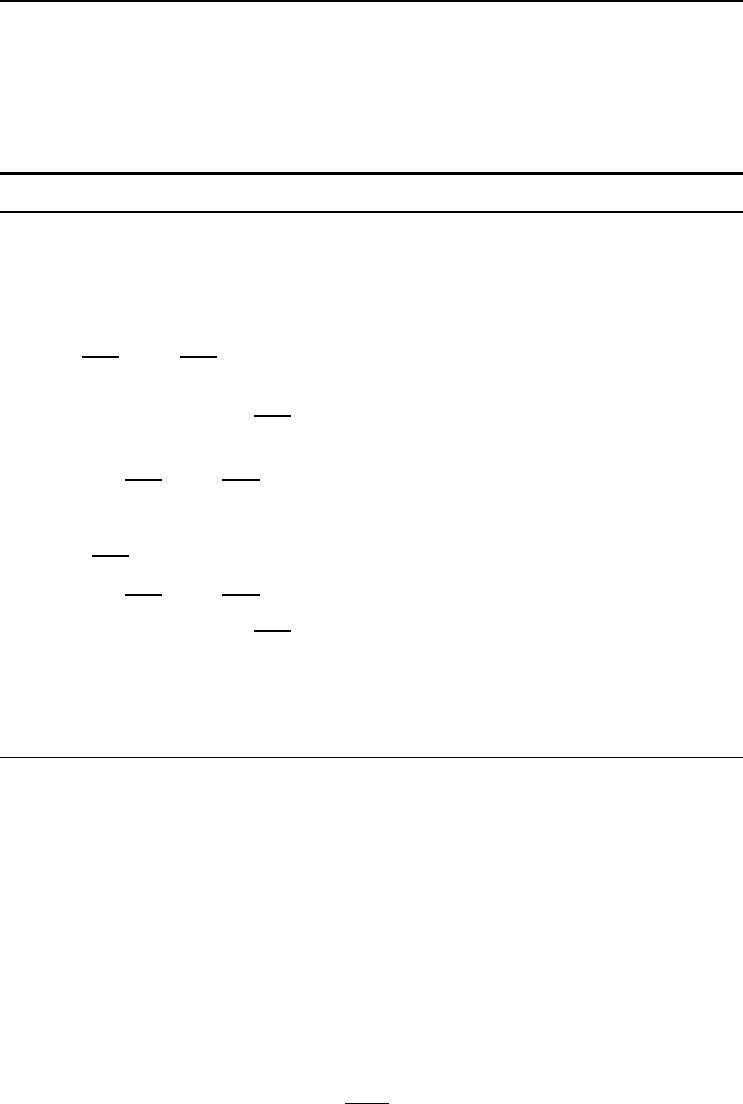
RPROP is summarized in Algorithm 6.1. The value of ∆
0
indicates the first weight
step, and is chosen as a small value, e.g. ∆
0
=0.1 [728]. It is shown in [728] that
the performance of RPROP is insensitive to the value of ∆
0
. Parameters ∆
max
and
∆
min
respectively specify upper and lower limits on update step sizes. It is suggested
in [728] that η
−
=0.5andη
+
=1.2.
Algorithm 6.1 RPROP Neural Network Training Algorithm
Initialize NN weights to small random values;
Set ∆
ji
=∆
kj
=∆
0
, ∀i =1,...,I+1, ∀j =1,...,J +1, ∀k =1,...,K;
Let t =0;
while stopping condition(s) not true do
for each w
kj
,j=1,...,J +1,k=1,...,K do
if
∂E
∂w
kj
(t − 1)
∂E
∂w
kj
(t) > 0 then
∆
kj
(t)=min{∆
kj
(t − 1)η
+
, ∆
max
};
∆w
kj
(t)=−sign
∂E
∂w
kj
(t)
∆
kj
(t);
w
kj
(t +1)=w
kj
(t)+∆w
kj
(t);
else if
∂E
∂w
kj
(t − 1)
∂E
∂w
kj
(t) < 0 then
∆
kj
(t)=max{∆
kj
(t − 1)η
−
, ∆
min
};
w
kj
(t +1)=w
kj
(t) − ∆w
kj
(t − 1);
∂E
∂w
kj
=0;
else if
∂E
∂w
kj
(t − 1)
∂E
∂w
kj
(t)=0then
∆w
kj
(t)=−sign
∂E
∂w
kj
(t)
∆
kj
(t);
w
kj
(t +1)=w
kj
(t)+∆w
kj
(t);
end
Repeat the above for each v
ji
weight, j =1,...,J, i =1,...,I +1;
end
6.3.2 Gradient Descent Reinforcement Learning
For problems where only the immediate reward is maximized (i.e. there is no value
function, only a reward function), Williams [911] proposed weight update rules that
perform a gradient descent on the expected reward. These rules are then integrated
with back-propagation. Weights are updated as follows:
∆w
kj
= η
kj
(r
p
− θ
k
)e
kj
(6.14)
where η
kj
is a non-negative learning rate, r
p
is the reinforcement associated with
pattern z
p
, θ
k
is the reinforcement threshold value, and e
kj
is the eligibility of weight
w
kj
,givenas
e
kj
=
∂
∂w
kj
[ln(g
j
)] (6.15)
where
g
j
= P (o
k,p
= t
k,p
|w
k
, z
p
) (6.16)

6.3 Neural Networks and Reinforcement Learning 89
is the probability density function used to randomly generate actions, based on whether
the target was correctly predicted or not. Thus, this NN reinforcement learning rule
computes a GD in probability space.
Similar update equations are used for the v
ji
weights.
6.3.3 Connectionist Q-Learning
Neural networks have been used to learn the Q-function in Q-learning [527, 891, 745].
The NN is used to approximate the mapping between states and actions, and even to
generalize between states. The input to the NN is the current state of the environment,
and the output represents the action to execute. If there are n
a
actions, then either
one NN with n
a
output units can be used [825], or n
a
NNs, one for each of the actions,
can be used [527, 891, 745].
Assuming that one NN is used per action, Lin [527] used the Q-learning in equation
(6.10) to update weights as follows:
∆w(t)=η[r(t)+γ max
a∈A
Q(t − 1) − Q(t)]∇
w
Q(t) (6.17)
where Q(t) is used as shorthand notation for Q(s(t),a(t)) and ∇
w
Q(t) is a vector
of the output gradients,
∂Q
∂w
(t), which are calculated by means of back-propagation.
Similar equations are used for the v
j
weights.
Watkins [891] proposed a combination of Q-learning with TD(λ)-learning, in which
case,
∆w(t)=η[r(t)+γ max
a∈A
Q(t − 1) − Q(t)]
t
t
=0
(λγ)
t−t
∇
w
Q(t
)
(6.18)
where the relevance of the current error on earlier Q-value predictions is determined
by λ. The update algorithm is given in Algorithm 6.2.
Rummery and Niranjan [745] proposed an alternative hybrid, where
∆w(t)=η(r(t)+γQ(t +1)− Q(t))
t
t
=0
(λγ)
t−t
∇
w
Q(t
)
(6.23)
which replaces the greedy max
a∈A
Q(t +1) with Q(t +1).
Peng and Williams [674] proposed the Q(λ) method, which combines Q-learning and
TD(λ)-learning as follows: A two step approach is followed, where weights are first
updated using equation (6.17), followed by
∆w(t)=η[r(t)+γ max
a∈A
Q(t +1)−max
q∈A
Q(t)]
t
t
=0
(λγ)
t−t
∇
w
Q(t
) (6.24)
90 6. Reinforcement Learning
Algorithm 6.2 Connectionist Q-Learning Update Algorithm
Reset all eligibilities, e(t)=0;
t =0;
while stopping condition(s) not true do
Select action a(t) as the one with maximum predicted Q-value;
if t>0 then
w(t)=w(t − 1) + η(r(t − 1) + γQ(t) − Q(t − 1))e(t − 1) (6.19)
end
Calculate ∇
w
Q(t) with respect to action a(t);
Update eligibilities,
e(t)=∇
w
Q(t)+γλe(t − 1) (6.20)
Perform action a(t), and receive reward, r(t);
end
Algorithm 6.3 Q(λ) Connectionist Update Algorithm
Reset all eligibilities, e(t)=0;
t =0;
while stopping condition(s) not true do
Select action a(t) as the one with maximum predicted Q-value;
if t>0 then
w(t)=w(t − 1) + η([r(t − 1) + γ max
a∈A
Q(t) − Q(t − 1)]∇
w
Q(t − 1)
+[r(t − 1) + γ max
a∈A
Q(t) − max
a∈A
Q(t − 1)]e(t − 1)) (6.21)
end
Update eligibilities,
e(t)=λγ[e(t − 1) + λ
w
Q(t − 1)] (6.22)
Calculate ∇
w
Q(t) with respect to action a(t);
Perform action a(t), and receive reward, r(t);
end
This gives an overall update of
∆w(t)=η
[r(t)+γ max
a∈A
Q(t +1)− Q(t)]∇
w
Q(t)
+[r(t)+γ max
a∈A
Q(t +1)− max
a∈A
Q(t)]e(t)
(6.25)
where the eligibility is calculated using
e(t)=
t
t
=0
(λγ)
t−t
∇
w
Q(t − t
)=∇
w
Q(t)+λγe(t) (6.26)

6.4 Assignments 91
Equation (6.26) keeps track of the weighted sum of previous error gradients.
The Q(λ) update algorithm is given in Algorithm 6.3.
6.4 Assignments
1. Discuss how reinforcement learning can be used to guide a robot out of a room
filled with obstacles.
2. Discuss the influence of the reinforcement threshold in equation (6.14) on per-
formance.
3. Contrast reinforcement learning with coevolution (refer to Chapter 15).
4. For the RPROP algorithm, what will be the consequence if
(a) ∆
max
is too small?
(b) η
+
is very large?
(c) η
−
is very small?
5. Provide a motivation for replacing max
a∈A
Q(t+1) with Q(t) in equation (6.23).

Chapter 7
Performance Issues
(Supervised Learning)
Performance is possibly the driving force of all organisms. If no attention is given to
improve performance, the quality of life will not improve. Similarly, performance is
the most important aspect that has to be considered when an artificial neural network
is being designed. The performance of an artificial NN is not just measured as the
accuracy achieved by the network, but aspects such as computational complexity and
convergence characteristics are just as important. These measures and other mea-
sures that quantify performance are discussed in Section 7.1, with specific reference to
supervised networks.
The design of NNs for optimal performance requires careful consideration of several
factors that influence network performance. In the early stages of NN research and
applications, the design of NNs was basically done by following the intuitive feelings of
an expert user, or by following rules of thumb. The vast number of theoretical analyses
of NNs made it possible to better understand the working of NNs – to unravel the
“black box”. These insights helped to design NNs with improved performance. Factors
that influence the performance of NNs are discussed in Section 7.3.
Although the focus of this chapter is on supervised learning, several ideas can be
extrapolated to unsupervised learning NNs.
7.1 Performance Measures
This section presents NN performance measures under three headings: accuracy, com-
plexity and convergence.
7.1.1 Accuracy
Generalization is a very important aspect of neural network learning. Since it is a
measure of how well the network interpolates to points not used during training, the
ultimate objective of NN learning is to produce a learner with low generalization error.
Computational Intelligence: An Introduction, Second Edition A.P. Engelbrecht
c
2007 John Wiley & Sons, Ltd
93

94 7. Performance Issues (Supervised Learning)
That is, to minimize the true risk function
E
G
(Ω; W)=
(f
NN
(z, W) − t )
2
dΩ(z, t ) (7.1)
where, from Section 3.2.1, Ω(z, t ) is the stationary density according to which patterns
are sampled, W describes the network weights, and z and t are respectively the input
and target vectors. The function f
NN
is an approximation of the true underlying
function. Since Ω is generally not known, f
NN
is found through minimization of the
empirical error function
E
T
(D
T
; W)=
1
P
T
P
T
p=1
(f
NN
(z
p
,W) − t
p
)
2
(7.2)
over a finite data set D
T
∼ Ω. When P
T
→∞,thenE
T
→E
G
.TheaimofNN
learning is therefore to learn the examples presented in the training set well, while
still providing good generalization to examples not included in the training set. It is,
however, possible that a NN exhibits a very low training error, but bad generalization
due to overfitting (memorization) of the training patterns.
The most common measure of accuracy is the mean squared error (MSE), in which
case the training error, E
T
, is expressed as
E
T
=
P
T
p=1
K
k=1
(t
k,p
− o
k,p
)
2
P
T
K
(7.3)
where P
T
is the total number of training patterns in the training set D
T
,andK is the
number of output units. The generalization error, E
G
, is approximated in the same
way, but with the first summation over the P
G
patterns in the generalization, or test
set, D
G
. Instead of the MSE, the sum squared error (SSE),
SSE =
P
p=1
K
k=1
(t
k,p
− o
k,p
)
2
(7.4)
can also be used, where P is the total number of patterns in the data set considered.
However, the SSE is not a good measure when the performance on different data set
sizes are compared.
An additional error measure is required for classification problems, since the MSE
alone is not a good descriptor of accuracy. In the case of classification problems, the
percentage correctly classified (or incorrectly classified) patterns is used as a measure
of accuracy. The reason why the MSE is not a good measure, is that the network
may have a good accuracy in terms of the number of correct classifications, while
having a relatively large MSE. If just the MSE is used to indicate when training
should stop, it can result in the network being trained too long in order to reach the
low MSE; hence, wasting time and increasing the chances of overfitting the training
data (with reference to the number of correct classifications). But when is a pattern
classified as correct? When the output class of the NN is the same as the target class
– which is not a problem to determine when the ramp or step function is used as the
7.1 Performance Measures 95
activation function in the output layer. In the case of continuous activation functions,
a pattern z
p
is usually considered as being correctly classified if for each output unit
o
k
,((o
k,p
≥ 0.5+θandt
k,p
=1)or(o
k,p
≤ 0.5 −θandt
k,p
= 0)), where θ ∈ [0, 0.5]
– of course, assuming that the target classes are binary encoded.
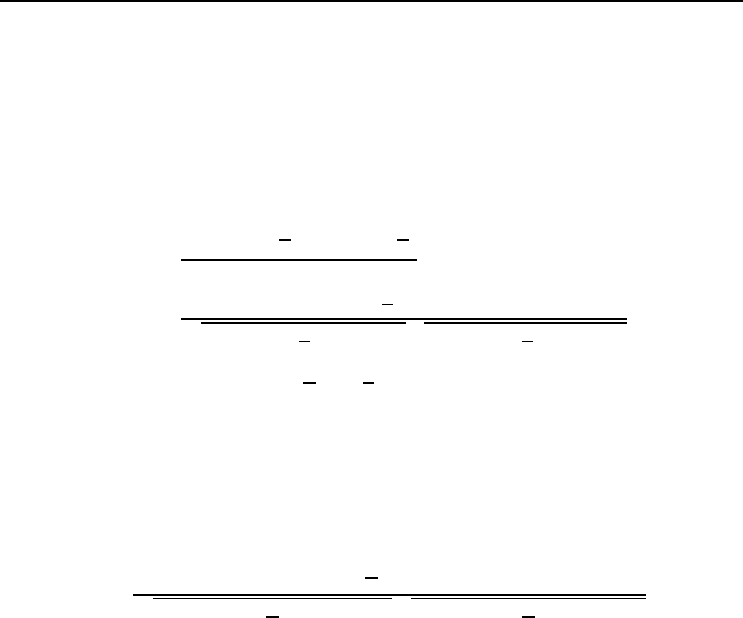
An additional measure of accuracy is to calculate the correlation between the out-
put and target values for all patterns. This measure, referred to as the correlation
coefficient, is calculated as
r =
n
i=1
(x
i
− x)
n
i=1
(y
i
− y)
σ
x
σ
y
=
n
i=1
x
i
y
i
−
1
n
n
i=1
x
i
n
i=1
y
i
n
i=1
x
2
i
−
1
n
(
n
i=1
x
i
)
2
n
i=1
y
2
i
−
1
n
(
n
i=1
y
i
)
2
(7.5)
where x
i
and y
i
are observations, x and y are respectively the averages over all ob-
servations x
i
and y
i
,andσ
x
and σ
y
are the standard deviations of the x
i
and y
i
observations respectively, and can be used to quantify the linear relationship between
variables x and y. As measure of learning accuracy, where x = o
k,p
and y = t
k,p
,
the correlation coefficient quantifies the linear relationship between the approximated
(learned) function and the true function. A correlation value close to 1 indicates a
good approximation to the true function. Therefore, the correlation coefficient
r =
P
p=1
o
k,p
t
k,p
−
1
P
P
p=1
o
k,p
P
p=1
t
k,p
P
p=1
o
2
k,p
−
1
P
(
P
p=1
o
k,p
)
2
P
p=1
t
2
k,p
−
1
P
(
P
p=1
t
k,p
)
2
(7.6)
is calculated as a measure of how well the NN approximates the true function.
Another very important aspect of NN accuracy is overfitting. Overfitting of a training
set means that the NN memorizes the training patterns, and consequently loses the
ability to generalize. That is, NNs that overfit cannot predict correct output for data
patterns not seen during training. Overfitting occurs when the NN architecture is too
large, i.e. the NN has too many weights (in statistical terms: too many free param-
eters) – a direct consequence of having too many hidden units and irrelevant input
units. If the NN is trained for too long, the excess free parameters start to memo-
rize all the training patterns, and even noise contained in the training set. Remedies
for overfitting include optimizing the network architecture and using enough training
patterns (discussed in Section 7.3).
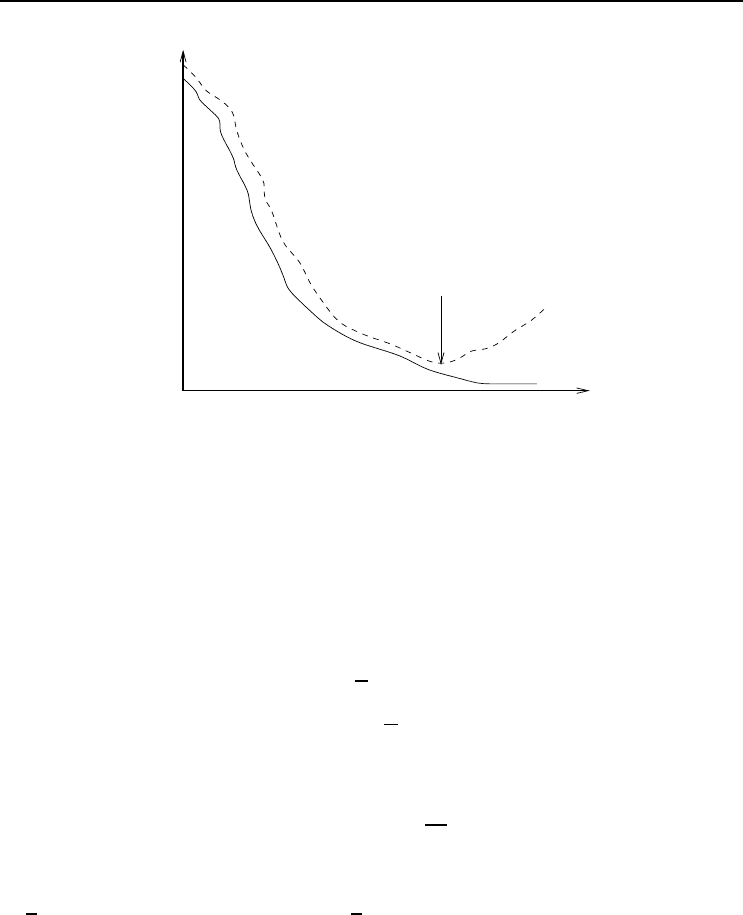
Estimations of generalization error during training can be used to detect the point
of overfitting. The simplest approach to find the point of overfitting was developed
through studies of training and generalization profiles. Figure 7.1 presents a general
illustration of training and generalization errors as a function of training epochs. From
the start of training, both the training and generalization errors decrease - usually
exponentially. In the case of oversized NNs, there is a point at which the training
error continues to decrease, while the generalization error starts to increase. This is
the point of overfitting. Training should stop as soon an increase in generalization
error is observed.
96 7. Performance Issues (Supervised Learning)
Epoch
Error
E
E
T
G
Point of overfitting
Figure 7.1 Illustration of Overfitting
In order to detect the point of overfitting, the original data set is divided into three
disjoint sets, i.e. the training set D
T
, the generalization set D
G
and the validation set
D
V
. The validation set is then used to estimate the generalization error. Since both
the training error and the validation error usually fluctuate, determining the point of
overfitting is not straightforward. A moving average of the validation error has to be
used. Overfitting is then detected when
E
V
> E
V
+ σ
E
V
(7.7)
where E
V
is the MSE on the validation set, E
V
is the average MSE on the validation
set since training started, and σ
E
V
is the standard deviation in validation error.
R¨obel suggested the generalization factor as an alternative indication of overfitting
[732]. R¨obel defines the generalization factor ρ =
E
V
E
T
,whereE
V
and E
T
are the MSE on
the validation set D
V
and current training subset D
T
respectively. The generalization
factor indicates the error made in training on D
T
only, instead of training on the entire
input space. Overfitting is detected when ρ(t) >ϕ
ρ
(t), where ϕ
ρ
(t)=min{ϕ
ρ
(t −
1),
ρ + σ
ρ
, 1.0}; t is the current epoch, ρ is the average generalization factor over a
fixed number of preceding epochs, and σ
ρ
is the standard deviation. This test ensures
that ρ ≤ 1.0. Keep in mind that ρ does not give an indication of the accuracy of
learning, but only the ratio between the training and validation error. For function
approximation problems (as is the case with R¨obel’s work) where the MSE is used as
a measure of accuracy, a generalization factor ρ<1 means that the validation error
is smaller than the training error – which is desirable. As ρ becomes large (greater
than 1), the difference between the training error and validation error increases, which
indicates an increase in validation error with a decrease in training error – an indication
of overfitting. For classification problems where the percentage of correctly classified
patterns is used as a measure of accuracy, ρ should be larger than 1.

7.1 Performance Measures 97
It is important to note that the training error or the generalization error alone is not
sufficient to quantify the accuracy of a NN. Both these errors should be considered.
Additional Reading Material on Accuracy
The trade-off between training error and generalization has prompted much research in
the generalization performance of NNs. Average generalization performance has been
studied theoretically to better understand the behavior of NNs trained on a finite
data set. Research shows a dependence of generalization error on the training set, the
network architecture and weight values. Schwartz et al. [767] show the importance of
training set size for good generalization in the context of ensemble networks. Other
research uses the VC-dimension (Vapnik-Chervonenkis dimension) [8, 9, 152, 643] to
derive boundaries on the generalization error as a function of network and training set
size. Best known are the limits derived by Baum and Haussler [54] and Haussler et
al. [353]. While these limits are derived for, and therefore limited to, discrete input
values, Hole derives generalization limits for real valued inputs [375].
Limits on generalization have also been developed by studying the relationship between
training error and generalization error. Based on Akaike’s final prediction error and
information criterion [15], Moody derived the generalized prediction error which gives
a limit on the generalization error as a function of the training error, training set size,
the number of effective parameters, and the effective noise variance [603, 604]. Murata
et al. [616, 617, 618] derived a similar network information criterion. Using a different
approach, i.e. Vapnik’s Bernoulli theorem, Depenau and Møller [202] derived a bound
as a function of training error, the VC-dimension and training set size.
These research results give, sometimes overly pessimistic, limits that help to clarify
the behavior of generalization and its relationship with architecture, training set size
and training error. Another important issue in the study of generalization is that of
overfitting. Overfitting means that the NN learns too much detail, effectively mem-
orizing training patterns. This normally happens when the network complexity does
not match the size of the training set, i.e. the number of adjustable weights (free
parameters) is larger than the number of independent patterns. If this is the case,
the weights learn individual patterns and even capture noise. This overfitting phe-
nomenon is the consequence of training on a finite data set, minimizing the empirical
error function given in equation (7.2), which differs from the true risk function given
in equation (7.1).
Amari et al. developed a statistical theory of overtraining in the asymptotic case
of large training set sizes [22, 21]. They analytically determine the ratio in which
patterns should be divided into training and test sets to obtain optimal generalization
performance and to avoid overfitting. Overfitting effects under large, medium and
small training set sizes have been investigated analytically by Amari et al. [21] and
M¨uller et al. [612].