
Engelbrecht Andries P. Computational Intelligence: An Introduction
Подождите немного. Документ загружается.


68 4. Unsupervised Learning Neural Networks
characteristics of the function. Thus, all codebook vectors are updated even if they
are far from the BMN. This is strictly not necessary, since neurons far away from the
BMN are dissimilar to the presented pattern, and will have negligible weight changes.
Many calculations can therefore be saved by clipping the Gaussian neighborhood at a
certain threshold – without degrading the performance of the SOM.
Additionally, the width of the neighborhood function can change dynamically during
training. The initial width is large, with a gradual decrease in the variance of the
Gaussian, which controls the neighborhood. For example,
σ(t)=σ(0)e
−t/τ
1
(4.39)
where τ
1
is a positive constant, and σ(0) is the initial, large variance.
If the growing SOM (refer to Section 4.5.3) is used, the width of the Gaussian neigh-
borhood function should increase with each increase in map size.
Learning Rate
A time-decaying learning rate may be used, where training starts with a large learning
rate which gradually decreases. That is,
η(t)=η(0)e
−t/τ
2
(4.40)
where τ
2
is a positive constant and η(0) is the initial, large learning rate.
Shortcut Winner Search
The shortcut winner search decreases the computational complexity by using a more
efficient search for the BMN. The search is based on the premise that the BMN of a
pattern is in the vicinity of the BMN for the previous epoch. The search for a BMN is
therefore constrained to the current BMN and its neighborhood. In short, the search
for a BMN for each pattern is summarized in Algorithm 4.6.
Algorithm 4.6 Shortcut Winner Search
Retrieve the previous BMN;
Calculate the distance of the pattern to the codebook vector of the previous BMN;
Calculate the distance of the pattern to all direct neighbors of the previous BMN;
if the previous BMN is still the best then
Terminate the search;
end
else
Let the new BMN be the neuron (within the neighborhood) closest to that
pattern;
end

4.5 Self-Organizing Feature Maps 69
Shortcut winner search does not perform a search for the BMN over the entire map,
but just within the neighborhood of the previous BMN, thereby substantially reducing
computational complexity.
4.5.5 Clustering and Visualization
The effect of the SOM training process is to cluster together similar patterns, while
preserving the topology of input space. After training, all that is given is the set of
trained weights with no explicit cluster boundaries. An additional step is required to
find these cluster boundaries.
One way to determine and visualize these cluster boundaries is to calculate the unified
distance matrix (U-matrix) [403], which contains a geometrical approximation of the
codebook vector distribution in the map. The U-matrix expresses for each neuron,
the distance to the neighboring codebook vectors. Large values within the U-matrix
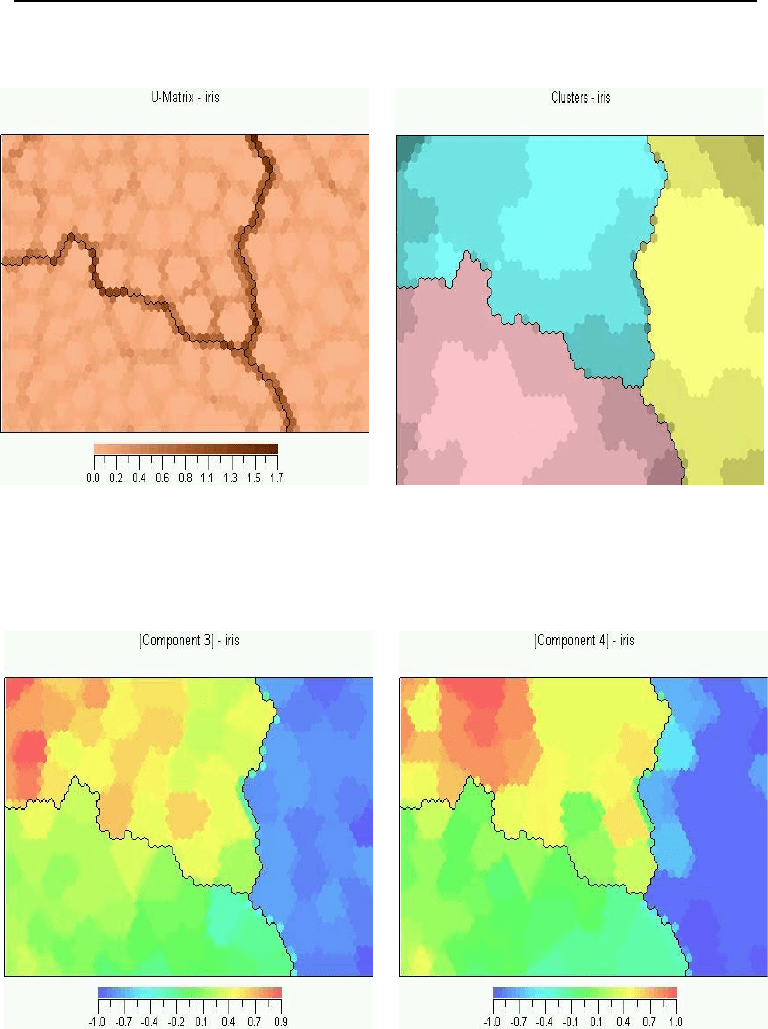
indicate the position of cluster boundaries. Using a gray-scale scheme, Figure 4.4(a)
visualizes the U-matrix for the iris classification problem.
For the same problem, Figure 4.4(b) visualizes the clusters on the actual map. Bound-
aries are usually found by using Ward clustering [23] of the codebook vectors. Ward
clustering follows a bottom-up approach where each neuron initially forms its own
cluster. At consecutive iterations, two clusters that are closest to one another are
merged, until the optimal or specified number of clusters has been constructed. The
end result of Ward clustering is a set of clusters with a small variance over its members,
and a large variance between separate clusters.
The Ward distance measure is used to decide which clusters should be merged. The
distance measure is defined as
d
rs
=
n
r
n
s
n
r
+ n
s
||w
r
− w
s
||
2
2
(4.41)
where r and s are cluster indices, n
r
and n
s
are the number of patterns within the
clusters, and w
r
and w
s
are the centroid vectors of these clusters (i.e. the average
of all the codebook vectors within the cluster). The two clusters are merged if their
distance, d
rs
, is the smallest. For the newly formed cluster, q,
w
q
=
1
n
r
+ n
s
(n
r
w
r
+ n
s
w
s
) (4.42)
and
n
q
= n
r
+ n
s
(4.43)
Note that, in order to preserve topological structure, two clusters can only be merged if
they are adjacent. Furthermore, only clusters that have a nonzero number of patterns
associated with them are merged.
70 4. Unsupervised Learning Neural Networks
(a) U-Matrix (b) Map Illustration
(c) Component Map for Third Input (d) Component Map for Fourth Input
i
Figure 4.4 Visualization of SOM Clusters for Iris Classification

4.6 Assignments 71
4.5.6 Using SOM
The SOM has been applied to a variety of real-world problems, including image analy-
sis, speech recognition, music pattern analysis, signal processing, robotics, telecom-
munications, electronic-circuit design, knowledge discovery, and time series analysis.
The main advantage of SOMs comes from the easy visualization and interpretation of
clusters formed by the map.
In addition to visualizing the complete map as illustrated in Figure 4.4(b), the relative
component values in the codebook vectors can be visualized as illustrated in the same
figure. Here a component refers to an input attribute. That is, a component plane
can be constructed for each input parameter (component) to visualize the distribution
of the corresponding weight (using some color scale representation). The map and
component planes can be used for exploratory data analysis. For example, a marked
region on the visualized map can be projected onto the component planes to find the
values of the input parameters for that region.
A trained SOM can also be used as a classifier. However, since no target information is
available during training, the clusters formed by the map should be manually inspected
and labeled. A data vector is then presented to the map, and the winning neuron
determined. The corresponding cluster label is then used as the class.
Used in recall mode, the SOM can be used to interpolate missing values within a
pattern. Given such a pattern, the BMN is determined, ignoring the inputs with
missing values. A value is then found by either replacing the missing value with the
corresponding weight of the BMN, or through interpolation among a neighborhood of
neurons (e.g. take the average of the weight values of all neurons in the neighborhood
of the BMN).
4.6 Assignments
1. Implement and test a LVQ-I network to distinguish between different alphabet-
ical characters of different fonts.
2. Explain why it is necessary to retrain a supervised NN on all the training data,
including any new data that becomes available at a later stage. Why is this not
such an issue with unsupervised NNs?
3. Discuss an approach to optimize the LVQ-I network architecture.
4. How can PSO be used for unsupervised learning?
5. What is the main difference between the LVQ-I and SOM as an approach to
cluster multi-dimensional data?
6. For a SOM, if the training set contains P
T
patterns, what is the upper bound
on the number of neurons necessary to fit the data? Justify your answer.
7. Explain the purpose of the neighborhood function of SOMs.
8. Assuming a Gaussian neighborhood function for SOMs, what can be done to
reduce the number of weight updates in a sensible way?

72 4. Unsupervised Learning Neural Networks
9. Explain how a SOM can be used to distinguish among different hand gestures.
10. Discuss a number of ways in which the SOM can be adapted to reduce its com-
putational complexity.
11. Explain how a SOM can be used as a classifier.
12. Explain how it is possible for the SOM to train on data with missing values.
13. How can a trained SOM be used to determine an appropriate value if for a given
input pattern an attribute does not have a value.

Chapter 5
Radial Basis Function
Networks
Several neural networks have been developed for both the supervised and the unsu-
pervised learning paradigms. While these NNs were seen to perform very well in their
respective application fields, improvements have been developed by combining super-
vised and unsupervised learning. This chapter discusses two such learning algorithms,
namely the learning vector quantizer-II in Section 5.1 and radial basis function NNs
in Section 5.2.
5.1 Learning Vector Quantizer-II
The learning vector quantizer (LVQ-II), developed by Kohonen, uses information from
a supervisor to implement a reward and punish scheme. The LVQ-II assumes that the
classifications of all input patterns are known. If the winning cluster unit correctly
classifies the pattern, the weights to that unit are rewarded by moving the weights to
better match the input pattern. On the other hand, if the winning unit misclassified
the input pattern, the weights are penalized by moving them away from the input
vector.
For the LVQ-II, the weight updates for the winning output unit o
k
are given as
∆u
ki
=
η(t)[z
i,p
− u
ki
(t − 1)] if o
k,p
= t
k,p
−η(t)[z
i,p
− u
ki
(t − 1)] if o
k,p
= t
k,p
(5.1)
Similarly to the LVQ-I, a conscience factor can be incorporated to penalize frequent
winners.
5.2 Radial Basis Function Neural Networks
A radial basis function (RBF) neural network (RBFNN) is a FFNN where hidden units
do not implement an activation function, but represents a radial basis function. An
RBFNN approximates a desired function by superposition of nonorthogonal, radially
Computational Intelligence: An Introduction, Second Edition A.P. Engelbrecht
c
2007 John Wiley & Sons, Ltd
73
74 5. Radial Basis Function Networks
symmetric functions. RBFNNs have been independently proposed by Broomhead and
Lowe [92], Lee and Kill [506], Niranjan and Fallside [630], and Moody and Darken
[605] as an approach to improve accuracy and to decrease training time complexity.
The RBFNN architecture is overviewed in Section 5.2.1, while different radial basis
functions are discussed in Section 5.2.2. Different training algorithms are given in
Section 5.2.3. Variations of RBFNNs are discussed in Section 5.2.4.
5.2.1 Radial Basis Function Network Architecture
+1
−1
z
I+1
w
12
w
K1
w
K2
w
1,J+1
µ
21
µ
J1
z
2
z
1
µ
11
µ
2,J+1
σ
1
σ
J
σ
2
y
1
y
2
y
J
w
1J
w
11
w
K,J+1
o
1
o
K
Figure 5.1 Radial Basis Function Neural Network
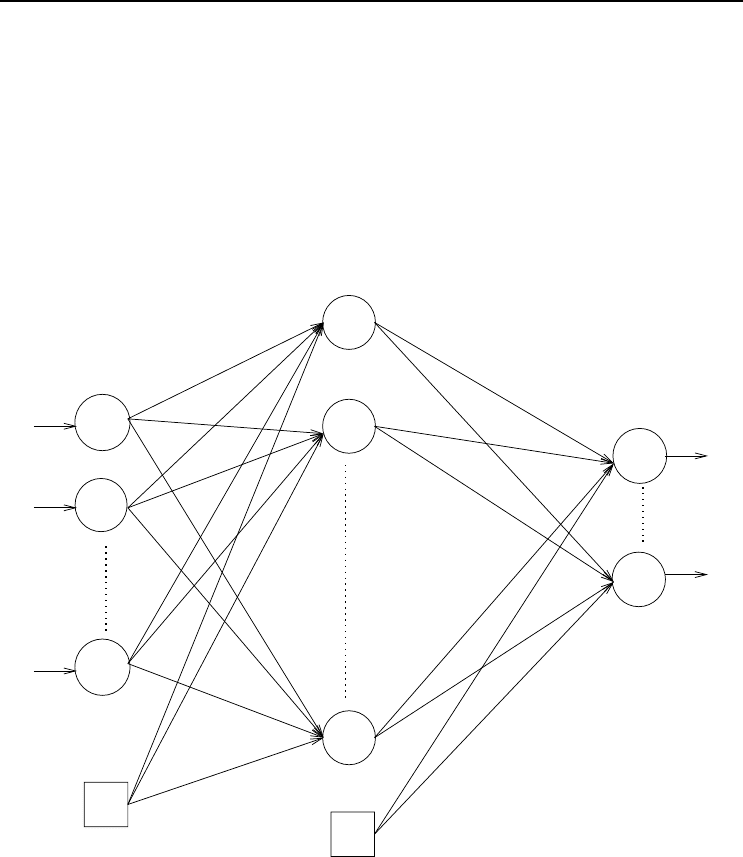
Figure 5.1 illustrates a general architecture of the RBFNN. The architecture is very
similar to that of a standard FFNN, with the following differences:
• Hidden units implement a radial basis function, Φ. The output of each hidden
unit is calculated as
y
j,p
(z
p
)=Φ(||z
p
−µ
j
||
2
) (5.2)
where µ
j
represents the center of the basis function, and ||•||
2
is the Euclidean
norm.
• Weights from the input units to a hidden unit, referred to as µ
ij
, represent the
center of the radial basis function of hidden unit j.

5.2 Radial Basis Function Neural Networks 75
• Some radial basis functions are characterized by a width, σ
j
. For such basis
functions, the weight from the basis unit in the input layer to each hidden unit
represents the width of the basis function. Note that input unit z
I+1
has an
input signal of +1.
The output of an RBFNN is calculated as
o
k,p
=
J+1
j=1
w
kj
y
j,p
(5.3)
Note that the output units of an RBFNN implement linear activation functions. The
output is therefore just a linear combination of basis functions.
As with FFNNs, it has been shown that RBFNNs are universal approximators [47,
349, 682].
5.2.2 Radial Basis Functions
Each hidden unit implements a radial basis function. These functions, also referred to
as kernel functions, are strictly positive, radially symmetric functions. A radial basis
function (RBF) has a unique maximum at its center, µ
j
, and the function usually
drops off to zero rapidly further away from the center. The output of a hidden unit
indicates the closeness of the input vector, z
p
, to the center of the basis function.
In addition to the center of the function, some RBFs are characterized by a width,
σ
j
, which specifies the width of the receptive field of the RBF in the input space for
hidden unit j.
A number of RBFs have been proposed [123, 130]:
• Linear function, where
Φ(||z
p
− µ
j
||
2
)=||z
p
− µ
j
||
2
(5.4)
• Cubic function, where
Φ(||z
p
− µ
j
||
2
)=||z
p
− µ
j
||
3
2
(5.5)
• Thin-plate-spline function, where
Φ(||z
p
− µ
j
||
2
)=||z
p
− µ
j
||
2
2
ln ||z
p
− µ
j
||
2
(5.6)
• Multiquadratic function, where
Φ(||z
p
− µ
j
||
2
,σ
j
)=
||z
p
− µ
j
||
2
2
+ σ
2
j
(5.7)
• Inverse multiquadratic function, where
Φ(||z
p
− µ
j
||
2
,σ
j
)=
1
||z
p
− µ
j
||
2
2
+ σ
2
j
(5.8)

76 5. Radial Basis Function Networks
• Gaussian function, where
Φ(||z
p
− µ
j
||
2
,σ
j
)=e
−||z
p
−µ
j
||
2
2
/(2σ
2
j
)
(5.9)
• Logistic function, where
Φ(||z
p
− µ
j
||
2
,σ
j
)=
1
1+e
||z
p
−µ
j
||
2
2
/σ
2
j
−θ
j
(5.10)
where θ
j
is an adjusted bias.
Considering the above functions, the accuracy of an RBFNN is influenced by:
• The number of basis functions used. The more basis functions that are
used, the better the approximation of the target function will be. However,
unnecessary basis functions increase computational complexity.
• The location of the basis functions as defined by the center vector, µ
j
,for
each basis function. Basis functions should be evenly distributed to cover the
entire input space.
• For some functions, the width of the receptive field, σ
j
. The larger σ
j
is, the
more of the input space is represented by that basis function.
Training of an RBFNN should therefore consider methods to find the best values for
these parameters.
5.2.3 Training Algorithms
A number of methods have been developed to train RBFNNs. These methods differ
mainly in the number of parameters that are learned. The fixed centers algorithm
adapts only the weights between the hidden and output layers. Adaptive centers
training algorithms adapt both weights, centers, and deviations. This section reviews
some of these training algorithms.
Training RBFNNs with Fixed C enters
Broomhead and Lowe [92] proposed a training method where it is assumed that RBF
centers are fixed. Centers are randomly selected from the training set. Provided that
a sufficient number of centers are uniformly selected from the training set, an adequate
sampling of the input space will be obtained. Common practice is to select a large
number of centers, and then to prune, after training, redundant basis functions. This
is usually done in a systematic manner, removing only those RBFs that do not cause
a significant degradation in accuracy.
The fixed centers training algorithm is summarized in Algorithm 5.1. With reference
to this algorithm, Gaussian RBFs are used, with widths calculated as
σ
j
= σ =
d
max
√
J
,j=1,...,J (5.11)

5.2 Radial Basis Function Neural Networks 77
where J is the number of centers (or hidden units), and d
max
is the maximum Eu-
clidean distance between centers.
Weight values of connections between the hidden and output layers are found by
solving for w
k
in
w
k
=(Φ
T
Φ)
−1
Φ
T
t
k
(5.12)
where w
k
is the weight vector of output unit k, t
k
is the vector of target outputs, and
Φ ∈ R
P
T
×J
is the matrix of RBF nonlinear mappings performed by the hidden layer.
Algorithm 5.1 Training an RBFNN with Fixed Centers
Set J to indicate the number of centers;
Choose the centers, µ
j
,j=1,...,J,as
µ
j
= z
p
,p∼ U (1,P
T
) (5.13)
Calculate the width, σ
j
, using equation (5.11);
Initialize all w
kj
,k=1,...,K and j =1,...,J to small random values;
Calculate the output for each output unit using equation (5.3) with Gaussian radial
basis functions;
Solve for the network weights using equation (5.12) for each k =1,...,K;
Training an RBFNN using Gradient Descent
Moody and Darken [605] and Poggio and Girosi [682] used gradient descent to adjust
weights, centers, and widths. The algorithm is summarized in Algorithm 5.2.
In Algorithm 5.2, η
w
,η
µ
,andη
σ
respectively indicate the learning rate for weights,
centers, and widths. In this algorithm, centers are initialized by sampling from the
training set. The next subsection shows that these centers can be obtained in an
unsupervised training step, prior to training the weights between hidden units (radial
basis) and output units.
Two-Phase RBFNN Training
The training algorithms discussed thus far have shown slow convergence times [899]. In
order to increase training time, RBFNN training can be done in two phases [605, 881]:
(1) unsupervised learning of the centers, µ
j
, and then, (2) supervised training of the w
k
weights between the hidden and output layers using gradient descent. Algorithm 5.3
summarizes a training algorithm where the first phase utilizes an LVQ-I to cluster
input patterns [881].