
Engelbrecht Andries P. Computational Intelligence: An Introduction
Подождите немного. Документ загружается.

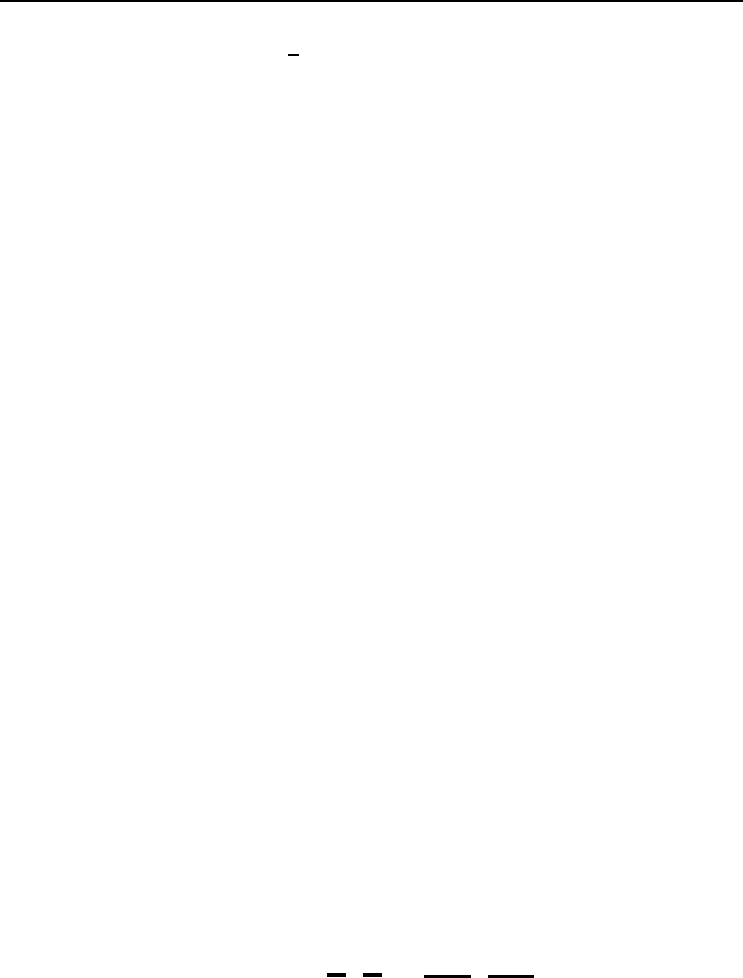
58 4. Unsupervised Learning Neural Networks
o
k
=
P
T
p=1
o
k,p
/P (4.8)
Another variant of the Hebbian learning rule uses the correlation in the changes in
activation values over consecutive time steps. For this learning rule, referred to as
differential Hebbian learning,
∆u
ki
(t)=η∆z
i
(t)∆o
k
(t − 1) (4.9)
where
∆z
i
(t)=z
i,p
(t) − z
i,p
(t − 1) (4.10)
and
∆o
k
(t − 1) = o
k,p
(t − 1) − o
k,p
(t − 2) (4.11)
4.3 Principal Component Learning Rule
Principal component analysis (PCA) [426] is a statistical technique used to transform
a data space into a smaller space of the most relevant features. The aim is to project
the original I-dimensional space onto an I
-dimensional linear subspace, where I
<
I, such that the variance in the data is maximally explained within the smaller I
-
dimensional space. Features (or inputs) that have little variance are thereby removed.
The principal components of a data set are found by calculating the covariance (or
correlation) matrix of the data patterns, and by getting the minimal set of orthogonal
vectors (the eigenvectors) that span the space of the covariance matrix. Given the
set of orthogonal vectors, any vector in the space can be constructed with a linear
combination of the eigenvectors.
Oja developed the first principal components learning rule, with the aim of extract-
ing the principal components from the input data [635]. Oja’s principal components
learning rule is an extension of the Hebbian learning rule, referred to as normalized
Hebbian learning, to include a feedback term to constrain weights. In doing so, prin-
cipal components could be extracted from the data. The weight change is given as
∆u
ki
(t)=u
k
i(t) − u
ki
(t − 1)
= ηo
k,p
[z
i,p
− o
k,p
u
ki
(t − 1)]
= ηo
k,p
z
i,p
Hebbian
− ηo
2
k,p
u
ki
(t − 1)
forgetting factor
(4.12)
The first term corresponds to standard Hebbian learning (refer to equation (4.2)),
while the second term is a forgetting factor to prevent weight values from becoming
unbounded.
The value of the learning rate, η, above is important to ensure convergence to a stable
state. If η is too large, the algorithm will not converge due to numerical unstability.
If η is too small, convergence is extremely slow. Usually, the learning rate is time
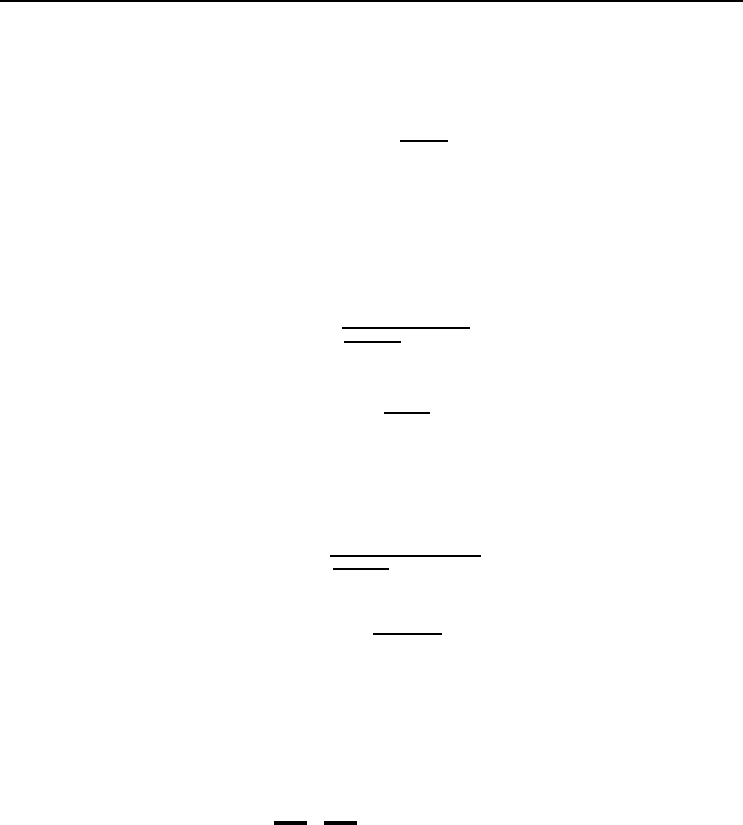
4.4 Learning Vector Quantizer-I 59
dependent, starting with a large value that decays gradually as training progresses.
To ensure numerical stability of the algorithm, the learning rate η
k
(t) for output unit
o
k
must satisfy the inequality:
0 <η
k
(t) <
1
1.2λ
k
(4.13)
where λ
k
is the largest eigenvalue of the covariance matrix of the inputs to the unit
[636]. A good initial value is given as η
k
(0) = 1/[2Z
T
Z], where Z is the input matrix.
Cichocki and Unbehauen [130] provided an adaptive learning rate that utilizes a for-
getting factor, γ, as follows:
η
k
(t)=
1
γ
η
k
(t−1)
+ o
2
k
(t)
(4.14)
with
η
k
(0) =
1
o
2
k
(0)
(4.15)
Usually, 0.9 ≤ γ ≤ 1.
The above can be adapted to allow the same learning rate for all the weights in the
following way:
η
k
(t)=
1
γ
η
k
(t−1)
+ ||o(t)||
2
2
(4.16)
with
η
k
(0) =
1
||o(0)||
2
2
(4.17)
Sanger [756] developed another principal components learning algorithm, similar to
that of Oja, referred to as generalized Hebbian learning. The only difference is the
inclusion of more feedback information and a decaying learning rate η(t):
∆u
ki
(t)=η(t)[z
i,p
o
k,p
Hebbian
−o
k,p
k
j=0
u
ji
(t − 1)o
j,p
] (4.18)
For more information on principal component learning, the reader is referred to the
summary in [356].
4.4 Learning Vector Quantizer-I
One of the most frequently used unsupervised clustering algorithms is the learning
vector quantizer (LVQ) developed by Kohonen [472, 474]. While several versions of
LVQ exist, this section considers the unsupervised version, LVQ-I.
Ripley [731] defined clustering algorithms as those algorithms where the purpose is to
divide a set on n observations into m groups such that members of the same group
60 4. Unsupervised Learning Neural Networks
are more alike than members of different groups. The aim of a clustering algorithm is
therefore to construct clusters of similar input vectors (patterns), where similarity is
usually measured in terms of Euclidean distance. LVQ-I performs such clustering.
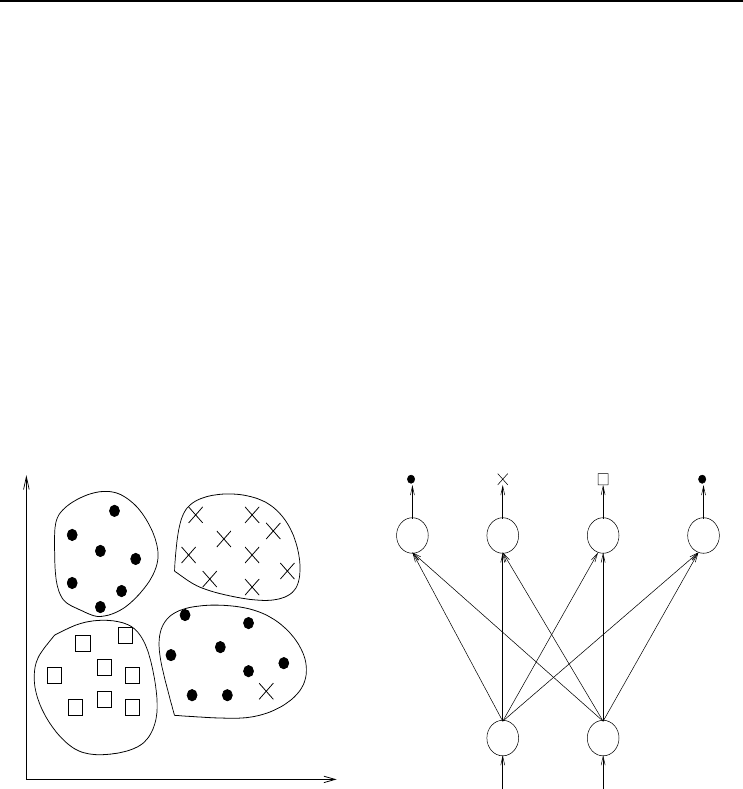
The training process of LVQ-I to construct clusters is based on competition. Referring
to Figure 4.1, each output unit o
k
represents a single cluster. The competition is among
the cluster output units. During training, the cluster unit whose weight vector is the
“closest” to the current input pattern is declared as the winner. The corresponding
weight vector and that of neighboring units are then adjusted to better resemble the
input pattern. The “closeness” of an input pattern to a weight vector is usually
measured using the Euclidean distance. The weight update is given as
∆u
ki
(t)=
η(t)[z
i,p
− u
ki
(t − 1)] if k ∈ κ
k,p
(t)
0otherwise
(4.19)
where η(t) is a decaying learning rate, and κ
k,p
(t) is the set of neighbors of the winning
cluster unit o
k
for pattern p. It is, of course, not strictly necessary that LVQ-I makes
use of a neighborhood function, thereby updating only the weights of the winning
output unit.
2
1
3
4
z
1
z
2
(a) Clustering Problem
1234
z
1
z
2
u
22
u
11
u
12
u
21
(b) LVQ-I network
Figure 4.2 Learning Vector Quantizer to Illustrate Clustering
An illustration of clustering, as done by LVQ-I, is given in Figure 4.2. The input
space, defined by two input units z
1
and z
2
, is represented in Figure 4.2(a), while
Figure 4.2(b) illustrates the LVQ-I network architecture required to form the clusters.
Note that although only three classes exist, four output units are necessary – one for
each cluster. Less output units will lead to errors since patterns of different classes
will be grouped in the same cluster, while too many clusters may cause overfitting.
For the problem illustrated in Figure 4.2(a), an additional cluster unit may cause a
separate cluster to learn the single × in cluster 4.
The Kohonen LVQ-I algorithm is summarized in Algorithm 4.2. For the LVQ-I, weights
are either initialized to random values, sampled from a uniform distribution, or by

4.4 Learning Vector Quantizer-I 61
Algorithm 4.2 Learning Vector Quantizer-I Training Algorithm
Initialize the network weights, the learning rate, and the neighborhood radius;
while stopping condition(s) not true do
for each pattern p do
Compute the Euclidean distance, d
k,p
, between input vector z
p
and each
weight vector u
k
=(u
k1
,u
k2
, ···,u
KI
)as
d
k,p
(z
p
, u
k
)=
I
i=1
(z
i,p
−u
ki
)
2
(4.20)
Find the output unit o
k
for which the distance d
k,p
is the smallest;
Update all the weights for the neighborhood κ
k,p
using equation (4.19);
end
Update the learning rate;
Reduce the neighborhood radius at specified learning iterations;
end
taking the first input patterns as the initial weight vectors. For the example in Fig-
ure 4.2(b), the latter will result in the weights u
11
= z
1,1
,u
12
= z
2,1
,u
21
= z
1,2
,u
22
=
z
2,2
,etc.
Stopping conditions may be
• a maximum number of epochs is reached,
• stop when weight adjustments are sufficiently small,
• a small enough quantization error has been reached, where the quantization error
is defined as
Q
T
=
P
T
p=1
||z
p
− u
k
||
2
2
P
T
(4.21)
One problem that may occur in LVQ networks is that one cluster unit may dominate
as the winning cluster unit. The danger of such a scenario is that most patterns will
be in one cluster. To prevent one output unit from dominating, a “conscience” factor
is incorporated in a function to determine the winning output unit. The conscience
factor penalizes an output for winning too many times. The activation value of output
units is calculated using
o
k,p
=
1formin
∀k
{d
k,p
(z
p
, u
k
) − b
k
(t)}
0otherwise
(4.22)
where
b
k
(t)=γ(
1
I
− g
k
(t)) (4.23)
and
g
k
(t)=g
k
(t − 1) + β(o
k,p
− g
k
(t − 1)) (4.24)

62 4. Unsupervised Learning Neural Networks
In the above, d
k,p
is the Euclidean distance as defined in equation (4.20), I is the total
number of input units, and g
k
(0) = 0. Thus, b
k
(0) =
1
I
, which initially gives each
output unit an equal chance to be the winner; b
k
(t) is the conscience factor defined
for each output unit. The more an output unit wins, the larger the value of g
k
(t)
becomes, and b
k
(t) becomes larger negative. Consequently, a factor |b
k
(t)| is added to
the distance d
k,p
. Usually, for normalized inputs, β =0.0001 and γ = 10.
4.5 Self-Organizing Feature Maps
Kohonen developed the self-organizing feature map (SOM) [474, 475, 476], as moti-
vated by the self-organization characteristics of the human cerebral cortex. Studies of
the cerebral cortex showed that the motor cortex, somatosensory cortex, visual cortex
and auditory cortex are represented by topologically ordered maps. These topological
maps form to represent the structures sensed in the sensory input signals.
The self-organizing feature map is a multidimensional scaling method to project an
I-dimensional input space to a discrete output space, effectively performing a com-
pression of input space onto a set of codebook vectors. The output space is usually a
two-dimensional grid. The SOM uses the grid to approximate the probability density
function of the input space, while still maintaining the topological structure of input
space. That is, if two vectors are close to one another in input space, so is the case
for the map representation.
The SOM closely resembles the learning vector quantizer discussed in the previous
section. The difference between the two unsupervised algorithms is that neurons are
usually organized on a rectangular grid for SOM, and neighbors are updated to also
perform an ordering of the neurons. In the process, SOMs effectively cluster the
input vectors through a competitive learning process, while maintaining the topological
structure of the input space.
Section 4.5.1 explains the standard stochastic SOM training rule, while a batch version
is discussed in Section 4.5.2. A growing approach to SOM is given in Section 4.5.3.
Different approaches to speed up the training of SOMs are overviewed in Section 4.5.4.
Section 4.5.5 explains the formation of clusters for visualization purposes. Section 4.5.6
discusses in brief different ways how the SOM can be used after training.
4.5.1 Stochastic Training Rule
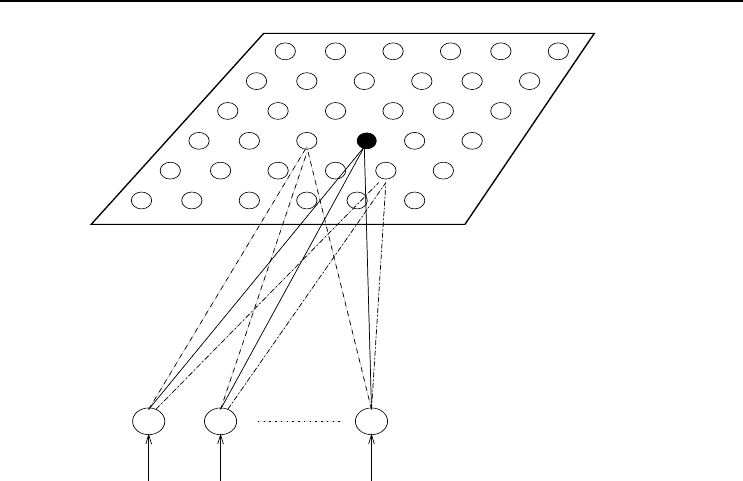
SOM training is based on a competitive learning strategy. Assume I-dimensional
input vectors z
p
, where the subscript p denotes a single training pattern. The first
step of the training process is to define a map structure, usually a two-dimensional
grid (refer to Figure 4.3). The map is usually square, but can be of any rectangular
shape. The number of elements (neurons) in the map is less than the number of
training patterns. Ideally, the number of neurons should be equal to the number of
independent training patterns.
4.5 Self-Organizing Feature Maps 63
Map
Input Vector
k
z
1
z
2
z
I
Figure 4.3 Self-organizing Map
Each neuron on the map is associated with and I-dimensional weight vector that forms
the centroid of one cluster. Larger cluster groupings are formed by grouping together
“similar” neighboring neurons.
Initialization of the codebook vectors can occur in various ways:
• Assign random values to each weight w
kj
=(w
kj1
,w
kj2
, ···,w
KJI
), with K the
number of rows and J the number of columns of the map. The initial values
are bounded by the range of the corresponding input parameter. While random
initialization of weight vectors is simple to implement, this form of initialization
introduces large variance components into the map which increases training time.
• Assign to the codebook vectors randomly selected input patterns. That is,
w
kj
= z
p
(4.25)
with p ∼ U(1,P
T
).
This approach may lead to premature convergence, unless weights are perturbed
with small random values.
• Find the principal components of the input space, and initialize the codebook
vectors to reflect these principal components.
• A different technique of weight initialization is due to Su et al. [818], where
the objective is to define a large enough hyper cube to cover all the training
patterns [818]. The algorithm starts by finding the four extreme points of the
map by determining the four extreme training patterns. Firstly, two patterns
are found with the largest inter-pattern Euclidean distance. A third pattern is

64 4. Unsupervised Learning Neural Networks
located at the furthest point from these two patterns, and the fourth pattern
with largest Euclidean distance from these three patterns. These four patterns
form the corners of the map. Weight values of the remaining neurons are found
through interpolation of the four selected patterns, in the following way:
– Weights of boundary neurons are initialized as
w
1j
=
w
1J
− w
11
J −1
(j − 1) + w
11
(4.26)
w
Kj
=
w
KJ
− w
K1
J −1
(j − 1) + w
K1
(4.27)
w
k1
=
w
K1
−w
11
K −1
(k − 1) + w
11
(4.28)
w
kJ
=
w
KJ
− w
1J
K −1
(k − 1) + w
1J
(4.29)
for all j =2, ···,J − 1andk =2, ···,K− 1.
– The remaining codebook vectors are initialized as
w
kj
=
w
kJ
− w
k1
J −1
(j − 1) + w
k1
(4.30)
for all j =2, ···,J − 1andk =2, ···,K− 1.
The standard training algorithm for SOMs is stochastic, where codebook vectors are
updated after each pattern is presented to the network. For each neuron, the associated
codebook vector is updated as
w
kj
(t +1)=w
kj
(t)+h
mn,kj
(t)[z
p
− w
kj
(t)] (4.31)
where mn is the row and column index of the winning neuron. The winning neuron is
found by computing the Euclidean distance from each codebook vector to the input
vector, and selecting the neuron closest to the input vector. That is,
||w
mn
− z
p
||
2
=min
∀kj
{||w
kj
− z
p
||
2
2
} (4.32)
The function h
mn,kj
(t) in equation (4.31) is referred to as the neighborhood function.
Thus, only those neurons within the neighborhood of the winning neuron mn have
their codebook vectors updated. For convergence, it is necessary that h
mn,kj
(t) → 0
when t →∞.
The neighborhood function is usually a function of the distance between the coordi-
nates of the neurons as represented on the map, i.e.
h
mn,kj
(t)=h(||c
mn
− c
kj
||
2
2
,t) (4.33)
with the coordinates c
mn
,c
kj
∈ R
2
. With increasing value of ||c
mn
− c
kj
||
2
2
(that is,
neuron kj is further away from the winning neuron mn), h
mn,kj
→ 0. The neighbor-
hood can be defined as a square or hexagon. However, the smooth Gaussian kernel is
mostly used:
h
mn,kj
(t)=η(t)e
−
||c
mn
−c
kj
||
2
2
2σ
2
(t)
(4.34)

4.5 Self-Organizing Feature Maps 65
where η(t) is the learning rate and σ(t) is the width of the kernel. Both η(t)andσ(t)
are monotonically decreasing functions.
The learning process is iterative, continuing until a “good” enough map has been
found. The quantization error is usually used as an indication of map accuracy, defined
as the sum of Euclidean distances of all patterns to the codebook vector of the winning
neuron, i.e.
E
T
=
P
T
p=1
||z
p
− w
mn
(t)||
2
2
(4.35)
Training stops when E
T
is sufficiently small.
4.5.2 Batch Map
The stochastic SOM training algorithm is slow due to the updates of weights after each
pattern presentation: all the weights are updated. Batch versions of the SOM training
rule have been developed that update weight values only after all patterns have been
presented. The first batch SOM training algorithm was developed by Kohonen [475],
and is summarized in Algorithm 4.3.
Algorithm 4.3 Batch Self-Organizing Map
Initialize the codebook vectors by assigning the first KJ training patterns to them,
where KJ is the total number of neurons in the map;
while stopping condition(s) not true do
for each neuron, kj do
Collect a list of copies of all patterns z
p
whose nearest codebook vector
belongs to the topological neighborhood of that neuron;
end
for each codebook vector do
Compute the codebook vector as the mean over the corresponding list of
patterns;
end
end
Based on the batch learning approach above, Kaski et al. [442] developed a faster
version, as summarized in Algorithm 4.4.
4.5.3 Growing SOM
One of the design problems when using a SOM is deciding on the size of the map. Too
many neurons may cause overfitting of the training patterns, with each training pattern
assigned to a different neuron. Alternatively, the final SOM may have succeeded in
forming good clusters of similar patterns, but with many neurons with a zero or close
to zero frequency. The frequency of a neuron refers to the number of patterns for
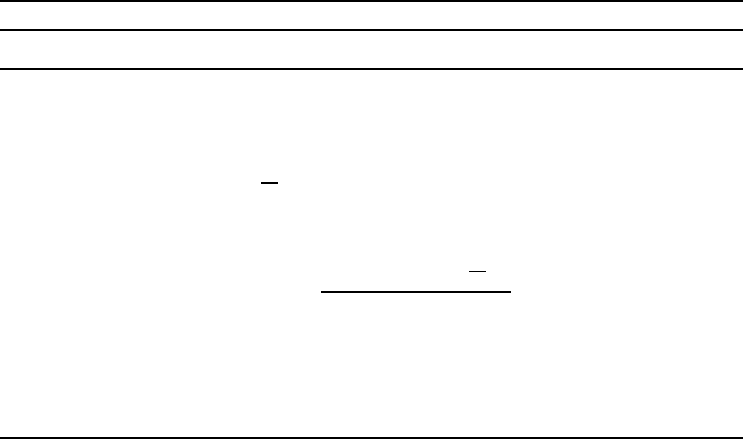
66 4. Unsupervised Learning Neural Networks
Algorithm 4.4 Fast Batch Self-Organizing Map
Initialize the codebook vectors, w
kj
, using any initialization approach;
while stopping condition(s) not true do
for each neuron, kj do
Compute the mean over all patterns for which that neuron is the winner;
Denote the average by
w
kj
;
end
Adapt the weight values for each codebook vector using
w
kj
=
nm
N
nm
h
nm,kj
w
nm
nm
N
nm
h
nm,kj
(4.36)
where nm iterates over all neurons, N
nm
is the number of patterns for which
neuron nm is the winner, and h
nm,kj
is the neighborhood function which
indicates if neuron nm is in the neighborhood of neuron kj, and to what degree.
end
which that neuron is the winner, referred to as the best matching neuron (BMN). Too
many neurons also cause a substantial increase in computational complexity. Too few
neurons, on the other hand, will result in clusters with a high variance among the
cluster members.
An approach to find near optimal SOM architectures is to start training with a small
architecture, and to grow the map when more neurons are needed. One such SOM
growing algorithm is given in Algorithm 4.5, assuming a square map structure. Note
that the map-growing process coexists with the training process.
Growing of the map is stopped when any one of the following criteria is satisfied:
• the maximum map size has been reached;
• the largest neuron quantization error is less than a user specified threshold, ;
• the map has converged to the specified quantization error.
A few aspects of the growing algorithm above need some explanation. These are the
constants , γ, and the maximum map size as well as the different stopping conditions.
A good choice for γ is 0.5. The idea of the interpolation step is to assign a weight
vector to the new neuron ab such that it removes patterns from neuron kj with the
largest quantization erro in order to reduce the error of that neuron. A value less than
0.5 will position neuron ab closer to kj, with the chance that more patterns will be
removed from neuron kj. A value larger than 0.5 will have the opposite effect.
The quantization error threshold, , is important to ensure that a sufficient map size
is constructed. A small value for may result in a too large map architecture, while
a too large may result in longer training times to reach a large enough architecture.
An upper bound on the size of the map is easy to determine: it is simply the number
of training patterns, P
T
. This is, however, undesirable. The maximum map size is

4.5 Self-Organizing Feature Maps 67
Algorithm 4.5 Growing Self-Organizing Map Algorithm
Initialize the codebook vectors for a small, undersized SOM;
while stopping condition(s) not true do
while growing condition not triggered do
Train the SOM for t
pattern presentations using any SOM training method;
end
if grow condition is met then
Find the neuron kj with the largest quantization error;
Find the furthest immediate neighbor mn in the row-dimension of the map,
and the furthest neuron rs in the column-dimension;
Insert a column between neurons kj and rs and a row between neurons kj
and mn (this step preserves the square structure of the map);
For each neuron ab in the new column, initialize the corresponding codebook
vectors w
ab
using
w
ab
= γ(w
a,b−1
+ w
a,b+1
) (4.37)
and for each neuron in the new row,
w
ab
= γ(w
a−1,b
+ w
a+1,b
) (4.38)
where γ ∈ (0, 1)
end
end
Refine the weights of the final SOM architecture with additional training steps until
convergence has been reached.
rather expressed as βP
T
,withβ ∈ (0, 1). Ultimately, the map size should be at least
equal to the number of independent variables in the training set. The optimal value
of β is problem dependent, and care should be taken to ensure that β is not too small
if a growing SOM is not used. If this is the case, the final map may not converge to
the required quantization error since the map size will be too small.
4.5.4 Improving Convergence Speed
Training of SOMs is slow, due to the large number of weight updates involved (all
the weights are updated for standard SOM training). Several mechanisms have been
developed to reduce the number of training calculations, thereby improving speed
of convergence. BatchMap is one such mechanism. Other approaches include the
following:
Optimizing the neighborhood
If the Gaussian neighborhood function as given in equation (4.34) is used, all neurons
will be in the neighborhood of the BMN, but to different degrees, due to the asymptotic