
Engelbrecht Andries P. Computational Intelligence: An Introduction
Подождите немного. Документ загружается.


98 7. Performance Issues (Supervised Learning)
7.1.2 Complexity
The computational complexity of a NN is directly influenced by:
1. The network architecture: The larger the architecture, the more feedforward
calculations are needed to predict outputs after training, and the more learning
calculations are needed per pattern presentation.
2. The training set size: The larger the training set size, the more patterns are
presented for training. Therefore, the total number of learning calculations per
epoch is increased.
3. Complexity of the optimization method: As will be discussed in Section 7.3,
sophisticated optimization algorithms have been developed to improve the accu-
racy and convergence characteristics of NNs. The sophistication comes, however,
at the cost of increased computational complexity to determine the weight up-
dates.
Training time is usually quantified in terms of the number of epochs to reach specific
training or generalization errors. When different learning algorithms are compared, the
number of epochs is usually not an accurate estimate of training time or computational
complexity. Instead, the total number of pattern presentations, or weight updates are
used. A more accurate estimate of computational complexity is to count the total
number of calculations made during training.
7.1.3 Convergence
The convergence characteristics of a NN can be described by the ability of the network
to converge to specified error levels (usually considering the generalization error). The
ability of a network to converge to a specific error is expressed as the number of times,
out of a fixed number of simulations, that the network succeeded in reaching that
error. While this is an empirical approach, rigorous theoretical analysis has been done
for some network types.
7.2 Analysis of Performance
Any study of the performance of NNs (or any other stochastic algorithm for that mat-
ter) and any conclusions based on just one simulation are incomplete and inconclusive.
Conclusions on the performance of NNs must be based on the results obtained from
several simulations. For each simulation the NN starts with new random initial weights
and uses different training, validation and generalization sets, independent of previ-
ous sets. Performance results are then expressed as averages over all the simulations,
together with variances, or confidence intervals.
Let denote the performance measure under consideration. Results are then reported
as
±σ
. The average is an indication of the average performance over all simulations,

7.3 Performance Factors 99
while σ
gives an indication of the variance in performance. The σ
parameter is very
important in decision making. For example, if two algorithms A and B are compared
where the MSE for A is 0.001±0.0001, and that of B is 0.0009±0.0006, then algorithm
A will be preferred even though B has a smaller MSE. Algorithm A has a smaller
variance, having MSE values in the range [0.0009, 0.0011], while B has MSE values in
a larger range of [0.0003, 0.0015].
While the above approach to present results is sufficient, results are usually reported
with associated confidence intervals. If a confidence level of α =0.01 is used, for
example, then 99% of the observations will be within the calculated confidence interval.
Before explaining how to compute the confidence intervals, it is important to note that
statistical literature suggests that at least 30 independent simulations are needed. This
allows the normality assumption as stated by the central limit theorem: the probability
distribution governing the variable
approaches a Normal distribution as the number
of observations (simulations) tends to infinity. Using this result, the confidence interval
associated with confidence level α can be estimated as
± t
α,n−1
σ
(7.8)
where t
α,n−1
is a constant obtained from the t-distribution with n − 1 degrees of
freedom (n is the number of simulations) and
σ
=
!
n
i=1
(
i
− )
2
n(n − 1)
(7.9)
It should be noted at this point that the t-test assumes that samples are normally
distributed. It is, however, not always the case that 30 samples will guarantee a
normal distribution. If not normally distributed, nonparametric tests need to be used.
7.3 Performance Factors
This section discusses various aspects that have an influence on the performance of
supervised NNs. These aspects include data manipulation, learning parameters, ar-
chitecture selection, and optimization methods.
7.3.1 Data Preparation
One of the most important steps in using a NN to solve real-world problems is to
collect and transform data into a form acceptable to the NN. The first step is to
decide on what the inputs and the outputs are. Obviously irrelevant inputs should be
excluded. Section 7.3.5 discusses ways in which the NN can decide itself which inputs
are irrelevant. The second step is to process the data in order to remove outliers,
handle missing data, transform non-numeric data to numeric data and to scale the
data into the active range of the activation functions used. Each of these aspects are
discussed in the sections below.

100 7. Performance Issues (Supervised Learning)
Missing Values
It is common that real-world data sets have missing values for input parameters. NNs
need a value for each of the input parameters. Therefore, something has to be done
with missing values. The following options exist:
• Remove the entire pattern if it has a missing value. While pattern removal solves
the missing value problem, other problems are introduced: (1) the available
information for training is reduced which can be a problem if data is already
limited, and (2) important information may be lost.
• Replace each missing value with the average value for that input parameter in
the case of continuous values, or with the most frequently occurring value in the
case of nominal or discrete values. This replacing of missing values introduces
no bias.
• For each input parameter that has a missing value, add an additional input
unit to indicate patterns for which parameters are missing. It can then be
determined after training whether the missing values had a significant influence
on the performance of the network.
While missing values present a problem to supervised neural networks, SOMs do not
suffer under these problems. Missing values do not need to be replaced. The BMN
for a pattern with missing values is, for example, calculated by ignoring the missing
value and the corresponding weight value of the codebook vector in the calculation of
the Euclidean distance between the pattern and codebook vector.
Coding of Input Values
All input values to a NN must be numeric. Nominal values therefore need to be
transformed to numerical values. A nominal input parameter that has n different
values is coded as n different binary input parameters, where the input parameter
that corresponds to a nominal value has the value 1, and the rest of these parameters
have the value 0. An alternative is to use just one input parameter and to map each
nominal value into an equivalent numerical value. This is, however, not a good idea,
since the NN will interpret the input parameter as having continuous values, thereby
losing the discrete characteristic of the original data.
Outliers
Outliers have severe effects on accuracy, especially when gradient descent is used with
the SSE as objective function. An outlier is a data pattern that deviates substantially
from the data distribution. Because of the large deviation from the norm, outliers
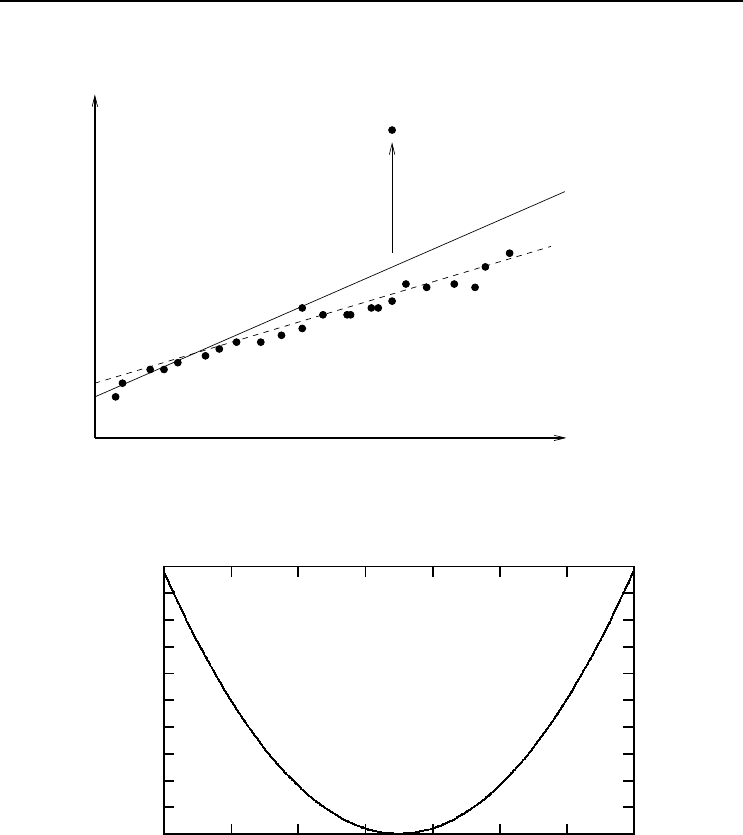
result in large errors, and consequently large weight updates. Figure 7.3 shows that
larger differences between target and output values cause an exponential increase in the
error if the SSE is used as objective function. The fitted function is then pulled toward
the outliers in an attempt to reduce the training error. As result, the generalization
7.3 Performance Factors 101
deteriorates. Figure 7.2 illustrates this effect.
Outlier
Input
Target
Expected fitted
function
Large error
pulls function
upwards
Actual fitted
function
Figure 7.2 Effect of Outliers
0
5
10
15
20
25
30
35
40
45
50
-7 -5 -3 -1 1 3 5 7
(t − o)
2
(t − o)
Figure 7.3 Sum Squared Error Objective Function
The outlier problem can be addressed in the following ways:
• Remove outliers before training starts, using statistical techniques. While such
actions will eliminate the outlier problem, it is believed that important informa-
tion about the data might also be removed at the same time.
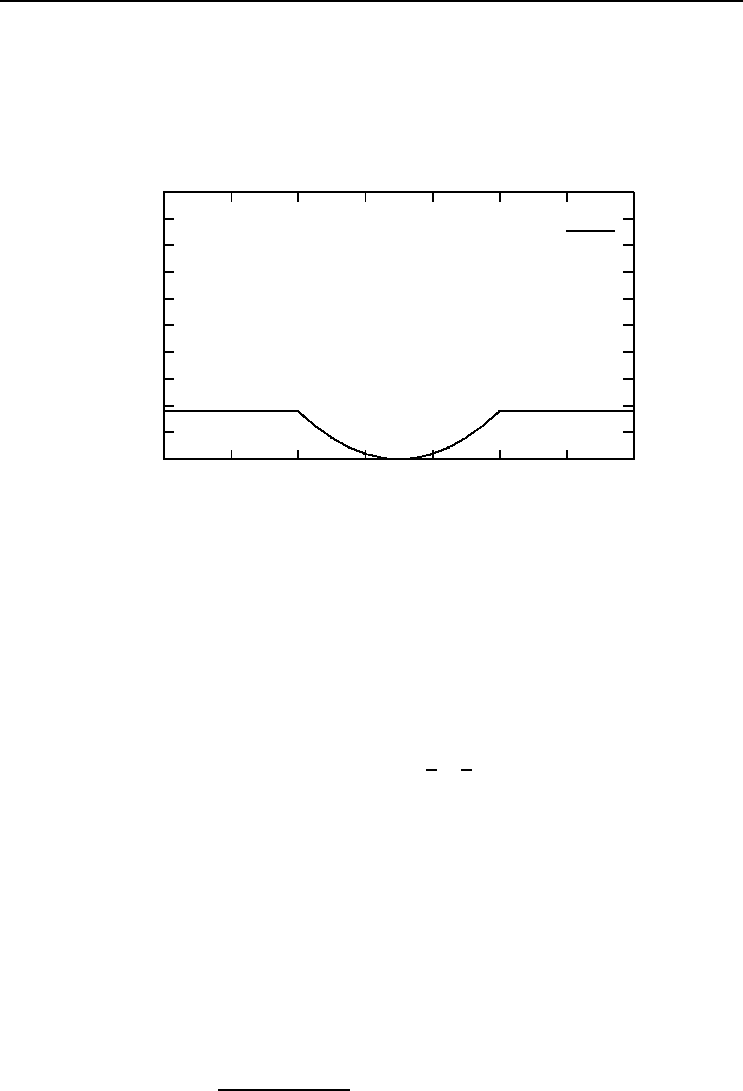
• Use a robust objective function that is not influenced by outliers. An example
objective function is the Huber function as illustrated in Figure 7.4 [396]. Pat-
terns for which the error is larger than || have a constant value, and have a zero
influence when weights are updated (the derivative of a constant is zero).
102 7. Performance Issues (Supervised Learning)
• Slade and Gedeon [796] and Gedeon et al. [311] proposed bimodal distribution
removal, where the aim is to remove outliers from training sets during training.
Frequency distributions of pattern errors are analyzed during training to identify
and remove outliers. If the original training set contains no outliers, the method
simply reduces to standard learning.
0
5
10
15
20
25
30
35
40
45
50
-7 -5 -3 -1 1 3 5 7
Error
(t − o)
SSE
Huber
Figure 7.4 Huber Objective Function
Scaling and Normalization
Data needs to be scaled to the active range and domain of the activation functions
used. While it is not necessary to scale input values, performance can be improved
if inputs are scaled to the active domain of the activation functions. For example,
consider the sigmoid activation function. Simple mathematical calculations show that
the active domain of the sigmoid function is [−
√
3,
√
3], corresponding to the parts of
the function for which changes in input values have relatively large changes in output.
Values near the asymptotic ends of the sigmoid function have a very small influence
on weight updates. Changes in these values result in very small changes in output.
Furthermore, the derivatives near the asymptotes are approximately zero, causing
weight updates to be approximately zero; therefore, achieving no learning in these
areas.
When bounded activation functions are used, the target values have to be scaled to the
range of the activation function, for example (0, 1) for the sigmoid function and (−1, 1)
for the hyperbolic tangent. If t
u,max
and t
u,min
are the maximum and minimum values
of the unscaled target t
u
, then,
t
s
=
t
u
− t
u,min
t
u,max
−t
u,min
(t
s,max
−t
s,min
)+t
s,min
(7.10)
where t
s,max
and t
s,min
are the new maximum and minimum values of the scaled
values, linearly maps the range [t
u,min
,t
u,max
] to the range [t
s,min
,t
s,max
].

7.3 Performance Factors 103
In the case of classification problems, target values are usually elements of the set
{0.1, 0.9} for the sigmoid function. The value 0.1 is used instead of 0, and 0.9 instead
of 1. Since the output of the sigmoid function can only approach 0 and 1, a NN can
never converge to the best set of weights if the target values are 0 or 1. In this case
the goal of the NN is always out of reach, and the network continues to push weight
values toward extreme values until training is stopped.
Scaling of target values into a smaller range does have the disadvantage of increased
training time. Engelbrecht et al. [244] showed that if target values are linearly scaled
using
t
s
= c
1
t
u
+ c
2
(7.11)
where t
s
and t
u
are respectively the scaled and original unscaled target values, the NN
must be trained longer until
MSE
s
=(c
1
)
2
MSE
r
(7.12)
to reach a desired accuracy, MSE
r
, on the original unscaled data set.
The hyperbolic tangent will therefore result in faster training times than the sigmoid
function, assuming the same initial conditions and training data.
The scaling process above is usually referred to as amplitude scaling, or min-max
scaling. Min-max scaling preserves the relationships among the original data. Two
other frequently used scaling methods are mean centering and variance scaling. To
explain these two scaling methods, assume that Z ∈ R
I×P
is a matrix containing all
input vectors such that input vectors are arranged as columns in Z,andT ∈R
K×P
is the matrix of associated target vectors, arranged in column format. For the mean
centering process, compute
Z
i
=
P
p=1
Z
i,p
/P (7.13)
T
k
=
P
p=1
T
k,p
/P (7.14)
for all i =1, ···,I and k =1, ···,K;
Z
i
is the average value for input z
i
over all the
patterns, and
T
k
is the average target value for the k-th output unit over all patterns.
Then,
Z
M
i,p
= Z
i,p
− Z
i
(7.15)
T
M
k,p
= T
k,p
− T
k
(7.16)
for all i =1, ···,I, k =1, ···,K and p =1, ···,P; Z
M
i,p
is the scaled value of the input
to unit z
i
for pattern p,andT
M
k,p
is the corresponding scaled target value.
Variance scaling, on the other hand, computes for each row in each matrix the standard
deviations (I deviations for matrix Z and K deviations for matrix T )overallP
elements in the row. Let σ
z
i
denote the standard deviation of row i of matrix Z,and

104 7. Performance Issues (Supervised Learning)
σ
t
k
is the standard deviation of row k of matrix T . Then,
Z
V
i,p
=
Z
i,p
σ
z
i
(7.17)
T
V
k,p
=
T
k,p
σ
t
k
(7.18)
for all i =1, ···,I, k =1, ···,K and p =1, ···,P.
Mean centering and variance scaling can both be used on the same data set. Mean cen-
tering is, however, more appropriate when the data contains no biases, while variance
scaling is appropriate when training data are measured with different units.
Both mean centering and variance scaling can be used in situations where the minimum
and maximum values are unknown. Z-score normalization is another data transfor-
mation scheme that can be used in situations where the range of values is unknown. It
is essentially a combination of mean centering and variance scaling, and is very useful
when there are outliers in the data. For z-score normalization,
Z
MV
i,p
=
Z
i,p
−Z
i
σ
z
i
(7.19)
T
MV
k,p
=
T
k,p
− T
k
σ
t
k
(7.20)
For some NN types, for example the LVQ, input data is preferred to be normalized to
vectors of unit length. The values z
i,p
of each input parameter z
i
are then normalized
using
z
i,p
=
z
i,p
I
i=1
z
2
i,p
(7.21)
The normalization above loses information on the absolute magnitude of the input
parameters, since it requires the length of all input vectors (patterns) to be the same.
Input patterns with parameter values of different magnitudes are normalized to the
same vector, e.g. vectors (−1, 1, 2, 3) and (−3, 3, 6, 9). Z-axis normalization is an
alternative approach that preserves the absolute magnitude information of input pat-
terns. Before the normalization step, input values are scaled to the range [−1, 1].
Input values are then normalized using
z
i,p
=
z
i,p
√
I
(7.22)
and adding an additional input unit z
0
to the NN, referred to as the synthetic param-
eter, with value
z
0
=
"
1 −
L
2
I
(7.23)
where L is the Euclidean length of input vector z
p
.

7.3 Performance Factors 105
Noise Injection
For problems with a limited number of training patterns, controlled injection of noise
helps to generate new training patterns. Provided that noise is sampled from a normal
distribution with a small variance and zero mean, it can be assumed that the resulting
changes in the network output will have insignificant consequences [379]. Also, the
addition of noise results in a convolutional smoothing of the target function, result-
ing in reduced training time and increased accuracy [713]. Engelbrecht used noise
injection around decision boundaries to generate new training patterns for improved
performance [237].
Training Set Manipulation
Several researchers have developed techniques to control the order in which patterns
are presented for learning. These techniques resulted in the improvement of training
time and accuracy. A short summary of such training set manipulation techniques is
given below.
Ohnishi et. al. [634] suggested a method called selective presentation where the
original training set is divided into two training sets. One set contains typical patterns,
and the other set contains confusing patterns. With “typical pattern” the authors
mean a pattern far from decision boundaries, while “confusing pattern” refers to a
pattern close to a boundary. The two training sets are created once before training.
Generation of these training sets assumes prior knowledge about the problem, i.e.
where decision boundaries are located in input space. In many practical applications
such prior knowledge is not available, thus limiting the applicability of this approach.
The selective presentation strategy alternately presents the learner with typical and
then confusing patterns.
Kohara developed selective presentation learning specifically for forecasting applica-
tions [471]. Before training starts, the algorithm generates two training sets. The one
set contains all patterns representing large next-day changes, while patterns represent-
ing small next-day changes are contained in the second set. Large-change patterns are
then simply presented more often than small-change patterns (similar to selective pre-
sentation).
Cloete and Ludik [137, 537] have done extensive research on training strategies. Firstly,
they proposed Increased Complexity Training where a NN first learns easy problems,
and then the complexity of the problem to be learned is gradually increased. The
original training set is split into subsets of increasing complexity before training com-
mences. A drawback of this method is that the complexity measure of training data
is problem dependent, thus making the strategy unsuitable for some tasks. Secondly,
Cloete and Ludik developed incremental training strategies, i.e. incremental subset
training [139] and incremental increased complexity training [538]. In incremental
subset training, training starts on a random initial subset. During training, random
subsets from the original training set are added to the actual training subset. Incre-
mental increased complexity training is a variation of increased complexity training,

106 7. Performance Issues (Supervised Learning)
where the complexity ranked order is maintained, but training is not done on each
complete complexity subset. Instead, each complexity subset is further divided into
smaller random subsets. Training starts on an initial subset of a complexity subset,
and is incrementally increased during training. Finally, delta training strategies were
proposed [138]. With delta subset training examples are ordered according to inter-
example distance, e.g. Hamming or Euclidean distance. Different strategies of example
presentations were investigated: smallest difference examples first, largest difference
examples first, and alternating difference.
When vast quantities of data are available, training on all these data can be pro-
hibitively slow, and may require reduction of the training set. The problem is which
of the data should be selected for training. An easy strategy is to simply sample a
smaller data set at each epoch using a uniform random number generator. Alterna-
tively, a fast clustering algorithm can be used to group similar patterns together, and
to sample a number of patterns from each cluster.
7.3.2 Weight Initialization
Gradient-based optimization methods, for example gradient descent, is very sensitive
to the initial weight vectors. If the initial position is close to a local minimum, con-
vergence will be fast. However, if the initial weight vector is on a flat area in the
error surface, convergence is slow. Furthermore, large initial weight values have been
shown to prematurely saturate units due to extreme output values with associated
zero derivatives [400]. In the case of optimization algorithms such as PSO and GAs,
initialization should be uniformly over the entire search space to ensure that all parts
of the search space are covered.
A sensible weight initialization strategy is to choose small random weights centered
around 0. This will cause net input signals to be close to zero. Activation functions
then output midrange values regardless of the values of input units. Hence, there is no
bias toward any solution. Wessels and Barnard [898] showed that random weights in
the range [
−1
√
fanin
,
1
√
fanin
] is a good choice, where fanin is the number of connections
leading to a unit.
Why are weights not initialized to zero in the case of gradient-based optimization?
This strategy will work only if the NN has just one hidden unit. For more than
one hidden unit, all the units produce the same output, and thus make the same
contribution to the approximation error. All the weights are therefore adjusted with
the same value. Weights will remain the same irrespective of training time – hence,
no learning takes place. Initial weight values of zero for PSO will also fail, since no
velocity changes are made; therefore no weight changes. GAs, on the other hand, will
work with initial zero weights if mutation is implemented.

7.3 Performance Factors 107
7.3.3 Learning Rate and Momentum
The convergence speed of NNs is directly proportional to the learning rate η. Consid-
ering stochastic GD, the momentum term added to the weight updates also has the
objective of improving convergence time.
Learning Rate
The learning rate controls the size of each step toward the minimum of the objective
function. If the learning rate is too small, the weight adjustments are correspond-
ingly small. More learning iterations are then required to reach a local minimum.
However, the search path will closely approximate the gradient path. Figure 7.5(a)
illustrates the effect of small η. On the other hand, large η will have large weight
updates. Convergence will initially be fast, but the algorithm will eventually oscillate
without reaching the minimum. It is also possible that too large a learning rate will
cause “jumping” over a good local minimum proceeding toward a bad local minimum.
Figure 7.5(b) illustrates the oscillating behavior, while Figure 7.5(c) illustrates how
large learning rates may cause the network to overshoot a good minimum and get
trapped in a bad local minimum. Small learning rates also have the disadvantage of
being trapped in a bad local minimum as illustrated in Figure 7.5(d). The search path
goes down the first local minimum, with no mechanism to move out of it toward the
next, better minimum. Of course, the search trajectory depends on the initial starting
position. If the second initial point is used, the NN will converge to the better local
minimum.
But how should the value of the learning rate be selected? One approach is to find
the optimal value of the learning rate through cross-validation, which is a lengthy
process. An alternative is to select a small value (e.g. 0.1) and to increase the value
if convergence is too slow, or to decrease it if the error does not decrease fast enough.
Plaut et al. [680] proposed that the learning rate should be inversely proportional
to the fanin of a neuron. This approach has been theoretically justified through an
analysis of the eigenvalue distribution of the Hessian matrix of the objective function
[167].
Several heuristics have been developed to dynamically adjust the learning rate during
training. One of the simplest approaches is to assume that each weight has a different
learning rate η
kj
. The following rule is then applied to each weight before that weight
is updated: if the direction in which the error decreases at this weight change is the
same as the direction in which it has been decreasing recently, then η
kj
is increased; if
not, η
kj
is decreased [410]. The direction in which the error decreases is determined by
the sign of the partial derivative of the objective function with respect to the weight.
Usually, the average change over a number of pattern presentations is considered and
not just the previous adjustment.
An alternative is to use an annealing schedule to gradually reduce a large learning
rate to a smaller value (refer to equation 4.40). This allows for large initial steps, and
ensures small steps in the region of the minimum.