
Enns R.H. Computer Algebra Recipes for Mathematical Physics
Подождите немного. Документ загружается.

2.3. FOURIER SERIES 77
An even function f2 is introduced which is the same as f for 0 ≤ x ≤ L and
symmetrical about the origin. f 2 is used to generate the cosine series.
>
f2:=piecewise(x<-L/2,L+x,x<0,-x,x<L/2,x,x<L,L-x);
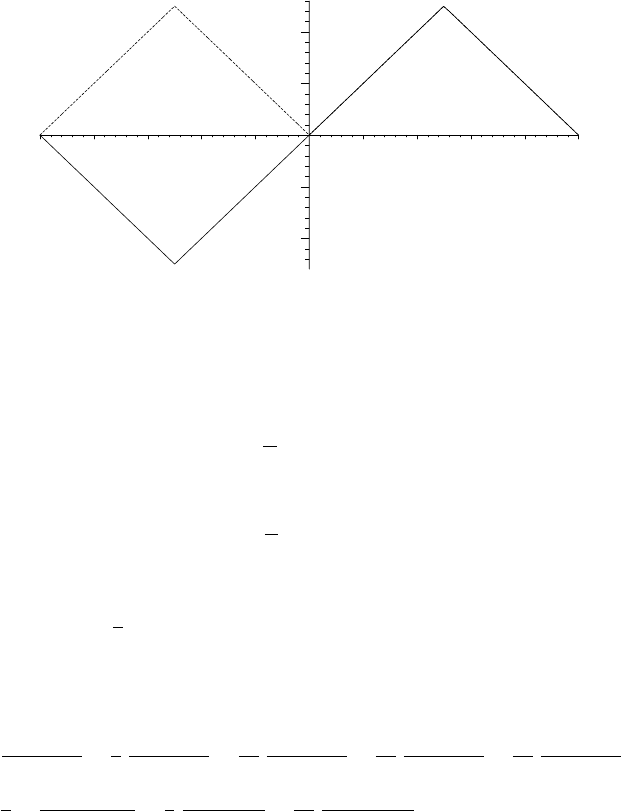
To confirm that f1andf2 are odd and even extensions of f to the region x<0,
they are plotted as solid and dashed curves in Figure 2.6. For x>0, the two
curves are identical, and therefore indistinguishable.
>
plot([f1,f2],x=-L..L,linestyle=[SOLID,DASH],thickness=2);
–0.4
0.4
–1 1
x
Figure 2.6: Solid curve, f1. dashed curve, f2.
For a given f , functional operators A, B and F are introduced to calculate the
series coefficients a
n
and b
n
, and to produce the series out to N terms.
>
A:=(f,n)->(1/L)*int(f*cos(n*X),x=-L..L);
A := (f, n) →
1
L
L
−L
f cos(nX) dx
>
B:=(f,n)->(1/L)*int(f*sin(n*X),x=-L..L);
B := (f, n) →
1
L
L
−L
f sin(nX) dx
>
F:=(f,N)->A(f,0)/2+sum(A(f,n)*cos(n*X)+B(f,n)*sin(n*X),n=1..N);
F := (f, N) →
1
2
A(f, 0) + (
N
n=1
(A(f, n) cos(nX)+B(f, n)sin(nX)))
Taking N =10, the Fourier sine and cosine series are produced in F1 and F2 .
>
F1:=F(f1,10); F2:=F(f2,10);
F1:=
4sin(πx)
π
2
−
4
9
sin(3 πx)
π
2
+
4
25
sin(5 πx)
π
2
−
4
49
sin(7 πx)
π
2
+
4
81
sin(9 πx)
π
2
F2:=
1
4
−
2 cos(2 πx)
π
2
−
2
9
cos(6 πx)
π
2
−
2
25
cos(10 πx)
π
2
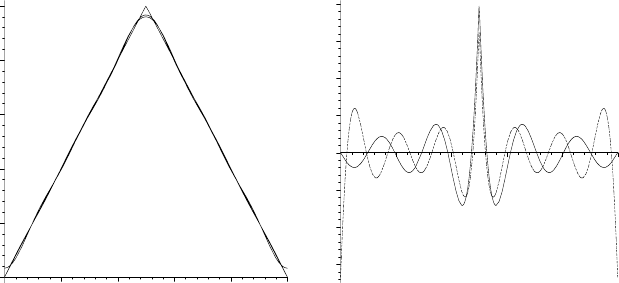
The two series are plotted along with f and shown on the left of Figure 2.7.
>
plot([f,F1,F2],x=0..L,color=[blue,red,green],thickness=2);
78 CHAPTER 2. APPLICATIONS OF SERIES
0
0.5
x
1
–0.01
0
0.01
0.02
1
x
Figure 2.7: Left: f and the two series. Right: Solid, f −F1. Dashed, f − F2 .
Even though N is not large, both series fit f quite well, except near the apex
of the triangle and, for the cosine series, near x = 0 and 1. To magnify the
difference between the series results and f, the differences f − F1 and f − F2
are plotted as solid and dashed curves in the right graph of Figure 2.5.
>
plot([f-F1,f-F2],x=0..L,linestyle=[1,3],thickness=2);
The cosine series clearly fits less well at the end points of the x range. Can you
suggest why this is the case?
2.3.3 How Sweet This Is!
Few things are harder to put up with than the annoyance
of a good example.
Mark Twain, American author, Pudd’nhead Wilson, 1894
If you have calculated series expansions by hand, you know what a tedious
task it can be to explicitly calculate a large number of terms in the series and
then have to plot the results. By now, you should have gotten a clear idea that
using computer algebra is the way to go in handling such problems. The fol-
lowing recipe for the Legendre–Fourier series is a particularly “sweet” example
that derives a “beautiful” result very quickly.
Consider a step function, f(x)=0for −1 <x<0andf(x) =1 for 0 <x<1.
Derive the Legendre–Fourier series for f and plot the series and f together over
the range −1 <x<1. Calculate the area between the x-axis and the series
curve and compare with the exact result for f. Discuss the plot and area results.
>
restart:

2.3. FOURIER SERIES 79
Functional operators A and F are formed to calculate the coefficients A
n
,and
the Legendre series out to N terms, for a given function f.
>
A:=(f,n)->((2*n+1)/2)*int(f*LegendreP(n,x),x=-1..1);
A := (f, n) →
1
2
(2 n +1)
1
−1
f LegendreP(n, x) dx
>
F:=(f,N)->sum(A(f,n)*LegendreP(n,x),n=0..N);
F := (f, N) →
N
n=0
A(f, n) LegendreP(n, x)
The given f is entered with the Heaviside(x) command and the Legendre-
Fourier series calculated in F1 for N =15.
>
f:=Heaviside(x); F1:=F(f,15);
f := Heaviside(x)
F1 :=
1
2
+
3 x
4
−
7
16
LegendreP(3,x)+
11
32
LegendreP(5,x)
−
75
256
LegendreP(7,x)+
133
512
LegendreP(9,x) −
483
2048
LegendreP(11,x)
+
891
4096
LegendreP(13,x) −
13299
65536
LegendreP(15,x)
This is a formidable looking series, which has been generated in three command
lines. If I now wanted to see what the series looks like for, say N =100, changing
15 to 100 in F1 and executing the command would generate the new result
almost instantaneously.
How formidable the result really is, even for 15 terms, can be appreciated by
expanding F1 .Thesort command is used to order the polynomial expansion
from the highest exponent to the lowest. Wow, what a result!
>
F1:=sort(expand(F1));
F1 := −
128931743655
134217728
x
15
+
503889568875
134217728
x
13
−
800852700375
134217728
x
11
+
664630841875
134217728
x
9
−
307629132525
134217728
x
7
+
78646056489
134217728
x
5
−
10402917525
134217728
x
3
+
703956825
134217728
x +
1
2
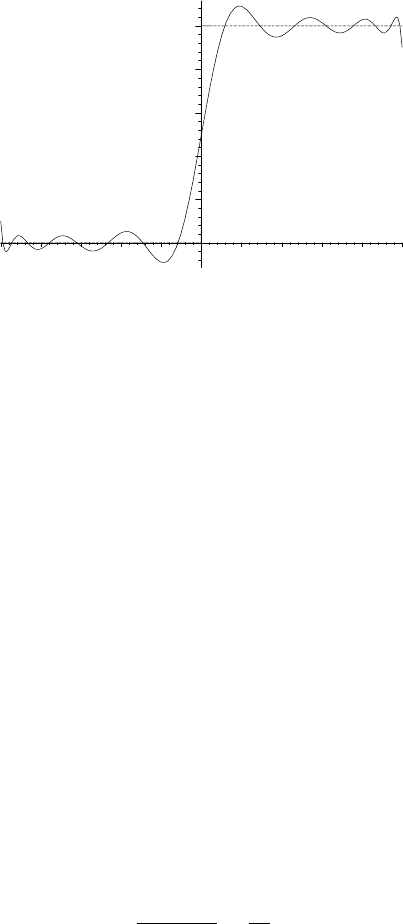
Now f and F1 are plotted in Figure 2.8 over the range x = −1to1,andare
represented by dashed and solid curves, respectively.
>
plot([f,F1],x=-1..1,thickness=2,linestyle=[3,1]);
Two features of the Legendre series are quite clear from the picture, and can be
confirmed by taking N larger. (You will have to adjust the view and number
of digits and plotting points.) The series curve displays a Gibb’s phenomenon
and also passes through the midpoint of the step.
80 CHAPTER 2. APPLICATIONS OF SERIES
0
1
–1 1
x
Figure 2.8: Dashed curve, Step function f. Solid curve, Legendre series F1 .
The area between the Legendre series curve and the x-axis is now calculated
and found to be exactly the same as the area for the step function.
>
Area:=int(F1,x=-1..1);
Area := 1
2.4 Summing Series
In this section, two different approaches to summing infinite series are presented.
The first recipe makes use of ideas already introduced in the earlier Fourier
series examples. In the second recipe, the series to be summed is replaced by a
complexserieswhichMapleisabletosum.
2.4.1 I. M. Curious Sums a Series
Once, I thought I made a mistake, but I was mistaken.
From the diary of I. M. Curious
In this recipe, Ms. Curious answers the following question:
By expanding f(x)=x(L − x), defined in the interval (0,L)withL= π,in
a Fourier sine series of period 2L and setting x = L/2, prove that
∞
n=0
(−1)
n
(2n +1)
3
=
π
3
32
.
Confirm this result by directly summing the series with Maple, first showing
that the sum can be expressed as either a generalized hypergeometric function
or as a polylogarithm function.
I. M. begins her solution by assuming that the Fourier series summation
indices m and n are integers. She then sets L=π and enters f =x (L − x).

2.4. SUMMING SERIES 81
>
restart: assume(m::integer,n::integer):
>
L:=Pi: f:=x*(L-x):
To expand f in a Fourier sine series of period 2 L, she forms the following odd
piecewise function, pw, defined in the interval −L<x<L.
>
pw:=piecewise(x<0,x*(L+x),x>0,f);
pw :=
x (π + x) x<0
x (π − x)0<x
I. M. then calculates the Fourier coefficients a
0
, a
m
for m =0,andb
m
.
>
a[0]:=(1/L)*int(pw,x=-L..L);
a
0
:= 0
>
a[m]:=(1/L)*int(pw*cos(m*Pi*x/L),x=-L..L);
a
m
:= 0
>
b[m]:=(1/L)*int(pw*sin(m*Pi*x/L),x=-L..L);
b
m
:= −
4(−1+(−1)
m
)
πm
3
She notices that in b
m
the coefficients are only non-zero if m is an odd integer.
So she substitutes m =2n +1 into b
m
and relabels the coefficients as b
2n+1
.
The new summation index n will take on the values n =0, 1, 2, ....
>
b[2*n+1]:=simplify(subs(m=2*n+1,b[m]));
b
2 n+1
:=
8
π (2 n +1)
3
Since the coefficients a
m
are zero for all m (and therefore all n), the Fourier
series is then of the form F =
∞
n=0
b
2n+1
sin((2n +1)πx/L).
>
F:=Sum(b[2*n+1]*sin((2*n+1)*Pi*x/L),n=0..infinity);
F :=
∞
n=0
(
8 sin((2 n +1)x)
π (2 n +1)
3
)
Thus, the original function f in the region 0 <x<Lcanbewrittenasthe
Fourier sine series F .Thisisenteredineq1 .
>
eq1:=f=F;
eq1 := x (π − x)=
∞
n=0
(
8 sin((2 n +1)x)
π (2 n +1)
3
)
eq1 is divided by 8 and evaluated at x=L/2.
>
eq2:=eval(eq1/8,x=L/2);
eq2 :=
π
2
32
=
1
8
∞
n=0
(
8(−1)
n
π (2 n +1)
3
)
Multiplying eq2 by π, and expanding, confirms the series sum.
>
eq3:=expand(Pi*eq2);

82 CHAPTER 2. APPLICATIONS OF SERIES
eq3 :=
π
3
32
=
∞
n=0
(−1)
n
(2 n +1)
3
To sum the series directly with Maple, I. M. extracts it from the rhs of eq3 .
>
S:=rhs(eq3);
S :=
∞
n=0
(−1)
n
(2 n +1)
3
She expresses the sum S as a hypergeometric function by applying the following
convert command.
>
S:=convert(S,hypergeom);
S := hypergeom([
1
2
,
1
2
,
1
2
, 1], [
3
2
,
3
2
,
3
2
], −1)
If this function is unfamiliar to you, highlight hypergeom in the computer out-
put with your mouse and open the relevant help window to see its definition.
According to Help, it may be possible to convert the hypergeometric function
into one of the standard special and elementary functions found in such texts
as Handbook of Mathematical Functions by Abramowitz and Stegun ([AS72]).
Applying the convert(StandardFunctions) command,
>
S:=convert(S,StandardFunctions);
S := −
1
2
I polylog(3,I)+
1
2
I polylog(3, −I)
yields a combination of polylog functions. Again, if the polylogarithm function
is unfamiliar, it may be looked up in Maple’s Help. I. M. finally obtains the
desired form of the series sum by using simplify.
>
S:=simplify(S);
S :=
π
3
32
2.4.2 Spiegel’s Series Problem
Old age is that time of life when you can feel bad in the morning
without having had fun the night before.
Gregarius Nerd, Professor of Mathematics, Erehwon Institute of Technology
In the previous example, we saw that Maple was successful in summing the
given series. If Maple is unsuccessful, does that mean that the series cannot be
summed? Not necessarily, as you will now see. Sometimes it needs a bit of help
in the form of human brain power. This will not be the last time in this book
that this is the case.
Let’s consider the following infinite series,
r sin(φ)+
1
3
r
3
sin(3 φ)+
1
5
r
5
sin(5 φ)+
1
7
r
7
sin(7 φ)+···, (2.13)
which, according to the Schaum Outline Series on Advanced Mathematics by
Murray Spiegel ([Spi71]), arises from solving for the steady-state temperature

2.4. SUMMING SERIES 83
distribution in a thin circular plate of unit radius whose faces are insulated and
has each half of its boundary kept at a different constant temperature. In polar
coordinates, r is the radial distance from the center of the plate and φ the polar
angle. Spiegel’s Problem 12.52 is to show that the series can be summed and
cast into the form (1/2) tan
−1
(2r sin φ/(1 − r
2
)).
The following recipe solves Spiegel’s problem. An operator S is formed to
generate the series out to exponent 2 N +1.
>
restart:
>
S:=N->sum(rˆ(2*m+1)*sin((2*m+1)*phi)/(2*m+1),m=0..N);
S := N →
N
m=0
r
(2 m+1)
sin((2 m +1)φ)
2 m +1
Taking N =3, then entering S(3) generates the terms displayed in (2.13).
>
S1:=S(3);
S1 := r sin(φ)+
1
3
r
3
sin(3 φ)+
1
5
r
5
sin(5 φ)+
1
7
r
7
sin(7 φ)
Taking N = ∞ in S and applying the value command, we find that Maple is
unable to directly sum the series, returning the unevaluated sum in S2 .
>
S2:=value(S(infinity));
S2 :=
∞
m=0
r
(2 m+1)
sin((2 m +1)φ)
2 m +1
To sum the series, note that the real series can be written as the imaginary part
of a complex series. To accomplish this, the summand in S2 can be taken as
the imaginary part of a complex summand, viz., with I ≡
√
−1,
Im
r
2m+1
e
I(2m+1)φ
2m +1
=Im
(re
Iφ
)
2m+1
2m +1
=Im
z
2m+1
2m +1
with z ≡re
Iφ
. Using this result, the complex series, CS, is entered and then
successfully summed.
>
CS:=Sum(zˆ(2*m+1)/(2*m+1),m=0..infinity);
CS :=
∞
m=0
z
(2 m+1)
2 m +1
>
CS:=value(CS);
CS :=
1
2
ln(
1+z
1 − z
)
Then, z =re
Iφ
is substituted into CS,
>
CS2:=subs(z=r*exp(I*phi),CS);
CS2 :=
1
2
ln(
1+re
(φI)
1 − re
(φI)
)
and the complex result CS2 broken into real and imaginary parts in CS3 with
the complex evaluation command and simplified in CS4 assuming r<1.

84 CHAPTER 2. APPLICATIONS OF SERIES
>
CS3:=evalc(CS2);
>
CS4:=simplify(CS3) assuming r<1;
CS4 :=
1
4
ln(
r
2
+2r cos(φ)+1
1 − 2 r cos(φ)+r
2
)
+
1
2
I arctan(
2 r sin(φ)
1 − 2 r cos(φ)+r
2
, −
−1+r
2
1 − 2 r cos(φ)+r
2
)
The portion of the argument in arctan before the comma is the numerator, the
portion after the comma being the denominator. To extract the imaginary part
of CS4 ,thecoeff command is used to pull out the coefficient of I.
>
S3:=coeff(CS4,I);
S3 :=
1
2
arctan(
2 r sin(φ)
1 − 2 r cos(φ)+r
2
, −
−1+r
2
1 − 2 r cos(φ)+r
2
)
The operand command, op is used to write the series sum in a form which
agrees with the result quoted by Spiegel.
>
S4:=op(1,S3)*arctan((op([2,1],S3)/op([2,2],S3)));
S4 := −
1
2
arctan(
2 r sin(φ)
−1+r
2
)
2.5 Supplementary Recipes
02-S01: Euler and Bernoulli Numbers
(a) Taylor expand sec(z), dropping terms of O(z
12
). The Euler numbers E
2n
are defined by sec(z)=
∞
n=0
(−1)
n
E
2n
z
2n
/(2n)! Using the Euler number
command euler(2*n), confirm that the latter expansion of sec(z) agrees
with the Taylor expansion. Generate the Euler numbers E
0
,E
2
,E
4
,...,E
10
.
(b) Taylor expand z/(e
z
−1), dropping terms of O(z
12
). The Bernoulli num-
bers B
n
are defined by z/(e
z
− 1) =
∞
n=0
B
n
z
n
/n! Using the Bernoulli
number command bernoulli(n), confirm that the latter expansion agrees
with the Taylor expansion. Generate the first 10 Bernoulli numbers.
02-S02: Ms. Curious Approximates an Integral
Ms. Curious has been given the following problem to solve. Consider the integral
f(x)=
x
0
sin(t
2
) dt. Evaluate this integral analytically and identify the function
which occurs. Obtain the smallest polynomial approximation to f(x)whichis
valid within ±0.00001 for 0 ≤ x ≤ 1.
02-S03: More Finite Difference Approximations
(a) Confirm the following finite difference approximation,
y
(x)=[y(x +2h) −4y(x + h)+6y(x) − 4y(x − h)+y(x − 2h)]/h
4
.
Suggest a physical problem for which this FDA might be useful. Taking
y = x
4.7
, graphically compare and discuss the FDA (with h =0.1and12
digits accuracy) with the exact 4th derivative over the range x=0 to 70.
2.5 SUPPLEMENTARY RECIPES 85
(b) Show that an FDA to the Laplacian, ∇
2
f(x, y)≡∂
2
f/∂x
2
+∂
2
f/∂y
2
,is
∇
2
f(x, y)=(1/12 h
2
)[16 [f(x+h, y)+f (x, y+h)+f(x − h, y)+f (x, y − h)]
−[f(x+2h, y)+f (x, y+2 h)+f(x − 2 h, y)+f (x, y −2 h)+60f(x, y)]].
Suggest a physical problem for which this FDA might be useful. Consid-
ering f(x, y)=e
−x
2
y
2
and taking h =0.1 and 10 digits accuracy, produce
a 3-dimensional color-coded plot of the difference between the exact 2-
dimensional Laplacian and the FDA for the range x = −2..2, y = −2..2.
02-S04: Series Solution
Mimicking a hand calculation, obtain a general series solution, valid near x=0,
of the following LODE
xy
+2y
+ xy =0.
Show that the series solution may be expressed in a closed form. Confirm this
closed-form solution by directly solving the LODE with the dsolve command.
02-S05: Chebyshev Polynomials Revisited
Obtain a general series solution of Chebyshev’s equation,
(1 − x
2
) y
− xy
+ p
2
y =0
valid near x = 0, by (a) mimicking a hand calculation, (b) using the series
option in the dsolve command. If p is a positive integer, show that one or
the other of the series in the general solution reduces to a finite polynomial.
These polynomials are the Chebyshev polynomials. The zeroth order Chebyshev
polynomial T
0
(x) = 1. The higher order polynomials T
m
(x) are normalized so
that the coefficient of the largest power in the mth order polynomial is 2
(m−1)
.
Derive the Chebyshev polynomials T
1
, T
2
, ..., T
7
and plot T
1
to T
5
over the
range x = −1 to 1. Note that the non-finite-polynomial parts of the solution
diverge at the end points of the range and are rejected in physical problems.
02-S06: A Fourier Series
Expand f(θ)=θ
2
,0<θ<2 π, in a Fourier series F of period 2 π.Plotf and
F (for an upper value N =20 of the summation index) in the same figure.
02-S07: Fourier Sine Series
Taking L =1,expandeachofthefollowingf(x) in a Fourier sine series F of
period 2L, over the interval (0, L):
(a) f (x)=x (L − x);
(b) f (x)=x,0<x<L/2, and f (x)=L − x, L/2<x<L;
(c) f (x)= 1, 0<x<L/2, and f(x)=0, L/2<x<L.
In each case plot f(x)andF (for an upper value N = 10 of the summation
index) in the same figure and discuss the goodness of the fit.
02-S08: Fourier Cosine Series
Taking L=1,expandeachofthef(x) given in 02-S07 in a Fourier cosine series

86 CHAPTER 2. APPLICATIONS OF SERIES
F of period 2L, over the interval (0, L). In each case plot f(x)andF (for an
upper value N =10 of the summation index) in the same figure and discuss the
goodness of the fit.
02-S09: Legendre Series
Expand the following f(x) in a series F of Legendre polynomials (up to n =
N =15) and plot f and F together in the same figure:
(a) f (x)=0, −1<x<0, and f(x)= 1, 0<x<1;
(b) f (x)=0, −1<x<0, and f(x)=x,0<x<1.
02-S10: Directly Evaluating Series Sum
Write the following infinite series out in the summation notation and then use
Maple to directly evaluate the series sum in closed form:
(a) f (x)=1+2x +3x
2
+4x
3
+ ···
(b) f (x)=
1
1 · 2
+
x
2 · 3
+
x
2
3 · 4
+
x
3
4 · 5
+ ···
(c) f =
1
1 · 3
+
1
2 · 4
+
1
3 · 5
+
1
4 · 6
+ ···
(d) f (x)=x −
4 x
3
3!
+
9 x
5
5!
−
16 x
7
7!
+ ···
02-S11: Another Cosine Series
Expand f(x)=sin(x), 0 <x<π, in a Fourier cosine series F . Explicitly write
out F for the first 5 non-zero terms and plot F and f(x) together. Use F to
prove
∞
n=1
1/(4n
2
−1)= 1/2. Confirm this by directly summing with Maple.
02-S12: The Complex Series Trick Again
In a certain 2-dimensional electrostatic potential problem, the following infinite
series occurs:
S =sin(
πx
a
) e
−
πy
a
+
1
3
sin(
3 πx
a
) e
−
3 πy
a
+
1
5
sin(
5 πx
a
) e
−
5 πy
a
+ ···
Show that the series can be summed and put into the form
S =
1
2
arctan
sin(πx/a)
sinh(πy/a)
.