
Enns R.H. Computer Algebra Recipes for Mathematical Physics
Подождите немного. Документ загружается.

CONTENTS xi
5.5 ConformalMapping .........................208
5.5.1 Field Around a Semi-infinite Plate .............209
5.5.2 ACleverTransformation ..................212
5.5.3 Schwarz–ChristoffelTransformation ............216
5.6 Supplementary Recipes .......................218
05-S01Roots .............................218
05-S02FluidFlowAroundaCylinder ...............218
05-S03 Constructing f(z) ......................219
05-S04AnalyticorNon-analytic?..................219
05-S05AContourIntegral......................219
05-S06AHigher-orderPole .....................219
05-S07AnotherAngularIntegral ..................219
05-S08ARemovableSingularity ..................219
05-S09AnotherContourIntegral ..................219
05-S10FluidFlow&ElectricFieldAroundaPlate........219
05-S11AnotherBranchCut.....................220
05-S12LaurentExpansion......................220
05-S13CapacitorEdgeEffects....................220
6 Integral Transforms 221
6.1 FourierTransforms..........................221
6.1.1 SomeFourierTransformShapes ..............223
6.1.2 A Northern Weenie Roast ..................225
6.1.3 TurnOfftheBoobTubeandConcentrate.........227
6.1.4 DiffusiveHeatFlow .....................230
6.1.5 DejaVu............................232
6.2 LaplaceTransforms..........................234
6.2.1 JenniferConsultsMr.Spiegel................235
6.2.2 Jennifer’sHeatDiffusionProblem .............236
6.2.3 Daniel Strikes Yet Again: Mr. Laplace Appears ......238
6.2.4 Infinite-medium Green’s Function .............239
6.2.5 OurFieldofDreams.....................241
6.3 BromwichIntegralandContourIntegration ............243
6.3.1 Spiegel’sTransformProblemRevisited...........245
6.3.2 Ms.Curious’sBranchPoint.................246
6.3.3 CoolingThatWeenieRod..................249
6.4 OtherTransforms...........................252
6.4.1 MeettheHankelTransform.................253
6.5 Supplementary Recipes .......................255
06-S01VerifyingtheConvolutionTheorem.............255
06-S02BandwidthTheorem.....................255
06-S03 Solving an Integral Equation ................255
06-S04VerifyingParseval’sTheorem ................255
06-S05HeatDiffusioninaCopperRod ..............255
06-S06 Solving Another Integral Equation .............255
xii CONTENTS
06-S07 Free Vibrations of an Infinite Beam ............256
06-S08APotentialProblem.....................256
06-S09 Solving an ODE .......................256
06-S10ImpulsiveForce........................256
06-S11BromwichIntegral ......................256
06-S12BranchPoint .........................256
7 Calculus of Variations 257
7.1 Euler–Lagrange Equation ......................257
7.1.1 Betsy’sInAHurry......................257
7.1.2 Fermat’sPrinciple ......................262
7.1.3 Betsy’sOtherPath......................264
7.2 Subsidiary Conditions ........................267
7.2.1 Ground State Energy ....................267
7.2.2 ErehwonHydroLine.....................269
7.3 Lagrange’s Equations .........................272
7.3.1 Daniel’s Chaotic Pendulum .................273
7.3.2 VanAllenBelts........................275
7.4 Rayleigh–RitzMethod........................279
7.4.1 I. M. Estimates a Bessel Zero ................280
7.4.2 I. M. Estimates the Ground State Energy .........283
7.5 Supplementary Recipes .......................286
07-S01Geodesic............................286
07-S02LawsofGeometricalOptics.................286
07-S03BendingofStarlight .....................286
07-S04AnotherRefractiveIndex ..................286
07-S05Mirage.............................286
07-S06AConstrainedExtremum..................287
07-S07MaximumVolume ......................287
07-S08EigenvalueEstimate .....................287
07-S09SurfaceofRevolution ....................287
07-S10DidoWasn’taDodo.....................287
07-S11AnotherApproachtotheStringEquation.........287
07-S12BetsyBug’sRide.......................288
III THE DESSERTS 289
8 NLODEs & PDEs of Physics 291
8.1 NonlinearODEs:ExactMethods..................291
8.1.1 JacobBernoulliandtheNonlinearDiode .........291
8.1.2 TheChase ..........................294
8.1.3 NotAsHardAsItSeems ..................297
8.2 NonlinearODEs:GraphicalMethods................300
8.2.1 JoeandtheVanderPolScroll ...............300
CONTENTS xiii
8.2.2 SquidMunch(Slurp?)Herring ...............303
8.3 NonlinearODEs:ApproximateMethods..............309
8.3.1 Poisson’sMethodIsn’tFishy ................309
8.3.2 LindstedtSavestheDay...................312
8.3.3 Krylov–BogoliubovHaveASay...............316
8.3.4 ARitzyApproach ......................318
8.4 NonlinearPDEs ...........................321
8.4.1 John Scott Russell’s Chance Interview ...........321
8.4.2 ThereisaSimilarity.....................324
8.4.3 Creating Something Out Of Nothing ............328
8.4.4 PortraitofaNerveImpulse .................330
8.5 Supplementary Recipes .......................333
08-S01ABunchofBernoulliequations...............333
08-S02IntroducingtheRiccatiEquation..............333
08-S03 Period of the Plane Pendulum ...............334
08-S04 The Child–Langmuir Law ..................334
08-S05SoftSpring ..........................334
08-S06Gnitsvs.Gnots .......................334
08-S07TheVibratingEardrum ...................335
08-S08VanderPolTransientGrowth ...............335
08-S09AnotherRitzySolution ...................335
08-S10PortraitofaDarkSoliton..................335
08-S11BrightSolitonSolution ...................336
9 Numerical Methods 337
9.1 OrdinaryDifferentialEquations...................337
9.1.1 Joe’sProblemRevisited...................338
9.1.2 SurvivaloftheFittest ....................340
9.1.3 AChemicalReaction.....................343
9.1.4 Parametric Excitation ....................346
9.1.5 AStiffSystem ........................348
9.1.6 AStrangeAttractor .....................351
9.2 PartialDifferentialEquations ....................353
9.2.1 Steady-State Temperature Distribution ..........354
9.2.2 1-DimensionalHeatFlow ..................356
9.2.3 Von Neumann Stability Analysis ..............359
9.2.4 SometimesItPaystobeBackwards ............361
9.2.5 DanielStillSeparates,INowIterate ............363
9.2.6 InteractingLaserBeams...................365
9.2.7 KdVSolitons .........................368
9.3 Supplementary Recipes .......................370
09-S01WhiteDwarfEquation....................370
09-S02 Spruce Budworm Infestation ................371
09-S03AMathExample.......................371
09-S04HermioneHippo .......................371
xiv CONTENTS
09-S05 The Oregonator .......................371
09-S06Lorenz’sButterfly ......................372
09-S07 A Stiff Harmonic Oscillator .................372
09-S08 Courant Stability Condition .................372
09-S09Poisson’sEquation......................372
09-S10Crank–NicolsonMethod...................372
09-S11Klein–GordonEquation ...................373
Bibliography 375
Index 379
Computer Algebra Recipes
for Mathematical Physics
INTRODUCTION
The purpose of computing is insight, not numbers.
R.W. Hamming, Numerical Methods for Scientists and Engineers (1973)
Science means simply the aggregate of all the recipes
that are always successful.
Paul Val´ery, French poet and essayist (1871–1945)
A. Computer Algebra Systems
Computer algebra systems (CASs) are revolutionizing the way we learn and
teach those scientific subjects which make extensive use of advanced mathe-
matics. CASs not only allow us to carry out the numerical computations of
standard programming languages and to plot the results in a wide variety of
ways, but to also perform lengthy and complicated symbolic mathematical ma-
nipulations as well. The purpose of this text is to show how a CAS can be used
to tackle problem-solving and exploration of concepts and methods in mathe-
matical physics. A CAS can perform a wide variety of mathematical operations,
including
• analytic differentiation and analytic/numerical integration,
• analytic/numerical solution of ordinary/partial differential equations,
• Taylor/Laurent series expansions of functions,
• manipulation and simplification of algebraic expressions,
• analytic/numerical solution of algebraic equations,
• production of 2- and 3-dimensional vector field and contour plots,
• animation of analytic and numerical solutions.
The computer algebra worksheets, or recipes, in this book are based on the
powerful Maple 9.5 software system. Any reader desiring to use a different
release of Maple, or even an alternate CAS, should generally have little difficulty
in modifying the recipes to his or her own taste. This is because the Maple
input and output is completely annotated for each recipe and the underlying
mathematics and physics fully explained.
2 INTRODUCTION
B. Computer Algebra Recipes
The heart of this text consists of a systematic collection of computer algebra
recipes which have been designed to illustrate the concepts and methods of
mathematical physics and to stimulate the reader’s intellect and imagination.
Associated with each recipe is an intrinsically important mathematical physics
example and, where feasible, the example is presented in a “story” format
wherein real or fictitious characters motivate or explain the recipe.
Every topic or story in the text contains the Maple code or recipe to explore
that particular topic. To make life easier for you, all recipes have been placed
on the CD-ROM enclosed within the back cover of this text. The recipes are
ordered according to the chapter number, the section number, and the subsec-
tion (story) number. For example, the recipe 01-1-2, entitled The Tale of the
Turbulent Tail, is associated with chapter 1, section 1, subsection 2. Although
the recipes can be directly accessed on the CD by clicking on the appropriate
worksheet number, it is strongly recommended that you access them through
the hyperlinked recipe index file 00recipe, which provides complete instruc-
tions. The computer code exported into the text is accompanied by detailed
explanations of the underlying mathematical physics concepts and/or methods
and what the recipe is trying to accomplish.
The recommended procedure for using this text is first to read a given
topic/story for overall understanding and enjoyment. If you are having any
difficulty in understanding a piece of the text code, then you should execute
the corresponding Maple worksheet and try variations on the code. Keep in
mind that the same objective may often be achieved by a different combination
of Maple commands than those that I chose. After reading the topic, you should
execute the worksheet (if you have not already done so) to make sure the code
works as expected. At this point feel free to explore the topic. Try rotating
any three-dimensional graphs or running any animations in the file. See what
happens when changes in the model or Maple code are made and then try to
interpret any new results. This book is intended to be open-ended and merely
serve as a guide to what is possible in mathematical physics using a CAS, the
possibilities being limited only by your own background and desires.
At the end of each chapter, Supplementary Recipes are presented in the
form of problems, their fully annotated solutions (recipes) being included on
the CD. These recipes are also hyperlinked to the recipe index file with a simple
numbering system. For example, 01-S02 is the second supplementary recipe
in Chapter 1. Supplementary recipes can be used in two different ways. They
can be regarded as problems to be solved by using the mathematical physics
concepts and computer algebra techniques presented in the main text recipes.
Your solutions can then be compared with those that I have presented. Even
if you are successful, you probably will be interested in the many little com-
puter algebra features that are introduced in my solutions. On the other hand,
these additional recipes can be regarded as still more interesting applications
of computer algebra to mathematical physics. Enjoy exploring all the recipes!
MAPLE HELP 3
C. Maple Help
In this text, the Maple commands are introduced on a need-to-know basis. If
you wish to learn more about these commands, or about other possible com-
mands which might prove useful in solving a particular mathematical physics
problem, Maple’s Help should be consulted. The Help system allows you to
explore Maple commands and features, listed by name or subject. One can
search by topic or carry out a full text search. Both procedures are illustrated
by first using the Topic Search to find the correct form of the command for
taking a square root, and then using the Full Text Search to find the command
for analytically solving an ODE. In either case, begin by using the mouse and
clicking on Maple’s Help which opens a help window.
(a) Topic Search
• Click on Topic Search. Auto-search should then be selected.
• You wish to find the Maple command for taking the square root.
Depending on the programming language, the command could be
sqr, sqrt, root, ...In this case type sq in the Topic box. Maple will
display all the commands starting with sq. Double click on sqrt or,
alternately, single click on sqrt and then on OK. A description of
the square root command will appear on the computer screen.
(b) Full Text Search
• ClickonFullTextSearch.
• TypeodeintheWord(s)boxandclickonSearch.
• Double click on dsolve. A description of the dsolve command for
solving ODEs will appear along with several examples as well as
hyperlinks to related topics.
To learn more about these search methods as well as other features of Maple’s
help, open Using Help on the help page.
If on executing a Maple command, the output yields a mathematical func-
tion that is unfamiliar to you, e.g., EllipticF , you may find out what this
function is by clicking on the word to highlight it, then on Help, and finally on
Help on EllipticF. You will find that EllipticF refers to the incomplete elliptic
integral of the first kind, which is defined in the Help page. The same Help
window may also be opened by typing in a question mark followed by the word
and a semicolon, e.g., ?EllipticF;
Maple’s Help is not perfect and on occasion you might feel frustrated, but
generally it is helpful and should be consulted whenever you get stuck with
Maple syntax or are seeking just the right command to accomplish a certain
mathematical task. Maple learning and programming guides are also available
([Cha03], [MGH
+
03b], [MGH
+
03a]). Let us emphasize that in this book we will
merely scratch the surface of what can be done with the Maple symbolic com-
puting package, concentrating on those features which are relevant to tackling
mathematical physics problems.

4 INTRODUCTION
D. Introductory Recipes
In the following chapters, recipes will be presented which correlate with the ma-
jor topics developed in standard undergraduate mathematical physics ([MW71],
[Boa83], [AW00]) texts. To give you a preliminary idea of what these recipes
will look like and to introduce some basic Maple syntax, consider the following
two kinematics examples. These introductory recipes are not on the accompa-
nying CD-ROM, so after reading the following subsections you should open up
Maple and type the recipes in and execute them.
D.1 A Dangerous Ride?
A horse is dangerous at both ends and uncomfortable in the middle.
Ian Fleming, British mystery writer, (1908–64)
The vertical displacement (in meters) of a proposed circus ride at t seconds
is given by Y =at
2
e
−bt
cos(ct)/(1 + d
√
t). a, b, c,andd are real constants.
(a) Determine the velocity V and acceleration A at arbitrary time t.
(b) Given a =2m/s
2
, b =3/8 s
−1
, c =10s
−1
,andd =1s
−1/2
,plotV over
thetimeintervalt =0toT = 20 seconds.
(c) Find the maximum V in m/s and km/h and the time at which it occurs.
(d) Plot A and V together from t =0toT/2 = 10 seconds and discuss the
graph. Do you think that this proposed ride is dangerous? If so adjust
the parameter values to make the ride safer.
To solve this problem, let’s first clear Maple’s internal memory of any
previously assigned values (other worksheets may be open with numerical
values given to some of the same symbols being used in the present recipe).
This is done by typing in the restart command after the opening prompt
( >) symbol, ending the command with a colon (:), and pressing Enter
(which generates a new prompt symbol) on the computer key board.
>
restart:
All Maple command lines must be ended with either a colon, which suppresses
any output, or a semi-colon (;), which allows the output to be viewed.
The analytic form of the ride’s vertical coordinate Y is entered.
>
Y:=a*tˆ2*exp(-b*t)*cos(c*t)/(1+d*sqrt(t));
Y :=
at
2
e
(−bt)
cos(ct)
1+d
√
t
Use has been made of the assignment (:=) operator, placing Y on the left-hand
side (lhs) of the operator and the time-dependent form of Y on the right-hand
side (rhs). Assigned quantities can be mathematically manipulated. The sym-
bols *, /, +, -,andˆ are used for multiplication, division, addition, subtraction,
and exponentiation, The Maple forms cos and exp of the cosine and exponential
commands are intuitively obvious.
INTRODUCTORY RECIPES 5
Differentiating Y once with respect to t yields the velocity V ,
>
V:=diff(Y,t);
V :=
2 ate
(−bt)
cos(ct)
1+d
√
t
−
at
2
be
(−bt)
cos(ct)
1+d
√
t
−
at
2
e
(−bt)
sin(ct) c
1+d
√
t
−
1
2
at
(3/2)
e
(−bt)
cos(ct) d
(1 + d
√
t)
2
while differentiating twice yields the acceleration A.
>
A:=diff(Y,t,t);
A :=
2 ae
(−bt)
cos(ct)
1+d
√
t
−
4 atbe
(−bt)
cos(ct)
1+d
√
t
−
4 ate
(−bt)
sin(ct) c
1+d
√
t
−
7
4
a
√
te
(−bt)
cos(ct) d
(1 + d
√
t)
2
+
at
2
b
2
e
(−bt)
cos(ct)
1+d
√
t
+
2 at
2
be
(−bt)
sin(ct) c
1+d
√
t
+
at
(3/2)
be
(−bt)
cos(ct) d
(1 + d
√
t)
2
−
at
2
e
(−bt)
cos(ct) c
2
1+d
√
t
+
at
(3/2)
e
(−bt)
sin(ct) cd
(1 + d
√
t)
2
+
1
2
ate
(−bt)
cos(ct) d
2
(1 + d
√
t)
3
The form of A would be tedious to derive by hand. With Maple, the calculation
is done quickly and without any errors. If the structure of Y is changed, the
new forms of V and A are obtained almost immediately by re-executing the
above command lines.
The given parameter values are entered. Although not necessary, I like to
leave spaces between commands on the same prompt line for easier readability.
>
a:=2: b:=3/8: c:=10: d:=1: T:=20:
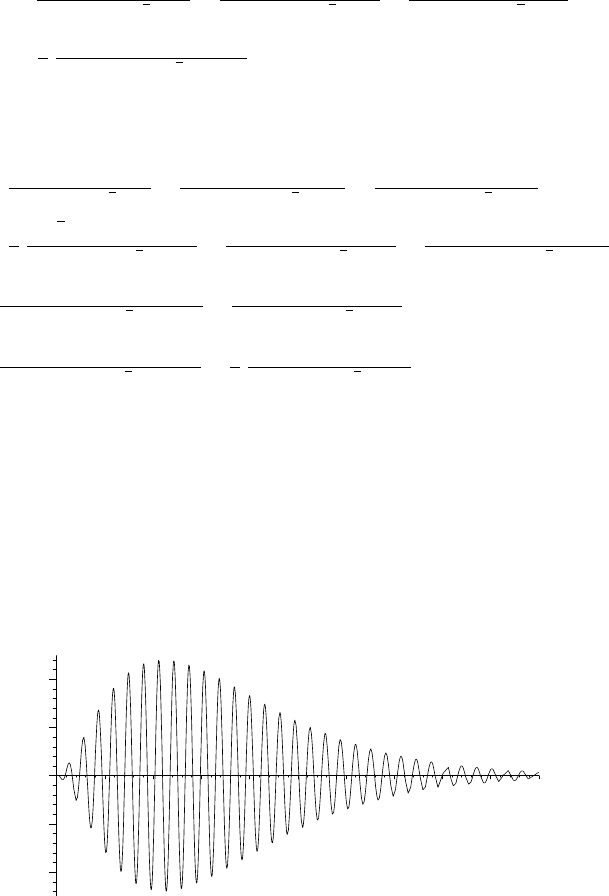
The velocity is plotted over the time interval t=0 to T and shown in Figure 1.
>
plot(V,t=0..T);
–20
–10
0
10
20
24
6
8 101214
16
18 20
t
Figure 1: Velocity V (vertical axis) versus time t.