
Enns R.H. Computer Algebra Recipes for Mathematical Physics
Подождите немного. Документ загружается.


1.3 SUPPLEMENTARY RECIPES 57
G as much as possible and write it as a piecewise function. Check that G obeys
the general symmetry property G(x|ζ)=G(ζ|x). At what k values does G have
singularities where G diverges?
01-S10: A Potpourri of General Solutions
Classify the following LODEs as to order, homogeneneous or nonhomogeneous,
and constant or variable coefficients. Obtain the general solution for each and
identify which part of the solution is the particular solution and which part is the
solution to the corresponding homogeneous ODE. Identify any non-elementary
functions in the solution. What method of attack does Maple use?
(a) xy
+(1+x) y = e
x
;
(b) y
+ xy =0;
(c) y
+3y
+2y = e
x
;
(d) x
2
y
− 6 y = x
3
ln x;
(e) y
− (3/x) y
+ (15/(4 x
2
)+
√
x) y =0;
(f) x
2
y
+(1− 2 α) xy
+(k
2
β
2
x
2 β
+(α
2
− p
2
β
2
)) y =0.
01-S11: Chebyshev Polynomials
Taking p =
√
1 − x
2
, q =0, w =1/
√
1 − x
2
,andλ = n
2
, show that the S-L
ODE yields the Chebyshev equation,(1− x
2
) y
− xy
+ n
2
y =0. For n a
non-negative integer, Chebyshev’s ODE is known to have polynomial solutions
(the Chebyshev polynomials T
n
(x)) defined over the range x =−1 to +1. Using
the command expand(ChebyshevT(n,x)), generate the T
n
(x)forn = 0 to 10.
Then use the dsolve command to obtain the general solution of the Chebyshev
ODE and show that it can be expressed in terms of the T
n
(x). Demonstrate
that, e.g.,
1
−1
T
9
(x) T
10
(x) w(x) dx=0, i.e., the Chebyshev polynomials form a
set of orthogonal functions. Plot the first five polynomials for x =−1to1.
01-S12: The Growing Pendulum
Consider a pendulum which consists of a point mass m at the bottom end of
a light supporting rod of length L which is allowed to move in a vertical plane
about a pivot point at its top end. Suppose that L increases at a steady rate,
i.e., L = L
0
+ vt,wherev>0 is a constant speed and t the time.
(a) Letting the rod make an angle θ(t) with the vertical and neglecting drag,
use Newton’s second law for angular motion (d(Iω)/dt = T ,whereI is
the moment of inertia, ω the angular velocity, and T the torque) to derive
the LODE for small θ. Solve the ODE for θ(t), given θ(0) = Θ,
˙
θ(0) = 0.
Simplify θ(t) and identify the functions which occur.
(b) Taking L
0
=1 m, g =10 m/s
2
,Θ=π/6 rads, and v =0.5 m/s, plot θ(t)for
t = 0 to 100 seconds. Describe the behavior of the period. Then animate
the motion of the pendulum arm (representing it as a thick line) over this
time interval taking 100 frames and using constrained scaling.

58 CHAPTER 1. LINEAR ODES OF PHYSICS
01-S13: Another Green Function
Assuming that m = 0, derive the Green function G which is the solution to
(1 − x
2
) G
− 2 xG
− m
2
G/(1 − x
2
)=δ(x − z), subject to the boundary
conditions that G remains finite at the end points x= ±1 of the range. Simplify
G as much as possible and write it as a piecewise function. Plot G over the
range x=−1to1,takingm =3 and z =1/2.
01-S14: Going Green, Once Again
A light elastic string, under tension T andfixedatx=±L, is horizontal in the
absence of any applied forces. The string is embedded in an elastic membrane
which exerts a Hooke’s law (spring constant k) restoring force if the string is
displaced from equilibrium. If a force fe
−βx
2
is applied to the string, derive
the ODE for its shape y(x), assuming that y(x) is small. Using the Green
function method, determine y(x). The answer will involve the error function,
erf(z) ≡(2/
√
π
x
0
e
−t
2
dt. Check your result by solving the original ODE with
Maple’s dsolve command, subject to the given boundary condition. Taking
T =100 N, k =10 N/m, L=1 m, β =1/100 m
−2
,andf =50 N, plot y(x).

Chapter 2
Applications of Series
In this chapter, it is assumed that you are already familiar with the basic
concepts of infinite series covered in standard calculus texts such as Calculus
by James Stewart [Ste87]. The emphasis here is on applications of series, the
topics being Taylor series, series solutions of LODEs, Fourier series, Legendre
and Bessel series, and summing series. Laurent series are covered in Chapter 5.
2.1 Taylor Series
The Taylor expansion of a function f(x)=f(x
0
+ h)aboutx
0
is given by
f(x)=f(x
0
)+hf
(x
0
)+
1
2!
h
2
f
(x
0
)+
1
3!
h
3
f
(x
0
)+···. (2.1)
Thus, e.g., taking x
0
=0, so h=x − x
0
=x,
sin(x)=x −
x
3
3!
+
x
5
5!
−
x
7
7!
+ ···=
∞
n=0
(−1)
n
x
2n+1
(2n + 1)!
≡
∞
n=0
u
n
.
Applying the ratio test, r ≡|u
n+1
/u
n
|= x
2
/((2n + 3)(2n + 2)) → 0asn →∞.
Since r<1, the series converges for all x, i.e., the radius of convergence is ∞.
The extension to functions of more than one variable is straightforward, e.g.,
for a function f(x, y)=f(x
0
+ h, y
0
+ k),theTaylorseriesisoftheform,
f(x, y)=f(x
0
,y
0
)+
h
∂
∂x
+k
∂
∂y
f(x
0
,y
0
)+
1
2!
h
∂
∂x
+k
∂
∂y
2
f(x
0
,y
0
)+···.
2.1.1 Polynomial Approximations
Every man sees in his relatives, and especially in his cousins,
a series of grotesque caricatures of himself.
H. L. Mencken, American journalist, (1880–1956)
In this recipe, I will demonstrate how the Taylor series expansion may be used
to obtain the smallest polynomial approximation to the integral
f =
x
0
u
4
e
u
2
du, valid within ±0.000001 over the range 0 ≤ x ≤ 1.

60 CHAPTER 2. APPLICATIONS OF SERIES
The desired accuracy A is entered, and then the integral f is displayed and
evaluated in the following command line.
>
restart: A:=0.000001:
>
f:=Int(uˆ4*exp(uˆ2),u=0..x)=int(uˆ4*exp(uˆ2),u=0..x);
f :=
x
0
u
4
e
(u
2
)
du =
1
2
x
3
e
(x
2
)
−
3
4
xe
(x
2
)
−
3
8
I
√
π erf(xI)
Theanswerisgivenintermsoftheerror function,erf(z)=(2/
√
π)
z
0
e
−u
2
du,
with z = Ix=
√
−1 x. The result can be expressed in terms of real quantities by
converting the rhs to an imaginary error function,erfi(x)=(2/
√
π)
x
0
e
u
2
du.
>
f:=convert(rhs(f),erfi);
f :=
1
2
x
3
e
(x
2
)
−
3
4
xe
(x
2
)
+
3
8
√
π erfi(x)
Then f is simplified by collecting exponential terms.
>
f:=collect(f,exp);
f := (
1
2
x
3
−
3
4
x) e
(x
2
)
+
3
8
√
π erfi(x)
Although f can be evaluated numerically, a polynomial approximation to f is
now obtained. An operator F is formed which Taylor expands f in powers of
x about x=0, dropping terms of order x
N+1
.
>
F:=N->taylor(f,x=0,N+1):
A second arrow operator F2 is created to remove the order of term in the series.
>
F2:=N->convert(F(N),polynom):
Using F2(2*n+1), a sequence of polynomial approximations to the integral is
generated in T for n = 0 to 10 (not all polynomials are shown here). Note that
the Taylor series expansion of the integral generates only odd order polynomials,
hence the argument 2 n + 1. For plotting purposes, T is assigned.
>
T:=seq(t||(2*n+1)=F2(2*n+1),n=0..10); assign(T):
T := t1 =0, t3 =0, t5 =
x
5
5
, t7 =
1
5
x
5
+
1
7
x
7
, t9 =
1
5
x
5
+
1
7
x
7
+
1
18
x
9
,
t11 =
1
5
x
5
+
1
7
x
7
+
1
18
x
9
+
1
66
x
11
, ............................................................,
t21 =
1
5
x
5
+
1
7
x
7
+
1
18
x
9
+
1
66
x
11
+
1
312
x
13
+
1
1800
x
15
+
1
12240
x
17
+
1
95760
x
19
+
1
846720
x
21
The difference between the exact integral f and each polynomial for n =2
(yielding t5 ) and 10 (yielding t21 ) is plotted over the range x =0 to 1.
>
plot([seq(f-t||(2*n+1),n=2..10)],x=0..1,view=[0..1,0..A],
axes=box,thickness=2);
Since the differences turn out to be positive, the vertical view has been taken to
be between 0 and A, the upper limit setting the desired accuracy. The sequence
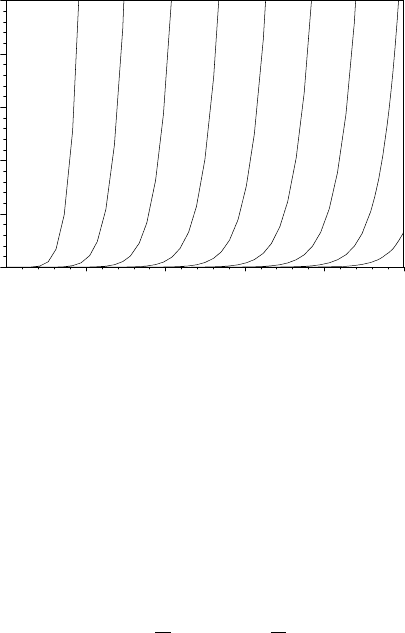
2.1. TAYLOR SERIES 61
of differences is shown in Figure 2.1, the difference corresponding to n =2 on
the far left and that corresponding to n = 10 on the far right. Since the first
difference curve that remains completely within the vertical viewing range is
the curve corresponding to n =10, the smallest polynomial which is within the
desired accuracy over the range x=0to1isgivenbyt21 .
0
2e–07
4e–07
6e–07
8e–07
1e–06
0.2 0.4
0.6
0.8 1
x
Figure 2.1: Differences between exact integral and polynomial approximations.
2.1.2 Finite Difference Approximations
I’m not a teacher: only a fellow-traveler of whom you asked the way.
I pointed ahead–ahead of myself as well as you.
George Bernard Shaw, Anglo-Irish playwright (1856–1950)
Replacing ordinary and partial derivatives by their finite difference approxi-
mations (FDAs) is useful in numerically solving ODEs and PDEs as will be
illustrated in Chapter 9. These approximations are based on a Taylor series
approach. For example, an FDA to y
(x) can be obtained by Taylor expanding
y(x ± h)aboutx for small h, viz.,
y(x ± h)=y(x) ± hy
(x)+
1
2!
h
2
y
(x) ±
1
3!
h
3
y
(x)+O(h
4
), (2.2)
where O(h
4
) indicates that terms of order h
4
(and higher) are being neglected.
Forming the sum y(x + h)+y(x − h), and solving for y
, yields the FDA,
y
(x)=[y(x + h)+y(x − h) − 2y(x)]/h
2
+ O(h
2
). (2.3)
Eq. (2.3), known as the central difference approximation to the second deriva-
tive, was easily derived by hand. However, a computer algebra approach can
sometimes prove useful in deriving other FDAs as our mathematical physics
student, I. M. Curious, will now illustrate in answering the following problem.
(a) Show that to O(h
4
) an alternate FDA to the second derivative is given by
y
(x)=[−y(x+2h)+16y(x+h)−30y(x)+16y(x−h)−y(x−2h)]/(12h
2
).

62 CHAPTER 2. APPLICATIONS OF SERIES
Taking 12 digits accuracy, plot the difference between the FDA and the
exact y
for y = x
5.1
over the range x=0.1to10forh=0.1andh=0.05.
(b) Show that an FDA for f
xxyy
≡ ∂
4
f(x, y)/∂x
2
∂y
2
is given by
f
xxyy
=[f (x+h, y + k)+f(x − h, y+k)+f (x+h, y − k)+f(x − h, y − k)
−2(f(x+h, y)+f(x −h, y)+f (x, y+k)+f(x, y −k))+4 f (x, y)]/(h
2
k
2
),
and produce a 3-dimensional plot of the difference between the FDA and
the exact fourth derivative for f =sin(x − y) e
−x
2
y
2
. Take h = k =0.05,
12 digits accuracy, and a plotting range x= −3...3, y =−3...3.
I. M. begins her recipe for part (a) by setting the accuracy to 12 digits.
>
restart: Digits:=12:
Noting that the wording of the problem implies that terms of order h
6
have
been dropped in the Taylor series, she creates an arrow operator t to Taylor
expand y(x + ah)inpowersofh about an arbitrary point x, dropping terms of
O(h
6
). The order of term is removed by enclosing the taylor command with
convert( ,polynom). The quantity a is an integer which must be supplied.
>
t:=a->y(x+a*h)=convert(taylor(y(x+a*h),h,6),polynom):
Asatest,I.M.choosesa =2 and generates the Taylor series for y(x +2h).
>
t(2);
y(x +2h)=y(x)+2D(y)(x) h +2(D
(2)
)(y)(x) h
2
+
4
3
(D
(3)
)(y)(x) h
3
+
2
3
(D
(4)
)(y)(x) h
4
+
4
15
(D
(5)
)(y)(x) h
5
In the output, (D
(4)
)(y)(x), for example, stands for the 4th derivative, y
(x).
Making use of the operator t, the proposed FDA is entered in eq1 .
>
eq1:=-t(2)+16*t(1)-30*t(0)+16*t(-1)-t(-2);
eq1 := −y(x +2h)+16y(x + h) −30 y(x)+16y(x − h) − y(x − 2 h)
=12(D
(2)
)(y)(x) h
2
On the rhs of the output, only the second derivative term survives, all other
terms up to O(h
6
) having canceled. Using the isolate command, the second
derivative (entered as D[1,1](y)(x))isisolatedtothelhsofeq2 ,
>
eq2:=isolate(eq1,D[1,1](y)(x));
eq2 := (D
(2)
)(y)(x)
= −
1
12
y(x +2h) − 16 y(x + h)+30y(x) − 16 y(x − h)+y(x − 2 h)
h
2
thus confirming the FDA.
An arrow operator y is formed to evaluate y = x
5.1
at an arbitrary x value.
So that the FDA can be evaluated for different h values, the rhs of eq2 is turned
into a functional operator A, depending on h, using the unapply command.
>
y:=x->xˆ5.1: A:=unapply(rhs(eq2),h):
The exact y
(x) is calculated and the FDAs generated for h=0.1andh=0.05.
2.1. TAYLOR SERIES 63
>
exact:=diff(y(x),x,x); approx1:=A(0.1): approx2:=A(0.05):
exact := 20.91 x
3.1
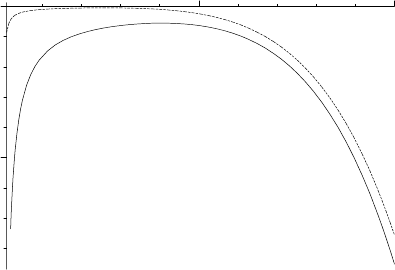
The differences between the FDAs approx1 and approx2 and exact are plotted
for x=0.1 to 10 as solid red and dashed green curves, respectively, the resulting
plot being shown in Figure 2.2.
>
plot([approx1-exact,approx2-exact],x=0.1..10,color=
[red,green],thickness=2,linestyle=[1,3],tickmarks=[2,2]);
–5e–05
0
510
x
Figure 2.2: FDA minus the exact result for h=0.1 (solid) and h=0.05 (dashed).
As expected, the accuracy of the FDA is improved with the smaller value of h.
Both curves have greatest accuracy over a limited range of x.
Now, I. M. tackles part (b) of the problem. The plots library package is
loaded and 12 digits accuracy entered.
>
restart: with(plots): Digits:=12:
The FDA involves a Taylor expansion in two variables. I. M. uses the multivari-
ate Taylor series command, mtaylor, to create an operator t for performing the
expansion of f(x + ah, y + bk)inpowersofh and k, neglecting terms of sixth
order. mtaylor does not generate the order of term, so convert( ,polynom)
needn’t be applied. Two integers a and b must be entered as arguments in t.
>
t:=(a,b)->f(x+a*h,y+b*k)=mtaylor(f(x+a*h,y+b*k),[h,k],6):
The given FDA is entered in eq1 .
>
eq1:=t(1,1)+t(-1,1)+t(1,-1)+t(-1,-1)
-2*(t(1,0)+t(-1,0)+t(0,1)+t(0,-1))+4*t(0,0);
eq1 := f (x + h, y + k)+f (x − h, y + k)+f (x + h, y −k)+f (x − h, y −k)
− 2 f (x + h, y) − 2 f (x − h, y) − 2 f (x, y + k) − 2 f (x, y − k)
+4f (x, y)=h
2
k
2
D
1, 1, 2, 2
(f)(x, y)
64 CHAPTER 2. APPLICATIONS OF SERIES
Only a single term involving D
1, 1, 2, 2
results on the rhs of the output, the
subscripts 1 and 2 denoting derivatives with respect to x and y, respectively.
Dividing eq1 by h
2
k
2
, and simplifying, yields the desired FDA.
>
eq2:=simplify(eq1/(hˆ2*kˆ2));
eq2 := (f(x + h, y + k)+f(x −h, y + k)+f(x + h, y − k)+f(x − h, y −k)
− 2f(x + h, y) − 2f(x −h, y) − 2f(x, y + k) − 2f(x, y −k)
+4f(x, y))/(h
2
k
2
)=D
1, 1, 2, 2
(f)(x, y)
The function f(x, y)=sin(x − y) e
−x
2
y
2
is entered, as well as h= k =0.05.
>
f:=(x,y)->sin(x-y)*exp(-xˆ2*yˆ2): h:=0.05: k:=0.05:
The exact 4th derivative is calculated and the FDA given by the lhs of eq2 .
>
exact:=diff(f(x,y),x,x,y,y); approx:=lhs(eq2):
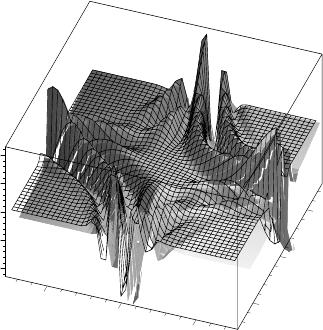
The plot3d command is used to create a 3-dimensional plot of approx minus
exact for x = −3...3, y = −3...3. The grid is taken to be 25 ×25, the shad-
ing to be XYZ (i.e., the color varies in the 3 directions), the axes boxed, the
plot “illuminated” with a light source at a certain orientation given by enter-
ing lightmodel=light2, the number of plotting points to be 2000, and the
orientation specified. The resulting picture is shown in Figure 2.3.
>
plot3d(approx-exact,x=-3..3,y=-3..3,grid=[25,25],
shading=XYZ,axes=box,lightmodel=light2,numpoints=2000,
tickmarks=[3,3,3],orientation=[20,40]);
–2
0
2
x
–2
0
2
y
–0.4
–0.2
0
0.2
0.4
Figure 2.3: Difference between FDA and exact 4th derivative.
The regions where the FDA and exact result differ appreciably can be seen as
a series of ridges and valleys. The 3-dimensional plot can be rotated on the
computer screen by dragging with the mouse.

2.2. SERIES SOLUTIONS OF LODES 65
2.2 Series Solutions of LODEs
Consider an nth-order homogeneous linear ODE with variable coefficients,
d
n
y
dx
n
+ a
n−1
(x)
d
n−1
y
dx
n−1
+ ···+ a
1
(x)
dy
dx
+ a
0
(x) y =0. (2.4)
If a
0
(x), ..., a
n−1
(x)areregular (single-valued and analytic) at a point x = x
0
,
then x
0
is referred to as an ordinary point of the ODE. Near x
0
, the general
solution of the LODE can be written as a Taylor series, y =
∞
m=0
c
m
(x −x
0
)
m
,
whose radius of convergence is the distance to the nearest singular point (a
non-ordinary point) of the ODE. The coefficients c
m
are found by substituting
the series into the ODE and setting the coefficients of each power of x to zero.
If x
0
is not an ordinary point, but (x − x
0
) a
n−1
(x), (x − x
0
)
2
a
n−2
(x),...,
(x −x
0
)
n
a
0
(x) are regular at x
0
,thenx
0
is a regular singular point.Nearsuch
an x
0
,aFrobenius series solution of the form y =(x−x
0
)
s
∞
m=0
c
m
(x−x
0
)
m
,
with c
0
= 0 and s not necessarily an integer, can always be found. The radius
of convergence is again the distance to the nearest singular point outside x
0
.
In this section, series solutions to two familiar Sturm–Liouville ODEs are
obtained, illustrating the two types of expansions mentioned above.
2.2.1 Jennifer Renews an Old Acquaintance
We need two kinds of acquaintances, one to complain to,
while to the others we boast.
Logan Pearsall Smith, American essayist, Afterthoughts,“Other People”, 1931
In recipe 01-2-1, Jennifer introduced the Legendre functions. In this recipe,
she renews her acquaintance with these important special functions, showing
us how they arise as a series solution to the Legendre ODE,
(1 − x
2
) y
− 2 xy
+ n (n +1)y =0. (2.5)
Casting (2.5) into the “standard” form (2.4), Equation (2.5) has regular singular
points at x = ±1. Jennifer seeks a Taylor series solution about the ordinary
point x
0
= 0. She decides that it will suffice for calculation purposes to work
with a finite number of terms, say N = 7, in the series.
>
restart: N:=7:
The left-hand side of Legendre’s equation is now entered.
>
ode:=(1-xˆ2)*diff(y(x),x,x)-2*x*diff(y(x),x)+n*(n+1)*y(x);
ode := (1 − x
2
)(
d
2
dx
2
y(x)) −2 x (
d
dx
y(x)) + n (n +1)y(x)
The power series y(x)=
N
m=0
c
m
x
m
is inputted using the add command.
>
y(x):=add(c||m*xˆm,m=0..N);
y(x):=c0 + c1 x + c2 x
2
+ c3 x
3
+ c4 x
4
+ c5 x
5
+ c6 x
6
+ c7 x
7
y(x) is automatically substituted into ode and powers of x are collected.

66 CHAPTER 2. APPLICATIONS OF SERIES
>
ode2:=collect(ode,x);
ode2 := (−56 c7 + n (n +1)c7 ) x
7
+(−42 c6 + n (n +1)c6 ) x
6
+ (42 c7 − 30 c5 + n (n +1)c5 ) x
5
+(n (n +1)c4 − 20 c4 +30c6 ) x
4
+(−12 c3 + n (n +1)c3 +20c5 ) x
3
+(−6 c2 +12c4 + n (n +1)c2 ) x
2
+(6c3 + n (n +1)c1 − 2 c1 ) x +2c2 + n (n +1)c0
Since ode2 represents the lhs of the Legendre equation, it must be set equal
to zero to form the complete equation. But x is arbitrary, so the coefficient of
each power of x must separately be equal to zero. A functional operator eq is
created to set the coefficient of x
m
in ode2 equal to zero.
>
eq:=m->coeff(ode2,x,m)=0:
The set of equations eq(m) is solved for the c||(m+2) for m=0 to N −2.
>
sol:=solve({seq(eq(m),m=0..N-2)},{seq(c||(m+2),m=0..N-2)}):
The solution sol is assigned, the coefficients factored and the series formed,
>
assign(sol): y:=add(factor(c||m)*xˆm,m=0..N):
and the coefficients of c0 and c1 collected in y.
>
y:=collect(y,{c||0,c||1});
y := (1 −
n (n +1)x
2
2
+
n (n − 2) (n +3)(n +1)x
4
24
−
n (n − 2) (n − 4) (n +5)(n +3)(n +1)x
6
720
)c0
+(x −
(n +2)(n − 1) x
3
6
+
(n − 1) (n − 3) (n +4)(n +2)x
5
120
−
(n − 1) (n − 3) (n − 5) (n +6)(n +4)(n +2)x
7
5040
)c1
y gives the first few term in the general series solution of Legendre’s ODE.
It consists of an even (coefficient of c0 ) and odd (coefficient of c1 ) series in
x. Noting that the denominator of the x
m
term is just m! (e.g., for m =6,
6! = (6)(5)(4)(3)(2)(1) = 720), the structure of higher order terms in the infinite
series is easy to deduce. In deriving y, Jennifer has mimicked a hand calculation.
The same result could be more easily obtained by using the series option in
the dsolve command, as Jennifer will now demonstrate. She unassigns y and
sets the order of the first term to be neglected in the series solution. Since she
has taken N =7,theorderhereis8,i.e.,termsofO(x
8
)aredroppedinthe
series. If the order is not specified, the default is to neglect terms of O(x
6
).
>
unassign(’y’): Order:=N+1;
Order := 8
Then ode is solved for y(x), subject to the initial condition y(0) = c0 and
y
(0)= c1 , using the series option in the dsolve command.
>
Y:=dsolve({ode,y(0)=c||0,D(y)(0)=c||1},y(x),series);