
Enns R.H. Computer Algebra Recipes for Mathematical Physics
Подождите немного. Документ загружается.


2.2. SERIES SOLUTIONS OF LODES 67
The output (suppressed here in the text) contains the “order of” term O(x
8
)
which is then removed from the rhs of Y using convert( ,polynom).
>
Y:=convert(rhs(Y),polynom):
Collecting the coefficients of c0 and c1 yields a series solution Y equivalent to
that obtained in y.
>
Y:=collect(Y,{c||0,c||1});
Y := (1 −
n (n +1)x
2
2
+(
1
24
n
4
+
1
12
n
3
−
5
24
n
2
−
1
4
n) x
4
+(−
1
720
n
6
−
1
240
n
5
+
23
720
n
4
+
17
240
n
3
−
47
360
n
2
−
1
6
n) x
6
)c0
+(x +(
1
3
−
1
6
n
2
−
1
6
n) x
3
+(−
13
120
n
2
+
1
120
n
4
+
1
60
n
3
−
7
60
n +
1
5
) x
5
+(
41
5040
n
4
−
1
5040
n
6
−
1
1680
n
5
+
29
1680
n
3
−
5
63
n
2
−
37
420
n +
1
7
) x
7
)c1
Often, in cases of physical interest, x ≡ cos(θ) where the angle θ varies from
0toπ radians. So x then ranges from 1 to −1. It turns out that both series
diverge at x = ±1, unless n is a positive integer in which case the even or odd
series in Y ,ory, terminates with the power x
n
when n is even or odd. To
explicitly demonstrate this, Jennifer turns Y into an operator depending on n
with the unapply command,
>
YY:=unapply(Y,n):
and then uses a do loop to generate the solutions y0 ,y1 ,...,y5 for n=0, 1, ..., 5
>
for n from 0 to 5 do y||n:=YY(n); end do;
y0 := c0 +(x +
1
3
x
3
+
1
5
x
5
+
1
7
x
7
) c1
y1 := (1 − x
2
−
1
3
x
4
−
1
5
x
6
) c0 + c1 x
y2 := (1 − 3 x
2
) c0 +(x −
2
3
x
3
−
1
5
x
5
−
4
35
x
7
) c1
y3 := (1 − 6 x
2
+3x
4
+
4
5
x
6
) c0 +(x −
5
3
x
3
) c1
y4 := (1 − 10 x
2
+
35
3
x
4
) c0 +(x − 3 x
3
+
6
5
x
5
+
2
7
x
7
) c1
y5 := (1 − 15 x
2
+30x
4
− 10 x
6
) c0 +(x −
14
3
x
3
+
21
5
x
5
) c1
In y0 , the coefficient of c0 is 1, which is just the zeroth order Legendre polyno-
mial P
0
(x), while the coefficient of c1 involves the leading terms of an infinite
series. In y1 ,thec0 coefficient is an infinite series, while the c1 coefficient
is x, which is just the first order Legendre polynomial P
1
(x). In y2 ,thec0
coefficient is proportional to P
2
(x), the coefficient of c1 an infinite series, and
so on for increasing n values. Jennifer creates a functional operator F to extract
the coefficient of either c0 (set p =0) or c1 (set p =1) for each solution yn.

68 CHAPTER 2. APPLICATIONS OF SERIES
>
F:=(n,p)->coeff(y||n,c||p):
The Legendre polynomials P
n
(x) are traditionally normalized so that each poly-
nomial has the value 1 at x = 1. Making use of F(2*n,0) and including this
normalization, the first few even subscript Legendre polynomials are generated.
>
Peven:=seq(P||(2*n)=F(2*n,0)/eval(F(2*n,0),x=1),n=0..2);
Peven := P0 =1, P2 = −
1
2
+
3 x
2
2
, P4 =
3
8
−
15
4
x
2
+
35
8
x
4
The odd subscript polynomials P
1
, P
3
,andP
5
can be generated by replacing
F(2*n,0) with F(2*n+1,1) in the last command line.
The odd exponent infinite series are similarly extracted by using F(2*n,1).
These are labeled Q0 , Q2 , Q4 for reasons which will now be explained.
>
Qeven:=seq(Q||(2*n)=F(2*n,1),n=0..2);
Qeven := Q0 = x +
1
3
x
3
+
1
5
x
5
+
1
7
x
7
, Q2 = x −
2
3
x
3
−
1
5
x
5
−
4
35
x
7
,
Q4 = x − 3 x
3
+
6
5
x
5
+
2
7
x
7
Each of the above infinite series can be summed and are found to be proportional
to the Legendre functions Q
0
(x), Q
2
(x), Q
4
(x) of the second kind. Jennifer
concludes her recipe by demonstrating, for example, that the Taylor expansion
of Q
0
(x)isthesameasQ0 given above. The solution branch between x = −1
and 1 is selected by entering the following command.
>
_EnvLegendreCut:=1..infinity:
Then Taylor expanding LegendreQ(0,x) about x =0, dropping terms of O(x
8
),
and simplifying yields a series expansion for Q
0
which agrees with that for Q0 .
>
Q[0]:=simplify(LegendreQ(0,x)=taylor(LegendreQ(0,x),x=0,8));
Q
0
:=
1
2
ln(x +1)−
1
2
ln(1 − x)=x +
1
3
x
3
+
1
5
x
5
+
1
7
x
7
+O(x
8
)
In physical problems where x varies from −1to1,theQ
n
(x) must be rejected
because they diverge at the end points of the range.
2.2.2 Another Old Acquaintance
Acquaintance. A person whom we know well enough to borrow from,
but not well enough to lend to.
Ambrose Bierce, American author, The Devils Dictionary, (1842–1914)
After revisiting the Legendre functions, it’s not too surprising that Jennifer
renews another old acquaintance, the Bessel functions, again showing how they
arise as a series solution to Bessel’s equation (with p non-negative),
x
2
y
+ xy
+(x
2
− p
2
) y =0. (2.6)
Putting (2.6) into the standard form (2.4), the second-order LODE has a regular
singular point at x= x
0
=0, so Jennifer will now seek a Frobenius power series
solution expanded about x = 0, viz., y =
∞
m=0
c
m
x
m+s
. The total number N

2.2. SERIES SOLUTIONS OF LODES 69
of terms which will be kept in the series for plotting purposes is taken to be
100. The left-hand side of Bessel’s equation is entered in ode .
>
restart: N:=100:
>
ode:=xˆ2*diff(y(x),x,x)+x*diff(y(x),x)+xˆ2*y(x)-pˆ2*y(x);
ode := x
2
(
d
2
dx
2
y(x)) + x (
d
dx
y(x)) + x
2
y(x) −p
2
y(x)
For y(x), Jennifer enters the summand of the Frobenius series.
>
y(x):=c[m]*xˆ(m+s);
y(x):=c
m
x
(m+s)
Noting that y(x) is automatically substituted into ode , ode is divided by x
s
and
the result simplified. The resulting summand is given by the output of eq .
>
eq:=simplify(ode/xˆs);
eq := c
m
x
m
m
2
+2c
m
x
m
ms+ c
m
x
m
s
2
+ x
(2+m)
c
m
− p
2
c
m
x
m
The sum
∞
m=0
over the five terms of eq is to be set equal to zero which implies
that the coefficients of equal powers of x must also be equal to zero. Now all the
terms in eq involve x
m
, except for the fourth one which contains x
m+2
.But,
on summing, the fourth operand in eq can be transformed as follows,
∞
m=0
c
m
x
m+2
=
∞
m=2
c
m−2
x
m
=
∞
m=0
c
m−2
x
m
. (2.7)
if we agree to define c
−1
=0,c
−2
= 0. Jennifer enters these coefficient values.
>
c[-1]:=0: c[-2]:=0:
The transformation (2.7) can be accomplished in eq by using the subsop com-
mand to replace the 4th operand with c
m−2
x
m
.
>
eq2:=subsop(4=c[m-2]*xˆm,eq);
eq2 := c
m
x
m
m
2
+2c
m
x
m
ms+ c
m
x
m
s
2
+ c
m−2
x
m
− p
2
c
m
x
m
Now each term in eq2 involves x
m
. Dividing this equation by x
m
, equating the
result to 0, and simplifying, yields a recurrence relation relating c
m
to c
m−2
.
>
eq3:=simplify(eq2/xˆm)=0;
eq3 := c
m
m
2
+2c
m
ms+ c
m
s
2
+ c
m−2
− p
2
c
m
=0
Terms involving c
m
are now collected in the recurrence relation eq3 .
>
eq4:=collect(eq3,c[m]);
eq4 := (m
2
+2ms+ s
2
− p
2
) c
m
+ c
m−2
=0
Setting m=0 in eq4 yields the so-called indicial equation, eq5 .
>
eq5:=eval(eq4,m=0);
eq5 := (s
2
− p
2
) c
0
=0
Assuming that the coefficient c
0
=0,eq5 has two solutions for s, which are
explicitly extracted using the solve command. Jennifer will consider the series

70 CHAPTER 2. APPLICATIONS OF SERIES
solution (the second one in sol) to Bessel’s equation corresponding to s = p.
The other series solution is obtained by replacing p with −p.
>
sol:=solve(eq5,s); s:=sol[2];
sol := −p, p
s := p
Evaluating the recurrence relation eq4 for m = 1, and noting that for non-
negative p,1+2p can never be zero, it follows from eq6 below that the coefficient
c
1
=0. This coefficient is extracted from eq6 with the solve command.
>
eq6:=eval(eq4,m=1); c[1]:=solve(eq6,c[1]);
eq6 := (1 + 2 p) c
1
=0
c
1
:= 0
For m ≥ 2, one must work with the full recurrence equation eq4 . The recurrence
relation can be rewritten by isolating the coefficient c
m
on the left side of the
equation and then factoring the result as in eq7 .
>
eq7:=factor(isolate(eq4,c[m]));
eq7 := c
m
= −
c
m−2
m (m +2p)
The coefficients c
2
to c
N
= c
100
are now explicitly evaluated by first using
the unapply command to turn eq7 into a functional operator in terms of the
argument m and then using a do loop to iterate the recurrence relation.
>
eq8:=unapply(eq7,m):
>
for m from 2 to N do c[m]:=rhs(eq8(m)); end do:
Jennifer has used a command line ending colon to suppress the very long output.
All the even subscript coefficients are proportional to c
0
, while odd subscript
coefficients are proportional to c
1
and therefore are all equal to zero.
To study the behavior of the series as more and more terms are retained, an
arrow operator JJ is introduced to add the terms in the series for m=0 to M.
>
JJ:=M->add(c[m]*xˆ(m+s),m=0..M):
Jennifer now calculates the sum Jp for M =6 and collects the c
0
coefficients.
>
Jp:=collect(JJ(6),c[0]);
Jp :=
x
p
−
x
(2+p)
2(2+2p)
+
x
(4+p)
8(2+2p)(4+2p)
−
x
(6+p)
48 (2+2 p)(4+2p)(6+2p)
c
0
With the proper assignment (which will be done shortly) of the arbitrary coef-
ficient c
0
, the infinite series corresponding to Jp is the Bessel function J
p
of the
first kind of order p. Not surprisingly, the same result could have been much
more easily obtained by using the series option of the dsolve command. To
demonstrate this, Jennifer now unassigns y(x). The order of the series is set as
well as the information level on the methods used in the dsolve command.
>
unassign(’y(x)’): Order:=7: infolevel[dsolve]:=5:
Jennifer replaces y(x)withz(x)inode and obtains the general series solution
of ode2. She has deleted some of the unsuccessful methods in the output.

2.2. SERIES SOLUTIONS OF LODES 71
>
ode2:=subs(y(x)=z(x),ode): dsolve(ode2,z(x),series);
....................................
dsolve/series/ordinary: trying Newton iteration
dsolve/series/direct: trying direct subs
dsolve/series/froben: trying method of Frobenius
dsolve/series/froben: indicial eqn is -pˆ 2+rˆ 2
dsolve/series/froben: roots of indicial eqn are [[p], [-p]]
z(x)=
C1 x
p
(1 −
1
4 p +4
x
2
+
1
(8 p + 16) (4 p +4)
x
4
−
1
(12 p + 36) (8 p + 16) (4 p +4)
x
6
+O(x
7
))
+
C2 x
(−p)
(1 +
1
4 p − 4
x
2
+
1
(8 p − 16) (4 p − 4)
x
4
+
1
(12 p − 36) (8 p − 16) (4 p − 4)
x
6
+O(x
7
))
The method of Frobenius has been successfully used, the roots of the indicial
equation obtained, and the general series solution constructed for z(x). The
first series, involving the arbitrary coefficient
C1, is exactly the same as in Jp.
The second series, involving the other arbitrary coefficient
C2, is the second
independent solution of the second order LODE obtained by replacing p with
−p. I.e., the second independent solution is J
−p
(x).
This conclusion about the mathematical form of the second solution is true
providing that p is not zero or an integer. For p = 0, there is only one root,
s = 0, to the indicial equation and the second series is identical with the first.
For integer values of p, all denominators in the second series beyond a certain
term vanish, so this series becomes meaningless. Thus for p =0, 1, 2, ... a more
general second solution must be sought. Jennifer has decided not to go into
this issue here, referring her students to standard ODE texts which cover the
topic. At this stage it suffices to note that this second independent solution is
the Bessel function Y
p
of the second kind of order p.
Returning to her “hand mimicking” calculation, Jennifer completes the iden-
tification of the infinite series solution as J
p
(x) by making the “standard” choice
for c
0
, viz. c
0
=1/(2
p
p!).
>
c[0]:=1/(2ˆp*p!):
To see how may terms have to be retained in the series over a certain range
of x, e.g., x = 0 to 50, to obtain a reasonably correct curve, Jennifer will now
plot the sequence of results obtained from JJ for p = 0 and N/5 = 100/5 = 20,
40, 60, 80, and 100 terms along with the “exact” infinite series result for J
0
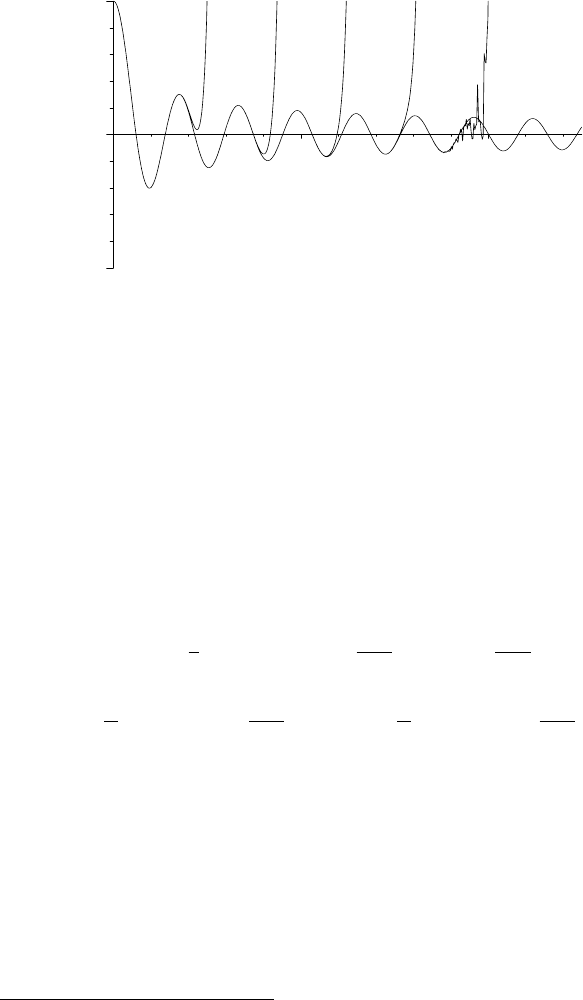
(x).
Because the finite series results diverge to ∞ before x = 50 is reached, the
vertical view is limited to be between −1and1.
>
plot([seq(eval(JJ(k*N/5),p=0),k=1..5),BesselJ(0,x)],
x=0..50,thickness=2,numpoints=500,labels=["x","J"],
tickmarks=[3,3],view=[0..50,-1..1]);
72 CHAPTER 2. APPLICATIONS OF SERIES
–1
0
1
J
20 40
x
Figure 2.4: Divergent curves from left to right: 20, 40, 60, 80, and 100 terms.
From left to right in Figure 2.4, the divergent curves represent the finite series
representations of J
0
for 20, 40, 60, 80, and 100 terms. The non-divergent
oscillatory curve is the infinite series representing the exact J
0
(x).
2.3 Fourier Series
Consider a single-valued function f(x) defined over the fundamental interval
−L ≤ x ≤ L and satisfying the boundary conditions f (−L)=f(L). If f (x)has
a finite number of discontinuities and maxima and minima, and
L
−L
|f(x)| dx
is finite,
1
then f(x) can be expanded in the Fourier series ([MW71], [Boa83])
f(x)=
1
2
a
0
+
∞
n=1
a
n
cos
nπx
L
+ b
n
sin
nπx
L
, (2.8)
with a
n
=
1
L
L
−L
f(x)cos
nπx
L
dx, b
n
=
1
L
L
−L
f(x)sin
nπx
L
dx.
The forms of a
n
and b
n
can be derived from Equation (2.8) by noting that
y
n
(x) = cos(nπx/L) (or sin(nπx/L)) satisfies the orthogonality condition
L
−L
w(x) y
m
(x) y
n
(x) dx =0, for m = n,withw(x) = 1. The identification of
w(x) follows on noting that the y
n
(x) are solutions of y
(x)+(nπ/L)
2
y(x)=0.
This equation is a Sturm–Liouville ODE, (1.6), with p =1, q =0, w =1, and
λ = −(nπ/L)
2
.Thea
n
and b
n
follow on multiplying (2.8) by cos(nπx/L) (or
sin(nπx/L)), integrating from −L to L, and using the orthogonality condition.
If f(x) is an odd function, that is to say f(−x)=−f(x), then a
n
= 0 and
b
n
=(2/L)
L
0
f(x)sin(nπx/L) dx,sof(x) is expressed as a Fourier sine series.
1
These are sufficient, but not necessary, conditions.

2.3. FOURIER SERIES 73
On the other hand, if f(x) is an even function, i.e., f(−x)=f(x), then
a
n
=(2/L)
L
0
f(x) cos(nπx/L) dx and b
n
=0, so f(x)isaFourier cosine series.
Since each term in (2.8) is periodic with period 2L,thenf(x +2L)=f(x).
Thus, the Fourier series may either represent an f(x) defined in the fundamental
interval (−L, L), or a periodic f(x) with period 2L for all of x.
When f(x) is defined only in the range 0 to L, it can be written as a Fourier
sine series by including the range to −L to 0 and considering f(x)tobeanodd
function about x = 0. Alternately, it can be written as a Fourier cosine series
by considering f (x) to be an even function about the origin. It may turn out
that one series fits f(x) better than the other for a finite number of terms.
To this point, the fundamental interval has been taken to be 2L.Thiscan
be easily changed. For example, consider f(t) defined in the range t =0toT
and we want the fundamental interval to be T , not 2T . To accomplish this, set
x = t and L = T/2 in (2.8) and a
n
and b
n
and change the range of the integrals
from −T/2 ... T /2to0... T . In this case, the general Fourier expansion becomes
f(t)=
1
2
a
0
+
∞
n=1
a
n
cos
2nπt
T
+ b
n
sin
2nπt
T
, (2.9)
with a
n
=
2
T
T
0
f(t)cos
2nπt
T
dt, and b
n
=
2
T
T
0
f(t)sin
2nπt
T
dt.
Again, this series may be used to represent either a function defined in the
fundamental interval 0 to T or a periodic function whose period is T .
The concept of expanding a function f (x) in terms of sines and cosines can
be extended to other special functions y
n
(x) satisfying a S-L type equation. If
the y
n
(x) satisfy the same boundary conditions at a and b as f(x), then
f(x)=
n
A
n
y
n
(x), with A
n
=
b
a
w(x) f(x) y
n
(x) dx
b
a
w(x) y
n
(x)
2
dx
. (2.10)
The functions y
n
(x) are said to form a complete set. Often, they are normalized
so that
b
a
w(x) y
n
(x)
2
dx= 1. Since they have the orthogonality property, they
then satisfy the orthonormality condition
b
a
w(x) y
m
(x) y
n
(x) dx = δ
mn
, (2.11)
where δ
mn
,theKronecker delta, is defined by δ
mn
=1 for m =n and 0 for m=n.
As an example of expanding in terms of special functions, the Legendre–
Fourier series (or simply the Legendre series)isgivenby
f(x)=
∞
n=0
A
n
P
n
(x), with A
n
=
(2 n +1)
2
1
−1
f(x) P
n
(x) dx. (2.12)
A mathematical example of this series is given in Recipe 02-3-3.

74 CHAPTER 2. APPLICATIONS OF SERIES
2.3.1 Madeiran Levadas and the Gibb’s Phenomenon
The idealist walks on tiptoe, the materialist on his heels.
Malcolm de Chazal, French writer, (1902–81)
On the island of Madeira, water is transported from the mountains by a net-
work of levadas (irrigation canals) which often cling to the mountain side with
vertigo-inducing drop offs and pass through pitch-black tunnels. This recipe
is inspired by some interesting hikes that I have taken on Madeiran levada re-
taining walls. A levada retaining wall is described by the piecewise function
f =(L + x)/2for−L ≤ x ≤−L/2, f = L/4for−L/2 ≤ x<0, and f =0 for
0 <x≤ L,withL=π. Determine the Fourier series representation of f(x)and
plot it and f together. Calculate the cross-sectional area of the retaining wall
using f(x) and then the Fourier series. Discuss the various results.
To simplify the command entries, let’s set X =πx/L.
>
restart: X:=Pi*x/L:
Using the inert Sum command, an operator F is formed to calculate the Fourier
series, keeping N terms.
>
F:=N->a[0]/2+Sum(a[n]*cos(n*X)+b[n]*sin(n*X),n=1..N);
F := N →
1
2
a
0
+(
N
n=1
(a
n
cos(nX)+b
n
sin(nX)))
The formal expressions for the coefficients are entered using the inert form of
the integral command. In the outputs, X is replaced with πx/L.
>
a[0]:=(1/L)*Int(f,x=-L..L);
a
0
:=
1
L
L
−L
fdx
>
a[n]:=(1/L)*Int(f*cos(n*X),x=-L..L);
a
n
:=
1
L
L
−L
f cos(
nπx
L
) dx
>
b[n]:=(1/L)*Int(f*sin(n*X),x=-L..L);
b
n
:=
1
L
L
−L
f sin(
nπx
L
) dx
The value L= π is specified and the piecewise function f entered.
>
L:=Pi: f:=piecewise(x<-L/2,(L+x)/2,x<0,L/4,x<L,0);
f :=
⎧
⎪
⎪
⎨
⎪
⎪
⎩
π
2
+
x
2
x<−
π
2
π
4
x<0
0 x<π
The value of the coefficient a
0
is obtained.
>
a[0]:=value(a[0]);
2.3. FOURIER SERIES 75
a
0
:=
3 π
16
The coefficients a
n
and b
n
can be simplified by assuming that n is an integer.
The “type match command” (::) is used in the assumption.
>
a[n]:=simplify(value(a[n])) assuming n::integer;
a
n
:= −
1
2
(−1)
n
− cos(
πn
2
)
πn
2
>
b[n]:=simplify(value(b[n])) assuming n::integer;
b
n
:= −
1
4
πn+2sin(
πn
2
)
πn
2
The Fourier series is generated in FF ,withN =15. (Only the leading terms in
the output are shown here in the text.) You can increase the value of N, but
you might then wish to suppress the very lengthy output by putting a colon on
the end of the command line.
>
FF:=value(F(15));
FF :=
3 π
32
+
1
2
cos(x)
π
−
1
4
(π +2)sin(x)
π
−
1
4
cos(2 x)
π
−
1
8
sin(2 x)
+
1
18
cos(3 x)
π
−
1
36
(3 π − 2) sin(3 x)
π
−
1
16
sin(4 x)+
1
50
cos(5 x)
π
+ ···
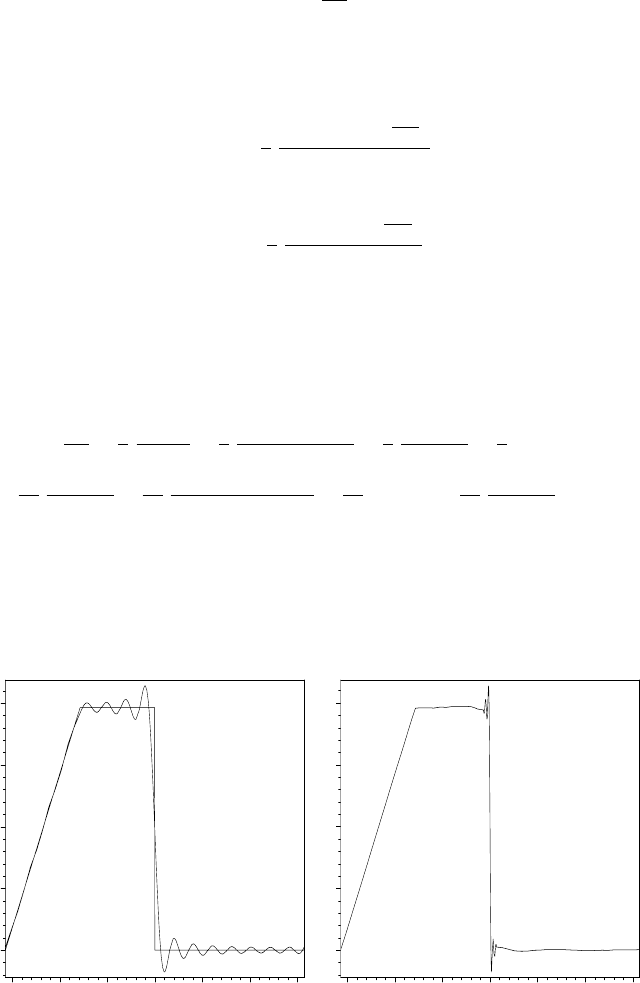
Finally, the function f and the Fourier series FF are plotted over the range
x = −L = −π to x = L = π, being represented by thick blue and red lines. The
resulting picture is shown on the left of Figure 2.5.
>
plot([f,FF],x=-L..L,color=[blue,red],thickness=2,axes=box);
0
0.2
0.4
0.6
0.8
–3 –2 –1 0 1 2 3
x
0
0.2
0.4
0.6
0.8
–3 –2 –1 0 1 2 3
x
Figure 2.5: Left: Fourier series for N =15 and f.Right:SeriesforN =100.

76 CHAPTER 2. APPLICATIONS OF SERIES
The Fourier series oscillates around the exact f. The fit can be improved (the
size of the oscillations reduced) by increasing N. The plot on the right of
Figure 2.5 shows the Fourier series result for N = 100. The overshoot in the
vicinity of the step function at x=0 persists, however, no matter how large an
N is chosen. This is called the Gibbs’ phenomenon. Notice also in the left plot
that the Fourier series curve passes approximately through the midpoint of the
step. As N →∞, the Fourier curve will pass exactly though the midpoint, a
general property of Fourier series at step discontinuities.
The exact cross-sectional area of the retaining wall is calculated in Area1 by
integrating f from x =−L= −π to π. The cross-sectional area is also calculated
in Area2 by integrating the Fourier series FF over the same range.
>
Area1:=int(f,x=-Pi..Pi); Area2:=int(FF,x=-Pi..Pi);
Area1 :=
3 π
2
16
Area2 :=
3 π
2
16
The two areas are identical. The “wiggles” in the Fourier series about the f
curve exactly cancel. You might like to confirm that this is still true for N = 100.
2.3.2 Sine or Cosine Series?
I see it all perfectly; there are two possible situations – one can either
do this or that. My honest opinion and my friendly advice is this:
do it or do not do it – you will regret both.
Søren Kierkegaard, Danish philosopher, (1813–55)
Consider the function f(x)=x for 0 ≤ x ≤ L/2andf(x)=L − x for
L/2 ≤ x ≤ L,withL = 1. Extending the range to −L ≤ x ≤ L,derivea
Fourier sine series and a cosine series representation of f (x). Plot f(x) and the
two series together and discuss the results.
The value of L is entered and, again for convenience, let’s set X =πx/L.
>
restart: L:=1: X:=Pi*x/L:
The function f is entered using the piecewise command.
>
f:=piecewise(x<L/2,x,x<L,L-x);
f :=
xx<
1
2
1 − xx<1
An odd function f1 is introduced which is the same as f for 0 ≤ x ≤ L, but is
equal to −f for −L ≤ x ≤ 0. f1 will be used to generate the sine series.
>
f1:=piecewise(x<-L/2,-(L+x),x<L/2,x,x<L,L-x);
f1 :=
⎧
⎪
⎪
⎪
⎨
⎪
⎪
⎪
⎩
−1 − xx<
−1
2
xx<
1
2
1 − xx<1