
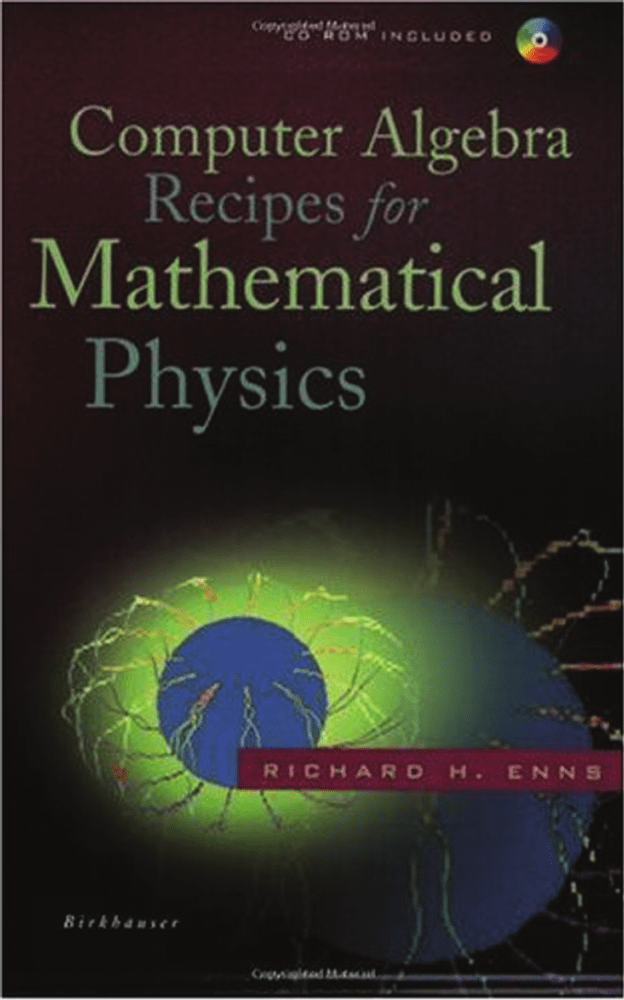
Enns R.H. Computer Algebra Recipes for Mathematical Physics
Подождите немного. Документ загружается.


This mathematical physics contribution
to the Computer Algebra Recipes series
is dedicated to my wife Karen,
who lights my path through life.

Richard H. Enns
Computer Algebra Recipes
for Mathematical Physics
Birkh
¨
auser
Boston
•
Basel
•
Berlin

Richard H. Enns
Simon Fraser University
Department of Physics
Burnaby, B.C. V5A 1S6
Canada
AMS Subject Classifications (2000): 15A90, 30-XX, 33-XX, 34-XX, 35-XX, 35Qxx, 40-XX,
42-XX, 44-XX, 49-XX, 65-XX, 68-XX, 70-XX, 97U50
ISBN 0-8176-3223-9 Printed on acid-free paper.
c
2005 Birkh
¨
auser Boston
All rights reserved. This work may not be translated or copied in whole or in part without the written
permission of the publisher (Birkh
¨
auser Boston, c/o Springer Science+Business Media Inc., Rights
and Permissions, 233 Spring Street, New York, NY 10013, USA), except for brief excerpts in con-
nection with reviews or scholarly analysis. Use in connection with any form of information storage
and retrieval, electronic adaptation, computer software, or by similar or dissimilar methodology now
known or hereafter developed is forbidden.
The use in this publication of trade names, trademarks, service marks and similar terms, even if they
are not identified as such, is not to be taken as an expression of opinion as to whether or not they are
subject to proprietary rights.
Printed in the United States of America. (HP)
987654321 SPIN 10923559
www.birkhauser.com
Preface
This book is a self-contained guide to problem-solving and exploration in math-
ematical physics using the powerful Maple 9.5 computer algebra system (CAS).
With a CAS one cannot only crunch numbers and plot results, but also carry out
the symbolic manipulations which form the backbone of mathematical physics.
The heart of this text consists of over 230 useful and stimulating “classic”
computer algebra worksheets or recipes, which are systematically organized to
cover the major topics presented in the standard Mathematical Physics course
offered to third or fourth year undergraduate physics and engineering students.
The emphasis here is on applications, with only a brief summary of the un-
derlying theoretical ideas being presented. The aim is to show how computer
algebra can not only implement the methods of mathematical physics quickly,
accurately, and efficiently, but can be used to explore more complex examples
which are tedious or difficult or even impossible to implement by hand.
The recipes are grouped into three sections, the introductory Appetizers
dealing with linear ordinary differential equations (ODEs), series, vectors, and
matrices. The more advanced Entrees cover linear partial differential equations
(PDEs), scalar and vector fields, complex variables, integral transforms, and
calculus of variations. Finally, in the Desserts the emphasis is on presenting
some analytic, graphical, and numerical techniques for solving nonlinear ODEs
and PDEs. The numerical methods are also applied to linear ODEs and PDEs.
No prior knowledge of Maple is assumed in this text, the relevant command
structures being introduced on a need-to-know basis. The recipes are thor-
oughly annotated and, on numerous occasions, presented in a “story” format
or in a historical context. Each recipe takes the reader from the analytic formu-
lation or statement of a representative type of mathematical physics problem to
its analytic or numerical solution and to a graphical visualization of the answer,
where relevant. The graphical representations vary from static 2-dimensional
pictures, to contour and vector field plots, to 3-dimensional graphs that can
be rotated, to animations in time. For your convenience, all 230 recipes are
included on the accompanying CD.
The range of mathematical physics problems that can be solved with the
enclosed recipes is only limited by your imagination. By altering the parameter
values, or initial conditions, or equation structure, thousands of other problems
can be easily generated and solved. “What if?” questions become answerable.
This should prove extremely useful to instructor and student alike.
Contents
Preface v
INTRODUCTION 1
A.ComputerAlgebraSystems ...................... 1
B.ComputerAlgebraRecipes....................... 2
C.MapleHelp ............................... 3
D.IntroductoryRecipes.......................... 4
D.1ADangerousRide?......................... 4
D.2ThePatrolRouteofBertieBumblebee.............. 7
E.HowtoUsethisText.......................... 10
I THE APPETIZERS 11
1 Linear ODEs of Physics 13
1.1 LinearODEswithConstantCoefficients.............. 13
1.1.1 DazzlingDsolveDebuts ................... 14
1.1.2 TheTaleoftheTurbulentTail ............... 18
1.1.3 ThisBarDoesn’tServeDrinks ............... 21
1.1.4 Shake, Rattle, and Roll ................... 25
1.1.5 “Resonances”, A Recipe by I. M. Curious ......... 27
1.1.6 Mr.Dirac’sFamousFunction................ 32
1.2 LinearODEswithVariableCoefficients .............. 36
1.2.1 Introducing the Sturm–Liouville Family .......... 36
1.2.2 OnsetofBendinginaVerticalAntenna .......... 42
1.2.3 The Quantum Oscillator ................... 44
1.2.4 GoingGreen,theMathematician’sWay .......... 48
1.2.5 InSearchofaMoreStableExistence............ 51
1.3 Supplementary Recipes ....................... 54
01-S01Newton’sLawofCooling .................. 54
01-S02ChargingaCapacitor .................... 55
01-S03RadioactiveChain ...................... 55
viii CONTENTS
01-S04NewtonandStokesJoinForces............... 55
01-S05ExploringtheRLCSeriesCircuit.............. 55
01-S06TheWhirlingBarRevisited................. 56
01-S07 Driven Coupled Oscillators ................. 56
01-S08SomePropertiesoftheDeltaFunction........... 56
01-S09AGreenFunction ...................... 56
01-S10APotpourriofGeneralSolutions.............. 57
01-S11ChebyshevPolynomials ................... 57
01-S12 The Growing Pendulum ................... 57
01-S13AnotherGreenFunction................... 58
01-S14 Going Green, Once Again .................. 58
2 Applications of Series 59
2.1 TaylorSeries ............................. 59
2.1.1 PolynomialApproximations................. 59
2.1.2 FiniteDifferenceApproximations.............. 61
2.2 SeriesSolutionsofLODEs...................... 65
2.2.1 JenniferRenewsanOldAcquaintance ........... 65
2.2.2 AnotherOldAcquaintance ................. 68
2.3 FourierSeries............................. 72
2.3.1 MadeiranLevadasandtheGibb’sPhenomenon...... 74
2.3.2 SineorCosineSeries? .................... 76
2.3.3 HowSweetThisIs!...................... 78
2.4 SummingSeries............................ 80
2.4.1 I.M.CuriousSumsaSeries................. 80
2.4.2 Spiegel’sSeriesProblem................... 82
2.5 Supplementary Recipes ....................... 84
02-S01EulerandBernoulliNumbers................ 84
02-S02Ms.CuriousApproximatesanIntegral........... 84
02-S03MoreFiniteDifferenceApproximations .......... 84
02-S04SeriesSolution ........................ 85
02-S05ChebyshevPolynomialsRevisited.............. 85
02-S06AFourierSeries ....................... 85
02-S07FourierSineSeries ...................... 85
02-S08FourierCosineSeries..................... 85
02-S09LegendreSeries........................ 86
02-S10DirectlyEvaluatingSeriesSums .............. 86
02-S11AnotherCosineSeries .................... 86
02-S12 The Complex Series Trick Again .............. 86
3 Vectors and Matrices 87
3.1 Vectors:CartesianCoordinates................... 87
3.1.1 BobbyBlowfly ........................ 88
3.1.2 Hiking in the Southern Chilkotin .............. 90
3.1.3 EstablishingTheseIdentitiesisEasy............ 94
CONTENTS ix
3.1.4 ThisTaskisNotaChore .................. 95
3.2 Vectors: Curvilinear Coordinates .................. 98
3.2.1 From Scale Factors to Vector Operators .......... 98
3.2.2 Vector Operators the Easy Way ...............100
3.2.3 These Operators Do Not Have an Identity Crisis .....102
3.2.4 IsThisVectorFieldConservative? .............103
3.2.5 TheDivergenceTheorem ..................105
3.3 Matrices................................108
3.3.1 SomeMatrixBasics .....................109
3.3.2 EigenvaluesandEigenvectors ................111
3.3.3 Diagonalizing a Matrix ....................115
3.3.4 Orthogonal and Unitary Matrices ..............117
3.3.5 IntroducingtheEulerAngles ................119
3.4 Supplementary Recipes .......................122
03-S01BobbyBlowflySeeksaWarmerClime ...........122
03-S02Jennifer’sVectorAssignment ................122
03-S03 Another Vector Operator Identity .............123
03-S04AnotherMapleApproach ..................123
03-S05ConservativeorNon-conservative? .............123
03-S06BasicMatrixOperations...................123
03-S07 The Cayley–Hamilton Theorem ...............123
03-S08 Simultaneous Diagonalization ................124
03-S09OrthonormalVectors.....................124
03-S10Stokes’sTheorem.......................124
03-S11 Solving Linear Equation Systems ..............124
II THE ENTREES 125
4 Linear PDEs of Physics 127
4.1 ThreeCheersfortheString .....................128
4.1.1 JenniferFindstheGeneralSolution ............128
4.1.2 DanielSeparatesStrings:ISeparateVariables ......130
4.1.3 Daniel Strikes Again: Mr. Fourier Reappears .......133
4.1.4 The3-PieceString ......................135
4.1.5 Encore? ............................137
4.2 BeyondtheString ..........................141
4.2.1 Heaviside’sTelegraphEquation...............141
4.2.2 Spiegel’sDiffusionProblems.................143
4.2.3 IntroducingLaplace’sEquation...............146
4.2.4 Grandpa’s “Trampoline” ...................148
4.2.5 Irma Insect’s Isotherm ....................150
4.2.6 DanielHitsMiddleC ....................152
4.2.7 APoissonRecipe.......................155
4.3 BeyondCartesianCoordinates ...................158
x CONTENTS
4.3.1 IsItSeparable?........................158
4.3.2 AShellProblem,NotaShellGame ............162
4.3.3 TheLittleDrummerBoy ..................166
4.3.4 TheCannonBall.......................169
4.3.5 VariationonaSplit-spherePotential............171
4.3.6 AnotherPoissonRecipe ...................174
4.4 Supplementary Recipes .......................178
04-S01GeneralSolutions.......................178
04-S02BalalaikaBlues........................179
04-S03DampedOscillations.....................179
04-S04 Kids Will Be Kids ......................179
04-S05EnergyofaVibratingString ................179
04-S06VibrationsofaTaperedString ...............180
04-S07GreenFunctionforForcedVibrations ...........180
04-S08 Plane-wave Propagation in a 5-Piece String ........180
04-S09TransverseVibrationsofaWhirlingString ........180
04-S10NewtonWouldThinkThatThisRecipeIsCool......181
04-S11LocomotiveonaBridge ...................181
04-S12TheTemperatureSwitch ..................181
04-S13TelegraphEquationRevisited................181
04-S14Another“Trampoline”Example ..............182
04-S15 An Electrostatic Poisson Problem .............182
04-S16SHEDoesNotWanttoSeparate..............182
04-S17WECanSeparate ......................182
04-S18TheStarkEffect .......................183
04-S19AnnularTemperatureDistribution .............183
04-S20 Split-boundary Temperature Problem ...........183
04-S21 Fluid Flow Around a Sphere ................183
04-S22SoundofMusic? .......................183
5 Complex Variables 185
5.1 Introduction..............................185
5.1.1 JenniferTestsBasics.....................186
5.1.2 TheStreamFunction ....................188
5.2 ContourIntegrals...........................190
5.2.1 JenniferTestsCauchy’sTheorem..............191
5.2.2 Cauchy’sResidueTheorem .................193
5.3 DefiniteIntegrals...........................196
5.3.1 Infinite Limits ........................196
5.3.2 PolesontheContour.....................198
5.3.3 AnAngularIntegral .....................201
5.3.4 ABranchCut.........................202
5.4 LaurentExpansion..........................205
5.4.1 Ms.CuriousMeetsMr.Laurent ..............205
5.4.2 ConvergeorDiverge? ....................207