
Enns R.H. Computer Algebra Recipes for Mathematical Physics
Подождите немного. Документ загружается.

8.3. NONLINEAR ODES: APPROXIMATE METHODS 309
saddle point at the origin. The fourth singular point at H =0, S =−9000 plays
no role in the “flow” of the trajectories. The phase-plane portrait doesn’t show
the times involved, but of course the other plot on the rhs of Figure 8.7 does.
If every squid was removed from the area occupied by the herring and
from all surrounding areas, H would asymptotically approach an upper limit of
110,000 herring (the H value of the saddle point to which the trajectory would
be attracted). To answer the last part of part (b), we numerically solve the
system of NLODEs with the initial condition H(0) = 110, 000, S(0) = 2, giving
the output as a listprocedure.
>
sol2:=dsolve({sys,H(0)=110000,S(0)=2},{H(t),S(t)},
type=numeric,output=listprocedure):
The number of herring and squid at an arbitrary time t years later is now
determined using sol2.
>
H:=eval(H(t),sol2): S:=eval(S(t),sol2):
The number (per acre of seabed) of herring and squid two years later is now
calculated, and (using the round command) found to be about 108,794 and 26.
>
H2:=round(H(2)); S2:=round(S(2));
H2 := 108794 S2 := 26
8.3 Nonlinear ODEs: Approximate Methods
The perturbation and Krylov–Bogoliubov approximation methods, which may
be applied when the nonlinear terms in the NLODEs are small, are illustrated,
along with the Ritz trial function method which can be used when they are not.
8.3.1 Poisson’s Method Isn’t Fishy
Let a man get up and say, Behold, this is the truth, and instantly
I perceive a sandy cat filching a piece of fish in the background.
Look, you have forgotten the cat, I say.
Virginia Woolf, British novelist, (1882–1941)
Perturbation methods are applicable to NLODEs when the nonlinear terms
are small. As a simple example, consider the motion of a unit mass moving in
a viscous medium characterized by a Hooke’s law restoring force F
Hooke
= −y
and a drag force F
drag
= −av− v
3
= −a (dy/dt) − (dy/dt)
3
where y is the
displacement from equilibrium, v is the velocity, a is a positive coefficient, and
is a small positive parameter. The governing NLODE then is
¨y + a ˙y + ˙y
3
+ y =0. (8.13)
For = 0, (8.13) reduces to the linearly damped simple harmonic oscillator
equation. Our goal is to derive an approximate analytic solution when is
small, but not zero, for the initial condition y(0)= 1, ˙y(0)= 0. Two values of a
will be considered, first a =1/2 which is entered below, and later, a =0. The
Poisson perturbation method is to assume a series solution in powers of , viz.,

310 CHAPTER 8. NLODES & PDES OF PHYSICS
y(t)=y
0
(t)+y
1
(t)+
2
y
2
(t)+···+
N
y
N
(t). In our recipe, let’s take N =2,
i.e., we will stop at second order in in our expansion.
>
restart: with(plots): N:=2: a:=1/2:
A functional operator is introduced for generating the governing NLODE.
>
ode:=y->diff(y(t),t,t)+a*diff(y(t),t)
+epsilon*(diff(y(t),t))ˆ3+y(t)=0;
ode := y → (
d
2
dt
2
y(t)) + a (
d
dt
y(t)) + (
d
dt
y(t))
3
+ y(t)=0
The Poisson perturbation expansion is now entered out to order N.
>
Y(t):=sum(y[n](t)*epsilonˆn,n=0..N);
Y (t):=y
0
(t)+y
1
(t) + y
2
(t)
2
The perturbation expansion is automatically substituted into the NLODE in
the following command line and the result expanded. The very lengthy output
is suppressed with a line-ending colon.
>
ode2:=expand(ode(Y)):
Powers of are now collected in ode2 , all powers of order
(N+1)
and higher
being set equal to zero. The result is then simplified.
>
eq1:=simplify(collect(ode2,epsilon),{epsilonˆ(N+1)=0}):
Since is arbitrary (but small), the coefficient of each power of must be equal
to zero. This will generate a linear ODE for each order of the perturbation
expansion. These equations are produced in the following do loop.
>
fornfrom0toNdo
>
Eq[n]:=coeff(lhs(eq1),epsilon,n)=0;
>
end do;
Eq
0
:= (
d
2
dt
2
y
0
(t)) +
1
2
(
d
dt
y
0
(t)) + y
0
(t)=0
Eq
1
:= (
d
2
dt
2
y
1
(t)) + (
d
dt
y
0
(t))
3
+ y
1
(t)+
1
2
(
d
dt
y
1
(t)) = 0
Eq
2
:= (
d
2
dt
2
y
2
(t)) + 3 (
d
dt
y
0
(t))
2
(
d
dt
y
1
(t)) +
1
2
(
d
dt
y
2
(t)) + y
2
(t)=0
The zeroth order equation, Eq
0
, is just the linearly damped simple harmonic
oscillator equation. It is now solved subject to the initial condition y
0
(0) = 1,
˙y
0
(0) = 0, and the solution is assigned.
>
sol[0]:=dsolve({Eq[0],y[0](0)=1,D(y[0])(0)=0},y[0](t));
assign(sol[0]):
sol
0
:= y
0
(t)=
1
15
√
15 e
(−
t
4
)
sin(
√
15 t
4
)+e
(−
t
4
)
cos(
√
15 t
4
)
Since the zeroth-order solution satisfies the initial condition, all higher-order
equations must be solved subject to y
n
(0) = ˙y
n
(0) = 0, where n =1, ···,N.

8.3. NONLINEAR ODES: APPROXIMATE METHODS 311
This is done in the following do loop, using the Laplace transform option of the
dsolve command. Each solution is assigned and the do loop ended.
>
fornfrom1toNdo
>
sol[n]:=dsolve({Eq[n],y[n](0)=0,D(y[n])(0)=0},y[n](t),
method=laplace); assign(sol[n]):
>
end do:
The lengthy perturbation expansion is now written out
3
in Y ,
>
Y:=sum(’epsilonˆn*rhs(sol[n])’,’n’=0..N):
and and exponential terms sequentially collected.
>
Y:=collect(Y,[epsilon,exp]);
Y := (
1
15
sin(
√
15 t
4
)
√
15+cos(
√
15 t
4
)) e
(−
t
4
)
+ ((−
4
305
cos(
3
√
15 t
4
)+
116
13725
sin(
3
√
15 t
4
)
√
15+
4
5
cos(
√
15 t
4
)
+
4
75
sin(
√
15 t
4
)
√
15)e
(−
3 t
4
)
+(−
48
61
cos(
√
15 t
4
)+
8
305
sin(
√
15 t
4
)
√
15) e
(−
t
4
)
)
+
2
((
127494
161101
cos(
√
15 t
4
) −
10818
805505
sin(
√
15 t
4
)
√
15) e
(−
t
4
)
−(
108
61
cos(
√
15 t
4
)+
84
1525
sin(
√
15 t
4
)
√
15 +
32
1525
sin(
3
√
15 t
4
)
√
15) e
(−
3 t
4
)
+(−
648
211975
cos(
5
√
15 t
4
) −
1544
3179625
√
15sin(
5
√
15 t
4
) −
486
28975
cos(
3
√
15 t
4
)
+
2306
86925
sin(
3
√
15 t
4
)
√
15+
28944
28975
cos(
√
15 t
4
)+
6896
86925
sin(
√
15 t
4
)
√
15)e
(−
5 t
4
)
)
Clearly, deriving the above solution by hand would be a tedious task. Let’s now
take a specific value for the parameter, say =0.4.
>
epsilon:=0.4:
The perturbation solution Y is plotted over the time interval t =0 to 20 in gr1.
>
gr1:=plot(Y,t=0..20,labels=["t","y"],thickness=2):
For comparison, the NLODE is now solved numerically, subject to the given
initial condition,
>
X:=dsolve({ode(x),x(0)=1,D(x)(0)=0},x(t),numeric,
output=listprocedure):
and plotted in gr2. A point style is chosen, with fifty size 12 black circles.
>
gr2:=odeplot(X,[t,x(t)],0..20,style=point,symbol=circle,
symbolsize=12,numpoints=50,color=black):
The two graphs are superimposed with the display command,
>
display([gr1,gr2]);
3
Note the enclosure of the summand and summation index in “right quotes” here. This is
required for the sum to be carried out. See Maple’s Help on sum for a discussion of this issue.
312 CHAPTER 8. NLODES & PDES OF PHYSICS
0
y
1
20
t
–6
0
y
10
t
20
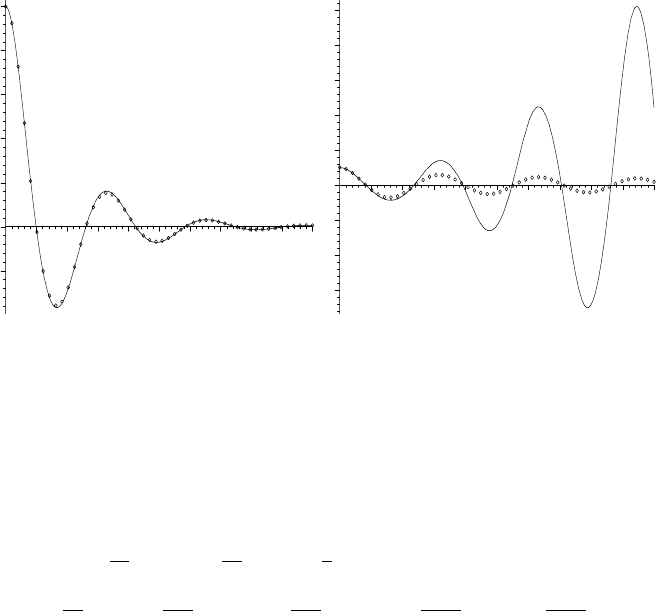
Figure 8.8: Numerical (circles) and perturbation (line) solutions for a =1/2
(left) and a=0 (right).
the resulting picture being shown on the left of Figure 8.8. In this case, the
perturbation expansion fits the numerical solution very well.
However, if the recipe is re-executed with a = 0, trouble occurs. Y then
takes the following form, containing secular terms involving powers of t.
Y = cos(t)+ (
1
32
sin(3 t)+
9
32
sin(t) −
3
8
t cos(t))
+
2
(−
9
64
t sin(t)+
27
128
t
2
cos(t) −
9
256
t sin(3 t) −
3
1024
cos(5 t)+
3
1024
cos(t)).
Referring to the right hand side picture in Figure 8.8, the perturbation solution
agrees with the exact numerical result for short times, but eventually the secular
terms cause the perturbation expansion to diverge from the exact solution, the
oscillations in fact increasing with time, rather than decreasing. Going to higher
order in the perturbation expansion will not “cure” the situation, as even higher
powers of t then occur. Their are a variety of methods (see Zwillinger [Zwi89])
for dealing with the presence of secular terms in the perturbation solution of a
NLODE. In the following recipe, we illustrate one method which can be applied
to a NLODE having a periodic solution.
8.3.2 Lindstedt Saves the Day
I like to do all the talking myself.
It saves time, and prevents arguments.
Oscar Wilde, Anglo-Irish playwright, author, (1854–1900)
Consider a spring whose displacement from equilibrium satisfies the NLODE,
¨y(t)+y(t)+y(t)
5
=0, (8.14)

8.3. NONLINEAR ODES: APPROXIMATE METHODS 313
with >0 and small. Our goal is to derive a second-order perturbation solution
to equation (8.14), subject to the initial condition y(0) = 1, ˙y(0) = 0. The
solution then will be compared to the exact numerical solution for =1/2. If
the Poisson method is applied, secular terms will occur, which would destroy
the expected periodic solution. So what do we do?
For =0, (8.14) is just the simple harmonic oscillator equation which has the
periodic solution cos(t), with frequency 1. The Lindstedt perturbation method
is to assume not only a perturbation expansion for y, but that the frequency
changes slightly to a new frequency Ω, which can also be represented by a per-
turbation series. Introducing a new time variable T =Ωt, and setting X ≡ y,
equation (8.14) can be rewritten as
Ω
2
¨
X(T )+X(T )+X(T )
5
=0. (8.15)
Lindstedt’s procedure is to assume that
X(T )=x
0
(T )+x
1
(T )+
2
x
2
(T )+···, and Ω = 1+ω
1
+
2
ω
2
+···. (8.16)
The secular terms are removed in each order by imposing the periodicity condi-
tion X(T +2π)=X(T ), i.e., x
n
(T +2π)=x
n
(T ), for n=0, 1, 2, .... The initial
conditions are x
0
(0)= 1, ˙x
0
=0, and x
n
(0)= 0, ˙x
n
(0)= 0 for n=1, 2, ....
The following recipe carries out Lindstedt’s method for the given NLODE.
The maximum power, N =2, of to be kept in the expansion is entered. The
following alias command produces the output symbol when e is entered.
>
restart: with(plots): N:=2: alias(epsilon=e):
The NLODES (8.14) and (8.15) are entered in ode1a and ode1b, respectively.
>
ode1a:=diff(y(t),t,t)+y(t)+e*y(t)ˆ5=0;
ode1a := (
d
2
dt
2
y(t)) + y(t)+ y(t)
5
=0
>
ode1b:=Omegaˆ2*diff(X(T),T,T)+X(T)+e*X(T)ˆ5=0;
ode1b := Ω
2
(
d
2
dT
2
X (T )) + X (T )+ X (T )
5
=0
The perturbation expansions for X(T ) and Ω, given in (8.16), are inputted.
>
X(T):=sum(’x||n(T)*eˆn’,’n’=0..N);
X (T ):=x0 (T )+x1 (T ) + x2 (T )
2
>
Omega:=1+sum(’omega||n*eˆn’,’n’=1..N);
Ω:=1+ω1 + ω2
2
The above series are automatically substituted into ode1b, which is expanded.
>
ode2:=expand(ode1b):
Powers of are collected in ode2 , and terms higher than
N
set equal to 0.
>
ode3:=simplify(collect(ode2,e),{eˆ(N+1)=0}):
A functional operator eq is formed to set the coefficient of the nth power of
on the lhs of ode3 equal to zero.
>
eq:=n->coeff(lhs(ode3),e,n)=0:

314 CHAPTER 8. NLODES & PDES OF PHYSICS
Using the functional operator in the following sequence command produces the
linear ODEs eq0 , eq1 ,andeq2 , corresponding to
0
,
1
,and
2
, respectively.
>
eqs:=seq(eq||n=eq(n),n=0..N); assign(eqs);
eqs := eq0 =((
d
2
dT
2
x0 (T )) + x0 (T )=0),
eq1 =(x1 (T )+(
d
2
dT
2
x1 (T )) + x0 (T )
5
+2ω1(
d
2
dT
2
x0 (T )) = 0),
eq2 =((
d
2
dT
2
x2 (T )) + 5 x0 (T )
4
x1 (T )+2ω1(
d
2
dT
2
x1 (T )) + x2 (T )
+ ω1
2
(
d
2
dT
2
x0 (T )) + 2 ω2(
d
2
dT
2
x0 (T )) = 0)
An operator sol is created to analytically solve the nth order ODE, using the
Laplace transform method. The order n and initial value A of x
n
must be given.
>
sol:=(n,A)->dsolve({eq||n,x||n(0)=A,D(x||n)(0)=0},x||n(T),
method=laplace):
Setting A=1, the zeroth-order ODE is solved and the solution assigned.
>
sol0:=sol(0,1); assign(sol0):
sol0 := x0 (T ) = cos(T )
The1stODEissolvedwithA =0, trig terms are combined, and sol1 assigned.
>
sol1:=combine(sol(1,0),trig); assign(sol1);
sol1 := x1 (T )=
5
128
cos(3 T ) −
1
24
cos(T )+
1
384
cos(5 T )
−
5
16
T sin(T )+T sin(T ) ω1
The secular terms, −
5
16
T sin(T )+T sin(T ) ω1, occur and must be removed
from x1 (T ) to maintain periodicity, i.e., to have x1 (T +2π)=x1 (T ). This
implies that we must have ω1=5/16. This frequency is extracted and the
secular term removed from x1 (T ) in the following command lines.
>
omega||1:=solve(coeff(x||1(T),sin(T))=0,omega||1);
x||1(T):=subs(sin(T)=0,x||1(T));
ω1:=
5
16
x1 (T ):=
1
384
cos(5 T )+
5
128
cos(3 T ) −
1
24
cos(T )
Then, the second-order ODE is solved, and the solution assigned.
>
sol2:=combine(sol(2,0),trig); assign(sol2):
sol2 := x2 (T )=
1
98304
cos(9 T )+
95
294912
cos(7 T ) −
5
192
cos(3 T )
+
3791
147456
cos(T )+T sin(T ) ω2+
215
3072
T sin(T )
Secular terms occur in sol2 , which are removed by choosing ω2=−215/3072.
>
omega||2:=solve(coeff(x||2(T),sin(T))=0,omega||2);
8.3. NONLINEAR ODES: APPROXIMATE METHODS 315
x||2(T):=subs(sin(T)=0,x||2(T));
ω2:=
−215
3072
x2 (T ):=
1
98304
cos(9 T )+
95
294912
cos(7 T ) −
5
192
cos(3 T )+
3791
147456
cos(T )
The perturbation solution is now completely determined to second order in .
Setting =1/2andT =Ωt, the Lindstedt perturbation solution X is displayed.
This would be a tedious result to derive by hand.
>
e:=1/2: X:=subs(T=Omega*t,x||0(T)+e*x||1(T)+eˆ2*x||2(T));
X :=
581327
589824
cos(
13993 t
12288
)+
1
768
cos(
69965 t
12288
)+
5
384
cos(
13993 t
4096
)
+
1
393216
cos(
41979 t
4096
)+
95
1179648
cos(
97951 t
12288
)
AgraphofX,aswellasthe = 0 solution, is created over the time interval
t= 0 to 20.
>
gr1:=plot({X,cos(t)},t=0..20):
The original NLODE, ode1a, is numerically solved and plotted over the same
time interval, size 12 black circles being used for the numerical curve.
>
Y:=dsolve({ode1a,y(0)=1,D(y)(0)=0},y(t),numeric,
output=listprocedure):
>
gr2:=odeplot(Y,[t,y(t)],0..20,style=point,symbol=circle,
symbolsize=12,numpoints=120,color=black):
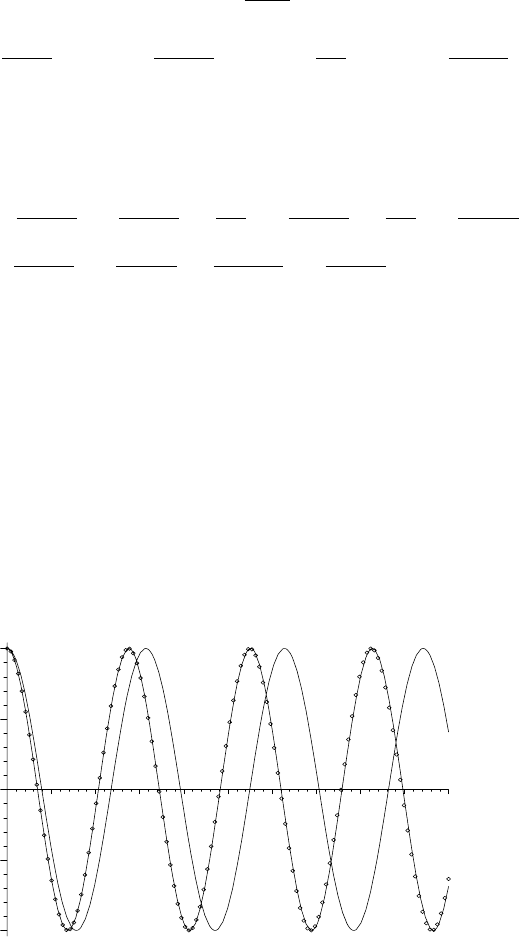
The two graphs are superimposed, the resulting picture being shown in Fig-
ure 8.9. The Lindstedt curve fits the numerical data quite well, and differs
appreciably from the =0 solution.
>
display({gr1,gr2});
–1
0
1
10
t
20
Figure 8.9: Lindstedt curve lies on numerical circles. Other curve: =0 solution.

316 CHAPTER 8. NLODES & PDES OF PHYSICS
8.3.3 Krylov–Bogoliubov Have A Say
He who says he hates every kind of flattery, and says it in earnest,
certainly does not yet know every kind of flattery.
G. C. Lichtenberg, German physicist and philosopher, (1742–99)
For a =0, equation (8.13) reduces to
¨y + y + ˙y
3
=0, (8.17)
the initial condition being y(0)= 1, ˙y(0)= 0. For small, we saw that the Poisson
perturbation expansion broke down for this NLODE, generating secular terms
which grew with time. Since the solution of this equation is not periodic, the
Lindstedt procedure cannot be used to remove the secular terms.
A procedure developed by Krylov and Bogoliubov [KB43] can be employed
to solve NLODEs of the general structure
¨x + ω
2
0
x + f(x, ˙x)=0, (8.18)
with a small parameter. Equation (8.17) is of this structure with x = y,
ω
0
= 1 and f =˙x
3
.For = 0, a general solution of (8.18) would be of the form
x=a sin(ω
0
t + φ), with a and φ constants determined by the initial conditions.
If x is the displacement, the velocity would be ˙x = aω
0
cos(ω
0
t + φ). In the
Krylov–Bogoliubov (KB) method
4
, exactly the same forms are assumed for x
and ˙x, but the amplitude a and phase factor φ are allowed to become time-
dependent. Provided that a(t)andφ(t) are “slowly varying”, their structures
are determined by solving [EM00] [Zwi89],
˙a = −
2πω
0
2π
0
f(a sin ψ, aω
0
cos ψ)cosψdψ,
˙
φ =
2πaω
0
2π
0
f(a sin ψ, aω
0
cos ψ)sinψdψ,
(8.19)
where ψ ≡ ω
0
t + φ. The criterion for being slowly varying is that
˙a
a
2 π
ω
0
1, and
˙
φ
ω
0
1. (8.20)
Recalling that ω
0
= 1, for equation (8.17) we have f =(a cos ψ)
3
. Since the
relevant integrand cos
3
ψ sin ψ is an odd function of ψ,
˙
φ =0,soφ is a constant.
We need only determine the form of a(t) and make sure that the solution
x = a(t)sin(t + φ) satisfies the initial condition. We shall now do this for
the same initial condition as in Recipe 08-3-1, taking x(0) = 1 and ˙x(0) = 0.
The KB solution will be compared to the numerical solution for the same value
of as in that recipe, viz., =0.4.
Use of the following alias command allows us to enter e in the input and
generate in the output.
4
Also referred to as the method of averaging [Zwi89].

8.3. NONLINEAR ODES: APPROXIMATE METHODS 317
>
restart: with(plots): alias(epsilon=e):
The form of f isenteredintermsofψ,
>
f:=(a(t)*cos(psi))ˆ3;
f := a(t)
3
cos(ψ)
3
and the integration in the ˙a equation in (8.19) carried out.
>
eq:=diff(a(t),t)=-(e/(2*Pi))*int(f*cos(psi),psi=0..2*Pi);
eq :=
d
dt
a(t)=−
3
8
a(t)
3
The resulting first-order ODE eq is analytically solved for a(t),
>
sol:={dsolve(eq,a(t))};
sol := {a(t)=
2
√
3 t+4 C1
, a(t)=−
2
√
3 t+4 C1
}
generating two answers with
C1 an arbitrary integration constant. The rhs
of the positive square root solution (the first one here) is selected to form the
solution x. The two constants
C1 and φ remain to be determined.
>
x:=rhs(sol[1])*sin(t+phi);
x :=
2sin(t + φ)
√
3 t+4 C1
Taking =0.4, we set x(0)=1 in initial condition ic1 ,
>
e:=0.4: ic1:=eval(x,t=0)=1;
ic1 :=
1
2
√
4sin(φ)
√
C1
=1
and ˙x(0) = 0 in ic2 .
>
ic2:=eval(diff(x,t),t=0)=0;
ic2 := −
0.07500000000
√
4sin(φ)
C1
(3/2)
+
1
2
√
4 cos(φ)
√
C1
=0
Then ic1 and ic2 are numerically solved for φ and
C1 . The solution sol2 is
assigned, and the final KB solution, x,displayed.
>
sol2:=fsolve({ic1,ic2},{phi,_C1}); assign(sol2): x:=x;
sol2 := {
C1 =0.9769696007,φ= −11.14792061}
x :=
2sin(t − 11.14792061)
√
1.2 t +3.907878403
The KB solution is plotted over the time interval t= 0 to 20.
>
gr1:=plot(x,t=0..20,labels=["t","x"]):
The NLODE is entered,
>
ode:=diff(y(t),t,t)+y(t)+e*diff(y(t),t)ˆ3=0;
ode := (
d
2
dt
2
y(t)) + y(t)+0.4(
d
dt
y(t))
3
=0
solved numerically subject to the same initial condition,
318 CHAPTER 8. NLODES & PDES OF PHYSICS
>
Y:=dsolve({ode,y(0)=1,D(y)(0)=0},y(t),numeric,
output=listprocedure):
and plotted using 50 size 12 black circles to represent the numerical curve.
>
gr2:=odeplot(Y,[t,y(t)],0..20,style=point,symbol=circle,
symbolsize=12,numpoints=50,color=black):
The KB and numerical solutions are superimposed with the display command,
>
display([gr1,gr2]);
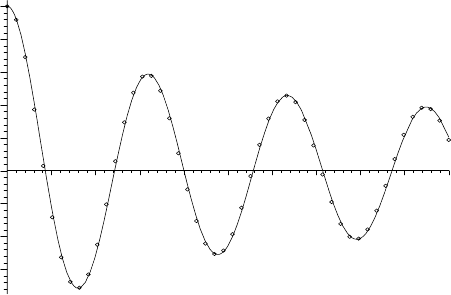
the resulting picture being shown in Figure 8.10.
–0.6
0
x
1
10
t
20
Figure 8.10: Circles: numerical solution. Curve: KB solution.
The KB solution is in quite good agreement with the exact (numerical) solution.
8.3.4 A Ritzy Approach
We must never confuse elegance with snobbery.
Yves Saint Laurent, French couturier, Ritz, no. 85 (London, 1984)
The perturbation and Krylov–Bogoliubov methods can be applied to a NLODE
when the nonlinear terms are small compared to the linear parts of the equation.
The Ritz method is more general, not being restricted to small nonlinearities.
Consider a general ODE,
f(x, ˙x, ¨x, ..., t)=0, (8.21)
where f is some nonlinear function of its arguments. In the spirit of the
Rayleigh–Ritz method for estimating eigenvalues, we try to guess at a trial
wave function Φ which comes “close” to satisfying (8.21). Since, in general, Φ
will not be an exact solution, substitution of Φ into (8.21) will not generate
0 on the right-hand side, but some time-dependent contribution e(t), referred
to as the residual, i.e., f(Φ,
˙
Φ,
¨
Φ, ... t)=e(t). Paralleling the method of least
squares for fitting experimental data, the Ritz method calculates the total error