
Foster L.V. A Brief History of Mexico
Подождите немного. Документ загружается.

A BRIEF HISTORY OF MEXICO
248
protections were rendered useless because Mexico was not producing
enough maize for domestic consumption.
Fox maintained steadfast support for NAFTA, arguing that the treaty
had benefited Mexico as demonstrated by its trade surplus with the
United States. He nonetheless offered to take legal action to eliminate
U.S. subsidies of crops, a corrective process permitted under the treaty
but one that provided little chance of relief. He also claimed there really
was no crisis in rural Mexico to worry about—despite the fact that by
most estimates more than 70 percent of the rural population was living
in poverty. His indifference provoked an angry response. The increas-
ingly unified farming groups were joined by sympathetic labor unions
and indigenous organizations. Under the banner of “The countryside
can’t take anymore,” they took over government offices buildings,
blocked highways near the northern border, and tied up many urban
centers with their demonstrations. The PRI seized the opportunity to
gain much-needed political support and argued that NAFTA should
indeed be reconsidered for national security. Fox was forced to negoti-
ate
with
the agrosector, and promised renewed assistance for the rural
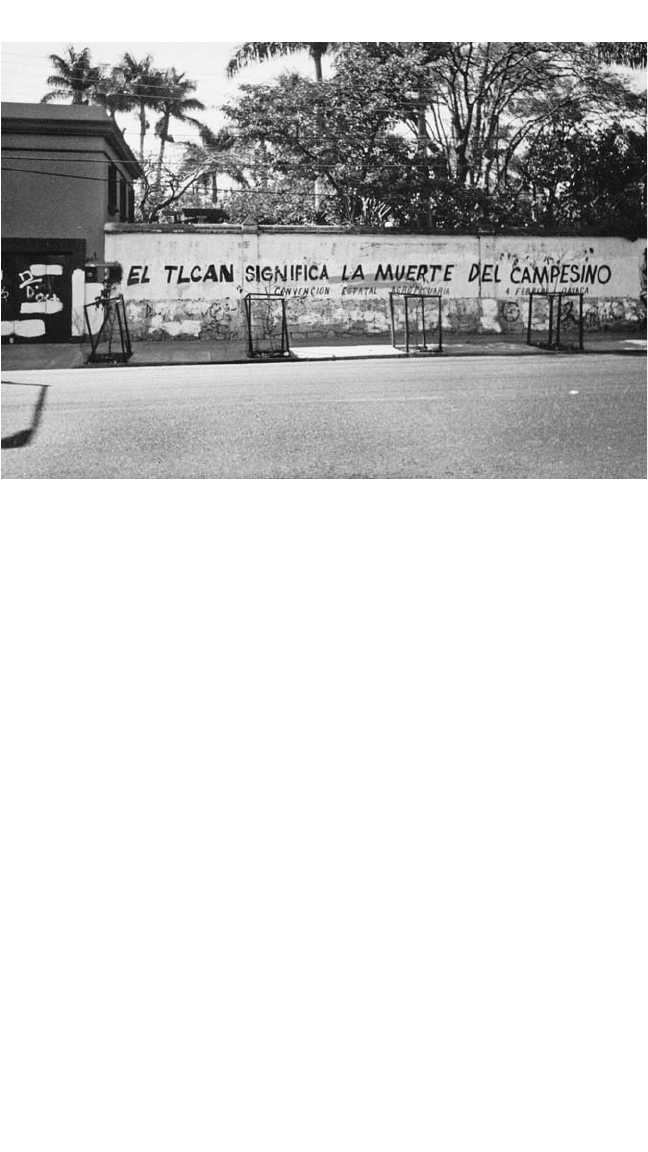
Wall painted with graffito proclaiming NAFTA (“TLCAN” in Spanish) means death to the small
farmer.
(Courtesy Lawrence Foster)

249
Maize Invasion
Without corn, there is no Mexico.
political slogan, 2008
M
aize is so fundamental to the Mexican diet and Mesoamerican
identity that its production increased at the end of the 20th
century against all odds. Yet Mexico became less self-sufficient as
population growth and demand outstripped domestic production.
Imports from the United States increased dramatically, and after the
implementation of NAFTA in 1994, the price of corn plunged from
competition with U.S. government-subsidized grains. Corn that cost
$3.41 per bushel to grow in the United States was sold for $2.28,
undercutting Mexican farm prices. As imports increased, so did the
spread of genetically engineered species. By 2001 high-tech corn was
growing in remote mountainous regions of Oaxaca, contaminating
irreplaceable native varieties in the very land where corn was first
domesticated. Globalization, it seemed, was undermining not only
maize production but also the future viability of the grain itself.
Mexicans, from scientists and bureaucrats to peasants and environ-
mental activists, joined in a worldwide protest of biotech crops.
Above all else, the threat to maize production fanned discontent
with NAFTA.
Sources: Institute for Agriculture and Trade Policy and U.N. Development Program
Domestic Maize Cultivation v. Imports
(in millions of metric tons)
1980 1992 1994 2000 2003
Mexican 11.1 14.0 15.0 15.5 19.0
U.S. imports .8 1.0 2.5 5.5 5.6
Sources: Mexican Ministry of Agriculture, U.S. Department of Agriculture, and
UN Food and Agricultural Organization
A MORE DEMOCRATIC MEXICO

A BRIEF HISTORY OF MEXICO
250
sector, including government support for fertilizers and seeds and
cheaper loans for the purchase of equipment. The immediate crisis was
averted, and Mexican corn production actually increased. But roughly
half of Mexican producers were subsistence farmers, most of them
indigenous peoples whose incomes fell drastically after the implemen-
tation of NAFTA. The distrust of NAFTA remained.
Migration and Remittances
The rates of rural poverty in Mexico and barriers to employment of
the poor worsened after the implementation of NAFTA, leading to an
increase in migration to the United States. So many migrated, villages
were notably empty of working-age males, and Mexico’s population
growth fell below 1 percent for the first time in the modern era. By
2002 one of every three adult Mexicans had lived in the United States,
however briefly. Twenty-one million people in the United States had
roots in Mexico, and only half had lived there for five years or longer.
An estimated 6 to 7 million were there illegally in 2005. By the end
of Fox’s term, Mexico had become the biggest exporter of labor in
the world. Mexicans living in the United States or Mexicans traveling
back and forth between the two countries have had a huge impact on
both societies, creating a transnational culture of rap and ranchera
music, graffiti and Corona beer. The cultural impact on the United
States has been so great—Mexican pop stars like Alejandro Fernández
sell more records in the United States than at home—that writer
Carlos Fuentes has called it the reconquest of the territory lost in the
Mexican-American War.
The greatest impact on Mexico, however, has been economic.
Immigrant remittances sent back to families in Mexico constitute one
of the largest sources of foreign revenues, second only to oil exports
and ahead of tourist dollars. Despite the recession in the United States
and the low wages earned by most immigrants, Mexicans were able
to save over $20 billion to send home in 2006. In some states, remit-
tances exceed local budgets. Seventy-five percent of the money helps
poor Mexicans survive, accounting for half the household income of
the extremely poor. For some, it pays for a better home, a village water
system, or fireworks at the village patron saint’s celebration. There is
now greater concern to harness the money to stimulate new businesses
and sustainable economic growth.
Fox, more than any other president, championed migrants and called
them national heroes for the personal risks taken crossing the border
A BRIEF HISTORY OF MEXICO
251
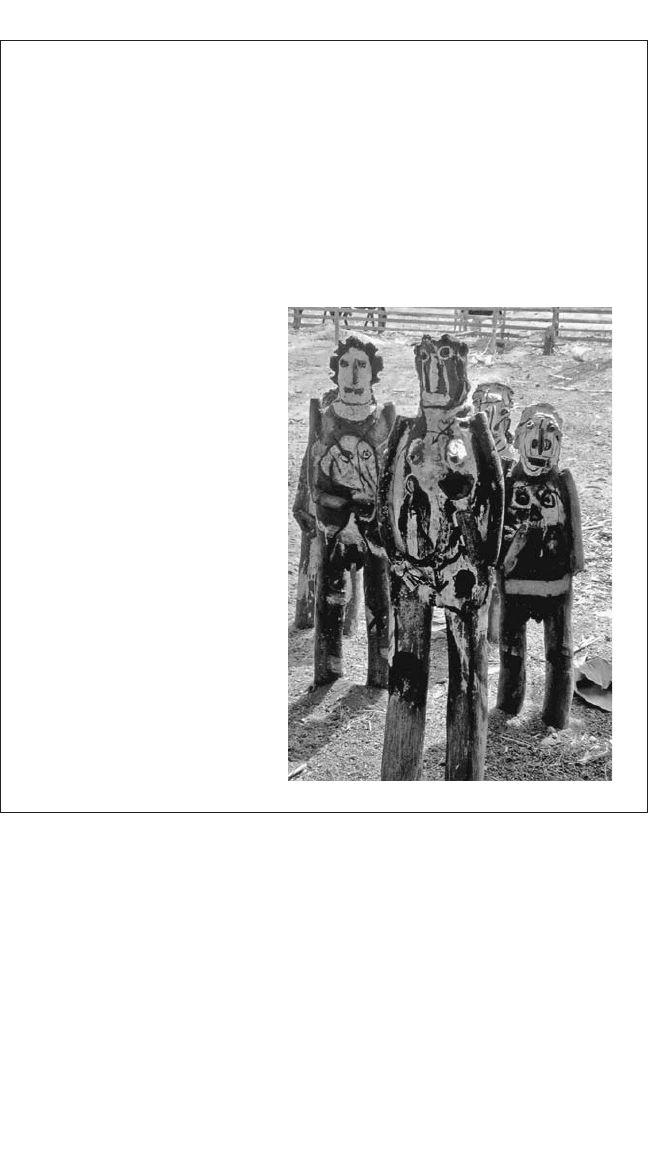
Close-up: Mixtec
Transnationalism
T
he lack of arable land and poverty in the Sierra Mixteca of
Oaxaca caused a major exodus to the United States, especially
to California where approximately 250,000 Mixtec workers now con-
stitute that state’s largest Indian group. They are so numerous in the
city of Fresno, for example,
that radio programs broad-
cast in their native language
of Mixteco, traditional
festivals are celebrated in
their new, if temporary,
home, and the Oaxacan
Indigenous Binational Front
enables them to organize
projects to help Mixtecs in
both countries. Mixtec cul-
ture has rooted in both the
United States and Mexico.
A MORE DEMOCRATIC MEXICO
Migrantes 2007, a few of
the 2,501 life-size clay sculp-
tures created by Mixtec artist
Alejandro Santiago to represent
the enormous loss of youths
from villages like his in Oaxaca
(Courtesy Diana Ricci)
in order to help their families. His first major foreign policy initiative
with the United States was for a more open border and immigration
reform that included granting legal status to 3.5 million undocumented
Mexicans working in the United States. Initially U.S. president George
W. Bush was receptive, but the terrorist attacks on the United States on
September 11, 2001, brought an abrupt end to the dialogue, much to
the embarrassment of the Fox government. In subsequent years, U.S.
anti-immigrant feeling became so intense that the Bush administration
began the construction of a 698-mile barrier along the border.

A BRIEF HISTORY OF MEXICO
252
Political Confrontation
Now more than ever before, citizens are taking the country’s
destiny into their own hands.
President Vincente Fox, 2005
For many Mexicans, democracy meant that their voices could be
heard, their needs answered. The new Mexico, however, had the same
nonresponsive bureaucracy as the old. No respected institutions of
arbitration or conflict resolution had been developed. Politicians,
barred from running for reelection, were more responsive to their par-
ties than to their constituents. As a result, demonstrations proliferated
as the most obvious means for getting the government’s attention.
Grassroots organizations conducted sit-ins at state capitals and town
halls demanding everything from better schools to sewer connections.
Ranchers rode their horses into the venerable Mexican Senate building
to protest pork prices. The traffic tie-ups caused by near continuous
rallies led some states to consider moving their government offices
outside the capital city and Fox abandoned the presidential palace on
the Zócalo for all but ceremonial occasions.
To Fox’s credit, he initially took the political activism as a healthy
symptom of the new democracy. And he believed Mexicans, remem-
bering the guerra sucia, would denounce him for any use of force.
When there was a strike at the Volkswagen factory, he did nothing to
intervene, despite his lack of sympathy for labor rights. When villag-
ers from San Salvador Atenco protested—with machetes in hand—the
confiscation of their ejido land for an expanded airport in Mexico City,
he shrugged off the project rather than arrest the activists. And when
a teachers’ strike in Oaxaca grew into a confrontation with the state
government, he at first claimed it was not appropriate for the federal
government to intervene in local affairs.
By the end of his term, however, Fox’s tolerance ended. Succumbing
to business pressures, he turned against independent unions, even
sending the military and Federal Preventive Police (PFP) to break up
a strike of the National Mining and Metal Workers Union. The sur-
prise police action was violent, killing two workers and wounding 73.
After the PRI gained congressional seats in the 2003 midterm elections
by depicting the PAN president as out of control, Fox reengaged the
recalcitrant activists of Atenco, this time over a misunderstanding with
flower vendors at a local market. After a day of violent confrontations
253
between the state police and the protesters, he permitted the PFP to join
the local police in what turned into a retaliatory attack on the villagers.
Two villagers were killed, including a 14-year-old innocent bystander;
many hundreds were arrested; and some were sexually assaulted.
Fox was also under pressure to intervene in the turbulent situation
in Oaxaca, where protesters, demanding the resignation of the corrupt
PRI governor Ulises Ruiz, had occupied the capital city for five months,
closing most government offices and taking over radio and TV stations.
Drive-by shootings, said to be authorized by the state, had killed many
protesters. After his party won the 2006 presidential election, Fox bent
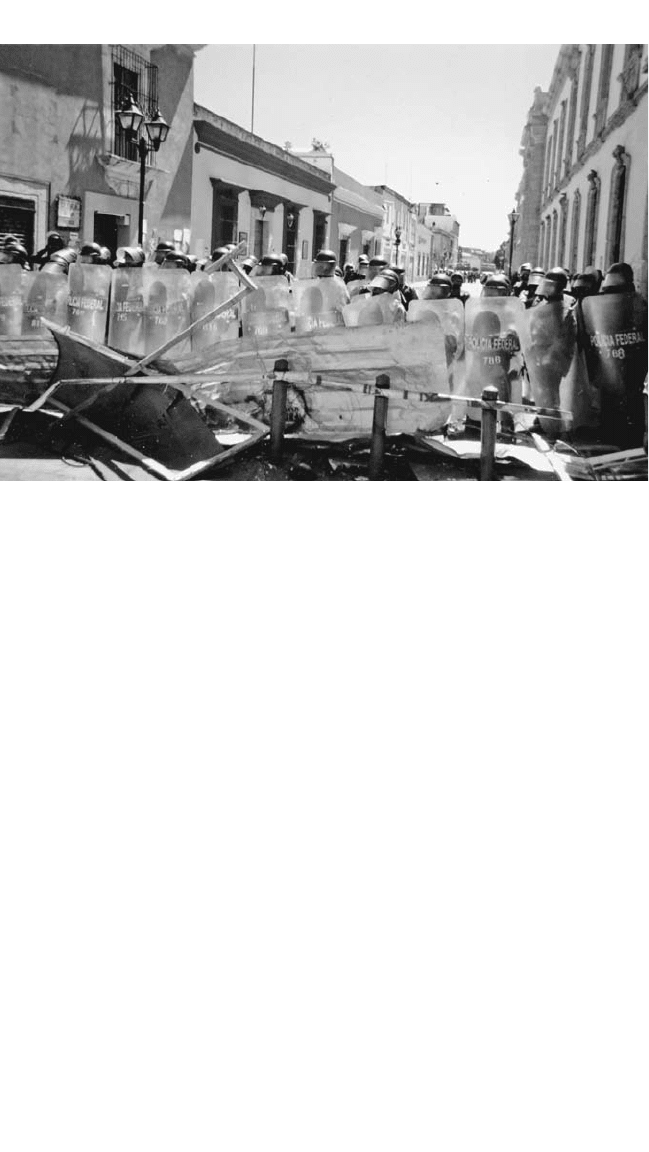
to pressures to resolve the problem before the end of his term. He sent in
federal police, who continued to occupy the city for months, enabling the
discredited governor to resume control. According to the new National
Commission of Human Rights, arbitrary arrests and torture were wide-
spread, and at least 18 individuals were killed during the protest.
Fox ended his presidency amid cries of human rights abuses and
repression from both Mexicans and international human rights organi-
zations, such as Amnesty International and the United Nations. In 2009
the Supreme Court agreed, ruling that the state had gravely violated the
rights of Mexicans in both Atenco and Oaxaca; the labor situation with
the miners’ union continued to fester.
A MORE DEMOCRATIC MEXICO
Federal Preventive Police occupy the state capital of Oaxaca, 2006. (Courtesy Michele Gibbs)

A BRIEF HISTORY OF MEXICO
254
The Fox Presidency
After six years in office, most believed Fox had been a better candidate
than president. He never provided the leadership to transform Mexico
and squandered the faith Mexicans had in the new democracy to such
an extent that 59 percent did not vote in the midterm elections. Both
political gridlock and a contraction in the U.S. economy severely
undermined his optimistic economic goals, with an actual loss of hun-
dreds of thousands of jobs and growth that averaged less than 2 percent
annually.
The corruption bonus disappeared too, taking the promised social
programs with it. The freedom of information laws and audits exposed
fraud and kickbacks during former president Zedillo’s bank bailout,
but Fox refused to take any corrective action. His own excesses were
revealed as well, from $9 million in illegal campaign contributions to
funds siphoned by his wife from the National Lottery for her personal
charity, not to mention suspicious tax write-offs for various corpora-
tions, including a waiver of $3.5 billion in taxes owed by Citibank from
its purchase of Banamex, Mexico’s largest bank. Practically bankrupt at
the beginning of his term, Fox nonetheless found the resources dur-
ing his presidency to pay for expensive homes and cars for his seven
children and stepchildren and for the luxurious upgrade of his own
ranch.
Politically, Fox never dismantled the PRI apparatus or exposed its
wrongdoings with sufficient diligence. Instead, the disgraced former
president Carlos Salinas de Gotari was permitted to return permanently
from exile; his brother Raúl Salinas, initially convicted of planning
his brother-in-law’s murder and charged with enriching himself at the
public expense, was released from prison on the grounds of insufficient
evidence. Fox never attacked the network of influence peddling but
instead seemed absorbed into it. Yet he institutionalized changes that
made government more transparent and accountable, changes that
would prove embarrassing not only to Fox but to politicians in all
branches of government.
Presidential Campaign 2006
The 2006 presidential campaign offered real political choices and the
possibility of a progressive government for the first time in decades.
From start to finish, the campaign was intense, engaging voter inter-
est and, occasionally, voter outrage. It pitted the soft-spoken, Harvard
educated Felipe Calderón Hinojosa of the PAN against the dynamic
A BRIEF HISTORY OF MEXICO

255
Andrés Manuel López Obrador, also known as AMLO (for his initials),
of the PRD and, as the vote would demonstrate, it pitted the wealthier
north against the poor southern states. From the northern state of
Michoacán, Calderón embraced the conservative agenda of privatiz-
ing energy resources, curtailing labor rights, and, like Fox, using free
trade to reduce poverty. On the other side, AMLO championed new
solutions to many of the problems that had plagued the Fox adminis-
tration, such as renegotiating the terms of NAFTA that most harmed
small farmers and investing in education and pension programs that
would reduce poverty. Calderón, chosen only after Fox’s preferred
candidate was forced to withdraw on charges of corruption, was not
well known. López Obrador was the prominent mayor of Mexico City,
admired for his personal frugality—he lived in a simple apartment in
Mexico City—as well as for his effective leadership. He had successfully
implemented a new pension program in the capital, as well as having
revived downtown Mexico City through joint public and private initia-
tives. When he left office in 2004 to run for the presidency, AMLO had
an 80 percent approval rating.
The PRI never gained momentum in the presidential election. The
selection of Roberto Madrazo, a member of the dinosaur wing that
represented the kind of government Mexicans had hoped to eradicate
in 2000, splintered the party into two factions in which one refused to
support the candidate. In fact, Madrazo suffered a terrible defeat by not
winning in a single state. Nonetheless, the PRI played a critical role
before the official campaign began. The PRI, desperate to regain the
presidency, and the PAN, determined to keep power, feared they could
never compete with the popularity of López Obrador. Before the official
selection of candidates, they plotted to disqualify AMLO by impeaching
him for a minor crime. The dirty politics ended with a judicial dismissal
of the complaint in 2004 but not before the tactic had outraged much
of the nation—1 million Mexicans gathered in the main plaza of the
capital to protest it—and threatened to tarnish Fox’s reputation as a
defender of democracy. Unfortunately, this episode was just the first
round of dirty politics that plagued the presidential campaign of 2006.
Calderón’s predictable platform could never have catapulted him
ahead of López Obrador. His ad campaign, however, did. It depicted
López Obrador, with his broad support from grassroots organizations
and the poor, as akin to the radical populist President Hugo Chávez
of Venezuela and a danger to the Mexican nation. These ads were
eventually forced off the air by the election commission as defamatory,
but not before they convinced some voters that López Obrador would
A MORE DEMOCRATIC MEXICO
A BRIEF HISTORY OF MEXICO
256
bring instability to Mexico. The PRD candidate also damaged his own
popularity through bad decisions, such as not participating in the first
televised debate. His absence was all the more notable for an empty
chair left on the stage throughout the debate. He appeared at the next
debate but the damage had been done. He held only a slight lead in the
final days of the election.
The election was a cliff-hanger. Both candidates declared victory.
The close vote required absolute public confidence in the election
commission’s integrity; unfortunately, it was discovered that several
million ballots had not been included in the preliminary count favor-
ing Calderón. Once counted, these ballots narrowed the vote to just
a .58 percent margin between the two. In an election in which almost
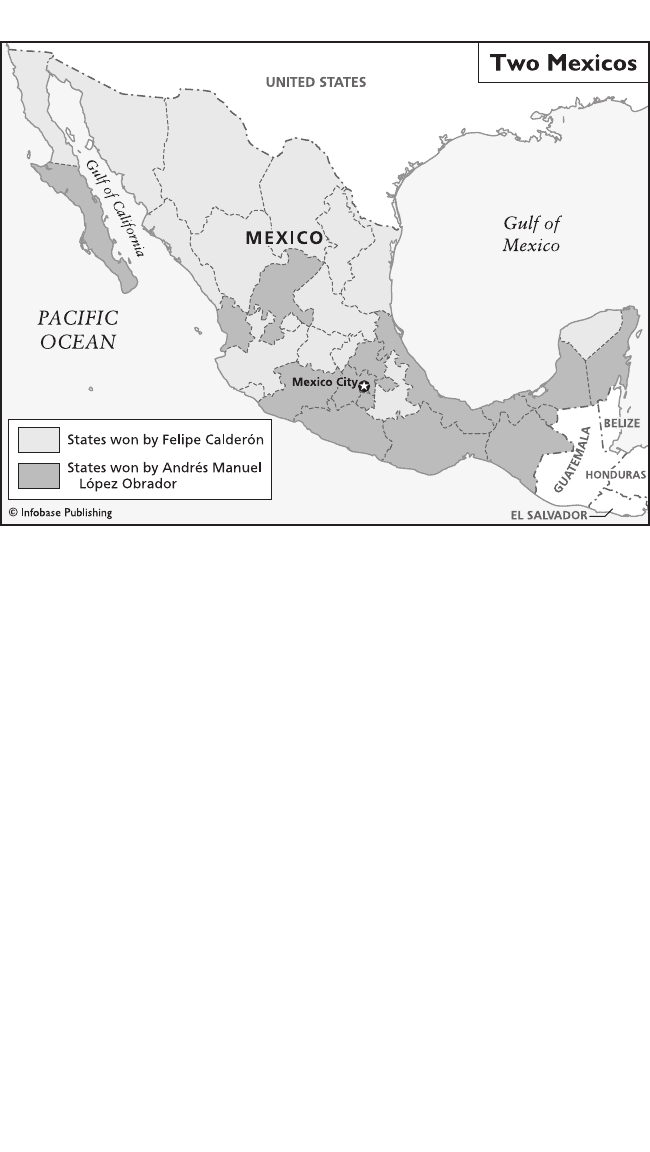
In the 2006 presidential election, the PAN candidate, Felipe Calderón, won 16 states, the PRD’s
Andrés Manuel López Obrador won 15 states plus the federal district of Mexico City, and the
PRI failed to win a single state. The vote divided Mexico into two geographic camps, with the
north voting for Calderón and the south for López Obrador. The wealthier northern states, with
their large, irrigated farms and manufacturing base, contrast so sharply with the subsistence
farms and indigenous culture of the southern states that the World Bank (2008,6) has called
them two worlds. The south includes the poorest states in Mexico, with inadequate educational
and social services and few job opportunities. While the average income in northern cities such
as Nuevo León can be more than $17,000, it is under $3,500 in rural states such as Oaxaca.
257
A MORE DEMOCRATIC MEXICO
42 million Mexicans cast their votes, Calderón had just over 243,934
more votes than López Obrador. AMLO called for a total recount
based on what he saw as evidence of fraud and, if not a recount, then
a new election, owing to the illegal campaign practices of the PAN.
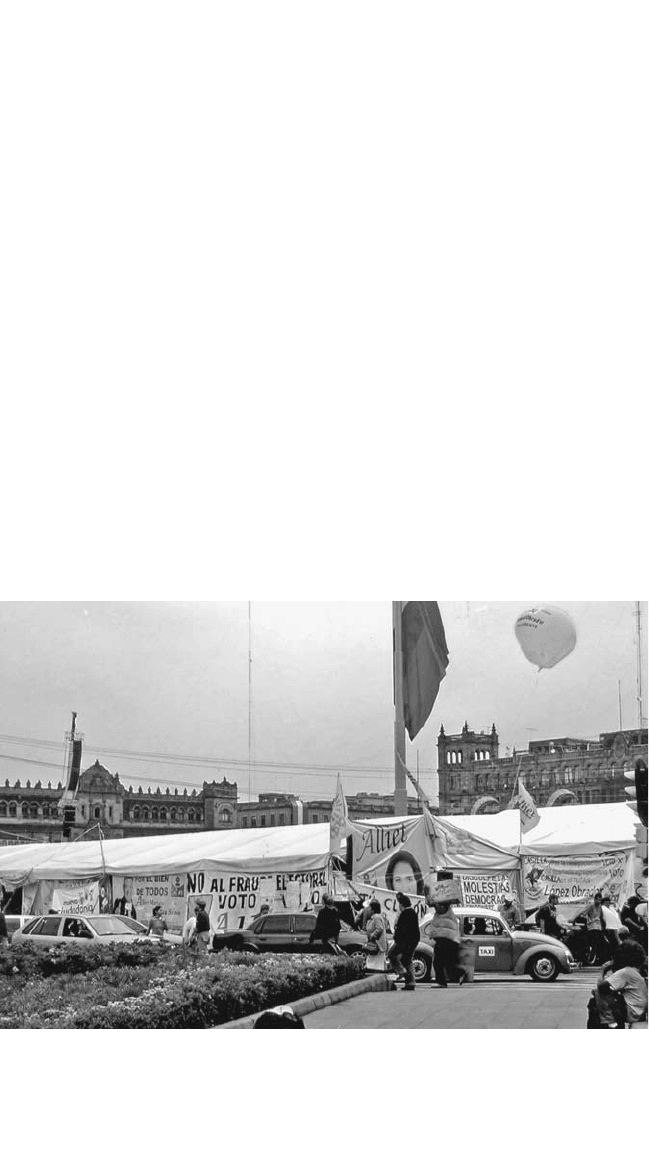
While the Federal Election Tribunal reviewed his requests, hundreds
of thousands of AMLO’s supporters occupied the main square and
streets of Mexico City to await the results. They would wait for more
than two months.
With their nation’s history of fraudulent elections, the majority of
Mexicans wanted a recount to dispel any doubts about the legitimacy
of the new president. When the tribunal ordered only 9 percent of the
ballots recounted, there was widespread disappointment. The tribunal
also ruled that the PAN had indeed risked the legitimacy of the election
with its tactics: Mexican law prohibits a president from campaigning,
yet Fox did; third party ads are illegal too, yet business organizations
paid $19 billion in such ads in support of the PAN. Nonetheless, the
tribunal claimed it could not decide whether these illegal methods were
responsible for Calderón’s narrow lead. The judges declared the elec-
tion legal and Felipe Calderón the winner.
Downtown Mexico City was transformed into an encampment of Andrés Manuel López
Obrador’s supporters during the deliberations of the election tribunal in 2006.
(Courtesy Diana
Ricci)