
Foster L.V. A Brief History of Mexico
Подождите немного. Документ загружается.


The drug war is only one example of an area of common interest
between Mexico and the United States. Equally important is the North
American Free Trade Agreement (NAFTA) that has intertwined the
economies of the two nations since 1991. NAFTA has also led to another
important exchange between the nations, as it contributed to a phenom-
enal increase in migration to the United States when it undermined the
survival of millions of subsistence farmers. In fact, migration and free
trade have created such profound cultural and economic links between
the two countries in the past decade that it has been given a special name:
“transnationalism.” Mexicans re-create their culture in communities in
the United States and bring their resources to bear on their homes in
Mexico. Some Mexican Americans even return to their villages to run for
political office; many others vote in local elections, bringing U.S. politi-
cal values with them. Unfortunately, these ties that have brought the two
nations closer have also caused hostility in the United States, where a
600-mile fence along the border neared completion in 2009.
Despite the increasing familiarity of Mexican culture in the United
States, Mexico remains something of an enigma to its neighbors north
of the border. Yet Mexico is vital to the United States, both as a good
neighbor and an economic partner. Knowledge of Mexico’s distinctive
heritage is indispensable for continued cooperation and understanding.
Fortunately for the reader, Mexican history is fascinating. It is rooted in a
sophisticated indigenous civilization that in its heyday built some of the
largest cities in the world. When the Spanish conquerors arrived, they
encountered a densely settled land, not the wilderness that marked much
of what is now known as the United States. The drama of Hernán Cortés’s
conquest ushered in three centuries of Spanish colonization as well as
the first hospital and university in the Americas. This early history laid
the foundation for modern Mexico, one that is predominantly mestizo,
a mixed race and culture of Indians and Spaniards. It is the formation of
this modern nation, with its revolutionary struggles against a legacy of
Spanish feudalism and its proud contribution of artists and Nobel laure-
ates, that holds the key to understanding the Mexico of today.
This history begins with the peopling of the Americas and gives
broad coverage to Mexico’s pre-Columbian civilizations that thrived
from at least 1200
b.c.e. until the Spanish conquest in 1519 c.e. Even
though much of this past is not recorded in writing and so is not techni-
cally “history,” it is integral to understanding contemporary indigenous
culture as well as Mexico’s pride in its unique past. It even clarifies pop-
ular political gestures and expenditures—such as President Calderón’s
support for current excavations in Mexico City that may lead to the lost
A BRIEF HISTORY OF MEXICO
x

tomb of the great Aztec emperor Ahuitzotl. So much progress has been
made in the last decades toward understanding the values and beliefs of
these ancient societies that a close examination is well rewarded.
This history also lingers over the early exchanges between the
Spaniards and Indians. Not only is it fascinating to examine the unex-
pected encounter of two civilizations, but the period is critical for the
future course of events in Mexico. The Spanish Empire left its mark in
language and art, in religion, politics, and the economy. When Mexico
gained its independence, it found itself without a political center
and with an economy and social system that would hold it back for
decades longer.
Mexico’s struggle for political stability and independence was not
achieved until the 20th century. It was a hard-fought effort that had to
overcome centuries of colonial occupation by Spain followed by nearly
a century of internal strife and regional factionalism. In the end, it
took the upheaval and devastation of the Revolution of 1910 to set it
on its modern course. These historic events defined Mexican national
identity, providing it not only with a modern constitutional government
but also heroes and icons that have made their way into school primers
as well as art and literature. In the 21st century, Mexico is undergoing
another revolution, the so-called democratic revolution that is opening
up its politics to vigorous dialogue and speeding the country along the
path of economic globalization.
Accounts of political and cultural events too often give a monolithic
and dehumanized impression of society. But many individuals do not
walk in step with the main course of political events, especially not
in a country of such regional and ethnic diversity. And many political
events have an unexpected impact on the fabric of society and the ecol-
ogy of the land. To provide more contrasts and a deeper understanding
of the variety of human responses to events, this history attempts to
elaborate various epochs with contemporary quotations and illustra-
tions of period art. It also provides asides in photo captions or boxed
“close-ups” about everything from religious icons to the sacredness of
corn, from the decipherment of ancient hieroglyphs to life in the capital
during a military coup.
The close-ups also are intended to amplify the unusual back-
grounds of some important individuals in politics. Just as often they
give voice to those who are not usually represented in the official
histories: a Spaniard preferring life in a Maya village to rejoining his
fellow conquistadors; a poet choosing the nunnery over the viceregal
court; a successful mulatto painter in a racist society. This history also
xi
INTRODUCTION

uses the close-ups to overcome a tendency in Mexican histories to
abandon the fate of the indigenous people a century after the Spanish
conquest. The Indians become numbing statistics about impoverished
peasants. Yet many native peoples (estimated to constitute 10 to 30
percent of the populace) have struggled to preserve to this day their
separate cultural identity and ancient traditions. Their growing resur-
gence captured world attention in the Zapatista uprising of 1994 and
forced an amendment to the Mexican constitution in 2001. A number
of the close-ups spotlight their diverse methods of survival. Others
follow the fortunes of some Mixtec Indians in Oaxaca through the
centuries after the conquest to their migration to the United States in
the 21st century.
As this fourth edition of A Brief History of Mexico is prepared for
press, presidents Calderón and Obama are making headlines as they
discuss solutions to their mutual problems of drug violence, migra-
tion, and trade. Within Mexico, the global financial crisis overshadows
the nation’s ongoing debate about poverty and development, and the
wave of drug violence undermines the nation’s discussion of human
rights and greater government accountability. But these problems have
also spurred Mexicans to participate more in their democracy, result-
ing in louder demands for more open institutions and greater govern-
ment investment in the economy to alleviate joblessness and poverty.
How President Calderón responds may decide the future direction of
Mexico’s fledgling democracy and its political stability. It is hoped that
this book, however brief, will shed light on the challenges Mexico faces
in creating a new political and social order for the 21st century.
A BRIEF HISTORY OF MEXICO
xii

1
1
The First Peoples:
Pre-Columbian Mexico
They had always known within themselves
the lengths of their days.
The moon, the year, the day, and the night,
The breath of life were fulfilled and they passed.
Maya Book of the Chilam Balam of Chumayel
(translated by Ralph Roys)
M
exico contains the ruins of more than 10,000 ancient cit-
ies dating from before the Spanish conquest. Some dominate
the countryside in sublime isolation; others are mostly obscured by
urban sprawl except for their too-grand-to-hide pyramids supporting
monumental 16th-century Spanish churches. Others have yet to be
discovered: new ones, some surprisingly large but in remote regions,
are found practically every year.
These ruins represent the great pre-Columbian civilizations that
flourished for 3,000 years. The earliest civilization, the Olmec, dates
to 1200
b.c.e.—around the time in which Egypt was ruled by the
dynasty of Ramses the Great but western Europe had yet to achieve
a civilization, much less produce a great ruler. Pre-Columbian cit-
ies ranked among the largest in the world: Teotihuacán, known for
its pyramids of the Sun and Moon that still stand outside modern
Mexico City (
see page 30), had a population of more than 200,000
in 600
c.e., a time in which the most populous city in the world,
Constantinople, had only 500,000 inhabitants. In the early 16th
century, the Aztec capital of Tenochtitlán was five times larger than
London. Although massive, Mexico’s great metropolises were con-
structed without pack animals and with only stone-age technology:

A BRIEF HISTORY OF MEXICO
2
obsidian (volcanic glass) and stone tools, not metal ones; wheels
were used, but for toys, not pulleys and carts.
The descendants of the people who built these pre-Columbian cities
live on in Mexico today, a country named after the ancient Mexica, the
Aztecs’ name for themselves. Mexico’s population is primarily mes-
tizo, or mixed Indian and European extraction, but at least 10 million
Mexicans are Indian—perhaps three times that number according to
more generous estimates. Mexico’s most traditional citizens preserve
the mythologies of their ancestors, farm the land for the maize and
beans that have sustained American Indians for thousands of years,
and speak the Nahuatl, Yucatec Mayan, and other languages of this pre-
Hispanic land. Their legends and artistic heritage are an integral part
of the national identity, inspiring modern artists and writers and infus-
ing every aspect of life from political rhetoric to haute cuisine, not to
mention the pyramid-shaped hotels at beach resorts, such as Cancún.
Their demands for indigenous rights are part of 21st-century politics.
No understanding of Mexico can be complete without an examination
of its prehistoric indigenous past.
Origins of the First Americans
The words of the song arrived
When there wasn’t heaven and earth
There, then, it was born . . .
Maya Book of the Chilam Balam of Chumayel
(translated by Peter Keeler)
In the 15th century when Europeans set out on their search for a sea
route to Asia, they expected to sail their way to the East Indies unim-
peded. Coming upon the land masses now known as the American con-
tinents, they assumed they had reached some islands off the coast of the
Indies and forever perpetuated their mistake by calling the people they
encountered “Indians.” They had sailed into an entirely new world, one
previously unknown to Europeans. Living in an age of romance novels,
they wondered whether they had stumbled upon the fabled lands of
Amazonian women and fountains of eternal youth.
Upon coming to Mexico, the Spaniards were awed by the sheer num-
ber of people in this unexpected land. In battle, as the Europeans soon
learned, these Americans were “demonic-looking” with their tattooed
3
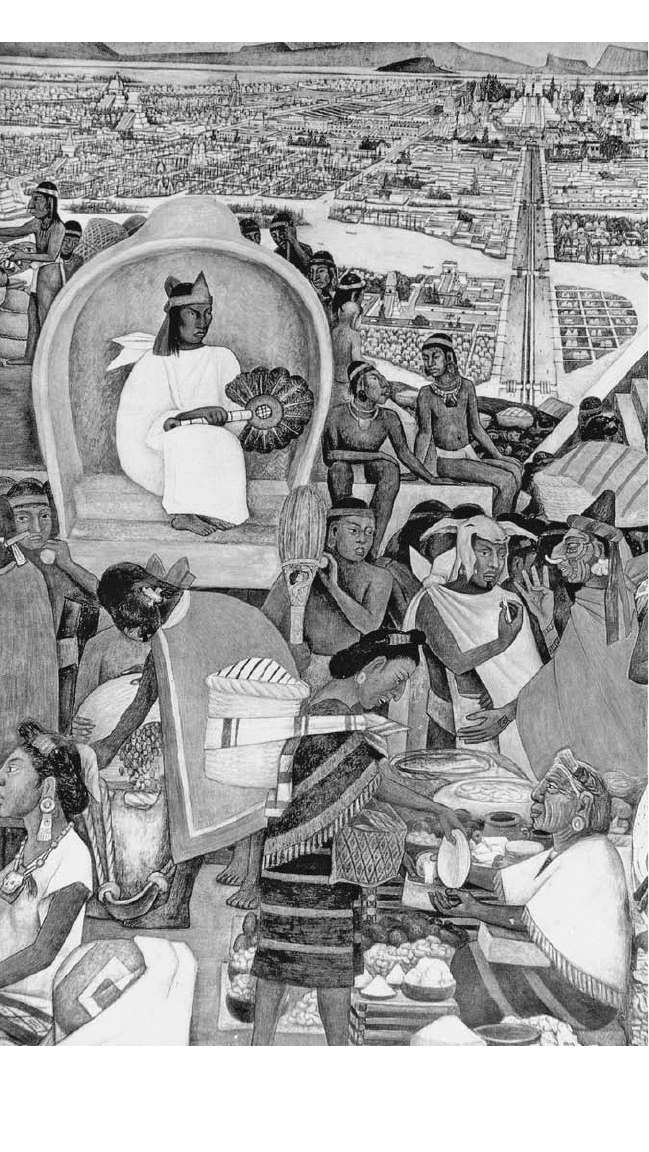
Mexico before the Conquest (1945), Diego Rivera’s mural of the Aztec capital Tenochtitlán,
in the National Palace, Mexico City
THE FIRST PEOPLES: PRE-COLUMBIAN MEXICO

A BRIEF HISTORY OF MEXICO
4
faces and jaguar capes. They marched to a cacophony of tortoise-shell
drums, conch-shell horns, and shrill whistles. The stone cities of pre-
Columbian Mexico were just as otherworldly: There was nothing so large
in 15th-century Spain. Some of the soldiers had traveled to Constantinople
and Rome, but even they never had seen anything like the Aztec capital of
Tenochtitlán. The Aztecs were equally perplexed by the Europeans, whom
they found terrifying with their clanging metal armor, snorting horses,
and snarling attack dogs.
The curiosity concerned more than appearances: Each wondered
about the origin of the other. The Aztec emperor Moctezuma was
uncertain whether the Spaniards were gods or humans. He ordered
all the archives in the land to be searched for paintings of creatures
such as these. Not one was found. While the foreign ships, described
by the Aztecs as floating mountains, were still anchored in the Gulf of
Mexico, he sent his prophets and wise men to the coast to observe the
strangers. These messengers carried two kinds of food to the ships to
see which would be eaten: the food of the gods, sprinkled with sacri-
ficial blood, was repulsive to the Europeans; they opted, instead, for
the tortillas, turkey, guavas, and avocados, revealing their humanity in
the process.
The conquistadores were curious, too. Christopher Columbus, like
Moctezuma, reflected on the nature of the people he first encountered.
Without a tortilla test, however, he decided the Americans were hom-
brecillos—almost, but not quite, humans. His compatriots in Europe
found such questions more compelling. The Catholic church, espe-
cially, needed to determine whether these were beings capable of salva-
tion. Once answering “yes,” a more perplexing issue remained: if all
humans descended from Adam and Eve, as taught by the Bible, how
did the Indians arrive in the New World? Even scientists would later be
forced to ask similar questions, because no pre–Homo sapiens skeletal
remains have ever been discovered in the New World. Who were these
previously unknown people? Survivors of Alexander’s shipwrecked
fleet? Descendants of legendary lost Atlantis? Egyptians?
Such questions, and some fantastic answers, would preoccupy
thinkers for centuries to come, often with a passion that is unimagi-
nable today. Some idly speculated free of any cumbersome evidence;
it mattered little, for example, that ancient Egypt possessed no seafar-
ing boats capable of reaching the Americas. Others studied illustrated
reports on the New World looking for clues as to the true identity of the
ancient people. Lord Kingsborough of Ireland, for instance, collected
and published at his own expense everything he could find about the

5
New World. He bankrupted himself and died in debtors’ prison without
ever proving his belief that the Indians were descendants of the Lost
Tribe of Israel. (Yet he did preserve a wealth of material for future schol-
ars, including copies of those precious few pre-Columbian books that
miraculously survived the devastation of the conquest.)
Gonzalo Guerrero
T
oday, the scientific view that the Americas were peopled by Ice
Age migrants from Asia has quieted most other speculation as
to the origins of the first Americans. Many remain fascinated, however,
by ideas of exotic, even extraterrestrial, cultural contacts with the
Americas. Such ideas about the origin of civilization certainly are more
dramatic than the reports archaeologists provide on the gradual evolu-
tion of native civilizations. Erich von Daniken’s Chariots of the Gods is
a case in point: he claimed that other planetary beings landed in the
Americas, bringing civilization with them. He just never explained why
the space age jets left behind only Stone Age tools.
The accidental shipwreck is often advanced as another means
of bringing advanced civilization to the New World. A critical ques-
tion seldom is asked by such theorists: how might strange-looking,
storm-lost seafarers be received? One answer is recorded in history.
In 1511, when Spain had yet to venture as far as Mexico, a hurricane
destroyed one of its ships on the way from Panama to the Dominican
Republic. Twenty men managed to grab on to a lifeboat. Just over half
survived two weeks without food and water before a current tossed
them onto the Mexican coast south of the modern resort of Cancún,
a region occupied then, as now, by Maya Indians. Five of these bearers
of European iron-age civilization were immediately killed in a sacrificial
rite, according to one of the two survivors, Jerónimo de Aguilar. The
others escaped from their pens and fled into the arms of more benign
Maya, who only enslaved them. Aguilar himself, rescued eight years later
by Hernán Cortés, lived as a servant within Maya society. The only
Spaniard to thrive was Gonzalo Guerrero who completely integrated
himself into Maya life, marrying a Maya noblewoman, tattooing his body,
and piercing his nose and lips with gold plugs. Unlike Aguilar, he refused
Cortés’s offer of escape. Maybe Guerrero made a European mark on
Maya civilization, but all that is recorded is his tactical advice on fighting
the Spaniards. He died on the battlefield with his fellow Maya.
The only indisputable legacy from the Old World left by the ship-
wreck survivors was smallpox.
THE FIRST PEOPLES: PRE-COLUMBIAN MEXICO

A BRIEF HISTORY OF MEXICO
6
Although some contemporary writers toy with ideas about strange
voyagers peopling and civilizing the Americas, scientists believe that
the first peoples in the Americas arrived by land and by sea in coast-
hu
gging canoes from northern Asia across what is now the Bering Strait.
Comparative studies of DNA support this view. During the Pleistocene,
or late Ice Age that began around 40,000
b.c.e., the sea level was reduced
by 300 feet, converting the strait into a 1,000-mile-wide land bridge con-
necting Siberia and Alaska. Many thousands of years before Alexander the
Great built his fleet in the fourth century
b.c.e., big-game hunters stalked
bisons and mammoths, some 13 feet in height, across the tundra of this
land bridge, and other nomads exploited the marine resources along its
coast. Exactly when they started arriving in the Americas remains uncer-
tain—some argue humans arrived during an earlier Ice Age, 100,000 years
ago. There is more convincing evidence for settlements from as early as
15,000 years ago along the Pacific coast of the Americas. However, the
first clear evidence of peoples in Mexico dates a few thousand years later
and is associated with a massive mammoth kill in the highland plateau
of central Mexico. The earliest known human skeletal remains in the
Americas may turn out to be from Mexico as well, but the dating of the
fossil bones called Eva of Naharon to 13,600 years ago is controversial.
If the dating proves correct, the 20-year-old Eva would belong to this
same period of big-game hunters. The first peoples, then, filtered into
the Americas from Asia in Paleolithic times, possibly continuing to arrive
until around 10,000
b.c.e., when melting glaciers submerged the land
bridge and isolated the American continents from the rest of the world.
The Land
The first known Mexicans were big-game hunters. Over the millennia,
the rainfalls and grasslands diminished; the hairy mammoths and giant
armadillos and Ice Age horses became extinct around 5000
b.c.e. Some
argue that overhunting from indiscriminate mass kills contributed to
their extinction. Humans survived, but out of necessity they evolved
into seminomadic hunters of deer, rabbit, and peccary; trappers of igua-
nas, turtles, shellfish, and birds; and gatherers of wild plants, roots, and
seeds. Then, around 3000
b.c.e. after maize (or corn) was domesticated
in Mexico, they became farmers.
By 2000
b.c.e. the first Mexicans—unlike their neighbors to the
north—had become sedentary villagers, relying on cultivated crops.
As surplus crops of corn, beans, chile peppers, and squash produced a
wealthier and more complex culture, the villagers changed from sub-
7
sistence survivors to citizens of the first American civilizations. The
cultures that evolved were unique to the New World—even the basic
foods were distinct from the wheat, barley, and rye of the Old World
civilizations. And these cultures were unusual in their independence
from outside influence: the nearest center of Old World civilization
was 7,000 miles away in China, a distance greater than from London to
Beijing and made more formidable by the barrier of the sea.
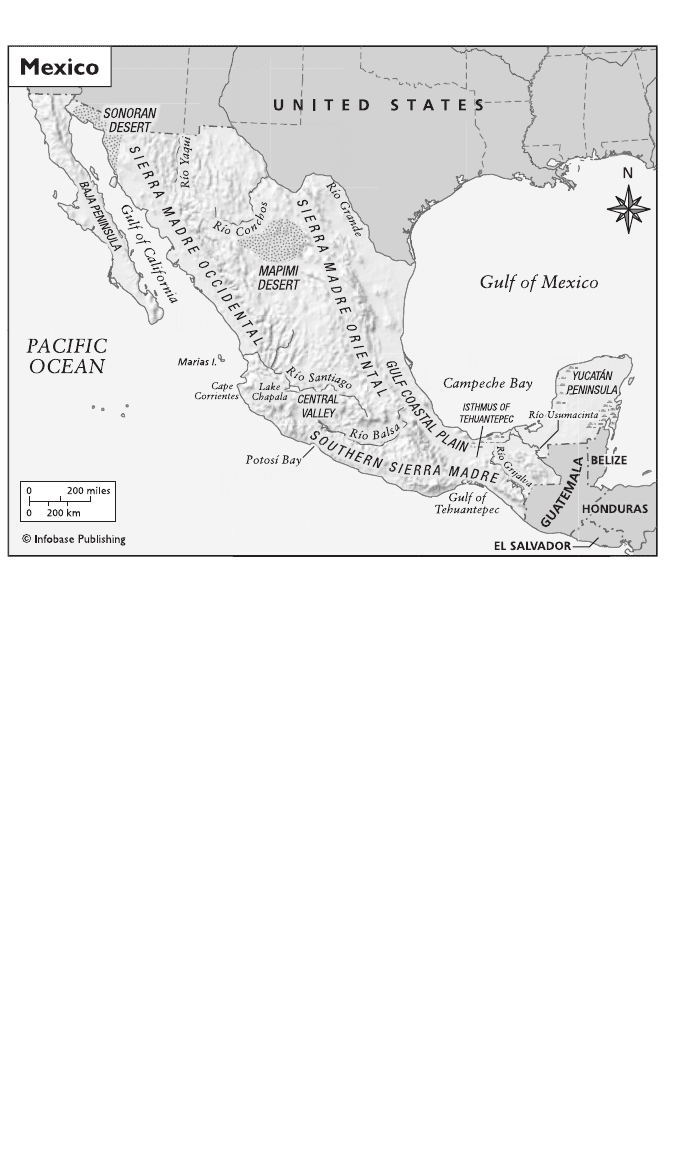
The land provided a richly diverse setting for the evolution of these
cultures. Most often pictured as the cactus desert of western movies,
Mexico also is the tropical rain forest of Chiapas with howler monkeys,
jaguars, and brilliantly colored macaws. It is a highland plateau domi-
nated by snowcapped volcanic peaks, like that of Orizaba (18,700 feet),
one of the three highest peaks in North America. It is the tangled green
tropical lands of the coasts and riverine lowlands, as well as the cool,
pine-forested regions of the Sierra Madre.
The mountainous land contrasts with its largest flat area, the Yucatán
peninsula, a limestone shelf barely above sea level. Other coastal low-
lands are found along the Gulf of Mexico and the Pacific Ocean. Not all
Mexico’s major topographic features
THE FIRST PEOPLES: PRE-COLUMBIAN MEXICO