
Foster L.V. A Brief History of Mexico
Подождите немного. Документ загружается.


A BRIEF HISTORY OF MEXICO
228
Resurgence of Native Traditions
I feel I am more Maya than ever . . . I have no desire to belong
to another culture.
Pedro Meza (Foxx 1987, 209)
The mestizo nation that was officially born with the Mexican Revolution
embodied the ideals of two traditions and two races merging into one
nation and one people. Racially, the desired mix was achieved in this
country where the nonmestizo categories are most accurately described
as “predominantly white” or “predominantly Indian.” Culturally, national
festivals, such as the Day of the Dead, incorporate pre-Hispanic ances-
tor worship into the very Catholic All Saints’ Day. Yet many Indians are
culturally distinct from mestizos; at least 10 million speak the language
of their pre-Columbian forebears. The “mestizo ideal” overlooked the
fact that these Mexicans cherish their pre-Columbian heritage and have
no desire to lose it through assimilation, especially into a society that
provides few opportunities for them.
In the most isolated villages indigenous groups continue to live in
the most traditional manner. Nahuas still calculate their corn plant-
ing according to ancient traditions of the cyclical New Year. A vestige
of an old solar calendar is still used in the Chiapas village of San Juan
Chamula. Pre-Hispanic myths pervade the contemporary religious
beliefs of the Mixtecs; Yucatec Maya sages, based on old myths, foretell
the day when their ancestors will rule once again. These Mexicans also
are among the poorest: as the millennium approached, they lived in
homes without sewers (72 percent) or running water (48 percent), and
their literacy rate (59 percent) was well below that for the nation as a
whole (90 percent).
In 1992, the 500th anniversary of Columbus’s voyage to the
Americas, indigenous peoples organized within Mexico and through-
out the hemisphere to present their concerns: they wanted the right to
preserve their cultures while achieving greater economic parity. One
result was an amendment to the Constitution of 1917: Mexico was
designated as a multiethnic, not mestizo, nation. The hoped-for by-
products are that schools will become more multilingual and native
cultures no longer will be treated as anachronisms in a mestizo world.
It would take the 1994 Zapatista armed uprising, however, to make
discrimination against Mexico’s first peoples illegal.
229
The Problems Overlooked
Salinas’s agenda, especially con-
cerning NAFTA, was not greeted
with equanimity by all Mexicans.
Intellectuals believed national sover-
eignty and mexicanidad were threat-
ened. Small businesses knew their
survival was at stake. Economists
predicted millions of jobs would
be lost in the first five years. Many
became concerned that their coun-
try was up for sale. When U.S. vice
president Al Gore defended NAFTA
to U.S. citizens in a televised debate, his remark that NAFTA was an
opportunity equivalent to the purchase of Alaska caused an uproar in
Mexico.
Under Salinas, modernization ignored the basic needs of the
citizenry and polarized Mexican society into the wealthy few and the
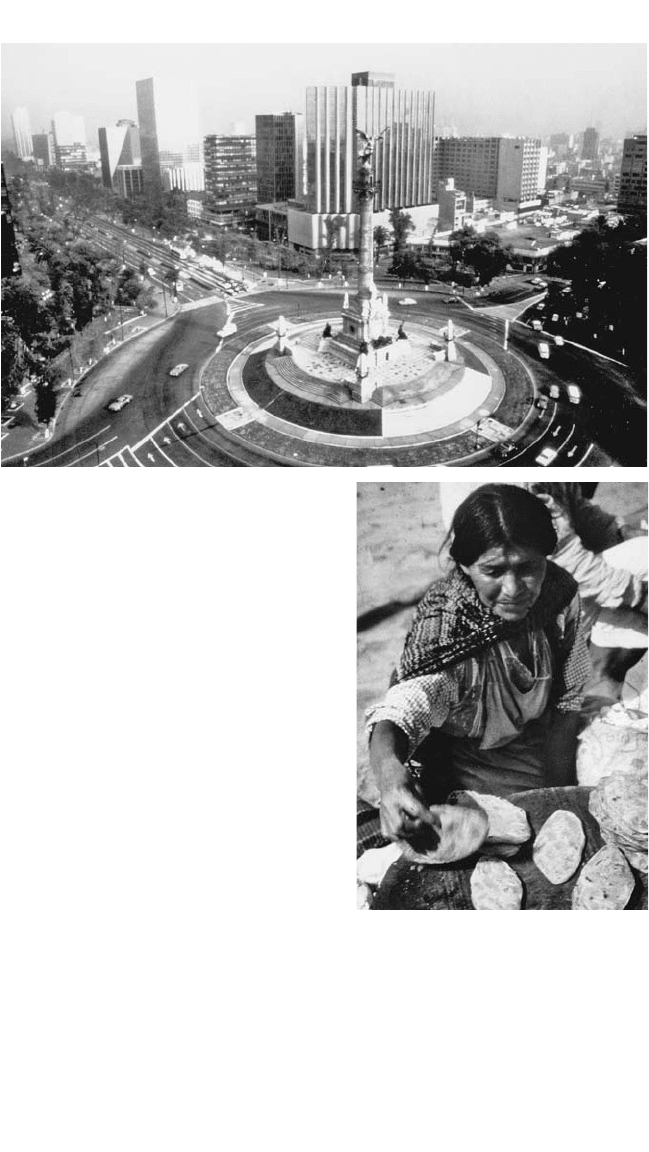
Two Mexicos: above, Mexico City skyscrapers;
below, a Mexico City street vendor making
tlacoyos, or flat corn-and-bean cakes
(Photos
courtesy of the Mexico Ministry of Tourism)
THE MARCH TOWARD DEMOCRACY

A BRIEF HISTORY OF MEXICO
230
increasingly poor masses. Hoping to impress global investors with the
strength and stability of the peso, Salinas overinflated it while hold-
ing down wages. To further expand the export-driven economy, he
thought low wages were essential. (Fifty-one percent of manufactured
exports were produced by maquiladoras, foreign businesses operating
with cheap Mexican labor in order to send competitively priced goods
into the United States.) The economy grew, but per capita income
never increased enough to make up for the losses caused by the reces-
sions during the 1980s. The purchasing power of the minimum wage
declined 66 percent from 1982. The now grossly inadequate minimum
wage, the lowest even among the more developed Latin American
countries, became such a political issue in the United States—yet not
for the PRI government—that NAFTA negotiations forced Salinas to
increase it. However, at the beginning of 1997 it was still under $3.50
a day. A full-time job at minimum wage equaled poverty.
More than wages were depressed. Salinas developed new social ser-
vices under his highly publicized solidarity program, yet the monies—
Overpopulation and
the Environment
F
amily-planning efforts reduced the birth rate from 3.5 percent in
1970 to 1.8 percent in 1995. Statistics on fertility rates for 2000
showed the average family dwindling to just over 2.5 children in con-
trast to seven in 1965. Nonetheless, Mexico’s population will continue
to grow, albeit more slowly. Already it is the 11th most populous nation
in the world. The car and industrial pollution in urban areas cannot
be missed by the naked eye; smog has become a major health hazard
requiring no-car days in the capital and the relocation of factories.
Demand has depleted the water table so much that Ciudad Juárez is
expected to run dry; in Mexico City the streets, built over the canals
and lagoons of the Aztec city, have sunk 35 feet. In the countryside,
overpopulation has forced families out of their communities in search
of new farm land, and deforestation of 1.5 million acres each year has
become a problem as potentially disastrous as it was to ancient Maya
civilization. In response, an entirely new government agency, SEDUE,
was created to prevent further disintegration of the environment, and
citizen activist groups sprang up to monitor its progress. By 2008, how-
ever, the rate of deforestation had doubled.

231
mostly from temporary reserves resulting from privatization—were
used selectively to neutralize opposition from both Cárdenas support-
ers and the “dinosaur” wing of the PRI. They did little to compensate
for the 10 percent cutbacks in social programs at a time when contin-
ued population growth meant the government could barely keep up
with the basic educational needs of the nation. For the first time in
their history, public universities considered ending their open-door
policy; primary schools required double shifts, but compensation was
not always available for the teachers. The social security system, too,
became overtaxed with state hospitals struggling to provide adequate
care. At charity hospitals, people with broken bones could wait for
weeks while the limited staff responded to more serious emergencies.
Overpopulation had also resulted in land conflicts in some of the most
indigenous, and poor, regions of Mexico. Little was done to resolve
the disputes between peasants and ranchers or even between peasant
and peasant.
Trouble: Zapatistas
Despite these undercurrents, Salinas remained genuinely popular
among the middle class and, of course, the elite. The president’s confi-
dence in his policies and the respect he received worldwide gave hope
to many Mexicans that an era of prosperity and development would
be theirs.
Then, on New Year’s Day 1994, the day NAFTA took effect, Mexico
was greeted by an armed uprising of 2,000 Maya Indians in the poor
southern state of Chiapas. Their leaders, faces covered with ski masks,
appeared in the world media saying that NAFTA was a death sen-
tence for Indians. Calling themselves the Zapatista Army of National
Liberation (EZLN), the Maya demanded land to farm and the return
of the constitutional provisions protecting their right to land. They
demanded greater democracy and the end to discrimination against
them. They wanted schools and medical care. Said Carlos Aguilar, a
Zapatista, “The peasants have awakened and realized that they had to
do something in order for them to listen to us. Now the whole world is
listening” (Holden: 1994).
Suddenly Salinas’s promise of a modern Mexico crashed against the
reality of a Mexico that had been completely ignored by the policies of two
successive conservative administrations. In Mexico’s indigenous states,
such as Chiapas, 70 percent of the population lived below the poverty
line. During the Salinas years extreme poverty increased by one-third.
THE MARCH TOWARD DEMOCRACY

A BRIEF HISTORY OF MEXICO
232
The army was sent in to restore order, but Mexicans, ashamed of the
abject poverty suffered by much of the peasant population, demanded
negotiations, not war. Salinas adeptly avoided political catastrophe by
unilaterally declaring a cease-fire. Negotiations began in earnest and
resulted in the San Andrés Accords of 1996, which recognized Zapatista
demands for indigenous rights. However, the government failed to sub-
mit the accords for congressional approval, and the conflict continued
to fester, occasionally erupting in violence against the Zapatistas.
Assassination
This shock was followed by another in Salinas’s final year in office.
His hand-appointed successor as the PRI presidential candidate, Luis
Donaldo Colosio, satisfied many who had misgivings about Salinas’s
economic policies. Colosio had a political background that made him
seem a progressive antidote to his two PRI predecessors: as minister of
social development he was well known for his commitment to social
programs; as an elected official, he was more attuned to the people than
the technocrats. No one doubted that Colosio would be elected without
the help of stuffed ballot boxes.
Despite democratic reforms and strengthened opposition parties, it
looked as if Salinas had created so much support for the PRI and its
new presidential candidate that the old political machine would once
again be victorious. To further prove the PRI’s commitment to an open
election, Salinas invited international observers to monitor the election
along with Mexican grassroots groups that had sprung up during the
earthquake of 1985, such as Civic Alliance.
Colosio, however, was assassinated in March 1994 while campaign-
ing in Tijuana. It was the first assassination of a presidential candidate
or president in the PRI’s history. Six months later, the PRI secretary
general, José Ruiz Massieu, was gunned down. The combination of
the Zapatista uprising and the political assassinations left Mexico pro-
foundly shaken.
President Ernesto Zedillo and Democratic Reforms
Unlike Colosio, the new candidate, Ernesto Zedillo, had never run
for office. A PRI technocrat with a doctorate in economics from Yale
University, Zedillo was politically awkward. The PRI won anyway,
buoyed on a wave of Colosio sympathy. Cuauhtémoc Cárdenas ran
again, but the PRI had done much to undermine the PRD; the left was
233
in disarray and Cárdenas’s campaign, lackluster. The PAN candidate,
Diego Fernández de Cevallos, more popular after Mexico’s historic first
televised presidential debate, seemed to stop campaigning at a critical
juncture—some claimed in collusion with the PRI. The PRI victory came
with a healthy margin, because many Mexicans feared the unknown that
would result from a PRI defeat. For the first time, they did not believe
their votes were mere protests and local elections proved them right:
the PAN racked up enough victories that by 1996 it represented about
one-third of the population in municipalities, state governments, and
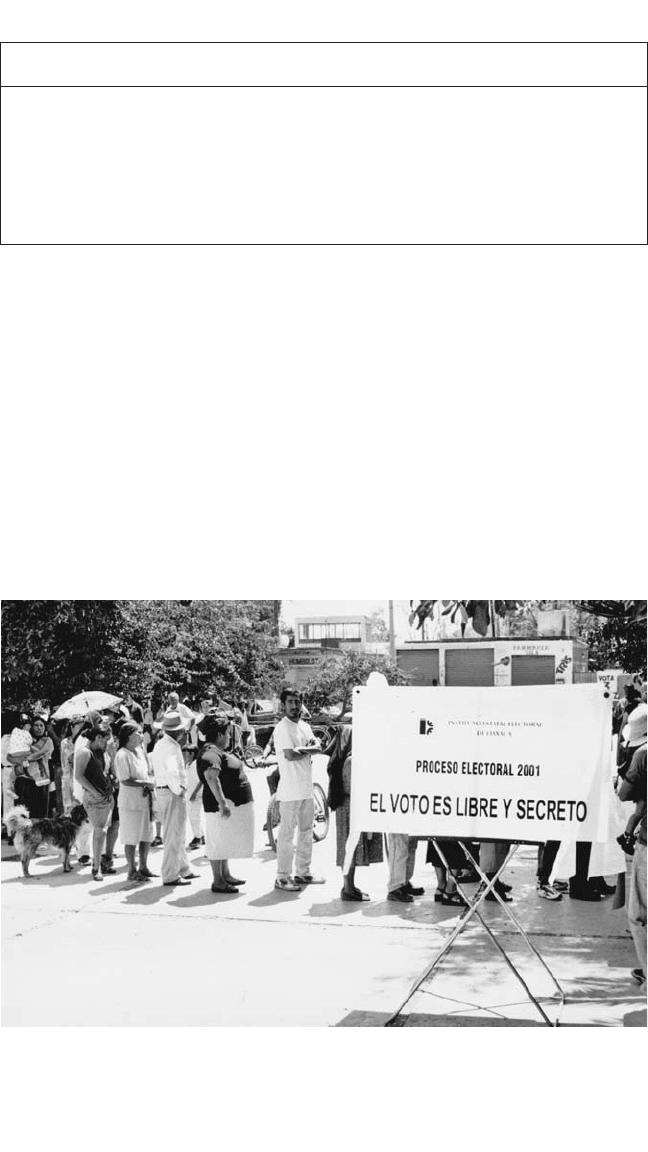
EI voto es libre y secreto (Your vote is free and secret). Election reforms, such as the secret ballot,
under President Ernesto Zedillo resulted in a greater number of Mexicans voting.
(Courtesy
Partido de Convergencia, Oaxaca, Mexico)
1997 Midterm Elections, by Party
PRI PAN PRD Other
Old seats 298 119 65 18
New seats 239 122 125 14
Source: Federal Elections Commission, Mexico City
THE MARCH TOWARD DEMOCRACY

A BRIEF HISTORY OF MEXICO
234
congressional delegations. These strides toward democracy culminated
in 1996 when all parties agreed on a constitutional restructuring of the
electoral process. Although the PRI “dinosaurs” continued their efforts
to weaken these reforms, the 1997 midterm elections demonstrated that
the PRI could no longer dictate who governed Mexico. For example,
Cuahtémoc Cárdenas overwhelmingly defeated the PRI candidate in the
mayoral election for Mexico City, the second most visible political office
in Mexico. Also, despite the fact that the PRI had the only nationwide
political machine, it lost majority control of the Chamber of Deputies for
the first time in its history. The new opposition Congress had the power
to force even more electoral reforms on the PRI government in time for
the presidential election in 2000.
La Crisis
While democracy made considerable advances under Zedillo, the
economy almost collapsed. The fledgling president was immediately
confronted with a fiscal crisis. Salinas, campaigning for the position of
director of the World Trade Organization, had not seen fit to manage
what would be a very unpopular devaluation of the peso. He left the
A Mixtec Success Story
E
roded land and population pressures sent Isác López to Mexico
City from the Sierra Mixteca as a young boy. Living with relatives
in Ciudad Nezahualcóyotl, he attended school and, to contribute to
the family’s needs, sold chiclets on the public buses in the afternoon.
While the rest of his family continued to struggle to make ends meet,
they contributed what they could so that Isác could become a certified
public accountant. For 15 years, Isác worked for major corporations
in Mexico, such as Salinas y Rochas and Sheraton. In the 1990s, when
interest rates had fallen under Salinas, he qualified for a mortgage on a
new, two-story house in the resort of Huatulco, where he worked. With
the crisis of 1995, the interest on his mortgage went from 24 to 100
percent. But Isác was one of the lucky ones during la crisis: he managed
to hold on to his job and his house. The interest payments, however,
affected the well-being not only of his immediate family, but also of his
extended family who relied on him in times of trouble. In 1996, interest
rates finally fell below 30 percent.

235
dirty work to the new president, who had not yet earned the confidence
of foreign financial markets. It was mishandled: the Mexico peso went
into a downward spin, and the nation was catapulted into its fourth
recession since 1982 and its worst since the Revolution. It took an
emergency bailout loan from the United States, with Mexican oil as
collateral, to prevent complete collapse of the peso.
By mid-1996 there were signs of a fragile recovery, but Mexico was
suffering still. Two million jobs and thousands of small businesses had
been lost. To avoid a complete collapse of the currency, interest rates
had been quadrupled, and the price of gasoline and utilities had been
increased, as had the value-added tax. The cost of food increased as
Zedillo eliminated subsidies for basic foods including tortillas. By 1997
Mexico City workers needed to labor almost twice as long (50 minutes)
as in 1994 (27 minutes) to purchase a loaf of bread. Half the Mexican
population was estimated to be living in poverty. The devastated middle
class was angry: it was government lies and ineptitude that had done
this to them. Salinas’s popularity plummeted with the peso, as did
world confidence in Mexican markets. Crime soared, as did migration
to the United States: the average number of Mexicans establishing per-
manent residence in the United States during the 1990s rose to 227,000
annually, 10 times greater than during the 1960s.
Oil and NAFTA
In 1998 the world economy was rocked by the Asian crisis, and oil
prices started to plummet, threatening yet another fiscal crisis for
Mexico. Although oil contributed only 12 percent to Mexico’s export
income, in contrast to a peak of 80 percent in 1982, taxes on PEMEX,
the government monopoly, constituted 39 percent of the federal budget.
Zedillo ruthlessly cut government programs in order to avoid deficits
and a drop in the value of the peso. Further cuts were not needed, how-
ever, when his government used its position as the fifth largest producer
of crude oil to organize a new cartel that included the OPEC nations
along with Norway: oil prices rose.
Driven by NAFTA and Zedillo’s fiscal austerity, Mexico’s economy
finally turned the corner, ringing up 7 percent growth in the GDP
in 1998 alone. Exports to the United States grew from $60 billion in
1995 to $100 billion four years later. These exports demonstrated a
new diversity: in addition to oil, machinery, clothing, fresh produce,
glass, and electronic parts. In fact, manufacturing outstripped oil in
importance and Mexico edged on China’s position as the largest single
THE MARCH TOWARD DEMOCRACY

A BRIEF HISTORY OF MEXICO
236
exporter of textiles. Inflation decreased dramatically, encouraging
foreign investment that averaged about $11 billion annually and was
increasing at the end of Zedillo’s term. More than 3 million new jobs
were created during his term. They were not enough to keep up with
population growth, but the jobless rate was reduced and consumer
spending increased. There were grounds for optimism.
Corruption
At the time of Colosio’s assassination, rumors were rampant about the
PRI’s possible involvement. With Ruiz Massieu’s assassination, they
became even more convoluted. The “dinosaurs” did it, some thought, in
an attempt to end the liberalizing policies of Salinas. Salinas did it, others
thought, because he wanted to run for a second term: his popularity was
so great that some thought he could successfully amend the constitution,
especially during a time of such crisis. Drug kingpins did it, others specu-
lated, because they were being pursued by PRI prosecutors. As extraor-
dinary as all these accusations seemed, they were widely held by the
Mexican populace and press and were fanned into greater credibility by
the television soap operas in which Salinas look-alikes played assassins.
More seriously, however, these speculations remained credible because
the government failed to resolve the murders. In the incomplete pro-
cess of untangling them, astonishing levels of corruption were revealed.
Initially Ruiz Massieu’s brother was appointed by Salinas to investigate
the deaths, but he resigned in protest, saying political pressures from
high within the PRI prevented an honest investigation. Once Zedillo took
office he encouraged confidence in his administration by appointing an
attorney general from outside the PRI. Soon thereafter Zedillo daringly
permitted the arrest and imprisonment of Salinas’s brother, Raúl, for col-
lusion in the murder of Ruiz Massieu, his own brother-in-law.
The arrest of Raúl Salinas led to a series of revelations that even the
most cynical Mexican would have thought impossible. After Salinas’s
Wages and Inflation
1995 1997 1998
Inflation 52% 17% 14%
Minimum wage –20% –17% 14%
237
arrest, the former attorney general Ruiz Massieu—hired to find his
brother’s murderer—fled the country and was arrested at a U.S. airport
carrying a suitcase that contained large amounts of undeclared cash.
Then, he was discovered to have millions of dollars in U.S. banks.
Corruption was revealed to have touched everything, from the way
tortillas are made to the sale of state-owned agencies, from protection
of drug kingpins to murder. Corruption was always known to exist, but
the Salinas scandal demonstrated a shocking degree of violence, even
in regard to one’s own family, and a scale of personal enrichment that
made a farce of the PRI. The once popular Carlos Salinas was forced to
join Hernán Cortés and Porfirio Díaz as among the most reviled figures
in Mexican history. He sensibly sneaked out of Mexico; in 1997, he was
living comfortably in Ireland, a country without an extradition treaty
with Mexico.
Zedillo himself was tainted with PRI-style corruption when he pro-
posed a bailout of failing banks in 1995. There was little doubt that the
economic crisis had left many banks with a massive number of unpaid
loans, but an independent audit discovered that much of the insolvency
was due to fraud and political payoffs. In addition, the United States
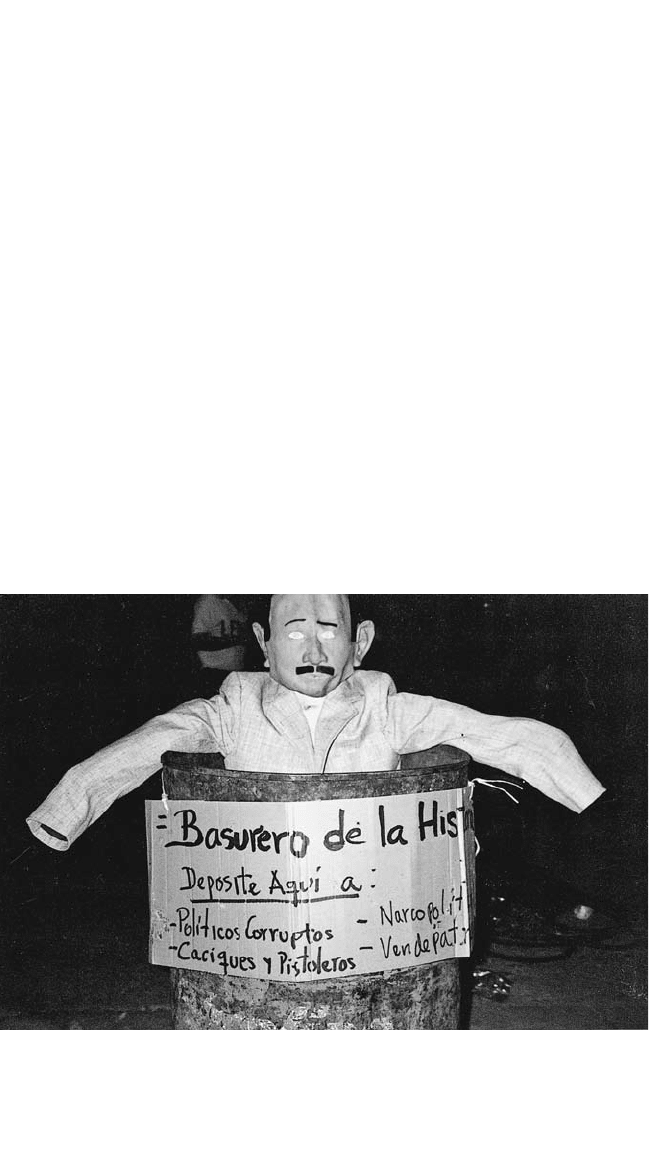
A garbage can in Mexico City stuffed with an effigy of Carlos Salinas de Gortari. The sign says,
in part: “Trash can of history: Deposit corrupt politicians and narcopoliticians here.”
(Courtesy
Diana Ricci)
THE MARCH TOWARD DEMOCRACY