
Foster L.V. A Brief History of Mexico
Подождите немного. Документ загружается.


A BRIEF HISTORY OF MEXICO
238
in an undercover sting operation implicated some of Mexico’s largest
financial institutions for drug money laundering. One banker confessed
to paying $25 million to the PRI for unspecified favors. Zedillo did not
reveal the extraordinary cost of the bailout, nor did he fully answer
allegations that he had received $5 million in donations from the banks
for his 1994 campaign.
Drugs and Politics
The amount of money that was discovered to have been squirreled
out of the country was so great that outraged Mexicans believed
corruption had bankrupted their nation. Not surprisingly, they felt
personally robbed. Raúl Salinas alone had an estimated $300 mil-
lion in European banks. He was charged with the additional crime
of illicit enrichment, his government salary having been $190,000.
Evidence mounted that kickbacks and favoritism were involved in the
sale of government businesses. Many of the government plums went
to members of Salinas’s campaign finance committee; the number of
Mexican billionaires soared from two to 24. Even given the privatiza-
tion scandals, the stupendous prices offered, say for a television chan-
nel, were well above market value. The amount of capital involved led
some of the more serious Mexican political scientists to conclude that
drug money was welcomed by the Salinas administration. This too,
shocked Mexico.
Zedillo and the Military
Zedillo inherited the Salinas scandals, the Zapatista uprising, and the
economic crisis, but as each unfurled during his term, they sparked
other unsettling events. There were sporadic guerrilla outbreaks in 1996
by a group calling itself the People’s Revolutionary Army (EPR), for
example. The group was not a significant threat, yet its existence added
to the general bewilderment: no one was certain whether these violent
outbursts were staged by PRI dinosaurs, impoverished campesinos,
or drug dealers. Mexicans were further unsettled by the rising rate
of crime, much of it drug related and all of it seemingly unstoppable:
drive-by assassinations became common in border cities and kidnap-
ping gangs terrorized Mexico City. Some crimes were surprisingly
audacious—in 1999, for example, robbers stole a military payroll from
Zedillo’s elite guard just two blocks from the presidential palace—and
corrupt police were often implicated. Zedillo responded to the EPR, the

239
Zapatistas, drug trafficking, crime, and any and all threats to security by
relying on the army. He even appointed a military commander as chief
of police in Mexico City—an act quickly reversed by Cárdenas when he
became mayor. Unfortunately, little was accomplished by this reliance
on the secretive military in civic affairs. And concerns about the pos-
sible corruption of military commanders by drug lords would turn out
to be completely justified.
Mexico at the Millennium
Mexico reeled during the 1990s. During the 1994 election, pundits pre-
dicted either civil war or repression. Neither happened. During la crisis,
they predicted a social explosion, and once again they were proven
wrong. As the millennium approached, Zedillo appeared to have done
much to put the country back on track.
His establishment of an autonomous central bank to control inflation
and his tight fiscal policies regained investor confidence. In the last two
years of his term, the economy was among the fastest growing in the
world. Modern Mexico had survived its worst economic crisis without
massive social upheaval. The PRI government, too, seemed to have
learned its lesson from the Tlatelolco massacre of 1968 and avoided
overreacting to protests: confronted with a disruptive 10-month-long
student strike at the UNAM, Zedillo avoided violence by sending the
police into the campus with only shields and batons and accompanied
by human rights observers.
Social and Human Development
1990 2001
Literacy 82% 91%
Average schooling 5.2 years 7.2 years
Life expectancy 67 years 73 years
Infant mortality under five years 46 per 1,000 29 per 1,000
Per capita wealth $2,180 $4,460
Wealth held by upper 20% 53% 57%
Although wealth was increasingly concentrated in a small percentage of the population, Mexico
improved the basic health and education of its people during the 1990s.
THE MARCH TOWARD DEMOCRACY

A BRIEF HISTORY OF MEXICO
240
Despite continued progress in human and social development, much
remained to be done to improve the welfare of the majority of Mexicans.
Zedillo’s bailout of the banks eventually cost taxpayers $120 billion at a
time when educational and health resources were dwindling. By 2002
the social security system would face bankruptcy. NAFTA had exploited
cheap Mexican labor, and government policies had kept wages low, so
low that Mexican manufacturing workers in 1996 earned only 8 percent
of their U.S. counterparts, in contrast to 22 percent in 1980. Mexico
City workers were among the lowest-paid urban workers in the world.
Many Mexicans could survive only by migrating; an estimated 6 million
undocumented adults were working in the United States by 2000.
As the millennium approached, the presidential election of 2000 was
foremost on everyone’s mind. Mexicans seemed ready to shed the cor-
rupt and autocratic PRI government, but were Zedillo’s reforms enough
to guarantee a truly democratic election? There was a much freer press,
one willing to challenge the traditional authorities; an independent
electoral commission had been established. Grassroots movements
were increasingly tolerated: Civic Alliance had created a “corruption
watch” in which participating citizens adopted a politician to monitor.
With the death in 1997 of the PRI’s labor leader Fidel Velázquez, splin-
ter unions became stronger and more independent of the PRI. Politics
had become more complex; the citizenry, more engaged. Yet the most
important question remained: Would the PRI accept defeat?

241
12
A More Democratic
Mexico (2000–2009)
The citizen’s hour has come.
President Vincente Fox, 2005
We now have a chance of going from authoritarianism
to something that I hope is going to be democracy.
Lorenzo Meyer, historian, 1999
O
n July 2, 2000, Vicente Fox Quesada was elected president of
Mexico, the first in 71 years who was not a member of the PRI.
The electoral process was transparently clean and democratic. As
outgoing president Ernesto Zedillo graciously conceded Fox’s victory
to the nation, Mexicans spontaneously crowded into town squares
throughout the republic to celebrate. In the weeks and months follow-
ing, politicians from the various parties united to guarantee that the
transition to a democratic government would not upset Mexico’s politi-
cal and economic stability. And it did not. The PRI dinosaurs cried foul,
fought among themselves, and maligned Zedillo as a traitor. In the end,
the truth was self-evident: PRI had been defeated. The independent
Federal Elections Commission reviewed and certified the results. Fox
had won. The victory was Mexico’s.
The elections of 2000 ushered in democracy. Mexico not only
became a government of shared power but also a more open nation.
Today, the media are more critical. Strong grassroots organizations have
proliferated and pushed their various agendas to the forefront of politi-
cal affairs, quite often in ways authorities do not wish. Labor unions
A BRIEF HISTORY OF MEXICO
242
have multiplied, and although some of the largest remain co-opted by
the government, more independent ones have become savvy in the art
of protest.
Yet much remains to be done. Clean elections alone cannot remedy
institutionalized corruption, a weak judiciary, drug violence, or the
chasm between rich and poor. As the solutions to these complex prob-
lems are yet to be found, some voices have become more strident, grow-
ing into social movements that test the new democracy’s commitment
to human rights and its tolerance for change.
The 2000 Campaign
The opposition parties had been so determined to end the PRI’s one-
party domination of presidential politics that they considered uniting
behind one candidate to defeat the PRI’s Francisco Labastida Ochoa.
In the 1997 contests where the parties had formed such alliances, the
PRI had been defeated, yet the PAN and the PRD represented oppo-
site ends of the Mexican political spectrum. The PAN’s probusiness
platform, for example, recommended constitutional amendments to
privatize the energy sector and to eliminate labor protections such as
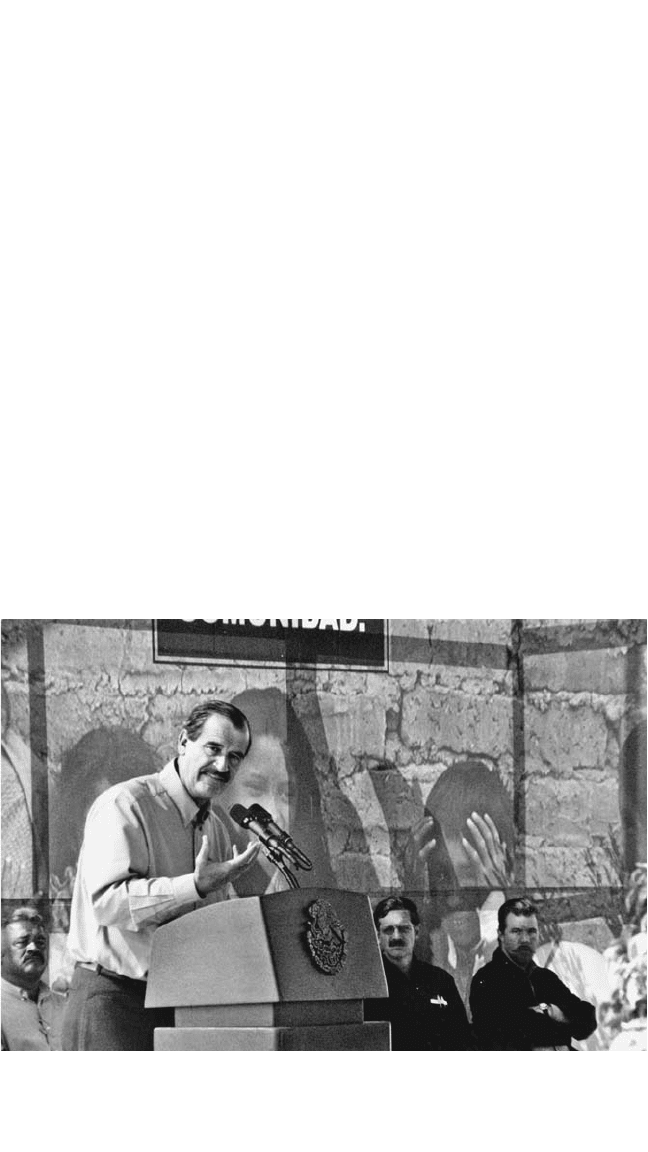
PAN candidate Vicente Fox Quesada campaigning for the presidency in 2000 (Courtesy Jorge
Luis Plata)

243
the eight-hour day and the right to strike. And the PAN saw no rea-
son for the strict separation of church and state. These positions were
anathema to the PRD.
Not too surprisingly, the two parties could not agree on a candi-
date. The conservative PAN selected Vicente Fox, a former Coca-Cola
executive and dynamic politician with a populist appeal. The PRD,
allied with other progressive parties, relied on Cuauhtémoc Cárdenas
once again. Although the two opposition parties fielded different
candidates, some prominent members of the PRD joined an alliance
behind Fox, who by the spring of 2000 looked increasingly like a
winner. His maverick charm complemented by cowboy boots and
an undoctrinaire attitude toward the PAN agenda gave him an early
lead in opinion polls. He gained further popularity after the widely
watched debates on television. For an increasing number of Mexicans,
defeating the PRI became the priority, and they came to believe that
Fox, with his promises to protect human rights and end corruption,
was the candidate to do it. These advocates of the “useful vote” argued
that the rest of the political agenda could be debated later.
The PRI selected Labastida, a candidate who first had to heal the
divisions in his party between the Zedillo technocrats and the tradi-
tional politicians. He appealed to the technocrats by promising to rein
in deficits, but at the same time he promised to improve the standard
of living of most Mexicans by government spending, something the
dinosaurs had long thought needed to be done. He promised afford-
able housing and crop and farm machine subsidies to appeal to the
rural base of the PRI. However, in case that was not enough to gain
victory, the PRI candidate played on citizen’s fears by suggesting the
nation would be destabilized without one-party government. The PRI
still had enough resources to pull out all the stops for votes. (Indeed
the party was later investigated for embezzling more than $100 mil-
lion from the government-owned PEMEX.) In Yucatán, voters were
given free refrigerators; in rural areas, government largesse was at
its most generous with groceries delivered to poor homes as well as
checks for schooling.
The Democratic Victory
Most young, urban Mexicans found the PRI’s continued domination of
politics an embarrassment to their country. They wanted a democratic
and more modern Mexico, and they voted overwhelmingly for change.
With 75 percent of the population urban and 50 percent under 35
A MORE DEMOCRATIC MEXICO

A BRIEF HISTORY OF MEXICO
244
years old, their votes determined the outcome on July 2, 2000. A new
group of voters also turned out: Mexicans living in the United States
were permitted to vote for the first time, but not by absentee ballot.
Sensing their vote might be critical, thousands traveled by truck and
bus, some for as long as 23 hours, to vote at special precincts estab-
lished just across the border. Zedillo’s electoral reforms, implemented
against the desire of many in his own party, allowed everyone’s vote
to count. His own premature announcement that Fox was the likely
victor prevented any attempts at fraud. Democracy was the victor.
The Open Mexico
During the first years of the Fox presidency, Mexicans embraced their
new government and reveled in its openness. The press, no longer
subsidized by the PRI government, had never been freer—or more
mocking of the establishment. One of the most popular journalists
was Brozo the Creepy Clown, the TV persona of Victor Trujillo, who
read the TV news each morning in a green wig and painted face. A
newly established human rights commission reported to the nation on
abuses, criticizing the government in the process. Freedom of informa-
tion laws, passed by Congress, made the government more transparent.
Commissions were established to investigate campaign finance abuses,
and independent auditors routinely checked government accounts for
fraud. These institutionalized checks on the government proved to be
some of the most enduring reforms of the Fox era.
Presidential Election Results in 2000, by Party
PAN PRI PRD OTHERS
President 42.5% 36.1% 16.6% 4.7%
Senate 46 seats 60 seats 15 seats 7 seats
Chamber of Deputies 207 seats 211 seats 50 seats 32 seats
State Governors 7 19 5 1
The PRI lost both the presidency and its majority in the Senate, yet it maintained a plurality
in the Congress. By forming coalitions with the PRD, it was quite capable of blocking any leg-
islative initiative by the PAN. As the goodwill of the historic election faded, President Vicente
Fox found he could not control the Congress enough to get any major initiative enacted.
Source: Federal Election Commission, Mexico City

245
In 2002 the Supreme Court felt free to order the president to inves-
tigate some of the most sensitive scandals of previous administrations.
The investigation revealed the government’s shameful role in the
Tlatelolco massacre of 1968 and the military’s kidnapping and torture
of citizens in the guerra sucia (dirty war) during the 1970s. And the first
military trial in Mexico’s history convicted two generals of collaborating
with drug traffickers. However, human rights violations persisted. The
police were believed to have a role in the horrible unresolved murders
since 1993 of more than 600 young women along the border around
Ciudad Juárez, but they were never prosecuted by the Fox government,
despite intense international pressure. Digna Ochoa, a high-profile
human rights lawyer who criticized the military, died suspiciously in
2001. Many believed the extremely secretive military should be subject
to civilian review, but not Fox. In fact, as his term progressed, he exhib-
ited less and less enthusiasm for structural reforms and human rights
investigations, disappointing Mexicans who had expected more public
accountability of past abuses by the PRI—not to mention the preven-
tion of future violations.
The Zapatista March
Few events better demonstrate the new political openness in Mexico at
the beginning of Fox’s term than his initiatives on the still-unresolved
Zapatista conflict. And few better exemplify the political stalemate
that repeatedly occurred in Congress during his presidency. Fox’s first
official act was to submit the San Andrés Accords of 1996 to Congress
in support of a constitutional amendment for indigenous rights and
autonomy. As a goodwill gesture for reopening the peace process, he
released Zapatista prisoners and removed Mexican army units from
Chiapas. Subcomandante Marcos, spokesman for the Zapatistas, refused
to negotiate, however, until the five-year-old San Andrés Accords
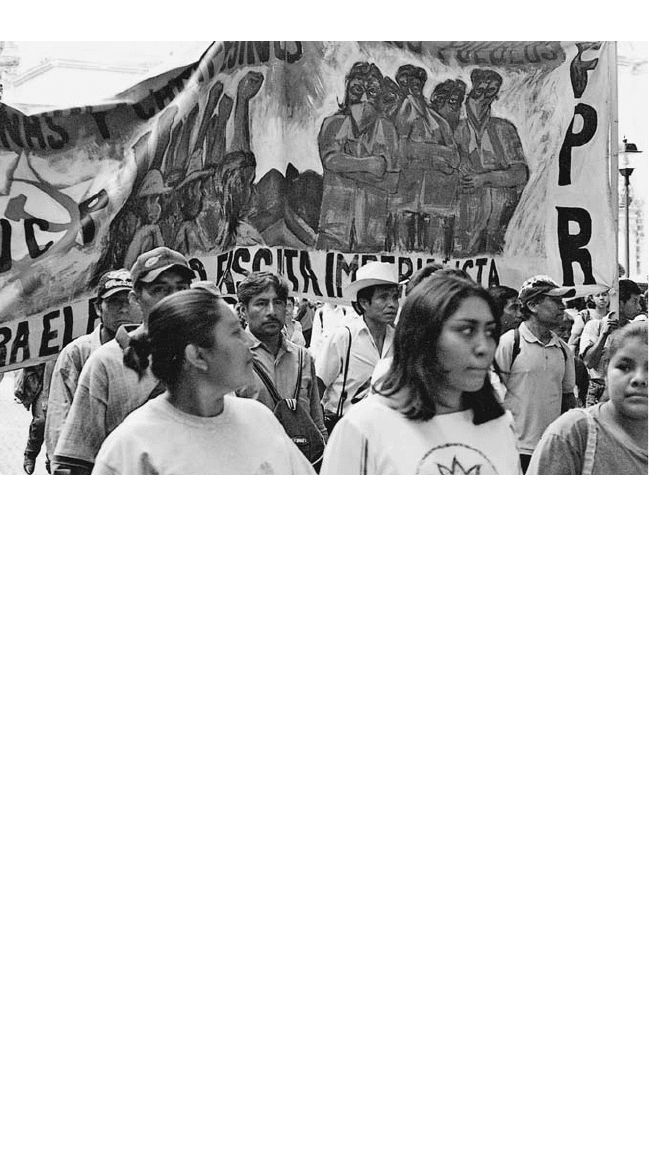
were enacted into law. To promote their passage, Marcos organized a
Zapatista march to Mexico City, a caravan of unarmed Zapatista leaders
and international supporters that traveled more than 3,000 kilometers
and held rallies in 10 states before arriving in the main square of the
capital. The march culminated in historic presentations by the rebel
group before Congress. Fox embraced the march and guaranteed its
safety, against the wishes of many in his own party who thought the
Zapatistas should be arrested. The peaceful march was an international
event, drawing extraordinary media attention and attracting thou-
sands of people at rallies—an estimated 100,000 in Mexico City alone.
A MORE DEMOCRATIC MEXICO
A BRIEF HISTORY OF MEXICO
246
Unfortunately, the law Congress enacted in April 2001 amended the
carefully negotiated accords in a way that forced the Zapatistas, as well
as the National Indigenous Council, to reject it. The hoped-for peace
negotiations never occurred. It was a bitter defeat for Fox, whose own
party was partially responsible for the amendment.
Political Gridlock
Fox came to office on a wave of optimism about the Mexican economy.
In contrast to presidential transitions for the previous 20 years, the
peso and prices remained stable and investment strong. Buoyed by an
expanding economy in the United States, Mexicans hoped that Fox
could actually live up to his ambitious campaign promises: a 7 percent
growth rate, 1.35 million new jobs annually, and continued stability
for foreign capital. Foreign investors looked forward to the privatiza-
tion of PEMEX and the electric power industry. Despite his promised
budget austerity, Fox said that health programs and education could be
expanded through the “bonus” of eliminating corruption plus a new
tax system.
The Zapatista march for indigenous rights as it passed through Oaxaca on the way to Mexico
City.
(Courtesy Diana Ricci)

247
However, the Fox presidency resulted in political gridlock. There
was no consensus in Congress, where no single party had a majority.
With few allies in the legislature and a PRI bureaucracy basically left
intact, Fox needed more political savvy than he could muster to imple-
ment the changes Mexicans expected. Agencies sometimes undermined
his own directives, and the Congress did not authorize most of his
policies. When the privatization of electric power failed, he doubled
the price of electricity, adversely affecting all Mexicans but particularly
the poor. Furthermore, the two major items that were enacted into
law, tax reform and indigenous rights, bore little resemblance to Fox’s
original proposals. Fox’s proposed 15 percent tax on basic foods and
medicines, for example, was transformed into a luxury tax by the more
liberal parties.
NAFTA Protests
When Fox was not being stymied by Congress, he was dealing with
protesters. His enthusiastic support for free trade and NAFTA was
sorely tested by the rural sector, which represented less than 4 per-
cent of the nation’s exports but 18 percent of the labor force. Under
the provisions of NAFTA, various protections for the agricultural
sector ended in 2003, when Mexican farmers and agribusinesses
would have to compete with what they perceived as unfairly subsi-
dized U.S. farm imports. In fact, subsidies in the United States had
increased by 500 percent between 1994 and 2000, and by 2002 they
made up 40 percent of farm income; yet in approximately the same
time frame, Mexican farmers went from receiving just over 33 per-
cent of their income from subsidies to only 13 percent. Also Mexico
did not have the technology to compete with its favored trade part-
ners, Canada and the United States, either in the number of tractors
possessed or in cheap loans to buy them. Mexican farmers and agri-
businesses demanded nothing less than the renegotiation of NAFTA.
If that was impossible, they wanted enough government assistance
to at least level the playing field. Without assistance, the farmers
argued, Mexican poultry and pork producers would be eliminated
and domestic grain production would plummet—and all because of
illegal subsidies in the United States.
The most inflammatory issue concerned the threat to the nation’s 3
million maize farmers. Unlike most other products, NAFTA protected
maize, permitting limits on the amount imported until 2008. Yet such
A MORE DEMOCRATIC MEXICO