
Francoise J.-P., Naber G.L., Tsun T.S. (editors) Encyclopedia of Mathematical Physics
Подождите немного. Документ загружается.

Ng (1998) has shown that ribbon knots generate
an index 2 subgroup of G
n
.
Polynomiality and Gauss Sums
Goussarov (1998) (see also Goussarov–Polyak–Viro
(2001)) found an intriguing way to compute finite-
type invariants from a Gauss diagram presentation of
a knot, showing in particular that finite-type invar-
iants grow as polynomials in the number of crossings
n and can be computed in polynomial time in n
(though actual computer programs are still missing!).
Gauss diagrams are obtained from knot diagrams
in much of the same way as Chord diagrams are
obtained from singular knots, except all crossings
are counted and not just the double points, and
certain over/under and sign information is asso-
ciated with each crossing/chord so that the knot
diagram can be recovered from its Gaus s diagram.
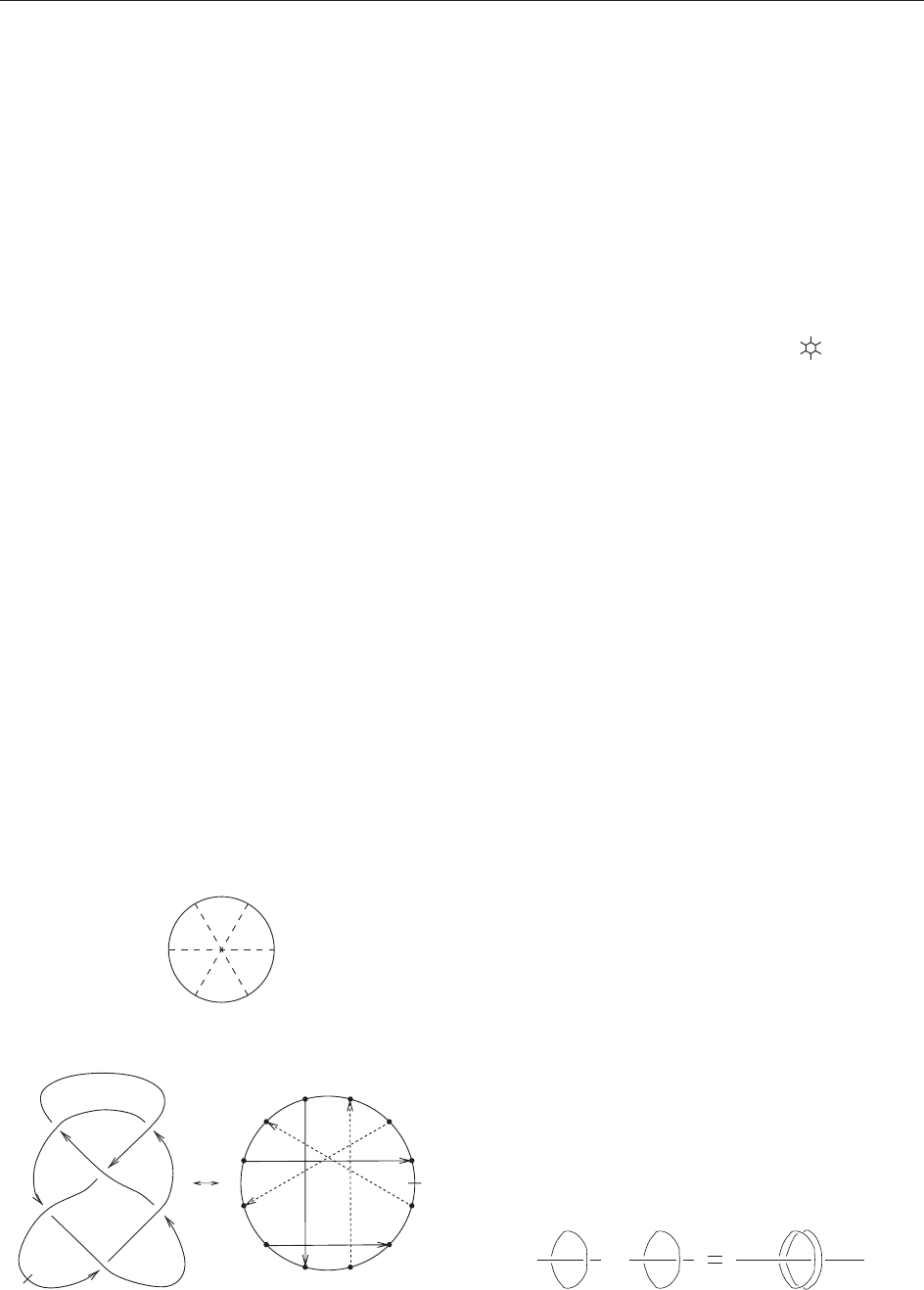
In the example below (Figure 8), we also dashed a
subdiagram of the Gauss diagram equivalent to the
chord diagram shown in Figure 7.
If G is a Gauss diagram and D is a chord diagram,
then let hD, Gi be the number of subdiagrams of
G equivalent to D, counted with appropriate signs
(to be preci se, we also need to base the diagrams
involved and count subdiagrams that respect the
basing).
Theorem 16 (Goussarov 1998, Goussarov et al.
2000). If V is a type m invariant, then there are
finitely many (based) cho rd diagrams D
i
with at
most m chords and rational numbers
i
so that
V(K) =
P
i
i
hD
i
, Gi whenever G is a Gauss dia-
gram representing a knot K.
Computing the Kontsevich Integral
While the Kontsevich integral Z
1
is a cornerstone of
the theory of finite-type invariants, it has been
computed for surprisingly few knots. Even for the
unknot, the result is nontrivial:
Theorem 17 (‘ ‘Wheels,’’ Bar-Natan et al. 2000,
2003). The framed Kontsevich integral of the unknot,
Z
F
1
(), expressed in terms of diagrams in
^
B, is given
by = exp
[
_
P
1
n = 1
b
2n
!
2n
, where the ‘‘modified Ber-
noulli numbers’’ b
2n
are defined by the power series
expansion
P
1
n = 0
b
2n
x
2n
= (1=2) log (sinh x=2)=ðx=2Þ,
the ‘‘2n-wheel’’ !
2n
is the free Jacobi diagram made
of a 2n-gonwith2nlegs(so, e.g., !
6
= ), and where
exp
[
_
means ‘‘exponential in the disjoint union sense.’’
Closed-form formulas have also been given for the
Kontsevich integral of framed unknots, the Hopf
link and Hopf chains.
Theorem 17 has a companion that utilizes the same
element , the ‘‘wheeling’’ theorem (Bar-Natan et al.
2000, 2003). The wheeling theorem ‘‘upgrades’’ the
vector space isomorphism : B!A to an algebra
isomorphism and is related to the Duflo isomorphism
of the theory of Lie algebras. It is amusing to note that
the wheeling theorem (and hence Duflo’s theorem in
the metrized case) follows using finite-type techniques
from the ‘‘1 þ 1 = 2onanabacus’’identity(Figure 9).
Taming the Kontsevich Integral
While explicit calculations are rare, there is a nice
structure theorem for the values of the Kontsevich
integral, saying that for a knot K and up to any fixed
number of loops in the Jacobi diagrams,
1
Z
1
(K)can
be described by finitely many rational functions (with
denominators powers of the Alexander polynomial)
which dictate the placement of the legs. This structure
theorem was conjectured in Rozansky (2003), proven
in Kricker (2000), and partially generalized to links in
Garoufalidis and Kricker (2004).
The Rozansky–Witten Theory
One way to construct linear functionals on A (and
hence finite-type invariants) is using Lie algebras
and representations as discussed earlier; much of our
insight about A comes this way. But there is another
construction for such functionals (and hence invar-
iants), due to Rozansky and Witten (1997), using
contractions of curvature tensors on hyper-Ka¨ hler
Figure 7 A chord diagram.
2
5
5
+
1
4
1
2
6
+
4
6
+
+
+
1
2
3
4
5
+
+
+
–
–
–
–
6
3
3
Figure 8 A knot and its Gauss diagram.
#
Figure 9 A knot theoretic 1 þ1 = 2.
346 Finite-Type Invariants

manifolds. Very little is known about the Rozansky–
Witten approach; in particular, it is not known if it
is stronger or weaker than the Lie algebraic
approach. For an application of the Rozansky–
Witten theory back to hyper-Ka¨ hler geometry
check Hitchin and Sawon (2001), and for a
unification of the Rozansky–Witten approach with
the Lie algebraic approach (albeit at a categorical
level) check Roberts and Wille ton (in preparation).
The Melvin–Morton Conjecture and the
Volume Conjecture
The Melvin–Morton conjecture (stated Melvin and
Morton (1995), proven Bar-Natan and Garoufalidis
(1996)) says that the Alexander polynomial can be read
off certain coefficients of the colored Jones polynomial.
The Kashaev–Murakami–Murakami volume conjec-
ture (stated Kashaev (1997) and J Murakami and H
Murakami (2001), unproven) says that a certain
asymptotic growth rate of the colored Jones polyno-
mial is the hyperbolic volume of the knot complement.
Both conjectures are not directly about finite-type
invariants but both have ramifications to the theory
of finite-type invariants. The Melvin–Morton con-
jecture was first proven using finite-type invariants
and several later proofs and generalizations (see
(Bar-Natan)) also involve finite-type invariants. The
volume conjecture would imply, in particular, that
the hyperbolic volume of a knot complement can be
read from that knot’s finite-type invariants, and
hence finite-type invariants would be at least as
strong as the volume invariant.
A particularly noteworthy result and direction for
further research is Gukov’s (preprint) recent unifica-
tion of these two conjectures under the Chern–
Simons umbrella (along with some relations to
three-dimensional quantum gravity).
Beyond Knots
Forlackofspace,wehaverestrictedourselvesheretoa
discussion of finite-type invariants of knots. But the
basic ‘‘differentiation’’ idea of the first section calls for
generalization, and indeed it has been generalized
extensively. We will only make a few quick comments.
Finite-type invariants of homotopy links (links
where each component is allowed to move across
itself freely) and of braids are extremely well
behaved. They separate, they all come from Lie
algebraic constructions and in the case of braids,
step-by-step integration as discussed previously works
(for homotopy links the issue was not studied).
Finite-type invariants of 3-manifolds and especially
of integral and rational homology spheres have been
studied extensively and the picture is nearly a
complete parallel of the picture for knots. There are
several competing definitions of finite-type invar-
iants, and they all agree up to regrading. There are
weight systems and they are linear funct ionals on a
space A(;) which is a close cousin of A and B and is
related to Lie algebras and hyper-Ka¨ hler manifolds in
a similar way. There is a notion of a ‘‘universal’’
invariant, and there are several con structions; they all
agree or are conjectured to agree, and they are related
to the Chern–Simons–Witten theory.
Finite-type invariants were studied for several
other types of topological objects, including knots
within other manifolds, higher-dimensional knots,
virtual knots, plane curves and doodles and more
(see Bar-Natan).
Acknowledgmnts
This work was partially supported by NSERC
grant RGPIN 262178. Electronic versions: http://
www.math.toronto.edu/drorbn/papers/EMP/ and
arXiv:math.GT/0408182. Copyright is reta ined by
the author. The author wishes to thank O Dasbach
and A Savage for comments and corrections,
especially pertaining to Problem 2.
See also: Finite-Type Invariants of 3-Manifolds; Knot
Invariants and Quantum Gravity; Kontsevich Integral;
Mathematical Knot Theory; von Neumann Algebras:
Introduction, Modular Theory, and Classification Theory.
Further Reading
The first reference is an extensive bibliography of finite invariants,
listing more than 550 references. To save space, references for this
article are only cited above stating the authors’ full last name(s)
and approximate year of publication.
Bar-Natan D Bibliography of Vassiliev invariants, http://
www.math.toronto.edu/drorbn/VasBib.
Bar-Natan D (1998) On associators and the Grothendieck–
Teichmuller group I. Selecta Mathematica 4: 183–212.
Bar-Natan D and Thurston D Algebraic Structures on knotted objects
and universal finite type invariants (in prepartion), http://
www.math.toronto.edu/drorbn/papers/AlgebraicStructures.
Drinfel’d VG (1990) Quasi-Hopf algebras. Leningrad Mathema-
tical Journal 1: 1419–1457.
Drinfel’d VG (1991) On quasitriangular Quasi-Hopf algebras and
a group closely connected with Gal(Q=Q). Leningrad Math-
ematical Journal 2: 829–860.
Gukov S Three-dimensional quantum gravity, Chern–Simons
theory, and the A-polynomial. Preprint, arXiv:hep-th/0306165.
Hitchin N and Sawon J (2001) Curvature and characteristic
numbers of hyper-Ka¨hler manifolds. Duke Mathematical
Journal 106–3: 599–615, arXiv:math.DG/9908114.
Kashaev RM (1997) The hyperbolic volume of knots from
quantum dilogarithm. Letters in Mathematical Physics 39:
269–275, arXiv:q-alg/9601025.
Finite-Type Invariants 347

Knizhnik VG and Zamolodchikov AB (1984) Current algebra and
Wess–Zumino model in two dimensions. Nuclear Physics B
247: 83–103.
Murakami J and Murakami H (2001) The colored Jones
polynomials and the simplicial volume of a knot. Acta
Mathematica 186(1): 85–104, arXiv:math.GT/9905075.
Reshetikhin Yu N and Turaev VG (1990) Ribbon graphs and
their invariants derived from quantum groups. Communica-
tions in Mathematical Physics 127: 1–26.
Witten E (1989) Quantum field theory and the Jones polynomial.
Communications in Mathematical Physics 121: 351–399.
Finite-Type Invariants of 3-Manifolds
TTQLeˆ , Georgia Institute of Technology, Atlanta,
GA, USA
ª 2006 Elsevier Ltd. All rights reserved.
Introduction
Physics Background and Motivation
Suppose G is a s emisimple compact Lie group and
M aclosedoriented3-manifold.Witten (1989)
defined quantum invariants by the path integral
over all G-connections A:
ZðM; G ; kÞ :¼
Z
expð
ffiffiffiffiffiffiffi
1
p
k CSðAÞÞDA
where k is an integer and CS(A) is the Chern–Simons
functional,
CSðAÞ¼
1
4
Z
M
tr
A ^ dA þ
2
3
A
3
The path integral is not mathematically rigorous.
According to the stationary-phase approximation in
quantum field theory, in the limit k !1the path
integral decomposes as a sum of contributions from
the flat connections:
ZðM; G; kÞ
X
flat connections f
Z
ðf Þ
ðM; G; kÞ as k !1
Each contri bution is exp(2
ffiffiffiffiffiffiffi
1
p
k CS(f )) times a
power series in 1=k. The contribution from the
trivial connection is important, especially for
rational homology 3-spheres, and the coefficients
of the powers (1=k)
n
, calculated using (n þ 1)-loop
Feynman diagrams by quantum field theory techni-
ques, are known as perturbative invar iants.
Mathematical Theories
A mathematically rigorous theory of quantum
invariants Z(M, G ; k) was pioneered by Reshetikhin
and Turaev in 1990 (see Turaev (1994) ).
A number-theoretical expansion of the quantum
invariants into power series that should correspond
to the perturbative invariants was given by Ohtsuki
(in the case of sl
2
, and general simple Lie algebras
by the author) in 1994. This led him to introducing
finite-type invariant (FTI) theory for 3-manifolds. A
universal perturbative invariant was constructed by
Le–Murakami–Ohtsuki (LMO) in 1995; it is uni-
versal for both finite-type invariants and quantum
invariants, at least for homology 3-spheres.
Rozansky in 1996 defined perturbative invariants
using Gaussian integral, very close in the spirit to
the original physics point of view. Later Habiro
(for sl
2
and Habiro and the author for all simple
Lie algebras) found a finer expansion of quantum
invariants, known as the cyclotomic expansion, but
no physics origin is known for the cyclotomic
expansion. The cyclotomic expansion helps to show
that the LMO invariant dominates all quantum
invariants for homology 3-spheres.
The purpose of this article is to give an overview
of the mathematical theory of finite-type and
perturbative invariants of 3-manifolds.
Conventions and Notations
All vector spaces are assumed to be over the ground
field Q of rational numbers, unless otherwise stated.
For a graded space A, let Gr
n
A be the su bspace of
grading n and Gr
n
A the subspace of grading n.
For x 2 A, let Gr
n
x and Gr
n
x be the projections of
x onto, respectively, Gr
n
A and Gr
n
A.
All 3-manifolds are supposed to be closed and
oriented. A 3-manifold M is an integral homology
3-sphere (ZHS) if H
1
(M, Z) = 0; it is a rational
homology 3-sphere (QHS) if H
1
(M, Q) = 0. For a
framed link L in a 3-manifold M denote M
L
the
3-manifold obtained from M by surgery along L (see
e.g., Turaev (1994)).
Finite-Type Invariants
After its introduction by Ohtsuki in 1994, the theory
of FTIs of 3-manifolds has been developed rapidly
by many authors. Later Goussarov and Habiro
independently introduced clasper calculus, or
Y-surgery, which provides a powerful geometric
technique and deep insight in the theory. Y-surgery,
corresponding to the commutator in group theory,
naturally gives rise to 3-valent graph s.
348 Finite-Type Invariants of 3-Manifolds

Generality on FTIs
Decreasing filtration In a theory of FTIs, one
considers a class of objects, and a ‘‘good’’ decreasing
filtration F
0
F
1
F
2
on the vector space
F = F
0
spanned by these objects. An invariant of
the objects with values in a vector space is of order
less than or equal to n if its restriction to F
nþ1
is 0;
it is of finite type if it is of order n for some n.An
invariant has order n if it is of order n but not
n 1. Good here means at least the space of FTI
of each order is finite dimensional. It is desirable to
have an algorithm of polynomial time to calculate
every FTI. In addition, one wants the set of FTIs to
separate the objects (completeness).
The space of invariants of order n can be
identified with the dual space of F
0
=F
nþ1
; its
subspace F
n
=F
nþ1
is isomorphic to the space of
invariants of order n modulo the space of invar-
iants of order n 1. Informally, one can say that
F
n
=F
nþ1
is more or less the set of invariants of
order n.
Elementary moves, the knot case Usually the
filtrations are defined using ‘‘independent elemen-
tary moves.’’ For the class of knots the elementary
move is given by crossing change. Any two knots
can be connected by a finite sequenc e of such moves.
The idea is if K, K
0
2F
n
, the nth term of the
filtration, then K K
0
2F
nþ1
, where K
0
is obtained
from K by an elementary move. Formal definition is
as follows. Suppose S is a set of double points of a
knot diagram D.Let
½D; S¼
X
S
0
S
ð1Þ
#S
0
D
S
0
where the sum is over all subsets S
0
of S, including
the empty set, D
S
0
is the knot obtained by changing
the crossing at every point in S
0
, and #S
0
is the
number of elements of S
0
. Then F
n
is the vector
space spanned by all elements of the form [D, S]
with #S = n. For the knot case, the Kontsevich
integral is an invariant that is universal for all FTIs
(see Bar-Natan (1995)).
Ohtsuki’s Definition of FTIs for ZHS
An el ement ary move here is a surgery along a
knot: M ! M
K
,whereK is a framed knot in a
ZHS M. A collection of m oves corresponds to
surgery on a framed li nk. To always remain in the
class of ZHS we need to restrict ourselves to unit-
framed and algebraically split links, that is, framed
links i n ZHS each component of which has
framing 1 and the linking number of every two
components is 0. It is easy to prove that a link L
in a ZHS M is unit-framed and algebrai cally s plit
if and only if M
L
0
is a ZHS for every sublink L
0
of
L. For a unit-framed, algebraically split link L in a
ZHS M define
½M; L¼
X
L
0
L
ð1Þ
j#L
0
j
M
L
0
which is an element in the vector space M freely
spanned by ZHS.
For a non-negative integer n let F
AS
n
be the
subspace of M span ned by [M, L]with#L = n.
Then the descending filtration M = F
AS
0
F
AS
1
F
AS
2
defines a theory of FTIs on the class of
ZHS.
Theorem 1
(i) (Ohtsuki) The dimension of F
n
(M) is finite for
every n.
(ii) (Garoufalidis–Ohtsuki) One has F
3nþ1
(M) =
F
3nþ2
(M) = F
3nþ3
(M).
The orders of FTIs in this theory are multiples of 3.
The first nontrivial invariant, which is the only (up
to scalar) invariant of degree 3, is the Casson
invariant.
The Goussarov–Habiro Definition
Y-surgery or clasper surgery Consider the standard
Y-graph Y and a small neighborhood N(Y)ofitin
the standard R
2
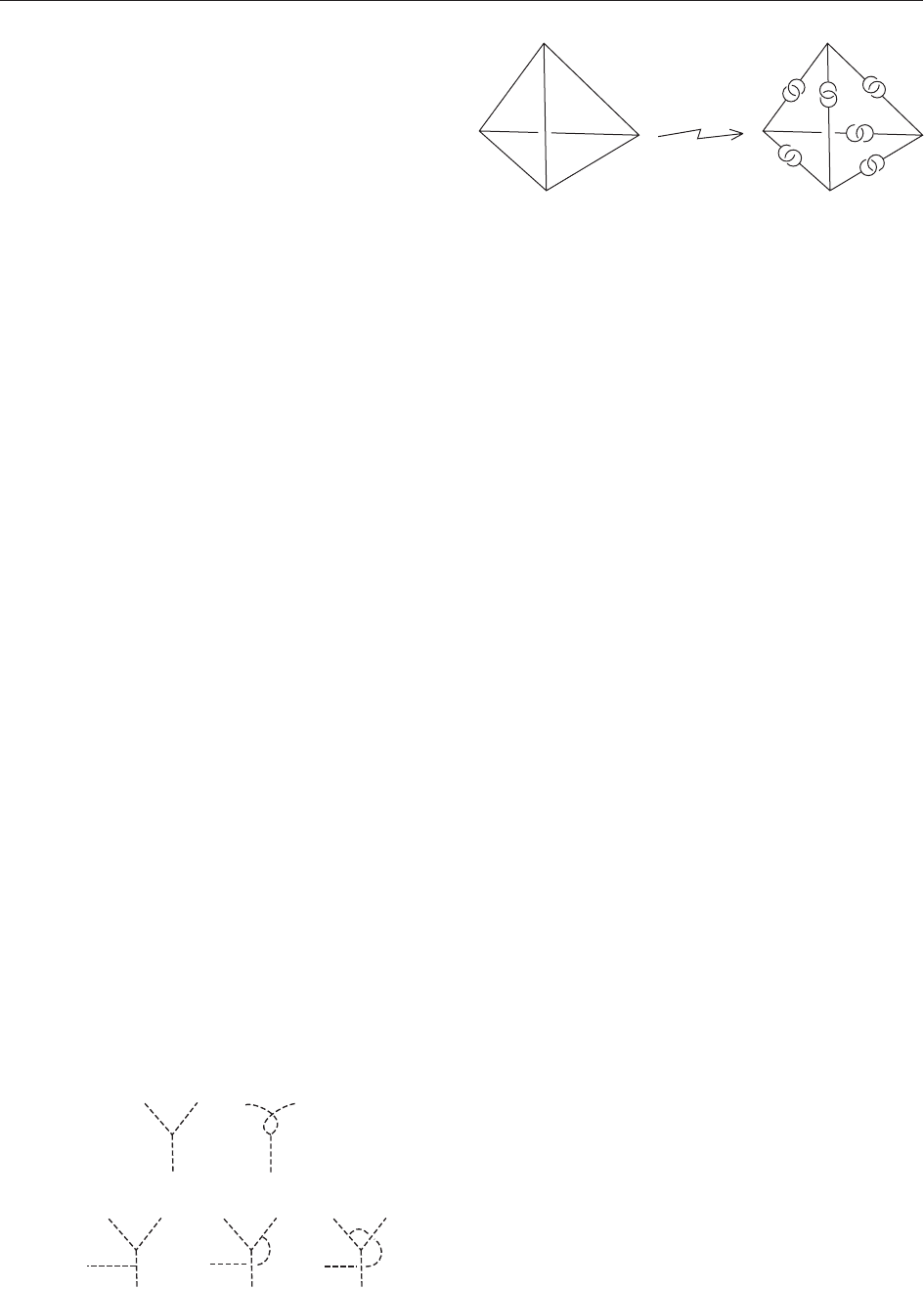
(see Figure 1). Denote by L(Y)the
six-component framed link diagram in N(Y) R
3
,
each component of which has framing 0 in R
3
(see Figure 1).
A framed Y-graph C in a 3-manifold M is the
image of an embedding of N(Y) into M. The surgery
of M along the image of the six-component link
L(Y) is called a Y-surgery along C, den oted by M
C
.
If one of the leaves bounds a disk in M whose
interior is disjoint from the graph, then M
C
is
homeomorphic to M.
Matveev in 1987 proved that two 3-manifolds M
and M
0
are related by a finite sequence of
Y-surgeries if and only if there is an isomorphism
from H
1
(M, Z) onto H
1
(M
0
, Z) preserving the
Y-
g
raph Sur
g
ery link L (Y )Its nei
g
hborhood N (Y )
Figure 1 Y-graph.
Finite-Type Invariants of 3-Manifolds 349
linking form on the torsion group. It is natural to
partition the class of 3-manifolds into subclasse s of
the same H
1
and the same linking form.
Goussarov–Habiro filtrations For a 3-manifold M
denote by M(M) the vector space spanned by all
3-manifolds with H
1
and linking form the same as
those of M. Define, for a set S of Y-graphs in M,
[M, S] =
P
S
0
S
(1)
#S
0
M
S
0
,andF
Y
n
M(M) the vector
space spanned by all [N, S] such that N is in M(M)
and #S = n. The following theorem of Goussarov
and Habiro (Goussarov 1999, Garoufalidis et al.
2001, Habiro 2000) shows that the FTI theory
based on Y-surgery is the same as the one of Ohtsuki
in the case of ZHS.
Theorem 2 For the case M= M(S
3
), one has
F
Y
2n1
= F
Y
2n
= F
AS
3n
.
The Fundamental Theorem of FTIs of ZHS
Jacobi diagrams A closed Jacobi diagram is
a vertex-or iented triv alent graph, that is, a graph
for which the degree of each vertex is equal to 3 and
a cyclic order of the three half-edges at every vertex
is fixed. Here, multiple edges and self-loops are
allowed. In pictures, the orientation at a vertex is
the clockwise orientation, unless otherwise stated.
The ‘‘degree’’ of Jacobi diagram is half the number
of its vertices.
Let Gr
n
A(;), n 0, be the vector space spanned
by all closed Jacobi diagrams of degree n, modulo
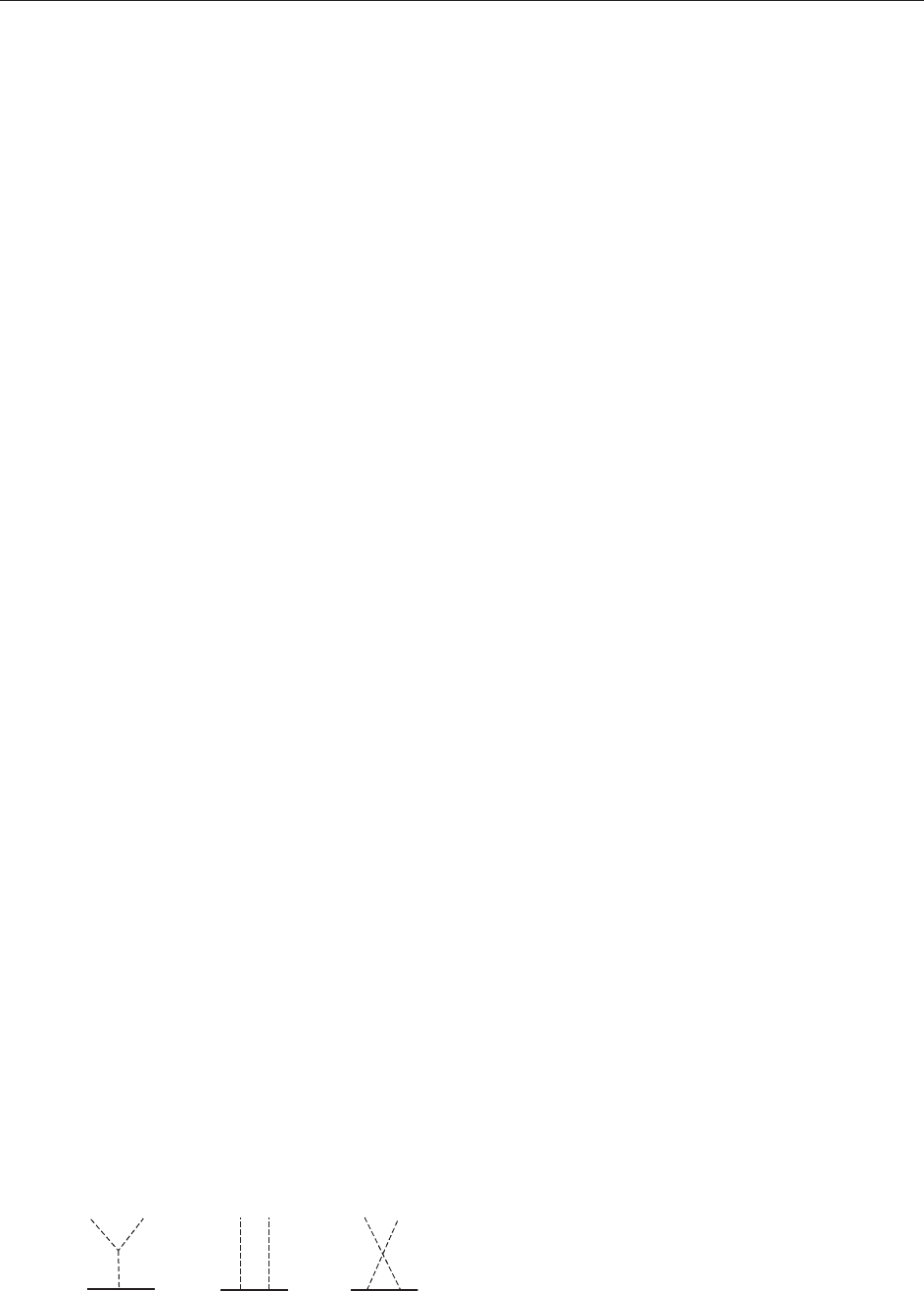
the antisymmetry (AS) and Jacobi (IHX ) relations
(see Figure 2).
The universal weight map W Suppose D is a closed
Jacobi diagram of degree n.EmbeddingD into R
3
S
3
arbitrarily and then projecting down onto R
2
in
general position, one can describe D by a diagram,
with over/under-crossing information at every dou-
ble point just as in the case of a link diagram. We
can assume that the orientation at every vertex of D
is given by a clockwise cyclic order. From the image
of D, construct a set G of 2nY-graphs as in
Figure 3. Here only the cores of a Y-graph are
drawn, with the convention that each framed
Y-graph is a small neighborhood of its core in R
2
.
If G
0
is a proper subset of G , then in G
0
there is a
Y-graph, one of the leaves of which bounds a disk,
hence S
3
G
0
= S
3
. Thus, W(D):= [S
3
, G] = S
3
G
S
3
.By
definition, W(D) 2F
Y
2n
; it might depend on the
embedding of D into R
3
, but one can show that
W(D) is well defined in F
Y
2n
=F
Y
2nþ1
. The map W was
first constructed by Garoufalidis and Ohtsuki in the
framework of F
AS
.
Fundamental theorem
Theorem 3 (Leˆ et al. 1998, Leˆ 1997). The map W
descends to a well-defined linear map
W :Gr
n
A(;) !F
Y
2n
=F
Y
2nþ1
and moreover, is an
isomorphism between the vector spaces Gr
n
A(;)
and F
Y
2n
=F
Y
2nþ1
, for M= M(S
3
).
The theorem essentially says that the set of
invariants of degree 2n is dual to the space of closed
Jacobi diagram Gr
n
A(;). The proof is based on the
LMO invariant (see the next section).
A Q-valued invariant I of order 2n restricts to a
linear map from F
2n
=F
2nþ1
to Q. The composition
of I and W is a functional on Gr
n
A(;) called the
‘‘weight system’’ of I. The theorem shows that every
linear functional on Gr
n
A(;) is the weight of an
invariant of order 2n.
Relation to knot invariants Under the map that
sends an (unframed) knot K S
3
to the ZHS
obtained by surgery along K with framing 1, an
invariant of degree 2n (in the F
Y
theory) of ZHS
pulls back to an invariant of order 2n of knots.
This was conjectured by Garoufalidis and proved by
Habegger.
Other classes of rational homology 3-spheres
Actually, the theorem was first proved in the frame-
work of F
AS
. Clasper surgery theory allows Habiro
(2000) to generalize the fundamental theorem to QHS:
for M a QHS, the universal weight map W :Gr
n
A(;) !F
2n
M(M)=F
2nþ1
M(M), defined similarly as
+ = 0AS
+ + = 0
IHX
(Jacobi)
Figure 2 The AS and IHX relations.
Figure 3 The weight map.
350 Finite-Type Invariants of 3-Manifolds
in the case of ZHS, is an isomorphism, and
F
2n1
M(M) = F
2n
M(M).
Other filtrations and approaches Other equiva lent
filtrations were introduced (and compared) by
Garoufalidis, Garoufalidis and Levine (1997), and
Garoufalidis–Goussarov–Polyak (2001). Of impor-
tance is the one using subgroups of mapping class
groups in Garoufalidis and Levine (1997). A theory
of n-equivalence was constructed by Goussarov and
Habiro that encompasses many geometric aspects of
FTIs of 3-manifolds (Habiro 2000, Goussarov
1999). Cochran and Melvin (2000) extended the
original Ohtsuk i definition to manifolds with
homology, using algebraically split links, but the
filtrations are different from those of Goussarov–
Habiro.
The Le–Murakami–Ohtsuki Invariant
Jacobi Diagrams
An open Jacobi diagram is a vertex-oriented uni–
trivalent graph, that is, a graph with univalent and
trivalent vertices together with a cyclic ordering of
the edges incident to the trivalent vertices. A
univalent vertex is also called ‘‘a leg.’’ The degree
of an open Jacobi diagram is half the number of
vertices (trivalent and univalent). A Jacobi diagram
based on X, a compact oriented 1-manifold, is a
graph D together with a decomposition D = X [ ,
such that D is the result of gluing all the legs of an
open Jacobi diagram to distinct interior points of
X. The degree of D, by definition, is the degree of .
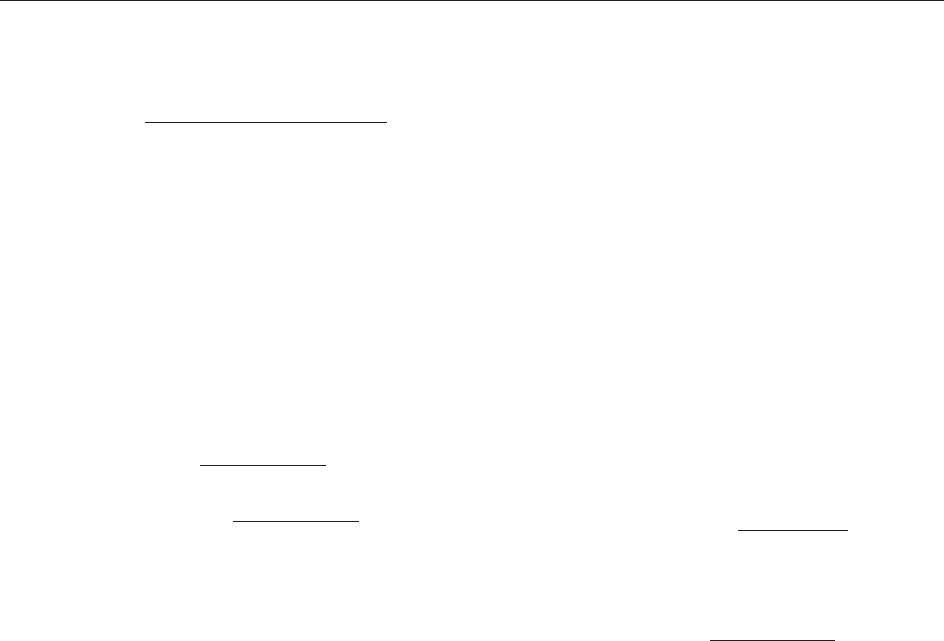
In Figure 4 X is depicted by bold lines. Let A
f
(X)be
the space of Jacobi diagrams based on X modulo the
usual antisymmetry, Jacobi and the new STU
relations. The completion of A
f
(X) with respect to
degree is denoted by A(X).
When X is a set of m-ordered oriented intervals,
denote A(X)byP
m
, which has a natural algebra
structure where the product DD
0
of two Jacobi
diagrams is defined by stacking D on top of D
0
(concatenating the corresponding oriented intervals).
When X is a set of m-ordered oriented circles,
denote A(X)byA
m
. By identifying the two
endpoints of each interval, one gets a map pr : P
m
!
A
m
, which is an isomorphism if m = 1 (see
Bar-Natan (1995)).
For x 2A
m
and y 2A
1
, the connected sum is
defined by x#
m
y := pr((pr
1
x)(pr
1
y)
m
), where
(pr
1
y)
m
is the element in P
m
with pr
1
y on each
oriented interval.
Symmetrization maps Let B
m
be the vector space
spanned by open Jacobi diagrams whose legs are
labeled by elements of {1, 2, ..., m}, modulo the
antisymmetry and Jacobi relations. One can define
an analog of the Poincare–Birkhoff–Witt isomorph-
ism : B
m
!P
m
as follows. For a diagram D, (D)
is obtained by taking the average over all possible
ways of ordering the legs labeled by j and attaching
them to the jth oriented interval. It is known that
is a vector space isomorphism (Bar-Natan (1995)).
The Framed Kontsevich Integral of Links
For an m-component framed link L R
3
, the
(framed version of the) Kontsevich integral Z(L)is
an invariant taking values in A
m
(see, e.g., Ohtsuki
(2002)). Let := Z(K), when K is the unknot with
framing 0, and
Z(L):= Z(L)#
m
. An explicit for-
mula for is given in Bar-Natan et al. (2003).
Removing Solid Loops: The Maps
n
Suppose x 2B
m
is an open Jacobi diagram with legs
labeled by {1, ..., m}. If the number of vertices of
any label is different from 2n, or if the degree of
D > (m þ 1)n, we set
n
(D) = 0. Otherwise, parti-
tioning the 2n vertices of each label into n pairs and
identifying points in each pair, from x we get a
trivalent graph which may contain some isolated loops
(no vertices) and which depends on the partition.
Replacing each isolated loop by a factor 2n,
and summing up over all partitions, we get
n
(D) 2 Gr
n
A(;).
For x 2A
m
, choose y 2P
m
such that pr( y ) = x.
Using the isomorphism we pull back
1
y 2B
m
.
Define
n
(x):=
n
(
1
y). One can prove that
n
(x)
does not depend on the choice of the preimage y of x.
Note that
n
lowers the degree by nm.
Definition of the Le–Murakami–Ohtsuki
Invariant Z
LMO
In A(;):=
Q
1
n = 0
Gr
n
A(;) let the produ ct of two
Jacobi diagrams be their disjoint union. In addition,
define the coproduct (D) = 1 D þ D 1 for D a
connected Jacobi diagram. Then A(;) is a commu-
tative cocommutative graded Hopf algebra.
For the unknot U
with framing 1, one has
n
(
Z(U
)) = (1)
n
þ (terms of degree 1); hence,
their inverses exist. Suppose the linking matrix of an
=-STU
Figure 4 The STU relation.
Finite-Type Invariants of 3-Manifolds 351
oriented framed link L R
3
has
þ
positive eigen-
values and
negative eigenvalues. Define
n
ðLÞ¼
n
ð
ZðLÞÞ
ð
n
ð
ZðU
þ
ÞÞÞ
þ
ð
n
ð
ZðU
ÞÞÞ
2 Grad
n
ðAð;ÞÞ ½1
Theorem 4 (Leˆ et al. 1998).
n
(L) is an invariant
of the 3-manifold M = S
3
L
.
We can combine all the
n
to get a better
invariant:
Z
LMO
ðMÞ :¼ 1 þ Grad
1
ð
1
ðMÞÞ
þþGrad
n
ð
n
ðMÞÞþ2Að;Þ
For M a QHS, we also define
^
Z
LMO
ðMÞ :¼ 1 þ
Grad
1
ð
1
ðMÞÞ
dðMÞ
þþ
Grad
n
ð
n
ðMÞÞ
dðMÞ
n
þ
where d(M) is the cardinality of H
1
(M, Z).
Proposition 1 (Leˆ et al. 1998). Both Z
LMO
(M) and
^
Z
LMO
(M)(when defined) are group-like elements,
that is,
ðZ
LMO
ðMÞÞ ¼ Z
LMO
ðMÞZ
LMO
ðMÞ
ð
^
Z
LMO
ðMÞÞ ¼
^
Z
LMO
ðMÞ
^
Z
LMO
ðMÞ
Moreover,
^
Z
LMO
(M
1
#M
2
) =
^
Z
LMO
(M
1
)
^
Z
LMO
(M
2
).
Universality Properties of the LMO Invariant
Let us restrict ourselves to the case of ZHS.
Theorem 5 (Leˆ 1997). The less than or equal to n
degree part Gr
n
Z
LMO
is an invariant of degree 2n.
Any invariant of degree 2n is a compo-
sition w(Gr
n
Z
LMO
), where w :Gr
n
A(;) ! Q is a
linear map.
Clasper calculus (or Y-surgery) theory allows
Habiro to extend the theorem to rational homology
3-spheres.
The Arhus Integral
The Arhus integral (ca. 1998) of Bar-Natan,
Garoufalidis, Rozansky and Thurston, based on a
theory of formal integration, calc ulates the LMO
invariant of rational homology 3-spheres. The
formal integration theory has a conceptual flavor
and helps to relate the LMO invariant to perturba-
tive expansions of quantum invariants. We give here
the definition for the case when one does surgery on
a knot K with nonzero framing b. The link case is
similar (see Bar-Natan et al. (2002a, b)).
When K is a knot,
Z(K) is an element of A
1
P
1
B
1
. Note that B
1
is an algebra where the
product is the disjoint union t. Since the framing is
b, one has
ZðKÞ¼exp
t
ðbw
1
=2ÞtY
where w
1
is the ‘‘dashed interval’’ (the only
connected open Jacob i diagram without trivalent
vertex), and Y is an element in B every term of
which must have at least one trivalent vertex. For
uni–trivalent graphs C, D 2B
1
let
hC; Di¼
0 if the numbers of legs of C; D
are different
sum of all ways to glue legs of C and D
together
8
>
<
>
:
One defines
R
FG
Z(K):= hexp
t
( w
1
=2b), Yi.Then
Z
FG
ZðKÞ¼
X
1
n¼0
Gr
n
ð
n
ZðKÞÞ
ðbÞ
n
Hence,
^
Z
LMO
ðS
3
K
Þ¼
R
FG
ZðKÞ
R
FG
ZðU
signðbÞ
Þ
Other Approaches
Another construction of a universal perturbative
invariant based on integrations over configuration
spaces, closer to the original physics approach but
harder to calculate because of the lack of a surgery
formula, was developed by Axelrod and Singer,
Kontsevich, Bott and Cattaneo, Kuperberg and
Thurston (see Axelred and Singer (1992), Bott and
Cattaneo (1998)).
Quantum Invariants and Perturbative
Expansion
Fix a simple (complex) Lie algebra g of finite
dimension. Using the quantized enveloping algebra
of g one can define quantum link and 3-manifold
invariants. We recall here the definition, adapted for
the case of roots lattice (projective group case).
Here our q is equal to q
2
in the text book (Jantzen
1995). Fix a root system of g.LetX, X
þ
, Y denote
respectively the weight lattice, the set of dominant
weights, and the root lattice. We normalize the
invariant scalar product in the real vector space of
the weight lattice so that the length of any short root
is
ffiffiffi
2
p
.
352 Finite-Type Invariants of 3-Manifolds

Quantum Link Invariants
Suppose L is a framed oriented link with m-ordered
components, then the quantum invariant
J
L
(
1
, ...,
m
) is a Laurent polynomial in q
1=2D
,
where
1
, ...,
m
are dominant weights, standing
for the simple g-modules of highest weights
1
, ...,
m
, and D is the determinant of the Cartan
matrix of g (see, e.g., Turaev (1994) and Leˆ (1996)).
The Jones polynomial is the case when g = sl
2
and
all the
i
’s are the highest weights of the funda-
mental representation. For the unknot U with zero
framing, one has (here is the half-sum of all
positive roots)
J
U
ðÞ¼
Y
positive roots
q
ðþjÞ=2
q
ðþjÞ=2
q
ðjÞ=2
q
ðjÞ=2
We will also use another normalization of the
quantum invariant:
Q
L
ð
1
; ...;
m
Þ :¼ J
L
ð
1
; ...;
m
Þ
Y
m
j¼1
J
U
ð
j
Þ
This definition is good only for
j
2 X
þ
. Note
that each 2 X is either fixed by an element of the
Weyl group under the dot action (see Humphreys
(1978)) or can be moved to X
þ
by the dot action.
We define Q
L
(
1
, ...,
m
) for arbitrary
j
2 X by
requiring that Q
L
(
1
, ...,
m
) = 0 if one of the
j
’s is
fixed by an element of the Weyl group, and that
Q
L
(
1
, ...,
m
) is component-wise invariant under
the dot action of the Weyl group, that is, for every
w
1
, ..., w
m
in the Weyl group,
Q
L
ðw
1
1
; ...; w
m
m
Þ¼Q
L
ð
1
...;
m
Þ
Proposition 2 (Leˆ 1996). Suppose
1
, ...,
m
are in
the root lattice Y.
(i) (Integrality) Then Q
L
(
1
, ...,
m
) 2 Z[q
1
], (no
fractional power).
(ii) (Periodicity) When q is an rth root of 1, then
Q
L
(
1
, ...,
m
) is invariant under the action of
the lattice group rY, that is, for y
1
, ..., y
m
2 Y,
Q
L
(
1
, ...,
m
) = Q
L
(
1
þ ry
1
, ...,
m
þ ry
m
).
Quantum 3-Manifold Invariants
Although the infinite sum
P
j
2Y
Q
L
(
1
, ...,
m
)
does not have a meaning, heuristic ideas show that
it is invariant under the second Kirby move, and
hence almost defines a 3-manifold invariant. The
problem is to regularize the infinite sum. One
solution is based on the fact that at rth roots of
unity, Q
L
(
1
, ...,
m
) is periodic, so we should use
the sum with
j
’s run over a fundamental set P
r
of
the action of rY, where
P
r
:¼fx ¼ c
1
1
þþc
‘
‘
j 0 c
1
; ...; c
‘
< rg
Here
1
, ...,
‘
are basis roots. For a root of
unity of order r, let
F
L
ðÞ¼
X
j
2ðP
r
\YÞ
Q
L
ð
1
; ...;
m
Þj
q¼
If F
U
() 6¼ 0, define
L
ðÞ :¼
F
L
ðÞ
ðF
U
þ
ðÞÞ
þ
ðF
U
ðÞÞ
Recall that D is the determinant of the Cartan
matrix. Let d be the maximum of the absolute values
of entries of the Cartan matrix outside the diagonal.
Theorem 6 (Leˆ 2003)
(i) If the order r of is coprime with dD, then
F
U
() 6¼ 0.
(ii) If F
U
( ) 6¼ 0 then
Pg
M
( ):=
L
( ) is an invariant
of the 3-manifold M = S
3
L
.
Remark 1 The version presented here corresponds to
projective groups. It was defined by Kirby and Melvin
for sl
2
, Kohno and Takata for sl
n
,andbyLeˆ (2003) for
arbitrary simple Lie algebra. When r is coprime with
dD, there is also an associated modular category that
generates a topological quantum field theory. In most
texts in literature, say Kirillov (1996) and Turaev
(1994), another version
g
was defined. The reason we
choose
Pg
is: it has nice integrality and eventually
perturbative expansion. For relations between the
version
Pg
and the usual
g
,seeLeˆ (2003).
Examples When M is the Poincare´ sphere and
g = sl
2
,
Psl
2
M
ðqÞ¼
1
1 q
X
1
n¼0
q
n
ð1 q
nþ1
Þ
ð1 q
nþ2
Þ...ð1 q
2nþ1
Þ
Here q is a root of unity, and the sum is easily
seen to be finite.
Integrality The following theorem was proved for
g = sl
2
by Murakami (1995) and for g = sl
n
by
Takata–Yokota and Masbaum–Wenzl (using ideas
of J Roberts) and for arbitrary simple Lie algebras
by Leˆ (2003).
Theorem 7 Suppose the order r of is a prime big
enough, then
Pg
M
( ) is in Z[] = Z[ exp (2i=r)].
Finite-Type Invariants of 3-Manifolds 353

Perturbative Expansion
Unlike the link case, qua ntum 3-manifold invar iants
can be defined only at certain roots of unity. In
general, there is no analytic extension of the
function
Pg
M
around q = 1. In perturbative theory,
we want to expand the function
g
M
around q = 1
into power series. For QHS, Ohtsuki (for g = sl
2
)
and then the present author (for all other simple Lie
algebras) showed that there is a number-theoretical
expansion of
Pg
M
around q = 1 in the following sense.
Suppose r is a big enough prime, a nd
= exp(2i=r). By the integrality (Theorem 7),
Pg
M
ðÞ2Z ½¼Z½q=ð1 þ q þ q
2
þþq
r1
Þ
Choose a representative f (q) 2 Z[q]of
Pg
M
( ).
Formally substitute q = (q 1) þ 1inf(q):
f ðqÞ¼c
r;0
þ c
r;1
ðq 1Þþþc
r;n2
ðq 1Þ
n2
The integers c
r, n
depend on r and the representative
f(q). It is easy to see that c
r, n
(mod r) does not depend
on the representative f(q) and hence is an invariant of
QHS. The dependence on r is a big drawback. The
theorem below says that there is a rational number c
n
,
not depending on r,suchthatc
r, n
(mod r)isthe
reduction of either c
n
or c
n
modulo r, for sufficiently
large prime r. It is easy to see that if such c
n
exists, it
must be unique. Let s be the number of positive roots
of g. Recall that ‘ is the rank of g.
Theorem 8 For every QHS M, there is a sequence
of numbers
c
n
2 Z
1
ð2n þ 2sÞ!jH
1
ðM; ZÞj
such that for sufficiently large prime r
c
r;n
jH
1
ðM; ZÞj
r
‘
c
n
ðmod rÞ
where
jH
1
ðM; ZÞj
r
¼1
is the Legendre symbol. Moreover, c
n
is an invariant
of order 2 n.
The series t
Pg
M
(q 1) :=
P
1
n = 0
c
n
(q 1)
n
, called
the Ohtsuki series, can be considered as the
perturbative expansion of the function
Pg
M
at q = 1.
For actual calculation of t
Pg
M
(q 1), see Leˆ (2003),
Ohtsuki (2002), and Rozansky (1997).
Recovery from the LMO invariant It is known that
for any metrized Lie algebra g, there is a linear map
W
g
:Gr
n
A(;) ! Q (see Bar-Natan (1995)).
Theorem 9 One has
X
1
n¼0
W
g
ðGr
n
Z
LMO
Þh
n
¼ t
Pg
M
ðq 1Þj
q¼e
h
This shows that the Ohtsuki series t
Pg
M
(q 1) can
be recovered from, and hence totally determined by,
the LMO invariant. The theorem was proved by
Ohtsuki for sl
2
. For other simple Lie algebras, the
theorem follows from the Arhus integral (see Bar-
Natan et al. (2002a, b) and Ohtsuki (2002)).
Rozansky’s Gaussian Integral
Rozansky (1997) gave a definition of the Ohtsuki
series using formal Gaussian integral in the impor-
tant work. The work is only for sl
2
, but can be
generalized to other Lie algebras; it is closer to the
original physics ideas of perturbative invariants.
Cyclotomic Expansion
The Habiro Ring
Let us define the Habiro ring
d
Z[q]by
d
Z½q :¼ lim
n
Z½q=ðð1 qÞð1 q
2
Þ...ð1 q
n
ÞÞ
Habiro (2002) called it the cyclotomic completion
of Z[q]. Formally,
d
Z[q] is the set of all series of the
form
f ðqÞ¼
X
1
n¼0
f
n
ðqÞð1 qÞð1 q
2
Þ...ð1 q
n
Þ
f
n
ðqÞ2Z½q
Suppose U is the set of roots of 1. If 2 U then
(1 )(1
2
) (1
n
) = 0ifn is big enough;
hence, one can define f()forf 2
d
Z[q]. One can
consider every f 2
d
Z[q] as a function with domain U.
Note that f () 2 Z[] is always an algebraic integer.
It turns out that
d
Z[q] has remarkable properties,
and plays an important role in quantum topology.
Note that the formal derivative of (1 q)
(1 q
2
) ...(1 q
n
) is divisible by (1 q)(1
q
2
) ...(1 q
k
)withk > (n 1)=2. This means every
element f 2
d
Z[q] has a derivative f
0
2
d
Z[q], and hence
derivatives of all orders in
d
Z[q]. One can then
associate to f 2
d
Z[q] its Taylor series at a root of 1:
T
ðf Þ :¼
X
1
n¼0
f
ðnÞ
ðÞ
n!
ðq Þ
n
which can also be obtained by noticing that (1 q)
(1 q
2
) ...(1 q
n
) is divisible by (q )
k
if n is
bigger than k times the order of . Thus, one has a
map T
:
d
Z[q] ! Z[][[q ]].
354 Finite-Type Invariants of 3-Manifolds

Theorem 10 (Habiro 2004)
(i) For each root of unity , the map T
is injective,
that is, a function in
d
Z[q] is determined by its
Taylor expansion at a point in the domain U.
(ii) if f () = g() at infinitely many roots of prime
power orders, then f = gin
d
Z[q].
One important consequence is that
d
Z[q]isan
integral domain, since we have the embedding
T
1
:
d
Z[q] ,!Z[[q 1]].
In general the Taylor series T
1
f has 0 convergence
radius. However, one can speak about p-adic
convergence to f () in the following sense. Suppose
the order r of is a power of prime, r = p
k
. Then it is
known that ( 1)
n
is divisible by p
m
if n > mk.
Hence, T
1
f () converges in the p-adic topology, and
it can be easily shown that the limit is exactly f ().
The above properties suggest considering
d
Z[q]as
a class of ‘‘analytic functions’’ with domain U.
Quantum Invariants as an Element of
d
Z[q]
It was proved, by Habiro for sl
2
and by Habiro with
the present author for general simple Lie algebras,
that quantum invariants of ZHSs belong to
d
Z[q]
and thus have remarkable integrality properties:
Theorem 11
(i) For every ZHS M, there is an invariant I
g
M
2
d
Z[q] such that if is a root of unity for which
the quantum invariant
Pg
M
( ) can be defined,
then I
g
M
() =
Pg
M
().
(ii) The Ohtsuki series is equal to the Taylor series
of I
g
M
at 1.
Corollary 1 Suppose M is a ZHS.
(i) For every root of unity , the quantum invariant
at is an algebraic integer,
g
M
() 2 Z[]. (No
restriction on the order of is required.)
(ii) The Ohtsuki series t
Pg
M
(q 1) has integer coeffi-
cients. If isarootoforderr= p
k
, where p is
prime, then the Ohtsuki series at converges
p-adically to the quantum invariant at .
(iii) The quantum invariant
Pg
M
is determined by
values at infinitely many roots of prime power
orders and also determined by its Ohtsuki series.
(iv) The LMO invariant totally determines the
quantum invariants
Pg
M
.
Part (ii) was conjectured by R Lawrence for sl
2
and first proved by Rozansky (also for sl
2
). Part (iv)
follows from the fact that the LMO invariant
determines the Ohtsuki series; it exhibits another
universality property of the LMO invar iant.
See also: Finite-Type Invariants; Knot Invariants and
Quantum Gravity; Lie Groups: General Theory; Quantum
3-Manifold Invariants.
Further Reading
Axelrod S and Singer IM (1992) Chern–Simons perturbation
theory. In: Proceedings of the XXth International Conference
on Differential Geometric Methods in Theoretical Physics,
New York, 1991, vols. 1 and 2, pp. 3–45. River Edge, NJ:
World Scientific.
Bar-Natan D (1995) On the Vassiliev knot invariants. Topology
34: 423–472.
Bar-Natan D, Garoufalidis S, Rozansky L, and Thurston DP
(2002a) The Arhus integral of rational homology 3-spheres.
Selecta Mathematica (NS) 8: 315–339.
Bar-Natan D, Garoufalidis S, Rozansky L, and Thruston DP
(2002b) The Arhus integral of rational homology 3-spheres.
Selecta Mathematica (NS) 8: 341–371.
Bar-Natan D, Garoufalidis S, Rozansky L, and Thurston DP
(2004) The Arhus integral of rational homology 3-spheres.
Selecta Mathematica (NS) 10: 305–324.
Bar-Natan D, Leˆ TTQ, and Thurston DP (2003) Two applica-
tions of elementary knot theory to Lie algebras and Vassiliev
invariants. Geometry and Topology 7: 1–31 (electronic).
Bott R and Cattaneo AS (1998) Integral invariants of 3-manifolds.
Journal of Differential Geometry 48: 91–133.
Cochran TD and Melvin P (2000) Finite type invariants of
3-manifolds. Inventiones Mathematicae 140: 45–100.
Garoufalidis S and Levine J (1997) Finite type 3-manifold
invariants, the mapping class group and blinks. Journal of
Differential Geometry 47: 257–320.
Garoufalidis S, Goussarov M, and Polyak M (2001) Calculus of
clovers and finite type invariants of 3-manifolds. Geometry
and Topology 5: 75–108 (electronic).
Goussarov M (1999) Finite type invariants and n-equivalence of
3-manifolds. Comptes Rendus des Seances de l’Academie des
Scie
´
nces. Se
´
rie I. Mathe
´
matique 329: 517–522.
Habiro K (2000) Claspers and finite type invariants of links.
Geometry and Topology 4: 1–83 (electronic).
Habiro K (2002) On the quantum sl
2
invariants of knots and integral
homology spheres. In: Invariants of Knots and 3-Manifolds
(Kyoto, 2001), Geometry and Topology Monogram, (electronic),
vol. 4, pp. 55–68. Coventry: Geometry and Topology Publisher.
Habiro K (2004) Cyclotomic completions of polynomial rings.
Publications of the Research Institute for Mathematical
Sciences, Kyoto University 40: 1127–1146.
Humphreys J (1978) Introduction to Lie Algebras and Representation
Theory. Graduate Texts in Mathematics, vol. 6. Berlin: Springer.
Jantzen JC (1995) Lecture on Quantum Groups. Graduate
Studies in Mathematics, vol. 6. Providence, RI: American
Mathematical Society.
Kirillov A (1996) On an inner product in modular categories.
Journal of American Mathematical Society 9: 1135–1169.
Leˆ TTQ (1997) In: Buchtaber and Novikov S (eds.) An Invariant
of Integral Homology 3-Spheres which is Universal for all
Finite Type Invariants. AMS Translation Series 2, vol. 179,
pp. 75–100. Providence, RI: American Mathematical Society.
Leˆ TTQ (2000) Integrality and symmetry of quantum link
invariants. Duke Mathematical Journal 102: 273–306.
Leˆ TTQ (2003) Quantum invariants of 3-manifolds: integrality,
splitting, and perturbative expansion. Topology and Its
Applications 127: 125–152.
Finite-Type Invariants of 3-Manifolds 355