
Francoise J.-P., Naber G.L., Tsun T.S. (editors) Encyclopedia of Mathematical Physics
Подождите немного. Документ загружается.


Reduction of the Landau Potential
In realistic problems, quickly becomes extremely
complicated, that is, it includes a high number of
terms and therefore of coefficients. A thorough
study of different symmetry-breaking patterns, that
is, of the symmetry type of minima of for different
values of these coefficients and of the external
control parameter, is in this case a prohibitive task.
It is possible to reduce the generality of the Landau
polynomial with no loss of generality for the
corresponding physical problem. Indeed, a change
of coordinates in the X space will produce a
formally different – but obviously equivalent –
Landau polynomial; it is convenient to use coordi-
nates in which the Landau polynomial is simpler.
A systematic and algorithmic reduction procedure –
based on perturbative expansion near the origin – is well
known in dynamical systems theory (Poincare´–Birkhoff
normal forms), and can be adapted to the reduction
of Landau polynomials. (An alternative and more
general – but also much more demanding – approach
is provided by the spectral sequence approach, also
originating in normal-form theory.)
We work near the origin, so that we can assume
X = R
n
(with metric ), and for simplicity we also
take the case where G acts via a linear representa-
tion T
g
. We consider changes of coordinates of the
(Poincare´) form
x
i
¼ y
i
þ h
i
ðyÞ½5
generated by a G-invari ant function H: h
i
(y) =
ij
(@H(y)=@y
j
); this guarantees that [5] preserves the
G-invariance of . The action of [5] on can be read
from its action on the basic invariants J
a
. It results
J
a
ðxÞ¼J
a
ðyÞþðJ
a
ÞðyÞ
J
a
:¼P
ab
ð@H=@J
b
Þ
½6
Let us now consider the reduction of an invariant
polynomial (x) =( J). We write D
:= @=@J
, and
understand that summation over repeated indices is
implied. In general,
ðJÞ!ðJ þ JÞ
¼ ðJÞþ
X
r
¼1
@ðJÞ
@J
J
þ
where the ellipsis means higher-order terms.
Disregarding higher-order terms and using [6] and
[4], we get
¼
@
@J
P
@H
@J
ðD
ÞP
ðD
HÞ½7
We expand as a sum of homogeneous poly-
nomials, and write (x) =
P
‘
k = 0
k
(x), where
k
(ax) = a
kþ1
k
(x). Also, write =
P
k
k
, where
k
(x):=
k
[ J(x)].
It results that under a change of coordinates [5]
generated by H = H
m
homogeneous of degree m þ 1,
the terms
k
with k m are not changed, while the
terms
mþp
change according to
mþp
!
mþp
¼
mþp
þðD
p
ÞP
ðD
H
m
Þþ ½8
We can then operate sequentially with H
m
of
degree 3, 4, ...; at each stage (generator H
m
), we are
not affecting the terms
k
with k m. Moreover,
we can just consider [8], as higher-order terms are
generic and will be taken care of in subsequent
steps. (This procedure requires to determine suitable
generating functions H
m
; these are obtained as
solutions to homological equations.)
In the above, we disregarded the dependence on the
control parameters, such as temperature, pressure,
magnetic field, etc; that is, we implicitly considered
fixed values for these. However, they have to change
for a phase transition to take place. If we consider a full
range of values – including in particular the critical
ones – for the control parameters, say 2 , we should
take care that the concerned quantities and operators
are nonsingular uniformly in .
This leads to reduction criteria for the Landau and
Landau–Michel polynomials (Gufan). Define, for
i = 1, ..., k the quantities U
i
( J
1
, ..., J
k
):= (@F=@J
s
)P
si
.
Reduction Criterion
For (x) =( J
1
, ..., J
k
):R
n
! R a G-invariant poten-
tial depending on physical parameters 2 ,thereisa
sequence of Poincare´ changes of coordinates such that
is expressed in the new coordinates y as
^
(y) =
^
( J),
where terms which can be written (up to higher-order
terms) uniformly in as
P
k
= 1
Q
( J
1
, ..., J
k
)
U
( J
1
, ..., J
k
), with Q
polynomials in J
1
, ..., J
k
satisfying the compatibility condition (@Q
=@J
) =
(@Q
=@J
), are not present in
^
.
Nonstationary and Nonvariational
Problems
So far we have considered stationary physical states.
In some cases, one is not satisfied with such a
description, and wants to study time evolution. A
model framework for this is provided by the
Ginzburg–Landau equatio n
_
x ¼ f ðxÞ½9
where f = (r):X ! TX (see above for notation).
In this case, G-invariance of implies equivariance
326 Finite Group Symmetry Breaking

of [9]. More generally, we can consider [9] for an
equivariant smooth f (not necessarily a gradient),
that is, f
i
(gx) = (Dg)
i
j
f
j
(x).
In this case, one shows that
f ðxÞ2T
x
ðxÞ½10
so that closures of G-strata are dynamically invar-
iant, and the dynamics can be reduced to them. This
is of special interest for the ‘‘most singular’’ strata,
that is, those of lower dimension. The reduction
lemma and the equivariant branching lemma men-
tioned above also hold (and were originally for-
mulated) in this context.
The relation [10] also implies that one can project
the dynamics [9] in X to a smooth dynamics
_
p = F(p)
in the orbit space; this satisfies F[ J(x)] = (DJ)[ f (x)].
In the gradient case, this (together with initial
conditions) embodies the full dynamics in X, while
in the generic case one loses all information about
motions along group orbits (note that these corre-
spond to phonon modes).
An orbit ! isolated in its stratum is still an orbit of
fixed points for any G-equivariant dynamics in X in
the gradient case, while in the generic case it
corresponds to a fixed point for F and to relative
equilibria (dynamical orbits which belong to a single
group orbit) in X. In this case, time averages of
physical quantities can be G-invariant for nontrivial
relative equilibria.
Extensions and Physical Applications
We have discussed finite group symmetry breaki ng
and focused on polynomial potentials (which can be
thought of as Taylor expansions around critical
points). For nonfinite groups, and in particular
noncompact ones, the situation can be considerably
more complicated.
1. An extension of the theory sketched here is
provided by Palais’ theory, and in particular by
his ‘‘symmetric criticality principle,’’ which
applies in Hilbert or Banach spaces of sections
of a fiber bundle satisfying certain conditions.
This is especially relevant in connection with field
theory and gauge groups.
2. We focused on the situation discussed in classical
physics. Finite group symmetry breaking is of
course also relevant in quantum mechanics;
this is discussed, for example, in the classical
books by Weyl (1931) and Wigner (1959), and in
the review by Michel et al. (2004).
3. One speaks of ‘‘explicit symmetry breaking’’
when a nonsymmetric perturbation is introduced
in a symmetric problem. In the Hamiltonian
case (or in the Lagrangian one for Noether
symmetries), Hamiltonian symmetries correspond
to conserved quantities, and nonsymmetric
perturbations make these become approximate
constants of motion.
4. The symmetry of differential equations – as well
as symmetric and symmetry-breaking solutions for
symmetric equations – can be studied in general
mathematical terms (see, e.g., Olver (1986)).
5. Physical applications of the theory discussed here
abound in the literature, in particular through the
Landau theory of phase transitions. A number of
these, together with a deeper discussion of the
underlying theory, is given in the monumental
review paper by Michel et al. (2004).
See also: Central Manifolds, Normal Forms; Compact
Groups and Their Representations; Electroweak Theory;
Finite Group Symmetry Breaking; Phase Transitions in
Continuous Systems; Quasiperiodic Systems; Symmetry
and Symmetry Breaking in Dynamical Systems;
Symmetry Breaking in Field Theory.
Further Reading
Abud M and Sartori G (1983) The geometry of spontaneous
symmetry breaking. Annals of Physics (NY) 150: 307–372.
Gaeta G (1990) Bifurcation and symmetry breaking. Physics
Reports 189: 1–87.
Gaeta G (2004) Lie–Poincare´ transformations and a reduction
criterion in Landau theory. Annals of Physics (NY) 312:
511–540.
Golubitsky M, Stewart I, and Schaeffer DG (1988) Singularities
and Groups in Bifurcation Theory. New York: Springer.
Landau LD (1937) On the theory of phase transitions I & II.
Zhurnal Eksperimentalnoi i Teoreticheskoi Fiziki 7: 19
and 627.
Landau LD and Lifshitz EM (1958) Statistical Physics. London:
Pergamon.
Michel L (1971) Points critiques des fonctions invariantes sur une
G-variete´. Comptes Rendus de l’Academie des Sciences de
Paris 272: 433–436.
Michel L (1980) Symmetry, defects, and broken symmetry.
Reviews of Modern Physics 52: 617–650.
Michel L, Kim JS, Zak J, and Zhilinskii B (2004) Symmetry,
invariants, topology. Physics Reports 341: 1–395.
Olver PJ (1986) Applications of Lie Groups to Differential
Equations. Berlin: Springer.
Palais RS (1979) The principle of symmetric criticality. Commu-
nications in Mathematical Physics 69: 19–30.
Sartori G (2002) Geometric invariant theory in a model-
independent analysis of spontaneous symmetry and super-
symmetry breaking. Acta Applicandae Mathematicae 70:
183–207.
Toledano JC and Toledano P (1987) The Landau Theory of Phase
Transitions. Singapore: World Scientific.
Weyl H (1931) The Theory of Groups and Quantum Mechanics.
New York: Dover.
Wigner EP (1959) Group Theory and Its Application to the
Quantum Mechanics of Atomic Spectra. New York: Academic
Press.
Finite Group Symmetry Breaking 327

Finite Weyl Systems
D-M Schlingemann, Technical University
of Braunschweig, Braunschweig, Germany
ª 2006 Elsevier Ltd. All rights reserved.
Introduction
Finite Weyl systems have their applications in
various branches of quantum information theory.
They are helpful to tame the growth of complexity
for a large clas s of quantum systems: a key
discrepancy between classical and quantum systems
is the difference in the growth of complexity as one
goes to larger and larger systems. This is encoun-
tered by simulating a quantum spin system on a
computer, for example, with the aim to determine
the ground state of a solid-state model of magnet-
ism. For a model of N classical spins, this involves
checking the energy for 2
N
different configurations,
but for a model with quantum spins it requires the
solution of an eigenvalue equation in a Hilbert space
of dimension 2
N
, which is a vastly more difficult
problem for large N. For a three-dimensional lattice,
three sites each way (N = 27), this is a problem in
10
8
dimensions, and lattice size 4 leads to utterly
untractable 10
19
dimensions.
It is therefore highly desirable to find ways of
treating at least some aspects of large, complex
quantum systems without actually having to write
out state vectors component by component. States
which are invariant under a suitable discrete abelian
symmetry group satisfy this condition. They can be
characterized by simple combi natorial data, which
do not grow exponentially with the system size N.
At the same time, the class of these so-called
stabilizer states is sufficiently complex to capture
some of the key features needed for computation,
especially the quantum correlation (entanglement)
between subsystems. They have also been shown to
be sufficient to generate large quantum error
correcting codes.
A further motivation for finite Weyl systems is
directly based on constru cting quantum error cor-
recting codes from classical coding procedures (see
Quantum Error Correction and Fault Tolerance).
The ‘‘quantization’’ technique which is used there
naturally leads to the structure of finite Weyl
systems.
Finite Weyl systems precisely represent quantum
versions of discrete abelian symmetry groups. It is a
standard procedure to build the quantum version of
a symmetry group by an appropriate central exten-
sion, or equivalently, to study all its projective
representations: the composition of two symmetry
transformations is only prese rved up to a phase on
the representation Hilbert space. The unitary opera-
tors which represent the symmetry transformations
are called Weyl operators.
The simplest and most prominent example for a
finite Weyl system is given by the three Pauli
matrices and the identity. These four unitary
operators build a projective representation of the
symmetry grou p of binary vectors (0, 0), (0, 1),
(1, 0), (1, 1), where the group law is the addition
modulo two. The null-vector (0, 0) corresponds to
the identity, the vector (0, 1) is assigned to X, (1, 0)
corresponds to Z, and (1, 1) is mapped to iY.Itis
not difficult to verify that the product of two Pa uli
operators preserves the addition of binary vectors up
to a phase.
Discrete Weyl systems are deeply related to
symplectic geometry for vector spaces over finite
fields. The additive structure of the vector space is
the underlying abelian symmetry group. The
exchange of two Weyl operators within a product
produces a phase that is the exponential of an
antisymmetric bilinear form, as it is explained in the
next sect ion. For irreducible Weyl systems, this
antisymmetric form must be symplectic because the
Weyl operat ors generate a full matrix algebra. In
particular, this requires that the dimension of the
underlying vector space is even. The Pauli matrices
are also an example for this more special structure:
the binary vectors (p, q)
p, q = 0, 1
are a two-dimensional
vector space over the field with two elements {0, 1}.
The commutation relations for Pauli operators
imply that the symplectic form can be evaluated
for two binary vectors (p, q), (p
0
, q
0
) according to
pq
0
qp
0
mod 2. It is apparent to interpret the
binary vectors (p, q) as points in a discrete phase
space, where the first entry corresponds to the
momentum and the second to the position. In view
of this, discrete Weyl systems serve as a finite-
dimensional analog of the canonical commutation
relations.
For the generic situation in quantum information
theory, an irreducible Weyl system is represented on
the Hilbert space describing a system of several
single particles. Stabilizer states are left unchanged
under the action of a so-called isotropic subgroup
which consists of mutually commuting Weyl opera-
tors: this kind of invariance is precisely the type of
constraint that reduces the complexity for the
parametrization of the state. For an efficient
description of such states, there are combinatorial
techniques available e.g., graph theory.
328 Finite Weyl Systems
Operations that preserve the class of stabilizer
states (for a particular symmetry group) must be
covariant with respect to this symmetry. These
operations are called Clifford channels which have
far-reaching applications in the theory of quantum
error correction. They also allow to take classical
coding procedures and turn them into quantum
codes: on the classical level, the encoding operation
acts on classical phase space as a linear map
(additive code). Up to a choice of phases, this
induces a quantum channel that preserves the
structure of Weyl systems. These codes are called
stabilizer codes and have been investigated by many
authors (Calderbank et al. 1997, Cleve and Gottesman
1996, 1997) (see Quantum Error Corr ection and
Fault Tolerance). In particular, the first quantum
error correcting codes belong to this class.
This article is organized as follows. In the next
section, the basic mathematical notions are provided,
like projective representations, Weyl systems, and
irreducibility. Mo reover, statements on the main
structure of Weyl systems are presented. Next, the
notion of Weyl covariant channels (Clifford channels)
is introduced and their basic properties are stated. In
particular, stronger results for the reversible case are
given. The relation between symplectic geometry and
reversible Clifford operations on finite Weyl systems
is explained. Results on the general structure of
stabilizer states and stabilizer codes are given in the
penultimate section. Finally, the representation of
stabilizer codes in terms of graphs is described.
Finite Weyl Systems
A projective repre sentation of a group assigns to
each group element a unitary operator w()ona
Hilbert space H such that the group law is preserved
up to a phase, that is, the relation
wð
1
þ
2
Þ¼f ð
1
;
2
Þwð
1
Þwð
2
Þ½1
is fulfilled for a phase-valued function f on
2
.Inthe
following, we denote a projective representation by a
triple ( w, f , H). A finite Weyl system is a projective
representation of a finite abelian group. The opera-
tors w() are called Weyl operators and the function f
is called the factor system. We refer to the work by
Zmud (1971, 1972) for an analysis of projective
representations for general abelian groups.
The Weyl algebra A (w, f , H) associated with a
Weyl system (w, f , H) is the smallest norm-closed
subalgebra in the space of bounded operators B(H)
which contains all Weyl operators. If the Weyl
algebra coincides with the alge bra of all bounded
operators, then the Weyl system is called irreducible.
This is equivalent to the fact that each operator that
commutes with all Weyl operators must be a
multiple of the identity.
In order to analyze the properties of factor
systems systematically, we introduce here a few
pieces of the cohomology theory of groups. For each
positive integer k = 1, 2, 3, ... we introduce the
abelian group C
k
()ofk-cochains which consists
of all phase-valued functions on
k
. The product
and the inver se of k-cochains is defined pointwise.
Factor systems are special 2-cochains. Namely, if we
consider a Weyl system (w, f , H), then associativity
implies that the so-called 2-cocycle condition,
f ð
1
þ
2
;
3
Þf ð
2
;
3
Þ
1
f ð
1
;
2
þ
3
Þ
1
f ð
1
;
2
Þ¼1 ½2
holds. This property can also be expressed by a
coboundary map
which is a group homomorphism
from k-cochains to (k þ 1)-cochains. We consider here
the action of the coboundary map on a 1-cochain ’
and a 2-cochain f:
ð
’Þð
1
;
2
Þ:¼ ’ð
1
þ
2
Þ’ð
1
Þ
1
’ð
2
Þ
1
½3
ð
f Þð
1
;
2
;
3
Þ:¼f ð
1
þ
2
;
3
Þf ð
2
;
3
Þ
1
f ð
1
;
2
þ
3
Þ
1
f ð
1
;
2
Þ½4
The group of 2-cocycles Z
2
() consists of all
2-cochains f with
f = 1 and the group of all
2-coboundaries B
2
() contains all 2-cochains of
the form f =
’. The 2-fold concatenation of the
coboundary map is the trivial homomorphism
= 1, which implies that each 2-coboundary is
a 2-cocycle. The converse is in gen eral not the case
and the 2-cohomology group H
2
():= Z
2
()=B
2
()
is nontrivial.
The Zmud (1971, 1972) analysis shows that the
set of Weyl systems are characterized by elements of
the 2-cohomology H
2
(). The multiplication of a
Weyl system (w, f , H) by a 1-cochain ’ yields a new
family of Weyl operators (’w)() = ’()w(). The
2-cocycle f is altered by the multiplication of the
2-coboundary
’ and the new Weyl system is given
by (’w,
’f , H). This kind of transformation does
not change the cohomology class of the factor system
and the corresponding Weyl algebras coincide:
A ( w, f , H) = A (’w,
’f , H). Thus, the fundamental
properties of a Weyl system only depend on the
cohomology class of the factor system. In particular,
if the factor system f =
’ is a 2-coboundary, then
we can trivialize the Weyl system (w,
’, H)by
multiplying the inverse 1-cochain ’
1
and we obtain
a true unitary representation (’
1
w,1,H). The
corresponding Weyl algebra A (w,
’, H) is abelian.
The relation between cohomology and Weyl systems
Finite Weyl Systems 329

can be made even more precise by the following
theorem:
Theorem 1 ( Zmud 1971, 1972). is the group
homomorphism on 2-cochains that exchanges the
variables:(f )(
1
,
2
) = f (
2
,
1
).
(i) The antisymmetric part f
1
(f ) of a factor
system (2-cocycle) is an antisymmetric bichar-
acter, that is, a grou p homomorphism in both
arguments keeping the other variable fixed.
(ii) Each symmetric 2-cocycle f = fisa
2-coboundary f =
’.
(iii) The group of antisymmetric bicharacters on is
isomorphic to the 2-cohomology group H
2
().
For each antisymmetric bicharacter the corre-
sponding 2-cohomology class is uniquely deter-
mined by = f
1
(f ) for some representative
f 2 Z
2
().
Example 2 The following Weyl system describes
n-quantum digits (in short qudits). The system’s
Hilbert space is spanned by orthonormal vectors
jai= ja
1
, a
2
, ..., a
n
i which are labeled by vectors a
of the additive group F
n
, where F = Z
d
is the cyclic
field of prime order. A projective representation
(w, , C
d
n
) of the additive group F
2n
is given by
wðp; qÞjai:¼ e
ð2i=dÞp
t
a
ja þ qi½5
where p
t
is the transposed vector. The factor system
assigns to each pair (p, q), (p
0
, q
0
) the phase
ðp; qjp
0
; q
0
Þ:¼ e
ð2i=dÞp
t
q
0
½6
The finite vector space F
2n
is interpreted as finite
phase space with a multiplicative symplectic form .
It assigns to a pair of vectors (p, q), (a, b) the phase
ðp; qja; bÞ:¼ e
ð2i=dÞðp
t
ba
t
qÞ
½7
The commutation relation for Weyl operators
comprise the symplectic form:
wðp; qÞwða; bÞ¼ða; bjp; qÞwða; bÞwðp; qÞ½8
The d
2n
Weyl operators w(p, q) are a basis of
the algebra of all operators acting on the Hilbert
space C
d
n
, hence (w, , C
d
n
) is irreducible. In
particular, this Weyl system is a nice error basis in
the sense of (Klappenecker and Roetteler 2002,
2005). Namely, the Weyl operators form a projec-
tive represent ation, on the one hand, and a unitary
basis (Werner 2001) on the other.
For d = 2 and n = 4, we obtain a system of four
qubits and the Weyl operators are tensor products of
four Pauli matrices including the identity. For
instance, the Weyl operator of the binary vector
(p, q) = (0011, 1010) can be expressed in terms of
Pauli matrices (see Introduction) as follows:
wð0011; 1010Þ¼wð0; 1Þ1 wð1; 1Þwð1; 0Þ
¼ iX 1 Y Z ½9
Clifford Channels
Weyl systems can be seen as quantized symmetries
corresponding to finite abelian groups. In the
Heisenberg picture the symmetry transformations
act on operators A 2B(H ) of the observable algebra
by automorphisms (reversibl e quantum channels):
Ad½wðÞðAÞ:¼ wðÞAwðÞ
½10
Since a projective representation preserves the group
law up to a phase, the corresponding automorph-
isms preserve the group law:
Ad½wð Þ Ad½wðÞ ¼ Ad½wð þ Þ ½11
A quantum channel T is called a Clifford channel if
it is covariant with respect to Weyl systems
(w
1
, f
1
, H
1
)and(w
2
, f
2
, H
2
), that is, the intertwiner
relation
T Ad½w
2
ðÞ ¼ Ad½w
1
ðÞ T ½12
holds. It is required that the antisymmetric part of
the factor systems f
1
and f
2
coincide, that is,
= f
1
1
f
1
= f
1
2
f
2
. We call (w
1
, f
1
, H
1
) the input
and (w
2
, f
2
, H
2
) the output system. We refer to the
article by Scutaru (1979), which is concerned with
the general properties of covari ant channels.
It is a natural question to ask how Clifford
channels act on Weyl operators. As shown by
Holevo (n.d.), a Clifford channel maps Weyl
operators of the output system to multiples of a
Weyl operators of the input system, provided the
input system is irreducible.
Theorem 3 (Holevo (n.d.)). Let T be a Clifford
channel such that the input system (w
1
, f
1
, H
1
) is
irreducible. Then there exists a function ’ : !C
such that
Tðw
2
ðÞÞ ¼ ’ðÞw
1
ðÞ½13
holds for all 2 . The function ’ is of positive
type, that is, for all complex functions f on the
inequality
0
X
;2
’ð Þf ð Þf ðÞ½14
holds. Conversely, if the factor systems f
1
= f
2
coincide, then a well-defined channel is determined
330 Finite Weyl Systems

by [13] for any function ’ of positive type with
’(0) = 1.
We apply Theorem 3 to a reversible Clifford
channel T. Each output Weyl operator w
2
( )is
mapped to a multiple of an input Weyl operator
Tðw
2
ðÞÞ ¼ ’ðÞw
1
ðÞ½15
where ’ is phase-valued (a 1-cochain) according to
the reversibility of T. We focus now on the converse
problem: construct all reversible Clifford channels
for irreducible Weyl systems that have a common
antisymmetric part of the factor system. The
following theorem gives a useful characterization
of reversible Clifford channels.
Theorem 4 (Schlingemann and Werner 2001). If
(w
1
, f
1
, H
1
) and (w
2
, f
2
, H
2
) are irreducible Weyl
systems with f
1
1
(f
1
) = f
1
2
(f
2
), then there exists a
1-cochain ’ with coboundary
’ = f
1
1
f
2
, and a
reversible Clifford channel T
’
is determined by
T
’
ðw
2
ðÞÞ ¼ ’ðÞw
1
ðÞ½16
If is a 1-cochain that also satisfies
= f
1
1
f
2
, then
there exists 2 such that
ðÞ¼ ðjÞ’ðÞ½17
T
¼ Ad ½w
1
ðÞ T
’
¼ T
’
Ad½w
2
ðÞ ½18
holds. In other words, two irreducible Weyl systems
determine a reversible Clifford channel up to a
‘‘phase space translation .’’
We consider the Weyl system (w, f , H) over a
discrete phase space F
2n
, where F is a finite field of
prime order. The group of symplectic transforma-
tions Sp(n, F) consists of all F-linear maps s on the
phase space F
2n
that preserve the symplectic form
= f
1
f . A further Weyl system (w s, f s, H)is
obtained for each symplectic transformation s. Here
the factor system f s is defined according to (f s)
(, ):= f (s, s) and the corresponding Weyl opera-
tors are (w s)() = w(s). Obviously, the antisym-
metric part of the factor system f s is the
symplectic form s = . The follow ing statement
is a direct consequence of Theorem 4.
Corollary 5 For each symplectic transformation
s 2 Sp(n, F) there exists a 1-cochain ’ with
coboundary
’ = f
1
(f s) and the corresponding
reversible Clifford channel T
[’, s]
is given by
T
½’;s
ðwð ÞÞ ¼ ’ðÞwðsÞ½19
with , 2 F
2n
.
Example 6 We consider a finite field F.Toa
symmetric matrix 2 M
n
(F) we associate the
symplectic transformation on F
2n
that maps a
phase space vector (p, q)to(p q, q). This shear
transformation is viewed as one elementary step of a
discrete dynamics. The quantized version of this
dynamics is given by the unitary multiplication
operator
uðÞjqi¼
q
t
q
d
jqi½20
with the root of unity
d
= exp(i(d þ 1)=d)for
d 6¼ 2and
2
= i. The unitary operator u()
implements a reversible Clifford operati on for the
symplectic transformation (p, q) 7! (p q , q)
since the relation
uðÞwðp; qÞuðÞ
¼
q
t
q
d
wðp q; qÞ½21
holds. The symm etric matrix describes a pattern
of two-qudit interact ions. This can be visualized by
a graph whose vertices are the positions
x, y = 1, ..., n. Two vertices x, y are connected by
an edge if the matrix element
x
y
6¼ 0 is nonvanish-
ing. The value of the mat rix element
x
y
is
interpreted as the strength of the interaction.
Example 7 The second type of symplectic trans-
formations, which is relevant here, is determined by
an invertible matrix C 2 M
n
(F). It induces a
symplectic transformation which maps the vector
(p, q)to(Cq,
~
Cp), where
~
C is the inverse of the
transpose of C. This is implemented by a unitary
transformation F
[C]
. It is called the Fourier trans-
form associated with the invertible matrix C:
F
½C
jpi¼
1
ffiffiffi
d
p
n
X
q2F
n
e
ð2i=dÞp
t
Cq
jqi½22
By construction, the relation
F
½C
wðp; qÞ F
½C
¼ e
ð2i=dÞp
t
q
wðCq;
~
CpÞ½23
follows. If C = diag( c
1
, ..., c
n
) is a diagonal matrix,
then F
[C]
is a local unita ry transformation. In fact,
the Fourier transform is a tensor product
F
½C
¼ F
½c
1
F
½c
2
F
½c
n
½24
with c
x
2 Fn0, where the tensor product structure is
determined by jqi= jq
1
ijq
n
i.
The Stabilizer Formalism
This section is dedicated to the stabilizer formalism,
which has widely been discussed in the literature
(Calderbank et al. 1997, Gottesman 1996, 1997).
We investigated here stabilizer codes from a point of
view of symmetries and show how they can be
characterized by Clifford channels. We verify that
Finite Weyl Systems 331

stabilizer codes are specific Clifford channels in the
sense described in the last section. To begin with, we
consider an irreducible Weyl system (w, f , H)ofan
even-dimensional F-vector space such that the
antisymmetric part of the factor system := f
1
f is
a symplectic form on . Furthermore, we need to
introduce the following notions:
The symplectic complement of a subspace Q
is the subspace
Q
¼f 2 jðjqÞ¼1 8q 2Qg ½25
Furthermore, a subspace Q of is isotropic if it is
contained in its symplectic complement Q
Q.In
other words, for all pairs of vectors q, q
0
2Q we
have (q jq
0
) = 1.
We consider an isotropic subspace Q and we
denote by (wj
Q
, f j
Q
, H) the corresponding restriction
of the Weyl system (w, f , H). Since Q is isotropic, it
follows that the rest riction f j
Q
is symmetric. Hence,
the Weyl algebra for the restricted system A
Q
:=
A ( wj
Q
, f j
Q
, H) is an abelian subalgebra of B(H). As
a consequence, all the operators in A
Q
can be
diagonalized simultaneously. To obtain the joint
spectral resolution for all operat ors in A, we employ
some facts from the theory of finite dimensional
abelian C
-algebras:
1. A
Q
is a finite-dimensional abelian C
-algebra and
can be identified with the algebra of complex
functions C(Q
^
) on a finite set Q
^
.
2. Each element $ 2Q
^
is a character (pure state),
that is, a linear functional such that
$(AB) = $(A)$( B) and $(A
) = $(A).
3. For each operator A 2 A
Q
there exists precisely
one function f
A
on Q
^
which is uniquely
determined by $(A) = f
A
($). The isomorphism
A !f
A
is called the Gelfand isomorphism.
4. A character $ 2Q
^
is an irreducible representa-
tion of A
Q
and there is a unique projection e
$
onto the subspace in H which carries this
irreducible representation.
From these facts we derive a joint spectral
resolution for all operators in A
Q
. Namely, each
A 2A
Q
can be written as
A ¼
X
$2Q
^
e
$
$ðAÞ½26
We are now prepared to introduce the notion of
stabilizer codes in accordance with Calderbank et al.
(1997) and Gottesman (1996, 1997):LetQ be an
isotropic subspace in and let $ 2Q
^
be a character
of A
Q
. The projection e
$
is called a stabilizer code.
The abelian group that is generated by the Weyl
operators w(q), q 2Q, is called stabilizer group. The
abelian C
-algebra A
Q
is called stabilizer algebra.
According to the following theorem, each stabilizer
code is uniquely associated with a Clifford channel:
Theorem 8 (Schlingemann 2002, 2004). Let Q be
an isotropic subspace of and let e
$
be the
stabilizer code of a character $. Then there exists
a unique Clifford channel E
$
with input system
(w
$
, f
$
, H
$
) and output system (wj
Q
, f j
Q
, H) such
that the following is true:
(i) For each 2 the identity
E
$
ðwð ÞÞ¼
Q
ðÞw
$
ðÞ½27
is fulfilled.
(ii) Let v
$
: H
$
!H be the isometry which embeds
H
$
into H, then
E
$
ðAÞ¼v
$
Av
$
½28
holds for all A 2B(H).
(iii) The chan nel E
$
is invariant under translations
in the isotropic subspace Q, that is, the identity
E
$
Ad½wðqÞ¼ E
$
½29
holds for all q 2Q.
Stabilizer codes for maximally isotropic subspaces
Q= Q
are special, since the projection e
$
onto the
eigenspace of the character $ is one-dimensional.
Thus, e
$
is the density matrix of a pure state which is
called stabilizer state. In view of Theorem 8,the
expectation value of a Weyl operators w()isgivenby
tr e
$
wðÞðÞ¼$ðwðÞÞ
Q
ðÞ½30
Representation by Graphs
As described in the previous section (Theorem 8),
each stabilizer codes is a pure Clifford channel
which is completely determined by an isotropic
subspace and a character of the corresponding
stabilizer algebra. A constructive characterization
of isotropic subspaces can be given in terms of
graphs, as it has been shown in Schlingemann (2002,
2004). The complete description of a stabilizer code
requires in addition the choice of a character of the
stabilizer algebra. Both data, the isotropic subspace
and the character, can be encoded in a single graph
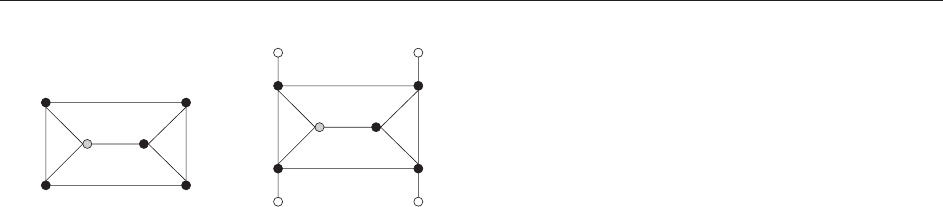
. The set of vertices N is partitioned into four
different types, the input vertices I, the output
vertices J, the measurement vertices K and the
syndrome vertices L (see Figure 1). The edges of
the graph are undirected, and a pair of vertices can
be connected by at most d 1 edges, where self-
links are also allowed. The adjacency matrix (also
332 Finite Weyl Systems
denoted by ) is a symmetric matrix with entries
x
y
= 0, 1, ..., d 1 according to the number of
edges between x and y. Thus, the adjacency matrix
can be seen as a linear operator on F
N
with cyclic
field F = Z
d
. Each subset A N corresponds to a
linear projection onto the subspace F
A
F
N
, which
we denote by
A
. For a convenien t description we
introduce the following notation: the union of two
sets of vertices is written without the symbol [, that
is, instead of I [ J we write IJ:
Theorem 9 (Schlingemann 2002, 2004). Let Q
F
J
F
J
be an isotropic subspace and let $ be a
character of the stabilizer algebra A
Q
. Then there
exists a graph with input vertices I, output vertices
J, measurement vertices K and syndrome vertices L
such that the following holds:
(i) The linear operator
JK
IKL
is invertible.
(ii) The isotropic subspace Q consists of the vectors
(
J
JK
q,
J
q) with q 2 ker(
IK
JK
).
(iii) There is a unique vector a in the syndrome
subspace F
L
such that the expectation values of
the character $ are given by
$ wð
J
JK
q;
J
qÞðÞ¼
ðqþaÞ
t
ðqþaÞ
d
½31
with q 2 ker(
IK
JK
).
Theorems 8 and 9 provide different useful
characterizations of stabilizer codes, namely in
terms of eigenspaces, Clifford channels, and graphs.
The original definition of stabilizer codes in terms of
eigenspaces goes back to Calderbank, Gottesman,
Rains, Shor, and Sloane (see, e.g., Calderbank et al.
(1997), Gottesman (1996, 1997). They have devel-
oped an approach to derive quantum codes from
classical binary codes.
Stabilizer codes can also be characterized by
specific Clifford channels (see Theorem 8). The
condition for a channel to be a stabilizer code is
the covariance with respect to a subgroup of
phase space translations. This reflects stabilizer
codes in terms of symmetries.
Theorem 9 yields a characterization of stabilizer
codes in terms of graphs providing an explicit
expression for the isotropic subspace and the
character of the stabilizer code. This graphical
representation provides a suggestive encoding of
various properties like error-correcting capabil-
ities, multipartite entanglement, the effects of
specific local operations. In fact, as it has been
shown in Briegel and Raus sendorf (2001), Du¨r
et al. (2003), and Hein et al. (2004) that the
entanglement present in a graph state can be
derived from its shape.
See also: Capacities Enhanced by Entanglement;
Quantum Error Correction and Fault Tolerance.
Further Reading
Briegel H-J and Raussendorf R (2001) Persistent entanglement
in arrays of interacting particles. Physical Review Letters
86: 910.
Calderbank AR, Rains EM, Shor PW, and Sloane NJA (1997)
Quantum error correction and orthogonal geometry. Physical
Review Letters 78: 405–408.
Cleve R and Gottesman D (1997) Efficient computations of
encodings for quantum error correction. Physical Review A
56: 76–83.
Du¨ r W, Aschauer H, and Briegel H-J (2003) Multiparticle
entanglement purification for graph states. Physical Review
Letters 91: 107903.
Gottesman D (1996) Class of quantum error-correcting codes
saturating the quantum Hamming bound. Physical Review A
54: 1862.
Gottesman D (1997) Stabilizer Codes and Quantum Error
Correction. Ph.D. thesis, CalTec.
Hein M, Eisert J, Du¨ r W, and Briegel H-J (2004) Multi-party
entanglement in graph states. Physical Review A 69: 062311.
Holevo AS (n.d.) Remarks on the classical capacity of quantum
channel, quant-ph/0212025.
Holevo AS (2004) Additivity conjecture and covariant channels.
In Proc. Conference Foundations of Quantum Information.
Camerino.
Klappenecker A and Roetteler M (2002) Beyond stabilizer codes
I: Nice error bases. IEEE Transactions on Information Theory
48(8): 2392.
Klappenecker A and Roetteler M (2005) On the monomiality of
nice error bases. IEEE Transactions on Information Theory
51(3): 1.
Schlingemann D-M (2000) Stabilizer codes can be realized as
graph codes. Quant. Inf. Comp. 2(4): 307–323.
Schlingemann D-M (2004) Cluster states, graphs and algorithms.
Quant. Inf. Comp. 4(4): 287–324.
Schlingemann D-M and Werner RF (2001) Quantum error-
correcting codes associated with graphs. Physical Review A
65: 012308.
(1, 1) ~ iY (1,
0) ~ Z
(1,
0) ~ Z
(0,
0) ~ 1
(1,
1) ~ iY
10
0
0
0
1
1
1
1
(a) (b)
Figure 1 (a) A graphical representation of a Weyl operator
Y Y Z Z 1 of the stabilizer algebra of a quantum error
correcting code, encoding one qubit into five (see 00273). The
input vertex is gray, the output vertices are black. Each binary
vector represents a Pauli matrix sitting at a tensor position of the
output system. (b) The expectation values which are products
over all edges, where to each edge with labels q, q
0
the value
(1)
qq
0
is assigned. The character corresponds to the syndrome
configuration (1110) (blanc vertices).
Finite Weyl Systems 333

Schlingemann D-M and Werner RF (2005) On the structure of
Clifford quantum cellular automata. Preprint (in preparation).
Scutaru H (1979) Some remarks on covariant completely positive
linear maps. Rep. Math. Phys. 16: 79–87.
Werner RF (2001) All teleportation and dense coding schemes.
Journal of Physics A 35: 7081.
Zmud EM (1971) Symplectic geometries over finite abelian
groups. Mathematics of the USSR Sbornik 15: 7–29.
Zmud E (1972) Symplectic geometry and projective representa-
tions of finite abelian groups. Mathematics of the USSR
Sbornik 16: 1–16.
Finitely Correlated States
R F Werner, Technische Universita
¨
t Braunschweig,
Braunschweig, Germany
ª 2006 Elsevier Ltd. All rights reserved.
Introduction
A typical problem of quantum statistical mechanics is
to compute equilibrium states of quantum dynamical
systems. However, there is a strange difficulty inherent
in this task, which is to describe the solution: if we try
to describe the quantum state by specifying all matrix
elements of all local density operators, we have a job
which grows exponentially with the system size. This
approach is obviously out of the question for the large
systems statistical mechanics is interested in. Luckily,
in practice nobody really wants to see all those
numbers anyway, and one is content with determining
a few correlation functions, or other easily parame-
trized characteristics of the state. But for computing a
state in the first place, we cannot restrict the state
description to a such parameters. So the problem there
is again: how can we efficiently parametrize the states
of interest?
In this article we collect some results on a
particular way of addressing this problem. It
originated in the early 1990s (Fannes et al. 1992b)
in ideas for quantizing the notion of Markov chains
(Accardi and Frigerio 1983). Recently, there has
been a new surge of interest in such ideas, because
they turned out to be very useful for numerical work
on quantum spin chains.
Its typical feature is that one does not directly
describe expectation values of the state, but instead
generates the state from a description of its correla-
tions between neighboring sites. In the language of
quantum information theory, it could be said that
the method focuses on the entanglement between
different parts of the system.
The Basic Construction
Notation
We consider a quantum spin chain, that is, a system
of infinitely subsystems, labeled by the integers, each
of which is a quantum-mechanical d-level system.
Let us denote the observable algebra at site x 2 Z by
A
x
. Each A
x
is hence isomorphic to the d d
matrices. The observables of the whole (infinite)
system lie in the infinite tensor product
A
Z
=
N
x2Z
A
x
. This is defined as a quasilocal
algebra (Bratteli and Robinson 1987, 1997), which
is to say that it is the algebra generated by all finite
tensor products of elements of the A
x
, say
N
x2
A
x
with A
x
2A
x
and finite. Such an element is said
to be localized in , and we denote by A
the
corresponding algebra. For
1
2
, we identify A
1
with a subalgebra of A
2
, by tensoring with the
identity operator on all sites in
2
n
1
. A
Z
is the
completion of the union of all A
, with finite,
under the C
-norm.
A state ! on A
Z
is uniquely specified by its
expectations on the subalgebras A
. Since these are
finite-dimensional matrix algebras, we can write
!(A) = tr(
A) for A 2A
, with a ‘‘local density
operator’’
. The system of local density operators
must be consistent with respect to restrictions
(partial traces).
So far we have not used the structure of the
underlying lattice Z in any way. This enters via the
translation automorphisms
n
of A
Z
, which identify
A
x
with A
xþn
. A state is called translationally
invariant, if !
n
= !. The translationally invariant
states form a weakly compact convex subset of the
state space of A
Z
, whose extreme points are called
ergodic states.
How to Generate Correlations
Correlations between parts of a systems typically
have their origin in an interaction in the past. Even
if the subsystems are dynamically separated later on,
the correlation persists, and one can take this as a
motivation to model correlations from two ingredi-
ents: a simp lified prototype of a correlated system,
and some evolution taking the parts of the simplified
system to the parts of the given system. Let us
consider a composite system, whose parts have
observable algebras A
1
and A
2
, respectively, so
that the whole system has algebra A
1
A
2
. We can
build a state ! on this system from a simpler one,
334 Finitely Correlated States
say a state on some B
1
B
2
, and two completely
positive unit preserving maps T
i
: A
i
!B
i
such that
!ðA
1
A
2
Þ¼ T
1
ðA
1
ÞT
2
ðB
2
ÞðÞ
Some features of are inherited by !. For example,
when is separable (a convex combination of
products), which is always the case if either B
1
or
B
2
is classical (i.e., an abelian algebra), then the
same holds for ! . Hence, if we want to describe
quantum correlated ‘‘entangled’’ states, we have to
build the correlations on an entangled state .
Similarly, the ‘‘size’’ of the model system B
1
B
2
limits the strength of correlations in !. As for every
correlated state, we can look at the linear func-
tionals on A
2
, which are of the form A 7!!(A
1
A)
with fixed A
1
2A
2
. The dimension of the space of
such functionals might be called the correlation
dimension of !. This dimension is 1 for product
states, and can clearly not increase by passing from
to !. Hence, it is bounde d by the dimensions of B
1
and B
2
, even if A
1
and A
2
are infinite dimensional.
‘‘Finite correlation’’ in the sense of the title of this
article refers to the finiteness of the correlation
dimension between the two halves of a spin chain.
The VBS Construction, and Matrix Product States
The so-called valence bond solid (VBS) states on a
chain are constructed by applying these ideas to the
correlations across every link of a spin chain. Let us
introduce a correlated model state
x
on some
algebra B
x
B
þ
x
for every bond (x, x þ 1). Then
the state at site x is a function of contributions from
both bonds connecting it, and we express this by a
completely positive map T
x
: A
x
!B
þ
x1
B
x
. Then
an observable A
1
A
L
on a chain piece of
length L is first mapped by
N
L
x = 1
T
x
to an element
of B
þ
0
B
1
B
þ
L1
B
L
. Evaluating with the
states
1
L1
, we are left with an element of
B
þ
0
B
L
, which we can evaluate with yet another
state
0L
describing the boundary conditions for the
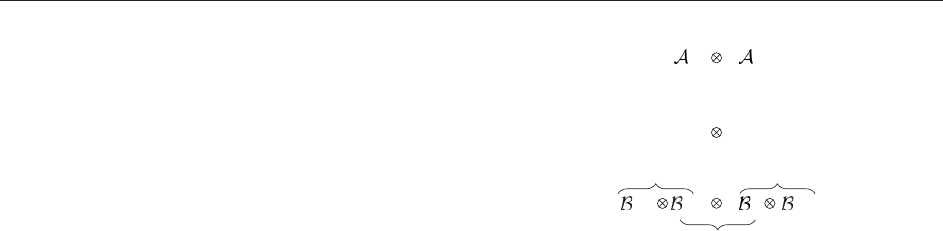
construction (see Figure 1).
Clearly, if we take the algebras B
x
large enough,
and the model states
x
sufficiently highly entangled,
we can generate every state on the finite chain.
However, we can get an interesting class of states,
even for fixed finite dimensions of the B
x
.By
restricting this correlation dimension, we can set a
level of complexity for the state description. We can
then try to handle a given physical proble m first
with simple states of low correlation dimension, and
increase this parameter only as needed. A typical
problem here is to determine the ground state of a
finite-range Hamiltonian. We can then optimize
each T
x
and
x
separately, minimizing the ground
state energy with all other elements fixed. This is a
semidefinite programming problem, for which very
efficient methods are known. The global minimiza-
tion is then done by letting the optimization site x
sweep over the whole chain as often as needed.
In a ground-state problem one is looking for a
pure state, and it is therefore sufficient to choose
both the model states
x
and the operations T
x
to
pure, that is, without decomposition into sums of
similar objects. The scheme is thus run at the vector
level rather than the operator level: we take the
algebras B
þ
x
= B
x
as the operators on a Hilbert space
K
x
, and
x
= (dim K
x
)
1
j
x
ih
x
j with the (unnor-
malized) maximally entangled vector
x
¼
X
j
jjijji2K
x
K
x
½1
The maps T
x
will be implemented by a single
operator V
x
: K
x1
K
x
!H as T
x
(A) = V
x
AV
x
.
Then the vectors 2H
L
contributing to the state
on the chain of length L are of the form
¼ V
1
V
L
jj
0
i
L
ji
L
¼
X
j
0
;j
1
;...;j
L
ðV
1
V
L
Þjj
0
; j
1
; j
1
; ...; j
L1
; j
L
i
where j
0
, j
L
are labels for bases in K
0
and K
L
,
describing the possible choices at the boundary, and
we have used the special form of . We write out
the operators V
x
in components, so that
V
x
jjj
0
i¼
X
jiV
x;jj
0
with suitable dim K
x1
dim K
x
dimensional
matrices V
x
, in terms of which the above expression
can be interpreted as a matrix product. The
components of in a product basis {ji} become
h
1
; ...;
L
ji¼hj
0
jV
1
1
V
2
2
V
L
L
jj
L
i½2
Due to this form the states generated in this way
have also been called ‘‘matrix product states’’
(Klu¨ mper 1991). If one wants to consider periodic
. . .
.
. .
.
. .
.
. .
.
. .
.
. .
.
. .
.
. .
↓
η
x
C
x x + 1
T
x
↓
T
x + 1
↓
–
x
– 1
+
x
–
x
+
x
+ 1
Figure 1
Finitely Correlated States 335