
Francoise J.-P., Naber G.L., Tsun T.S. (editors) Encyclopedia of Mathematical Physics
Подождите немного. Документ загружается.


boundary conditions, the indices j
0
and j
L
can also
be contracted, and the expression becomes a trace.
For some simulations it is also convenient to choose
K
0
= dim K
L
= 1, so there is only one matrix
element to be considered.
The scheme for getting ground-state vectors
described here is essentially the same as the density
matrix renormalization group method (Verstraete
et al. 2004). However, the version given here
appears to be more transparent, more flexible, and
in some cases (e.g., periodic boundary conditions)
vastly more efficient. However, it may be too early
for such judgment, since this is very much work in
progress (Verstraete et al. 2005).
In the sequel, we will focus not so much on the
numerical aspects, but on the possibility this
construction offers to explicitly construct nontrivial
translationally invariant states on the infinite chain.
Numerically, even in a translation invariant situa-
tion the matrices V
x
obtained by optimization may
turn out to depend on x (Wolf, Private Commu-
nication), that is, one has to admit the possibility of
a spontaneous symmetry breaking. However, for the
construction of states on the infinite chain we will
simply fix all V
x
to be equal. In some sense this
turns the matrix product into a matrix power, which
could be analyzed by methods familiar from the
transfer matrix formalism of statistical mechanics.
In eqn [2] this does not work, because of the
-dependence of the matrices involved. Neverthe-
less, a slight reorganization of the constr uction will
lead to a transfer-matrix-like formalism.
The Evolution Operator Construction
Fixing all T
x
to be the same in Figure 1 still does not
fix the state uniquely, since both in the mixed state
version and in the pure state version of the
construction some boundary information enters, as
well. This boundary information then has to be
chosen in such a way that a consistent family of
local density operators is generated. It turns out that
by rearranging the construction a little bit one can
trivially solve one boundary condition, and reduce
the other to finding a fixed point of a linear
operator. This rearrangement was first carried out
in Fannes et al. (1992b), where the term ‘‘finitely
correlated state’’ was also coined.
The basic element of the VBS construction was
the operators T : A!B
þ
B
(here already taken
independent of x). This is specified by dim A
dim B
þ
dim B
matrix elements. However, assum-
ing we can identify the algebras B
, we can also
consider these matrix elements as those of an
‘‘evolution operator’’ E : AB!B. This operator
is once again taken to be completely positive and
unit preserving. We introduce its nth iterat e
E
(n)
: A
n
B!Bby the recursion
E
ð1Þ
¼ E; E
ðnþ1Þ
¼ Eðid
A
E
ðnÞ
Þ½3
Clearly, these operators are again completely posi-
tive and unit preserving. Anot her way to express this
iteration is to look at E as a family of maps on B,
parametrized by A 2A: We set E
A
(B) = E(A B),
and find
E
ðnÞ
ðA
1
A
n
BÞ¼E
A
1
E
A
1
ðBÞ½4
An important special role is played by the operator
b
E = E
1
, which is again completely positive and unit
preserving.
Now given any state on B, we get a state !
n
on
A
n
, by setting
!
n
ðA
1
A
n
Þ¼ E
ðnÞ
ðA
1
A
n
1Þ
½5
Since
b
E(1) = 1, this family of states is consistent
with respect to increasing n, by adding sites on the
right, that is, !
nþ1
(A 1) = !
n
(A). In other words,
the family !
n
defines a state on the infinite right
half-chain. This state can be extended to the full
chain, as a translationally invariant state if and
only if consistency also holds for adding sites
on the left, that is, if !
nþ1
(1 A) = !
n
(A) for all
A 2A
n
. For this we need a condition on the state
: it must be invariant under the map
b
E (i.e.,
(
b
E(B)) = (B) for all B 2B). This is the only
requirement, and we call ! the state A
Z
generated
by E and . Note that since
b
E has the invariant
vector 1, its transpose also has an invariant vector,
which can also be chosen as a stat e. We will often
look at unique invariant state, in which case we can
call ! the state generated by E, without having to
mention .
The valence bond picture was very much sug-
gested by trying to describe correlations in a
spatially distributed quantum system (the chain).
The construction given here is perhaps more readily
suggested by a process in time, rather than space. In
fact, the paper by Fannes et al. (1992b) was partly
motivated by an attempt to define a quantum analog
of Markov processes (Accardi and Frigerio 1983). In
fact, we can think of the construction as a general
form for a repeated measurement in quantum
theory. The object on which the measurements are
performed has observable algebra B, whereas
A describes the successive outputs. Choosing A to
be classical (abelian) we would find in ! the joint
probability distribution of the sequence of measured
values, when the initial state of the object is (not
necessarily invariant). Allowing nonabelian A would
336 Finitely Correlated States

then correspond to a family of delayed choice
experiments: while E describes the interaction of
the system with the measurement apparatus (includ-
ing the overall state change
b
E), we are still free to
make correlated and even entangled measurements
on the successive output systems. This interpretation
suggests many extensions, in particular, to continu-
ous time (where the case of abelian outputs is
discussed extensively in the classic book by Davies
1976), or to cases allowing an external quantum
input in each step, in which case we are looking at a
quantum channel with memory B (Kretschmann and
Werner 2005).
In spite of the different natural interpretations,
however, the constructions in this and previous
paragraphs give exactly the same class of transla-
tionally invariant states on the chain, as was shown
in (Fannes et al. 1992b).
Ergodic Decomposition
A state on A
Z
is called ergodic if it is an extreme
point of the compact convex subset of translation-
ally invariant states. Often in statistical mechanics,
one finds states which may be ergodic, but never-
theless contain a breaking of translation symmetry.
Such states can be decomposed into periodic states,
that is, states which are invariant with respect
to some power of the shift. In general, new
decompositions may become possible for any
period. If no decomposition into periodic states is
possible, the state is called completely ergodic.
In this section we consider the question of how to
decompose a finitely correlated state into ergodic
components, using a well-established connection
between ergodicity and clustering properties
(Bratteli and Robinson 1987, 1997), that is, the
decay of correlation functions.
Correlation functions are very easily evaluated for
finitely correlated states: let A
be two observables
localized on n
sites, and suppose that these sites are
separated by L sites. Then eqn [5] gives
! A
1
L
A
þ
¼ E
ðn
Þ
A
b
E
L
E
ðn
þ
Þ
A
ð1Þ
½6
The L-dependence of this operator is clearly
governed by the matrix powers of
b
E. By assumption
this operator always has the eigenvalue 1, because
b
E(1) = 1, and has norm 1, because it is also
completely positive. The spectrum is hence
contained in the unit circle. Each eigenvalue with
modulus <1 thus contributes exponentially decay-
ing terms to the correlation function [6]. From
eigenvalues of modulus 1, which make up the
so-called peripheral spectrum, we may get constant
or periodic contributions. This distinction is directly
reflected in the ergodic properties (Fannes et al.
1992b):
When the eigenvalue 1 is simple, there is a unique
invariant state , and lim
n
n
1
P
n1
k = 0
b
E
k
(B) =
(B )1. This implies, by [6] and (Bratteli and
Robinson 1987, 1997, theorem 4.3.22), that ! is
ergodic.
When the eigenvalue 1 is simple, the peripheral
spectrum consists precisely of the pth roots of
unity for some p 1. The state ! is then the
equal-weight convex combination of p periodic
states with period p, which are translates of each
other.
In particular (i.e., for p = 1), a peripheral spec-
trum consisting only of the simple eigenval ue 1
implies that ! is exponentially clustering in the
sense that
j! A
1
L
A
þ
!ðA
Þ!ðA
þ
Þj
poly ðLÞr
L
kA
kkA
þ
k½7
where r is the largest modulus of eigenvalues other
than 1, and poly is polynomial obtained from the
Jordan normal form of
b
E. By the previous item, the
state ! is then completely ergodic.
Conversely, if a state is finitely correlated, and is
ergodic (resp. completely ergodic), it has a
representation such that 1 is a simple eigenvalue
(resp. the peripheral spectrum is trivial).
Purity
Pure States
As in the case of the VBS construction, there is a
version of the evolution operator construction,
which is especially suited to produce pure stat es.
Pure states are those which cannot be decomposed
into a weighted sum of other states. For a
translationally invar iant state, this is a much
stronger property than ergodicity and even com-
plete ergodicity: not only the decomposition into
periodic states is impossible, but any decomposition
whatsoever. Nevertheless, this is what one expects
from a ground state of translationally invariant
interaction.
From the formula [5] it is clear that if we
decompose the E-operator entering for a site x into
a sum two completely positive terms, we will have
decomposed ! into two positive terms. These might
still be equal, but it is certainly suggestive to look at
states generated with an E, which cannot be
decomposed nontrivially into a sum of other
Finitely Correlated States 337

completely positive maps. Such maps are called
pure, and are characterized by the form
EðA BÞ¼V
ðA BÞV
V : C
k
! C
d
C
k
is isometric
½8
and A and B are the algebras of d d and k k
matrices, respectively. Finitely correlated states
generated from such a pure evolution operator are
called purely generated. These are the candidates for
pure finitely generated states.
The form of a pure map is reminiscent of the
Stinespring dilation of a general completely positive
map: for a general E, we can set
EðA BÞ¼V
ð1
~
A
A BÞV ½9
where
e
A is some auxiliary matrix algebra. Since the
invariance condition for does not involve the A
algebras, we get a purely generated state
e
! with one-
site algebra (
e
AA), whose restriction to the
original chain is !. Hence, purely generated states
are the prototypes from which all other finitely
correlated are obtained by sitewise restriction.
But are such states pure? Since
b
E need not have a
trivial peripheral spectrum, the previous section tells us
that a purely generated state may have a nontrivial
decomposition into other, perhaps periodic states. But
this is the only restriction we have to make. Indeed, the
following statements about a finitely correlated state !
are equivalent (Fannes et al. 1994,theorem1.5):
! is pure;
! is purely generated, and the operator
b
E has
trivial peripheral spectrum;
the mean entropy of ! vanishes, and ! is
clustering, that is, [7] holds; and
E has the form [8], and no subalgebra of B, which
contains 1, is invariant under all operators E
A
.
The Asymptotic Form of the Local Support
Let us now fix an isometry V, such that
b
E has trivial
peripheral spectrum, and let denote the unique
invariant state of
b
E. Then the vectors 2H
n
in
the support of ! are of the form [2] and depend,
apart from the fixed choice of the V
x
V
, on the
boundary indices j
0
, j
n
= 1, ..., k. We can consider
this as a map
n
from k k matrices to H
n
:
h
1
; ...;
n
j
n
ðBÞi ¼ trðBV
1
V
2
V
n
Þ½10
and denote the range of
n
by G
n
. Then G
n
is at most
k
2
-dimensional. Moreover, this family of subspaces
is nested, that is, G
nþm
G
n
H
n
and G
nþm
H
m
G
m
. Using that
b
E(B)
n
!(B)1 converges
exponentially fast, we also find that
n
is asympto-
tically an isometry between G
n
, and the Hilbert
space of k k matrices with scalar product
hB, Ci
= tr( B
C). Hence, all the spaces G
n
are
asymptotically identified, even though they are
contained in each other. This ‘‘self-similarity’’ is
the source of many further properties. For example,
for any density matrix
e
on ‘ þ m þ r sites supported
by G
‘þmþr
, and any observable A, localized on m
sites in the middle of this interval (with ‘ to the
left and r to the right), we get the expectation
tr(
e
A) !(A), up to exponentially small terms
depending only on ‘ and r.
Ground States and Gaps
Suppose we fix some interval length ‘, and let h be
the projection onto the complement of G
‘
in H
‘
.
We now consider h as the interaction term of a
lattice interaction, that is, we consider the formal
Hamiltonian
H ¼
X
x
x
ðhÞ½11
Then in the finitely correlated state !, each term in
this sum has expectation zero, which is the absolute
minimum for such expectations, because h 0. In
this sense ! is the ground state for this Ham iltonian.
Usually, ground states are not characterized in this
way: one can only require that the average energy is
minimized with respe ct to all translationally invar i-
ant states ( Bratteli and Robinson 1987, 1997,
theorem 6.2.58). Hence, one can usually perturb a
ground state local ly such that some terms in [11]
have less than average expectation, at the expense of
others. For ! this is clearly impossible. Moreover,
any state !
0
with !
0
(
x
(h)) = 0 for all x must coincide
with !, even if we do not impose translation
invariance. This follows from the previous section:
the local density operators of !
0
must all be
supported in G
n
by the nesting property; hence, if
we compare den sity operators on intervals of length
‘ þ m þ r on observables localized on the middle m
sites, we get !
0
(A) !(A), up to errors exponentially
small in ‘ and r.
The Hamiltonian [11] involves an infinite sum,
which can be mathematically understood as a
quadratic form in the GNS-representation associated
with ! (Bratteli and Robinson 1987, 1997). This is
the Hilber t space spanned by vectors written as A,
with the scalar products hA , B!i= ! (A
B), for
local operators A, B. The ground-state property then
implies H=0, and H 0, because h 0. It can be
seen that H generates a well-defined dynamics, and
is essentially self-adjoint on the domain of such
vectors. Thus also the spectrum of H is a well-
defined concept . This suggests a strengthening of the
338 Finitely Correlated States

ground-state property: not only is the unique
eigenvector of H for eigenvalue 0, but there is a gap
>0 between zero and the next eigenvalue. This
property is of considerable interest for models in
solid-state phy sics and statistical mechanics. It was
shown for all ergodic pure finitely correlated states
in (Fannes et al. 1992b).
Density
Density of Finitely Correlated Pure States
The natural topology in which to consider the
approximation between states on the chain is the
weak topology. A sequence !
n
converges weakly to
! if for all local A the expectations converge, that is,
!
n
(A) !!(A).
Let us start from an arbitrary translationally
invariant state !, and see how we can approximate
it. First, we can split the chains into intervals of
length L, and replace ! by the tensor product of the
restrictions of ! to each of these intervals. This state
is not translational ly invariant, so we average it over
the L translations, and call the resulting state !
L
.
Consider a local observable A, whose localization
region has length R. Then for L R out of the L
translates contributing to !
L
the expectation will be
the same as for !, and we get
!
L
ðAÞ¼ 1
R
L
!ðAÞþ
R
L
e
!ðAÞ;
where the error term
e
! is again a state. Hence, !
L
converges weakly to ! as L !1. One can show
easily that !
L
is finitely correlated, with an algebra
B essentially equal to A
L
. Hence, the finitely
correlated states are weakly dense in the set of
translationally invariant states.
We can make the approximating states purer by a
very simple trick. In the previous construction we
always take two intervals together, and replace the
tensor product of the two restrictions by a purifica-
tion, that is, by a pure state on an interval of length
2L, whose restrictions to the two length-L subinter-
vals coincide with !. We average this over 2L
translates, and call the result
L
. The estimates
showing that
L
!! weakly are exactly the same as
before. Moreover, one can show (Fannes et al.
1992a) that
L
is purely generated.
Being defined as a convex combination of other
states,
L
is not pure, and the peripheral spectrum of
b
E will contain all the 2Lth roots of unity. However,
we can use that such a rich peripheral spectrum is
not generic for
b
E constructed from an isometry V.
Therefore, if we choose an isometry V
"
close to the
isometry V generating
L
, we obtain a purely
generated state
"
L
with trivial peripheral spectrum.
Since the expression for expectations of such states
depends continuously on the generating isomet ry,
we have that
"
L
!
L
as " !0. But we know from
the previous section that such states are pure.
Hence, the pure finitely correlated states are weakly
dense in the set of all translationally invariant states
(Fannes et al. 1992a).
This has implications for the geometry of the
compact convex set of translationally invariant
states, which are rathe r coun ter-intuitive for the
intuitions trained on finite-dimensional convex
bodies. To begin with, the extreme points (the
ergodic states) are dense in the whole body. This is
not such a rare occurrence in infinite-dimensional
convex sets, and is shared, for example, by the set of
operators F with 0 F 1 on an infinite-dimen-
sional Hilbert space (Davies 1976). Together with
the property that the translationally invariant states
form a simplex, it actually fixes the structure of this
compact convex set to be the so-called Poulsen
simplex. Thi s was known also without looking at
finitely correlated states. The rather surprising result
of the above density argument is that even the small
subclass of states which are extremal, not only in the
translationally invariant subset but even in the
whole state space, is still dense.
Finitely Correlated Pure States with
Bounded Memory Dimension
It is clear in the above construction that the dimension
of the algebra B goes to infinity for an approximating
sequence. How many states can we get with a fixed
memory algebra B? The dimension of this manifold
can be estimated easily from the number of parameters
needed to describe the map E, and this dimension is
certainly small compared to the dimension of the state
space of the length L piece of the chain as L !1.
However, since this is an infinite set, and not a linear
subspace, we do not get an immediate bound on the
dimension of the linear span of these states. What we
want to show in this section is that the space of finitely
correlated states with fixed B nevertheless generates a
low-dimensional subspace of states on any large
interval of the chain. To this end we will have to
exhibit many observables A,localizedonL sites,
whose expectation is the same for all finitely correlated
states with given B.
Let us look first at the case of purely generated
states, or rather at the vectors 2H
L
, which can
be written in the form [2], which in the translation
invariant case becomes
h
1
; ...;
L
ji¼hj
0
jV
1
V
2
V
L
jj
L
i½12
Finitely Correlated States 339

for some collection V
1
, ..., V
d
of k k matrices, and
some basis labels j
0
, j
L
2 {1, ..., k}. The span of all
such vectors will be denoted by V
L
(k, d), and we would
like to analyze the growth of dim V
L
(k, d), as L !1.
Now a vector with components a(
1
, ...,
L
) lies in the
orthogonal complement of V
L
(k, d) if and only if
X
1
;...;
L
að
1
; ...;
L
ÞV
1
V
2
V
L
¼ 0
for any collection of matrices V
. In other words, this
expression, considered as a noncommutative polyno-
mial in d variables, is a polynomial identity for k k
matrices. The simplest such identity, for k = 2,
d = 3, L = 5, is [A,[B, C]
2
] = 0. (For the proof observe
that [B, C] is traceless, so its square is a multiple of the
identity by the Cayley–Hamilton theorem.) This
identity alone implies the existence of many more
identities. For example, we can substitute higher-order
polynomials for A, B, C, and multiply the identity with
arbitrary polynomial from the right or form the left.
There is a well-developed theory for such identities,
called the theory of polynomial identity (PI) rings. In
that context, the precise growth we are looking for has
been worked out (Drensky 1998):
lim
L!1
log dim V
L
ðk; dÞ
log L
¼ðd 1Þk
2
þ 1 ½13
Thus, the dim V
L
(k, d) only grows like a polynomial
in L, of known degree, and the joint support of all
purely generated finitely corre lated state is exponen-
tially small compared to H
L
.
We can apply the same idea to the set of all finitely
correlated states with B equal to the k k matrices.
The joint support in this case is the full space, since the
trace state on the chain, which is a product state
generated with k = 1, already has full support. How-
ever, it is still true all but a polynomial number of
expectation values of ! are already fixed by specifying
k. Indeed, formula [5] for a general state is precisely of
the form [12], with the difference that the arguments A
replace , and the matrices E
A
are now operators on
the k
2
-dimensional space B. If we only want an upper
bound, we can ignore subtlatties coming from Hermi-
ticity and normalization constraints on E, and we get
that the dimension of all finitely correlated states
generated from the k k matrices, restricted to a
subchain of length L, grows at most like L
,with
(d
2
1)k
2
þ 1.
See also: Ergodic Theory; Quantum Spin Systems;
Quantum Statistical Mechanics: Overview.
Further Reading
Accardi L and Frigerio A (1983) Markovian cocycles. Proceedings
of the Royal Irish Academy 83A: 251–263.
Bratteli O and Robinson DW (1987, 1997) Operator Algebras
and Quantum Statistical Mechanics I, II, 2nd edn. Springer.
Davies EB (1976) Quantum Theory of Open Systems. Academic
Press.
Drensky V (1998) Gelfand–Kirillov dimension of PI-algebras. In:
Methods in Ring Theory, (Levico Terme, 1997), Lecture Notes in
Pure and Appl. Math., vol. 198, pp. 97–113. New York: Dekker.
Fannes M, Nachtergaele B, and Werner RF (1992a) Abundance of
translation invariant pure states on quantum spin chains. Lett.
Mathematical Physics 25: 249–258.
Fannes M, Nachtergaele B, and Werner RF (1992b) Finitely
correlated states on quantum spin chains. Communications in
Mathematical Physics 144: 443–490.
Fannes M, Nachtergaele B, and Werner RF (1994) Finitely
correlated pure states. Journal of Functional Analysis 120:
511–534.
Klu¨ mper A, Schadschneider A, and Zittartz J (1991) Journal of
Physics A 24: L955.
Kretschmann D and Werner RF (2005) Quantum channels with
memory, quant-ph/0502106.
Verstraete F, Porras D, and Cirac JI (2004) DMRG and periodic
boundary conditions: a quantum information perspective.
Physical Review Letters 93: 227205.
Verstraete F, Weichselbaum A, Schollwo¨ck U, Cirac JI, and
von Delft J (2005) Variational matrix product state approach
to quantum impurity models, cond-mat/0504305.
Wolf M private communication.
Finite-Type Invariants
D Bar-Natan, University of Toronto, Toronto, ON,
Canada
ª 2006 D Bar-Natan. Published by Elsevier Ltd.
All rights reserved.
Introduction
Knots belong to sailors and climbers and upon further
reflection, perhaps also to geometers, topologists, or
combinatorialists. Surprisingly, throughout the 1980s,
it became apparent that knots are also closely related
to several other branches of mathematics in general
and mathematical physics in particular. Many of these
connections (though not all!) factor through the
notion of ‘ ‘finite-type invariants’’ (aka ‘ ‘Vassiliev’’ or
‘‘Goussarov–Vassiliev’’ invariants) (Goussarov 1991,
1993, Vassiliev 1990, 1992, Birman-Lin 1993,
Kontsevich 1993, Bar-Natan 1995).
Let V be an arbitrary invariant of oriented knots in
oriented space with values in some abelian group A.
Extend V to be an invariant of 1-singular knots, knots
that may have a single singularity that locally looks like
a double point
%-, using the formula
340 Finite-Type Invariants
Vð
%-Þ ¼ Vð ÞVð Þ½1
Further extend V to the set K
m
of m-singular
knots (knots with m double points) by repeatedly
using [1].
Definition 1 We say that V is of type m if its
extension Vj
K
mþ1
to (m þ 1)-singular knots vanishes
identically. We also say that V is of finite type if it is
of type m for some m.
Repeated differences are similar to repeated deriva-
tives; hence, it is fair to think of the definition of Vj
K
m
as repeated differentiation. With this in mind, the
above definition imitates the definition of polynomials
of degree m. Hence, finite-type invariants can be
considered as ‘‘polynomials’’ on the space of knots.
As described in the section ‘‘Basic facts’’, finite-type
invariants are plenty and powerful and they carry a
rich algebraic structure and are deeply related to Lie
algebras. There are several constructions for a
‘‘universal finite-type invariant’’ and those are related
to conformal field theory, the Chern–Simons–Witten
topological quantum field theory, and Drinfel’d’s
theory of associators and quasi-Hopf algebras (see
the section ‘‘The proofs of the fundamental theo-
rem’’). Finite-type invariants have been studied
extensively (see the section ‘‘Some further directions’’)
and generalized in several directions (see the section
‘‘Beyond knots’’). But the first question on finite-type
invariants remains unanswered:
Problem 2 Honest polynomials are dense in the
space of functions. Are finite-type invariants dense
within the space of all knot invariants? Do they
separate knots?
In a similar way, one may define finite-type
invariants of framed knots (and ask the same
questions).
Basic Facts
Classical Knot Polynomials
The first (nontrivial!) thing to notice is that there are
plenty of finite-type invariants and they are at least
as powerful as all the standard knot polynomials
combined (finite-type invariants are like polynomials
on the space of knots; the standard phrase ‘‘knot
polynomials’’ refers to a different thing – knot
invariants with polynomial values):
Theorem 3 (Bar-Natan 1995, Birman-Lin 1993).
Let J(K)(q) be the Jones polynomial of a knot K (it is
a Laurent polynomial in a variable q). Consider the
power series expansion J(K)(e
x
) =
P
1
m = 0
V
m
(K)x
m
.
Then each coefficient V
m
(K) is a finite-type knot
invariant (thus, the Jones polynomial can be
reconstructed from finite- type information).
A similar theorem holds for the Alexander–
Conway, HOMFLY-PT, and Kauffma n polynomials
(Bar-Natan 1995), and indeed, for arbitrary Reshe-
tikhin–Turaev invariants (Reshetikhin and Turaev
1990, Lin 1991), although it is still unknown if the
signature of a knot can be expressed in terms of its
finite-type invariants.
Chord Diagrams and the Fundamental Theorem
The top derivatives of a multivariable polynomial
form a system of constants which determine
the polynomial up to p olynomials of lower
degree. Likewise the mth derivative V
(m)
:=
V(
%-
m
%-)ofatypem invariant V is a constant (for
V(
%-
m
%- ) V(
%-
m
%- ) = V(
%-
mþ1
%-) = 0
so V
(m)
is blind to 3D topology), and likewise V
(m)
determines V up to invariants of lower type. Hence, a
primary tool in the study of finite-type invariants is the
study of the ‘ ‘top derivative’’ V
(m)
, also known as ‘‘the
weight system of V.’ ’
Blind to 3D topology, V
(m)
only sees the combi-
natorics of the circle that parametrizes an m-singular
knot. On this circle, there are m pairs of points that
are pairwise identified in the image; one indicates
those by drawing a circle with m chords marked (an
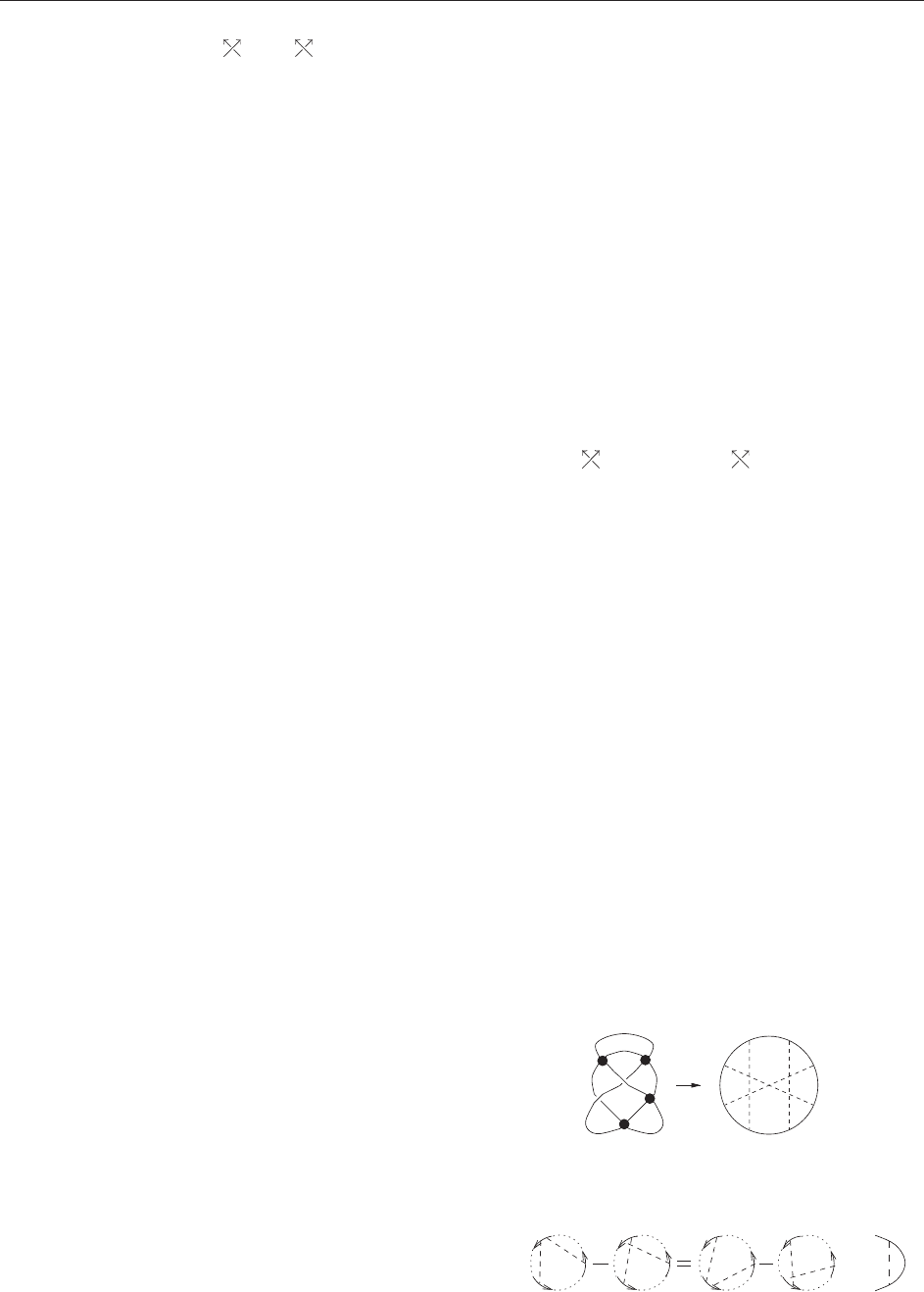
‘‘m-chord diagram’’) (see Figure 1).
Definition 4 Let D
m
denote the space of all formal
linear combinations with rational coefficients of
m-chord diagrams. Let A
r
m
be the quotient of D
m
by all 4T and FI relations as drawn in Figure 2 (full
details are given in, e.g., Bar-Natan (1995)), and let
^
A
r
be the graded completion of A :=
L
m
A
r
m
. Let
A
m
, A, and
^
A be the same as A
r
m
, A
r
, and
^
A
r
but without imposing the FI relations.
Theorem 5 (The fundamental theorem)
1
4
2
1
2
4
3
3
Figure 1 A 4-singular knot and its corresponding chord diagram.
4T : FI :
Figure 2 The 4T and FI relations.
Finite-Type Invariants 341

(Easy part). If V is a rational valued type
m-invariant then V
(m)
defines a linear functional on
A
r
m
. If in addition V
(m)
0, then V is of type m 1.
(Hard part). For any linear functional W on A
r
m
,
there is a rational valued type m invariant V so
that V
(m)
= W.
Thus, to a large extent, the study of finite-type
invariants is reduced to the finite (though super-
exponential in m) algebraic study of A
r
m
. A similar
theorem reduces the study of finite-type invariants
of framed knots to the study of A
m
.
The Structure of A
Knots can be multiplied (the ‘‘connected sum’’ opera-
tion) and knot invariants can be multiplied. This
structure interacts well with finite-type invariants and
induces the following structure on A
r
and A:
Theorem 6 (Kontsevich 1993, Bar-Natan 1995,
Willerton 1996, Chmutov et al. 1994). A
r
and A are
commutative and cocommutative graded bialgebras
(i.e., each carries a commutative product and a
compatible cocommutative coproduct). Thus, both
A
r
and A are graded polynomial algebras over their
spaces of primitives, P
r
=
m
P
r
m
and P =
m
P
m
.
Framed knots differ from knots only by a single
integer parameter (the ‘‘self-linking,’’ itself a type 1
invariant). Thus, P
r
and P are also closely related.
Theorem 7 (Bar-Natan 1995). P = P
r
hi, where
is the unique 1-chord diagram:
Bounds and Computational Results
Table 1 shows the number of type m-invariants of
knots and framed knots modulo type m 1 invar-
iants (dim A
r
m
and dim A
m
) and the number of
multiplicative generators of the algebra A in degree
m ( dim P
m
) for m 12. Some further tabulated
results are in Bar-Natan (1996).
Little is known about these dimensions for large m.
There is an explicit conjecture in Broadhurst (1997),
but no progress has been made in the direction of
proving or disproving it. The best asymptotic bounds
available are the following.
Theorem 8 For large m, dim P
m
> e
c
ffiffiffi
m
p
(for any
fixed c <
ffiffiffiffiffiffiffiffi
2=3
p
) and dim A
m
< 6
m
m!
ffiffiffiffiffi
m
p
=
2m
(Stoimenow 1998, Zagier 2001).
Jacobi Diagrams and the Relation
with Lie Algebras
Much of the richness of finite-type invariants stems
from their relationship with Lie algebras. Theorem 9
below suggests this relationship on an abstract level,
Theorem 10 makes that relationship concrete, and
Theorem 12 makes it a bit deeper.
Theorem 9 (Bar-Natan 1995). The algebra A is
isomorphic to the algebra A
t
generated by ‘‘Jacobi
diagrams in a circle’’ (chord diagrams that are also
allowed to have oriented internal trivalent vertices)
modulo the AS, STU, and IHX relations (see Figure 3).
Thinking of trivalent vertices as graphical analogs
of the Lie bracket, the AS relation becomes the
anti-commutativity of the bracket, STU becomes
the equation [x, y] = xy yx, and IHX becomes the
Jacobi identity. This analogy is made concrete
within the proof of the following:
Theorem 10 (Bar-Natan 1995). Given a finite-
dimensional metrized Lie algebra g (e.g., any semi-
simple Lie algebra), there is a map T
g
: A! U(g)
g
defined on A and taking values in the invariant part
U(g)
g
of the universal enveloping algebra U(g) of g.
Given also a finite-dimensional representation R of g
there is a linear functional W
g, R
: A!Q.
Table 1 Some dimensions of spaces of finite type invariants
m 01234 5 6 7 8 9 10 11 12
dim A
r
m
1 0 1 1 3 4 9 14 27 44 80 132 232
dim A
m
1123610193360104184316548
dim P
m
011123581218273955
Source: Bar-Natan (1995); Kneissler (1997).
+
=
=
AS :
STU
:
IHX
:
= 0
–
–
Figure 3 A Jacobi diagram in a circle and the AS, STU, and
IHX relations.
342 Finite-Type Invariants
The last assertion along with Theorem 5 show
that associated with any g, R, and m, there is a
weight system and hence a knot invariant. Thus,
knots are unexpectedly linked with Lie algebras.
The hope (Bar-Natan 1995) that all finite-type
invariants arise in this way was dashed by Vogel
(1997, 1999) and Liebe rum (1999). But finite-type
invariants that do not arise in this way remain rare
and not well understood.
The Poincare´–Birkhoff–Witt (PBW) theorem of
the theory of Lie algebras says that the obvious
‘‘symmetrization’’ map
g
: S(g) !U(g) from the
symmetric algebra S(g) of a Lie algebra g to its
universal envelo ping algebra U(g)isag-module
isomorphism. The following definition and theorem
form a diagrammatic counterpart of this theorem:
Definition 11 Let B be the space of formal linear
combinations of ‘‘free Jacobi diagrams’’ (Jacobi
diagrams as before, but with unmarked univalent
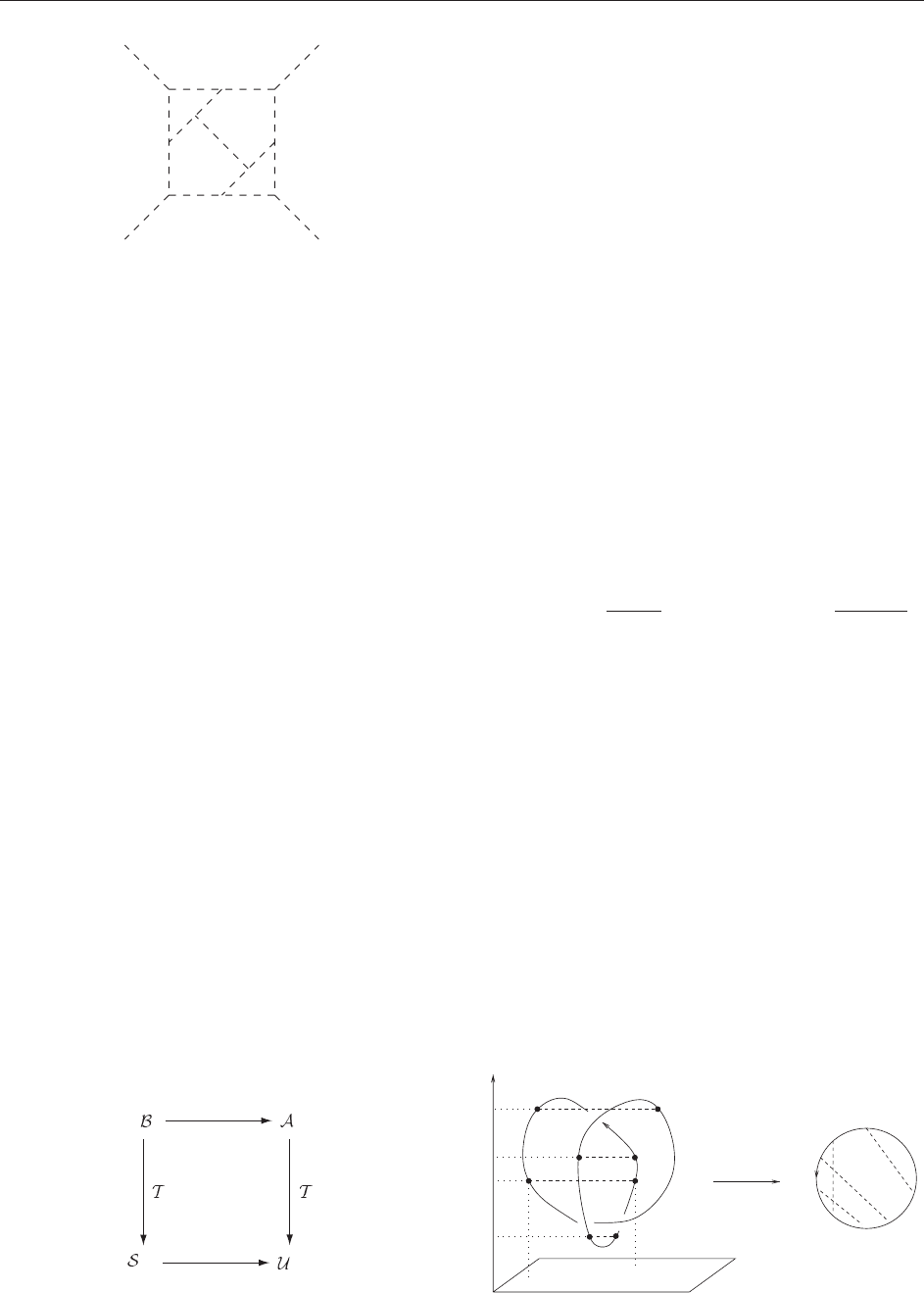
ends (‘‘legs’’) replacing the circle; see an example in
Figure 4), modulo the AS and IHX relations of before.
Let : B!Abe the symmetrization map which maps
a k-legged free Jacobi diagram to the average of the k!
ways of planting these legs along a circle.
Theorem 12 (Diagrammatic PBW; Kont sevich
1993, Bar-Natan 1995). is an isomorphism of
vector spaces. Furthermore , fixing a metrized g there
is a commutative square as in Figure 5.
Note that B can be graded (by half the number of
vertices in a Jacobi diagram) and that respects
degrees so it extends to an isomorphism :
^
B!
^
A
of graded completions.
Proofs of the Fundamental Theorem
The heart of all known proofs of Theorem 5 is
always a construction of a ‘‘universal finite-type
invariant’’ (see below); it is simple to show that the
existence of a universal finite-ty pe invariant is
equivalent to Theorem 5.
Definition 13 A universal finite-type invariant is a
map Z : {knots} !
^
A
r
whose extension to singular
knots satisfies Z(K) = D þ (higher degrees) when-
ever a singular knot K and a chord diagram D are
related as discussed before.
The Kontsevich Integral
The first construction of a universal finite-type
invariant was given by Kontsevich (1993) (see also
Bar-Natan (1995) and Chmutov and Duzhin
(2001)). It is known as ‘‘the Kontsevich integral’’
and up to a normalization factor it is given by
Z
1
ðKÞ¼
X
1
m¼0
1
ð2iÞ
m
X
t
1
<<t
m
P¼fðz
i
;z
0
i
Þg
Z
ð1Þ
#P
#
D
P
^
m
i¼1
dz
i
dz
0
i
z
i
z
0
i
where the relationship between the knot K, the pairing
P, the real variables t
i
, the complex variables z
i
and z
0
i
,
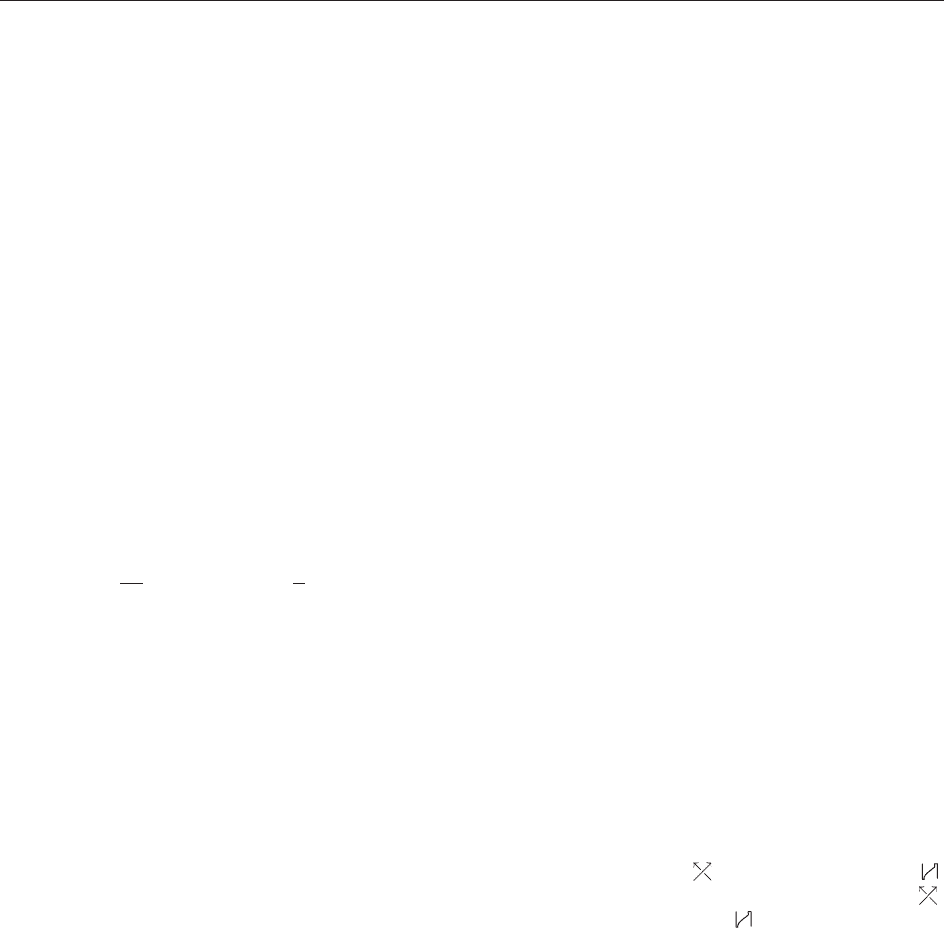
and the chord diagram D
P
is summarized in Figure 6
(the symbol
R
P
means ‘‘sum over all discrete variables
and integrate over all continuous variables.’’)
The Kontsevich integral arises from studying the
holonomy of the Knizhnik–Zamolodchikov equation
of conformal field theory (Knizhnik and Zamolodchi-
kov 1984). When evaluating Z
1
, one encounters
multiple -numbers (Le-Murakami 1995) in a sub-
stantial way, and the proof that the end result is
rational is quite involved (Le-Murakami 1996) and
relies on deep results about associators and quasitrian-
gular quasi-Hopf algebras (Drinfel’d 1990, 1991).
Employing the same techniques, in Le-Murakami
Figure 4 A free Jacobi diagram.
(ᒄ)
(ᒄ)
ᒄ
χ
χ
ᒄ
ᒄ
Figure 5 The diagrammatic PBW isomorphism and its
classical counterpart.
z
2
z ′
z
t
1
t
2
t
3
t
4
t
2
3
1
4
K
D
P
2
Figure 6 The key ingredients of the Kontsevich integral.
Finite-Type Invariants 343
(1996), it is also shown that the composition of W
g, R
Z
1
precisely reproduces the Reshetikhin–Turaev invar-
iants (Reshetikhin and Turaev 1990).
Perturbative Chern–Simons–Witten Theory
and Configuration Space Integrals
Historically, the first approach to the construction
of a universal finite-type invariant was to use
perturbation theory with the Chern–Simons–Witten
topological quantum field theory; this is also how
the relationship with Lie algebras first arose. But
taming the integrals involved turned out to be
difficult and working constructions using this
approach appeared only a bit later.
In short, one writes a perturbative expansion for
the large k asymptotics of the Chern–Simons–Witten
path integral for some metrized Lie algebra g with a
Wilson loop in some representation R of g,
Z
g
-
connections
DA tr
R
hol
K
ðAÞ
exp
ik
4
Z
R
3
tr A ^ dA þ
2
3
A ^ A ^ A
The result is of the form
X
D: Feynman diagram
W
gðDÞ;R
X
Z
EðDÞ
where E(D) is a very messy integral expression and
the diagrams D as well as the weights W
g(D), R
were
already discussed before. Replacing W
g(D), R
by
simply D in the above formula, we get an expression
with values in
^
A:
Z
2
ðKÞ :¼
X
D
D
X
Z
EðDÞ2
^
A
For formal reasons Z
2
(K) ought to be a universal
finite-type invariant, and after much work taming
the E(D) factors and after multiplying by a further
framing-dependent renormalization term Z
anomaly
,
the result is indeed a universal finite -type invariant.
Upon further inspection, the E(D) factors can be
reinterpreted as integrals of certain spherical volume
forms on certain (compactified) configuration spaces
(Bott–Taubes 1994) . These integrals can be further
interpreted as counting certain ‘‘tinker toy construc-
tions’’ built on top of K (Thurston 1995). The latter
viewpoint makes the construction of Z
2
visually
appealing (Bar-Natan 2000), but there is no satis-
factory write-up of this perspective yet.
We note that the precise form of the renormaliza-
tion term Z
anomaly
remains an open problem. An
appealing conjecture is that Z
anomaly
= exp (1/2)
.If
this is true then Z
2
= Z
1
(Poirier 1999); but the
conjecture is only verified up to degree 6 (Lescop
2001) (there is also an unconfirmed verification to all
orders (Yang 1997)).
The most important open problem about pertur-
bative Chern–Simons–Witten theory is not directly
about finite-type invariants, but it is nevert heless
worthwhile to recall it here:
Problem 14 Does the perturbative expansi on of the
Chern–Simons–Witten theory converge (or is asymp-
totic to) the exact solution due to Witten (1989) and
Reshetikhin and Turaev (1990) when the parameter
k converges to infinity?
Associators and Trivalent Graphs
There is also an entirely algebraic approach for the
construction of a universal finite-type invariant Z
3
.
The idea is to find some algebraic context within which
knot theory is finitely presented – that is, presented by
finitely many generators subject to finitely many
relations. If the algebraic context at hand is compatible
with the definitions of finite-type invariants and of
chord diagrams, one may hope to define Z
3
by defining
it on the generators in such a way that the relations are
satisfied. Thus, the problem of defining Z
3
is reduced
to finding finitely many elements of A-like spaces
which solve certain finitely many equations.
A concrete realization of this idea is in
Le-Murakami (1996) and Bar-Natan (1997) (follow-
ing ideas from Drinfel’d (1990, 1991) on quasitrian-
gular quasi-Hopf algebras). The relevant ‘‘algebraic
context’’ is a category with certain extra operations,
and within it, knot theory is genera ted by just two
elements, the braiding
and the re-association .
Thus, to define Z
3
it is enough to find R = Z
3
( )
and ‘‘an associator’’ =Z
3
( ) which satisfy certain
normalization conditions as well as the pentagon
and hexagon equations:
123
ð11ÞðÞ
234
¼ð11ÞðÞð11ÞðÞ
ð1ÞðR
Þ¼
123
ðR
Þ
23
ð
1
Þ
132
ðR
Þ
13
312
As it turns out, the solution for R is easy and
nearly canonical. But finding an associator is rather
difficult. There is a closed-form integral expression
KZ
due to Drinfel’d (1990) but one encounters the
same not-too-well-understood multiple numbers.
There is a rather complicated iterative procedure
for finding an associat or (Drienfel’d 1991, Bar-
Natan 1998). On a computer it had been used to find
an associator up to degree 7. There is also closed-form
associator that works only with the Lie superalgebra
gl(1j1) (Lieberum 2002). But it remains an open
344 Finite-Type Invariants

problem to find a closed-form formula for a rational
associator (existence by Drienfel’d (1991) and
Bar- Natan (1998)).
On the positive side, we should note that the end
result, the invariant Z
3
, is independent of the choice
of and that Z
3
= Z
1
.
There is an alternative (more symmetric and intrinsi-
cally three dimensional, but less well-documented)
description of the theory of associators in terms
of knotted trivalent graphs (Bar-Natan and
Thurston). There ought to be a perturbative invariant
associated with knotted trivalent graphs in the spirit of
the last subsection and such an invariant should lead to
a simple proof that Z
2
= Z
3
= Z
1
. But the E(D)factors
remain untamed in this case.
Step-by-Step Integration
The last approach for proving the fundamental
theorem is the most natural and historically the
first. But here it is last because it is yet to lead to an
actual proof. A weight system W : A
r
m
! Q is an
invariant of m-singular knots. We want to show that
it is the mth derivative of an invariant V of
nonsingular knots. It is natural to try to integrate
W step by step, first finding an invariant V
m1
of
(m 1)-singular knots whose derivative in the sense
of [1] is W, then an invariant V
m2
of (m 2)-
singular knots whose derivative is V
m1
, and so on
all the way up to an invariant V
0
= V whose mth
derivative will then be W. If proven, the following
conjecture woul d imply that such an inductive
procedure can be made to work:
Conjecture 15 (Hutc hings 1998). If V
r
is a once-
integrable invariant of r-singular knots, then it is
also twice integrable. That is, if there is an invariant
V
r1
of (r 1)-singular knots whose derivative is
V
r
, then there is an invariant V
r2
of (r 2)-singular
knots whose second derivative is V
r
.
Hutchings (1998) reduced this conjecture to a
certain appealing topological statem ent and further
to a certain combinatorial-algebraic statement about
the vanishing of a certain homo logy group H
1
which
is probably related to Kontsevich’s graph homology
complex (Kontsevich 1994) (Kontsevich’s H
0
is A,
so this is all in the spirit of many deformation theory
problems where H
0
enumerates infinitesimal defor-
mations and H
1
is the obstruc tion to globalization).
Hutchings (1998) was also able to prove the
vanishing of H
1
(and hence reprove the fundam ental
theorem) in the simpler case of braids. But no
further progress has been made along these lines
since then.
Some Further Directions
We would like to touch upon a number of
significant further directions in the theory of finite-
type invariants and describe each of those only
briefl y; the reader is referred to the ‘‘Further read-
ing’’ section for more infor mation.
The Original ‘‘Vassiliev’’ Perspective
V A Vassiliev came to the study of finite-type knot
invariants by studying the infinite-dimensional space
of all immersions of a circle into R
3
and the topology
of the ‘‘discriminant,’’ the locus of all singular
immersions within the latter space (Vassiliev 1990,
1992). Vassiliev studied the topology of the comple-
ment of the discriminant (the space of embeddings)
using a certain spectral sequence and found that
certain terms in it correspond to finite-type invar-
iants. This later got related to the Goodwillie calculus
and back to the configuration spaces discussed in the
last section. See Volic (2004).
Interdependent Modifications
The standard definition of finite-type invariant s is
based on modifying a knot by replacing over (or
under) crossings with under (or over) crossings.
Goussarov (1998) generalized this by allowing
arbitrary modifications done to a knot – just take
any segment of the knot and move it anywhere else
in space. The resulting new ‘‘finite-type’’ theory
turns out to be equivalent to the old one though
with a factor of 2 applied to the grading (so an
‘‘old’’ type m invariant is a ‘‘new’’ type 2m invariant
and vice versa). (see also Bar-Natan (2001) and
Conant (2003)).
n-Equivalence, Commutators, and Claspers
While little is known about the overall power of finite-
type invariants, much is known about the power of
type n-invariants for any given n. Goussarov (1993)
defined the notion of n-equivalence: two knots are
said to be ‘ ‘n-equivalent’ ’ if all their type n-invariants
are the same. This equivalence relation is well under-
stood both in terms of commutator subgroups of the
pure braid group (Stanford 1998, Ng and Stanford
1999) and in terms of Habiro’s calculus of surgery
over ‘‘claspers’’ (Habiro 2000) (the latter calculus also
gives a topological explanation for the appearance of
Jacobi diagrams). In particular, already Goussarov
(1993) shows that the set of equivalence classes of
knots modulo n-equivalence is a finitely generated
abelian group G
n
under the operation of connected
sum, and the rank of that group is equal to the
dimension of the space of type n-invariants.
Finite-Type Invariants 345