
Francoise J.-P., Naber G.L., Tsun T.S. (editors) Encyclopedia of Mathematical Physics
Подождите немного. Документ загружается.


toward a distant guide star (IM Pegasi). Superconduct-
ing current loops encircling each rotor were designed to
measure the change in direction of the rotors by
detecting the change in magnetic flux through the loop
generated by the London magnetic moment of the
spinning superconducting film. The spacecraft was in a
polar orbit at 650 km altitude. The primary science goal
of GPB was a 1% measurement of the 41 marcsec yr
1
frame dragging or Lense–Thirring effect caused by the
rotation of the Earth; its secondary goal was to measure
to six parts in 10
5
the larger 6.6 arcsec yr
1
geodetic
precession caused by space curvature.
The Binary Pulsar
The binary pulsar PSR 1913 þ 16, discovered in 1974,
provided important new tests of GR. The pulsar, with
a pulse period of 59 ms, was observed to be in orbit
about an unseen companion (now generally thought to
be a dead pulsar), with a period of 8h. Through
precise timing of apparent variations in the pulsar
‘‘clock’’ caused by the Doppler effect, the important
orbital parameters of the system could be measured
with exquisite precision. These included nonrelativistic
‘‘Keplerian’’ parameters, such as the eccentricity e,and
the orbital period (at a chosen epoch) P
b
,aswellasa
set of relativistic ‘‘post-Keplerian’’ (PK) parameters.
The first PK parameter, h
_
!i, is the mean rate of
advance of periastron, the analog of Mercury’s
perihelion shift. The second, denoted
0
, is the effect
of special relativistic time dilation and the gravita-
tional redshift on the observed phase or arrival time of
pulses, resulting from the pulsar’s orbital motion and
the gravitational potential of its companion. The third,
_
P
b
, is the rate of decrease of the orbital period; this is
taken to be the result of gravitational radiation
damping (apart from a small correction due to the
acceleration of the system in our rotating galaxy). Two
other parameters, s and r, are related to the Shapiro
time delay of the pulsar signal if the orbital inclination
is such that the signal passes in the vicinity of the
companion; s is a direct measure of the orbital
inclination sin i. According to GR, the first three PK
effects depend only on e and P
b
, which are known, and
on the two stellar masses, which are unknown. By
combining the observations of PSR 1913 þ 16 (see
Table 2) with the GR predictions, one obtains both a
measurement of the two masses and a test of GR, since
the system is overdetermined. The results are
m
1
¼ 1:4414 0:0002M
; m
2
¼ 1:3867 0:0002M
_
P
GR
b
=
_
P
OBS
b
¼ 1:0013 0:0021 ½9
Other relativistic binary pulsars may provide even
more stringent tests. These include the relativistic
neutron star/white dwarf binary pulsar J1141-6545,
with a 0.19 day orbital period, which may ultimately
lead to a very strong bound on the phenomenon of
dipole gravitational radiation, predicte d by many
alternative theories of gravity, but not by GR; and
the remarkable ‘‘double pulsar’’ J0737-3039, a
binary system with two detected pulsars, in a
0.10 day orbit seen almost edge on and a periastr on
advance of 178 per year. For further discussion of
binary pulsar tests, see Stairs (2003 ).
Gravitational-Wave Tests
The detection of gravitational radiation by either
laser interferometers or resonant cryogenic bars will
usher in a new era of gravitational-wave astronomy
(Barish and Weiss 1999). Furthermore, it will yield
new and interesting tests of GR in its radiative
regime (Will 1999).
GR predicts that gravitational waves possess only two
polarization modes independently of the source; they are
transverse to the direction of propagation and quad-
rupolar in their effect on a detector. Other theories of
gravity may predict up to four additional modes of
polarization. A suitable array of gravitational antennas
could delineate or limit the number of modes present in a
given wave. If distinct evidence were found of any mode
other than the two transverse quadrupolar modes of
GR, the result would be disastrous for the theory.
Table 2 Parameters of the binary pulsars PSR 1913 þ 16 and J0737-3039
Parameter Symbol Value
a
in PSR1913 þ 16 Value
a
in J0737-3039
Keplerian parameters
Eccentricity e 0.6171338(4) 0.087779(5)
Orbital period P
b
(day) 0.322997448930(4) 0.102251563(1)
Post-Keplerian parameters
Periastron advance h
_
!i(
yr
1
) 4.226595(5) 16.90(1)
Redshift/time dilation
0
(ms) 4.2919(8) 0.382(5)
Orbital period derivative
_
P
b
(10
12
) 2.4184(9)
Shapiro delay ( sin i ) s 0.9995(4)
a
Numbers in parentheses denote errors in last digit.
486 General Relativity: Experimental Tests

According to GR, gravitational waves propagate with
thesamespeed,c, as light. In other theories, the speed
could differ from c because of coupling of gravitation to
‘ ‘b ackground’’ gravitational fields, or propagation of the
waves into additional spatial dimensions. Another way
in which the speed of gravitational waves could differ
from c is if gravitation were propagated by a massive
field (a massive graviton), in which case v
g
would be
given by, in a local inertial frame,
v
2
g
c
2
¼ 1
m
2
g
c
4
E
2
1
c
2
f
2
2
g
½10
where m
g
, E, and f are the graviton rest mass,
energy, and frequency, respectively, and
g
= h=m
g
c
is the graviton Compton wavelength (it is assumed
that
g
c=f ).
The most obvious way to measure the speed of
gravitational waves is to compare the arrival times of a
gravitational wave and an electromagnetic wave from
the same event (e.g., a supernova). For a source at a
distance of 600 million light years (a typical distance
for the currently operational detectors), and a differ-
ence in times on the order of seconds, the bound on the
difference j1 v
g
=cj could be as small as a part in
10
17
. It is worth noting that a 2002 report that the
speed of gravity had been measured by studying light
from a quasar as it propagated past Jupiter was
fundamentally flawed. That particular measurement
was not sensitive to the speed of gravity.
Conclusions
The past four decades have witnessed a systematic,
high-precision experimental verification of Einstein’s
theories. Relativity has passed every test with flying
colors. A central theme of future work will be to test
strong-field gravity in the vicinity of black holes and
neutron stars, and to see how well GR works on
cosmological scales. Gamma-ray, X-ray, microwave,
infrared, neutrino, and gravitational-wave astronomy
will all play a critical role in probing these largely
unexplored aspects of GR.
GR is now the ‘‘standard model’’ of gravity. But,
as in particle physics, there may be a world beyond
the standard model. Quantum gravity, strings, and
branes may lead to testabl e effects beyond Einstein’s
GR. Searches for such effects using laboratory
experiments, particle accelerators, space instrumen-
tation, and cosmological observations are likely to
continue for some time to come.
See also: Cosmology: Mathematical Aspects; Einstein
Equations: Exact Solutions; General Relativity: Overview;
Geometric Flows and the Penrose Inequality;
Gravitational Lensing; Gravitational Waves; Standard
Model of Particle Physics.
Further Reading
Barish BC and Weiss R (1999) LIGO and the detection of
gravitational waves. Physics Today 52: 44.
Haugan MP and Will CM (1987) Modern tests of special
relativity. Physics Today 40: 69.
Mattingly D (2005) Modern tests of Lorentz invariance. Living
Reviews in Relativity 8: 5 (online article cited on 1 April 2005,
http://www.livingreviews.org/lrr-2005-5).
Stairs IH (2003) Testing general relativity with pulsar timing.
Living Reviews in Relativity 6: 5 (online article cited on 1
April 2005, http://www.livingreviews.org/lrr-2003-5).
Will CM (1993) Theory and Experiment in Gravitational Physics.
Cambridge: Cambridge University Press.
Will CM (1999) Gravitational radiation and the validity of
general relativity. Physics Today 52: 38.
Will CM (2001) The confrontation between general relativity
and experiment. Living Reviews in Relativity 4: 4 (online
article cited on 1 April 2005, http://www.livingreviews.org/
lrr-2001-4).
General Relativity: Overview
R Penrose, University of Oxford, Oxford, UK
ª 2006 Elsevier Ltd. All rights reserved.
The Principle of Equivalence
The special theory of relativity is founded on two
basic principles: that the laws of physics should be
independent of the uniform motion of an inertial
frame of reference, and that the speed of light
should have the same constant value in any such
frame. In the years between 1905 and 1915,
Einstein pondered deeply on what was , to him, a
profound enigma, which was the issue of why these
laws retain their proper form only in the case of an
inertial frame. In special relativity, as had been the
case in the earlier dynamics of Galilei–Newton, the
laws indeed retain their basic form only when the
reference frame is unaccelerated (which includes it
being nonrotating). It demonstrated a particular
prescience on the part of Einstein that he should
have demanded the seemingly impossible require-
ment that the very same dynamical laws should
hold also in an accelerating (or even rotating)
reference frame. The key realization came to him
late in 1907, when sitting in his chair in the Bern
General Relativity: Overview 487

patent office he had the ‘‘happiest thought’’ in his life,
namely that if a person were to fall freely in a
gravitational field, then he would not notice that field
at all while falling. The physical point at issue is
Galileo’s early insight (itself having roots even earlier
from Simon Stevin in 1586 or Ioannes Philiponos in
the fifth or sixth century) that the acceleration
induced by gravity is independent of the body upon
which it acts. Accordingly, if two neighboring bodies
are accelerated together in the same gravitational
field, then the motion of one body, in the (nonrotat-
ing) reference frame of the other, will be as though
there were no gravitational field a t all. To put this
another way, the effect of a gravitational force is just
like that of an accelerating reference system, and can
be eliminated by free fall. This is now known as the
‘‘principle of equivalence.’’
It should be made clear that this is a particular
feature of only the gravitational field. From the
perspective of Newtonian dynamics, it is a conse-
quence of the seemingly accidental fact that the
concept of (passive) ‘‘mass’’ m that features in
Newton’s law of gravitational attraction, where the
attractive force due to the gravitational field of
another body, of mass M, has the form
GmM
r
2
is the same as – or, at least, proportional to – the
inertial mass m of the body which is being acted
upon. Thus, the impedance to acceleration of a body
and the strength of the attractive force on that body
are, in the case of gravity (and only in the case of
gravity), in proportion to one another, so that the
acceleration of a body in a gravitational field is
independent of its mass (or, indeed, of any other
localized magnitude) possessed by it. (The fact that
the active gravitational mass, here given by the
quantity M, is also in proportion to its own passive
gravitational mass – from Newton’s third law – may
be regarded as a feature of the general Lagrangian/
Hamiltonian framework of physics. But see Bondi
(1957).) Other forces of nature do not have this
property. For example, the electrostatic force on a
charged body, by an electric field, acts in proportion to
the electric charge on that body, whereas, the
impedance to acceleration is still the inertial mass of
that body, so the acceleration induced depends on the
charge-to-mass ratio. Accordingly, it is the gravita-
tional field alone which is equivalent to an acceleration.
Einstein’s fundam ental idea, therefore, was to
take the view that the ‘‘relativity principle’’ could
as well be applied to accelerating reference frames as
to inertial ones, where the same physical laws would
apply in each, but where now the perceived
gravitational field would be different in the two
frames. In accordance with this perspective, Einstein
found it necessary to adopt a different viewpoint
from the Newtonian one, both with regard to the
notion of ‘‘gravitational force’’ and to the very
notion of an ‘‘inertial frame.’’ According to the
Newtonian perspective, it would be appropriate to
describe the action of the Earth’s gravitational field,
near some specific place on the Earth’s surface, in
terms of a ‘‘Newtonian inertial frame’’ in which the
Earth is ‘‘fixed’’ (here we ignore the Earth’s rotation
and the Earth’s motion about the Sun ), and we
consider that there is a constant gravitational field
of force (directed towards the Earth’s center). But
the Einsteinian perspective is to regard that frame as
noninertial where, instead, it would be a frame
which falls freely in the Earth’s (Newtonian)
gravitational field that would be regarded as a
suitable ‘‘Einsteinian inertial frame.’’ Generally, to
be inertial in Einstein’s sense, the frame would refer
to free fall under gravity, so that the Newtonian
field of gravitational force would appear to have
disappeared – in accordance with his ‘‘happiest
thought’’ that Einstein had had in the Bern patent
office. We see that the concept of a gravitational
field must also be changed in the passage from
Newton’s to Einstein’s viewpoint. For in Newton’s
picture we indeed have a ‘‘gravitational force’’
directed towards the ground with a magnitude of
gm, where m is the mass of the body being acted
upon and g is the ‘‘acceleration due to gravity’’ at
the Earth’s surface, whereas in Einstein’s picture we
have specifically eliminated this ‘‘gravitational
force’’ by the choice of ‘‘Einsteinian inertial frame.’’
It might at first seem puzzling that the gravitational
field has appeared to have been removed altogether by
this device, and it is natural to wonder how gravita-
tional effects can have any physical role to play at all
from this point of view! However, this would be to go
too far, as the Newtonian gravitational field may vary
from place to place – as it does, indeed, in the case of
the Earth’s field, since it is directed towards the Earth’s
center, which is a different spatial direction at different
places on the Earth’s surface. Our considerations up to
this point really refer only to a small neighborhood of a
point. One might well take the view that a ‘‘frame’’
ought really to describe things also at widely separated
places at once, and the considerations of the para-
graphs above do not really take this into consideration.
The Tidal Effect
To proceed further, it will be helpful to consider an
astronaut A in free fall, high above the Earth’s
surface. Let us first adopt a Newtonian perspective.
488 General Relativity: Overview
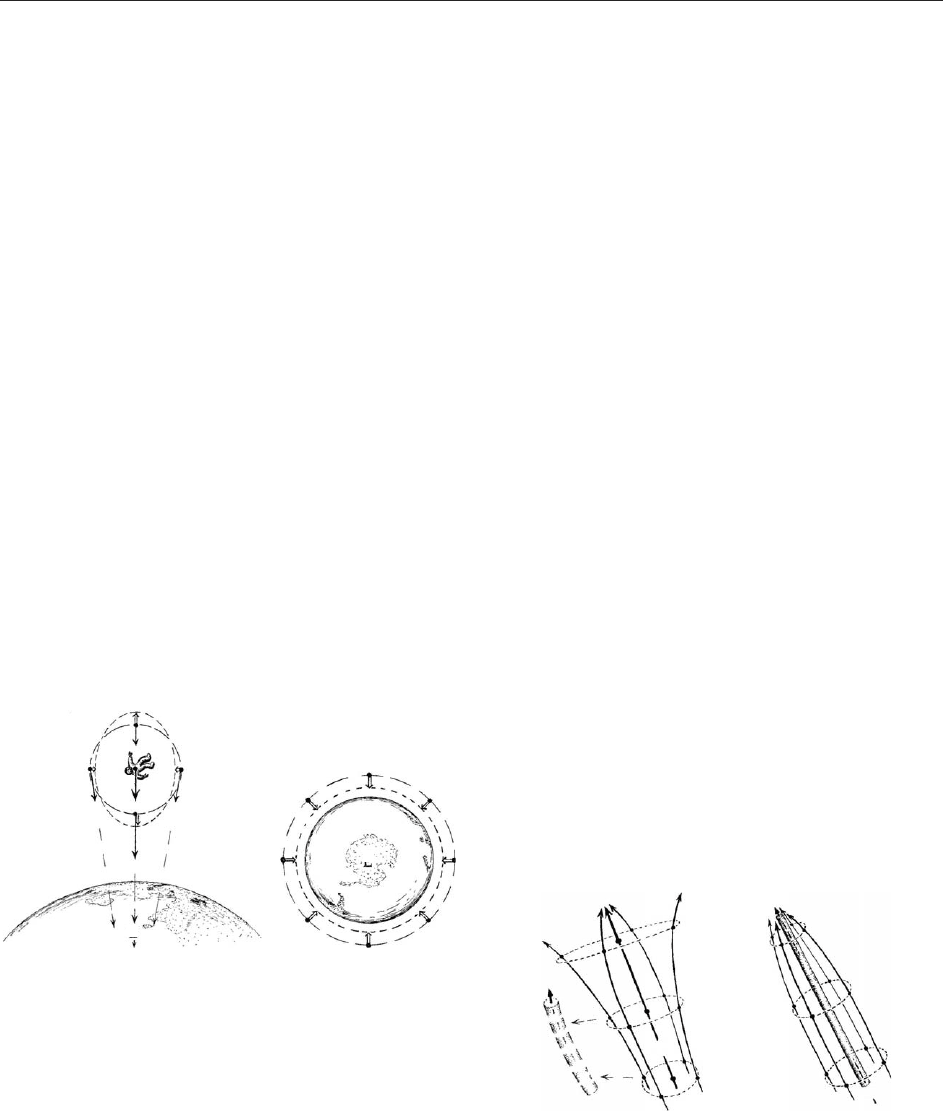
We shall be concer ned only with the instantaneous
accelerations due to gravity in the neighborhood of
A, so it will be immaterial whether we regard the
astronaut as falling to the ground or – more
comfortably! – in orbit about the Earth.
Let us imagine that the astronaut is initially
surrounded, nearby, by a sphere of particles, with A
at the centre, which are taken to be initially at rest
with respect to A (see Figure 1). To a first
approximation, all the particles will share the same
acceleration as the astronaut, so they will seem to the
astronaut to hover motionless all around. But now let
us be a little more precise about the accelerations.
Those particles which are initially located in a vertical
line from A, that is, either directly below A, at B, or
directlyaboveA,atT,willhave,likeA,an
acceleration which is in the direction AO, where O
is the Earth’s center. But for the bottom point B, the
acceleration will be slightly greater than that at A, and
for the top point T, the acceleration will be slightly
less than the acceleration at A, because of the slightly
differing distances from O. Thus, relative to A, both
will initially accelerate away from A. With regard to
particles in the sphere which are initially in a circle in
the horizontal plane through A, the direction to O
will now be somewhat inwards, so that the particles
at these points H
i
will accelerate, relative to A,
slightly inwards. Accordingly, the entire sphere of
particles will begin to get distorted into a prolate
spheroid (elongated ellipsoid of revolution). This is
referred to as the tidal distortion, for the good reason
that it is precisely the same physical effect which is
responsible for the tides in the Earth’s oceans, where
for this illustration we are to think of the Earth’s
center as being at A, the Moon (or Sun) to be situated
at O, and the sphere of particles to represent the
surface of the water of the Earth’s oceans.
It is not hard to calculate (reverting, now, to our
original picture) that, as a reflection of Newton’s
inverse-square law of gravitational attraction, the
amount of (small) outward vertical displacement
from A (at B and T) will be twice the inward
horizontal displacement (over the circle of points
H
i
); accordingly, the sphere will ini tially be distorted
into an ellipsoid of the same volume. This depends
upon there being no gravitating matter insi de the
sphere. The presence of such matter would con-
tribute a volume-reducing effect in proportion to the
total mass surrounded. (An extreme case illustrating
this would occur if we take our sphere of particles to
surround the entire Earth, where the volume-
reducing effect would be manifest in the accelera-
tions towards the ground at all points of the
surrounding sphere.)
Gravity as Curved Spacetime
It is appropriate to take a spacetime view of these
phenomena (Figure 2). The distortions that we have
been considering are, in fact, direct manifestations
(a) (b)
E
A
E
Figure 1 (a) Tidal effect. The astronaut A surrounded by a
sphere of nearby particles initially at rest with respect to A. In
Newtonian terms, they have an acceleration towards the Earth’s
center E, varying slightly in direction and magnitude (single-
shafted arrows). By subtracting A’s acceleration from each, we
obtain the accelerations relative to A (double-shafted arrows);
this relative acceleration is slightly inward for those particles
displaced horizontally from A, but slightly outward for those
displaced vertically from A. Accordingly, the sphere becomes
distorted into a (prolate) ellipsoid of revolution, with symmetry
axis in the direction AE. The initial distortion preserves volume.
(b) Now move A to the Earth’s center E and the sphere of
particles to surround E just above the atmosphere. The
acceleration (relative to A = E) is inward all around the sphere,
with an initial volume reduction acceleration 4GM, where M is
the total mass surrounded. Reproduced with permission from
Penrose R (2004) The Road to Reality: A Complete Guide to the
Laws of the Universe. London: Jonathan Cape.
(a)
E
A
E
(b)
Figure 2 Spacetime versions of Figure 1 in terms of the
relative distortion of neighboring geodesics. (a) Geodesic
deviation in empty space (basically Weyl curvature) as seen in
the world lines of A and surrounding particles (one spatial
dimension suppressed), as might be induced from the gravita-
tional field of a nearby body E. (b) The corresponding inward
acceleration (basically Ricci curvature) due to the mass density
within the bundle of geodesics. Reproduced with permission
from Penrose R (2004) The Road to Reality: A Complete Guide
to the Laws of the Universe. London: Jonathan Cape.
General Relativity: Overview 489
of spacetime curvature, according to Einstein’s
viewpoint. We are to think of the world line of a
particle, falling freely under gravity (Eins teinian
inertial motion), as described as some kind of
geodesic in spacetime. We shall be coming to this
more completely shortly, but for the moment it will
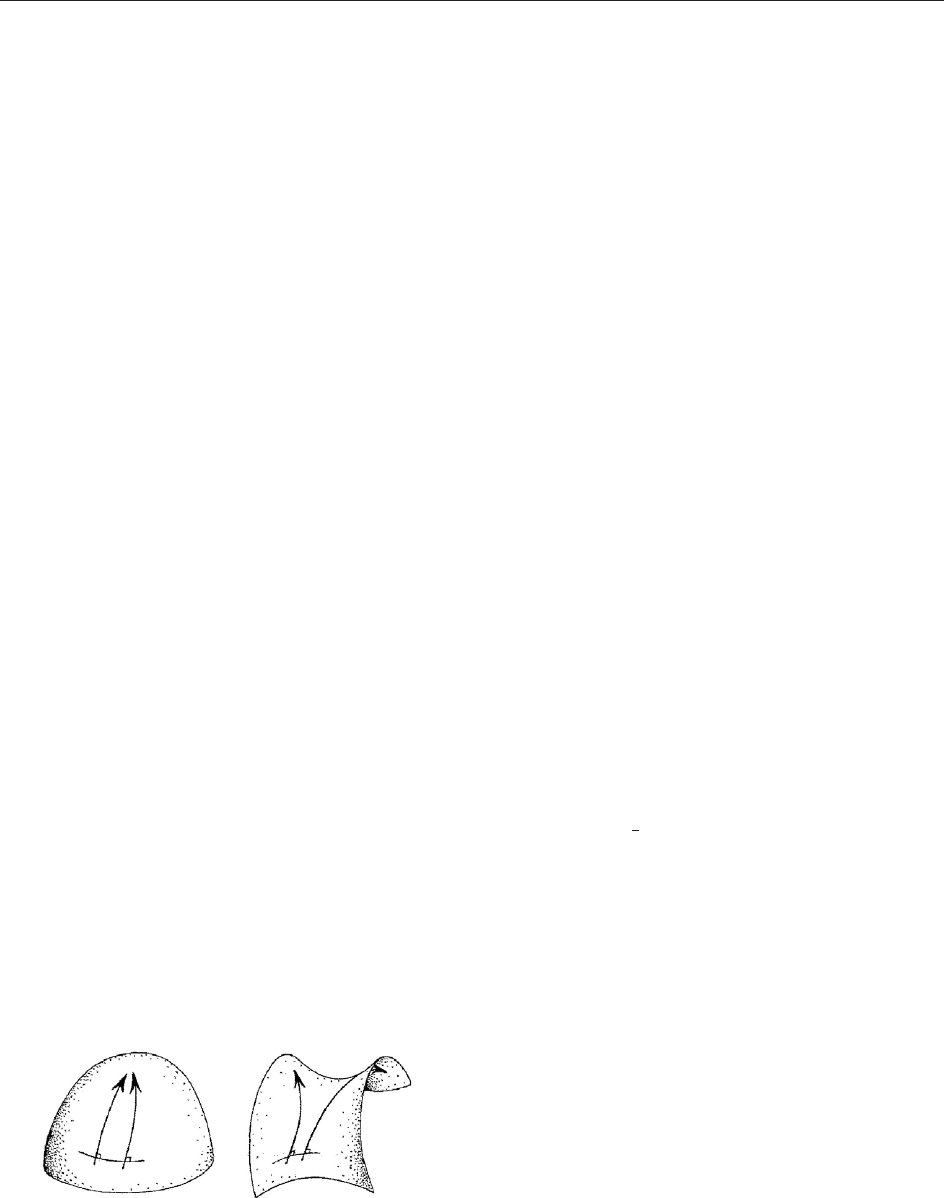
be helpful to picture the behavior of geodesics
within an ordinary curved 2-surface S (Figure 3).
If S has positive (Gaussian) curvature, then there
will be a tendency for geodesics on S to bend
towards each other, so that a pair of infinitesimally
separated geodesics which are initially parallel will
begin to get closer together as we move along them;
if S has negative (Gaussian) curvature, then there
will be a corresponding tendency for geodesics on S
to bend away from each other. This is what happens
in two dimensions, where the intr insic curvature at a
point is given by a single number. However, we are
now concerned with a four-dimensional space,
where the notion of curvature requires many more
components. We see in Figure 2 that we are indeed
to expect mixtures of convergence and divergence of
geodesics, which suggests that there are both
positive and negative curvature components
involved, the positive curvature being in the hor-
izontally displaced directions from A and the
negative curvature in the vertically displaced direc-
tions. In a curved space of dimension 4, as is the
case for a curved spacetime, we can expect 20
independent components of curvature at each point
altogether. In the present situation, the others would
be called into play when differing velocities of A are
considered.
Let us see how we are to accommodate the above
considerations within the standard framework of
differential geometry. So far, we have not really
deviated from Newtonian theory, even though we
have been considering ‘‘geodesics’’ in a four-dimen-
sional spacetime. In fact, it is perfectly legitimate to
view Newtonian theory in this way (see Newtonian
Limit of General Relativity), although the 4-geometry
description is somewhat more complicated than one
might wish. This is due to the fact that the infinite
speed at which gravitation is taken to act in
Newtonian theory demands that the ‘‘metric’’ of
Newtonian spacetime is degenerate. (In effect, one
would have a degenerate ‘‘dual metric’’ G
ab
,of
matrix rank 3, which plays a role in defining spatial
displacements and a very degenerate ‘‘metric’ ’ G
ab
,of
matrix rank 1, which defines temporal differences,
where G
ab
G
bc
= 0; see Newtonian Limit of General
Relativity.) Accordingly, there is no unique notion of
‘‘geodesic’’ defined by the metric in Newtonian
theory.
It is strik ing that althoug h the insights provided
by the principle of equiva lence are to some
considerable extent independent of special relativity
(since we see from the paragraphs prior to the
preceding one that a curved-spacetime-geometry
view of gravity is natural in the ligh t of the
equivalence principle alone), it is the nondegenerate
metric g
ab
, (and its inverse g
ab
) that special relativity
gives us locally, which leads to an elegant space-
time theory of gravity. Although the metric g
ab
is Lorentzian (with prefe rred choice of signature
þ here) rather than positive definite, so that
the spacetime is not strictly a Riemannian one, the
change of signature makes little difference to
the local formalism. In particular, the fact that the
metric defines a unique (torsion-free) connection
preserving it is unaffected by the signature. This
connection is the one defined by Christoffel’s symbols
ac
b
¼
1
2
g
db
ð@
c
g
da
þ @
a
g
cd
@
d
g
ca
Þ
where @
a
stands for coordinate derivative @=@x
a
,
so that the covariant derivative of a vector V
a
is
given by
r
a
V
b
¼ @
a
V
b
þ V
c
ac
b
(Here the standard ‘‘physicist’s conventions’’ are
being used, whereby notation such as ‘‘g
ab
’’ and
‘‘V
a
’’ can be used interchangeably either for the sets
of components of the metric tensor g and the vector
V, respectively, or alternatively for the entire
geometrical metric tensor g or vector V, in each
case; moreover, the summation convention is being
assumed, or this can alternatively be understood in
terms of abstract indices. (For the abstract-index
notation for tensors, see Penrose and Rindler (1984),
especially Chapters 2 and 4. Sign and index-ordering
conventions used here follow those given in that
book. Many other authors use conventions which
differ from these in various, usually minor
respects.))
(a) (b)
γ ′
γ
γ
′
γ
Figure 3 Geodesic deviation when M is a 2-surface (a) of
positive (Gaussian) curvature, when the geodesics ,
bend
towards each other, and (b) of negative curvature, when they
bend apart. Reproduced with permission from Penrose R (2004)
The Road to Reality: A Complete Guide to the Laws of the
Universe. London: Jonathan Cape.
490 General Relativity: Overview

Physical Interpretation of the Metric
Some words of clarification are needed, as to the
meaning of the metric tensor g
ab
in relativity theory.
In the early discussions by Einstein and others, the
spacetime metric tended to be interpreted in terms of
little ‘‘rulers’’ placed on a curved manifold.
Although this is natural in the Riemannian
(positive-definite) case, it is not quite so appropriate
for the Lorentzian geometry of spacetime manifolds.
An ordinary physical ruler has a spacetime descrip-
tion as a timelike strip, and it does not naturally
express the spatial separation between two
spacelike-separated events. In order for a ruler to
measure such a spacelike separation, it would be
necessary for the two events to be simultaneous in
the ruler’s rest frame, and for this to be assured,
some further mechanism would be needed, such as
Einstein’s procedure for ensuring simultaneity by the
use of light signals from the two events to be
received simultaneously at their midpoint on the
ruler. Clearly this complicate s the issue, and it turns
out to be much preferable to concentrate on
temporal displacements rather than spatial ones.
The idea that spacetime geometry should really be
regarded as ‘‘chronometry,’’ in this way, has been
stressed by a number of distinguished expositors of
relativity theory, most notably John L Synge (1956,
1960) and Hermann Bondi (1961, 1964, 1967).
Where needed, spatial displacements can then be
defined by the use of temporal ones together with
light signals. This has the additional advantage that
in modern technology, the measurement of (proper)
time far surpasses that of distance in accuracy, to the
extent that the meter is now defined simply by the
requirement that there are exactly 299792458 of
them in a light-second! The proper time interval
between two nearby events is, indeed, measured by a
clock which encounters both events, moving iner-
tially between the two, and very precise atom ic and
nuclear clocks are now a common feature of current
technology. The physical role of the metric g
ab
is
most clearly seen in the formula
¼
Z
q
p
ðg
ab
dx
a
dx
b
Þ
which measures the (proper) time interval between
an event p and a later event q on its world line, the
integral being taken along this curve, and where now
that curve need not be a geodesic, so that accelerating
(noninertial) motion of the clock is allowed. The
metric (with choice of signature þso that it is
the timelike displacements that are directly provided
as real numbers) is very precisely specified by this
physical requirement, and this tells us that the
pseudo-Riemannian (Lorentzian) structure of space-
time is far from being an arbitrary construction, but
is given to us by Nature with enormous precision.
(Some theorists prefer to use the alternative spacetime
signature þþþ, because this more directly relates
to familiar Newtonian concepts, these being normally
described in spatial terms. The difference is essentially
just a notational one, however. It may be remarked
that the 2-spinor formalism (see Spinors and
Spin Coefficients) fits in much more readily with the
þsignature being used here.) It may be noted,
also that this time measure is ultimately fixed by
quantum principles and the masses of the elementary
ingredients involved (e.g., particle masses) via the
Einstein and Planck relations E = mc
2
and E = h,so
that there is a natural frequency associated with a
given mass, via = mc
2
=h (c being the speed of light
and h being Planck’s constant).
Riemann Curvature and Geodesic
Deviation
The unique torsion-free (Christoffel–Levi-Civita)
connection r
a
is, via this physically determined
metric, also fixed accordingly by these physical
considerations, as is the notion of a geodesic, and
therefore so also is the curvature. The 20-independent-
component Riemann curvature tensor R
abcd
may be
defined by
ðr
a
r
b
r
b
r
a
ÞV
d
¼ R
abc
d
V
c
with normal index-raising/lowering conventions, so
that R
abcd
= R
e
abc
g
ed
, etc., and we have the standard
classical formula
R
abc
d
¼ @
a
cb
d
@
b
ca
d
þ
cb
e
ea
d
ca
e
eb
d
The symmetries R
abcd
=R
cdab
= R
bacd
, R
abcd
þR
bcad
þ
R
cabd
=0 reduce the number of independent compo-
nents of R
abcd
to 20 (from a potential 4
4
=64).
Of these, 10 are locally fixed by the kind of
physical requirement indicated above, that in order
to express something that agrees closely with New-
ton’s inverse-square law we require that there should
be a net inward curving of free world lines (the
timelike geodesics that represent local inertial
motions, or ‘ ‘free fall’’ under gravity). Let us see
how this requirement is satisfied in Einstein’s general
relativity.
What we find, from Newton’s theory, is that a
system of test particles which, at some initial time
constitutes a closed 2-surface at rest surrounding
some gravitating matter, will begin to accelerate in
such a way that the volume surrounded is initially
reduced in proportion to the total mass surrounded.
General Relativity: Overview 491

This volume reduction is a direct consequence of
Poisson’s equation r
2
=4 ( being the gravi-
tational potent ial and the mass density) and of
Newton’s second law, which tell us that the second
time derivative of the free-fall volume of our initially
stationary closed surface of test particles is indeed
4GM, where M is the total gravitating mass
surrounded (and G is Newton’s constant, as above).
In Einstein’s theory, we can basically carry this over
to our four-dimensional Lorentzian spacetime.
We do, however, find that such a general statement
as this does not exactly hold. Instead of referring to
3-volumes of any size, we must restrict attention to
infinitesimal volumes.
The basic mathematical tool is the equation of
‘‘geodesic deviation,’’ namely the ‘‘Jacobi equation’’:
D
2
u
d
¼ R
abc
d
t
a
u
b
t
c
where D describes ‘‘propagation derivative’’
D ¼ t
a
r
a
along a timelike geodesic , where t
a
is a unit
timelike tangent vector to (so t
a
t
a
= g
ab
t
a
t
b
= 1)
which is (consequently) parallel-propagated along ,
Dt
a
¼ 0
(When acting on a scalar quantity defined along ,
we can read ‘‘D’’ as ‘‘d=d,’’ where measures
proper time along .) The vector u
a
is what is called
a connecting vector between the geodesic and
some ‘‘neighboring geodesic’’
0
. We think of the
vector u
a
as ‘‘connecting’’ a point p on to some
neighboring point p
0
on
0
, where it is usual to take
u
a
to be orthogo nal to t
a
(i.e., u
a
t
a
= 0). The
derivative Du
a
measures the rate of change of u
a
,
as p and p
0
move together into the future along .
Mathematically, we express this as the vanishing of
the Lie derivative of u
a
with respect to t
a
(with t
a
extended to a unit vector field which is tangent both
to and to
0
). By taking three independent vectors u
a
at p, we can form a spatial 3-volume element W and
investigate how this propagates along . We find
D
2
W ¼ WR
ab
t
a
t
b
where the Ricci tensor R
ab
(= R
ba
) is here defined by
R
ab
¼ R
acb
c
The Einstein Field Equations
In view of what has been said above, with regard to
the way that the acceleration of volume behaves in
Newtonian theory, it would be natural to ‘‘iden-
tify’’ R
ab
t
a
t
b
with (4G )the(activegravita-
tional) mass density, with respect to the time
direction t
a
. In (special) relativity theory we expect
to ident ify mass density with c
2
energy density
(by E = mc
2
) and to take energy density as just one
component (the time–time component) of a sym-
metric tensor T
ab
, called the ‘‘energy tensor,’’ and
for s implicity we now take c = 1. The tensor
quantity T
ab
is to incorporate the contributions to
the local mass/energy density of all particles and
fields other than gravity itself. Since we would
require this to work for all choices of time-
direction t
a
, it would be n atural, accordingly, to
make the identification
R
ab
¼4GT
ab
Indeed, this was Einstein’s initial choice for a
gravitational field equation. However, this will
actually not do, as Einstein later realized. The
trouble comes from the Bianchi identity
r
a
R
bcde
þr
b
R
cade
þr
c
R
abde
¼ 0
from which we deduce
r
a
R
ab
1
2
Rg
ab
¼ 0
where
R ¼ R
a
a
This causes trouble in connection with the standard
requirement on the energy tensor, that it satisfy the
local ‘‘conservation law’’
r
a
T
ab
¼ 0
The latter equation is an essential requirement in special
relativity, since it expresses the conservation of energy
and momentum for fields in flat spacetime. In standard
Minkowski coordinates, each of T
a0
, T
a1
, T
a2
, T
a3
satisfies an equation just like the r
a
J
a
= 0ofthe
charge–current vector J
a
of Maxwell’s theory of
electromagnetism, with now r
a
= @
a
= @=@x
a
,which
expresses global conservation of charge. Similarly to the
way that J
a
encapsulates density and flux of electric
charge, T
a0
encapsulates density and flux of energy, and
T
a1
, T
a2
, T
a3
encapsulate the same for the three
components of momentum. So the equation
r
a
T
ab
= 0 is essential in special relativity, for similarly
expressing global conservation of energy and momen-
tum. We find (referring to a local inertial frame) that,
when we pass to general relativity, this equation should
still hold, with r
a
now standing for covariant
derivative. But the initially proposed field equation
R
ab
= 4GT
ab
would now give us r
a
R
ab
= 0, which
combined with the geometrically necessary r
a
(R
ab
(
1
2
)Rg
ab
) = 0, tells us that R is constant. In turn this
implies the physically unacceptable requirement that
T = T
a
a
is constant (since we have R = 4GT).
492 General Relativity: Overview

Einstein eventually became convinced (by 1915)
of the modified field equations
R
ab
1
2
Rg
ab
¼8GT
ab
(the ‘‘8’’ rather than ‘‘4’’ being now needed to fit in
with the New tonian limit) and it is these that are
now commonly referred to as ‘‘Einstein’s field
equations.’’ (Some authors prefer to use the singular
form ‘‘field equation,’’ especially if the formula is to
be read as an abstract-index expression rather than a
family of component equations, since the tensors
involved are really single entities.) It may be noted
that the formula can be rewritten as
R
ab
¼8GT
ab
1
2
Tg
ab
from which we deduce that in Einstein’s theory the
source of gravity is not simply the mass (or equivalently
energy) density, but there is an additional contribution
from the pressure (momentum flux, i.e., space–space
components of T
ab
). This can have significant implica-
tions for the instability of very large and massive stars in
highly relativistic regimes, where increases in pressure
can, paradoxically, actually increase the tendency for a
star to collapse, owing to its contribution to the
attractive effect of its gravity.
In 1917, Einstein put forward a slight modifica-
tion of his field equations – basically the only
modification that can be made without fundamen-
tally changing the foundations of his theory – by
introducing the very tiny cosmological constant .
The modified equations are
R
ab
1
2
Rg
ab
þ g
ab
¼8GT
ab
and the source of gravity, or active gravitational
mass is now
þ P
1
þ P
2
þ P
3
4G
where (with respect to a local Lorentzian orthonormal
frame, units being chosen so that c = 1) = T
00
is the
mass/energy density and P
1
= T
11
, P
2
= T
22
, P
3
= T
33
are the principal pressures. The -term, for positive ,
provides a repulsive contribution to the gravitational
effect, but it is extremely tiny (and totally ignorable) on
all ordinary scales, beginning to show itself only at the
most vast of observed cosmological distances (since the
effect of adds up relentlessly at larger and larger
distances). Einstein originally introduced the term in
order to have the possibility of a static universe, where
the attractive gravitational effect of the totality of
ordinary matter would be balanced, overall, by .But
thediscoveryoftheexpansionoftheuniverse(by
Hubbleandothers)ledEinsteintoabandonthe
cosmological term. However, since 1998 (initially
from the supernova observations of Brian Schmidt and
Robert Kirschner, and Saul Perlmutter, see Perlmutter
et al. (1998)), cosmological evidence has mounted in
favor of the presence of a very small positive -term,
which has resulted in the expansion of the universe
beginning to accelerate. While the presence of Einstein’s
constant -term is consistent with observations, and
remains the simplest explanation of this observed
acceleration, many cosmologists prefer to allow for
what would amount to a ‘‘varying ,’’ and refer to it as
‘‘dark energy.’’
Energy Conservation and Related Matters
One of the features of Einstein’s general relativity
theory that had been deeply puzzling to a good many of
Einstein’s contemporaries, and which may be said to be
still not fully resolved, even today, is ‘ ‘energy conserva-
tion,’ ’ in the presence of a dynamical gravitational field.
We have noted that the energy tensor T
ab
is to
incorporate the contributions of all particles and fields
other than gravity. But what about gravity itself? There
are many physical situations in which energy can be
transferred back and forth from gravitational systems
to nongravitational ones (most strikingly in the example
of the emission of gravitational waves; see Gravitational
Waves). The conservation of energy would make no
sense without an understanding of how energy can be
stored in a gravitational field. At first sight we seem to
see no role for a gravitational contribution to energy in
Einstein’s theory, since the conservation law r
a
T
ab
= 0
seems to be a self-contained expression of energy
conservation with no direct contribution from the
gravitational field in the tensor T
ab
.However,thisis
illusory, since the formulation of a global conservation
law from the local covariant expression r
a
T
ab
= 0does
notworkincurvedspacetime(basicallybecause,unlike
the charge–current quantity J
a
of Maxwell’s electro-
dynamical theory, the extra index on T
ab
prevents it
from being regarded as a 1-form). We may take the view
that the energy of gravitation enters nonlocally into the
equation, so that the failure of T
ab
to provide a global
conservation law on its own is an expression of the
gravitational contributions of energy not being taken
into account. This is no doubt a correct attitude to take,
but it is a difficult one to express comprehensively in a
mathematical form. Einstein himself provided a partial
understanding, but at the expense of introducing
concepts known as ‘‘pseudo tensors’’ whose meaning
was too tied up with arbitrary choices of coordinate
systems to provide an overall picture. In modern
approaches, the most clear-cut results come from the
study of asymptotically flat or asymptotically de Sitter
spacetimes (de Sitter space being the empty universe
which takes over the role of Minkowski space when
General Relativity: Overview 493

there is a positive cosmological constant ; see
Cosmology: Mathematical Aspects).
The important role of the ‘‘Weyl conformal tensor’’
C
abcd
¼R
abcd
1
2
ðR
ac
g
bd
R
bc
g
ad
þ R
bd
g
ac
R
ad
g
bc
Þ
þ
1
6
Rðg
ac
g
bd
g
bc
g
ad
Þ
should also be pointed out. This tensor retains all
the symmetries of the full Riemann tensor, but has
the Ricci tensor contribution removed, so that all its
contractions vanish, as is exemplified by
C
abc
a
¼ 0
It describes the conformal part of the curvature, that
is, that part that survives under conformal rescalings
of the metric;
g
ab
7!
2
g
ab
where is a smooth (positive) function of position. The
tensor C
abc
d
is itself invariant under these conformal
rescalings. This has importance in the asymptotic
analysis of gravitational fields (see Asymptotic Struc-
ture and Conformal Infinity). We may take the view
that C
abcd
describes the degrees of freedom in the free
gravitational field, whereas R
ab
contains the informa-
tion of the sources of gravity. This is analogous to the
Maxwell tensor F
ab
describing the degrees of freedom
in the free electromagnetic field, whereas J
a
contains
the information of the sources of electromagnetism.
From the observational point of view, general
relativity stands in excellent shape, with full agreement
with all known relevant data, starting with the
anomalous perihelion advance of the planet Mercury
observed by LeVerrier in the mid-nineteenth century,
through clock-slowing, light-bending (lensing) and
time-delay effects, and the necessary corrections to
GPS positioning systems, to the precise orbiting of
double neutron-star systems, with energy loss due to the
emission of gravitational waves. The effects of gravita-
tional lensing now play vital roles in modern cosmology.
To get some idea of the precision in Einstein’s theory, we
may take note of the fact that the double neutron-star
system PSR 1913þ16 has been observed for some
30 years, and the agreement between observation and
theory overall is to about one part in 10
14
.
See also: Asymptotic Structure and Conformal Infinity;
Canonical General Relativity; Computational Methods in
General Relativity: the Theory; Cosmology: Mathematical
Aspects; Einstein Equations: Exact Solutions; Einstein
Equations: Initial Value Formulation; Einstein–Cartan
Theory; Einstein’s Equations with Matter; General
Relativity: Experimental Tests; Geometric Flows and the
Penrose Inequality; Gravitational Lensing; Gravitational
Waves; Hamiltonian Reduction of Einstein’s Equations;
Lorentzian Geometry; Newtonian Limit of General
Relativity; Noncommutative geometry and the Standard
Model; Spacetime Topology, Causal Structure and
Singularities; Spinors and Spin Coefficients; Symmetries
and Conservation Laws; Twistor Theory: Some
Applications [in Integrable Systems, Complex Geometry
and String Theory].
Further Reading
Bondi H (1957) Negative mass in general relativity. Reviews of
Modern Physics 29: 423 (Mathematical Reviews 19: 814).
Bondi H (1961) Cosmology. Cambridge: Cambridge University Press.
Bondi H (1964) Relativity and Common Sense. London: Heinemann.
Hartle JB (2003) Gravity: An Introduction to Einstein’s General
Relativity. San Francisco: Addison Wesley.
Penrose R (2004) The Road to Reality: A Complete Guide to the
Laws of the Universe. London: Jonathan Cape.
Penrose R and Rindler W (1984) Spinors and Space-Time, Vol. 1:
Two-Spinor Calculus and Relativistic Fields. Cambridge:
Cambridge University Press.
Perlmutter S et al. (1998) Cosmology from type Ia supernovae. Bulletin
of the American Astronomical Society 29 (astro-ph/9812473).
Rindler W (2001) Relativity: Special, General, and Cosmological.
Oxford: Oxford University Press.
Synge JL (1960) Relativity: The General Theory. Amsterdam:
North-Holland.
Wald RM (1984) General Relativity. Chicago: University of
Chicago Press.
Generic Properties of Dynamical Systems
C Bonatti, Universite
´
de Bourgogne, Dijon, France
ª 2006 Elsevier Ltd. All rights reserved.
Introduction
The state of a concrete system (from physics,
chemistry, ecology, or other sciences) is described
using (finitely many, say n) observable quantities
(e.g., positions and velocities for mechanical
systems, population densities for echological
systems, etc.). Hence, the state of a system may be
represented as a point x in a geometrical space R
n
.
In many cases, the quantities describing the state are
related, so that the phase space (space of all possible
states) is a submanifold M R
n
. The time evolution
of the system is represented by a curve x
t
, t 2 R
drawn on the phase space M, or by a sequence x
n
2
M, n 2 Z, if we consider discrete time (i.e., every
day at the same time, or every January 1st).
Believing in determinism, and if the system is
isolated from external influences, the state x
0
of the
system at the present time determines its evolution.
For continuous-time systems, the infinitesimal
494 Generic Properties of Dynamical Systems

evolution is given by a differential equation or vector
field dx=dt = X(x); the vector X(x) represents velo-
city and direction of the evolution. For a discrete-time
system, the evolution rule is a function F : M !M;if
x is the state at time t,thenF(x) is the state at the
time t þ 1. The evolution of the system, starting at
the initial data x
0
, is described by the orbit of x
0
,that
is, the sequence {(x
n
)
n2Z
jx
nþ1
= F(x
n
)} (discrete
time) or the maximal solution x
t
of the differential
equation ax=dt = X(x) (continuous time).
General problem Knowing the initial data and the
infinitesimal evolution rule, what can we tell about
the long-time evolution of the system?
The dynamics of a dynamical system (differential
equation or function) is the behavior of the orbits,
when the time tends to infinity. The aim of
‘‘dynamical systems’’ is to produce a general
procedure for describing the dynamics of any
system. For example, Conley’s theory presented in
the next section organizes the global dymamics of a
general system using regions concentrating the orbit
accumulation and recurrence and splits these regions
in elementary pieces: the chain recurrence classes.
We focus our study on C
r
-diffeomorphisms F (i.e., F
and F
1
are r times continuously derivable) on a
compact smooth manifold M (most of the notions and
results presented here also hold for vector fields). Even
for very regular systems (F algebraic) of a low-
dimensional space ( dim (M) = 2), the dynamics may
be chaotic and very unstable: one cannot hope for a
precise description of all systems. Furthermore, neither
the initial data of a concrete system nor the infinitesi-
mal-evolution rule are known exactly: fragile proper-
ties describe the evolution of the theoretical model, and
not of the real system. For these reasons, we are mostly
interested in properties that are persistent, in some
sense, by small perturbations of the dynamical system.
The notion of small perturbations of the system
requires a topology on the space Diff
r
(M)ofC
r
-
diffeomorphisms: two diffeomorphisms are close for
the C
r
-topology if all their partial derivatives of order
r are close at each point of M. Endowed with this
topology, Diff
r
(M) is a complete metric space.
The open and dense subsets of Diff
r
(M)providethe
natural topological notion of ‘‘almost all’’ F. Genericity
is a weaker notion: by Baire’s theorem, if O
i
, i 2 N,are
dense and open subsets, the intersection
T
i2N
O
i
is a
dense subset. A subset is called residual if it contains
such a countable intersection of dense open subsets. A
property P is generic if it is verified on a residual
subset. By a practical abuse of language, one says:
‘‘C
r
-generic diffeomorphisms verify P’’
A countable intersection of residual sets is a residual
set. Hence, if {P
i
}, i 2 N, is a countable family of
generic properties, generic diffeomorphisms verify
simultanuously all the properties P
i
.
A property P is C
r
-robust if the set of diffeo-
morphisms verifying P is open in Diff
r
(M). A
property P is locally generic if there is an (nonempty)
open set O on which it is generic, that is, there is
residual set R such that P is verified on R\O.
The properties of generic dynamical systems
depend mostly on the dimension of the manifold M
and of the C
r
-topology considered, r 2 N [ {þ1}
(an important problem is that C
r
-generic diffeo-
morphisms are not C
rþ1
):
On very low dimensional spaces (diffeomorphisms of
the circle and vector fields on compact surfaces) the
dynamics of generic systems (indeed in a open and
dense subset of systems) is very simple (called Morse–
Smale) and well understood; see the subsection
‘‘Genericpropertiesofthelow-dimensional
systems.’’
Inhigherdimensions,for C
r
-topology, r>1,one
has generic and locally generic properties related
to the periodic orbits, like the Kupka–Smale
property(seethesubsection‘‘Kupka–Smaletheo-
rem’’)andtheNewhousephenomenon(seethe
subsection‘‘Local C
2
-genericityofwildbehavior
forsurfacediffeomorphisms’’).However,westill
do not know if the dynamics of C
r
-generic
diffeomorphisms is well approached by their
periodic orbits, so that one is still far from a
global understanding of C
r
-generic dynamics.
For the C
1
-topology, perturbation lemmas show that
the global dynamics is very well approximated by
periodicorbits(seethesection‘‘C
1
-genericsystems:
globaldynamicsandperiodicorbits’’).Onethen
dividesgenericsystemsin‘‘tame’’systems,witha
global dynamics analoguous to hyperbolic dynamics,
and ‘‘wild’’ systems, which present infinitely many
dynamically independent regions. The notion of
dominatedsplitting(seethesection‘‘Hyperbolic
propertiesof C
1
-genericdiffeormorphisms’’)seems
to play an important role in this division.
Results on General Systems
Notions of Recurrence
Some regions of M are considered as the heart of the
dynamics:
Per(F) denotes the set of periodic points x 2 M of
F, that is, F
n
(x) = x for some n > 0.
A point x is recurrent if its orbit comes back
arbitrarily close to x, infinitely many times.
Rec(F) denotes the set of recurrent points.
The limit set Lim(F) is the union of all the
accumulation points of all the orbits of F.
Generic Properties of Dynamical Systems 495