
Francoise J.-P., Naber G.L., Tsun T.S. (editors) Encyclopedia of Mathematical Physics
Подождите немного. Документ загружается.


A point x is ‘‘wandering’’ if it admits a neighbor-
hood U
x
M disjoint from all its iterates
F
n
(U
x
), n > 0. The nonwandering set (F) is the
set of the nonwandering points.
R(F) is the set of chain recurrent points, that is,
points x 2 M which look like periodic points if we
allow small mistakes at each iteration: for any
">0, there is a sequence x = x
0
, x
1
, ..., x
k
= x
where d(f (x
i
), x
iþ1
) <" (such a sequence is an
"-pseudo-orbit).
A periodic point is recurrent, a recurrent point is a
limit point, a limit point is nonwandering, and a
nonwandering point is chain recurrent:
PerðFÞRecðFÞLimðFÞðFÞRðFÞ
All these sets are invariant under F,and(F) and
R(F) are compact subsets of M. There are diffeo-
morphisms F for which the closures of these sets are
distinct:
A rotation x 7!x þ with irrational angle 2
RnQ on the circle S
1
= R=Z has no periodic
points but every point is recurrent.
The map x 7!x þ (1=4)(1 þ cos (2x)) induces
on the circle S
1
a diffeomorphism F having a
unique fixed point at x = 1=2; one verifies that
(F) = {1=2} and R(F) is the whole circle S
1
.
An invariant compact set K M is transitive if there
is x 2 K whose forward orbit is dense in K. Generic
points x 2 K have their forward and backward
orbits dense in K: in this sense, transitive sets are
dynamically indecomposable.
Conley’s Theory: Pairs Attractor/Repeller and
Chain Recurrence Classes
A trapping region U M is a compact set whose
image F(U) is contained in the interior of U.By
definition, the intersection A =
T
n0
F
n
(U)isan
attractor of F:anyorbitinU ‘‘goes to A.’’ Denote by
V the complement of the interior of U:itisatrapping
region for F
1
and the intersection R =
T
n0
F
n
(V)is
a repeller. Each orbit either is contained in A [ R,or
‘‘goes from the repeller to the attractor.’’ More
precisely, there is a smooth function : M ![0, 1]
(called Lyapunov function) equal to 1 on R and 0 on A,
and strictly decreasing on the other orbits:
ðFðxÞÞ < ðxÞ for x =2A [ R
So, the chain recurrent set is contained in A [ R.
Any compact set contained in U and containing the
interior of F(U) is a trapping region inducing the
same attracter and repeller pair (A,R); hence, the set
of attracter/repeller pairs is countable. We denote by
(A
i
, R
i
,
i
), i 2 N, the family of these pairs endowed
with an associated Lyapunov function. Conley
(1978) proved that
RðFÞ¼
\
i2N
ðA
i
[ R
i
Þ
This induces a natural partition of R(F)inequiva-
lence classes: x y if x 2 A
i
,y 2 A
i
. Conley proved
that x y iff, for any ">0, there are "-pseudo orbits
from x to y and vice versa. The equivalence classes
for are called chain recurrence classes.
Now, considering an average of the Lyapunov
functions
i
one gets the following result: there is a
continuous function ’: M !R with the following
properties:
’(F(x)) ’(x) for every x 2 M, (i.e., ’ is a
Lyapunov function);
’(F(x)) = ’(x) ,x 2R(F);
for x, y 2R(F), ’(x) = ’(y) ,x y;and
the image ’(R(F) is a compact subset of R with
empty interior.
This result is called the ‘‘fundamental theorem of
dynamical systems’’ by several authors (see
Robinson (1999)).
Any orbit is ’-decreasing from a chain recurrence
class to another chain reccurence class (the global
dynamics of F looks like the dynamics of the
gradient flow of a function , the chain recurrence
classes supplying the singularities of ). However,
this description of the dynamics may be very rough:
if F preserves the volume, Poincare´’s recurrence
theorem implies that (F) = R(F) = M; the whole M
is the unique chain recurrence class and the function
’ of Conley’s theorem is constant.
Conley’s theory provides a general procedure for
describing the global topological dynamics of a
system: one has to characterize the chain recurrence
classes, the dynamics in restriction to each class,
the stable set of each class (i.e., the set of points
whose positive orbits goes to the class), and the
relative positions of these stable sets.
Hyperbolicity
Smale’s hyperbolic theory is the first attempt to give
a global vision of almost all dynamical systems. In
this section we give a very quick overview of this
theory. For further details, see Hyperbolic Dynami-
cal Systems.
Hyperbolic Periodic Orbits
A fixed point x of F is hyperbolic if the derivative
DF(x) has no (neither real nor complex) eigenvalue
with modulus equal to 1. The tangent space at x
496 Generic Properties of Dynamical Systems
splits as T
x
M = E
s
E
u
, where E
s
and E
u
are the
DF(x)-invariant spaces corresponding to the eigen-
values of moduli < 1 and > 1, respectively. There are
C
r
-injectively immersed F-invariant submanifolds
W
s
(x) and W
u
(x) tangent at x to E
s
and E
u
; the
stable manifold W
s
(x) is the set of points y whose
forward orbit goes to x. The implicit-function
theorem implies that a hyperbolic fixed point x
varies (locally) continuously with F; (compact parts
of) the stable and unstable manifolds vary continu-
ously for the C
r
-topology when F varies with the
C
r
-topology.
A periodic point x of period n is hyperbolic if it is
a hyperbolic fixed point of F
n
and its invariant
manifolds are the corresponding invariant manifolds
for F
n
. The stable and unstable manifold of the orbit
of x, W
s
orb
(x) and W
u
orb
(x), are the unions of the
invariant manifolds of the points in the orbit.
Homoclinic Classes
Distinct stable manifolds are always disjoint; how-
ever, stable and unstable manifolds may intersect. At
the end of the nineteenth century, Poincare´ noted
that the existence of transverse homoclinic orbits,
that is, transverse intersection of W
s
orb
(x) with
W
u
orb
(x) (other than the orbit of x), implies a very
rich dynamical behavior: indeed, Birkhoff proved
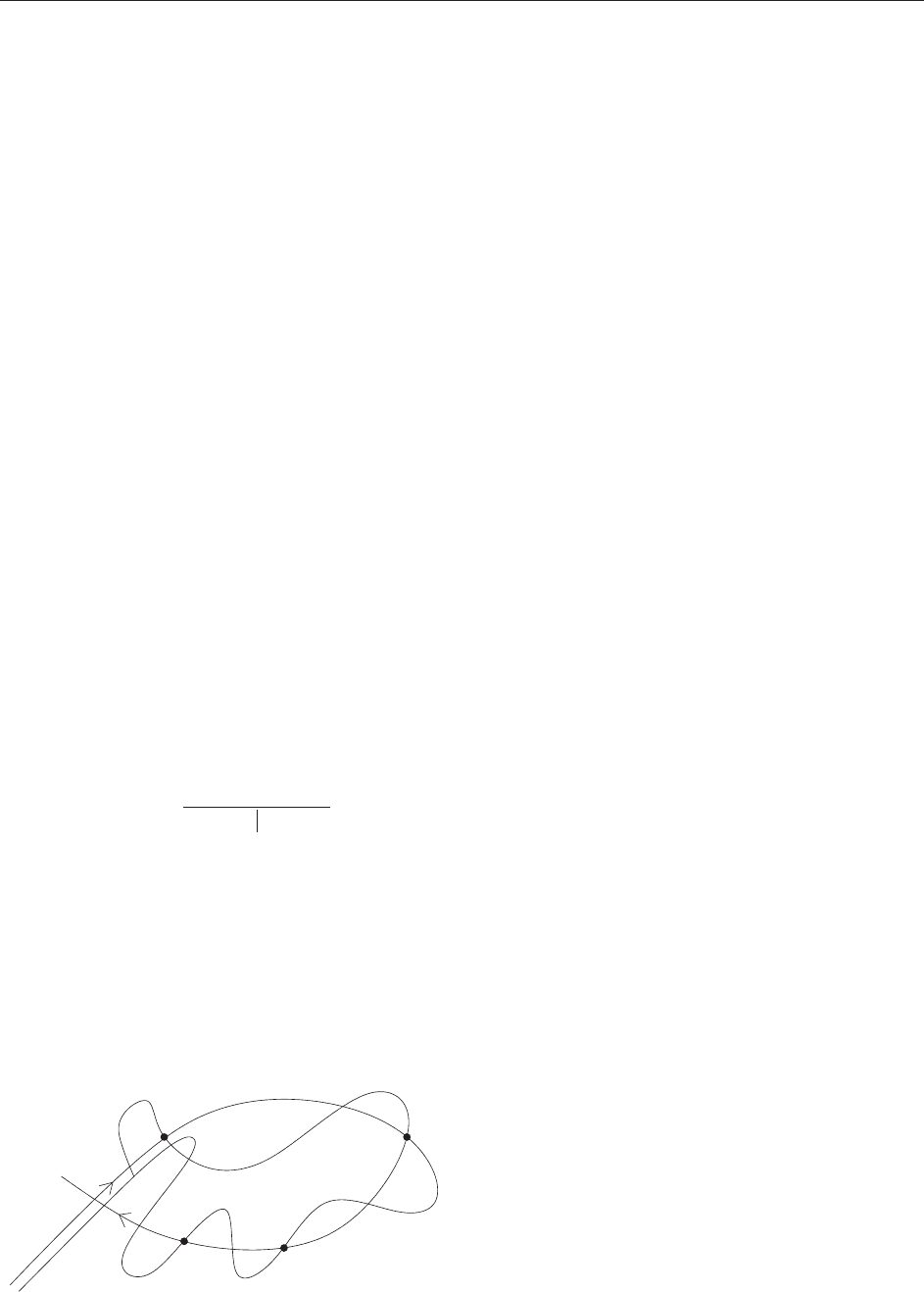
that any transverse homoclinic point is accumulated
by a sequence of periodic orbits (see Figure 1). The
homoclinic class H(x) of a periodic orbit is the
closure of the transverse homoclinic point associated
to x:
HðpÞ¼
W
s
orb
ðxÞ\W
u
orb
ðxÞ
There is an equivalent definition of the homoclinic
class of x: we say that two hyperbolic periodic
points x and y are homoclinically related if W
s
orb
(x)
and W
u
orb
(x) intersect transversally W
u
orb
(y)and
W
s
orb
(y), respectively; this defines an equivalence
relation in Per
hyp
(F) and the homoclinic classes are
the closure of the equivalence classes.
The homoclinic classes are transitive invariant
compact sets canonically associated to the periodic
orbits. However, for general systems, homoclinic
classes are not necessarily disjoint.
For more details, see Homoclinic Phenomena.
Smale’s Hyperbolic Theory
A diffeomorphism F is Morse–Smale if (F) = Per(F)
is finite and hyperbolic, and if W
s
(x) is tranverse to
W
u
(y)foranyx, y 2 Per(F). Morse–Smale diffeo-
morphisms have a very simple dynamics, similar to
the one of the gradient flow of a Morse function; apart
from periodic points and invariant manifolds of
periodic saddles, each orbit goes from a source to a
sink (hyperbolic periodic repellers and attractors).
Furthermore, Morse–Smale diffeomorphisms are
C
1
-structurally stable, that is, any diffeomorphism
C
1
-close to F is conjugated to F by a homeomorphism:
the topological dynamics of F remains unchanged by
small C
1
-perturbation. Morse–Smale vector fields
were known (Andronov and Pontryagin, 1937)to
characterize the structural stability of vector fields on
the sphere S
2
. However, a diffeomorphism having
transverse homoclinic intersections is robustly not
Morse–Smale, so that Morse–Smale diffeomorphisms
are not C
r
-dense, on any compact manifold of
dimension 2. In the early 1960s, Smale generalized
the notion of hyperbolicity for nonperiodic sets in
order to get a model for homoclinic orbits. The goal of
the theory was to cover a whole dense open set of all
dynamical systems.
An invariant compact set K is hyperbolic if the
tangent space TMj
K
of M over K splits as the direct
sum TM
K
= E
s
E
u
of two DF-invariant vector
bundles, where the vectors in E
s
and E
u
are
uniformly contracted and expanded, respectively,
by F
n
,forsomen > 0. Hyperbolic sets persist
under small C
1
-perturbations of the dynamics: any
diffeomorphism G which is C
1
-close enough to F
admits a hyperbolic compact set K
G
close to K and
the restrictions of F and G to K and K
G
are
conjugated by a homeomorphism close to the
identity. Hyperbolic compact sets have well-
defined invariant (stable and unstable) manifolds,
tangent (at the points of K)toE
s
and E
u
and the
(local) invariant manifolds of K
G
vary locally
continuously with G.
The existence of hyperbolic sets is very common:
if y is a transverse homoclinic point associated to a
hyperbolic periodic point x, then there is a transitive
hyperbolic set containing x and y.
Diffeomorphisms for which R(F) is hyperbolic
are now well understood: the chain recurrence
classes are homoclinic classes, finitely many, and
transitive, and admit a combinatorical model
(subshift of finite type). Some of them are
x
f(x)
f
2
(x)
Figure 1 A transverse homoclinic orbit.
Generic Properties of Dynamical Systems 497

attractors or repellers, and the basins of the
attractors cover a dense open subset of M. If,
furthermore, all the stable and unstable manifolds
of points in R(f ) are transverse, the diffeomorph-
ism is C
1
-structurally stable (Robbin 1971,
Robinson 1976); indeed, this condition, called
‘‘axiom A þ strong transversality,’’ is equivalent
to the C
1
-structural stability (Man˜e´ 1988).
In 1970, Abraham and Smale built examples of
robustly non-axiom A diffeomorphisms, when
dim M 3: the dream of a global understanding
of dynamical systems was postponed. However,
hyperbolicity remains a key tool in the study of
dynamical systems, even for nonhyperbolic
systems.
C
r
-Generic Systems
Kupka–Smale Theorem
Thom’s transversality theorem asserts that two
submanifolds can always be put in tranverse posi-
tion by a C
r
-small perturbations. Hence, for F in an
open and dense subset of Diff
r
(M), r 1, the graph
of F in M M is transverse to the diagonal
={(x, x), x 2 M}: F has finitely many fixed points
x
i
, depending locally continuously on F, and 1 is not
an eigenvalue of the differential DF(x
i
). Small local
perturbations in the neighborhood of the x
i
avoid
eigenvalue of modulus equal to 1: one gets a dense
and open subset O
r
1
of Diff
r
(M) such that every fixed
point is hyperbolic. This argument, adapted for
periodic points, provides a dense and open set O
r
n
Diff
r
(M), such that every periodic point of period n
is hyperbolic. Now
T
n2N
O
r
n
is a residual subset of
Diff
r
(M), for which every periodic point is
hyperbolic.
Similarly, the set of diffeomorphisms F 2
T
n
i = 0
O
r
i
(M) such that all the disks of size n,of
invariant manifolds of periodic points of period less
that n, are pairwise transverse, is open and dense.
One gets the Kupka–Smale theorem (see Palis and de
Melo (1982) for a detailed exposition): for C
r
-generic
diffeomorphisms F 2 Diff
r
(M), every periodic orbit is
hyperbolic and W
s
(x) is transverse to W
u
(y) for
x, y 2 Per(F).
Generic Properties of Low-Dimensional Systems
Poincare´–Denjoy theory describes the topological
dynamics of all diffeomorphisms of the circle S
1
(see
Homeomorphisms and Diffeomorphisms of the
Circle). Diffeomorphisms in an open and dense
subset of Diff
r
þ
(S
1
) have a nonempty finite set of
periodic orbits, all hyperbolic, and alternately
attracting (sink) or repelling (source). The orbit of
a nonperiodic point comes from a source and goes
to a sink. Two C
r
-generic diffeomorphisms of S
1
are
conjugated iff they have same rotation number and
same number of periodic points.
This simple behavior has been generalized in 1962
by Peixoto for vector fields on compact orientable
surfaces S. Vector fields X in a C
r
-dense and open
subset are Morse–Smale, hence structurally stable
(see Palis and de Melo (1982) for a detailed proof).
Peixoto gives a complete classification of these
vector fields, up to topological equivalence.
Peixoto’s argument uses the fact that the return
maps of the vector field on transverse sections are
increasing functions: this helped control the effect
on the dynamics of small ‘‘monotonous’’ perturba-
tions, and allowed him to destroy any nontrivial
recurrences. Peixoto’s result remains true on non-
orientable surfaces for the C
1
-topology but remains
an open question for r > 1: is the set of Morse–
Smale vector fields C
2
-dense, for S nonorientable
closed surface?
Local C
2
-Genericity of Wild Behavior for Surface
Diffeomorphisms
The generic systems we have seen above have a very
simple dynamics, simpler than the general systems.
This is not always the case. In the 1970s, Newhouse
exhibited a C
2
-open set ODiff
2
(S
2
) (where S
2
denotes the two-dimensional sphere), such that
C
2
-generic diffeomorphisms F 2O have infinitely
many hyperbolic periodic sinks. In fact, C
2
-generic
diffeomorphisms in O present many other patholo-
gical properties: for instance, it has been recently
noted that they have uncountably many chain
recurrence classes without periodic orbits. Densely
(but not generically) in O, they present many other
phenomena, such as strange (Henon-like) attractors
(see Lyapunov Exponents and Strange Attractors).
This phenomenon appears each time that a
diffeomorphism F
0
admits a hyperbolic periodic
point x whose invariant manifolds W
s
(x)and
W
u
(x) are tangent at some point p 2 W
s
(x) \
W
u
(x)(p is a homoclinic tangency associated to x).
Homoclinic tangencies appear locally as a codimen-
sion-1 submanifold of Diff
2
(S
2
); they are such a
simple phenomenon that they appear in very natural
contexts. When a small perturbation transforms the
tangency into tranverse intersections, a new hyper-
bolic set K with very large fractal dimensions is
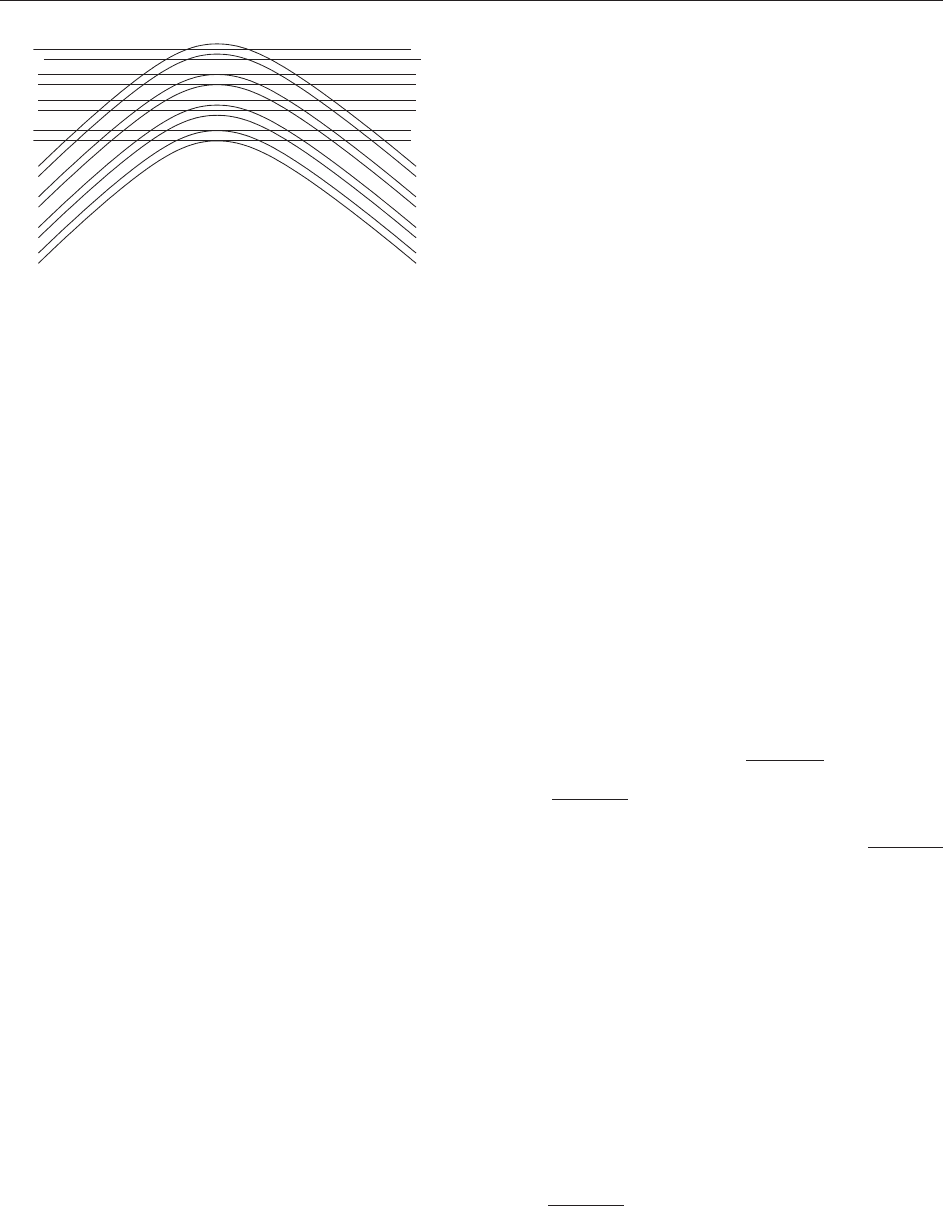
created. The local stable and unstable manifolds of
K, each homeomorphic to the product of a Cantor
set by a segment, present tangencies in a C
2
-robust way,
that is, for F in some C
2
-open set O (see Figure 2).
As a consequence, for a C
2
-dense subset of O, the
498 Generic Properties of Dynamical Systems
invariant manifolds of the point x present some
tangency (this is not generic, by Kupka–Smale
theorem). If the Jacobian of F at x is <1, each
tangency allows to create one more sink, by an
arbitrarily small perturbation. Hence, the sets of
diffeomorphisms having more than n hyperbolic
sinks are dense open subsets of O, and the
intersection of all these dense open subsets is the
announced residual set. See Palis and Takens
(1993) for details on this deep argument.
C
1
-Generic Systems: Global Dynamics
and Periodic Orbits
See Bonatti et al. (2004), Chapter 10 and Appendix A,
for a more detailed exposition and precise
references.
Perturbations of Orbits: Closing and Connecting
Lemmas
In 1968, Pugh proved the following Lemma.
Closing lemma If x is a nonwandering point of a
diffeomorphism F, then there are diffeomorphisms
G arbitrarily C
1
-close to F, such that x is periodic
for G.
Consider a segment x
0
, ..., x
n
= F
n
(x
0
) of orbit
such that x
n
is very close to x
0
= x; one would like
to take G close to F such that G(x
n
) = x
0
, and
G(x
i
) = F(x
i
) = x
iþ1
for i 6¼ n. This idea works for
the C
0
-topology (so that the C
0
-closing lemma is
easy). However, if one wants G "-C
1
-close to F, one
needs that the points x
i
, i 2 {1, ..., n 1}, remain at
distance d(x
i
, x
0
) greater than C(d(x
n
, x
0
)="), where
C bounds kDf k on M.IfC=" is very large, such a
segment of orbit does not exist. Pugh solved this
difficulty in two steps: the perturbation is first
spread along a segment of orbit of x in order to
decrease this constant; then a subsegment y
0
, ..., y
k
of x
0
, ..., x
n
is selected, verifying the geometrical
condition.
For the C
2
topology, the distances d(x
i
, x
0
) need
to remain greater than
ffiffiffiffiffiffiffiffiffiffiffiffiffiffiffiffiffiffi
d(x
n
, x
0
)
p
=" d(x
n
, x
0
).
This new difficulty is why the C
2
-closing lemma
remains an open question.
Pugh’s argument does not suffice to create
homoclinic point for a periodic orbit whose unstable
manifold accumulates on the stable one. In 1998,
Hayashi solved this problem proving the
Connecting lemma (Hayashi 1997) Le t y and z be
two points such that the forward orbit of y and the
backward orbit of z accumulate on the same
nonperiodic point x. Fix some ">0. There is N >
0 and a "-C
1
-perturbation G of F such that G
n
(y) = z
for some n > 0, and G F out of an arbitrary small
neighborhood of {x, F(x), ..., F
N
(x)}.
Using Hayashi’s arguments, we (with Crovisier)
proved the following lemma:
Connecting lemma for pseudo-orbits (Bonatti and
Crovisier 2004) Assume that all periodic orbits of F
are hyperbolic; consider x, y 2 M such that, for any
">0, there are "-pseudo-orbits joining x to y; then
there are arbitrarily small C
1
-perturbations of F for
which the positive orbit of x passes through y .
Densities of Periodic Orbits
As a consequence of the perturbations lemma above,
we (Bonatti and Crovisier 2004) proved that for
FC
1
-generic,
RðFÞ¼ðFÞ¼
Per
hyp
ðFÞ
where
Per
hyp
(F) denotes the closure of the set of
hyperbolic periodic points.
For this, consider the map : F 7!(F) =
Per
hyp
(F)
defined on Diff
1
(M) and with value in K(M), space
of all compact subsets of M, endowed with the
Hausdorff topology. Per
hyp
(F ) may be approximated
by a finite set of hyperbolic periodic points, and this
set varies continuously with F; so Per
hyp
(F) varies
lower-semicontinuously with F: for G very close to
F, Per
hyp
(G) cannot be very much smaller than
Per
hyp
(F ). As a consequence, a result from general
topology asserts that, for C
1
-generic F, the map is
continuous at F. On the other hand, C
1
-generic
diffeomorphisms are Kupka–Smale, so that the
connecting lemma for pseudo-orbits may apply:
if x 2R(F), x can be turned into a hyperbolic
periodic point by a C
1
-small perturbation of F. So,
if x =2
Per
hyp
(F), F is not a continuity point of ,
leading to a contradiction.
Furthermore, Crovisier proved the following
result: ‘‘for C
1
-generic diffeomorphisms, each chain
recurrence class is the limit, for the Hausdorff
distance, of a sequence of periodic orbits.’’
Figure 2 Robust tangencies.
Generic Properties of Dynamical Systems 499

This good approximation of the global dynamics
by the periodic orbits will now allow us to
better understand the chain recurrence classes of
C
1
-generic diffeomorphisms.
Chain Recurrence Classes/Homoclinic Classes
of C
1
-Generic Systems
Tranverse intersections of invariant manifolds of
hyperbolic orbits are robust and vary locally
continuously with the diffeomorphisms F. So, the
homoclinic class H(x) of a periodic point x varies
lower-semicontinuously with F (on the open set
where the continuation of x is defined). As a
consequence, for C
r
-generic diffeomorphisms (r
1), each homoclinic class varies continuously with F.
Using the connecting lemma, Arnaud (2001) proved
the following result: ‘‘for Kupka–Smale diffeo-
morphisms, if the closures
W
u
orb
(x)andW
s
orb
(x)
have some intersection point z, then a C
1
-pertuba-
tion of F creates a tranverse intersection of W
u
orb
(x)
and
W
s
orb
(x)atz.’’ So, if z =2H(x), then F is not a
continuity point of the function F 7!H(x, F). Hence,
for C
1
-generic diffeomorphisms F and for every
periodic point x,
HðxÞ¼
W
u
orb
ðxÞ\W
s
orb
ðxÞ
In the same way,
W
u
orb
(x) and W
s
orb
(x) vary locally
lower-semicontinuously with F so that, for F
C
r
-generic, the closures of the invariant manifolds
of each periodic point vary locally continuously. For
Kupka–Smale diffeomorphisms, the connecting
lemma for pseudo-orbits implies: ‘‘if z is a point in
the chain recurrence class of a periodic point x, then
a C
1
-small perturbation of F puts z on the unstable
manifold of x’’; so, if z =2
W
u
orb
(x), then F is not a
continuity point of the function F 7!
W
u
orb
(x, F).
Hence, for C
1
-generic diffeomorphisms F and for
every periodic point x, the chain recurrence class of
x is contained in
W
u
orb
(x) \ W
s
orb
(x), and, therefore,
coincides with the homoclinic class of x. This
argument proves:
For a C
1
-generic diffeomorphism F, each homoclinic class
H(x) is a chain recurrence class of F (of Conley’s theory):
a chain recurrence class containing a periodic point x
coincides with the homoclinic class H(x). In particular,
two homoclinic classes are either disjoint or equal.
Tame and Wild Systems
For generic diffeomorphisms, the number N(F) 2
N [ {1} of homoclinic classes varies lower-semicon-
tinuously with F. One deduces that N(F )islocally
constant on a residual subset of Diff
1
(M)(Abdenur
2003).
A local version (in the neighborhood of a chain
recurrence class) of this argument shows that, for
C
1
-generic diffeomorphisms, any isolated chain
recurrence classe C is robustly isolated: for any
diffeomorphism G, C
1
-close enough to F, the
intersection of R(G) with a small neighborhood of
C is a unique chain recurrence class C
G
close to C.
One says that a diffeomorphism is ‘‘tame’’ if each
chain recurrence class is robustly isolated. We
denote by T (M) Diff
1
(M) the (C
1
-open) set of
tame diffeomorphisms and by W(M) the comple-
ment of the closure of T (M). C
1
-generic diffeo-
morphisms in W(M) have infinitely many disjoint
homoclinic classes, and are called ‘‘wild’’
diffeomorphisms.
Generic tame diffeomorphisms have a global
dynamics analogous to hyperbolic systems: the
chain recurrence set admits a partition into finitely
many homoclinic classes varying continuously with
the dynamics. Every point belongs to the stable set
of one of these classes. Some of the homoclinic
classes are (transitive) topological attractors, and the
union of the basins covers a dense open subset of M,
and the basins vary continuously with F (Carballo
Morales 2003). It remains to get a good description
of the dynamics in the homoclinic classes, and
particularly in the attractors. As we shall see in the
next section, tame behavior requires some kind of
weak hyperbolicity. Indeed, in dimension 2, tame
diffeomorphisms satisfy axiom A and the noncycle
condition.
As of now, very little is known about wild
systems. One knows some semilocal mechanisms
generating locally C
1
-generic wild dynamics, there-
fore proving their existence on any manifold with
dimension dim (M) 3 (the existence of wild diffeo-
morphisms in dimension 2, for the C
1
-topology,
remains an open problem). Some of the known
examples exhibit a universal dynamics: they admit
infinitely many disjoint periodic disks such that, up
to renormalization, the return maps on these disks
induce a dense subset of diffeomorphisms of the
disk. Hence, these locally generic diffeomorphisms
present infinitely many times any robust property of
diffeomorphisms of the disk.
Ergodic Properties
A point x is well closable if, for any ">0 there is
G "-C
1
-close to F such that x is periodic for G and
d(F
i
(x), G
i
(x)) <" for i 2 {0, ..., p}, p being the
period of x. As an important refinement of Pugh’s
closing lemma, Man˜e´ proved the following lemma:
Ergodic closing lemma For any F-invariant prob-
ability, almost every point is well closable.
500 Generic Properties of Dynamical Systems

As a consequence, ‘‘for C
1
-generic diffeomoph-
isms, any ergodic measure is the weak limit of a
sequence of Dirac measures on periodic orbits,
which converges also in the Hausdorff distance to
the support of .’’
It remains an open problem to know if, for
C
1
-generic diffeomorphisms, the ergodic measures
supported in a homoclinic class are approached by
periodic orbits in this homoclinic class.
Conservative Systems
The connecting lemma for pseudo-orbits has been
adapted for volume preserving and symplectic
diffeomorphisms, replacing the condition on the
periodic orbits by another generic condition on the
eigenvalues. As a consequence, one gets: ‘‘C
1
-generic
volume-preserving or symplectic diffeomorphisms
are transitive, and M is a unique homoclinic class.’’
Notice that the KAM theory implies that this
result is wrong for C
4
-generic diffeomorphisms, the
persistence of invariant tori allowing to break
robustly the transitivity.
The Oxtoby–Ulam (1941) theorem asserts that
C
0
-generic volume-preserving homeomorphisms are
ergodic. The ergodicity of C
1
-generic volume-
preserving diffeomorphisms remains an open question.
Hyperbolic Properties of C
1
-Generic
Diffeomorphisms
For a more detailed exposition of hyperbolic proper-
ties of C
1
-generic diffeomorphisms, the reader is
referred to Bonatti et al. (2004, chapter 7 and
appendix B).
Perturbations of Products of Matrices
The C
1
-topology enables us to do small perturbations of
the differential DF at a point x without perturbing either
F(x )orF out of an arbitrarily small neighborhood of x.
Hence, one can perturb the differential of F along a
periodic orbit, without changing this periodic orbit
(Frank’s lemma). When x is a periodic point of period n,
the differential of F
n
at x is fundamental for knowing the
local behavior of the dynamics. This differential is (up to
a choice of local coordinates) a product of the matrices
DF(x
i
), where x
i
= F
i
(x). So, the control of the
dynamical effect of local perturbations along a periodic
orbit comes from a problem of linear algebra: ‘‘consider
a product A= A
n
A
n1
A
1
of n 0 bounded
linear ismorphisms of R
d
; how do the eigenvalues and
the eigenspaces of A vary under small perturbations of
the A
i
?’’
A partial answer to this general problem uses
the notion of dominated splitting. Let X M be an
F-invariant set such that the tangent space of M at
the points x 2 X admits a DF-invariant splitting
T
x
(M) = E
1
(x) E
k
(x), the dimensions dim (E
i
(x))
being independent of x. This splitting is dominated if
the vectors in E
iþ1
are uniformly more expanded than
the vectors in E
i
: there exists ‘>0 such that, for
any x 2 X,anyi 2 {1, ..., k 1} and any unit vectors
u 2 E
i
(x)andv 2 E
iþ1
(x), one has
kDF
‘
ðuÞk <
1
2
kDF
‘
ðvÞk
Dominated splittings are always continuous,
extend to the closure of X, and persist and vary
continuously under C
1
-perturbation of F.
Dominated Splittings versus Wild Behavior
Let {
i
} be a set of hyperbolic periodic orbits. On
X =
S
i
one considers the natural splitting
TMj
X
= E
s
E
u
induced by the hyperbolicity of the
i
. Man˜e´ (1982) proved: ‘‘if there is a C
1
-neighbor-
hood of F on which each
i
remains hyperbolic, then
the splitting TMj
X
= E
s
E
u
is dominated.’’
A generalization of Man˜e´’s result shows: ‘‘if a
homoclinic class H(x) has no dominated splitting,
then for any ">0 there is a periodic orbit in H(x)
whose derivative at the period can be turned into an
homothety, by an "-small perturbation of the
derivative of F along the points of ’’; in particular,
this periodic orbit can be turned into a sink or a
source. As a consequence, one gets: ‘‘for C
1
-generic
diffeomorphisms F, any homoclinic class either has a
dominated splitting or is contained in the closure of
the (infinite) set of sinks and sources.’’
This argument has been used in two directions:
Tame systems must satisfy some hyperbolicity. In
fact, using the ergodic closing lemma, one proves
that the homoclinic classes H(x) of tame diffeo-
morphisms are volume hyperbolic, that is, there is
a dominated splitting TM = E
1
E
k
over
H(x) such that DF contracts uniformly the
volume in E
1
and expands uniformly the volume
in E
k
.
If F admits a homoclinic class H(x) which is
robustly without dominated splittings, then gen-
eric diffeomorphisms in the neighborhood of F are
wild: at this time this is the unique known way to
get wild systems.
See also: Cellular Automata; Chaos and Attractors;
Fractal Dimensions in Dynamics; Homeomorphisms and
Diffeomorphisms of the Circle; Homoclinic Phenomena;
Hyperbolic Dynamical Systems; Lyapunov Exponents
and Strange Attractors; Polygonal Billiards; Singularity
and Bifurcation Theory; Synchronization of Chaos.
Generic Properties of Dynamical Systems 501

Further Reading
Abdenur F (2003) Generic robustness of spectral decompositions.
Annales Scientifiques de l’Ecole Normale Superieure IV 36(2):
213–224.
Andronov A and Pontryagin L (1937) Syste` mes grossiers. Dokl.
Akad. Nauk. USSR 14: 247–251.
Arnaud M-C (2001) Cre´ation de connexions en topologie C
1
.
Ergodic Theory and Dynamical Systems 21(2): 339–381.
Bonatti C and Crovisier S (2004) Re´currence et ge´ne´ricite´.
Inventiones Mathematical 158(1): 33–104 (French) (see also
the short English version: (2003) Recurrence and genericity.
Comptes Rendus Mathematique de l’Academie des Sciences
Paris 336 (10): 839–844).
Bonatti C, Dı`az LJ, and Viana M (2004) Dynamics Beyond
Uniform Hyperbolicity. Encyclopedia of Mathematical
Sciences, vol. 102. Berlin: Springer.
Carballo CM and Morales CA (2003) Homoclinic classes and
finitude of attractors for vector fields on n-manifolds.
Bulletins of the London Mathematical Society 35(1): 85–91.
Hayashi S (1997) Connecting invariant manifolds and the
solution of the C
1
stability and -stability conjectures for
flows. Annals of Mathematics 145: 81–137.
Man˜e´ R (1988) A proof of the C
1
stability conjecture. Inst.
Hautes E
´
tudes Sci. Publ. Math. 66: 161–210.
Palis J and de Melo W (1982) Gemetric Theory of Dynamical
Systems, An Introduction. New York–Berlin: Springer.
Palis J and Takens F (1993) Hyperbolicity and Sensitive-Chaotic
Dynamics at Homoclinic Bifurcation. Cambridge: Cambridge
University Press.
Robbin JW (1971) A structural stability theorem. Annals of
Mathematics 94(2): 447–493.
Robinson C (1974) Structural stability of vector fields. Annals of
Mathematics 99(2): 154–175 (errata. Annals of Mathematics
101(2): 368 (1975)).
Robinson C (1976) Structural stability of C
1
diffeomorphisms.
Journal of Differential Equations 22(1): 28–73.
Robinson C (1999) Dynamical Systems. Studies in Advanced
Mathematics. Boca Raton, FL: CRC Press.
Geometric Analysis and General Relativity
L Andersson, University of Miami, Coral Gables,
FL, USA and Albert Einstein Institute, Potsdam, Germany
ª 2006 Elsevier Ltd. All rights reserved.
Geometric analysis can be said to originate in the
nineteenth century work of Weierstrass, Riemann,
Schwarz, and others on minimal surfaces, a problem
whose history can be traced at least as far back as
the work of Meusnier and Lagrange in the eight-
eenth century. The experiments performed by
Plateau in the mid-19th century, on soap films
spanning wire contours, served as an important
inspiration for this work, and led to the formulation
of the Plateau problem, which concerns the exis-
tence and regularity of area-minimizing surfaces in
R
3
spanning a given boundary contour. The Plateau
problem for area-minimizing disks spanning a curve
in R
3
was solved by J Douglas (who shared the first
Fields medal with Lars V Ahlfors) and T Rado in the
1930s. Generalizations of Plateau’s problem have
been an important driving force behind the devel-
opment of modern geometric analysis. Geometric
analysis can be viewed broadly as the study of
partial differential equations arising in geometry,
and includes many areas of the calculus of varia-
tions, as well as the theory of geometric evolution
equations. The Einstein equation, which is the
central object of general relativity, is one of the
most widely studied geometric partial differential
equations, and plays an important role in its
Riemannian as well as in its Lorentzian form, the
Lorentzian being most relevant for general relativity.
The Einstein equation is the Euler–Lagrange
equation of a Lagrangian with gauge symmetry
and thus in the Lorentzian case it, like the Yang–
Mills equation, can be viewed as a system of
evolution equations with constraints. After imposing
suitable gauge conditions, the Einstein equation
becomes a hyperbolic system, in particular using
spacetime harmonic coordinates (also known as
wave coordinates), the Einstein equation becomes a
quasilinear system of wave equations. The con-
straint equations implied by the Einstein equations
can be viewed as a system of elliptic equations in
terms of suitably chosen variables. Thus, the
Einstein equation leads to both elliptic and hyper-
bolic problems, arising from the constraint equa-
tions and the Cauchy problem, respectively. The
groundwork for the mathematical study of the
Einstein equation and the global nature of space-
times was laid by, among others, Choquet-Bruhat,
who proved local well-posedness for the Cauchy
problem, Lichnerowicz, and later York who pro-
vided the basic ideas for the analysis of the
constraint equations, and Leray who formalized the
notion of global hyperbolicity, which is essential for
the global study of spacetimes. An important frame-
work for the mathematical study of the Einstein
equations has been provided by the singularity
theorems of Penrose and Hawking, as well as the
cosmic censorship conjectures of Penrose.
Techniques and ideas from geometric analysis
have played, and continue to play, a central role in
recent mathematical progress on the problems posed
by general relativity. Among the main results are the
502 Geometric Analysis and General Relativity

proof of the positive mass theorem using the
minimal surface technique of Schoen and Yau, and
the spinor-based approach of Witten, as well as the
proofs of the (Riemannian) Penrose inequality by
Huisken and Illmanen, and Bray. The proof of the
Yamabe theorem by Schoen has played an important
role as a basis for constructing Cauchy data using
the conformal method.
The results just mentioned are all essentially
Riemannian in nature, and do not involve study of
the Cauchy problem for the Einstein equations.
There has been great progress recently concerning
global results on the Cauchy problem for the
Einstein equations, and the cosmic censorship con-
jectures of Penrose. The results available so far are
either small data results (among these the nonlinear
stability of Minkowski space proved by Christodoulou
and Klainerman) or assume additional symmetries,
such as the recent proof by Ringstro¨ m of strong
cosmic censorship for the class of Gowdy space-
times. However, recent progress concerning quasi-
linear wave equations and the geometry of
spacetimes with low regularity due to, among
others, Klainerman and Rodnianski, and Tataru
and Smith, appears to show the way towards an
improved understanding of the Cauchy problem for
the Einstein equations.
Since the constraint equations, the Penrose
inequality and the Cauchy problem are discussed
in separate articles, the focus of this article will be
on the role in general relativity of ‘‘critical’’ and
other geometrically defined submanifolds and folia-
tions, such as minimal surfaces, marginally trapped
surfaces, constant mean curvature hypersurfaces
and null hypersurfaces. In this context it would be
naturalalsotodiscussgeometrically defined flows
such as mean curvature flows, inverse mean
curvature flow, and Ricci flow. However, this
article restricts the discussion to mean curvature
flows, since the inverse mean curvature flow
appears naturally in the context of the Penrose
inequality and the Ricci flow has so far mainly
served as a source of inspiration for research on the
Einstein equations rather than an important tool.
Other topics which would fit well under the
heading ‘‘General relativity and geometric analysis’’
are spin geometry (the Witten proof of the Positive
mass theorem), the Yamabe theorem and related
results concerning the Einstein constraint equa-
tions, gluing and other techniques of ‘‘spacetime
engineering.’’ These are all discussed in other
articles. Some techniques which have only recently
come into use and for which applications in general
relativity have not been much explored, such as
Cheeger–Gromov compactness, are not discussed.
Minimal and Related Surfaces
Consider a hypersurface N in Euclidean space R
n
which is a graph x
n
= u(x
1
, ..., x
n1
) with respect to
the function u. The area of N is given by
A(N) =
R
ffiffiffiffiffiffiffiffiffiffiffiffiffiffiffiffiffiffiffiffi
1 þjDuj
2
q
dx
1
dx
n1
. N is stationary
with respect to A if u satisfies the equation
X
i
D
i
D
i
u
ffiffiffiffiffiffiffiffiffiffiffiffiffiffiffiffiffiffiffiffi
1 þjDuj
2
q
!
¼0 ½1
A hypersurface N defined as a graph of u solving
[1] minimizes area with respect to compactly sup-
ported deformations, and hence is called a minimal
surface. For n 7, a solution to eqn [1] defined on
all of R
n1
must be an affine function. This fact is
known as a Bernstein principle. Equation [1],and
more generally, the prescribed mean curvature
equation which will be discussed below, is a quasi-
linear, uniformly elliptic second-order equation. The
book by Gilbarg and Trudinger (1983) is an excellent
general reference for such equations.
The theory of rectifiable currents, developed by
Federer and Fleming, is a basic tool in the modern
approach to the Plateau problem and related varia-
tional problems. A rectifiable current is a countable
union of Lipschitz submanifolds, counted with integer
multiplicity, and satisfying certain regularity condi-
tions. Hausdorff measure gives a notion of area for
these objects. One may therefore approach the study of
minimal surfaces via rectifiable currents which are
stationary with respect to variations of area. Suitable
generalizations of familiar notions from smooth
differential geometry such as tangent plane, normal
vector, extrinsic curvature can be introduced. The
book by Federer (1969) is a classic treatise on the
subject. Further information concerning minimal sur-
faces and related variational problems can be found in
Lawson, Jr. (1980) and Simon (1997). Note, however,
that unless otherwise stated, all fields and manifolds
considered in this article are assumed to be smooth. For
the Plateau problem in a Riemannian ambient space,
we have the following existence and regularity result.
Theorem 1 (Existence of embedded solutions for
Plateau problem). Let M be a complete Riemannian
manifold of dimension n 7 and let be a compact
(n 2)-dimensional submanifold in M which bounds.
Then there is an (n 1)-dimensional area-minimizing
hypersurface N with as its boundary. N is a smooth,
embedded manifold in its interior.
If the dimension of the ambient space is >7,
solutions to the Plateau problem will in general have
a singular set of dimension n 8. Let N be an
oriented hypersurface of a Riemannian manifold M
Geometric Analysis and General Relativity 503

with covariant derivative D. Let be the unit
normal of N and define the second fundamental
form and mean curvature of N by A
ij
= hD
e
i
, e
j
i
and H = trA. Define the action functional
E(N) = A(N)
R
M; N
H
0
, where H
0
is a function
defined on M,and
R
M; N
denotes the integral over
the volume bounded by N in M. The problem of
minimizing E is a useful generalization of the
minimization problem for A.
Theorem 2 (Existence of minimizers in homology).
Let M be a compact Riemannian manifold of
dimension 7, and let be an integral homology
class on M of codimension 1. Then there is a smooth
minimizer for E representing [].
Again, in higher dimensions, the minimizers will
in general have singularities. The general form of
this result deals with elliptic functionals. For
surfaces in 3-manifolds, the problem of minimizing
area within homotopy classes has been studied.
Results in this direction played a central role in the
approach of Schoen and Yau to manifolds with non-
negative scalar curvature.
If M is not compact, it is in general necessary to use
barriers to control the minimizers, or consider some
version of the Plateau problem. Barriers can be used due
to the strong maximum principle, which holds for the
mean curvature operator since it is quasilinear elliptic.
Consider two hypersurfaces N
1
, N
2
which intersect at a
point p and assume that N
1
lies on one side of N
2
with
the normal pointing towards N
1
. If the mean curvatures
H
1
, H
2
of the hypersurfaces, defined with respect to
consistently oriented normals, satisfy H
1
H
2
for
some constant ,thenN
1
and N
2
coincide near p and
have mean curvatures equal to . This result requires
only mild regularity conditions on the hypersurfaces.
Generalizations hold also for the case of spacelike or
null hypersurfaces in a Lorentzian ambient space, see
Andersson et al. (1998) and Galloway (2000).
Let be a smooth compactly supported function
on N. The variation E
0
=
E of E under a
deformation is
E
0
¼
Z
N
ðH H
0
Þ
Thus, N is stationary with respect to E if and only if
N solves the prescribed mean curvature equation
H(x) = H
0
(x) for x 2 N. Supposing that N is
stationary and H
0
is constant, the second variation
E
00
=
E
0
of E is of the form
E
00
¼
Z
N
ðJ Þ
where J is the second-variation operator, a second-
order elliptic operator. A calculation, using the
Gauss equation and the second-variation equation
shows
J ¼
N
1
2
½ðScal
M
Scal
N
ÞþH
2
þjAj
2
½2
where
N
, Scal
M
, Scal
N
denote the Laplace–Beltrami
operator of N, and the scalar curvatures of M and
N, respectively. If J is positive semidefinite, N is
called stable.
To set the context where we will apply the
above, let (M, g
ij
) be a connected, asymptotically
Euclidean three-dimensional Riemannian manifold
with covariant derivative, and let k
ij
be a symmetric
tensor on M. Suppose (M, g
ij
, K
ij
) is imbedded
isometrically as a spacelike hypersurface in a space-
time (V,
) with g
ij
, K
ij
the first and second
fundamental forms induced on M from V,in
particular K
ij
= hD
e
i
T, e
j
i where T is the timelike
normal of M in the ambient spacetime V,andD is
the ambient covariant derivative. We will refer to
(M, g
ij
, K
ij
) as a Cauchy data set for the Einstein
equations. Although many of the results which will
be discussed below generalize to the case of a
nonzero cosmological constant , we will discuss
only the case =0 in this article. G
= Ric
V
(1=2)Scal
V
be the Einstein tensor of V, and let
= G
T
T
,
j
= G
j
T
. Then the fields (g
ij
, K
ij
)
satisfy the Einstein constraint equations
R þ tr K
2
jKj
2
¼ 2 ½3
r
j
tr K r
i
K
ij
¼
j
½4
We assume that the dominant energy condition
(DEC)
X
i
i
i
1=2
½5
holds. We will sometimes make use of the null
energy condition (NEC), G
L
L
0 for null
vectors L, and the strong energy condition (SEC),
Ric
V
v
v
0 for causal vectors v. M will be
assumed to satisfy the fall-off conditions
g
ij
¼ 1 þ
2m
r
ij
þ Oð1=r
2
Þ½6a
K
ij
¼ Oð1=r
2
Þ½6b
as well as suitable conditions for the fall-off of deriva-
tives of g
ij
, K
ij
.Herem is the ADM (Arnowitt, Deser,
Misner) mass of (M, g
ij
, K
ij
).
Minimal Surfaces and Positive Mass
Perhaps the most important application of the theory
of minimal surfaces in general relativity is in the
504 Geometric Analysis and General Relativity

Schoen–Yau proof of the positive-mass theorem,
which states that m 0, and m = 0onlyif(M, g, K)
can be embedded as a hypersurface in Minkowski
space. Consider an asymptotically Euclidean manifold
(M, g)withg satisfying [6a] and with non-negative
scalar curvature. By using Jang’s equation, see below,
the general situation is reduced to the case of a time
symmetric data set, with K = 0. In this case, the DEC
implies that (M, g) has non-negative scalar curvature.
Assuming m < 0 one may, after applying a
conformal deformation, assume that Scal
M
> 0in
the complement of a compact set. Due to the
asymptotic conditions, level sets for sufficiently
large values of one of the coordinate functions, say
x
3
, can be used as barriers for minimal surfaces in
M. By solving a sequence of Plateau problems with
boundaries tending to infinity, a stable entire
minimal surface N homeomorphic to the plane is
constructed. Stability implies using [2],
Z
N
1
2
Scal
M
þ
1
2
jAj
2
0
where = (1=2)Scal
N
is the Gauss curvature of N.
Since by construction Scal
M
0, Scal
M
> 0 outside a
compact set, this gives
R
N
>0. Next, one uses the
identity, related to the Cohn–Vossen inequality
Z
N
¼ 2 lim
i
L
2
i
2A
i
where A
i
, L
i
are the area and circumference of a
sequence of large discs. Estimates using the fact
that M is asymptotically Euclidean show that
lim
i
(L
2
i
=2A
i
) 2 which gives a contradiction and
shows that the minimal surface constructed cannot
exist. It follows that m 0. It remains to show that the
case m = 0 is rigid. To do this proves that for an
asymptotically Euclidean metric with non-negative
scalar curvature, which is positive near infinity, there
is a conformally related metric with vanishing scalar
curvature and strictly smaller mass. Applying this
argument in case m = 0 gives a contradiction to the
fact that m 0. Therefore, m = 0 only if the scalar
curvature vanishes identically. Suppose now that (M, g)
has vanishing scalar curvature but nonvanishing Ricci
curvature Ric
M
. Then using a deformation of g in the
direction of Ric
M
, one constructs a metric close to g
with negative mass, which leads to a contradiction.
This technique generalizes to Cauchy surfaces of
dimension n 7. The proof involves induction on
dimension. For n > 7 minimal hypersurfaces are
singular in general and this approach runs into
problems. The Witten proof using spinor techniques
does not suffer from this limitation but instead
requires that M be spin.
Marginally Trapped Surfaces
Consider a Cauchy data set (M, g
ij
, K
ij
) as above and
let N be a compact surface in M with normal ,
second fundamental form A and mean curvature H.
Then considering N as a surface in an ambient
Lorentzian space V containing M, N has two null
normal fields which after a rescaling can be taken to
be L
= T . Here, T is the future-directed time-
like unit normal of M in V. The null mean
curvatures (or null expansions) corresponding to
L
can be defined in terms of the variation of the
area element
N
of N as
L
N
=
N
or
¼ tr
N
K H
where tr
N
K denotes the trace of the projection of
K
ij
to N. Suppose L
þ
is the outgoing null normal.
N is called outer trapped (marginally trapped,
untrapped) if
þ
< 0(
þ
= 0,
þ
> 0). An asymptoti-
cally flat spacetime which contains a trapped surface
with
< 0,
þ
< 0 is causally incomplete. In the
following we will for simplicity drop the word outer
from our terminology.
Consider a Cauchy surface M. The boundary of
the region in M containing trapped surfaces is, if it is
sufficiently smooth, a marginally trapped surface.
The equation
þ
= 0 is an equation analogous to the
prescribed curvature equation, in particular it is a
quasilinear elliptic equation of second order. Mar-
ginally trapped surfaces are not variational in the
same sense as minimal surfaces. Nevertheless, they
are stationary with respect to variations of area
within the outgoing light cone. The second variation
of area along the outgoing null cone is given, in view
of the Raychaudhuri equation, by
L
þ
þ
¼ðG
þþ
þj
þ
j
2
Þ ½7
for a function on N.HereG
þþ
= G
L
þ
L
þ
,and
þ
denotes the shear of N with respect to L
þ
, that is, the
tracefree part of the null second fundamental form
with respect to L
þ
. Equation [7] shows that the
stability operator in the direction L
þ
is not elliptic.
In the case of time-symmetric data, K
ij
= 0, the
DEC implies Scal
M
0 and marginally trapped
surfaces are simply minimal surfaces. A stable
compact minimal 2-surface N in a 3-manifold M
with non-negative scalar curvature must satisfy
2ðNÞ¼
Z
1
2
Z
N
Scal
M
þjAj
2
0
and hence by the Gauss–Bonnet theorem, N is
diffeomorphic to a sphere or a torus. In case N is a
stable minimal torus, the induced geometry is flat
and the ambient curvature vanishes at N. If, in
addition, N minimizes, then M is flat.
Geometric Analysis and General Relativity 505