
Francoise J.-P., Naber G.L., Tsun T.S. (editors) Encyclopedia of Mathematical Physics
Подождите немного. Документ загружается.


discontinuous in t in this case, which corresponds
to the ‘‘jumping out’’ phenomenon referred to at
the beginning of this section.
We also note that since the Hawking mass of the
level sets of u(x) is monotone, this inverse mean
curvature flow technique not only proves the
Riemannian Penrose inequality, but also gives a
new proof of the positive mass theorem in dimen-
sion 3. This is seen by letting the initial surface be a
very small, round sphere (which will have approxi-
mately zero Hawking mass) and then flowing by
inverse mean curvature, thereby proving m 0.
The Huisken and Ilmanen inverse mean curvat ure
flow also seems ideally suited for proving Penrose
inequalities for 3-manifolds which have R 6 and
which are asymptotically hyperbolic. This situation
occurs if (M
3
, g) is chosen to be a constant mean
curvature slice of the spacetime or if the spacetime is
defined to solve the Einstein equation with nonzero
cosmological constant. In these cases, there exists a
modified Hawking mass which in monotone under
inverse mean curvature flow which is the usual
Hawking mass plus 4(jj=16)
3=2
. However, because
the monotonicity of the Hawking mass relies on the
Gauss–Bonnet theorem, these arguments do not work
in higher dimensions, at least so far. Also, because
of the need for eqn [4], inverse mean curvature
flow only proves the Riemannian Penrose inequality
for a single black hole. In the next section, we
present a technique which proves the Riemannian
Penrose inequality for any number of black holes,
and which can likely be generalized to higher
dimensions.
The Conformal Flow of Metrics
Given any initial Riem annian manifold (M
3
, g
0
)
which has non-negative scalar curvature and which
is harmonically flat at infinity, we will define a
continuous, one-parameter family of metrics (M
3
, g
t
),
0 t < 1. This family of metrics will converge to a
three-dimensional Schwarzschild metric and will have
other special properties which will allow us to prove
the Riemannian Penrose inequality for the original
metric (M
3
, g
0
).
In particular, let
0
be the outermost minimal
surface of (M
3
, g
0
)withareaA
0
. Then, we will also
defineafamilyofsurfaces(t)with(0) =
0
such
that (t) is minimal in (M
3
, g
t
). This is natural since
as the metric g
t
changes, we expect that the location
of the horizon (t)willalsochange.Then,the
interesting quantities to keep track of in this flow are
A(t), the total area of the horizon (t)in(M
3
, g
t
),
and m(t), the total mass of (M
3
, g
t
) in the chosen end.
In addition to all of the metrics g
t
having non-
negative scalar curvature, we will also have the very
nice properties that
A
0
ðtÞ¼0
m
0
ðtÞ0
for all t 0. Then, since (M
3
, g
t
) converges to a
Schwarzschild metric (in an appropriate sense)
which gives equality in the Riemannian Penrose
inequality as described in the intro duction,
mð0Þmð1Þ ¼
ffiffiffiffiffiffiffiffiffiffiffiffi
Að1Þ
16
r
¼
ffiffiffiffiffiffiffiffiffiffi
Að0Þ
16
r
½7
which proves the Riemannian Penrose inequality for
the original metric (M
3
, g
0
). The hard part, then, is
to find a flow of metrics which preserves non-
negative scalar curvature and the area of the
horizon, decreases total mass, and converges to a
Schwarzschild metric as t goes to infinity.
The Definition of the Flow
In fact, the metrics g
t
will all be conform al to g
0
.
This conformal flow of metrics can be thought of as
the solution to a first-order ODE in t defined by
eqns [8]–[11]. Let
g
t
¼ u
t
ðxÞ
4
g
0
½8
and u
0
(x) 1. Given the metri c g
t
, define
ðtÞ¼the outermost minimal area
enclosure of
0
in ðM
3
; g
t
Þ½9
where
0
is the original outer minimizing horizon in
(M
3
, g
0
). In the cases in which we are interested, (t)
will not touch
0
, from which it follows that (t)is
actually a strictly outer minimizing horizon of (M
3
, g
t
).
Then given the horizon (t), define v
t
(x) such that
g
0
v
t
ðxÞ0 outside ðtÞ
v
t
ðxÞ¼0onðtÞ
lim
x!1
v
t
ðxÞ¼e
t
8
>
<
>
:
½10
and v
t
(x) 0 inside (t). Finally, given v
t
(x), define
u
t
ðxÞ¼1 þ
Z
t
0
v
s
ðxÞds ½ 11
so that u
t
(x) is continuous in t and has u
0
(x) 1.
Note that eqn [11] implies that the first-order rate
of change of u
t
(x)isgivenbyv
t
(x). Hence, the first-
order rate of change of g
t
is a function of itself, g
0
,
and v
t
(x) which is a function of g
0
, t,and(t)which
is in turn a function of g
t
and
0
. Thus, the first-order
rate of change of g
t
is a function of t, g
t
, g
0
,and
0
.
516 Geometric Flows and the Penrose Inequality
Theorem 2 Taken together, eqns [8]–[11] define a
first-order ODE in t for u
t
(x) which has a solution
which is Lipschitz in the t variable, C
1
in the x
variable everywhere, and smooth in the x variable
outside (t). Furthermore, (t) is a smooth, strictly
outer minimizing horizon in (M
3
, g
t
) for all t 0,
and (t
2
) encloses but does not touch (t
1
) for all
t
2
> t
1
0.
Since v
t
(x) is a superharmonic function in (M
3
, g
0
)
(harmonic everywhere except on (t), where it is
weakly superharmonic), it follows that u
t
(x) is super-
harmonic as well. Thus, from eqn [11] we see that
lim
x !1
u
t
(x) = e
t
and consequently that u
t
(x) > 0
for all t by the maximum principle. Then, since
Rðg
t
Þ¼u
t
ðxÞ
5
ð8
g
0
þ Rðg
0
ÞÞu
t
ðxÞ½12
it follows that ( M
3
, g
t
) is an asymptotically flat
manifold with non-negative scalar curvature.
Even so, it still may not seem like g
t
is particularly
naturally defined since the rate of change of g
t
appears
to depend on t and the original metric g
0
in eqn [10].
We would prefer a flow where the rate of change of g
t
can be defined purely as a function of g
t
(and
0
perhaps), and interestingly enough this actually does
turn out to be the case! The present author has proved
this very important fact and defined a new equivalence
class of metrics called the harmonic conformal class.
Then, once we decide to find a flow of metrics which
stays inside the harmonic conformal class of the
original metric (outside the horizon) and keeps the
area of the horizon (t) constant, then we are basically
forced to choose the particular conformal flow of
metrics defined above.
Theorem 3 The function A(t) is constant in t and
m(t) is nonincreasing in t, for all t 0.
The fact that A
0
(t) = 0 follows from the fact that
to first order the metric is not changing on (t)
(since v
t
(x) = 0 there) and from the fact that to first
order the area of (t) does not change as it moves
outward since (t) is a critical point for area in
(M
3
, g
t
). Hence, the interesting part of Theorem 3 is
proving that m
0
(t) 0. Curiously, this follows from
a nice trick using the Riemannian positive mass
theorem, which we describe later.
Another important aspect of this conformal flow of
themetricisthatoutsidethehorizon(t), the manifold
(M
3
, g
t
) becomes more and more spherically sym-
metric and ‘‘approaches’’ a Schwarzschild manifold
(R
3
n{0}, s) in the limit as t goes to 1. More precisely,
Theorem 4 For sufficiently large t, there exists a
diffeomorphism
t
between (M
3
, g
t
) outside the
horizon (t) and a fixed Schwarzschild manifold
(R
3
n{0}, s) outside its horizon. Furthermore, for all
>0, there exists a T such that for all t > T, the
metrics g
t
and
t
(s)(when determining the lengths
of unit vectors of (M
3
, g
t
)) are within of each other
and the total masses of the 2- manifolds are within
of each other. Hence,
lim
t!1
mðt Þ
ffiffiffiffiffiffiffiffiffi
AðtÞ
p
¼
ffiffiffiffiffiffiffiffiffi
1
16
r
Theorem 4 is not that surprising really although a
careful proof is reasonably long. However, if one is
willing to believe that the flow of metrics converges
to a spherically symmetric metric outside the
horizon, then Theorem 4 follows from two facts.
The first fact is that the scalar curvature of (M
3
, g
t
)
eventually becomes identically zero outside the
horizon (t) (assuming (M
3
, g
0
) is harmonically
flat). This follows from the facts that (t) encloses
any compac t set in a finite amount of time, that
harmonically flat manifolds have zero scalar curva-
ture outside a compact set, that u
t
(x) is harmonic
outside (t), and eqn [12] . The second fact is that
the Schwarzschild metrics are the only complete,
spherically symmetric 3-manifolds with zero scalar
curvature (except for the flat metric on R
3
).
The Riemannian Penrose inequal ity, inequality
[3], then follows from eqn [7] using Theorems 2–4,
for harmonically flat manifolds. Since asym ptoti-
cally flat manifolds can be approximated arbitrarily
well by harmonically flat manifolds while changing
the relevant quantities arbitrarily little, the asymp-
totically flat case also follows. Finally, the case of
equality of the Penrose inequality follows from a
more careful analysis of these same arguments.
Qualitative Discussion
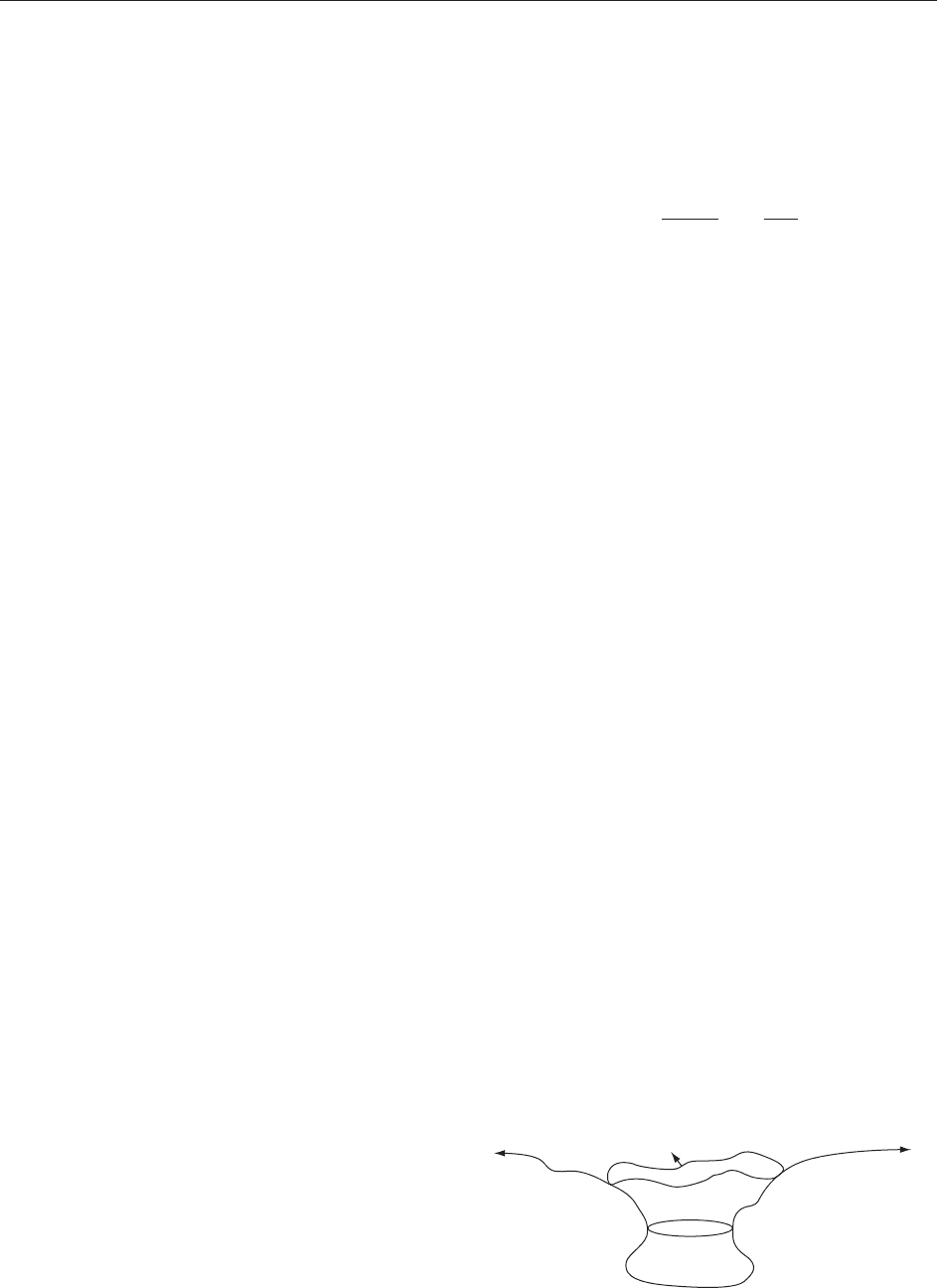
Figures 3 and 4 are meant to help illustrate some of the
properties of the conformal flow of the metric. Figure 3
is the original metric which has a strictly outer
minimizing horizon
0
.Ast increases, (t)moves
outwards, but never inwards. In Figure 4,wecan
observe one of the consequences of the fact that
A(t) = A
0
is constant in t. Since the metric is not
changing inside (t), all of the horizons (s), 0 s t
Σ(0) = Σ
0
Σ(t )
(M
3
, g
0
)
v
Figure 3 Original metric having a strictly outer minimizing
horizon
0
:
Geometric Flows and the Penrose Inequality 517
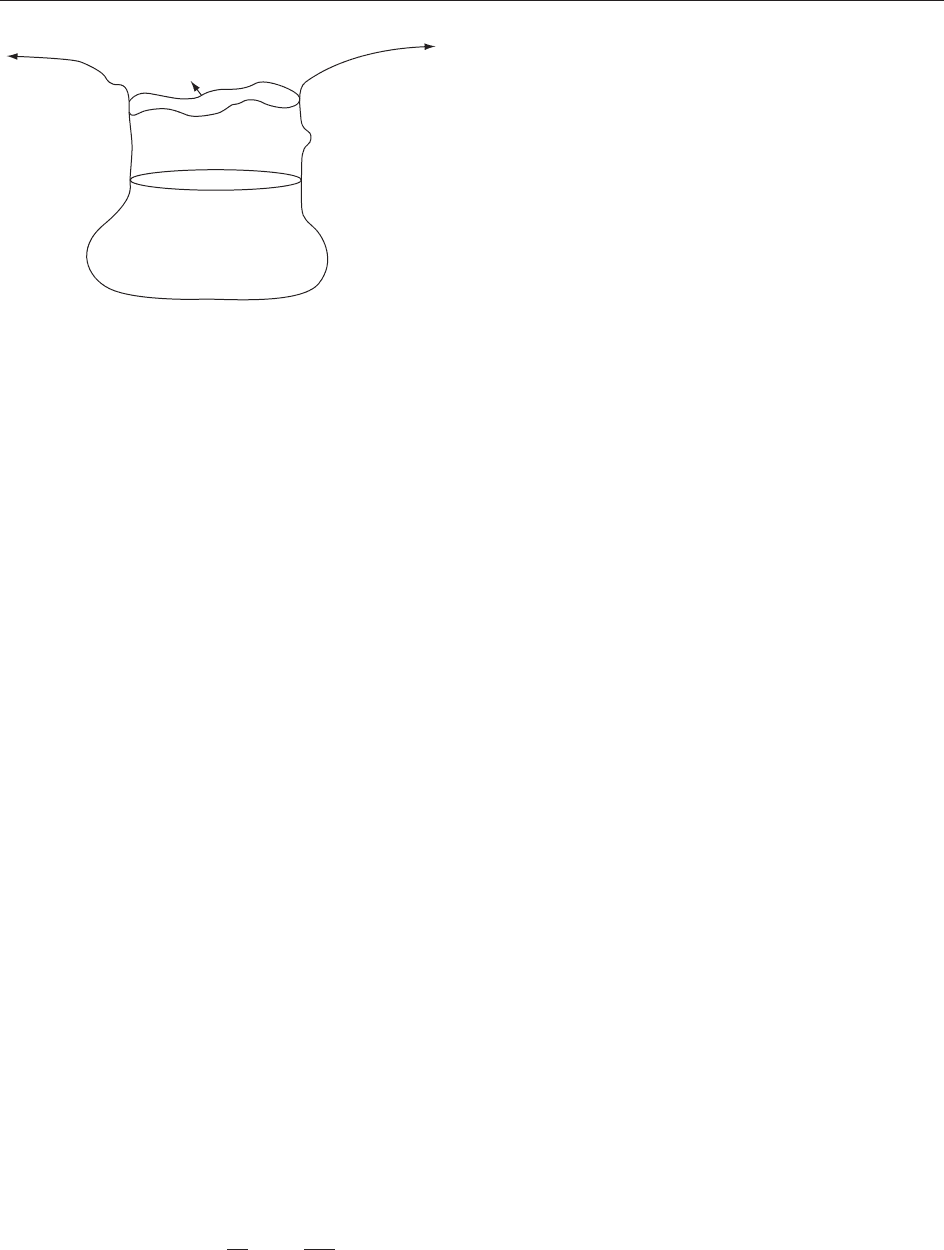
have area A
0
in (M
3
, g
t
). Hence, inside (t), the
manifold (M
3
, g
t
) becomes cylinder-like in the sense
that it is laminated (i.e., foliated but with some gaps
allowed) by all of the previous horizons which all have
the same area A
0
with respect to the metric g
t
.
Now let us suppose that the original horizon
0
of (M
3
, g) had two components, for example. Then
each of the components of the horizon will move
outwards as t increases, and at some point before
they touch they will suddenly jump outwards to
form a horizon with a single component enclosing
the previous horizon with two components. Even
horizons with only one component will sometimes
jump outwards, but no more than a countable
number of times. It is interesting that this phenom-
enon of surfaces jumping is also found in the
Huisken–Ilmanen approach to the Penrose conjec-
ture using their generalized 1=H flow.
Proof that m
0
(t) 0
The most surprising aspect of the flow defined
earlier is that m
0
(t) 0. As mentioned in that
section, this important fact follows from a nice
trick using the Riemannian positive mass theorem.
The first step is to realize that while the rate of
change of g
t
appears to depend on t and g
0
, this is in
fact an illusion. As described in detail by Bray, the
rate of change of g
t
can be described purely in terms
of g
t
(and
0
). It is also true that the rate of change
of g
t
depends only on g
t
and (t). Hence, there is no
special value of t, so proving m
0
(t) 0 is equivalent
to proving m
0
(0) 0. Thus, without loss of genera l-
ity, we take t = 0 for convenience.
Now expand the harmonic function v
0
(x), defined
in eqn [10], using spherical harmonics at infinity, to get
v
0
ðxÞ¼1 þ
c
jxj
þO
1
jxj
2
!
½13
for some constant c. Since the rate of change of the
metric g
t
at t = 0 is given by v
0
(x) and since the total
mass m(t) depends on the 1/r rate at which the
metric g
t
becomes flat at infinity (see eqn [2]), it is
not surprising that direct calculation gives us that
m
0
ð0Þ¼2ðc mð0ÞÞ
Hence, to show that m
0
(0) 0, we need to show
that
c mð0Þ½14
In fact, cou nterexamples to eqn [14] can be found
if we remove either of the requirements that (0)
(which is used in the definition of v
0
(x)) be a
minimal surface or that (M
3
, g
0
) have non-negative
scalar curvature. Hence, we quickly see that eqn
[14] is a fairly deep conjecture which says something
quite interesting about manifold with non-negative
scalar curvature. Well, the Riemannian positive
mass theorem is also a deep conjecture which says
something quite interesting abo ut manifolds with
non-negative scalar curvature. Henc e, it is natural to
try to use the Riemannian positive mass theorem to
prove eqn [14].
Thus, we want to create a manifold whose total
mass depends on c from eqn [13]. The idea is to use
a reflection trick similar to one used by Bunt ing and
Masood-ul-Alam (1987) for another purpose. First,
remove the region of M
3
inside (0) and then reflect
the remainder of (M
3
, g
0
) through (0). Define the
resulting Riemannian manifold to be (
M
3
,
g
0
) which
has two asymptotically flat ends since (M
3
, g
0
) has
exactly one asymptotically flat end not contained by
(0). Note that (
M
3
,
g
0
) has non-negative scalar
curvature everywhere except on (0) where the
metric has corners. In fact, the fact that (0) has
zero mean curvature (since it is a minimal surface)
implies that (
M
3
,
g
0
) has ‘‘distributional’’ non-
negative scalar curvature everywhere, even on (0).
This notion is made rigorous by Bray. Thus, we have
used the fact that (0) is minimal in a critical way.
Recall from eqn [10] that v
0
(x) was defined to be
the harmonic function equal to zero on (0) which
goes to 1 at infinity. We want to reflect v
0
(x)tobe
defined on all of (
M
3
,
g
0
). The trick here is to define
v
0
(x)on(
M
3
,
g
0
) to be the harmoni c function which
goes to 1 at infinity in the original end and goes to
1 at infinity in the reflect end. By symmetry, v
0
(x)
equals 0 on (0) and so agrees with its original
definition on (M
3
, g
0
).
The next step is to compactify one end of (
M
3
,
g
0
).
By the maximum principle, we know that v
0
(x) > 1
and c > 0, so the new Riemannian manifold (
M
3
,
(v
0
(x) þ 1)
4
g
0
) does the job quite nicely and compac-
tifies the original end to a point. In fact, the
compactified point at infinity and the metric there
Σ(0) = Σ
0
Σ(t )
(M
3
, g
t
)
v
Figure 4 Metric after time t.
518 Geometric Flows and the Penrose Inequality

can be filled in smoothly (using the fact that (M
3
, g
0
)is
harmonically flat). It then follows from eqn [12] that
this new compactified manifold has non-negative
scalar curvature since v
0
(x) þ 1isharmonic.
The last step is simply to apply the Riemannian
positive mass theorem to (
M
3
,(v
0
(x) þ 1)
4
g
0
). It is
not surprising that the total mass
~
m(0) of this
manifold involves c, but it is quite lucky that direct
calculation yields
~
mð0Þ¼4ðc mð0ÞÞ
which must be positive by the Riemannian positive
mass theorem. Thus, we have that
m
0
ð0Þ¼2ðc mð0ÞÞ ¼
1
2
~
mð0Þ0
Open Questions and Applications
Now that the Riemannian Penrose conjecture has been
proved, what are the next interesting directions? What
applications can be found? Is this subject only of
physical interest, or are there possibly broader
applications to other problems in mathematics?
Clearly, the most natural open problem is to find a
way to prove the general Penrose inequality in which
M
3
is allowed to have any second fundamental form in
the spacetime. There is good reason to think that this
may follow from the Riemannian Penrose inequality,
although this is a bit delicate. On the other hand, the
general positive mass theorem followed from the
Riemannian positive mass theorem as was originally
shown by Schoen and Yau using an idea due to Jang.
For physicists, this problem is definitely a top priority
since most spacetimes do not even admit zero-second
fundamental form spacelike slices.
Another interesting question is to ask these same
questions in higher dimensions. The author is currently
working on a paper to prove the Riemannian Penrose
inequality in dimensions <8. Dimension 8 and higher
are harder because of the surprising fact that minimal
hypersurfaces (and hence apparent horizons of black
holes) can have codimension 7 singularities (points
where the hypersurface is not smooth). This curious
technicality is also the reason that the positive mass
conjecture is still open in dimensions 8 and higher for
manifolds which are not spin.
Naturally, it is harder to tell what the applications
of these techniques might be to other problems, but
already there have been some. One application is to
the famous Yamabe problem: given a compact
3-manifold M
3
, define E(g) =
R
M
3
R
g
dV
g
where g is
scaled so that the total volume of (M
3
, g)is1,R
g
is
the scalar curvature at each point, and dV
g
is the
volume form. An idea due to Yamabe was to try to
construct canonical metrics on M
3
by finding critical
points of this energy functional on the space of metrics.
Define C(g) to be the infimum of E(
g) over all metrics
g
conformal to g. Then the (topological) Yamabe
invariant of M
3
, denoted here as Y(M
3
), is defined to
be the supremum of C(g) over all metrics g. Y(S
3
) = 6
(2
2
)
2=3
Y
1
is known to be the largest possible value
for Yamabe invariants of 3-manifolds. It is also known
that Y(T
3
) = 0andY(S
2
S
1
) = Y
1
= Y(S
2
~
S
1
),
where S
2
~
S
1
is the nonorientable S
2
bundle over S
1
.
The author, working with Andre Neves on a
problem suggested by Richard Schoen, recently was
able to compute the Yamabe invariant of RP
3
using
inverse mean curvature flow techniques and found
that Y(RP
3
) = Y
1
=2
2=3
Y
2
. A corollary is Y(RP
2
S
1
) = Y
2
as well. These techniques also yield the
surprisingly strong result that the only prime 3-mani-
folds with Yamabe invariant larger than RP
3
are
S
3
, S
2
S
1
,andS
2
~
S
1
. The Poincare conjecture for
3-manifolds with Yamabe invariant greater than RP
3
is therefore a corollary. Furthermore, the problem of
classifying 3-manifolds is known to reduce to the
problem of classifying prime 3-manifolds. The
Yamabe approach then would be to make a list of
prime 3-manifolds ordered by Y. The first five prime
3-manifolds on this list are therefore S
3
, S
2
S
1
, S
2
~
S
1
, RP
3
,andRP
2
S
1
.
Acknowledgments
This research was supported in part by NSF
grants #DMS-9706006 and #DMS-9971960.
See also: Black Hole Mechanics; General Relativity:
Experimental Tests; General Relativity: Overview;
Geometric Analysis and General Relativity; Holomorphic
Dynamics; Mirror Symmetry: A Geometric Survey;
Spinors and Spin Coefficients; Stationary Black Holes.
Further Reading
Bray HL (1997) The Penrose Inequality in General Relativity and
Volume Comparison Theorems Involving Scalar Curvature.
Thesis, Stanford University.
Bray HL (2001) Proof of the Riemannian Penrose inequality using
the positive mass theorem. Journal of Differential Geometry.
59: 177–267.
Bray HL and Neves A (2004) Classification of Prime 3-Manifolds
with Yamabe Invariant Greater than RP
3
. Annals of Mathe-
matics 159: 407–424.
Bray HL and Schoen RM (1999) Recent proofs of the Riemannian
Penrose conjecture. In: Yau S-T (ed.) Current Developments in
Mathematics.
Bunting and Masood-ul-Alam (1987) Non-existence of multiple
black holes in asymptotically euclidean static vacuum space-
time. General Relativity and Gravitation 19(2).
Christodoulou D and Yau S-T (1988) Some remarks on the quasi-
local mass. Contemporary Mathematics 71: 9–14.
Geometric Flows and the Penrose Inequality 519

Hawking SW and Ellis GFR (1973) The Large-Scale Structure of
Space-Time.Cambridge: Cambridge University Press.
Huisken G and Ilmanen T (2001) The inverse mean curvature
flow and the Riemannian Penrose inequality. Journal of
Differential Geometry 59: 353–437.
Huisken G and Ilmanen T (1997a) A Note on Inverse Mean
Curvature Flow. Proceedings of the Workshop on Nonlinear
Partial Differential Equations, Saitama University, Sept. 1997
(available from Saitama University).
Huisken G and Ilmanen T (1997b) The Riemannian Penrose
inequality. International Mathematics Research Notices
20: 1045–10 58.
Jang PS and Wald RM (1977) The positive energy conjecture and
the cosmic censor hypothesis. Journal of Mathematical Physics
18: 41–44.
Parker TH and Taubes CH (1982) On Witten’s proof of the
positive energy theorem. Communications in Mathematical
Physics 84: 223–238.
Penrose R (1973) Naked singularities. Annals of the New York
Academy of Sciences 224: 125–134.
Schoen R and Yau S-T (1979a) On the proof of the positive mass
conjecture in general relativity. Communications in Mathema-
tical Physics 65: 45–76.
Schoen R and Yau S-T (1979b) Positivity of the total mass of a
general space-time. Physical Review Letters 43: 1457–1459.
Schoen R and Yau S-T (1981) Proof of the positive mass
theorem II. Communications in Mathematical Physics 79:
231–260.
Witten E (1981) A new proof of the positive energy theorem.
Communications in Mathematical Physics 80: 381–402.
Geometric Measure Theory
G Alberti, Universita
`
di Pisa, Pisa, Italy
ª 2006 Elsevier Ltd. All rights reserved.
Introduction
The aim of these pages is to give a brief, self-
contained introduction to that part of geometric
measure theory which is more directly related to the
calculus of variations, namely the theory of currents
and its applications to the solution of Plateau
problem. (The theory of finite-perimeter sets, which
is closely related to currents and to the Plateau
problem, is treated in the article Free Interfaces and
Free Discontinuities: Variational Problems in the
Encyclopedia.)
Named after the Belgian physicist J A F Plateau
(1801–1883), this problem was originally formulated
as follows: find the surface of minimal area spanning
a given curve in the space. Nowadays, it is mostly
intended in the sense of developing a mathematical
framework where the existence of k-dimensional
surfaces of minimal volume that span a prescribed
boundary can be rigorously proved. Indeed, several
solutions have been proposed in the last century,
none of which is completely satisfactory.
One difficulty is that the infimum of the area
among all smooth surfaces with a certain boundary
may not be attained. More precisely, it may happen
that all minimizing sequences (i.e., sequences of
smooth surfaces whose area approaches the infimum)
converge to a singular surface. Therefore, one is
forced to consider a larger class of admissible surfaces
than just smooth ones (in fact, one might want to do
this also for modeling reasons – this is indeed the case
with soap films, soap bubbles, and other capillarity
problems). But what does it mean that a set ‘‘spans’’ a
given curve? and what should we intend by area of a
set which is not a smooth surface?
The theory of integral currents developed by
Federer and Fleming (1960) provides a class of
generalized (oriented) surfaces with well-defined
notions of boundary and area (called mass) where
the existence of minimizers can be proved by direct
methods. More precisely, this class is large enough
to have good compactness properties with respect
to a topology that makes the mass a lower-
semicontinuous functional. This approach turned
out to be quite powerful and flexible, and in the
last decades the theory of currents has found
applications in several different areas, from dyna-
mical systems ( in parti cular, Mather theory) to the
theory of foliations, to optim al trans port probl ems.
Hausdorff Measures, Dimension,
and Rectifiability
The volume of a smooth d-dimensional surface in
R
n
is usually defined using parametrizations by
subsets of R
d
. The notion of Hausdorff measure
allows to compute the d-dimensional volume using
coverings instead of parametrizations, and, what is
more important, applies to all sets in R
n
, and makes
sense even if d is not an integer. Attached to
Hausdorff measure is the notion of Hausdorff
dimension. Again, it can be defined for all sets in
R
n
and is not necessarily an integer. The last
fundamental notion is rectifiability: k-rectifiable
sets can be roughly understood as the largest class
of k-dimensional sets for which it is still possible to
define a k-dimensional tangent bundle, even if only
in a very weak sense. They are essential to the
construction of integral currents.
520 Geometric Measure Theory

Hausdorff Measure
Let d 0 be a positive real number. Gi ven a set E in
R
n
, for every >0 we set
H
d
ðEÞ:¼
!
d
2
d
inf
X
j
ðdiamðE
j
ÞÞ
d
½1
where !
d
is the d-dimensional volume of the unit
ball in R
d
whenever d is an integer (there is no
canonical choice for !
d
when d is not an integer;
a convenient one is !
d
= 2
d
), and the infimum is
taken over all countable families of sets {E
j
} that
cover E and whose diameters satisfy diam(E
j
) .
The d-dimensional Hausdorff measure of E is
H
d
ðEÞ:¼ lim
!0
H
d
ðEÞ½2
(the limit exists because H
d
(E) is decreasing in ).
Remarks
(i) H
d
is called d-dimensional because of its
scaling behavior: if E
is a copy of E scaled
homothetically by a factor , then
H
d
ðE
Þ¼
d
H
d
ðEÞ
Thus, H
1
scales like the length, H
2
scales like the
area, and so on.
(ii) The measure H
d
is clearly invariant under
rigid motions (translations and rotat ions). This
implies that H
d
agrees on R
d
with the Lebesgue
measure up to some constant factor; the renorma-
lization constant !
d
=2
d
in [1] makes this factor
equal to 1. Thus, H
d
(E) agrees with the usual
d-dimensional volume for every set E in R
d
,and
the area formula shows that the same is true if
E is (a subset of) a d-dimensional surface of class C
1
in R
n
.
(iii) Besides the Hausdorff measure, there are
several other, less popular notions of d-dimensional
measure: all of them are invariant under rigid motion,
scale in the expected way, and agree with H
d
for sets
contained in R
d
or in a d-dimensional surface of class
C
1
, and yet they differ for other sets (for further
details, see Federer (1996, section 2.10)).
(iv) The definition of H
d
(E) uses only the notion
of diameter, and therefore makes sense when E is a
subset of an arbitrary metric space. Note that H
d
(E)
depends only on the restriction of the metric to E,
and not on the ambient space.
(v) The measure H
d
is countably additive on
the -algebra of Borel sets in R
n
, but not on all sets ;
to avoid pathological situations, we shall always
assume that sets and maps are Borel measurable.
Hausdorff Dimension
According to intuition, the length of a surface
should be infinite, while the area of a curve should
be null. These are indeed particular cases of the
following implications:
H
d
ðEÞ > 0 ) H
d
0
ðEÞ¼1 for d
0
< d
H
d
ðEÞ < 1)H
d
0
ðEÞ¼0 for d
0
> d
Hence, the infimum of all d such that H
d
(E) = 0 and
the supremum of all d such that H
d
(E) = 1
coincide. This number is called Hausdorff dimension
of E, and denoted by dim
H
(E). For surface of class
C
1
, the notion of Hausdorff dimension agrees with
the usual one. Example of sets with nonintegral
dimension are described in the next subsection.
Remarks
(i) Note that H
d
(E) may be 0 or 1 even for
d = dim
H
(E).
(ii) The Hausdor ff dimension of a set E is strictly
related to the metric on E, and not just to the
topology. Indeed, it is preserved under diffeomorph-
isms but not under homeomorphisms, and it does
not always agree with the topological dimension.
For instance, the Hausdorff dimension of the graph
of a continuous function f : R !R can be any
number between 1 and 2 (included).
(iii) For nonsmooth sets, the Hausdorff dimension
does not always conform to intuition: for example,
the dimension of a Cartesian product E F of
compact sets does not agree in general with the sum
of the dimensions of E and F.
(iv) There are many other notions of dimension
besides Hausdorff and topological ones. Among
these, packing dimension and box-counting dimen-
sion have interesting applications (see Falconer
(2003, chapters 3 and 4)).
Self-Similar Fractals
Interesting examples of sets with nonintegral dimen-
sion are self-similar fractals. We present here a
simplified version of a construction due to Hutchinson
(Falconer 2003,chapter9).Let{
i
} be a finite set of
similitudes of R
n
with scaling factor
i
< 1, and
assume that there exists a bounded open set V such
that the sets V
i
:=
i
(V) are pairwise disjoint and
contained in V. The self-similar fractal associated with
the system {
i
} is the compact set C that satisfies
C ¼
[
i
i
ðCÞ½3
The term ‘‘self-similar’’ follows by the fact that C
can be written as a union of scaled copies of itself.
Geometric Measure Theory 521
The existence (and uniqueness) of such a C follows
from a standard fixed-point argument applied to the
map C 7!
S
i
(C). The dimension d of C is the
unique solution of the equation
X
i
d
i
¼ 1 ½4
Formula [4] can be easily justified: if the sets
i
(C)
are disjoint – and the assumption on V implies that
this almost the case – then [3] impli es H
d
(C) =
H
d
(
i
(C)) =
d
i
H
d
(C), and therefore H
d
(C) can
be positive and finite if and only if d satisfies [4].
An example of this construction is the usual
Cantor set in R, which is given by the similitudes
1
ðxÞ :¼
1
3
x and
2
ðxÞ :¼
2
3
þ
1
3
x
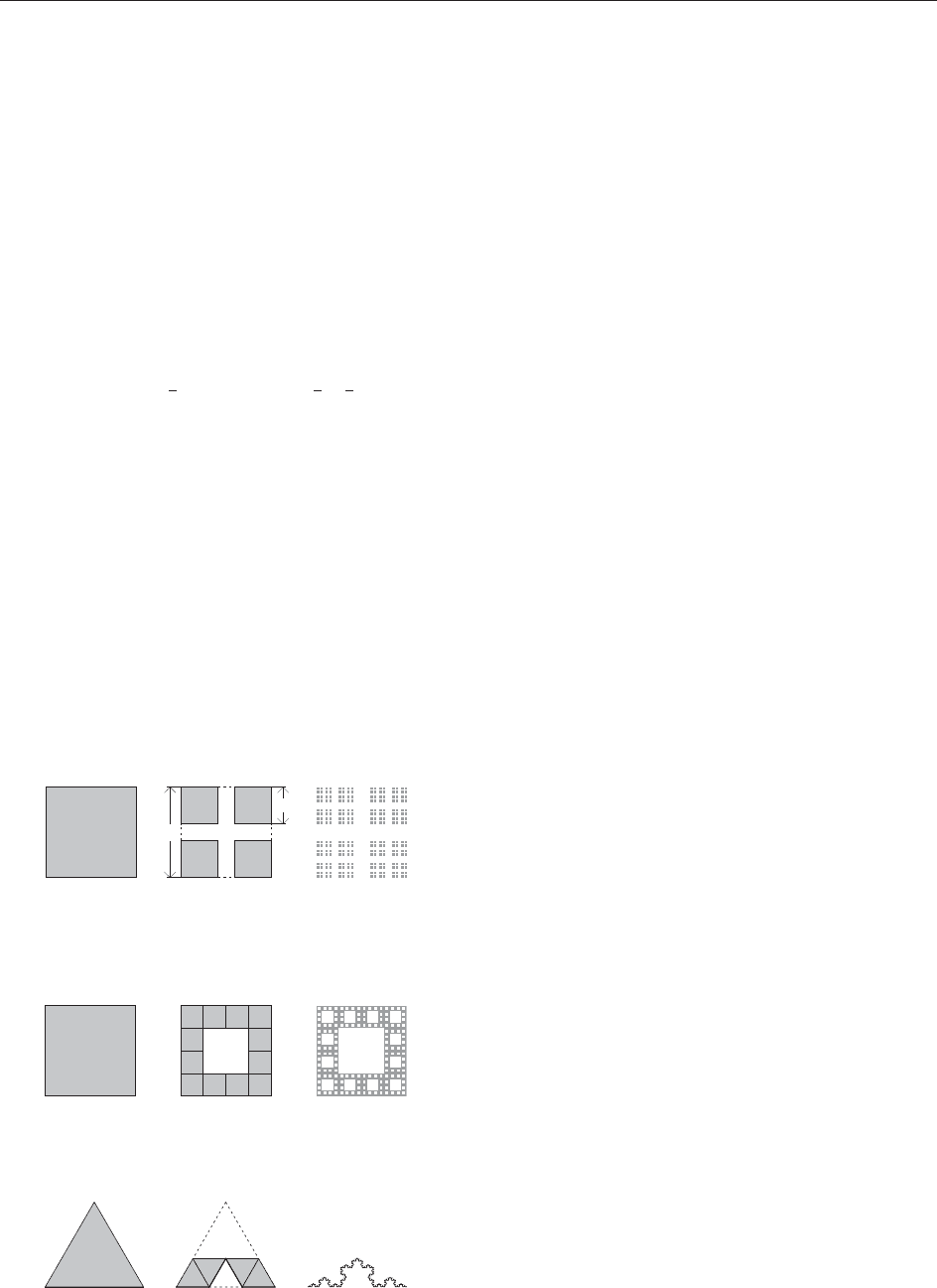
By [4], its dimension is d = log 2= log 3. Other
examples are described in Figure s 1–3.
Rectifiable Sets
Given an integer k = 1, ..., n, we say that a set E in
R
n
is k-rectifiable if it can be covered by a countable
family of sets {S
j
} such that S
0
is H
k
-negligible (i.e.,
H
k
(S
0
) = 0) and S
j
is a k-dimensional surface of class
C
1
for j = 1, 2, ... Note that dim
H
(E) k because
each S
j
has dimension k.
A k-rectifiable set E bears little resemblance to
smooth surfaces (it can be everywhere dense!), but it
still admits a suitably weak notion of tangent bundle.
More precisely, it is possible to associate with every
x 2 E a k-dimensional subspace of R
n
, denoted by
Tan(E, x), so that for every k-dimensional surface S
of class C
1
in R
n
there holds
TanðE; xÞ¼TanðS; xÞ for H
k
-a.e. x 2 E \ S ½5
where Tan(S, x) is the tangent space to S at x
according to the usual definition.
It is not difficult to see that Tan(E, x) is uniquely
determined by [5] up to an H
k
-negligible amount of
points x 2 E,andifE is a surface of class C
1
, then it
agrees with the usual tangent space for H
k
-almost
all points of E.
Remarks
(i) In the original definition of rectifiability, the
sets S
j
with j > 0 are Lipschitz images of R
k
, that is,
S
j
:= f
j
(R
k
), where f
j
: R
k
!R
n
is a Lipschitz map.
It can be shown that this definition is equivalent to
the one above.
(ii) The construction of the tangent bundle is
straightforward: Let {S
j
} be a covering of E as earlier,
and set Tan(E, x):= Tan(S
j
, x), where j is the smallest
positive integer such that x 2 S
j
.Then[5] is an
immediate corollary of the following lemma: if S and
S
0
are k-dimensional surfaces of class C
1
in R
n
,then
Tan(S, x) = Tan(S
0
, x)forH
k
-almost every x 2 S \ S
0
.
(iii) A set E in R
n
is called purely k-unrectifiable
if it contains no k-rectifiable subset with posi-
tive k-dimensional measure, or, equivalently, if
H
k
(E \ S) = 0 for every k-dimensional surface S of
class C
1
. For instance, every product E := E
1
E
2
,
where E
1
and E
2
are H
1
-negligible sets in R is a
purely 1-unrectifiable set in R
2
(it suffices to show
that H
1
(E \ S) = 0 whenever S is the graph of a
function f : R !R of class C
1
, and this follows by
the usual formula for the length of the graph). Note
that the Hausdorff dimension of such product sets
can be any number between 0 and 2, hence
rectifiability is not related to dimension. The self-
similar fractals described in Figures 1 and 3 are both
purely 1-unrectifiable.
Rectifiable Sets with Finite Measure
If E is a k-rectifiable set with finite (or locally finite)
k-dimensional measure, then Tan(E, x) can be
related to the behavior of E close to the poin t x.
Let B(x, r) be the open ball in R
n
with center x
and radius r, and let C(x, T, a) be the cone with
center x,axisT –ak-dimensional subspace of R
n
–
and amplitude = arcsin a, that is,
Cðx; T; aÞ:¼fx
0
2 R
n
: distðx
0
x; TÞajx
0
xjg
V
V
1
V
2
V
3
V
4
C
1
λ
Figure 1 The maps
i
, i = 1, ..., 4, take the square V into the
squares V
i
at the corners of V. The scaling factor is for all i,
hence dim
H
(C) = log 4=(log ). Note that dim
H
(C) can be any
number between 0 and 2, including 1.
V
V
1
V
2
V
3
C
....
Figure 2 A self-similar fractal with more complicated topology.
The scaling factor is 1/4 for all twelve similitudes, hence
dim
H
(C) = log 12= log 4:
V
V
1
V
4
V
3
V
2
C
Figure 3 The von Koch curve (or snowflake). The scaling
factor is 1/3 for all four similitudes, hence dim
H
(C) = log 4= log 3:
522 Geometric Measure Theory

For H
k
-almost every x 2 E, the measure of E \
B(x, r) is asymptotically equivalent, as r !0, to the
measure of a flat disk of radius r, that is,
H
k
E \ Bðx; rÞðÞ!
k
r
k
Moreover, the part of E contained in B(x, r)is
mostly located close to the tangent plane Tan(E, x),
that is,
H
k
E \ Bðx; rÞ\Cðx; TanðE; xÞ; aÞðÞ!
k
r
k
for every a > 0
When this condition holds, Tan(E, x) is called the
approximate tangent space to E at x (see Figure 4).
The Area Formula
The area formula allows to comput e the measure
H
k
((E)) of the image of a set E in R
k
as the
integral over E of a suitably defined Jacobian
determinant of .When is injective and takes
values in R
k
, we recover the usual change of
variable formula for multiple integrals.
We consider first the linear case. If L is a linear
map from R
k
to R
m
with m k, the volume ratio
:= H
k
(L(E))=H
k
(E) does not depend on E, and
agrees with jdet (PL)j, where P is any linear
isometry from the image of L into R
k
, and det (PL)
is the determinant of the k k matrix associated
with PL. The volume ratio can be computed using
one of the following identities:
¼
ffiffiffiffiffiffiffiffiffiffiffiffiffiffiffiffiffiffiffi
detðL
LÞ
q
¼
ffiffiffiffiffiffiffiffiffiffiffiffiffiffiffiffiffiffiffiffiffiffiffiffiffi
X
ðdet MÞ
2
q
½6
where L
is the adjoint of L (thus, L
L is a linear
map from R
k
into R
k
), and the sum in the last term
is taken over all k k minors M of the matrix
associated with L.
Let : R
k
!R
m
be a map of class C
1
with m k,
and E a set in R
k
. Then
Z
ðEÞ
#ð
1
ðyÞ\EÞdH
k
ðyÞ¼
Z
E
JðxÞdH
k
ðxÞ½7
where #A stands for the number of elements of A,
and the Jacobian J is
JðxÞ:¼
ffiffiffiffiffiffiffiffiffiffiffiffiffiffiffiffiffiffiffiffiffiffiffiffiffiffiffiffiffiffiffiffiffiffiffiffiffiffiffiffi
det rðxÞ
rðxÞðÞ
q
½8
Note that the left- hand side of [7] is H
k
((E)) when
is injective.
Remark
Formula [7] holds even if E is a k-rectifiable set in R
n
.
In this case, the gradient r(x)in[8] should be
replaced by the tangential derivative of at x (viewed
as a linear map from Tan(E, x)intoR
m
). No version of
formula [7] is available when E is not rectifiable.
Vectors, Covectors, and Differential
Forms
In this section, we review some basic notions of
multilinear algebra. We have chosen a definition of
k-vectors and k-covectors in R
n
, and of the corres-
ponding exterior products, which is quite convenient
for computations, even though not as satisfactory from
the formal viewpoint. The main drawback is that it
depends on the choice of a standard basis of R
n
,and
therefore cannot be used to define forms (and currents)
when the ambient space is a general manifold.
k-Vectors and Exterior Product
Let { e
1
, ..., e
n
} be the standard basis of R
n
. Given an
integer k n, I(n, k) is the set of all multi-indices
i = (i
1
, ..., i
k
) with 1 i
1
< i
2
< < i
k
n, and
for every i 2 I(n, k) we introduce the expression
e
i
¼ e
i
1
^ e
i
2
^^e
i
k
A k-vector in R
n
is an y formal linear combination
i
e
i
with
i
2 R for every i 2 I(n, k). The space of
k-vectors is denoted by ^
k
(R
n
); in particular,
^
1
(R
n
) = R
n
. For reasons of formal convenience,
we set ^
0
(R
n
):= R and ^
k
(R
n
):= {0} for k > n.
We denote by jjthe Euclidean norm on ^
k
(R
n
).
The exterior product v ^ w 2^
kþh
(R
n
) is defined
for every v 2^
k
(R
n
) and w 2^
h
(R
n
), and is
completely determined by the following properties:
(1) associativity, (2) linearity in both arguments, and
(3) e
i
^ e
j
= e
j
^ e
i
for every i 6¼ j and e
i
^ e
i
= 0 for
every i.
Simple Vectors and Orientation
A simple k-vector is any v in ^
k
(R
n
) that can be
written as a product of 1-vectors, that is,
v ¼ v
1
^ v
2
^^v
k
It can be shown that v is null if and only if the
vectors {v
i
} are linearly dependent. If v is not null,
T = Tan(E, x)
x
C(x, T, a)
α
r
E
Figure 4 A rectifiable set E close to a point x of approximate
tangency. The part of E contained in the ball B(x , r) but not in the
cone C(x, T , a) is not empty, but only small in measure.
Geometric Measure Theory 523

then it is uniquely determined by the following
objects: (1) the k-dimensional space M spanned
by {v
i
}; (2) the orientation of M associated with the
basis {v
i
}; (3) the euclidean norm jvj. In particular,
M does not depend on the choice of the vectors v
i
.
Note that jvj is equal to the k-dimensional volume of
the parallelogram spanned by {v
i
}.
Hence, the map v 7!M is a one-to-one correspon-
dence between the class of simple k-vectors with
norm jvj= 1 and the Grassmann manifold of
oriented k-dimensional subspaces of R
n
.
This remark paves the way to the following definition:
if S is a k-dimensional surface of class C
1
in R
n
, possibly
with boundary, an orientation of S is a continuous map
S
: S !^
k
(R
n
) such that
S
(x)isasimplek-vector with
norm 1 that spans Tan(S, x) for every x.Withevery
orientation of S (if any exists) is canonically associated
the orientation of the boundary @S that satisfies
S
ðxÞ¼ðxÞ^
@S
ðxÞ for every x 2 @S ½9
where (x) is the inner normal to @S at x.
k-Covectors
The standard basis of the dual of R
n
is
{dx
1
, ..., dx
n
}, where dx
i
: R
n
!R is the linear
functional that takes every x = (x
1
, ..., x
n
) into the
ith component x
i
. For every i 2 I(n, k) we set
dx
i
¼ dx
i
1
^ dx
i
2
^^dx
i
k
and the space ^
k
(R
n
)ofk-covectors consists of all
formal linear combinations
i
dx
i
. The exterior
product of covectors is defined as that for vectors.
The space ^
k
(R
n
) is dual to ^
k
(R
n
) via the duality
pairing h; i defined by the relations hdx
i
; e
j
i:=
ij
(that is, 1 if i = j and 0 otherwise).
Differential Forms and Stokes Theorem
A differential form of order k on R
n
is a map
! : R
n
!^
k
(R
n
). Using the canonical basis of
^
k
(R
n
), we can write ! as
!ðxÞ¼
X
i2Iðn;kÞ
!
i
ðxÞdx
i
where the coordinates !
i
are real functions on R
n
.
The exterior derivative of a k-form ! of class C
1
is
the (k þ 1)-form
d!ð xÞ:¼
X
i2Iðn;kÞ
d!
i
ðxÞ^dx
i
where, for every scalar function f, df is the 1-form
df ðxÞ:¼
X
n
i¼1
@f
@x
i
ðxÞdx
i
If S is a k-dimensional oriented surface, the
integral of a k-form ! on S is naturally defined by
Z
S
! :¼
Z
S
h!ðxÞ;
S
ðxÞidH
k
ðxÞ
Stokes theorem states that for every (k 1)-form !
of class C
1
there holds
Z
@S
! ¼
Z
S
d! ½10
provided that @S is endowed with the orientation
@S
that satisfies [9].
Currents
The definition of k-dimensional currents closely
resembles that of distributions: they are the dual of
smooth k-forms with compact support. Since every
oriented k-dimensional surface defines by integration
a linear functional on forms, currents can be regarded
as generalized oriented surfaces. As every distribution
admits a derivative, so every current admits a
boundary. Indeed, many other basic notions of
homology theory can be naturally extended to
currents – this was actually one of the motivations
behind the introduction of currents, due to de Rham.
For the applications to variational problems,
smaller classes of currents are usually considered;
the most relevant to the Plateau problem is that of
integral currents. Note that the definitions of the
spaces of normal, rectifiable, and integral currents
and the symbols used to denote them vary, some-
times more than slightly, depending on the author.
Currents, Boundary, and Mass
Let n, k be integers with n k. The space of
k-dimensional currents on R
n
, denoted by D
k
(R
n
),
is the dual of the space D
k
(R
n
) of smooth k-forms
with compact support in R
n
. For k 1, the
boundary of a k-current T is the (k 1)-current @T
defined by
h@T; !i:¼hT; d!i for every ! 2 D
k1
ðR
n
Þ½11
while the boundary of a 0-current is set equal to 0.
The mass of T is the number
MðTÞ:¼ sup hT; !i: ! 2 D
k
ðR
n
Þ; j!j1
no
½12
Fundamental examples of k-currents are oriented
k-dimensional surfaces: with each oriented surface
S of class C
1
is canonically associated the current
hT;d!i: =
R
S
! (in fact, S is completely determined
by the action on forms, i.e., by the associated
524 Geometric Measure Theory

current). By Stok es theorem, the b oundary of T is
the current associated with th e boundary of S;thus,
the notion of boundary for c urrents is compatible
with the classical one for o riented surfaces.
A simple computation shows that M(T) = H
k
(S);
therefore, the mass provides a natural extension
of the notion of k-dimensional volume to
k-currents.
Remarks
(i) Not all k-currents look like k-dimensional
surfaces. For example, every k-vectorfield v : R
n
!^
k
(R
n
) defines by duality the k-current
hT; !i:¼
Z
h!ðxÞ; vðxÞi dH
n
ðxÞ
The mass of T is
R
jvjdH
n
, and the boundary is
represented by a similar integral formula involving
the partial derivatives of v (in particular, for
1-vectorfields, the boundary is the 0-current asso-
ciated with the diver gence of v). Note that the
dimension of such T is k because k-vectorfields act
on k-forms, and there is no relation with the
dimension of the support of T, which is n.
(ii) To be precise, D
k
(R
n
) is a locally convex
topological vector space, and D
k
(R
n
) is its topolo-
gical dual. As such, D
k
(R
n
) is endowed with a dual
(or weak
) topology. We say that a sequenc e of
k-currents (T
j
) converge to T if they converge in the
dual topology, that is,
hT
j
; !i!hT; !i for every ! 2 D
k
ðR
n
Þ½13
Recalling the definition of mass, it is easy to show
that it is lower-semicontinuous with respect the dual
topology, and in particular
lim inf MðT
j
ÞMðTÞ½14
Currents with Finite Mass
By definition, a k-current T with finite mass is a
linear functional on k-forms which is bounded with
respect to the supremum norm, and by Riesz
theorem it can be represented as a bounded measure
with values in ^
k
(R
n
). In other words, there exist a
finite positive measure on R
n
and a density
function : R
n
!^
k
(R
n
) such that j(x)j= 1 for
every x and
hT; !i¼
Z
h!ðxÞ; ðxÞi dðxÞ
The fact that curren ts are the dual of a separable
space yields the following compactness result: a
sequence of k-currents (T
j
) with uniformly bounded
masses M(T
j
) admits a subsequence that converges
to a current with finite mass.
Normal Currents
A k-current T is called normal if both T and @T
have finite mass. The compactness result stated in
the previous paragraph implies the following com-
pactness theorem for normal currents: a sequence of
normal currents (T
j
) with M(T
j
) and M(@T
j
)
uniformly bounded admits a subsequence that
converges to a normal current.
Rectifiable Currents
A k-current T is called rectifiable if it can repre-
sented as
hT; !i¼
Z
E
h!ðxÞ; ðxÞiðxÞdH
k
ðxÞ
where E is a k-rectifiable set E, is an orientation of
E – that is, (x) is a simple unit k-vector that spans
Tan(E, x) for H
k
-almost every x 2 E – and is a real
function such that
R
E
jjdH
k
is finite, called multi-
plicity. Such T is denoted by T = [E, , ]. In
particular, a rectifiable 0-current can be written as
hT; !i=
i
!(x
i
), where E = {x
i
} is a countable set in
R
n
and {
i
} is a sequence of real numbers with
j
i
j < þ1.
Integral Currents
If T is a rectifiable current and the multiplicity
takes integral values, T is called an integer multi-
plicity rectifiable current. If both T and @T are
integer multiplicity rectifiable currents, then T is an
integral current.
The first nontrivial result is the bounda ry rectifia-
bility theorem: if T is an integer multiplicity
rectifiable current and @T has finite mass, then @T
is an integer multiplicity rectifiable current, too, and
therefore T is an integral current.
The second fundamental result is the compactness
theorem for integral currents: a sequence of integral
currents (T
j
) with M(T
j
)andM(@T
j
) uniformly
bounded admits a subsequence that converges to
an integral current.
Remarks
(i) The point of the compactness theorem for
integral currents is not the existence of a converging
subsequence – that being alre ady established by the
compactness theorem for normal currents – but the
fact that the limit is an integral current. In fact, this
result is often referred to as a ‘‘closure theorem’’
rather than a ‘‘compactness theorem.’’
Geometric Measure Theory 525