
Francoise J.-P., Naber G.L., Tsun T.S. (editors) Encyclopedia of Mathematical Physics
Подождите немного. Документ загружается.


For a compact marginally trapped surface N in M,
analogous results can be proved by studying the
stability operator defined with respect to the direc-
tion .LetJ be the operator defined in terms of a
variation of
þ
by J =
þ
. Then
J ¼
N
þ2s
A
D
A
þ
1
2
Scal
N
s
A
s
A
þD
A
s
A
1
2
j
þ
j
2
G
þ
Here, s
A
= (1=2)hL
, D
A
L
þ
iand G
þ
is the Einstein
tensor evaluated on L
þ
, L
. We may call N stable if
the real part of the spectrum of J is non-negative. A
sufficient condition for N to be stable is that N is
locally outermost. This can be formulated, for
example, by requiring that a neighborhood of N in M
contains no trapped surfaces exterior to N.Inthiscase,
assuming that the DEC holds, N is a sphere or a torus,
and if the real part of the spectrum of J is positive then
N is a sphere. If N is a torus, then the ambient
curvature and shear vanishes at N, s
A
is a gradient, and
N is flat. One expects that in addition, global rigidity
should hold, in analogy with the minimal surface case.
This is an open problem. If N satisfies the stronger
condition of strict stability, which corresponds to the
spectrum of J having positive real part, then N is in the
interior of a hypersurface H of the ambient spacetime,
with the property that it is foliated by marginally
trapped surfaces (Andersson et al. 2005). If the NEC
holds and N has nonvanishing shear, then H is
spacelike at N. A hypersurface H with these proper-
ties is known as a dynamical horizon.
Jang’s Equation
Consider a Cauchy data set (M, g
ij
, K
ij
). Extend K
ij
to a tensor field on M R, constant in the vertical
direction. Then the equation for a graph
N ¼fðx; tÞ2M R; t ¼ f ðxÞg
such that N has mean curvature equal to the trace of
the projection of K
ij
to N with respect to the induced
metric on N, is given by
X
i;j
K
ij
r
i
r
j
f
ð1 þjrf j
2
Þ
1=2
!
g
ij
r
i
f r
j
f
1 þjrf j
2
!
¼ 0 ½8
an equation closely related to the equation
þ
= 0. Equation [8] was introduced by P S Jang
(Jang 1978) as part of an attempt to generalize the
inverse mean curvature flow method of Geroch from
time-symmetric to general Cauchy data.
Existence and regularity for Jang’s equation were
proved by Schoen and Yau (1981) and used to
generalize their proof of the positive-mass theorem
from the case of maximal slices to the general case.
The solution to Jang’s equation is constructed as the
limit of the solution to a sequence of regularized
problems. The limit consists of a collection N of
submanifolds of M R. In particular, component
near infinity is a graph and has the same mass as M.
N may contain vertical components which project
onto marginally trapped surfaces in M, and in fact
these constitute the only possibilities for blow-up of
the sequence of graphs used to construct N. If the
DEC is valid, the metric on N has non-negative
scalar curvature in the weak sense that
Z
N
Scal
N
2
þ 2jr j
2
> 0
for smooth compactly supported functions . If the
DEC holds strictly, the strict inequality holds and in
this case the metric on N is conformal to a metric
with vanishing scalar curvature.
Jang’s equation can be applied to prove existence
of marginally trapped surfaces, given barriers. Let
(M, g
ij
, K
ij
) be a Cauchy data set containing two
compact surfaces N
1
, N
2
which together bound a
compact region M
0
in M. Suppose the surfaces N
1
and N
2
have
þ
< 0onN
1
and
þ
> 0onN
2
.
Schoen recently proved the following result.
Theorem 3 (Existence of marginally trapped sur-
faces). Let M
0
, N
1
, N
2
be as above. Then there is a
finite collection of compact, marginally trapped
surfaces {
a
} contained in the interi or of M
0
, such
that [
a
is homologous to N
1
. If the DEC holds,
then
a
is a collection of spheres and tori.
The proof proceeds by solving a sequence of
Dirichlet boundary-value problems for Jang’s equation
with boundary value on N
1
, N
2
tending to 1and 1,
respectively. The assumption on
þ
is used to show the
existence of barriers for Jang’s equation. Let f
k
be the
sequence of solutions to the Dirichlet problems. Jang’s
equation is invariant under renormalization f
k
! f
k
þ
c
k
for some sequence c
k
of real numbers. A Harnack
inequality for the gradient of the solutions to Jang’s
equation is used to show that the sequence of solutions
f
k
, possibly after a renormalization, has a subsequence
converging to a vertical submanifold of M
0
R, which
projects to a collection
a
of marginally trapped
surfaces. By construction, the zero sets of the f
k
are homologous to N
1
and N
2
. The estimates on
the sequence {f
k
} show that this holds also in the limit
k !1. The statement about the topology of the
a
follows by showing, using the above-mentioned
inequality for Scal
N
, that if DEC holds, the total
Gauss curvature of each surface
a
is non-negative.
506 Geometric Analysis and General Relativity

Center of mass
Since by the positive-mass theorem m > 0 unless the
ambient spacetime is flat, it makes sense to consider
the problem of finding an appropriate notion of
center of mass. This problem was solved by Huisken
and Yau who showed that under the asymptotic
conditions [6] the isoperimetric problem has a unique
solution if one considers sufficiently large spheres.
Theorem 4 (Huisken and Yau 1996). There is an
H
0
> 0 and a compact region B
H
0
such that for each
H 2 (0, H
0
) there is a unique constant mean curva-
ture sphere S
H
with mean curvature H contained in
MnB
H
0
. The spheres form a foliation.
The proof involves a study of the evolution
equation
dx
ds
¼ðH
HÞ ½9
where
H is the average mean curvature. This is the
gradient flow for the isoperimetric problem of
minimizing area keeping the enclosed volume con-
stant. The solutions in Euclidean space are standard
spheres. Equation [9] defines a parabolic system, in
particular we have
d
ds
H ¼ H þðRicð; ÞþjAj
2
ÞðH
HÞ
It follows from the fall-off conditions [6] that the
foliation of spheres constructed in Theorem 4 are
untrapped surfaces. They can therefore be used as
outer barriers in the existence result for marginally
trapped surfaces, (Theorem 3).
The mean curvature flow for a spatial hypersur-
face in a Lorentz manifold is also parabolic. This
flow has been applied to construct constant mean
curvature Cauchy hypersurfaces in spacetimes.
Maximal and Related Surfaces
Let N be the hypersurface x
0
= u(x
1
, ..., x
n
)in
Minkowski space R
1þn
with line element dx
2
0
þ
dx
2
1
þþdx
2
n
. Assume jruj < 1 so that N is
spacelike. Then N is stationary with respect to
variations of area if u solves the equation
X
i
r
i
r
i
u
ffiffiffiffiffiffiffiffiffiffiffiffiffiffiffiffiffiffiffiffi
1 jruj
2
q
0
B
@
1
C
A
¼ 0 ½10
N maximizes area with respect to compactly
supported variations, and hence is called a maximal
surface. As in the case of the minimal surface
equation, eqn [10] and more generally the
Lorentzian prescribed mean curvature equation, is
quasilinear elliptic, but it is not uniformly elliptic,
which makes the regularity theory more subtle.
A Bernstein principle analogous to the one for the
minimal surface equation holds for the maximal
surface equation [10]. Suppose that u is a solution to
[10] which is defined on all of R
n
. Then u is an
affine function (Cheng and Yau 1976). An impor-
tant tool used in the proof is a Bochner type identity,
originally due to Calabi, for the norm of the second
fundamental form. For a hypersurface in a flat
ambient space, the Codazzi equation states r
i
A
jk
r
j
A
ik
= 0. This gives the identity
A
ij
¼r
i
r
j
H þ A
km
R
mk
ij
þ A
mi
Ric
m
j
½11
The curvature terms can be rewritten in terms of A
ij
if the ambient space is flat. Using [11] to compute
jAj
2
gives an expression which is quadratic in rA,
and fourth order in jAj, and which allows one to
perform maximum principle estimates on jAj. Gen-
eralizations of this technique for hypersurfaces in
general ambient spaces play an important role in the
proof of regularity of minimal surfaces, and in the
proof of existence for Jang’s equation as well as in
the analysis of the mean curvature flow used to
prove existence of round spheres. The generalization
of eqn [11] is known as a Simons identity.
For the case of maximal hypersurfaces of
Minkowski space, it follows from further maximum
principle estimates that a maximal hypersurface of
Minkowski space is convex, in particular, it has
nonpositive Ricci curvature. Generalizations of this
technique allow one to analyze entire constant mean
curvature hypersurfaces of Minkowski space.
Consider a globally hyperbolic Lorentzian mani-
fold (V, ). A C
0
hypersurface is said to be weakly
spacelike if timelike curves intersect it in at most one
point. Call a codimension-2 submanifold V a
weakly spacelike boundary if it bounds a weakly
spacelike hypersurface N
0
.
Theorem 5 (Existence for Plateau problem for
maximal surfaces (Bartnik 1988)). Let V be a
globally hyperbolic spacetime and assume that the
causal structure of V is such that the domain of
dependence of an y compact domain in V is compact.
Given a weakly spacelike boundary in V, there is a
weakly spacelike maximal hypersurface N with as
its boundary. N is smooth except possibly on null
geodesics connecting points of .
Here, maximal hypersurface is understood in a
weak sense, referring to stationarity with respect to
variations. Due to the nonuniform ellipticity for the
maximal surface equation, the interior regularity
Geometric Analysis and General Relativity 507

which holds for minimal surfaces fails to hold in
general for the maximal surface equation.
A time-oriented spacetime is said to have a crushing
singularity to the past (future) if there is a sequence
n
of Cauchy surfaces so that the mean curvature
function H
n
of
n
diverges uniformly to 1(1).
Theorem 6 (Gerhardt 1983). Suppose that (V, ) is
globally hyperbolic with compact Cauchy surfaces
and satisfies the SEC. Then if (V, ) has crushing
singularities to the past and future it is globally
foliated by constant mean curvature hypersurfaces.
The mean curvature of these Cauchy surfaces is a
global time function.
The proof involves an application of results from
geometric measure theory to an action E of the form
discussed earlier. A barrier argument is used to control
the maximizers. Bartnik (1984, theorem 4.1) gave a
direct proof of existence of a constant mean curvature
(CMC) hypersurface, given barriers. If the spacetime
(V, ) is symmetric, so that a compact Lie group acts
on V by isometries, then CMC hypersurfaces in V
inherit the symmetry. Theorem 6 gives a condition
under which a spacetime is globally foliated by CMC
hypersurfaces. In general, if the SEC holds in a
spatially compact spacetime, then for each 6¼ 0,
there is at most one constant mean curvature Cauchy
surface with mean curvature .IncaseV is vacuum,
Ric
V
= 0, and 3 þ 1 dimensional, then each point x 2
V is on at most one hypersurface of constant mean
curvature unless V is flat and splits as a metric product.
There are vacuum spacetimes with compact Cauchy
surface which contain no CMC hypersurface
(Chrusciel et al. 2004). The proof is carried out by
constructing Cauchy data, using a gluing argument, on
the connected sum of two tori, such that the resulting
Cauchy data set (M, g
ij
, K
ij
) has an involution which
reverses the sign of K
ij
. The involution extends to the
maximal vacuum development V of the Cauchy data
set. Existence of a CMC surface in V gives, in view of
the involution, barriers which allow one to construct a
maximal Cauchy surface homeomorphic to M.This
leads to a contradiction, since the connected sum of
two tori does not carry a metric of positive scalar
curvature, and therefore, in view of the constraint
equations, cannot be imbedded as a maximal Cauchy
surface in a vacuum spacetime. The maximal vacuum
development V is causally geodesically incomplete.
However, in view of the existence proof for CMC
Cauchy surfaces (cf. Theorem 6), these spacetimes
cannot have a crushing singularity. It would be
interesting to settle the open question whether there
are stable examples of this type.
In the case of a spacetime V which has an
expanding end, one does not expect in general that
the spacetime is globally foliated by CMC hyper-
surfaces even if V is vacuum and contains a CMC
Cauchy surface. This expectation is based on the
phenomenon known as the collapse of the lapse; for
example, the Schwarzschild spacetime does not
contain a global foliation by maximal Cauchy
surfaces (Beig and Murchadha 1998). However, no
counterexample is known in the spatially compact
case. In spite of these caveats, many examples of
spacetimes with global CMC foliations are known,
and the CMC condition, or more generally pre-
scribed mean curvature, is an important gauge
condition for general relativity.
Some examples of situations where global
constant or prescribed mean curvature foliations
are known to exist in vacuum or with some types of
matter are spatially homogeneous spacetimes,
and spacetimes with two commuting Killing fields.
Small data global existence for the Einstein equa-
tions with CMC time gauge have been proved for
spacetimes with one Killing field, with Cauchy
surface a circle bundle over a surface of genus > 1,
by Choquet-Bruhat and Moncrief. Further, for
(3 þ 1)-dimensional spacetimes with Cauchy
surface admitting a hyperbolic metric, small data
global existence in the expanding direction has been
proved by Andersson and Moncrief. See Andersson
(2004) and Rendall (2002) for surveys on the
Cauchy problem in general relativity.
Null Hypersurfaces
Consider an asymptotically flat spacetime contain-
ing a black hole, that is, a region B such that future
causal curves starting in B cannot reach observers at
infinity. The boundary of the trapped region is
called the event horizon H. This is a null hypersur-
face, which under reasonable conditions on causality
has null generators which are complete to the future.
Due to the completeness, assuming that H is
smooth, one can use the Raychaudhuri equation
[7] to show that the null expansion
þ
of a spatial
cross section of H must satisfy
þ
0, and hence
that the area of cross sections of H grows mono-
tonously to the future. A related statement is that
null generators can enter H but may not leave it.
This was first proved by Hawking for the case of
smooth horizons, using essentially the Raychaudhuri
equation. In general H can fail to be smooth.
However, from the definition of H as the boundary
of the trapped region it follows that it has support
hypersurfaces, which are past light cones. This
property allows one to prove that H is Lipschitz
and hence smooth almost everywhere. At smooth
points of H, the calculations in the proof of
508 Geometric Analysis and General Relativity

Hawking apply, and the monotonicity of the area of
cross sections follows.
Theorem 7 (Area theorem (Chrusciel et al. 2001)).
Let H be a black hole event horizon in a smooth
spacetime (M, g). Suppose that the generators are
future complete and the NEC holds on H. Let
S
a
, a = 1, 2, be two spacelike cross sections of H and
suppose that S
2
is to the future of S
1
. Then
A(S
2
) A(S
1
).
The eikonal equation r
ur
u = 0 plays a central
role in geometric optics. Level sets of a solution u are
null hypersurfaces which correspond to wave fronts.
Much of the recent progress on rough solutions to the
Cauchy problem for quasilinear wave equations is
based on understanding the influence of the geometry
of these wave fronts on the evolution of high-
frequency modes ‘in the background spacetime. In
this analysis many objects familiar from general
relativity, such as the structure equations for null
hypersurfaces, the Raychaudhuri equation, and the
Bianchi identities play an important role, together
with novel techniques of geometric analysis used to
control the geometry of cross sections of the wave
fronts and to estimate the connection coefficients in a
rough spacetime geometry. These techniques show
great promise and can be expected to have a
significant impact on our understanding of the
Einstein equations and general relativity.
Acknowledgments
The author is grateful to, among others, Greg
Galloway, Gerhard Huisken, Jim Isenberg, Piotr
Chrusciel, and Dan Pollack for helpful discussions
concerning the topics covered in this article. The
work of the author has been supported in part by
the NSF under contract number DMS 0407732 with
the University of Miami.
See also: Computational Methods in General Relativity:
The Theory; Einstein Equations: Initial Value
Formulation; Einstein’s Equations with Matter; Geometric
Flows and the Penrose Inequality; Hamiltonian Reduction
of Einstein’s Equations; Holomorphic Dynamics;
Lorentzian Geometry; Minimal Submanifolds; Mirror
Symmetry: A Geometric Survey; Spacetime Topology,
Causal Structure and Singularities; Stability of Minkowski
Space.
Further Reading
Andersson L (2004) The global existence problem in general
relativity. In: Chrusciel P and Friedrich H (eds.) The Einstein
Equations and the Large Scale Behavior of Gravitational Fields,
pp. 71–120. Basel: Birkhauser.
Andersson L, Galloway GJ, and Howard R (1998) A strong maximum
principle for weak solutions of quasi-linear elliptic equations with
applications to Lorentzian and Riemannian geometry. Commu-
nications on Pure and Applied Mathematics 51(6): 581–624.
Andersson L, Mars M, and Simon W (2005) Local existence of
dynamical and trapping horizons. Physical Review Letters 95:
111102.
Bartnik R (1984) Existence of maximal surfaces in asymptotically
flat spacetimes. Communications in Mathematical Physics
94(2): 155–175.
Bartnik R (1988) Regularity of variational maximal surfaces. Acta
Mathematica 161(3–4): 145–181.
Beig R and Murchadha NO
´
(1998) Late time behavior of the
maximal slicing of the Schwarzschild black hole. Physical
Review D 57(8): 4728–4737.
Cai M and Galloway GJ (2000) Rigidity of area minimizing tori
in 3-manifolds of nonnegative scalar curvature. Communica-
tions in Analysis and Geometry 8(3): 565–573.
Shiu Yuch Cheng and Shing Tung Yau (1976) Maximal space-like
hypersurfaces in the Lorentz–Minkowski spaces. Annals of
Mathematics (2) 104(3): 407–419.
Chrusciel PT, Delay E, Galloway GJ, and Howard R (2001)
Regularity of horizons and the area theorem. Ann. Henri
Poincare´ 2(1): 109–178.
Chrusciel PT, Isenberg J, and Pollack D (2004) Gluing initial data
sets for general relativity. Physical Review Letters 93: 081101.
Federer H (1969) Geometric measure theory. Die Grundlehren der
mathematischen Wissenschaften, Band 153. New York: Springer.
Galloway GJ (2000) Maximum principles for null hypersurfaces and
null splitting theorems. Annales Henri Poincare´ 1(3): 543–567.
Gerhardt C (1983) H-surfaces in Lorentzian manifolds. Commu-
nications in Mathematical Physics 89(4): 523–553.
Gilbarg D and Trudinger NS (1983) Elliptic partial differential
equations of second order. In: Grundlehren der Mathema-
tischen Wissenschaften (Fundamental Principles of Mathema-
tical Sciences), 2nd edn., vol. 224. Berlin: Springer.
Huisken G and Yau ST (1996) Definition of center of mass for
isolated physical systems and unique foliations by stable spheres
with constant mean curvature. Inventiones Mathematicae
124(1–3): 281–311.
Jang PS (1978) On the positivity of energy in general relativity.
Journal of Mathematical Physics 19(5): 1152–1155.
Lawson HB Jr. (1980) Lectures on Minimal Submanifolds, vol. 1.
Mathematics Lecture Series 9 (2nd edn). Wilmington, DE:
Publish or Perish Inc.
Rendall AD (2002) Theorems on existence and global dynamics
for the Einstein equations. Living Reviews in Relativity 5: 62
pp. (electronic).
Schoen R and Yau ST (1981) Proof of the positive mass theorem II.
Communications in Mathematical Physics 79(2): 231–260.
Simon L (1997) The minimal surface equation. In: Geometry, V,
Encyclopaedia of Mathematical Science vol. 90, pp. 239–272.
Berlin: Springer.
Geometric Analysis and General Relativity 509
Geometric Flows and the Penrose Inequality
H Bray, Duke University, Durham, NC, USA
ª 2006 H Bray. Published by Elsevier Ltd. All rights reserved.
This article was originally published as ‘‘Black holes,
geometric flows, and the Penrose inequality in general
relativity.’’ Notices of the American Mathematical Society,
49(2002), 1372–1381.
Introduction
In a paper, R Penrose (1973) made a physical
argument that the total mass of a spacetime which
contains black holes with event horizons of total area
A should be at least
ffiffiffiffiffiffiffiffiffiffiffiffiffiffi
A=16
p
. An important special
case of this physical statement translates into a very
beautiful mathematical inequality in Riemannian
geometry known as the Riemannian Penrose inequal-
ity. The Riemannian Penrose inequality was first
proved by Huisken and Ilmanen (1997) for a single
black hole and then by the author in 1999 for any
number of black holes. The two approaches use two
different geometric flow techniques. The most general
version of the Penrose inequality is still open.
A natural interpretation of the Penrose inequality
is that the mass contributed by a collection of
black holes is (at least)
ffiffiffiffiffiffiffiffiffiffiffiffiffiffi
A=16
p
. More generally,
the question ‘‘How much matter is in a given region
of a spacetime?’’ is still very much an open problem.
(Christodoulou and Yau 1988). In this paper, we
will discuss some of the qualitative aspects of mass
in general relativity, look at examples which are
informative, and describe the two very geometric
proofs of the Riemannian Penrose inequality.
Total Mass in General Relativity
Two notions of mass which are well understood in
general relativity are local energy density at a point
and the total mass of an asymptotical ly flat space-
time. However, defining the mass of a region larger
than a point but smaller than the entire universe is
not very well understood at all.
Suppose (M
3
, g) is a Riemannian 3-manifold
isometrically embedded in a (3 þ 1)-dimensional
Lorentzian spacetime N
4
. Suppose that M
3
has zero-
second fundamental form in the spacetime. This is a
simplifying assumption which allows us to think of
(M
3
, g)asa‘‘t = 0’’ slice of the spacetime. (Recall that
the second fundamental form is a measure of how
much M
3
curves inside N
4
. M
3
is also sometimes
called ‘‘totally geodesic’’ since geodesics of N
4
which
are tangent to M
3
at a point stay inside M
3
forever.)
The Penrose inequality (which allows for M
3
to have
general second fundamental form) is known as the
Riemannian Penrose inequality when the second
fundamental form is set to zero.
We also want to only consider (M
3
, g) that are
asymptotically flat at infinity, which means that for
some compact set K, the ‘‘end’’ M
3
nK is diffeo-
morphic to R
3
nB
1
(0), where the metric g is
asymptotically approaching (with certain decay
conditions) the standard flat metric
ij
on R
3
at
infinity. The simplest example of an asymptotically
flat manifold is (R
3
,
ij
) itself. Other good examples
are the conformal metrics (R
3
, u(x)
4
ij
), where u(x)
approaches a constant sufficiently rapidly at infinity.
(Also, sometimes it is convenient to allow (M
3
, g)to
have multiple asymptotically flat ends, in which
case each connected component of M
3
nK must
have the property described above.) A qualitative
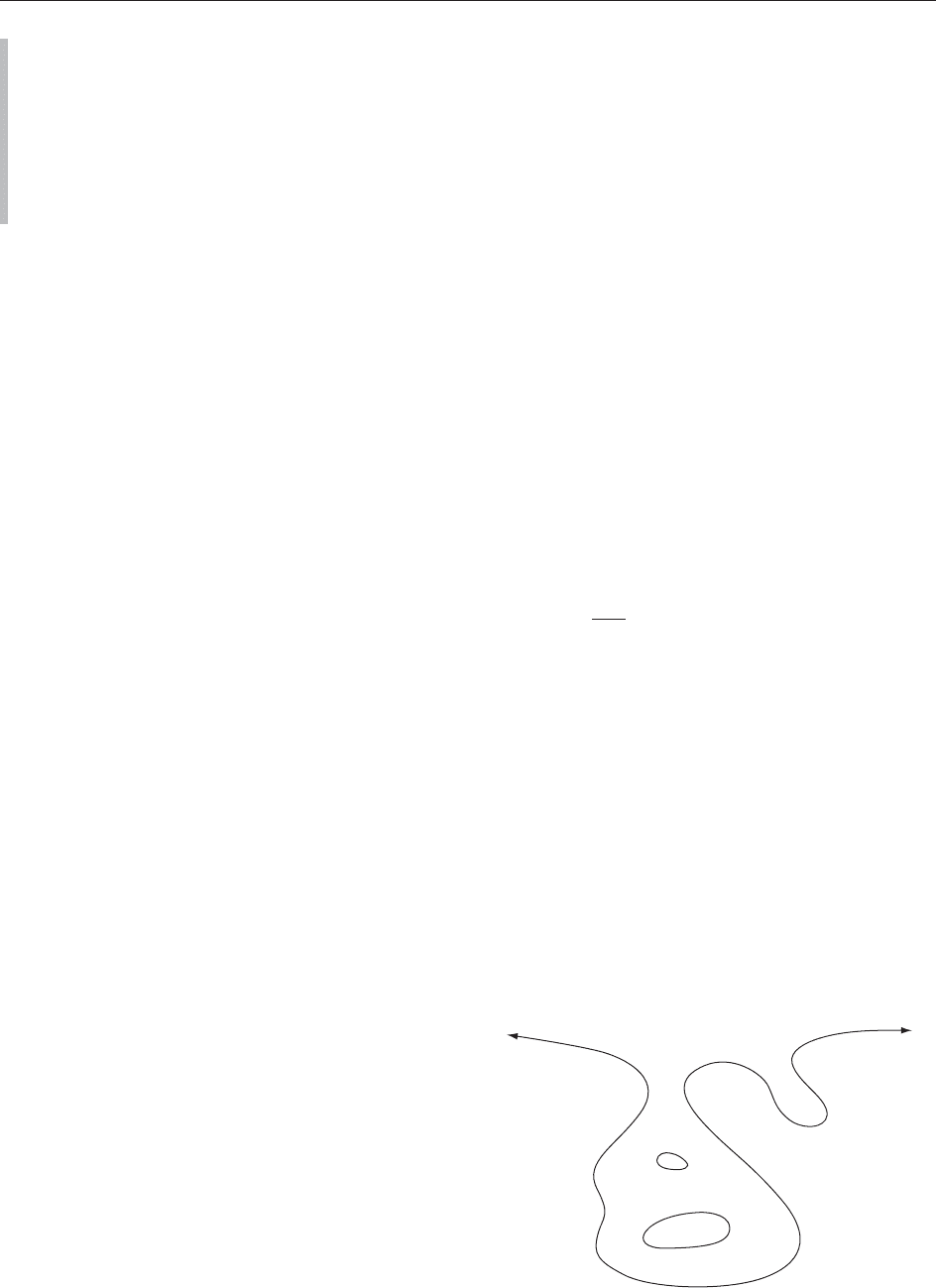
picture of an asympotically flat 3-manifold is shown
in Figure 1.
The purpose of these assumptions on the asymp-
totic behavior of (M
3
, g) at infinity is that they imply
the existence of the limit
m ¼
1
16
lim
!1
Z
S
X
i;j
ðg
ij;i
j
g
ii;j
j
Þd
where S
is the coordinate sphere of radius , is the
unit normal to S
,andd is the area element of S
in the
coordinate chart. The quantity m is called the ‘ ‘total
mass’ ’ (or ADM mass) of (M
3
, g) and does not depend
on the choice of asymptotically flat coordinate chart.
The above equation is where many people would
stop reading an article like this. But before you do,
we will promise not to use this definition of the total
mass in this paper. In fact, it turns out that total mass
can be quite well understood with an example. Going
back to the example (R
3
, u(x)
4
ij
), if we suppose that
u(x) > 0 has the asymptotics at infinity
uðxÞ¼a þ b=jxjþOð1=jxj
2
Þ½1
Figure 1 A qualitative picture of an asymptotically flat
3-manifold.
510 Geometric Flows and the Penrose Inequality

(and derivatives of the O(1=jxj
2
) term are O(1=jxj
3
)),
then the total mass of (M
3
, g)is
m ¼ 2ab ½2
Furthermore, suppose ( M
3
, g) is any metric whose
‘‘end’’ is isometric to (R
3
nK, u(x)
4
ij
), where u(x)is
harmonic in the coordinate chart of the end (R
3
n
K,
ij
) and goes to a constant at infinity. Then
expanding u(x) in terms of spherical harmonics
demonstrates that u(x) satisfies condition [1].
We will call these Riemannian manifolds (M
3
, g)
‘‘harmonically flat at infinity,’’ and we note that the
total mass of these manifolds is also given by eqn [2].
A very nice lemma by Schoen and Yau is that,
given any >0, it is always possible to perturb an
asymptotically flat mani fold to become harmoni-
cally flat at infinity such that the total mass changes
less than and the metric changes less than
pointwise, all while maintaining non-negative
scalar curvature. Hence, it happens that to prove
the theorems in this paper, we only need to con sider
harmonically flat manifolds! Thus, we can use eqn
[2] as our definition of total mass. As an example,
note that (R
3
,
ij
) has zero total mass. Also, note
that, qualitatively, the total mass of an asymptoti-
cally flat or harmonically flat manifold is the 1=r
rate at which the metric becomes flat at infinity.
The Phenomenon of Gravitational Attraction
What do the above definitions of total mass have to
do with anything physical? That is, if the total mass
is the 1=r rate at which the metric beco mes flat at
infinity, what does this have to do with our real-
world intuitive idea of mass?
The answer to this question is very nice. Given a
Schwarzschild spacetime metric
R
4
; 1 þ
m
2jxj
4
dx
2
1
þ dx
2
2
þ dx
2
3
1 m=2jxj
1 þ m=2jxj
2
dt
2
jxj > m=2, for example, note that the t = 0 slice
(which has zero-second fundamental form) is the
spacelike Schwarzschild metric
R
3
n B
m=2
ð0Þ; 1 þ
m
2jxj
4
ij
(discussed more later). Note that according to eqn
[2], the parameter m is in fact the total mass of this
3-manifold.
On the other hand, suppose we wer e to release a
small test particle, initially at rest, a large distance r
from the center of the Schwarzschild spacetime. If
this particle is not acted upon by external forces,
then it should follow a geodesic in the spacetime. It
turns out that with respect to the asymptotically flat
coordinate chart, these geodesics ‘‘accelerate’’
towards the middle of the Schwarzschild metric
proportional to m=r
2
(in the limit as r goes to
infinity). Thus, our Newtonian notion of mass also
suggests that the total mass of the spacetime is m.
Local Energy Density
Another quantification of mass which is well under-
stood is local energy density. In fact, in this setting,
the local energy density at each point is
¼
1
16
R
where R is the scalar curvature of the 3-manifold
(which has zero-second fundamental form in the
spacetime) at each point. Note that (R
3
,
ij
) has zero
energy density at each point as well as zero total mass.
This is appropriate since (R
3
,
ij
)isinfacta‘‘t = 0’’
slice of Minkowski spacetime, which represents a
vacuum. Classically, physicists consider 0tobea
physical assumption. Hence, from this point on, we
will not only assume that (M
3
, g) is asymptotically flat,
but also that it has non-negative scalar curvature,
R 0
This notion of energy density also helps us
understand total mass better. After all, we can take
any asymptotically flat manifold and then change
the metric to be perfectly flat outside a large
compact set, thereby giving the new metric zero
total mass. However, if we introduce the physical
condition that both metrics have non-negative scalar
curvature, then it is a beautiful theorem that this is
in fact not possible, unless the original metric was
already (R
3
,
ij
)! (This theorem is actually a corollary
to the positive mass theorem discussed below.)
Thus, the curvature obstruction of having non-
negative scalar curvature at each point is a very
interesting condition.
Also, notice the indirect connection between the
total mass and local energy density. At this point,
there does not seem to be much of a connection at
all. The total mass is the 1=r rate at which the metric
becomes flat at infinity, and local energy density is
the scalar curvature at each point. Furthermore, if a
metric is changed in a compact set, local energy
density is changed, but the total mass is unaffected.
The reason for this is that the total mass is ‘‘not’’
the integral of the local energy density over the
manifold. In fact, this integral fails to take potential
energy into account (which woul d be expected to
Geometric Flows and the Penrose Inequality 511

contribute a negative energy) as well as gravitational
energy. Hence, it is not initially clear what we should
expect the relationship between total mass and local
energy density to be, so let us begin with an example.
Example Using Superharmonic Functions in R
3
Once again, let us return to the (R
3
, u(x)
4
ij
)
example. The formula for the scalar curvature is
R ¼8uðxÞ
5
uðxÞ
Hence, since the physical assumption of non-
negative energy density implies non-negative scalar
curvature, we see that u(x) > 0 must be super-
harmonic (u 0). For simplicity, let us also
assume that u( x) is harmonic outside a bounded set
so that we can expand u(x) at infinity using
spherical harmonics. Hence, u(x) has the asympto-
tics of eqn [1]. By the maximum principle, it follo ws
that the minimum value for u(x) must be a, referring
to eqn [1]. Hence, b 0, which implies that m 0!
Thus, we see that the assumption of non-negative
energy density at each point of (R
3
, u(x)
4
ij
) implies
that the total mass is also non-negative, which is
what one would hope.
The Positive Mass Theorem
Why would one hope this? What would be the
difference if the total mass were negative? This
would mean that a gravitational system of positive
energy density could collectively act as a net
negative total mass. This phenomenon has not
been observed experimentally, and so it is not a
property that we would hope to find in general
relativity.
More generally, suppose we have any asymptotically
flat manifold with non-negative scalar curvature, is it
true that the total mass is also non-negative? The
answer is yes, and this fact is know as the positive mass
theorem, first proved by Schoen and Yau (1979) using
minimal surface techniques and then by Witten (1981)
using spinors. In the zero-second fundamental form
case, the positive mass theorem is known as the
Riemannian positive mass theorem and is stated below.
Theorem 1 (Schoen, Yau). Let (M
3
, g) be any
asymptotically flat, complete Riemannian manifold
with non-negative scalar curvature. Then the total
mass m 0, with equality if and only if (M
3
, g) is
isometric to (R
3
, ).
Gravitational Energy
The previous example neglects to illustrate some of
the subtleties of the positive mass theorem. For
example, it is easy to construct asymptotical ly flat
manifolds (M
3
, g) (not conform al to R
3
) which have
zero scalar curvature everywhere and yet have
‘‘nonzero’’ total mass. By the positive mass theorem,
the mass of these manifolds is positive. Physically,
this corresponds to a spacetime with zero energy
density everywhere which still has positive total
mass. From where did this mass come? How can a
vacuum have positive total mass?
Physicists refer to this extra energy as gravita-
tional energy. There is no known local definition of
the energy densi ty of a gravitational field, and
presumably such a definition does not exist. The
curious phenomenon, then, is that for some reason,
gravitational energy always makes a non-negative
contribution to the total mass of the system.
Black Holes
Another very interesting and natural phenomenon in
general relativity is the existence of black holes.
Instead of thinking of black holes as singularities in
a spacetime, we will think of black holes in terms of
their horizons. For example, suppose we are explor-
ing the universe in a spacecraft capable of traveling
at any speed less than the speed of light. If we are
investigating a black hole, we would want to make
sure that we don’t get too close and get trapped by
the ‘‘gravitational forces’’ of the black hole. In fact,
we could imagine a ‘‘sphere of no return’’ beyond
which it is impossible to escape from the black hole.
This is called the event horizon of a black hole.
However, one limitation of the notion of an event
horizon is that it is very hard to determine its location.
One way is to let daredevil spacecraft see how close
they can get to the black hole and still escape from it
eventually. The only problem with this approach
(besides the cost in spacecraft) is that it is hard to
know when to stop waiting for a daredevil spacecraft
to return. Even if it has been 50 years, it could be that
this particular daredevil was not trapped by the black
hole but got so close that it will take it 1000 or more
years to return. Thus, to define the location of an event
horizon even mathematically, we need to know the
entire evolution of the spacetime. Hence, event
horizons can not be computed based only on the
local geometry of the spacetime.
This problem is solved (at least for the mathema-
tician) with the notion of apparent horizons of black
holes. Given a surface in a spacetime, suppo se that it
emits an outward shell of light. If the surface area of
this shel l of light is decreasing everywhere on the
surface, then this is called a trapped surface. The
outermost boundary of these trapped surfaces is
called the apparent horizon of the black hole.
Apparent horizons can be computed based on their
512 Geometric Flows and the Penrose Inequality
local geometry, and an apparent horizon always
implies the existence of an event horizon outside of
it (Hawking and Ellis 1973).
Now let us return to the case we are considering
in this paper where (M
3
, g)isa‘‘t = 0’’ slice of a
spacetime with zero-sec ond fundamental form. Then
it is a very nice geometric fact that apparent
horizons of black holes intersected with M
3
corres-
pond to the connected components of the outermost
minimal surface
0
of (M
3
, g).
All of the surfaces we are considering in this paper
will be required to be smooth boundaries of open
bounded regio ns, so that outermost is well defined
with respect to a chosen end of the manifold.
A minimal surface in (M
3
, g) is a surface which is a
critical point of the area function with respect to any
smooth variation of the surface. The first variational
calculation implies that minimal surfaces have zero
mean curvature. The surface
0
of (M
3
, g) is defined
as the boundary of the union of the open regions
bounded by all of the minimal surfaces in (M
3
, g). It
turns out that
0
also has to be a minimal surface,
so we call
0
the ‘‘outermost minimal surface.’’
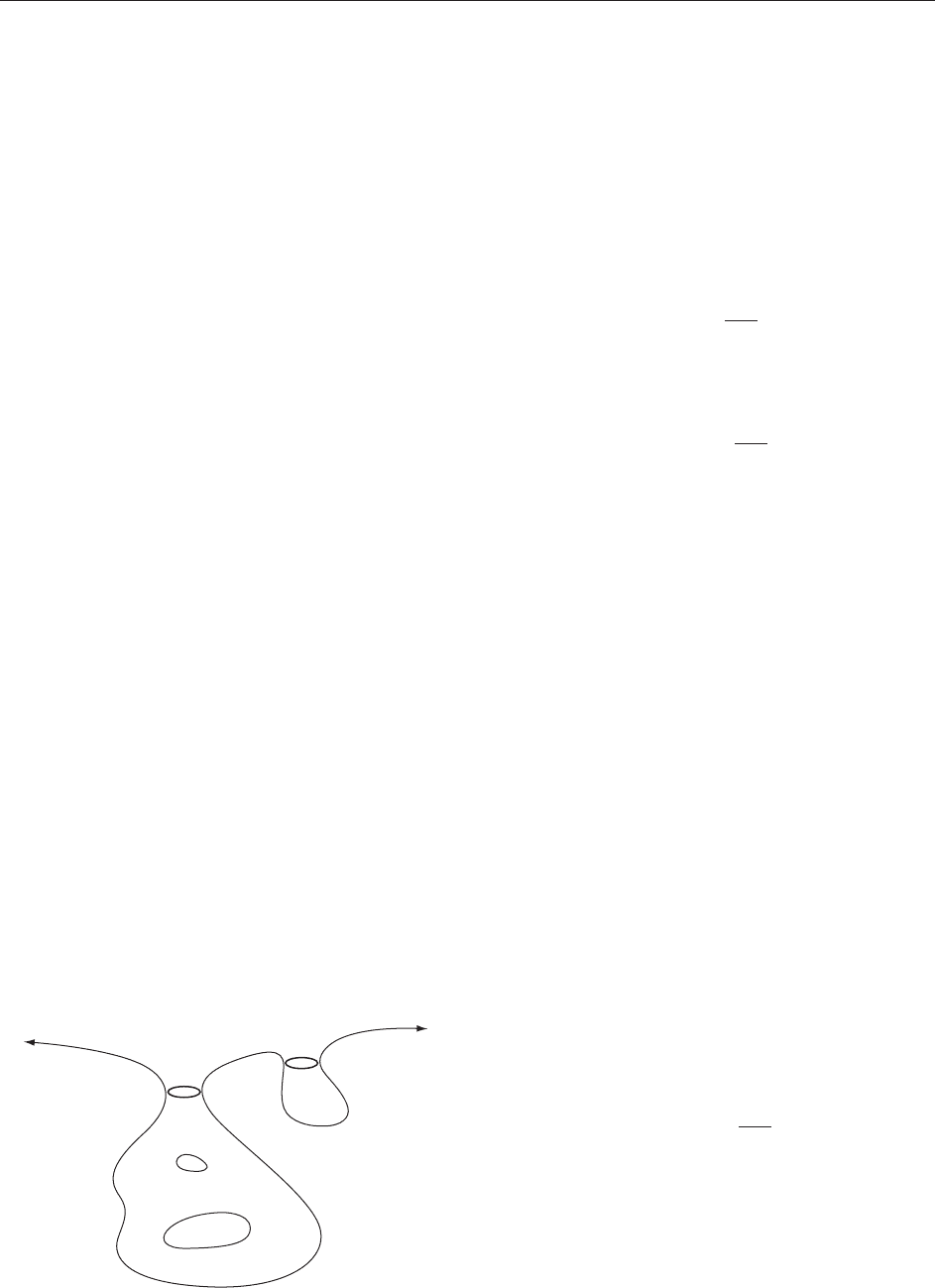
A qualitative sketch of an outermost minimal
surface of a 3-manifold is shown in Figure 2.
We will also define a surface to be ‘‘(strictly) outer
minimizing’’ if every surfa ce which encloses it has
(strictly) greater area. Note that outermost minimal
surfaces are strictly outer minimizing. Also, we define
a ‘‘horizon’’ in our context to be any minimal surface
which is the boundary of a bounded open region.
It also follows from a stability argument (using
the Gauss–Bonnet theorem interestingly) that each
component of an outermost minimal surface (in a
3-manifold with non-negative scalar curvature) must
have the topology of a sphere. Furthermore, there is
a physical argument, based on Penrose (1973),
which suggests that the mass contributed by the
black holes (thought of as the conn ected compo-
nents of
0
) should be defined to be
ffiffiffiffiffiffiffiffiffiffiffiffiffiffiffiffi
A
0
=16
p
,
where A
0
is the area of
0
. Hence, the physical
argument that the total mass should be greater than
or equal to the mass contributed by the black holes
yields the following geometric statement.
The Riemannian Penrose Inequality Let (M
3
, g)be
a complete, smooth, 3-manifold with non-negative
scalar curvature which is harmonically flat at
infinity with total mass m and which has an
outermost minimal surface
0
of area A
0
. Then,
m
ffiffiffiffiffiffiffiffiffi
A
0
16
r
½3
with equality if and only if (M
3
, g) is isometric to the
Schwarzschild metric
R
3
nf0g; 1 þ
m
2jxj
4
ij
outside their respective outermost minimal surfaces.
The above statement has been proved by the
present author, and Huisken and Ilmanen proved it
when A
0
is defined instead to be the area of the
largest connected component of
0
. We will discuss
both approaches in this paper, which are very
different, although they both involve flowing sur-
faces and/or metrics.
We also clarify that the above statement is with
respect to a chosen end of (M
3
, g), since both the
total mass and the definition of outermost refer to a
particular end. In fact, nothing very important is
gained by considering manifolds with more than one
end, since extra ends can always be compactified by
connect summing them (around a neighborhood of
infinity) with large spheres while still preserving non-
negative scalar curvature, for example. Hence, we
will typically consider manifolds with just one end. In
the case that the manifold has multiple ends, we will
require every surface (which could have multiple
connected components) in this paper to enclose all of
the ends of the manifold except the chosen end.
The Schwarzschild Metric
The Schwarzschild metric
R
3
nf0g; 1 þ
m
2jxj
4
ij
referred to in the above statement of the Rieman-
nian Penrose inequality, is a particularly important
example to consider, and corresponds to a zero-
second fundamental form, spacelike slice of the
usual (3 þ 1)-dimensional Schwarzschil d metric
(which represents a spherically symmetric static
black hole in vacuum). The three-dimensional
Figure 2 A qualitative sketch of an outermost minimal surface
of a 3-manifold.
Geometric Flows and the Penrose Inequality 513

Schwarzschild metrics have total mass m > 0 and
are characterized by being the only spherically
symmetric, geodesically complete, zero scalar curva-
ture 3-metrics, other than (R
3
,
ij
). They can also be
embedded in four-dimensional Euclidean space
(x, y, z, w) as the set of points satisfying
jðx; y; zÞj ¼ ðw
2
=8mÞþ2m
which is a parabola rotated around an S
2
. This last
picture allows us to see that the Schwarzschild
metric, which has two ends, has a Z
2
symmetry
which fixes the sphere with w = 0 and j(x, y, z)j=
2m, which is clearly minimal. Furthermore, the area
of this sphere is 4(2m)
2
, giving equality in the
Riemannian Penrose inequali ty.
A Brief History of the Problem
The Riemannian Penrose inequality has a rich
history spanning nearly three decades and has
motivated much interesting mathematics and phy-
sics. In 1973, R Penrose in effect conjectured an
even more general version of inequality [3] using a
very clever physical argument, which we will not
have room to repeat here (Penrose 1973). His
observation was that a counterexample to inequality
[3] would yield Cauchy data for solving the Einstein
equations, the solution to which would likely violate
the cosmic censor conjecture (which says that
singularities generically do not form in a spacetime
unless they are inside a black hole).
Jang and Wald (1977), extending ideas of Geroch,
gave a heuristic proof of inequality [3] by defining a
flow of 2-surfaces in (M
3
, g) in which the surfaces
flow in the outward normal direction at a rate equal
to the inverse of their mean curvatures at each point.
The Hawking mass of a surface (which is supposed
to estimate the total amount of energy inside the
surface) is defined to be
m
Hawking
ðÞ¼
ffiffiffiffiffiffiffiffiffi
jj
16
r
1
1
16
Z
H
2
(where jj is the area of and H is the mean
curvature of in (M
3
, g)) and, amazingly, is
nondecreasing under this ‘‘inverse mean curvature
flow.’’ This is seen by the fact that under inverse
mean curvature flow, it follows from the Gauss
equation and the second variation formula that
d
dt
m
Hawking
ðÞ¼
ffiffiffiffiffiffiffiffiffi
jj
16
r
1
2
þ
1
16
Z
2
jr
Hj
2
H
2
þR 2K þ
1
2
ð
1
2
Þ
2
when the flow is smooth, where R is the scalar
curvature of (M
3
, g), K is the Gauss curvature of the
surface , and
1
and
2
are the eigenvalues of the
second fundamental form of , or principle curva-
tures. Hence,
R 0
and
Z
K 4 ½4
(which is true for any con nected surface by the
Gauss–Bonnet theorem) imply
d
dt
m
Hawking
ðÞ0 ½5
Furthermore,
m
Hawking
ð
0
Þ¼
ffiffiffiffiffiffiffiffiffi
j
0
j
16
r
since
0
is a minimal surface and has zero mean
curvature. In addition, the Hawking mass of suffi-
ciently round spheres at infinity in the asymptotically
flat end of (M
3
, g) approaches the total mass m. Hence,
if inverse mean curvature flow beginning with
0
eventually flows to sufficiently round spheres at
infinity, inequality [3] follows from inequality [5].
As noted by Jang and Wald, this argument only
works when inverse mean curvature flow exists and
is smooth, which is generally not expected to be the
case. In fact, it is not hard to construct manifolds
which do not admit a smooth inverse mean
curvature flow. The problem is that if the mean
curvature of the evolving surface becom es zero or is
negative, it is not clear how to define the flow.
For 20 years, this heuristic argument lay dormant
until the work of Huisken and Ilmanen in 1997. With
a very clever new approach, Huisken and Ilmanen
discovered how to reformulate inverse mean curvature
flow using an energy minimization principle in such a
way that the new generalized inverse mean curvature
flow always exists. The added twist is that the surface
sometimes jumps outward. However, when the flow is
smooth, it equals the original inverse mean curvature
flow, and the Hawking mass is still monotone. Hence,
as will be described in the next section, their new flow
produced the first complete proof of inequality [3] for
a single black hole.
Coincidentally, the author found another proof of
inequality [3], submitted in 1999, which works for any
number of black holes. The approach involves flowing
the original metric to a Schwarzschild metric (outside
the horizon) in such a way that the area of the
outermost minimal surface does not change and the
514 Geometric Flows and the Penrose Inequality

total mass is nonincreasing. Then, since the Schwarzs-
child metric gives equality in inequality [3],the
inequality follows for the original metric.
Fortunately, the flow of metrics which is defined
is relatively simple, and in fact stays inside the
conformal class of the original metric. The outer-
most minimal surface flows outwards in this
conformal flow of metrics, and encloses any
compact set (and hence all of the topology of the
original metric) in a finite amount of time. Further-
more, this conformal flow of metrics preserves non-
negative scalar curvature. We will describe this
approach later in the paper.
Other contributions on the Penrose conjecture
have also been made by Herzlich using the Dirac
operator which Witten used to prove the positive
mass theorem, by Gibbons in the special case of
collapsing shells, by Tod, by Bartnik for quasi-
spherical metrics, and by the present author using
isoperimetric surfaces. There is also some interesting
work of Ludvigsen and Vickers using spinors and
Bergqvist, both concerning the Penrose inequality
for null slices of a spacetime.
Inverse Mean Curvature Flow
Geometrically, Huisken and Ilmanen’s idea can be
described as follows. Let (t) be the surface
resulting from inverse mean curvature flow for
time t beginning with the minimal surface
0
.
Define
(t) to be the outermost minimal area
enclosure of (t). Typically, (t) =
(t) in the flow,
but in the case that the two surfaces are not equal,
immediately replace (t ) with
(t) and then con-
tinue flowing by inverse mean curvature.
An immediate consequence of this modified flow is
that the mean curvature of
(t)isalwaysnon-negative
by the first variation formula, since otherwise
(t)
would be enclosed by a surface with less area. This is
becauseifweflowasurface in the outward
direction with speed , the first variation of the area
is
R
H,whereH is the mean curvature of .
Furthermore, by stability, it follows that in the
regions where
(t) has zero mean curvature, it is
always possible to flow the surface out slightly to
have positive mean curvature, allowing inverse mean
curvature flow to be defined, at least heuristically at
this point.
Furthermore, the Hawking mass is still monotone
under this new modified flow. Notice that when (t)
jumps outwards to
(t),
Z
ðtÞ
H
2
Z
ðtÞ
H
2
since
(t) has zero mean curvature where the two
surfaces do not touch. Furthermore,
j
ðtÞj ¼ jðtÞj
since (this is a neat argument) j
(t)jj(t)j (since
(t) is a minimal area enclosure of (t)) and we
cannot have j
(t)j < j(t)j since (t) would have
jumped outwards at some earlier time. This is only a
heuristic argument, but we can then see that the
Hawking mass is nondecreasing during a jump by
the above two equations.
This new flow can be rigorously defined, always
exists, and the Hawking mass is monotone. Huisken
and Ilmanen define (t) to be the level sets of a
scalar valued function u(x) defined on (M
3
, g) such
that u(x) = 0 on the original surface
0
and satisfies
div
ru
jruj
¼jruj½6
in an appropri ate weak sense. Since the left-hand
side of the above equation is the mean curvature of
the level sets of u(x) and the right-hand side is the
reciprocal of the flow rate, the above equation
implies inverse mean curvature flow for the level sets
of u(x) when jru(x)j 6¼ 0.
Huisken and Ilmanen use an energy minimization
principle to define weak solutions to eqn [6].
Equation [6] is said to be weakly satisfied in by
the locally Lipschitz function u if for all locally
Lipschitz v with {v 6¼ u} ,
J
u
ðuÞJ
u
ðvÞ
where
J
u
ðvÞ :¼
Z
jrvjþvjruj
It can then be seen that the Euler–Lagrange equation
of the above energy functional yields eqn [6].
In order to prove that a solution u exists to the above
two equations, Huisken and Ilmanen regularize the
degenerate elliptic equation 6 to the elliptic equation
div
ru
ffiffiffiffiffiffiffiffiffiffiffiffiffiffiffiffiffiffiffiffiffiffi
jruj
2
þ
2
q
0
B
@
1
C
A
¼
ffiffiffiffiffiffiffiffiffiffiffiffiffiffiffiffiffiffiffiffiffiffi
jruj
2
þ
2
q
Solutions to the above equation are then shown to
exist using the existence of a subsolution, and then
taking the limit as goes to zero yields a weak
solution to eqn [6]. There are many details which we
are skipping here, but these are the main ideas.
As it turns out, weak solutions u(x)toeqn [6]
often have flat regions where u(x) equals a
constant. Hence, the level sets (t)ofu(x) will be
Geometric Flows and the Penrose Inequality 515