
Francoise J.-P., Naber G.L., Tsun T.S. (editors) Encyclopedia of Mathematical Physics
Подождите немного. Документ загружается.


Secondly, with this choice of temporal gauge, the
reduced action given by [35] simplifies to
I
reduced
¼
Z
I
dt
Z
M
p
TTij
@
ij
@t
ðÞ
n
ffiffiffiffiffiffiffiffiffiffi
det g
p
d
n
x ½38
from which one can read off an effective reduced
Hamiltonian density,
H
reduced
ð; ;p
TT
Þ¼ðÞ
n
ffiffiffiffiffiffiffiffiffiffi
det g
p
½39
and an effective reduced Hamiltonian,
H
reduced
ð; ; p
TT
Þ¼
Z
M
ðÞ
n
ffiffiffiffiffiffiffiffiffiffiffi
det g
p
d
n
x
¼ðÞ
n
Z
M
d
g
¼ðÞ
n
volðM; gÞ½40
where vol(M, g) =
R
M
d
g
is the volume of the
Riemannian manifold (M, g). Thus in terms of the
physical variables (g
ij
,
ij
), the reduced Hamiltonian
H
reduced
at ‘‘time’’ is simply the volume of the CMC
slice with mean curvature rescaled by the factor
()
n
. With this reduced Hamiltonian density, the
reduced action [38] takes the canonical form
I
reduced
¼
Z
I
dt
Z
M
p
TTij
@
ij
@t
H
reduced
d
n
x ½41
As the third consideration for the given choice of the
time function, we note that rescaling the physical
volume vol(M, g) by the factor ()
n
yields a dimen-
sionless quantity. Indeed, as we have seen, the spatial
physical volume has the dimension ‘
n
and the constant
mean curvature has the dimension ‘
1
,sothatthe
reduced Hamiltonian ()
n
vol(M, g) is dimensionless.
The main advantage of having a dimensionless
reduced Hamiltonian is that only such a reduced
Hamiltonian can have a topological significance,
and indeed, the infimum of H
reduced
is closely related
to a dimensionless topological invariant of M (see
the remarks after [48]).
In terms of the conformal variables (, p
TT
), the
reduced Hamiltonian is found from [21] and [40] to
be given for n 3by
H
reduced
ð; ; p
TT
Þ¼ðÞ
n
Z
M
ffiffiffiffiffiffiffiffiffiffi
det g
p
d
n
x
¼ðÞ
n
Z
M
ffiffiffiffiffiffiffiffiffiffiffiffiffiffiffiffiffiffiffiffiffiffiffiffiffiffiffiffiffi
detð’
4=ðn2Þ
Þ
q
d
n
x
¼ðÞ
n
Z
M
ð’
4=ðn2Þ
Þ
n=2
ffiffiffiffiffiffiffiffiffiffi
det
p
d
n
x
¼ðÞ
n
Z
M
’
2n=ðn2Þ
d
½42
where d
is the Riemannian measure on M
determined by (locally, d
=
ffiffiffiffiffiffiffiffiffiffi
det
p
d
n
x)and
’ = ’(, , p
TT
) is the conformal factor which,
through the solution of the Hamiltonian constraint
[17], is expressed as a function of the ‘‘time’’ t and
the independent conformal (or canonical) variables
(, p
TT
):
In the special case n = 2, M = S
2
p
, p 2, a simple
formula for H
reduced
can be derived. In terms of the
conformal variables (, p
TT
), we find from [40],
[10], [14], [17], [21], [22], and [32] that
H
reduced
ð;;p
TT
Þ
¼
Z
2
p
ðÞ
2
d
g
¼2
Z
2
p
ðdetgÞ
1
TT
TT
RðgÞ
d
g
¼2
Z
2
p
ðdetðe
2’
ÞÞ
1
p
TT
p
TT
d
ðe
2’
Þ
2
Z
2
p
RðgÞd
g
¼2
Z
2
p
ðe
2’
Þ
2
ðdetÞ
1
p
TT
p
TT
e
2’
d
8ðS
2
p
Þ
¼2
Z
2
p
e
2’
ðdet Þ
1
p
TT
p
TT
d
þ16ðp 1Þ½43
where ’=’(, ,p
TT
), (S
2
p
)=2(1 p) is the Euler
characteristic of the genus p surface S
2
p
, and where
we have used the Gauss–Bonnet theorem
Z
2
p
RðgÞd
g
¼ 4ð S
2
p
Þ¼8ð1 pÞ½44
Since
H
reduced
ð; ; p
TT
Þ
¼ 2
Z
2
p
e
2’
ðdet Þ
1
ðp
TT
p
TT
Þd
þ 16ðp 1Þ16ðp 1Þ½45
the infimum of H
reduced
is attained precisely when
p
TT
= 0 and this infimum coincides with the topo-
logical invariant 8(S
2
p
) = 16(p 1), which char-
acterizes the surface S
2
p
(see also [51] below). As we
shall see shortly, an analogous result holds for
n 3.
A straightforward but lengthy calculation, which
is valid in arbitrary dimensions, shows that the
reduced Hamiltonian is strictly monotonically
decreasing in the direction of cosmological expan-
sion except for a family of continuously self-similar
spacetimes for which this Hamiltonian is constant
(Fischer and Moncrief 2002b). The latter solutions
exist if and only if M admits a Riemannian metric
2M
1
which is an Einstein metric, that is, for
which the Ricci tensor satisfies Ric() = (1=n).
Using the mean curvature as a convenient time
coordinate, that is, temporarily taking t = , the
616 Hamiltonian Reduction of Einstein’s Equations
corresponding self-similar vacuum spacetime metrics
then have the line element
ds
2
¼
n
2
2
d
2
þ
n
ðn 1Þ
1
2
ij
dx
i
dx
j
½46
In the case that n = 3, the Einstein metric is
actually hyperbolic with constant sectional curvature
K() = 1=6 and Ricci curvature Ric() = (1=3).
Although the conformal variables (, p
TT
) = (,0) are
static in this model, the physical variables (g, )are
not. In this case, the resulting spacetimes (which
depend on the underlying topology of M) have
expanding closed hyperbolic spacelike hypersurfaces
where the physical volume vol(M, g) ‘‘starts’’ at zero
at the big bang and expands to infinity in the forward
time direction, as befits a universe endlessly expand-
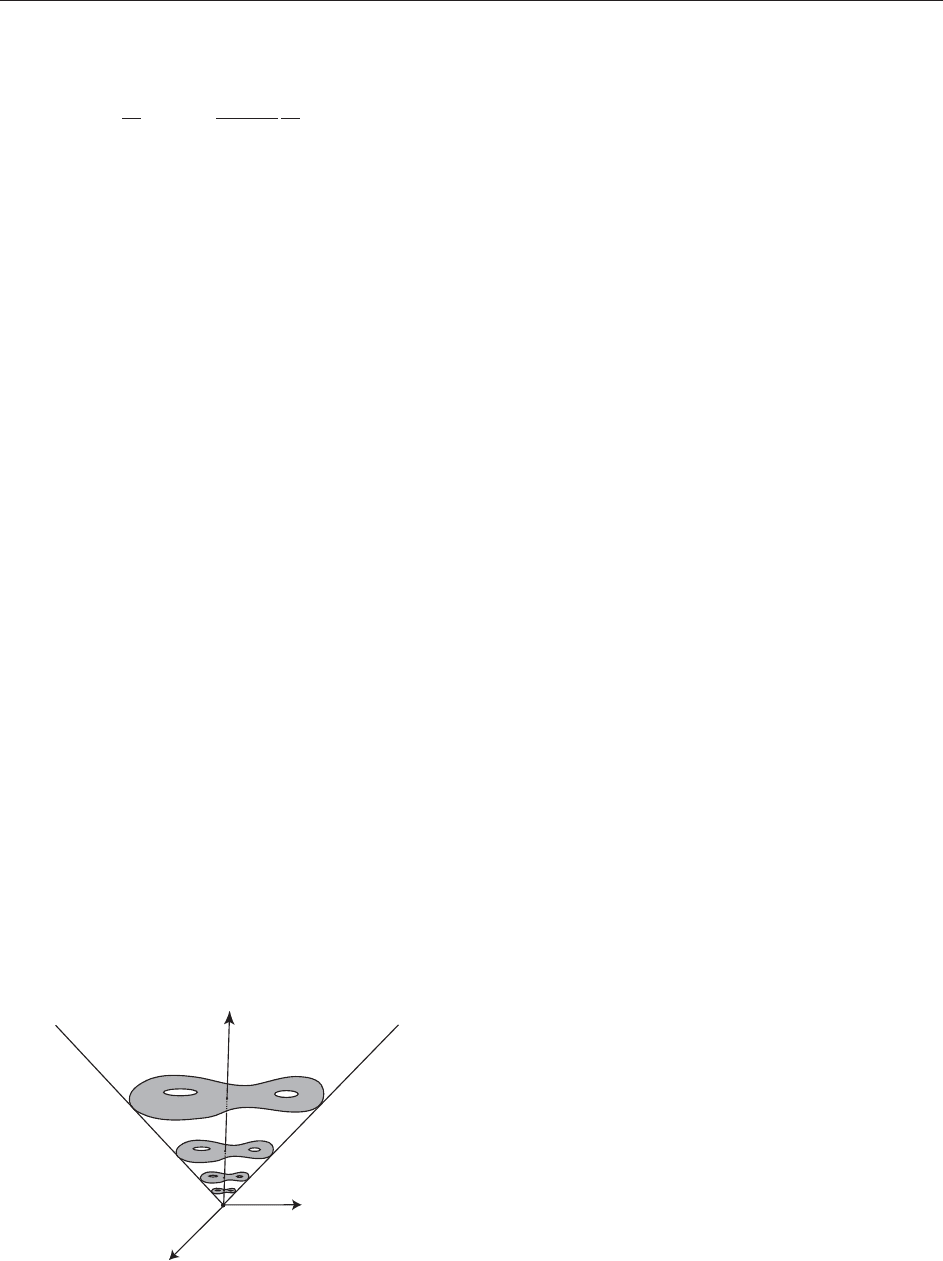
ing from the big bang. Such a universe is depicted in
Figure 1, where the genus-2 surface is used to
represent a generic closed hyperbolic 3-manifold.
The Bianchi and Thurston types of this model are
discussed in the next section.
The line element [46] is locally isometric to the
vacuum Friedmann–Lemaıˆtre–Robertson–Walker
(FLRW) k = 1 spacetime, which is well known to
be flat. Although these spatially compactified mod-
els are technically not classical FLRW spacetimes
since the expanding compact hypersurfaces are not
homogeneous (and thus not isotropic), they are
Lorentz-covered by the FLRW k = 1 spacetime
and thus are locally isometric to this classical
spacetime.
The same result leading to [46] holds even if
matter sources are allowed, provided they satisfy a
suitable energy condition, in which case the corre-
sponding reduced Hamiltonian will only be station-
ary in the vacuum limit and then only when the
metric is of the above type; otherwise it mono-
tonically decays. This result even has a quasilocal
generalization expressible in terms of the corre-
sponding quasilocal reduced Hamiltonian defined
for an arbitrary domain D
within the CMC slice
= constant by restricting H
reduced
in [42] to the
domain D
, so that for n 3,
H
D
ð; ; p
TT
Þ¼ðÞ
n
Z
D
d
g
¼ðÞ
n
Z
D
’
2n=ðn2Þ
d
½47
If D
is determined from its specification on some
initial slice =
0
, by letting the domain flow along
the normal trajectories of the CMC foliation, one
can then verify that H
D
is monotonically decreasing
except for the vacuum solutions of self-similar type
described above, in which case H
D
is constant. This
result is independent of the initial domain chosen.
We remark that one cannot use the quasilocal
Hamiltonian to get equations of motion (even
quasilocally) since the full true Hamiltonian is
nonlocal and so one gets contributions from the
whole manifold.
Since the reduced Hamiltonian H
reduced
as well as
its quasilocal variant H
D
is monotonically decreasing
for generic solutions of Einstein’s equations, it is
natural to ask what its infimum is and whether this
infimum is ever attained, at least asymptotically, by
solutions of the field equations. The infimum of the
reduced Hamiltonian for n 3andforaspatial
manifold M of negative Yamabe type can be character-
ized in terms of a certain topological invariant of M
called the sigma constant (M)ofM. For manifolds of
negative Yamabe type, this quantity can be defined in
terms of the infimum of the volume of all metrics which
range over the space of conformal metrics M
1
.The
precise definition leads to the formula
ðMÞ¼ inf
2M
1
volðM;Þ
2=n
½48
Interestingly, this equation defines the topological
invariant (M) by a purely geometrical equation
involving the volume functional restricted to M
1
.
We also remark that [48] is a dimensionless
equation, the left-hand side being dimensionless
since it is a topological invariant of M and the
right-hand side being dimensionless since the con-
formal metric and its volume are dimensionless (see
the remarks after [34]).
Although the -constant can be defined for all
Yamabe types, [48] holds only for manifolds of
negative Yamabe type. From this equation, one can
conclude that for such manifolds
ðMÞ0 ½ 49
x
t
y
Figure 1 Expansion of the physical universe in the Bianchi V,
Thurston type H
3
, spatially compactified FLRW flat spacetime
cosmology.
Hamiltonian Reduction of Einstein’s Equations 617

One can relate the foregoing to the reduced
Hamiltonian by showing that the infimum of
H
reduced
defined for arbitrary <0 as a functional
on the reduced phase space
T
T¼T
M
1
D
0
½50
is given by
inf
ð;p
TT
Þ2T
T
H
reduced
ð;;p
TT
Þ
¼
8ðS
2
p
Þ¼16ðp 1Þ
n
n 1
ððMÞÞ
n=2
8
>
>
<
>
>
:
if n ¼2
and p 2
if n 3
½51
where for n 3, M is of negative Yamabe type and
thus (M) 0 (see [49]).
One proves this result by first showing that within
an arbitrary fiber of the cotangent bundle
T
(M
1
=D
0
), one minimizes H
reduced
by setting the
fiber variable p
TT
to zero. In this case, the solution for
the conformal factor ’ reduces to a spatial constant
which is a function of alone (see [33]), and thus the
formula for H
reduced
given in [42] reduces to
H
reduced
ð; ;0Þ¼
n
n 1
n=2
volðM;Þ½52
The infimum over all conformal metrics 2M
1
of
this latter functional yields the -constant as outlined
above. If matter sources obeying a suitable energy
condition are allowed, the argument goes through in
much the same way with the additional implication
that the infimum is achieved only for a vacuum
solution so that in fact the matter must be ‘‘turned off.’’
Thus, as a consequence of the above analysis,
one has
H
reduced
ð;; p
TT
Þ
H
reduced
ð;; 0Þ¼
n
n 1
n=2
volðM;Þ
n
n 1
n=2
inf
0
2M
1
vol M;
0
ðÞ
¼
n
n 1
ððMÞÞ
n=2
½53
where the last equality follows by inverting [48] to give
inf
2M
1
volðM;Þ¼ððMÞÞ
n=2
½54
Moreover, if 2M
1
actually achieves the
-constant, that is, if vol(M, ) = ((M))
n=2
(and
not just asymptotically approaches it as a curve or
sequence), then must be an Einstein metric with
RicðÞ¼
1
n
½55
If, additionally, n = 3, then must be hyperbolic
(with constant sectional curvature K() = 1=6).
Although Thurston’s conjectures do not refer to
the -constant, Anderson (1997) has been able to
reformulate and somewhat refine the Thurston
geometrization conjectures for 3-manifolds of arbi-
trary Yamabe type in terms of conjectured proper-
ties of the -constant. Additionally, if Perelman’s
results are technically complete, they would provide
a proof of Anderson’s conjectures as well as those of
Thurston’s (see Anderson (2003)).
The conjectured behavior for a sequence of
conformal metrics {
i
},
i
2M
1
, i = 1, 2, ..., which
seeks to minimize the volume of a stand-alone
K(p, 1) 3-manifold M of negative Yamabe type can
be described as follows:
1. If M is hyperbolizable, then (M) < 0 is attained
by a hyperbolic metric
h
2M
1
, unique up to
diffeomorphism, and the sequence of conformal
metrics {
i
} converges to this metric in a suitable
function space topology.
2. If M is a pure graph manifold, then (M) = 0and
the sequence {
i
} of conformal metrics ‘‘volume
collapses’’ M with bounded curvature. Typically
this occurs through collapse of circular or toroidal
fibers in the associated circle or 2-torus bundle
structure (see examples 3, 4, and 5 in the section
‘‘Topological Background’’ and see also the penul-
timate section). The six manifolds of flat type are
not included here as they are of zero Yamabe type.
3. If M is a generic K(p, 1)-manifold (not of type 1
or 2 above), then M can be decomposed along
incompressible tori into its final finite-volume-
type hyperbolizable and (possibly empty set of)
graph-manifold pieces. In this case, (M)< 0 and
the sequence {
i
} of conformal metrics collapses
the graph-manifold components and converges to
finite-volume complete hyperbolic metrics on the
hyperbolizable components (normalized to have
R() = 1) yielding a -constant that is entirely
determined by the volumes of these final hyper-
bolic components (see the final section).
We shall return to this conjectured characteriza-
tion of sequences of conformal metrics in the next
two sections.
Reduction of Bianchi Models
and Conformal Volume Collapse
For manifolds of negative Yamabe type, the strict
monotonic decay of H
reduced
in the direction of
cosmological expansion along nonconstant integral
curves of the reduced Einstein equations suggests
618 Hamiltonian Reduction of Einstein’s Equations

that the reduced Hamiltonian is seeking to achieve
its infimum inf H
reduced
= ((n=(n 1))((M)))
n=2
.
But does this ever happen? Does the reduced
Einstein flow of the conformal geometry asymptoti-
cally approach inf H
reduced
in the limit of infinite
cosmological expansion?
To answer this question, one can consider for n = 3
known locally homogeneous vacuum solutions of
Einstein’s equations which spatially compactify to
manifolds of negative Yamabe type. Applying the
theory of Hamiltonian reduction to these classical
models, one can show that the reduced Hamiltonian
behaves as expected under the reduced Einstein flow
defined by these models. Since these models existed
long before this theory, it is somewhat satisfying to see
that they can be interpreted in terms of Hamiltonian
reduction and how, with this interpretation, new
properties of these classical solutions can be found.
Since H
reduced
is a strictly monotonically decreasing
function along nonconstant integral curves of the
reduced Einstein flow, it is expected that under certain
conditions, the reduced Hamiltonian is monotonically
seeking to decay to its infimum. Thus, it is of interest to
look at Hamiltonian reduction under the consequence
of the following two assumptions:
1. The reduced Einstein field equations give rise
to the existence of a positive semiglobal non-
constant solution ( (t), p
TT
(t)) defined for all
t 2 (0, 1) (or equivalently, for all 2 (1, 0);
2. The reduced Hamiltonian strictly monotonically
decays to its infimum along nonconstant integral
curves,
H
reduced
ððtÞ;ðtÞ; p
TT
ðtÞÞ
! inf H
reduced
as t !1 ½56
From [40] and [51], in terms of the physical
variables (g, ) (or (g, k)), [56] can be written
equivalently as
3
volðM;gÞ¼ðtr
g
kÞ
3
volðM;gÞ!
3
2
ððMÞÞ
3=2
as t! 1 ½ 57
As a consequence of these assumptions, it follows
from [53] that the conformal volume vol(M,) must
also decay to its infimum [54] (although not
necessarily monotonically),
volðM;ðtÞÞ! inf
2M
1
volðM;Þ
¼ððMÞÞ
3=2
as t ! 1 ½ 58
Now suppose that (M) = 0. A large class of
manifolds for which this is true are the graph
manifolds (and thus also the Seifert manifolds) of
negative Yamabe type since (M) 0 for graph
manifolds in general and since (M) 0 for mani-
folds of negative Yamabe type. In this case the curve
(t) 2M
1
of conformal metrics must necessarily
(conformally) volume collapse M in the direction of
cosmological expansion,
volðM;ðtÞÞ!ððMÞÞ
3=2
¼ 0ast ! 1 ½ 59
Consequently, the curve of conformal metrics (t)
must undergo some form of degeneration as its
volume collapses. The details of this metric degen-
eration are of importance and are discussed below.
Not all locally homogeneous vacuum Bianchi
models admit spatially compact quotients. Fortu-
nately, the general theory of which Bianchi models
admit spatially compact quotients has been worked
out in detail by Tanimoto, Koike, and Hosoya (see
Tanimoto et al. (1997) and the references therein).
These Bianchi models together with their corre-
sponding Thurston classification and typical exam-
ples of their closed quotient manifolds are listed in
Table 1, where ‘‘K–S’’ indicates ‘‘Kantowski–Sachs,’’
‘‘P,’’ ‘‘Z,’’ and ‘‘N’’ denote manifolds of Yamabe
type positive, zero, and negative, respectively (see
the section ‘‘Topological Background’’), ‘‘Seifert’’
means Seifert fibered, ‘‘Hyper’’ means hyperboliz-
able, ‘‘?’’ indicates ‘‘unknown, but conjectured to be
so,’’ and ‘‘manifold collapse’’ denotes the type of
collapse that the conformal manifold (M, (t)) goes
through as the conformal volume vol(M, (t))
collapses. We also remark that all of the manifolds
Table 1 Bianchi, Thurston, and Yamabe type of a connected closed oriented irreducible 3-manifold
Bianchi type Thurston type Typical examples Yamabe type -constant Manifold structure Manifold collapse
K–S S
2
RS
2
S
1
P >0 Seifert
IX S
3
Nontrivial S
1
-bundles over S
2
P >0 Seifert
I R
3
T
3
Z 0 Seifert
II Nil Nontrivial S
1
-bundles over T
2
N 0 Seifert Total
III H
2
R S
2
p
S
1
, p 2 N 0 Seifert Pancake
VIII
g
SL(2, R) Nontrivial S
1
-bundles over S
2
p
N 0 Seifert Pancake
VI
0
Sol Nontrivial T
2
-bundles over S
1
N 0 Graph Barrel
V, VII
h
H
3
Closed hyperbolizable manifolds N < 0 ? Hyper None
Hamiltonian Reduction of Einstein’s Equations 619
listed in the ‘‘Typical examples’’ column are irredu-
cible with the exception of S
1
S
2
, which is prime
but not irreducible. Also, in this column, p 2.
In this table, the eight Thurston types are grouped
into three sets according to their Yamabe type. The
first set of such Bianchi models are those that
spatially compactify to yield 3-manifolds of positive
Yamabe type which allow metrics with positive
constant scalar curvature, for example, Bianchi IX
models defined over spherical space forms. The
second set (consisting of one type) yields manifolds
of zero Yamabe type which allow zero scalar
curvature metrics but not constant positive scalar
curvature metrics, for example, Bianchi I models
defined over T
3
or one of the other five manifolds of
flat type finitely covered by T
3
. The third set (the
last five entries in Table 1 and the set of most
interest in this article) yields manifolds of negative
Yamabe type which do not allow metrics with zero
scalar curvature.
These latter models are the five Bianchi models of
types II, III, VIII, VI
0
, and V (and in part VII
h
),
which in turn correspond in Thurston’s classification
to manifolds of type Nil, H
2
R,
g
SL(2, R ), Sol, and
H
3
, respectively.
In the first three cases, the models of Bianchi type
II, III, and VIII compactify to a nontrivial S
1
-bundle
over T
2
or to a trivial or nontrivial S
1
-bundle over
S
2
p
, p 2, respectively. Each of these spaces is Seifert
fibered. In the fourth case, the model of Bianchi type
VI
0
compactifies to a nontrivial T
2
-bundle over S
1
which is an irreducible graph manifold. Since each
of these manifolds is also of negative Yamabe type,
in each of these four cases, as discussed in the
beginning of this section, (M) = 0. In the fifth case,
we consider vacuum Bianchi V metrics as well
as a special case of Bianchi type VII
h
which
compactify to an arbitrary closed oriented hyperbo-
lizable manifold M.
For these latter five Bianchi models that spatially
compactify to manifolds of negative Yamabe type,
one can consider the classical solutions from
the point of view of Hamiltonian reduction. The
starting point for this point of view is to use
explicitly known vacuum metrics for the
simplest ‘‘standard’’ metric forms, given, for exam-
ple, in Wainwright and Ellis (1997). One need not
consider all such possible spatially compact quoti-
ents, even though that would appear to be quite
feasible, but one need only consider some represen-
tative examples for each of the Bianchi types listed.
It can be shown by explicit calculation, using the
known solutions, that in the four nonhyperbolizable
cases where (M) = 0, each of the classical Bianchi
solutions gives rise to the existence of a positive
semiglobal nonconstant solution to the reduced Einstein
field equations and that along this solution, the reduced
Hamiltonian asymptotically approaches 0 under the
reduced Einstein flow, thereby confirming the expecta-
tion that the reduced Hamiltonian asymptotically
approaches its infimum ((3=2)((M)))
3=2
= 0. Thus
in these cases the reduced Einstein flow conformally
volume-collapses the 3-manifold.
The explicit calculations also show the details of
this collapse. In the second and third models of
Bianchi type III, Thurston type H
2
R,and
Bianchi type VIII, Thurston type
g
SL(2, R), respec-
tively, the conformal metric degenerates along
embedded circular fibers and this metric degenera-
tion causes M to collapse to its base manifold S
2
p
,
p 2. Since the collapse is along one-dimensional
fibers and since the two-dimensional base mani-
fold S
2
p
does not collapse, we refer to this type of
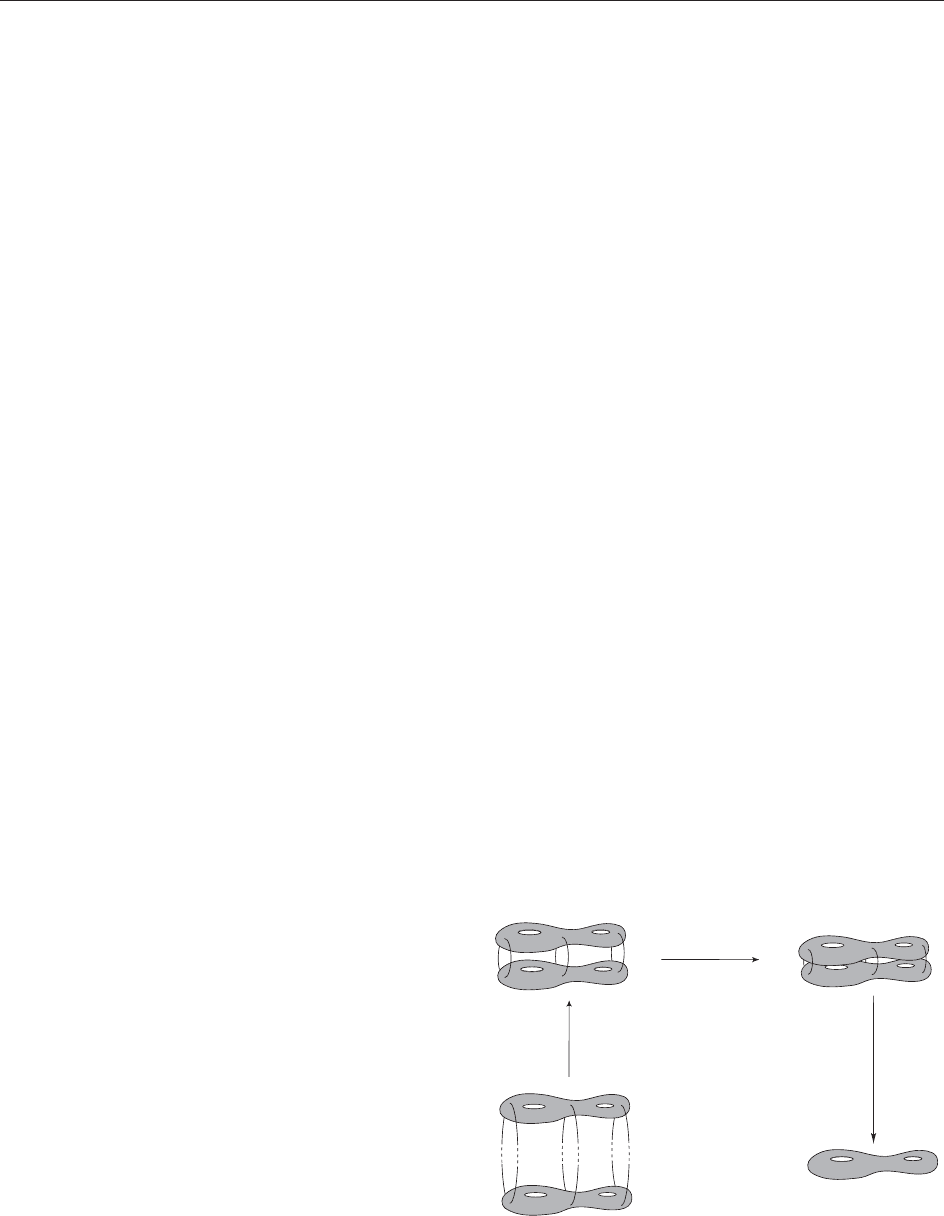
collapse as pancake collapse (see Figure 2).
In the fourth model of Bianchi type VI
0
, Thurston
type Sol, the conformal metric degenerates along
embedded T
2
-fibers and this metric degeneration
causes M to collapse to its base manifold S
1
. Since
the collapse is along two-dimensional fibers and
since the one-dimensional base manifold S
1
does not
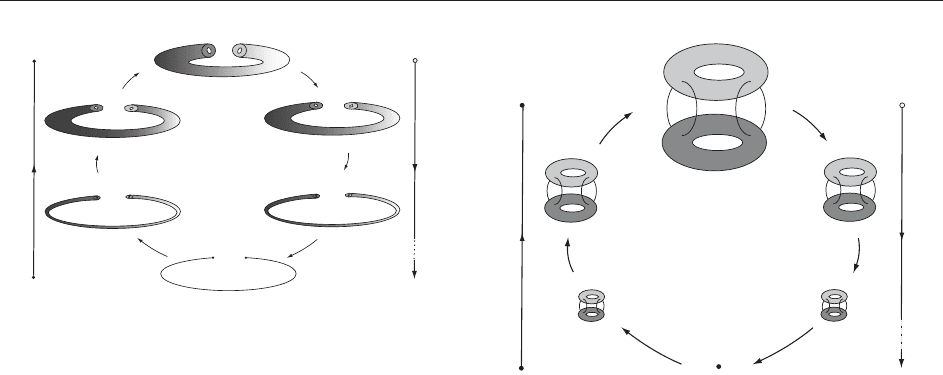
collapse, we refer to this type of collapse as barrel
collapse (see Figure 3).
In the first model of Bianchi type II, Thurston type
Nil, as in the second and third models, the
conformal metric degenerates along embedded cir-
cular fibers. Additionally, not only do the circular
fibers collapse but simultaneously the flat quotient
2-torus base manifold T
2
’ M=S
1
of M modulo its
circular fibers also collapses. Thus the metric
degeneration collapses M to a point, exhibiting a
t = 0
+
t
= ∞
t
t
Figure 2 Bianchi III, Thurston type H
2
R, M = S
2
p
S
1
,
pancake collapses to S
2
p
, p = 2. The conformal geometry starts
with an infinite S
1
-fiber at the big bang (t = 0
þ
) and pancake
collapses with bounded curvature to S
2
2
at infinite cosmological
expansion (t !1).
620 Hamiltonian Reduction of Einstein’s Equations
case of total collapse. Thus these model universes
provide examples of nonflat almost-flat manifolds
that exhibit total collapse with bounded curvature.
Since the conformal geometries of these model
universes collapse to a point, they aptly deserve
their name Nil (see Figure 4).
Remarkably, in each of these four cases of
collapse, the collapse occurs with bounded curva-
ture, precisely as occurs in the totally different
setting of the Cheeger–Gromov theory of collapsing
Riemannian manifolds, recognized many years ago
to be of importance in the understanding of the
behavior of sequences of metrics with uniform
curvature bound (see Gromov (1999) for references
and Anderson (2004) for other applications of
Cheeger–Gromov theory to general relativity).
What is somewhat remarkable is that the above
cosmological models were constructed completely
independently of that setting and thus provide
naturally occurring cosmological models whose
closed spatial hypersurfaces undergo conformal
volume collapse and metric degeneration exactly as
occurs in the theory of collapsing Riemannian
manifolds.
Of course, this volume collapse and metric
degeneration only occur as described in the con-
formal variables. The physical variables behave
differently. Indeed, in contrast to the conformal
volume which collapses to zero in the first four cases
and is constant in the hyperbolizable case (see
below), the volume of the physical metric in all
five cases goes to infinity since the flow is
temporally oriented in the direction of infinite
cosmological expansion.
In the fifth case where M is hyperbolizable, (M)
is conjectured to be negative and to be determined
by the hyperbolic volume, (M) = (vol(M,
h
))
2=3
,
of the hyperbolic conformal metric
h
normalized so
that R(
h
) = 1. In this case,
h
together with
p
TT
= 0 is a fixed point for the reduced Einstein
flow so that trivially the conformal volume does
not collapse. Moreover, if (M) is determined by
the volume of
h
, then the constant reduced
Hamiltonian also trivially achieves its infimum
H
reduced
(,
h
,0)= ((3=2) ((M)))
3=2
= (3=2)
3=2
(vol
(M,
h
)), again confirming the expectation for the
behavior of H
reduced
on these Bianchi models.
Note that for this static case, the physical
variables behave as described after [46] and as
shown in Figure 1. Also note that in contrast to
Figures 2–4 where the conformal geometry is
depicted, Figure 1 depicts the physical geometry.
Overall, in all five cases, subject in the hyper-
bolizable case to a hyperbolic metric realizing the
-constant, the reduced Hamiltonian asymptotically
approaches its -constant infimum along the flow
lines of the reduced Einstein system. In doing so, the
volumes of the conformal metrics either go to zero
(in the first four cases) or to the hyperbolic volume
(in the hyperbolic case). In all five cases, the
curvature of the conformal metrics is uniformly
bounded.
t = 0
+
t = ∞
t
t
Figure 3 Bianchi VI
0
, Thurston type Sol, nontrivial T
2
-bundle
over S
1
, barrel collapses to S
1
. The conformal geometry evolves
from a base manifold S
1
at the big bang (t = 0
þ
). Instanta-
neously after the big bang, flat T
2
-fibers bloom out of the
collapsed S
1
state. The conformal metric then expands to a
maximum volume and then barrel collapses with bounded
curvature back to the base manifold S
1
at infinite physical
cosmological expansion ( t !1). The two facial 2-tori are flat
and are glued together by an orientation-reversing toral
automorphism so as to give a nontrivial T
2
-bundle over S
1
.
The gray-scale density grading along the tube also indicates the
nontriviality of the bundle.
t = 0
+
t = ∞
t
t
Figure 4 Bianchi II, Thurston type Nil, nontrivial S
1
-bundle
over T
2
, totally collapses to a point. The conformal geometry
evolves from a point at the big bang (t = 0
þ
). Instantaneously
after the big bang, the full 3-manifold blooms out from that point.
The conformal geometry then evolves to a metric of maximum
volume and then totally collapses with bounded curvature back
to a point at infinite physical cosmological expansion (t !1).
The two 2-tori, represented here by doughnuts, are flat and
are glued together by an orientation-reversing toral automorph-
ism so as to give a nontrivial S
1
-bundle over T
2
.
Hamiltonian Reduction of Einstein’s Equations 621

Because the reduced Einstein field equations behave
as expected for the Bianchi models that we have
considered with spatially compactified manifolds
being either Seifert fibered, graph, or hyperbolizable,
it seems plausible that for a more complicated starting
manifold M, the reduced Einstein flow may induce a
decomposition of M into geometric pieces. Indeed,
Anderson’s conjectures (Anderson 1997) predict how
a sequence of geometries with bounded curvature
approaching (M) degenerate. Assuming these con-
jectures, the asymptotic behavior of large classes of
Einstein spacetimes may perhaps be characterized
rather explicitly in terms of the geometrization
program of 3-manifolds (see the next section).
Conversely, it is conceivable that the damped
hyperbolic system of equations defined by the reduced
Einstein flow (with its strictly monotonically decreas-
ing reduced Hamiltonian on nonconstant curves)
could be used to try to establish some form of the
geometrization conjectures for 3-manifolds, much like
the parabolic system of equations defined by Ricci
flow is currently being used. If such a program were to
be successful, it would amount to a spectacular
consequence of Einstein’s equations, implying as it
does that geometrization may actually occur in nature.
Possible Cosmological Applications
of the Reduced Hamiltonian
Astronomical observations strongly support the view
that in a sufficiently coarse-grained sense, the universe
is homogeneous and isotropic. Furthermore, it is
expanding at such a rate, relative to its observable
energy density, that it will continue to expand forever.
The simplest cosmological model consistent with these
properties and which has a vacuum limit is the k = 1
FLRW model. Spatially compactified variants of this
model are still locally homogeneous and isotropic even
though they are no longer globally so (see the
discussion after [46]). Evidence for one or another of
the infinitely many compactifications possible could be
sought in patterns of fluctuations of the cosmic
microwave background radiation and the detection
of such patterns could be strong evidence for a
spatially closed universe.
However, is one really justified in extrapolating
local observations of that portion of the universe
visible to astronomers to a conclusion about its
global topology? Could it be instead that there is a
dynamical reason, provided by Einstein’s equations,
for the observed fact that the universe seems to be
locally homogeneous and isotropic and in such a
state as to continue expanding forever?
Suppose for the sake of argument that the
universe has a more complicated topology, such as
that of one of the generic K(p, 1)-manifolds which
does not admit a locally homogeneous and isotropic
metric even though its hyperbolizable components
would each individually do so. A plausible scenario
suggested by the results in this article is that under
the Einstein evolution, the reduced Hamiltonian given
by [40] consisting of the rescaled spatial volume
becomes asymptotically dominated in the future
direction of cosmological expansion by the contribu-
tion of the hyperbolizable components. On each of
these components, the limiting conformal metric
approaches local homogeneity and isotropy with the
relative contribution of the graph-manifold constitu-
ents, if any are present, collapsing asymptotically to a
negligible fraction of the whole. The idea is that if
structure formation develops sufficiently late in the
evolution of such a universe, then it should occur, with
overwhelmingly high probability, in those regions
which dominate the conformal volume and admit an
asymptotically locally homogeneous and isotropic
metric of constant negative curvature, locally indis-
tinguishable from a k = 1 FLRW model.
One can speculate still further and imagine what
happens if the spatial topology is not of prime type
but rather consists of a connected sum of several
K(p, 1)’s together perhaps with nontrivial spherical
manifolds S
3
=G and handles S
1
S
2
. Here it seems
conceivable, especially in view of the expected
tendency of spherical manifolds to ‘‘recollapse,’’ that
the evolving universe would develop pinch-off singu-
larities along the essential 2-spheres that separate the
individual prime factors. Such singularities might
occur in finite time between connected sums of
spherical recollapsing factors or in infinite time
between connected sums of K(p, 1)-factors. Similar
patterns of singularity formation are seen to occur in
Ricci flow and must be treated in the resolution of
the 3-manifold geometrization program.
Of course there is no proof of such behavior for the
full (3 þ 1)-dimensional Einstein gravity but for the
model problem of Einstein’s theory in (2 þ 1) dimen-
sions, something close to a proof of the analogous
conjecture is already at hand. In the vacuum case,
which can be described rather explicitly, one can
construct the generic solution for a higher genus
surface topology by cutting open the corresponding
k = 1 FLRW model and gluing in the so-called
Kazner wedges. These wedges play the role of the
graph-manifold constituents of a generic K(p, 1)-
manifold in three dimensions and evolve anisotropi-
cally. However, it is known rigorously in this case that
the rescaled spatial area H
reduced
(, , p
TT
) =
()
2
Area(
2
p
, g) is asymptotically exhausted by the
FLRW components with the contribution from the flat
Kazner anisotropic pieces shrinking to zero in this
622 Hamiltonian Reduction of Einstein’s Equations

limit. If certain types of matter sources are included,
for example, those analogous to terms which result
from Kaluza–Klein reduction of vacuum gravity in
(3 þ 1)-dimensions, then a similar result can be proved
at least for sufficiently small but fully nonlinear
perturbations away from the vacuum backgrounds
(see Choquet-Bruhat (2004)).
In fully general (3 þ 1)-dimensional gravity, there
are few known topologically general results beyond
those mentioned earlier and the problem is compli-
cated by the presence of gravitational waves (which
are absent in (2 þ 1) dimensions) and the fact that
on such more general manifolds, there are no known
‘‘background’’ solutions to perturb about. However,
for the special case of (future) vacuum evolution on
a pure closed hyperbolizable manifold, one can show
that if the initial data is sufficiently close to that of an
FLRW model, then the fully nonlinear gravitational
perturbations eventually die out leaving a locally
homogeneous and isotropic model in the asymptotic
limit (see Andersson and Moncrief (2004)). It seems
likely that this result can be generalized to allow for
the inclusion of various types of matter sources as in
the (2 þ 1)-dimensional case.
Acknowledgments
This research was supported in part by NSF grant
PHY-0354391 to Yale University. We would also
like to thank the Institut des Hautes E
´
tudes
Scientifiques, the Max-Planck-Institut fu¨ r Gravita-
tionsphysik, Albert-Einstein-Institut, and The Erwin
Schro¨ dinger International Institute for Mathematical
Physics for their hospitality and support for several
periods during which this research was carried out.
See also: Computational Methods in General Relativity:
The Theory; Einstein Equations: Exact Solutions;
Einstein Equations: Initial Value Formulation; Einstein
Manifolds; General Relativity: Overview; Geometric
Analysis and General Relativity.
Further Reading
Anderson M (1997) Scalar curvature and geometrization con-
jectures for 3-manifolds. In: Grove K and Petersen P (eds.)
Comparison Geometry. Mathematical Science Research Insti-
tute Publication Cambridge: Cambridge University Press.
Anderson M (2003) Remarks on Perelman’s papers, http://
www.math.sunysb.edu/anderson/papers.html.
Anderson M (2004) Cheeger–Gromov theory and applications to
general relativity. In: Chrus
´
ciel PT and Friedrich H (eds.) The
Einstein Equations and the Large Scale Behavior of Gravita-
tional Fields (Cargese 2002), pp. 347–377. Basel: Birkha¨ user.
Andersson L and Moncrief V (2003) Elliptic–hyperbolic systems
and the Einstein equations. Annales Henri Poincare´ 4: 1–34.
Andersson L and Moncrief V (2004) Future complete vacuum
spacetimes. In: Chrus
´
ciel PT and Friedrich H (eds.) The
Einstein Equations and the Large Scale Behavior of Gravita-
tional Fields, pp. 299–330. Basel: Birkha¨ user.
Arnowitt R, Deser S, and Misner C (1962) The dynamics of
general relativity. In: Witten L (ed.) Gravitation: An Introduc-
tion to Current Research. New York: Wiley.
Cao H, Chow B, Chu S, and Yau ST (eds.) (2003) Collected
Papers on Ricci Flow, Series in Geometry and Topology, vol.
37. Somerville, MA: International Press.
Carlip S (1998) Quantum Gravity in 2 þ 1 Dimensions. Cambridge:
Cambridge University Press.
Choquet-Bruhat Y (2004) Future complete U(1) symmetric Einstei-
nian spacetimes, the unpolarized case. In: Chrus
´
ciel PT and
Friedrich H (eds.) The Einstein Equations and the Large Scale
Behavior of Gravitational Fields, pp. 251–298. Basel: Birkha¨user.
Choquet-Bruhat Y and York J (1980) The Cauchy problem.
In: Held A (ed.) General Relativity and Gravitation,vol.1,
New York: Plenum.
Fischer A (1970) The theory of superspace. In: Carmeli M, Fickler S,
and Witten L (eds.) Relativity. New York: Plenum.
Fischer A and Marsden J (1972) The Einstein equations of
evolution – a geometrical approach. Journal of Mathematical
Physics 28: 1–38.
Fischer A and Marsden J (1975) Deformations of the scalar
curvature. Duke Mathematical Journal 42: 519–547.
Fischer A and Moncrief V (2000) The reduced Hamiltonian of
general relativity and the -constant of conformal geometry.
In: Cotsakis S and Gibbons GW (eds.) Proceedings of the 2nd
Samos Meeting on Cosmology, Geometry and Relativity,
Mathematical and Quantum Aspects of Relativity and
Cosmology, Samos, August 31–September 4, 1998, Lecture
Notes in Physics, vol. 537, pp. 70–101. Berlin: Springer.
Fischer A and Moncrief V (2002a) Conformal volume collapse of
3-manifolds and the reduced Einstein flow. In: Holmes P,
Newton PK, and Weinstein A (eds.) Geometry, Mechanics,
and Dynamics: Volume in Honor of the 60th Birthday of
J. E. Marsden, pp. 463–522. New York: Springer.
Fischer A and Moncrief V (2002b) Hamiltonian reduction and
perturbations of continuously self-similar (n þ 1)-dimensional
Einstein vacuum spacetimes. Classical Quantum Gravity 19:
5557–5589.
Fischer A and Tromba A (1984) On a purely ‘‘Riemannian’’ proof of
the structure and dimension of the unramified moduli space of a
compact Riemann surface. Mathematische Annalen 267: 311–345.
Gromov M (1999) Metric Structures for Riemannian and Non-
Riemannian Spaces. Boston: Birkha¨user.
Hempel J (1976) 3-Manifolds, Annals of Mathematical Studies,
Number 86. Princeton: Princeton University Press.
Isenberg J (1995) Constant mean curvature solutions of the
Einstein constraint equations on closed manifolds. Classical
Quantum Gravity 12: 2249–2274.
Jaco W (1980) Lectures on three-manifold topology. In Con-
ference Board of the Mathematical Sciences, number 43,
Regional Conference Series in Mathematics. Providence, RI:
American Mathematical Society.
Lichnerowicz A (1955) The´ories Relativistes de la Gravitation
et de Electromagnetisme. Paris: Masson.
Tanimoto M, Koike T, and Hosoya A (1997) Hamiltonian
structures for compact homogeneous universes. Journal of
Mathematical Physics 38: 6560–6577.
Thurston W (1997) Three-Dimensional Geometry and Topology
vol. 1. Princeton: Princeton University Press.
Wainwright J and Ellis GFR (eds.) (1997) Dynamical Systems in
Cosmology. Cambridge: Cambridge University Press.
Hamiltonian Reduction of Einstein’s Equations 623

Hamiltonian Systems: Obstructions to Integrability
M Irigoyen, Universite
´
P.-M. Curie, Paris VI, Paris,
France
ª 2006 Elsevier Ltd. All rights reserved.
Introduction
In the study of differential systems, and particularly
of Hamiltonian differential equations, a fundamen-
tal problem is the question of their integrability.
Because there are different definitions of this notion,
a system which is integrable according to one
definition can be nonintegrable according to another
one. The notion of integrability is connected to the
existence of a sufficiently large number of first
integrals, which are linked to conservati on laws. For
a real analytic Hamiltonian system with n degrees of
freedom, the ‘‘complete integrability’’ means the
existence of n first integrals, which are functionally
independent, and ‘‘in involution,’’ in the entire phase
space. These integrals can be functions of class C
r
(r finite), C
1
, or analytic.
For the classical pro blems of Hamiltonian
mechanics which are integrable, their first integrals
can be continued into the complex domain of the
variables, as one-valued holomorphic, or mero-
morphic, functions of complex time. This fact leads
to the concept of ‘‘complex integrability’’ of a
system. Note that a real Hamiltonian system which
is integrable may be nonintegrable in the complex
domain, if the real first integrals cannot be con-
tinued as one-valued holomorphic functions of the
complex time.
Generally, the branchin g of solutions of a system,
as functions of complex time, is an obstruction to
the existence of one-valued first integrals. To study
this problem, one can, following Poincare´, expand
the solutions in convergent series of a small
parameter: this is the base of ‘‘perturbation meth-
ods,’’ and the main fact is that a small perturbation
of an integrable Hamiltonian system generally
destroys its integrability. Another metho d of proving
nonintegrability consists of studying the linearized
equations along a particular solution. This last
direction has been exploited recently, in particular,
through methods based on algebraic results inspired
by differential Galois theory.
Hamiltonian Systems and Mechanics
Let us consider a conservative holonomic real
dynamical system with n degrees of freedom: the
positions of this system are points of an
n-dimensional real manifold N (the state space or
configuration space) with local coordinates
x
1
, x
2
, ..., x
n
. If the velocities are denoted by
˙
x
i
= dx
i
=dt, we consider the Lagrangian function L
associated to this system:
Lðx
1
; ...; x
n
;
_
x
1
; ...;
_
x
n
Þ
¼ Tðx
1
; ...; x
n
;
_
x
1
; ...;
_
x
n
ÞþVðx
1
; ...; x
n
Þ
where
˙
x = (
˙
x
1
, ...,
˙
x
n
) is a tangent vector to the
manifold N at the point x = (x
1
, ..., x
n
). The kinetic
energy T(x,
˙
x) is a positive-definite quadratic form in
˙
x
1
, ...,
˙
x
n
,andV(x) is the potential energy, whose
gradient determines the forces acting on the system.
The motions (x
1
(t), x
2
(t), ..., x
n
(t)) of the system
on the manifold N are the extremals of the action
integral:
R
t
2
t
1
L(x
1
, ..., x
n
,
˙
x
1
, ...,
˙
x
n
)dt (‘‘principle
of stationary action of Hamilton’’) and t hey a re
the solutions of the Euler–Lagrange system, which
consists in n differential equations of second order
for the coordinates x
1
, x
2
,..., x
n
(Whittaker 1904):
d
dt
@L
@
_
x
i
@L
@x
i
¼ 0; 1 i n
This system can be written in the Hamiltonian
form: the Lagrangian L is a function defined on the
tangent bundle TN of the state space N,withlocal
coordinates x
1
, ..., x
n
,
˙
x
1
, ...,
˙
x
n
(i.e., an element of
TN consists in a point x of N, joint with a tangent
vector to N at x). Now, we consider the cotangent
bundle T
N: an element of T
N consists in a point x
of N joint with a cotangent vector to N at x,thatis,a
linear form defined in the tangent space to N at x.In
local coordinates, the components of this linear form
are y
1
, ..., y
n
, defined by: y
i
=@L=@
˙
x
i
; y
1
,..., y
n
are
called the generalized momenta, or impulsions. x
i
and y
i
are called conjugate canonical variables.
The mapping from TN to T
N thus defined is the
Legendre transformation (Abraham and Marsden
1967). Through it, the Euler–Lagrange equations
become a system of 2n differential equations of first
order:
dx
i
dt
¼
@H
@y
i
;
dy
i
dt
¼
@H
@x
i
; 1 i n
where H(x
1
, ..., x
n
, y
1
, ..., y
n
) = T(x
1
, ..., x
n
,
y
1
, ..., y
n
) V(x
1
, ..., x
n
).
H is the Hamiltonian function of this system. The
solutions of these differential equations are curves
on the 2n-dimensional manifold T
N, whose projec-
tions in the n-dimensional state manifold N coincide
with the solutions of the Lagrangian system. T
N is
624 Hamiltonian Systems: Obstructions to Integrability

called the phase sp ace of the system. The second
members of the differential system define a vector
field in the phase space.
Let M = T
N. On this 2n-dimensional manifold,
consider the standard symplectic form =
P
n
i = 1
dy
i
^ dx
i
.Iff and g are C
1
-functions on M,
we define their Poisso n bracket {f , g} in local
coordinates by
f ; g
fg
¼
X
n
i¼1
@f
@x
i
@g
@y
i
@f
@y
i
@g
@x
i
It defines the space C
1
(M) as a Lie algebra over R.
Then, if H 2 C
1
(M) is the Hamiltonian fun ction
associated to a system, the corre sponding Hamilto-
nian equations can be written as the following 2n
‘‘canonical equations’’ (Arnol’d 1976):
dx
i
dt
¼ x
i
; H
fg
¼
@H
@y
i
;
dy
i
dt
¼ y
i
; H
fg
¼
@H
@x
i
;
1 i n ½1
AfunctionF 2 C
1
(M) is a (first) integral of eqns [1]
if it is constant along any solution of [1], that is, if it
verifies: {F , H} = 0. Thus, a first integral is a quantity
which is preserved along a solution (‘ ‘conservation
law’’). In particular, H itself is a first integral of the eqns
[1]. It represents the ‘‘total energy’ ’ of the system.
1. The simplest example of Hamiltonian system is
the harmoni c oscillator defined by the one degree of
freedom Hamiltonian:
Hðx; yÞ¼
1
2
y
2
þ
1
2
x
2
It possesses the energy integral H. Thus, the trajectories
in the phase space R
2
(phase plane) are given by
x
2
þ y
2
= 2h, which are concentric circles if the
constant energy verifies h 0. The phase space R
2
is
foliated by these circles. The system is said to be
‘‘integrable.’’ Obviously, it is also possible to construct
Hamiltonian systems with n degrees of freedom
(n 1), by coupling n harmonic oscillators, with a
Hamiltonian defined by
Hðx
1
; ...; x
n
; y
1
; ...; y
n
Þ¼
1
2
X
n
i¼1
y
i
2
þ
X
n
i¼1
a
i
x
i
2
with n constant coefficients a
i
0.
2. Another example of Hamiltonian system with one
degree of freedom is the simple mathematical pendu-
lum. The state coordinate is the angle of the
pendulum with the vertical axis, defined modulo 2.
The phase space is: M = S
1
R (x = (mod 2) 2
S
1
, y 2 R),that is, a cylinder. The Hamiltonian function
is: H(x, y) = (1=2) y
2
cos x; H is a first integral of the
differential equations, the system is integrable and the
trajectories on the cylinder S
1
R are defined by
(1=2)y
2
cos x = h. According to the constant value
of h on each phase curve, the solutions are periodic
oscillations of the pendulum (if h h
0
), periodic
solutions of rotation where the angle varies mono-
tonically with time (if h h
0
), two equilibria (one
stable, one unstable) and solutions which ‘‘begin’’
when t !1at the unstable equilibrium and ‘‘finish’’
when t !þ1 at the same point (if h = h
0
): the
corresponding phase curves are called ‘‘separatrices.’’
3. The system of He´non– Heiles (He´non and Heiles
1964) is a system with two degrees of freedo m. The
phase space is R
2
R
2
and the Hamiltonian is
defined by
Hðx
1
; x
2
; y
1
; y
2
Þ
¼
1
2
ðy
1
2
þ y
2
2
Þþ
1
2
ðx
1
2
þ x
2
2
Þþx
1
2
x
2
x
2
3
where is a real constant. This system is ‘‘integrable’’
for some isolated values of the parameter (Ziglin
1983) and ‘‘nonintegrable’’ otherwise. Of course, it is
necessary to define the integrability of a Hamiltonian
system, although according to Poincare´: ‘‘A system of
differential equations is only more or less integrable.’’
Integrability of Hamiltonian Systems
Generally, if a differential system is of order p,itis
necessarytoknowp first integrals to integrate it. But if
the system is Hamiltonian of order 2n, only n first
integrals are sufficient to integrate it ‘‘by quadratures,’’
that is, by ‘‘algebraic’’ operations such as integrations
and inverting of functions. The reason is that the
existence of one first integral allows us to reduce the
order of the system by two: a system of order 2n with
one first integral can be reduced to order 2n –2.
Theorem of Liouville (see Arnol’d (1976)). Sup-
pose that F
1
, F
2
, ..., F
n
2 C
1
(M) are n first integrals
of the Hamiltonian system [1] which are ‘‘in
involution,’’ that is, such that:{F
i
, F
j
} = 0, 8i, j, and
suppose that they are functionally independent, that
is, the n differentials,dF
i
, are linearly independent at
each point of the level set M
f
defined by
M
f
¼ x
1
; ...; x
n
; y
1
; ...; y
n
ðÞ2M : F
i
ðx
1
; ...; y
1
; ...Þ
f
¼ f
i
; i ¼ 1; 2; ...; n
g
Then
(i) the set M
f
is a manifold which is invariant
along the solutions of the system [1];
(ii) if M
f
is compact and connected, it is diffeo-
morphic to an n-dimensional torus
T
n
¼ S
1
S
1
S
1
¼ð’
1
; ...;’
n
Þ : ’
i
2 R=2Z
fg
;
Hamiltonian Systems: Obstructions to Integrability 625