
Francoise J.-P., Naber G.L., Tsun T.S. (editors) Encyclopedia of Mathematical Physics
Подождите немного. Документ загружается.


not a true thermodynamical phase, but rather the
precursor towards a crossover behavior.
The SC phase of the HTSC has a number of
striking properties not shared by conventional
superconductors. First of all, phase-sensitive experi-
ments indicate that the SC phase for most of the
cuprates has d wave like pairing symmetry. This is
also supported by the photoemission experiments
which show the existence of the nodal points in the
quasiparticle gap. Neutro n scattering experiments
find a new type of collective mode, carrying spin 1,
lattice momentum close to (, ), and a resolution-
limited sharp resonance energy aroun d 20–40 meV.
Most remarkably, this resonance mode appears only
below T
c
of the optimally doped cuprates. Another
property uniquely different from the conventional
superconductors is the vortex state. Most HTSCs are
type II superconductors where the magnetic field can
penetrate into the SC state in the form of a vortex
lattice, where the SC order is destroyed at the center
of the vortex core. In conventional superconductors,
the vortex core is filled by the normal metallic
electrons. However, a number of different experi-
mental probes, including neutron scattering, muon
spin resonance (sR), and nuclear magnetic reso-
nance (NMR), have shown that the vortex cores in
the HTSC cuprates are antiferromagnetic, rather
than normal metallic. This phenomenon has been
observed in almost all HTSC materials, including
LSCO, YBCO, TBCO, and NSCO, making it one of
the most universal properties of the HTSC cuprates.
The HTSC materials also have highly unusual
transport properties. While conventional metals
have a T
2
dependence of resistivity, in accordance
with the predictions of the Fermi liquid theory, the
HTSC materials have a linear T dependence of
resistivity near optimal doping. This linear T
dependence extends over a wide temp erature win-
dow, and seems to be universal among most of the
cuprates. When the underdoped or so metimes
optimally doped SC state is destroyed by applying
a high magnetic field, the ‘‘normal state’’ is not a
conventional conducting state, but exhibits insula-
tor-like behavior, at least along the c-axis. This
phenomenon may be related to the insulating AF
vortices mentioned in the previous paragraph.
The discovery of HTSC has greatly stimulated the
theoretical understanding of superconductivity in
strongly correlated systems. There are a number of
promising approaches, pa rtially reviewed in Dagotto
(1994), Imada et al. (1998), and Orenstein and
Millis (2000), but an universally accepted theory has
not yet emerged. This article focuses on a particular
theory, which unifies the AF and the SC phases of
the HTSC cuprates based on an approximate SO(5)
symmetry (Zhang 1997). The SO(5) theory draws
its inspirations from the successful application of
symmetry con cepts in theoretical physics. All funda-
mental laws of Nature are statements about sym-
metry. Conservation of energy, momentum, and
charge are direct consequences of global symmetries.
The form of fundamental interactions is dictated by
local gauge symmetries. Symmetry unifies appar-
ently different physical phenomena into a common
framework. For example, electricity and magnetism
were disc overed independently, and viewed as
completely different phenomena before the nine-
teenth century. Maxwell’s theory, and the under-
lying relativistic symmet ry between space and time,
unify the electric field E and the magnetic field B
into a common electromagne tic field tensor F
.
This unification shows that electricity and magnet-
ism share a common microscopic origin, and can be
transformed into each other by going to different
inertial frames. As discussed previously, the two
robust and universal ordered phases of the HTSC
are the AF and the SC phases. The central question
of HTSC concerns the transition from one phase to
the other as the doping level is varied. The SO(5)
theory unifies the 3D AF order parameter
(N
x
, N
y
, N
z
) and the 2D SC order parameter
(Re,Im) into a single, 5D order parameter called
‘‘superspin,’’ in a way similar to the unification of
electricity and magnetism in Maxwell’s theory:
F
¼
0
E
x
0
E
y
B
z
0
E
z
B
y
B
x
0
0
B
B
@
1
C
C
A
, n
a
¼
Re
N
x
N
y
N
z
Im
0
B
B
B
B
@
1
C
C
C
C
A
½1
This unification relies on the postulate that a
common microscopic interaction is responsible for
both AF and SC in the HTSC cuprates and related
materials. A well-defined SO(5) transformation
rotates one form of the order into another. Within
this fram ework, the mysterious transition from the
AF and the SC as a function of doping is explained
in terms of a rotation in the 5D order parameters
space. Symmetry principles are not only fundamen-
tal and beautiful, they are also practically useful in
extracting informat ion from a strongly interacting
system, which can be tested quantitatively. The
approximate SO(5) symmetry between the AF and
the SC phases has many direct consequences, which
can be, and some of them have been, tested both
numerically and experimentally.
The commonly used microscopic model of the
HTSC materials is the repulsive Hubbard model,
which describes the electronic degrees of freedom in
646 High T
c
Superconductor Theory

the CuO
2
plane. Its low-energy limit, the t J model
is defined by
H ¼t
X
hx;x
0
i
ðc
y
ðxÞc
ðx
0
Þþh:c:Þ
þ J
X
hx;x
0
i
SðxÞSðx
0
Þ½2
where the term t describes the hopping of an
electron with spin from a site x to its nearest
neighbor x
0
, with double occupancy removed, and
the J terms describe the nearest-neighbor exchange
of its spin S. The main merit of these models does
not lie in the microscopic accuracy and realism, but
rather in the conceptual simplicity. However,
despite their simplicity, these models are still very
difficult to solve, and their phase diagrams cannot
be compared directly with experiments. The idea of
the SO(5) theory is to derive an effective quantum
Hamiltonian on a coarse-grained lattice, which
contains only the superspin degrees of freedom.
The resulting SO(5) quantum nonlinear -model is
much simpler to solve using the standard field
theoretical techniques, and the resulting phase
diagram can be compared directly with
experiments.
SO(4) Symmetry of the Hubbard Model
Before presenting the full SO(5) theory, let us first
discuss a much simpler toy model, namely the
negative U Hubbard model, which has an SC
ground state with s-wave pairing. However, it also
has a charge-density-wave (CDW) ground state at
half-filling. The competition between CDW and the
SC states is similar to the competition between AF
and SC states in the HTSC cuprates. In the negative
U Hubbard model, the CDW/ SC competition can be
accurately described by a hidden symmetry, namely
the SO(4) symmetry of the Hubbard model.
The Hubbard model is defined by the Hamiltonian
H ¼t
X
hx;x
0
i
ðc
y
ðxÞc
ðx
0
Þþh:c:Þ
þU
X
x
n
"
ðxÞ
1
2
n
#
ðxÞ
1
2
X
x
n
ðxÞ½3
where c
(x) is the fermion operator and n
(x)=
c
y
(x)c
(x) is the electron density operator at site x
with spin , t, U, and are the hopping, interaction,
and the chemical potential parameters, respectively.
The Hubbard model has a pseudospin SU(2) symmetry
generated by the operators
¼
X
x
ðÞ
x
c
"
ðxÞc
#
ðxÞ;
þ
¼ð
Þ
y
z
¼
1
2
X
n
ðxÞ
1
2
; ½
;
¼i
½4
where
=
x
i
y
and = x, y, z. The model is
defined on any bipartite lattice, and the lattice
function ()
x
takes the value 1 on even sublattice
and 1 on odd sublattice. These operators commute
with the Hubbard Hamiltonian at half-filling when
= 0, that is, [H,
] = 0; therefore, they form the
symmetry generators of the model (Yang and Zhang
1990). Combined with the standard SU(2 ) spin
rotational symmetry, the Hubbard model enjoys an
SO(4) = SU(2) SU(2)=Z
2
symmetry. This symme-
try has important consequences in the phase
diagram and the collective modes in the system. In
particular, it implies that the SC and CDW orders
are degenerate at half-filling. The SC and the CDW
order parameters are defined by
¼
X
x
c
"
ðxÞc
#
ðxÞ;
þ
¼ð
Þ
y
z
¼
1
2
X
x
ð1Þ
x
n
ðxÞ; ½
;
¼i
½5
where
=
x
i
y
. The last equation of [5]
shows that the operators perform the rotation
between the SC and CDW order parameters. Thus,
is the pseudospin generator an d
is the
pseudospin order parameter. Just like the total spin
and the Neel order parameter in the AF Heisenberg
model, they are canonically conjugate variables.
Since [H,
] = 0at = 0, this exact pseudospin
symmetry implies the degeneracy of SC and CDW
orders at half-filling.
The phase diagram of the U < 0 Hubbard model
is identical to the phase diagram of the AF
Heisenberg model in a uniform magnetic field. If
the AF order parameter originally points along the
z-direction, a magnetic field applied along the
z-direction causes the AF order parameter to flop
into the xy-plane. This transition is called the spin-
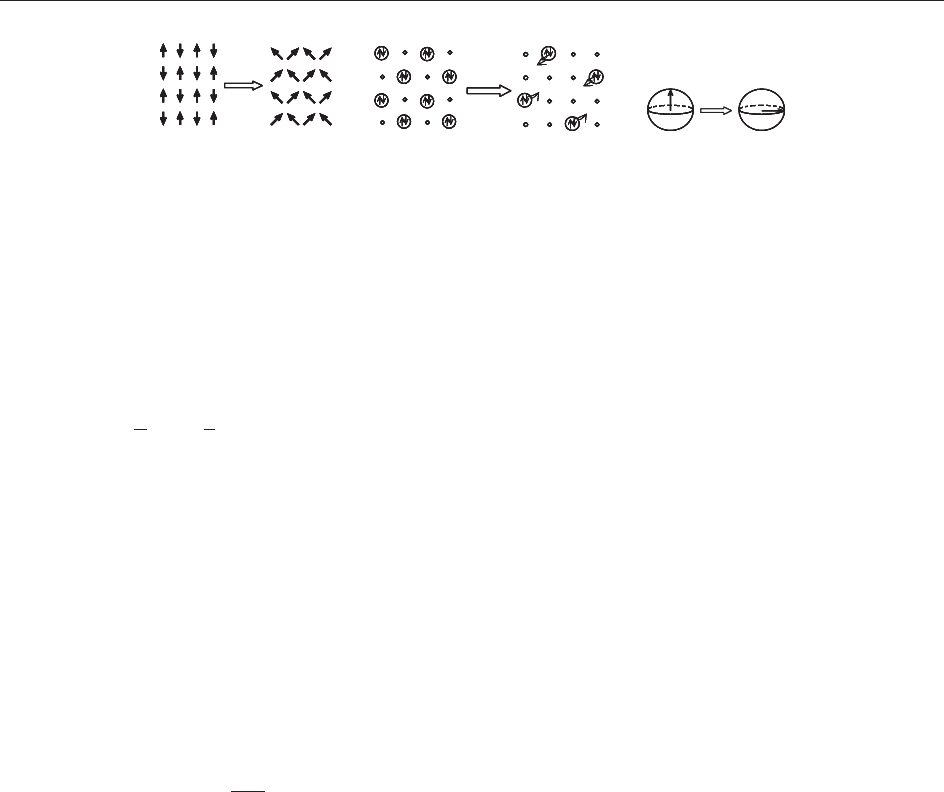
flop transition, and is depicted in Figures 2a and 2c .
The chemical potent ial in the negative U Hubbard
model plays a role similar to the magnetic field in
the AF Heisenberg model. It transforms a CDW
state at half-filling to an SC state away from half-
filling, as depicted in Figures 2a and 2c.
In the low-energy sector, both the AF Heisenberg
model in a magnetic field and the negative-U
Hubbard model with a chemical potential can be
described by the SO(3) nonlinear -model, which is
defined by the following Lagrangian density (in
High T
c
Superconductor Theory 647
imaginary time coordinates) for a unit vector field
n
with n
2
= 1:
L¼
2
!
2
þ
2
ð@
i
n
Þ
2
þ VðnÞ
!
¼ n
ð@
t
n
iB
n
Þð !Þ
½6
where the magnetic field, or equivalently the chemical
potential, is given by B
= (1=2)
B
. and are
the susceptibility and stiffness parameters, and V(n)is
the anisotropy potential, which can be taken as
V(n) = (g=2)n
2
z
. Exact SO(3) symmetry is obtained
when g = B
= 0. g > 0 corresponds to easy axis
anisotropy, while g < 0 corresponds to easy plane
anisotropy. In the case of g > 0, there is a phase
transition as a function of B
z
with B
x
= B
y
= 0. To see
this, let us expand out the first term in [6]. The time-
independent part contributes to an effective potential
V
eff
¼ VðnÞ
B
2
2
ðn
2
x
þ n
2
y
Þ
from which we see that there is a phase transition at
B
c1
=
ffiffiffiffiffiffiffiffi
g=
p
. For B < B
c1
, the system is in the Ising
phase, while for B > B
c1
, the system is in the XY
phase. Therefore, tuning B for a fixed g > 0 leads to
the spin-flop transition. In D = 2, both the XY and
the Ising phase can have a finite-temperature phase
transition into the disor dered state. However,
because of the Mermin–Wagner theorem, a finite-
temperature phase transition is forbidden at the
point B = g = 0, where the system has an enhanced
SO(3) symmetry. This SO(3) symmetric point leads
to a large regime below the mean field transition
temperature where the fluctuation dominates. This
large fluctuation regime can be identified as the
pseudogap behavior.
The pseudospin SU(2) symmetry of the negative-U
Hubbard model has another important consequenc e.
Away from half-filling, the operators no longer
commute with the Hamiltonian, but they are
eigenoperators of the Hamiltonian, in the sense that
½H;
¼2
½7
This means that the operators create well-defined
collective modes with energy 2. Since they carry
charge 2, they usually do not couple to any
physical probes. However, in an SC state, the SC
order parameter mixes the operators with the
CDW operator
z
, via eqn [5]. From this reasoning,
a pseudo-Goldstone mode was predicted to exist in
the density response function at wave vector (, )
and energy 2, which appears only below the SC
transition temperature T
c
.
Unification of Antiferromagnetism and
Superconductivity through the SO(5)
Theory
Order Parameters and SO(5) Group Properties
The negative U Hubbard model an d the SO(3)
nonlinear -models discussed in the previous section
give a nice description of the quantum phase
transition from the Mott insulating phase with
CDW order to the SC phase. On the other hand,
these simple models do not have eno ugh complexity
to describe the AF insulator at half-filling and the SC
order away from half-filling. Therefore, a natural
step is to generalize these models so that the Mott
insulating phase with the scalar CDW order para-
meter is replaced by a Mott insulating phase with
the vector AF order parameter. The pseudospin
SO(3) symmetry group considered previously arises
from the combination of one real scalar component
of the CDW order parameter with one complex, or
two real components of the SC order parameter.
After replacing the scalar CDW order parameter by
the three components of the AF order parameter,
and combining with the two components of the SC
order parameters, we are naturally led to consider a
five-component order parameter vector, and the
SO(5) symmetry group which transforms it.
It is simplest to define the concept of the SO(5)
symmetry generator and order parameter on two
sites with fermion operators c
and d
, respectively,
(a)
Bz
ˆ
储
(b)
μ
B or µ
(c)
Figure 2 The spin-flop transition. (a) The spin-flop transition of the AF Heisenberg model. When a uniform magnetic field is applied
along the direction of the AF moments, there is no net gain of the Zeeman energy. Therefore, after a critical value of the magnetic field,
the AF spin component flops into the xy-plane, while a uniform spin component aligns in the direction of applied magnetic field. (b) The
Mott insulator to superfluid transition of the hardcore boson model or the U < 0 Hubbard model. At half-filling, one possible state is the
CDW state of ordered boson pairs. Upon doping, the pairs become mobile and form the superfluid state. (c) Both transitions can be
described by the spin or the pseudospin flop in the SO(3) nonlinear -model, induced either by the magnetic field or by the chemical
potential.
648 High T
c
Superconductor Theory

where = 1, 2 is the usual spin index. The AF order
parameter operator can be naturally defined in
terms of the difference between the spins of the c
and d fermions as follows:
N
¼
1
2
ðc
y
c d
y
dÞ; n
2
N
1
n
3
N
2
; n
4
N
3
½8
where
are the Pauli matrices. In view of the strong
on-site repulsion in the cuprate problem, the SC order
parameter should be naturally defined on a bond
connecting the c and d fermions, explicitly given by
y
¼
i
2
c
y
y
d
y
¼
1
2
ðc
y
"
d
y
#
þ c
y
#
d
y
"
Þ;
n
1
y
þ
2
; n
5
y
2i
½9
We can group these five components together to
form a single vector n
a
= (n
1
, n
2
, n
3
, n
4
, n
5
) called the
superspin, since it contai ns both superconducting
and antiferromagnetic spin components. The indivi-
dual components of the superspin are explicitly
defined in the last parts of eqns [8] and [9].
The concept of the superspin is only useful if there
is a natural symmet ry group acting on it. In this
case, since the order parameter is 5D, it is natural to
consider the most general rotation in the 5D order
parameter space spanned by n
a
. In 3D, three Euler
angles specify a general rotation. In higher dimen-
sions, a rotation is specified by selecting a plane and
the angle of rotation within this plane. Since there
are n(n 1)=2 independent planes in n dimensions,
the group SO(n) is generated by n(n 1)=2 ele-
ments, specified in general by antisymmetric
matrices L
ab
= L
ba
, with a = 1, ..., n. In particular,
the SO(5) group has ten generators. The total spin
and the total charge operator
S
¼
1
2
ðc
y
c þ d
y
dÞ
Q ¼
1
2
ðc
y
c þ d
y
d 2Þ
½10
perform the function of rotating the AF and SC
order parameters within each subspace. In addition,
there are six so-called operators, defined by
y
¼
1
2
c
y
y
d
y
;
¼ð
y
Þ
y
½11
which perform the rotation from AF to SC and vice
versa. These infinitesimal rotations are defined by
the commutation relations
½
y
; N
¼i
y
; ½
y
; ¼iN
½12
The ten operators, the total spin S
, the total charge
Q, and the six operators form the ten generators
of the SO(5) group.
The superspin order parameter n
a
, the associated
SO(5) generators L
ab
, and their commutation relations
can be expressed compactly and elegantly in terms of
the SO(5) spinor and the five Dirac matrices. The
four-component SO(5) spinor is defined by
¼
c
d
y
½13
They satisfy the usual anticommutation relations
f
y
;
g¼
; f
;
g¼f
y
;
y
g¼0 ½14
Using the spinor and the five Dirac matrices, we
can express n
a
and L
ab
as
n
a
¼
1
2
y
a
; L
ab
¼
1
2
y
ab
½15
The L
ab
operators satisfy the comm utation relation
L
ab
;L
cd
½¼ið
ac
L
bd
þ
bd
L
ac
ad
L
bc
cc
L
ad
Þ½16
The n
a
and the
operators form the vector and the
spinor representations of the SO(5) group, satisfying
the following equations:
L
ab
; n
c
½¼ið
ac
n
b
bc
n
a
Þ½17
and
L
ab
;
¼
1
2
ab
½18
If we arrange the ten operators S
, Q, and
into
L
ab
’s by the following matrix form:
L
ab
¼
0
y
x
þ
x
0
y
y
þ
y
S
z
0
y
z
þ
z
S
y
S
x
0
Q
1
i
ð
y
x
x
Þ
1
i
ð
y
y
y
Þ
1
i
ð
y
z
z
Þ 0
0
B
B
B
B
B
B
B
@
1
C
C
C
C
C
C
C
A
½19
and group n
a
as in eqns [8] and [9],weseethateqns
[16] and [17] compactly reproduce all the commuta-
tion relations worked out previously. These equations
show that L
ab
and n
a
are the symmetry generators
and the order parameter vectors of the SO(5) theory.
Having introduced the concept of local symmetry
generators and order-parameter-based sites in real
space, we now proceed to discuss definitions of
these operators in momentum space. The AF and
dSC order parameters can be naturally expressed in
terms of the microscopic fermion operators as
N
¼
X
p
c
y
pþ
c
p
;
y
¼
i
2
X
p
dðpÞc
y
p
y
c
y
p
dðpÞcos p
x
cosp
y
½20
where (, ) and d(p) is the form factor for
d-wave pairing in 2D. They can be combined into
the five-component superspin vector n
a
by using the
High T
c
Superconductor Theory 649

same convention as before. The total spin and total
charge operator are defined microscopically as
S
¼
X
p
c
y
p
c
p
; Q ¼
1
2
X
p
ðc
y
p
c
p
1Þ½21
and the -operators can be defined as
y
¼
X
p
gðpÞc
y
pþ
y
c
y
p
½22
The form factor g(p) needs to be chosen appro-
priately to satisfy the SO(5) commutation relation
[16], and this requirement determines g(p) =
sgn(d( p)).
The SO(5) symmet ry generators perform the most
general rotation among the five-order parameters.
It is easy to see that the quantum number of the
operators exactly patches up the difference in
quantum numbers between the AF and the dSC
order parameters, according to Table 1.
The SO(5) quantum nonlinear -model
In the previous section we presented the concept of
the local SO(5) order parameters and symmetry
generators. These relationships are purely kinematic,
and do not refer to any particular Hamiltonian. One
can in fact construct microscopic models with exact
SO(5) symmetry out of these operators. A large class
of models, however, may not have SO(5) symmetry
at the microscopic level, but their long-distance,
low-energy properties may be described in terms of
an eff ective SO(5) model. In the previous section, we
have seen that many different microscopic models
indeed all have the SO(3) nonlinear -model as their
universal low-energy description. Similarly, we pre-
sent the SO(5) quantum nonlinear -model as a
general theory of AF and dSC in the HTSC.
From eqn [17] and the discussions in the previous
subsection, we see that L
ab
and n
a
are conjugate
degrees of freedom, very much similar to [q, p] = ih
in quantum mechanics. This suggests that we can
construct a Hamiltonian from these conjugate
degrees of freedom. The Hamiltonian of the SO(5)
quantum nonlinear -model takes the follo wing
form:
H ¼
1
2
X
x
L
2
ab
ðxÞþ
2
X
<x;x
0
>
n
a
ðxÞn
a
ðx
0
Þ
þ
X
x
B
ab
ðxÞL
ab
ðxÞþ
X
x
VðnðxÞÞ ½23
where the n
a
vector field is subjected to the
constraint
n
2
a
¼ 1 ½24
This Hamiltonian is quantized by the canonical
commutation relations [16] and [17]. Here, the first
term is the kinetic energy of the SO(5) rotors, where
has the physical interpretation of the moment of
inertia of the SO(5) rotors. The second term
describes the coupling of the SO(5) rotors on
different sites, through the generalized stiffness .
The third term intro duces the coupling of external
fields to the symmetry generators, while the V(n)
can include anisotropic terms to break the SO(5)
symmetry to the SO(3) U(1) symmetry. The SO(5)
quantum nonlinear -model is a natural combina-
tion of the SO(3) nonlinear -mode l describing the
AF Heisenberg model and the quantum XY mod el
describing the SC to insulator transition. If we
restrict to the values a = 2, 3, 4, then the first two
terms describe the symmetric Heisenberg model, the
third term describes easy plane or easy axis
anisotropy of the Neel vector, while the last term
represents the coupling to the uniform external
magnetic field. On the other hand, for a = 1, 5, the
first term describes Coulomb or capacitance energy,
the second term is the Josephson coupling energy,
while the last term describes coupling to external
chemical potential.
The first two terms of the SO(5) model describe
the competition between the quantum disorder and
classical order. In the ordered state, the last two
terms describe the competition betw een the AF and
the SC order. Let us first consider the quantum
competition. The first term prefers sharp eigenstates
of the an gular momentum. At an isolated site, C
P
L
2
ab
is the Casimir operator of the SO(5) group, in
the sense that it commutes with all the SO(5)
generators. The eigenvalues of this operat or can be
determined completely from group theory; they are
0, 4, 6, and 10, respectively, for the 1D SO(5)
singlet, 5D SO(5) vector, 10D antisymmetric
tensor, and 14D symmetric, traceless tensors. There-
fore, we see that this term always prefers a
quantum-disordered SO(5) singlet ground state,
which is a total spin singlet. This ground state is
separated from the first excited state, the fivefold
Table 1 Quantum number of the AF and the dSC order
parameters, and the operator, which rotates the AF and the
dSC order parameters into each other
Charge Spin Momentum Internal angular
momentum
,
y
or
n
1
, n
5
2 0 0 d-Wave
N
or
n
2, 3, 4
01(, ) s-Wave
,
y
21(, ) d-Wave
650 High T
c
Superconductor Theory

SO(5) vector state with an energy gap of 2=. This
gap will be reduced, when the different SO(5) rotors
are coupled to each other by the second term. This
term represents the effect of stiffness, which prefers
a fixed direction of the n
a
vector, rather than a fixed
angular momentum. This competition is an appro-
priate generalization of the competition between the
number sharp and phase sharp states in a super-
conductor and the competition between the classical
Neel state and the bond or plaquette singlet state in
the Heisenbe rg AF. The quantum phase transition
occurs near ’ 1.
In the classically ordered state, the last two
anisotropy terms compete to select a ground state.
To simplify the discussion, we can first consider the
following simple form of the static anisotropy
potential:
VðnÞ¼gðn
2
2
þ n
2
3
þ n
2
4
Þ½25
At the particle-hole symmetric point with vanishing
chemical potential B
15
= = 0, the AF ground state
is selected by g > 0, while the SC ground state is
selected by g < 0 coupled with the constraint n
2
a
= 1.
g = 0 is the quantum phase transition point separat-
ing the two ordered phases.
However, it is unlikely that the HTSC cuprates
can be close to this quantum phase transition point.
In fact, we expect the anisotropy term g to be large
and positive, so that the AF phase is strongly
favored over the SC phase at half-filling. However,
the chemical potential term has the opposite,
competing effect favoring SC. To see this, we
transform the Hamiltonian into the Lagrangian
density (in imaginary time coordinates) in the
continuum limit:
L¼
2
!
ab
ðx; tÞ
2
þ
2
ð@
k
n
a
ðx; tÞÞ
2
þ Vðnðx; tÞÞ ½26
where
!
ab
¼ n
a
ð@
t
n
b
iB
bc
n
c
Þða !bÞ½27
is the angular velocity. We see that the chemical
potential enters the Lagrangian as a gauge coupling
in the time direction. Expanding the time derivative
term, we obtain an effective potential
V
eff
ðnÞ¼VðnÞ
ð2Þ
2
2
ðn
2
1
þ n
2
5
Þ½28
from which we see that the V term competes with
the chemical potential term. For <
c
=
ffiffiffiffiffiffiffiffi
g=
p
, the
AF ground state is selected, while for >
c
, the SC
ground state is realized. At the transition point, even
though each term strongly breaks SO(5) symmetry,
the combined term gives an effective static potential
which is SO(5) symmetric, as we can see from [28].
Even though the static potential is SO(5) symmetric,
the full quantum dynamics is not. This can be most
easily seen from the time-dependent term in the
Lagrangian. When we expand out the square, the
term quadratic in enters the effective static
potential in eqn [28]. However, there is also a
time-dependent term linear in . This term breaks
the particle-hole symmetry, and it dominates over
the second-order time derivative term in the n
1
and
n
5
variables. In the absence of an external magnetic
field, only second-order time derivative terms of
n
2, 3, 4
enter the Lagrangian. Therefore, while the
chemical potential term compensates the anisotropy
potential in eqn [28] to arrive at an SO(5) symmetric
static potential, its time-dependent part breaks the
full quantum SO(5) symmetry. This observation
leads to the concept of the projected, or stat ic
SO(5) symmetry (Zhang et al. 1999). A model with
projected or static SO(5) symm etry is described by a
quantum effective Lagrangian of the form
L¼
2
X
a¼2;3;4
ð@
t
n
a
Þ
2
ðn
1
@
t
n
5
n
5
@
t
n
1
Þ
V
eff
ðnÞ½29
where the static potential V
eff
is SO(5) symmetric,
but the time-dependent part contains a first-order
time derivative term in n
1
and n
5
.
The SO(5) quantum nonlinear -model is con-
structed from two canonically conjugate field
operators L
ab
and n
a
. In fact, there is a kinematic
constraint among these field operators:
L
ab
n
c
þ L
bc
n
a
þ L
ca
n
b
¼ 0 ½30
This identity is valid for any triples a, b,andc, and
can be easily proved by expressing L
ab
= n
a
p
b
n
b
p
a
, wher e p
a
is the conjugate momentum of n
a
.
Geometrically, this identity expresses the fact that
L
ab
generates a rotation of the n
a
vector. The
infinitesimal rotation vector lies on the tangent
plane of the four sphere S
4
, and is therefore
orthogonal to the n
a
vector itself.
In a large class of materials, including the high-T
c
cuprates, the organic superconductors, and the heavy
fermion compounds, the AF and SC phases occur in
close proximity to each other. The SO(5) theory is
developed based on the assumption that these two
phases share a common microscopic origin and should
be treated on an equal footing. The SO(5) theory gives
a coherent description of the rich global phase diagram
of the high-T
c
cuprates and its low-energy dynamics
through a simple symmetry principle and a unified
effective model based on a single quantum Hamilto-
nian. A number of theoretical predictions, including
the intensity dependence of the neutron resonance
High T
c
Superconductor Theory 651
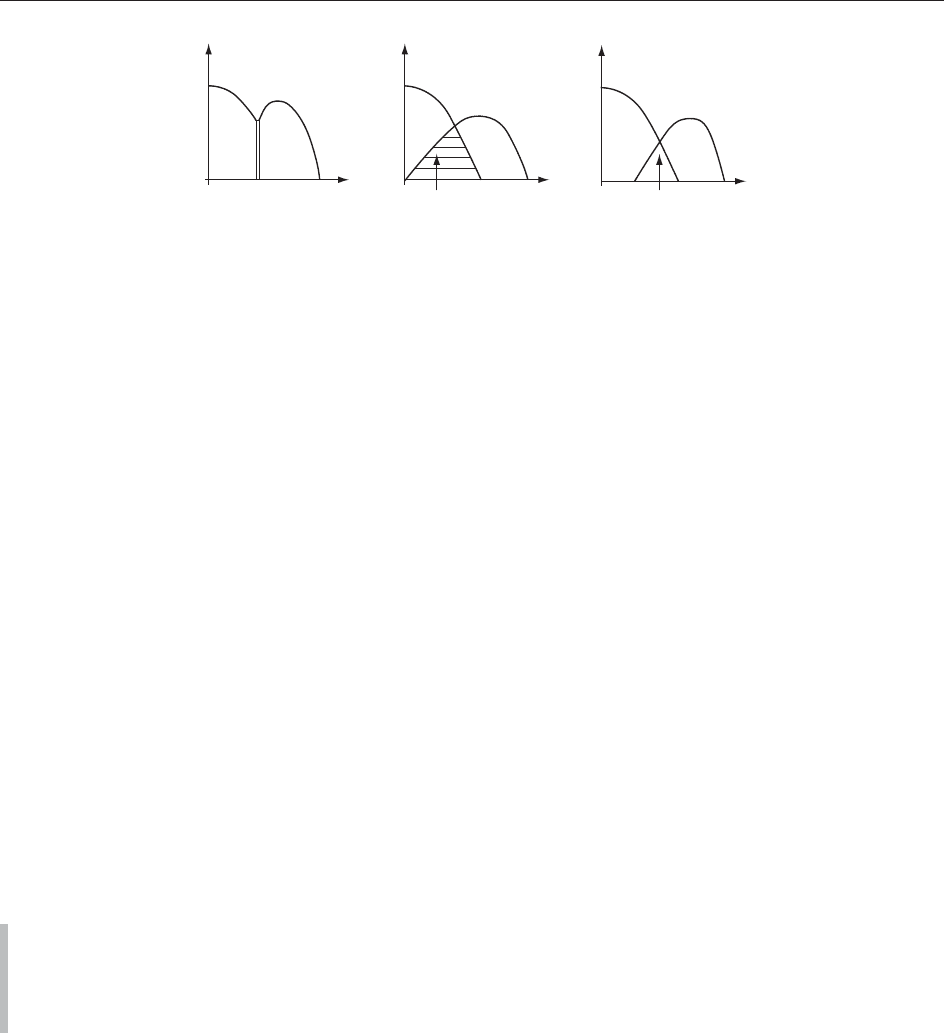
mode, the AF vortex state, and the mixed phase of AF
and SC, have been verified experimentally (Figure 3).
The theory also sheds light on the microscopic
mechanism of superconductivity and quantitatively
correlates the AF exchange energy with the condensa-
tion energy of superconductivity. However, the theory
is still incomplete in many ways and lacks full
quantitative predictive power. While the role of
fermions is well understood within the exact SO(5)
models, their roles in the effective SO(5) models are
still not fully worked out. As a result, the theory has
not made many predictions concerning the transport
properties of these materials.
See also: Abelian Higgs Vortices; Effective Field
Theories; Euclidean Field Theory; Ginzburg–Landau
Equation; Hubbard Model; Quantum Phase Transitions;
Quantum Spin Systems; Quantum Statistical Mechanics:
Overview; Renormalization: General Theory;
Renormalization: Statistical Mechanics and Condensed
Matter; Superfluids; Symmetry Classes in Random Matrix
Theory; Variational Techniques for Ginzburg–Landau
Energies.
Further Reading
Bardeen J, Cooper LN, and Schrieffer JR (1957) Physical Review
108(5): 1175.
Dagotto E (1994) Reviews of Modern Physics 66(3): 763.
Imada M, Fujimori A, and Tokura Y (1998) Reviews of Modern
Physics 70(4): 1039.
Orenstein J and Millis AJ (2000) Science 288(5465): 468.
Yang CN and Zhang SC (1990) Modern Physics Letters B 4(6–7):
759.
Zhang SC (1997) Science 275(5303): 1089.
Zhang SC, Hu JP, Arrigoni E, Hanke W, and Auerbach A (1999)
Physical Review B 60(18): 13070.
Holomorphic Dynamics
M Lyubich, University of Toronto, Toronto, ON,
Canada and Stony Brook University, NY, USA
ª 2006 Elsevier Ltd. All rights reserved.
Introduction
Subject
Holomorphic dynamics (in a narrow sense) is a
theory of iterates of rational endomorphisms of the
Riemann sphere
^
C = C [ {1}. The goal is to under-
stand the phase portrait of this dynamical system,
that is, the structure of its trajectories, and the
dependence of the phase portrait on parameters
(coefficients of f ).
Holomorphic dynamics in a broader sense would
include the theory of analytic transformation s, local
and global, in dimension 1 and higher, as well as the
theory of groups an d pseudogroups of analytic
transformations, which would cover theory of
Kleinian groups and holomorphic foliations. How-
ever, we will mostly focus on holomorphic dynamics
in the narrow sense.
Brief History
Local dynamical theory of analytic maps was laid
down in the late nineteenth and early twentieth
century by Ko¨nigs, Schro¨der, Bo¨ttcher, and Leau.
Globaltheoryofiteratesofrationalmapswas
founded by Fatou and Julia in comprehensive
memoires of 1918–19. The theory had been
TT T
T
N
T
N
T
bc
T
c
T
bc
T
c
AF
AF
SC
SC
T
N
T
tc
T
c
AF
SC
Phase
separation
δ
δ
c
μ
μ
μ
c
μ
c1
μ
c2
μ
c0
Uniform AF/SC
(a) (b) (c)
Figure 3 The finite-temperature phase diagram of the SO(5) model in the temperature (T) versus chemical potential () plane. (a) and
(b) are two different representations of the same phase diagram, corresponding to a direct first-order phase transition between AF and
SC, as a function of the chemical potential and doping, respectively. (c) corresponds to two second-order phase transitions with a uniform
AF/SC mix phase in between. The AF and the SC transition temperatures T
N
and T
c
merge into a bicritical T
bc
or a tetra-critical point T
tc
.
Both possibilities are allowed theoretically; it is up to experiments to determine which one is actually realized in the high-T
c
cuprates.
652 Holomorphic Dynamics

developed very little since then until early 1980s
when it exploded with new methods, ideas, and
computer images. Particularly influential were the
works of D Sullivan who introduced ideas of
quasiconformal deformations into the field, of
A Douady and J Hubbard who gave a comprehensive
combinatorial desc ri ption of the Mandelbrot set,
and W T hurston who linked holomorphic
dynamics to three-dimensional hyperbolic geome-
try bringing to the field ideas of geometrization and
rigidity. As a result, profound rigidity conjectures
were formulated. Renormalization ideas introduced to
the theory later on led to a significant progress
towards these conjectures (see Universality and
Renormalization).
Another source of ideas came from ergodic theory
and the general theory of dynamical systems,
particularly hyperbolic dynamics and thermodyna-
mical formalism. They led to constructions of
natural geometric measures on the Julia sets that
helped to penetrate into their frac tal nature.
General Terminology and Notations
N = {1, 2, ...} is the set of natural numbers; D is the
unit disk; Z
þ
= N [f0g; T = @D.
A topological disk is a simply connected domain
in C .Atopological annulus is a doubly connected
domain in C (i.e., a domain homeomorphic to a
round annulus). A Cantor set is a totally
disconnect compact subset of R
n
without isolated
points.
Given a map f : X !X, f
n
will stand for its n-fold
iterate. The semigroup of iterates form a dynamical
system with discrete time.Anorbit or trajectory of a
point z is orb
f
(z) = (f
n
z)
1
n = 0
.
A subset Y
^
C is called invariant if f (Y) Y and
completely invariant if also f
1
(Y) Y.
A point 2
^
C is called periodic if f
p
= for
some natural p. The smallest such p is called the
period of .Ifp = 1, then is called a fixed
point. The orbit of a periodic point is also called a
cycle.
Two maps f : X !X and g : Y !Y on topological
spaces X and Y are called topologically conjugate if
there exists a homeomorphis m h : X !Y such that
h f = g h.Ifh has better regularity properties, for
example, it is quasiconform al/conformal/affine, then
f and g are called quasiconformally/conformally/
affinely conjugate.
Let f (z) = P(z)=Q(z) be a rational function viewed
as a map
^
C !
^
C. Its topological degree deg f =
#f
1
(z), z 2
^
C, (where the preimages of z are
counted with multip licity), is equal to the algebraic
degree max(deg P, deg Q). The dynamics of f is very
simple in degree 1, so in what follows we assume
that deg f 2.
Let C
f
= {c : Df (c) = 0} stand for the set of critical
points of f, and V
f
= f (C
f
) be the set of critical
values. A rational function of degree d has 2d 2
critical points counted with multiplicity. Moreover,
C
f
n
¼
[
n1
k¼0
f
k
ðC
f
Þ; V
f
n
¼
[
n
k¼1
f
k
ðC
f
Þ
The latter formula explains why the behavior of the
critical orbits crucially influences the global dynamics
of f. The set O
f
= [V
f
n
is called postcritical.
Basic Dynamical Theory
Local Theory
The local theory describes the dynamics of an
analytic map f : z 7!z þ
P
n = 2
a
n
z
n
near its fixed
point 0. The derivative = f
0
(0) is called the multi-
plier of 0. The fixed point is called attracting,
repelling,orneutral, depending on whether jj < 1,
jj > 1, or jj= 1. It is called superattracting if
= 0.
In case when 0 is an attracting (but not super-
attracting) or repelling fixed point, the map is lineariz-
able, that is, it is conformally conjugate to its linear part
z 7!z; thus, there is a local conformal solution of the
Schro¨ der equation (fz) = (z). This solution is also
called the linearizing coordinate near 0.
In the superattracting case, the map is confor-
mally conjugate to the map z 7!z
d
, where a
d
z
d
is the
first nonv anishing term in the local expansion of f.
Thus, in this case there is a local conformal solution
of the Bo¨ ttcher equation (fz) = (z)
d
. It is also
called the Bo¨ ttcher coordinate near 0.
The situ ation in the neutral case (when
= e
2i
, 2 R=Z) depends in a delicate way on
the arithmetic properties of the rotation number .If
= q=p is rational, the fixed point 0 is called
parabolic. The local dynamics is then described in
terms of the Leau–Fatou flower consisting of
attracting petals alternating with repelling petals.
In each petal, the map is conformally conjugate to
the translation z 7!z þ 1. The quotients of the petals
by dynamics are conformally eq uivalent to the
cylinder C=< z 7!z þ 1>. They are called (attracting/
repelling) Ecalle–Voronin cylinders.
In the irrational case, when 2 RnQ,themapcan
be either linearizable or not. Accordingly, 0 is called a
Siegel or a Cremer fixed point. If the multiplier is
Diophantine (i.e., there exist C > 0and>2such
that for all rational numbers q=p,wehave:
j q=pjCp
), then 0 is linearizable (Siegel 1942).
Holomorphic Dynamics 653
Notice that almost all numbers are Diophantine.
A sharper arithmetic condition for linearizability in
terms of the continuous fraction expansion for was
given by Bruno (1965). In the quadratic case,
z 7!e
2i
z þ z
2
, this condition was proved to be sharp
(Yoccoz 1988).
Fatou and Julia Sets
From now on, f :
^
C !
^
C is a rational endomorphism
of the Riemann sphere. The theory starts with the
splitting of the sphere into two subsets now called
Fatou and Julia sets based on the notion of a normal
family in the sense of Montel. A family (
: S !
^
C)
of meromorphic functions on some Riemann surface
S is called normal if it is precompact in the open–
closed topology. The Fatou set F(f ) is the maximal
open subset of
^
C on which the family of iterates
(f
n
)
1
n = 0
is normal. The Julia set J(f ) is the comple-
ment of the Fatou set. Both sets are completely
invariant. The Julia set is always nonempty, and is
either nowhere dense or coincides with the whole
sphere. The trajectories on the Fatou set are
Lyapunov stable (if z is close to z
0
2 F(f ), then
orb
f
(z) is uniformly close to orb
f
(z
0
)), while the
dynamics on the Julia set is ‘‘chaotic.’’
If f is a polyn omial, then the Fatou and Julia sets
can be defined in a more concrete way as follows. In
this case, 1 is a superattracting fixed point for f. Let
us consider its basin of attraction,
D
f
ð1Þ ¼ fz : f
n
z !1as z !1g
Its complement, K(f ), is called the filled Julia set.
Then,
Jðf Þ¼@Kðf Þ¼@D
f
ð1Þ
Periodic Points
Let be a periodic point of f of period p. As a fixed
point of f
p
, it is subject of the local theory. Thus, it
(and its cycle) is classified as attracting, repelling,
etc., according to the properties of the multiplier
= (f
p
)
0
() (that can be calculated in any local chart
near ).
The basin of attraction D
f
(a) of an attracting
cycle a = (f
n
)
p1
n = 0
is the set {z : f
n
z !a as n !1}.
The immediate ba sin of attraction D
f
(a) is the
union of components of D
f
(a) containing the points
of a.
Theorem 1 (Fatou–Julia). The immediate basin of
any attracting cycle contains a critical point. (Note
that a superattracting cycle actually contains some
critical point.)
It follows that a rational function of degree d has
at most 2d 2 attracting cycles. A polynomial of
degree d has at most d 1 attracting cycles in C.
Attracting cycles belong to the Fatou set, while
repelling cycles lie on the Julia set. Parabolic and
Cremer points lie on the Julia set, while Siegel points
belong to the Fatou set. The basin of attraction of a
parabolic cycle a is defined as
D
f
ðaÞ¼fz: f
n
z ! a as n !1gn
[
1
n¼0
f
n
ðaÞ
It is the union of some components of the Fatou set.
The union of the components of D
f
(a) containing
the petals of the Leau–Fatou flower is called the
immediate basin of attraction D
f
(a)ofa. As in the
attracting case, the immediate basin D
f
(a) of a
parabolic cycle contains a critical point of f.
Components of the Fatou set containing Siegel
periodic points are called Siegel disks.IfD is a Siegel
disk of period p, then f
p
jD is conformal ly conjugate
to the irrational rotation z 7!e
2i
z of the unit disk.
Theorem 2 (Shishikura 1987). A ration al function
of degree d has at most 2d 2 nonrepelling cycles.
The proof of this result uses the methods of
quasiconformal surgery.
Examples
For f : z 7!z
d
, d 2, the Julia set J(f ) is the unit circle.
Moreover, D
f
(1) =
^
Cn
D,whileD is the basin of
attraction of the superattracting fixed point 0.
For maps f
"
: z 7!z
2
þ " with sufficiently small
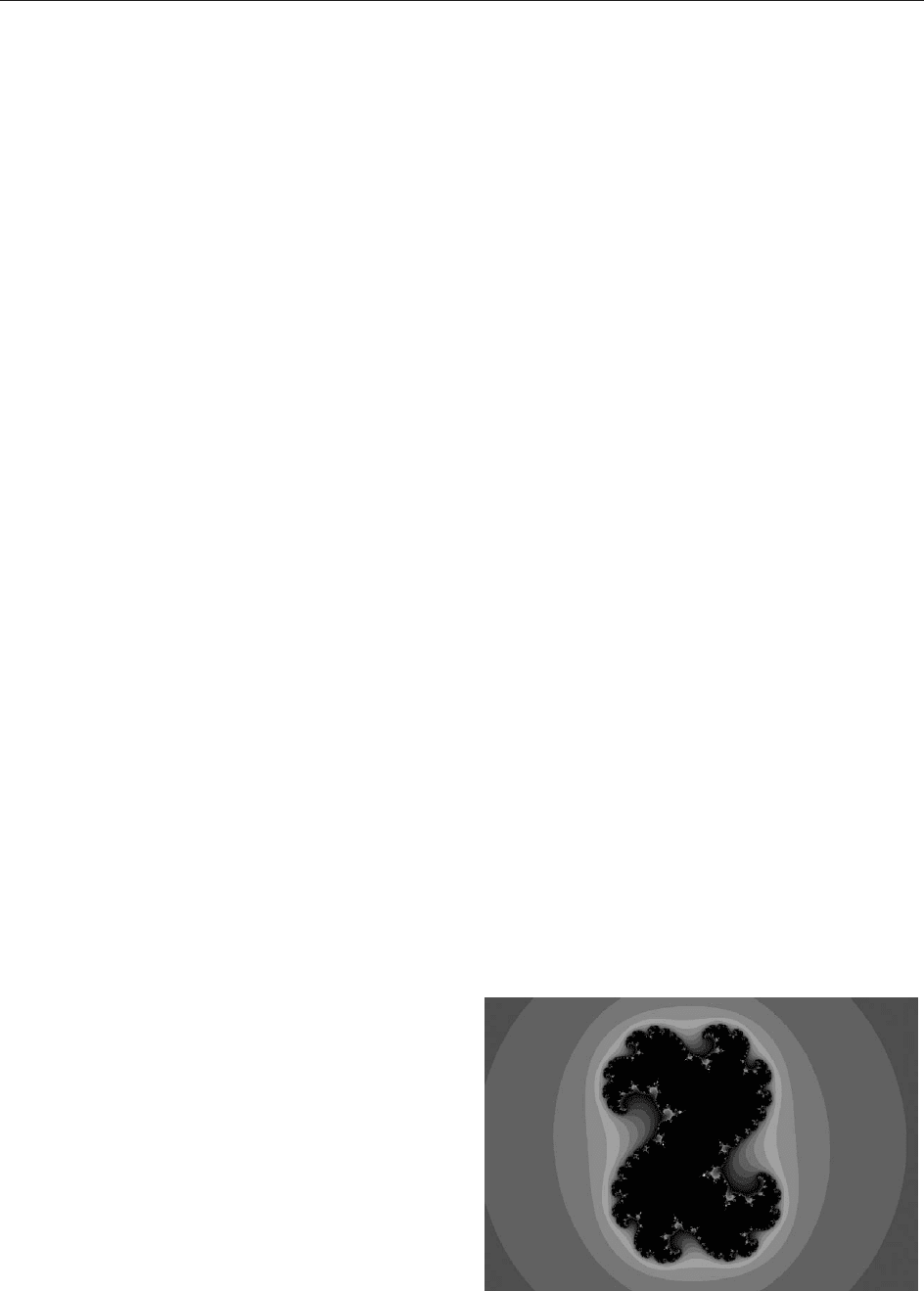
" 6¼ 0, the Julia set J( f )isanowhere-di ffer entiable
Jordan curve (see Figure 1). The domain bounded
by this curve is the basin of attraction of an
attracting fixed point
"
.
The filled Julia set of the map f : z 7!z
2
1 called
the basilica is depicted in black in Figure 2. The
Figure 1 Nowhere-differentiable Jordan curve.
654 Holomorphic Dynamics
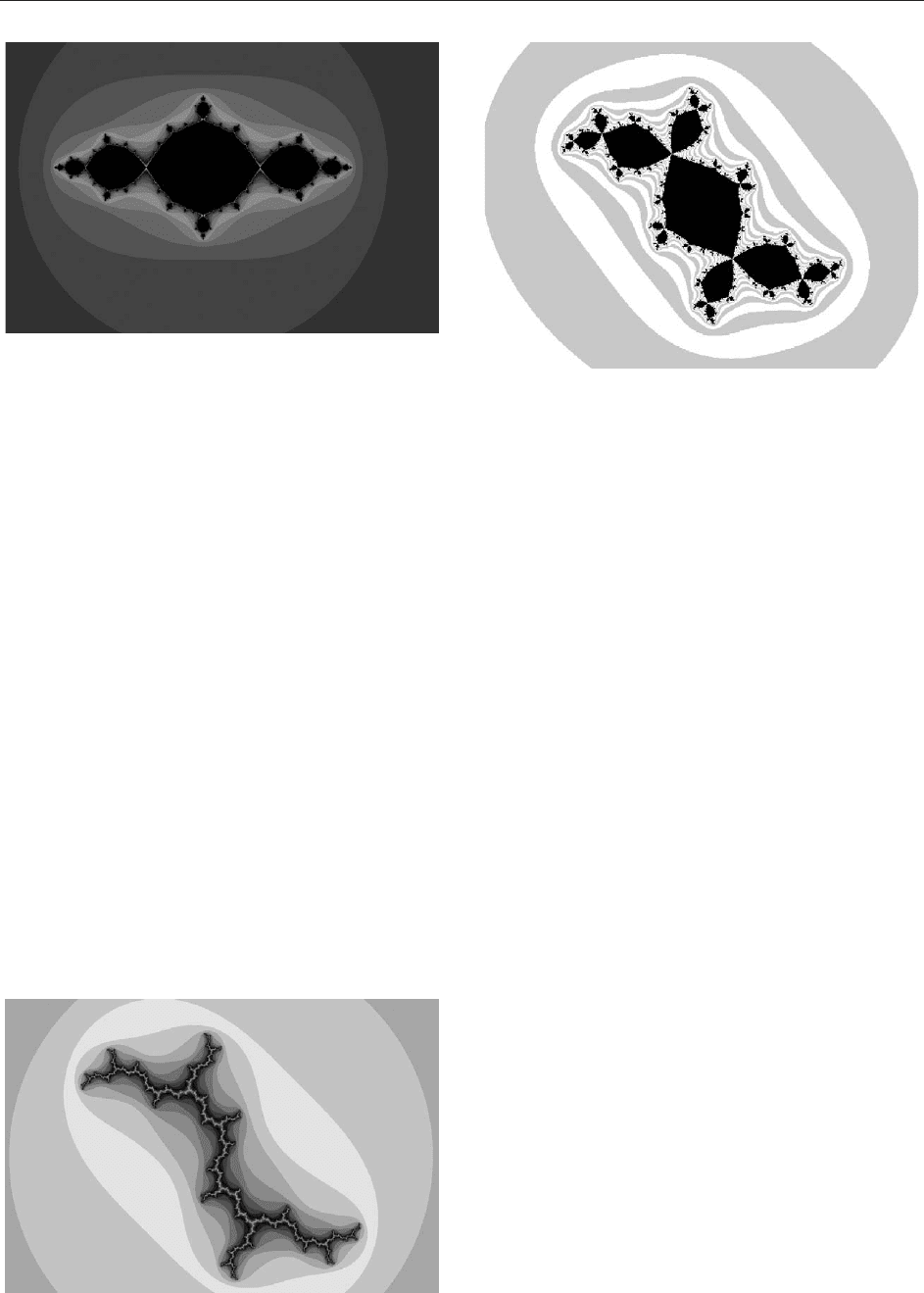
interior of the basilica is the basin of the super-
attracting cycle a = (0, 1) of period 2.
For the map f : z 7!z
2
2, the Julia set is the
interval [2, 2]. It is affinely conjugate to the Cheby-
shev quadratic polynomial Ch
2
: z 7!2z
2
1. More
generally, for a Chebyshev polynomial Ch
d
of any
degree d, the Julia set is the interval. (By definition, the
Chebyshev polynomial Ch
d
is the solution of the
functional equation cos dz = Ch
d
(cosz).)
For quadratic maps f
c
: z 7!z
2
þ c with c < 2, the
Julia set is a Cantor set on R. For maps f
c
with
c > 1=4, the Julia set is a Cantor set that does not
meet R. For c 2 (2, 1=4], the Julia set contains an
invariant interval on R, but is not contained in R.
For f : z 7!z
2
þ i, the Julia set is a ‘‘dendrite’’ (see
Figure 3).
For c 0.12 þ 0.74i, the map f : z 7!z
2
þ c ha s an
attracting cycle of period 3. Its Julia set in known as
the Douady rabbit (Figure 4).
No Wandering Domains Theorem and Dynamics
on the Fatou Set
AcomponentD of the Fatou set is called wandering
if f
n
(D) \ f
m
(D) = ; for all natural n > m.
Theorem 3 (Sullivan 1982). Rational functions do
not have wandering domains.
This theorem is analogous to Ahlfors theorem in
the theory of Kleinian groups. Its proof introduced
to holomorphic dynamics the methods of quasicon-
formal deformations that has become the basic tool
of the subject.
The ‘‘no wandering domains theorem’’ has com-
pleted the picture of dynamics on the Fatou set.
Namely, for any z 2 F(f ), one of the following three
events may happen:
z belongs to the basin of attraction of some
attracting cycle;
z belongs to the basin of attraction of some
parabolic cycle; and
for some n, f
n
z belongs to a rotation domain.
Here a rotation domain is either a Siegel disk, or a
Herman ring, that is, a topological annulus A such
that f
p
(A) = A for some p 2 N and f
p
jA is con-
formally equivalent to an irrational rotation z 7!e
2i
z
of a round annulus {z :1< jzj < R}. Note that
Herman rings cannot occur for polynomial maps.
More Properties of the Julia Set
There are two more useful characterizations of the
Julia set:
If z is not an attracting periodic point and does
not belong to a rotation domain, then the set of
accumulation points of the full prei mages f
n
zis
equal to J(f ).
The Julia set is the closure of the set of repelling
periodic points.
In the polynomial case, the Julia set J(f ) (and the
filled Julia set K(f )) is connected if and only if the
critical points do not escape to 1 (in other words,
Figure 2 Basilica.
Figure 3 Dendrite.
Figure 4 Douady rabbit.
Holomorphic Dynamics 655