
Francoise J.-P., Naber G.L., Tsun T.S. (editors) Encyclopedia of Mathematical Physics
Подождите немного. Документ загружается.


at a detailed leve l with respect to radio wave s, the
surprises from gravitational waves used as tools to
view the universe are potentially even greater.
See also: Asymptotic Structure and Conformal
Infinity; Computational Methods in General Relativity:
The Theory; General Relativity: Experimental Tests;
General Relativity: Overview.
Further Reading
Bartusiak M (2003) Einstein’s Unfinished Symphony: Listening to
the Sounds of Space-Time. New York: Berkley Publishing Group.
Cutler C and Thorne K (2002) An overview of gravitational wave
sources, Arxiv.org:gr-qc/0204090.
Douglass D and Braginsky V (1979) Gravitational radiation
experiments. In: Hawking S and Israel W (eds.) General
Relativity: An Einstein Centenary Survey. Cambridge:
Cambridge University Press.
Kennefick D (1997) Controversies in the history of the radiation
reaction problem in general relativity, Arxiv.org:gr-qc/
9704002.
Saulson P (1994) Fundamentals of Interferometric Gravitational
Wave Detectors.Singapore: World Scientific.
Schutz B (1984) Gravitational waves on the back of the envelope.
American Journal of Physics 52: 412.
Taylor J (1994) Nobel lecture: binary pulsars and relativistic
gravity. Reviews of Modern Physics 66: 711.
Thorne K (1987) Gravitational radiation. In: Hawking S and
Israel W (eds.) 300 Years of Gravitation. Cambridge:
Cambridge University Press.
Thorne K (1995a) Gravitational waves, Arxiv.org:gr-qc/9506086.
Thorne K (1995b) Black Holes and Time Warps: Einstein’s
Outrageous Legacy. New York: W W Norton.
Throne K (1997) Gravitational radiation: a new window on the
universe, Arxiv.org:gr-qc/9704042.
The LIGO project web page, which includes links to all the other
experimental efforts: http://www.ligo.caltech.edu.
Growth Processes in Random Matrix Theory
K Johansson, Kungl Tekniska Ho
¨
gskolan, Stockholm,
Sweden
ª 2006 Elsevier Ltd. All rights reserved.
Introduction
Probability distributions coming from random matrix
theory (RMT), RMT laws, occur in different contexts,
notably in quantum physics and in number theory.
RMT laws are also seen in certain local random growth
models and related problems in discrete probability,
random permutations, exclusion processes, and ran-
dom tilings (dimer models). In these models limit laws
for height/shape fluctuations are given by limit laws
from RMT, in particular the largest eigenvalue or
Tracy–Widom distributions. These models belong to
the Kardar–Parisi–Zhang (KPZ) universality class.
Models in this class have two universal exponents, 1/
3 describing the interface fluctuations and 2/3 describ-
ing the correlations in the transversal direction. By a
local random growth model, we mean a model where
the random growth mechanism is local in that it does
not depend on the global geometry as in diffusion
limited aggregation (DLA). Typically there is also some
smoothing mechanism. The connection with RMT can
only be established for special exactly solvable models.
Below we discuss a basic model based on a last-passage
percolation problem, which translates into a poly-
nuclear growth (PNG) process. Other models that can
be treated are in a sense variations of this model. Point
processes with determinantal correlation functions
play a central role in RMT and in the analysis of the
basic model and we start by discussing these. The basic
model has several different interpretations that will be
outlined. Another basic tool, which can be formulated
in different ways, is the Robinson–Schensted–Knuth
(RSK) correspondence well known in combinatorics.
One approach is in terms of nonintersecting paths
which translates into a multilayer PNG process. Limit
theorems can be formulated for the height above a
fixed location, and also for the whole height function in
terms of the Airy process which extends the Hermitian
Tracy–Widom distribution F
2
. It is expected that
several results should generalize to a broader class of
models. There is a natural universality problem of
extending the validity of the RMT laws.
Determinantal Processes
Point processes with determinantal correlation func-
tions play an important role in the exactly solvable
models. We consider probability measures on
n
, R, of the form
1
Z
n
detð
i
ðx
j
ÞÞ
n
i; j¼1
det ð
i
ðx
j
ÞÞ
n
i; j¼1
d
n
ðxÞ½1
which can be thought of as describing random points
in at positions x
1
, ..., x
n
.Here, is a reference
measure on , for example, Lebesgue or counting
measure, Z
n
a normalization constant, and
i
,
i
given
functions. A measure of this form has determinantal
correlation functions in the sense that the density, with
respect to d
m
(y), of particles at y
1
, ..., y
m
is
ðy
1
; ...; y
m
Þ¼detðK
n
ðy
i
; y
j
ÞÞ
m
i; j¼1
½2
There is an explicit formula for the correlation
kernel K
n
in terms of the functions
i
,
i
.
586 Growth Processes in Random Matrix Theory

The eigenvalue measures in the basic random
matrix ensembles have the form
1
Z
n
j
n
ðxÞj
Y
n
j¼1
wðx
j
Þd
n
ðxÞ½3
where
n
(x) = det(x
i1
j
)
n
i, j= 1
is Vandermonde’s
determinant, x 2
n
and x
1
, ..., x
n
are the eigen-
values. For the Gaussian unitary ensemble (GUE
n
),
Z
1
n
exp(tr M
2
)dM of n n Hermitian matrices M,
we have = 2, =R, w(x) = exp(x
2
) and the
Lebesgue measure. For the Laguerre unitary ensem-
ble (LUE
n,
) of complex covariance matrices, M
M,
where M is an (n þ ) n-matrix with standar d
complex Gaussian elements, we have w(x) =
x
e
x
, 0, = 2, =[0, 1) and the Lebesgue
measure. The = 2 case of [3] can be put into the
form [1] and hence has determinantal correlation
functions. In this case the correlation kernel can be
expressed in terms of the normalized orthogonal
polynomials p
k
(x) with respect to w(x)d(x)on.
Because of this when = 2 the ensemble [3] is
referred to as an orthogonal polynomial ensemble
(OPE). The kernel is given by
K
n
ðx; yÞ¼
X
n1
k¼0
p
k
ðxÞp
k
ðyÞðwðxÞwðyÞÞ
1=2
½4
A consequence of [2] is that the probability of
finding no particle in a set J is given by a
Fredholm determinant,
P½no particle in J¼detðI K
n
Þ
L
2
ðJ;Þ
½5
In particular the distribution function F()ofthelargest
eigenvalue or rightmost particle x
max
= max
1jn
x
j
in an OPE is given by [5] with K
n
as in [4] and
J = (, 1).
A Basic Model
Let (w(i, j))
(i, j)2Z
2
þ
be independent geometric random
variables with parameter a
i
b
j
,
P½wði; jÞ¼k¼ð1 a
i
b
j
Þða
i
b
j
Þ
k
½6
k 0 and 0 a
i
b
j
< 1. As a limiting case we can
obtain exponential random variables. Consider the
last-passage time
GðM; NÞ¼max
X
ði;jÞ2
wði; j Þ½7
where the maximum is over all up/right paths
from (1, 1) to (M, N), that is, = {(i
1
, j
1
), ...,(i
m
, j
m
)}
with (i
kþ1
, j
kþ1
) (i
k
, j
k
) = (1, 0) or (0, 1), (i
1
, j
1
) =
(1, 1) and (i
m
, j
m
) = (M, N), m = M þ N 1. We can
also think of this as a zero- temperature directed
polymer, by thinking of the w(i, j) : s as (minus)
energies and as random walk paths.
As will be explained in some more detail below,
if the w(i, j) : s are exponential with mean 1 and
M N,thenG(M, N) =
max
in distribution, M N,
where
max
is the largest eigenvalue in LUE
N, MN
.
Hence, in this case G(M, N) behaves exactly like a
largest eigenvalue. If the w(i, j):s are geometric with
parameter q,thenG(M, N) has the same distribution
as the rightmost particle in an OPE, namely [3],
with = 2, w(x) =
MNþx
x
q
x
and the counting
measure on =N, called the Meixner ensemble.
Since in this case the relevant orthogonal polynomials
are discrete the ensemble is referred to as a discrete
OPE.
The random variables {G(M, N)}
(M, N)2Z
2
þ
have two
interpretations related to random growth. It follows
from [7] that
GðM; NÞ
¼maxðGðM 1; NÞ; GðM; N 1ÞÞ
þ wðM; NÞ½8
This can be thought of as a growth rule. We change
variables by letting G(M, N) = h(M N, M þ N 1)
and w(M,N) = !(M N,M þN 1) with w(M,N)=0
if (M,N) 62Z
2
þ
. Then
hðx; t þ 1Þ
¼ maxðhðx 1; tÞ; hðx; tÞ; hðx þ 1; tÞÞ
þ !ðx; tÞ½9
x Z, t N, h(x,0) 0, and !(x, t) = 0ifjxjt or if
x t is even. We can extend it to the whole real line
by letting h(x, t ) = h([x], t). The growth rule [9] is a
discrete polynuclear growth (PNG) model. Up-steps
in the inte rface, x ! h(x, t
) (see the top curve in
Figure 1), move at unit speed to the left and down-
steps move at unit speed to the right and they merge
at collision. On top of this smoothing mechanism,
we have random deposition given by !(x, t). Look-
ing at the definition of !, we see that all deposition
up to time t is on top of a basic layer (t, t). The
asymptotic shape will look like a droplet and this
setting of PNG is called the droplet geometry. We
see that height fluctuations are directly related to
fluctuations of G(M, N).
We get another growth model, the corner growth
model, somewhat similar to the classical Eden
growth model, by considering the random shape
(see Figure 2),
ðnÞ¼fðM; NÞ2Z
2
þ
; GðM; NÞþM þ N 1 ng
þ½1; 0
2
½10
Growth Processes in Random Matrix Theory 587
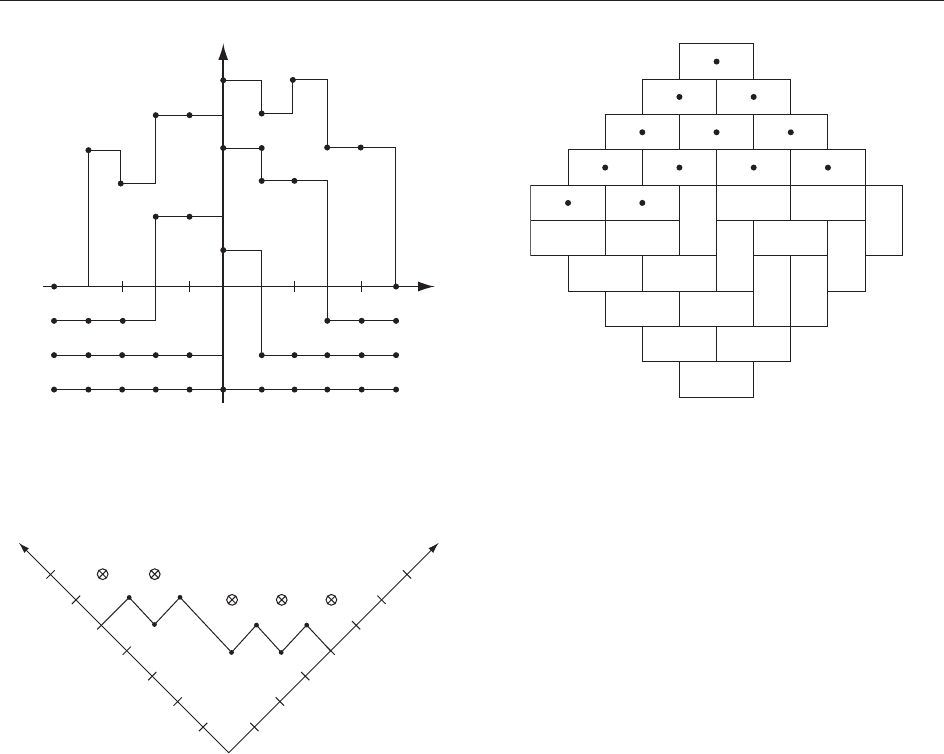
The complement of this set in Z
2
þ
has a boundary
B(n) which we can think of as an interface. By [8]
and the lack of memory property of the geometric/
exponential distribution, the region (n) grows by
adding new squares independently at each corner of
B(n) with geometric/exponential waiting times (see
Figure 2). If we look at B(n) in a coordinate system
with M = N as vertical axis and write a 1 for every
unit down-step on B(n) and a 0 for every unit up-
step (see Figure 2), the corner growth dynamics
translates into the totally asymmetric simple exclu-
sion process (TASEP), in discrete or continuous
time, with initial configuration ...1111000 ... .As
shown by Jockush, Propp, and Shor, (n) also
occurs in a uniform random domino tiling of a
region called the Aztec diamond (see Figure 3). The
shape (n), when q = 1=2, has the same law as the
completely regular (frozen) North Polar Region
(NPR) in the tiling and hence the boundary
fluctuations of the NPR are related to the fluctua-
tions of G(M, N). The NPR in Figure 3 has the same
shape as (5) in Figure 2. This connects the models
considered here with dimer or tiling problems in
two-dimensional equilibrium statistical mechanics.
Consider a (Poissonized) random permutation
from S
N
, where N is a Poisson() random variable.
Let L() denote the length of the longes t increasing
subsequence in , for example, = 316452 has
L = 3. By thinking of the representation of a
permutation by its permutation matrix, we see that
G(N, N) with w(i, j) geometric with parameter
q = =N
2
converges to L() in distribution as
N !1. We call this limit the Poisson limit. Taking
this limit in the PNG process yields the Pra¨ hofer–
Spohn continuous time PNG (cont-PNG) model,
which is similar to the discrete PNG defined above
but where all steps have unit size and we have
continuous time dynamics with deposition events
according to a two-dimensional spacetime Poisson
process. The study of L(), and its de-Poissonization
when N is nonrandom, is known as Ulam’s problem
in combinatorial probability.
The RSK Correspondence
The mapping of the last-passage problem [7] into a
determinantal proces s is based on the RSK corre-
spondence. This correspondence maps the integer
matrix (w(i, j))
1i, jM
bijectively to a pair of semi-
standard Young tableaux (P, Q) with common
shape , which is a partition = (
1
,
2
, ...)of
P
1i, jM
w(i, j). This map has the property that
G(M, N) =
1
, the length of the first row in the
Young diagram. From the combinatorial definition
of the Schur polynomials s
it follows that the
measure [6] on the integer matrix is mapped to a
b
5
b
4
b
3
b
2
b
1
a
1
a
2
a
3
a
4
a
5
h
0
h
–1
h
–2
h
–3
X
Figure 1 Multilayer PNG model.
01 01
0
1
0
1
1
0
0
0
1
1
Ω(5)
Figure 2 Corner growth model at time n = 5. The crosses are
the possible growth sites.
Figure 3 Domino tiling of an Aztec diamond of size n = 5.
Dominos marked by dots form the NPR.
588 Growth Processes in Random Matrix Theory

probability measure on partitions, the Schur mea-
sure, given by
P
Schur
½¼
1
Z
s
ða
1
; ...; a
M
Þs
ðb
1
; ...; b
M
Þ½11
This measure has determinantal correlation functions
if we think of x
i
=
i
i as the positions of particles
in Z.Ifweusex
i
=
i
þ N i as variables and
specialize to a
1
= = a
M
=
ffiffiffi
q
p
, b
1
= = b
N
=
ffiffiffi
q
p
and b
j
= 0forj > N we get the Meixner ensemble.
The case of exponential random variables, for
example the relation to LUE discussed above, is
obtained from the Meixner ensemble by taking an
appropriate limit. In the Poisson limit we get the
Poissonized Plancherel measure,
P
Plan
½¼
X
1
N ¼0
e
=
n
N!
½12
where P
Plan, N
[] = (dim )
2
=N! if is a partition of
N and 0 otherwise. Here dim is the dimension
of the irreducible representation of S
N
labeled by .
In the work of Borodin and Olshanski in representa-
tion theory various measures on partitions with
determinantal correlation functions occur naturally.
Also Okounkov and co-workers have used the
Plancherel and Schur measures in Gromov–Witten
theory. The correlation kernel for the Plancherel
measure repre sented as the point process (x
i
)
i1
in Z
with x
i
=
i
i has the correlation kernel, called the
discrete Bessel kernel,
B
ðx; yÞ¼
ffiffiffiffi
p
ðx yÞ
1
ðJ
x
ð2
ffiffiffiffi
p
ÞJ
yþ1
ð2
ffiffiffiffi
p
Þ
J
xþ1
ð2
ffiffiffiffi
p
ÞJ
y
ð2
ffiffiffiffi
p
Þ½13
where J
n
is the ordinary Bessel function. The
random variable L() has the same distribution as
max x
j
þ 1. Henc e, by [5],
P½LðÞn¼detðI B
Þ
‘
2
ðfn; nþ1;...gÞ
½14
The random variable L() also gives the height
above the origin in cont-PNG.
There is a geometric interpretation of RSK going
back to Viennot. The pair (P, Q) is represented as a
family of nonintersecting paths in a directed graph.
These paths can be obtained by running a multilayer
version of the PNG process where the size of
collisions are deposited as growth in lower layers
which evolve according to the same PNG dynamics.
The information lost in the collisions is recorded in
the lower layers. This can be done also for
{w(i, j)}
iþj1t
and leads to a multilayer version of
[9],{h
j
(x,t)}
1
j = 1
, where h
j
(x,0) j, h
j
(t, t) =
j, and h(x, t) = h
0
(x, t) is the top path (see Figure 1).
The Karlin–McGregor theorem or the Gessel–
Viennot method say that the weight (probability)
of a family of nonintersecting paths with fixed initial
and final positions on a weighted directed acyclic
graph is given by a determinant. It follows that the
probability of a certain configuration { h
j
(0, t)}
j1
is
given by a product of two determinants and hence
has the form [1].InFigure 1, the weights of the
horizontal line segments will be 1, whereas each unit
vertical step has weight a
i
or b
j
as indicated in the
figure. This leads to [9] using the Jacobi–Trudi
formula for the Schur polynomial.
Limit Theorems
The existenc e of a limit shape in a model like [6]
with w(i, j) independent random variables, and in
related problems follows by a subadditivity argu-
ment, although explicit shapes are only known in a
few cases . The formalism described above makes it
possible to get more detailed results about the
fluctuations around the limit shape, like a central-
limit theorem, but with a non-normal limit law. We
know that G(M, N) has the same distribution as
x
max
N þ 1, where x
max
is the rightmost particle in
the Meixner ensemble. This, together with [4], [5],
and an asymptotic analysis of the Meixner poly-
nomials, gives
P
GðM; NÞ!ð;qÞN þð;qÞN
1=3
!F
2
ðÞ½15
as N !1, M !1, M=N ! 1, where
!ð; qÞ¼
ð1 þ
ffiffiffiffiffiffi
q
p
Þ
2
1 q
1 ½16
and
ð; qÞ¼
ðq=Þ
1=6
1 q
ð
ffiffiffi
p
þ
ffiffiffi
q
p
Þ
2=3
ð1 þ
ffiffiffiffiffiffi
q
p
Þ
2=3
½17
The limiting distribution function F
2
is the Tracy–
Widom distribution given by
F
2
ðÞ¼detðI AÞ
L
2
ð;1Þ
½18
where
Aðx; yÞ¼
AiðxÞAi
0
ðyÞAi
0
ðxÞAiðyÞ
x y
½19
is the Airy kernel. It is also the limiting largest
eigenvalue distribution for GUE
n
,
lim
N!1
P
ffiffiffiffiffiffi
2n
p
ðnÞ
max
2n
n
1=3
"#
¼F
2
ðÞ½20
The function F
2
can also be expressed in terms of a
Painleve´ II function. The limit theorem [15]
Growth Processes in Random Matrix Theory 589

translates into a fluctuation result for the height
function in the corner growth and the PNG models,
saying that the height fluctuations above a fixed
location at time t are of order t
1=3
and given by the
F
2
-distribution. Here we see the KPZ exponent 1/3.
For the length L() of the length of a longest
increasing subsequence in a random permutation or
the height above the origin in the cont-PNG, [14]
and asymptotics for Bessel funct ions yield
P½ðLðÞ2
ffiffiffiffi
p
Þ=
1=6
!F
2
ðÞ½21
as !1. This result was first proved by Baik,
Deift, and Johansson using a Toeplitz determinant
formula (Gessel’s formula) for the left-hand side of
[14] and the Deift–Zhou nonlinear steepest descent
method for oscil latory Riemann–Hilbert problems.
The above limit theorems can be extended to limit
theorems for the whole point process rescaled
around the rightmost point. This results in a
limiting determinantal point process given by the
Airy kernel [19].
The Airy Process
From the point of view of the growth processes, for
example, the PNG process [7], it is natural to consider
a scaling limit of the whole height function x ! h(x, t)
as t !1. Looking at the height configuration in the
multilayer growth process x ! {h
j
(x, t)}
j1
at differ-
ent locations x
1
, ..., x
r
, x
rþ1
, ..., x
M1
leads, via the
Karlin–McGregor or Gessel–Viennot method, to
probability measures of the form
1
Z
Y
M1
r¼0
det
r;rþ1
y
r
i
; y
rþ1
j
n
i;j¼1
½22
with y
0
and y
M
fixed configurations. Here, in the
discrete PNG model,
r, rþ1
(x, y) is the transition
probability (weight) to go from height x to height y
between positions x
r
and x
rþ1
. This measure
generalizes [1] and it also has determinantal correla-
tion functions. Measures of this form also arise in
multimatrix models and in Dyson’s Brownian
motion model, t ! M(t), t 2 R, for Hermitian
matrices, which is a Gaussian multimatrix model.
The elements of the time-dependent Hermitian
matrix M(t) evolve according to independent
Ornstein–Uhlenbeck processes and we have the
transition kernel
Z
1
exp½trðMðtÞqMð0ÞÞ
2
=ð1 q
2
Þ ½23
where q = exp(t). This process has GUE as its
stationary distribution. The Harish–Chandra/Itzykson–
Zuber integral can be used to show that the joint
eigenvalue measure for M(t
1
), ..., M(t
M1
)hasthe
form [22] and hence has determinantal correlation
functions. The correlation kernel is the extended
Hermite kernel,
K
n
ð;x; ; yÞ
¼
X
1
k¼1
e
kðÞ
p
nk
ðxÞp
nk
ðyÞe
1
2
ðx
2
þy
2
Þ
if
X
0
k¼1
e
kðÞ
p
nk
ðxÞp
nk
ðyÞe
1
2
ðx
2
þy
2
Þ
if <
8
>
>
>
>
>
>
>
>
>
>
>
<
>
>
>
>
>
>
>
>
>
>
>
:
½24
with p
k
the normalized Hermite polynomials, p
k
0
if k < 0. Notice that this reduces to the Hermite
kernel [4] when = . This machinery can be used
to show that the largest eigenvalue process
t !
(n)
max
(t) induced by M( t) converges in the sense
of finite-dimensional distributions to a limiting
process, the Airy process,
ffiffiffiffiffiffi
2n
p
n
max
ðn
1=3
tÞ2n
=n
1=3
!AðtÞ½25
as n !1. The Airy process A(t), which is a
stationary process, can be viewed as the top curve
of a multilayer process t ! (A
j
(t))
j1
, A(t) = A
0
(t)
such that the point process {A
j
(t
k
)}
1kM, j0
has
determinantal correlation functions with correlation
kernel
Að;;
0
;
0
Þ
¼
Z
1
0
e
ð
0
Þ
Ai ð þ ÞAi ð
0
þ Þd
if
0
Z
0
1
e
ð
0
Þ
Ai ð þ Þ Ai ð
0
þ Þd
if <
0
8
>
>
>
>
>
>
>
>
<
>
>
>
>
>
>
>
>
:
½26
the extended Airy kernel, which reduces to the
ordinary Airy kernel [19] when =
0
. The Airy
process can be viewed as an extension of the Tracy–
Widom distribution F
2
. For the PNG model above,
the multilayer process is described by an extended
kernel, which in the cont-PNG is an extended
version of the discrete Bessel kernel [13].Ina
suitable scaling limit, this extended kernel converges
to the extended Airy kernel. For the PNG process
[7], this leads to the limit law
ðdN
1=3
Þ
1
h 2d
1
1 þ
ffiffiffi
q
p
1
ffiffiffi
q
p
N
2=3
;2N 1
2
ffiffiffi
q
p
1 q
N
!AðÞ½27
590 Growth Processes in Random Matrix Theory

as N !1, where d = (1 q)
1
(
ffiffiffi
q
p
)
1=3
(1 þ
ffiffiffi
q
p
)
1=3
.
Notice the exponent 2/3 which is the second KPZ
exponent. This exponent can also be seen in the
transversal fluctuations of the maximal paths in [6]
for G(N, N). These are superdiffusive, they have
fluctuations of order N
2=3
around the diagonal,
compared to N
1=2
for random walk paths between
the same points. A fluctuation result like [27] can
also be proved for the corner growth model and
hence also for the Aztec diamond. The boundary of
the NPR suitably rescaled converges to the Airy
process.
Variations
Above we discussed one possible geometry, the
droplet, for the PNG process. If we start with
h(x,0) 0 and allow random depositions along the
whole line, we get an interface that is macroscopi-
cally flat, and not curved as in the droplet case. In
this case, the height fluctuations above a fixed
location at time t are again of size t
1=3
and described
by the Gaussian Orthogonal Ensemble largest
eigenvalue distribution. This law comes from the
scaling limit of the rightmost particle in [3] with
= 1, w(x) = exp(x
2
), =R,and the Lebesgue
measure. In this case, the correlation functions are
not determinants but rather pfaffians. The result for
flat PNG follows from the Baik–Rains analysis of
symmetrized last -passage or permutation problems.
In the PNG model we can also consider an interface
in equilibrium. This can be put into the last-passage
percolation picture by suit able boundary conditions,
different parameters for w(i, j) when i or j equals 1
or extra Poisson points on the axes in the Poisson
limit. Results by Baik and Rains show that in the
cont-PNG in equilibrium the height fluctuations are
given by a relative of the Tracy–W idom distribution,
F
0
. In these last two cases, the scaling limit of the
whole height profile is not known.
The types of results discussed above can only be
obtained for very special models. However, it is
expected that many of the results (in particular the
KPZ exponents 1/3 and 2/3, and also the fluctuation
laws, including the Airy process) should generalize
to many other models. The different interpretations
of [6] mentioned above suggest different general-
izations, various local growth models, directed
polymers, asymmetric exclusion processes, and
dimer/tiling problems. RMT laws are natural limit
laws for which the domain of attraction is not
understood.
See also: Combinatorics: Overview; Determinantal
Random Fields; Dimer Problems; Integrable Systems in
Random Matrix Theory; Random Walks in Random
Environments; Random Matrix Theory in Physics;
Random Partitions.
Further Reading
Baik J and Rains E (2001) Symmetrized random permutations. In:
Ruck M (ed.) Random Matrix Models and Their Applications,
Math. Sci. Res. Publ., vol. 4, pp. 1–19. Cambridge: Cambridge
University Press. (arXiv/math.CO/9910019).
Baik J, Deift PA, and Johansson K (1999) On the distribution of
the length of the longest increasing subsequence in a random
permutation. Journal of American Mathematical Society 12:
1119–1178.
Borodin A and Olshanski G (2001) In: z-Measures on Partitions,
Robinson–Schensted–Knuth Correspondence, and = 2
Rand om Matrix Ensembles, Ma th. sci. Res. Publ., vol. 4,
pp. 71–94. Cambridge: Cambridge University Press. (arXiv/
math.CO/9905189).
Ferrari PL, Pra¨ hofer M, and Spohn H (2003) Stochastic growth in
one dimension and Gaussian multi-matrix models. Proceed-
ings of the International Congress of Mathematical Physics,
Lissabon 2003 (arXiv/mathph/0310053).
Johansson K (2002) Toeplitz determinants, random growth and
determinantal processes. Proceedings of the ICM Beijing
2002, vol. 3, pp. 53–62 (arXiv/math.PR/0304368).
Krug J and Spohn H (1992) Kinetic roughening of growing
interfaces. In: Godre` che C (ed.) Solids Far from Equilibrium:
Growth, Morphology and Defects, pp. 479–582. Cambridge:
Cambridge University Press.
Mehta ML (1991) Random Matrices, 2nd edn. San Diego:
Academic Press.
Okounkov A (2003) The uses of random partitions, arXiv/math-ph/
0309015 Proceedings of the International Congress of
Mathematical Physics, Lissabon 2003 (arXiv/mathph/
0309015).
Stanley RP (1999) Enumerative Combinatorics, vol. 2. Cambridge:
Cambridge University Press.
Tracy C and Widom H (2002) Distribution functions for largest
eigenvalues and their applications. Proceedings of the ICM
Beijing 2002, vol. 1, pp. 587–596 (arXiv/math.PR/0210034).
Growth Processes in Random Matrix Theory 591

H
Hamiltonian Fluid Dynamics
P J Morrison, University of Texas at Austin, Austin,
TX, USA
ª 2006 Elsevier Ltd. All rights reserved.
Introduction
The ideal fluid description is one in which viscosity or
other phenomenological terms are neglected. Thus, as is
the case for systems governed by Newton’s second law
without dissipation, such fluid descriptions possess
Lagrangian and Hamiltonian descriptions. In fact, in
the eighteenth century, Lagrange himself discussed
what is in essence the action principle for the
incompressible fluid. The subsequent history of action
functional and Hamiltonian formulations of the ideal
fluid is long and convoluted with contributions from
Clebsch in the nineteenth century, and the likes of L
Landau and V Arnol’d in the mid-twentieth century.
In the early 1980s, there was a flurry of activity on
the noncanonical Poisson bracket formulation, and
this formulation is the focus of the present treatment,
which is motivated by the wo rk of the author, D
Holm,JMarsden,TRatiu,AWeinstein,andothers.
Noncanonical Hamiltonian Structure
The traditional arena for Hamiltonian dynamics is the
cotangent bundle M:= T
Q, the phase space, which is
naturally a symplectic manifold with a closed non-
degenerate 2-form. In coordinates, the 2-form is given
by !
c
= dq ^ dp,whereq denotes the configuration
coordinate for the base space manifold Q and p
denotes the corresponding canonical momenta that
arise from Legendre (convex) transformation. The
2-form !
c
provides a natural identification at a point
z = (q, p) 2Mof T
z
M with T
z
M, and because of
nondegeneracy its inverse, the cosymplectic form,
provides the map J
c
: T
z
M!T
z
M.Thus,fora
Hamiltonian H : M!R we have the Hamiltonian
system of ordinary differential equations
_
z = J
c
dH,
which in canonical coordinates has the familiar form
_
q
i
¼ @H=@p
i
;
_
p
i
¼@H=@q
i
½1
with i = 1, 2, ..., N, where N is the number of
degrees of freedom.
Hamilton’s equations can also be written in terms
of the Poisson bracket [f , g]:= !
c
(J
c
df , J
c
dg), where
f , g : M!R are smooth phase-space functions. In
terms of z = (q, p), Hamilton’s equations a re
_
z
¼ J
c
@H
@z
¼½z
; H½2
where the Poisson bracket is
½f ; g¼
@f
@z
J
c
@g
@z
½3
with
J
c
¼
0
N
I
N
I
N
0
N
½4
Note, repeated indices are to be summed with
, = 1, 2, ...,2N.In[4],0
N
is an N N matrix
of zeros and I
N
is the N N unit matrix.
Noncanonical Poisson Brackets
The canonical Poisson bracket description of [2]–[4]
suggests a generalization, with antecedents to S Lie
and others, that was termed noncanonical Hamilto-
nian form in the fluid mechanics context by
P Morrison and J Greene (1980):
A system has noncanonical Hamiltonian form if it
can be written as
_
z = [z, H], where the noncanonical
Poisson bracket [,]is a Lie product for a realization of
a Lie enveloping algebra on phase-space functions.
Recall a Lie enveloping algebra a is a Lie algebra,
with the usual product [ , ] that is bilinear, anti-
symmetric, and satisfies the Jacobi identity, which in
addition has a product a a !a that satisfies
the Leibniz identity [fg, h] = f [g, h] þ [f , h]g for all
f , g, h 2 a .
The geometric description of noncanonical Hamil-
tonian form has evolved into a structure called the
Poisson manifold, a differential manifold Z
endowed with the binary bracket operation [ , ]
defined on smooth functions, say, f , g : Z!R.
Poisson manifolds differ from symplectic manifolds
because the nondegeneracy condition is removed. In
coordinates, [ , ] is given by
½f ; g¼
@f
@z
J
@g
@z
;
; ¼1; 2; ...; M
½5
where M = dim Z. Note that J need not have the
form of [3], may depend upon the coordinate
z, and may have vanishing determinant. Bilinearity,
[f , g] = [g, f ]forallf , g, and the Jacobi
identity, [f,[g, h]] þ [g,[h, f ]] þ [h,[f , g]] 0, for
all f , g, h, imply that t he cosym plectic matr ix
satisfies J
= J
and
J
@J
@z
þ J
@J
@z
þ J
@J
@z
0 ½6
respectively, for , , , = 1, 2, ..., M.
ThelocalstructureofZ is elucidated by the Darboux–
Lie theorem, which states that in a neighborhood of a
point z 2Z,forwhichrankJ = M, there exist coordi-
nates in which J has the following form:
ðJÞ¼
0
N
I
N
0
I
N
0
N
0
000
M2N
0
@
1
A
½7
From [7] it is clear that in the right coordinates, the
system looks like a canonical N-degree-of-freedom
Hamiltonian system with some extraneous coordi-
nates, M 2N in fact. Through any point of the
M-dimensional phase space Z, there exists a local
foliation by symplectic leaves of dimension 2N.
A consequence of the degeneracy is that there
exists a special class of invariants called Casimir
invariants that is built into the phase space. Since
the rank of J is 2N, there exist possibly M 2N
independent null eigenvectors. A consequence of the
Darboux–Lie theorem is that the independent null
eigenvectors exist and, moreover, the null space can
in fact be spanned by the gradients of the Casimir
invariants, which satisfy J
@C
(a)
=@z
= 0, where
a = 1, 2, 3, ..., M 2N. That the Casimir invariants
are constants of motion follows from
_
C
ðaÞ
¼
@C
ðaÞ
@z
J
@H
@z
¼0 ½8
Thus, Casimir invariants are constants of motion for any
Hamiltonian. The symplectic leaves of dimension 2N
are the intersections of the M 2N surfaces defined by
C
(a)
= constant. Dynamics generated by any H that
begins on a particular symplectic leaf remains there. The
structure of Poisson manifolds has now been widely
studied, but we will not pursue this further here.
Let us turn to infinite-dimensional systems, field
theories such as those that govern ideal fluids, where
the governing equations are partial differential
equations. Although the level of rigor does not
match that achieved for the finite systems described
above, formally one can parody most of the steps
and, consequently, the finite theory provides cogent
imagery and serves as a beacon for shedding light. In
infinite dimensions, an analog of [5] is given by
fF; Gg¼
Z
d
F
i
J
ij
G
j
¼:
F
; J
G
½9
where F and G are functionals of the functions
i
(, t),
which are functions of = (
1
, ...,
n
), independent
variables of some kind, F=
i
denotes the functional
(variational) derivative, and ,
hi
is a pairing between a
vector (function) space and its dual. The
i
, i = 1, ..., n,
are n field components, and now J is a cosymplectic
operator. To be noncanonically Hamiltonian requires
antisymmetry, {F, G} = {G, F}, and the Jacobi iden-
tity, {F,{G, H}} þ {G,{H, F}} þ {H,{F, G}} 0, for all
functionals F, G,andH. Antisymmetry requires J to be
skew-symmetric, that is, hf ,Jgi= J
y
f ,g
= g,Jf
hi
.
The Jacobi identity for infinite-dimensional systems has
a condition analogous to [6]; it can be shown that one
need only consider variations of J when calculating, for
example, {F,{G,H}}.
Lie–Poisson Brackets
As noted in the Introduction, the usual variables of
fluid mechanics are not a set of canonical variables,
and, consequently, the Hamiltonian description in
terms of these variables is noncanonical. There is a
special general form that the Poisson bracket takes
for equations that describe media in terms of
Eulerian-like variables, the so-called Lie–Poisson
brackets, a special form of noncanonical Poisson
bracket. Lie–Poisson brackets describe essentially
every fundamental equation that describes classical
media. In addit ion to the equations for the ideal
fluid, they describe Liouville’s equation for the
dynamics of the phase-space densi ty of a collection
of particles, the various hierarchy of kinetic theory,
the Vlasov equation of plasma physics, and various
approximations thereof, and magnetized and other
more complicated fluids.
Both finite- and infinite-dimensional Lie–Poisson
brackets are intimately associated with a Lie group G .
We use the pairing between a vector space and its
dual, ,
hi
, where the second slot is reserved for
elements of the Lie algebra g of G and the first slot
for elements of its dual g
. Thus, ,
hi
: g
g !R.In
terms of the pairing, noncanonical Lie–Poisson
brackets have the following compact form:
fF; Gg¼h; ½F
; G
i ½10
594 Hamiltonian Fluid Dynamics

where we suppose the dynamical variable 2 g
,[,]is
the Lie algebra product, which takes g g !g ,andwe
have introduced the shorthand F
:= F=.The
quantities F
and G
are, of course, in g . We refer to
{ , } as the ‘‘outer’’ bracket of the realization enveloping
algebra and [ , ] as the ‘‘inner’’ bracket of the Lie algebra
g. The binary operator [ , ]
y
is defined as follows:
h; ½f ; gi ¼: ½; g
y
; f
DE
½11
where evidently 2 g
, g, f 2 g ,and[,]
y
: g
g !g
.
The operator [ , ]
y
, which defines the coadjoint orbit,
is necessary for obtaining the equations of motion
from a Lie–Poisson bracket.
For finite-dimensional systems, the group G must be
a finite-parameter Lie group, the variable corre-
sponds to w, and the cosymplectic form in coordinates
is given by J
ab
= c
c
ab
w
c
, where the c
c
ab
are the structure
constants for the Lie algebra g , which satisfy
c
c
ab
¼c
c
ba
c
e
ab
c
d
ec
þ c
e
bc
c
d
ea
þ c
e
ca
c
d
eb
¼ 0
½12
relations that imply [10] satisfies the antisymmetry
condition and the Jacobi identity.
For infinite-dimensional systems, the group G
must be an infinite-parameter Lie group and the
cosymplectic operator has the form J
ij
= C
k
ij
k
,
where C
k
ij
are structure operators. The meaning of
these structure operators will be clarified when we
consider brackets for fluid mechanics.
The Fluid State
Fluid mechanics has a long history, and thus it
comes as no surprise that the fluid state has been
described in many ways. Because the Hamiltonian
structure depend s on the state variab les, some of
these ways are described below, beginning with
Lagrangian variable description.
Lagrangian Variables
The description of a fluid that is most like that of
particle mechanics occurs in terms of variables usually
referred to as Lagrangian variables. This description
dates to the eighteenth century. The idea behind the use
of these variables is a simple one: if a fluid is described
as a continuum collection of fluid particles, also called
fluid parcels or elements, then its motion is governed by
an equation that is an infinite-dimensional version of
Newton’s second law and, consequently, as we will see,
both the Hamiltonian and the Lagrangian descriptions
are infinite degree-of-freedom generalizations of those
of ordinary particle mechanics.
The position of a fluid element, referred to a fixed
rectangular coordinate systems, is given by q = q(a, t),
where q = (q
1
, q
2
, q
3
)anda = (a
1
, a
2
, a
3
)isacon-
tinuum label that replaces the index i of [1].In
practice, the label can be any quantity that identifies
a fluid particle, but it is often taken to be the position
of the fluid particle at time t = 0inrectangular
coordinates. The quantities q
i
(a, t) are coordinates
for the configuration space Q, which is in fact a
function space because in addition to the three indices
‘‘i’’ there is the continuum label a.Weassumethata
varies over a fixed domain, R
3
, which is
completely filled with fluid, and that the function
q : ! is one-to-one and onto. We will assume that
as many derivatives of q with respect to a as needed
exist, but we will not say more about Q; in fact, not
much is known about the solution function space for
the 3D fluid equations in Lagrangian variables. Often
in the Hamiltonian context the functions q = q(a, t)are
assumed to be diffeomorphisms and their collection is
referred to as the diffeomorphism group.
In the sequel several manipulations are needed and
so we record here some identities for later use. Viewing
the map a 7!q at fixed t as a coordinate change, the
Jacobian matrix @q
k
=@a
i
=: q
k
,i
has an inverse given by
@q
k
@a
j
A
i
k
J
¼
i
j
½13
where A
i
k
is the cofac tor of q
k
,i
and J is its
determinant. A convenient expression for A
i
k
is
given by
A
i
k
¼
1
2
kjl
imn
@q
j
@a
m
@q
l
@a
n
½14
where
ijk
( =
ijk
) is the skew-symmetric tensor
(density). Evidently, @J =@q
i
,j
= A
j
i
follows from [13].
Eulerian Variables
In the Lagrangian variable description, one picks out
a particular particle, labeled by a, and keeps track in
time t of where it goes. How ever, in the Eulerian
variable description, one stays at a spatial observa -
tion point r = (x
1
, x
2
, x
3
) 2 and monitors the
nature of the fluid at r at time t.
The most important Eulerian variable is the Eulerian
velocity field v(r, t). This quantity is the velocity of the
particular fluid element that is located at the spatial
point r at time t. The label of that particular fluid
element is given by a = q
1
(r, t), and so
vðr; tÞ¼
_
qða; tÞj
a¼q
1
ðr; tÞ
:¼
_
q q
1
ðr; tÞ½15
where denotes differentiation with respect to time
at fixed label a. Attached to a fluid element is a
certain amount of mass descr ibed by a density
Hamiltonian Fluid Dynamics 595