
Francoise J.-P., Naber G.L., Tsun T.S. (editors) Encyclopedia of Mathematical Physics
Подождите немного. Документ загружается.


Considering the fact that the orbit we have described
goes close to double resonances, this is the best
estimate one may hope for in view of the improved
Nekhoroshev stability estimates at resonances.
The idea is now well spread that the time of
diffusion is exponentially large. However, we point
out that, if it is indeed exponentially small as a
function of the parameter , it is only polynomially
small as a function of the second parameter ,aswas
first understood by P Lochak and proved in Bernard
(1996) using the variational method of U Bessi.
Conclusion
The theories of instability are developing in several
directions. One of them is to try to understand the
limits of stability, and to test to what extent the
stability results obtained so far are optimal. This
aspect has quickly developed recently, for example,
the optimal stability exponent a for convex systems
is almost known. Another direction is to try to give
a description of unstable orbits in typical systems.
This remains a widely open question.
Let us finally mention that the application of the
theories we have presented to concrete systems is
very difficult. One of the reasons is that the
estimates of the threshold
0
of validity of Nekhor-
oshev and KAM theorems that can (painfully) be
obtained by inspection in the proofs are very bad,
and it is much too bad, for example, to think about
applications to the solar systems with the physical
values of the parameters.
See also: Averaging Methods; Hyperbolic Billiards; KAM
Theory and Celestial Mechanics; Separatrix Splitting;
Stability Problems in Celestial Mechanics; Stability
Theory and KAM; Weakly Coupled Oscillators.
Further Reading
Arnol’d VI (1964) Instability of dynamical systems with several
degrees of freedom. Soviet Mathematical Doklady 5: 581–585.
Arnol’d VI Mathematical Methods of Classical Mechanics.
Springer.
Bernard P (1996) Perturbation d’un hamiltonien partiellement
hyperbolique. Comptes Rendus de l’Academie des Sciences,
Serie I, 323.
Bessi U (1996) An approach to Arnold’s diffusion through the
calculus of variations. Nonlinear Analysis 26(6):
1115–1135.
Bourgain J and Kaloshin V (2005) On diffusion in high-
dimensional Hamiltonian systems. Journal of Functional
Analysis 229(1): 1–61.
Khinchin AI Mathematical Foundations of Statistical Mechanics.
Dover.
Lochak P (1992) Canonical perturbation theory via simultaneous
approximation. Russian Math. Surveys 47: 57–133.
Lochak P, Marco JP, and Sauzin D (2003) On the splitting of
invariant manifolds in multidimensional near-integrable
Hamiltonian systems. Mem. Amer. Math. Soc. 163(775).
Nekhoroshev NN (1977) An exponential estimate for the time of
stability of nearly integrable Hamiltonian systems. Russian
Math. Surveys 32: 1–65.
Niedreman L Hamiltonian stability and subanalytic geometry.
Ann. Inst. Fourier. (in press).
Po¨ schel J (1993) Nekhoroshev estimates for quasi-convex
Hamiltonian systems. Math. Z. 213: 187–216.
Hamilton–Jacobi Equations and Dynamical
Systems: Variational Aspects
A Siconolfi, Universita
`
di Roma ‘‘La Sapienza’’,
Rome, Italy
ª 2006 Elsevier Ltd. All rights reserved.
Overview
Given a continuous Hamiltonian H(x, p) defined on
the cotangent bundle of a compact boundaryless
manifold, where x and p are the state and the
momentum variable, respectively, and satisfying
suitable convexity and coercivity assumptions, we
consider the family of Hamilton–Jacobi equations
Hðx; DÞ¼a ½ 1
with a a real parameter. If, in addition, H is
assumed to be smooth, we also consider the
Hamilton’s equations
_
¼ H
p
ð; Þ;
_
¼H
x
ð; Þ½2
whose analysis is related to the variational problem
of minimizing the action functional
Z
I
Lð;
_
Þdt ½3
among all Lipschitz–continuous or, equivalently,
continuous piecewise C
1
curves defined on I with
fixed end points. Here I is a compact interval and L,
the Lagrangian, is the Fenchel transform of H.A
‘‘conjugate’’ flow, named after Euler–Lagrange, is
636 Hamilton–Jacobi Equations and Dynamical Systems: Variational Aspects

also defined on the tangent bundle of the underlying
manifold.
A connection between [1] and [2] is provided by
the classical Hamilton–Jacobi method, which shows
that the graph of the differential of any regular, say
C
1
, global solution to [1] is an invariant subset for
the Hamiltonian flow. The drawback of this
approach is that such regular solutions do not exist
in general, even for very regular Hamiltonians.
However, for a ny continuous Hamiltonian a
distinguished value of the parameter a can be
detected, denoted by c and qualified, from now on,
as critical, for which there are a.e. subsolutions of
the corresponding Hamilton–Jacobi equations
enjoying some extremality properties. Note that
such functions can be equivalently defined as weak
solutions, in the viscosity sense, of [1] with a = c,or
as fixed points of the associated Lax–Oleinik
semigroup (see Fathi (to appear)). We do not give
these interpretations here to avoid any technicalities.
Even if they are just Lipschitz–continuous on the
whole underlying manifold, these extremal subsolu-
tions become of class C
1
, when restricted on a
special compact subset, the same for any of them,
say A, and the corresponding differentials coincide
on A. More genera lly, all critical subsolutions, that
is, the a.e. subsolutions to [1] with a = c, are
continuously differentiable on A. This regularity
property holds if H is at least locally Lipschitz–
continuous in both variables. When, in addition, the
Hamiltonian is smooth, so that the Hamiltonian
flow is defined, the graph of this common differ-
ential defined in A, denoted by
~
A, is an invariant set
for the flow, and is foliated by integral curves of [1]
possessing some global minimiz ing properties with
respect to the action functional.
The aim of this presentation is to give an
explanation of the previously described phe nomena
occurring at the critical level, and of some related
facts, using tools and arguments as simply as
possible. We propose a metric approach to the
subject and consider as central in our analysis a
family of distances, denoted by S
a
, for any a c.We
emphasize that such distances can be defined for
only continuous Hamiltonians, and the qualitative
analysis of the critical subsol utions has an interest
independent from the dynamical applications.
Indeed, it can be used in other contexts such as in
homogenization problems, and the large-time beha-
vior of the viscosity solutions to the time-dependent
equation u
t
þ H(x, Du) ¼ 0.
The discovery of the critical value has a history
that reflects the dual character of the topics, which
has a dynamical as well as a partial differential
equation (PDE) interest.
It was probably Ricardo Man˜e´ who first focused his
attention on it, at the beginning of the 1980s, in
connection with the analysis of integral curves of the
Euler–Lagrange flow with some global minimizing
properties. The set, previously denoted by
~
A, has been
found and analyzed by Serge Aubry, in a purely
dynamical way, as the union of the supports of such
minimizing curves. On the other hand, John Mather
(1986) independently defined, in a more general
framework, a set, contained in the Aubry set, through
a weak approach that utilizes minimal probability
measures invariant with respect to the Euler–Lagrange
flow. The Mather set is actually the closure of the
union of the supports of such measures. We will follow
the approach of Aubry (see Fathi (2005b)), and will
not introduce the Mather’s measures.
In the viscosity solution theory, the critical value
has instead been introduced in a famous unpub-
lished paper of P L Lions, S R S Varadhan, and
G Papanicolaou (1987), in connect ion with some
periodic homogenization problems for Hamilton–
Jacobi equations. It is worth noticing that they
consider continuous Hamiltonian, defined on the
flat N-dimensional torus, without any convexity
assumption.
They define the critical value, and show the
existence of viscosity solutions to the critical equation
by means of an ergodic approximation, that is, by
considering the equation "u þ H(x, Du) = 0 and then
passing to the limit for " ! 0. The critical viscosity
solutions are used as correctors in the homogeniza-
tion. They do not perform any qualitative analysis,
and if such analysis can be done, and something
similar to the Aubry–Mather sets exists for noncon-
vex Hamiltonian this is still an important open
problem.
The two pieces of the picture were pasted together
by Fathi (1996) with his weak KAM theory (see
Contreras and Iturriaga (1999) and Fathi (2005a)
for a general treatment, where the relevance of the
extremal critical subsolutions ha s first been recog-
nized for the analysis of the dynamics, and the
Aubry–Mather sets have been characterized as a
regularity set for such subsolutions, as described
above). Evans and co-workers have been presently
using more general PDE methods in weak KAM
theory to address some integrability issues and to
find a quantum analog (see Evans and Gomes (2001,
2002) and Evans (2004)).
Critical Value and Extremal Subsolutions
We consider the family of Hamilton–Jacobi equa-
tions [1] defined, for simplicity, on the flat torus
T
N
= R
N
=Z
N
, endowed with the flat Riemannian
Hamilton–Jacobi Equations and Dynamical Systems: Variational Aspects 637

metric induced by the Euclidean metric on R
N
. The
tangent, as well as the cotangent bundle of T
N
will
be identified with T
N
R
N
. All the results discussed
in the remainder of the paper are still true in any
compact boundaryless manifold, and some of them
also hold in noncompact manifolds. We require H to
be continuous in both variables, to satisfy the
coercivity assumption,
fðy; pÞ: Hðy; pÞag is compact for any a
and the following (strict) quasiconvexity conditions
for any x 2 T
N
, a 2 R:
fp: Hðy; pÞag is strictly convex
@fp: Hðy; pÞag¼fp: Hðy; pÞ¼ag
where @, in the above formula, indicates the
boundary. We denote by S
a
the (possibly empty)
set of the Lipschitz–continuous a.e. subsolutions to
[1]. They will be called in the sequel, for short, just
subsolutions. Due to the convex character of the
Hamiltonian and its continuity, the property of
being a subsolution, for some function u, can be
equivalently expressed by requiring the inequality
H(x, p) a to hold for any x 2 T
N
and any p in the
(Clarke) generalized gradient @u(x), defined by
@uðxÞ¼cofp ¼ lim
i
Duðx
i
Þ:
x
i
differentiability point of u; lim
i
x
i
¼ xg
where co indicates the convex hull. Note that if this
set of weak derivatives reduces to a singleton at some
x, then the function u is strictly differentiable at x,
i.e., it is differentiable and Du is continuous at x.
By a strict subsolution to [1] we mean a
Lipschitz–continuous function w with ess sup
T
N
H
(x,Dw(x)) < a. The property of being a (strict)
subsolution is not affected by addition of constants.
Moreover, the pointwise supremum (resp. infimum)
of any class of equibounded subsolution to [1] is
itself a subsolution, and S
a
is stable with respect to
the uniform convergence in T
N
.
The purpose of this section is to show that there is
a unique value c (the critical value) for which the
corresponding equation
Hðx; DuÞ¼c ½4
possesses subsolutions enjoying some extremality
properties. We, more precisely, call a subsolution u 2
S
a
maximal (resp. minimal) if for any open subset
of T
N
and any Lipschitz–continuous function with
u ¼ on @ and ess sup
Hðx; DðxÞÞ < a ½5
one has u (resp. u )in.
Any maximal (resp. minimal) subsolution u is
actually an a.e. solution of [1]. If, in fact,
H(x
0
, Du(x
0
)) < a for some differentiability point x
0
of u, then the function (x) = u(x
0
) þ Du(x
0
)(x
x
0
) "jx x
0
jþ" (resp. (x) = u(x
0
) þ Du(x
0
)(x
x
0
) þ "jx x
0
j")shouldsatisfy[5] for a suitable
choice of ">0 and of a neighborhood of x
0
,and
so should violate the maximality (resp. minimality)
condition for u.
The previous argument can be easily adapted to
show something more general: if u is a maximal
(resp. minimal) subsolution then no subtangents
(resp. supertangents) to u at any y 2 T
N
can be local
strict subsolutions at y, that is, strict subsolutions in
some neighborhood of y.
The subtangency (resp. supertangency) condition
of a function to u at a point x
0
means that x
0
is a
local minimizer (resp. maximizer) of u .We
denote by D
u(x
0
) (resp. D
þ
u(x
0
)) the sets made up
by the differentials of the C
1
-subtangent (resp.
supertangent) to u at x
0
. They are (possibly empty)
closed convex subsets of @u(x
0
). It is app arent that if
D
þ
u(x
0
) 6¼;6¼ D
u(x
0
) then u is differentiable at x
0
and D
þ
u(x
0
) = D
u(x
0
) = {Du(x
0
)}.
It is an immediate consequence of the previ ous
fact that no extremal subsolutions can exist in S
a
,
whenever [1] admits a strict subsolution, say , since
there are global minimizers and maximizers of u ,
for any u 2S
a
, because of the compactness of T
N
.
The function is then subtangent and supertangent,
respectively, to u at such points.
The unique value we can look at for finding
extremal subsolutions is therefore
c ¼ inf a 2 R: S
a
6¼;
fg
½6
The set on the right-hand side of [6] is nonempty
since the null function belongs to S
a
when a >
max
T
N
H(x, 0), and bounded from below by
min
T
N
H(x, 0). The value c is consequently well
defined by [6].
Moreover, any sequence u
n
2S
a
n
,witha
n
decreasing and convergent to c, i s equi-Lipschitz–
continuous because of the coercivity of H,and
equibounded, up to addition of suitable constants.
It is therefore uniformly convergent, up to a
subsequence, to some u, which belongs to S
a
n
,
for any n, since these classes are stable for the
uniform convergence. This implies that u is a
subsolution to [4] ,sothatS
c
6¼;. The critical
value c is then characterized by the property that
the corresponding eqn [4] admits subsolutions
but not strict subsolutions. Our aim is to show
that extremal subsolutions do exist for the critical
eqn [4].
638 Hamilton–Jacobi Equations and Dynamical Systems: Variational Aspects

For any supercritical value a,thatis,a c,wecan
define the functional nonsymmetric semidistance:
S
a
ðy; xÞ¼supfuðxÞuðyÞ: u 2S
a
g
¼ supfuð xÞ: u 2S
a
; uðyÞ¼0g
for any x, y in T
N
. It is immediate that S
a
satisfies
the triangle inequality and S
a
(y, y) = 0 for any y. But
it fails, in general, to be symm etric and positive if
x 6¼ y. We will nevertheless call it a distance, in the
sequel, to ease terminology. The function
x 7!S
a
(y, x) is itself a subsolution to [1], for any y,
being the pointwise supremum of a family of
equibounded subsolutions. Taking into account the
inequality
uðxÞuðyÞS
a
ðx; yÞ
which holds for any u 2S
a
, and the fact that it
becomes an equality by setting u = S
a
(x, ), we also get
S
a
ðx; yÞ¼inffuðxÞuðyÞ: u 2S
a
g
¼ inffuðxÞ: u 2S
a
; uðyÞ¼0g
and S
a
( , y) is, as well, a subsolution to [1]. Note
that
S
a
ðx; yÞþS
a
ðy; xÞ0 for any y; x ½7
The interest of intro ducing the distance S
a
in the
present context is that, for any a c and y 2 T
N
,
the function x 7!S
a
(y, x) (resp. x 7!S
a
(x, y)) satis-
fies the maximality (resp. minimality) condition for
subsolutions of [1] in any open set not containing y.
If, by contradiction, the maximality property of
S
a
(y, ) were violated in some open set with y 62
by a satisfying [5] then one could make the set
{x: (x) > S
a
(y, x)} nonempty and compactly con-
tained in , by adding a suitable constant. Hence,
the formula
u ¼
maxf; S
a
ðy; Þg in
S
a
ðy; Þ otherwise
½8
could provide a subsolution to [1] with
u(y) = S
a
(y, y) = 0 and u > S
a
(y, ) at some point of
, which is in contrast with the very definition of S
a
.
One can similarly prove the minim ality condition
for S
a
( , y).
We now focus our attention on the critical case.
We derive from the previous considerations that if a
maximal subsolution to [4] does not exist then, for
any y, we can find a neighborhood
0
y
of y where
S
c
(y, ) fails to be maximal. We can thus construct,
through a formula like [8],au
y
2S
c
with
ess sup
y
Hð; Du
y
ðÞÞ < c ½9
in some neighborhood
y
of y contain ed in
0
y
.
Thanks to the compactness of T
N
, we can extract
from {
y
} a finite subcover {
y
i
}, i = 1, ..., m, for
some m 2 N, and define
u ¼
X
i
i
u
y
i
where
i
are positive constants with
P
m
1
i
= 1. The
convex character of the Hamiltonian and [9] imply
that u is a strict critical subsolution, which cannot
be. We therefore conclude that there is a nonempty
subset of y, denoted henceforth by A, for which
S
c
(y, ) is indeed a maximal critical subsolution. It
can also be proved, by exploiting some stability
properties of the maximal subsolutions, that A is
closed. Similarly, S
a
( , y) must be a minimal
critical subsolution for some y. We denote by
A
the closed set made up by such points.
The previous covering argument shows that if
y 62A (resp. y 62
A) then there is a local strict
critical subsolution at y. The converse is also true:
let in fact be such a s trict subsolution satisfying
(y) = S
c
(y, y) = 0; then is subtangent to S
c
(y, )
(resp. supertangent to S
c
( , y)) at y,bythevery
definition of the distance S
c
. This shows that S
c
(y, )
(resp. S
c
( , y)) is not a maximal (resp. minimal)
critical subsolution, and so y 62A(resp. y 62
A). Since
the previous characterization holds for both A and
A,itfollowsthatA=
A. This set is a generalization
of the (projected) Aubry set. We will come back on
this point later on.
We also see from the covering argument that there
is a critical subsolution , which is strict outside A,
that is, such that ess sup
H(x, D(x)) < c for any
open set compactly contained in T
N
nA.
This implies that any y such that {p: H(y, p) c}
has empty interior, belongs to A. The empty interior
condition in fact implies, thanks to the strict
quasiconvexity of H, that the sublevel set reduces
to a singleton, say {p
0
}. We know that @u(y)
{p: H(y, p) c}, for any u 2S
c
; therefore, @u(y)isa
singleton and so any critical subsolution u is strictly
differentiable at y with H(y, Du(y)) = H(y, p
0
) = c.
Hence, there cannot be critical subsolutions which
are strict around y.
The previously described points will be called, in
the sequel, equilibria, and the (possibly empty)
closed set made up by them will be denoted by E.
The reason of this terminology will be explained
later. The differentiability property of the critical
subsolutions at equilibria, can be extended, quite
surprisingly, to any point of A, under more stringent
assumptions on H. We will discuss this issue in the
next section.
Hamilton–Jacobi Equations and Dynamical Systems: Variational Aspects 639

Qualitative Properties of Generalized
Aubry Set
We introduce some dynamical aspects in the picture
by showing that the distances S
a
, defined in the
previous section for an y a c, are actually of length
type, in the sense that S
a
(y, x) equals, for any pair y,
x, the infimum of the intrinsic length of absolutely
continuous, or equivalently Lipschitz-continuous,
curves joining y to x. By intrinsic length, we mean
the total variati on of S
a
on the curve. It will be
denoted by ‘
a
, while ‘ will indicate the natural (i.e.,
Euclidean) length.
For this purpose, we proceed to give a line-
integral representation formula of S
a
. To start with,
we consider a C
1
subsolution u to [1], some x, y T
N
and a (Lipschitz-continuous) curve , defined in
some compact interval I, joining y to x. We have
uðxÞuðyÞ¼
Z
I
Du
_
dt
Z
I
a
ð;
_
Þdt ½10
where, for any (x, v) 2 T
N
R
N
,
a
(x, v):=
max
p2Z
a
(x)
pv and
Z
a
ðxÞ :¼fp: Hðx; pÞag
Inequality [10] also holds for a Lipschitz-continuous
subsolution to [1] through suitable replacement of
the differential by the gen eralized gradient. The set-
valued map Z
a
is compact convex valued, by the
coercivity and quasiconvexity assumptions on H,
and continuous with respect to the Hausdorff
metric. The function
a
is accordingly continuous
in the first variable, and convex and positively
homogeneous in the second, being a support func-
tion. This implies in particular that the integral on
the right-hand side of [10] is invariant under change
of parameter preserving the orientation. We derive,
from [10],
S
a
ðy; xÞinf
Z
1
0
a
ð;
_
Þdt: de fined
in ½0; 1 and joining y to x
½11
for any y, x. We denote by
S
a
(y, x) the quantity on
the right-hand side of [11]. It is immediate that the
triangle inequality holds for
S
a
. The function
u :=
S
a
(y, ) is, moreover, Lipschitz-continuous
since
a
(x, v)=jvj is bounded from above in
T
N
(R
N
n{0}) because of the co ercivity of H. Given
v 2 R
N
, we exploit the definition of S
a
, the
continuity of
a
, and the triangle inequality for S
a
,
to get at any differentiability point x
0
of u,
Duðx
0
Þv ¼ lim
h!0
þ
uðx
0
hvÞuðx
0
Þ
h
lim sup
h!0
þ
S
a
ðx
0
hv; x
0
Þ
h
lim
h!0
þ
1
h
Z
1
0
a
ðx
0
hvt; hvÞdt
¼ lim
h!0
þ
Z
1
0
a
ðx
0
hvt; vÞdt
¼
a
ðx
0
; vÞ
This imp lies by Hahn–Banach theorem that
Du(x
0
) 2 Z
a
(x) or, in other terms, that u = S
a
(y, ) 2
S
a
. We then derive, from [11] and the very
definition of S
a
,
S
a
ðy; xÞ¼inf
Z
1
0
ð;
_
Þdt:
defined in ½0; 1 with ð0Þ¼y;
ð1Þ¼x
Taking into account that the integral functional
appearing in the previous formula is lower semicon-
tinuous for the uniform convergence of equi-
Lipschitz-continuous sequence of curves, by standard
variational results, we in turn infer that it equals the
intrinsic length ‘
a
. Mathematically,
‘
a
ðÞ¼
Z
I
a
ð;
_
Þdt
for any co mpact interval I and any curve defined
in I.
Since S
a
is just a semidistance, we do not have any
a priori information on the sign of ‘
a
; however, by
[10], the intrinsic length of any cycle must be non-
negative. Furthermore, while j‘
a
()j must be small
for any curve with small natural length, by the
coercivity condition on H, no converse estimates
hold, in general. If a > c, some information in this
direction can be gathered by taking a strict subsolu-
tion to [1], that it can be assumed smooth, up to
regularization by mollification, then D(x)v
a
(x, v) jvj for any (x, v) 2 T
N
R
N
, and some
>0, and consequently
‘
a
ðÞ
Z
I
ð
a
ð;
_
ÞDðÞ
_
Þdt
þ ðxÞðyÞ‘ ðÞS
a
ðx; yÞ½12
for any pair y, x and any curve , defined in some
interval I, joining y to x. The previous formula says,
in particular, that when jx yj is small then any
curve whose intrinsic length approxim ates S
a
(y, x)
must have small natural length. The previous
640 Hamilton–Jacobi Equations and Dynamical Systems: Variational Aspects

argument cannot be extended to the critical case.
This gap suggests the next definition. The main
purpose for introducing it is to get a metric
characterization of the Aubry set A.
We say that S
c
is localizable at some y if for every
">0 there is 0 <
"
<"such that
S
c
ðy; xÞ¼inff‘
c
ðÞ: joins y to x and ‘ðÞ <"g½13
whenever jx yj <
"
.Ify 62A, we adapt the argu-
ment previously used in the strict subcritical case to
get that S
c
is indeed localizable at y. In this case we
have, in fact, at our disposal a critical subsolution,
say , which is strict in some neighborhood of y,
thanks to the characterization of the Aubry set given
in the previous section.
We assume, to simplify, to be C
1
; under the
natural condition of Lipschitz-continuity, general-
ized gradients should be used in place of differ-
entials. We have D(x)v (x, v) jvj for any
x 2 , any v 2 R
N
, and some >0, and D(x)v
(x, v), for any x, v. Exploiting these inequalities, we
obtain an estimate analogous to [12] for curves
starting from y, which allows us to prove [13].
Conversely, let y 62E be a point where S
c
is
localizable. We claim that Z
c
(y) D
u(y), where
u := S
c
(y, ). It is enough to show that any p
0
in the
interior of Z
c
(y) belongs to D
u(y), since D
u(y)is
closed. Note that the interior of Z
c
(y) is nonempty
since we are assuming that y is not an equilibrium.
Such a p
0
belongs to the interior of Z
c
(x) for x
sufficiently close to y, thanks to the continuity of Z
c
;
consequently, p(x y) <‘
c
() for any x close to y
and any curve joining y to x with ‘() sufficiently
small. Taking into account [13], we then deduce
pðx yÞS
c
ðy; xÞ for x close to y
and so the linear function (x):= p
0
(x y)is
subtangent to u at y. This in turn implies that y is
out of A since is a local strict critical subsolution at
y,andsoS
c
(y, ) cannot be a maximal subsolution by
the characterization given in the previous section.
The fact that S
c
is not localizable at any point of
y 2AnEleads to the announced metric characteriza-
tion of A.Ify is such a point, there is an ">0, a
point x, with jx yj, and so jS
c
(y, x)j, as small as
desired, and a curve joining y to x with ‘
c
( )
S
c
(y, x) and ‘() >". We construct a cycle , passing
through y, by juxtaposition of and the Euclidean
segment joining x to y. We obtain, in this way, a
sequence of cycles
n
, passing through y, with length
‘
c
(
n
) ! 0 and ‘(
n
) ", for any n.
The same result can also be obtained for y 2E.In
this case we select ">0 and v
0
2 R
N
with
c
(y, v
0
) = 0, and denote by B
n
a sequence of
Euclidean balls, centered at y, satisfying
c
( , v
0
) <
1=n in B
n
. We construct a sequence of cycles,
passing through y, by going up and down on the
line {y þ sv} in such a way that
n
(t) 2 B
n
, for every
t, and "<‘(
n
) < 2"; therefore 0 ‘
c
(
n
) < 2"=n.
Conversely, such a sequence of cycles cannot exist
at any y 62Abecause S
c
is localizable at y.
We emphasize that the previous definition of A
through cycles and the fact that S
c
is not localizable
at any point y 2A with intZ
c
(y) 6¼; shows that,
apart for the special case of equilibria, the property of
being a point of A is definitively not of local nature.
As pointed out already, if y 62A, and so S
c
is
localizable at y, then Z
c
(y) D
u(y), where
u := S
c
(y, ); on the other hand, we know that
D
u(y) @u(y) and @u(y) Z
c
(y), where the latter
inclusion holds since u is a critical subsolution. We
then derive
D
uðyÞ¼@uðyÞ¼Z
c
ðyÞ
We interpret these inequalities as a convexity–type
property, or, to use a more appropriate terminology,
a semiconvexity property of the distance function
S
c
(y, )aty. The same property holds for the
Euclidean distance function jxj at 0.
A contrasting phenomenon takes place if y 2A,
namely S
c
(y, ) is semiconcave at y, which means
that D
þ
u(y) = @u(y). This is more complicated to
prove (see Fa thi 2005b), and requires, in addition, H
to be strictly convex in p and locally Lipschitz-
continuous in (x, p). Under these assumptions one
can, more generally, show that S
c
(y, ) is semicon-
cave in T
N
,ify 2A, while it is semiconcave in
T
N
n{y} and semiconvex in y,ify 62A. Some
important consequences can be deduced.
First, thanks to the semiconcavity property there
are C
1
supertangents to u := S
c
(y, )aty, whenever
y 2A. Such a function, say , is also supertangent to
S
c
( , y), which is a minimal critical subsolution, at
the same point. We know from the previous section
that no supertangents to S
c
( , y)aty can be strict
critical subsolution locally at y, and so
H(y, D(y)) = c. This implies that D
þ
u(y) is con-
tained in the boundary of Z
c
(y). We then see, taking
into account that D
þ
u(y) is convex and Z
c
(y) strictly
convex, that D
þ
u(y) reduces to a singleton, and so,
by the semiconcavity property, @u(y) reduces to a
singleton. Therefore, S
c
(y, ) is strictly differentiable
at y, for any y 2A. One can similarly show that
S
c
( , y) is strictly differentiable at y.
Second, given y 2Aand a critical subsolution w,
which can be assumed, up to addition of a constant,
to vanish at y, we see that S
c
(y, ) (resp. S
c
( , y)) is
supertangent (resp. subtangent) at y because of
its extremality properties. Since both these
Hamilton–Jacobi Equations and Dynamical Systems: Variational Aspects 641

super(sub)-tangents are differentiable, by the previous
point, we deduce that w itself is differentiable at y.
Moreover, the differentials at y of all three functions
under consideration, namely S
c
(y, ), S
c
( , y), and
w, coincide. In particular, H(y, Dw(y)) = c,and
y 7!Dw(y) is continuous on A,sinceS
c
(y, )hasbeen
proved to be strictly differentiable at y,whenevery 2
A. Any critical subsolution, restricted to A,isconse-
quently a continuously differentiable solution to [4].
Summing up, we have discovered (under the
assumption of strict convexity and Lipschitz-
continuity for H) that every critical subsolution is
differentiable on A, and the differential on A is the
same for every critical subsolution. A continuous
map G : A!R
N
is then defined by taking G(y)
equal to the common differential of any critical
subsolution at y. We denote by
~
A the graph of G,
which is a subset of the cotangent bundle of T
N
,
identified with T
N
R
N
.
As we have already pointed out, the existence of a
C
1
subsolution to [1] is obvious when a > c, and
such a subsolution can be obtained through a
suitable regularization by mollification of any strict
subsolution. The same construction cannot be
performed at the critical level, since no strict critical
subsolutions are available to start the regularization
procedure. We can nevertheless show the existence
of C
1
critical subsolutions by exploiting the infor-
mation gathered on the Aubry set. We start by
considering a countable locally finite open cover of
T
N
nA,{
i
}; we know from the previous section that
there is a critical subsolution, say w
i
, which is strict
on
i
, for any i. Loosely speaking, we have some
space, also in this case, for regularizing w
i
in such a
way that the regularized funct ion is still a critical
subsolution, at least on
i
.
We can glue together, with some precautions,
these regularized local critical subsolutions through
a C
1
partition of the unity, to produce a critical
subsolution which is C
1
outside A. Using the fact
that any critical subsolution is differentiable on A,
we can further adjust the previous construction so
that the critical subsolution is C
1
on the whole T
N
.
We state this result in the following way: if the
equation [1] has a subsolution then it also has a C
1
subsolution. It is worth noticing that it holds even if
the underlying manifold is noncompact (see Fathi
(2004, 2005b)).
The Intrinsic Lengths and the Action
Functional
Here we assume H to satisfy all the usual assump-
tions in order to define the Hamilton’s equations [2]
and to have the completeness of the associated
Hamiltonian flow. Namely, we require H to be C
2
in both variables, C
2
-strictly convex, that is, H
pp
>
0inT
N
R
N
and superlinear, in the sense that
lim
jpj!þ1
Hðx; pÞ
jpj
¼þ1 uniformly in x
We define the Lagrangian L as the Fenchel
transform of H. It takes finite values thanks to the
superlinearity condition, and, in addition, inherits,
from H, C
2
regularity, C
2
-strict convexity and
superlinearity. In our setting , the Fenchel transform
is involutive.
We call a vector v
0
and a covector p
0
conjugate at
a point x if v
0
= H
p
(x, p
0
), and so L(x, v
0
) = p
0
v
0
H(x, p
0
). This also implies the relations p
0
= L
v
(x, v
0
)
and H(x, p
0
) = p
0
v
0
L(x, v
0
). If H(x, p
0
) = a,for
some a,thenp
0
v
0
=
a
(x, v
0
), and p
0
is the unique
element of Z
a
(x
0
) for which such a relation holds.
Since the function y 7!p
0
v
0
H(y, p
0
)issubtangent
to L( , v
0
)atx, we see that L
x
(x, v
0
) = H
x
(x, p
0
).
We introduce, for any (Lipschitz-continuous)
curve defined in [a, b], for some a < b, the action
functional A() through
AðÞ¼
Z
I
Lð;
_
Þdt
We say that the curve is a minimizer of the action
if A() A() for any defined [a, b] and with the
same end points of . It is a classical result in
calculus of variations that an y of such minimizers
is of class C
2
and satisfies the Euler–Lagrange
equation
d
dt
L
v
ð;
_
Þ¼L
x
ð;
_
Þ in a; b½
Consequently, and the conjugate curve
= L
v
(,
˙
) satisfy the Hamilton’s equations [2].
Note that all the integral curves of [2] lie in a fixed
level of the Hamiltonian, which is compact by the
superlinearity condition. The corresponding Hamil-
tonian flow is consequently complete.
We show that if x
0
2E, and Z
c
(x
0
) = {G(x
0
)},
then (x
0
, G(x
0
)) is a steady state of the Hamiltoni an
flow. In this case, in fact, c = min
p
H(x
0
, p) and so
L(x
0
,0)= c and H
p
(x
0
, G(x
0
)) = 0, or equivalently
G(x
0
) and 0 are conjugate at x
0
. Taking into
account that c is the critical value, we have that
Lðx; 0Þ¼min
p
Hðx; pÞc for any x 2 T
N
so that x
0
is a minimizer of x 7!L(x,0) and
L
x
(x
0
,0)= H
p
(x
0
, G(x
0
) = 0. It is easy to see that,
642 Hamilton–Jacobi Equations and Dynamical Systems: Variational Aspects

conversely, if (x
0
, p
0
) is a steady state of the
Hamiltonian flow and H( x
0
, p
0
) = c then x
0
2E
and p
0
= G(x
0
).
We want to establish a relation between A( ) and
the length functionals ‘
a
defined in the previous
section for a c. This will allow, among other
things, to show that the Aubry set
~
A is invariant for
the Hamiltonian flow and to analyze the properties
of the integral curves lying on it. To this aim, we
consider the minimal geodesics for S
a
, a c, that is,
the curves, defined on compact inte rvals, whose
intrinsic lengths ‘
a
equal the distance S
a
between
their end points.
If a > c, we claim that, given any pair of points in
T
N
, there is a minimal geodesics joining them.
Recalling the formula [12], whose validity depends
on the fact that in the strict supercritical case there is
a smooth strict subsolution to [1], we have
‘
a
ðÞ!þ1 whenever ‘ðÞ!þ1
The claim is then proved by using the Ascoli
theorem and the lower-semicontinuity property of
‘
a
. In the critical case, given y 62A, we can use the
same argument to deduce the existence of minimiz-
ing geodesics for S
c
between y and any point x
sufficiently close to y (in the Euclidean sense). This
comes from the fact that S
c
is localizable at y, and so
any sequence of curves
n
with ‘
c
(
n
) ! S
c
(y, x) has
bounded natural length. For a general pair of points,
we will show, on the contrary, that existence of a
minimal geodesic is not guaranteed in the critical
case.
We consider a minimizing geodesics for S
a
between a pair of points y and x. We assume a > c
or a = c and \E= ;. We want to show that is a
minimizing curve for the action, up to a change of
parameter. We choose the new parameter in such a
way that
Lð
~
;
_
~
Þþa ¼
a
ð
~
;
_
~
Þ½14
where we have denoted by
˜
the reparametrized
curve. Since
˜
stays away from E, the velocities j
_
~
j
are bounded from below by a positive constant and
so the domain of definition of
˜
, denoted by [0, T], is
a compact interval. Note that ‘
a
() = ‘
a
(
˜
), since the
intrinsic length is invariant under change of para-
meter. We take into account that is a minimal
geodesic and the inequality L(x, v) þ a
a
(x, v),
which holds for any x, v, to get
Að
~
Þ¼‘
a
ðÞaT ‘
a
ðÞaT AðÞ
for any defined in [0, T] with (0) = y, (T) = x.
This proves the announced minimality propert y of
˜
.
Furthermore, we show that the function
u := S
a
(y, ) is strictly differentiable at
˜
(s), for s 2
]0, T[, and
Duð
~
Þ¼L
v
ð
~
;
_
~
Þ¼: ½15
in [0, T]. Hence, (
˜
, Du(
˜
)) is a solution of the
Hamilton’s equations in ]0, T[. To see this, we start
from the relations
Z
t
0
d
ds
uð
~
ðsÞÞds ¼ uð
~
ðtÞÞ ¼
Z
t
0
c
ð
~
;
_
~
Þds
¼
Z
t
0
_
~
ds ½16
which hold in [0, T] because u is Lipschitz-contin-
uous,
˜
is a minimizing geodesic, and (s)is
conjugate to
_
~
(s)at
˜
(s) for any s 2 [0, T]. We
know that
d
ds
uð
~
ðsÞÞ ¼ p
_
~
ðsÞ
for a:e: s and some p 2 @uð
~
ðsÞÞ
We have that p 2 Z
c
(
˜
(s)), sinc e u is a critical
subsolution, and so
p
_
~
ðsÞ
c
ð
~
ðsÞ;
_
~
ðsÞÞ ¼ ðsÞ
_
~
ðsÞÞ
We see, in the light of [16], that equality must hold
in the previous formula, for a.e. s. Therefore,
d
ds
uð
~
ðsÞÞ ¼ ðsÞ
_
~
ðsÞ for a:e: s ½17
we derive from the fact that the function ( )
_
~
( )is
continuous that ( u(
˜
( )) is actually continuously
differentiable in ]0, T[ and that [17] holds for any s.
We finally exploit that u is semiconcave in T
N
n{y},
as pointed out in the previous section, and so
D
þ
u(
˜
(s)) = @u(
˜
(s)), for any s.If is a C
1
-
supertangent to u at
˜
(s) then
Dð
~
ðsÞÞ
_
~
ðsÞÞ ¼
d
ds
uð
~
ðsÞÞ
accordingly,
p
_
~
ðsÞ¼ðsÞ
~
ðsÞ for any s and p 2 @uð
~
ðsÞÞ
Since @u(
˜
(s)) Z
c
(
˜
(s)), this implies that @u(
˜
(s)) =
{(s)}. This actually gives the strict differentiability
function u at
˜
(s), and Du(
˜
(s)) = (s) for any s.
The same argument works, with some adjustment,
also when a = c and \E6¼;. If, for instance, y 62
E, t
0
= min {t: (t) 2E}, then by reparametrizing in
[0, t
0
], as indicated in [14], we get a curve
˜
defined
in [0, þ1[ which is a minimizer of the action
functional in any compact interval contained in
[0, þ1[. Moreover, u := S
c
(y, ) is strictly
Hamilton–Jacobi Equations and Dynamical Systems: Variational Aspects 643

differentiable in ]0, þ1[ and (
˜
, Du(
˜
)) is a solution
of the Hamilton’s equations.
We proceed to investigate the properties of the
Hamiltonian flow on A.Wetakeay
0
in AnE,and
consider a sequence
n
of cycles passing through y
0
with ‘
c
(
n
)) ! 0, ‘(
n
) 2, for some positive .Such
a sequence does exist in view of the characterization
of A through cycles given in the previous section.
Moreover, we assume that the
n
are parametrized by
the natural arc length in [ T
n
, T
n
], for some T
n
,
and satisfy
n
(0) = y
0
for any n. There is then defined
a uniform limit curve in [, ], up to a
subsequence, thanks to the Ascoli theorem.
The idea is to construct a new sequence of cycles
n
by replacing the portion of the
n
between and
by , and pasting this new piece with the
remainder of
n
through Euclidean segments at the
end points. The
n
are still of infinitesimal intrinsic
length ‘
c
, which shows, in particular, that is
contained in A. By exploiting that S
c
is a length
distance, that the
n
are cycles, and the formula [7],
with a = c, we get
‘
c
ð
n
ÞS
c
ððÞ;ðÞÞ þ S
c
ððÞ;ðÞÞ
0
for any n, and we at last derive
‘
c
ðÞ¼S
c
ððÞ;ðÞÞ¼ S
c
ððÞ;ðÞÞ
Note that the second equality is actually redundant.
By reparametrizing ,asin[14], with a = c, in some
open interval con taining 0 as interio r point and
contained in [, ], we get a curve contai ned in
AnE, denoted by , defined on some open interval I
and satisfying
Aðj
½s;t
Þþcðt sÞÞ ¼ ‘
c
ðj
½s;t
Þ
¼S
c
ððtÞ;ðsÞÞ for any t > s ½18
This, in particular, shows that is a minimizer of the
action functional in any [s, t] I. If we denote, as
usual, by the curve conjugate to
˙
, we have,
arguing as above, that (t) is the differential of the
function S
c
( (s), )at(t), but, since the differentials
of all critical subsolutions coincide on A, we finally
get that (t) = G((t) for every t 2 I. Therefore,
(, G()) is a solution of the Hamilton’s equation in
I and is contained in
~
A. The same properties can be
extended on the whole R.
Taking into account that if y 2Ethen (y, G(y)) is
a steady state of the Hamiltonian flow, we in the
end see that
~
A is foliated by integral curves of
the Hamiltonian flow (, G()), with enjoying the
variational property [18]. This is indeed a
characterization since if, conversely, a curve
satisfies [18] then it must be contained in A.
As an application, we finally show that there
cannot be minimal geodesics, for the critical metric
S
c
, joining a point of A, say y, to some x 62A,at
least when E = ;. If such a geodesic, say , ex ists,
and is defined in [0, T], for some T > 0, then
(, Du()) is a solution of the Hamilton’s equations,
up to a change of parameter, where u := S(y, ),
satisfying the initial conditions (0) = y
0
, (0) =
lim
t!0
þ
Du((t)).
The last relation tells us that (0) 2 @u(y) and,
since u is differentiable at y 2Awith Du(y) = G(y),
we conclude that (0) = G(y). Therefore, (, Du()) is
a part of the integral curve of the Hamiltonian flow
starting at (y, G(y)) that we know, by the above
reasoning, to be contained in
~
A, which is in
contradiction with (T) = x 62A.
See also: Control Problems in Mathematical Physics;
Dynamical Systems in Mathematical Physics: An
Illustratrion form Water Waves; KAM Theory and Celestial
Mechanics; Minimax Principle in the Calculus of Variations;
Optimal Transportation; Stability Theory and KAM.
Further Reading
Arnold VI, Kozlov VV, and Neishtadt AI (1988) Mathematical
Aspects of Classical and Celestial Mechanics, Encyclopedia of
Mathematical Sciences. Dynamical Systems III. New York:
Springer.
Contreras G and Iturriaga R (1999) Global Minimizers of
Autonomous Lagrangians, 22nd Brazilian Mathematics
Colloquium. IMPA: Rio de Janeiro.
Evans LC (2004) A survey of partial differential methods in weak
KAM theory. Communications on Pure and Applied Mathe-
matics 57: 445–480.
Evans LC and Gomes D (2001) Effective Hamiltonians and
averaging for Hamilton dynamics I. Arch. Rat. Mech. Analysis
157: 1–33.
Evans LC and Gomes D (2002) Effective Hamiltonians and
averaging for Hamilton dynamics II. Arch. Rat. Mech.
Analysis 161: 271–305.
Fathi A Weak Kam Theorem in Lagrangian Dynamics.
Cambridge: Cambridge University Press (to appear).
Fathi A and Siconolfi A (2004) Existence of C
1
critical
subsolutions of the Hamilton–Jacobi equations. Inventiones
Mathematicae 155(2): 363–388.
Fathi A and Siconolfi A (2005) PDE aspects of Aubry–Mather
theory for quasiconvex Hamiltonians. Calculus of Variations
and Partial Differential Equations 22(1): 185–228.
Forni G and Mather J (1994) In: Graffi S (ed.) Action Minimizing
Orbits in Hamiltonian Systems (transition to Chaos in
Classical and Quantum Mechanics), Lecture Notes in Mathe-
matics, 1589. Springer.
Weinan E (1999) Aubry–Mather theory and periodic solutions of
the forced Burgers equation. Communications on Pure and
Applied Mathematics 52: 811–828.
644 Hamilton–Jacobi Equations and Dynamical Systems: Variational Aspects
Hard Hexagon Model see Eight Vertex and Hard Hexagon Models
High T
c
Superconductor Theory
S-C Zhang, Stanford University, Stanford, CA, USA
ª 2006 Elsevier Ltd. All rights reserved.
Introduction
The phenomenon of superconduc tivity is one of the
most profoun d manifestations of quantum
mechanics in the macroscopic world. The celebrated
Bardeen–Cooper–Schrieffer (BCS) theory (Bardeen
et al. 1957) of superconductivity (SC) provides a
basic theoretical framework to understand this
remarkable phenomenon in terms of the pairing of
electrons with opposite spin and momenta to form a
collective condensate state. This theory does not
only quantitatively explain the experimental data of
conventional superconductors, the basic concepts
developed from this theory, including the concept of
spontaneous broken symmetry, the Nambu–Gold-
stone modes and the Anderson–Higgs mechanism
provide the essential buil ding blocks for the unified
theory of fundamental forces. The discovery of high-
temperature superconductivity (HTSC) in the copper
oxide material poses a profound challenge to
theoretically understand the phenomenon of super-
conductivity in the extreme limit of strong correla-
tions. While the basic idea of electron pairing in the
BCS theory carries over to the HTSC, other aspects
like the weak coupling mean field approximation
and the phonon mediated pairing mechanism may
not apply without modifications. Therefore, HTSC
system provides an exciting opportunity to develop
new theoretical frameworks and concepts for
strongly correlated electronic systems.
To date, a number of different HTSC materials have
been discovered. The most studied ones include the
hole-doped La
2x
Sr
x
CuO
4þ
(LSCO), YBa
2
Cu
3
O
6þ
(YBCO), Bi
2
Sr
2
CaCu
2
O
8þ
(BSCO), Tl
2
Ba
2
CuO
6þ
(TBCO) materials and the electron-doped Nd
2x
Ce
x
CuO
4
(NCCO) material. All these materials have a
two-dimensional (2D) CuO
2
plane, and have an
antiferromagnetic (AF) insulating phase at half-filling.
The magnetic properties of this insulating phase is well
approximated by the antiferromagnetic Heisenberg
model with spin S = 1=2 and an AF exchange constant
J 100 meV. The Neel temperature for the 3D AF
ordering is approximately given by T
N
300
500 K. The HTSC material can be doped either by
holes or by electrons. In the doping range of
5% <
x <
15%, there is an SC phase with a dom-like
shape in the temperature versus doping plane. The
maximal SC transition temperature T
c
is of the order
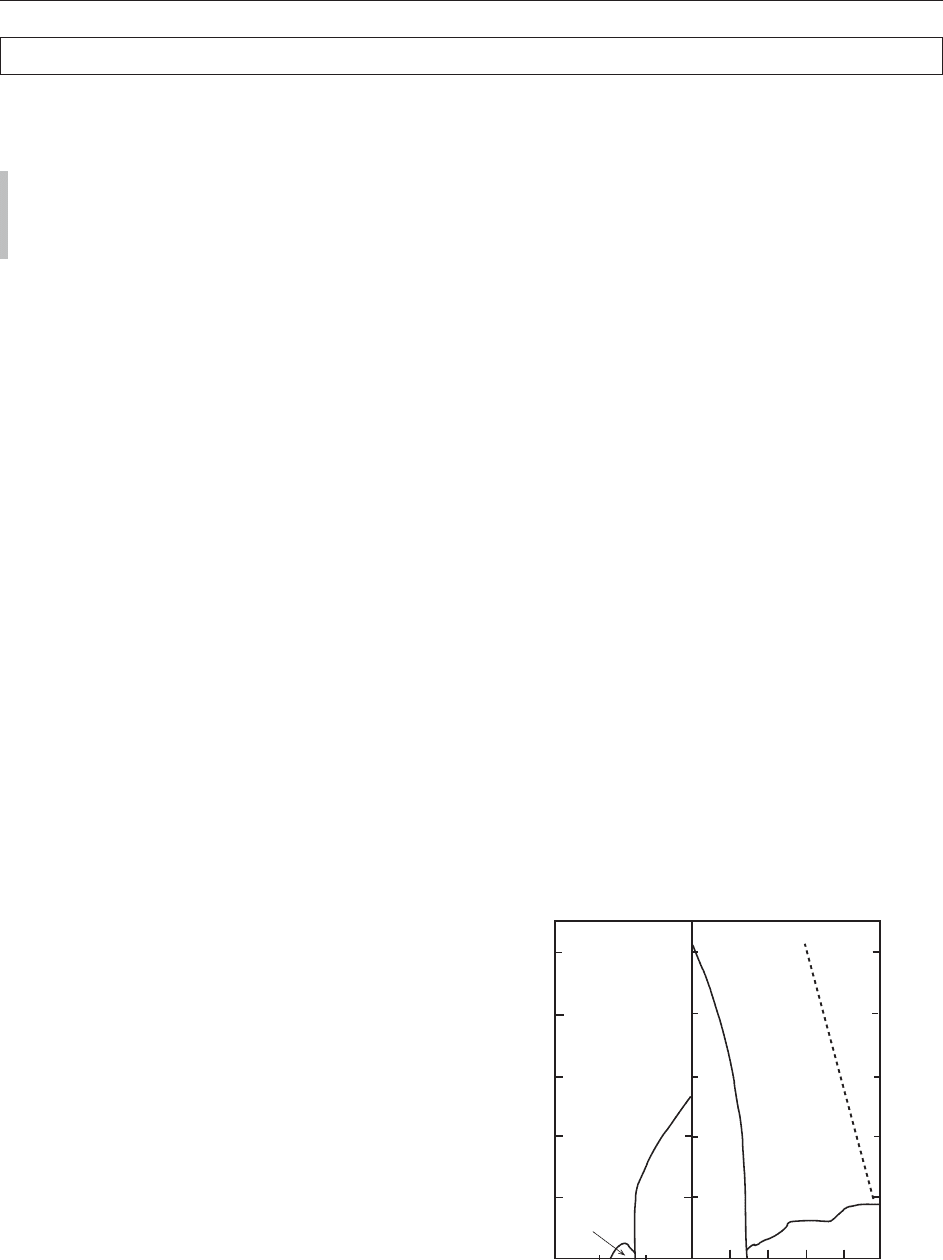
of 100 K. The generic phase diagram of HTSC is
shown in Figure 1.
One of the main questions concerning the HTSC
phase diagram is the transition region between the
AF and the SC phases. Partly because of the
complicated material chemistry in this regime,
there is no universal agreement among different
experiments. Different experiments indicate several
different possibilities, including phase separation
with an inhomogeneous density distribution, uni-
form coexistence phase between AF and SC and
periodically ordere d spin and charge distributions in
the form of stripes or checkerboards.
The phase diagram of the HTSC cuprates also
contains a regime with anomalous behaviors con-
ventionally called the pseudogap phase. This region
of the phase diagram is indicated by the dashed lines
in Figure 1. In conventiona l superconductors, a
pairing gap opens up at T
c
. In a large class of HTSC
cuprates, however, an electronic gap starts to open
up at a temperature much higher than T
c
. Many
experiments indicate that the pseudogap ‘‘phase’’ is
0.2 0.4 0.6 0.80.20 0.1 1.00.00.30
Nd
2–x
Ce
x
CuO
YBa
2
Cu
3
O23
6 + x
500
400
300
200
100
xx
Temperature (K)
AFM AFM
SC
100
200
300
400
500
Temperature (K)
SC
Figure 1 Phase diagram of the of the NCCO and the YBCO
superconductors.
High T
c
Superconductor Theory 645