
Francoise J.-P., Naber G.L., Tsun T.S. (editors) Encyclopedia of Mathematical Physics
Подождите немного. Документ загружается.

Then it can be proved that the scale space is the
unique solution of the heat equation :
@u
@t
u ¼ 0
uð0; xÞ¼f ðxÞ
½12
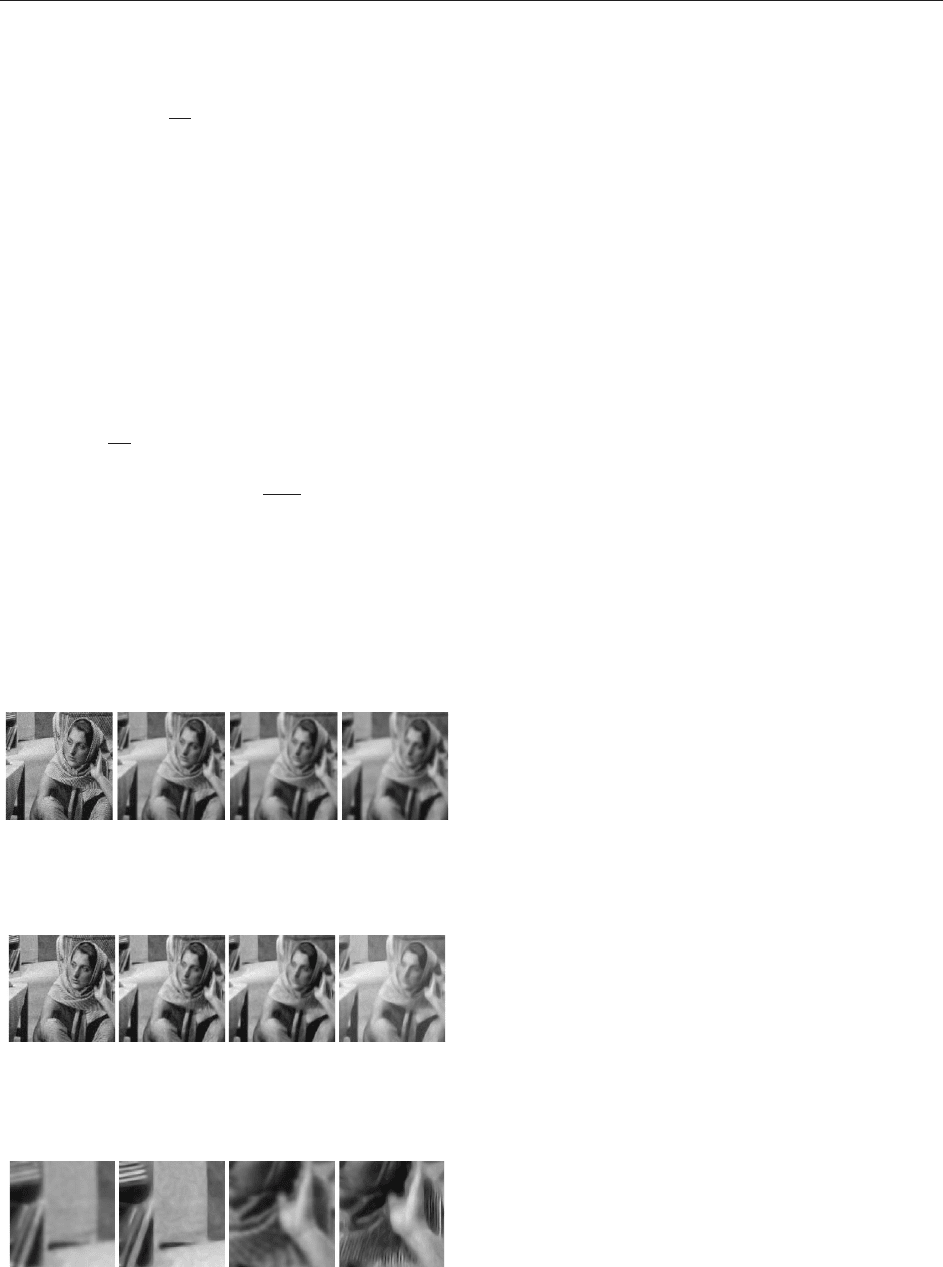
Figure 4 is an example of [12] applied to a noisy
image at different scale, that is, at different time.
Note that noise is quickly removed but one has to
stop the evolution very early if we would like to
preserve some edges. In the nonlinear cases, several
operators have also been found based on curvature.
For instance, under suitable axioms (Alvarez et al.
1993), including contrast, scale, and affine invari-
ance, the associated scale space is
@u
@t
signðÞðtÞ
1=3
jruj¼0
where ¼ div
ru
jruj
uð0; xÞ¼f ðxÞ
½13
This equation is called affine morphological scale
space (AMSS) and three restored images are shown
in Figure 5. Some qualitative differences are shown
in Figure 6.
Remark Scale space theory has shown the formal
link between some operators and PDEs. It has to be
noticed that one may propose some PDEs which do
not directly come from the scale space framework.
Starting from [12] which performs isotropic smoot h-
ing and smears edges, many nonlinear diffusion
models have been proposed to smooth images while
preserving edges (see e.g., Perona and Malik
(1990)).
&
To know more on scale space and PDEs, we refer
the reader to Weickert (1998) and Aubert and
Kornprobst (2002).
The Wavelet Approach
Before the 1980s , the Fourier transform played a
major role for analyzing osci llating signals. The
interest of such a transform for real application
increased after the discovery of the fast Four ier
transform. However, the Fourier transform has
some limit. The Fourier transform extracts from
the signal details of the frequency content but loses
all information on the location of particular fre-
quency. Moreover, for computing the Fourier trans-
form Ff (), we need to know f(t) for all the real
values of t. These difficulties can be overcome by
first windowing the signal, and then by taking its
Fourier transform:
F
win
f ð; tÞ¼
Z
R
f ðsÞgðs tÞe
is
ds
where g is a window function. The parameter
plays the role of a freque ncy localized around the
abscissa t of the temporal signal and F
win
f (, t) give
an information about what is happening around
s = t, for the frequency . The main drawback of
this method is that the window has a fixed length
which is a serious disadvantage when we want to
treat signals having variations of different orders of
magnitude. All these issues highlighted that a
mathematical theory of time–frequency representa-
tion was necessary. This was achieved with the
wavelet representation. In this section, we first recall
some elements of this theory (for 1D signal) and
then we show how it can be applied for restoring
noisy images.
The Wavelet Decomposition
The basic idea is to construct from a function ,
called mother wavelet, an orthonormal basis {
j, k
}of
L
2
(R) deduced from by translation and dilatation.
It is required that be regular, oscillating (but not
too much), that and F are well localized and that
has some null moments. Once this function is
Original image
40 iterations 90 iterations 150 iterations
Figure 4 Illustration of heat equation [12].
Original image 40 iterations 90 iterations 150 iterations
Figure 5 Illustration of the AMSS model [13].
Heat AMSS Heat AMSS
Figure 6 Some close-ups of Figures 4 and 5 showing
qualitative differences after 40 iterations.
Image Processing: Mathematics 7

chosen, we set
j, k
(x) = 2
j=2
(2
j
t k), j, k 2Z.An
elegant and practical way for obtaining such a basis is
to construct a multiresolution analysis of L
2
(R)
(Mallat 1989).
Definition 4 A multiresolution analysis of L
2
(R)is
a sequence V
j
, j 2Z of subspaces of L
2
(R), with the
following properties:
(i)
T
j
V
j
= {0},
(ii) V
j
V
jþ1
,
(iii)
S
j
V
j
= L
2
(R),
(iv) f (t) 2V
j
if and only if f (2t) 2V
jþ1
, and
(v) There exists a regular function with compact
support such that the family (t k), k 2Z,is
an orthonormal basis of V
0
for the scalar
product of L
2
(R). Such a function is called a
scaling function.
Then it is straightforward to check that the family
j, k
(t) defined by
j, k
(t) = 2
j=2
(2
j
t k) is an ortho-
normal basis of V
j
.
A basic example of multiresolution analysis of
L
2
(R) is to choose V
0
as the set of piecewise
constant functions on R and take as the
characteristic function of the interval [0, 1):
(t) =
[0, 1)
(t).
Let us now look at the link between wavelet basis
and multiresolution analysis. We just give main
ideas, all details can be found in the work of Mallat
(1989). Assume that we have a multire solution
analysis, and let us define W
0
as the orthogonal
complement of V
0
in V
1
.Webuildthemother
wavelet by imposing that the family (t k),
k 2Z, is an orthonormal basis of W
0
. For example,
if (t) =
[0, 1)
(t), it can be shown that (t) =
[0, 1=2)
(t)
[1=2, 1)
(t) (called the Haar wavelet). B y
change of scal e, one get s that the family
j, k
(t) = 2
j=2
(2
j
t k), k 2Z,isanorthonormal
basis of W
j
, the orthogonal complement of V
j
in
V
jþ1
,thatis,
V
j
W
j
¼ V
jþ1
½14
Since the V
j
’s are a multiresolution analysis, we have
V
J
=
J1
j = 1
W
j
and L
2
=
j = þ1
j = 1
W
j
. It is then clear
that
j, k
(t) is an orthonormal basis of L
2
(R), that is,
for each function f 2L
2
(R), we get the following
decomposition:
f ðtÞ¼
X
þ1
1
X
k
f
j;k
j;k
ðtÞ with f
j;k
¼hf ;
j;k
i
L
2
Let us see now how in practice a multiresolution
analysis can be inte rpreted. Let f be a function in
L
2
(R). We denote A
2
j f (resp. D
2
j f ) the operator
which approximates f (resp. gives the details of f )at
resolution 2
j
. More precisely, A
2
j f (resp. D
2
j f ) is the
projection of f on V
j
(resp. on W
j
):
A
2
j f ðtÞ¼
X
k¼þ1
k¼1
hf ;
j;k
i
j;k
ðtÞ
A
2
j f is characterized by the sequence of scalar
products A
d
2
j
f = {hf ,
j, k
i}
k 2Z.
We call A
d
2
j
f the
discrete approximation of f at resolution 2
j
.
In the same way, we have
D
2
j f ðtÞ¼
X
k¼þ1
k¼1
hf ;
j;k
i
j;k
ðtÞ
D
2
j f is characterized by the sequence of scalar
products D
d
2
j
f = {hf ,
j, k
i}
k 2Z.
We call D
d
2
j
f the details of f at resolution 2
j
.
According to [14], approximation and detail are
linked by the relation
A
2
jþ1 f ¼ A
2
j
f þ D
2
j
f
This means that D
2
j f represents the details to be
added to obtain from one level of approximation to
the next level of approximation.
Finally, the decomposition of a signal f on a
wavelet basis is obtain ed as an accumulation of
details at scale 2
j
from 0 to þ1:
f ¼
X
j¼þ1
j¼1
D
2
j f ¼
X
j¼þ1
j¼1
X
k¼þ1
k¼1
hf ;
j;k
i
j;k
½15
Instead of considering the sum over all dyadic
levels j, one can sum over j J for a fixed J; in this
case, we have
f ¼
X
k¼þ1
k¼1
X
jJ
hf ;
j;k
i
j;k
þ
X
k¼þ1
k¼1
hf ;
J;k
i
J;k
We conclude this section by showing how we can
construct a 2D wavelet basis from the 1D case. We
can simply use a tensor product. Scaling function
and mother wavelet are given, respectively, as
follows:
ðx; yÞ¼ðxÞðyÞ; ¼ð
1
;
2
;
3
Þ
with
1
ðx; yÞ¼ðxÞ ðyÞ
2
ðx; yÞ¼ðyÞ ðxÞ
3
ðx; yÞ¼ ðxÞ ðyÞ
As for the 1D case, A
2
j f denotes the projection of
f on V
j
, D
1
2
j
the horizontal details, D
2
2
j
the vertical
8 Image Processing: Mathematics
details, and D
3
2
j
the other details (the indice l in D
l
2
j
is the same as in
l
). For a 2D image f, we then have
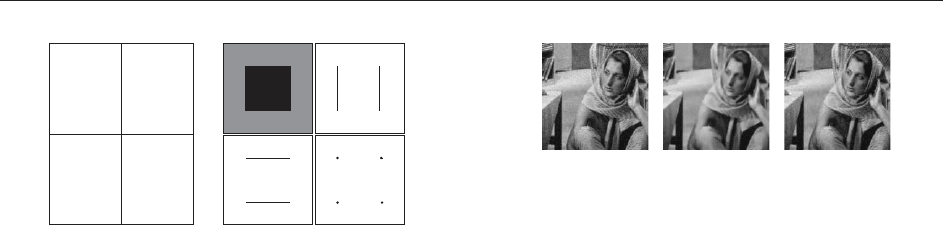
the following decomposition (see Figure 7):
f ¼
X
l
2
X
k¼þ1
k¼1
X
jJ
hf ;
j;k
i
j;k
þ
X
k¼þ1
k¼1
hf ;
J;k
i
J;k
Application to the Denoising Problem
We go back to the denoising problem. Our goal is to
solve this problem by using a variational approach
and wavelets. We recall that we have an ideal image
u that has been corrupted by a white Gaussian noise
resul ting in an obs ervation f with f = u þ .Asit
has been seen in the sect ion ‘‘The vari ational
appro ach,’’ this question can be tackl ed by solving
the variational problem
min
u
ðjuj
E
Þþjf uj
G
½16
for suitable choices of E, G,and. Here we propose to
choose G = L
2
()( is the domain image) and for E
the Besov space B
1
1
(L
1
()) and = Identity. Besov
spaces B
q
(L
p
()) are used in many domains of
mathematics as harmonic analysis or approximation
theory. There exist different ways for defining them.
Roughly speaking, they consist of functions having
derivatives in L
P
(); the third parameter q allows one
to make finer distinctions in smoothness. Here we are
only concerned with the Besov space B
1
1
(L
1
()). One
important property needed here is that the norm of a
function in E = B
1
1
(L
1
()) is equivalent to the l
1
-norm
of the wavelet coefficients, that is if {
j, k
}isan
orthonormal basis of L
2
()andifu
j, k,
are the wavelet
coefficients of u 2E,thenjuj
E
=
P
j
P
k,
ju
j, k,
j.
Remark When one is concerned with a finite
domain, then some changes must be made with
respect to the construction given in [15] to obtain an
orthonormal basis of L
2
(). To avoid further
technical complications , we ignore this question.
&
Let us denote, respectively, by {u
j, k,
} and {f
j, k,
}
the wavelet coefficients of u and f, then solving [16]
amounts to finding the minimizer of the functional
FðuÞ¼
X
j;k;
ju
j;k;
jþ
X
j;k;
ju
j;k;
f
j;k;
j
2
½17
One notes immediat ely that mi nimizing problem
[17] reduces to finding the minimizer s, given t,of
E(s) = js tj
2
þ jsj and that the minimizer of E(s)is
given by s = t (=2) if t >=2, s = 0ifjtj=2
and s = t þ (=2) if t < (=2).
Thus, we shrink the wavelet coefficients f
j, k,
toward zero by an amount of =2 to obtain the
minimizer. This is exactly the wavelet shrinkage
algorithm of Donoho and Johnstone (1994).Itis
remarkable that the wavelet shrinkage algorithm,
which has been found by using statistical tools, can
also be explained via a variational approach
(Chambolle et al. 1998). Figure 8 shows an example
of the result on a noisy image.
For more details, we refer the reader to Mallat
(1998).
Conclusion
Image processing is a challenging domain of applied
mathematics which has to deal with discrete and
continuous representations. In this article, we have
covered the core mathematical tools used in the
area. The example of gray-scale image restoration
allowed us to illustrate and compare the different
methodologies. Naturally, as mentioned in the
introduction, image processing refers to a wide
variety of applications and an intensive research
has been carri ed out on the different topics using the
methodologies described here. The reader will find
in the references (therein) several illustrations of
challenging problems.
See also: -Convergence and Homogenization; Convex
Analysis and Duality Methods; Elliptic Differential
A
2
–1
f
D
2
–1
f
1
D
2
–1
f
2
D
2
–1
f
3
Figure 7 Illustration on the wavelets methodology.
Original noisy
ima
g
e
BV regularization Wavelet
shrinka
g
e
Figure 8 Illustration of two regularization methods.
Image Processing: Mathematics 9

Equations: Linear Theory; Evolution Equations: Linear
and Nonlinear; Fluid Mechanics: Numerical Methods;
Fractal Dimensions in Dynamics; Free Interfaces and
Free Discontinuities: Variational Problems; Geometric
Measure Theory; Ginzburg–Landau Equation;
Inequalities in Sobolev Spaces; Minimax Principle in the
Calculus of Variations; Optimal Transportation; Partial
Differential Equations: Some Examples; Stochastic
Differential Equations; Variational Techniques for
Ginzburg–Landau Energies; Wavelets: Applications;
Wavelets: Mathematical Theory.
Further Reading
Alvarez L, Guichard F, Lions P, and Morel J (1993) Axioms and
fundamental equations of image processing. Archive for
Rational Mechanics and Analysis 123(3): 199–257.
Ambrosio L, Fusco N, and Pallara D (2000) Functions of
Bounded Variation and Free Discontinuity Problems, Oxford
Mathematical Monographs. New York: Clarendon Press.
Aubert G and Aujol J (2005) Modeling very oscillating signals –
application to image processing. Applied Mathematics and
Optimization 51(2): 163–182.
Aubert G and Kornprobst P (2002) Mathematical Problems in
Image Processing: Partial Differential Equations and the
Calculus of Variations, Applied Mathematical Sciences,
vol. 147. New York: Springer.
Besag J (1974) Spatial interaction and the statistical analysis of
lattice systems (with discussion). Journal of Royal Statistical
Society 2: 192–236.
Chambolle A, DeVore R, Lee N, and Lucier B (1998) Non-linear
wavelet image processing: variational problems, compression,
and noise removal through wavelet shrinkage. IEEE Transac-
tions on Image Processing 7(3): 319–334.
Chambolle A and Lions P (1997) Image recovery via total
variation minimization and related problems. Nu¨ merische
Mathematik 76(2): 167–188.
Crandall M, Ishii H, and Lions P-L (1992) User’s guide to
viscosity solutions of second order partial differential equa-
tions. Bulletin of the American Society 27: 1–67.
Crandall M and Lions P (1981) Condition d’unicite´ pour les
solutions ge´ne´ralise´es des e´quations de Hamilton–Jacobi du
premier ordre. Comptes Rendus de l’Acade´mie des Sciences
292: 183–186.
Donoho D and Johnstone I (1994) Ideal spatial adaptation by
wavelet shrinkage. Biometrica 81: 425–455.
Geman S and Geman D (1984) Stochastic relaxation, Gibbs
distributions, and the Bayesian restoration of images. IEEE
Transactions on Pattern Analysis and Machine Intelligence
6(6): 721–741.
Gonzalez RC and Woods RE (1992) Digital Image Processing,
3rd edn. Addison-Wesley.
Kirkpatrick S, Gellat C, and Vecchi M (1983) Optimization by
simulated annealing. Science 220: 671–680.
Li S (1995) Markov Random Field Modeling in Computer Vision.
Tokyo: Springer.
Mallat S (1989) A theory for multiresolution signal decomposi-
tion: the wavelet representation. IEEE Transactions on
Pattern Analysis and Machine Intelligence 11(7): 674–693.
Mallat S (1998) A Wavelet Tour of Signal Processing. Cambridge:
Academic Press.
Meyer Y (2001) Oscillating Patterns in Image Processing and
Nonlinear Evolution Equations, University Lecture Series,
vol. 22. Providence, RI: American Mathematical Society.
Perona P and Malik J (1990) Scale-space and edge detection using
anisotropic diffusion. IEEE Transactions on Pattern Analysis
and Machine Intelligence 12(7): 629–639.
Rudin L, Osher S, and Fatemi E (1992) Nonlinear total variation
based noise removal algorithms. Physica D 60: 259–268.
Weickert J (1998) Anisotropic Diffusion in Image Processing.
Stuttgart: Teubner-Verlag.
Incompressible Euler Equations: Mathematical Theory
D Chae, Sungkyunkwan University, Suwon,
South Korea
ª 2006 Elsevier Ltd. All rights reserved.
Introduction
In this article we present comprehensive mathema-
tical results on the incompressible Euler equations.
Our presentation is focussed on the two aspects of
the equations. The first one is on the theories of
classical solutions and the problem of global in time
continuation/finite time blow-up of the local classi-
cal solutions. The second topic is concerned on the
weak solutions, mainly for the two-dimensional
(2D) Euler equations for existence and uniqueness
questions.
The motion of homogeneous incompressible ideal
fluid in a domain R
n
is descr ibed by the
following system of Euler equati ons:
@v
@t
þðv rÞv ¼rp ½1
div v ¼ 0 ½2
vðx; 0 Þ¼v
0
ðxÞ½3
where v = (v
1
, v
2
, ..., v
n
), v
j
= v
j
(x, t), j = 1, 2, ..., n,
is the velocity of the fluid flows, p = p(x, t) is the
scalar pressure, and v
0
(x) is a given initial velocity
field satisfying div v
0
= 0. Here we use the standard
notion of vector calculus, denoting
10 Incompressible Euler Equations: Mathematical Theory

rp ¼
@p
@x
1
;
@p
@x
2
; ...;
@p
@x
n
ðv rÞv
j
¼
X
n
k¼1
v
k
@v
j
@x
k
div v ¼
X
n
k¼1
@v
k
@x
k
Equation [1] represents the balance of momentum
for each portion of fluid, while eqn [2] represents
the conservation of mass of fluid during its motion,
combined with the homogeneity (constant density)
assumption on the fluid. Equations [1] and [2] are
first obtained by Euler in 1755. Although we could
consider, more generally, the inhomogeneous incom-
pressible Euler equations, in mathematical fluid
mechanics considerations the incompressible Euler
equations usually mean the above system [1]–[2].
For a bounded domain with fixed boundary @, the
natural boundary condition is
vðx; tÞðxÞ¼0 8ðx; tÞ2@ ½0; 1Þ ½4
where (x) is the unit normal vector at the boundary
point x 2 @. Several studies are concerned wi th the
Cauchy problem of the system [1]–[3], where we
consider the case
¼
R
n
ðwhole domain of R
n
Þ; or
R
n
=Z
n
ðperiodic domainÞ
(
½5
In this article for simplicity we suppose
=R
n
, n = 2, 3 unless otherwise stated. We note
that the Euler equation is obtained formally by
setting the viscosity = 0, or, equivalently, Reynolds
number = 1 in the Navier–Stokes equations. Thus,
we may view the Euler equations as the one
describing approximately the extremely high
Reynolds number turbulent flows. For detailed
mathematical studies on the finite Reynolds number
Navier–Stokes equations, see Temam (1984) and
Lions (1996). For much shorter and more compre-
hensive review see Constantin (1995). In the study of
the Euler equations the notion of vorticity, ! = curl v,
plays a very important role. In particular, we can
reformulate the system in terms of vorticity fields
only as follows. We first suppose we are working in
three-dimensional (3D) space, and rewrite [1] as
@v
@t
v curl v ¼r p þ
1
2
jvj
2
½6
Taking curl of [6], and using elementary vector
identities we obtain the following vorticity formulation:
@!
@t
þðv rÞ! ¼ ! rv ½7
div v ¼ 0; curl v ¼ ! ½8
!ðx; 0 Þ¼!
0
ðxÞ½9
The linear elliptic system [8] for v can be solved
explicitly in terms of ! to give the Biot–Savart law
vðx; tÞ¼
1
4
Z
R
3
ðx yÞ!ðy; tÞ
jx yj
3
dy ½10
Substituting this v into [7] formally, we obtain a
integrodifferential system for !. The term in the
right-hand side of [7] is called the ‘‘vortex stretching
term,’’ and is regar ded as the main source of
difficulties in the mathematical theory of the 3D
Euler equations. In the 2D case we take the vorticity
as the scalar, ! = @v
2
=@x
1
@v
1
=@x
2
, and the
evolution equation of ! becomes
@!
@t
þðv rÞ! ¼ 0 ½11
combined with the 2D Biot–Savart law,
vðx; tÞ¼
1
2
Z
R
2
ðy
2
þ x
2
; y
1
x
1
Þ
jx yj
2
!ðy; tÞdy ½12
In many studies of the Euler equations it is
convenient to introduce the notion of ‘‘particle
trajectory mapping,’’ (, t) defined by
@ð; tÞ
@t
¼ vðð; tÞ; tÞ
ð; 0Þ¼; 2
½13
The mapping (, t) transforms from the location of
the initial fluid particles to the location at time t,
and the parameter is called the Lagrangian particle
marker. If we denote the Jacobian of the transfor-
mation, det (r
(, t)) = J(, t), then we can show
easily that
@J
@t
¼ðdiv vÞJ
which implies the fact that the velocity field v
satisfies the incompressibility, div v = 0 if and only if
the mapping (, t) is volume preserving. At this
moment, we note that, although the Euler equations
are originally derived by applying the mass con-
servation and the momentum balance principles, we
could also derive them by applying the principle of
least action to the action defined by
AðÞ¼
1
2
Z
t
2
t
1
Z
@ðx; tÞ
@t
2
dx dt
Here, (, t): ! is a parametrized family of
volume-preserving diffeomorphism. This variational
approach to the Euler equations implies that we can
Incompressible Euler Equations: Mathematical Theory 11

view solutions of the Euler equations as a geodesic
curve in the L
2
-metric on the infinite-dimensional
manifold of volume-preserving diffeomorphisms (see
for more details, e.g., Arnol’d and Khesin (1998)).
The 3D Euler equations have many conserved
quantities. We list some important ones below.
1. Energy
EðtÞ¼
1
2
Z
jvðx; tÞj
2
dx ½14
2. Helicity
HðtÞ¼
Z
vðx; tÞ!ðx; tÞdx ½15
3. Circulation
CðtÞ
¼
I
CðtÞ
v dl ½16
where C(t) = {( , t)j 2 C} is the curve moving
along with the fluid.
4. Impulse
IðtÞ¼
1
2
Z
x ! dx ½17
5. Moment of impulse
Mðt Þ¼
1
3
Z
x ðx !Þdx ½18
The proof of conservations of the above quantities
can be carried out without difficulty by using
elementary vector calculus (for details see, e.g.,
Chorin and Marsden (1993), Majda and Bertoz zi
(2002), Marchioro and Pulvirenti (1994)). The
helicity above, in particular, represents the degree
of knotedness of the vortex lines in the fluid, where
the vortex lines are the integral curves of the
vorticity fields. Arnol’d and Khesin (1998) discuss
in detail aspects of helicity and other geometric
aspects of the Euler equations. For the 2D Euler
equations there is no analog of helicity, while the
circulation conservation is replaced by the vorticity
flux integral,
Z
AðtÞ
!ðx; tÞdx ½19
where A(t) = {(, t)j 2 A} is a planar region
moving along the fluid. The impulse and the
moment of impulse integrals are replace by
1
2
Z
ðx
2
; x
1
Þ! dx ½20a
and
1
3
Z
jxj
2
! dx ½20b
respectively.
In the 2D ideal incompressible fluids we have
extra conserved quantities; namely for any p 2
[1, 1] the integral
Z
j!ðx; tÞj
p
dx ½21
is conserved (as a matter of fact we can extend this
statement by replacing the integral by
R
f (!(x, t))dx
for any continuous function f ). There are many
known explicit solutions to the Euler equations (See
e.g., Lamb (1932) and Majda and Bertozzi (2002)).
Local Existence and the Blow-Up
Problem
The Classical Results
We first introd uce some notations of function
spaces. The Lebesgue space L
p
(), p 2 [1, 1], is the
Banach space defined by the norm
kf k
L
p
:¼
R
jf ðxÞj
p
dx
1=p
; p 2½1; 1Þ
ess: sup
x2
jf ðxÞj; p ¼1
(
Let us set := (
1
,
2
, ...,
n
) 2 (Z
þ
[ {0})
n
with
jj=
1
þ
2
þþ
n
. Then, D
:= D
1
1
D
2
2
D
n
n
,
where D
j
= @=@x
j
, j = 1, 2, ..., n. For given k 2 Z
and p 2 [1, 1) the Sobolev space, W
k, p
() is the
Banach space of functions consisting of functions
f 2 L
p
() such that
kf k
W
k;p
:¼
Z
jD
f ðxÞj
p
dx
1=p
< 1
where the derivatives are in the sense of distribu-
tions. For p = 1 we replace the L
p
-norm by the L
1
norm. In order to cooperate with the fractional
derivatives of order s 2 R, we use the space L
s
p
()
defined by the Banach spaces norm,
kf k
L
s;p
:¼kð1 Þ
s=2
f k
L
p
where (1 )
s=2
f = F
1
[(1 þjj
2
)
s=2
F(f )()] with
F()andF
1
() denoting the Fourier transform
and its inverse. Below we outline the key ideas of
proving the local existenc e theorems for the Euler
equations. For more details we refer the reader to
Majda and Bertozzi (2002). For simplicity, we use
the function space H
m
(R
n
) = W
m,2
(R
n
), n = 2, 3.
Taking derivatives D
on [1], and then taking its
12 Incompressible Euler Equations: Mathematical Theory

L
2
inner product with D
v, and summing over the
multi-indices with jjm, we obtain
1
2
d
dt
kvk
2
H
m
¼
X
jjm
ðD
ðv rÞv ðv rÞD
v; D
vÞ
L
2
X
jjm
ððv rÞD
v; D
vÞ
L
2
X
jjm
ðD
rp; D
vÞ
L
2
I þII þIII
By integration by parts, we obtain
III ¼
X
jjm
ðD
p; D
div vÞ
L
2
¼ 0
Integrating by parts again, and using the fact that
div v = 0, we have
II ¼
1
2
X
jjm
Z
R
3
ðv rÞjD
vj
2
dx
¼
1
2
X
jjm
Z
R
3
div vjD
vj
2
dx ¼ 0
We now use the so-called commutator type of
estimate,
X
jjm
kD
ðfgÞfD
gk
L
2
Cðkrf k
L
1
kgk
H
m1
þkf k
H
m
kgk
L
1
Þ
and obtain
I
X
jjm
kD
ðv rÞv ðv rÞD
vk
L
2
kvk
H
m
Ckrvk
L
1
kvk
2
H
m
Summarizing the above estimates, I–III, we have
d
dt
kvk
2
H
m
Ckrvk
L
1
kvk
2
H
m
½22
Further estimate, using the Sobolev inequality, krvk
L
1
Ckvk
H
m
for m > 5=2, gives
d
dt
kvk
2
H
m
Ckvk
3
H
m
Thanks to Gronwall’s lemma, we have the local-in-
time uniform estimate
kvðtÞk
H
m
kv
0
k
H
m
1 Ctkv
0
k
H
m
2kv
0
k
H
m
for all t 2 [0, 1=(2Ckv
0
k
H
m
)]. This is the key a priori
estimate for the construction of the local solutions.
The local-in-time solution of the Euler equations in
the Sobolev space H
m
(R
n
) for m > n=2 þ 1, m 2 Z,
was obtained by Kato (1972). For the above-
constructed l ocal-in-time solutions, one of the
most outstanding open problems in mathematical
fluid m echanics is whether the solution can be
continued to any future time up to infinity, or the
solution will lose regul arity and blow up in finite
time. Even in terms of numerical experiments, the
answer is not yet settled down. In the direction of
solving t his problem there is a celebrated results,
called the Beale–Kato–Majda criterion (1984),
which states
lim sup
t%T
kvðtÞk
H
s
¼1 if and only if
Z
T
0
k!ðsÞk
L
1
ds ¼1 ½23
We outline the proof of this result below (for more
details see Majda and Bertozzi (2002)). We first
recall the Beale–Kato–Majda’s version of the loga-
rithmic Sobolev inequality,
krvk
L
1
Ck!k
L
1
ð1 þlogð1 þkvk
H
m
ÞÞþCk!k
L
2
½24
for m > 5=2. Now suppose
R
T
0
k!(t)k
L
1
dt < 1.
Taking L
2
inner product of [7] with !, then after
integration by part we obtain
1
2
d
dt
k!k
2
L
2
¼ðð! rÞv;!Þ
L
2
k!k
L
1
krvk
L
2
k!k
L
2
¼k!k
L
1
k!k
2
L
2
where we used the identity krvk
L
2
= k!k
L
2
. Apply-
ing the Gronwall lemma, we obtain
k!ðtÞk
L
2
k!
0
k
L
2
exp
Z
T
0
k!ðsÞk
L
1
ds
Cð!
0
; T
Þ½25
for all t 2 [0, T
]. Substituting [24] into [22], and
combining this with [25], we have
d
dt
kvk
2
H
m
C 1 þk!k
L
1
½1 þ logð1 þkvk
H
m
Þ½kvk
2
H
m
Applying the Gronwall’s lemma, we obtain
kvðtÞk
H
m
kv
0
k
H
m
exp C
1
exp C
2
Z
T
0
k!ðÞk
L
1
d
Cðv
0
; T
Þ
for all t 2 [0, T
] and for some constants C
1
, C
2
.
Thus, we proved the ‘‘necessity part’’ of [23], The
Incompressible Euler Equations: Mathematical Theory 13

‘‘sufficiency part’’ is an easy consequence of the
Sobolev inequality,
Z
T
0
k!ðsÞk
L
1
ds T
sup
0tT
krvðtÞk
L
1
CT
sup
0tT
kvðtÞk
H
m
for m > 5=2.
Other Related Results
The previous local existence result in H
m
(R
n
), m >
n=2 þ 1, is basically due to T Kato in 1972. He and
G Ponce extended this existence result using the
fractional Sobolev space, L
s
p
(R
n
), s > n=2 þ 1, s 2 R
in 1986. These results were further extended, using
the Besov and the Triebel–Lizorkin spaces, by the
present author in 2001.
For bounded domain R
n
, R Temam obtained
the local-existence result using the space W
k, p
()in
1975. On the other hand, in the setting of the
Ho¨ lder space, C
1,
(R
n
) L Lichtenstein (1925) and
W Wolibner (1933) obtained local existence of
solutions of the Euler equations. More recently,
J-Y Chemin considered the Zygmund C
s
(R
n
), which
is identical to the Ho¨ lder space C
[s], s[s]
(R
n
) for
noninteger s, where [s] means the largest integer not
greater than s, but is different from C
[s], 0
(R
n
) for
integer s . He proved, in 1992, local existence of
solutions to the 3D Euler equations in this space in
1992. See Chemin (1998) for details of this proof.
The Beale–Kato–Majda criter ion for the finite-
time blow-up of the classical solutions of the 3D
Euler equations has been refined recently by many
authors; replacing the L
1
-norm of vorticity !(x, t)
by the weaker BMO (the space of functions with
bounded mean oscillations) norm (H Kozono and
Y Taniuchi, 2000), and by the even weaker Besov
space or Triebel–Lizorkin space norms by the
present author in 2001 (see Triebel (1983) for
more details on those spaces). Here we just note
that these spaces are refinements of the usual
Sobolev spaces. For a bounded domain case, there
is a result by A Ferrari in 1993. The blow-up
problem is still open even in the case of axisym-
metric 3D Euler equations if there is a nonzero swirl
(angular velocity). In this case, the blow-up is
controlled only by the angular component of the
vorticity as shown by the present author (1996). In
the region off the axis, in particular, the axisym-
metric 3D Euler equation has the same form as the
2D Boussinesq equations.
Some researchers also tried to approach to
regularity/singularity problem of the 3D Euler
equations by investigating the geometric structure
of the vortex stretching term, and obtained a
geometric type of blow-up criterion (P Constantin,
C Fefferman, and A Majda, 1996). For more
detailed review of studies in this directi on see
Constantin (1995).
Since the blow-up problem of the 3D Euler
equation itself looks too difficult to solve, it has
also been studied on the simplified model problems.
In 1985, P Constantin, P D Lax, and A Majda
considered the following 1D model problem of the
3D Euler equations:
t
þðHðÞÞ
x
¼ 0;ðx; 0Þ¼
0
ðxÞ
where H() is the Hilber t transform defined by
Hð!Þ¼
1
PV
Z
1
1
!ðyÞ
x y
dy
They proved finite-time blow-up of this model
problem by explicitly obtaining the solution. There
is another, 2D model problem of the 3D Euler
equations, the quasigeostro phic equations,
t
þðu rÞ ¼ 0
u ¼r
?
;¼ ð Þ
1=2
ðx; 0Þ¼
0
ðxÞ
½26
where r
?
= (@
2
, @
1
). Contrary to the above 1D
model equation, this 2D model has real physical
relevance in the atmospheric science, and (x, t)
represents the temperature of the air. The resem-
blance of this equation to the 3D Euler equation
was first observed by P Constantin, A Majda, and
E Tabak in 1994, and they derived the finite blow-
up criterion of the equations. In spite of many
interesting partial results, including the work by
D Cordoba (1998), the blow-up problem of [26] is
still open.
The 2D Euler Equations and the
Weak Solutions
The Case of W
1, p
Weak Solutions
In 2D Euler equations, the problem of global well-
posedness of the classical solutions is settled down.
This is an immediate consequence of the conserva-
tion of k !(t)k
L
1
as stated in [21] combined with the
Beale–Kato–Majda criterion [23]. On the other
hand, the notion of weak solutions is not well
understood. A weak solution of the Euler equations
is a singular (nondifferentiable) solution of the
equations. More precisely, by a weak solution of
14 Incompressible Euler Equations: Mathematical Theory

[1]–[2] in (0, T) we mean a vector field v 2
C([0, T); L
2
loc
()) satisfying the integral identity:
Z
T
0
Z
R
3
vðx; tÞ
@ðx; tÞ
@t
dxdt
Z
R
3
vðx; 0Þðx; 0Þdx
Z
T
0
Z
R
3
vðx; tÞvðx;tÞ : rðx;tÞdx dt ¼ 0 ½27a
Z
T
0
Z
R
3
vðx; tÞr ðx; tÞdx dt ¼ 0 ½27b
for every vector test function = (
1
,
2
, ...,
n
) 2
C
1
0
( [0, T)) satisfying div = 0, and for every
scalar test function 2 C
1
0
( [0, T)). Here we
used the notation (u v)
ij
= u
i
v
j
,andA : B =
P
n
i, j = 1
A
ij
B
ij
for n n matrices A and B.We
observe that [27a] and [27b] are obtained by
multiplying and to [1] and [2], respe ctively,
and integrating by parts. Thus, even the locally
square-integrable vector fields, which are not differ-
entiable in the classical sense, could be solutions of
the Euler equations. For the general 3D Euler
equations, we do not yet have the global existence
theorems for the weak solutions. Actually, it is even
suggested that we need more weaker notion of
solution (the so-called ‘‘measure-valued solutions’’)
to describe generic global solutions for the 3D Euler
equations. For the 2D Euler equations, however, we
have global existence theorems for !
0
2 L
1
(R
2
) \
L
p
(R
2
) for p 2 [1, 1]. This better situation of 2D
Euler equations compared to the 3D case for the
weak solutions is mainly due to the conservation
law of L
p
-norm described in [21]. Here we present
briefly the existence proof of the weak solutions for
2D Euler equations in the simplest situation. We will
prove the global existence of weak solutions for
!
0
2 L
p
(R
2
), 1 < p < 1. Let
"
(x) = (1="
2
)(x="),
where 2 C
1
0
(R
2
) is a standard mol lifier, satisfying
0, supp {x 2 R
2
jjxj < 1}, and
R
R
2
dx = 1.
Let v
0
be the velocity associated with the initial
vorticity !
0
, given by the Biot–Savart law [12].
Define the sequence of initial data v
"
0
(x) =
"
v
0
(x) =
R
R
2
"
(x y)v
0
(y)dy. For each v
"
0
we have
global-in-time smooth solutions v
"
(x, t). Moreover,
thanks to [21], we have the following estimate of the
vorticity that is uniform in ":
k!ðtÞ
"
k
L
p
¼k!
"
0
k
L
p
k!
0
k
L
p
½28
where we used the property of the mollifier in the
second inequality. If we take the (distributional)
derivative of the Biot–Savart law [12], we find
rv = K ! þ C!, where K(x) is a kernel funct ion
defining a singular integral operator of the convolu-
tion type, and C is a constant vector. The well-
known Calderon–Zygmund inequality implies that
krvk
L
p
C
p
k!k
L
p
½29
Combining [28] and [29] we have
sup
0tT
krv
"
ðtÞk
L
p
Cðv
0
Þ; 8T > 0 ½30
namely the sequence {v
"
} is uniformly bounde d in
L
1
(0, T; W
1, p
(R
2
)). Next, we claim that {v
"
} satis-
fies the inequality
kv
"
ðt
1
Þv
"
ðt
2
Þk
H
3
ðR
2
Þ
Ckv
0
k
2
2
kt
1
t
2
j½31
for all t
1
, t
2
with 0 < t
1
t
2
< T, where C is an
absolute constant. Here the negative-order Sobolev
space H
m
(), m > 0, is defined as the dual of
H
m
0
(), and can be identified with the space of
functions C
1
0
() completed with metric in H
m
().
Indeed, let 2 C
1
0
(R
2
). Taking L
2
(R
2
) inner pro-
duct of [1] with we have the estimates
Z
R
2
@v
"
ðx; tÞ
@t
ðxÞdx
Z
R
2
ð rÞp
"
dx
þ
Z
R
2
ðv
"
rÞv
"
dx
¼
Z
R
2
p
"
r dx
þ
Z
R
2
ðv
"
rÞv
"
dx
kp
"
ðtÞk
H
2
krk
H
2
þkv
"
ðtÞk
2
L
2
krk
1
Cðkp
"
ðtÞk
H
2
þkv
"
0
k
2
L
2
Þkk
H
3
½32
where we used the Sobolev inequality krk
L
1
Ckk
H
3
and the energy equality in the last step.
Since [32] holds for all 2 C
1
0
(R
2
), by taking the
closure of C
1
0
(R
2
)inH
3
(R
2
) we obtain
dv
"
ðtÞ
dt
H
2
Ckp
"
ðtÞk
H
2
þkv
0
k
2
L
2
½33
We now estimate kp
"
(t)k
H
2
. Taking the divergence
operation on [1], we have the Poisson equation
p
"
¼divðv
"
rv
"
Þ
Let 2 C
1
0
(R
2
), then
Z
R
2
p
"
ðx; tÞðxÞdx
¼
Z
R
2
divðv
"
rv
"
Þ dx
¼
Z
R
2
ðv
"
rÞv
"
r dx
¼
Z
R
2
ðv
"
rÞr v
"
dx
kv
"
ðtÞk
2
L
2
k
2
k
L
1
Ckv
0
k
2
L
2
kk
H
4
½34
Incompressible Euler Equations: Mathematical Theory 15

where we used the energy equality [14] and the
Sobolev inequality in the last step. Since [34] holds
for all 2 C
1
0
(R
2
), taking the closure of C
1
0
(R
2
)in
H
4
(R
2
), we obtain
Z
R
2
p
"
ðx; tÞðxÞdx
Ckv
0
k
2
L
2
kk
H
4
8 2 H
4
ðR
2
Þ½35
Thus,
kp
"
ðtÞk
H
4
Ckv
0
k
2
L
2
8t 2½0; TÞ
This provides us with
kp
"
ðtÞk
H
2
kD
2
p
"
ðtÞk
H
4
Ckp
"
ðtÞk
H
4
Ckv
0
k
2
L
2
Combining [33] with [36], we obtain
sup
0tT
dv
"
ðtÞ
dt
H
2
Ckv
0
k
2
L
2
Thus, from
v
"
ðt
1
Þv
"
ðt
2
Þ¼
Z
t
1
t
2
dv
"
ðtÞ
dt
dt
we have
kv
"
ðt
1
Þv
"
ðt
2
Þk
H
2
sup
0tT
dv
"
ðtÞ
dt
H
2
jt
1
t
2
j
Ckv
0
k
2
L
2
jt
1
t
2
j
Thus, [31] is proved as claimed. Thanks to the
Aubin–Nitsche compactness lemma together with
[30] and [31] we have a subsequence, denoted by the
same notation, {v
"
}andv in L
1
(0, T; W
1, p
(R
2
)) such
that
v
"
! v weakly in L
1
ð0; T; W
1; p
ðR
2
ÞÞ ½36
and
v
"
! v in L
2
loc
ðR
2
ð0; TÞÞ ½37
as " !0. We know that as a classical solution each
v
"
and v
"
0
satisfies
Z
R
2
ðx; 0Þ v
"
0
ðxÞdx
þ
Z
T
0
Z
R
2
ð
t
v
"
þr : v
"
v
"
Þdx dt ¼ 0 ½38
for all 2 C
1
0
(R
2
[0, T)) with div = 0and
Z
T
0
Z
R
2
r v
"
dx dt ¼ 0 ½39
for all 2 C
1
0
(R
2
[0, T)). We can check easily that
the convergence [36] and [37] is enough to pass to the
limit " !0in[38] and [39] to obtain the correspond-
ing equations with v
"
and v
"
0
replaced by v and v
0
.
Thus, v is a weak solution of the Euler equations with
initial data v
0
. This completes the outline of the proof
of weak solutions to the 2D Euler equations.
Notes on Further Results
The study of weak solutions of the 2D Euler
equations was initiated by V Yudovich in 1963,
where he proved the existence of weak solutions for
initial data !
0
2 L
1
(R
2
) \ L
1
(R
2
). Subsequenthy,
theory of weak solutions has been developed by
studies of the vortex sheet problem due to DiPerna
and Majda in 1987. For the existence of weak
solutions t o the vortex sheet initial data, namely
the existence problem for initial vorticity !
0
2
H
1
(R
2
) \M(R
2
), where M(R
2
)isthespaceof
Radon measures on R
2
, is still an outstanding open
problem. The main physical motivation of this
problem is to understand the dynamics of vortex
sheets in the 3D turbulence. For this problem
J M D elort proved existence assuming single-
signedness of the initial vortex sheet in 1991. The
proof is simplified by A Majda in 1993, using the
conservation of moment of impulse. The result is
also reproved by L C Evans and S Mu¨ ller in 1994,
using the weak compactness of the Hardy space.
Later in 2001, M C Lopes Filho, H J Nussenzveig
Lopes and Z Xin allowed the change of sign for
initial vortex sheet, but assumed special reflection
symmetry to prove existence of global weak solu-
tions. Related to this problem is the one of
characterizing the precise borderline function space
to which initial data belongs, and above which there
is no concentration phenomenon for weakly approx-
imating sequence of solutions; a recent analysis of
this problem was done by E Tadmor in 2001.
For the uniqueness problem of the weak solutions of
the 2D Euler equations, there are remarkable works by
V Scheffer (1993) and A Shnirelman (1997), where
they constructed explicitly an L
2
loc
(R
2
R) weak
solution starting from zero initial data. Also M Vishik
(1999) extended the uniqueness class of the weak
solutions of the 2D Euler equations, improving
previous work by V Yudovich (1995). The class
found by M Vishik, in particular, includes the BMO.
There is another problem closely related to the weak
solutions of the 2D Euler equations, called the vortex
patch problem. The main question was if there is any
singularity of the boundary of a patch
(t) = {X(, t) j 2
0
}, where X(, t) is the particle
trajectory mapping generated by a weak solution
v(x, t), which is evolving from the initial data
!
0
(x) =
0
(x), the characteristic function of set
0
16 Incompressible Euler Equations: Mathematical Theory