
Francoise J.-P., Naber G.L., Tsun T.S. (editors) Encyclopedia of Mathematical Physics
Подождите немного. Документ загружается.


Everything is proved if m(x, ) = (p
0
þ 1) is a scale
function, if p
j
and their derivatives are controlled by
(p
0
þ 1):
ðH3Þj@
x
@
p
j
ðx;ÞjC
;;j
ðp
0
þ1Þðx;Þ
jjj
ðx;Þ
jjj
for all (,) 2N
n
N
n
, and if there is a suitable
control of the family (N 2N) of symbols
ðp
0
þ 1Þh
ðNþ 1 Þ
p
X
N
j¼0
p
j
h
j
Under these assump tions, the main result is that P
is, for h small enough, essentially self-adjoint. This
means that the operator which was initially defined
on S(R
n
) by the pseudodifferential operator with
symbol p admits a unique self-adjoint extension.
The Functional Calculus
It is well known by the spectral theorem for a self-
adjoint operator P that a functional calculus exists
for Borel functions. What is important here is to find
a class of functions (actually essentially C
1
0
) such
that f (P) is a pseudodifferential operator in the same
class as P with simple rules of computation for the
principal symbol.
We are starting from the general formula (see
Dimassi and Sjo¨ strand (1999))
f ðPÞ¼
1
lim
!0
þ
ZZ
jIm zj
@
~
f
@
z
ðx; yÞðz PÞ
1
dx dy
which is true for any self-adjoint operator and any f
in C
1
0
(R). Here the function (x, y) 7!
~
f (x, y) (note
that z = x þ iy) is a compactly supported, almost
analytic extension of f to C. This means that
~
f = f
on R and that for any N 2 N there exists a constant
C
N
such that
@
~
f
@
z
ðzÞC
N
Im z
N
The main result due to Helffer–Robert (see also
Dimassi and Sjo¨ strand (1999) and references
therein) is that, for P an h-regular pseudodifferential
operator satisfying (H0)–(H3) and f in C
1
0
(R), the
operator f (P)isanh-pseudodifferential operator,
whose Weyl symbol p
f
(x, ; h) admits a formal
expansion in powers of h:
p
f
ðx;; hÞ
X
j0
h
j
p
f ;j
ðx;Þ
with
p
f ;0
¼ f ðp
0
Þ
p
f ;1
¼ p
1
f
0
ðp
0
Þ
p
f ;j
¼
X
2j1
k¼1
ð1Þ
k
ðk!Þ
1
d
j;k
f
ðkÞ
ðp
0
Þ; 8j 2
where the d
j, k
are universal polynomial functions of
the symbols @
x
@
p
‘
,withjjþjjþ‘ j.
The main point in the proof is that we can construct,
for Im z 6¼ 0, a parametrix (= approximate inverse) for
(P z) with a nice control as Im z !0. The constants
controlling the estimates on the symbols are exploding
as Im z !0 but the choice of the almost analytic
extension of f absorbs any negative power of jIm zj.
As a consequence, we get that if, for some interval
I and some
0
> 0,
ðH4Þ p
1
0
ðI þ½
0
;
0
Þ is compact
then the spectrum is, for h small enough, discrete in I.
In particular, we get that, if p
0
(x, ) !þ1 as
jxjþjj!þ1, then the spectrum of P
h
is discrete
(P
h
has compact resolvent). Under the assumption
(H4), we get more precisely the following theorem.
Theorem 3 Let P be an h-regular pseudodifferen-
tial operator satisfying (H0)–(H4), with I = [E
1
, E
2
],
then, for any g in C
1
0
([E
1
, E
2
]), we have the
following expansion in powers of h:
tr½gðPðhÞÞ h
n
X
j0
h
j
T
j
ðgÞ; as h !0
where g 7!T
j
(g) are distributions in D
0
(]E
1
, E
2
[).
In particular, we have
T
0
ðgÞ¼ð2Þ
n
ZZ
gðp
0
ðx;ÞÞdx d
T
1
ðgÞ¼ð2Þ
n
ZZ
g
0
ðp
0
ðx;ÞÞp
1
ðx;Þdx d
This theorem is just obtained by integration of the
preceding one, because in these cases the trace of a
trace-class pseudo-different ial operator Op
w
(a)is
given by the integral of the symbol a over
R
2n
= R
n
x
R
n
. According to [3], the distribution
kernel is given by the oscillatory integral:
Kðx; y; hÞ¼ð2hÞ
n
Z
R
n
exp
i
h
ðx yÞ
a
x þ y
2
;; h
d ½8
706 h-Pseudodifferential Operators and Applications

and the trace of Op
w
(a) is the integral over R
n
of the
restriction to the diagonal of the distribution kernel:
Kðx; xÞ¼ð2hÞ
n
Z
R
n
aðx;; hÞd
Of course, one could think of using the theorem
with g, the characteristic function of an interval, in
order to get, for example, the behavior of the counting
function attached to this interval. This is of course not
directly possible and this will be obtained only through
Tauberian theorems (Ho¨ rmander (1968), (1984), Ivrii
(1998)) and at the price of additional errors.
Let us, however, remark that, if the function g is not
regular, then the length of the expansion depends on
the regularity of g. So it will not be surprising that, by
looking at the Riesz means, we shall get a better
expansion when s is large.
Anyway, one basic interest of functional calculus is
to permit a localization in the energy of the operator.
For a general h-pseudodifferential operator, it could be
difficult to approximate an operator like exp(itP=h)
by suitable Fourier integral operators but approximate
exp(itP=h)f (P) for suitable compactly supported f
could be easier.
Another interest is that for suitable f (possibly
h-dependent) the operator f (P) could have better
properties than the initial operator. This idea will, for
example, be applied for the theorem concerning
clustering. It appears, in particular, very powerful in
dimension 1, where we can in some interval of energy
find a function t 7!f (t; h) admitting an expansion in
powers of h such that f (P; h) has the spectrum of the
harmonicoscillator.ThisisawaytogettheBohr–
Sommerfeld conditions (see Helffer–Robert (1987),
together with Maslov (1972), Leray (1981),orthe
thesis of A Voros in 1977), which reads:
f ð
n
ðhÞ; hÞð2n þ 1Þh modulo Oðh
1
Þ
h-Fourier Integral Operators
and Evolution Operators
Classical Mechanics
Let us come back to the Hamilton equations [1].
The local existence of solutions is well known. If, in
addition, we assume (H4), the energy conservation
law implies global existence for these solutions, if
the initial data (y, ) belong to p
1
(I).
We recall that (y, ) 7!
t
(y, ) = (x(t, y, ), (t, y, ))
defines for any t a canonical transformation, that is, a
diffeomorphism respecting the symplectic 2-form:
¼
X
j
d
j
^ dx
j
We shall denote by
t
the graph of
t
which is a
Lagrangian submanifold (which means that at each
point m of the manifold the restriction of the
symplectic two-form to T
m
t
is 0) for the 2-form
on R
2n
R
2n
:
P
j
d
j
^ dy
j
P
j
d
j
^ dx
j
.
When the projection (y, , x, ) 7!(, x) gives a
local system of coordinates for
t
(and this will
always be the case for (, x) in a compact set and t
small enough), one easily finds, using the Lagran-
gian character of
t
, a function (, x) 7!S
t
(x, ) such
that
t
¼fy;;x;jy ¼ @
S
t
; ¼ @
x
S
t
g
This function is only defined modulo an arbitrary
function of t. In order to get a more natural
choice, we consider the Lagrangian submanifold
in R
2n
R
2n
R
2
defined as
¼fy;;x;;t;jðx;Þ¼
t
ðy;Þ; ¼p
0
ðx;Þg ½9
The parametrization of , by its projection
(y, , x, , t, ) 7!(, x, t), will now give a natural
function (, x, t) 7!S(t, x, ) = S
t
(x, ) describing by
¼fy;;x;;t;j ¼ @
x
S; y ¼ @
S; ¼ @
t
Sg½10
We observe that we can choose
Sð0; x;Þ¼x ½11
and that S is automatically a solution of the Hamilton–
Jacobi equation
ð@
t
SÞðt; x;Þþp
0
ðx;@
x
Sðt; x;ÞÞ ¼ 0 ½12
also called the eiconal equation .
We also observe the following property (by
comparison of [9] and [10]):
t
ð@
Sðt; x;Þ;Þ¼ðx;@
x
Sðt; x;ÞÞ
We have actually an explicit expression of S(t, x, )in
term of the inverse y(t, x, ) of the map y 7!x(t, y, ):
Sðt;x;Þ¼yðt;x;Þ
þ
Z
t
0
h
X
i
i
ðs;y;Þð@
i
pÞðxðs;y;Þ;ðs;y;ÞÞ
pðy;Þ
i
ds
=y¼yðt;x;Þ
For the harmonic oscillator, easy computations give
pðx;Þ¼
1
2
ð
2
þ x
2
Þ; H
p
¼ð; xÞ
t
ðy;Þ¼ðy cos t þ sin t; y sin t þ cos tÞ
and
Sðt; x;Þ¼
1
2
ðx
2
þ
2
Þðtan tÞþ
x
cos t
h-Pseudodifferential Operators and Applications 707

Fourier Integral Operators
We have already given in [8] the distribution kernel
of an h-pseudodifferential operator. It appears useful
to generalize this point of view by considering more
generally objects defined similarly as
Kðx;y;hÞ¼ð2hÞ
r
Z
R
N
exp
i
h
ðx;y;Þ
aðx;y;;hÞd
There are a lot of examples entering in this frame-
work. The representation of the metaplectic group in
L
2
(R
n
) appears to be in this class, with the specificity
that the phase is quadratic (Guillemin and Sternberg
(1977)). A quite elementary case corresponds to the
case when N = 0 and (x, y)=x y.No variable is
present and so no integration appears with respect to
. When a= 1, this defines essentially the Fourier
transform. Under suitable conditions on and a, one
can show that the associated operators are contin-
uous on S(R
n
) (this is, of course, the case for the
Fourier transform). This was done by Asada and
Fujiwara, who transpose the theory developed by
Ho¨ rmander (1971) in this context, and we should
also mention the older (but more formal) work by
Maslov (1972) (see also Leray (1981)). We actually
do not need it in the semiclassical context because
the case when the amplitude is with compact support
is sufficient.
The basic object is first to look, thinking of
the stationary-phase theorem, which gives the
main contribution as h !0 in this ‘‘formal integral’’
(see Stationary Phase Approximation), at the critical
set C
:
C
¼fðx; y;Þ2R
n
R
n
R
N
jð@
Þðx; y;Þ¼0g
In the case of a pseudodifferential operator, we find
that it is included in {x = y}. Then we associate the
canonical object, which is a Lagrangian submanifold
called
and defined as
¼fðx ;;y;Þj9 s:t: ¼r
x
ðx; y;Þ;
¼r
y
ðx; y;Þ; r
ðx; y;Þ¼0g
The assumptions on (which are omitted here) are
given in order to get that
is a regular manifold at
least on the support of a. The associated operators
are called Fourier integral operators (FIOs).
L. Ho¨ rmander (1971, 1984) has developed a general
and more intrinsic machinery but with a homo-
geneity condition on the phase which is irrelevant in
the semiclassical context. This theory permits also
the reduction to normal forms for Hamiltonians in
continuation of what can be done in classical
mechanics.
Quantum Evolution
We just sketch how one approximates the operator
exp (itP=h) by an FIO. The formal construction is
probably rather old (Maslov 1972, Fedoryuk and
Maslov 1981) but the rigorous ap proach with
estimates of the remainders was first considered by
J Chazarai n with rather strong assumptions. It has
been later realized that we need only a local
approximation of this operato r and everything
becomes easier.
The first approach followed by Helffer–Robert (see
Robert (1987)) is to localize in energy, within the
functional calculus associated to the operator P.IfI is
an interval and is with compact support in I,it
appears to be easier to approximate exp (itP=h)(P)
when P satisfies (H4) in a neighborhood of I.
We do not need any more assumptions at 1 and
the composition by (P) localizes the construction.
Although this construction is simple because we
remain within a functional calculus which involves
only functions of P, it is not always sufficient to
localize in energy . We have then to localize through
more general h-pseudodifferential operators and
consider exp (itP=h)a
w
(x, hD
x
), where a is a sym-
bol with compact support. We shall quickly develop
the first approach. The result is that one can
approximate U
(t):= (P) exp (itP=h) by a Fourier
integral operator of the form
K
ðt; x;y; hÞ¼ð2hÞ
n
Z
osc
exp
i
h
ðSðt;x;Þy Þ
d
ðt; x;; hÞd
with d
P
j
d
,j
h
j
, in order to have
ðPÞexp
itP
h
K
ðtÞ
LðL
2
Þ
¼Oðh
1
Þ
Writing that U
(t) is a solution of (hD
t
þ P)U
= 0,
(U
)(0) = (P), and expanding in powers of h, one
gets a sequenc e of equations permitting to determine
recursively the symbols. The first one was analyzed
in [12] and reads, in the case when P =h
2
þ V:
ð@
t
SÞðt; x;Þþjr
x
Sðt; x;Þj
2
þ VðxÞ¼0
with the initial condition S(0, x, ) = x .
This has been solved for t small enough. The other
equations are called transport equations. The first
one is, for a(t, x, ) = d
,0
(t, x, ),
@
t
a þð@
p
0
Þðx;@
x
Sðt; x;ÞÞ @
x
a þ ca ¼ f
with initial condition a(0, x, ) = (p
0
(x, )).
This type of equation is easily solved by integra-
tion along the integral curves of the vector field
@
t
þ (@
p
0
)(x, @
x
S(t, x, )) @
x
.
708 h-Pseudodifferential Operators and Applications

Applications
The Frequency Set
One has already met the question of localization of
the eigenfunctions. It appears important to give this
localization, not only in position (in domain of R
)
but directly in the phase space. This can be
described by the notion of frequency set attached
to a bounded family u
h
of functions in L
2
(R
) (or
more generally of distributions in S
0
(R
)). Here h
belongs to an interval (0, h
0
] or more generally to a
subset of R
þ
having 0 as accumulation point.
Definition 4 We shall say that (x
0
,
0
) 2 R
R
does not belong to the frequency set of the family u
h
and write (x
0
,
0
) 62 FS(u
h
), if there exists a compactly
supported function equal to 1 in a neighborhood of
x
0
and a neighborhood V of
0
in which the h-Fourier
transform of u
h
satisfies, as h !0,
Z
exp
ix
h
ðxÞu
h
ðxÞdx ¼Oðh
1
Þ in V
For example, the frequency set FS(u
h
)of
u
h
(x) = (x) exp (i (x)=h) with compactly supported
is contained in {(x, ) jx 2 supp , = r
x
(x)}, and
the frequency set of the coherent state,
x 7!
y;;h
ðxÞ¼h
=4
exp
iðx yÞ
h
exp
ðx yÞ
2
h
!
is reduced to a point (y, ).
In this semiclassical context, this notion seems
to have been introduced by Guillemin and Sternberg
(1977) and is further discussed in the book of Robert
(1987) (see references therein). This is the semiclassi-
cal analog of the well-known notion of wave front set
of a distribution introduced by Ho¨ rmander (1984)
in the C
1
-category for describing the singularities
of a distribution, but note that a major difference is
that the frequency set is attached to a family. If P is
an h-pseudodifferential operator with symbol in S
0
,it
is possible, as a consequence of the elliptic theory,
to prove that: FS(Pu
(h)
) FS(u
(h)
). For an FIO F
attached to a canonical relation ,wegetsimilarly:
FS(Fu
(h)
) (FS(u
(h)
)).
We also get a microlocal version of the localization
result for the eigenfunctions mentioned in the first
section (using again the parametrix construction).
Theorem 5 Let E be in I and let ((h
j
),
(h
j
)
(x)) be a
sequence in I L
2
(R
n
), where (h
j
) !Eandh
j
!0 as
j !1, x 7!
(h
j
)
(x) is an associated eigenfunction to
(h
j
) with norm 1. Then
FSð
ðh
j
Þ
Þp
1
0
ðEÞ
Moreover, the frequency set of the family
(h
j
)
is
invariant under the Hamiltonian flow
t
.
The last statement in the above theorem is the
analog of the theorem on the propagation of
singularities for the solution of a partial differential
equation (PDE) (see Ho¨ rmander (1984)) and is a
consequence of the Egorov theorem, which will be
presented in the next subsection.
Another remarkable property is that (see, e.g., the
report on the lecture of T Paul in Rauch and Simon
(1997), say, in the case of dimension 1, when P is a
harmonic oscillator, then exp (it=hP)
y, ; h
is a
coherent state attached to
t
(y, ).
Egorov’s Theorem
Egorov’s theorem plays a central role in the classical
theory of PDE by permitting to reduce the study of
general differential operators to the study of sim pler
model operators, the simplest one being @=@x
n
(see
Ho¨ rmander (1984)). We use it here in a simple form,
given in the semiclassical context by Robert (1987),
and which will play an important role in the study
of ergodic situations (see Quantum Ergodicity and
Mixing of Eigenfunctions, an d references therein).
The theorem is the following:
Theorem 6 Let P satisfy assumptions (H0)–(H3).
For all a’sinS
0
with compact support and all t 2 R,
we have
exp i
t
h
P
a
w
ðx; hD
x
Þexp i
t
h
P
a
w
t
ðx; hD
x
Þ
LðL
2
Þ
¼OðhÞ
where
a
t
ðx;Þ¼a
t
ðx;Þ
ðÞ
and
t
is the flow of H
p
0
, where p
0
is the principal
symbol of P.
The proof is based on the study of the operator
exp (iðt=hÞP) a
w
(x, hD
x
)exp(iðt=hÞP), which appears
as the composition of three FIOs. But the Lagrangian
manifold associated with this composition is the graph
of the identity, and this is consequently a pseudodiffer-
ential operator whose ‘‘principal’’ symbol can be
computed modulo O(h)asa(
t
(x, )). As an immediate
consequence, FS(exp (itP=h)u
h
) =
t
(FS(u
h
)).
h-Pseudodifferential Operators and Applications 709

The Poisson Relation
We start from the harmonic oscillator
HðhÞ¼
1
2
h
2
d
2
dx
2
þ x
2
!
Its spectrum is given by (n þ 1=2)h (n 0). Its
symbol is a
0
(x, ) = (1=2)(
2
þ x
2
) and the corre-
sponding flow, for any strictly positive level E,is
periodic with primitive period 2. The quantity we
are interested in is
S
h
ðtÞ :¼
X
j2N
j þ
1
2
h
exp itjþ
1
2
Using the classical Poisson relation,
X
k2Z
^
f ðkÞexpðikxÞ¼ð2Þ
X
k2Z
f ðx þ 2kÞ
one shows rather easily that the frequency set of S
is
FS ðS
h
Þ¼fð2k; Þj>0;
2 supp ; k 2 Zg[ðR f0g
This admits the following generalization, initiated in
this context by Chazarain.
Theorem 7 Let P satisfy (H0)–(H4). Let be a
function with compact support in I and let
t 7!f
(t; h) be the family of distributions defined by
f
ðt; hÞ¼tr exp
itP
h
ðPÞ
Then FS(f
) is contained in
fðt;Þj 2 supp ðÞ and 9ðx;Þ s:t:
p
0
ðx;Þ¼;
t
ðx;Þ¼ðx;Þg
According to the definition, we have to study
Z
exp
it
h
ðtÞf
ðt; hÞdt
This takes the form
Z
cðt; x;Þexp
i
h
ðt þ Sðt; x;ÞxÞdt dx d
and can be analyz ed by a nonstationary-phase
theorem, in order to determine for which value of
the quantity is O(h
1
).
Gutzwiller’s Formula
The Gutzwiller formula was established formally by
Gutzwiller (1971). It then appears in the context of
high-energy spectral asymptotics in contributions of
Colin de Verdie` re, Chazarain, and Duistermaat
and Guillemin (see Duistermaat and Guillemin (1975),
Ho¨ rmander (1984), Guillemin and Sternberg (1977);
see also Semi-Classical Spectra and Closed Orbits and
Quantum Ergodicity and Mixing of Eigenfunctions). In
the semiclassical context, the simplest statement (cf.
Chazarain, Helffer–Robert, Guillemin–Uribe, Mein-
rencken, Paul–Uribe, Dozias, Combescure–Ralston–
Robert – see Robert (1987), Rauch and Simon (1997),
Dimassi and Sjo¨ strand (1999), and in the recent article
by Combescure et al. (1999) for techniques involving
coherent states) can be presented in the following way.
For a noncritical E,weintroducetheenergysurface
W
E
= {w 2 T
R
n
jp
0
(w) = E}. Let P(h)anh-pseudo-
differential operator satisfying (H0)–(H4), with I = {E}.
We also assume that
(Cl) The restriction of the flow
t
p
0
to W
E
is clean.
(A flow
t
, associated with a C
1
-vector field X
on a manifold W, is called clean if the two
following properties are satisfied:
the set ={(t, w) 2 R W j
t
(w) = w}isa
submanifold of R W;
in each point = (t, w)of, the tangent
space to is given by T
={(, v) 2 R
T
w
W jX(w) þ (D
t
)(w) v = v}.)
Then there exists a sequence of distributions
k
2D
0
(R), such that, for all 2S(R) with com-
pactly supported Fourier transform, we have the
asymptotic expansion in powers of h:
X
j
ðhÞ2½E
0
=2;Eþ
0
=2
ðh
1
ð
j
ðhÞEÞÞ
X
1
j¼0
j
ð
^
Þh
nþ1þj
½13
Moreover, the supports of the distributions are
contained in the set of the periods of the periodic
trajectories of the flow contained in W
E
.
Actually, the proof gives more information on the
structure of the different distributions. Let us just
write the formula for
0
:
0
¼ðÞ
n=2
d
d
Z
pðx;Þ
dxd
!
¼E
0
where
0
is the Dirac measure at 0.
Clustering of Eigenvalues
We shall mention one typical result due to Chazarain–
Helffer–Robert in this context, but inspired by
previous results obtained for the Laplacian on compact
manifolds (see Semi-Classical Spectra and Closed
Orbits, Quantum Ergodicity and Mixing of Eigenfunc-
tions and references therein, including Chazarain,
Duistermaat–Guillemin, and Colin de Verdie`re).
710 h-Pseudodifferential Operators and Applications

Clustering means that the spectrum is concentrated
around a specific sequence tending to 1. This was
observed in the case of the Laplacian on the sphere
S
n1
by explicit computations. Here we assume
that, with I = [E
1
,E
2
], the conditions (H0)–(H4) are
satisfied and that
(H5) [E
1
, E
2
] does not meet the set of critical
values of p
0
.
(H6) 8E 2 [E
1
, E
2
þ ], W
E
is connected.
(H7) 8E 2 [E
1
, E
2
þ ], the Hamiltonian flow
associated with p
0
is periodic, with period T(E) > 0,
on W
E
(with T(E) bounded).
(H8) 8E 2 [E
1
, E
2
þ ], the subprincipal p
1
vanishes on W
E
.
Then, under these conditions, one first observes that for
a suitable C
1
-function f defined in a neighborhood of
[E
1
, E
2
], the period of the Hamiltonian flow associated
with f (p
0
) can be chosen as constant and equal to 2.
Extending the function f suitably, one can then state the
following result of Chazarain–Helffer–Robert:
Theorem 8 There exists h
0
and C such that, for
0 < h h
0
,
ðf ðPðhÞÞÞ \ ½E
1
; E
2
[
k2Z
I
k
ðhÞ
where
I
k
ðhÞ¼
S
2
h
4
þ kh Ch
2
;
S
2
h
4
þ kh þ Ch
2
S ¼
Z
dx 2E
for some (hence for any) periodic trajectory of period
2, and is the Maslov index of this trajectory.
Moreover, one can compute the multiplicity, in each
of the intervals I
k
. The property remains true
(e.g., Dozias proved this (see Rauch and Simon
(1997)) in the case when the assumption is made only
for one energy E,butinintervals[E ah, E þ ah],
where a can be large but h is small enough.
Remark 1 These results appear first in the context of
high energy for Laplacians on compact manifolds. After
illuminating contributions by physicists like Balian–
Bloch, the main ideas (see the presentation in Semi-
Classical Spectra and Closed Orbits) appear in the
works of Colin de Verdie` re, Chazarain, Duistermaat–
Guillemin (1975), and Weinstein (see also Ho¨ rmander
(1984) and Quantum Ergodicity and Mixing of Eigen-
functions). The proof given in the semiclassical context
is actually more general (it contains the case of the
Laplacian on a Riemannian manifold) and shows that
the results are true for general Hamiltonians.
Remark 2 (the case of dimension 1). In this
particular case, the flow is periodic and the above
theorems gives the localization of the problem predicted
by the Bohr–Sommerfeld relations and the computation
of the multiplicity gives n
k
(h) = 1forh small enough.
This point of view was developed by Helffer–Robert
(1987) (see Semi-Classical Spectra and Closed Orbits).
Similar properties have been extended to the case
of integrable systems by Colin de Verdie` re in the
high-energy context and in the semiclassical context
by Charbonnel and Ivrii (see Ivrii (1998), Dimassi
and Sjo¨ strand (1999), and references therein).
Remark 3 Another interesting application of semi-
classical analysis concerns the Schnirelman theorem
treating the case when the flow is ergodic. We refer
the reader to Quantum Ergodicity and Mixing
of Eigenfunctions for references and to Helffer–
Martinez–Robert (see Rauch and Simon (1997) for
references) for the specific statement for general
Hamiltonians in semiclassical analysis.
Conclusions and Suggestions
for Further Reading
In this brief survey we have tried to present some of the
foundational techniques appearing in the ‘‘mathemati-
cal’ ’ semiclassical analysis. Of course, this is very
limited, and semiclassical methods go far beyond the
verification of the correspondence principle. One can
refer to semiclassical analysis for many other problems
where the same analysis (with a small parameter h)is
relevant but where h is no more the Planck constant.
This could be a flux (Harper’s equation) or the inverse
of a flux, the inverse of a mass (Born–Oppenheimer’s
approximation), of an energy, or of a number of
particles. We have not developed this point of view here.
The books given in the bibliography will allow the
reader to discover other fields. The books by Robert
(1987), Helffer (1988) and Dimassi and Sjo¨strand
(1999) present the basic statements of the theory. The
book by Martinez (2002) is more ‘ ‘microlocal’’ in spirit.
The lectures published in Rauch and Simon (1997) give
a rather good idea of the state of art in the middle of the
1990s, and we also refer the reader to other articles in
this encyclopedia for the presentation of the resonances
(see Resonances), spectral problems connected with
ergodicity (see Quantum Ergodicity and Mixing of
Eigenfunctions), Kolmogorov–Arnol’d–Moser theory
(see Normal Forms and Semi-Classical Approxima-
tion), and trace formulas (see Semi-Classical Spectra
and Closed Orbits). The book by Ivrii (1998) gives the
h-Pseudodifferential Operators and Applications 711

most sophisticated theorems on the counting functions
(including boundaries, singularities, ...) but is only
written for specialists.
See also: Normal Forms and Semiclassical
Approximation; Quantum Ergodicity and Mixing of
Eigenfunctions; Resonances; Schro
¨
dinger Operators;
Semiclassical Spectra and Closed Orbits; Stability of
Matter; Stationary Phase Approximation.
Further Reading
Combescure M, Ralston J, and Robert D (1999) A proof of the
Gutzwiller semi-classical trace formula using coherent states
decomposition. Communications in Mathematical Physics
202(2): 463–480.
Dimassi M and Sjo¨ strand J (1999) Spectral Asymptotics in the Semi-
Classical Limit, London Mathematical Society Lecture Notes
Series, vol. 268. Cambridge: Cambridge University Press.
Duistermaat JJ (1973) Fourier Integral Operators. Courant Institut
Mathematical Society. New York: New York University.
Duistermaat JJ and Guillemin VW (1975) The spectrum of
positive elliptic operators and periodic bicharacteristics.
Inventiones Mathematicae 29: 39–79.
Fedoryuk MV and Maslov VP (1981) Semi-Classical Approxima-
tion in Quantum Mechanics. Dordrecht: Reidel.
Guillemin V and Sternberg S (1977) Geometric Asymptotics,
American Mathematical Surveys, No. 14. Providence, RI:
American Mathematical Society.
Gutzwiller M (1971) Periodic orbits and classical quantization
conditions. Journal of Mathematical Physics 12: 343–358.
Helffer B (1988) Introduction to the Semi-Classical Analysis for
the Schro¨ dinger Operator and Applications, Springer Lecture
Notes in Mathematics, No. 1336. Berlin: Springer.
Helffer B and Sjo¨ strand J (1984) Multiple wells in the semi-
classical limit I. Communications in Partial Differential Equa-
tions 9(4): 337–408.
Helffer B and Sjo¨ strand J (1989) Analyse semi-classique pour
l’e´quation de Harper III. Me´moire de la SMF, No. 39.
Supple´ment du Bulletin de la SMF, Tome 117, Fasc.4.
Ho¨ rmander L (1968) The spectral function of an elliptic operator.
Acta Mathematica 121: 193–218.
Ho¨ rmander L (1971) Fourier integral operators I. Acta Mathe-
matica 127: 79–183.
Ho¨ rmander L (1979) The Weyl calculus of pseudodifferential
operators. Communications Pure and Applied Mathematics
32: 359–443.
Ho¨ rmander L (1984) The Analysis of Linear Partial Differential
Operators, Grundlehren der Mathematischen Wissenschaften.
Berlin: Springer.
Ivrii V (1998) Microlocal analysis and precise spectral asymptotics,
Springer Monographs in Mathematics. Berlin: Springer.
Leray J (1981) Lagrangian Analysis and Quantum Mechanics. A
Mathematical Structure Related to Asymptotic Expansions and
the Maslov Index. Cambridge: MIT Press. (English translation
by Carolyn Schroeder.)
Martinez A (2002) An Introduction to Semi-Classical and
Microlocal Analysis. Universitext. New York: Springer-Verlag.
Maslov VP (1972) The´orie des perturbations et me´thodes
asymptotiques. Paris: Dunod Gauthier-Villars.
Rauch J and Simon B (eds.) (1997) Quasiclassical Methods,
The IMA Volumes in Mathematics and its Applications, vol. 95.
New York: Springer-Verlag.
Robert D (1987) Autour de l’approximation semi-classique, Progress
in Mathematics, No. 68. Boston, MA: Birkha¨user.
Hubbard Model
H Tasaki, Gakushuin University, Tokyo, Japan
ª 2006 Elsevier Ltd. All rights reserved.
Definitions
The Hubbard model is a standard theoretical model
for strongly interacting electrons in a solid. It is a
minimum model which takes into account both
quantum many-body effects and strong nonlinear
interaction between electrons. Here we review rigor-
ous results on the Hubbard model, placing main
emphasis on magnetic properties of the ground states.
Let the lattice be a finite set whose elements
x, y, ... 2 are called sites. Physically speaking,
each site corresponds to an atomic site in a crystal.
The Hubbard model is based on the simplest tight-
binding description of electrons (Figure 1), where a
single state is associated with each site.
For each x 2 and 2 {", #}, we define the
creation and the annihilation operators c
y
x,
and
c
x,
, respectively, for an electron at site x with
spin .(A
y
is the adjoint or the Hermitian conjugate
of A.) These operators satisfy the canonical anti-
commutation relations
c
y
x;
; c
y;
no
¼
x;y
;
c
y
x;
; c
y
y;
no
¼fc
x;
; c
y;
g¼0
½1
for any x, y 2 and , = ", #,where{A, B} = AB þ
BA. The number operator is defined by
n
x;
¼ c
y
x;
c
x;
½2
which has eigenvalues 0 and 1.
The Hilbert space of the model is constructed as
follows. Let
vac
be a normalized vector state which
satisfies c
x,
vac
= 0 for any x 2 and = ", #.
Physically,
vac
corresponds to a state where there
are no electrons in the system. For arbitrary subsets
"
,
#
, we defin e
"
;
#
¼
Y
x2
"
c
y
x;"
!
Y
x2
#
c
y
x;#
!
vac
½3
712 Hubbard Model
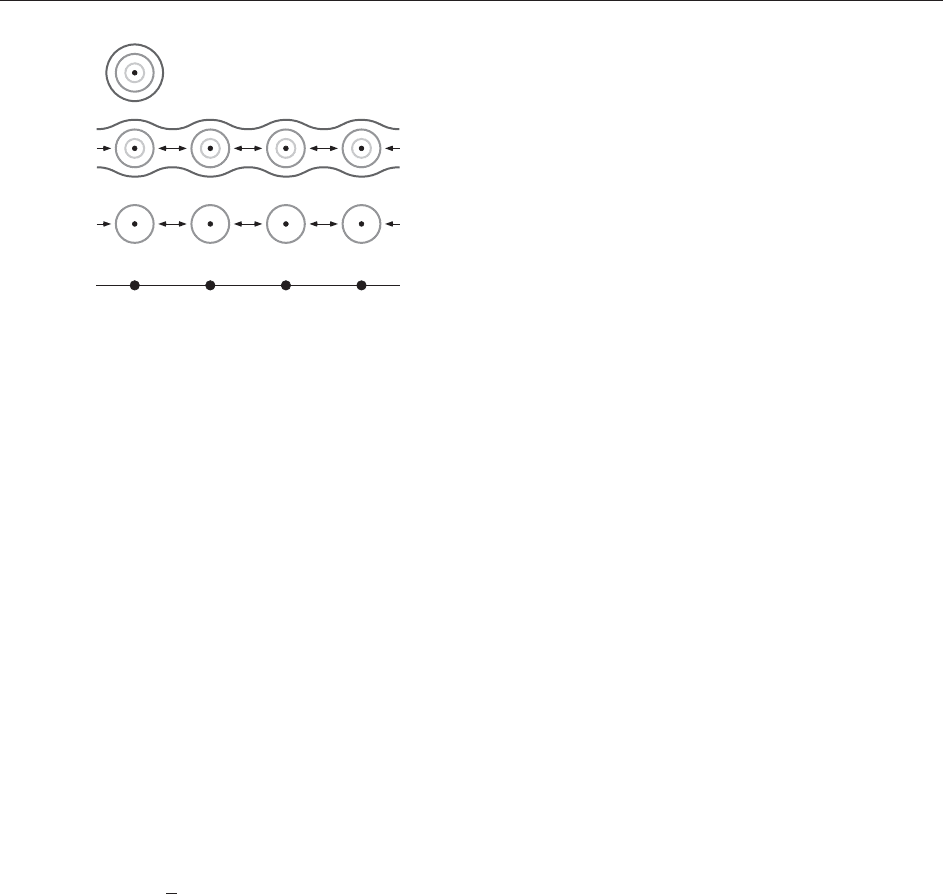
in which sites in
"
are occupied by up-spin
electrons and sites in
#
by down-spin electrons.
We fix the electron number N
e
, which is an integer
satisfying 0 < N
e
2jj. (We denote by jSj the
number of elements in a set S.) The Hilbert space
for the system with N
e
electrons is spanned by the
basis states [3] with all subsets
"
and
#
such that
j
"
jþj
#
j= N
e
.
We define total spin operators
^
S
tot
= (
^
S
(1)
tot
,
^
S
(2)
tot
,
^
S
(3)
tot
)
by
^
S
ðÞ
tot
¼
1
2
X
x2
;¼";#
c
y
x;
ðp
ðÞ
Þ
;
c
x;
½4
for = 1, 2, and 3. Here p
()
are the Pauli matrices
p
ð1Þ
¼
01
10
; p
ð2Þ
¼
0 i
i0
p
ð3Þ
¼
10
0 1
½5
The operat ors
^
S
tot
are the generators of global SU(2)
rotations of the spin space. As usual, we denote the
eigenvalue of (
^
S
tot
)
2
as S
tot
(S
tot
þ 1). The maximum
possible value of S
tot
is S
max
= N
e
=2 when N
e
jj,
and S
max
= jj(N
e
=2) when N
e
jj.
The most general Hamiltonian of the Hubbard
model is
H ¼
X
x;y2
¼";#
t
x;y
c
y
x;
c
y;
þ
X
x2
U
x
n
x;"
n
x;#
½6
Here the first term describes quantum-mechanical
motion of electrons which hop around the lattice
according to the amplitude t
x, y
= t
y, x
2 R. Usually,
t
x, y
is nonnegligible only when the two sites x and y
are close to each other. The second term represents
nonlinear interaction between electrons. There is an
increase in energy by U
x
2 R when the site x is
occupied by both up-spin electro n and down-spin
electron. We usually set U
x
> 0 to mimic (screened)
Coulomb interaction betw een electrons.
The Hamiltonian H commutes with the total spin
operator
^
S
()
tot
for = 1, 2, and 3. One can thus
investigate simultaneous eigenstates of (
^
S
tot
)
2
and H.
For S
tot
in the allowed range, we denote by E
min
(S
tot
)
the lowest possible energy among the states which
satisfy (
^
S
tot
)
2
=S
tot
(S
tot
þ 1).
Wave–Particle Dualism in the
Hubbard Model
It is illuminating to examine the eigenstates of the
Hamiltonian [6] for the following two special cases.
First suppose that one has U
x
= 0 for all x 2 ,
that is, the model has no interactions. For
i = 1, 2, ..., jj, let
(i)
= (
(i)
x
)
x2
2 C
be the
single-electron eigenstate, which is the solution of
the Schro¨ dinger equation
X
y2
t
x;y
ðiÞ
y
¼
i
ðiÞ
x
for any x 2 ½7
We order the energy eigenvalues as
i
iþ1
.By
defining the corresponding creation operator by
a
y
i,
=
P
x2
(i)
x
c
y
x,
, we see that, for any subsets
I
"
, I
#
2 {1, 2, ..., jj} such that jI
"
jþjI
#
j= N
e
, the
state
I
"
;I
#
¼
Y
i2I
"
a
y
i;"
0
@
1
A
Y
i2I
#
a
y
i;"
0
@
1
A
vac
½8
is an eigenstate of H (with U
x
= 0) with the
eigenvalue E =
P
i2I
"
i
þ
P
i2I
#
i
. The ground states
are obtained by choosing I
"
, I
#
which minimize E.In
particular, when N
e
is even and the single-electron
eigenenergies
i
are nondegenerate, the ground state
is unique and written as
GS
¼
Y
N
e
=2
i¼1
a
y
i;"
a
y
i;#
!
vac
½9
The fact that this ground state has the minimum
possible spin S
tot
= 0 is known as Pauli
paramagnetism.
We have seen that the Hamiltonian H with U
x
= 0
can be diagonalized by using single-electron
(a)
(b)
(c)
(d)
Figure 1 A highly schematic figure which explains the philoso-
phy of tight-binding description. (a) A single atom which has
multiple electrons in different orbits. (b) When atoms come
together to form a solid, electrons in the black orbits become
itinerant, while those in the light gray orbits are still localized at the
original atomic sites. Electrons in the gray orbits are mostly
localized around the atomic sites, but tunnel to nearby gray orbits
with nonnegligible probabilities. (c) We only consider electrons in
the gray orbits, which are expected to play essential roles in
determining various aspects of low-energy physics of the system.
(d) If the gray orbit is nondegenerate, we get a lattice model in
which electrons live on lattice sites and hop from one site to
another. In a simplified treatment of a metal, the black and the
gray orbits correspond to the 4s and the 3d bands, respectively.
Hubbard Model 713

eigenstates
(i)
. When (t
x, y
) has a trans lation
invariance, each
(i)
behaves as a ‘‘wave.’’ We
can say that the noninteracting models can
be understood in terms of the wave picture of
electrons.
Next suppose that t
x, y
= 0 for all x, y 2 , that is,
the electrons do not hop. Then the Hamiltonian [6]
is readily diagonalized in terms of the basis state [3],
where the corresponding eigenvalue is simply
E =
P
x2
"
\
#
U
x
. In this case, the model is best
understood in the particle picture of electrons.
We thus see that the wave–particle dualism
manifests itself in the Hubbard model in an essential
manner. When both the first and the second terms in
the Hamiltonian [6] are prese nt, there takes place a
‘‘competition’’ between wave-like nature and particle-
like nature of electrons. The competition generates
rich nontrivial phenomena including antiferromagnet-
ism, ferromagnetism, metal–insulator transition, and
(probably) superconductivity. To investigate these
phenomena is a major motivation in the study of
the Hubbard model.
One-Dimensional Model
The Hubbard model defined on a simple one-
dimensional lattice is easier to study. But it does
not exhibit truly nontrivial behavior as the following
classical theorem of Lieb and Matt is suggests.
Theorem 1 Consider a Hubbard model on a one-
dimensional lattice ={1, 2, ..., N} with open bound-
ary conditions. We assume that t
x, y
6¼ 0 if jx yj= 1,
and t
x, y
= 0 if jx yj > 1. t
x, x
2 R and U
x
2 R are
arbitrary. Then one has E
min
(S
tot
) < E
min
(S
tot
þ 1) for
any S
tot
= 0, 1, ..., S
max
1(or S
tot
= 1=2, 3=2, ...,
S
max
1).
As a consequence, one finds that the ground states
always have S
tot
= 0 (or S
tot
= 1=2) as in the
noninteracting models.
The translation invariant model with t
x, y
= t if
jx yj= 1, t
x, y
= 0ifjx yj 6¼ 1, and U
x
= U can be
solved by using the Bethe ansatz, as was first shown
by Lieb and Wu. It was found that the model is
insulating for all U > 0, and there is no metal–
insulator transition. (A metal–insulator transition is
expected to take place in higher dimensions.) Earlier
works on the Bethe ansatz were based on the
assumption that the Bethe ansatz equation gives
the true ground states. Recently, the existence and
the uniqueness of the Bethe ansatz solution for the
ground state of a finite system was proved by
Goldbaum.
Half-Filled Systems
The system in which the electron num ber N
e
is
identical to the number of sites jj is said to be
half-filled. Many (but not all) physical systems can
be modeled as a half-filled Hubbard model.
Based on a heuristic perturbation theory, low-energy
properties of half-filled models with large U are
expected to be similar to those of Heisenberg anti-
ferromagnetic spin systems. There is no electrical
conduction, and the spin degrees of freedom may
show antiferromagnetic long-range order in the ground
states.
This expectation is partly justified by the follow-
ing theore m due to Lieb. A Hubbard model is said
to be bipartite if the lattice can be decomposed
into a disjoint union of two sublattices as =A [ B
(with A \ B = ;), and it holds that t
x, y
= 0 whenever
x, y 2 A or x, y 2 B. In other words, only hopping
between different sublattices is allowed.
Theorem 2 Consider a bipartite Hubbard model. We
assume jj is even, and the whole is connected
through nonvani shing t
x, y
. We also assume U
x
= U > 0
for any x 2 . Then the ground states of the model
are nondegenerate apart from the trivial spin
degeneracy, and have total spin S
tot
= jAjjBj
jj
=2.
It also holds that E
min
(S
tot
) < E
min
(S
tot
þ 1) for any
S
tot
jAjjBj
jj
=2.
The theorem implies that, as far as the total spin is
concerned, the half-filled Hubbard model behaves
exactly as the Heisenberg antiferromagnet. But the
existence of antiferromagneti c ordering has not been
proved in any version of the Hubbard model.
To see another implication of Theorem 2, take the
so-called CuO lattice in Figure 2. Here the A and B
sublattices consist of black and white sites, respec-
tively. One has jAj= jj=3 and jBj= 2jj=3. Then
the theorem implies that the ground state of the
corresponding Hubbard model has total spin
Figure 2 An example (the so-called CuO lattice) of a bipartite
lattice in which the numbers of sites in two sublattices are
different. Lieb’s theorem implies that the half-filled Hubbard
model defined on this lattice exhibits ferrimagnetism.
714 Hubbard Model

S
tot
= jAjjBj
jj
=2 = jj=6. Since the total spin mag-
netic moment of the system is proportional to the
number of sites jj , we conclude that the model
exhibits ferrimagnetism, a weaker version of
ferromagnetism.
Another interesting result for the half-filled
models is the following uniform density theorem
by Lieb, Loss, and McCann.
Theorem 3 Consider a bipartite Hubbard model.
t
x, y
2 R, U
x
2 R are arbitrary. Suppose that
the ground states are n-fold degenerate, and let
(i)
GS
(i = 1, ..., n) be mutually orthogonal normal-
ized ground states. Define the correlation function
by (x, y) = n
1
P
n
i = 1
(i)
GS
,(c
y
x, "
c
y, "
þ c
y
x, #
c
y, #
)
(i)
GS
DE
.
(h,i is the inner product.) Then for any x, y 2 Aor
x, y 2 B, one has (x, y) =
x, y
.
It is interes ting that the density (x, x) in the
ground state is always unity though the hopping
matrix and interactions can be highly nonuniform.
Ferromagnetism
Ferromagnetism is an interesting phenomenon in
which the majority of the spins in the system align in
the same direction. One of the original motivat ions
to study the Hubbard model was to understand the
origin of ferromagnetism in an idealized situation.
Let us recall that neither the hopping term nor the
interaction term in the Hamiltonian [6] favors
ferromagnetism (or any other magnetic order). One
must deal with the interplay between the two terms
to have ferromagnetism. Here we review three
rigorous examples of saturated ferromagnetism in
the Hubbard model. Saturated ferromagnetism is the
strongest form of ferromagnetism where the ground
state has S
tot
= S
max
.
The first example is due to Nagaoka and
Thouless.
Theorem 4 Take an arbitrary finite lattice , and
let N
e
= jj1. Assume that t
x, y
0 for any x 6¼ y,
and let U
x
!1 for all x 2 .(Taking the limit
U
x
!1 is equivalent to inhibiting x from being
occupied by two electrons.) Then among the ground
states of the model, there exist states with total spin
S
tot
= S
max
(= N
e
=2). If the system further satisfies the
connectivity condition (see below), then the ground
states have S
tot
= S
max
(= N
e
=2) and are nondegen-
erate apart from the trivial spin degeneracy.
The connectivity condition is a simple condition
which holds in most of the lattices in two or higher
dimensions, including the square lattice, the trian-
gular lattice, or the cubic lattice. To be precise the
condition requires that ‘‘by starting from any
electron configuration on the lattice and by moving
around the hole along nonvanishing t
x, y
, one can get
any other electron configuration.’’
The requirements that U
x
!1 and N
e
= jj1
are indeed rather pathological. We still do not know
if the ferromagnetism extends to more realistic
situations. Heuristic studies indicate that the issue
is highly delicate.
A compl etely different class of rigorous examples
of ferromagnetism was found by Mielke. Take, for
example, the kagome´ lattice of Figure 3, and define
a Hubbard model by setting t
x, y
= t < 0 when x and
y are neighboring, t
x, y
= 0 otherwise, and U
x
= U 0
for any x 2 . Then the corresponding single-electron
Schro¨ dinger equation [7] has a peculiar feature that
its ground states are {(jj=3) þ 1}-fold degenerate.
This huge degeneracy corresponds to the fact that the
lowest-energy band of the model is completely
dispersionless (or flat).
Theorem 5 Consider the Hubbard model on the
kagome´ lattice with N
e
= (jj=3) þ 1. For any U > 0,
the ground states have S
tot
= S
max
(= N
e
=2) and are
nondegenerate apart from the trivial spin degeneracy.
There are similar examples in higher dimensions.
Ferromagnetism observed in these models is called
flat-band ferromagnetism.
The above examples of ferromagnetism have
either singular interaction (U
x
!1) or singular
dispersion relation (highly degenerate single-electron
ground states). Tasaki found a class of Hubbard
models which are free from such singularities, and
exhibit ferromagnetism.
For simplicity, we concentrate on the simplest
model in one dimension. There are similar examples
in higher dimensions. Take the one-dimensional
lattice ={1, 2, ..., N} with N sites (where N is an
even integer), and impo se a periodic boundary
condition by identifying the site N þ 1withthesite1.
The hopping matrix is defined by setting t
x, xþ1
=
t
xþ1, x
= t
0
for any x 2 , t
x, xþ2
= t
xþ2, x
= t for
even x, t
x, xþ2
= t
xþ2, x
= s for odd x,andt
x, y
= 0
Figure 3 The Hubbard model on the kagome
´
lattice is a typical
example which exhibits flat-band ferromagnetism.
Hubbard Model 715