
Francoise J.-P., Naber G.L., Tsun T.S. (editors) Encyclopedia of Mathematical Physics
Подождите немного. Документ загружается.


Therefore, also the Lagrangian tori obtained with
this procedure have the same dimension of the tori
obtained in the planar case (i.e., four).
The general case Consider the general case follow-
ing the strategy of M Herman as presented by Fe´joz
(2004), to which the reader is referred for complete
proofs and further references.
The symplectic variables used in Fe´joz (2004),to
cope with the spatial planetary (1 þ n)-body prob-
lem (Sun and n planets), are closely related to the
variables defined in eqn [23]. For 1 i n, let
((L
i
, G
i
,
i
), (‘
i
, g
i
,
i
)) denote the Delaunay variables
associated with the two-body system, Sun–ith
planet. Then (as shown by Poincare´) the variables
((
i
,
i
), (
i
,
i
), (p
i
, q
i
)), where
i
= L
i
,
i
= ‘
i
þg
i
þ
i
,
and
i
¼
ffiffiffiffiffiffiffiffiffiffiffiffiffiffiffiffiffiffiffiffiffiffi
2ðL
i
G
i
Þ
p
cosðg
i
þ
i
Þ
i
¼
ffiffiffiffiffiffiffiffiffiffiffiffiffiffiffiffiffiffiffiffiffiffi
2ðL
i
G
i
Þ
p
sinðg
i
þ
i
Þ
p
i
¼
ffiffiffiffiffiffiffiffiffiffiffiffiffiffiffiffiffiffiffiffiffiffiffi
2ðG
i
i
Þ
p
cos
i
q
i
¼
ffiffiffiffiffiffiffiffiffiffiffiffiffiffiffiffiffiffiffiffiffiffiffi
2ðG
i
i
Þ
p
sin
i
½26
are symplectic and analytic near circular, non-
coplanar motions (see, e.g., Biasco et al. (2003)).Let
H
nbp
:¼H
ð0Þ
ðÞþ"H
ð1Þ
ð;;;;p; qÞ½27
denote the Hamiltonian (eqn [8]) expressed in terms
of the Poincare´ symplectic variables ((, ), (, ),
(p, q)), =(
1
, ...,
n
), etc.
As the number of the planets increases, the
degeneracies become stronger and stronger. Further-
more, a clean reduction, such as the reduction of the
nodes, is no more available if n > 2. To overcome
these problems Herman proposed a new approach,
which is described below.
Instead of Kolmogorov’s nondegeneracy assump-
tion – which says that the frequency map [13]
I !!(I) is a local diffeomorphism – one may
consider weaker nondegeneracy conditions. In
particular, in Fe´joz (2004), one considers non-
planar frequency maps. A smooth curve u 2 A !
!(u) 2 R
d
, where A is an open nonempty interval,
is called ‘‘nonplanar’’ at u
0
2 A if all the u-derivatives
up to order (d 1) at u
0
, !(u
0
), !
0
(u
0
), ..., !
(d1)
(u
0
)
are linearly independent in R
d
; a smooth
map u 2 A R
p
!!(u) 2 R
d
, p d, is called
nonplanar at u
0
2 A if there exists a smooth
curve ’ :
ˆ
A !A such that ! ’ is nonplanar at t
0
2
ˆ
A with ’(t
0
) = u
0
. A S Pyartli has proved (see, e.g.,
Fe´joz (2004)) that if the map u 2 A R
p
!!(u) 2 R
d
is nonplanar at u
0
, then there exists a neighborhood
B A of u
0
and a subset C B of full Lebesgue
measure (i.e., meas(C) = meas(B)) such that !(u)is
Diophantine for any u 2 C. The nonplanarity condi-
tion is weaker than Kolmogorov’s nondegeneracy
conditions; for example, the map
!ðIÞ:¼ @
I
I
4
1
4
þ I
2
1
I
2
þ I
1
I
3
þ I
4
¼ I
3
1
þ 2I
1
I
2
þ I
3
; I
2
1
; I
1
; 1
violates both Kolmogorov’s nondegeneracy and the
isoenergetic nondegeneracy conditions but is non-
planar at any point of the form (I
1
, 0, 0, 0), since
!(I
1
,0,0,0)= (I
3
1
, I
2
1
, I
1
, 1) is a nonplanar curve (at
any point).
As in the three-body case, the frequency map is
that associated with the averaged secular
Hamiltonian
H
sec
:¼H
ð0Þ
ðÞþ"
H
ð1Þ
H
ð1Þ
ð;;;p; qÞ:¼
Z
H
ð1Þ
d
ð2Þ
n
½28
which has an elliptic equilibrium at = = p = q = 0
(as above, is regarded as a parameter). It is a
remarkably well-known fact that the quadratic part
of
H
(1)
does not contain ‘‘mixed terms,’’ namely,
H
ð1Þ
¼
H
ð1Þ
0
þ " Q
pln
þQ
pln
þQ
spt
p p
þQ
spt
q q þ O
4
½29
where the function
H
(1)
0
and the symmetric matrices
Q
pln
and Q
spt
depend upon while O
4
denotes
terms of order 4 in (, , p, q). The eigenvalues of the
matrices Q
pln
and Q
spt
are the first Birkhoff
invariants of
H
(1)
(with respect to the symplectic
variables ( , , p, q)). Let
1
, ...,
n
and &
1
, ..., &
n
denote, respectively, the eigenvalues of Q
pln
and
Q
spt
; then the frequency map for the (1 þ n)-body
problem will be defined as (recall eqn [18] )
!ð
^
!; "Þ½30
with
^
! :¼
1
3
1
; ...;
n
3
n
:¼ð; &Þ :¼ð
1
; ...;
n
Þ; ð&
1
; ...;&
n
ÞðÞ
½31
Herman pointed out, however, that the frequencies
and & satisfy two independent linear relations,
namely (up to renumbering the indices),
&
n
¼ 0;
X
n
i¼1
ð
i
þ &
i
Þ¼0 ½32
which clearly prevents the frequency map to be
nonplanar; the second relation in eqn [32] is usually
KAM Theory and Celestial Mechanics 197

called ‘‘Herman resonance’’ (wh ile the first relation
is a well-known consequence of rotation invariance).
The degeneracy due to rotation invariance may
be easily taken care of by considering (as in the
three-body case) the (6n 2)-dimensional invariant
symplectic manifold M
ver
, defined by taking the
total angular momentum C to be vertical, that is,
C k
1
= 0 = C k
2
. But, when n > 2, Jacobi’s reduc-
tion of the nodes is no more available and to get rid
of the second degener acy (Herm an’s resonance), the
authors bring in a nice trick, originally due – once
more! – to Poincare´. In place of considering H
nbp
restricted on M
ver
,Fe´joz considers the modified
Hamiltonian
H
nbp
:¼H
nbp
þ C
2
3
; C
3
:¼ C k
3
¼jCj½33
where 2 R is an extra artificial parameter. By an
analyticity argument, it is then possible to prove that
the (rescaled) frequency map
ð;Þ!ð
^
!;
1
; ...;
n
;&
1
; ...;&
n1
Þ2R
3n1
is nonplanar on an open dense set of full measure
and this is enough to find a positive measure set of
Lagrangian maximal (3n 1)-dimensional invariant
tori for H
nbp
; but, since H
nbp
and H
nbp
commute, a
classical Lagrangian intersection argument allo ws
one to conclude that such tori are invariant also for
H
nbp
yielding the complete proof of Arnol’d’s
theorem in the general case. Notice that this
argument yields (3n 1)-dimensional tori, which in
the three-body case means five dimensional. Instead,
the tori found in the sect ion ‘‘The spatial three -body
proble m’’ are four dimensi onal. The point is that
in the reduced phase space, the motion of the
nodeline – denoted as
2
(t)ineqn [25] – does not
appear.
We conclude this discussion by mentioning that
the KAM theory used in Fe´joz (2004) is a modern
and elegant function-theoretic reformulation of the
classical theory and is based on a C
1
local inversion
theorem (F Sergeraer t and R Hamilton) on ‘‘tame’’
Frechet spaces (which, in turn, is related to the
Nash–Moser implicit function theorem; see Bost
(1984–85)).
Lower Dimensional Tori
The maximal tori for the many-body problems
described above are found near the elliptic equilibria
given by the decoupled Keplerian motions. It is
natural to ask what happens of such elliptic
equilibria when the interaction among planets is
taken into account. Even though no complete
answer has yet been give n to such a question, it
appears that, in general, the Kepler ian elliptic
equilibria ‘‘bifurcate’’ into elliptic n-dimensional
tori. This section presents a short and nontechnical
account of the existing results on the matter (the
general theory of lower-dimensional tori is, mainly,
due to J K Moser and S M Graff for the hyperbolic
case and V K Melnikov, H Eliasson, and S B Kuksin
for the technically more difficult elliptic case; for
references, see, e.g., Chierchia et al. (2004)).
The normal form of a Hamiltonian admitting an
n-dimensional elliptic invariant torus T of energy E,
proper frequencies
ˆ
! 2 R
n
, and ‘‘normal frequen-
cies’’ 2 R
p
in a 2d-dimensional phase space with
d = n þ p is given by
N :¼ E þ
^
! y þ
X
p
j¼1
j
2
j
þ
2
j
2
½34
Here the symplectic form i s given by dy ^ dx þ
d ^ d, y 2 R
n
, x 2 T
n
,(, ) 2 R
2p
; T is then given
by T := {y = 0} { = = 0}. Under suitable assump-
tions, a set of such tori persists under the effect of a
small enough perturbation P(y, x, , ). Clearly, the
union of the persistent tori (if n < d)formsasetof
zero measure in phase space; however, in general,
n-parameter families persist.
In the many-body case considered in this article,
the proper frequencies are the Keplerian frequencies
given by the map !
ˆ
!()(eqn [31]), which is a
local diffeomorphism of R
n
. The normal frequencies
, instead, are proportional to " and are the first
Birkhoff invariants around the elliptic equilibria as
discussed above. Under these circumstances, the main
nondegeneracy hypothesis needed to establish the
persistence of the Keplerian n-dimensional elliptic tori
boils down to the so-called Melnilkov condition:
j
6¼ 0 6¼
i
j
; 8j 6¼ i ½35
Such condition has been checked for the planar
three-body case in Fe´joz (2002), for the spatial
three-body case in Biasco et al. (2003) and for the
planar n-body case in Biasco et al. (2004). The
general spatial case is still open: in fact, while it is
possible to establish lower-dimensional elliptic tori
for the modified Hamiltoni an H
nbp
in [33], it is not
clear how to conclude the existence of elliptic tori
for the actual Hamiltonian H
nbp
since the argument
used above works only for Lagrangian (maximal)
tori; on the other hand, the direct asymptotics
techniques used in Biasco et al. (2003) do not
extend easily to the general spatial case.
Clearly, the lower-dimensional tori descr ibed in
this section are not the only ones that arise in
n-body dynami cs. For more lower-dimensional tori
in the planar three-body case, see Fe´joz (2002).
198 KAM Theory and Celestial Mechanics

Physical Applications
The above results show that, in principle, there may
exist ‘‘stable planetary systems’’ exhibiting quasiper-
iodic motions arou nd coplanar, circular Keplerian
trajectories – in the Newtonian many-body approx-
imation – provided the masses of the planets are
much smaller than the mass of the central star.
A quite different question is: in the Newtoni an
many-body approximation, is the solar system or,
more in generally, a solar subsystem stable?
Clearly, even a precise mathematical reformula-
tion of such a question might be difficult. However,
it might be desirable to develop a mathematical
theory for important physical model s, taking into
account observed parameter values.
As a very preliminary step in this direction, consider
one of the results of Celletti and Chierchia (see Celletti
and Chierchia (2003), and references therein).
In Celletti and Chierchia (2003), the (isolated)
subsystem formed by the Sun, Jupiter, and asteroid
Victoria (one of the main objects in the Asteroidal
belt) is considered. Such a system is modeled by an
order-10 Fourier truncation of the RPC3BP, whose
Hamiltonian has been described in the section
‘‘Kolmogorov’s theorem and the RPC3BP (1954).’’
The Sun–Jupiter motion is therefore approximated by
a circular one, the asteroid Victoria is considered
massless, and the motions of the three bodies are
assumed to be coplanar; the remaining orbital
parameters (Jupiter/Sun mass ratio, which is approx-
imately 1/1000; eccentricity and semimajor axis of the
osculating Sun–Victoria ellipse; and ‘‘energy’’ of the
system) are taken to be the actually observed values.
For such a system, it is proved that there exists an
invariant region, on the observed fixed energy level,
bounded by two maximal two-dimensional Kolmo-
gorov tori, trapping the observed orbital parameters of
the osculating Sun–Victoria ellipse.
As mentioned above, the proof of this result is
computer assisted: a long series of algebraic compu-
tations and estimates is performe d on computers,
keeping a rigorous track of the numerical errors
introduced by the machines.
Acknowledgments
The author is indebted t o J Fe´ joz for explaining
his work on Herman’s proof of Arnol’d’s theorem
prior to publication. The author is also grateful
for the collaborations with his colleagues and
friends L Biasco, E Valdinoci, and especially A
Celletti.
See also: Averaging Methods; Diagrammatic
Techniques in Perturbation Theory; Gravitational
N-Body Problem (Classical); Hamiltonian Systems:
Stability and Instability Theory; Hamilton–Jacobi
Equations and Dynamical Systems: Variational Aspects;
Korteweg–de Vries Equation and Other Modulation
Equations; Stability Problems in Celestial Mechanics;
Stability Theory and KAM.
Further Reading
Arnol’d VI (1963a) Proof of a Theorem by A. N. Kolmogorov
on the invariance of quasi-periodic motions under small
perturbations of the Hamiltonian. Russian Mathematical
Survey 18: 13–40.
Arnol’d VI (1963b) Small denominators and problems of stability
of motion in classical and celestial mechanics. Uspehi
MatematiI
¨
ceskih Nauk 18(6(114)): 91–192.
Arnol’d VI (ed.) (1988) Dynamical Systems III, Encyclopedia of
Mathematical Sciences, vol. 3. Berlin: Springer.
Biasco L, Chierchia L, and Valdinoci E (2003) Elliptic two-
dimensional invariant tori for the planetary three-body
problem. Archives for Rational and Mechanical Analysis
170: 91–135.
Biasco L, Chierchia L, and Valdinoci E (2004) N-dimensional
invariant tori for the planar (N þ1)-body problem. SIAM Journal
on Mathematical Analysis, to appear, pp. 27 (http://www.mat.
uniroma3.it/users/ch ierchia/WW W/engli sh_ve rsion.html ).
Bost JB (1984/85) Tores invariants des syste` mes dynamiques
hamiltoniens. Se´minaire Bourbaki expose 639: 113–157.
Celletti A and Chierchia L (2003) KAM stability and celestial
mechanics. Memoirs of the AMS, to appear, pp. 116. (http://
www.mat.uniroma3.it/users/chierchia/WWW/english_version.
html).
Chierchia L and Qian D (2004) Moser’s theorem for lower
dimensional tori. Journal of Differential Equations 206:
55–93.
Fe´joz J (2002) Quasiperiodic motions in the pl anar three-body
problem. Journal of Diffe rential Equati ons 183( 2):
303–341.
Fe´joz J (2004) De´monstration du ‘‘the´ore` me d’Arnol’d’’ sur la
stabilite´ du syste` me plane´taire (d’apre` s Michael Herman).
Ergodic Theory & Dynamical Systems 24: 1–62.
Herman MR (1998) De´monstration d’un the´ore` me de V.I.
Arnol’d. Se´minaire de Syste`mes Dynamiques and manuscripts.
Kolmogorov AN (1954) On the conservation of conditionally
periodic motions under small perturbation of the Hamilto-
nian. Doklady Akademii Nauk SSR 98: 527–530.
Laskar J and Robutel P (1995) Stability of the planetary three-
body problem. I: Expansion of the planetary Hamiltonian.
Celestial Mechanics & Dynamical Astronomy 62(3):
193–217.
Robutel P (1995) Stability of the planetary three-body problem.
II: KAM theory and existence of quasi-periodic motions.
Celestial Mechanics & Dynamical Astronomy 62(3):
219–261.
Salamon D (2004) The Kolmogorov–Arnol’d–Moser theorem.
Mathematical Physics Electronic Journal 10: 1–37.
Siegel CL and Moser JK (1971) Lectures on Celestial Mechanics.
Berlin: Springer.
KAM Theory and Celestial Mechanics 199

Kinetic Equations
C Bardos, Universite
´
de Paris 7, Paris, France
ª 2006 Elsevier Ltd. All rights reserved.
Introduction
In most physical cases, the evolution of a system of N
indistinguishable interacting particles X
N
= (x
1
, x
2
, ...,
x
N
) with velocities V
N
= (v
1
, v
2
, ..., v
N
) is described by
a Hamiltonian system
dX
N
dt
¼
@HðX
N
; V
N
Þ
@V
N
dV
N
dt
¼
@HðX
N
; V
N
Þ
@X
N
½1
in the phase space R
dN
X
R
dN
V
.WhenN becomes
large, it is natural to consider replacing the above
discrete phase s pace by a continuous phase space
of dimension 1 d 3, R
d
x
R
d
v
and to introduce
ameasuref (x, v, t) that describes the density of
particles which, at the point x 2 R
d
and at time t,
have velocity v.Thismeasuremayalsobe
interpreted a s a generalization of the empirical
measure
N
ðtÞ¼
1
N
X
1iN
x
i
ðtÞ;v
i
ðtÞ
defined in the phase space R
d
x
R
d
v
by the above
system of N particles. In this way, one constructs a
link between the microscopic and the macroscopic
descriptions. The macroscopic physical quantities
are, for instance, the first moments of this density:
ðx; tÞ¼
Z
R
d
v
f ðx; v; tÞdv ðdensityÞ
ðx; tÞuðx; tÞ¼
Z
R
d
v
vf ðx; v; tÞdv ðmomentumÞ
ðx; tÞEðx; tÞ¼
Z
R
d
v
jvj
2
2
f ðx; v; tÞ dv ðenergyÞ
Kinetic theory studies the intermediate stage shown
in Figure 1.
Its first successes were related to classical thermo-
dynamics and in particular to the molecular hypoth-
esis. The contributions of Maxwell (1860, 1872)
and of Boltzmann (1867) led to the ‘‘Boltzmann’’
equation, described in the companion article of
Mario Pulvirenti ( see Boltzmann Equation (Classical
and Quantum)). In 1905, Lorentz used the same
point of view to describe the motion of electrons in a
metal. However, the different physical context leads
to some basic differences between the Boltzmann
equation and the Lorentz equ ation. The Boltzmann
equation is derived under the assumption that the
driving forces result from collisions between pairs of
molecules. Therefore, the problem is nonlinear with
a quadratic nonlinearity. In the Lorentz model the
driving force is the interaction of the electrons with
the atoms of the metal, which remain fixed.
Collisions between electrons are ignored, so that
the Lorentz equation is linear.
The most general form of a kinetic equation is as
follows:
@
t
f ðx; v; tÞþr
v
H
f
r
x
f ðx; v; tÞ
r
x
H
f
r
v
f ðx; v; tÞ¼Cðf Þ½2
The term C(f ) represents the effect of interactions
either between particles or with the background.
Without this term, the eqn [2] is reduced to the
classical Liouville equation
@
t
f ðx; v; tÞþr
v
H
f
r
x
f ðx; v; tÞ
r
x
H
f
r
v
f ðx; v; tÞ¼0 ½3
which says that the function f is transported by the
flow of the Hamiltonian H
f
(x, v). This Hamiltonian
depends on the model and may involve the unknown
function f itself. In the simplest case H(x, v) = jvj
2
=2,
eqn [3] and its solutions are given by
@
t
f ðx; v; tÞþv r
v
f ðx; v; tÞ¼0
f ðx; v; tÞ¼f ðx vt; v ; 0Þ½4
Nowadays kinetic equations appear in a variety of
sciences and applications, such as astrophysics,
aerospace engineering, nuclear engineering, particle–
fluid interactions, semiconductor technology, social
sciences, and biology, for example in chemotaxis
and immunology.
They are used first to model phenomena and then
to obtain a qualitative and quantitative description
of situations involving sufficiently many particles so
as to prohibit any computation at the level of
particles, and yet the medium is still too rarefied to
allow the use of macroscopic equations. As detailed
in the next section, a macr oscopic description
requires that the function f (x, v, t) be close to local
thermodynamical equilibrium. For classical and
quantum Boltzmann equations (see Boltzmann
Hamiltonian Systems
Kinetic equations Macroscopic equations
→→
12
Figure 1 Illustration of the role of kinetic equations in linking
microscopic and macroscopic properties.
200 Kinetic Equations

Equation (Classical and Quantum)) these equilibria
are either Maxwellian, Bose–Einstein, or Fermi–
Dirac distributions.
Several effects, especially the influence of the
boundary, may prevent the system from reaching
local thermodynamical equilibr ium and, therefore,
even in macroscopic descriptions, kinetic equations
may still be used to take into account the eff ect of
the boundary. In this case, the term ‘‘Knudsen
boundary layer’’ is currently used.
Finally, one should keep in mind that there exist
some macroscopic phenomena which cannot be
deduced from the corresponding microscopic phys-
ics by the mediati on of a kinetic equation. Once
again, returning to the companion article (see
Boltzmann Equation (Classical and Quantum)) one
observes that, since the only equilibria are Maxwel-
lian, the macroscopic equations are those describing
perfect gases. A real gas with a nontrivial van der
Waals law is ‘‘too dense’’ to be explained by this
theory. The alternative seems to go directly from the
microscopic direction to the macroscopic descrip-
tion. This is a subject which is still under investiga-
tion and for which the reader may consult Olla et al.
(1993).
Kinetic Equations Entropy
and Irreversibility
At the level of particles, the basic laws of physics are
reversible. Yet these same laws are not reversible
when seen at the level of a macroscopic description.
This lack of reversibility is measured by the decay of
entropy (mathematicians prefer convex funct ions;
therefore, the mathematical entropy considered in
this contribution is the negative of the physical
entropy, and with irreversibility it decays). The
kinetic equations lie in between, as shown in
Figure 1; the decay of entropy should appear along
one of the two arrows of this diagram.
Since the appearance of irreversibility is related to
loss of information and averaging, it should be
driven by a ‘‘mixing’’ process.
In general two mechanisms are responsible for
such effects:
1. an ergodic or a relaxation mechanism by which a
process averages itself; and
2. the introduction of some external random param-
eter. Observable quantities are then defined as
averages over that parameter.
It seems important to compare these two ‘‘pro-
cesses.’’ This will be illustrated below with the most
classical examples of the theory.
The Diffusion Limit for the Neutron Transport
Equation
Equations very similar to the one introduced by
Lorentz are used to describe the interaction of neutrons
with atoms in a nuclear reactor: this is the reason why
these types of equations are often called neutron
transport equations. An important issue is the deriva-
tion of a macroscopic diffusion equation. Assuming
that neutrons are not subject to acceleration effects,
considering the problem with constant modulus of
velocity (jvj= 1), introducing a ‘‘small’’ parameter
which here corresponds to the absorption of the
medium, one can study the following simplified model:
@
t
f
þ v r
x
f
þ
ðxÞ
f
Z
jv
0
j¼1
kðv; v
0
Þf
ðv
0
Þdv
0
¼ 0 ½5
In [5] one assumes, for the kernel k(v, v
0
), the
following properties:
8v; v
0
; kð v ; v
0
Þ¼kðv
0
; vÞ; 0 < kðv; v
0
Þ
Z
jv
0
j¼1
kðv; v
0
Þdv ¼ 1 ½6
and denotes by K the operator
f 7!Kf ¼
Z
jv
0
j¼1
kðv; v
0
Þf ðv
0
Þdv
0
In the simplest case (say without boundary) eqn [5]
is well-posed both for positive and negative time
but hy pothesis [6] has the following important
consequences:
1. For positive time, it defines, for each >0, a
contraction semigroup in any L
p
space and, there-
fore, the sequence of solutions or a subsequence
thereof converges, say weakly, to a limit f (x, v, t).
2. One also observes that v 7!1 is (up to a multi-
plicative constant) the only solution of the equation
f Kf ¼ f ðvÞ
Z
jv
0
j¼1
kðv; v
0
Þf ðv
0
Þdv ¼ 0 ½7
Therefore, the
1
in front of the collision term
forces the limit f (x, v, t) to be independent of v.
In this simple problem, this is the thermodyna-
mical equilibrium.
Dividing by and integrating over jvj= 1 gives the
relation
@
t
Z
jvj¼1
f
ðx; v; tÞdv
þr
x
1
Z
jvj¼1
vf
ðx; v; tÞdv ¼ 0 ½8
Kinetic Equations 201
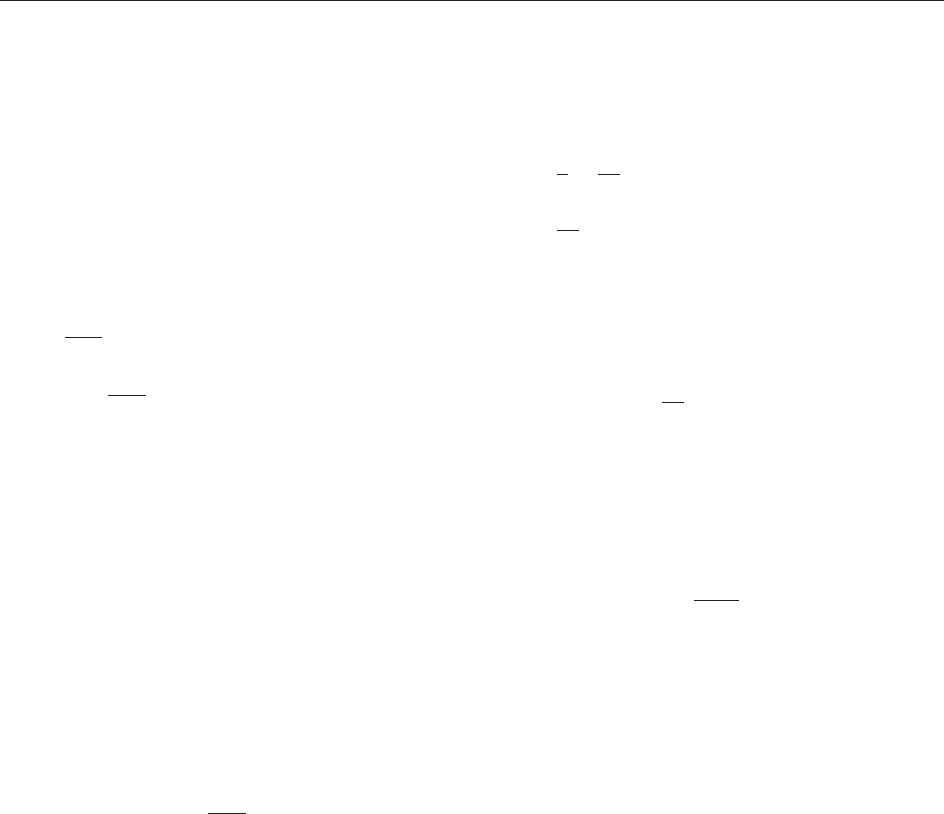
Now using the Fredholm alternative implies the
existence and uniqueness of a function v 7!(v) such
that
ðvÞ
Z
jv
0
j¼1
kðv; v
0
Þðv
0
Þdv
0
¼ v;
Z
jv
0
j¼1
ðv
0
Þdv
0
¼ 0 ½9
Multiply eqn [5] by (v) and integrate over jvj= 1to
obtain
lim
!0
ðxÞ
Z
jvj¼1
ððI KÞÞðvÞf
ðx; v; tÞdv
¼ lim
!0
ðxÞ
Z
jvj¼1
ðvÞðI KÞf
ðx; v; tÞdv
¼lim
!0
r
x
Z
jvj¼1
ðvÞvf
ðx; v; tÞdv ½10
Since the operator (I K) is self-adjoint non-
negative, with 0 as the leading eigenvalue, the
matrix
D ¼
Z
jvj¼1
ðvÞvdv
¼
Z
jvj¼1
ðvÞðI KÞðvÞdv
is positive definite, and one finally obtains the
diffusion equation
@
t
f r
x
D
ðxÞ
r
x
f
¼ 0 ½11
The above derivation is an example of what is called
the ‘‘moments method.’’ It is implicit even in the
papers of Maxwell. It has been systematically used
in several domains:
To understand the relation between the Boltzmann
equation and the Euler and Navier–Stokes
equations (Golse 2005);
To compute the critical size of a nuclear assembly.
One shows that this size is well approximated by
the size of the domain for which the Laplacian,
with appropriate boundary conditions, has lead-
ing eigenvalue 0. It is for the spectral analysis of
this problem that the averaging lemma (see the
section ‘‘Some speci fic math ematical tools ’’) was
derived.
To analyze the macroscopic limit for the solution
of the radiative transfer equations, which describe
the propagation of the intensity of photons in a
large class of phenomena ranging from stellar
atmospheres to the cooling of glass, including
optical tomography in biomedical imaging. In a
simplified form, the so-called ‘‘grey model,’’ these
equations can be reduced to
@
t
I
ðx; v; tÞþv r
x
I
ðx; v; tÞ
þ
1
1
4
Z
jv
0
j¼1
I
ðx; v
0
; tÞÞdv
0
I
ðx; v; tÞ
1
4
Z
jv
0
j¼1
I
ðx; v
0
; tÞÞdv
0
¼ 0 ½12
In contrast to the previous example, the problem
is, in many cases, nonlinear. The opacity is a
positive function that depends on the intensity I
through
~
Iðx; tÞ¼
1
4
Z
jv
0
j¼1
I
ðx; v
0
; tÞdv
0
and which goes to 1 with
~
I
going to zero. The
moments method can be applied with the aver-
aging lemma, and one shows that the limit of I
is
a function that is independent of v and satisfies
the following degenerate parabol ic equation:
@
t
I r
x
1
3ðIÞ
r
x
I
¼ 0 ½ 13
This equation is similar to the one obtained in the
description of porous media and contains the
following information: for initial data I(x, 0) with
compact support, in contrast to the behavior of
solutions of the standard diffusion equation, the
solution I(x, t) remains compactly supported in x.
The boundary of this support is the thermal front
and for a finite time, up to saturation (by water in
porous media, by reacted deuterium in laser-
confined fusion), this front remains fixed.
What made the analysis of the above macroscopic
limit simple was the existence of an >0 dependent
process which, for vanishing , forces the solution to
converge to a ‘‘thermodynamical’’ equilibrium. The
irreversibility was already present in the first arrow
of Figure 1. This is what made the analysis of the
second arrow simple. The subtleties of the appear-
ance of the irreversibility in the first arrow may be
well explained by the next examples.
The Linear Billiard Model
In the absence of an external electric field, the model
proposed by Lorentz could be viewed as a limit of a
system of particles evolving freely between spherical
obstacles and reflecting on these obstacles according
to the law of geometric optics. Along these lines,
two types of results have been proved in two space
variables.
202 Kinetic Equations

In 1973, Gallavotti considered the case where the
obstacles are randomly spaced under a Poisson
configuration and proved the following theorem:
Theorem 1 Consider obstacles(balls) of radius
and center c
i
. Assume that the probability of finding
exactly N such obstacles in a bounded measurable
set R
2
is given by the ‘‘Poisson law’’
Pðdc
N
Þ¼e
jj
N
N!
dc
1
dc
2
dc
N
½14
with
c
N
¼ c
1
; c
2
; ...; c
N
and
¼
½15
Denote by E
the expectation with respect to the
above Poisson distribution. For given and c
N
introduce
O
c
N
;
¼ R
2
n[
1iN
fjx c
i
jg½16
and f
c
N
,
, the solution of the problem
@
t
f
c
N
;
ðx; v ; tÞþv r
x
f
c
N
;
ðx; v; tÞ¼0
in O
c
N
;
S
1
½17
with specular reflection on the boundary and
v-independent initial data:
f
c
N
;
ðx; v; 0Þ¼ðxÞ in O
c
N
;
S
1
½18
Then
h
ðx; t; Þ¼E
½f
c
N
;
½19
converges weakly for t 0 to the solut ion of the
transport equation
@
t
f ðx; v; tÞþv rf ðx; v; tÞþ
2f ðx; vÞ
1
4
Z
S
f ðx; v
0
Þjv v
0
jdv
0
¼ 0 ½20
f ðx; v; 0Þ¼ðxÞ in R
2
S
1
½21
The situation is completely different when the
obstacles are periodically spaced, a situation which
seems closer to Lorentz’s original idea. Golse (2003)
(and previous contributions quoted in this article)
obtained the following result:
Theorem 2 Assume that the obstacles are periodi-
cally spaced and conveniently scaled , defining the
domain
O
¼ R
2
n[
j2Z
2
fx; jx jj
2
g½22
Then there exists a family of continuous uniformly
bounded ini tial data such that no subsequence
extracted from the family of solutions of
@
t
f
þ v r
x
f
¼ 0 in O
S
1
½23
with specular reflections on the boundary, converges
to solutions of equations of the type [20].
This pathology is related to the existence of
particles that can travel freely for a very long time
before meeting the obstacles, and the proof with
some arithmetic (Diophantine approximations and
continued fractions) relies on the analysis of such
trajectories.
A comparison between the Theorems 1 and 2
shows that the ergodic property of the free flow on
the periodic lattice is not strong enough to lead to a
collisional kinetic equation unless some complemen-
tary randomness is introduced.
The examples of this section should be compar ed
with the rigorous derivation of the Boltzmann
equation by Lanford (see Boltzmann Equation
(Classical and Quantum)). The reader should
observe that this derivation corresponds to the
same type of scaling (finite mean free path).
However, no extra randomness is needed in this
case. The proof uses the fact that configurations
leading only to a finite number of binary collisions
are of full measure. This corresponds to an
ergodicity property which is enforced by the fact
that the problem is genuinely nonlinear.
Mean-Field Scaling and Vlasov Equations
The neutron transport equation is devoted to the
interaction with obstacles and the Boltzmann
equation to binary collisions. A simpler situation
from the mathematical point of view corresponds
to the case where each particle is under the action
of the average of all other particles. Then the name
‘‘mean field limit’’ is used. The simplest example is
the derivation of a Vlasov-type equation from a
system of N classical particles interacting w ith a C
2
potential V(jxj). The following Hamiltonian is
used:
Hðx
1
; ...; x
N
; v
1
; ...; v
N
Þ
¼
X
1kN
jv
k
j
2
2
þ
1
2N
X
1l6¼kN
Vðjx
k
x
l
jÞ ½24
and the name mean-field scaling is related to the
factor N
1
before the potential. Assuming that the
particles are undistinguishable, one introduces
the joint probability density F
N
F
N
(x
1
, ..., x
N
,
Kinetic Equations 203

v
1
, ..., v
N
) in the N-particle phase space, which
satisfies the Liouville equation
@
t
F
N
þfH
N
; F
N
g:¼@
t
F
N
þ
X
1kN
v
k
r
x
k
F
N
1
2N
X
1l6¼k N
r
x
k
ðVðjx
k
x
l
ÞÞ
r
v
k
F
N
¼ 0 ½25
From [25], with the notations
X
n
¼ðx
1
; ...; x
n
Þ; V
n
¼ðv
1
; ...; v
n
Þ
X
n
N
¼ðx
nþ1
; ...; x
N
Þ; V
n
N
¼ðx
nþ1
; ...; x
N
Þ
one deduces an infinite hierarchy of equations for
the marginals
F
n
N
ðX
n
; V
n
; tÞ¼
Z
f
N
ðX
N
; V
N
; tÞdX
n
N
dV
n
N
for 1 n N; F
n
N
0 for N < n :
@
t
F
n
ðX
n
; V
n
; tÞþ
X
1in
v
n
r
x
i
F
n
N
ðX
n
; V
n
; tÞ
1
N
X
1i<jn
r
v
i
r
x
i
Vðjx
i
x
j
jÞF
n
N
ðX
n
; V
n
; tÞ
N n
N
X
1in
r
v
i
ZZ
r
x
i
Vðjx
i
x
jÞ
F
nþ1
N
ðX
n
; V
n
; x
; v
; tÞdx
dv
¼ 0 ½26
Letting N go to infinity, one obtains ‘‘formally,’’ for
the distribution functions,
F
n
¼ lim
N!1
F
n
N
the Vlasov hierarchy:
@
t
F
n
ðX
n
; V
n
; tÞþV
n
r
X
n
F
n
ðX
n
; V
n
; tÞ
X
1in
r
v
i
ZZ
r
x
i
Vðjx
i
x
jÞ
F
nþ1
N
ðX
n
; V
n
; x
; v
; tÞdx
dv
¼ 0 ½27
Observe that for any density F(x, v, t) that satisfies
ZZ
Fðx; v; t Þdx dv ¼ 1; Fðx; v; tÞ0 ½28
and is a solution of the V potential Vlasov equation:
@
t
Fðx; v; t Þþv r
x
Fðx; v; t Þ
ZZ
r
x
Vðjx x
jÞFðx
; v
Þdx
dv
r
v
Fðx; v; t Þ¼0 ½29
the factorization formula
F
n
ðX
n
; V
n
; tÞ¼
Y
1in
Fðx
i
; v
i
; tÞ½30
defines a solution of the above Vlasov hier archy.
A uniqueness argum ent implies that any solution
of the Vlasov hierarchy which is factorized at time
zero will remain factorized at any subsequent time.
Such a property, also observed for the hierarchy
leading to the Boltzmann equation, is called the
propagation of chaos. To make the proof rigorous,
one has to analyze the limiting process in the
hierarchy and prove the uniqueness of the solution
of the infinite hierarchy. For a smooth potential, this
has been done by Braun and Hepp in 1977 and by
Spohn in 1981. An interesting approach consists,
following Dobrushin, in introducing the Wasserstein
distance; see Golse (2003) for a detailed exposition.
In the case of the Vlasov–Poisson equation [29]
with V(jxj) = 1=4jxj the potential turns out to be
too singular for the above derivation. In particular,
the corresponding solution of the N-particle pro-
blem is not uniformly defined. However, for the
corresponding equation (and for variants thereof,
including the effect of the magnetic field, the
Vlasov–Maxwell system) a series of mathematical
results concerning existence and stability of solu-
tions have been obtained. An excellent recent
exposition of these results can be found in the
book of Glassey (1996).
Equation [29] as well as the original system turns
out to be fully reversible. Neither irreversibility nor
averaging has appeared in the limit process which
corresponds to the first arrow of Figure 1; this is due
to the ‘‘weak coupling.’’ Therefore, irreversibility
should now appear on the second arrow. Integrating
eqn [29] with respect to v gives the relation (often
called Fick’s law):
@
t
ðx; tÞþr
x
Z
vFð x; v; t Þdv ¼ 0 ½ 31
But now expressing the curre nt j =
R
vF(x, v, t)dv in
terms of macroscopic variables turns out to be a
difficult issue in the absence of a ‘‘relaxation’’ effect.
Up to now there has been no derivation of such
macroscopic equations from first principles.
The same type of problems exist for the two-
dimensional Euler equation, which is in some sense
very similar to the Vlasov equation. It has been
observed that these equations develop for ‘‘turbulent
initial data’’ a kind of ‘‘mixing process’’ leading to
coherent structures that would play the role of
thermodynamical equilibrium (in the absence of
relaxation). The Jupiter red spot is the most
204 Kinetic Equations

well-known example of such a structure. These
coherent structures are obtained by maximizing an
entropy which does not come directly from the
dynamics but which is inspired by similar problems
in statistical mechanics. Finally, one has to take into
account in this construction the existence of an
infinite set of conserved quantities: for each regular
function G, vanishing at infinity, one has
d
dt
ZZ
GðFðx; v; t ÞÞdx dv ¼ 0
This approach was already started by Onsager in 1945
and pursued by many scientists. A recent reference is
the article of Chavanis and Sommeria (1998).
Derivation of Kinetic Equations from the
Schro¨ dinger Equation
Oscillatory solutions of the Schro¨ dinger equation,
with wavelength of the order of the Planck constant,
tend to behave like particles. This is described in
detail by different tools of high-frequency approxi-
mation. In particular, the limit of the Wigner
transform of the density (x, t)
(y, t):
Wðx;;tÞ¼
1
ð2Þ
3d
Z
R
3d
e
iy
x þ
hy
2
; t
x
hy
2
; t
dy ½32
is a solution of a Liouville equation. Therefore, one
should expect that in the presence of ‘‘many’’
obstacles (‘‘many potentials’’) the limit should be
given by a kinetic equation. As shown by the
previous section the introduction of randomness
seems compulsory in reachin g this goal.
Consider a big cube =
L
of size L in R
3
. Let
! = (x
), = 1, 2, ..., N denote the configuration of
random obstacles distributed uniformly in . The
density of obstacles is = N=L
3
and the expectation
with respect to this uniform measure is denoted by
E :¼
Y
1N
L
d
Z
dx
With V(jxj) a smooth, short-range potent ial, the
random potential created by the obstacles is
V
!
ðxÞ¼
X
1N
Vðjx x
jÞ
then one of the typical results (low-density limit,
which corresponds to the quantum version of
Gallavotti classical result) obtained, reads as follows:
Theorem 3 (Erdo¨ s and Yau 1988) Assume that the
density of obstacles is =
0
with a fixed
0
.
Denote by
!
(t) the solution of the Schro¨ dinger
equation
i@
t
!
¼
1
2
x
!
þ V
!
!
½33
with initial condition localized and oscillating at the
scale , that is, with h and S smooth
!
ð0Þ¼
3=2
hðxÞexp i
SðxÞ
½34
Consider the density matrix
!
(t, x, y) =
!
(t, x)
!
(t, y) and its Wigner transform
W
!
ðx;;tÞ
¼
1
ð2Þ
3
Z
R
3
e
iy
!
t; x þ
y
2
; x
y
2
dy
½35
Then for any t > 0, EW
!
(t) converges weakly with
going to zero to a solution F(t) of the kinetic equation
@
t
Fðt; x;Þþ r
x
Fðt; x;Þ
¼
Z
jTð;
0
Þj
2
ðjj
2
j
0
j
2
ÞðFðt; x;
0
Þ
Fðt; x;ÞÞd
0
½36
where T is the amplitude of the scattering operator
associated to the Schro¨ dinger equation with the
short range potential V.
The proof uses several ingredients including
scattering theory with expansion in term of Dyson
series; see Erdo¨ s and Yau (1998).
Semiconductor Modeling
In modern computers, the electronic devices are so
small that the electric current may have no space/time
to reach a thermodynamical equilibrium. Therefore,
this turns out to be a field where the kinetic equations
are the most naturally used. Details of what can be
deduced from a mathematical analysis can be found
in Poupaud (1994). The equations involve the
distribution of electrons f
e
(x, k, t) and holes
f
h
(x, k, t ) and have the following form:
@
t
f
e
ðt; x; kÞþv
e
ðkÞr
x
f
e
ðt; x; kÞ
þ
q
h
r
x
Uðt; xÞr
k
f
e
ðt; x; kÞ
¼
1
ðQ
e
ðf
e
Þðt; x; kÞþR
e
ðf
e
; f
h
Þðt; x; kÞÞ ½37
@
t
f
h
ðt; x; kÞþv
h
ðkÞr
x
f
h
ðt; x; kÞ
q
h
r
x
Uðt; xÞr
k
f
h
ðt; x; kÞ
¼
1
Q
h
ðf
h
Þðt; x; kÞþR
h
ðf
h
; f
e
Þðt; x; kÞ½38
Kinetic Equations 205

The variable k ranges over a torus B of R
3
which, in
physics books, carries the name of Brillouin zone.
The velocities of propagation of electrons and holes
are determined in terms of the energy band by the
formula
v
e;h
¼
1
h
r
k
E
e;h
ðkÞ½39
The potential U is determined in terms of the doping
profile C(x), the conductivity
r
, and the density of
electrons and holes according to the formula
x
Uðt; xÞ¼
q
r
CðxÞ
1
jBj
Z
B
f
e
ðt; x; kÞdk
þ
1
jBj
Z
B
f
h
ðt; x; kÞdk
½40
Finally Q
e,h
and R
e,h
are binary integral operators in
the variable k 2 B which model collisions and
generation–recombination processes. Conce rning
the ‘‘mathematical approach’’ the situation is as
follows.
The relations [39] can be deduced from the high-
frequency analysis of the solution of the Schro¨ dinger
equation
ih@
t
¼
h
2
2
þ V
x
h
½41
with V a periodic potential constructed on the dual
lattice of B. The method uses the Bloch decom-
position of the solution and t he Wigner series
(Poupaud 1994). No mathematical derivation of
the collisions operator is currently available. The
situation should be compared to what is said in the
secti on ‘‘Derivation of ki netic equations from the
Schro¨ dinger e quation,’’ but in a much m or e
complicated setting.
On the other hand, the collision operators Q
e,h
and R
e,h
, as given by phenomenological arguments,
have enough good relaxation properties to allow a
rigorous limit of the system [37]–[38] for going to
zero (Poupaud 1994). This leads to the justification
of the so-called drift–diffusion models and to the
possibility of constructing correctors (with respect to
) and to treating the effect of heterojunctions by
boundary layer analysis.
Some Specific Mathematical Tools
Few proofs were given in the above exposition and
details would not be suitable for a review article.
However, the mathematical approach to kinetic
equations has generated some new tools, and it
may be useful to give the most prominent ones.
The Averaging Lemma
Compactness results appear in spectral theory and in
the construction of solutions of nonlinear equations
(whenever strong convergence is needed for the
limit). Being hyperbolic, the transport operator
v r
x
propagates singularities along characteristics.
Therefore, at first sight it seems hopeless that one
might obtain any regularizing effect from the free
streaming part of a kinetic model. The key to
obtaining regularizing effects from the transport
operator v r
x
is to seek those effects not on the
number density itself, but on velocity averages
thereof; in other words, on the macroscopic densities.
Here is the prototype of all velocity averaging
results.
Theorem 4 Let F
be a bounded family in L
2
(R
d
R
d
). Assume that the family v r
x
F
is also bounded
in L
2
(R
d
R
d
). Then, for each 2 L
2
(R
d
), the
family of moments
(x) defined by
ðxÞ¼
Z
R
d
F
ðx; vÞðvÞ dv
is relatively compact in L
2
(R
d
).
For the proof one starts with the expression
G
= F
þ v r
x
F
takes the Fourier transform with
respect to x of this relation and writes for
^
() the
expression
^
¼
Z
R
d
^
G
ð; vÞðvÞdv
1 þ iv:
½42
Then use the Cauchy–Schwarz inequality to obtain
j
^
j
2
Z
R
d
jðvÞj
2
dv
1 þjv j
2
!
Z
R
d
jG
ð; vÞj
2
dv ½43
and complete the proof by standard arguments.
The averaging lemma was first observed by
Agoshkov (1984) for abstract results concerning
the regularity of solutions of kinetic equations in
domains with boundary. Independently, it was
rediscovered in the improved form given ab ove by
Golse, Perthame, and Sentis (1985) and used for the
spectral theory in the diffusion approximation. The
extension to L
p
, p > 1, spaces and to L
1
(with use of
entropy estimate) were instrumental in proving the
validity of the Rosseland approximation for the
radiative transfer equations and for the proof of
existence by Lions and Di Perna of renormalized
solutions of the Boltzmann equation. A more refined
result needs to be used to establish the incomp res-
sible limit of the solutions of the Boltzmann
equations; see Golse (2005) for details and a
complete list of references.
206 Kinetic Equations