
Francoise J.-P., Naber G.L., Tsun T.S. (editors) Encyclopedia of Mathematical Physics
Подождите немного. Документ загружается.


Surveys 56(4): 745–746 (translation from Uspekhi Matema-
ticheskikh Nauk 56(4): 135–136 (2001)).
Flaschka H and Newell AC (1980) Monodromy and spectrum
preserving deformations I. Communications in Mathematical
Physics 76: 67–116.
Fokas AS and Ablowitz MJ (1982) On a unified approach to
transformations and elementary solutions of Painleve´ equa-
tions. Journal of Mathematical Physics 23(11): 2033–2042.
Fuchs R (1907) Mathematical Annals 63: 301–321.
Garnier R (1912) Annales Scientifiques de l’Ecole Normale
Supe´rieure 29: 1–126.
Its AR and Novokshenov VYu (1986) The Isomonodromic Defor-
mation Method in the Theory of Painleve´Equations, Lecture
Notes in Mathematics, vol. 1191, p. 313. Berlin: Springer.
Jimbo M and Miwa T (1981) Monodromy preserving deforma-
tions of linear ordinary differential equations with rational
coefficients, II. Physica D 2: 407–448.
Lin C-H and Sibuya Y (1990) Some applications of isomono-
dromic deformations to the study of Stokes multipliers.
Journal of the Faculty of Sciences, University of Tokyo,
Section IA 36(3): 649–663.
Malgrange B (1983) Sur les de´formations isomonodromiques. I.
Singularite´s re´gulie`res, pp. 401–426. II. Singularite´sirre´gu-
lie` res. Mathematics and Physics (Paris, 1979/1982), Progress
in Mathematics, vol. 37. Boston, MA: Birkha¨user.
Schlesinger L (1912) U
¨
ber eine Klasse von Differentialsystemen
beliebiger Ordnung mit festen kritischen Punkten. J. Reine
Angew. Math 141: 96–145.
Sibuya Y (1990) Linear Differential Equations in the Complex
Domain: Problems of Analytic Continuation. Providence, RI:
American Mathematical Society.
Ueno K (1980) Monodromy preserving deformations of linear
differential equations with irregular singular points. Proceed-
ings of the Japanese Academy Series A Mathematical Sciences
56(3): 97–102.
Isomonodromic Deformations 177
J
The Jones Polynomial
V F R Jones, University of California at Berkeley,
Berkeley, CA, USA
ª 2006 Published by Elsevier Ltd.
Introduction
A ‘‘link’’ is a finite family of disjoint, smooth,
oriented or unoriented, closed curves in R
3
or
equivalently S
3
. A ‘‘knot’’ is a link with one
component. The ‘‘Jones polynomial’’ V
L
(t)isa
Laurent polynomial in the variable
ffiffi
t
p
which is
defined for every oriented link L but depends on
that link only up to orientat ion-preserving diffeo-
morphism, or equivalently isotopy, of R
3
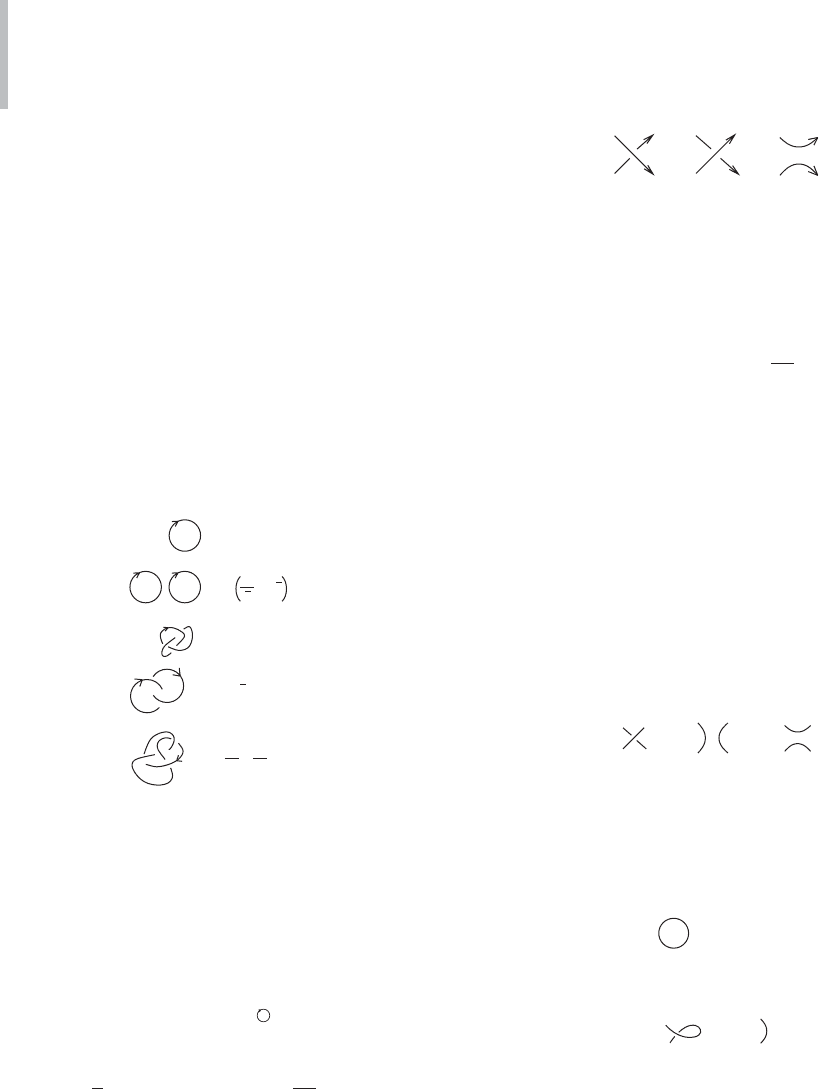
. Links can
be represented by diagrams in the plane and the
Jones polynomials of the simplest links are given
below.
V
=1
V
= – +
1
√t
√t
= t + t
3
– t
4
V
V
=–
(1 + t
2
)
√t
V
=
1
t
2
1
t
– + 1– t + t
2
The Jones polynomial of a knot (and generally a
link with an odd number of components) is a
Laurent polynomial in t.
The most elementary ways to calculate V
L
(t)
use the ‘‘linear skein theory’’ ideas of Conway
(1970). Indeed, it is not hard to see by induction
that V
L
(t) is defined by its invariance under
isotopy, the normalization V
(t) = 1 and the skein
formula
1
t
V
L
þ
tV
L
¼
ffiffi
t
p
1
ffiffi
t
p
V
L
0
which holds for any three oriented links having
diagrams which are identical except near one crossing
where they differ as below.
L
0
L
+
L
–
As such the Jones polynomial resembles the
Alexander (1928) polynomial
L
(t) which can be
calculated in exactly the same manner as V
L
(t)
except that the skein relation becomes
L
þ
L
¼
ffiffi
t
p
1
ffiffi
t
p
L
0
A two-variable generalization P
L
of both
L
and
V
L
, sometimes called the HOMFLYPT polynomial,
was found in Freyd et al. (1985) and Przytycki and
Traczyk (1988). It satisfies the most general skein
relation
xP
L
þ
þ yP
L
þ zP
L
0
¼ 0
for homogeneous variables x, y, and z.
The other skein-like definition of V
L
was found in
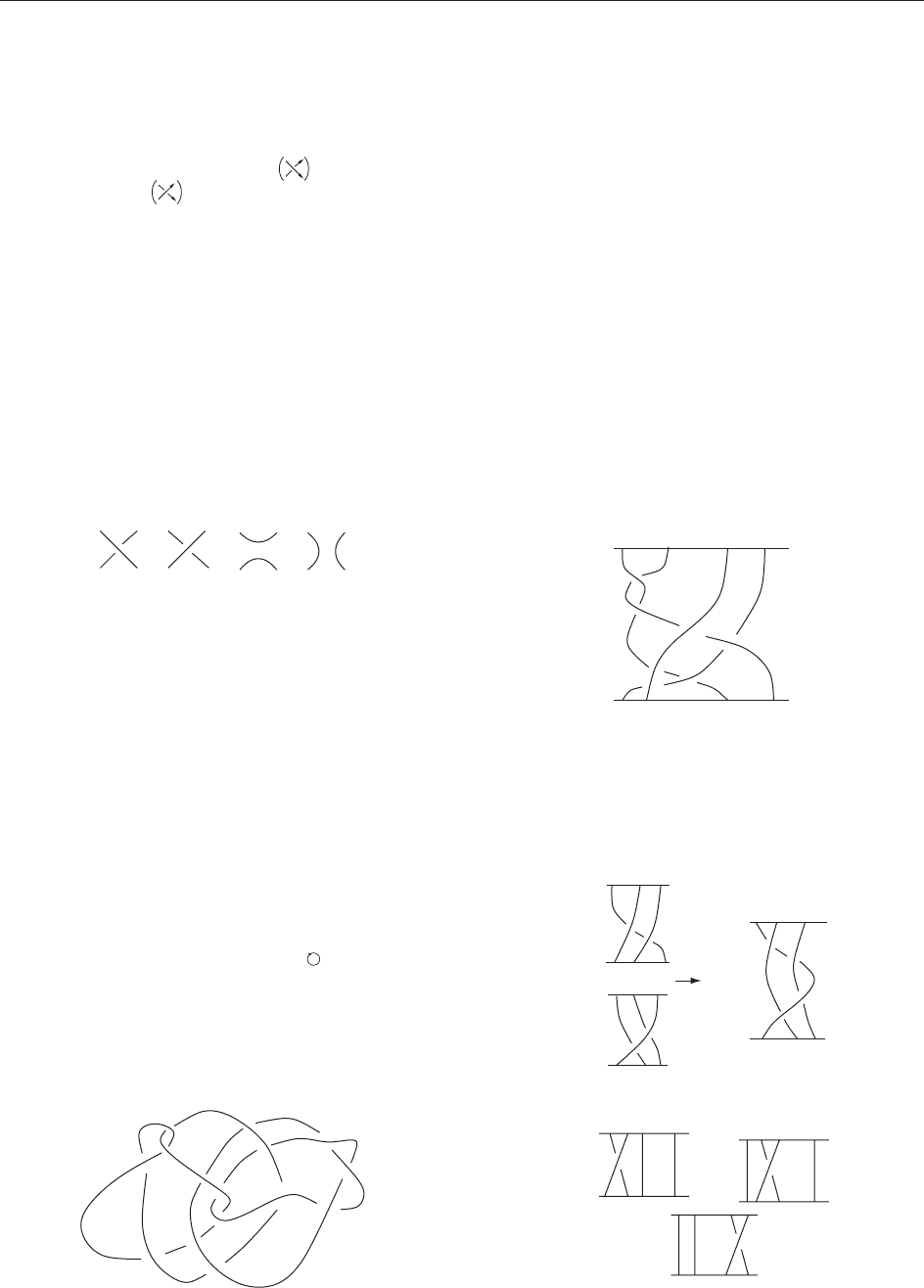
Kauffman (1987). Begin with unoriented link dia-
grams up to planar istotopy. The Kauffman bracket
hLi of such a diagram is calculated using
〈〉 〉
= A 〈
〉
+ A
–1
〈
where the hi notation means that the relation may
be applied to that part of the link diagrams inside
the bracket, the rest of the diagrams being identical.
If hLi were to be an invariant of three-dimensional
isotopy it is easy to see that
〈〉
= –
A
2
– A
–2
which further implies
〈〉
= A
–3
〈
〉
Thus, hLi cannot be a three-dimensional isotopy
invariant as such. However, if L is given an
orientation (then called
~
L), a simple renormalization
solves the problem and it is true that
ðÞ V
L
ðA
4
Þ¼A
3 writhe ð
~
LÞ
hLi
where writhe (
~
L) is the sum over the crossings of L
of þ1 for a positive crossing
and 1 for a
negative crossing
.
The formula () is readily proved by induction but
a more structural proof will be discussed later on,
connected with physics. If the crossings in a link
alternate between over and under as one follows the
string around , the highest and lowest degree terms in
the Kauffman bracket can readily be located. This
led to the proof of some old conjectures about
alternating knots in Murasugi (1987), Kauffman
(1987), and Thistlethwaite (1987).
The Kauffman two-variable polynomial F
L
(a, x)is
defined in Kauffman (1990) by considering the
linear skein relation involving all four possibilities
at a crossing:
L
+
L
–
L
0
L
∞
This polynomial contains V
L
(T) as a specializa-
tion but not the Alexander polynomial.
The above polynomials are quite powerful at
distinguishing links one from another, including
links from their mirror images, which corresponds
for the Jones polynomial to replacing t by t
1
. More
power can be added to the polynomials if simple
geometric operations are allowed. ‘‘Cabling’’ entails
replacing a singl e strand with several parallel copies
and the polynomials of cables of a link are also
isotopy invariants if attention is paid to the writhe
of a diagram.
The following problem, however, is open at the
time of writing this article: ‘‘Does there exist a knot
in R
3
, different from the unknot , whose Jones
polynomial is equal to 1?’’
For links with more than one component, it is
known (Thistlethwaite 2001, Eliahou et al. 2003)
that the answer to the corresponding question is yes,
the simplest example being:
One of the reasons that the question above has
not been answered is presumably that, unlike with
the Alexander polynomial, we have little intuitive
understanding of the meaning of the ‘‘t’’ in V
L
(t).
Perhaps, the most promising theory in this context is
in Khovanov (2000) where a complex is constructed
whose Euler characteristic, in an appropriately
graded sense, is the Jones polynomial. The homol-
ogy of the complex is a finer invariant of links
known as ‘‘Khovanov homology.’’
Braids
Abraid(seeBirman (1974))onn strings is a
collection of curves in R
3
joining n points in a
horizontal plane to the n points directly below
them on another horizontal plane. If the end-
points of the braid are on a straight line, the
braid can be dr awn as i n the example below
(where n = 4).
The crucial property of a braid is that the tangent
vector to the curves can never be horizontal. Braids
are considered up to isotopies which are supported
between the top and bottom planes.
Braids on n strings form a group, called B
n
, under
concatenation (plus some isotopy) as below:
α
=
β
=
αβ
=
Let
1
,
2
, ...,
n1
be the braids below:
σ
1
=
σ
2
=,,
σ
n–1
=
,
.
. .
.
. .
.
. .. . .
180 The Jones Polynomial
Artin’s presentation (Birman 1974) of the braid
group is on the generators
1
,
2
, ...,
n1
with the
relations
i
iþ1
i
¼
iþ1
i
iþ1
for 1 i n 2
i
j
¼
j
i
if ji jj2
Thus, to find linear representations of B
n
,itsuffices
to find matrices
1
,
2
, ...,
n1
satisfying the above
relations (with replaced by ). One such representa-
tion (of dimension n) called the (nonreduced) Burau
representation is given by the row-stochastic matrices
1
¼
1 tt00...
1000...
0010...
.
.
.
.
.
.
.
.
.
.
.
.
.
.
.
000... 1
0
B
B
B
B
B
B
@
1
C
C
C
C
C
C
A
2
¼
1000...
01tt 0 ...
0100...
0001...
.
.
.
.
.
.
.
.
.
.
.
.
.
.
.
000... 1
0
B
B
B
B
B
B
B
B
B
@
1
C
C
C
C
C
C
C
C
C
A
; ...
...;
n1
¼
10 ... 0
01 ... 0
.
.
.
.
.
.
.
.
.
.
.
.
0 ... 1 tt
0 ... 10
0
B
B
B
B
B
B
@
1
C
C
C
C
C
C
A
This representation is known not to be faithful for
n 5 but faithful for n 3. The case n = 4 remains
open. (See Moody (1991), Long and Paton (1993),
and Bigelow (1999)).
Braids can be viewed in several ways, which lead to
several generalizations. For instance, identifying the
vertical axis for a braid with time and taking the
intersection of horizontal planes with the braids shows
that elements of B
n
can be thought of as motions of n
distinct points in the plane. Thus, it is natural that
B
n
ffi
1
ðfC
n
ng=S
n
Þ
when is the set {(z
1
, ..., z
n
)jz
i
= z
j
for some i 6¼ j}
and the symmetric gro up S
n
acts freely on C
n
n by
permuting coordinates. But is the zero-set of the
frequently encountered function
Y
i<j
ðz
i
z
j
Þ
so the braid group may naturally be generalized as
the fundamental group of C
n
minus the singular
set of some algebraic function (Birman 1974). Or,
motions of points can be extended to motions of the
whole plane and a braid defines a diffeomorphism of
the plane minus n points. Thus, the braid group may
be generalized as the ‘‘mapping clas s group’’ of a
surface with marked points (Birman 1974).
The Temperley–Lieb Algebra
If 2 C one may define the algebra TL(n, ) with
identity 1 and generators e
1
, e
2
, ..., e
n1
subject to
the following relations:
e
2
i
¼ e
i
e
i
e
i1
e
i
¼ e
i
e
i
e
j
¼ e
j
e
i
if ji jj2
Counting reduced words on the e
i
’s shows that
dimfTLðn;Þg
1
n þ 1
2n
n
and in Jones (1983) it is shown that these numbers,
the Catalan numbers, are indeed the dimensions of
the Temperley–Lieb algebras. In the obvious way,
TL(n, ) TL(n þ 1, ). If
1
is not in the set
{4 cos
2
q; q 2 Q}, TL(n, ) is semisimple and its
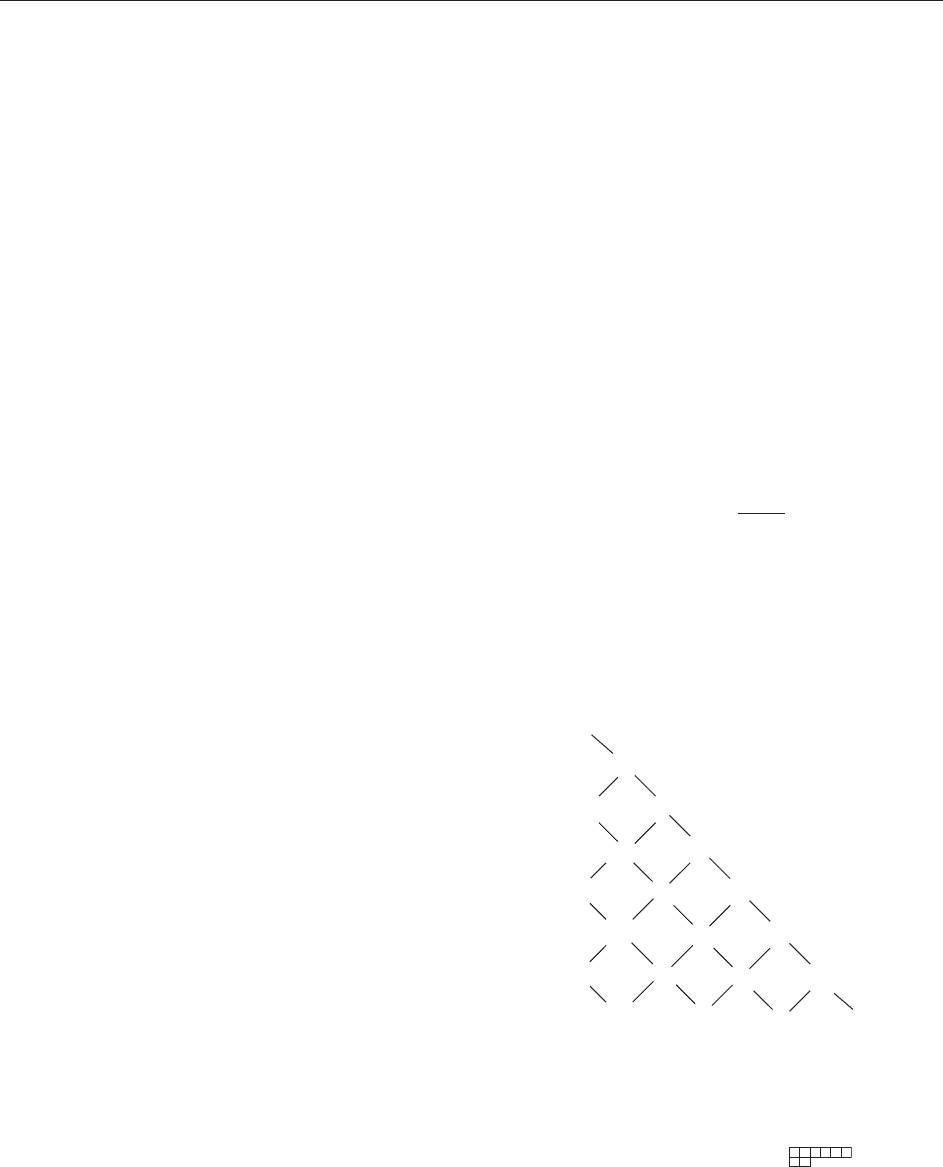
structure is given by the following Bratteli diagram:
3
2
5
1
1
1
1
9
5
1
1
1
1
2
5
4
where the integers on each row are the dimensions
of the irreduci ble representations of TL(n, ) and the
diagonal lines give the restriction of representations
of TL(n, )toTL(n 1, ). These representations
are naturally indexed by Young diagrams with n
boxes and at most two rows:
with the
diagonal lines in the Bratteli diagram corresponding
to removal/addition of a box. The dimension of the
representation corresponding to the diagram whose
second row has r boxes (r n)is
n
r
n
r 1
The Jones Polynomial 181
One may attempt to make TL(n, ) into a
C
-algebra and look for Hilbert space represen-
tations (with e
i
6¼ 0), by imposing e
i
= e
i
. From
(Wenzl 1987), this is only possible (for all n) when
1. 2 R,0< 1=4, or
2.
1
2 {4 cos
2
=m, m = 3, 4, 5, ...}.
The proof uses the fact that f
n
, inductively defined by
f
nþ1
¼ f
n
½2
q
½n þ 1
q
½n þ 2
q
f
n
e
nþ1
f
n
must be an orthogonal projection with e
i
f
n
= f
n
e
i
= 0
for i n. These f
n
are sometimes called Jones–Wenzl
idempotents. (Here
1
= 2 þ q
2
þ q
2
and for this
and later formulas we define the quantum integer
[n]
q
= (q
n
q
n
)=(q q
1
)).
When
1
= 4 cos
2
(=m), the Hilbert space repre-
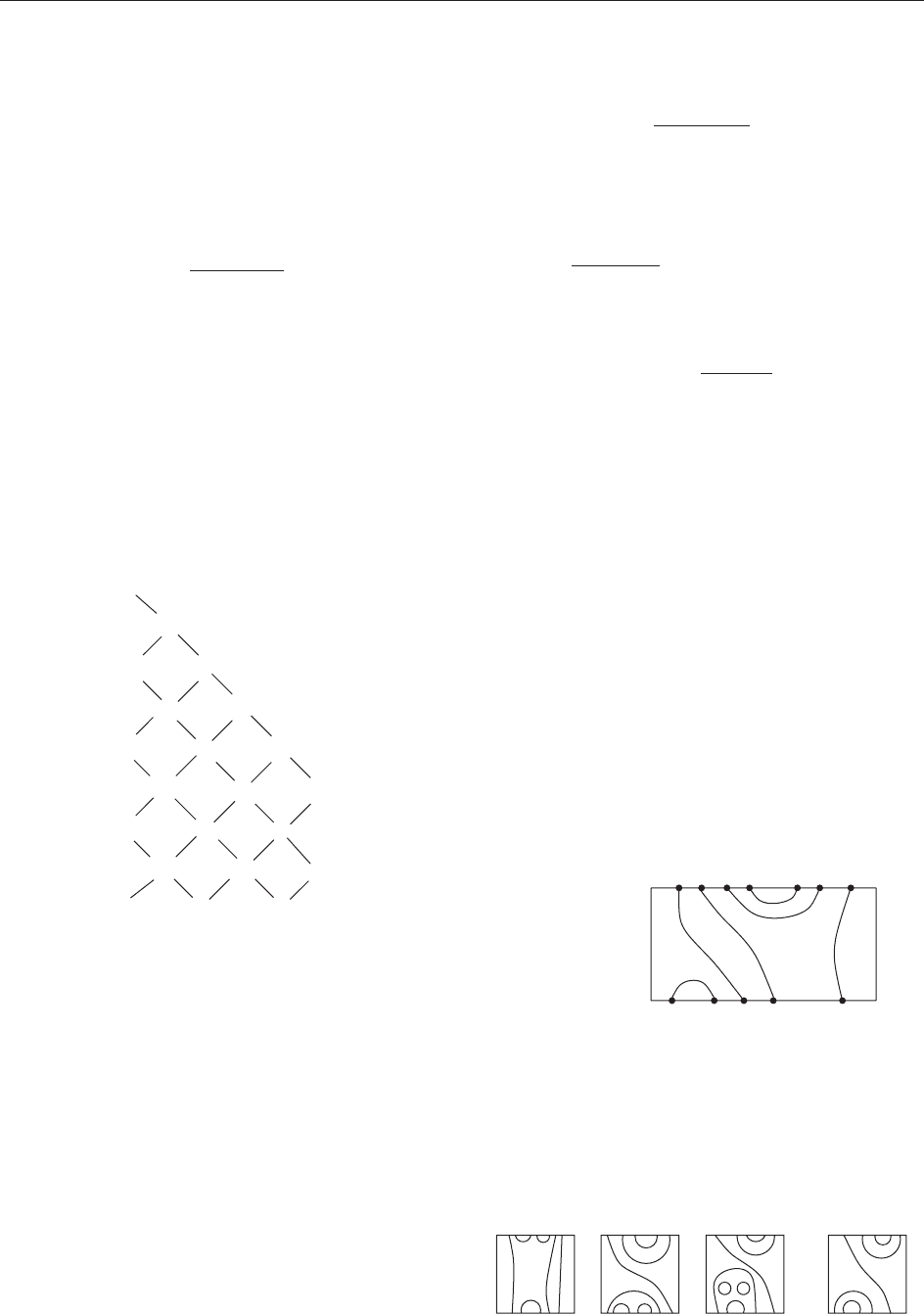
sentations decompose according to Bratteli diagrams
obtained by trunca ting – eliminating the 1 on the
mth row, and all representations below and to the
right of it, so that for m = 7 we would obtain
4
1
5
1
1
1
1
1
1
9
5
5
14
14
2
2
3
5
In terms of Young diagrams, this corresponds to
only taking those diagrams whose row lengths differ
by at most m 2. The ex istence of these Hilbert
space representations is from Jones (1983).
The Temperley–Lieb algebras arose in Jones (1983)
as orthogonal projections onto subfactors of II
1
factors.
As such the Hilbert space structure was manifest. The
trace on a II
1
factor also yielded a trace on the TL(n, ).
To be precise, there is for each m a unique linear
map tr : TL(n, ) !C with:
1. tr(1) = 1
2. tr(ab) = tr(ba)
3. tr(xe
nþ1
) = tr(x) for x 2 TL(n þ 1, ).
This trace may be calculated either from (1), (2),
and (3), or us ing the repre sentations, as a weighted
sum of ordinary matrix traces. The weight for the
representation of TL(n, ), the second row of whose
Young diagram has r boxes, is
½n r þ 1
q
ð½2
q
Þ
n
Thus, if x 2 TL(n, ) and
r
is the
n
r
n
r1
dimensional irreducible representation, then
trðxÞ¼
1
ðq þ q
1
Þ
n
X
½n=2
r¼0
½n r þ 1
q
trace ð
r
ðxÞÞ
One also has
trðf
n
Þ¼
½n þ 2
q
ð½2
q
Þ
nþ1
so that the disappearance of the ‘‘1’’ from the
Bratteli diagram is mirrored by the vanishing of the
trace of the corresponding proje ction.
Positivity of tr, tr(a
a) 0, is responsible for all the
Hilbert space structures. To explicitly construct the
Hilbert space representations, one may use the GNS
construction: take the quotient of the -algebra by the
kernel of the form ha, bi= tr(b
a) which makes this
quotient a Hilbert space on which TL(n, )willact
with the e
i
’s as orthogonal projections. Explicit bases
can be obtained easily if desired, using paths on the
Bratteli diagram, or Young tableaux.
A useful diagrammatic presentation of TL(n, )
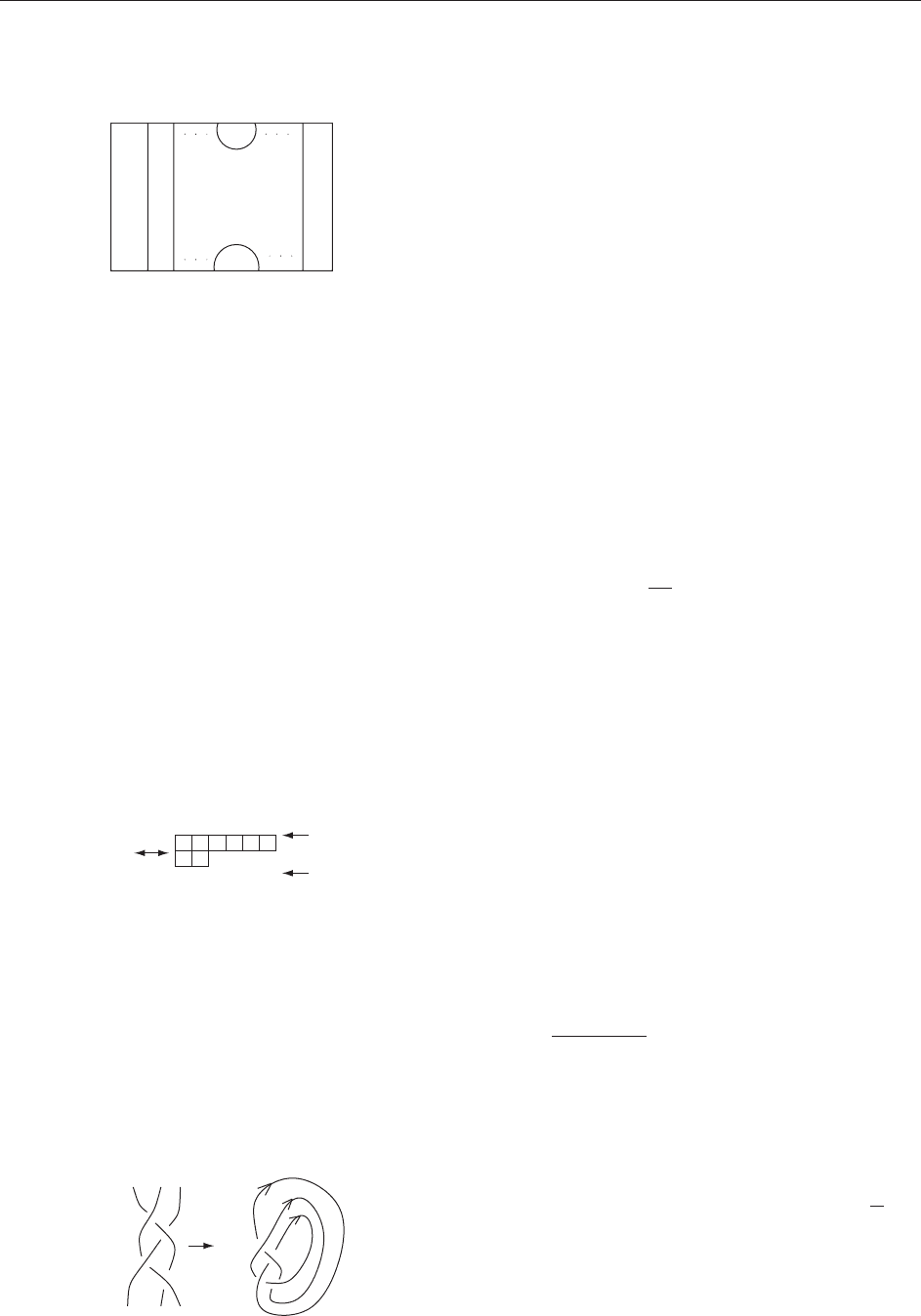
was discovered in Kauffman (1987 ). A (Kauffman)
TL diagram (for non-negative integers m and n)isa
rectangle with n marked points on the top and m on
the bottom with nonintersecting smooth curves
inside the rectangle connecting the boundary points
as illustrated below.
A (5, 7)-diagram
Two Kauffman TL diagrams are considered the same
if they connect the same pairs of boundary points.
The vector space TL(m, n, ) with basis the set of
(m, n) diagrams, and 2 C, becomes a category with
this concatenation together with the rule that closed
curves may be removed, each one counting a
(multiplicative) factor of . We illustrate their
product in TL(m, n, ) below:
×
=
δ
2
=
182 The Jones Polynomial
Of special interest is the algebra TL(n, n, ). If we
define E
i
to be the diagram below:
12 ii + 1
12 ii
+ 1
then E
2
i
= E
i
, E
i
E
i1
E
i
= E
i
, and E
i
E
j
= E
j
E
i
for
ji jj2. Thus, provided 6¼ 0, we have an
isomorphism between TL(n,
2
)andTL(n, n, )by
mapping e
i
to (1=)E
i
.
One of the nicest features of the Kauffm an
diagrams is that they yield simple explicit bases for
the irreducible representations. To see this, call a
curve in a diagr am a ‘‘through-string’’ if it connects
the top of the rectangle to the bottom . Then all
(m, n) diagrams are filtered by the number of
through-strings and if we let TL(m, n, k, )be
the span of (m, n) diagrams with at most k
through-strings, we have TL(k, n, )TL(n, m, k, )
TL(k, m, k, ). Thus, V
n, m
= TL(n, m, m, )=TL(n, m,
m 1, )isaTL( n,
2
)-module, a basis of which is
given by (m, n)-diagrams with m through-strings
(m n). The number of such diagrams is
n
m
n
m1
and it follows from Jones (1983) that all these
representations are irreducible for ‘‘generic’’ (i.e.,
62 {2 cos Q}) and that they may be identified with
those indexed by Young diagrams as below:
V
n, m
m
n –
m
The invariant inner product on V
n, m
is defined by
hv, wi= w
v for the natural identification of V
m, m
with C (
is the obvious involution from (m, n)
diagrams to (n, m) diagrams.).
The Original Definition of V
L
(t)
Given a braid 2 B
n
one may form an oriented link
ˆ
called the closure of by tying the top of the braid
to the bottom as illustrated below:
β =
β =
ˆ
All oriented links occur in this way (Birman 1974)
but if 2 B
n
,
1
and
1
n
(in B
nþ1
) have the
same closure.
Theorem 1 (Markov) (Birman 1974). Let be the
equivalence relation on
‘
1
n = 1
B
n
(all braids on any
number of strings) generated by the two ‘‘moves’’
1
n
and
1
. Then
1
2
if and only
if the links
^
1
and
^
2
are the same.
It is easily checked that, if 1, e
1
, e
2
, e
3
, ... satisfy
the TL rel ations of the sect ion ‘‘The Temper ley–Lieb
algeb ra,’’ then send ing
i
to (t þ 1)e
i
1 (with
1
=
2 þ t þ t
1
) defines a representation
n
of B
n
inside
TL(n, ) for each n. The representation is unitary for
the C
-algebra structure when
1
= 4 cos
2
=n,
n = 3, 4, 5, ... (and t = e
2i=n
). It is an open question
whether
n
is faithful for all n. It contains the Burau
representation as a direct summand.
Combining the properties of the trace tr defined
on TL with Markov’s theorem, one obtains imme-
diately that, for 2 B
n
, the following function of t
depends only on
ˆ
:
ffiffi
t
p
1
ffiffi
t
p
n1
ffiffi
t
p
e
trð
n
ðÞÞ
(here e 2 Z is the ‘‘exponent sum’’ of as a word on
1
,
2
, ...,
n1
).
A simple check using the (oriente d) skein-theoretic
definition of the Jones polynomial shows that this
function of t is precisely V
^
(t). This is how V
L
(t)
was first discovered in Jones (1985).
Although less elementary, this approach to V
L
(t)
does have some advantages. Let us mention a few.
1. One may use representation theory to do calcula-
tions. For instance, using the weighted sum of
ordinary traces to calculate tr as in the section
‘‘The Temperley–Lieb algebra,’’ one obtains read-
ily the Jones polynomial of a torus knot (i.e.,
ˆ
where = (
1
2
p1
)
q
2 B
p
if p and q are
relatively prime). It is
t
ðp1Þðq1Þ=2
1 t
2
ð1 t
pþ1
t
qþ1
t
pþq
Þ
2. If one restricts attention to links realizable as
ˆ
for
2 B
n
for fixed n, the computation of V
ˆ
(t)canbe
performed in polynomial time as a function of the
number of crossings in
ˆ
. Thus, one has computa-
tional access to rather complicated families of links.
3. Unitarity of the representation when t = e
2i
n
can
be used to bound the size of jV
L
(t)j. For instance,
if 2 B
k
and V
ˆ
(t) = (
ffiffi
t
p
(1=
ffiffi
t
p
))
k1
, then
is in the kernel of
n
, and jV
ˆ
(e
2i=n
)j
(2 cos =n)
k1
for any other 2 B
k
.
The Jones Polynomial 183
The representation of the braid group inside the TL
algebra should be thought of as an extension of the
Jones polynomial to ‘‘special knots with boundary.’’
The coefficients of the words in the e
i
’s (or equivalently
the Kauffman TL diagrams) are all invariants of the
braid. We can further remove the braid restriction and
consider arbitrary knots and links with boundary,
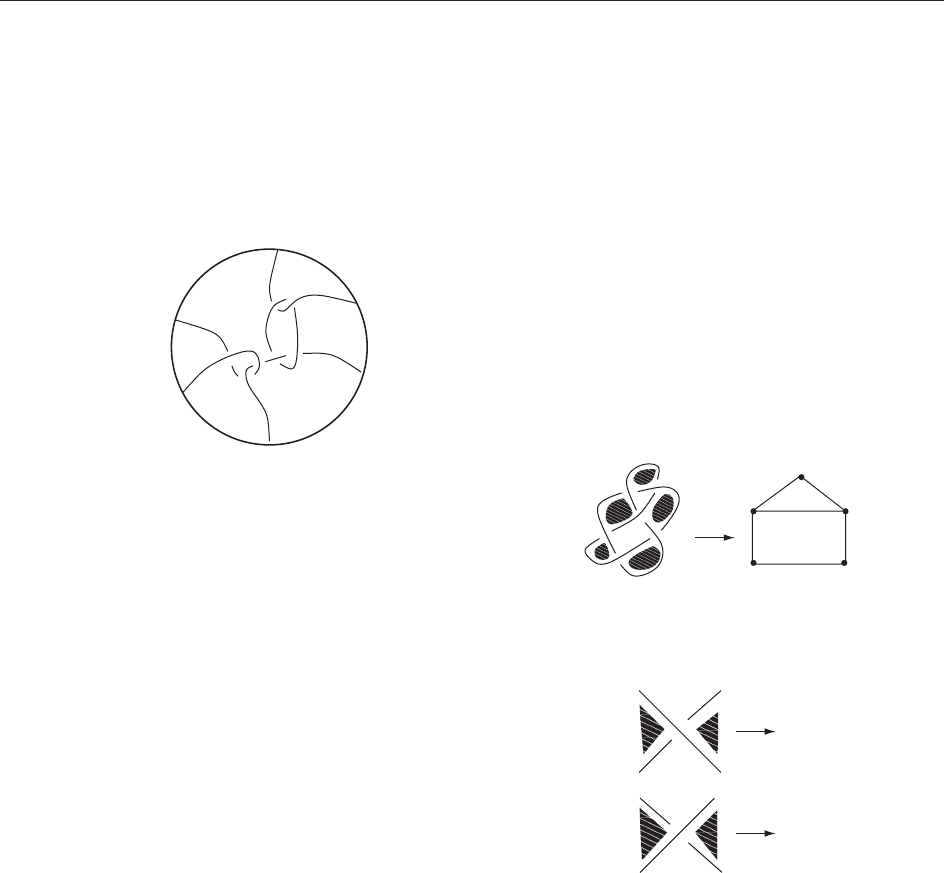
known as ‘‘tangles’’ (Conway 1970).
A 3-tangle
Tangles may be oriented or not and their
invariants may be evaluated either by reduction to
a system of elementary tangles using skein relations
or by organi zing the tangle and representing it in an
algebra. See Turaev (1994).
A similar algebraic approach is available for the
HOMFLYPT and Kauffman two-variable polyno-
mials. The algebra playing the role of the TL algebra
is the Hecke algebra for HOMFLYPT (Freyd et al.
1985, Jones 1987) and the BMW algebra (Birman and
Wenzl 1989, Murakami 1990) for the Kauffman
polynomial. The BMW algebra was discovered after
the Kauffman polynomial in order to provide an
analog of the TL and Hecke algebras. For detailed
analysis of the Hilbert space and other structures for
both Hecke and BMW algebras, see Wenzl (1988) and
Wenzl (1990).
Connections with Statistical Mechanics
One might say that turning a knot into a braid
organizes the knot by ‘‘putting it on a lattice,’’
thereby creat ing a physical model with the crossings
of the knot as interactions. Taking the trace of the
braid is evaluating the partition function with
periodic (vertical) boundary conditions.
This is more than wishful thinking. The Temperley–
Lieb algebra arose from transfer matrices in both
the Potts and ice-type models in two dimensions
(Temperley and Lieb 1971) and each ‘‘e
i
’ ’ implements
the addition of one more interaction to the system.
(The same e
i
’s as in the ice-type models were
rediscovered in the subfactor context in Pimsner and
Popa (1986)). Thus, the Jones polynomial of a closed
braid is the partition function for a statistical mecha-
nical model on the braid. In Jones (1983),itisobserved
that knowledge of the Jones polynomial for a family of
links called French sinnets would constitute a solution
of the Potts model in two dimensions.
In Temperley and Lieb (1971), the TL relations
are used to establish the mathematical equivalence
of the Potts and ice-type (six-vertex) models. In
Baxter (1982, chapter 12), this equivalence is shown
for Potts models on an arbitrary planar graph. In
view of this, it is not surprising that statistical
mechanical models can be defined directly on link
diagrams to give explicit formulas for V
L
(t) (and
other invariants) as partition functions. This works
most easily for the Q-state Potts model.
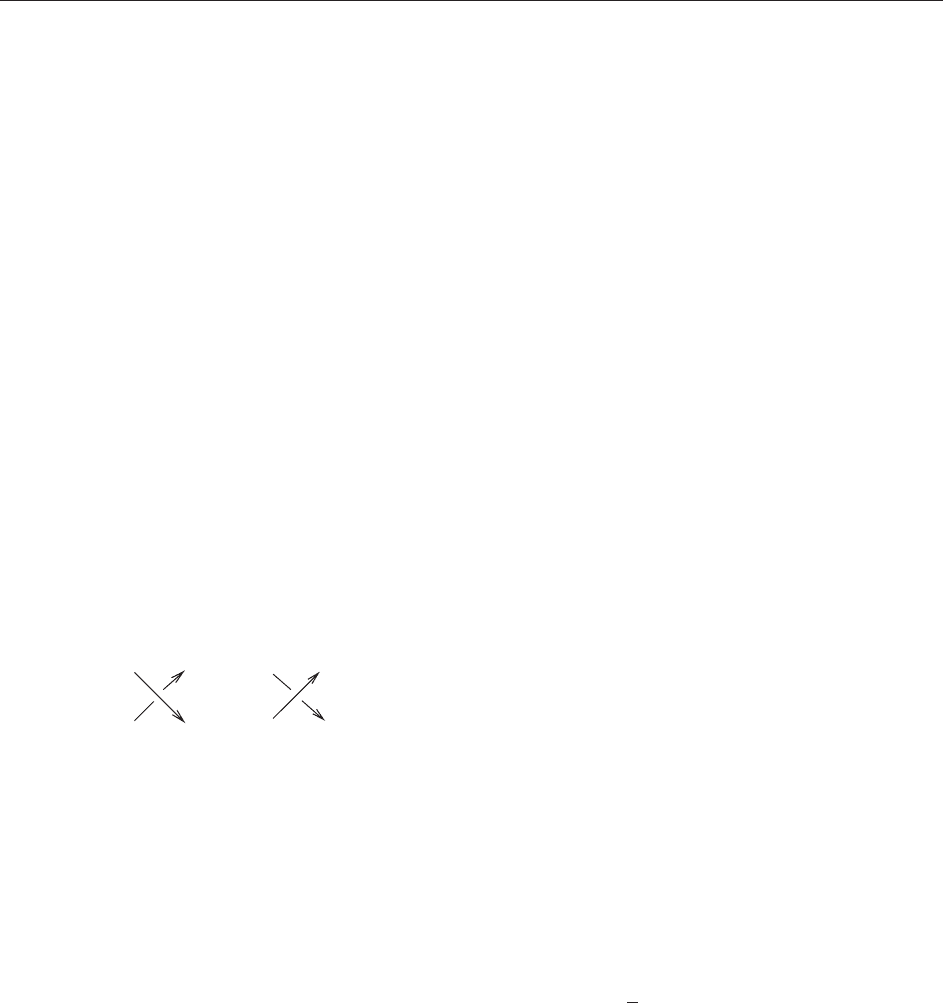
Given an unoriented link diagram D, shade the
regions of the plane black and white and form the
planar graph whose vertices are the black regions
and whose edges are the crossings as below:
D
Γ
Assign þ and to each edge according to the
following scheme:
+
–
Fix Q 2 N and two symmetric mat rices w
(a, b)
for 1 a, b Q. The partition function of the
diagram is then
Z
D
¼
X
states
Y
edges of
w
ð;
0
Þ
where a ‘‘state’’ is a function from the vertices of
to {1, 2, ..., Q} and, given an edge of and a state,
and
0
denote the values of the state at the ends of
that edge (w
þ
and w
are used according to the sign
of the edge).
The ‘‘Potts model’’ is defined by the property that
the ‘‘Boltzmann weights’’ w
(,
0
) depend only on
whether =
0
or not. It is a miracle that the choice
(with Q = 2 þ t þ t
1
)
w
ð;
0
Þ¼
t
1
if ¼
0
1 otherwise
184 The Jones Polynomial
gives the Jones polynomial of the link defined by D
as its partition function (up to a simple normal-
ization). See Jones (1989) for details.
It is natural to look for other choices of w
which
give knot invariants. The Fateev–Zamolodchikov
(1982) model gives a classical knot invariant but
besides that (and some variants on the Jones
polynomial) there is only one other known choice of
any interest, discovered in Jaeger (1992).Inthiscase,
Q = 100 and the Boltzmann weights are symmetric
under the action of the Higman–Sims group on the
Higman–Sims graph with 100 vertices. The knot
invariant is a special value of the Kauffman two-
variable polynomial.
The other side of Temperley–Lieb equivalence is
the ‘‘ice-type’’ model which is a ‘‘vertex model .’’
That is to say the ‘‘spins’’ reside on the edges of a
graph and the interactions occur at the vertices. To
use vertex models in knot theory, the knot projec-
tion D itself is the (4-valent) graph. The ice-type
model has two spin states per edge so that a state of
the system is a function from the edges of the graph
to the set {}; the Boltzmann weights are given by
two 4 4 matrices w
(
1
,
2
,
3
,
4
) where the ’s
are 1andw
þ
and w
are the contributions of
σ
2
σ
1
σ
4
σ
3
σ
2
σ
1
σ
4
σ
3
and
to the partition function, respectively. Furthermore,
we may think of a state as a locally constant
function on D so for any f :{1} !R we may
form the term
R
D
f ()d corresponding to interac-
tion with an external field (d is the curvature or
change of angle form on D). Then the partition
function is
Z
D
¼
X
states
Y
crossings of D
w
ð
1
;
2
;
3
;
4
Þ
0
@
1
A
e
R
D
f ðÞd
A (nonphysical) specialization of the six-vertex
model yields values of f and w
for which Z
D
is a
link invariant equal to V
L
(t). See Jones (1989).
As with the Potts model, one may try to generalize
to more general w
and f.Thisismuchmore
successful for these ‘‘vertex’’ models than it was for
models like the Potts model. The theory of quantum
groups (Jimbo 1986, Drinfeld 1987, Rosso 1988)
allows one to obtain link invariants (as partition
functions for vertex models) for each simple finite-
dimensional Lie algebra A andeachassignmentofan
irreducible representation of A to the components of
the link. The images of the braid generators
i
in the
corresponding braid group representations are called
‘‘R-matrices.’’ It is the Yang–Baxter equation that
gives isotopy invariance of the partition function. In
this way, one obtains (by an infinite family of one-
variable specializations) the HOMFLYPT polynomial
(sl
n
) and the Kauffman polynomial (orthogonal and
symplectic algebras) and more polynomials. The
geometric operation of cabling corresponds to the
tensor product of representations.
Connections with Quantum Field Theory
Conformal Field Theory
If ’ is a (multicomponent) field in one chiral half of
a two-dimensional conformal field theory (CFT), the
correlation functions
h’ðz
1
Þ’ðz
2
Þ’ðz
n
Þi
(where z
i
2 C) are expected to be singular if z
i
= z
j
for some i 6¼ j, holomorphic otherwise and satisfy a
linear differential equation. Thus, analytic con tinua-
tion should determine a unitary monodromy repre-
sentation of
1
(C
n
n{(z
1
, z
2
, ..., z
n
)jz
i
= z
j
for some
i 6¼ j}) on the vector space of solutions to the
differential eq uation near a point. In Tsuchiya and
Kanie (1988), these representations were calculated
for the SU(2) WZW (Wess–Zumino–Witten) model,
where the differential equation is known as the
Khniznik–Zamolodchikov equation. The corre-
sponding braid group representations were shown
to be those obtained in the section ‘‘The original
definition of V
L
(t)’’ and cablings thereof.
Topological Quantum Field Theory
In Witten (1989), the following formula appears:
V
L
ðe
2i=ðkþ2Þ
Þ
¼
Z
A
exp
i
h
Z
S
3
trðA ^ dA þ 2=3 A ^ A ^ AÞ
Y
j
tr Pexp
I
j
A
!
½DA
where A ranges over all functions from S
3
to the Lie
algebra su(2), modulo the action of the gauge group
SU(2). Also h = =k and j runs over the components
of the link L, to each of which is assigned an
irreducible representation of SU(2). Parallel trans-
port around a component j using A yields the linear
map Pexp
H
i
A whose trace is constant modulo gauge
transformations. And [DA] is a fictitious diffeo-
morphism invariant measure on all A’s modulo
gauge transformation.
The Jones Polynomial 185

There are at least two ways to interpret this
formula.
1. As a solvable topological quantum field theory
(TQFT) in 2 þ 1 dimensions, according to Witten
(1988) and Atiyah (1988, 1989). One is then
obliged to expand the context and conclude that
V
L
(e
2i=n
) is defined for (possibly empty) links in
an arbitrary 3-manifold. The TQFT axioms then
provide an explicit formula for the invariant if the
3-manifold is obtained from surgery on a link. In
particular, the invariant of a 3-manifold without a
link is a statistical mechanics type sum over
assignments of irreducible representations of
SU(2) to the components of the surgery link. The
key condition making this sum finite is that only
representations up to a certain dimension (deter-
mined by n) are allowed. This is the vanishing of
the Jones–Wenzl idempotent of the section ‘‘The
Temperley–Lieb algebra.’’ This explicit formula
was rigourously shown to be a manifold invariant
in Reshetikhin and Turaev (1991).Foramore
simple treatment, see Lickorish (1997) and for the
whole TQFT treatment, see Blanchet et al. (1995).
2. As a perturbative QFT. The stationary-phase
Feynman diagram technique may be applied to
obtain the coefficients of the expansion of Witten’s
formula in powers of h or equivalently 1=n. These
coefficients are known to be ‘‘finite type’’ or
Vassiliev invariants and have expressions as
integrals over configurations of points on the link,
see Vassiliev (1990) and Bar-Natan (1995).
Algebraic Quantum Field Theory
In the Haag–Kastler operator algebraic framework
of quantum field theory (Haag 1996), statis tics of
quantum systems were interpreted in Doplicher
et al. (1971, 1974) (DHR) in terms of certain
representations of the symmetric group correspond-
ing to permuting regions of spacetime. To obtain the
symmetric group, the dimension of spacetime needs
to be sufficiently large. It was proposed in
Fredenhagen et al. (1989) that the DHR theory
should also work in low dimensions with the braid
group replacing the symmetric group, and that
unitary braid group representations defined above
should be the ones occurring in quantum field
theory. The ‘‘statistical dimension’’ of the DHR
theory turns up as the square root of the index of a
subfactor (this connection was clearly established in
Longo (1989, 1980)). The mathematical issue of the
existence of quantum fields with braid statistics was
established in Wassermann (1998) using the language
of loop group representations. Actual physical systems
with nonabelian braid statistics have not yet been
found but have been proposed in Freedman (2003)
as a mechanism for quantum computing.
Acknowledgments
The author would like to thank Tsou Sheung Tsun
for her help in preparing this article.
The work of this author was supported in part by
NSF Grant DMS 0401734, the NZIMA, and the
Swiss National Science Found ation.
See also: Braided and Modular Tensor Categories;
C
*
-Algebras and their Classification; Hopf Algebras
and q-Deformation Quantum Groups; Knot Homologies;
Knot Invariants and Quantum Gravity; Knot Theory
and Physics; Large-N and Topological Strings;
Mathematical Knot Theory; Schwarz-Type Topological
Quantum Field Theory; String Field Theory; Topological
Knot Theory and Macroscopic Physics; Topological
Quantum Field Theory: Overview; von Neumann
Algebras: Introduction, Modular Theory, and
Classification Theory; von Neumann Algebras:
Subfactor Theory; Yang–Baxter Equations.
Further Reading
Alexander JW (1928) Topological invariants of knots and links.
Transactions of the American Mathematical Society 30(2):
275–306.
Atiyah M (1988) Topological quantum field theories. Institut des
Hautes Etudes Scientifiques Publications Mathe´matiques 68:
175–186.
Bar-Natan D (1995) On the Vassiliev knot invariants. Topology
34(2): 423–472.
Baxter RJ (1982) Exactly Solved Models in Statistical Mechanics.
London: Academic Press.
Bigelow S (1999) The Burau representation is not faithful for
n = 5. Geometric Topology 3: 397–404.
Birman JS (1974) Braids, Links, and Mapping Class Groups.
Annals of Mathematics Studies, No. 82. Princeton, NJ:
Tokyo: Princeton University Press; University of Tokyo Press.
Birman JS and Wenzel H (1989) Braids, link polynomials and a
new algebra. Transaction of the American Mathematical
Society 313(1): 249–273.
Blanchet C, Habegger N, Masbaum G, and Vogel P (1995)
Topological quantum field theories derived from the Kauffman
bracket. Topology 34(4): 883–927.
Conway JH (1970) An enumeration of knots and links, and some of
their algebraic properties. Computational Problems in Abstract
Algebra, Proc. Conf., Oxford, 1967 and pp. 329–358.
Doplicher S, Haag R, and Roberts JE (1971) Local observables
and particle statistics, I. Communications in Mathematical
Physics 23: 199–230.
Doplicher S, Haag R, and Roberts JE (1974) Local observables
and particle statistics, II. Communication in Mathematical
Physics 35: 49–85.
Drinfeld VG (1987) Quantum groups. In: Proceedings of the
International Congress of Mathematicians, Berkeley, CA,
1986, vol. 1 and 2, pp. 798–820. Providence, RI: American
Mathematical Society.
186 The Jones Polynomial