
Francoise J.-P., Naber G.L., Tsun T.S. (editors) Encyclopedia of Mathematical Physics
Подождите немного. Документ загружается.

The Dispersive Property
Consider for the solutions in R
d
x
R
d
v
of the
elementary kinetic equations
@
t
f þ v r
x
f ¼ 0; f ðx; v; 0Þ¼f
0
ðx; vÞ½44
the local density
ðx; tÞ¼
Z
R
d
v
f ðx; v; tÞ dv ½45
From the relation
jðx; tÞj ¼
Z
R
d
v
f ðx; v; tÞdv
¼
Z
R
v
f
0
ðx vt; v; tÞdv
Z
R
d
sup
w2R
d
jf
0
ðx vt; wÞjdv ½46
deduce with an elementary change of variable the
following estimate, which carries the name of
dispersion lemma,
jðx; tÞj
1
jtj
d
kf
0
k
L
1
ðR
d
x
;L
1
ðR
d
v
ÞÞ
½47
From interpolation and duality arguments follows:
Proposition 1 The macroscopic density defined
by [45] satisfies the inequality
kk
L
q
ðR
t
;L
p
ðR
d
x
ÞÞ
CðdÞkf
0
k
L
a
ðR
2d
Þ
½48
for any choice of real numbers a, p, and q such that
1 p <
d
d 1
;
2
q
¼
d
1
1
p
1 a ¼
2p
p þ 1
<
2d
2d 1
½49
The values a = 1, p = 1, and q = 1 are obvious.
The other limiting values are the interes ting ones.
They are given by p = d=(d 1), that is, p = d
0
then
q = 2 and a = 2d=(2d 1).
These inequalities carry the name of Strichartz
inequalities because they are very similar to classical
inequalities obtained by Strichartz for the solution of
the free Schro¨ dinger equation. This should not be
surprising since the Wigner transform of the densities
f ðx; v; tÞ¼
1
ð2Þ
d
Z
e
iyv
ðx þ
1
2
y; tÞ
ðx
1
2
y; tÞdy ½50
then turns out to be a solution of the transport
equation
@
t
f þ v r
x
f ¼ 0 ½51
However, the estimates for kinetic equations are not
easily translated into estimations for the Schro¨ dinger
equation because the properties of the initial data in
terms of norms cannot be simply estimated in terms of
the inverse Wigner transform. Spaces with Fourier
transform in L
p
, p 6¼ 2, are not easy to characterize and
not natural for the Schro¨ dinger equation. The above
estimates have been very useful in analyzing the large-
time behavior of solutions and also in proving the
regularity of the three-dimensional Vlasov equation.
The Entropy and Entropy Dissipation
For solutions of the Boltzmann equation the
Boltzmann H function
Hðf Þ¼
Z
R
3
R
3
f ðx; vÞlog f ðx; vÞdx dv
decreases in time and the same is true for the
relative entropy to an absolute Maxwellian M(v) =
(2)
3=2
e
jvj
2
=2
:
HðFjMÞ¼
Z
R
3
R
3
f ln
f
M
f þ M
dx dv
This leads to the systematic introduction in the theory
of the notion of relative entropy. It turned out to be
instrumental in proving relaxation toward equilib-
rium of solutions of kinetic (or similar) equations
and for the analysis of hydrodynamical limits.
A striking example considered by Desvillettes and
Villani is the linearized Fokker–Planck equation in
any space dimension:
@
t
F þ v r
x
F r
x
VðxÞr
v
F
¼r
v
ðr
v
F þ FvÞ½52
When x 7!V(x) is a smoot h potential strictly convex
at infinity, this system has a unique steady state
given by the relation
F
1
ðx; vÞ¼e
VðxÞ
MðvÞ¼e
VðxÞ
e
jvj
2
=2
ð2Þ
d=2
½53
For any solution of [52] one has
@
t
HðFjMÞþ
Z
R
d
R
d
Fjr
v
log
F
M
j
2
dx dv ¼ 0 ½54
which says that the entropy dissipation is the
relative Fisher information (with respect to v)ofF.
Now, to study the relaxation to equilibrium, one
uses the logarithmic Sobolev inequality:
HðFjMÞ
1
2
Z
R
d
R
d
Fjr
v
log
F
M
j
2
dx dv ½55
Details, referenc es, and extensions can be found in
Arnold et al. (2004).
Kinetic Equations 207
Conclusions
Kinetic equations have been studied since the end of
the nineteenth centur y, both from the physical and
mathematical points of view, but it seems that since
the middle of the last century the interest in this
approach has considerably increased.
The fact that these equations are well adapted to the
description of media which have not ‘‘thermalized’’
(because they are too rarefied or because the domain
where they evolve is too small) has been a basic reason
for their use in many applied fields; to the ones already
quoted one may add the analysis of the air between the
reading head and a compact disk, the computations of
the characteristics of an ionic motor, and many others.
As a consequence, mathematical progress has
been very important. Without going into the details,
this contribution is focused on this, and in particular
on what can be obtained by the deterministic
approach and where the introduction of randomness
seems compulsory.
The kinetic formulation turned out to be well
adapted to large-scale computers, in particular with
Monte Carlo simulations. One should observe that
the point of view of modern functional analysis
contributes stability estimates to the understanding
and improvement of numerical methods. For an
introduction to such numerical methods, the reader
should first concentrate on the Boltzmann equation
itself, which has been one of the basic motivations;
consult the book of Sone (2002) the references
therein and in particular the book of Bird (1994).
See also: Boltzmann Equation (Classical and Quantum);
Breaking Water Waves; Einstein’s Equations with Matter;
Fourier Law; Interacting Stochastic Particle Systems;
Nonequilibrium Statistical Mechanics: Dynamical
Systems Approach; Partial Differential Equations: Some
Examples; Quantum Dynamical Semigroups.
Further Reading
Arnold A, Carrillo J, Dolbeault J, et al. (2004) Entropies and
equilibria of many-particle systems: an essay on recent
research. Monatschefte fu¨ r Mathematik 142(1): 35–43.
Bird GA (1994) Molecular Gas Dynamics and the Direct
Simulation of Gas Flows. Oxford: Oxford University Press.
Chavanis PH and Sommeria J (1998) Monthly Notices of the
Royal Astronomical Society 296: 569.
Erdo¨ s L and Yau HT (1998) Linear Boltzmann equation as a
scaling weak limit of quantum Lorentz gas. Advances in
Differential Equations and Mathematical Physics, Contem-
porary Mathematics 217: 137–155.
Glassey RT (1996) The Cauchy Problem in Kinetic Theory.
Philadelphia, PA: SIAM.
Golse F (2003a) On the statistics of free-path lengths for the
periodic Lorentz gas. In: Zambrini J (ed.) Proceedings of the
XIVth International Congress of Mathematical Physics,
Lisbon 2003. Singapore: World Scientific.
Golse F (2003b) The mean-field limit for the dynamics of large
particle systems. Journe´es Equations aux de´rive´ es partielles
Forges-les-Eaux, 2 6 juin 2003 GDR 2434 (CNRS).
Golse F (2005) The Boltzmann equation and its hydrodynamic
limits. In: Dafermos C and Feireisl E (eds.) Handbook of
Differential Equations, vol. 2: Evolutionary Equations.
Boston: Elsevier.
Olla S, Varadhan R, and Yau HT (1993) Hydrodynamical limit
for Hamilton system with weak noise. Communications in
Mathematical Physics 155: 523–560.
Poupaud F (1994) Mathematical theory of kinetic equations for
transport modelling in semiconductors. In: Perthame B (ed.)
Advances in Kinetic Theory and Computing Series in Applied
Mathematics, vol. 22, pp. 141–168. Singapore: World Scientific.
Sone Y (2002) Kinetic Theory and Fluid D ynamics. Boston:
Birkha¨ user.
Knot Homologies
J Rasmussen, Princeton University,
Princeton, NJ, USA
ª 2006 Elsevier Ltd. All rights reserved.
Introduction
A knot hom ology is a theory which assigns to a knot
K (or link L)inS
3
a graded homology group whose
graded Euler characteristic is a knot polynomial
associated to K. In all known examples, the knot
polynomials in question are sp ecializations of the
HOMFLY polynomial P
K
(a, q), which we take to be
determined by the skein relation
aPð%-Þa
1
Pð%-Þ¼ðq q
1
ÞPð
2
1
Þ½1
and normali zed so that P of the unknot is equal to 1.
Let P
N
(K) be the specialization of P
K
given by
P
N
ðKÞ¼P
K
ðq
N
; qÞ½2
Then for each N 0, there is a bigraded knot
homology H
i, j
N
(K), which satisfies
P
N
ðKÞ¼
X
i;j
ð1Þ
i
q
j
dim H
i;j
N
ðKÞ½3
We refer to the first grading i as the homological
grading, and the second grading j as the polynomial
or q-grading.
The idea of a knot homology was introduced by
Khovanov (2000) in a seminal paper, in which he
defined the homology theory corresponding to the
208 Knot Homologies

Jones polynomial (N = 2). In subsequent work, he
defined such a theory for N = 3, and then, in
collaboration with Rozansky, for any N > 0.
Recently, the two authors have introduced a triply
graded homology theory H
i, j, k
(K) whose graded
Euler characteristic gives the entire HOMFLY
polynomial:
P
K
ða; qÞ¼
X
i;j;k
ð1Þ
i
q
j
a
k
dim H
i;j;k
ðKÞ½4
All of these theories are combinatorial in nature.
In contrast, the knot homology for N = 0 arises
from a very different source – the Heegaard Floer
homology of Ozsva´th and Szabo´. This theory traces
its roots back to invariants of 3- and 4-manifolds
defined using Seiberg–Witten and Donaldson theory.
The definition of H
0
(K) is not combinatorial, but
because of its connections with these invariants, the
theory is known to carry a good deal of geometric
information about the knot K. The interplay
between the two apparently different sorts of knot
homologies (N > 0 and N = 0) has enhanced our
understanding of both sides.
This article will mostly focus on the cases N = 0
and N = 2, which are the oldest and best-studied
examples of knot homologies and are related to the
two best-known specializations of the HOMFLY
polynomial – the Alexander and Jones polynomials.
We have chosen to use a uniform notation to
emphasize the similarities between theories, but the
reader should be aware that other notation is more
common in the literature. H
0
is often referred to as
the knot Floer homology (written HFK), and is
usually normalized with a polynomial grading of
j
0
= j=2, corresponding to the substitution t = q
2
,
which gives the standard normalization of the
Alexander polynomial. H
2
is generally called the
reduced Khovanov homology, and often denoted by
Kh
r
or Kh
red
.
Construction
Seen from a distance, all knot homologies are
defined in much the same way. Given a knot K,we
must first choose some additional data D which
give a concrete geometric presentation of the knot.
Using this data, we write down a bigraded chain
complex (C
i, j
N
(D), d
N
). This complex depends on
our initial choice of D, but when we take
homology, we are left with groups H
i, j
N
(K) which
are invariants of the knot K (cf. the simplicial
homology of a topological space X, where the
chain groups depend on the choic e of some initial
geometric data – a triangulation of X – but the
homology groups are invariants of X).
In all cases, the generators of C
N
(D) correspond
naturally to terms which appear in a classical model
for computing P
N
(K). In other words, we can write
P
N
ðKÞ¼
X
2S
ð1Þ
iðÞ
q
jðÞ
½5
where the sum runs over a set of states S determined
by D, and the functions i and j are also determined
by D. C
i, j
N
(D) is the free abelian group generated by
{ 2 Sji() = i, j() = j} and the differential d
N
is
chosen to preserve the j-grading: j(d
N
x) = j(x). It
follows that C
N
(D) decomposes into an infinite
direct sum of complexes, one for each value of j, and
[3] is a consequence of [5].
Beyond these global similarities, the definition of
C
N
(D) varies with the value of N. In the second half
of the article, we give explicit details of the
constructions for N = 0 and N = 2.
Filtered Complexes and Deformations
An important characteristic shared by all the C
N
’s is
the existence of deformations with homology Z.
Recall that (C
N
(D), d
N
) is a graded chain complex:
j(d
N
x) = j(x). By a deformation of such a complex,
we mean a new chain complex (C
N
(D), d
N
þ d
0
N
)in
which the underlying group remains the same, but
the differential has been perturbed by the addition of
a new term d
0
N
which strictly raises the j-grading:
j(d
0
N
(x)) > j(x).
Any deformation of a graded complex is naturally
a filtered complex, and as such, gives rise to a
spectral sequence. The E
0
term of this spectral
sequence is the original unperturbed complex
(C
N
(D), d
N
), so the underlying group of the E
1
term is just H
N
(K). Thus, it is independent of the
choice of initial data D. In fact, it can often be
shown that all terms in the spectral sequence beyond
the first one are invariants of K. This is known to
be the case for N = 0 and N = 2, and is most likely
true for all other N as well (cf. the Leray–Serre
sequence associated to a fibration, where the first
two terms depend on a choice of geometric data but
the E
2
and higher terms are all invariants of the
fibration).
For each value of N, C
N
(D) admits a natural
deformation whose homology is Z in homological
grading 0, and zero in every other grading. When
N = 0, 2, the filtration grading of this generator is
known to be an invariant of K. (This is probably the
case for N > 2 as well.) Equivalently, this is the
j-grading of the surviving copy of Z in the spectral
sequence. When N = 0, this invariant is convention-
ally normalized to be half the j-grading of the
Knot Homologies 209

generator, and is called (K). When N = 2, it is
called s(K).
Geometric Properties
Some elementary properties of the H
N
’s generalize
those of the HOMFLY polynomial. If K
1
#K
2
denotes the connected sum of K
1
and K
2
, then over Q
H
N
ðK
1
#K
2
ÞffiH
N
ðK
1
ÞH
N
ðK
2
Þ½6
and if
K is the mirror image of K,
H
i;j
N
ð
KÞffiH
i;j
N
ðKÞ½7
Moreover, H
0
satisfies an additional symmetry
H
i;j
0
ðKÞffiH
ij;j
0
ðKÞ½8
generalizing the symmetry of the Alexander poly-
nomial: P
0
(q) = P
0
(q
1
). (With integer coefficients,
these equalities all hold at the chain level. The
correct statements about the homology can be
obtained from the Kunneth formula and universal
coefficient theorem.)
H
N
(K) also contains deeper information related to
the genus of surfaces bounding K.IfK is a knot in
S
3
, recall that g(K) – the Seifert genus of K – is the
minimal genus of an orientable surface smoothly
embedded in S
3
and bounding K. If we view S
3
as
the boundary of the 4-ball B
4
, we can define a
second quantity g
(K) – the slice genus – by relaxing
the requirement that the surface be embedded in S
3
and instead requiring it to be embedded in B
4
.
Both s(K) and (K) give lower bounds on the slice
genus of K:
jðKÞj g
ðKÞ½9
jsðKÞj 2g
ðKÞ½10
These bounds are far from independent. In fact, in
all known examples, s(K) = 2( K). It is an open
problem to determine whether this is true for all
knots.
From [6], it follows that s and are additive
under connected sum. Thus, both invariants define
homomorphisms from the concordance group of
knots in S
3
to Z. The inequalities in eqns [9] and [10]
are not always sharp, but there is one case where
equality is known to hold. This is when K is
represented by a diagram with all positive crossings
(or, more generally, K is quasipositive.) In this case,
the slice genus is also equal to the Seifert genus, and
all three are easily computed using Seifert’s
algorithm.
The proof of [10] depends on the fact that
for N > 0, H
N
is functorial in the following sense.
If S S
3
[0, 1] is a smoothly embedded, orientable
cobordism between links L
1
and L
2
, then for each
N > 0, there is an induced map
S
N
: H
N
(L
1
) !
H
N
(L
2
).
S
N
is a graded map: it preserves the
homological grading, and lowers the j-grading by
(N 1)(S). Under deformation, it becomes a
filtered map which induces a rational isomorphism
on the deformed homologies.
H
0
and Heegaard Floer Homology
The proof of [9] depends on the close connection
between the knot Floer homology and the Heegaard
Floer homology. Roughly speaking, the Heegaard
Floer groups of 3-manifolds obtained by surgery on
K are determined by the groups H
i, j
0
(K) together
with additional differentials obtained by relaxing the
requirement that n
z
() = n
w
() = 0. The relation
with the slice genus again arises by studying maps
induced by co bordisms, but in this case, the relevant
cobordism is the surgery cobordism between S
3
and
the 0-surgery on K.
This connection also leads to another important
property of H
0
: it detects the Seifert genus. If we let
M(K) be the largest value of j for which the group
H
, j
0
(K) is nontrivial, then
MðKÞ¼2gðK Þ½11
This fact generalizes a well-known inequality invol-
ving the degree of the Alexander polynomial: if
m(K) is the largest power of q appearing in P
0
(K),
then m(K) 2g(K).
Computations
The difficulty of comput ing H
N
(K) varies with the
value of N.WhenN = 1, the theory is essentially
trivial: H
0, 0
1
(K) ffi Z for any knot K, and all other
groups vanish. Of the remaining knot homologies,
H
2
(K) is the easiest to compute. The theory for
alternating knots was worked out by E S Lee, and
extensive calculations have also been made for
nonalternating knots using computer programs
written by Bar-Natan and Shumakovitch.
Computing H
0
is more difficult, on account of the
noncombinatorial nature of d
0
. Three families of
knots for which H
0
is well understood are alternat-
ing knots, (1,1) knots (described in the next section),
and knots which admit lens space surgeries. Beyond
this, there is an array of techniques which may or
may not work in any given case. The best of these is
probably a setup introduced by Ozsva´th and Szabo´,
in which the generators of C
0
(D) correspond to
states in the Kauffman state model of the Alexander
polynomial. Combining this method with the known
210 Knot Homologies
results for alternating knots and (1,1) knots give s a
fairly good understanding of H
0
(K) for knots with
10 or fewer crossings; for larger knots, relatively
little is known.
Few computations of H
N
for N > 2 have been
made, although the definition in this case is purely
combinatorial.
Thin and Thick Knots
For simple knots, both H
0
and H
2
are thin. This
means that there exists a constant c
N
(K)(N = 0, 2)
such that H
i, j
N
(K) is trivial unless j 2i = c
N
(K). In
such cases, we necessarily have c
0
(K) = 2(K) (resp.
c
2
(K) = s(K)), and H
N
(K) is compl etely determined
by c
N
(K)andP
N
(K). The relationship is best
expressed in terms of the Poincare´ polynomial of
H
N
(K):
P
N
ðKÞ¼
X
i;j
t
i
q
j
dim H
i;j
N
ðKÞ
¼ðtÞ
c
N
ðKÞ=2
P
N
ðKÞðqðtÞ
1=2
Þ½12
If K is an alternating knot, both H
0
(K)andH
2
(K)
are thin, and c
0
(K) = c
2
(K) = (K). (Note that in this
case the bound on g
(K) coming from and s
coincides with the classical bound coming from the
signature.) Many nonalternating knots are thin as
well; in all examples in which both groups have
been computed, either both H
0
(K) and H
2
(K) are
thin, or neither is. In addition, all such knots appear
to have c
0
(K) = c
2
(K) = (K).
Those knots whose homologies are not thin are
called thick. There are a dozen such knots with ten
or fewer crossings: using the standard numbering in
the knot tables (see, e.g., Rolfsen (1976)) these are
8
19
,9
42
,10
124
,10
128
,10
132
,10
136
,10
139
,10
145
,10
152
,
10
153
,10
154
, and 10
161
. It is a curious and as yet
unexplained coincidence that, for all of these knots,
the ranks of H
0
(K)andH
2
(K) are equal.
There is an analogous notion of thinness when
N > 2, but there exist alternating knots for which
H
N
cannot be thin for N 0 (this can be seen from
the HOMFLY polynomials).
Construction of H
0
We now turn to a more detailed description of the
definition of H
0
(K). The geometric data D used to
define C
0
is a Heegaard diagram for the complement
of K. One convenient way to specify such a diagram
is by a doubly pointed Heegaard diagram of S
3
. The
data for such a diagram consist of a surface of
genus g, two g-tuples of attaching circle s {
1
, ...,
g
}
and {
1
, ...,
g
}on, and two points z, w 2
which are disjoint from all the ’s and ’s. Each set
of attaching circles is composed of g disjoint simple
closed curves, arranged so that when
g
is cut along
them the result is a sphere with 2g holes. Any such
set of attaching circles determi nes a unique genus-g
handlebody H with boundary and the property
that each attaching circle bounds a disk in H.
The choice of and curves determines the
underlying 3-manifold in which the knot is
embedded. Starting with [0, 1], we fill in
one component of the boundary with the handle-
body determined by the -curves, and the other
component with the handlebody determined by the
-curves to obtain a closed 3-manifold. By hypoth-
esis, this manifold is required to be S
3
. A simple
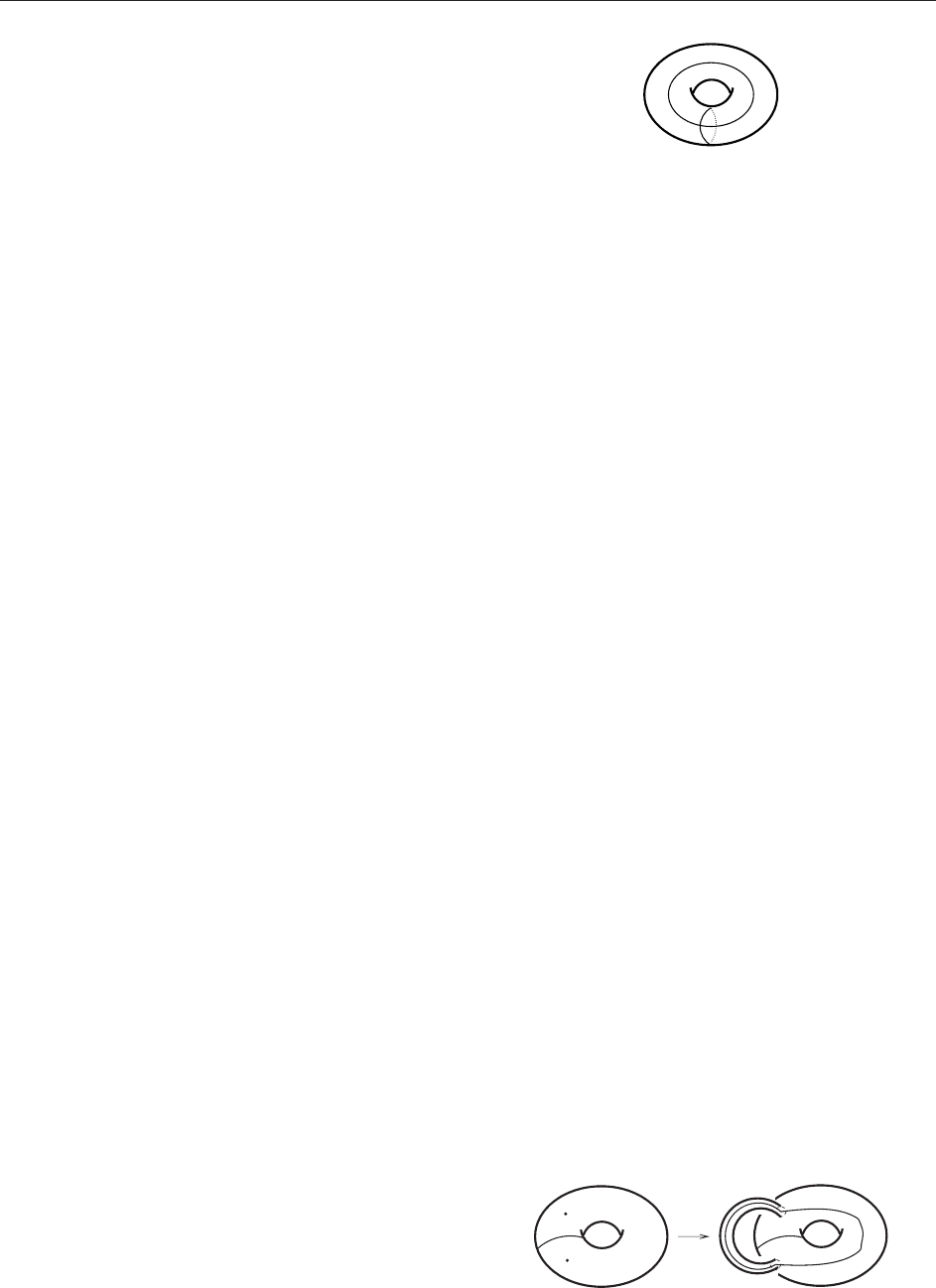
Heegaard diagram of S
3
with g = 1 is shown in
Figure 1.
To go from a doubly pointed Heegaard diagram
to a diagram of the knot complement, we remove
neighborhoods of z and w and replace them with a
tube to get a surface
0
of genus g þ 1. We also add
an additional -handle
gþ1
, which runs from z to w
in in such a way that it does not intersect the
other ’s, and then comes back over the tube. This
process is illustrated in Figure 2.
A Heegaard diagr am of S
3
K determines a
presentation of
1
(S
3
K) with one generator x
i
for each -circle and one relator w
j
for each -circle.
To find the relator w
j
, one travels along
j
,
recording each intersection with some
i
by append-
ing x
1
i
to the relator. The sign is determined by the
sign of the intersection. As an example, consider the
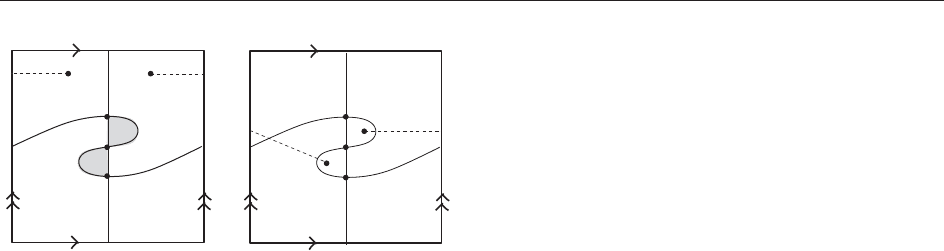
two doubly pointed diagrams of Figure 3, both of
which correspond to the same Heegaard diagram of
S
3
. (It is isotopic to the one shown in Figure 1.) The
fundamental groups of the associated knot comple-
ments can be read off from the corresponding genus-
2 Heegaard splittings. Starting from the point where
α
1
β
1
Figure 1 Heegaard splitting of S
3
corresponding to the
standard decomposition of S
3
into two solid tori.
α
2
α
1
α
1
z
w
Figure 2 Going from a doubly pointed diagram to a Heegaard
diagram of the knot complement.
Knot Homologies 211
1
intersects the left-hand side of the square and
moving to the right, we get
1
ðS
3
K
1
Þ¼hx
1
; x
2
jx
1
x
1
1
x
1
¼ 1i
1
ðS
3
K
2
Þ¼hx
1
; x
2
jx
2
x
1
x
1
2
x
1
1
x
1
2
x
1
¼ 1i
The first group is isomorphic to Z, and the knot in
Figure 3a is the unknot. The second is isomorphic to
1
of the complement of the trefoil knot, and in fact
the knot in Figure 3b is the left-handed trefoil.
The definition of C
0
(D) is based on a classi cal
method for computing the Alexander polynomial
known as the Fox calculus, which takes as its input
a presentation of
1
(S
3
K). According to Fox
calculus,
P
0
ðKÞ¼q
n
detðd
x
i
w
j
Þ
1i;jg
½13
Here d
x
i
w
j
is an element of the group ring
Z½H
1
ðS
3
KÞ ffi Z½q
2
It is determined by the following rules:
d
x
i
x
j
¼
ij
½14
d
x
i
ab ¼ d
x
i
a þjajd
x
i
b ½15
d
x
i
x
1
i
¼x
1
i
½16
where
jj:
1
ðS
3
KÞ!H
1
ðS
3
KÞffiZ ¼hq
2
i½17
is the abelianization map. The factor of q
n
is chosen
so that P
0
(K)(1) = 1andP
0
(K)(q) = P
0
(K)(q
1
).
As an exampl e, consider the two presentations
above. In the first presentation, jjsends x
1
to 1 and
x
2
to q
2
,so
d
x
1
x
1
x
1
1
x
1
¼ 1 x
1
x
1
1
þ x
1
x
1
1
¼ 1 1 þ 1
¼ 1 ½18
which is the Alexander polynomial of the unknot. If
we abelianize the relator in the second presentation,
we see that jx
1
j= jx
2
j= q
2
,so
d
x
1
x
2
x
1
x
1
2
x
1
1
x
1
2
x
1
¼ x
2
jj
x
2
x
1
x
1
2
x
1
1
þ x
2
x
1
x
1
2
x
1
1
x
1
2
½19
¼ q
2
1 þ q
2
½20
which is the Alexander polynomial of the trefoil.
When g = 1, the complex C
0
(D) is generated by
the points of
1
\
1
. These intersection points may
be naturally ident ified with the appearances of the
generator x
1
in w
1
, and thus with the monomials
appearing in d
x
1
w
1
. For example, the three mono-
mials which appear on the right-hand sides of eqns
[18] and [19] correspond, respectively, to the points
labeled p
1
, p
2
, and p
3
in Figure 3. The j-grading of
each generator is given by the exponent of q which
the corresponding monomial contributes to the
Alexander polynomial. Thus, all three generators in
Figure 3a have j-grading 0, while in Figure 3b, the
generators p
1
, p
2
,andp
3
have j-gradings 2, 0, and 2
respectively.
For general g, the monomials appearing in the
determinant of eqn [13] correspond to intersection
points of the two totally real tori =
1
g
and =
1
g
inside the symmetric product
Sym
g
. The knot Floer h omology is the Lagran-
gian Floer homology of and inside the
symplectic manifold Sym
g
( z w). The gen era-
tors of C
0
(D) are the points of \ ;the
differential is defined by counting holomorphic
disks with boundary on and . To be precise, for
x 2 \ ,
d
0
x ¼
X
2
2
ðx;yÞ;ðÞ¼1
n
z
ðÞ¼n
w
ðÞ¼0
#MðÞy ½21
Here
2
(x, y) denotes the set of homotopy classes of
maps of the strip D = {a þ ib jb 2 [0, 1]} into Sym
g
which take the right-hand boundary to and the
left-hand boundary to , and which limit to x as
b !1 and to y as b !1. () denotes the formal
dimension of the space of pseudoholomorphic disks
in this homotopy class. There is a natural action by
translation on the space of such maps, so when
() = 1 we can divide out by this action and obtain
an oriented zero-dimensional moduli space M().
Finally, by n
z
() and n
w
() we denote the intersec-
tion number of such a strip with the divisors
determined by z and w inside of Sym
g
. The
requirement that they vanish forces the strip to lie
α
1
α
1
β
1
β
1
φ
1
φ
2
p
1
p
1
p
3
p
3
p
2
p
2
w
z
z
w
(a) (b)
Figure 3 Doubly pointed Heegaard diagrams for the unknot
and the trefoil. Opposite sides of the square are identified to form
a torus. The dotted line represents
2
:
212 Knot Homologies

in Sym
g
( z w). It can be shown that, for
2
2
(x, y),
jðxÞjðyÞ¼n
z
ðÞn
w
ðÞ½22
so j(d
0
x) = j(x).
When g = 1, computing the differential amounts
to counting maps of the strip into the Heegaard
torus. This can be done algorithmically using the
Riemann mapping theorem, so computation of H
0
is
purely combinatorial. Knots of this form are called
(1,1) knots. They are one of our few windows into
the behavior of H
0
for large knots.
As an example, consider the diagram of Figure 3a.
The two shaded regions represent the domains
of classes
1
2
2
(p
1
, p
2
) and
3
2
2
(p
3
, p
2
).
The Riemann mapping theorem implies that up
to reparametrization, there is a unique holo-
morphic map of the strip into each region, so
#M(
1
) = 1 =#M(
2
). The di fferential in
C
0
(D
1
)isgivenby
d
0
ðp
1
Þ¼p
2
¼ d
0
ðp
3
Þ
d
0
ðp
2
Þ¼0
and H
0
(U) ffi Z. This reflects the fact that we could
have chosen the more efficient diagram of S
3
U
shown in Figure 1, simply by moving
1
to remove
two of the intersection points.
For comparison, consider the diagram for the
trefoil shown in Figure 3b. All three generators of
C
0
(D
2
) have different j-gradings, so we must have
d
0
0. Thus, H
0
(T) ffi Z
3
. The two disks
1
and
2
are still present, but now n
z
(
1
) = n
w
(
2
) = 1, so
neither disk contributes to the differential. This is
reflected in the fact that
1
cannot be moved to
reduce the number of intersection points without
passing through either z or w.
Deformations
In this case, finding an appropriate deformation of
C
0
(D) is simple: we just drop the condition that
n
z
() = 0 in the definition of the differential. If a
homotopy class 2
2
(x, y) contributes nontrivially
to the sum, it must have a holomorphic representative,
which necessarily intersects the divisor in Sym
g
defined by z non-negatively. Thus, n
z
() 0. From
[22], it follows that j(x) j(y) = n
z
() 0, so this
new differential has the form d
0
þ d
0
0
, where d
0
0
strictly lowers the j-grading.
The fact that the homology of C
0
(D) with respect
to the perturbed differential is Z goes back to the
knot Floer homology’s roots in Heegaard Floer
homology. By dropping the condition that
n
z
() = 0, we have effectively forgotten about the
basepoint z, and thus about the knot. The new
complex simply computes the Heegaard Floer group
c
HF(S
3
), which is isomorphic to Z. When g = 1, this
can be seen directly: if we remove the basepoint z,
any genus-1 Heegaard diagram of S
3
can be isotoped
into the standard diagram of Figure 1.
Construction of H
2
In this case, the geometric data D needed to define
the chain complex C
2
(D) is a planar diagram of
the knot, and the classical model on which the
construction of C
2
(D) is based is the Kauffman state
model for the Jones polynomial. There is a related
homology theory
~
H
2
(D), known as the unreduced
Khovanov homology, whose graded Euler character-
istic is (q þ q
1
)P
2
(K). This is the original categor-
ification of the Jones polynomial defined in
Khovanov (2000).
To construct
~
C
2
(D), we consider complete resolu-
tions of the planar diagram D. As shown in Figure 4,
there are two different ways to resolve each crossing
of D.IfD has n crossings, there will be 2
n
ways to
resolve all n, one for each vertex of the cube [0, 1]
n
.
To a vertex v, we associate the crossingless planar
diagram D
v
obtained from the corresponding reso-
lution of D. Thus, each vertex of the cube is
decorated by a 1-manifold D
v
.
If e is an edge joining vertices v
0
and v
1
(where v
0
has one more 0 coordinate than v
1
), we write
e : v
0
!v
1
, and decorat e e with a two-dimensional
cobordism S
e
from D
v
0
to D
v
1
. S
e
is a product
cobordism outside a neighborhood of a single
crossing, where it is the one-handle cobordism
between the 0-resolution and the 1-resolution. The
resulting cobordism is necessarily composed of
a union of product cobordisms (cylinders) together
with a single nontrivial cobordism (a pair of pants).
Thus, starting from D, we have constructed an
n-dimensional cube whose vertices are decorated by
1-manifolds and whose edges are decorated by
cobordisms between them . This is the cube of
resolutions of D.
The next step in the construction of
~
C
2
(D)isto
apply a graded (1 þ 1)-dimensional TQFT A to the
cube of resolutions. A is a functor which associates
to each 1-manifold X a group A(X), and to each
two-dimensional cobordism W : X
1
!X
2
a homo-
morphism A(W):A(X
1
) !A(X
2
). If we apply A to
all the manifolds and cobordisms of the cube of
0
1
Figure 4 0- and 1-resolutions of a crossing.
Knot Homologies 213
resolutions, we obtain a new cube, decorated with
groups and cobordisms between them. This process
is summarized in Table 1.
We can now describe the chain complex
~
C
2
(D).
As a group,
~
C
2
ðDÞ¼
M
v
AðD
v
Þ½23
where the sum runs over all vertices of the cube of
resolutions. For x 2A(D
v
), the differential is given by
d
2
x ¼
X
e:v!v
0
ð1Þ
sðeÞ
AðS
e
ÞðxÞ½24
The signs in this sum are determined by assigning a
sign (1)
s(e)
to each edge e in such a way that every
two-dimensional face of the cube has an odd
number of signs on its edges. (This ensures that
d
2
= 0.) There are many ways to do this, but they all
result in isomorphic complexes.
The homological grading i on
~
C
2
(D) is easily
determined. For x 2A(D
v
), we set i(x) = i(v) c(D),
where i(v) is the sum of all the coordinates of v, and
c(D) is a constant. Clearly, i(d
2
x) = i(x) þ 1. In order
to have invariance, it turns out that c(D) must be
chosen to be equal to the number of negative
crossings in D.
It remains to specify the TQFT A. At the level of
groups, A(S
1
) is a free abelian group of rank 2:
AðS
1
Þ¼A ¼h1; Xi½25
General principles then imply that
A
a
n
S
1
¼ A
n
½26
To specify the maps induced by cobordisms, it is
enough to descr ibe the maps associated to the two
pairs of pants shown in Figure 5. They are given by
mð1 1Þ¼1
ð1Þ¼1 X þ X 1 ½27
mð1 XÞ¼mðX 1Þ¼X
ðXÞ¼X X ½28
mðX XÞ¼0 ½29
Note that the multiplication m makes A into a
commutative ring isomorphic to Z [X]=(X
2
).
A is a graded TQFT. In other words, there is a
grading q on A and its tensor products, determined by
qð1Þ¼1
qða bÞ¼qðaÞþqðbÞ
½30
qðXÞ¼1 ½31
From eqns [27]–[29], it is easy to see that
qðmða bÞÞ ¼ qða bÞ1
qððaÞÞ ¼ qðaÞ1
½32
If we define j(x) = k(D) þ q(x) þ i(x), it follows that
j(d
2
x) = j(x). Taking the graded Euler characteristic
gives
ð
~
C
2
ðDÞÞ ¼ q
kðDÞ
X
v
ðqÞ
iðvÞ
ðq þ q
1
Þ
n
v
½33
where n
v
is the number of components of D
v
.Ifwe
define k(D) to be the writhe of D, this is preci sely
Kauffman’s formula for the unnormalized Jones
polynomial.
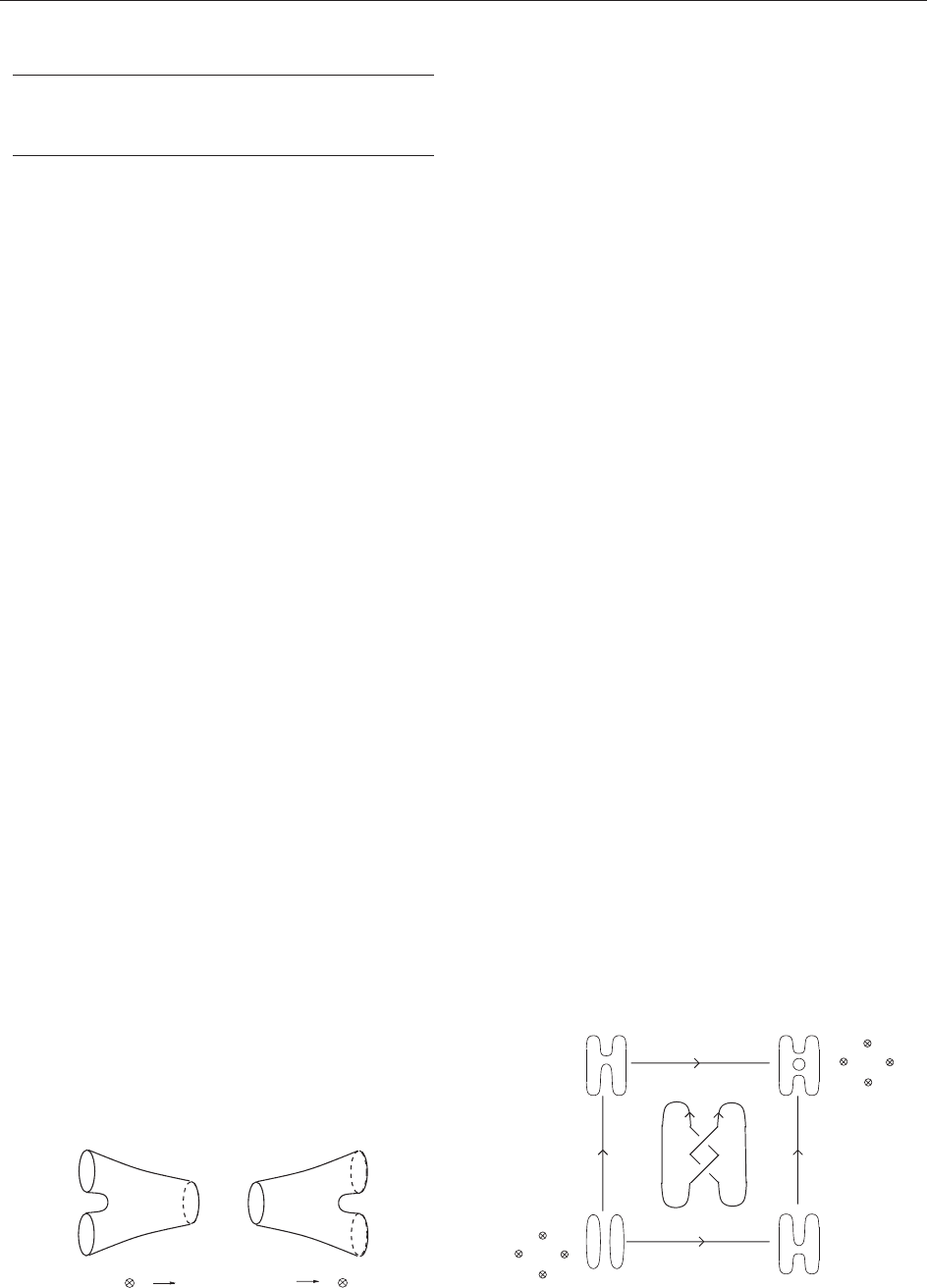
Figure 6 illustrates
~
C
2
(D) for a simple two-
crossing link. The figure shows the original link (in
the center), the cube of resolutions, and basis vectors
for
~
C
2
(D), together with their j-gradings. We leave it
to the reader to check that the homology
~
H
2
(L)is
four dimensional, supported in j-gradings 1 and 3 at
the vertex labeled 00, and in gradings 5 and 7 at the
vertex labeled 11.
Table 1 Summary of cube of resolutions
Vertex v
!
1- manifold D
v
!
Group A(D
v
)
Edge
!
Cobordism
!
Homomorphism
e : v
1
!v
2
S
e
: D
v
1
!D
v
2
A(S
e
) : A(D
v
1
) !A(D
v
2
)
Am : A A
Δ : A
A A
Figure 5 Maps induced by pairs of pants.
X
X
11
X1
X
1
X
1
X
X
11
X1
X
1
X
1
00
01 11
10
j
= 1
j
= 3
j
= 5
j
= 3
j
= 5
j
= 7
j
= 5
j
= 3
j
= 5
j
= 3
Figure 6 The cube of resolutions for the Hopf link.
214 Knot Homologies

To get the reduced chain complex C
2
(D), we must
divide the graded Euler characteristic by a factor of
(q þ q
1
). This is accomplished by choosing a
marked point on K and requiring that for each
resolution D
v
, the vector associated to the circle
containing the marked point lie in the subspace of A
spanned by X.IfD is a diagram of a knot, the
resulting homology H
2
(K) is independent of the
choice of marked poin t. For links, H
2
(L) depends on
the component of the link on which the marked
point lies.
Deformations
Deformations in the N = 2 theory are constructed
using a technique introduced by E S Lee. The idea is
to replace the graded TQF T A wi th a filtered TQFT
A
0
. As a group, we still have A(S
1
) = A, but the
multiplication and comultiplication maps are per-
turbations of those for A:
m
0
ð1 1Þ¼1
0
ð1Þ¼1 X þX 1 r1 1 ½34
m
0
ð1 XÞ¼m
0
ðX 1Þ¼X
0
ðXÞ¼X X þs1 1 ½35
m
0
ðX XÞ¼rX þ s ½36
The new terms involving r and s have q gradings
strictly greater than the terms which are shared with
eqns [27]–[29]. Thus, the differential defined by
replacing m and by m
0
and
0
will be a
perturbation of the original differential on
~
C
2
(D).
The simplicity of the homol ogy with respect to the
new differential depends on the fact that when the
polynomial X
2
rX s has simple roots, the TQFT
A
0
decomposes as a direct sum of two one-
dimensional TQFTs. This implies that for a knot,
the deformed homology
~
H
0
2
(K) decomposes as a
direct sum of two copies of H
1
(K). This group is
always isomorphic to Z,so
~
H
0
2
(K) ffi Z Z.Ifs = 0,
the same strategy can be used to define deformations
of the reduced chain complex C
2
(D). In this case, we
find that the deformed homology is isomorphic to a
single copy of Z.
See also: Floer Homology; Gauge Theory: Mathematical
Applications; The Jones Polynomial; Knot Theory and
Physics; Topological Quantum Field Theory: Overview.
Further Reading
Bar-Natan D (2002) On Khovanov’s categorification of the Jones
polynomial. Algebraic and Geometric Topology 2: 337–370.
Crowell R and Fox R (1963) Introduction to Knot Theory.
Boston: Ginn and Co.
Kauffman L (1987) State models and the Jones polynomial.
Topology 26: 395–407.
Khovanov M (2000) A categorification of the Jones polynomial.
Duke Mathematical Journal 101: 359–426.
Ozsva´th P and Szabo´ Z (2004) Heegaard diagrams and
holomorphic disks. In: Donaldson S, Eliashberg Y, and
Gromov M (eds.) Different Faces of Geometry, pp. 301–348.
New York: Kluwer/Plenum.
Ozsva´th P and Szabo´ Z (2004) Holomorphic disks and
topological invariants for closed three-manifolds. Annals of
Mathematics 159: 1027–1158.
Ozsva´th P and Szabo´ Z (2004) Holomorphic disks and knot
invariants. Advances in Mathematics 186: 58–116.
Rolfsen D (1976) Knots and Links, Mathematics Lecture Series,
No. 7. Berkeley: Publish or Perish.
Viro O (2004) Khovanov homology, its definitions and ramifica-
tions. Fundamentals of Mathematics 184: 317–342.
Knot Invariants and Quantum Gravity
R Gambini, Universidad de la Repu
´
blica, Montevideo,
Uruguay
J Pullin, Louisiana State University, Baton Rouge, LA,
USA
ª 2006 Elsevier Ltd. All rights reserved.
Introduction
As in all other physical theories, one expects that
gravitational phenomena will ultimately be ruled by
quantum mechanics. This requires to consider the
quantization of the best available theory of gravity,
namely Einstein’s general relativity. This problem has
been considered since the 1930s (see Loop Quantum
Gravity). The application of the rules of quantum
mechanics to general relativity is immediately problem-
atic. Unlike other physical interactions, general
relativity describes gravitational phenomena through a
distortion of spacetime rather than through a field living
in spacetime. Therefore, its quantization is bound to be
very different from that of other physical theories. In
particular, the well-established framework of perturba-
tive quantum field theory, used with remarkable success
in describing electroweak and strong interactions (in the
latter case at least in certain regimes), runs into trouble
when applied to general relativity. At present, it is not
clear if this is a fundamental problem or if there might
exist an implementation of perturbative quantum field
theory that works well in the gravitational case. On the
Knot Invariants and Quantum Gravity 215

other hand, there exist examples of field theories where
perturbative methods fail but that nevertheless can be
quantized. This suggests that the consideration of
nonperturbative techniques in the quantization of the
gravitational field could be a promising avenue.
In particular, canonical quantization methods
appear attractive for attempting a nonperturbative
quantization of gravity. Canonical methods force
the introduction, in a clear way, of a Hilbert space
of states and definition of the quantum operators of
interest. The application of canonical methods to
classical general relativity was pioneered by Dirac
and Bergmann in the late 1950s. During the 1960s,
the resulting canonical theories were considered in a
quantum setting by DeWitt. At the time it appeared
that making progress in the canonical quantization
of general relativity was going to be quite a
challenge. In particular, the canonical theory has
constraints, which have to be implemented as
operator identities quantum mechanically. The
wave functions were functionals of the spatial metric
of spacetime. One of the operator identities to
be satisfied implies that the wave functions only
depend on properties of the spatial metric that
are invariant under spatial diffeomorphisms. This
is a direct consequence of general relativity being
a theory that is independent of coordinate choice
since a diffeomorphism changes the assignment of
coordinates to points in the manifold. Finding such
wave functions already presented a challenge, since
there is no well-grounded mathematical theory of
functionals of diffeomorphism-invariant classes of
metrics. Moreover, the other operator identity to be
imposed, known as the Hamiltonian constraint or
Wheeler–DeWitt equation, was a nonpolynomial
complicated operator equation that does not admit
a simple geometrical interpretation and needs to be
regularized. Since one does not have a background
metric to rely upon, traditional regularization
techniques of quantum field theory are not suitable
to deal with the Hamiltonian constraint.
These difficulties severely hampered development
of canonical methods for the quantization of general
relativity for approximately two decades. The
situation started to change when Ashtekar noticed
that one could choose a different set of variables
to describe general relativity canonically. Instead of
using as variable the spatial metric q
ab
, Ashtekar
chooses to use a set of (densitized) frame fields
~
E
a
i
.
The relationship between the metric and the
densitized frames is det (q
ab
)q
ab
=
~
E
a
i
~
E
b
i
and we are
assuming the Einstein summation convention, that
is, the index i is summed from 1 to 3 (such an index
labels which vector in the triad one is referring to).
The resulting theory has an additional symmetry
with respect to usual general relativity, in the sense
that it is invariant under the choice of frame. This
symmetry operates on the index i as if it were
an SO(3) symmetry. As canonical momenta the
usual choice is to pick the extrinsic curvature of the
3-geometry. Ashtekar chooses a variable related to it
that behaves under frame transformations as an
SO(3) connection, A
i
a
. The resulting theory is there-
fore cast in terms of a canonical pair (
~
E
a
i
, A
i
a
), with i
an SO(3) index. One can therefore consider the
canonical pair as that of a Yang–Mills theory
associated with the SO(3) group. In fact, associated
with the extra symmetry under triad rotations the
theory has a new set of constraints that take
the form of a Gauss law, D
a
~
E
a
i
= 0 with D
a
the
covariant derivative formed with the connection A
i
a
.
This allows us to view the phase space of a Yang–
Mills theory as the kinematical arena on which to
discuss quantum gravity. The theory is of course
different from the Yang–Mills theory. In particular,
it still has constraints that imply that it is invariant
under spacetime diffeomorphisms. In the canonical
picture, these constraints appear asymmetrically as
one constraint is associated with time evolution
(‘‘Hamiltonian con straint’’) and a set of three
constraints is associated with spatial diffeomorph-
isms (‘‘diffeomorphism constraint’’).
If one quantizes the theory starting from the
Ashtekar formulation, given the resemblance with
Yang–Mills theory, the natural choice for a represen-
tation of the quantum wave functions is to consider
wave functions of the connection [A]thatare
invariant under SO(3) transformations. Such a repre-
sentation is known as ‘‘connection representation.’’
There is significant experience in Yang–Mills theory in
constructing such wave functions. In particular, it is
known that if one considers the parallel transport
operator defined by a connection around a closed
curve (holonomy) and one takes its trace (‘‘Wilson
loop’’), the resulting object is invariant under SO(3)
transformations. What is more important, the set of
traces of holonomies along all possible closed loops is
an overcomplete basis for all gauge-invariant func-
tions. More recently, it has been shown that one can
construct a less redundant complete basis using
techniques from spin networks. We will discuss later
on how to do this.
Since any gauge-invariant functional can be
expanded in the basis of Wilson loops, one can
choose to represent it through the coefficie nts of
such an expansion. These coefficients are functions
of the curve upon which the corresponding element
of the basis of Wilson loops is based. The
representation of wave functions in terms of such
coefficients is called ‘‘loop representation.’’ Wave
216 Knot Invariants and Quantum Gravity