
Francoise J.-P., Naber G.L., Tsun T.S. (editors) Encyclopedia of Mathematical Physics
Подождите немного. Документ загружается.


methods have been applied to significantly simplify
the proofs and obtain new perturbative results that
previously had been completely beyond reach.
Many such applications, that are outside the scope of
this article, are described in Bourgain (2004).In
particular, new results on the construction of quasiper-
iodic solutions in Melnikov problems and nonlinear
PDEs, obtained by using certain ideas developed for
nonperturbative quasiperiodic localization (e.g., the
theory of semialgebraic sets), are presented there.
Other results in this group contain localization for the
skew-shift model by Bourgain–Goldstein–Schlag, almost
periodicity for the quantum kicked-rotor model by
Bourgain and Bourgain–Jitomirskaya, and localization
forpotentialsinhigherGevrey classes by S Klein.
The main goal in a nonperturbative method is to
obtain exponential off-diagonal decay for the matrix
elements of the Green’s function of box-restricted
operators along with subexponential bounds on the
distance from the spectrum of such box restrictions
to a given energy. From that result one can obtain
localization through elimination of energy via an
argument involving complexity bounds on semialge-
braic sets (see Bourgain (2004)).
A nonperturbative way to achieve the desired
Green’s function estimates uses Cramer’s rule to
represent the matrix elements of the resolvent. Then,
in the one-dimensional (in space) case it is often
possible to obtain the estimates from the positivity of
Lyapunov exponents: uniformly for the numerator,
and from large deviation bounds for the subharmonic
functions for the denominator. This is done in one
step for a sufficiently large scale (see the subsection
‘‘CorollariesofpositiveLyapunovexponents’’)
A perturbative way consists of establishing the
desired estimates in a multiscale scheme: namely, the
estimates are proved outside a set of parameters of
(subexponentially) decaying (in the size of the box)
measure. Moreover, this set should be shown to have
a semialgebraic description, in order to make possible
sublinear upper bounds on the number of times a
trajectory of a given phase (under the underlying
rotation or other ergodic transformation of the torus)
hits the ‘‘forbidden’’ set. This, plus certain subhar-
monic function arguments, allows passage to a larger
scale through a repeated use of the resolvent identity.
An application that is most relevant to the current
article is localization for a ‘‘true’’ d > 1 situation.
The best currently available result is the following
very recent theorem (Bourgain 2005):
Theorem 10 Let d = b and let f be real analytic on
T
d
such that for all i = 1, ..., d and (
1
, ...,
i1
,
iþ1
, ...,
d
) 2 T
d1
, the map
i
7!vð
1
; ...;
i
; ...;
d
Þ
is a nonconstant function of
i
2 T. Then for any
>0 there is (f , ) s.t. for >(f , ) there is
(, f ) T
d
with mes() < so that for !=2
operator [1] with V
n
= f (n
1
!
1
, n
2
!
2
) has Anderson
(and dynamical) localization.
This result was obtained previously, for d = 2
only, by Bourgain, Goldstein, and Schlag. There
were some serious purely arithmetic difficulties that
prevented an extension of this result to higher
dimensions. In the previous results on localization
there were two major steps: estimations on the
Green’s function for fixed energy and elimination of
energy. The main difficulty in the multidimensional
case lies in establishing the sublinear bound
described above, that enters in the first step. It is
for this bound that an arithmetic condition on ! was
needed. The condition used was to guarantee that
the number of (n
1
, n
2
) 2 [1, N]
2
such that (n
1
!
1
,
n
2
!
2
)(mod Z
2
) 2 S is bounded from above by N
for
some <1, uniformly for all semialgebraic sets S of
degree D, with D
0
=D = o(1=N) and with the
measure of all horizontal and vertical sections S
x
satisfying log mesS
x
= o( log 1=N). This condition
roughly means that too many points close to an
algebraic curve of a bounded degree would force it
to oscillate more than it should. Such a statement is
essentially two dimensional and not extendable to
d 3. In Theorem 10, Bourgain circumvents it by
using from the beginning the theory of semialgebraic
sets to eliminate energy and the translation variable
to get conditions on ! (that depend on the potential)
already in the first step.
Dynamical Localization
Anderson localization does not in itself guarantee
absence of quantum transport, or nonspread of an
initially localized wave packet, as characterized, for
example, by boundedness in time of moments of the
position operator. This was first observed in del Rio
et al. (1996), where a rather artificial example of
coexistence of exponential localization and quantum
transport was constructed. However, such phenom-
ena also happen in models of interest to physicists
such as the random dimer model. Considering for
simplicity the second moment
hx
2
i
T
¼
1
T
Z
T
0
X
n
j
t
ðnÞj
2
n
2
dt
we will say that H exhibits dynamical localization
if h x
2
i
T
< const. We will say that the family
{H
}
2T
b
exhibits strong dynamical localization if
R
T
b
d sup
t
hx
2
i
t
< const. We note that the results
mentioned below will hold with more restrictive
Localization for Quasiperiodic Potentials 337

definitions of dynamical localization (involving the
higher moments of the position operator) as well.
Dynamical localization implies pure point spectrum
by RAGE theorem so it is a strictly stronger notion.
It turns out that nonperturbative methods allow
for such dynamical upgrades as well. For the almost-
Mathieu operator, strong dynamical localization
holds throughout the regime of localization. It was
shown by Bourgain and Jitomirskaya that in
Theorems 4 and 6 as well as some other localization
results, dynamical localization also holds (see
Bourgain (2004)). However, methods that require
elimination of certain frequencies based on implicit
conditions currently do not provide sufficient infor-
mation to obtain strong (i.e., averaged) dynamical
localization, like what was done in the almost-
Mathieu case.
Quasiperiodic Localization and Cantor
Spectrum
A remarkable feature of quasiperiodic operators
with b = d = 1 is their tendency to have Cantor
spectrum. In particular, it was conjectured that all
almost-Mathieu operators (for all nonzero couplings
and all irrational frequencies) have Cantor spec-
trum. This conjecture became known as the Ten
Martini problem. In a significant recent develop-
ment (Puig 2004), it was shown that for Diophan-
tine frequencies Cantor structure of the spectrum
follows from localization for phase = 0, with
corresponding eigenvalues being the boundaries of
noncollapsed gaps. The key idea here is that for
energies dual to eigenvalues of H
0
, corresponding to
localized eigenfunctions, the rotation number of the
transfer-matrix cocycle is of the form k!(modZ),
thus they are the ends of the gaps (possibly
collapsed). However, a collapsed gap in this case
would correspond to reducibility of the system to
the identity which can be shown to contradict the
simplicity of pure point spectrum for the dual
model. Since those energies form a dense subset of
the spectrum the result follows. The same idea
works, thus establishing Cantor spectrum, for
potentials that are generic in certain sense. Localiza-
tion also played an important role in the final proof
of the Ten Martini conjecture, for all irrationals
(Avila and Jitomirskaya 2005). It can be shown that
proving localization for a large set of phases allows
one to conclude reducibility of the transfer-matrix
cocycle for the dual model, for a large set of
energies, and this in turn can be shown to contradict
the presence of an interval in the spectrum.
Acknowledgement
The research work of this author was partially
supported by NSF grant DMS-0300974.
See also: Multiscale Approaches; Quantum Hall Effect;
Quasiperiodic Systems; Schro
¨
dinger Operators; Stability
Theory and KAM.
Further Reading
Avila A and Jitomirskaya S (2005) The ten martini problem.
Preprint.
Bourgain J (2003) Positivity and continuity of the Lyapunov
exponent for shifts on T
d
with arbitrary frequency vector and
real analytic potential. Preprint.
Bourgain J (2004) Green’s Function Estimates for Lattice
Schro¨ dinger Operators and Applications. Annals of Mathema-
ties Studies, vol. 158. xþ173 pp. Princeton, NJ: Princeton
University Press.
Bourgain J (2005) Anderson localization for quasi-periodic lattice
Schro¨ dinger operators on Z
d
, d arbitrary. Preprint.
Bourgain J and Goldstein M (2000) On nonperturbative localiza-
tion with quasiperiodic potential. Annals of Mathematics 152:
835–879.
del Rio R, Jitomirskaya S, Last Y, and Simon B (1996) Operators
with singular continuous spectrum: IV. Journal d’Analyse
Mathematique 69: 153–200.
Eliasson LH (1998) Reducibility and point spectrum for linear
quasiperiodic skew products. Doc. Math, Extra volume ICM
1998 II, 779–787.
Jitomirskaya S (1999) Metal–insulator transition for the almost
Mathieu operator. Annals of Mathematics 150: 1159–1175.
Last Y (2005) Spectral theory of Sturm–Liouville operators on
infinite intervals: a review of recent developments. In: Sturm–
Liouville Theory, pp. 99–120. Basel: Birkhauser.
Puig J (2004) Cantor spectrum for the almost Mathieu operator.
Communications in Mathematical Physics 244: 297–309.
Simon B (2000) Schro¨ dinger operators in the twenty-first century.
In: Mathematical Physics 2000. pp. 283–288. London:
Imperial College.
338 Localization for Quasiperiodic Potentials

Loop Quantum Gravity
C Rovelli, Universite
´
de la Me
´
diterrane
´
e et Centre de
Physique The
´
orique, Marseilles, France
ª 2006 Elsevier Ltd. All rights reserved.
Introduction
Loop quantum gravity (LQG) is a mathematical
formalism that defines a tentative quantum theory
of spacetime. Equally, the formalism provides a
description of the gravitational field in regimes in
which its quantum properties cannot be neglected.
The distinctive feature of LQG is to be a quantum
field theory consistent with general relativity.
According to general relativity, the physical fields
that form the world do not live on a background
spacetime. Rather, these fields make up spacetime
themselves (‘‘background independence’’). Accord-
ingly, the quanta of a quantum field theory compatible
with this principle – the s-knots described below – do
not live on a background spacetime: rather, they
themselves form physical spacetime.
This physical idea is realized in the formalism by
the gauge invariance under active diffeomorphisms
of the manifold on which the fields are originally
defined (‘‘diffeomorphism invariance’’). Such gauge
invariance renders the localization of the field’s
excitations on the manifold physically irrelevant.
LQG implements these physical motivations by
merging two traditional lines of thinking in theoretical
physics. The first is the long-standing idea that gauge
fields are naturally understood in terms of variables
associated to lines (holonomies of the gauge connec-
tion, Wilson loops, Faraday lines, ...). This idea can be
traced to Faraday’s initial intuition that gave birth to
modern field theory: physical fields are real entities
formed by lines. The second is the background-
independent canonical or covariant quantization of
general relativity developed by following the ideas of
Wheeler, DeWitt, and Hawking. Each of these two
lines of research has encountered serious obstructions,
but the two turn out to solve each others’ difficulties:
the formulation in terms of holonomies renders the old
ill-defined background-independent quantum gravity
well defined; conversely, background independence
cures the divergences associated to the Wilson loop
basis.
The formalism of LQG can be separated into two
parts. A kinematics, describing the quantum proper-
ties of space, and a dynamics, describing its
evolution. Here we outline the LQG kinematics,
and we give only the main result of the LQG
dynamics.
LQG can be extende d to include standard matter
couplings such as fermions and Yang–Mills fields. It
finds numerous applications, for instance, in early
cosmology, astrophysics and black hole thermo-
dynamics (see Black Hole Mechanics, Quantum
Cosmology).
So far no empirical evidence supports the physical
correctness of this – nor of any other – tentative
theory of quantum gravity.
General Relativity in Canonical Form
Classical general relativity is the field theory
describing the gravitational field and the structure
of physical spacetime. It is a well-established
physical theory, strongly supported empirically.
In its Riemannian version, the theory can be
written in canonical form in terms of two fields on a
three-dimensional (3D) manifold with coordinates
x
a
(a = 1, 2, 3): a 2-form E = E
a
abc
dx
a
dx
b
, called the
‘‘triad field’’ and a 1-form A = A
a
dx
a
, called the
‘‘gravitational connection’’ (
abc
is the totally anti-
symmetric tensor density). Both take values in the
su(2) algebra, and they satisfy the three ‘‘constraint’’
equations
G¼D
a
E
a
¼ 0 ½1
C
a
¼ tr½F
ab
E
a
¼0 ½2
C ¼ tr½F
ab
E
a
E
b
¼0 ½3
D
a
is the SU(2) covariant derivative defined by the
connection A, F
ab
is the SU(2) curvature of A, and
the trace is on su(2).
E and A are canonically conjugate: their Poisson
brackets are {E
a
(x), A
b
(y)} = 8Gc
3
a
b
3
(x, y); where
G is the Newton constant, c is the speed of light,
a
b
is
the Kronecker delta, and
3
(x, y) is the Dirac-delta on
, which is a scalar density in x. The Poisson brackets
of G with the fields define their SU(2) gauge
transformations: E transforms in the adjoint repre-
sentation and A transforms as a connection. The
Poisson brackets of C
a
(more precisely, of an
appropriate linear combination of C
a
and G)with
the fields determine their transformation under a
diffeomorphism of : E transforms as a 2-form and A
as a 1-form. The Poisson brackets of C with the fields
generate their coordinate time evolution. If the t
derivatives of the fields E(x
a
, t)andA(x
a
, t)are
given by their Poisson brackets with (the 3D integral
of) C, then (assuming that the determinant
E =
ffiffiffiffiffiffiffiffiffiffiffiffiffiffiffiffiffiffiffiffiffiffiffiffiffi
det tr[E
a
E
b
]
p
does not vanish) the metric field
Loop Quantum Gravity 339
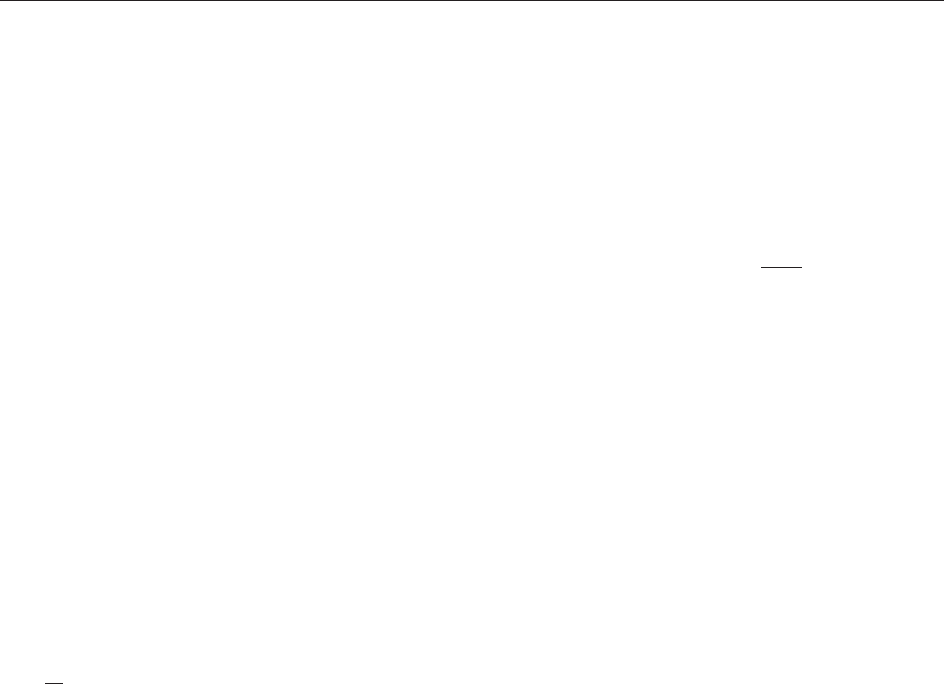
g
00
= 1, g
a0
= 0, g
ab
= tr[E
a
E
b
]=E is a general solution
of the Riemannian Einstein equations in a fixed gauge.
The physical Lorentzian theory can be obtained in
this formalism in two ways. Either by adding an
appropriate term to eqn [3], or by taking A in
sl(2,C) and satisfying a suitable reality condition.
(For more details, see Canonical General Relativity.)
Spin Network and s-Knot States
LQG can be defined as a Schro¨ dinger quantization
of the canonical formalism described above. The
space of the quantum states is defined as a Hilbert
space K of Schro¨ dinger wave functionals [A]ofthe
gravitational connection. The nontrivial aspect of
this construction is the definition of a scalar product
invariant under the two kinematical gauge invar-
iances of the theory: the local SU(2) and the
diffeomorphisms transformations generated by the
constraints [1] and [2]. The state space K is defined
as follows (see Quantum Geometry and its Applica-
tions for an essentially equivalent construction).
Given an su(2) connection A and an oriented path
: s 2 [0, 1] ! x
a
(s) 2 , recall that the ‘‘holonomy’ ’
U[A, ]ofA along is the element of SU(2) defined by
d
ds
U½A;ðsÞþ
_
a
ðsÞA
a
ððsÞÞU½A;ðsÞ¼0 ½4
U½A;ð0Þ¼1; U½A;¼U½A;ð1Þ½5
where
_
a
(s) dx
a
(s)=ds is the tangent to the path.
The solution of this equation is usually written in
the form
U½A;¼Pe
R
A
½6
where the path ordered P is understood as acting on
the power series expansion of the exponential.
Let A be the space of the smooth connections A on
. (For technical reasons, it is convenient to consider
smooth fields A defined everywhere in except at
most at a finite number of points, and the group
Diff
of the ‘‘extended diffeomorphisms’’ defined by
the continuous invertible maps : ! that are
smooth everywhere in except at most at a finite
number of points.) A graph is an ordered collection
of smooth oriented paths,
l
, denoted as links, with
l = 1, ..., L, where the links overlap only at their
endpoints, called nodes. Given a graph and a
smooth, Haar-integrable complex function f : U 2
(SU(2))
L
7!f (U) 2 C, the couple (, f ) defines the
(‘‘cylindrical’’) functional of A
; f
½A¼f ðU½A; Þ ½7
U½A; ðU½A;
1
; ...; U½A;
L
Þ ½8
Let L be the linear space of all functionals
, f
[A],
for all and f. L is dense (in an appropriate sense) in
the space of all continuous functionals on A.
An SU(2) and Diff
invariant scalar product can
be defined in L as follows. If two functionals
, f
[A]and
, g
[A] are defined by the same graph
, define
h
; f
j
;g
i
Z
dU f ðUÞgðUÞ½9
where dU is the Haar measure on (SU(2))
L
. The
extension to functionals defined on different graphs
is obtained by observing that (, f )and(
0
, f
0
) define
the same functional if contains
0
and f is
independent of the variables in but not in
0
.It
follows that any two given functionals
0
, f
0
and
00
, g
00
can be written as functionals
, f
and
, g
with the same graph , where is obtained from the
union of
0
and
00
. Using this, the scalar product [9]
is defined for any two functionals in L:
h
0
; f
0
j
00
;g
00
ih
;f
j
;g
i½10
Standard completion in the Hilbert norm defines the
kinematical Hilbert space K of LQG. L is dense in K
and defines the Gelfand triple LKL
. K carries
a natural unitary representation of the group of local
SU(2) representations and a natural unitary repre-
sentation U
of the group of the extended diffeo-
morphism of . These two properties are nontrivial;
they represent the main physical motivation for the
definition of the scalar product. The SU(2)-invariant
subspace of K is a proper subspace K
0
.
An orthonormal basis in K
0
can be defined using
the Peter–Weyl theorem. The basis states are labeled
by a graph , by the assignment of a nonvanishing
spin j
to each link 2 and by the assignment of a
basis element i
n
in the space of the intertwiners
(invariant tensors in the tensor product of the
representations space of the adjacent links) at each
node n of . The triple S = (, j
, i
n
) is called an
imbedded spin network. The quantum state
S
[A] = hAjSi in K
0
labeled by the spin network
S = (, j
, i
n
) is the cylindrical function obtained by
contracting the represent ation matrices of the
holonomies U(A, ), in the representations j
, with
the invariant tensors at the nodes.
The diffeom orphism-invariant state space K
diff
is
the SU(2) and diffeomorphism invariant subspace of
L
. It is the (closure of the) image of the map
P
diff
: L!L
defined by
ðP
diff
Þð
0
Þ¼
X
00
¼U
h
00
;
0
i8;
0
2K ½11
340 Loop Quantum Gravity
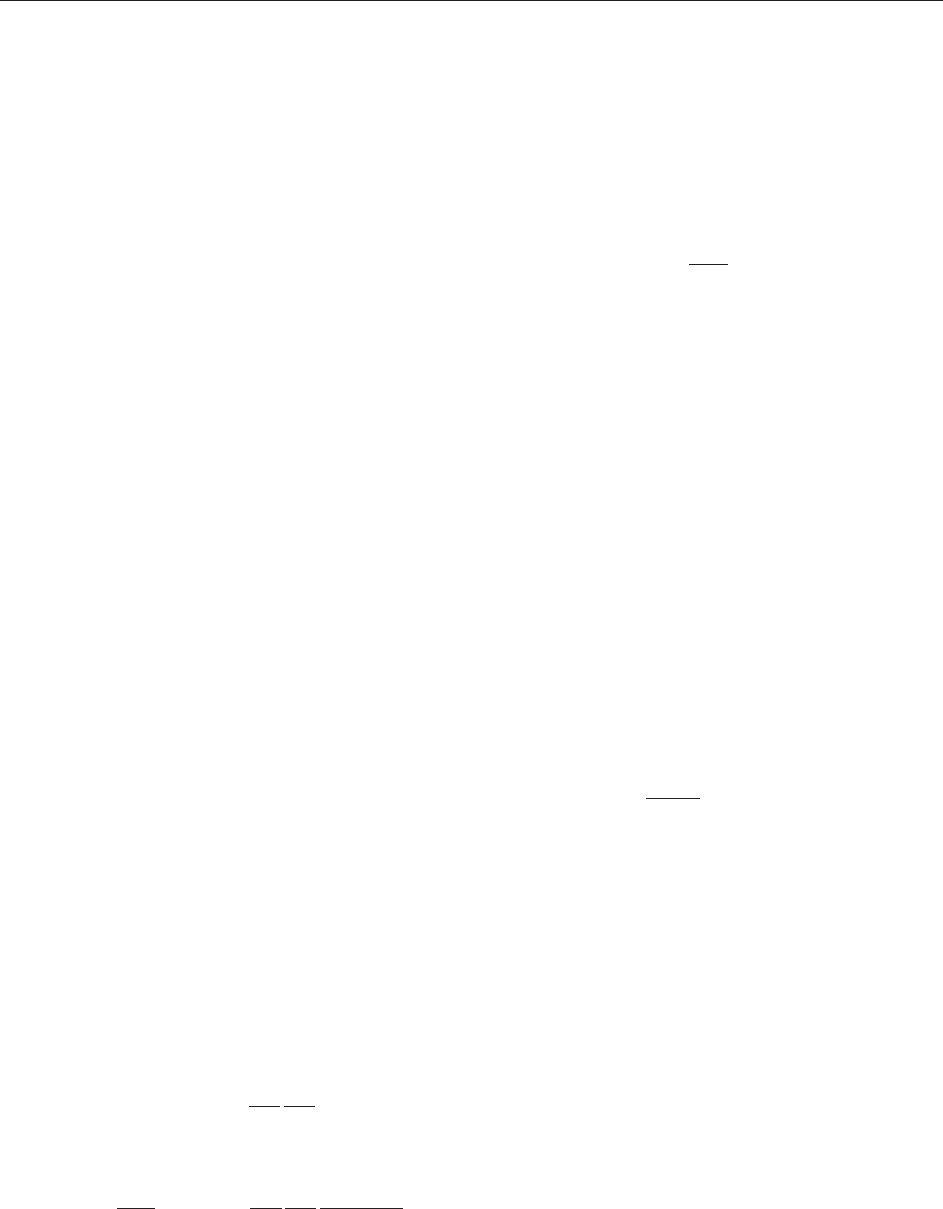
The sum is over all states
00
in L for which there
exists a diffeomorphism such that
00
= U
; this
is a finite sum. The scalar product on this image is
naturally defined by
hP
diff
S
; P
diff
S
0
i
K
diff
ðP
diff
S
Þð
S
0
Þ½12
The space K
diff
obtained in this manner is separable.
The images jsi= P
diff
jSi of the spin network states
are called s-knot states. They span K
diff
. The y are
determined only by the diffeomorphism equivalence
class s of the spin network S. Namely, by an abstract
(non-imbedded) knotted graph, colored with spins
and intertwiners. These colored knots are called
s-knots or abstract spin networks. The s-knot states
have a straightforward physical interpretation as
quantum excitations of space, discussed below.
Operators and Quanta of Space
The state space defined abo ve carries a quantum
representation of classical observables of general
relativity. The classical quantity U[A, ], a function
of the field variable A , acts naturally as a multi-
plicative operator on K. Thus, K provides a
Schro¨ dinger functional repre sentation [A] of quan-
tum gravity, which diagonalizes the (holonomy of
the) gravitational connection. The two constraints
[1] and [2] generate SU(2) gauge and diffeomorph-
ism transformations on A. The corresponding
transformations on the Schro¨ dinger functional states
[A] are given by the unitary representations
mentioned above. The quantum implementation of
the two constraint equations [1] and [2], following
Dirac’s theory of constrained quantum systems, is
the requirement of invariance under these trans for-
mations. The space K
diff
is the solution to these
requirement.
The triad field operator E can be defined only if
suitably smeared. Since E is a 2-form, its geometri-
cally natural smearing is with a 2D surface. (The
1-form field A is smeared over a line in U[A, ].)
Given a finite 2D surface S : = (
1
,
2
) 7!x
a
() 2 ,
the smeared field
E½S ¼
Z
S
E ¼
Z
d
2
abc
@x
a
@
1
@x
b
@
2
E
c
ðxðÞÞ ½13
is quantized by the functional derivative operator
E½S ih
8G
c
3
Z
d
2
abc
@x
a
@
1
@x
b
@
2
A
c
ðxðÞÞ
½14
This operator is well defined on K and the quantum
operators E[S] and U[A, ] define a linear represen-
tation of the Poisson algebra of the corresponding
classical quantities. Thus, they define a quantization
of the kinematics of general relativity. Notice that in
a general covariant quantum field theory field
operators can be well defined even if smeared on
low-dimensional regions, while in conventional
quantum field theory, these operators need to be
smeared over 3D or 4D regions.
A simple calculation shows that if S and
intersect once,
E
v
½SU½A;¼i h
8G
c
3
U½A;
1
vU ½A;
2
½15
where v 2 su(2), we have written E
v
= tr[vE],
1, 2
are the two paths into which is partitioned by the
surface, and the sign is determined by the relative
orientation of S and . More generally, E[S]U[A, ]
is a sum of one such term per intersection between S
and .
Composite operators can be constructed in terms
of these operators. In particular, using standard
formulas in classical general relativity, the area of
the surface S can be written as a Riemann sum
A½S ¼ lim
N!1
X
n
ffiffiffiffiffiffiffiffiffiffiffiffiffiffiffiffiffiffiffiffiffiffiffiffiffiffiffiffiffiffiffi
tr½EðS
n
ÞEðS
n
Þ
p
½16
where S
n
, n = 1, ..., N, is a Riemann partition of
the surface. A straightforward calculation based on
eqn [15] shows that, if S cuts n links of a spin
network carrying spins ( j
1
...j
n
) = j, then the spin
network state jSi is an eigenstate of A[S] with
eigenvalue
A
j
¼
8 hG
c
3
X
i¼1;n
ffiffiffiffiffiffiffiffiffiffiffiffiffiffiffiffiffiffi
j
i
ðj
i
þ 1Þ
p
½17
where j
i
= 1=2, 1, 3=2, 2, ... These are therefore
discrete eigenvalues of the area. All eigenvalues of
the area operator A[S] are real and discrete and
A[S] is a self-adjoint operator. Similar results are
obtained for the volume operator. This gets a
discrete contribution for each node of a spin
network.
These spectral properties of the area and volume
operators deter mine the physical interpretation of
the spin network states: the nodes of the spin
network represent quanta of space with quantized
volume; the nodes are connected by links represent-
ing quanta of surface with quantized area. The
graph determines the adjacency relations between
the individual quanta of space; the intertwiners i
n
are volume quantum numbers; the spins j
are area
quantum numbers.
The interpretation carries over to the s-nodes, which
represent the same quantum excitations of space, up to
its manifold coordinatization, which is physically
irrelevant because of the gauge invariance under
Loop Quantum Gravity 341
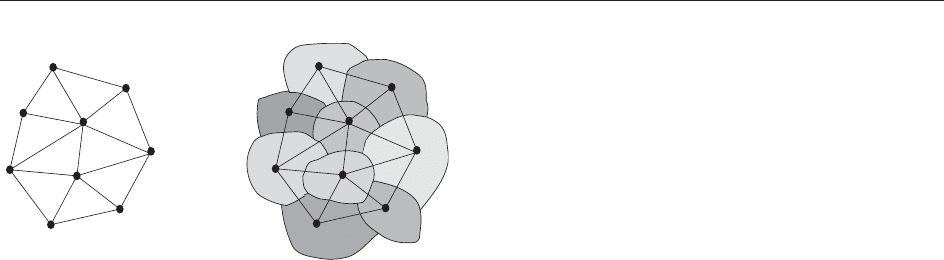
diffeomorphisms of .Ans-knot state jsi with N
nodes represents a quantum excitation of space with N
quanta of space adjacent to one another according to
the connectivity of (see Figure 1).
Notice that the quantum states jsi do not
represent quantum excitations living in the physical
space: they represent qua ntum excitations of the
physical sp ace. For instance, the state j0i defined by
the empty graph does not represent an ‘‘empty’’
physical space, but the absence of any physical
space. A generic quantum state of the physical space
is represented by a normalizable linear superposition
of these discrete quantized spacetimes (see Knot
Invariants and Quantum Gravity).
In a nongeneral covariant context, the kinematical
quantization predictions of quantum theory (such as
the quantization of the angular momentum) are
obtained from the spectral properties of operators
that represent measurements at a given time. In the
general covariant Hamiltonian formalism, the corre-
sponding kinematical quantization predictions are
given by spectral properties of ‘‘partial observables’ ’
operators, which in general are not gauge invariant in
the sense of Dirac. Area and volume are partial
observables of this kind. Their spectra are therefore
interpreted as physical predictions of LQG (up to an
overall numerical factor, called the Immirzi parameter,
which is obtained in certain variants of the theory).
Dynamics
The dynamics of the theory is obtained in terms of a
‘‘Hamiltonian constraint’’ operator C that quantizes
the constraint [3]. Different variants of the operator
C, and of its Lorentzian version, have been
constructed. The operator is defined via a suitab le
regularization procedure. The description of these
constructions exceeds the scope of this article, and
we limit ourself here to mentioning the main result
and a few general comments.
The main result of the LQG dynamics is that C
turns out to be well defined and ultraviolet-finite
when restricted to K
diff
. Finiteness holds also when
standard matter couplings, such a s Yang–Mills fields
and fermions, are added.
The reason for this finiteness can be understood as a
consequence of the discrete nature of space implied by
the spectral properties of the geometric operators
described above. The limit in which the ultraviolet
cutoff, introduced to regulate C, is removed turns
out to be trivial on the diffeomorphism-invariant states
in K
diff
. This is because this limit probes the short-
distance regime, but there is no physical (gauge-
invariant) short distance, in a theory in which
geometry turns out to be quantized at the Plank
scale. Since the physical states in K
diff
define a physical
geometry only at scales larger than the Planck scale
hGc
3
, the ‘‘short-distance’’ modes in the coordinate
manifold turn out to be pure gauge. This interplay
between quantum field-theoretical and general-
relativistic physics is the distinctive character of LQG.
Finally, we sketch the formal structure that
dynamics can take in the general cova riant
Hamiltonian formalism of LQG. The operator C
defines a linear operator P (C), usually (impro-
perly) denoted the ‘‘projector,’’ which sends states in
K
diff
into the kernel of C, formed by the generalized
K
diff
vectors that solve the Wheeler–De Witt equa-
tion C=0(see Wheeler–De Witt Theory). Matrix
elements of P are interpreted as transition ampli-
tudes between quantum states of space.
Physical predictions for processes that take place
in a finite spacetime region R can be obtained, in
principle, as follows. One considers a state ji
representing the result of the measurement of partial
observables of the 3D boundary of a spacetime
region R. ji codes the nonrelativistic notions of
initial, boundary and final conditions. Then h0jPji
can be interpreted as a relative probability ampli-
tude associated to this result. A formal expansion of
this amplitude in powers of C generates a spinfoam
sum (see Spin Foams) that can be understood as the
‘‘quantum gravity sum over histories’’ in R.
A systematic technique for computing physical
transition amplitudes from the background-
independent and nonperturbative formalism of
LQG has not yet been developed.
See also: BF Theories; Black Hole Mechanics; Canonical
General Relativity; Knot Invariants and Quantum Gravity;
Knot Theory and Physics; Quantum Cosmology; Quantum
Dynamics in Loop Quantum Gravity; Quantum Geometry
and its Applications; Spin Foams; Wheeler–De Witt Theory.
Figure 1 The graph of an s-knot, namely an abstract spinfoam,
and the set of quanta of space it represents. Each node n of the
graph defines a quantum of space. The associated intertwiner i
n
is
the corresponding volume quantum number. Two quanta of space
are adjacent if the corresponding nodes are linked. A link cuts
the elementary surface separating the two quanta and its spin j
is
the area quantum number of this surface.
342 Loop Quantum Gravity
Further Reading
Ashtekar A and Lewandowski J (2004) Background independent
quantum gravity: a status report. Classical and Quantum
Gravity 21: R53.
Rovelli C (1998) Loop quantum gravity. Living Reviews in
Relativity (electronic journal). (http://www.livingreviews.org/
Articles/Volume1/1998-1rovelli).
Rovelli C (2004) Quantum Gravity. Cambridge: Cambridge
University Press.
Rovelli C and Smolin L (1990) Loop space representation for
quantum general relativity. Nuclear Physics B 331: 80.
Rovelli C and Smolin L (1995) Discreteness of area and volume in
quantum gravity. Nuclear Physics B 442: 593.
Rovelli C and Smolin L (1995) Discreteness of area and volume in
quantum gravity – erratum. Nuclear Physics B 456: 734.
Smolin L (2002) Three Roads to Quantum Gravity. New York:
Perseus Books Group.
Thiemann T Modern Canonical Quantum General Relativity.
Cambridge: Cambridge University Press (to appear).
Lorentzian Geometry
P E Ehrlich, University of Florida, Gainesville, FL,
USA
S B Kim, Chonnam National University, Gwangju,
South Korea
ª 2006 Elsevier Ltd. All rights reserved.
Introduction
Einstein’s (1916) use of differential geometry as an
essential tool in his theory of general relativity has
long been a motivation for the study of Lorentzian
geometry. More recently, the influential mono-
graphs of R Penrose (1972) and of S Hawking and
G Ellis (1973), the latter still cited by some as the
Bible of general relativity, so fascinated differential
geometers that Lorentzian geometry took its place
alongside of global Riemannian geometry as a
worldwide research area.
Let M be a smooth n-dimensional manifold, n 2,
with a countable basis. A Lorentz metric g = < , >
on M is a symmetric nondegenerate (0, 2) tensor field
on M of index (, þ , ..., þ). The existence of such
a tensor field implies that M admits a (non-oriented)
line field; hence, some compact manifolds like S
2
do
not admit such metrics. A nonzero tangent vector v in
TM is then timelike (resp., nonspacelike, null, space-
like) according to whether g(v, v) < 0(resp.,
0, = 0, > 0). A Lorentzian manifold (M, g)isa
pair consisting of a smooth manifold together with a
choice of Lorentz metric. In this article, we use the
convention that a spacetime (M, g) is a Lorentzian
manifold together with a choice of time orientation,
that is, a continuous timelike vector field X on M.
Then a tangent vector v based at p may be
consistently defined to be future (resp., past) directed
if g(X(p), v) < 0(resp.,> 0). (Some authors also
require that (M, g) be space oriented.) If a Lorentzian
manifold happens not to be time orientable, then a
2-fold covering manifold with the induced pullback
metric will be time orientable. Also basic are the
notations p q (resp., p q) if there is a future-
directed timelike (resp., nonspacelike) curve from p
to q and the corresponding chronological (resp.,
causal) future of p given by I
þ
(p) = {q 2 M; p q}
and J
þ
(p) = {q 2 M; p q}.
For a Riemannian manifold (N, g
0
), the Riemannian
distance function
d
0
: N N !½0; þ1Þ ½1
given by d
0
(p, q) = inf {L(c); c : [0, 1] ! N is a piece-
wise smooth curve with c(0) = p and c(1) = q}. A
fundamental result in global Riemannian geometry
is the celebrated Hopf–Rinow theorem.
Hopf–Rinow Theorem For any Riemannian
manifold (N, g
0
), the following conditions are
equivalent:
(i) metric completeness :(N, d
0
) is a complete
metric space;
(ii) geodesic completeness: for any v in TN, the
geodesic c
v
(t) in N with initial condition
c
0
v
(0) = v is defined for all values of an affine
parameter t;
(iii) for some point p in N , the exponential map
exp
p
is defined on all of T
p
N;
(iv) finite compactness: every subset K of N that is
d
0
bounded has compact closure .
Moreover, if any one of (i)–(iv) holds, then
(N, g
0
) also satisfies
(v) minimal geo desic connectedness: given any p, q
in N, there exists a smoot h geodesic segment
c : [0, 1] ! N with c(0) = p, c(1) = q and
L(c) = d
0
(p, q).
A Riemannian metric for a smooth manifold is
then said to be complete if it satisfies any of the
above pro perties (i) through (iv). The Heine–Borel
property of basic topology implies (via (iv)) that all
Riemannian metrics for a compact manifold are
automatically complete and many of the examples
studied in basic Riemannian geometry are complete.
Lorentzian Geometry 343

Also, if Riem(N) denotes the space of all Rieman-
nian metrics for a smooth manifold N, both geodesic
completeness (property (ii) above) and geodesic
incompleteness (the failure of property (ii) to hold
for all geodesics) are C
0
stable properties on
Riem(N), that is, given a complete (resp., incom-
plete) metric g for N, there exists an open neighbor-
hood U(g)ofg in Riem(N) in the Whitney C
0
fine
topology such that all Riemannian metrics h in U(g)
are complete (resp., incomplete).
For spacetimes (M, g), however, many basic
examples furnished by general relativity fail to be
geodesically complete and compactness of the
underlying smooth manifold M does not imply that
the given Lorentz metric g (let alone all Lorentz
metrics for M) are complete. Also, the stability of
geodesic completeness and incompleteness is more
complicated than in the Riemannian case, necessi-
tating concepts like pseudoconvex geodesic systems
and disprisonm ent as studied by Beem and Parker.
To summarize, for spacetimes and their associated
Lorentzian distance functions, no naive analogs
for the Hopf–Rinow theorem are valid. Under
additional hypotheses, geodesic completeness may
be guaranteed. Marsden noted that a compact
spacetime with a homogenous Lorentz metric is
geodesically complete. Then Carriere showed that a
compact spacetime whose curvature tensor vanishes
is geodesically complete. Later Kamishima (assum-
ing constant curvature) and then Romero and
Sanchez more generally showed that a compact
Lorentzian manifold which admits a timelike Killing
field is geodesically complete.
At any point p in a given spacetime, emanating
from p are three families of geodesics: timelike,
spacelike, and null. It was hoped in the 1960s that
possibly continuity arguments could be obtained for
different types of geodesic completeness. However, a
series of examples showed by the mid-1970s that
timelike geodesic completeness, null geodesic com-
pleteness, and spacelike geodesic completeness are
logically inequival ent. (Here, a given geodesic is said
to be complete if it may be extended to be defined
for all values of an affine parameter.) Nomizu and
Ozeki for Riemannian manifolds showed that any
given Riemannian metric g
0
for the smooth mani-
fold N could be made geodesically complete by
making a conformal change of metric g
0
, where
: N ! (0, þ1) is a smooth function. Especially in
general relativity, such conformal changes are
natural because the causal character of tangent
vectors and curves (and hence of the basic causality
conditions) are preserved. For spacetimes while
generally nonspacelike geodesic completeness could
not be produced by conformal changes, for some
subclasses of spacetimes, such as the strongly causal
ones, it was possible with a global conformal
change.
For a large class of spacetimes, the warped or
multiwarped products (originally inspired by several
cosmological models in general relativity and a basic
construction from Riemannian geometry), explicit
integral criterion involving the warping functions
have been given for timelike or null geodesic
completeness. Several early examples of this type
of result are discussed in Beem et al. (1996,
pp. 111–112).
Lorentz Distance and the Nonspacelike
Cutlocus
For an arbitrary, not necessarily complete, Riemannian
manifold (N, g
0
), the Riemannian distance function
given in eqn [1] is continuous, the metric topology
induced by d
0
coincides with the given manifold
topology, and d
0
(p, q) is finite for all p, q in N.
Now, for an arbitrary spacetime (M, g), and p, q
in M, if there is no future-directed nonspacelike
curve from p to q, set d(p, q) = 0; if there is such a
curve, let
dðp; qÞ¼supfLðcÞ; c : ½0; 1!ðM; gÞ
is a piecewise smooth future-
directed nonspacelike curve
with cð0Þ¼p and cð1Þ¼qg½2
(Unlike the Riemannian case, [2] does not bound
d(p , q) from above by L(c) for any selected curve c
and hence the Lorentz distance may assume the
value þ1.)
This then defines what some authors term the
‘‘Lorentzian distance function’’
d ¼ dðg
Þ: M M !½0; þ1 ½3
and other authors term ‘‘proper time.’’ It is linked to
the causal structure of the given spacetime since
dðp; qÞ > 0 iff q is in I
þ
ðpÞ½4
and in place of the triangl e inequality for the
Riemannian distance function, a reverse trian gle
inequality holds:
if p r q; then dðp; qÞdðp; rÞþdðr; qÞ½5
Also in the context of eqn [2], a future-directed
nonspacelike curve c : [0, 1] ! M from c(0) = p to
c(1) = q is defined to be maximal if L(c) = d(p, q).
Corresponding to the Riemannian theory, a max-
imal nonspacelike curve turns out to be a smooth
null or timelike geodesic segment.
344 Lorentzian Geometry

As mentioned earlier, geodesic completeness is
generally not a natural requirement to place on
a spacetime. But what emerges from [4] in place of
Riemannian completeness is an interplay between
the causal properties of the given spacetime and
the continuity (and other properties) of the
Lorentzian distance function (cf. Beem et al. (1996,
chapter 4)). At the extre me of totally vicious
spacetimes, the Lorentz distance is always þ1.
Less drastically, if (M, g) contains a closed timelike
curve passing through p, then d(p, q) = þ1 for all
q in J
þ
(p). Also, certain cosmological models
contain pairs of points at infinite distance. In
general, Lorentzian distance is only lower semicon-
tinuous. Adding upper semicontinuity forces a
distinguishing spacetime to be causally continuous.
A spacetime is chronological iff d(p, p) = 0 for all p
in M. At the other extreme from totally vicious
spacetimes are globally hyperbolic spacetimes,
which share many properties somewhat analogous
to complete Riemannian manifolds. The Lorentzian
distance function of a globally hyperbolic spacetime
is both continuous and finite valued. (Indeed, a
strongly causal spacetime is globally hyperbolic iff
all Lorentz metrics g
0
in the conformal class
C(M, g) also have finite-valued distance functions
d(g
0
).) Second, corresponding to property (v) of the
Hopf–Rinow Theorem, these spacetimes all satisfy
maximal nonspacelike geodesic connect ability:
given any p, q in M with p q, there exists a
future nonspacelike geodesic segment c : [0, 1] ! M
with c(0) = p, c(1) = q and L(c) = d(p, q).
A basic concept from the calculus of variation s is
that of a pair of conjugate points along a geodesic
segment c : [0, a] ! (M, g). A smooth vector field
J(t) along c is said to be a ‘‘Jacobi field’’ if J satisfies
the Jacobi differential equation
J
00
þ RðJ; c
0
Þc
0
¼ 0 ½6
where R denotes the curvature tensor. Then
c(t ), c(s) are said to be conjugate points along c if
there exists a nonzero Jacobi field J along c with
J(t) = J(s) = 0. Much of the basic comparison tech-
niques in global Riemannian geometry involving
lengths of geodesics in manifolds satisfying curva-
ture inequalities, such as the ‘‘Rauch comparison
theorems,’’ the ‘‘Toponogov triangle comparison
theorem,’’ and volume comparison theorems, were
first obtained through Jacobi field techniques
(cf. Peter sen (1998) for a contemporary account).
Later, Riccati equation techniques became more
popular (cf. Karcher (1989)). For spacetimes, espe-
cially in the globally hyperbolic case, analogous
results have been obtain ed for nons pacelike geodesic
segments, with a key breakthrough in 1979 being
Harris’s version of the ‘‘Toponogov triangle com-
parison theorem’’ for timelike geodesic triangles in
globally hyperbolic spacetimes. The Raychaudhuri
equation used earlier in general relativity corre-
sponds for spacetimes to this passage in the
Riemannian setting from the Jacobi equation to the
Riccati equation. The basic conjugate point theory
and the Morse index theory for an arbitrary timelike
or null geodesic segment in a general spacetime are
reasonably close to the earlier Riemannian theory, if
vector fields of the form J(t) = f (t)
0
(t) are accounted
for in the case of a null geodesic segment
: [0, 1] ! ( M, g). But spacelike geodesics and
conjugate points are more problematic, as was first
established using symplectic techniques by Helfer in
1994. More recently, progress has been made in
applying important ideas of Gromov (1999) for
Riemannian manifolds to the spacetime context
(cf. Noldus (2004) for an example).
Inspired by fundamental concepts in global
Riemannian geometry, Beem and Ehrlich in 1979
introduced the concept of nonspacelike cut
point, again most tractable for globally hyperbolic
spacetimes. Let : [0, a) ! (M, g) be a future-
inextendible, future-directed nonspacelike geodesic
in an arbitrary spacetime. Define
t
0
¼ supft 2½0; aÞ; dðð0Þ;ðtÞÞ ¼ Lðj
½0; t
Þg ½7
(If there is a closed timelike curve through (0),
then d((0), (0)) = þ1 and t
0
will not exist. If is
a nonspacelike geodesic ray and hence
d((0), (t)) = L (j
[0, t]
) for all t, then t
0
= a.) How-
ever, if 0 < t
0
< a, then (t
0
) is said to be the future
nonspacelike cut point of p = (0) along . For
general spacetimes, it may be shown that:
1. for 0 < s < t < t
0
, that j
[s, t]
is the unique
maximal nonspacelike geodesic in all of (M, g)
between (s) and (t);
2. j
[0, t]
is maximal for all t with 0 t t
0
; and
3. for all t with t
0
< t < a, there is a longer
nonspacelike curve in (M, g) than j
[0, t]
between
(0) and (t).
A nonspacelike cut point is a subtler concept than
a nonspacelike conjugate point since the existence of
a cut point is not necessarily captured by the
behavior of families of futur e nonspacelike curves
(or geodesics) close to the give n geodesic segment ,
the basic viewpoint of the calculus of variations. But
since calculus of variations arguments shows that
past a nonspacelike conjugate point, longer ‘‘neigh-
boring curves’’ join (0) to (t), the futur e cut point
of p = (0) along comes no later than the first
Lorentzian Geometry 345

future conjugate point to p along in either the
timelike or null geodesic case.
In a startling result which contradicted erroneous
arguments in all the standar d textbooks, Margerin
in 1993 gave examples to show that even for
compact Riemannian manifolds, the first conjugate
locus of a point (i.e., the set of all first conjugate
points along all geodesics issuing from a given point)
need not be closed, even though elementary argu-
ments correctly show that the cut locus of any point
(i.e., the set of all cut points along all geodesics
issuing from the given point) is always closed. The
timelike first conjugate locus of a point in a
spacetime will generally not be closed, but because
a nonspacelike g eodesic in a globally hyperbolic
spacetime must escape from any compact subset in
finite affine parameter, the future (or past) first
nonspacelike conjuga te locus of any point in such a
spacetime is a closed subset. In a result analogous to
the Riemannian characterization, nonspacelike cut
points in globally hyperbolic spacetimes may be
characterized as follows: let q = (t
0
) be the future
cut point of p = (0) along the timelike (resp., null)
geodesic segment from p to q. Then either one of
both of the following conditions hold: (1) q is the
first future conjugate point to p along , or (2) there
exist at least two maximal timel ike (resp., null)
geodesic segments from p to q.
Now given p in an arbitrary spacetime (M, g), the
future timelike (resp., null) cut locus of p is defined
to be the set of all timelike (resp., null) cut points
along all future timelike (resp., null) geodesics
issuing from p and the future nonspacelike cut
locus of p is defined as the union of the future
timelike and null cut loci. Emp loying alternatives
(1) and (2) in the preceeding paragraph, it may be
shown for globally hyperbolic spacetimes that the
null and nonspacelike cut loci are closed subsets
of M.
The null c ut locus has a privileged status
by virtue of a phenomena not encountered for
Riemannian manifolds. Under a conformal change
of back-ground spacetime metric, null geodesics
remain null pregeodesics (i.e., may be reparame-
trized to be null geodesics in the deformed Lorentz
metric) while such deformations fail to preserve
timelike or spacelike geodesics, or to preserve
geodesics in the Riemannian case. Even though
null conjugate points along a null geodesic will not
remain invariant under conformal change of space-
time metric, it is remarkable that elementary
arguments involving the spacetime distance func-
tion show that global conformal diffeomorphisms
do preserve null cut points and hence the null cut
locus of any point.
Geodesic Incompleteness and the
Lorentzian Splitting Theorem
In global Riemannian geometry, an important concept
is that of a geodesic ray. In a complete Riemannian
manifold (N, g
0
), a unit geodesic c : [0, þ1) !
(N, g
0
) is said to be a (geodesic) ray if d
0
(c(0),
c(t )) = t for all t 0. By the triangle inequality, c(t)is
minimal between every pair of its points. By making a
limit construction, it may be shown that for each p in
N, there exists a geodesic ray c(t)withc(0) = p.An
allied concept is that of a (geodesic) line c : R !
(N, g
0
); here d
0
(c(t), c(s)) = jt sjfor all t, s is required,
that is, c is minimal between every pair of its points.
The existence of a line is much stronger than the
existence of a ray. If (N, g
0
) has positive Ricci
curvature everywhere, then (N, g
0
) contains no lines
despite the fact that it contains a ray issuing from
each point. A helpful tool in this setting is the
compactness of sets of tangent vectors of the form
fw 2 T
p
N; g
0
ðw; wÞ¼1g½8
for any p in N; hence, any infinite sequence of
tangent vectors based at p automatically has a
convergent subsequenc e.
For spacetimes, geodesic completeness cannot
generally be assumed. Yet a future nonspacelike
geodesic ray : [0, b) ! (M, g) may be defined to be
a future-directed, future-inextendible nonspacelike
geodesic with d((0), (t)) = L(j
[0, t]
) for all t in
[0, b). The reverse triangle inequality implies that
is maximal between any pair of its points. Similarly,
a nonspacelike geodesic line :(a, b) ! (M, g )isa
past- and future-inextendible nonspacelike geodesic
with d((t), (s)) = L(j
[t, s]
) for all s, t. Hence, is
maximal between any pair of its points. If nonspace-
like geodesic completeness is assumed, a = 1 and
b = þ1 above. Constructions here are more delicate
than in the Riemannian case because the sets
fv 2 T
p
M; gðv; vÞ¼1g½9
of unit timelike tangent vectors, while closed in the
tangent space, are noncompact. Despite this techni-
cality, using the limit curve machinery of general
relativity in place of the compactness in [8], it has
been shown that a strongly causal spacetime admits
a past and future nonspacelike geodesic ray issuing
from every point (cf. Beem et al. (1996, chapter 8)).
(If the spacetime is not nonspacelike geodesically
complete, these rays will not necessarily be past or
future complete.) As in the Riemannian case, the
existence of a complete line is a stronger geometric
condition. For that reason, in 1977 Beem and
Ehrlich introduced the concept of a spacetime
causally disconnected by a compact set K and
346 Lorentzian Geometry