
Francoise J.-P., Naber G.L., Tsun T.S. (editors) Encyclopedia of Mathematical Physics
Подождите немного. Документ загружается.


showed that a strongly causal spacetime which is
causally disconnected by a compact set contains a
nonspacelike geodesic line which intersects the
compact set. (Again, unless the spacetime is non-
spacelike geodesically complete, this line need not be
future or past complete.)
A pattern common to many results in global
Riemannian geometry especially since the 1950s is
the following: the existence of a complete Riemannian
metric on a smooth manifold which also satisfies a
global curvature inequality implies a topological or
geometric conclusion. A celebrated early example
from the 1950s and 1960s, obtained by separate
results of Rauch, Berger, and Klingenberg, is the
topological sphere theorem.
Topological Sphere Theorem Suppose (N, g
0
) is a
complete, simply connected Riemannian n-manifold
whose sectional curvatures satisfy 1=4 < K 1.
Then N is homeomorphic to S
n
.
By contrast, for spacetimes, the assumption of
geodesic completeness is generally unwarranted.
Here is an example of one of the celebrated
singularity theorems of general relativity, published
in 1970 as originally stated:
Hawking–Penrose Singularity Theorem No space-
time (M, g) of dimension n 3 can satisfy all of the
following three requirements together:
(i) (M, g) contains no closed timelike curves;
(ii) Every inextendible nonspacelike geodesic in
(M, g) contains a pair of conjugate points; and
(iii) There exists a future- or past-trapped set S in
(M, g).
This theorem may be reinterpreted more akin to
the Riemannian pattern above as follows: suppose
(M, g) is a chronological spacetime of dimensions
n 3 which satisfies the timelike convergence
condition (Ric(v, v) 0 for all timelike tangent
vectors) and the generic condition (every inextend-
ible nonspacelike geodesic contains a point which
has some appropriate nonzero sectional curvature).
If (M, g) contains a future- or past-trapped set, then
(M, g) is nonspacelike geodesically incomplete.
Hence, this result models the pattern: global
curvature inequalities (reflecting the physical
assumptions that gravity is assumed to be attractive
and every inextendible nonspacelike geodesic experi-
ences tidal acceleration) and a further physical or
geometric assumption (the first and third condit ions)
implies the existence of an incomplete timelike or
null geodesic.
An influential concept in global Riemannian
geometry formulated during the 1960s and 1970s
is that of curvature rigidity, which first became
widely known through the introduction to the text
Cheeger and Ebin (1975). The above statement of
the ‘‘sphere theorem’’ contains one hypothesis that
the sectional curvature is strictly greater than 1/4.
In curvature rigidity, the hypothesis of strict
inequality is relaxed to include the possibility of
equality as well, and then one tries to s how that
either the old conclusion is still valid, or if it fails, it
fails in an isometric (hence ‘‘rigid’’) manner. Thus
in the example of the sphere theorem, if the
sectional curvature is now allowed to satisfy 1=4
K 1, then either the given Riemannian manifold
remains homeomorphic to the n-sphere, or if not, it
is isom etric to a Riemannian symmetric space of
rank 1.
Already in an article in 1970, Geroch had
expressed the opinion that most spacetimes should
be nonspacelike geodesically incomplete and also
that a spacetime should fail to be nons pacelike
geodesically incomplete only under special circum-
stances. Apparently by the early 1980s, S T Yau had
formulated the idea that timelike geodesic incom-
pleteness of spacetimes ought to display a curvature
rigidity. In the paragraph following the statement of
the Hawking–Penrose singularity theorem, there are
two curvature conditions mentioned – the timelike
convergence condition and the generic condition.
Now the timelike convergence condition already
allows for the case of equality (i.e., zero timelike
Ricci curvature) in its formulation; hence, curvature
rigidity here would imply dropping the generic
condition that each inextendible nonspacelike geo-
desic contains a point of nonzero sectional curva-
tures as a hypothesis. This notion seems first to have
been published by Yau’s Ph.D. student R Bartnik in
1988 as follows:
Conjecture Let (M, g) be a spacetime of dimension
3 which
(i) contains a compact Cauchy surface and
(ii) satisfies the timelike convergence condition
Ric(v, v) 0 for all timelike v.
Then either (M, g) is timelike geod esically incom-
plete, or (M, g) splits isometrically as a product
(jR V, dt
2
þ h) where (H, h) is a compact
Riemannian manifold.
This conjecture has been proven in many cases
with the following proof scheme. From the physical
or geometric assumptions made, produce an
inextendible nonspacelike geodesic line. Further,
prove that the line happens to be timelike rather
than null. Then if the spacetime were timelike
geodesically complete, it would contain a complete
Lorentzian Geometry 347

timelike line. But then the desired splitting may be
obtained using the Lorentzian splitting theorem.
Lorentzian Splitting Theorem Let (M, g) be a
spacetime of dimension 3 which satisfies each of
the following conditions:
(i) (M, g) is either globally hyperbolic or timelike
geodesically complete;
(ii) (M, g) satisfies the timelike convergence condi-
tion; and
(iii) (M, g) contains a complete timelike line.
Then (M, g) splits isomet rically as a product (R V,
dt
2
þ h) where (H, h) is a complete Riemannian
manifold.
This result, which corresponds to obtaining the
spacetime analog of a celebrated splitting theorem of
Cheeger and Gromoll for lines in complete Riemannian
manifolds of non-negative Ricci curvature, published
in 1971, was posed as a problem by S T Yau in a
problem list stemming from the conference
Special Year in Differential Geometry held at the
Institute for Advanced Study in Princeton during the
1979–80 academic year. Early progress was made
using maximal hypersurface methods by Gerhardt in
1983, Bartnik in 1984, and Galloway in 1984. Then
in 1985, Beem, Ehrlich, Markvorsen, and Galloway
introduced the methodology of employing the
Busemann function of the complete timelike line,
motivated by techniques from Riemannian geome-
try, and succeeded in obtaining a splitting under the
hypothesis of global hyperbolicity and everywhere
nonpositive timelike sectional curvatures. In separate
publications, Eschenb urg and Galloway extended
the result to the desired curvature hypothesis of
nonnegative timelike Ricci curvatures. Finally,
Newman in 1990 achieved the originally desired
goal of obtaining the splitting under the assumption
of timelike geodesic completeness, rather than global
hyperbolicity. This is a more delicate setting, since
timelike geodesic completeness does not imply
maximal nonspacelike geodesic connectability, a
fairly basic geometric tool in many standard
constructions. But the idea emerged with
Newman’s solution that the existence of a timelike
geodesic line or segment in a nonglobally hyper-
bolic spacetime implies an adequate level of control
in a tubular neighborhood of the given line to
enable the proof to work. Galloway and Horta in
1996 published a much simplified working out of
these concepts. A fuller exposition of these devel-
opments may be found in Beem et al. (1996,
chapter 14). In addition, in 2000, Galloway
published a version of the splitting theore m for a
null maximal geodesic line.
Two-Dimensional Spacetimes
Two-dimensional spacetimes, sometimes termed
Lorentz surfaces, are especially tractable because
given (M, g) with dim M = 2, then (M, g) is also a
spacetime. Hence, it may be shown that any
Lorentzian 2-manifold (M, g) homeomorphic to R
2
may be made geodesically complete (not just
nonspacelike geodesically complete) by a conformal
change of metric. Also, any simply connected two-
dimensional Lorentzian manifold is strongly causal.
In Weinstein (1996), an extensive study is made of
Lorentz surfaces generally and particularly, of a
conformal boundary for such surfaces first given by
Kulkarni in 1985.
One of the prettiest classical results linking the
geometry and topology of a Riemannian surface is
the Gauss–Bonnet theorem. Let (N, g
0
)bea
Riemannian manifold of dimension 2 and let P be a
polygonal subregion with piecewise smooth bound-
ing curves c
i
,1 i k.LetK denote the Gauss
curvature of (N, g
0
) and the geodesic curvature of
the smooth curves c
i
(which vanishes if c
i
happens to
be a geodesic). If
i
denote the corresponding
interior angles between the successive boundary
curves c
i
and c
iþ1
, then the Gauss–Bonnet formula
over P is
Z
P
Z
K dA þ
Z
@P
ds þ
X
i
ð
i
Þ¼2 ½10
By considering a triangulation of N itself and
summing up the corresponding terms in [10],it
follows for a compact oriented Riemannian mani-
fold (N, g
0
) of dimension 2 that
Z
N
Z
K dA ¼ 2
ðNÞ
½11
where
(N)
denotes the Euler characteristic. Also
lurking in the background here is a formula for
computing the angle between unit tangent vectors v,
w as
cos ¼ g
0
ðv; wÞ½12
In the spacetime setting, different versions of a
Gauss–Bonnet formula for subregions of a two-
dimensional spacetime (M, g ) corresponding to [10]
have been given in 1974 by Helzer and in 1984 by
Birman and Nomizu. First, the angle computation is
a bit trickier for spacetimes than in the Riemannian
case; eqn [12] has to be replaced by techniques
which use the hyperbolic functions cosh u and
sinh u to define the angle u (sometimes called the
‘‘hyperbolic angle’’) between two unit vectors and
348 Lorentzian Geometry

then to allow for null vectors. Birman and Nomizu
obtained an analog of [10] assuming that the
boundary curves for P are successive smooth unit
timelike curves:
Z
@P
ds
Z
P
Z
K dA þ
X
i
i
¼ 0
Helzer in his formulation allows the different
boundary curves to be either unit timelike, unit
spacelike or null separately. Since the only compact,
orientable smooth surface which admits a spacetime
metric is the 2-torus, which has zero Euler char-
acteristic, the Riemannian formula [11] above
translates into the uniform constraint on the Gauss
curvature of the spacetime:
Z
M
Z
K dA ¼ 0
See also: General Relativity: Overview; Geometric
Analysis and General Relativity; Pseudo-Riemannian
Nilpotent Lie Groups; Spacetime Topology, Causal
Structure and Singularities.
Further Reading
Beem J, Ehrlich P, and Easley K (1996) Global Lorentzian
Geometry. In: Marcel Dekker Pure and Applied Mathematics,
vol. 202, 2nd edn. New York: Dekker.
Cheeger J and Ebin D (1975) Comparison Theorems in
Riemannian Geometry, North Holland Mathematical Library.
Amsterdam: North-Holland.
Einstein A (1916) Die Grundlage der allgemeinen Relativita¨ tsthe-
orie. Annalen der Physik 49: 769–822.
Gromov M (1999) Metric Structures for Riemannian and Non-
Riemannian Spaces, Birkhauser Progress in Mathematics,
vol. 152. Boston: Birkhauser.
Hawking S and Ellis G (1973) The Large Scale Structure of
Spacetime. Cambridge: Cambridge University Press.
Karcher H (1989) Riemannian comparison constructions. In:
Chern SS (ed.) Global Differential Geometry,Mathematical
Association of America Studies in Mathematics, vol. 27,
pp. 170–222. Washington, DC: MAA.
Kriele M (1999) Spacetime: Foundations of General Relativity
and Differential Geometry, Springer Lecture Notes in Physics
(Monographs), vol. 59. Heidelberg: Springer.
Noldus J (2004) The limit space of a Cauchy sequence of globally
hyperbolic spacetimes. Classical Quantum Gravity 21:
851–874.
O’Neill B (1983) Semi-Riemannian Geometry with Applications
to Relativity, Academic Press Pure and Applied Mathematics.
New York: Academic Press.
Penrose R (1972) Techniques of Differential Topology in
Relativity. Society for Industrial and Applied Mathematics,
Regional Conference Series in Applied Mathematics, vol. 7.
Philadelphia: SIAM.
Petersen P (1998) Riemannian Geometry, Springer Verlag Gradu-
ate Texts in Mathematics, vol. 171. New York: Springer.
Sachs R and Wu H (1977) General Relativity for Mathematicians,
Springer Verlag Graduate Texts in Mathematics, vol. 48. New
York: Springer.
Weinstein T (1996) An Introduction to Lorentz Surfaces,de
Gruyter Expositions in Mathematics, vol. 22. Berlin: de
Gruyter.
Lyapunov Exponents and Strange Attractors
M Viana, IMPA, Rio de Janeiro, Brazil
ª 2006 Elsevier Ltd. All rights reserved.
Lyapunov Exponents
The Lyapunov exponents of a sequence {A
n
, n 1}
of square matrices of dimension d 1 are the values
of
ðvÞ¼lim sup
n!1
1
n
log kA
n
vk½1
over all nonzero vectors v 2 R
d
. For completeness,
set (0) = 1. It is easy to see that (cv) = (v) and
(v þ v
0
) max{(v), (v
0
)} for any nonzero scalar c
and any vectors v, v
0
. It follows that, given any
constant a, the set of vectors satisfying (v) a is a
vector subspace. Consequently, there are at most d
Lyapunov exponents, henceforth denoted by
1
< <
k1
<
k
, and there exists a filtration
F
1
< < F
k1
< F
k
= R
d
into vector subspaces,
such that
ðvÞ¼
i
for all v 2 F
i
nF
i1
and every i = 1, ..., k (write F
0
= {0}). In particular,
the largest exponent is
k
¼ lim sup
n!1
1
n
log kA
n
k½2
One calls dim F
i
dim F
i1
the multiplicity of each
Lyapunov exponent
i
.
There are corresponding notions for continuous
families of matrices A
t
, t 2 (0, 1), taking the limit as
t goes to 1 in the relations [1] and [2]. The theories
for the two types of families, discrete and contin-
uous, are analogous and so at each point in what
follows we refer to either one or the other.
Lyapunov Exponents and Strange Attractors 349

Lyapunov Stability
Consider the linear differential equation
_
vðtÞ¼BðtÞvðtÞ½3
where B(t) is a bounded function with values in the
space of d d matrices, defined for all t 2 R. The
theory of differential equations ensures that there
exists a fundamental matrix A
t
, t 2 R, such that
vðtÞ¼A
t
v
0
is the unique solution of [3] with initial condition
v(0) = v
0
.
If the Lyapunov exponents of the family A
t
, t > 0,
are all negative then the trivial solution v(t ) 0is
asymptotically stable, and even exponentially stable.
The stability theorem of Lyapunov asserts that,
under an additional regularity condition, stability is
still valid for nonlinear perturbations
wðtÞ¼BðtÞw þ Fðt; wÞ½4
with kF(t, w)kconst.kwk
1þc
, c > 0. That is, the
trivial solution w(t) 0 is still exponentially asymp-
totically stable.
The regularity condition means, essentially, that
the limit in [1] does exist, even if one replaces
vectors v by elements v
1
^^v
l
of any lth exterior
power of R
d
,1l d. By definition, the norm of an
l-vector v
1
^^v
l
is the volume of the parallele-
piped determined by the vectors v
1
, ..., v
k
. This
condition is usually tricky to check in specific
situations. However, the multiplicative ergodic
theorem of V I Oseledets asserts that, for very
general matrix-valued stationary random processes,
regularity is an almost sure property. This result sets
the foundation for the modern theory of Lyapunov
exponents. We are going to discuss the precise
statement of the theorem in the slightly broader setting
of linear cocycles, or vector bundle morphisms.
Linear Cocycles
Let be a probability measure on some space M and
f : M !M be a measurable transformation that
preserves . Let : E!M be a finite-dimensional
vector bundle, endowed with a Riemannian metric
kk
x
on each fiber E
x
=
1
(x). Let A: E!E be a
linear cocycle over f. What we mean by this is that
A¼f
and the action A(x):E
x
!E
f (x)
of A on each fiber is
a linear isomorphism. Notice that the action of the
nth iterate A
n
is given by
A
n
ðxÞ¼Aðf
n1
ðxÞÞAðf ðxÞÞ AðxÞ
for every n 1.
Assume the function log
þ
kA(x)k
x
is -integrable:
log
þ
kAðxÞk
x
2 L
1
ðÞ½5
(we write log
þ
= log max {, 1}, for any >0).
It is clear that the sequence of functions
a
n
(x) = log kA
n
(x)k
x
satisfies
a
mþn
ðxÞa
m
ðxÞþa
n
ðf
m
ðxÞÞ
for every m, n, and x. It follows from J Kingman’s
subadditive ergodic theorem that the limit
lim
n!1
1
n
a
n
ðxÞ
exists for -almost all x. In view of [2], this means
that the largest Lyapunov exponent
k
(x) of the
sequence A
n
(x), n 1 is a limit, and not just a lim
sup, at almost every point.
Multiplicative Ergodic Theorem
The Oseledets theorem states that the same holds
for all Lyapunov exponents. Namely, for -almost
every x 2 M there exists k = k(x) 2 {1, ..., d}, a
filtration
F
1
x
< < F
k1
x
< F
k
x
¼E
x
and numbers
1
(x) < <
k
(x) such that
lim
n!1
1
n
log kA
n
ðxÞk
x
¼
i
ðxÞ½6
for all v 2 F
i
x
nF
i1
x
and i 2 {1, ..., k}.
The Lyapunov exponents
i
(x), and their number
k(x), are measurable functions of x and they are
constant on orbits of the transformation f.In
particular, if the measure is ergodic then k and
the
i
are constant on a full -measure set of
points. The subspaces F
i
x
also depend measurably
on the point x and are invariant under the linear
cocycle:
AðxÞF
i
x
¼ F
i
f ðxÞ
It is in the nature of things that, usually, these
objects are not defined everywhere and they depend
discontinuously on the base point x.
When the transformation f is invertible, one
obtains a stronger conclusion, by applying the
previous kind of result also to the inverse of the
cocycle. Namely, assuming that log
þ
kA
1
k is also
in L
1
(), one gets that there exists a
decomposition
E
x
¼ E
1
x
E
k
x
350 Lyapunov Exponents and Strange Attractors
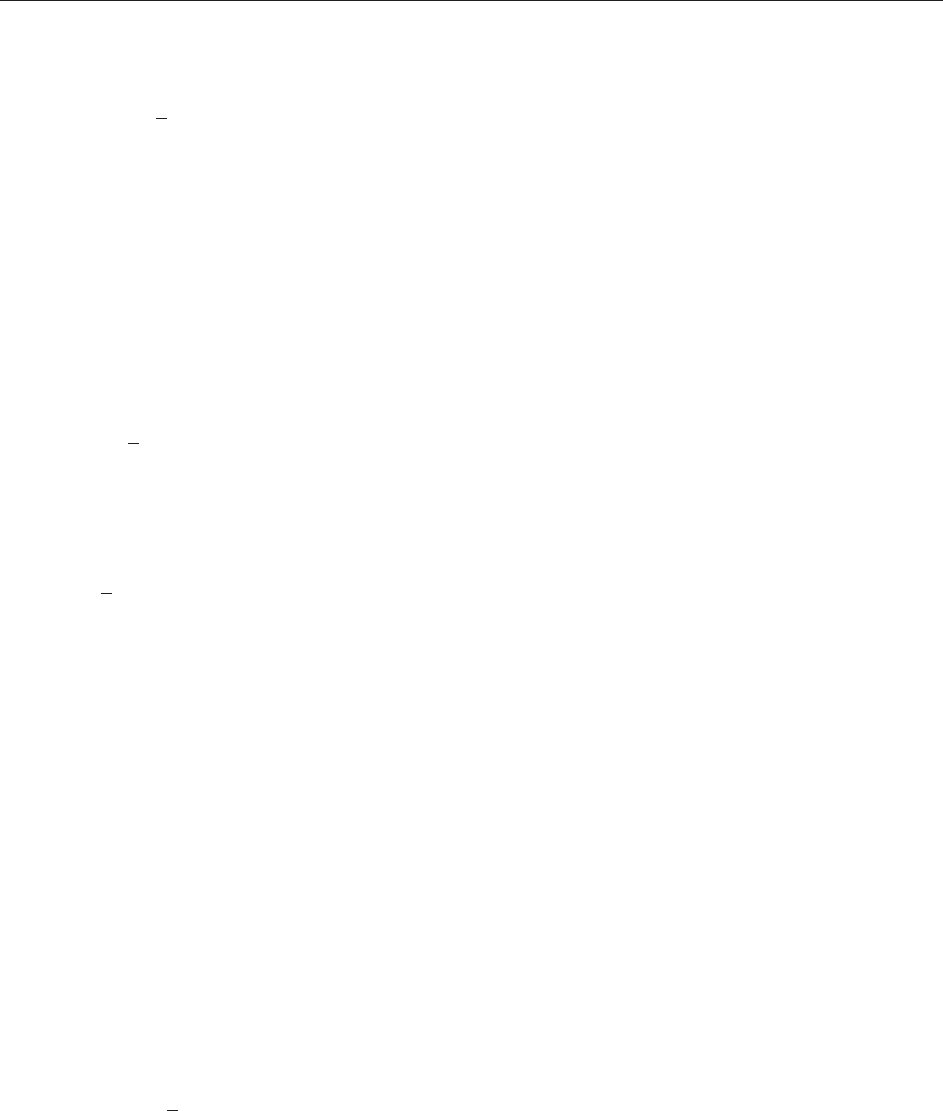
defined at almost every point and such that
A(x) E
i
x
= E
i
f (x)
and
lim
n!1
1
n
log kA
n
ðxÞk
x
¼
i
ðxÞ½7
for all v 2 E
i
x
different from zero and all i 2
{1, ..., k}. These Oseledets subspaces E
i
x
are related
to the subspaces F
i
x
through
F
j
x
¼
M
j
i¼1
E
i
x
Hence, dim E
i
x
= dim F
i
x
dim F
i1
x
is the multipli-
city of the Lyapunov exponent
i
(x).
The angles between any two Oseledets subspaces
decay subexponentially along orbits of f:
lim
n!1
1
n
log angle E
i
f
n
ðxÞ
; E
j
f
n
ðxÞ
¼0
for every i 6¼ j and almost every point. These facts
imply the regularity condition mentioned previously
and, in particular,
lim
n!1
1
n
log jdet A
n
ðxÞj ¼
X
k
i¼1
i
ðxÞdim E
i
x
½8
Consequently, for cocycles with values in SL(d, R),
the sum of all Lyapunov exponents, counted with
multiplicity, is identically zero.
As we are dealing with almost certain properties,
we may generally restrict the vector bundle to some
full measure subset over which it is trivial. Then
each fiber E
x
is identified with the space R
d
, and we
may think of A(x)asad d matrix. Then
A
n
(x) = A(f
n
(x)) is a stationary random process
relative to (f, ). Thus, in this context it is no
serious restriction to view a linear cocycle as a
stationary random process with values in the linear
group GL(d, R) of invertible d d matrices.
Furthermore, given any such random process
A
n
, n 0, one may consider its normalization
B
n
= A
n
=jdetA
n
j. The Lyapunov exponents of the
two random processes A
n
, n 0, and B
n
, n 0, differ
by the time average
lim
n!1
1
n
X
n1
j¼0
log jdetA
j
ðxÞj
of the determinant. The Birkhoff ergodic theorem
ensures that the time average is well defined almost
everywhere, as long as the function log jdet Aj is in
L
1
(); this is the case, for instance, if both
log
þ
kA
1
k are integrable. This relates the general
case to random processes with values in the special
linear group SL(d, R)ofd d matrices with
determinant 1.
The Oseledets theorem was extended by D Ruelle
to certain linear cocycles in infinite dimensions. He
assumes that the A(x) are compact operators on a
Hilbert space H and log
þ
kAk is in L
1
(). The
conclusion is the same as in finite dimensions,
except that the filtration
< F
i
x
< < F
1
x
¼ H
may involve infinitely many subspaces, and the
Lyapunov exponents may be 1. There is also a
version for cocycles over invertible transforma-
tions, where one assumes each A(x) to be invertible
and the sum of a unitary operator with a compact
operator, such that both log kA
k are integrable.
The conclusion is that there exists an Oseledets
decomposition H = E
1
x
E
i
x
at almost
every point, with finitely or countably many
factors.
Random Matrices
Relation [8] implies that, for SL(d, R) cocycles, if
there is only one Lyapunov exponent (with full
multiplicity) then it must be zero. When this
happens, the theory contains no information on the
behavior of the iterates A
n
(x) v, apart from the fact
that there is no exponential growth nor decay of
their norms. Thus, the question naturally arises
under which conditions is there more than one
Lyapunov exponent or, equivalently, under which
conditions is the largest Lyapunov exponent strictly
positive.
This problem was first addressed by H Furstenberg
for products of independent random variables,
corresponding to the following class of linear
cocycles. Let be a probability measure on the
group G = GL(d, R). Consider M = G
N
and =
N
(or M = G
Z
and =
Z
), and let f : M !M be the
shift map
f
ð
j
Þ
j
¼ð
jþ1
Þ
j
It is clear that is invariant and also ergodic for the
transformation f. Consider the cocycle A: E!E
defined by E = M R
d
and
A
ð
j
Þ
j
v ¼
0
v
Clearly,
A
n
ð
j
Þ
j
v ¼
n1
1
0
v
Corresponding to the hypothesis of the multiplicative
ergodic theorem, assume that log
þ
kk (and
log
þ
k
1
k)are-integrable functions of the matrix .
Furstenberg’s theorem states that if the closed
group G () generated by the support of is
Lyapunov Exponents and Strange Attractors 351

noncompact and strongly irreducible in R
d
then
the largest Lyapunov exponent of the cocycle A
is strictly positive. Strong irreducibility means
that there exists no finite union of subspaces of
R
d
that is invariant under all elements of the
group. Improvements, extensions, and alternative
proofs have been obtained by several authors since
then.
Especially, Y Guivarc’h and A Raugi provided
conditions under which there are exactly d distinct
Lyapunov exponents or, in other words, the
multiplicity of every Lyapunov exponent is equal
to 1. A matrix semigroup has the contraction
property if there exists a sequence of elements h
n
and a probability measure on the projective space
of R
d
that gives zero weight to any projective
subspace, such that the images (h
n
)
m of m under
the h
n
converge to a Dirac mass in the projective
space. They proved that if the closed semigroup
H() generated by the support of the probability
is strongly irreducible and has the contraction
property then the largest Lyapunov exponent has
multiplicity 1. Applying this to the exterior
powers of the cocycle, one obtains sufficient
conditions for simplicity of the other Lyapunov
exponents as well.
This statement has been improved by I Ya
Gol’dsheid and G A Margulis, who formulated the
hypotheses in terms of the algebraic closure
~
G()of
the semigroup H(). They assumed that
~
G() has the
contraction property and the connected component
of the identity inside
~
G() is irreducible in R
d
,
meaning that its elements do not have any common
invariant subspace. Then the largest Lyapunov
exponent is simple.
Schro¨ dinger Cocycles
The one-dimensional discrete Schro¨ dinger equation
is the second-order difference equation
ðu
nþ1
þ u
n1
ÞþV
n
u
n
¼ Eu
n
½9
derived from the stationary Schro¨ dinger equation in
dimension 1 by space discretization. Here the energy
E is a constant and V
n
= V(f
n
()), where the
potential V() is a bounded scalar function and
f : M !M is a transformation preserving some
probability measure on M. In what follows, we
take to be ergodic. Equation [9] may be rewritten
as a first-order relation,
u
nþ1
v
nþ1
¼
V
n
E 1
10
u
n
v
n
Hence, it may also be interpreted as a linear cocycle
A over f, where the vector bundle is E = M R
2
and
AðÞ¼
VðÞE 1
10
½10
takes values in SL(R, 2). By ergodicity, the Lyapu-
nov exponents are essentially independent of the
base point . Let (E) denote the largest exponent:
by the relation [8], the other one is (E).
The Lyapunov exponent (E) is related to the
spectral theory of the linear operators L
,
ðL
uÞ
n
¼ðu
nþ1
þ u
n1
ÞþV
n
u
n
on the space ‘
2
(Z) of complex square-integrable
sequences u
n
, n 2 Z. These are bounded Hermitian
operators and so the spectra are compact subsets of R.
Using the assumption that is ergodic, one can prove
that the spectrum spec(L
)isconstantalmostevery-
where. If the transformation f is minimal, the spectrum
is even independent of the point .Moreover,forall
energies,
ðEÞconst: distðE; specðL
ÞÞ
In particular, (E) is always positive on the comple-
ment of the spectrum.
A fundamental problem (Anderson localization) is
to decide when the spectrum is pure-point. This is
reasonably well understood for a few classes of base
dynamics only, for example, the very chaotic systems
such as Bernoulli and Markov processes (random
potentials) or uniformly hyperbolic maps and flows,
or the irrational rotations on the d-dimensional torus
(quasiperiodic potentials). In the latter case, the
results are more complete when there is only one
frequency (d = 1). It was shown by K Ishii and by L
Pastur that if (E) is positive for almost all values of
E in some Borel set then the absolutely continuous
part of the spectrum is essentially disjoint from that
set. The converse is also true (due to S Kotani). Thus,
checking that (E) is positive is an important step
towards proving localization.
A very general criterion for positivity of the
Lyapunov exponent was obtained by Kotani. Namely,
he proved that if the potential is not deterministic then
(E) is positive for almost all E. In particular, for
nondeterministic potentials the absolutely continuous
spectrum is empty, almost surely. In simple terms, the
hypothesis means that from the values of the potential
for negative n one cannot determine the values for
positive n. More formally, one calls the potential
deterministic if every V
n
, n 0 is almost everywhere a
measurable function of {V
n
: n 0}. For instance,
quasiperiodic potentials are deterministic, whereas
Bernoulli potentials are not.
352 Lyapunov Exponents and Strange Attractors

Subharmonicity Method
Let D
m
be the set of complex vectors (z
1
, ..., x
m
) 2 C
m
such that jz
j
j1forallj and let T
m
be the subset
defined by jz
j
j= 1forallj.Letf : T
m
!T
m
and
A : T
m
!SL(d , R) be continuous maps that admit
holomorphic extensions to the interior of D
m
with
f (0) = 0. Assume that f preserves the natural (Haar)
measure on T
m
.Let
ðA;Þ¼
Z
T
m
ðzÞd
where (z) denotes the largest Lyapunov exponent
for the cocycle defined by A over f. It also follows
from the subadditive ergodic theorem that
ðA;Þ¼lim
1
n
Z
T
m
log kA
n
ðzÞkd
M Herman observed that, since the function
log kA
n
(z)k is plurisubharmonic on D
m
, one may
use the maximum principle to conclude that
1
n
Z
T
m
log kA
n
ðzÞkd
1
n
log kA
n
ð0Þk
Then, taking the limit when n !1one obtains that
ðA;ÞðAÞ½11
where (A) denotes the spectral radius of the matrix
A(0). Starting from this observation, he developed a
very effective method for bounding Lyapunov
exponents from below, that received several applica-
tions and extensions, in particular, to the theory of
Schro¨ dinger cocycles with quasiperiodic potentials.
The best-known application is the following bound
for integrated Lyapunov exponents of two-dimen-
sional cocycles. Let f : M !M be a continuous
transformation on a compact metric space, preserving
some probability measure ,andA : M ! SL(2, R)be
a continuous map. For each fixed ,letAR
be the
cocycle obtained by multiplying A(x), at every point
x, by the rotation of angle . Herman proved that
1
2
Z
ðAR
;Þd
Z
M
NðxÞd
(A Avila and J Bochi later showed that the equality
holds) where
NðxÞ¼log
kAðxÞk þ kAðxÞ
1
k
2
Apart from the exceptional case when A acts by
rotation at every point in the support of , the right-
hand side of the inequality is positive, and so the
Lyapunov exponent of the cocycle AR
is positive
for many values of .
Nonuniform Hyperbolicity
The prototypical example of a linear cocycle is the
derivative of a smooth transformation on a mani-
fold. More precisely, let M be a finite-dimensional
manifold and f : M !M be a diffeomorphism, that
is, a bijective smooth map whose derivative Df (x)
depends continuously on x and is an isomorphism at
every point. Let E = TM be the tangent bundle to the
manifold and A= Df be the derivative. If M is
compact or, more generally, if the norms of both Df
and its inverse are bounded, then the hypothesis in
Oseledets theorem is automatically satisfied for any
f-invariant probability . Lyapunov exponents yield
deep geometric information on the dynamics of the
diffeomorphism, especially when they do not vanish.
For most results that we mention in the sequel, one
needs the derivative Df to be Ho¨ lder continuous:
kDf ðxÞDf ðyÞk const: dðx; yÞ
c
Let E
s
x
be the sum of the Oseledets subspaces
corresponding to negative Lyapunov exponents.
Pesin’s stable manifold theorem states that there
exists a family of embedded disks W
s
loc
(x) tangent to
E
s
x
at almost every point and such that the orbit of
every y 2 W
s
loc
(x) is exponentially asymptotic to the
orbit of x. This lamination {W
s
(x)} is invariant, in
the sense that
f ðW
s
ðxÞÞ W
s
ðf ðxÞÞ
and has an ‘‘absolute continuity’’ property. There
are analogous results for the sum E
u
x
of the Oseledets
subspaces corresponding to positive Lyapunov
exponents.
The entropy of a partition P of M is defined by
h
ðf ; PÞ ¼ lim
n!1
1
n
H
ðP
n
Þ
where P
n
is the partition into sets of the form
P = P
0
\ f
1
(P
1
) \\f
n
(P
n
) with P
j
2Pand
H
ðP
n
Þ¼
X
P2P
n
ðPÞlog ðPÞ
The Kolmogorov–Sinai entropy h
(f ) of the system
is the supremum of h
(f , P) over all partitions P
with finite entropy. The Ruelle–Margulis inequality
says that h
(f ) is bounded above by the average sum
of the positive Lyapunov exponents. A major result
of the theory, Pesin’s entropy formula, asserts that if
the invariant measure is smooth (e.g., a volume
element) then the two invariants coincide:
h
ðf Þ¼
Z
X
k
j¼1
þ
j
!
d
Lyapunov Exponents and Strange Attractors 353

A complete characterization of the invariant mea-
sures for which the entropy formula is true was
given by F Ledrappier and L S Young.
The invariant measure is called hyperbolic if all
Lyapunov exponents are nonzero at almost every
point. Hyperbolic measures are exact dimensional:
the pointwise dimension
dðxÞ¼lim
r!0
log ðB
r
ðxÞÞ
log r
exists at almost every point, where B
r
(x) is the
neighborhood of radius r around x. This fact was
proved by L Barreira, Ya Pesin, and J Schmeling. Note
that it means that the measure (B
r
(x)) of neighbor-
hoods scales as r
d(x)
when the radius r is small.
Another remarkable feature of hyperbolic mea-
sures, proved by A Katok, is that periodic motions
are dense in their supports. More than that,
assuming the measure is nonatomic, there exist
Smale horseshoes H
n
with topological entropy
arbitrarily close to the entropy h
(f ) of the system.
In this context, the topological entropy h(f , H
n
) may
be defined as the exponential rate of growth,
lim
k!1
1
k
log #fx 2 H
n
: f
k
ðxÞ¼xg
of the number of periodic points on H
n
.
Generic Systems
Given any area-preserving diffeomorphism on any
surface M, one may find another whose first
derivative is arbitrarily close to the initial one and
which has Lyapunov exponents identically zero at
almost every point, or else is globally uniformly
hyperbolic (Anosov). This surprising fact was
discovered by R Man˜e´, and a complete proof was
given by J Bochi. Uniform hyperbolicity means that
the tangent bundle admits a Df-invariant splitting
TM ¼ E
s
E
u
such that the line bundle E
s
is uniformly contracted
and E
u
is uniformly expanded by the derivative. It is
well known that Anosov diffeomorphisms can only
occur if the surface is the torus T
2
.
In fact, the theorem of Man˜e´–Bochi is stronger:
for a residual subset (a countable intersection of
open dense sets) of all once-differentiable area-
preserving diffeomorphisms on any surface, either
the Lyapunov exponents vanish almost everywhere
or the diffeomorphism is Anosov. This shows that
zero Lyapunov exponents are actually quite com-
mon for surface diffeomorphisms that are only once-
differentiable. Moreover, this theorem has been
extended to diffeomorphisms on manifolds with
arbitrary dimension, in a suitable formulation, by
J Bochi and M Viana.
However, this phenomenon should be specific to
systems with low differentiability. Indeed, already
for Ho¨ lder-continuous linear cocycles over chaotic
transformations it is known that vanishing Lyapu-
nov exponents can only occur with infinite codimen-
sion. That is, unless the cocycle satisfies an infinite
number of independent constraints, there exists
some positive exponent. By ‘‘chaotic’’ we mean
here that the invariant probability of the base
transformation is assumed to be hyperbolic and to
have local product structure: it is locally equivalent
to a product of two measures, respectively, along
stable and unstable sets.
Under additional assumptions, one can even prove
that all Lyapunov exponents have multiplicity 1
outside an infinite-codimension subset. This follows
from extensions of the Guivarc’h–Raugi criterion for
certain linear cocycles over chaotic transformations,
obtained by A Avila, C Bonatti, and M Viana.
Strange Attractors
This expression was coined by D Ruelle and
F Takens in their celebrated study on the nature of
fluid turbulence. E Hopf and also L D Landau and
E M Lifshitz had suggested that turbulent motion
arises from the existence in the phase space of
invariant tori carrying quasiperiodic flows with
large number of frequencies. Ruelle and Takens
observed that dissipative systems such as viscous
fluids do not generally have such quasiperiodic tori,
and concluded that turbulence must be credited to a
different mechanism: the presence of some ‘‘strange’’
attractor.
While they did not propose a precise definition,
two main features were mentioned:
1. Complex geometry: a strange attractor is not
reduced to an equilibrium point or a periodic
solution of the system and, generally, should
have a fractal structure.
2. Chaotic dynamics: solutions accumulating on the
attractor should be sensitive to their initial states.
As more examples were found, it became appar-
ent that the above two features do not always come
together. This led to two types of definitions in the
literature, depending on whether one emphasizes the
geometry or the dynamics. We adopt the second
point of view, and propose to define the strange
attractor as one carrying an invariant ergodic
physical measure which has some positive Lyapunov
exponent. The notion of physical measure will be
354 Lyapunov Exponents and Strange Attractors

defined near the end. The condition on the Lyapu-
nov exponent ensures that the dynamics near the
attractor is (exponentially) sensitive to the initial
states.
Lorenz-Like Attractors
The uniformly hyperbolic attractors introduced by
S Smale provided an interesting class of examples of
strange attractors, both chaotic and fractal. Perhaps
more striking, given that they originated from a
concrete problem in fluid dynamics, were the
strange attractors introduced by E N Lorenz. The
Lorenz system of differential equations,
_
x ¼x þ y;¼ 10
_
y ¼ rx y xz; r ¼ 28
_
z ¼ xy bz; b ¼ 8=3
½12
was derived from Lord Rayleigh’s model for
thermal convection, by Fourier expansion of the
stream function and temperature, and truncation of
all but three modes. Lorenz observed that its
solutions depend sensitively on their initial states.
Consequently, predictions based on the numerical
integration of the equations may turn out to be
very inaccurate, given that the initial data obtained
from experimental measurements are never com-
pletely precise. This remarkable observation
brought the issue of predictability in deterministic
systems to a whole new light and motivated intense
investigation of this and many other chaotic
systems.
The dynamical behavior of the eqns [12] was first
interpreted through certain geometric models where
the presence of strange attractors, both chaotic and
fractal, could be proved rigorously. It was much
harder to prove that the original eqns [12] them-
selves have such an attractor. This was achieved just
a few years ago, by W Tucker, by means of a
computer-assisted rigorous argument. At about the
same time, a mathematical theory of Lorenz-like
attractors in three-dimensional space was developed
by C Morales, M J Pacifico, and E Pujals. In
particular, this theory shows that uniformly hyper-
bolic attractors and Lorenz-like attractors are the
only ones which are robust under all small mod-
ifications of the vector field.
He´ non-Like Attractors
Starting from the work of Lorenz, many models of
strange attractors have been found and described to
some extent, often related to concrete problems.
From a mathematical point of view, it is usually
hard to give even a rough description of the
dynamics in the chaotic regime. However, this was
especially successful for the family of strange
attractors introduced by M He´non. He considered
a very simple nonlinear system, particularly suited
for numerical experimentation: the transformation
f ðx; yÞ¼ð1 ax
2
þ by; xÞ½13
where a and b are constant parameters. In a
breakthrough, M Benedicks and L Carleson were
able to prove that, for a set of parameter values with
positive probability, this transformation has some
nonhyperbolic attractor such that the orbits accu-
mulating on it are sensitive to the starting point. The
system [13] is also a model for many other
situations, including the phenomenon of creation of
homoclinic motions as parameters unfold, and the
conclusions of Benedicks and Carleson have been
extended to such situations, starting from the work
of L Mora and M Viana.
Moreover, a detailed theory of He´non-like attrac-
tors has been developed by M Benedicks, M Viana,
D Wang, L S Young, and other authors. It follows
from this theory that these attractors carry an
invariant ergodic probability measure which
describes the statistical behavior of almost all
trajectories f
j
(x), j 1, that accumulate the
attractor:
lim
n!1
1
n
X
n
j¼1
’ðf
j
ðxÞÞ ¼
Z
’ d
for any continuous function ’. This property
implies that, despite the fact that it is supported
on a zero-volume set, the measure is, in some
sense, physically observable. For this reason, one
calls it a physical measure. In other words, time
averages along typical orbits in the domain of
attraction coincide with the space averages deter-
mined by the probability . Another property with
physical relevance is that is the zero-noise limit of
the stationary measures associated to the Markov
chains obtained by adding random noise to f. One
says that the system (f , ) is stochastically stable.
See also: Chaos and Attractors; Dissipative Dynamical
Systems of Infinite Dimension; Ergodic Theory; Fractal
Dimensions in Dynamics; Generic Properties of
Dynamical Systems; Gravitational N-Body Problem
(Classical); Homoclinic Phenomena; Hyperbolic
Dynamical Systems; Lagrangian Dispersion (Passive
Scalar); Nonequilibrium Statistical Mechanics: Interaction
between Theory and Numerical Simulations; Random
Dynamical Systems; Synchronization of Chaos.
Lyapunov Exponents and Strange Attractors 355

Further Reading
Barreira L and Pesin Ya (2002) Lyapunov Exponents and Smooth
Ergodic Theory, Univ. Lecture Series, vol. 23. American
Mathematical Society.
Bochi J and Viana M (2004) Lyapunov exponents: how frequently
are dynamical systems hyperbolic? In: Modern Dynamical
Systems and Applications, pp. 271–297. Cambridge: Cambridge
University Press.
Bonatti C, Dı´az LJ, and Viana M (2004) Dynamics Beyond Uniform
Hyperbolicity: A Global Geometric and Probabilistic Perspec-
tive, Encyclopedia of Mathematical Sciences, vol. 102. Springer.
Eckmann J-P and Ruelle D (1985) Ergodic theory of chaos and
strange attractors. Reviews of Modern Physics 57: 617–656.
Gol’dsheid IYa and Margulis GA (1989) Lyapunov indices of
a product of random matrices. Uspekhi Mat. Nauk. 44:
13–60.
Man˜e´ R (1987) Ergodic Theory and Differentiable Dynamics.
Springer.
Spencer T (1990) Ergodic Schro¨dinger operators Analysis, et
cetera 623–637. Academic Press.
Viana M (2000) What’s new on Lorenz strange attractors? Math.
Intelligencer 22: 6–19.
356 Lyapunov Exponents and Strange Attractors