
Francoise J.-P., Naber G.L., Tsun T.S. (editors) Encyclopedia of Mathematical Physics
Подождите немного. Документ загружается.


This preliminary analysis of the singular set can
be refined by doing a so-called tangent cone
analysis.
Tangent Cone Analysis
It is not hard to see that scaling preserves the space
of minimal submanifolds of R
n
. Namely, if is
minimal, then so is
y;
¼fy þ
1
ðx yÞjx 2 g½56
(To see this, simply note that this scaling multi-
plies the principal curvatures by .) Suppose now
that we fix the point y and take a sequence
j
!0.
The monotonicity formula bounds the density of
the rescaled solution, allowing us to extract a
convergent subsequence and limit. This limit,
which is called a ‘‘tangent cone’’ at y,achieves
equality in the monotonicity formula and, hence,
must be homogeneous (i.e., invariant under dila-
tions about y).
The usefulness of tangent cone analysis in
regularity theory is based on two key facts. For
simplicity, we illustrate these when R
n
is an
area-minimizing hypersurface. First, if any tangent
cone at y is a hyperplane R
n1
, then is smooth in a
neighborhood of y. This follows easily from the
Allard regularity theorem since the densi ty at y of
the tangent cone is the same as the density at y of .
The second key fact, known as ‘‘dimension redu-
cing,’’ is due to Almgren and is a refinement of an
argument of Federer. To state this, we first stratify
the singular set S of into subsets
S
0
S
1
S
n2
½57
where we define S
i
to be the set of points y 2Sso
that any linear space contained in any tangent cone
at y has dimensi on at most i. (Note that S
n1
= ; by
Allard’s theorem.) The dimension reducing argu-
ment then gives that
dimðS
i
Þi ½58
where dimension means the Hausdorff dimension.
In particular, the solution of the Bernstein problem
then gives codimension-7 regularity of , that is,
dim (S) n 8.
Part 2. Constructing Minimal Surfaces
Thus far, we have mainly dealt with regularity and
a priori estimates but have ignored questions of
existence. In this part, we survey some of the most
useful existence resul ts for minimal surfaces. The
following section gives an overview of the classical
Plateau problem. Next, we recall the classical
Weierstrass representation, including a few modern
applications, and the Kapouleas desingularization
method. Then we deal with producing area-mini-
mizing surfa ces and questions of embeddedness.
Finally, we recall the min–max construction for
producing unstable minimal surfaces and, in parti-
cular, doing so while controlling the topology and
guaranteeing embeddedness.
The Plateau Problem
The following fundamental existence problem for
minimal surfaces is known as the Plateau problem:
given a closed curve , find a minimal surface with
boundary . There are various solutions to this
problem depending on the exact definition of a
surface (parametrized disk, integral current, Z
2
current, or rectifiable varifold). We shall consider
the version of the Plateau problem for parametrized
disks; this was solved independently by J Douglas
and T Rado. The generalization to Riemannian
manifolds is due to C B Morrey.
Theorem 13 Let R
3
be a piecewise C
1
closed
Jordan curve. Then there exists a piecewise C
1
map
u from D R
2
to R
3
with u(@D) such that the
image minimizes area among all disks with bound-
ary .
The solution u to the Plateau problem above can
easily be seen to be a branched conformal immer-
sion. R Osserman proved that u does not have true
interior branch points; subsequently, R Gulliver and
W Alt showed that u cannot have false branch
points either.
Furthermore, the solution u is as smooth as the
boundary curve, even up to the bounda ry. A very
general version of this boundary regularity was
proved by S Hildebrandt; for the case of surfaces
in R
3
, recall the following result of J C C Nitsche:
Theorem 14 If is a regular Jordan curve of class
C
k,
where k 1 and 0 <<1, then a solution u
of the Plateau problem is C
k,
on all of
D.
The Weierstrass Representation
The classical Weierstrass representation (see Osserman
(1986)) takes holomorphic data (a Riemann surface, a
meromorphic function, and a holomorphic 1-form)
and associates a minimal surface in R
3
. To be precise,
given a Riemann surface , a meromorphic function g
on , and a holomorphic 1-form on ,thenwe
Minimal Submanifolds 427

get a (branched) conformal minimal immersion
F : !R
3
by
FðzÞ¼Re
Z
2
z
0
;z
1
2
ðg
1
ðÞgðÞÞ;
i
2
ðg
1
ðÞþgðÞÞ; 1
ðÞ½59
Here, z
0
2 is a fixed base point and the integra-
tion is along a path
z
0
, z
from z
0
to z. The choice of
z
0
changes F by adding a constant. In general, the
map F may depend on the choice of path (and hence
may not be well defined); this is known as ‘‘the
period problem.’’ However, when g has no zeros or
poles and is simply connected, then F(z) does not
depend on the choice of path
z
0
, z
.
Two standard constructions of minimal surfaces
from Weierstrass data are
gðzÞ¼z;ðzÞ¼dz=z; ¼ Cnf0g
giving a catenoid ½60
gðzÞ¼e
iz
;ðzÞ¼dz; ¼ C giving a helicoid ½61
The Weierstrass representation is particularly
useful for constructing immersed minimal surfaces.
Typically, it is rather difficult to prove that the
resulting immersion is an embedding (i.e., is 1–1),
although there are some interesting cases where this
can be done. For the first modern example,
D Hoffman and Meeks proved that the surface
constructed by Costa was embedded; this was
the first new complete finite topology properly
embedded minimal surface discovered since the
classical catenoid, helicoid, and plane. This led
to the discovery of many more such surfaces
(see Rosenberg (1992) for more discussion).
Area-Minimizing Surfaces
Perhaps the most natural way to construct minimal
surfaces is to look for ones which minimize area, for
example, with fixed bounda ry, or in a homotopy
class, etc. This has the advantage that often it is
possible to show that the resulting surface is
embedded. We mention a few results along these
lines.
The first embeddedness result, due to Meeks and
Yau, shows that if the boundary curve is embedded
and lies on the boundary of a smooth mean convex
set (and it is null-homotopic in this set), then it
bounds an embedded least area disk.
Theorem 15 (Meeks III and Yau 1982). Let M
3
be
a compact Riemannian 3-manifold whose boundary
is mean convex and let be a simple closed curve in
@M which is null -homotopic in M; then is
bounded by a least area disk and any such least
area disk is properly embedded.
Note that some restriction on the boundary curve
is certainly necessary. For instance, if the
boundary curve was knotted (e.g., the trefoil), then
it cou ld not be spanned by any embedded disk
(minimal or otherwise). Prior to the work of Meeks
and Yau, embeddedness was known for extremal
boundary curves in R
3
with small total curvature by
the work of R Gulliver and J Spruck.
If we instead fix a homotopy class of maps, then
the two fundamental existence results are due to
Sacks–Uhlenbeck and Schoen–Yau (with embed-
dedness proved by Meeks–Yau and Freedman–
Hass–Scott, respectively):
Theorem 16 Given M
3
, there exist conformal
(stable) minimal immersions u
1
, ..., u
m
: S
2
!M
which generate
2
(M) as a Z[
1
(M)] module.
Furthermore,
(i) if u : S
2
!Mand[u]
2
6¼ 0, then Area(u)
min
i
Area(u
i
),
(ii) each u
i
is either an embedding or a 2–1 map
onto an embedded two-sided RP
2
.
Theorem 17 If
2
is a closed surface with genus
g > 0 and i
0
: !M
3
is an embedding which
induces an injective map on
1
, then there is a
least area embedding with the same action on
1
.
The Min–Max Construction
of Minimal Surfaces
Variational arguments can also be used to construct
higher index (i.e., nonminimizing) minimal surfaces
using the topology of the space of surfaces. There
are two basic approaches:
1. Applying Morse theory to the energy functional
on the space of maps from a fixed surface to M.
2. Doing a min–max argument over families of
(topologically nontrivial) sweep-outs of M.
The first approach has the advantage that the
topological type of the minimal surface is easily
fixed; however, the second approach has been more
successful at producing embedded minimal surfaces.
We will highlight a few key results below but refer
to Colding and De Lellis (2003) for a thorough
treatment.
Unfortunately, one cannot directly apply Morse
theory to the energy functional on the space of maps
from a fixed surface because of a lack of compact-
ness (the Palais–Smale condition C does not hold).
428 Minimal Submanifolds
To get around this difficulty, Sacks–Uhlenbeck
introduce a family of perturbed energy functionals
which do satisfy condition C and then obtain
minimal surfaces as limits of critical points for the
perturbed problems:
Theorem 18 If
k
(M) 6¼ 0 for some k > 1, then
there exists a branched immer sed minimal 2-sphere
in M (for any metric).
The basic idea of constructing minimal surfaces
via min–max arguments and swe ep-outs goes back
to Birkhoff, who developed it to construct simple
closed geodesics on spheres. In particular, when M is
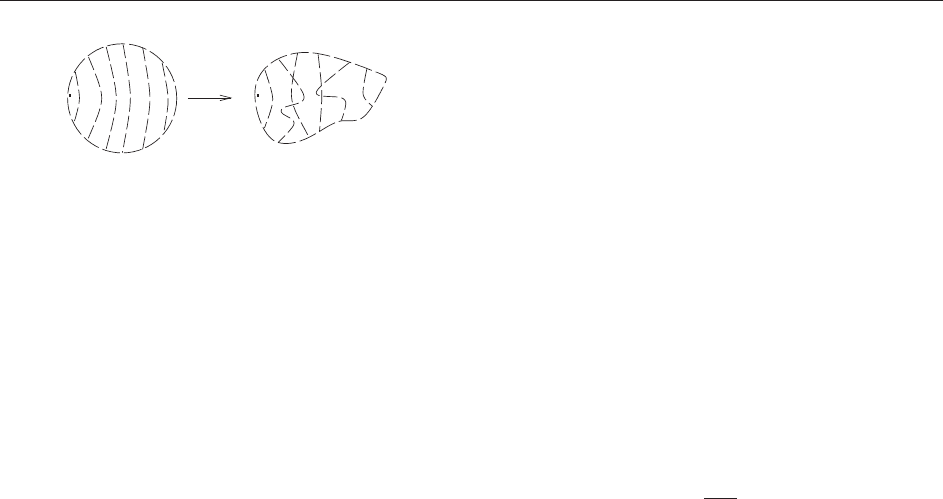
a topological 2-sphere, we can find a one-parameter
family of curves starting and ending at point curves
so that the induced map F : S
2
!S
2
(see Figure 1)
has nonzero degree. The min–max argument pro-
duces a nontrivial closed geodesic of length less than
or equal to the longest curve in the initial one-
parameter family. A curve-shortening argument
gives that the geodesic obtained in this way is
simple.
J Pitts applied a similar argument and geometric
measure theory to get that every closed Riemannian
3-manifold has an embedded minimal surface (his
argument was for dimensions up to seven), but he
did not estimate the genus of the resulting surface.
Finally, F Smith (under the direction of L Simon)
proved (see Colding and De Lellis (2003)):
Theorem 19 Every metric on a topological
3-sphere M admits an embedded minimal 2-sphere.
The main new contribution of Smith was to
control the topological type of the resulting minimal
surface while keeping it embedded.
Part 3. Some Applications of Minimal
Surfaces
In this part, we discuss very briefly a few applica-
tions of minimal surfaces. As mentioned in the
introduction, there are many to choose from and we
have selected just a few.
The Positive-Mass Theorem
The (Riemannian version of the) positive-mass
theorem states that an asymptotically flat
3-manifold M with non-negative scalar curvature
must have positive mass. The Riemannian manifold
M here arises as a maximal spacelike slice in a
(3 þ 1)-dimensional spacetime solution of Einstein’s
equations.
The asymptotic flatness of M arises because the
spacetime models an isolated gravitational system
and hence is a perturbation of the vacuum solution
outside a large compact set. To make this precise,
suppose for simplicity that M has only one end; M
is then said to be asymptoticall y fl at if there is a
compact set M so that Mn is diffeomorphic
to R
3
nB
R
(0) and t he metric on Mn can be
written as
g
ij
¼ 1 þ
M
2jxj
4
ij
þ p
ij
½62
where
jxj
2
jp
ij
jþjxj
3
jDp
ij
jþjxj
4
jD
2
p
ij
jC ½63
The consta nt M is the so-called mass of M. Observe
that the met ric g
ij
is a perturbation of the metric on
a constant-time slice in the Schwarzschild spacetime
of mass M; that is to say, the Schwarzschild metric
has p
ij
0.
A tensor h is said to be O(jxj
p
)ifjxj
p
jhjþ
jxj
pþ1
jDhjC. For example, an easy calculation
shows that
g
ij
¼ 1 þ 2 M=j xjðÞ
ij
þ Oðjxj
2
Þ
ffiffiffi
g
p
ffiffiffiffiffiffiffiffiffiffiffiffi
det g
ij
q
¼ 1 þ 3Mjxj
1
þ Oðjxj
2
Þ
½64
The positive-mass theorem states that the mass M
of such an M must be non-negative:
Theorem 20 (Schoen an d Yau 1979). With M as
above, M0.
There is a rigidity theorem as well which states that
the mass vanishes only when M is isometric to R
3
:
Theorem 21 (Schoen and Yau 1979 ). If jr
3
p
ij
j=
O(jxj
5
) and M= 0 in Theorem 20, then M is
isometric to R
3
.
We will give a very brief overview of the proof of
Theorem 20, showing in the process where minimal
surfaces appear.
Proof (Sketch). The argument will be by contra-
diction, so suppose that the mass is negative. It is
not hard to prove that the slab between two parallel
Figure 1 A one-parameter family of curves on a 2-sphere
which induces a map F : S
2
!S
2
of degree 1. First published in
Surveys in Differential Geometry, volume IX, in 2004, published
by International Press.
Minimal Submanifolds 429

planes is mean convex. That is, we have the
following:
Lemma 3 If M < 0 and M is asymptotically flat,
then there exist R
0
, h > 0 so that for r > R
0
the sets
C
r
¼fjxj
2
r
2
; h x
3
hg½65
have strictly mean-convex boundary.
Since the compact set C
r
is mean convex, we can
solve the Plateau problem to get an area-minimizing
(and hence stable) surface
r
C
r
with boundary
@
r
¼fjxj
2
¼ r
2
; x
3
¼ hg½66
Using the disk {jxj
2
r
2
, x
3
= h} as a comparison
surface, we get uniform local area bounds for any
such
r
. Combining these local area bounds with the
a priori curvature estimates for minimizing surfaces,
we can take a sequence of r’s going to infini ty and
find a subsequence of
r
’s that converge to a
complete area-minimizing surface
fh x
3
hg½67
Since is pinched betw een the planes {x
3
= h}, the
estimates for minimizing surfaces implies that (out-
side a large compac t set) is a graph over the plane
{x
3
= 0} and hen ce has quadratic area growth and
finite total curvature. Moreover, using the form of
the metric g
ij
, we see that jruj decays like jxj
1
and
Z
s
k
g
¼ð2s þ Oð1ÞÞðs
1
þ Oðs
2
ÞÞ
¼ 2 þ Oðs
1
Þ½68
where
s
= {x
2
1
þ x
2
2
= s
2
} \ and k
g
is the geodesic
curvature of
s
(as a curve in ).
To get the contradiction, one combines stability of
with the positive scalar curvature of M to see that
no such could have existed. (M was assumed only
to have non-negative scalar curvature. However, a
‘‘rounding off’’ argument shows that the metric on
M can be perturbed to have positive scalar curvature
outside of a compact set and still have negative
mass.) Namely, substituting the Gauss equation into
the stability inequality (this is the stability inequality
in a general 3-manifold; see Colding and Minicozzi II
(1999)) gives
Z
ðjAj
2
=2 þ Scal
M
K
Þ
2
Z
jrj
2
½69
Since has quadratic area growth, we can choose a
sequence of (logarithmic) cutoff functions in [69] to
get
0 <
Z
ðjAj
2
=2 þ Scal
M
Þ
Z
K
< 1½70
since K
may not be positive, we also used that
has finite total curvature. Moreover, we used that
Scal
M
is positive outside a compact set to see that
the first integral in [70] was positive. Finally,
substituting [70] into the Gauss–Bonnet formula
gives that
R
s
k
g
is strictly less than 2 for s large,
contradicting [68].
Black holes
Another way that minimal surfaces enter into
relativity is through black holes. Suppose that we
have a three-dimensional time slice M in a (3 þ 1)-
dimensional spacetime. For simplicity, assume that M
is totally geodesic and hence has non-negative scalar
curvature. A closed surface in M is said to be
trapped if its mean curvature is everywhere negative
with respect to its outward normal. Physically, this
means that the surface emits an outward shell of light
whose surface area is decreasing everywhere on the
surface. The existence of a closed trapped surface
implies the existence of a black hole in the spacetime.
Given a trapped surface, we can look for the
outermost trapped surface containing it; this outer-
most surface is called an apparent horizon. It is not
hard to see that an apparent horizon must be a
minimal surface and, moreover, a barrier argument
shows that it must be stable. Since M has non-
negative scalar curvature, stability in turn implies
that it must be diffeomorphic to a sphere. See, for
instance, Bray (2002) for references to some results
on black holes, horizons, etc.
Constant Mean Curvature Surfaces
At least since the time of Plateau, minimal surfaces
have been used to model soap films. This is because
the mean curvature of the surface models the surface
tension and this is essentially the only force acting
on a soap film. Soap bubbles, on other hand, enclose
a volume and thus the pressure gives a second
counterbalancing force. It follows easily that these
two forces are in equilibrium when the surface has
constant mean curvature (cmc).
For the same reason, cmc surfaces arise in the
isoperimetric problem. Namely, a surface that mini-
mizes surface area while enclosing a fixed volume must
have cmc. It is not hard to see that such an
isoperimetric surface in R
n
must be a round sphere.
There are two interesting partial converses to this.
First, by a theorem of Hopf, any cmc 2-sphere in R
3
must be round. Second, using the maximum principle
(‘‘the method of moving planes’’), Alexandrov showed
that any closed embedded cmc hypersurface in R
n
must be a round sphere. It turned out, however, that
not every closed immersed cmc surface is round. The
430 Minimal Submanifolds
first examples were immersed cmc tori constructed by
H Wente. Kapouleas constructed many new examples,
including closed higher-genus cmc surfaces.
Many of the techniques developed for studying
minimal surfaces generalize to general cmc surfaces.
Finite Extinction for Ricci Flow
We close this article by indicating how minimal
surfaces can be used to show th at on a hom otopy
3-sphere the Ricci flow becomes extinct in finite
time (see Colding and Minicozzi II (2005) and
Perelman (2003) for details).
Let M
3
be a smooth closed orientable 3-manifold
and let g(t) be a one-parameter family of metrics on
M evolving by the Ricci flow, so
@
t
g ¼2Ric
M
t
½71
In an earlier section, we saw that there is a natural
way of constructing minimal surfaces on many
3-manifolds and that comes from the min–max
argument where the minimal of all maximal slices of
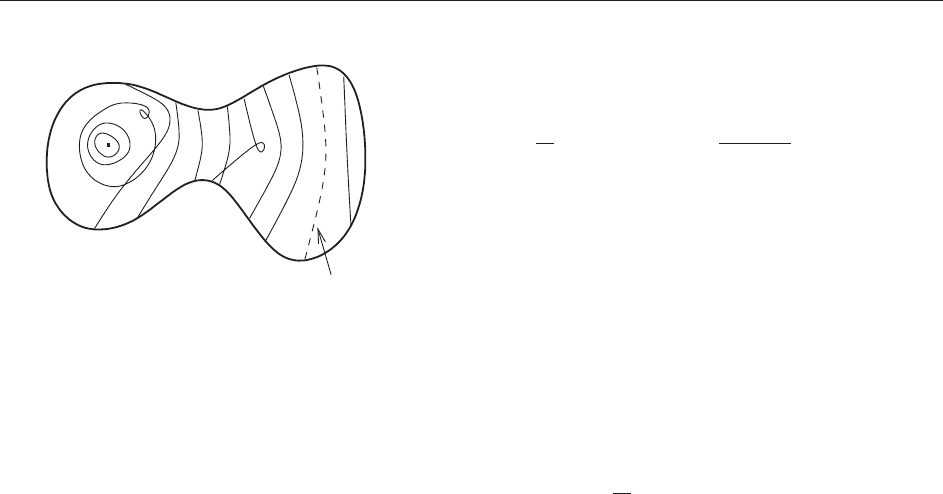
sweep-outs is a minimal surface. The idea is then to
look at how the area of this min–max surface changes
under the flow. Geometrically, the area measures a
kind of width of the 3-manifold and as we will see for
certain 3-manifolds (those, like the 3-sphere, whose
prime decomposition contains no aspherical factors),
the area becomes zero in finite time corresponding to
the solution becoming extinct in finite time.
Fix a con tinuous map : [0, 1] !C
0
\ L
2
1
(S
2
, M)
where (0) and (1) are constant maps so that is
in the nontrivial homotopy class [] (such exists
when M is a homotopy 3-sphere). We define the
width W = W(g,[]) by
WðgÞ¼min
2½
max
s2½0;1
EnergyððsÞÞ ½72
The next theorem gives an upper bound for the
derivative of W(g(t)) under the Ricci flow which forces
the solution g(t) to become extinct in finite time.
Theorem 22 Let M
3
be a homotopy 3-sphere
equipped with a Riemannian metric g = g(0).
Under the Ricci flow, the width W(g(t)) satisfies
d
dt
WðgðtÞÞ 4 þ
3
4ðt þ CÞ
WðgðtÞÞ ½73
in the sense of the limsup of forward difference
quotients. Hence, g(t) must become extinct in finite
time.
The 4 in [73] comes from the Gauss–Bonnet
theorem and the 3/4 comes from the bound on the
minimum of the scalar curvature that the evolution
equation implies. Both of these constants matter
whereas the constant C depends on the initial metric
and the actual value is not important.
To see that [73] implies finite extinction time,
rewrite [73] as
d
dt
WðgðtÞÞðt þ CÞ
3=4
4ðt þ CÞ
3=4
½74
and integrate to get
ðT þ CÞ
3=4
WðgðTÞÞ C
3=4
Wðgð0ÞÞ
16 ðT þ CÞ
1=4
C
1=4
hi
½75
Since W 0 by definition and the right-hand side of
[75] would become negative for T sufficiently large,
we get the claim.
As a corollary of this theorem we get finite
extinction time for the Ricci flow.
Corollary 3 Let M
3
be a homotopy 3-sphere
equipped with a Riemannian metric g = g(0). Under
the Ricci flow g(t) must become extinct in finite time.
Acknowledgments
The authors were partially supported by NSF Grants
DMS 0104453 and DMS 0405695.
See also: Black Hole Mechanics; Calibrated Geometry
and Special Lagrangian Submanifolds; Geometric Analysis
and General Relativity; Geometric Measure Theory;
Leray–Schauder Theory and Mapping Degree; Ljusternik–
Schnirelman Theory; Singularities of the Ricci Flow.
Further Reading
Bray H (2002) Black holes, geometric flows, and the Penrose
inequality in general relativity. Notices of the American
Mathematical Society 49(11): 1372–1381.
Colding TH and De Lellis C (2003) The Min–Max Construction
of Minimal Surfaces, Surveys in Differential Geometry, vol. 8,
Lectures on Geometry and Topology held in honor of Calabi,
Lawson, Siu, and Uhlenbeck at Harvard University, May 3–5,
W
The min–max surface
Figure 2 The sweep-out, the min–max surface, and the width
W. First published in the Journal of the American Mathematical
Society in 2005, published by the American Mathematical Society.
Minimal Submanifolds 431

2002, Sponsored by the Journal of Differential Geometry,
pp. 75–107 (math.AP/0303305).
Colding TH and Minicozzi WP II (1999) Minimal Surfaces.
Courant Lecture Notes in Math., vol. 4.
Colding TH and Minicozzi WP II (2003) Disks that are double
spiral staircases. Notices of the American Mathematical
Society 50(3): 327–339.
Colding TH and Minicozzi WP II (2005) Estimates for the
extinction time for the Ricci flow on certain 3-manifolds and a
question of Perelman. Journal of the American Mathematical
Society 18(3): 561–569 (math.AP/0308090).
Colding TH and Minicozzi WP, II (2005) Minimal submanifolds.
Preprint.
Lawson HB (1980) Lectures on Minimal Submanifolds, vol. I.
Berkeley: Publish or Perish.
Meeks W III and Perez J (2004) Conformal properties in classical
minimal surface theory. In: Grigor’yan A and Yau ST (eds.)
Eigenvalues of Laplacians and Other Geometric Operators,
Surveys in Differential Geometry IX, pp. 275–335. Somerville,
MA: International Press.
Meeks WH and Yau ST (1980) Topology of three-dimensional
manifolds and the embedding problems in minimal surface
theory. Annals of Mathematics 112(3): 441–484.
Meeks W III and Yau ST (1982) The classical Plateau problem
and the topology of three dimensional manifolds. Topology
21: 409–442.
Morgan F (1995) Geometric Measure Theory. A Beginner’s
Guide, 2nd edn. San Diego, CA: Academic Press.
Osserman R (1986) A Survey of Minimal Surfaces, 2nd edn.
New York: Dover.
Perelman G Finite extinction time for the solutions to the Ricci
flow on certain three-manifolds, math.DG/0307245.
Perez J (2005) Limits by rescalings of minimal surfaces: minimal
laminations, curvature decay and local pictures. In: Moduli
Spaces of Properly Embedded Minimal Surfaces, Notes for the
Workshop. Palo Alto, CA: American Institute of Mathematics.
(http://www.ugr.es/~jperez/papers/notes.pdf)
Rosenberg H (1992) Some recent developments in the theory of
properly embedded minimal surfaces in R
3
, Seminare Bour-
baki 1991/92, Asterisque No. 206, pp. 463–535.
Schoen R and Yau ST (1979) On the proof of the positive mass
conjecture in general relativity. Communications in Mathemat-
ical Physics 65(1): 45–76.
Minimax Principle in the Calculus of Variations
A Abbondandolo, Universita
`
di Pisa, Pisa, Italy
ª 2006 Elsevier Ltd. All rights reserved.
Introduction
When studying a functional f on an infinite-
dimensional function space X, one is ofte n interested
in finding critical points which are not local minima.
A simple yet powerful method to detect those
critical points is the minimax method. The idea
consists in detecting some complexity in the topol-
ogy of X, or in the structure of the sublevels of f,to
find a class of subsets of X which some how
reveals such a topological complexity, and to show
that the number
c :¼ inf
2
sup
x2
f ðxÞ
is finite (even if the functional may be unbounded
above and below). If the class is positively
invariant under the action of the negative-gradient
flow of f, and if a suitable compactness assum ption
known as the Pa lais–Smale condition holds, c is
proved to be a critical value of f. Quite remarkably,
the minimax method also works when no topologi-
cal complexity is presen t, but the negative-gradient
flow of f exhibits some kind of rigidity.
In this article we shall describe these ideas,
starting from the simplest minimax result, the
‘‘mountain-pass theorem.’’ We will show how to
apply the minimax method by discussing the
existence question of solutions of a nonlinear elli ptic
boundary value problem, of closed geodesics on
compact manifolds, and of closed characteristics on
compact energy hypersurfaces.
The Mountain-Pass Theorem
Let us start by considering the following familiar
fact. Let f : R
n
! R be a smooth coercive function
(i.e., its sublevels have compact closure). If a sublevel
{f < a} is not connected – say {f < a} = A [ B,with
A, B disjoint open sets – then f has a critical point x at
level
f ðxÞ¼c :¼ inf
2
max
u2
f ðuÞa
where is the class of all continuous curves in R
n
with one end point in A and the other in B. More
figuratively: i f t here are two valleys, then there
must be a mountain pass. Let us examine a possible
proof.
First notice that any curve in the class will have
to cross the level {f = a}, so c a. If by contradiction
c is not a critical value of f, by the compactness of the
sublevels there is some >0suchthatjrfj on
{c f c þ }. Then the negative-gradient flow
of f, that is, the solution of
@
t
ðt; uÞ¼rf ððt; uÞÞ;ð 0; uÞ¼u
432 Minimax Principle in the Calculus of Variations

pulls the sublevel {f c þ } down into the sublevel
{f c } in finite time 2=. Indeed, if ([0, t], u)
{c f c þ }, then the inequalities
2 f ðuÞf ððt; uÞÞ
¼
Z
t
0
d
ds
f ððs ; uÞÞds
¼
Z
t
0
jrf ððs ; uÞÞj
2
ds
2
t
imply that t 2=. By definition of c, we can find a
continuous curve 2 which is contained in {f
c þ }. But then the curve
0
:= (2=, ) still has one
end point in A, the other one in B, and lies in {f
c }, contradicting the definition of c.
If we try to generalize this result to functions
defined on an infinite-dimensional real Hilbert space
H, we encounter difficulties due to lack of compact-
ness. Indeed, a continuous function on an infinite-
dimensional Hilbert space can never have compact
sublevels (with respect to the norm topology). If we
look back at the proof, we see that we have used
coercivity to guarantee that if the level set {f = c}
contains no critical points, then rf is bounded away
from zero on the strip {c f c þ }, for some
small >0. A natural idea is then to replace the
coercivity assumption by a condition implying the
latter fact.
Definition Let f : H ! R be a continuously differ-
entiable function on a real Hilbert space H.
A sequence (u
h
) H is said a Palais–Smale sequence
if f (u
h
) is bounded and Df (u
h
) tends to zero. The
function f is said to satisfy the Palais–Smale
condition if every Palais–Smale sequence has a
converging subsequence.
The Palais–Smale condition readily implies the
statement above. Assuming also that f is twice
continuously differentiable, the negative-gradient
flow of f (a well-defined local flow because rf is
continuously differentiable) pulls the sublevel {f
c þ } down into {f c } in finite time. These
observations lead to the following:
Theorem (Mountain pass). Let f be a twice con-
tinuously differentiable function on a real Hilbert
space H, satisfying the Palais–Smale condition.
Assume that a sublevel {f < a} is not connected,
and let A, B be two disjoint open sets such that
A [B = {f < a}. Then f has a critical point x at level
f ðxÞ¼c :¼ inf
2
max
u2
f ðuÞa
where is the class of all continuous curves in H
with one end point in A and the other one in B.
If we are even more ambitious, and we wish to
consider functions defined on a real Banach space E,
we also encounter the problem of not having a
gradient vector field. Indeed, the differential of f at x,
Df (x), is an element of the dual space E
, but in this
case we have no inner product on E by which we can
represent Df (x) as the product by some vector of E.
This problem can be overcome by the notion of a
pseudogradient vector field. In fact, it can be proved
that if f is continuously differentiable on E, then there
exists a locally Lipschitz vector field V defined on the
complement of the critical points of f,suchthat
kVðuÞk < minfkDf ðuÞk; 1g
Df ðu Þ½VðuÞ >
1
2
minfkDf ðuÞk ; 1gkDf ðuÞk
In other words, even if there is no direction of
steepest increase for f, we do have directions along
which the increase of f is steep enough, and these
directions can be selected in a locally Lipschitz way.
Notice that pseudogradients are useful also in the
case of a continuously differentiable function on a
Hilbert space: in this case the gradient of f is just
continuous, so it does not generate a flow. The
Palais–Smale condition, as stated above, makes
perfect sense on the Banach space E (with the only
difference that now Df (u
h
) tends to zero in the dual
norm of E
), and the mountain-pass theorem holds
for functions of class C
1
on a Banach space.
Actually, the fact that the domain of f has a vector
structure is not relevant in this statement, and the
mountain-pass theorem holds also for functions
defined on connected infinite-dimensional mani-
folds. Since the essential feature is to dispose of a
pseudogradient vector field, the right level of
generality is to consider a Banach manifold M (i.e., a
manifoldmodeledonaBanachspace)endowedwitha
complete Finsler structure (i.e., a Banach norm on
each tangent space of M, varying in a suitably regular
way, inducing a complete distance on M).
A Nonlinear Elliptic Boundary-Value
Problem
Let us consider a typical application of the mountain-
pass theorem to a semilinear elliptic boundary-value
problem. Let be a smooth bounded domain in R
n
,
and for 2 R, p > 2, consider the problem
u ¼ u þ ujuj
p2
in
u ¼ 0on@
½1
Let 0 <
1
<
2
3
be the eigenvalues of the
Laplace operator , with domain H
2
\ H
1
0
(), the
Sobolev space of L
2
-functions on with weak first
Minimax Principle in the Calculus of Variations 433

two derivatives in L
2
, vanishing on @. We claim that,
if n = 2, or if n 3and2< p < 2
:= 2n=(n 2), then
problem [1] with <
1
has a nontrivial solution.
By elliptic regularity, the solutions of [1] are
precisely the critical points of the functional
EðuÞ¼
1
2
Z
jruðxÞj
2
uðxÞ
2
dx
1
p
Z
juðxÞj
p
dx
We recall that H
1
0
() continuously embeds into
L
p
(), for every p < þ1 if n = 2, for every p 2
if
n 3. So the functional E is well defined, and
actually continuously differentiable, on H
1
0
(), a
Hilbert space with the inner product
hu; vi
H
1
0
ðÞ
¼
Z
ruðxÞrvðxÞdx
Since p > 2, near zero the quadratic part of
the functional E dominates over the part with the
L
p
-norm. By the Rayleigh characterization of the
first eigenvalue of the Laplacian,
1
¼ min
u2H
1
0
ðÞnf0g
R
jruðxÞj
2
dx
R
uðxÞ
2
dx
the assumption <
1
implies that the quadratic
part of E is positive definite. So we can find a small
>0 such that
a :¼ inf
kuk
H
1
0
ðÞ
¼
EðuÞ > 0
On the other hand, the fact that p > 2 implies that
lim
!þ1
EðuÞ¼1
for every u 6¼ 0. Therefore, the sublevel {E < a}
is not connected, and if we can prove the
Palais–Smale condition, the mountain-pass theorem
will imply the existence of a critical point u with
E(u) a > 0, i.e., a nontrivial solution of [1].
In order to prove the Palais–Smale condition,
notice that the expression for the differential of E,
DEðuÞ½v¼
Z
ruðxÞrvðxÞdx
Z
uðxÞþjuðxÞj
p2
uðxÞ
vðxÞdx
and the compactness of the embedding of H
1
0
()
into L
p
() for p < 2
imply that the gradient of
E has the form
rEðuÞ¼u þ KðuÞ½2
where K : H
1
0
() ! H
1
0
() is a compact map, that is,
it maps bounded sets into precompact ones. It is
readily seen that when rE has such a form, bounded
Palais–Smale sequences are compact. Thus, it is
enough to show that every Palais–Smale sequence is
bounded. But this follows from the identity
pEðuÞDEðuÞ½u
¼
p
2
1
Z
jruðxÞj
2
uðxÞ
2
dx
together with the fact that the right-hand side term
defines an equivalent norm on H
1
0
(), because p > 2
and <
1
. This concludes the proof.
Actually, using the maximum principle one could
show that under the same assumptions, problem [1]
has a solution which is positive in .
When n 3andp = 2
= 2n=(n 2), the func-
tional f still exhibits a mountain-pass geometry, but
the Palais–Smale condition fails. In fact, the embed-
ding of H
1
0
() into L
2
() is not compact, so the
map K appearing in [2] is not compact, and
bounded Palais–Smale sequences need not have a
converging subsequence. We recall that the non-
compactness of the embedding of H
1
0
() into L
2
()
is due to the fact that the quotient
SðuÞ¼
R
jruðxÞj
2
dx
R
juðxÞj
2
dx
2=2
is invariant under rescaling u 7!u
(x) = u(x).
When = 0, the Pohozˇaev identity – an integral
formula obtained by multiplying the equation by
x ru(x)–canbeusedtoprovethatproblem[1]
has no nontrivial solutions, when is a star-shaped
domain other than the whole R
n
.
When 6¼ 0, the presence in the functional of an
L
2
-norm – which rescales differently – breaks the
symmetry, and the existence of nontrivial solutions
is again possible. Indeed, Brezis and Nirenberg have
shown that problem [1] with p = 2
has a nontrivial
solution provided that n 4 and 0 <<
1
,or
n = 3and
<<
1
, for some
2 [0,
1
] depend-
ing on the domain .
The proof is based on the fact that there is a
certain threshold s > 0, related to the best Sobolev
constant obtained by taking the infimum of S(u)
over all u 2 H
1
0
(the domain is irrelevant here),
below which the Palais–Smale condition holds. That
is, every sequence (u
h
) such that E(u
h
) converges to
some b less than s,andDE(u
h
) tends to zero, is
compact. The proof of the mountain-pass theorem
shows that the Palais–Smale condition is needed
only at the minimax level c. In order to conclude, it
is then enough to show that c < s. The value of
c can be estimated by using the fact that the
434 Minimax Principle in the Calculus of Variations

infimum of the quotient S over functions on the
whole R
n
is attained at the family of functions
u
ðxÞ¼
2
nðn 2Þ
ð
2
þjxj
2
Þ
2
!
ðn2Þ=4
which are then solutions of [1] with p = 2
, = 0,
and =R
n
.
Another way to break the symmetry is to keep
= 0 but to consider domains with a rich topology.
For instance, Bahri and Coron have shown that if
is a domain with some nonzero singular homology
group H
k
(; Z
2
), k 1, then problem [1] with
p = 2
and = 0 has a positive solution.
Elliptic equations having nonlinearities with the
critical exponent 2
arise naturally in some geo-
metric problems. Consider a manifold M of dimen-
sion n 3, with a metric g having scalar curvature k.
The Yamabe problem calls for finding a metric g
0
,
conformally equivalent to g, having constant scalar
curvature. If g
0
= u
4=(n2)
g, where the positive func-
tion u gives the conformal factor, one finds that
u must solve the equation
4ðn 1Þ
n 2
g
u ¼ku þ k
0
ujuj
2
2
where
g
is the Laplace–Beltrami operator associated
with the metric g, and the constant k
0
is the scalar
curvature of g
0
. Again, the corresponding functional
satisfies the Palais–Smale condition only below a
certain threshold (actually, the same number s as seen
earlier; this because the lack of compactness is due to
local concentration phenomena, and the metric
structure of the whole ambient becomes irrelevant).
The task is then to show that the minimax level is
below that threshold or, equivalently, that a certain
best Sobolev constant for (M, g)islessthanthe
corresponding constant for R
n
with the flat metric
(the latter constant is again the infimum of S(u)). This
fact was proved by Aubin in the case n 6or(M, g)
not locally conformally flat. Schoen has then treated
the remaining case, by means of the positive-mass
theorem, a deep result in differential geometry.
A General Minimax Principle
Let us consider again a twice continuously differ-
entiable function f on a real Hilbert space H. The
vector field
VðuÞ¼
rf ðuÞ
ffiffiffiffiffiffiffiffiffiffiffiffiffiffiffiffiffiffiffiffiffiffiffiffiffiffiffiffi
1 þkrf ðuÞk
2
q
has the same nice properties of the gradient vector
field of f, but in addition it is bounded. The
advantage is that the flow of V is globally defined.
When talking about the negative-gradient flow of
f, we will actually refer to such a flow. It will also be
useful to dispose of a negative-gradient flow
truncated below level b. This is the flow of the
vector field V
b
, where
V
b
ðuÞ¼’ðf ðuÞÞVðuÞ
with ’ a smooth function on R which is identically
zero on [1, b], then increases up to reaching the
value 1, and afterwards remains constantly equal to
1. This truncated negative-gradient flow keeps the
points in the sublevel {f b} fixed, and behaves
as the negative-gradient flow above b (except the
fact that trajectories slow down as the value of
f approaches b).
After these preliminaries, let us consider again the
characterization of the critical level c appearing in the
mountain-pass theorem. This critical level was
obtained as the infimum over a certain class of
sets – the curves with end points in different
components of {f < a} – of the maximum of f over .
But if we look back at the proof, we realize that the
fact that these sets were curves was not essential. The
important feature was that the negative-gradient flow
(t, ) mapped a set of the class into a set still
belonging to the class ,fort 0. This observation
leads to the following general minimax theorem, due
to Palais:
Theorem (General minimax). Let f be a twice
continuously differentiable function on a real
Hilbert space H, satisfying the Palais–Smale condi-
tion. Let be a class of subsets of H which is
positively invariant under the action of the negative-
gradient flow of f (possibly truncated below level
b): that is, if the set belongs to , then the set (
t , )
belongs to for all t 0. Then, if the number
c :¼ inf
2
sup
u2
f ðuÞ
is finite (and larger than b), then c is a critical
value of f.
The proof goes along the same lines of the proof of
the mountain-pass theorem: if c is not a critical value
of f, the (possibly truncated) negative-gradient flow
(t
0
, ) pulls a sublevel {f c þ } down into the
sublevel {f c } (with c >b), for some large
t
0
, by the Palais–Smale condition. Then we achieve a
contradiction choosing a set 2 on which f does
not exceed c þ , and noticing that (t
0
, ) is a set
which still belongs to the class , by positive
invariance, and on which f does not exceed c .
As we shall see in the last section, the possibility
of working with a truncated negative-gradient flow
Minimax Principle in the Calculus of Variations 435

(assuming in this case that c > b) makes the applica-
tion of this theorem easier. Again, an analogous
result holds for continuously differentiable functions
on Banach spaces, or more generally on Banach
manifolds with a complete Finsler structure.
Trivial classes are the class of all points in H,
and the class consisting of the single set H, yielding
to the infimum and the supremum of f, respectively.
More interesting classes are constructed by fixing a
topological space X and considering the images of
all continuous maps h : X ! H belonging to a
certain relative homotopy class.
Closed Geodesics on Compact Manifolds
A typical application of the general minimax
theorem is Birkhoff proof of the existence of a
closed geodesic on the sphere S
2
, endowed with an
arbitrary metric g. Closed geodesics are precisely the
critical points of the energy functional
SðxÞ¼
1
2
Z
1
0
gð
_
xðtÞ;
_
xðtÞÞdt
on the Hilbert manifold H
1
(T, S
2
) consisting of all
one-periodic loops on S
2
of Sobolev regularity H
1
(here T = R=Z denotes the circle parametrized by
[0, 1]). This functional satisfies the Palais–Smale
condition and it is bounded below, but its minima
are just the trivial constant loops, on which S = 0.
Let us use angle coordinates (, ’)onS
2
, =2
=2, 0 ’ 2 ( is the latitude, ’ the longi-
tude). A (suitably regular) map h : S
2
! S
2
induces a
curve in H
1
(T, S
2
) parametrized by : the value of
this curve at 2 [=2, =2] is the loop
t 7!h(,2t). It is a curve that joins two constant
loops. Let be the set of curves in H
1
(T, S
2
) which
are obtained by maps h : S
2
! S
2
of topological
degree 1. This class is clearly positively invariant
under the action of the negative-gradient flow of
S (as of every homotopy fixing the constant loops).
If we can show that the minimax level
c :¼ inf
2
sup
u2
SðxÞ
is positive, we will get a positive critical value of S by
the general minimax theorem, hence a nontrivial
closed geodesic. By considering the fact that loops
with small energy also have a small diameter, it
is easy to construct a homotopy on {S < a}, for
some small a > 0, which shrinks every loop to a
point. If h : S
2
!S
2
determines a curve with
max
x2
S(x) < a , composition with this homotopy
yields to a homotopy of h to a map whose image is
acurveinS
2
. A further homotopy then shows that
the map h is homotopic to a constant, which
is impossible if h has degree 1. This shows that
c a > 0, concluding the proof.
Actually, Ljusternik and Fet have proved that
every compact manifold M has a nontrivial closed
geodesic. Indeed, if M has nonzero fundamental
group, it is enough to minimize S on some nontrivial
homotopy class of loops. Otherwise, the fact that
M is a compact manifold implies that some homo-
topy group
kþ1
(M), 1 k < dim M, does not van-
ish. A construction similar to the one described
above then allows to associate with every noncon-
tractible map h : S
kþ1
! M a map u :(B
k
, @B
k
) !
(H
1
(T, M ), {S = 0}) which is not homotopically
trivial (here B
k
denotes the closed unit ball in R
k
,
and the notation means that u maps the boundary
of the ball B
k
into the set of constant loops). Taking
a minimax over the set of images of the maps
u associated with every noncontractible map
h : S
kþ1
! M yields to the desired critical point of
S with positive energy.
It is conjectured that every compact manifold has
infinitely many closed geodesics. Morse theory
allows to prove this fact for the vast majority of
manifolds, but not for the spheres. Bangert and
Franks have established the existence of infinitely
many geodesics on S
2
by proving that every area-
preserving homeomorphism of the open disk with
two fixed points must have infinitely many periodic
points. Proving the existence of infinitely many
closed geodesics on higher-dimensional spheres is a
challenging open problem.
A Rigidity Property of a Certain
Class of Maps
It is important that the class in the general
minimax theorem is only required to be invariant
under the action of the negative-gradient flow, and
not, say, under the action of any continuous
homotopy on which the function f is nonincreasing.
Indeed, too many undesirable things can be done on
an infinite-dimensional Hilbert space by arbitrary
continuous maps, whereas the maps arising from
our negative-gradient flow might show some rigid-
ity, forcing them to behave as maps on finite-
dimensional spaces.
Let us clarify this point by considering the follow-
ing example, due to Benci and Rabinowitz. It may
sound a bit artificial at this moment (simpler
examples could be built), but we will find it useful
in the next section. Assume that our Hilbert space is
436 Minimax Principle in the Calculus of Variations