
Francoise J.-P., Naber G.L., Tsun T.S. (editors) Encyclopedia of Mathematical Physics
Подождите немного. Документ загружается.

endowed with an orthogonal splitting H = H
H
þ
,
fix a unit vector u
þ
in H
þ
, and consider the sets
S ¼fu 2 H
þ
jkuk¼g
Q ¼fu þ u
þ
ju 2 H
; kuk; 0 g
@Q ¼fu þ u
þ
2 Q j 2f0;g or kuk¼g
for some positive numbers , , such that >.
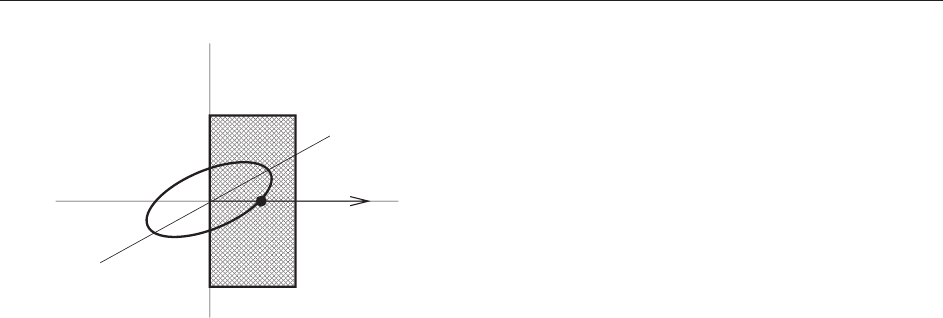
The latter inequality implies that the intersection
Q \ S is not empty (see Figure 1).
If the linear subspace H
is finite dimensional, a
simple argument involving the topological degree
shows the following fact: the image of any contin-
uous map h : Q ! H which is the identity on @Q has
nonempty intersection with S.
When H
is infinite dimensional, this fact is
not true anymore. Indeed, it is not difficult to see
that the set Q is homeomorphic to an infinite-
dimensional closed ball B, by a homeomorphism
mapping @Q onto the infinite-dimensional sphere
@B.IfB is the closed ball of an infinite-dimensional
Hilbert space, for instance, the space ‘
2
of all
square-summable sequences (x
h
) endowed with the
norm jxj
2
= (
P
1
h = 0
jx
h
j
2
)
1=2
, the continuous map
gðx
0
; x
1
; x
2
; ...Þ¼
ffiffiffiffiffiffiffiffiffiffiffiffiffiffiffiffi
1 jxj
2
2
q
; x
0
; x
1
; x
2
; ...
maps B into @B and is a shift operator on @B.
In particular, it is a continuous map on B without
fixed points, and it can be used to define a map
h : B ! @B which is the identity on @B, by setting
hðxÞ¼ðxÞx þð1 ðxÞÞgðxÞ
with ðxÞ1 such that jhðxÞj
2
¼ 1
Conjugation by the homeomorphism produces
a continuous map from Q to @Q, which is the
identity on @Q, providing us with the desired
counterexample.
In other terms, when H
is infinite dimensional,
the sets @Q and S can be unlinked by means of a
continuous map. The situation changes if we restrict
the class of maps h : Q ! H to those of the form
hðuÞ¼u þ KðuÞ½3
where K is a continuous compact map. In this case,
indeed, the argument for a finite-dimensional H
can be applied, by replacing the topological degree
by the Leray–Schauder degree (which is invariant
precisely with respect to homotopies of the form
above), and one proves that @Q and S cannot be
unlinked by means of continuous maps of this form.
Closed Characteristics on Compact
Energy Hypersurfaces
Consider R
2n
with coordinates (p
1
, ..., p
n
, q
1
, ..., q
n
),
endowed with the standard symplectic form
! :¼ dp ^ dq ¼
X
n
j¼1
dp
j
^ dq
j
Let be a compact connected hypersurface in R
2n
.
The restriction of ! to the tangent space T
x
has a
one-dimensional kernel, which varies smoothly with x.
In other words, there is a smooth line bundle
L
:¼fðx; uÞ2T j!ðu; vÞ¼0 8v 2 T
x
g
over . We wish to discuss the classical problem
of finding a closed characteristic for L
, that is,
a closed curve everywhere tangent to L
.
This geometric problem has a dynamical inter-
pretation. Indeed, let H be a smooth real function on
R
2n
such that is the inverse image of the regular
value 1. The function H – the Hamiltonian –
generates a vector field X
H
on R
2n
by the formula
!ðX
H
ðxÞ; uÞ¼DHðxÞ½u; 8u 2 R
2n
or, equivalently,
X
H
ðxÞ¼JrHðxÞ; with J ¼
0 I
I 0
The Hamiltonian vector field X
H
is tangent to and
belongs to L
. Therefore, the hypersurface is
invariant for the flow of X
H
, and the flow orbits are
precisely the characteristics. So finding a closed
characteristic on is equivalent to finding a
periodic orbit of X
H
with energy H = 1.
Up to changing the Hamiltonian, we may assume
that all the values in an interval ]1
0
,1þ
0
[ are
regular for H, and that the corresponding level sets
:= {H = } are all connected (hence diffeomorphic
to =
1
). We would like to sketch Hofer and
Zehnder’s proof of the fact that there is a dense set
of values 2 ]1
0
,1þ
0
[ for which
admits a
closed characteristic.
S
H
+
u
+
Q
H
–
Q
⭸
Figure 1 The sets S, Q, @Q:
Minimax Principle in the Calculus of Variations 437

This proof is based on the fact that the one-
periodic orbits of X
H
are critical points of the action
functional
A
H
ðxÞ¼
Z
T
x
ðp dq H dtÞ
¼
1
2
Z
1
0
_
xðtÞJxðtÞdt
Z
1
0
HðxðtÞÞdt
on the space of loops x : T ! R
2n
.
Clearly, it is enough to show that for every >0
there is a closed characteristic on some
with
j 1j <. We can take advantage of the fact that
we are free to change the Hamiltonian, as long as
it has the level sets
, j 1j <. Denoting by B
the bounded component of the complement of
{1 H 1 þ }, we may assume that B con-
tains the origin. We can modify H in such a way
that H vanishes identically on B,thenitgrows,
parametrizing all the hypersurfaces
, j 1j <,
in a strictly increasing way, then it remains
constant in a large ball, and finally it smoothly
switches to the quadratic form (3=2)jxj
2
.By
choosing H in this way, one can ensure that all
the constant orbits and all the one-periodic orbits
which do not lie on
for some j 1j < have
non-positive action. So it is enough to prove that
the functional A
H
has a positive critical value.
Using the Fourier series decomposition
xðtÞ¼
X
k2Z
e
2ktJ
^
x
k
;
^
x
k
2 R
2n
one sees that the quadratic part of the action
functional has the form
Z
1
0
_
xðtÞJxðtÞdt ¼ 2
X
k2Z
kj
^
x
k
j
2
½4
so it is positive on an infinite-dimensional linear
space, negative on an infinite-dimensional linear
space, and null on the 2n-dimensional space spanned
by the constant loops. The specific form of [4]
suggests to choose as domain of the action func-
tional the Sobolev space H
1=2
(T, R
2n
), the space of
square-integrable one-periodic curves x in R
2n
with
kxk
2
H
1=2
:¼j
^
x
0
j
2
þ 2
X
k2Z
jkjj
^
x
k
j
2
< þ1
This is indeed a Hilbert norm on H
1=2
(T, R
2n
). The
functional A
H
is smooth on this space, and its
gradient takes the form
rA
H
ðxÞ¼Lx þ KðxÞ½5
where L is the self-adjoint Fredholm operator
representing the quadratic form [4] with respect to
the H
1=2
-Hilbert product, and K is a compact map.
A gradient of the form [5] again implies that
bounded Palais–Smale sequences are compact. The
Palais–Smale condition then follows from the fact
that the Hamiltonian H is quadratic outside a large
ball, and has no one-periodic orbits there (the large
orbits are all periodic, but their period is 2/3).
Consider the splitting H
1=2
(T, R
2n
) = H
H
þ
,
with
H
¼fx j
^
x
k
¼ 0 for k > 0g
H
þ
¼fx j
^
x
k
¼ 0 for k 0g
Let S, Q, and @Q be the sets defined in the previous
section, with
u
þ
ðtÞ¼
1
ffiffiffiffiffiffi
2
p
e
2tJ
u
0
; u
0
2 R
2n
; ju
0
j¼1
and constants , , to be determined. Since the
quadratic form [4] is positive on H
þ
and the
Hamiltonian H vanishes near the origin, we can
find a small >0 such that
inf
x2S
A
H
ðxÞ> 0
The fact that the quadratic form [4] is seminegative
on H
and the behavior of H(x) for large jxj imply
that if and are suitably large (in particular
>), then
sup
x2@Q
A
H
ðxÞ0
Let be the set of all images of maps
h: Q ! H
1=2
ðT; R
2n
Þ
which are the identity on @Q and are of the form
hðxÞ¼e
ðxÞL
ðx þ KðxÞÞ ½6
with a continuous real-valued function, and K a
continuous compact map. This class of maps is more
general than the one considered in the previous
section, but the fact that e
L
commutes with the
projections onto H
and H
þ
ensures that @Q and
S cannot be unlinked even inside this class. There-
fore, any 2 has nonempty intersection with S,so
c :¼ inf
2
sup
x2
A
H
ðxÞinf
x2S
A
H
ðxÞ> 0
We would like to apply the general minimax
theorem, and conclude that c is the desired positive
critical value.
The number c being clearly finite, it is enough to
show that is positively invariant under the action
of the negative-gradient flow of A
H
, truncated
below level 0. Let = h(Q) 2 and t 0. Then
(t, ) is the image of Q by the map (t, h()). This
438 Minimax Principle in the Calculus of Variations

map is the identity on @Q because @Q lies in
{A
H
0} and is truncated below level 0. It is of
the form [6] because by [5] the truncated negative-
gradient flow of A
H
has the form
ðt; xÞ¼e
ðt;xÞL
ðx þ Kðt; xÞÞ
for some continuous function 0 (t, x) t and for
some continuous compact map K. This concludes
the proof.
This result was refined by Struwe, who proved the
existence of a closed characteristic on
for almost
every , in the sense of the Lebesgue measure. We
could try to use the abundance of closed characteristics
on energy levels near to get the existence of one on
by taking a limit. But this process produces a closed
characteristic on only if we can bound the periods of
the approximating closed orbits, otherwise a more
general invariant set results. Actually, Ginzburg, Her-
man, and Gu¨ rel have produced examples of compact
hypersurfaces without any closed characteristic.
As conjectured by Weinstein and proved by
Viterbo, closed characteristics always exist on
contact-type compact hypersurfaces (i.e., hypersur-
faces on which the restriction of ! is the
differential of a 1-form such that ^ d ^^
d is a volume form). In this case, one should even
expect a multiplicity result. For hypersurfaces which
bound a strictly convex set in R
2n
, for instance, the
existence of n closed characteristics is conjectured.
The best result so far is due to Long, who could
prove the existence of [n=2] þ 1 of them. Hofer,
Wysocki, and Zehnder have proved that, when n = 2,
there are either two or infinitely many closed
characteristics (for a generic contact-type hypersur-
face diffeomorphic to S
3
), by using the already
mentioned theorem by Franks on periodic points of
area-preserving homeomorphisms of the disk. Prov-
ing an analogous result for n 3 is an intriguing
open problem.
See also: Contact Manifolds; Floer Homology;
Hamilton–Jacobi Equations and Dynamical Systems:
Variational Aspects; Image Processing: Mathematics;
Inequalities in Sobolev Spaces; Leray–Schauder Theory
and Mapping Degree; Ljusternik–Schnirelman Theory;
Saddle Point Problems.
Further Reading
Abbondandolo A (2001) Morse Theory for Hamiltonian Systems.
Pitman Research Notes in Mathematics, vol. 425. London:
Chapman and Hall.
Ambrosetti A and Malchiodi A (2005) Perturbation Methods and
Semilinear Elliptic Problems R
n
. Birkha¨ user.
Aubin T (1998) Some Nonlinear Problems in Riemannian
Geometry. New York: Springer.
Chang KC (1993) Infinite-dimensional Morse Theory and Multi-
ple Solution Problems. Boston: Birkha¨ user.
Chang KC (2005) Methods in Nonlinear Analysis. Springer.
Ghoussoub N (1993) Duality and Perturbation Methods in Critical
Point Theory. Cambridge: Cambridge University Press.
Hofer H and Zehnder E (1994) Symplectic Invariants and
Hamiltonian Dynamics. Basel: Birkha¨user.
Klingenberg W (1982) Riemannian Geometry. Berlin: Walter de
Gruyter & Co.
Mawhin J and Willem M (1989) Critical Point Theory and
Hamiltonian Systems. New York: Springer.
Rabinowitz PH (1986) Minimax Methods in Critical Point
Theory with Applications to Differential Equations. Regional
Conference Series in Mathematics. Providence, RI: American
Mathematical Society.
Schechter M (1999) Linking Methods in Critical Point Theory.
Boston: Birkha¨user.
Struwe M (2000) Variational Methods, 3rd edn. Berlin: Springer-
Verlag.
Willem M (1996) Minimax Theorems. Boston: Birkha¨ user.
Mirror Symmetry: A Geometric Survey
R P Thomas, Imperial College, London, UK
ª 2006 Elsevier Ltd. All rights reserved.
Introduction
Mirror symmetry was discovered in the late 1980s
by physicists studying superconformal field theories
(SCFTs). One way to produce SCFTs is from closed
string theory; in the Riemannian (rather than
Lorentzian) theory the string’s world line gives a
map of a Riemannian 2-manifold into the target
with an action which is conformally invariant, so
the 2-manifold can be thought of as a Riemann
surface with a complex structure. Making sense of
the infinities in the quantum theory (supersymmetry
and anomaly cancelation) forces the target to be
10-dimensional – Minkowski space times by a
6-manifold X –andX to be (to first order) Ricci
flat and so to have holonomy in SU(3). That is X is a
Calabi–Yau 3-fold (X, , !). So SCFTs come from -
models (mapping Riemann surfaces into Calabi–Yau
3-folds) but, it turns out, in two different ways – the
A-model and the B-model. Deformations of the SCFT
and either -model are isomorphic, so over an open set
the two coincide. Thus, it was natural to conjecture
that almost all of the relevant SCFTs came from
geometry – from an A or B -model. In particular,
Mirror Symmetry: A Geometric Survey 439

the A-model of a Calabi–Yau X should, therefore,
give the same SCFT as the B-model on another
Calabi–Yau
ˇ
X. It turns out then that the A-model
on
ˇ
X should also be isomorphic to the B-model on
X; thus, mirror symmetry should give an involution
on a Calabi–Yau 3-folds. (The full picture is
slightly more complicated – it involves large
complex structure limits, multiple mirrors and
flops.) By studying the SCFTs, Greene and Plesser
predicted the mirror of the simplest Calabi–Yau
3-fold, the quintic in P
4
, and mirror symmetry
was born.
Topological observables, that is, certain path
integrals over the space of all maps, can be
calculated by the semiclassical approximation as
integrals over the space of classical minima – (anti)
holomorphic curves in the Calabi–Yau (these mini-
mize volume in a fixed homology class). From the
zero homology class we get the constant maps –
points in X – and so integrals over X. In some cases,
by Poincare´ duality, these can be thought of as
intersections of cycles; we think of the string world
sheet lying at a point of intersection. When the
world sheet has a nontrivial homology class, it
allows more general ‘‘intersections’’ where the cycles
need not intersect but are connected by a
holomorphic curve, giving a perturbation of the
usual intersection product on cohomology called
quantum cohomology. Namely, there is a contri-
bution (a.)(b.)(c.)e
R
!
to the quantum triple
product a.b.c of three 4-cycles a, b, c 2 H
1, 1
ffi H
2
ffi
H
4
from each holomorphic curve (of genus 0, in
the 0-loop approximation to the physics) in X of
area
R
! (where ! is the Ka¨ hler form). The
A-model correlation functions can be determined
from these data; the B-model computation involves
no such quantum correction and can be computed
purely in terms of integrals over cycles (‘‘periods’’)
and their derivatives (discussed in the next section).
So it is in some sense easier and, in a historic tour-
de-force, was calculated by Candelas et al. (1991)
for the Greene–Plesser mirror of the quintic.
Comparing with the A-model computation on
the quintic gave remarkable predictions about the
number of holomorphic rational curves on the
quintic. These were way beyond mathematical
capabilities at the time, and sparked enormous
mathematical interest. The predictions (and more)
have now been proved to be true by Givental and
Lian–Liu–Yau, while mirror symmetry has begun to
be understood geometrically. But, in some sense,
the mathematical reason for the relationship
between the Yukawa couplings and the quantum
cohomology of the mirror is still a little mysterious;
it is the hardest part of mirror symmetry to see in the
geometry, yet for the physics it was the easiest and the
first prediction.
We survey, nonchronologically, some of the
geometry of mirror symmetry as it is now under-
stood, mainly in dimension n = 3. For the many
topicsomitted,thereadershouldconsulttheFurther
Readingsection.
The Geometric Setup
A Calabi-Yau 3-fold (X, , !)isaKa¨ hler manifold
(X, !) with a holomorphic trivialization of its
canonical bundle
K
X
¼
3
C
T
X
(i.e., a nowhere-vanishing holomorphic volume form,
locally dz
1
^ dz
2
^ dz
3
), and b
1
(X) = 0. It follows that
the Hodge numbers h
0, 2
, h
0, 1
vanish, and so
H
2
(X, C) = H
1, 1
and H
3
(X, R) ffi H
2, 1
þH
3, 0
.By
Yau’s theorem the Ka¨hler metric can be changed
within its H
2
(X, R) cohomology class to a unique
Ricci-flat Ka¨ hler metric; equivalently, is parallel, so
the induced metric on K
X
is flat. Roughly speaking,
mirror symmetry swaps the symplectic or Ka¨hler
structure ! on X with the complex structure (encoded
in ,uptoscalingbyC
) on the (conjectural) mirror
ˇ
X.Ka¨hler deformations are unobstructed, forming an
open set K
X
in H
2
(X, R). Its closure K
X
is sometimes
extended by adding the Ka¨ hler cones of all birational
models of X to give Kawamata’s movable cone. This is
because the work of Aspinwall, Greene, Morrison, and
Witten suggested that all birational models of X are
indistinguishable in string theory and so are all mirrors
of
ˇ
X, corresponding to a different choice of (1, 1)-form
! which is a Ka¨hler form on one model only. K
X
is also
complexified by including in the A-model data any
‘‘B-field’’ B 2 H
2
(X, R=Z), and divided by holo-
morphic automorphisms of X, to give a moduli space
of complex dimension h
1, 1
(X). Deformations of
complex structure are also unobstructed by the
nontrivial Bogomolov–Tian–Todorov theorem; thus,
they form a smooth space with tangent space
H
1
ðT
XÞ!
y
’
H
1
ð
2
T
XÞ¼H
2;1
ð
XÞ
(Given a deformation of complex structure, the
above isomorphism takes the H
2, 1
-component of the
derivative of the (3, 0)-form .) So, for the moduli
spaces to match up, we get the first and simplest
prediction of mirror symmetry:
h
1;1
ðXÞ¼h
2;1
ð
XÞ and h
2;1
ðXÞ¼h
1;1
ð
XÞ½1
This is where mirror symmetry gets its name, the
above relation making the Hodge diamonds of X
and
ˇ
X mirror images of each other.
440 Mirror Symmetry: A Geometric Survey

As the complexified Ka¨ hler cone is a tube
domain, it has natural partial complex compactifi-
cations (due to Looijenga, and suggested in the
context of mirror symmetry by Morrison (1993)).
The simplest case is where we ignore the movable
cone and automorphisms and assume that there is
an integral basis e
1
, ...,e
n
of both K
X
and
H
2
(X, Z)=torsion. The complexified Kahler moduli
space is then
K
C
X
:¼ H
2
ðX; RÞ=H
2
ðX; ZÞþiK
X
¼fB þ i!g
with natural coordinates x
i
, y
i
0 pulled back from
the first and second factors, respectively, induced by
the e
i
. x
i
is multivalued with integer periods, so
z
i
¼ expð2iðx
i
þ iy
i
ÞÞ ½2
is a well-defined holomorphic coordinate, giving an
isomorphism to the product of n punctured unit
disks in C:
K
C
X
ffið
Þ
n
¼fðz
i
Þ : 0 < jz
i
j1gðC
Þ
n
The compactification
n
comes from adding in the
origins in the disks, which we reach by going to
infinity (in various directions) in K
C
X
. We call the
point (0, ...,0) 2
n
the large Kahler limit point
(LKLP) in this case. Moving along the ray generated
by
P
k
i
e
i
2K
X
, k
i
0, complexifies in the holo-
morphic structure [2] to give the analytic curve
z
k
j
i
¼ z
k
i
j
; 8i; j ½3
in K
C
X
. For k
i
2 Q 8i, this extends to a complete
curve in the compactification. Without loss of
generality, we can assume that k
i
are integers with
no common factor; then the link of the curve winds
around the LKLP (0, ...,0) 2
n
with winding
number
ðk
1
; ...; k
n
Þ2
1
ðH
2
ðX; RÞ=H
2
ðX; ZÞþiK
X
Þ
¼ H
2
ðX; ZÞ¼Z:e
1
Z:e
n
This is because multiplying the ray R.k
i
e
i
2K
X
by i gives the direction R.k
i
e
i
in the space
H
2
(X, R)=H
2
(X, Z) of B-fields, with the given
winding number. For k
i
not rational we get an
analytic mess; the direction in the space of B-fields
does not close up to give a circle.
There is no obvious mirror to these rays since we
consider only up to scale. So, mirror symmetry
predicts an isomorphism between K
C
X
and the
moduli space M
ˇ
X
of complex structures on
ˇ
X, and
a distinguished limit in M
ˇ
X
, the large complex
structure limit point (LCLP), the mirror of the LKLP
(0, ...,0) 2
n
above. Morrison has given a rigorous
definition of LCLPs and the canonical coordinates
onM
ˇ
X
dual to the z
i
on K
C
X
; see the section
MonodromyaroundtheLCLP.Theholomorphic
curves in ()
n
described above, corresponding to
rational rays of Ka¨ hler forms, give degenerations of
(the complex structure on)
ˇ
X to the LCLP whose
monodromy is discussed in this article (see ‘‘Lagran-
gian Torus Fibrations’’).
LCLPs play a vital role in mirror symmetry; in
fact, mirror symmetry is really a statement about
LCLPs and families of Calabi–Yau manifolds near
LCLPs. Most predictions only really hold near or at
the LCLP, and the complex structure moduli space
only looks like
n
near the LCLP. For instance,
manifolds can have many LCLPs and accordingly
many mirrors. This also explains one obvious
paradox – that rigid Calabi–Yau manifolds, those
with no complex structure deformations, h
2, 1
= 0,
and so no LCLP, can have no mirror, since a Ka¨ hler
(or symplectic) manifold has h
2
= h
1, 1
6¼ 0.
The first predicted refinement of [1] is, as
discussed in the introduction, that the variation of
Hodge structure (VHS) on
ˇ
X should be describable
in terms of Gromov–Witten invariants of X. Here
VHS is governed by how the ray C.
t
= H
3, 0
(
ˇ
X
t
)
sits inside H
3
(
ˇ
X
t
, C) as the complex structure on
ˇ
X
t
varies, parametrized by t 2M
ˇ
X
. By Poincare´
duality, it is sufficient to know how
t
pairs with
H
3
(
ˇ
X), that is, to compute the period integrals
Z
A
i
t
; i ¼ 1; ...; 2k ¼ 2h
2;1
þ 2
where A
i
form a basis of H
3
(
ˇ
X, Z). (In fact we can
choose the A
i
to be a symplectic basis, A
i
.A
j
=
iþk, j
,
and then knowledge of only the periods of the first k
A
i
suffices, locally in moduli space.) These periods
determine
t
and so the Yukawa coupling
H
1
ðT
X
t
Þ
3
!
[
H
3
ð
3
T
X
t
Þ!
y
2
t
H
3
ðK
X
t
ÞffiC ½4
On X, we get the cubic form on H
2
(X) described
earlier in terms of numbers of rational curves in X.
These numbers are in fact independent of the
almost-complex structure on X (as long as it is
compatible with the symplectic form !), and, there-
fore, give the symplectic invariants of Gromov
and Witten. The cubic form depends on ! = !
t
as it moves in K
X
t
(or in K
C
X
t
, replacing !
t
by
i(B
t
þ i!
t
)). Under the predicted local isomorphism
K
C
X
ffiM
ˇ
X
near the LKLP and LCLP, the equality of
these cubic forms gives the predictions of number of
rational curves in X mentioned in the introduction.
This has been carried out, and the predictions
checked rigorously, in quite some generality, for
instance for mirror pairs produced by Batyrev’s toric
methods.
Mirror Symmetry: A Geometric Survey 441

There is, of course, a flat connection, the Gauss–
Manin connection on the bundle over M
ˇ
X
with
fiber H
3
(
ˇ
X
t
, C) over t 2M
ˇ
X
, given by the local
system H
3
(
ˇ
X
t
, Z) H
3
(
ˇ
X
t
, C). As mirror to this,
Dubrovin has shown how to put a flat connection
on the bundles with fibers H
2
(X
t
) and H
ev
(X
t
) using
Gromov–Witten invariants.
Homological Mirror Symmetry
Building on the work of Witten, Kontsevich (1995)
proposed a remarkable conjecture that purported to
explain mirror symmetry, all the more surprising
because it appeared to have little to do with what
was thought to be mirror symmetry at the time. The
conjecture is now reasonably well understood, while
the link to Gromov–Witten invariants and Yukawa
couplings is more mysterious, although it is known
how both data should be encoded in the conjecture.
Kontsevich proposed that mirror symmetry should
be explained by a (noncanonical) equivalence of
triangulated categories between the derived Fukaya
category D
F
(X)of(X, !) and the bounded derived
category of coherent sheaves D
b
(
ˇ
X) on its mirror
ˇ
X.
This second category consists of chain complexes of
holomorphic bundles, with quasi-isomorphisms
(maps of chain complexes which induce isomorph-
isms on cohomology) formally inverted, that
is, decreed to be isomorphisms. For zero B-field
the first category should be constructed from
Lagrangian submanifolds L X carrying flat uni-
tary connections A. That is, L is middle- (three-)
dimensional, and
!j
L
0; F
A
¼ 0
For B 6¼ 0, this needs modifying to F
A
þ 2iB.id = 0
(so, in particular, we require that L satisfies
[Bj
L
] = 0 2 H
2
(L, R=Z)). There are also various
technical conditions such as the choice of a relative
spin structure, the Maslov class of L must vanish
(i.e., the map (j
L
=vol
L
):L ! C
has winding
number zero) and we pick a grading on L
(a choice of logarithm of this map). Morphisms are
defined by Floer cohomology HF
of Lagrangian
submanifolds; roughly speaking, this assigns a vector
space to each intersection point (the homomorph-
isms between the fibers of the two unitary bundles
carried by the Lagrangians at this point), made into
a chain complex by a certain counting of holo-
morphic disks between intersection points. In-depth
work by Fukaya–Oh–Ohta–Ono shows that this
gives the structure of an A
1
-category which can
then be ‘‘derived’’ into a triangulated category in a
formal way by taking ‘‘twisted cochains.’’ The
construction is still very technical and difficult to
calculate with, but the key points are that we get a
category depending only on the symplectic structure,
that certain ‘‘unobstructed’’ Lagrangian submani-
folds give objects of this category, and that
Hamiltonian isotopic unobstructed Lagrangian sub-
manifolds give isomorphic objects.
Since the introduction of D-branes there is a
physical interpretation of this conjecture in terms of
open string theory; the objects of the two categories
are boundary conditions for open strings, and
morphisms correspond to strings beginning on one
object and ending on the other. So, for instance,
intersections of Lagrangians give morphisms corre-
sponding to constant strings at the intersection
point, while the Floer differential gives instanton
tunneling corrections.
One paradox this formulation immediately sheds
light on concerns automorphisms on both sides of
mirror symmetry. While symplectomorphisms of
(X, !) are abundant, there are few holomorphic
automorphisms of a Calabi–Yau
ˇ
X.Theformer
induce autoequivalences of D
F
(X); Kontsevich’s
suggestion is that as a mirror to this there should
be an autoequivalence of D
b
(
ˇ
X); this need not be
induced by an automorphism of
ˇ
X. Motivated by
this, groups of autoequivalences of derived cate-
gories of sheaves of Calabi–Yau manifolds have
now been found that were predicted by mirror
symmetry; a few are mentioned below. Thus,
homological mirror symmetry suggests that an
SCFT is equivalent to a triangulated category,
and the ambiguities in geometrizing an SCFT
(finding a Calabi–Yau of which it is a -model)
are seen in the category – not all automorphisms
come from an automorphism of a Calabi–Yau
(e.g., Calabi–Yau manifolds
ˇ
X with equivalent
derived categories give multiple mirrors to X),
and not all appropriate categories need even come
from a Calabi–Yau. Supporting this suggestion,
Bondal–Orlov and Bridgeland have shown that
indeed birational Calabi–Yau manifolds
ˇ
X have
equivalent derived categories.
Finally, Kontsevich explained how deformation
theory of the categories should involve derived
morphisms on the product from the diagonal
(thought of as a Lagrangian in the A-model, its
structure sheaf as a coherent sheaf in the B-model)
to itself, giving quantum cohomology in the
A-model and Hodge structure in the B-model. For
instance, the holomorphic disks used to compute the
Floer cohomology of the diagonal on the product
X X give holomorphic rational curves on X. So,
one should be able to see some parts of ‘‘classical’’
mirror symmetry.
442 Mirror Symmetry: A Geometric Survey

Below, as we describe more of the geometry of
mirror symmetry that has emerged since Kontse-
vich’s conjecture, we will mention at each stage how
his conjecture fits in with it.
The Strominger–Yau–Zaslow Conjecture
To recover more geometry from Kontsevich’s con-
jecture, there are some obvious objects of D
b
(
ˇ
X)
that reflect the geometry of
ˇ
X – the structure sheaves
O
p
of points p 2
ˇ
X. Calculating their self-Homs,
Ext
(O
p
, O
p
) ffi
T
p
ˇ
X ffi
C
3
ffi H
(T
3
, C), shows
that if they are mirror to Lagrangians L in X (with
flat connections A on them) then we must have
HF
ððL; AÞ; ðL; AÞÞ ffi H
ðT
3
; CÞ
as graded vector spaces. Since the left-hand side is,
modulo instanton corrections, H
(L, C)
r
, where r is
the rank of the bundle carried by L, this suggests
that the mirror should be L ffi T
3
with a flat U(1)
connection A over it. There are reasons why the
Floer cohomology of such an object should not be
quantum corrected, and so be isomorphic to
Ext
(O
p
, O
p
).
For any Lagrangian L, the symplectic form gives
an isomorphism between T
L and its normal bundle
N
L
; thus, Lagrangian tori have trivial normal
bundles, and locally one can fiber X by them.
Thus, one might hope that X is fibered by
Lagrangian tori, and the mirror
ˇ
X is (at least over
the locus of smooth tori) the dual fibration. This is
because the set of flat U(1) connections on a torus is
naturally the dual torus.
This is the kind of philosophy that led to
the Strominger–Yau–Zaslow (SYZ) conjecture
(Strominger et al. 1996), although Strominger et al.
were working with physical D-branes, and not
Kontsevich’s conjecture. Therefore, their D-branes
are not the ‘‘topological D-branes’’ of Kontsevich,
but those minimizing some action. That is, instead
of holomorphic bundles in the B-model, we deal
with bundles with a compatible connection
satisfying an elliptic partial differential equation
(PDE) (e.g., the Hermitian–Yang–Mills equations
(HYM), or some perturbation thereof); instead of
Lagrangian submanifolds up to Hamiltonian isotopy
in the A-model, we consider special Lagrangians
(sLags) (see eqn [5]). The SYZ conjecture is that a
Calabi–Yau X should admit a sLag torus fibration,
and that the mirror
ˇ
X should admit a fibration
which is dual, in some sense.
A sLag is a Lagrangian submanifold of a Calabi–
Yau manifold X satisfying the further equation that
the unit norm complex function (phase)
j
L
vol
L
¼ e
i
¼ constant ½5
(So, sLags have Maslov class zero, in particular.)
This equation uses the complex structure on X as
well as the symplectic structure, and the resulting
Ricci-flat metric of Yau, to define a metric on L and
so its Riemannian volume form vol
L
. SLags are
calibrated by Re(e
i
) and so minimize volume in
their homology class. This is similar to the HYM
equations on the mirror
ˇ
X, which are defined on
holomorphic bundles on the complex manifold
ˇ
X
via a Ka¨hler form !, and minimize the Yang–Mills
action. The Donaldson–Uhlenbeck–Yau theorem
states that for holomorphic bundles that are
polystable (defined using [!], this is true for the
generic bundle), there is a unique compatible
HYM connection. Thus, modulo stability, HYM
connections are in one-to-one correspondence with
holomorphic bundles. A similar correspondence is
conjectured, and proved in some special cases, by
Thomas and Yau, for (special) Lagrangians: that
modulo issues of stability (which can be formulated
precisely), sLags are in one-to-one correspondence
with Lagrangian submanifolds up to Hamiltonian
isotopy. That is, there should be a unique sLag in
the Hamiltonian isotopy class of a Lagrangian if and
only if it is stable. Currently, only the uniqueness
part of this conjecture has been worked out, but, in
principle at least, we do not lose much by consider-
ing only Lagrangian torus fibrations.
The SYZ conjecture is thought to hold only near
the LCLPs and LKLPs of X and
ˇ
X;awayfromthese,
the sLag fibers may start to cross. According to Joyce,
the discriminant locus of the fibration on X is
expected to be a codimension one ribbon graph in a
base S
3
near the limit points, while the discriminant
locus of the dual fibration
ˇ
X maybedifferent–that
is, the smooth parts of the fibration and its dual are
compactified in different ways. In the limit of moving
to the limit points, however, both discriminant loci
shrink onto the same codimension-two graph. In this
limit, the fibers shrink to zero size, so that X (with its
Ricci-flat metric) tends, in the Gromov–Hausdorff
sense, to its base S
3
(with a singular metric). This
formal picture has been made precise in two
dimensions, for K3-surfaces, by Gross and Wilson.
The limiting picture suggests that if we are only
interested in topological or Lagrangian torus fibra-
tions then we might hope for codimension-two
discriminant loci, and such fibrations might make
sense well away from limit points. Gross and Ruan
carry this out in examples such as the quintic and its
mirror, and makes sense of dualizing the fibration by
dualizing monodromy around the discriminant locus
Mirror Symmetry: A Geometric Survey 443

and specifying a canonical compactification over the
discriminant locus. This gives the correct topology for
toric varieties and their mirrors, and flips the Hodge
numbers [1], for instance. Approaching the LCLP in
a different way (in the example of eqn [3] this
corresponds to altering the rational numbers k
i
)can
give a different graph and different fibration on X;
the dual fibration can then be a topologically
different manifold, giving a different birational
model of the mirror
ˇ
X.
We focus only on Lagrangian fibrations, as they
are better behaved and understood. We can expect
them to be C
1
fibrations with codimension-two
discriminant loci, for instance. Below we see how
to put a complex structure on the smooth part
of the fibration, but extending this over the
compactification is much harder and will involve
‘‘instanton corrections’’ coming from holomorphic
disks. Fukaya (2005) has beautiful conjectures about
this that will explain a great deal more of mirror
symmetry, but they will not be discussed here.
Lagrangian Torus Fibrations
If (X
2n
, !)
!
B
n
is a smooth Lagrangian fibration
with compact fibers, then the fibration is naturally
an affine bundle of torus groups (i.e., a bundle of
groups once we pick a Lagrangian 0-section – an
identity in each fiber), and the base B inherits a
natural integral affine structure: it looks like a
vector space V with an integral structure V ffi
Z
R up to translation by elements of V. This is the
classical theory of action-angle variables. T
b
B acts
on the fiber X
b
=
1
(b): by pullback and contrac-
tion with the symplectic form, 2 T
b
B gives a
vector field
tangent to X
b
, and the time-one flow
along
gives the action. By compactness and
smoothness of X
b
the kernel is a full-rank lattice
b
T
b
B, giving the isomorphism
X
b
ffi T
b
B=
b
We define the integral affine structure on B by
specifying the integral affine functions f (up to
translation) to be those whose time-one flow along
df is the identity (i.e., on the universal cover the time-
one flow is to a section of the bundle of lattices ).
The situation that concerns us is where B is a
3-manifold
B (usually S
3
) minus a graph; then the
monodromy around the graph preserves the integral
affine structure:
1
ðBÞ!R
3
o GLð3; ZÞ½6
A great deal of mirror symmetry can be seen from
just this knowledge of the smooth locus of the
fibration; in particular, Gross (1998) has shown
how mild assumptions about the compactification
(with singular fibers over
BnB) are enough to
determine much of the topology of X. The dual
fibration
ˇ
should have the monodromy dual to [6],
and he shows how this implies the switching of the
Hodge numbers [1] by the Leray spectral sequence;
the rough idea being the obvious isomorphism
R
i
R ffi
i
TB ffi
3i
T
B ffi R
3i
R
induced by a trivialization of
3
TB. That is, morally
speaking, the flipping of Betti numbers arises by
representing cycles by those with linear intersection
with the fibers, and replacing this linear space by its
annihilator in the dual torus. This also agrees with
the equivalence taking Lagrangians to coherent
sheaves described in the next section.
The dual fibration
ˇ
has a natural complex
structure; here the affine structure is essential, as in
general a tangent bundle TB only has a natural
almost complex structure along its 0-section. Since,
up to translation, locally B ffi V is a vector space,
TB ffi V V ffi V
R
C has a natural complex
structure which descends to
:
X ¼ TB=
! B ½7
Gross suggests that the B-field on X should lie in the
piece
H
1
ðR
1
R=ZÞ¼H
1
ðTB=
Þ
of the Leray spectral sequence converging to
H
2
( X, R=Z). That is, it is represented by a C
ˇ
ech
cocycle e on overlaps of an open cover of B with
values in the dual bundle of groups TB=
. Using
this to twist [7] and re-glue it via transition
functions translated by e, we get a new complex
manifold (e is locally constant, so translation by e is
holomorphic) which we consider as mirror to X
with complexified form B þ i!. In this way, Gross
manages to match up complexified symplectic
deformations of X with complex structures on
ˇ
X.
The 2-Torus
Mirror symmetry is nontrivial even for the simplest
Calabi–Yau – the 2-torus. This can be written as an
SYZ fibration T
2
!
B = S
1
, and write B as R=a Z
with its standard integral affine structure induced by
Z R. This trivializes T
B = B R and the lattice
in it as B Z B R. So as a symplectic manifold,
T
2
¼
T
S
1
¼
½0; a½0; 1
ð0; pÞða; pÞ; ðq; 0Þðq; 1Þ
½8
444 Mirror Symmetry: A Geometric Survey

with symplectic coordinates (q, p)inwhichthe
symplectic form is ! = dp ^ dq (so
R
T
2
! = a). Again,
the B-field, b 2 H
1
(R
1
R=Z) = H
2
(T
2
, R=Z), is in
H
1
of the locally constant sections of the dual
fibration.
In our trivialization B ffi R=aZ,
TB is also
standard: B Z B R, so the mirror has the
same description as in [8] in which the complex
structure is standard: J@
p
= @
q
. That is, p þ iq gives a
local holomorphic coordinate.
For nonzero B-field b 6¼ 0, twisting the dual
fibration by b gives
T
2
¼
T
S
1
¼
½0; a½0; 1
ð0; pÞða; b þ pÞ; ðq; 0Þðq; 1Þ
½9
again with holomorphic structure given by p þ iq and
SYZ fibration
ˇ
being projection onto q. So, as a
complex manifold the mirror is C divided by the lattice
¼h1; b þ iai
Changing b to b þ 1 does not alter this lattice,
so the construction is well defined for b 2 R=Z ffi
H
1
(R
1
R=Z), and we have the standard description
of an elliptic curve via its period point = b þ ia in
the upper half plane (as a > 0). Mirror symmetry
has indeed swapped the complexified symplectic
parameter b þ ia =
R
T
2
(b þ i!) for the complex
structure modulus = b þ ia. SL(2, Z) acts on both
sides (in the standard way on , and as symplecto-
morphisms modulo those isotopic to the identity on
the A-side) permuting the choices of SYZ fibration.
We note that in this case the fibrations are special
Lagrangians in the flat metric, with no singular
fibers.
Polishchuk and Zaslow have worked out in detail
how Kontsevich’s conjecture works in this case.
The general picture for any torus fibration is an
extension of the fiberwise duality that led to SYZ.
Namely, Lagrangian multisections L of the
fibration, of degree r over the base, give r points
on each fiber, and so r flat U(1) connections on the
dual fiber. The resulting U(1)
r
connections can be
glued together and twisted by the flat connection on
L, to give a rank-r vector bundle with connection on
the mirror. Arinkin and Polishchuk show that
in general the Lagrangian condition implies the
integrability condition F
0, 2
= 0 of the resulting
connection, giving a holomorphic structure on the
bundle. Leung–Yau–Zaslow show that the special
Lagrangian condition gives a perturbation of the
HYM equations on the connection. Branching of
sections has been dealt with by Fukaya, and requires
instanton corrections from holomorphic disks.
Other Lagrangians with linear intersection with the
fibers can be dealt with similarly. T
2
is simpler
because all Lagrangians with vanishing Maslov class
can be isotoped into straight lines (i.e., sLags in the
flat metric) with no branching. The upshot is that
the slope of the sLag over the base corresponds to
the slope (
R
T
2
c
1
=rank) 2 [1,1] of the mirror
sheaf.
The Large Complex Structure Limit
The LKLP for T
2
is clearly lim a !1.Onthe
mirror then, the LCLP is at = b þ ia ! b þ i1,
the nodal torus compactifying the moduli of elliptic
curves. Metrically, however, in the (Ricci-) flat
metric, things look different; if we rescale to have
fixed diameter, the torus collapses to the base of its
SYZ fibration, and all of its fibers contract. This is
an important general feature of the difference
between complex and metric descriptions of
LCLPs; see the description of the quintic in the
next section.
We note that, as in the compactifications
discussed in an earlier section, the monodromy
around this LCLP is given by rotating the B-field:
b 7!b þ 1. This gives back the same elliptic curve,
but after a monodromy diffeomorphism T, which,
from [9], is seen to be
T : q 7!q; p 7!p þ q=a
On H
1
(T
2
) = Z[fiber] Z[section] this acts as
T
¼
11
01
½10
This is called a Dehn twist. Picking the 0-section
O = {p = 0} in the mirror [9] when b = 0, this is
taken to the section
TðOÞ¼fp ¼ q=ag
and T is in fact the translation by this section T(O)
on T
2
, using the group structure on the fibers (now
we have chosen a 0-section). Again, Gross (1998)
has shown that this is a general feature of LCLPs.
If we pick a Ka¨ hler structure on this family of
complex tori, T turns out to be a symplectomorph-
ism. Importantly, its mirror is not a holomorphic
automorphism, but an equivalence of the derived
category of coherent sheaves. As above, the section
T(O) corresponds to a slope-one line bundle L
on the mirror, and the monodromy action
corresponds to
L : D
b
! D
b
½11
on the derived category. Again, this is a more
general feature of these LCLPs, with L such that
c
1
(L) equals the symplectic form which generated
Mirror Symmetry: A Geometric Survey 445

the ray along which the original LKLP was reached.
In general, the SYZ fiber is the invariant cycle under
T
[10], and, on the mirror, structure sheaves of
points are invariant under L. On the cohomology
of T
2
, cupping with ch(L) = e
c
1
(L)
= 1 þ c
1
(L) has the
same action [10] on H
ev
= Z(c
1
(L)) Z(1).
Notice we have used the choices of fibration and
0-section to produce the equivalence of triangulated
categories and to equate the monodromy actions.
Kontsevich’s conjectural equivalence is not canonical,
but is fixed by a choice of fibration and 0-section. In
turn, a fibration should be fixed by a choice of LCLP
or LKLP from the resulting collapse (in the Ricci-flat
metric) onto a half-dimensional S
n
base. The choice of
0-section is then rather arbitrary (as monodromy
about the LCLP changes it) but determines the
equivalence of categories. Different choices of section
give different equivalences, differing, for instance, by
the monodromy transformation L [11].
Another point of view is that a Lagrangian
fibration and 0-section determine a group structure
on the fibers and so on the Fukaya category
(translating Lagrangian multisections by multiplica-
tion on each fiber). This corresponds to a choice of
tensor product on the derived category of the
mirror; the identity for this product is then the
structure sheaf O
X
mirror to the 0-section, and an
ample line bundle is given by the action of the
monodromy transformation L = T(O
X
); T then
acts as T(O
X
) [11]. Since X is determined by the
graded ring
M
j0
H
0
X
ðL
j
Þ¼
M
j0
Hom
ðO
X
; T
j
ðO
X
ÞÞ
one might also try to construct X purely from the
0-section O and LCLP monodromy on
ˇ
X,as
X ¼ Proj
M
j0
HF
ðO; T
j
ðOÞÞ
A problem is to show that
j0
HF
0
(O, T
j
(O)) is
finitely generated; a related problem is to show that, for
j 0, the above Floer homologies vanish except
for = 0.
We now turn to the quintic 3-folds, where we will
see how to identify the (homology classes of the)
0-section and fiber in general using Hodge theory.
The Quintic 3-Fold
The simplest Calabi–Yau 3-fold is given by the zeros
Q of a homogeneous quintic polynomial on P
4
, that
is, an anticanonical divisor of P
4
. By adjunction, this
has trivial canonical bundle, and so is Calabi–Yau.
By the Lefschetz hyperplane theorem, it has h
1, 1
= 1,
so computing its Euler number to be e = 200, we
find that h
2, 1
= 101 gives its number of complex
deformations. Alternatively, this can be seen by
showing that all such deformations are themselves
quintics, then dividing the 126-dimensional space of
quintic polynomials by the 25-dimensional GL
(5, C). Thus, its mirror has one complex structure
deformation and 101 Ka¨hler classes.
Greene and Plesser prescribed the following
mirror. Take the special one-dimensional family of
Fermat quintics
Q
¼
X
4
i¼0
x
5
i
Y
4
i¼0
x
i
¼ 0
()
P
4
½12
with the action of {(
0
, ...,
4
) 2 (Z=5)
5
:
Q
i
i
= 1} ffi (Z=5)
4
given by rescaling the x
i
by
fifth roots of unity. Dividing by the diagonal Z=5
projective stabilizer, we get a free (Z=5)
3
action; the
mirror of the quintic is any crepant (K = O)
resolution of the quotient:
Q
¼
c
Q
ðZ=5Þ
3
Different resolutions give different Ka¨hler
cones whose union is the moveable cone; its complex-
ification is locally isomorphic to the complex
structure moduli space of Q. h
1, 1
(
ˇ
Q
) = 101 for any
crepant resolution, and h
2, 1
(
ˇ
Q
) = 1 corresponds
locally to the one complex structure deformation
[12]. In fact, for
5
= 1, multiplying x
0
by shows
that
ˇ
Q
ffi
ˇ
Q
, and
5
parametrizes the complex
structure moduli.
The LCLP is at = 1, that is, it is the quotient of
the union of hyperplanes
Q
1
¼
Y
4
i¼0
x
i
¼ 0
()
¼fx
0
¼ 0g[[fx
4
¼ 0g½13
This is a union of toric varieties, each with a T
3
action
inherited from the toric T
4
action on P
4
.Muchmore
generally, Batyrev’s construction considers the
anticanonical divisors (and even more generally,
complete intersections) in toric varieties fibered over
the boundary of the moment polytope, and takes as
mirror the anticanonical divisor of the toric variety
associated to the dual polytope. However, most of the
geometry is visible in this quintic example.
Equation [13] is the analog of the nodal torus of
the last section, and we emphasize again that
metrically it looks nothing like this; the Ricci-flat
metric collapses the T
3
toric fibers to the base S
3
(with
a singular metric). General LCLPs look rather similar,
446 Mirror Symmetry: A Geometric Survey