
Francoise J.-P., Naber G.L., Tsun T.S. (editors) Encyclopedia of Mathematical Physics
Подождите немного. Документ загружается.


with such ‘‘as bad as possible’’ normal crossing
singularities. Smoothing a local model (in x
0
= 1)
Q
4
i = 1
x
i
= 0, we can see the tori in f
Q
4
i = 1
x
i
= g:
T
3
¼
jx
1
j¼
1
; jx
2
j¼
2
;
jx
3
j¼
3
; x
4
¼
x
1
x
2
x
3
½14
These are even Lagrangian in the standard symplec-
tic form on the local model, and fiber the smoothing
over the base {(
1
,
2
,
3
)}. It turns out that,
metrically, these tori (which vanish into the normal
crossings singularity at the LCLP) actually form a
large part of the smooth Calabi–Yau. This
enlightens the apparent paradox between the SYZ
conjecture and the Batyrev construction, that is, why
a vertex of the original moment polytope (corre-
sponding to the deepest type of singularity
(0, 0, 0, 0) 2 {
Q
4
i = 1
x
i
= 0}) can be replaced by the
dual three-dimensional face in the dual polytope.
This was first suggested by Leung and Vafa.
Gross and Siebert (2003) exploit this to extend SYZ
and Batyrev’s construction to nontoric LCLP Calabi-
Yau manifolds; it is only the local toric nature of the
normal crossing singularities of the LCLP that they
use. It seems possible that their construction will give
the mirrors of all Calabi–Yau manifolds with LCLPs.
Much of mirror symmetry should soon be reduced to
graphs (the discriminant locus of a Lagrangian torus
fibration) in spheres, and further graphs over which D-
branes (such as holomorphic curves) fiber, as in recent
conjectures of Kontsevich and Soibelman and Fukaya
(2005). It may soon be possible to write down a
triangulated category in terms of such data. The full
geometric story (involving Joyce’s description of sLag
fibrations, for instance) is still some way off, however;
we cannot even write down an explicit Ricci-flat
metric on a compact Calabi–Yau.
Monodromy around the LCLP
As well as the SYZ torus fiber [14] we can also see a
Lagrangian 0-section on the quintic and its mirror as a
component of the real locus of [12] for >5.
Remarkably, like the torus [14],thiscyclewasalready
described and used by Candelas et al. (1991),long
before the relevance of torus fibrations was suspected.
Gross and Ruan have been able to describe the
quintic and its mirror (at least topologically or
symplectically) very explicitly as a simple torus
fibration over this S
3
with a natural integral affine
structure and codimension-two graph discriminant
locus (see, e.g., Gross et al. (2003)).
Under monodromy about = 1, the 0-section is
moved to another section T(O), and T is given by
translation by T(O) using the group structure on the
fibers. This is the analog of the Dehn twist [10], and
one can choose a basis of H
3
(
ˇ
Q) (with first element
the invariant cycle, the T
3
-fiber, second element
a cycle fibered over a curve in S
3
, third fibered over
a surface, and last the 0-section itself) such that
T
¼
11
01
001
0001
0
B
B
@
1
C
C
A
½15
Like the Dehn twist [10], it turns out that T
is
maximally unipotent; that is, we have in n-dimensions,
ðT
1Þ
nþ1
¼ 0 but ðT
1Þ
n
6¼ 0
Again, this is a general feature of LCLPs as formulated
by Morrison (1993) as part of the definition.
This should be compared with the Lefschetz
operator L = [ ! on the cohomology of the mirror,
which also satisfies L
n
6¼ 0, L
nþ1
= 0 (or, more
relevantly, exp (L), which satisfies (e
L
1)
n
6¼ 0,
(e
L
1)
nþ1
= 0). Their similarity was noticed by the
Griffiths school working on VHS in the late 1960s!
Now we know that for Calabi–Yau manifolds at an
LCLP dual to an LKLP along a ray ! = c
1
(L) on the
mirror, they should be considered mirror operators
(up to some factors of the Todd class of the
underlying Calabi–Yau, to do with the relationship
between the Chern character e
!
of the line bundle L
(see [11]) and the Riemann–Roch formula).
Both, by linear algebra of the nilpotent operator
N = log T
=
P
n
k = 1
(T
1)
k
, induce a natural
filtration W
:0 W
0
W
2n
= H on the coho-
mology on which they operate (which is H = H
n
for
N = log T
and H = H
ev
for N = L = [ !):
0 imðN
n
ÞimðN
n1
Þ\kerðNÞ
kerðN
n1
ÞþimðNÞkerðN
n
ÞH
½16
For a discussion of the construction of this mono-
dromy weight filtration, the reader is referred to the
furtherreadingsection.Itplaysakeyroleinstudying
degenerations of varieties and Hodge structures, in this
case as we approach the LCLP. It is a beautiful result of
Gross that this filtration coincides with the Leray
filtration on H
n
induced by the fibration. That is,
under Poincare´ duality, the weight filtration on cycles
is by the minimal dimension (over all homologous
cycles) of the image in the base over which the cycle is
fibered. So, the first graded piece is spanned by the
invariant cycle, the T
3
fiber, supported over a point,
and the last by the 0-section; cf. [15]. (Similarly on the
mirror, the filtration for the Lefschetz operator [e
!
has first piece spanned by the cohomology class of a
Mirror Symmetry: A Geometric Survey 447
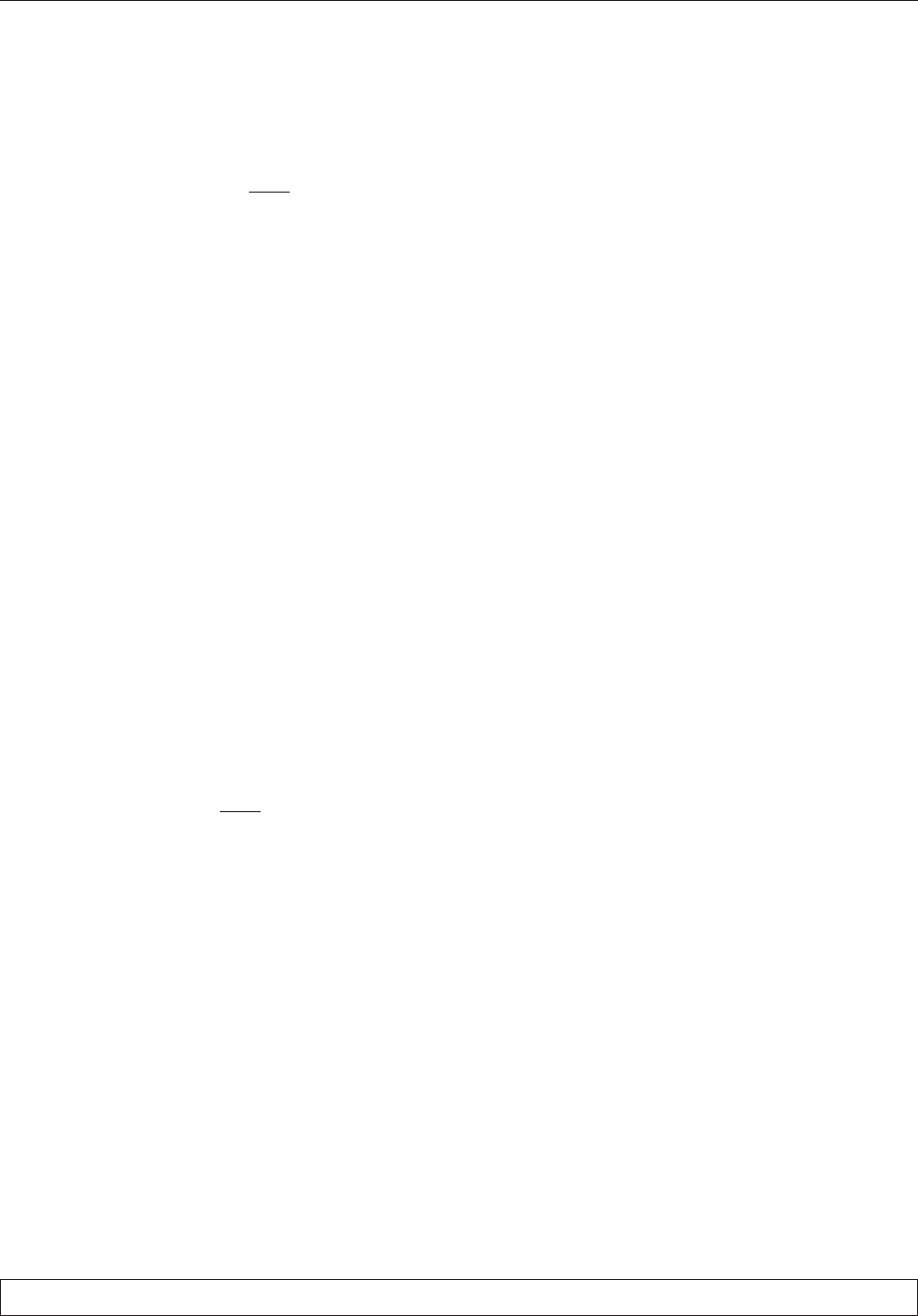
point, which is invariant under the monodromy action
L of [11],etc.)
Letting
0
be the class of a fiber and
1
span
W
2
=W
0
(which is one-dimensional) over the inte-
gers, then T
1
=
1
þ
0
. It follows that
q ¼ exp 2i
R
1
R
0
!
is invariant under monodromy. This is the higher-
dimensional analog of the coordinate exp (2i)on
the moduli space of elliptic curves, where is the
period point. It is this coordinate q that is mirror to
the coordinate
Z
line
!
on the Ka¨ hler moduli space on the mirror quintic,
which allows one to compute the correspondence
between VHS and Gromov–Witten invariants men-
tioned in the introduction.
More generally, following Morrison (1993), one
can make a rigorous definition of an LCLP using
features noted above extended to the case of h
2, 1
> 0
(see, e.g., Cox and Katz (1999). Roughly, the
upshot is that M
ˇ
X
(of dimension s = h
2, 1
(
ˇ
X)) should
be compactified with s divisors (D
i
)
s
i = 1
(parametriz-
ing singular varieties) forming a normal crossings
divisor meeting at the LCLP, with monodromies T
i
about them. There should be a unique (up to
multiples) integral cycle
0
(our torus fiber) invariant
under all T
i
, and cycles (
i
)
s
i = 1
such that
i
¼
R
i
R
0
is logarithmic at D
i
; that is
i
= (1=(2 i)) log (z
i
),
where z
i
is a local parameter for D
i
= {z
i
= 0}.
So, z
i
= exp (2i
i
) form local coordinates for
moduli space, mirror to the polydisk coordinates [2]
on K
C
X
. The direction of approach to the LKLP in that
section corresponds to the holomorphic curve z
k
j
i
= z
k
i
j
[3] we take through the LCLP (z
i
= 0 8i), and the
monodromy
P
N
i
T
i
varies accordingly, but the
corresponding weight filtration W
remains constant
if k
i
6¼ 0 8i, by a theorem of Cattani and Kaplan.
Morrison then requires that the (
i
)
s
i = 0
should
form an integral basis for W
2
= W
3
(with
0
a basis
of W
0
= W
1
). Finally, part definition and part
conjecture, we should be able to make a choice
such that they satisfy the condition log T
i
(
j
) =
ij
0
.
Of course, as has been emphasized, Morrison’s
definition of an LCLP is really where the mathematics
and geometry of mirror symmetry begin, and should
have been the starting point of this article. But that
would have required appreciable knowledge of
abstract VHS that are best understood, in this context,
through the new geometry of Lagrangian torus
fibrations that mirror symmetry has inspired.
See also: AdS/CFT Correspondence; Calibrated
Geometry and Special Lagrangian Submanifolds;
Derived Categories; Fourier–Mukai Transform in String
Theory; Geometric Analysis and General Relativity;
Geometric Flows and the Penrose Inequality; Geometric
Measure Theory; Geometric Phases; Number Theory in
Physics; Riemann Surfaces; Several Complex Variables:
Compact Manifolds; Topological Gravity, Two-
Dimensional; Topological Sigma Models; WDVV
Equations and Frobenius Manifolds.
Further Reading
Candelas P, de la Ossa X, Green P, and Parkes L (1991) A pair of
Calabi–Yau manifolds as an exactly soluble superconformal
theory. Nuclear Physics B 359: 21–74.
Cox D and Katz S (1999) Mirror Symmetry and Algebraic
Geometry. Mathematical Surveys and Monographs, vol. 68.
Providence, RI: American Mathematical Society.
Fukaya K (2005) Multivalued Morse theory, asymptotic analysis
and mirror symmetry. In: Mikhail Lyubich and Leon
Takhtajan (eds.) Proceedings of the conference dedicated to
Dennis Sullivan on his 60th birthday held at Stony Brook
University, Stony Brook, NY, June 14–21, 2001. Proceedings
of Symposia in Pure Mathematics, in Graphs and patterns in
mathematics and theoretical physics, vol. 73, pp. 205–278.
Providence, RI: American Mathematical Society.
Gross M (1998) Special Lagrangian fibrations I: topology. In:
Ueno K, Saito M-H, and Shimizu Y (eds.) Integrable Systems
and Algebraic Geometry (Kobe/Kyoto, 1997), pp. 156–193.
River Edge, NJ: World Scientific Publishing.
Gross M, Huybrechts D, and Joyce D (2003) Universitext. Calabi–
Yau Manifolds and Related Geometries. Berlin: Springer.
Gross M and Siebert B (2003) Mirror symmetry via logarithmic
degeneration data I. Preprint math.AG/0309070.
Hori K, Katz S, Klemm A, Pandharipande R, Thomas R et al.
(2003) Mirror Symmetry. Clay Mathematics Monographs,
vol. 1. Providence, RI: American Mathematical Society;
Cambridge, MA: Clay Mathematics Institute.
Kontsevich M (1995) Homological Algebra of Mirror Symmetry.
International Congress of Mathematicians. Zu¨ rich: Birkha¨user.
Morrison D (1993) Compactifications of moduli spaces inspired
by mirror symmetry. Aste´risque 218: 243–271.
Strominger A, Yau S-T, and Zaslow E (1996) Mirror symmetry is
T-duality. Nuclear Physics B 479: 243–259.
Voisin C (1999) (Translated from the 1996 French original by Roger
Cooke.) SMF/AMS Texts and Monographs, vol. 1. Mirror
Symmetry. Providence, RI: American Mathematical Society.
Modular Tensor Categories see Braided and Modular Tensor Categories
448 Mirror Symmetry: A Geometric Survey

Moduli Spaces: An Introduction
F Kirwan, University of Oxford, Oxford, UK
ª 2006 Elsevier Ltd. All rights reserved.
An earlier version of this article was originally published in
Proceedings of the Workshop on Moduli Spaces, Oxford, 2–3
July 1998, Eds. Kirwan F, Paycha S, Tsou S T (1998). Cairo,
Egypt: Hindawi Publishing Corporation.
The con cept of a moduli space has been used by
mathematicians for nearly 150 years, although it was
not until the 1960s that Mumford (1965) gave precise
definitions of moduli spaces and methods for con-
structing them. The use of the word ‘‘moduli’ ’ in this
context goes back to Riemann in a paper of 1857, in
which he observed that an isomorphism class of
compact Riemann surfaces of genus g ‘‘ha¨ngt ...
von 3g 3 stetig vera¨ nderlichen Gro¨ ssen ab, welche
die Moduln dieser Klasse genannt werden sollen.’’
The idea of moduli as parameters in some sense
measuring or describing the variation of geometric
objects has been of fundamental importance in
geometry ever since.
Moduli spaces arise naturally in classification
problems in geometry, particularly in algebraic
geometry (Mumford 1965, Newstead 1978, Popp
1977, Seshadri 1975, Sundaramanan 1980, Viehweg
1995). Algebraic geometry is, roughly speaking, the
study of solutions of systems of polynomial equa-
tions in many variables; the solutions to such a
system form an algebrai c variety. A simple example
of an algebraic variety is a hypersurface, consisting
of the solutions to a single polynomial equation in
some number of variables. We can try to classify
hypersurfaces by their degree and their dimension;
these are ‘‘discrete invariants’’ for the classification
problem, but of course they do not determine
hypersurfaces completely, even if we regard two
hypersurfaces as equivalent when one is obtained
from the other after making a change of coordinates.
It is typical of classification pro blems in algebraic
geometry (and other areas of geometry) that there
are not enough discrete invariants to classify objects
sufficiently finely, and this is where the concept of a
moduli space arises.
In complex algebraic geometry, discrete invariants
often come from topology. For exampl e, a non-
singular complex curve (i.e., a complex algebraic
variety which is a connected complex manifold of
dimension 1, in other words a Riemann surface)
which is projective (i.e., points have been added at
infinity to make it compact) is topologically just a
sphere with a number of handles attached to it; the
number of handles is called the genus of the curve
and is a discrete invariant. Nonsingular complex
projective curves (or equivalently compact Riemann
surfaces) are not classified completely by their genus
g; they are determined by g when regarded simply as
topological surfaces, but the genus does not deter-
mine their complex structure when g > 0.
A classification problem such as this one (the
classification of nonsingular complex projective
curves up to isomorphism, or, equivalently, compact
Riemann surfaces up to biholomorphism), can be
resolved into two basic steps.
Step 1 is to find as many discrete invariants as possible
(in the case of nonsingular complex projective
curves the only discrete invariant is the genus).
Step 2 is to fix the values of all the discrete invariants
and try to construct a ‘‘moduli space’’; that is, a
complex manifold (or an algebraic variety) whose
points correspond in a natural way to the
equivalence classes of the objects to be classified.
What is meant by ‘‘natural’’ here can be made
precise (as we shall see shortly) given suitable notions
of families of objects parametrized by base spaces and
of equivalence of families. A ‘‘fine moduli space’’ is
then a base space for a universal family of the objects
to be classified (any family is equivalent to the
pullback of the universal family along a unique map
into the moduli space). If no universal family exists
there may still be a ‘‘coarse moduli space’’ satisfying
slightly weaker conditions, which are nonetheless
strong enough to ensure that if a moduli space exists it
will be unique up to canonical isomorphism.
It is often the case that not even a coarse moduli
space will exist. Typically, particularly ‘‘bad’’ objects
must be left out of the classification in order for a
moduli space to exist. For example, a coarse moduli
space of nonsingular complex projective curves exists
(although to have a fine moduli space we must give the
curves some extra structure, such as a level structure),
but if we want to include singular curves (which is
often important so that we can understand how
nonsingular curves can degenerate to singular ones)
we must leave out the so-called ‘‘unstable curves’’ to
get a moduli space. However all nonsingular curves
are stable, so the moduli space of stable curves of genus
g is then a compactification of the moduli space of
nonsingular projective curves of genus g.
Moduli spaces are often constructed and studied as
orbit spaces for group actions (using Mumford’s
geometric invariant theory or more recently ideas due
to Kolla´r (1997) and Keel and Mori (1997);geometric
invariant theoretic quotients can also often be described
Moduli Spaces: An Introduction 449

naturally as symplectic reductions, and it is in this guise
that many moduli spaces in physics appear. Another
technique involves period maps, Torelli theorems and
variations of Hodge structures, initiated by Griffiths
(1984) and others. In the special case of moduli spaces
of compact Riemann surfaces, Teichmu¨ ller theory can
also be used (see e.g., Lehto (1987)).
Remark 1 Recall that a compact Riemann surface
(i.e., a compact complex manifold of complex dimen-
sion 1) can be thought of as a nonsingular complex
projective curve, in the sense that every compact
Riemann surface can be embedded in some
complex projective space
P
n
¼ C
nþ1
f0g=ðmultiplication by nonzero
complex scalars)
as the solution space of a set of homogeneous
polynomial equations. Moreover, two nonsingular
complex projective curves are biholomorphic if and
only if they are algebraically isomorphic. So, there is
a natural identification between the moduli space of
compact Riemann surfaces of genus g up to
biholomorphism and the moduli space of nonsingu-
lar complex projective curves up to isomorphism.
There are other situations where an ‘‘algebraic’’
moduli space can be naturally identified with the
corresponding ‘‘complex analytic’’ moduli space, but
this is not always the case. For example, if we
consider K3 surfaces (compact complex manifolds
of complex dimension 2 with first Betti number and
first Chern class both zero), we find that the moduli
space of all K3 surfaces has complex dimension 20,
whereas the moduli spaces of algebraic K3 surfaces
(which have one more discrete invariant, the degree,
to be fixed) are 19-dimensional.
This problem of algebraic moduli spaces versus
nonalgebraic ones is one reason why the question of
classifying n-folds (i.e., compact complex manifolds –
or, in the algebraic category, nonsingular projective
varieties – of dimension n) becomes much harder
when n > 1 than in the case n = 1 (which is the case of
compact Riemann surfaces or nonsingular projective
curves). Another difficulty is that families of n-folds
can be ‘‘blown up’’ along families of subvarieties to
produce ever more complicated families.
Remark 2 Recall that we blow up a complex
manifold X along a closed complex submanifold Y
by removing the submanifold Y from X and glueing
in the projective normal bundle of Y in its place. We
get a complex manifold
~
X with a holomorphic
surjection :
~
X ! X such that is an isomorphism
over X Y and if y 2 Y then
1
(y) is the complex
projective space associated to the normal space
T
y
X=T
y
Y to Y in X at y.IfX = C
nþ1
and Y = {0}
and we identify P
n
with the set of one-dimensional
linear subspaces of C
nþ1
, then
~
X ¼fðv; wÞ2C
nþ1
P
n
: v 2 wg
with (v, w) = v.
Again this problem does not arise when n = 1,
because blowing up a 1-fold makes no difference unless
the 1-fold has singularities (in which case blowing up
may help to ‘ ‘resolve’ ’ the singularities; for example,
when we blow up the origin {0} in C
2
, then the singular
curve C in C
2
defined by y
2
= x
3
þ x
2
is tranformed
into a nonsingular curve
~
C with the origin in C replaced
by two points, corresponding to the two complex
‘ ‘tangent directions’’ in C at 0).
Thus, the classification of n-folds when n > 1
requires a preliminary step before there is any hope
of carrying out the two steps described above.
Step 0 (the ‘‘minimal model programme’’ of Mori
(1987) and others): Instead of all the objects to be
classified, consider only specially ‘‘good’’ objects,
such that every object is obtained from one of these
specially good objects by a sequence of blow-ups
(or similar carefully prescribed operations).
How to carry out Mori’s minimal model program
is well understood for algebraic surfaces and 3-folds,
but in higher dimensions is incom plete as yet (Kolla´r
and Mori 1998). We shall ignore both step 0 and
step 1 from now on, and concentrate on step 2, the
construction of moduli spaces.
Ingredients of a Moduli Problem
Formally before posing a moduli problem, we need
to fix the category in which we are working; that is,
we need to specify what we mean by ‘‘space’’ and
‘‘map’’ in the description below. If, for example, we
are working in complex analytic geometry then we
might take ‘‘space’’ to mean a complex manifold (or
more generally we might allow singularities) and
take ‘‘map’’ to mean a co mplex analytic map,
whereas in algebraic geometry ‘‘space’’ might mean
an algebraic variety, or a scheme, or even a stack,
with ‘‘map’’ interpreted as a morphism of algebraic
varieties (or schemes, or stacks).
Once this is fixed, the ingredients of a moduli
problem are:
1. a set A of objects to be classified,
2. an equivalence relation on A,
3. the concept of a family of objects in A with base
space S (or parametrized by S), and sometimes
4. the concept of equivalence of families.
450 Moduli Spaces: An Introduction

These ingredients must satisfy:
1. a family parametrized by a single point {p} is just
an object in A (and equivalence of objec ts is
equivalence of families over {p}) an d
2. given a family X parametrized by a space S and a
map :
~
S ! S, there is a family
X parametrized
by
~
S (the ‘‘pullback of X along ’’), with
pullback being functorial and preserving
equivalence.
In particular, for any family X parametrized by S
and any s 2 S, there is an object X
s
given by pulling
back X along the inclusion of {s}inS. We think of
X
s
as the object in the family X whose parameter is
the point s in the base space S.
Example 1 A family of compact Riemann surfaces
parametrized by a complex manifold S is a surjective
holomorphic map
: T ! S
from a complex manifold T of (complex) dimen-
sion dim (T) = dim (S) þ 1toS, such that is
proper (i.e., the inverse image
1
(C)ofany
compact subset C of S under is compact) and
has maximal rank (i.e., its derivative is everywhere
surjective). Then
1
(s) is a compact R iemann
surface for each s 2 S, and is the object in the
family with parameter s.
The family defined by is an algebraic family if
is a morphism of nonsingular complex projective
varieties.
Example 2 A family of nonsingular compl ex
projective varieties parametrize d by a nonsingular
complex variety S is a proper surjective morphism
: T ! S
with T nonsingular and having maximal rank. We
can also allow T and S to be singular, but then we
require an extra technical condition (that must be
flat with reduced fibers).
In the above example, equivalence of families
1
: T
1
! S
1
and
2
: T
2
! S
2
is given by isomorph-
isms f : T
1
! T
2
and g : S
1
! S
2
such that g
1
=
2
f . Equivalence of families in the first example is
similar.
Definition 1 A ‘‘deformation’’ of a nonsingular
projective variety or compact complex manifold M
is given by a family : T ! S together with an
isomorphism
1
ðs
0
ÞffiM
for some s
0
2 S.
Strictly speaking, the deformation is the germ at
s
0
of such a ; that is, the restriction of over any
open neighborhood of s
0
in S determines the same
deformation of M as does.
A study of deform ations leads to information
about the local structure of moduli spaces. Let
: X ! S be a deformation of a compact complex
manifold M =
1
(s
0
) where s
0
2 S. We can cover M
(thought of as a subset of X) with open subsets W
i
of X such that there exist isomorphisms
h
i
: W
i
! U
i
V
i
where V
i
= (W
i
) is open in S and U
i
= M \ W
i
is
open in M =
1
(s
0
) and the projection of h
i
onto V
i
is just : W
i
! V
i
. For each i 6¼ j, we then get a
holomorphic vector field
ij
on U
i
\ U
j
by differ-
entiating h
i
h
1
j
in the direction of any tangent
vector v 2 T
s
0
S. These holomorphic vector fields
define a 1-cocycle in the tangent sheaf of M. This
gives us the ‘‘Kodaira–Spencer map’’
: T
s
0
S ! H
1
ðM; Þ
Theorem 1 (Kuranishi). If M is a compact com-
plex manifold, then it has a deformation : X ! S
with
1
(s
0
) = M such that
(i) the Kodaira–Spencer map
: T
s
0
S ! H
1
(M, )
is an isomorphism,
(ii) has the local universal property for deforma-
tions (i.e., any deformation of M is locally the
pullback of along a map f into S),
(iii) if H
0
(M, ) = 0, then the map f in (ii) is unique,
and
(iv) if H
2
(M, ) = 0, then S is nonsingular at s
0
and
so dim S = dim H
1
(M, ).
This deformation is called the ‘‘Kuranishi
deformation’’ of M (its germ at s
0
is unique up to
isomorphism), and S is called the ‘‘Kuranishi space’’
of M.
Example 3 A family of holomorphic (or algebraic)
vector bundles over a compact Riemann surface (or
nonsingular complex projective curve) is a vector
bundle over S where S is the base space (see e.g.,
Verdier and Le Potier (1985)). A deformation of a
vector bundle E
0
over is then given by a vector
bundle E over a product S together with an
isomorphism
Ej
fs
0
g
ffi E
0
for some s
0
2 S (strictly speaking it is the germ at s
0
of such a family of vector bundles).
Moduli Spaces: An Introduction 451

Fine and Coarse Moduli Spaces
For definiteness, ex cept when it is specified other-
wise, let us consider moduli problems in algebraic
geometry with ‘‘space’’ meaning algebraic variety
(over some fixed field k which is usually C) and
‘‘map’’ meaning morphism of algebraic varieties.
Definition 2 A ‘‘fine moduli space’’ for a given
(algebro-geometric) moduli problem is an algebraic
variety M with a family U parametrize d by M
having the following (universal) property: for every
family X parametrized by a base space S, there exists
a unique map : S ! M such that
X
U
U is then called a ‘‘universal family’’ for the given
moduli problem.
Many moduli problems have no fine moduli
space, but nonetheless there may be a moduli space
satisfying slightly weaker conditions, called a coarse
moduli space. If a fine moduli space does exist, it
will automatically satisfy the conditions to be a
coarse moduli space. Both fine and coarse moduli
spaces, when they exist, are unique up to canonical
isomorphism.
Definition 3 A ‘‘coarse moduli space’’ for a given
moduli problem is an algebraic vari ety M with a
bijection
: A=!M
(where as before A is the set of objects to be
classified up to the equivalence relation ) from the
set A= of equivalence classes in A to M such that:
(i) For every family X with base space S, the
composition of the given bijection : A=!M
with the function
X
: S ! A=
which sends s 2 S to the equivalence class [X
s
]
of the object X
s
with parameter s in the family
X, is a morphism.
(ii) When N is any other variety with : A=!N
such that for each family X parametrized by a
base space S the composition
X
: S ! N is a
morphism, then
1
: M ! N
is a morphism.
Remark 3 For some moduli problems, a family X
with base space S which is connected and of
dimension strictly greater than zero may exist such
that for some s
0
2 S we have
(i) X
s
X
t
for all s, t 2 S {s
0
} and
(ii) X
s
6 X
s
0
for all s 2 S {s
0
}.
This is the ‘‘jump phenomenon,’’ and when it
occurs we cannot construct a moduli space including
the equivalence class of the object X
s
0
. Typically, to
construct a moduli space, some objects (often called
‘‘unstable’’) must be left out because of the jump
phenomenon and we only get a moduli space of
‘‘stable’’ objects. This happens, for example, in the
construction of moduli spaces of complex projective
curves, if we want to include singular curves, or
moduli spaces of vector bundles.
Example 4 The Jacobian J() of a compact Rie-
mann surface is a fine moduli space for holo-
morphic line bundles (i.e., vector bundles of rank 1)
of fixed degree over up to isomorphism. As a
complex manifold
JðÞffiC
g
=
where g is the genus of and is a lattice of maximal
rank in C
g
(in other words J() is a complex torus).
Since J () is also a complex projective variety, it is an
‘ ‘abelian variety.’ ’
More precisely, J() is the quotient of the
complex vector space H
0
(, K
) of dimension g by
the lattice H
1
(, Z) ffi Z
2g
. Here K
is the complex
cotangent bundle of and H
0
(, K
) is the space of
its holomorphic sections, that is, the space of
holomorphic differentials on . If we choose a
basis !
1
, ..., !
g
of holomorphic differentials and a
standard basis
1
, ...,
2g
for H
1
(, Z) such that
i
:
iþg
¼ 1 ¼
iþg
:
i
when 1 i g and all other intersection pairings
i
.
j
are zero, then we can associate to the g 2g
‘‘period matrix’’ P() given by integrating the
holomorphic differentials !
i
around the 1-cycles
j
.
The Jacobian J() can then be ident ified with the
quotient of C
g
by the lattice spanned by the columns
of this period matrix.
We can in fact always choose the basis !
1
, ..., !
g
of holomorphic differentials so that the period
matrix P() is of the form
ðI
g
ZÞ
where I
g
is the g g identity matrix. This period
matrix is called a ‘‘normalized period matrix.’’ The
Riemann bilinear relations tell us that Z is sym-
metric and its imaginary part is positive definite.
452 Moduli Spaces: An Introduction

Example 5 The moduli space A
g
of all abelian
varieties of dimension g was one of the first moduli
spaces to be constructed. We have
A
g
ffiH
g
=Spð2g; ZÞ
where H
g
is Siegel’s upper half space, which consists
of the symmetric g g complex matrices with
positive-definite imagina ry part.
Example 6 One way to construct and study the
moduli space M
g
of compac t Riemann surfaces of
genus g is via the ‘‘Torelli map’’
: M
g
!A
g
given by
7!JðÞ
Torelli’s theorem tells us that is injective (cf.
Griffiths (198 4)). Describing the image of M
g
in A
g
is known as the Schottky problem.
We can calculate the dimension of the moduli
space M
g
using Kuranishi theory as in the previous
section: we get
dim M
g
¼ dim H
1
ð; Þ¼3g 3
for any compact Riemann surface of genus g 2.
In fact, if M is any compact complex manifold and
there exists a fine moduli space of complex mani-
folds diffeomorphic to M, then the moduli space is
locally isomorphic near [M] to the Kuranishi space
near s
0
. More often, there is only a coarse moduli
space (as in the case of M
g
), and then the moduli
space is locally isomorphic near [M] to the quotient
of the Kuranishi space by the action of the group of
automorphisms of M.
For the Teichmu¨ ller approach to M
g
(cf. Lehto
(1987)), we consider the space of all pairs consisting
of a compact Riemann surface of genus g and a basis
1
, ...,
2g
for H
1
(, Z) as abov e such that
i
:
iþg
¼ 1 ¼
iþg
:
i
if 1 i g and all other intersectio n pairings
i
.
j
are zero. If g 2, this space (called Teichmu¨ ller
space) is naturally homeom orphic to an open ball in
C
3g3
(by a theorem of Bers). The mapping class
group
g
(which consists of the diffeomorphisms of
the surface modulo isotopy) acts discretely on
Teichmu¨ ller space, and the quotient can be identi-
fied with the moduli space M
g
. This gives us a
description of M
g
as a complex analytic space, but
not as an algebraic variety.
To construct the moduli space M
g
as an algebraic
variety, we can use the fact that every compact
Riemann surface of genus g can be embedded
canonically as a curve of degree 6(g 1) in a
projective space of dimension 5g 6. The use of
the word ‘‘canonical’’ here is a rather poor pun; it
refers both to the canonical line bundle (or
cotangent bundle) of the Riemann surface, although
here ‘‘tricanonical’’ would be more accurate, and
also to the fact that no choices are involved, except
that a choice of basis is needed to identify the
projective space with the standard one P
5g6
. This
enables us to identify M
g
with the quotient of an
algebraic variety by the group PGL(n þ 1; C). How-
ever, here we do not have a discrete group action,
and to construct the quotient we must use Mum-
ford’s geometric invariant theory (see below), which
was developed in the 1960s in order to provide
algebraic constructions of this moduli space and
others.
In fact, geometric invariant theory also provides a
beautiful compactification of M
g
known as the
Deligne–Mumford (1969) compactification
M
g
.
This compactification is itself a moduli space: it is
the moduli space of (Deligne–Mumford) stable
curves, which are complex projective curves with
only nodal singularities and at most finitely many
automorphisms.
M
g
is singular but in a relatively
mild way; it is the quotient of a nonsingular variety
by a finite group action.
The moduli space M
g, n
of nonsingul ar complex
projective curves of genus g with n marked points
has a similar compactification
M
g, n
which is the
moduli space of complex projective curves with n
marked nonsingul ar points and with only nodal
singularities and finitely many automorphisms.
Finiteness of the automorphism group of such a
curve is equivalent to the requirement that any
irreducible component of genus 0 (respectively 1)
has at least 3 (respectively 1) special points, where
‘‘special’’ means either marked or singular in .
The construction of M
g
using the period matrices
of curves and the Torelli theorem leads to a different
compactification
~
M
g
of M
g
known as the Satake
(or Satake–Baily–Borel) compactification. Like the
Deligne–Mumford compactification,
~
M
g
is a com-
plex projective variety, but the boundary of M
g
in
~
M
g
has (complex) codimension 2 for g 3 whereas
the bounda ry of M
g
in
M
g
has codimension 1.
Each of the irreducible components
0
, ...,
[g=2]
of
is the closure of a locus of curves with exact ly one
node (irreducible curves with one node in the case of
0
, and in the case of any other
i
the union of two
nonsingular curves of genus i and g i meeting at a
single point). The divisors
i
meet transversely in
M
g
, and their intersections define a natural decom-
position of into connected strata which parame-
trize stable curves of a fixed topological type.
Moduli Spaces: An Introduction 453

For a recent guide to many different aspects of the
moduli spaces M
g
, see Harris and Morrison (1998).
Example 7 Given any nonsingular complex pro-
jective variety X, we can study the moduli spaces of
maps from curves to X considered by Kont sevich.
Intersection theory on these moduli spaces leads to
Gromov–Witten theory and the quantum cohomol-
ogy of X , with many applications, for example, to
enumerative geometry (cf. Cox and Katz (1999),
Fulton and Pandharipande (1997), Dijkgraaf et al.
(1995)).
More precisely, if 2g 2 þ n > 0 then for any
2 H
2
(X; Z) there is a moduli space M
g, n
(X, )of
n-pointed nonsingular complex projective curves
of genus g equipped with maps f : ! X sat isfying
f
[] = . This moduli space has a compactification
M
g, n
(X, ) which classifies ‘‘stable maps’’ of type
from n-pointed curves of genus g into X (Fulton
and Pandharipande 1997). Here, a map f : ! X
from an n-pointed complex projective curve
satisfying f
[] = is called stable if has only
nodal singularities and f : ! X has only finitely
many automorphisms, or equivalently every irre-
ducible component of of genus 0 (respectively
genus 1) which is mapped to a single point in X by
f contains at least three (respectively 1) special
points. The forgetful map from M
g, n
(X, )toM
g, n
which sends [, p
1
,...,p
n
,f : !X]to[, p
1
,...,p
n
]
extends to a forgetful map :
M
g,n
(X,) !
M
g,n
which collapses components of with genus 0 and
at most two special points.
Of course, when X is itself a single point,
M
g, n
(X, )and
M
g, n
(X, ) are simply the moduli
spaces M
g, n
and
M
g, n
. In general
M
g, n
(X, )has
more serious singularities than
M
g, n
and may indeed
have many different irreducible components with
different dimensions. In spite of this,
M
g, n
(X, )has
a ‘‘virtual fundamental class’’ [
M
g, n
(X, )]
vir
lying in
the expected dimension
3g 3 þ n þð1 gÞdim X þ
Z
c
1
ðTXÞ
of
M
g, n
(X, ). Gromov–Witten invariants (origin-
ally developed mainly in the case g = 0 when
M
g, n
(X, ) is more tractable, but now also studied
when g > 0) are obtained by evaluating cohomology
classes on
M
g, n
(X, ) against this virtual funda-
mental class.
Moduli Spaces as Orbit Spaces
Example 8 As a simple example, let us consider the
moduli space of ‘‘hyperelliptic’’ curves of genus g.
By a hyperelliptic curve of genus g, we mean a
nonsingular complex projective curve C with a
double cover f : C ! P
1
branched ov er 2g þ 2 points
in the complex projective line P
1
.
Let S be the set of unordered sequences of 2g þ 2
distinct points in P
1
, which we can identify with an
open subset of the complex projective space P
2gþ2
by
associating to an unordered sequence a
1
, ..., a
2gþ2
of
points in P
1
the coefficients of the polynomial whose
roots are a
1
, ..., a
2gþ2
. Then, it is not hard to
construct a family X of hyperelliptic curves of genus
g with base space S such that the curve parametrized
by a
1
, ..., a
2gþ2
is a double cover of P
1
branched
over a
1
, ..., a
2gþ2
. This family is not quite a universal
family, but it does have the following two properties.
(i) The hyperelliptic curves X
s
and X
t
parametrized
by elements s and t of the base space S are
isomorphic if and only if s and t lie in the same
orbit of the natural action of G = SL(2; C)onS.
(ii) (Local universal property) Any family of hyper-
elliptic curves of genus g is locally equivalent to
the pullback of X along a morphism to S.
These properties (i) and (ii) imply that a (coarse)
moduli space M exists if and only if there is an
‘‘orbit space’’ for the action of G on S (Newstead
1978). Here, by an orbit space we mean a
G-invariant morphism : S ! M such that every
other G-invariant morphism : S ! M factors
uniquely through , and moreover
1
(m) is a single
G-orbit for each m 2 M. (We can think of an orbit
space as the set of G-orbits endowed in a natural
way with the structure of an algebraic variety.)
This sort of situation arises quite often in moduli
problems, and the construction of a moduli space is
then reduced to the construction of an orbit space.
Unfortunately, such orbit spaces do not in general
exist. The main problem (which is closely related to
the jump phenomenon discussed above) is that there
may be orbits contained in the closures of other
orbits, which means that the natural topology on the
set of all orbits is not Hausdorff, so this set cannot
be endowed naturally with the structure of a variety.
This is the situation the geometric invariant theory
of Mumford (1965) attempts to deal with, telling us
how to throw out certain ‘‘unstable’’ orbits in order
to be able to construct an orbit space. For more
general constructions of orbit spaces which can be
used for moduli problems where geometric invariant
theory may not be of use, see Keel and Mori (1997)
and Kolla´r (1997).
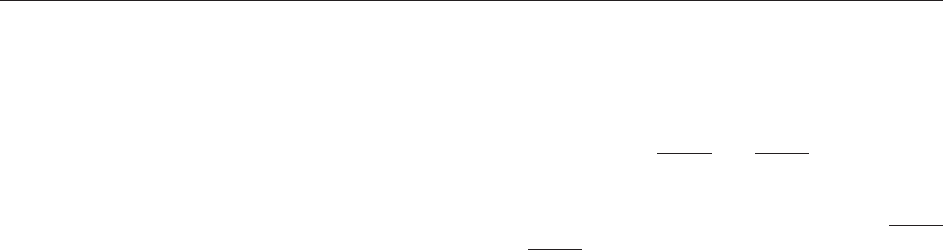
Example 9 Let G = SL(2; C) act on (P
1
)
4
via
Mo¨ bius transformations on the Riemann sphere
P
1
¼ C [ f1g
454 Moduli Spaces: An Introduction
Then,
fðx
1
; x
2
; x
3
; x
4
Þ2ðP
1
Þ
4
: x
1
¼ x
2
¼ x
3
¼ x
4
g
is a single orbit which is contained in the closure of
every other orbit. On the other hand, the open subset
fðx
1
; x
2
; x
3
; x
4
Þ2ðP
1
Þ
4
: x
1
; x
2
; x
3
; x
4
distinctg
of (P
1
)
4
has an orbit space which can be identified
with
P
1
f0; 1; 1g
via the cross ratio.
In order to describe Mumford’s geometric invar-
iant theory, let X be a complex projective variety
(i.e., a subset of a complex projective space defined
by the vanishing of homogeneous polynomial
equations), and let G be a complex reductive group
acting on X. We a lso require a ‘‘linearization’’ of the
action; that is, an ample line bundle L on X and a
lift of the action of G to L. We lose very little
generality in assuming that for some projective
embedding X P
n
the action of G on X extends
to an action on P
n
given by a representation
: G ! GLðn þ 1Þ
and taking for L the hyperplane line bundle on P
n
.
Algebraic geometry associates to X P
n
its homo-
geneous coordinate ring
AðXÞ¼
M
k0
H
0
ðX; L
k
Þ¼C½x
0
; ...; x
n
=I
X
which is the quotient of the polynomial ring
C[x
0
, ..., x
n
]inn þ 1 variables by the ideal I
X
generated by the homogeneous polynomials vanish-
ing on X. Since the action of G on X is given by a
representation : G ! GL(n þ 1), we get an induced
action of G on C[x
0
, ..., x
n
] and on A(X), and we
can therefore consider the subring A(X)
G
of A(X)
consisting of the elements of A(X) left invariant by
G. This subring A( X)
G
is a graded complex algebra,
and because G is reductive it is finitely generated
(Mumford 1965). To any finitely generated graded
complex algebra we can associate a complex
projective variety, and so we can define X== G to
be the variety associated to the ring of invariants
A(X)
G
. The inclusion of A(X)
G
in A( X) defines a
‘‘rational’’ map from X to X== G, but because
there may be points of X P
n
where every
G-invariant polynomial vanishes, this map will not
in general be well defined everywhere on X (i.e., it
will not be a morphism).
We define the set X
ss
of ‘‘semistable’’ points in X
to be the set of those x 2 X for which there exists
some f 2 A(X)
G
not vanishing at x. Then, the
rational map restricts to a surjective G-invariant
morphism from the open subset X
ss
of X to the
quotient variety X== G. However, : X
ss
! X== G is
still not in general an orbit space: when x and y are
semistable points of X, we have (x) = (y) if and
only if the closures
O
G
(x) and O
G
(y) of the G-orbits
of x and y meet in X
ss
. Topologically, X== G is the
quotient of X
ss
by the equivalence relation for which
x and y in X
ss
are equivalent if and only if O
G
(x)
and
O
G
(y) meet in X
ss
.
We define a ‘‘stable’’ point of X to be a point x of
X
ss
with a neighbourhood in X
ss
such that every
G-orbit meeting this neighborhood is closed in X
ss
,
and is of maximal dimension equal to the dimension
of G.IfU is any G-invariant open subset of the set
X
s
of stable points of X,then(U) is an open subset
of X== G and the restriction j
U
: U ! (U)of to U
is an orbit space for the action of G on U in the sense
described above, so that it makes sense to write U=G
for (U). In particular, there is an orbit space X
s
=G
for the action of G on X
s
,andX== G can be thought
of as a compactification of this orbit space.
X
s
X
ss
X
open open
##
X
s
=G
X
ss
= ¼X== G
open
Example 10 Let us return to hyperelliptic curves
of genus g. We have s een that the construction of a
moduli space reduces to the construction of an
orbit space for the action of G = SL(2; C)onan
open subset S of P
2gþ2
. If we identify P
2gþ2
with the
space of unordered sequences of 2g þ 2 points in
P
1
,thenS is the subset consisting of unordered
sequences of distinct points. When the action of G
on P
2gþ2
is linearized in the obvious way, then an
unordered sequence of 2g þ 2 points in P
1
is
semistable if and only if at most g þ 1 of the points
coincide anywhere on P
1
, and is stable if and only
if at most g of the points coincide anywhere on P
1
(cf. Kirwan (1985), chapter 16). Thus, S is an open
subset of P
s
2gþ2
,soanorbitspaceS=G exists with
compactification the projective variety P
2gþ2
== G.
This orbit space is then the moduli space of
hyperelliptic curves of genus g.
Other moduli spaces (such as moduli spaces of
curves and of vector bundl es; see e.g., Donaldson
(1984), Gieseker (1983), Mumford (1965, 1977),
and Newstead (1978)) can be constructed as orbit
spaces via geometric invariant theory in a similar
way.
Moduli Spaces: An Introduction 455

Symplectic Reduction and Moduli Spaces
of Vector Bundles
Geometric invariant theoretic quotients are clos ely
related to the process of reduction in symplectic
geometry, and thus many moduli spaces can be
described as symplectic reductions.
Suppose that a compact, connected Lie group K
with Lie algebra k acts smoothly on a symplectic
manifold X and preserves the symplectic form !. Let
us denote the vector field on X defined by the
infinitesimal action of a 2 k by
x 7!a
x
By a moment map for the action of K on X we mean
a smooth map
: X ! k
which satisfies
dðxÞðÞ:a ¼ !
x
ð; a
x
Þ
for all x 2 X , 2 T
x
X and a 2 k. In other words, if
a
: X ! R denotes the component of along a 2 k
defined for all x 2 X by the pairing
a
ðxÞ¼ðxÞ:a
between ( x) 2 k
and a 2 k,then
a
is a Hamiltonian
function for the vector field on X induced by a.We
shall assume that all our moment maps are equivariant
moment maps; that is, : X ! k
is K-equivariant
with respect to the given action of K on X and the
co-adjoint action of K on k
.
It follows directly from the definition of a
moment map : X ! k
that if the stabilizer K
of
any 2 k
acts freely on
1
(), then
1
()isa
submanifold of X and the symplectic form ! induces
a symplectic structure on the quotient
1
()=K
.
With this symplectic structure, the quotient
1
()=K
is called the Marsden–Weinstein reduc-
tion, or symplectic quotient, at of the action of K
on X. We can also consider the quotient
1
()=K
when the action of K
on
1
() is not free, but in
this case it is likely to have singularities.
Example 11 Consider the cotangent bundle T
Y of
any n-dimensional manifold Y with its canonical
symplectic form ! which is given by the standard
symplectic form
! ¼
X
n
j¼1
dp
j
^ dq
j
½1
with respect to any local coordinates (q
1
, ..., q
n
)on
Y and the induce d coordinates (p
1
, ..., p
n
) on its
cotangent spaces. If Y is the configuration space of a
classical mechanical system, then T
Y is the phase
space of the system and the coordinates p =
(p
1
, ..., p
n
) 2 T
q
Y are traditionally called the
momenta of the system.
If Y is acted on by a Lie group K , the induced
action on T
Y preserves ! and there is a moment
map : T
Y ! k
whose components
a
along a 2
k are given by pairing the moment coordinates p
with the vector fields on X induced by the
infinitesimal action of K; that is,
a
ðp; qÞ¼p:a
q
for all q 2 Y and p 2 T
q
Y. When K = SO(3) acts by
rotations on Y = R
3
, then is the angular momen-
tum, or moment of momentum, abou t the origin.
The connection with geometric invariant theory
arises as follows. Let X be a nonsingular complex
projective variety embedded in complex projective
space P
n
, and let G be a complex Lie group acting
on X via a complex linear representation : G !
GL(n þ 1; C). A necessary and sufficient condition
for G to be reductive is that it is the complex-
ification of a maximal compact subgroup K (e.g.,
G = GL(m; C) is the complexification of the unitary
group U(m)). By an appropriate choice of coordi-
nates on P
n
, we may assume that maps K into the
unitary group U(n þ 1). Then, the action of K
preserves the Fubini–Study form ! on P
n
, which
restricts to a symplectic form on X. There is a
moment map : X ! k
defined (up to multiplica-
tion by a constant scalar factor depending on
differences in convention on the normalization of
the Fubini–Study form) by
ðxÞ:a ¼
^
x
t
ðaÞ
^
x
2ijj
^
xjj
2
½2
for all a 2 k, where
^
x 2 C
nþ1
{0} is a representa-
tive vector for x 2 P
n
and the representation : K !
U(n þ 1) induces
: k ! u (n þ 1) and dually
: u(n þ 1)
! k
.
In this situation, we have two possible quotient
constructions, givin g us the geometric invariant
theory quotient X== G if we want to work in
algebraic geometry and the symplectic reduction
1
(0)=K if we want to work in symplectic geome-
try. In fact, these give us the same quotient space, at
least up to homeomorphism (and diffeomorphism
away from the singularities). More precisely, any
x 2 X is semistable if and only if the closure of its
G-orbit meets
1
(0), and the inclusion of
1
(0)
into X
ss
induces a homeomorphism
1
ð0Þ=K ! X== G
There are other quotient constructions closely related
to symplectic reduction and geometric invariant
456 Moduli Spaces: An Introduction